Showing posts with label Air. Show all posts

Saturday, December 21, 2019

Back Issue Bin 125 "Exit Stage Left, Havok & Wolverine: Meltdown, and other comics"

A clerk walked up to me and whispered into my ear, "You know, they're five for a dollar at the moment," and that's why I got a bunch of old comics recently.

Air #1 (Vertigo)
from October 2008

I still fondly remember getting into G. Willow Wilson's Air.  My interest at first was tentative, but then it became one of my favorite comics.  I still think it's Wilson's best comics work, which she doesn't seem to have been in too much of a rush to replicate, even after finding popular success years later with Ms. Marvel.  I've never added it to my graphic novel collection, though, so revisiting it was a long time coming, so it was great to find the first issue itself.  And I still enjoyed it.

Azrael #40 (DC)
from April 1998

I always find it funny to be reminded of comics I decided not to read, and there were some in the '90s that in retrospect really leave me scratching my head.  Even if I had no interest in Azrael itself, it's still strange to think there were rematches between the one-time Batman and Bane that didn't feel important enough to catch. About seven years back I read other encounters in the series between them (and maybe even this one?), so it was fun to do it again.  That the series lasted a hundred issues seems incomprehensible today, whether or not I was reading it myself.  But then, companies back then didn't have as itchy a trigger finger as they do now, constantly rebooting the big ones much less being patient with the smaller ones.  You can see how Azrael's lack of appearances in recent years would bode for any new attempt at a solo book.  The best of this issue is being reminded how long the original depiction of Bane managed to stick around, before subsequent generations screwed him up (well after the clownish version in Batman & Robin).  Thank goodness Christopher Nolan and Tom King came around!  This is a legitimately great character, with even greater potential still possible, which seems even more unlikely for a villain seemingly created just to provoke one of those endless '90s crises.

Batman and the Signal #3 (DC)
from June 2018

Duke Thomas was at one time pegged to be the next Robin, at least as far as fans expected, but eventually he assumed his own heroic identity, the Signal (Scott Snyder can be remarkably insular in his imaginative thought).  This was his first spotlight with the new handle.  Cully Hamner seems somehow less assured than usual on art, which was kind of strange.

DC Sampler (um, DC?)
from 1983

Ha!  A few years before Crisis on Infinite Earths, DC seemed pretty assured of its comics line.  This was a freebie they sent out with creative teams giving a small taste of what to expect from most of the titles at the time.  For flimsy reasons, it omits some pretty significant titles: Justice League of America, Green Lantern, and Camelot 3000 (one of the projects the company used to heavily promote alongside Watchmen, Dark Knight Returns, and the slightly less forgotten Ronin).

Exit Stage Left: The Snagglepuss Chronicles #5 (DC)
from July 2018

I've been talking about Mark Russell quite a bit here lately, and with good reason: He's struck me as one of the most significant creators to emerge in recent years, and in recent years, he's finally started cementing his reputation.  And for intents and purposes, that reputation begins with Exit Stage Left.

Using as its central conflict the familiar McCarthy Red Scare witch trials of the '50s, Russell reimagines a familiar Hanna-Barbera cartoon property as an allegory for the struggles of the LBGTQ community to find mainstream acceptance.  It was immediately picked up on by observers that Russell had struck upon a compelling concept.  I never had a chance to read it myself, having fallen into a black hole of sporadic comics reading at the time, and the later collection has been impossible to find in places other than the interwebs.  Now I think I may have to finally go that route, because more than Prez, more than Flintstones, it seems Exit Stage Left pushes Russell beyond the concept of social commentary into truly great writing, and finds him at his very best, just as the reports have had it.

The Red Scare is always going to be a fascinating concept in and of itself, what it was, what it provoked, and the general response to it, whether or not we learned anything from it, or might still have a chance to.  Clearly Russell believes it still has things to teach us, and as far as I'm concerned, he was absolutely right.  What emerges is at least the perception of an effect on society similar to the Nazis in Germany, which is an interpretation that history normally flattens into "naming names," something that seemingly only affected Hollywood.  DC itself has used the trials to explain what happened to the Justice Society after WWII, which the same flat interpretation.

Bottom line is, Russell created something that far exceeded a simple Hanna-Barbera nostalgia comic, into something that's valuable in a truly transcendent manner.  It should be a lot easier to find.

Havok & Wolverine: Meltdown #1 (Marvel)
from 1988

What I really like discovering are comics I didn't even know existed but turn out to be far more interesting than such a fate suggests.  This is obviously one of those.

From the husband-and-wife writing team of Walt and Louise Simonson (the latter of which I'd really only previously seen in the pages of Superman: The Man of Steel) and featuring art from Jon J. Muth (whom I'd previously seen in Grant Morrison's Mystery Play), this seems like another of Marvel's inexplicably lost evergreens.  The biggest difference between Marvel and DC that I've seen is that where DC actively celebrates its best stories, Marvel is most content basking in its great legacy.  Even the X-Men have gradually lost their once-celebrated memory for their '80s heyday. 

And this is part of it, perhaps the best part of it.  Wolverine, the poster child for breakout '80s X-Men success, and Havok (you know, Cyclops' brother).  (Oh, wait, you probably don't.  Because Havok has a tiny legacy.)

The Simonsons spend part of the story recounting the then-recent Chernobyl disaster (as recently depicted in a much-celebrated TV mini-series, called Chernobyl).  That was itself fun to read, real history unfolding in the pages of a comic that subsequently has great historic value.

Of course, Muth's art is spectacular in and of itself.  I have no idea, without researching, why Muth didn't make a much bigger name for himself, but it's not for lack of breathtaking talent.

Of course, at its heart Meltdown is a buddy adventure, and Wolverine & Havok play well off each other, in a story that's far removed from typical superhero comics material.

Marvel obviously knew it was a worthwhile project at some point: it was published in the prestige format.  It would be nice for Marvel to remember at some point, so fans can, too.  But thanks to whatever idiot gave up a treasure like this so I could discover it.

Justice League United #16 (DC)
from February 2016

I got this as much to see where the series had gone as astonishment that it had actually lasted that long, because it melted pretty much into oblivion, and I was just interested to see an issue from that late in the game (really only a few months before Rebirth).

JSA Classified #25 (DC)
from June 2007

I loved that DC expanded its Legends of the Dark Knight concept for a number of titles, between this, the JLA (Classified) and Batman and Superman (both Confidential), giving the company some anthology platforms.  This issue has the spotlight on the original Green Lantern, Alan Scott.

Legends of the DC Universe #9 (DC)
from October 1998

This is another '90s series I'm surprised I mostly skipped completely over, and of course it's a precursor to what I was just talking about, with this issue revisiting the classic team-up of Green Lantern (in this instance, Hal Jordan) and Green Arrow, with a tale of how they first met.

Legion of Super-Heroes #88 (DC)
from January 1997

I'm really sure I didn't read this issue when it was originally published, even though 2019 Tony thought it was an immediate necessity, as it features Impulse on the cover, and obviously a guest appearance by him inside, which 1997 should have been far more interested in, as I was a big fan of Bart Allen, and have since begun considering Mark Waid's Impulse perhaps a better overall experience than his Flash, which was itself one of my favorite '90s comics.  And I was happy to discover, even at the late date of 2019, that Impulse still amuses me.  This was a great spotlight for the character.

Marvel Boy: The Plutonian #1 (Marvel)
from March 2010

I thought this was another great discovery.  And I mean, it's interesting, but...Not as much as Havok & Wolverine.  I demand a Havok & Wolverine movie.  Or TV mini-series!  Starring Jared Harris!  As, I don't know, Wolverine!

Millennium #2, 3, 4, 6 & 8 (DC)
from 1987

Yey gods...I had never read Millennium, one of the event comics DC did after the great success of Crisis on Infinite Earths, but was pretty familiar with the concept, the Manhunters story where various characters were revealed to be infiltrators of the nefarious robot predecessors to the Guardians' Green Lantern Corps.  Now I wish I still had never read Millennium, because it's...dreck.  A totally botched event comic.  By the end, it feels like one of DC's perennial excuses to try and introduce a new generation of superheroes.  And absolutely none of them made it past Millennium itself.  At least as far as I can tell.  I had never heard of any of them until I saw their would-be spectacular debuts in the final issue.  And even I, who pride myself in being able to see great potential where others usually can't, couldn't imagine rehabilitating.  Any of them...

Mister X #1 (Vortex)
from June 1984

Mister X: Razed #4 (Dark Horse)
from May 2015

I had a great affinity for Dean Motter's Mister X.  I didn't discover it in that first issue from 1984, but rather years later, in a reprint collection, when interest was just beginning to surface again, leading to the Dark Horse revivals.  I got into Dean Motter comics, including finally reading Terminal City, which Motter had done for DC, and became a pretty big fan.  But Mister X itself is a somewhat peculiar beast.  The whole concept is almost only a concept, in which a character who's never really anything but a background character in his own comic exists mostly for a backstory, in a comic that looks spectacularly designed, regardless of who's drawing it (the original wasn't even written or drawn by Motter).  Yet strangely, I remain attached to it, even as I grow detached from my original excitement.  Seems almost like a secret handshake for true comics aficionados.  One I'm proud to be a part of.

Primal Force #12 (DC)
from October 1995

DC made the curious decision to publish a lot of titles that would've fit nicely with the original Vertigo conceit (an offbeat look at superheroes) under the regular DC label, and I think a lot of great material got buried as a result.  It only occurred to me that Primal Force is a part of that strange distinction upon this latest revisiting.  I didn't read this one at the time, either, of course, but I discovered and devoured it years later, and am always happy to be reminded of it.  I wish more fans understood what it accomplished, too, so that DC could add it to the trade collections always in-print.

The Sandman #4 (DC) 
from September 1975

As you can see from its publication stamp above, not the Neil Gaiman comic!  (Which of course I didn't read in the '90s!)  This is the earlier one, which at least as of this issue featured Jack Kirby art!  And exclamation points!  After!  Every!  Utterance!  Interestingly, features an add for a DC line expansion that includes Warlord (who endures in random appearances to this day) and Claw (who resurfaced in Primal Force and...doesn't endure to this day).

Seaguy#2 (Vertigo)
from August 2004

A lie!  A vicious lie!  Some jerk slipped this cover onto an issue of Fables.  I didn't discover this until I had already brought it home.  Some customers would probably bring it back and demand satisfaction.  I am not one of those costumers.  Makes for a better write-up here, anyway.

Starman #30 (DC)
from May 1997

Of course I didn't read Starman in the '90s.  What were you thinking, even wondering?  But I like to revisit it every now and then. 

Titans #30 (DC)
from August 2001

Hard to think of any date immediately preceding 9/11 without thinking of 9/11 (even though, as time stamps in comics go, this was actually released probably in June 2001, well ahead of that day).  Anyway, as Roy Harper comics go, at this point he was pretty much exclusively associated with Cheshire, the Elektra to his Daredevil, and this tale actually pivots more accurately on Cheshire herself, as she awaits the verdict for a trial concerning her villainous ways.  And then Roy Harper dies in Heroes in Crisis, and all anyone can fixate on is what Tom King did to poor Wally West.  What about Roy, fans.  What about Roy?

Monday, December 15, 2014

Quarter Bin #64 "Binge-worthy IX: An Indulgence"

Air #8 (Vertigo)
via Vertigo Comics
From 2009.

Air is the genius series that first introduced me to G. Willow Wilson, who has staged a remarkable comeback with Ms. Marvel.  You see, even though I love Air, there wasn't much of that going on during its original publication.  I named it twice to the top of my annual QB50 list.  I passed on scooping up this random issue a couple of times before finally deciding to buy it.  And once again I was reminded why I love Air so much.  Blythe has just experienced mystery lover Zayn's life firsthand, but there's very little time to reflect on that, because piloting the hyperprax method takes great concentration.  Did I mention Amelia Earhart was involved?  The whole experience was like following pirates of the imagination whose goal was to try and invent the future.  Hopefully Wilson's current success will help readers rediscover her masterpiece.

Detective Comics #648 (DC)
via Comic Vine
From 1992.

I picked this one up in part because of that gorgeous Matt Wagner cover, and also to hopefully catch a little of that early Tim Drake era, after he'd become the new Robin and before the whole Bane business threw everything into chaos.  I ended up gifted with an early Spoiler appearance.  Stephanie Brown's journey to becoming a permanent institution in the Batman mythos has been incredibly complicated.  At one point she succeeded Tim as Robin, was unceremoniously killed off, revived, and apparently rejected from the New 52 landscape until she showed up in the pages of Batman Eternal.  She's also been Batgirl, by the way.  But Spoiler is iconic all on her own, thank you very much.

Daredevil #323 (Marvel)
via Comic Vine
From 1993.

The only reason for me to have gotten this one, as it turned out, was because of the Scott McDaniel art.  Yeah, that cover promises Venom, and Venom was pretty big business for a while, but that's no reason to read this.  The Daredevil costume inside the issue is one of those variants Marvel tried in the '90s, including a return to his original look, but that simple red one is really all you need.  I had my first experience with McDaniel in the pages of Nightwing, which in a lot of ways might have been deemed in that first incarnation as a kind of DC version of Daredevil, complete with Blockbuster reinvented as a Kingpin figure with a similar singular focus on ruining the life of a pesky vigilante that went on to epic proportions (and under two creators: Chuck Dixon and Devin K. Grayson).  So to finally see McDaniel in the pages of Daredevil itself was worth the trouble of ignoring everything else about the issue.  And as it turns out, his work certainly evolved over the years.  I mean, I guess it figures.  But it's interesting to see it when it was less distinctive, though certainly recognizable.  I still can't believe that McDaniel has apparently angered the comic book gods and now can't get a regular penciling gig.  It boggles the mind.  He's got insane talent.

Elongated Man #1 (DC)
From 1992.

via Pinterest
After Identity Crisis, Ralph and Sue Dibney took on iconic proportions, for reasons most comic book characters probably wouldn't want to have associated with them even if it meant immortality.  Elongated Man is a peculiar relic of the Silver Age, a costumed detective who along with Plastic Man and Mr. Fantastic is best defined for an admittedly wacky superpower.  Being married always gave him special distinction.  This mini-series, spinning out of the infamous Giffen/DeMatteis Justice League era, is quite shocking for post-Identity Crisis readers, actually.  This debut issue sees the Dibneys in considerable discord.  The art is from the late Mike Parobeck, who would later achieve his greatest recognition in the pages of the comics spinning out of The Batman Adventures TV series.  I first saw his work in the pages of an attempted Justice Society relaunch from around the same time, and I always liked it.  Another crying shame in comic book creators taken too soon.  At this point he's been dead nearly twenty years!

Global Frequency #12 (WildStorm)
From 2004.

via Full-Page Bleed
Warren Ellis is the acknowledged master of the big concept in comics, the writer Jonathan Hickman and Rick Remender have been chasing and what Grant Morrison would look like if he weren't the personification of caffeine in the medium.  Maybe it's because his reign in that regard began while I wasn't reading them, but I always found it difficult to get into him.  Every now and then I'll check in with what he's done, and if I'm honest about it I'll admit I've never been disappointed.  Global Frequency is another such instance.  This is the conclusion of the story, with various characters converging in a sequence that in a movie would definitely have left my heart pounding as they try to disable a fail-safe weapon the United States military put in place years ago.

Grendel: War Child #1 (Dark Horse)
via Comic Vine
From 1992.

This is also technically Grendel #41.  Grendel, along with Mage, is the defining work of Matt Wagner's insufficiently-heralded career.  Wagner is one of the kings of the indy scene, a pioneer who helped pave the ground for Image (where Mage unfolded at one point), but now can't seem to get work unless it's related to some licensed property or another, which in itself is not a bad thing, but for a guy who's already struck gold twice on his own, it kind of comes off as a slap on the face.  Anyway, this issue is brilliant, explains the whole concept perfectly (instantly makes me want to read more), and somehow the issue is still stolen by an account of Grendel's recent print history at that time, being tied up in legal hell after Comico went out of business until Dark Horse finally came to the rescue and the issue you've just read has been made possible.  Anyway, Wagner is currently doing Grendel vs. The Shadow...

Justice League Europe #7 (DC)
From 1989.

via comiXology
Here's the Giffen/DeMatteis era in full bloom, two series strong and crossing over for the first time.  After Jurgens did his version and then later incarnations diluted the potential of having a non-all-stars version of the Justice League and we (happily) got Grant Morrison's JLA, it began to seem as if the whole run had been repudiated, but then the reunions began (and now we have Justice League 3000, which I've finally read for the first time).  It might be sometimes hard to remember that not only was Batman present in these comics, but he was definitely the Batman you are probably thinking about, not Adam West and definitely the Dark Knight.  Other than the "One punch!" moment with Guy Gardner, yeah, he was still around.  And in this issue, doing his level best to counteract...everyone else.  For me, it's inconceivable to even try to pretend these comics didn't happen.  The line-up is classic in the same way the New Teen Titans were, and the many times Booster Gold and Blue Beetle have popped up together prove all over again that it's not all just "Bwa-ha-ha" but rather a solid era that left a positive impression on the landscape...

Spider-Man Unlimited #8 (Marvel)
via Martwa Strefa
From 2005.

Here's one of those Joe Hill comics.  Hill's the son of Stephen King, and the father helped inspire the son to write books, and I figure the son helped inspire the father to write comics.  This early example is a little goofy, but it does feature the art of Seth Fisher, another comic book creator who left us far too soon.  Dying at the very start of 2006, which made much of his last work, Fantastic Four/Iron Man: Big in Japan, published posthumously, he was also known for Green Lantern: Willworld and The Flash: Time Flies.  The issue also contains the work of Ryan Sook, whose clean work I've always admired, and is perfectly suited to Spider-Man.  Sook probably comes closest to evoking the Stuart Immonen I know and love from his Superman era.

The Spirit #6 (DC)
via Comic Vine
From 2010.

I picked up a couple of Spirit comics because at the time I was reading a book that reminded me that there were Spirit comics that were probably similar to it.  Yeah, so this issue in particular I grabbed because of the backup from Brian Azzarello and Eduardo Risso, the 100 Bullets team that have otherwise worked together a number of other times as well, and now I've caught a few of those instances for myself, even though I never got into 100 Bullets itself (when it reached the hundredth and final issue, I tried to catch that, but didn't manage to).


The Spirit #8 (DC)
via Xplosion of Awesome
From 2011.

But to speak of The Spirit itself for a moment, of course this is the legendary Will Eisner's most famous creation, a pulp fiction vigilante who has since joined a whole collection of migratory characters constantly shuffling from company to company.  It's not that this isn't good material, because it is.  I wonder if it had been published under the Vertigo imprint that it might have had a different fate, or perhaps simply unconnected to the rest of the "First Wave" line.  Who knows?  One thing is for certain, however, and that the sneak preview included at the back of the issue for Scott Snyder's Batman debut in the pages of Detective Comics was another recent reminder that I've probably way too harsh on Snyder in recent years.  Expect friendlier coverage on that front in 2015...

Superboy #82 (DC)
via Scans Daily
From 2001.
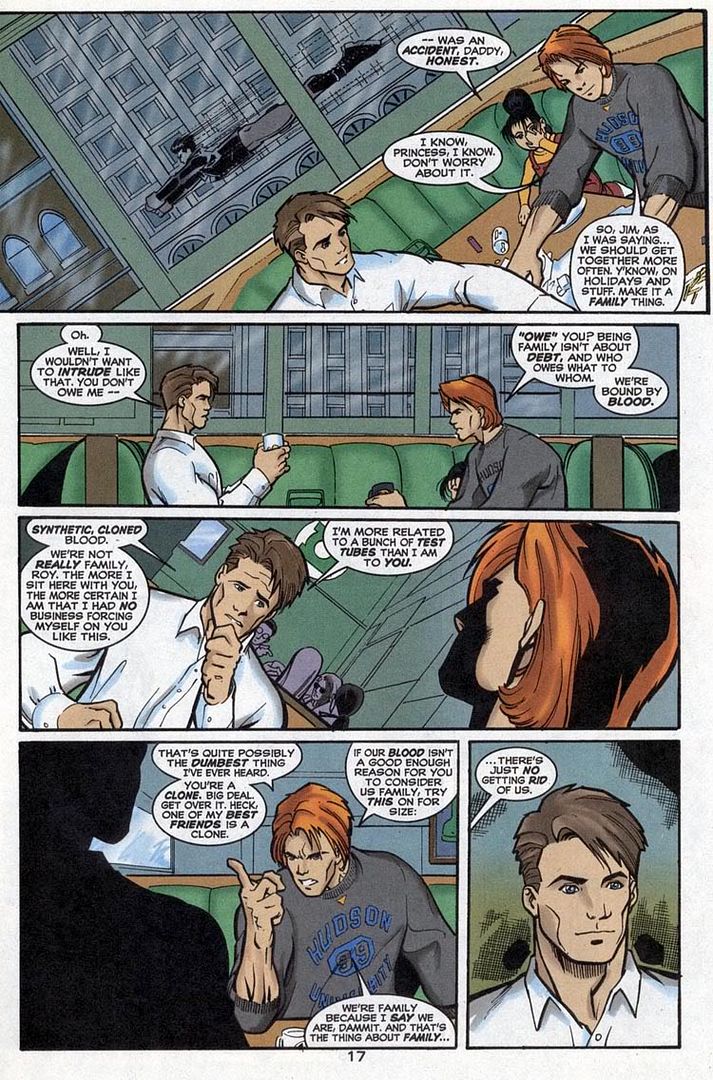
I read Superboy pretty religiously after it launched in the wake of "Reign of the Supermen."  Karl Kesel and Tom Grummett did some truly excellent work (to say nothing of the brilliant Superboy and the Ravers spin-off).  When I gave up reading comics in 1999, the series was in the middle of its "Hypertension" arc that was one of the first times DC had allowed the concept of the multiverse return after Crisis on Infinite Earths theoretically ended it forever.  I'd highly encourage DC to print up some trade collections from the Kesel/Grummett years.  This particular issue doesn't involve Kesel or Grummett (except the latter on the cover), but it at least continues the feel of that era in its story, unlike later issues (before its eventual cancellation with #100, in which it had transformed into a completely unrecognizable series, alas).  The highlight is a conversation between Roy Harper (known variously as Speedy, Arsenal, and Red Arrow) and Jim Harper (known as Guardian), something I'm not even sure had ever been thought of before, but there's Jay Faerber doing it, at the moment he had his apparently fleeting moment to work in the mainstream.

The Adventures of Superman #476 (DC)
via Boosteriffic
From 1991.

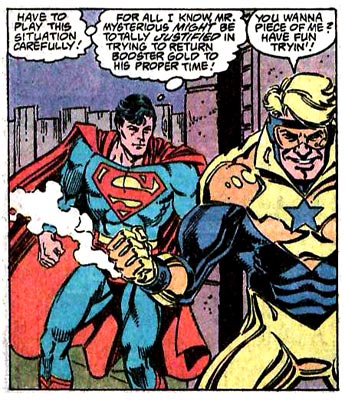
The "Time and Time Again!" arc was something I remember seeing advertised when it was later republished in a trade collection.  It was the first notable arc Dan Jurgens orchestrated, and it involved Booster Gold, his most famous creation, and the Linear Men, and even the Legion of Super-Heroes.  I wonder in hindsight if there was any discussion among fans that maybe this material was a little similar to the far more famous "Days of the Future Past" arc from X-Men, because there are definitely similarities.  Either way, it's a reminder of how much Jurgens used to have fun with his Superman.  When he wasn't, ah, killing him...

Superman #193 (DC)
via We Shop
From 2003.

Here's Scott McDaniel again, being far more familiar in his art this time than the previous Daredevil work, because of course this is after the Nightwing material I remember so fondly (among other work, including The Great Ten).  The writer for the issue is Steven T. Seagle, whose most notable Superman story is actually a Vertigo graphic novel entitled It's a Bird..., which was released a year later and details his reluctance to tackle the Man of Steel creatively.  One of the best comics I've ever read, too.  This issue, meanwhile, seems to involve Superman and Lois Lane's daughter.  But I'm sure there was some other explanation...

The Twelve #12 (Marvel)
via Science Fiction
From 2012.

Ha.  Realizing the publication year is just one of those ironies about this issue that is only just now dawning on me.  2012.  Of a series called The Twelve, twelve issues long, and here its twelfth issue.  The other layer is that the series was famously delayed for quite a while two-thirds of the way through, seemed like it was never going to finish.  And now several years later I catch this final installment, again, as a random discovery in a back issue bin.  It remains a favorite comics memory, a variation on Watchmen from a more sober perspective, wondering what would happen to a whole generation of WWII heroes reawakened, years after Captain America received similar treatment, with all their stories opening up again and not to their benefit.  The best I've ever seen from J. Michael Straczynski.  Artist Chris Weston, who at one point cobbled together a one-shot all on his own just to keep awareness of the project alive, also worked with Grant Morrison on The Filth.

Monday, November 25, 2013

My All-time Favorite Comic Books, 10-1

The final countdown...!

#10. Geoff Johns's Green Lantern

Creators: Geoff Johns, Doug Mahnke, Ethan Van Sciver, Ivan Reis, various
Publication dates: 2004-2013
Issues: Green Lantern: Rebirth 1-6, Green Lantern 1-67, 0-20, Blackest Night 1-8

Green Lantern was already my favorite comic book franchise when Johns strolled into the story in 2004.  I thought I already had my definitive era in Ron Marz's Kyle Rayner.  Then Johns brought Hal Jordan back, and exploded the whole mythology.  I mean, literally, he took the basic building blocks and figured out the best possible expansion, and led the whole thing to its greatest heights.  It's the epitome of creative storytelling, the single best innovative run in superhero comic book history, one that will continue to be felt for years. I mean, even Larfleeze has gotten his own ongoing series now.  Larfleeze!  How awesome is that?  Saint Walker made it into the pre-New 52 Justice League, the Red Lanterns have had their own series since the DC relaunch, and Johns has made a strong case for a Sinestro series.  No one would have ever thought that possible before 2004.  That's the definition of a substantial legacy.

#9. Air

Creators: G. Willow Wilson, M.K. Perker
Publication dates: 2008-2010
Issues: 1-24

Along with 52 part of a very select group to top my annual QB50 list twice, Air was an unabashed obsession of mine throughout its publication, even though it struggled to find an audience that did not have the name "Tony Laplume."  But it was brilliant, typical of the Vertigo breed in having a distinct and imaginative mythology, but atypical in its intimate approach, like Sandman without all the Goth touches.  G. Willow Wilson managed to spin a conspiracy and hero journey into one yarn.  The closest proximity I've found since was the similarly short-lived Saucer Country.  As with most of my selections, widely deserves a much larger audience.

#8. Cobra

Creators: Mike Costa, Antonio Fuso, Christos Gage
Publication dates: 2009-2013
Issues: 1-4, Special 1-2, 1-13, 1-21, The Cobra Files 1-9

This is basically everything I loved about Superboy and the Ravers, The Great Ten, Seven Soldiers of Victory, and Young Avengers in a nonsuperhero title, and surprisingly with another famous franchise it managed to totally reinvent from the outset, featuring an obscure Joe named Chuckles in the mission of his life, a reboot timeline where Cobra is just being discovered.  And from there, it's basically the Assange/Snowden/NSA era well before any of those scandals broke, one brilliant bit of character exploration after another in a world of paranoia and secrets, an unexpected phenomenon publisher IDW never expected, assuming it had merely a good mini-series when it acquired G.I. Joe in 2008, leading to a series of extensions that eventually transformed the whole line with the sensational death of Cobra Commander.  You don't need to know or care about the franchise to love this saga.  You just need to love great comics.

#7. Sandman

Creators: Neil Gaiman, Dave McKean, various
Publication dates: 1989-1996
Issues: 1-75

For simplicity's sake I'm sticking to the original series rather than also include subsequent additional materials, such as the recently-launched Sandman Overture mini-series.  Simply put, this one needs no introduction.  It's perhaps the most literary comic book ever published, filled with classical elements and one of the best-known mythologies outside of superheroes ever created.  It's a masterpiece.  Move along, move along.

#6. Bone

Creators: Jeff Smith
Publication dates: 1991-2004
Issues: 1-55

This one I owe entirely to a friend who was obsessed with it.  For a while, there was a very small cult audience obsessed with it.  And it expanded, thanks to word of mouth.  It started making in-roads to full-blown mainstream awareness.  There was talk of a movie.  All of this is for good reason.  Like a cartoon strip wedded perfectly to epic fantasy (such as you would never have believed possible until Bone), Jeff Smith's vision was a dream come to life, so popular Image for a while took over publication, until it went back to Smith's own company, where it completed its epic journey, only to be reborn in a series of reprints, where its legacy (as I've been hoping throughout this list for many other series) has grown.  Oh, and because it's my favorite phrase from Bone: stupid, stupid rat creatures...

#5. Wasteland

Creators: Antony Johnston, Christopher Mitten, Justin Greenwood
Publication dates: 2006-2014
Issues: 1-60

I've attempted for years to be an ambassador to this series, a classic post-apocalyptic yarn that explodes the genre into a startlingly rich landscape filled with intricate relationships between isolated figures.  Unlike The Walking Dead, Wasteland has made the riddle of what created the world after the Big Wet the whole point, except it's taken the whole journey to reach it.  In the meantime social politics have defined the story, especially the betrayals at the heart of life in Newbegin, the perfect representation of civilization after civilization's end.  My favorite character remains Michael, a sort of Wolverine if Wolverine had never joined the X-Men.

#4. 52

Creators: Geoff Johns, Grant Morrison, Greg Rucka, Mark Waid, Keith Giffen, various
Publication dates: 2006-2007
Issues: 1-52

DC's first weekly series in years, an ambitious effort to put out a new issue every week for a year, could have been its riskiest gamble ever.  Instead it turned out to be a stroke of genius, one of the best single comics it ever put out, following a hodgepodge of characters who could never have been mistaken for the mainstream (although some of them, including Booster Gold and the new Batwoman, received their own ongoing series as a result) as they embark on the greatest stories of their careers, including the Elongated Man's long-awaited response to Identity Crisis and Black Adam's shot at redemption.  The league of creators who wrote it remains a who's who, and to my mind in no small part to their participation in this book.  The company's later attempts to duplicate this remarkable accomplishment never seemed to capture the same interest from the fans, but that's to be expected, although I would highly recommend Countdown, while the bi-weekly Brightest Day is another winner.

#3. The Death of Captain Marvel


Creators: Jim Starlin
Publication date: 1982
Issues: [graphic novel]

This is the comic book that made me a fan of comic books, and it is also among the first I ever read, and completely by accident, something my sister had randomly come across and I stole a look, and no joking, I was changed forever.  The death of any comic book character wasn't as common in 1982 as it is today, and the true testament of this event is that Captain Marvel remains respectfully deceased.  It's a surreal, literary exploration and epitaph for a character who was never really that popular but whose legacy was instantly cemented by this effort.  What more could you ask for?

#2. Kingdom Come

Creators: Mark Waid, Alex Ross
Publication dates: 1996
Issues: 1-4

You might notice that I love my comics to be literary, and no superhero comic was ever more literary, not to mention seminal in my own creative development, than this landmark event that peered into the future of DC's icons and saw nothing good.  Lois Lane dead.  Superman forced into retirement.  The next generation, led by Magog, the reverse of everything that had come before them.  Narrated by a simple preacher and steeped in religious imagery (this is the secret origin of my obsession with the number 7, and why I subsequently adopted the term "seven thunders" from the Book of Revelations for what I always assumed must be my own magnum opus, because it was used in the previews for Kingdom Come), this was both creators at their absolute finest.  One of them ended up chasing this achievement for years (Ross) while the other only occasionally revisited it (Waid, in The Kingdom event that was as close to Seven Soldiers of Victory as DC ever got before Grant Morrison), while Geoff Johns famously brought it all back in the pages of his Justice Society of America.  Even Magog eventually entered the regular canon and had an ongoing series.  Often seen as DC's response to Marvels, it is more accurately seen in its own distinctive light, which is ultimately a more hopeful version of The Dark Knight Returns, taken on the grand scale.

#1. "The Return of Barry Allen"

Creators: Mark Waid, Greg LaRocque
Publication dates: 1993
Issues: The Flash 74-79

I choose to include only one storyline from Mark Waid's extended run on The Flash for a specific reason, because it was the earliest and best example of the whole thing, which often lived up to its potential and sometimes didn't (and the best of it wasn't even in the pages of The Flash but rather Impulse), so it's better to remember what remains the most memorable than complicate matters.  Because "The Return of Barry Allen" is most certainly the best of it.  And for the record, it doesn't even feature Barry Allen.  This was years before Barry came back.  The Flash throughout Waid's run was Wally West ("and I'm the Fastest Man Alive"), the third speedster to carry the name, and he was keenly aware of the whole mythology, which before Geoff Johns on Green Lantern, Waid was the first to attempt a wholesale expansion, introducing the concept of the Speed Force and old as well as new faces to the family, including my personal favorite, Max Mercury, the Zen Master of Speed.  If there is any weakening to this legacy, it's perhaps that even Waid seemed to let it slip by the wayside after a while, perhaps after "Dead Heat" (acknowledged within the pages of Johns's The Flash: Rebirth with a cameo by the villain Savitar), while Johns himself in two separate runs (with Wally and Barry) went in different directions.  Better, again, to remember it at its most pure, most perfect, most serene, most effective, when it's Wally struggling with his role in the grand scheme of things.  James Robinson would later take the same basic concept to similar heights in the pages of Starman, but has no comparable single storyline to this one.  This is the one, if you love superheroes and their legacies, that you have to read.  This is the love letter of all love letters to the whole phenomenon.

(All covers via Comic Book Database.)