Showing posts with label Warren Ellis. Show all posts

Monday, January 20, 2020

Reading Comics 241 "Batman Annual #4, plus a few more comics"

Batman Annual #4 (DC)

Yeah.  Now I'm sort of glad that this was the last one I read.  I had attempted to order a copy late last year, but got the numbering wrong and ended up with Batman Annual #2, which is itself also a great read, but it left me still needing to read this one.  And now I've read it after the last issue of Tom King's Batman.  And it works extremely well as a coda.

Basically, Alfred's diary, as the cover suggests, details the daily exploits of the Dark Knight.  Big adventures (dragons! and not the first time he's fought them, as Alfred duly notes!), small adventures.  Basically, as if Tom King really needed to prove to anyone he was capable of conceiving a Batman story well beyond the scope of his very long meditation in the main run.  Or if he really needed to prove, yet again, how consistently great he is.

A lot of writers, and I've read a lot of comics, and a lot of comics over the course of years from the same creators, are not this consistent.  They just aren't.  Even those who can hit truly high notes once or twice or even a half dozen times in their careers, they just aren't this consistent.  Sometimes it may simply be a matter of my disagreeing with their personal tastes.  But I've never had a comics writer I've so consistently admired as Tom King, since his breakthrough in the pages of Omega Men.  His co-writing work with Tim Seeley in Grayson, it's something I'll have to revisit in full at some point (though I repeat, I repeat, King's solo work in Grayson: Futures End remains the first time I realized how great he could be), but that's really the only time I haven't been able to say, Wow

A lot of fans quibble (and I use the term liberally) over his creative choices, but King, as far as I'm concerned, has achieved his greatness through his consistent use of creative choices, never being satisfying in "just" writing a story, but figuring out the best way to tell it.  That's what truly great writing looks like, that's what I love the most about a story, in any medium, how it's executed. 

And so we get this, which on the surface is pretty simple: a litany of fairly routines situations.  By the end, King isn't even writing anything the reader will see, and his perspective still dominates.  It helps to have Jorge Fornes (and Mike Norton) on art.  Fornes has quickly vaulted to the forefront of deceptively simple stylists, and this might end up serving as one of his calling cards.  Both in story and art, this is the definition of evergreen, something fans will be able to turn to for years.

The Dark Knight Returns: The Golden Child (DC)
In the tradition of the Last Crusade prestige format one-shot spin-offs, Golden Child focuses on Carrie, Lara, and Jonathan (the eponymous offspring for this comic) as they struggle to find their perspectives on the world and how they represent the legacies of their parents.  It's a worthy addition to the saga, and really nice to see Frank Miller get to write solo again.  The artist does a good job of embodying Miller's Dark Knight Returns work, notably with the Joker.

Event Leviathan #6 (DC)
This is something I'm going to want to check out in full, but had to read the final issue sooner rather than later thanks to the big reveal of who the new Leviathan is, one of the old Manhunters (not the robots, the several humans who have operated under the name over the years).  I think Bendis has only further increased the value of his DC tenure with this one.

Legion of Super-Heroes: Millennium #2 (DC)
Even though the Bendis ongoing has since launched, I was pleased to be able to catch the second and final issue of the preview, Rose (and Thorn)'s tour of DC future history leading up to the Legion itself.  Brian Michael Bendis basically achieved the Moira MacTaggert reveal from Hickman's X-Men before Hickman, with the new version of Rose (and Thorn) an immortal who gives an innovative (in superhero comics) approach to the idea, and begging that he revisit her.  But at his best, Bendis does that with every character he touches.  \

The Wildstorm #24 (DC)
Figured I'd check out the finale of the Warren Ellis reboot.  But I'm still not much more interested in the characters, or Ellis, than I generally tend to be. 

Tuesday, June 6, 2017

Quarter Bin 103 "Moon Knight"


Moon Knight #4, 7-10, 13-17 (Marvel)
from August 2014-September 2015

So, inspired by Jeff Lemire's recently concluded Moon Knight, and remembering I'd once read the last issue of Brian Michael Bendis's run, too, and last year so other back issues (I could check to see how much I may have duplicated my reading, but...nah), I decided to have a look at some older stuff, from the likes of Warren Ellis (I figured if anyone was comparable to Lemire it'd be him), Brian Wood (I have a spotty history with him), and Cullen Bunn (not the biggest fan).

And Greg Smallwood, by the way.  He illustrates the Wood issues.  It's clear he hadn't yet developed the intricacy of what he'd later bring to Lemire's run, but it's still fun having that continuity.

Of course none of them were ever going to do exactly what Lemire later did.  That would kind of diminish Lemire's work, I think.  But there's stuff here and there. I mean, it's the same character, who long ago developed a reputation for multiple personas. 

Ellis has Declan Shalvey on art.  Shalvey has kind of become a big deal recently.  Bunn doesn't have anyone with name value doing his run, and he has the least distinguished storytelling, the stuff you'd expect from someone who has a far more generalized concept of the character, who recognizes the trappings but can't quite exploit them. 

It was interesting, reading more Moon Knight.  That's about all I can say about these issues, seeing where the character came from immediately before Lemire.

Thursday, September 29, 2016

Quarter Bin 95 "Karnak #1"

Karnak #1 (Marvel)
From December 2015

writer: Warren Ellis

artist: Gerardo Zaffino

Warren Ellis is one of the elite comic book writers I don't normally have much time for, but he's got at least one project (Supreme: Blue Rose) that I think truly does warrant his genius reputation, so I always like to keep his work in mind.

Karnak is an Inhumans series.  The Inhumans are Marvel's attempt to try and replace the X-Men as the dominant subset group of its publishing line, because currently the X-Men belong to 20th Century Fox as a movie franchise (Marvel has taken the Fantastic Four completely off the board for similar reasons, but it would be foolhardy to try and do the same with the X-Men, but darned if it doesn't try really hard to do so).  I don't know much of anything about Karnak as a character outside of what I've read in this very issue, but the Inhumans in general seem to have very little definition and a lot of suggestion about them, and I'd never heard of Karnak until I saw this series on the shelves for the first time.

I wish I could bother uploading images, because it's the cover of this issue that always had me semi-interested in it (I finally read this because of a handy comics package). It's a great, impressive cover, Karnak's face imposing itself so that he looks completely badass without really having to do anything to achieve it.

But Karnak turns out to be a little like Doctor Strange mixed with the Spectre.  Ellis tends to write genius characters because there's so little work involved in actually establishing their genius.  It's just assumed that whatever they do is genius.  I mean, it's practically a comics staple, and in that regard, Ellis is right on target.  (He ought to write a Doctor Doom series.)

Grumpy Karnak is asked by Phil Coulson (who's one of those characters Marvel is using a lot these days because of the movies, but whose appearance here totally justifies it; Ellis should be writing a Phil Coulson series instead of a Karnak series) to look after one of the many, many humans recently exposed as an Inhuman because of a McGuffin (Ms. Marvel is the most famous example; she otherwise has absolutely nothing to do with the Inhumans, except for a few early issues).  Karnak proves to be a dick, because he can get away with it.  Pretty much end of story.

Bottom line is, I have absolutely no idea why Karnak exists.  Doesn't really rate such a killer cover.

Thursday, August 4, 2016

Quarter Bin 87 "Back to Automatic Kafka, and more from recent back issues blitzes"

Automatic Kafka #3, 4, 5, 9 (WildStorm)
From November & December 2002, January and July 2003
Joe Casey's comic caught my eye in previous rummaging through back issue bins, so I figured I'd read more of it.  Thankfully, #9 is the final issue and adequately explains what the hell he was doing with the rest of it.  Basically this was a post-modern superhero comic, in the tradition of Wasteland and Grant Morrison's Animal Man (Casey liberally appears in the final issue, speaking directly to Kaf and the reader), from the more cynical perspective of early millennium superhero comics, which had been turned on their head by stuff like The Authority, which would give birth to The Ultimates and somewhat strangely, the Marvel movies we all enjoy now, which are on the whole far less concerned with taking superheroes seriously than the comics that spawned them.  It's classic satire, the Kafkaesque version, if you will, of Loeb & Sale's formative collaboration in The Challengers of the Unknown Must Die!, a previous big find in the back issue bins recorded in previous editions of this column.

Black Magick #1 (Image)
From October 2015
Greg Rucka and Nicola Scott are past and present Wonder Woman creators.  Their pasts previously aligned in this series about a magic practitioner who's also a cop, which is kind of luck summarizing and simplifying Charmed.  Figured I'd finally have a look.

Blackhawks #2, 3, 4 (DC)
From December 2011, January & February 2012
As a huge Mike Costa fan...when he's writing his brilliant G.I. Joe/Cobra stories over at IDW, I always like to check in on his other stuff.  When the New 52 was announced, I was automatically intrigued at his Blackhawks, but then financial restraints got in the way and I was only able to check back in well after the fact.  This is the second such time I've read some of it, and I'm far more impressed now than the last time.  The big beef I had the last time was that I didn't really get the Mike Costa feel, that in having to create a whole team right off the bat, he didn't have the chance to dazzle with an intense single-character drama, like he did at IDW.  Well, I stand corrected, and even more curiously, the passage of time and further comics experience informs me that his Blackhawks reads like a preview of Valiant's current Bloodshot comics.  So I will definitely make a better effort at reading the complete short-lived run in the future.

Cairo sneak preview (Vertigo)
This graphic novel was G. Willow Wilson's comics debut, originally released in November 2007.  I later became hugely enamored with Wilson through Air, while other readers made her Ms. Marvel a leading member of Marvel's new generation.  I've always wanted to read Cairo (which is also Wilson's first collaboration with Air artist M.K. Perker), and so this teaser is a pretty good start.

Global Frequency #12 (WildStorm)
From August 2004
Thanks to Transmetropolitan and later works (such as the aforementioned Authority), Warren Ellis became known as one of the most progressive writers in comics (I dubbed his Supreme: Blue Rose as a landmark work).  Global Frequency was one of the several projects from the same general period that helped solidify his reputation.  At least in this final issue, it's a terrifying vision of government population measures.  I think I've read it before.  Didn't hurt to read it again.

Hitchhiker's Guide to the Galaxy Book 1 (DC)
From 1993
I've long wanted to have a look at DC's adaptation of Douglas Adams' classic story of Arthur Dent's terrifying vision of government population measures (heh).  For now, I'll have to settle with this first installment, featuring very, very '90s art.  No, not the Image kind.  What everyone else had when all the Image artists went to Image, or were employed in Marvel and DC books desperately trying to look like Image books.  If that helps.

Inferno #2 (DC)
From November 1997
I've read the complete mini-series before, but I wanted to have another look (those issues were lost in one of the purges).  This was Stuart Immonen's writer/artist tryout, I think, for DC, before he was allowed to assume the same responsibilities in his Superman comics.  His Inferno is a good reminder that there's a whole set of young readers who read comics because they identify with the human qualities these characters can exhibit, not the desperate attempts to be cool that some companies began to think were necessary to find them.  It's yet another example of the timelessness of Immonen's work, and why it's sad he's never really gotten another chance since that time to explore this side of comics.

Nova #3 (Marvel)
From March 2016
Ah...bad timing, Nova.  Because this latest incarnation of the Jeph Loeb vision for the character is the opposite everything I just talked about...

Our Love is Real (Image)
With his sensational work in Green Lanterns recently, I've gotten more aware of the name Sam Humphries, so when I saw this one-shot, I figured I really should have a look.  It's kind of a shameless parody of sexual diversity, and the artist draw sideburns like Howard Chaykin.  That's all I'll say about that!

Resistance #6 (WildStorm)
From July 2009
Here's Mike Costa again, doing another military comic, only this time it's based on a video game.  But it's excellent Costa material all the same.

Starman #6 (DC)
From January 1989
The Will Payton Starman, like the rest of them, popped up in James Robinson's later Starman series.  Here will is very much at the start of his career, and in the thick of the "Invasion" crossover arc, and contending with the Power Elite  But more on superhero Elites in a moment...

Action Comics #775 (DC)
From March 2001
The introduction of Manchester Black was one of those legendary events from early millennium Superman comics, and I always wanted to catch up with it.  Here was a character meant to help explain what makes Superman continually relevant, because he reflects all the violent tendencies that had been cropping up since the likes of Alan Moore and Frank Miller complicated such things.  This was a whole era in Superman comics dedicated to making him cool again, which really wouldn't work until Superman/Batman (somewhat ironically).  At the end of this issue, Joe Kelly makes him looks like he's stooped to Black's level, but then cleverly explains how he didn't, while still making Superman look pretty badass.  Black's Elites, who starred in a twelve-issue Justice League Elite, were another response to Ellis's work.

Superman: Last Son of Krypton FCBD
From 2013
This is the first issue in the Geoff Johns/Richard Donner run, that reads as well now as it did when originally published. 

We Stand on Guard #4 (Image)
From October 2015
Brian K. Vaughan is one of the guys who formed his reputation in the years following Ellis's dominance in the progressive movement, and in recent years he's been doing some even edgier stuff.  We Stand on Guard is a curious little thing, in that it tackles America's current reputation from the perspective of a future war with Canada.  It totally makes sense if you ignore the fact that Canada and the United States have generally been okay with each other since the unfortunate business of the war of 1812 and the business of trying to add Canada to the rest of America...

Ultimate X-Men #7 (Marvel)
From August 2001
Mark Millar explores the Ultimate version of Weapon X.  Predictably edgy outlook.

Monday, February 2, 2015

Supreme: Blue Rose #6 (Image)

via Image
writer: Warren Ellis

artist: Tula Lotay

This genius revision of Alan Moore's version of Rob Liefeld's Supreme will go down as a classic.  I'll keep saying that so that there's at least one voice saying it on the ground floor.  History in the making.

The problem, if there is one, is that perhaps it's history that will perhaps best be understood in the future.  That is to say, when the thing is collected and you can read it all at once.

The problem is that an issue like this one perhaps doesn't read like history because it doesn't itself ring like anything special.  But it's a necessary link in the chain.

And it's the penultimate issue.  Characters are figuring out where they've been headed.  Darius Dax plays his hand.  We're one issue away from finding out what exactly happened to Ethan Crane, the erstwhile Supreme.

Warren Ellis and Tula Lotay are brilliant even in isolation from what makes the project in itself brilliant.  

That's about all there's to say this time.

Sunday, December 28, 2014

Reading Comics 144 "Supreme: Blue Rose"

via Image Comics
Rob Liefeld isn't dead, but he's began to have a wonderful creative afterlife.

A few years back, a couple of his characters were revised away from their strictly superheroic origins in the most recent Glory and Prophet comics, with Prophet in particular making a cult-sized impact.  Starting this year, it was Supreme's turn.  Liefeld originally conceived of Supreme as a more violent Superman.  Not long afterward, Alan Moore came along for the first revision of the character, crafting him into a full-blown homage to the Silver Age Superman, which later inspired Moore's own Tom Strong.  Image even brought this version back recently.

But now comes Warren Ellis.  Ellis is the slightly more grounded version of Grant Morrison, the one the mainstream couldn't hope to tame, as it has Jonathan Hickman.  From the moment I heard of Supreme: Blue Rose, I knew I had to have a look.  The longer it took for the opportunity to present itself, the more I wondered if the diminishing but intrigued response I heard, very tepidly, from my sources might be telling me that perhaps it wasn't all that remarkable after all.

But then I read an issue for myself.  And then was able to read the rest of the issues released to date.  It's amazing.

And actually, it's not hugely different from a personal favorite comic of mine, IDW's Cobra, which Christos Gage and Mike Costa envisioned as a first look at G.I. Joe's enemy just as if the reader had never seen it before, a true psychological exploration that exploded the concept onto a whole new level.

That's what Ellis is doing with Supreme.  Oh, and Supreme himself is barely even present in this story.  He's identified by his secret identity, Ethan Crane, but he's basically become the maguffin of his own story.

Instead, the focus has shifted to Diana Dane, the Lois Lane equivalent Moore introduced.  In fact, all the characters I can identify other than Supreme himself were created by Moore.  Darius Dax, Moore's Lex Luthor, has become very much a Lex Luthor figure.  Doc Rocket, a member of Moore's Youngblood, is present and better than ever.

It's hard to say much more about what's happened over the course of the first five issues except to say that Dane's investigation into the mystery of Ethan Crane's existence has continued.  The other thing Ellis shares with Moore is a fascination with the acknowledgment that there has been more than one incarnation of Supreme.  But this is not metafiction.  There isn't even much of a connection to Morrison's tendencies.  This is simply a creator embracing an opportunity to be creative, in ways most writers never even imagine possible.

It is unarguably one of the best comics of the year.  Astonishingly good, and the art of Tula Lotay helps in exactly the same way Fiona Staples does for Saga.  More people need to talk about Blue Rose.  More people need to be reading.  Because this is comic book history in the making.

Monday, December 15, 2014

Quarter Bin #64 "Binge-worthy IX: An Indulgence"

Air #8 (Vertigo)
via Vertigo Comics
From 2009.

Air is the genius series that first introduced me to G. Willow Wilson, who has staged a remarkable comeback with Ms. Marvel.  You see, even though I love Air, there wasn't much of that going on during its original publication.  I named it twice to the top of my annual QB50 list.  I passed on scooping up this random issue a couple of times before finally deciding to buy it.  And once again I was reminded why I love Air so much.  Blythe has just experienced mystery lover Zayn's life firsthand, but there's very little time to reflect on that, because piloting the hyperprax method takes great concentration.  Did I mention Amelia Earhart was involved?  The whole experience was like following pirates of the imagination whose goal was to try and invent the future.  Hopefully Wilson's current success will help readers rediscover her masterpiece.

Detective Comics #648 (DC)
via Comic Vine
From 1992.

I picked this one up in part because of that gorgeous Matt Wagner cover, and also to hopefully catch a little of that early Tim Drake era, after he'd become the new Robin and before the whole Bane business threw everything into chaos.  I ended up gifted with an early Spoiler appearance.  Stephanie Brown's journey to becoming a permanent institution in the Batman mythos has been incredibly complicated.  At one point she succeeded Tim as Robin, was unceremoniously killed off, revived, and apparently rejected from the New 52 landscape until she showed up in the pages of Batman Eternal.  She's also been Batgirl, by the way.  But Spoiler is iconic all on her own, thank you very much.

Daredevil #323 (Marvel)
via Comic Vine
From 1993.

The only reason for me to have gotten this one, as it turned out, was because of the Scott McDaniel art.  Yeah, that cover promises Venom, and Venom was pretty big business for a while, but that's no reason to read this.  The Daredevil costume inside the issue is one of those variants Marvel tried in the '90s, including a return to his original look, but that simple red one is really all you need.  I had my first experience with McDaniel in the pages of Nightwing, which in a lot of ways might have been deemed in that first incarnation as a kind of DC version of Daredevil, complete with Blockbuster reinvented as a Kingpin figure with a similar singular focus on ruining the life of a pesky vigilante that went on to epic proportions (and under two creators: Chuck Dixon and Devin K. Grayson).  So to finally see McDaniel in the pages of Daredevil itself was worth the trouble of ignoring everything else about the issue.  And as it turns out, his work certainly evolved over the years.  I mean, I guess it figures.  But it's interesting to see it when it was less distinctive, though certainly recognizable.  I still can't believe that McDaniel has apparently angered the comic book gods and now can't get a regular penciling gig.  It boggles the mind.  He's got insane talent.

Elongated Man #1 (DC)
From 1992.

via Pinterest
After Identity Crisis, Ralph and Sue Dibney took on iconic proportions, for reasons most comic book characters probably wouldn't want to have associated with them even if it meant immortality.  Elongated Man is a peculiar relic of the Silver Age, a costumed detective who along with Plastic Man and Mr. Fantastic is best defined for an admittedly wacky superpower.  Being married always gave him special distinction.  This mini-series, spinning out of the infamous Giffen/DeMatteis Justice League era, is quite shocking for post-Identity Crisis readers, actually.  This debut issue sees the Dibneys in considerable discord.  The art is from the late Mike Parobeck, who would later achieve his greatest recognition in the pages of the comics spinning out of The Batman Adventures TV series.  I first saw his work in the pages of an attempted Justice Society relaunch from around the same time, and I always liked it.  Another crying shame in comic book creators taken too soon.  At this point he's been dead nearly twenty years!

Global Frequency #12 (WildStorm)
From 2004.

via Full-Page Bleed
Warren Ellis is the acknowledged master of the big concept in comics, the writer Jonathan Hickman and Rick Remender have been chasing and what Grant Morrison would look like if he weren't the personification of caffeine in the medium.  Maybe it's because his reign in that regard began while I wasn't reading them, but I always found it difficult to get into him.  Every now and then I'll check in with what he's done, and if I'm honest about it I'll admit I've never been disappointed.  Global Frequency is another such instance.  This is the conclusion of the story, with various characters converging in a sequence that in a movie would definitely have left my heart pounding as they try to disable a fail-safe weapon the United States military put in place years ago.

Grendel: War Child #1 (Dark Horse)
via Comic Vine
From 1992.

This is also technically Grendel #41.  Grendel, along with Mage, is the defining work of Matt Wagner's insufficiently-heralded career.  Wagner is one of the kings of the indy scene, a pioneer who helped pave the ground for Image (where Mage unfolded at one point), but now can't seem to get work unless it's related to some licensed property or another, which in itself is not a bad thing, but for a guy who's already struck gold twice on his own, it kind of comes off as a slap on the face.  Anyway, this issue is brilliant, explains the whole concept perfectly (instantly makes me want to read more), and somehow the issue is still stolen by an account of Grendel's recent print history at that time, being tied up in legal hell after Comico went out of business until Dark Horse finally came to the rescue and the issue you've just read has been made possible.  Anyway, Wagner is currently doing Grendel vs. The Shadow...

Justice League Europe #7 (DC)
From 1989.

via comiXology
Here's the Giffen/DeMatteis era in full bloom, two series strong and crossing over for the first time.  After Jurgens did his version and then later incarnations diluted the potential of having a non-all-stars version of the Justice League and we (happily) got Grant Morrison's JLA, it began to seem as if the whole run had been repudiated, but then the reunions began (and now we have Justice League 3000, which I've finally read for the first time).  It might be sometimes hard to remember that not only was Batman present in these comics, but he was definitely the Batman you are probably thinking about, not Adam West and definitely the Dark Knight.  Other than the "One punch!" moment with Guy Gardner, yeah, he was still around.  And in this issue, doing his level best to counteract...everyone else.  For me, it's inconceivable to even try to pretend these comics didn't happen.  The line-up is classic in the same way the New Teen Titans were, and the many times Booster Gold and Blue Beetle have popped up together prove all over again that it's not all just "Bwa-ha-ha" but rather a solid era that left a positive impression on the landscape...

Spider-Man Unlimited #8 (Marvel)
via Martwa Strefa
From 2005.

Here's one of those Joe Hill comics.  Hill's the son of Stephen King, and the father helped inspire the son to write books, and I figure the son helped inspire the father to write comics.  This early example is a little goofy, but it does feature the art of Seth Fisher, another comic book creator who left us far too soon.  Dying at the very start of 2006, which made much of his last work, Fantastic Four/Iron Man: Big in Japan, published posthumously, he was also known for Green Lantern: Willworld and The Flash: Time Flies.  The issue also contains the work of Ryan Sook, whose clean work I've always admired, and is perfectly suited to Spider-Man.  Sook probably comes closest to evoking the Stuart Immonen I know and love from his Superman era.

The Spirit #6 (DC)
via Comic Vine
From 2010.

I picked up a couple of Spirit comics because at the time I was reading a book that reminded me that there were Spirit comics that were probably similar to it.  Yeah, so this issue in particular I grabbed because of the backup from Brian Azzarello and Eduardo Risso, the 100 Bullets team that have otherwise worked together a number of other times as well, and now I've caught a few of those instances for myself, even though I never got into 100 Bullets itself (when it reached the hundredth and final issue, I tried to catch that, but didn't manage to).


The Spirit #8 (DC)
via Xplosion of Awesome
From 2011.

But to speak of The Spirit itself for a moment, of course this is the legendary Will Eisner's most famous creation, a pulp fiction vigilante who has since joined a whole collection of migratory characters constantly shuffling from company to company.  It's not that this isn't good material, because it is.  I wonder if it had been published under the Vertigo imprint that it might have had a different fate, or perhaps simply unconnected to the rest of the "First Wave" line.  Who knows?  One thing is for certain, however, and that the sneak preview included at the back of the issue for Scott Snyder's Batman debut in the pages of Detective Comics was another recent reminder that I've probably way too harsh on Snyder in recent years.  Expect friendlier coverage on that front in 2015...

Superboy #82 (DC)
via Scans Daily
From 2001.
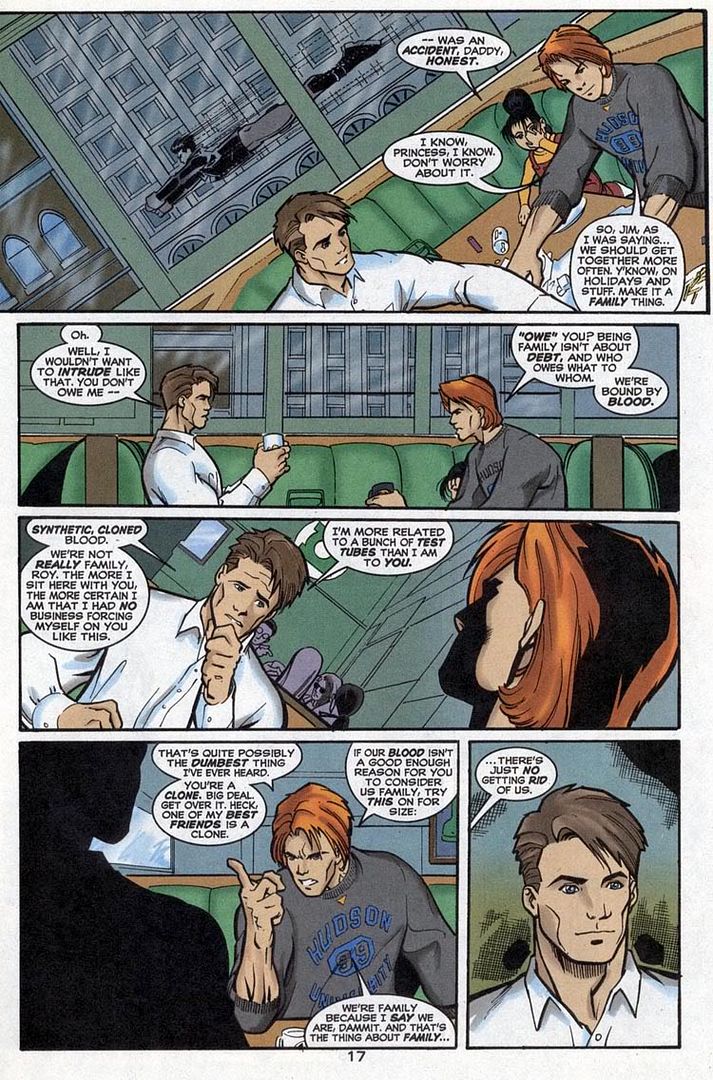
I read Superboy pretty religiously after it launched in the wake of "Reign of the Supermen."  Karl Kesel and Tom Grummett did some truly excellent work (to say nothing of the brilliant Superboy and the Ravers spin-off).  When I gave up reading comics in 1999, the series was in the middle of its "Hypertension" arc that was one of the first times DC had allowed the concept of the multiverse return after Crisis on Infinite Earths theoretically ended it forever.  I'd highly encourage DC to print up some trade collections from the Kesel/Grummett years.  This particular issue doesn't involve Kesel or Grummett (except the latter on the cover), but it at least continues the feel of that era in its story, unlike later issues (before its eventual cancellation with #100, in which it had transformed into a completely unrecognizable series, alas).  The highlight is a conversation between Roy Harper (known variously as Speedy, Arsenal, and Red Arrow) and Jim Harper (known as Guardian), something I'm not even sure had ever been thought of before, but there's Jay Faerber doing it, at the moment he had his apparently fleeting moment to work in the mainstream.

The Adventures of Superman #476 (DC)
via Boosteriffic
From 1991.

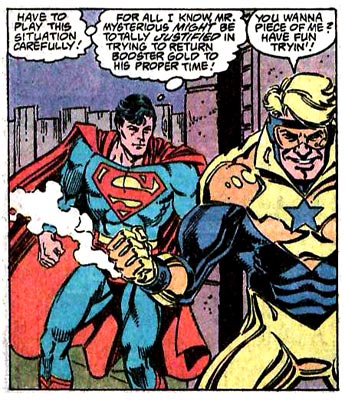
The "Time and Time Again!" arc was something I remember seeing advertised when it was later republished in a trade collection.  It was the first notable arc Dan Jurgens orchestrated, and it involved Booster Gold, his most famous creation, and the Linear Men, and even the Legion of Super-Heroes.  I wonder in hindsight if there was any discussion among fans that maybe this material was a little similar to the far more famous "Days of the Future Past" arc from X-Men, because there are definitely similarities.  Either way, it's a reminder of how much Jurgens used to have fun with his Superman.  When he wasn't, ah, killing him...

Superman #193 (DC)
via We Shop
From 2003.

Here's Scott McDaniel again, being far more familiar in his art this time than the previous Daredevil work, because of course this is after the Nightwing material I remember so fondly (among other work, including The Great Ten).  The writer for the issue is Steven T. Seagle, whose most notable Superman story is actually a Vertigo graphic novel entitled It's a Bird..., which was released a year later and details his reluctance to tackle the Man of Steel creatively.  One of the best comics I've ever read, too.  This issue, meanwhile, seems to involve Superman and Lois Lane's daughter.  But I'm sure there was some other explanation...

The Twelve #12 (Marvel)
via Science Fiction
From 2012.

Ha.  Realizing the publication year is just one of those ironies about this issue that is only just now dawning on me.  2012.  Of a series called The Twelve, twelve issues long, and here its twelfth issue.  The other layer is that the series was famously delayed for quite a while two-thirds of the way through, seemed like it was never going to finish.  And now several years later I catch this final installment, again, as a random discovery in a back issue bin.  It remains a favorite comics memory, a variation on Watchmen from a more sober perspective, wondering what would happen to a whole generation of WWII heroes reawakened, years after Captain America received similar treatment, with all their stories opening up again and not to their benefit.  The best I've ever seen from J. Michael Straczynski.  Artist Chris Weston, who at one point cobbled together a one-shot all on his own just to keep awareness of the project alive, also worked with Grant Morrison on The Filth.