Showing posts with label JLA. Show all posts

Tuesday, April 28, 2020

Pandemic Comics #7 “Justice Leagues”

More comics from the Mile High mystery boxes! Apparently today is National Superhero Day? And apparently Marvel began it? Well, the comics I’ll be talking about, ah, were all published by DC. But the pandemic is teaching us the real superheroes probably have very different costumes than we previously imagined, and masks look very different, too.

Harley Quinn #1
Here’s the “newest comic in the mystery boxes,” from Rebirth, featuring the creative team from the previous series (Marvel’s Constant Reboot Engine sees this happen more frequently) offers a quick recap of relevant information, including Harley’s huge collection of sidekicks. And yet in the spotlight: Deadpool Red Tool.  This was a shiny Mile High variant cover, by the way.

Hawkgirl #54 
As far as I know, this is the only time Hawkgirl had her own book. Of course, it began as Hawkman (where it was written by Geoff Johns) and this issue features the return of Hawkman (probably?). But the good news is it’s from legends Walt Simonson and Howard Chaykin, which is a combination and a series that stood out for me back in 2006, but for some reason never actually read. So, another mystery box that finally addresses one of my comic book sins...

icandy #1
I think it’s the title. Yeah, the title. It’s a terrible title. The comic itself turns out to be pretty good (I mean, it’s written by Dan Abnett & Andy Lanning, the geek gods of that period), a concept that folds video games into a playable concept. I’m frankly shocked this hasn’t been done more, or more successfully. The last time I saw it was Heroes Reborn, which naturally was four seasons after the series was actually popular.

Ion #7 
A maxi-series starring Kyle Rayner post-Green Lantern: Rebirth (otherwise known as “Thanks, Torchbearer, you now get to join the Back-up Corps!), this is a fortuitous random issue, because it reunites Kyle with Radu, the coffee shop owner who was a signature element of Kyle’s early days as a Green Lantern. Ion was a concept they fobbed on Kyle as a consolation prize, before it was replaced by his becoming White Lantern, before he became, well, just another Green Lantern...At the time, I guess, I was still annoyed that “my Green Lantern” had been “kicked to the curb” (which happens to literally every Green Lantern not named Hal Jordan eventually), and so couldn’t properly appreciate Ion. Now it seems like correcting that amounts to another of my comic book sins...

Justice League America #61
The first appearance of Bloodwynd! And, ah, Dan Jurgens takes over the series! In hindsight, Weapons Master really doesn’t seem like that big a challenge. Prometheus was basically an upgraded version only a handful of years later, and even he quickly got turned into a chump. Lesson, villains? Don’t put all your eggs in a fancy gimmick giving you special weapons. Because the weapons can be, well, taken away...

Justice League Task Force #2
This particular Justice League series from the ‘90s will always be the most thankless. Literally its biggest claim to fame is an issue of “Knightfall: The Crusade,” with Crippled Bruce Wayne. This issue is kind of ironic in hindsight: Nightwing looks like a chump while desperately trying to prove he isn’t just a former Teen Titan and/or Batman’s sidekick. If Dan DiDio caught this issue, it might explain why he used to think Nightwing was superfluous...

JLA/WildC.A.T.s
This was a really nice surprise! From the Grant Morrison era, written by Morrison, and featuring Electric Superman (what a snapshot!), something I think I’ve read before, but I guess never really considered that significant. But it is a great little snapshot. But the name of Jim Lee’s big superhero team still sucks, at least as far as incorporating one of the most convoluted acronyms from a whole history of convoluted acronyms in comics...

JLA #79 
It’s always great to remember just how long and varied Doug Mahnke’s history at DC alone is (dude’s also the co-creator of The Mask!), and he’s as easy a talent to revisit for that reason alone as there’s ever been. His art, at least during his DC tenure, has been remarkably consistent, though endlessly adaptable...Hopefully will get a spotlight collection at some point.

Monday, September 18, 2017

Quarter Bin 116 "JLA"

JLA #8 (DC)
from August 1997

This is the setup to the Key revamp Grant Morrison pulled early in his run, but I remember it best for Green Arrow Connor Hawke's memorable statement: "Dad.  Oh, dad.  You're going to be the death of me."  He's referencing having to use his then-late father Oliver Queen's infamous trick arrows.  I used a similar line for a story I later wrote. It's just perfectly executed, and still one of the most memorable endings to any single issue I've ever read.  It's also worth noting the excellent art of Oscar Jimenez, which he seems incapable of delivering on an ongoing basis.  How about signing him up for a limited series, folks?  Also, worth noting that Morrison's Key uses tactics that are very similar to The Matrix, an irony, as Morrison's The Invisibles has long been said to be an unacknowledged source of inspiration for the movie.  I don't know Invisibles well enough to offer a judgment about that, but clearly Morrison was on the right wavelength somewhere...

JLA #14 (DC)
from January 1998

Yeah, so I mistakenly thought this was the "Darkseid Is" issue (it's on the cover an' everything!), but it's the one after it.  It's also "Part 5 of 6" in the "Rock of Ages" arc, but for all intents and purposes, is probably to be considered, along with its immediate predecessor, the best stuff in the arc.  It's Morrison's first crack at Darkseid.  C'mon!  He responds with possibly his best JlA material.  Howard Porter provides art.  It's crazy to think Porter, when JLA launched, was instantly considered an elite artist, but has never received another elite assignment.  What the Apokolips is up with that???

JLA #88 (DC)
from December 2003

Truth be told, after Morrison left the title, I didn't really see much point in trying to see what his successors were up to, despite the fact that there's a lot more non-Morrison JLA issues than ones he actually wrote.  This one's from Joe Kelly, who at the time was threatening to become one of DC's most important writers.  Instead he and a bunch of his pals went and did their own projects, not in the Image way, but bigger, arguably.  Anyway, I chose this issue because the cover promised a strong Martian Manhunter spotlight ("vs the Martian Manhunter! and J'onn Jonzz! and John Jones!"), but as it turns out, Plastic Man is the one who receives the best spotlight.  Plastic Man was Morrison's most outlandish addition to the League, so it's really good to see that his presence in the team wasn't overlooked or forgotten years after the fact.  Kelly spins some poignant material that segues nicely with the Offspring character Mark Waid envisioned as Plastic Man's son.  Waid apparently considers Offspring the best thing about The Kingdom.  You'd really think there would've been more with these two.  There's always the future...Also quite fun to see Doug Mahnke's work, as always.  He seems to have developed, by this point, more or less the style he still uses today.

Friday, June 17, 2016

Quarter Bin 81 "Starlin's Infinity saga, Loeb's Iron Man, Moench's JLA, Hitch's JLA, Waid's Offspring, Moore's LXG"

Although this is a back issues feature that doesn't necessarily always feature comics literally found in a quarter bin, this time you can once again safely assume that.

The Infinity Entity #1 (Marvel)
From May 2016.
I love that my local shop puts damaged new releases in the discount bins.  It makes it incredibly simple to sample stuff I might have otherwise overlooked, such as Jim Starlin once again revisiting his Infinity saga.  Starlin's the guy who has been guiding this stuff from the beginning.  You have him to thank for Thanos, that guy who's kind of the big bad in the Avengers movies, and basically, the Infinity saga is Starlin's ongoing narrative of the further exploits of Thanos, and other interested parties, such as Adam Warlock.  This mini-series actually takes place between two Starlin graphic novels, Thanos: The Infinity Relativity and Thanos: The Infinity Finale, which was released this past April.  Infinity Entity focuses on Adam Warlock as he reintroduces himself following one of those untidy comic book deaths.  It's amusing, seeing him interact with the original Avengers.  These are Marvel comics I eagerly anticipate reading at some later date, the older and newer stuff.  This is, you understand, not something I usually say about Marvel comics...

Iron Man #9 (Marvel)
From July 1997.
I think so much of what Marvel was doing in the '90s came off as desperately trying to look cool (possibly because, oh, the fate of the entire company was in the air thanks to potential bankruptcy) that it ended up alienating older fans and leaving newer fans with the impression that none of this mattered, once the company shifted focus back to more familiar ground.  I rarely read Iron Man comics (I've just never been interested), but I figured I had to read this one, as it was written by Jeph Loeb, during that whole period where he was writing Marvel comics without anyone realizing it was Jeph Loeb, because being Jeph Loeb didn't matter until fans got excited about him thanks to DC work like Batman: The Long Halloween and Superman/Batman (which is ironic, because he never gets the same respect at Marvel, and yet that's where he's been for about a decade now).  This story features an old Tony Stark colleague who was actually partly responsible for the original set of Iron Man armor, and has since kind of gone off the deep end.  Naturally, the guy is totally unknown in today's lore (didn't see him in 2008's Iron Man, right?), and so he's been lost to the same comic book vagaries and/or '90s amnesia that are so easy to rely on with fans.  I didn't find it to be such a bad read.

JLA: Act of God #3 (DC)
From 2001.
Doug Moench was one of the lead Batman writers in the '90s (among other things, helping spearhead "Knightfall" and the vampire saga with Kelley Jones; he also created Bane and Black Mask, as well as Deathlok and Moon Knight over at Marvel, where he did most of his formative work).  One of his last projects with DC was a prestige format JLA mini-series, Act of God, where he imagined what it would look like if all superpowered heroes suddenly lost their superpowers.  By this finale, several of them had banded under the direction of Batman, while Superman and Wonder Woman struggle with finding new meaning in their lives.  It's not terribly hard, in retrospect, to read it as Moench's swan song statement, and so I'm glad to have read it.

Justice League of America #8 (DC)
From May 2016.
Bryan Hitch's Rao saga continues in this issue, and I suspect the next one finally explains why all those dead Superman bodies kept showing up, as depicted in the first issue of the series.  Hitch's art was once known for its hyper realism, but in this series it's been simplified so that it kind of looks like the work of Stuart Immonen.  As a fan of Immonen, I find this acceptable.  Hitch is the writer of the Rebirth Justice League (along with art from Tony Daniel), and I think this was a good choice.

The Kingdom: Offspring (DC)
From February 1999.
The Kingdom was Mark Waid's follow-up to Kingdom Come insofar as it depicted many of the next generation heroes from the original story, and featured the menace of Gog, who was responsible for next generation hero Magog.  The Kingdom was split up between bookend issues where the overall story was told, and several one-shots.  This may be the first time I've read Offspring, which features the son of Plastic Man.  Both of them are struggling with the idea of being taken seriously, and as such Offspring makes for a good standalone story in and of itself.  It doesn't hurt that Frank Quitely provides the art, because Quitely isn't really capable of doing ho-hum work. 

It's interesting, though, The Kingdom, because it's an example of what DC always wanted to do, and eventually did, with Watchmen.  I've talked far too much recently about Alan Moore (elsewhere), but suffice to say I find it disappointing that he left mainstream work the way he did, and wanted no part in revisiting Watchmen.  For a lot of fans, that's become axiomatic, which strikes me as interesting, because this is the comics medium, the place where storytellers are most free to reinterpret, the basic job of storytellers everywhere, ever.  And yet, there's Waid, doing it with Kingdom Come, not very long after.  I mean, it makes sense from a business standpoint.  DC, and its parent company Warners, would understandably be interested in maximizing the profitability of a proven hit.  That's just basic business sense.  I never thought The Kingdom was or was intended to be the same kind of creative statement as its predecessor, but it still provided room for material like Offspring, which represents excellent material in and of itself.  To assume that this is impossible is, to my mind, to completely misunderstand the art of storytelling.

It's interesting, too, just to reconsider Kingdom Come, thanks to something like Offspring.  This was something that was a major deal twenty years ago.  It's not inconceivable to think that fans really did think this was something akin to Watchmen or Dark Knight Returns.  Yet, twenty years on, you really don't find anyone talking about it like that anymore.  I find that odd.  The more I think about it, the more I wonder, have we just lost the ability to conceive new touchstones as actually existing?  Without Kingdom Come, you wouldn't have Civil War.  I mean, Mark Millar's Civil War, when you strip it down to its essentials, is essentially Kingdom Come, done in regular continuity.  Tragedy strikes, and the superhero community is forced to decide what to do next.  Isn't that argument enough that Kingdom Come is still important?  It's just, we stopped trying to see it as important, when it proved about as important as a superhero comic could get.  DC had Identity Crisis, later, and Marvel finally jumped on the bandwagon.  Civil War was clearly a creative watershed for the company.  And you wouldn't have it without Kingdom Come.  I'll leave it at that for now.

The League of Extraordinary Gentlemen #6 (ABC)
From September 2000.
Alan Moore's last significant creation was LXG, in which he envisioned a unified Victorian literary canon, which infamously was adapted into a 2003 movie that not only proved to be Sean Connery's last, but the straw that broke the camel's back in terms of Moore's ability to interact positively with the mainstream.  (The movie also made it important among fans that movies not treat, to their mind, adapted material with disrespect, which actually had the result of superhero movies after that time being more important in terms of mainstream crossover appeal than appealing directly to fans, which in 2016 seems to have taken on new wrinkles thanks to Batman v Superman: Dawn of Justice, in which fans have once again sunk their teeth into the debate).  Anyway, reading LXG itself is something of an odd experience.  Creatively it's not much of a statement.  More seems to have been put into the novelty of packaging the comic in vintage ads and, in the letters column, being wonderfully droll than in distinguishing the story experience itself.  At this point Moore had started to retreat into the familiar comforts of home, and yet the comic doesn't read as particularly British (that's why Paul Cornell's Knight & Squire was such a delight to read), and even if that wasn't the intent, just tossing familiar characters together reads like a cheat.  I mean, the old Allan Quatermain makes a fascinating subject, surely, in the same sense that comics with old superheroes (say, The Dark Knight Returns) tend to be, but it's odd to juxtapose him with, say, Moore's somewhat racist impression of Captain Nemo.  Quatermain (best known as the protagonist of King's Solomon's Mines, and as a cultural predecessor of Indiana Jones) and Nemo (20,000 Leagues Under the Sea) are surrounded by Mina Murray (Dracula), although for what reason, if not a vampire (as in the movie), I have no idea, at least as depicted in this story (more sense would have been Van Helsing, who was the subject of Van Helsing, which like LXG served as a template for Marvel's Avengers), the Invisible Man, and Jekyll/Hyde, plus Professor Moriarty as the antagonist (by the end, as much of a genius as Star Trek II: The Wrath of Khan's Khan), a predecessor to James Bond, and some Chinese characters who perhaps deserve about as much speculation as Moore's Nemo...

I feel I have to reiterate that I don't come by my impression of Alan Moore lightly.  I haven't read everything he's done, and wouldn't particularly care to, even if the best of it is better than the worst that I have read.  I'm just irritated, irrationally, by the notion that to some fans Alan Moore is a god, and that his views and his work can't stand criticism, when to my mind not only is it possible, but necessary for any true reader.  I mean, it's not like I'm not used to people picking on the stuff I like.  I know how it goes.  Maybe some of this logic is best left to fanatics.  We all form strong opinions, and to give voice to them, whether in the privacy of friends or in the wide reaches of the Internet, is to invite contrary opinions.  To dismiss the opposite as an idiot is maybe the easiest response.  But just maybe, it ought to have you reconsider why it is you formed those strong opinions in the first place. 

Well, we all reconsider our thoughts, eventually.  Hopefully.  I guess I really shouldn't worry about it. 

Monday, November 24, 2014

Quarter Bin #60 "Binge-worthy V: Comics Frontiers"

The Girl with the Dragon Tattoo Free Special Edition Preview (Vertigo)
From 2012.
via Amazon
Working in a bookstore when Stieg Larsson's trilogy became a worldwide phenomenon made it all the more impossible to ignore, so when I finally read the books last month I was pleased to discover that I quite liked them.  I'd already seen David Fincher's adaptation of the first book, and read the graphic novel version of the second, so I was familiar with some of the variations before experiencing the originals.  It was nice to come across this preview of the first graphic novel, then.  I don't remember now if I'd caught it when it was originally released, because at any rate I don't have that copy anymore much less most of the comics I had at that time.  But I want to read the rest of it now, and I hope all the more that Vertigo will adapt the third book and complete its own version of the story, which has become a personal favorite.


Godland #16 (Image)
From 2007.
via comiXology
Since catching some of Tom Scioli's American Barbarian earlier this year I became all the more interested in his Godland, which is a version of Jack Kirby's New Gods.  It's interesting, but I think I'm more interested in American Barbarian.


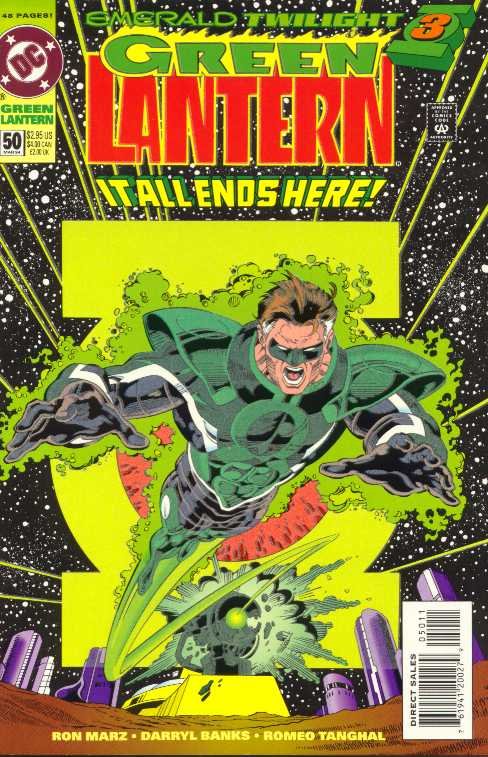
Green Lantern #50 (DC)
From 1994.
via DC Wikia
Hal Jordan's story reaches a climax in the conclusion to "Emerald Twilight," as the fallout from "Reign of the Supermen" and the destruction of Coast City causes him to turn violently against the Guardians and attempt to take matters dramatically into his own hands, a vigilante with the most powerful weapon in the universe.  Jordan has always been depicted at odds with the Guardians, and he'd frequently left the Green Lantern Corps because of it.  As Geoff Johns later explained in Green Lantern: Rebirth, the fear entity Parallax used his greatest personal crisis as a means to unleash its own potential.  Jordan's story continued within the pages of Zero Hour, The Final Night, and Day of Judgment.  In the wake of these events, Kyle Rayner temporarily became the last of the Green Lanterns, which was the other act that dramatically revamped the scope of the franchise within the DC landscape.  Watching Jordan battle Sinestro will always be the greatest moment from the issue, however, the moment Sinestro returned as a significant element of the mythos, regardless of the outcome at that time.


Green Lantern #81 (DC)
From 1996.
via Comic Vine
The '90s were littered with nods to longtime fans, a development that may have clashed with all the new ones the decade tried to bring in and probably part of the reason it ended up failing in permanently enlarging readership.  Hal Jordan had just sacrificed himself in the conclusion to The Final Night, and this was an issue dedicated to his memorial.  Fans like to point to James Robinson's Starman as an attempt to make a generational statement, but Ron Marz and was doing that within the pages of Green Lantern before Jack Knight inherited the cosmic rod, and Mark Waid had been doing that with Wally West in The Flash before Jordan had even heard of the Cyborg Superman.  It's funny to remember how angry fans were to what happened to Jordan, but he was constantly popping up and actually became far more relevant because of all that work.  In a span of a few years he became more important than his first three decades had managed, with the exception of the "Hard Traveling Heroes" arc.


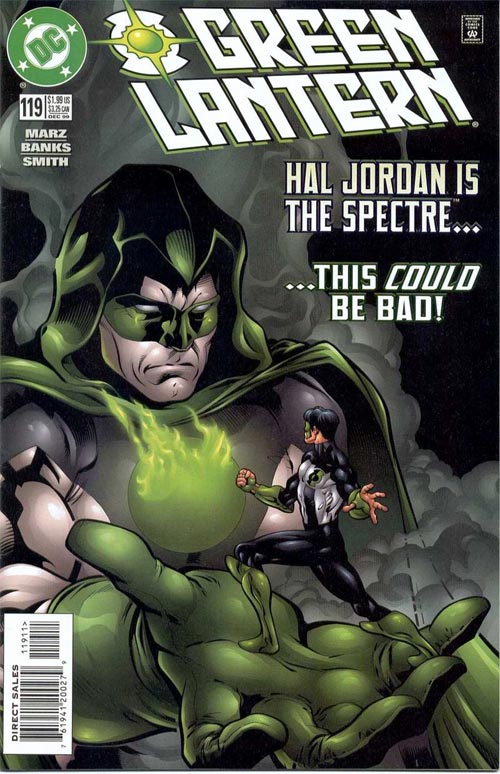
Green Lantern #119 (DC)
From 1999.
via DC Wikia
After his transformation into the Spectre, Jordan even had a whole series as the Spirit of Vengeance, but of course had to try out his new role within the pages of Green Lantern.  This was an issue I hadn't read previously.  Jordan sports, in human form, the same bomber jacket Geoff Johns would keep him in all the time.  In fact, this issue might even be considered a soft reboot for an era that hadn't been relevant to the characters for years.  It's very interesting to see that.


Jack Kirby's Galactic Bounty Hunters #6 (Icon)
From 2007.
via Comic Vine
Kirby nostalgia is something that never goes out of fashion in comics, where his legacy is still up for contention.  Since Marvel refuses to back away from its Stan Lee-heavy approach, it's up to everyone else and whatever scraps Kirby left behind to do the job.  Galactic Bounty Hunters is just one of the many obscure projects that attempt to fill that void.  One of the participants is Karl Kesel, who notably infused much of his long run on Superboy, including a version of Kamandi, with Kirby's ideas.  Kesel rarely gets enough respect for the work he's done.  It's not surprising to see him so closely linked to Kirby.  Hopefully he won't be entirely lost in the shuffle.  DC keeps making efforts, and clearly Dan DiDio is a big devotee.  Maybe he ought to bring Kesel back to give a helping hand.


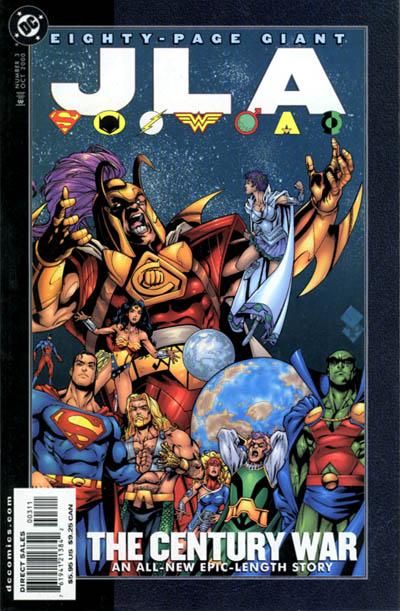
JLA Eighty-Page Giant #3 (DC)
From 2000. 
DC Wikia
After Grant Morrison's run that relaunched the team, I confess to have skipped out on pretty much everything that followed in the pages of JLA.  This one-shot provides a king-size story that revisits the era.  It's definitely not Morrison's JLA but it was certainly worth a look.


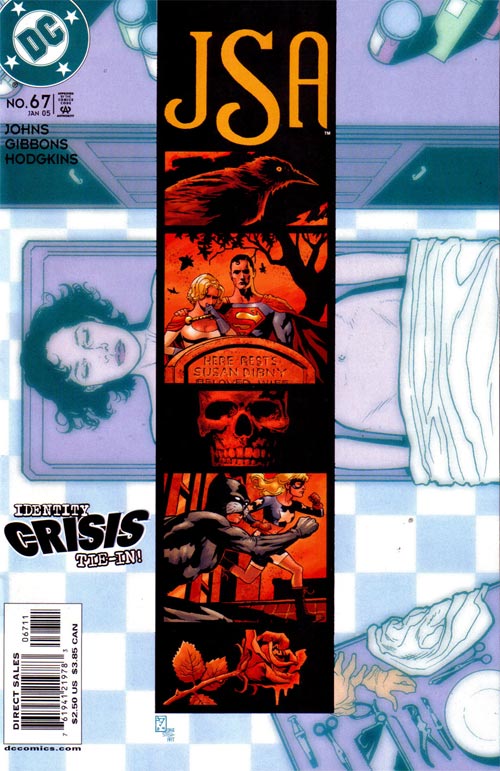
JSA #67 (DC)
From 2005.
via DC Wikia
As you might see on the cover, this ties in with Identity Crisis, but for me it's another glimpse into the whole Geoff Johns run, which I didn't follow regularly until the Justice Society of America relaunch.  A lot of the issue reflects on and interacts with Identity Crisis developments, but by the end spins off in its own direction with a different story entirely featuring a villain who probably wouldn't have been on the radar if Johns were working then the way he works now, or at least he probably would have handled the story differently.  Per Degaton certainly doesn't have the same resonance that Black Adam ended up having.


Tuesday, November 19, 2013

My All-time Favorite Comic Books, 20-16

Continuing my list:

#20. Grant Morrison's JLA

Creators: Grant Morrison, Howard Porter, Frank Quitely, various
Publication dates: 1997-2005
Issues: 1-17, 22-31, 34, 36-41, JLA: Earth 2, JLA Classified 1-3, One Million 1-4

The seminal point of 1990s DC comics where the icons started acting like icons again, setting the stage for how they would be uniformly depicted at the start of the new millennium, bringing together all the big guns back to the Justice League after years of second-stringer line-ups, arguably setting up the whole career of Geoff Johns.  This was Grant Morrison's version of the mainstream following notable runs in various Vertigo reinterpretations of heroes he was perhaps dooming once more to obscurity.  And he went big.  Every story an event.  The standout for me remains the "Rock of Ages" arc that reads like a preview of Morrison's later Final Crisis, with the particular highlight of #13, the "Darkseid Is" issue, one of the greatest scripts he ever wrote.  The sheer amount of imagination on display here, from the throwaway breakout character Tomorrow Woman to the Hawkman stand-in Zauriel who introduced an important piece of Morrison's mythology to the Ultramarine Corps and even Prometheus, one of the most important new villains of the past twenty years, and all the way to One Million, a vision of the future, there's so much to love here.  Needs reminding.

#19. Flashpoint

Creators: Geoff Johns, Andy Kubert
Publication dates: 2011
Issues: 1-5

The importance of this mini-series event in my personal comics experience cannot be overstated.  For a lot of fans, it became the gimmicky story that allowed DC to recreate its entire line-up from scratch with the New 52, but for me, it was a flashpoint of a different kind entirely.  (There's another Flashpoint, by the way, 1999's version from Pat McGreal and Norm Breyfogle, totally unrelated but perhaps equally worthy of inclusion on this list.)  I tend to like DC's alternate realities.  The Tangent experiment was for a long time a particular touchstone.  What sets this one apart is its clear emphasis on reflecting directly on known characteristics by turning them just a degree on their side rather than wholesale revision.  Most famously there was the Thomas Wayne Batman, who helps inform the story's emotional conclusion.  But it's really a story about Barry Allen, Geoff Johns' Barry Allen, a character he brought back in the same manner he'd done for Hal Jordan seven years earlier.  But he had this big story waiting for Barry, a piercing character study unlike any other crossover event before or since.  And I found what I've so far experienced of the spin-off books to be equally inspired.  I still intend to read through them all, but for now, the core title itself is more than enough to cement its place in my appreciation.  I was about to walk away from comics forever, half out of necessity and half because I'd lost my love for them.  And then this happened and reminded me about all the magic possible in the stories of costumes adventurers.

#18. Chuck Dixon and Devin K. Grayson's Nightwing

Creators: Chuck Dixon, Devin K. Grayson, Scott McDaniel, various
Publication dates: 1996-2006
Issues: 1-70, 101-106, 1,000,000 (Dixon), 71-100, 107-117, Nightwing and Huntress 1-4 (Grayson)

People like to make the comparison anyway, and it's a little easy in some regards, so let's go out and just say it: Dixon and Grayson's epic Nightwing saga was DC's answer to Frank Miller's classic Daredevil story about Elektra and the Kingpin.  Nightwing had Tarantula and Blockbuster.  It remains the longest and best Dick Grayson story ever attempted, creating an independent legacy for the first Robin's transition into his own man, and in some ways an impossible story to follow.  Many writers have tried, using some of the same basic elements, key among them being a relocation away from Gotham City, out from the shadow of Batman.  Dixon got the ball rolling with the introduction of a whole supporting cast, a battery of villainous foes to call Nightwing's own, most of them revolving around the auspices of Blockbuster, whose tragedy was that his moment of glory was interrupted by a health crisis.  Grayson picked up the ball and introduced Tarantula, a femme fatale who gave Nightwing his own Terra, and then plunged the hero into still murkier waters, which in some ways is also being revisited today.  It's unthinkable that one creator would follow another and not only complete their story but do it in such a fashion that not only remains controversial but elevated it to operatic proportions.  But that's what happened here.  The likes of which will probably never be seen again.

#17. Grant Morrison's Action Comics

Creators: Grant Morrison, Rags Morales
Publication dates: 2011-2013
Issues: 0-18

Morrison's All Star Superman was immediately recognized as its own kind of classic, depicting a version of the Man of Steel that spoke to the whole legacy of the character in much the way he would also do for Batman.  Yet his New 52 revamp may yet prove to be the more definitive.  Borrowing elements introduced by Geoff Johns in a different era of Action Comics, Morrison's Superman was a god among men struggling to be human and superhuman at the same time, drawing all manner of outrageous individuals towards him in the process, including the Legion of Super-heroes, Mxyzptlk, and a boy who stole his cape (the story in the 0 issue), plus one exceptional alternate reality (#9) that proves he can write a great Superman no matter the circumstances.  The ending should be viewed as a classic in its own right, how it turns into just another fight for the character who can sometimes be considered too powerful for his own good.  Morrison gets that, but that's nothing but an afterthought for someone who truly understands Superman.

#16. Stuart Immonen's Superman

Creators: Stuart Immonen, Karl Kesel, Mark Waid
Publication dates: 1994-2004
Issues: (as writer/artist) Adventures of Superman 530, 534, 573-577, Action Comics 738-748, 750-753, 758, Alpha Centurion Special Special 1, Superman: End of the Century, (as artist) The Final Night 1-4, Superman: Secret Identity 1-4

Here's a sorely overlooked milestone of the 1990s Superman comics, and to my mind the single best run.  There are a number of other issues where Immonen provided solely the art, but for my purposes here I'll stick with the ones he wrote and drew, because his talent in this dual capacity should be emphasized all the more for the reason that it's been overlooked since, plus two key projects where he provided only the art.  Simply put, Immonen's Superman was iconic simplicity, the exact opposite of everything the '90s are known for.  He also best depicted the Man of Steel's continuing fight against Lex Luthor, not the Luthor who was a red-haired clone of himself but one who formed his own budding supporting cast, including the since-forgotten Contessa, the only equal the criminal genius ever knew.  These are not only some of the best Superman comics, then, but some of the best Lex Luthor stories ever, highlighted by the brilliant Action Comics #741, in which Immonen juxtaposes the classic narrative of Chanticleer from The Canterbury Tales with Luthor's relationship to his infant daughter (another tragic lost element from this period).  It didn't matter which version of the 90s Superman was featured, whether it was Electric Superman, Mullet Superman, or Classic Superman, Immonen aced them all.  The Final Night remains one of the most unique event books ever in huge part to Immonen's art.  Until All-New X-Men he's never found a project nearly as worthy of his talents.

(All covers via Comic Book Database.)