Showing posts with label Howard Chaykin. Show all posts

Tuesday, April 28, 2020

Pandemic Comics #7 “Justice Leagues”

More comics from the Mile High mystery boxes! Apparently today is National Superhero Day? And apparently Marvel began it? Well, the comics I’ll be talking about, ah, were all published by DC. But the pandemic is teaching us the real superheroes probably have very different costumes than we previously imagined, and masks look very different, too.

Harley Quinn #1
Here’s the “newest comic in the mystery boxes,” from Rebirth, featuring the creative team from the previous series (Marvel’s Constant Reboot Engine sees this happen more frequently) offers a quick recap of relevant information, including Harley’s huge collection of sidekicks. And yet in the spotlight: Deadpool Red Tool.  This was a shiny Mile High variant cover, by the way.

Hawkgirl #54 
As far as I know, this is the only time Hawkgirl had her own book. Of course, it began as Hawkman (where it was written by Geoff Johns) and this issue features the return of Hawkman (probably?). But the good news is it’s from legends Walt Simonson and Howard Chaykin, which is a combination and a series that stood out for me back in 2006, but for some reason never actually read. So, another mystery box that finally addresses one of my comic book sins...

icandy #1
I think it’s the title. Yeah, the title. It’s a terrible title. The comic itself turns out to be pretty good (I mean, it’s written by Dan Abnett & Andy Lanning, the geek gods of that period), a concept that folds video games into a playable concept. I’m frankly shocked this hasn’t been done more, or more successfully. The last time I saw it was Heroes Reborn, which naturally was four seasons after the series was actually popular.

Ion #7 
A maxi-series starring Kyle Rayner post-Green Lantern: Rebirth (otherwise known as “Thanks, Torchbearer, you now get to join the Back-up Corps!), this is a fortuitous random issue, because it reunites Kyle with Radu, the coffee shop owner who was a signature element of Kyle’s early days as a Green Lantern. Ion was a concept they fobbed on Kyle as a consolation prize, before it was replaced by his becoming White Lantern, before he became, well, just another Green Lantern...At the time, I guess, I was still annoyed that “my Green Lantern” had been “kicked to the curb” (which happens to literally every Green Lantern not named Hal Jordan eventually), and so couldn’t properly appreciate Ion. Now it seems like correcting that amounts to another of my comic book sins...

Justice League America #61
The first appearance of Bloodwynd! And, ah, Dan Jurgens takes over the series! In hindsight, Weapons Master really doesn’t seem like that big a challenge. Prometheus was basically an upgraded version only a handful of years later, and even he quickly got turned into a chump. Lesson, villains? Don’t put all your eggs in a fancy gimmick giving you special weapons. Because the weapons can be, well, taken away...

Justice League Task Force #2
This particular Justice League series from the ‘90s will always be the most thankless. Literally its biggest claim to fame is an issue of “Knightfall: The Crusade,” with Crippled Bruce Wayne. This issue is kind of ironic in hindsight: Nightwing looks like a chump while desperately trying to prove he isn’t just a former Teen Titan and/or Batman’s sidekick. If Dan DiDio caught this issue, it might explain why he used to think Nightwing was superfluous...

JLA/WildC.A.T.s
This was a really nice surprise! From the Grant Morrison era, written by Morrison, and featuring Electric Superman (what a snapshot!), something I think I’ve read before, but I guess never really considered that significant. But it is a great little snapshot. But the name of Jim Lee’s big superhero team still sucks, at least as far as incorporating one of the most convoluted acronyms from a whole history of convoluted acronyms in comics...

JLA #79 
It’s always great to remember just how long and varied Doug Mahnke’s history at DC alone is (dude’s also the co-creator of The Mask!), and he’s as easy a talent to revisit for that reason alone as there’s ever been. His art, at least during his DC tenure, has been remarkably consistent, though endlessly adaptable...Hopefully will get a spotlight collection at some point.

Monday, October 27, 2014

Quarter Bin #56 "Binge-worthy I: Alan Moore"

These comics were sixty cents each.  The title of this column is inaccurate.

Recently the good folks at Zimmie's in Lewiston, ME (my history with this shop stretches back to 1992) indulged one of my worst habits: scouring bargain bins.  One week they had a whole table of long boxes filled with cheap comics.  I've made multiple surveys of their contents and come up with some fun reading.  This is the first in a series that explores what I found.

1963: Mystery Incorporated (Image)
From April 1993.
via Wow Cool
Alan Moore has become known for two kinds of comics: mature works that helped redefine the potential of the form, and nostalgic projects that looked backward at its most stereotypical instincts.  1963 comes from the latter instinct.  After Moore left DC and mainstream superheroes behind, he began a journey toward finding a new platform, which would eventually lead to Tom Strong and then League of Extraordinary Gentlemen, the ongoing project that has become his most notable recent output.  1963 is probably his thickest nostalgia act, something he pulled out for the budding Image line that was probably among its first material not to heavily rely on the reputation of its artist.  It's also the closest he's ever come to doing Marvel material.  For whatever reason, although he famously holds a grudge against DC, for which he created Watchmen, Moore has never even worked for Marvel.  Clearly, though, he was once a reader.  Mystery Incorporated is a pastiche of Fantastic Four, with four characters who have equally fantastic powers and little interest but quipping their way through the given crisis.  That's about all there is to find here.  That may be why only die hard Alan Moore fans even know about this particular effort.

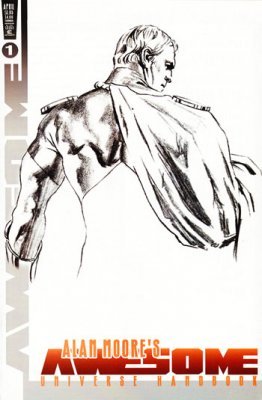
Alan Moore's Awesome Universe Handbook (Awesome)
From April 1999.
via Comic Book Realm
The bridge between 1963 and Tom Strong (as well as the rest of America's Best Comics) was laid down by, of all people, Rob Liefeld, whose Image offshoot imprint had a number of different titles but should best be remembered (and it should be remembered) as Awesome Entertainment.  Moore had previously helped relaunch Liefeld's Supreme as one of his nostalgia acts, a version of the Silver Age Superman (as last seen in the famous "Whatever Happened to the Man of Tomorrow?"), which led to his involvement with a rejuvenation of the whole Liefeld landscape.  This release detailed his plans for the whole thing, a rare public look at project proposals that only the name Alan Moore could possibly have justified.  There's Supreme, of course, plus Suprema (patterned after Supergirl), Glory (revamped as his version of Wonder Woman), and Youngblood (once and always the Avengers).  Alex Ross, still riding high at the time thanks to his Marvels breakthrough (with Kingdom Come yet to, well, come) provides the preview images of Supreme and family (including a Krypto equivalent).  The Moore version of Supreme remained relevant for years (in fact, Tom Strong and the whole ABC line was based off this work) and recently Warren Ellis has started building on this legacy within the pages of Supreme: Blue Rose (I've yet to read an issue, but am very eager to correct that).  This is really the only time I've been a first-hand fan of Moore.  The whole thing fell apart rather quickly when Awesome itself disappeared, and that was disappointing.

Albion #1 (WildStorm)
From August 2005.
via Comic Book Realm
This one was plotted by Moore but scripted by the team of Leah Moore (daughter of Alan Moore) and John Reppion (husband of Leah Moore), whom I've previously experienced in the excellent Complete Dracula adaptation.  It's sort of the British LXG mixed with Watchmen.  The title refers to an ancient designation of England itself, a sort of mythic version of the country.  This is the part where I admit I probably should reread this issue because it's pretty interesting, and this was my first exposure to the project.  Truth is, I tend to talk a lot of smack about Moore (Alan Moore, you understand), and this is in large part due to the fact that Moore himself has made it difficult to like him.  He's got a huge chip on his shoulder, a sense of entitlement he actually technically deserves as the most respected comic book writer of the past quarter century, which is also to say the most respected writer in comic book history itself.  But I also think he cashed in his chips far too early, burned bridges (on his end) at a point when he was really only beginning to explore his potential.  If you think his work as it is is impressive, it's my contention that his legacy could have been better if he'd simply gotten out of his own way.  An Alan Moore who continued to evolve, who looked forward (even if he mixed in looking backward, too) would deserve the contempt he holds over everyone else in the industry, whose viewpoint on superheroes doesn't look like it was frozen in the Silver Age and only looks otherwise at his say-so.  In short, someone who respects his contemporaries, and possibly even his own readers.

American Flagg! #40 (First)
From May 1987.
via Cover Browser
Although the series was created by Howard Chaykin, there's an Alan Moore connection, since he wrote material for a few issues.  Those were the days when Moore still played well with others, which curiously, as you've already seen me indicate, ended with Rob Liefeld (which would seem, by reputation, to be self-explanatory).  Chaykin, ironically, is the creator you get when you do everything right and you become a legend, but no one really seems to notice.  That's American Flagg! in a nutshell, too, one of those '80s projects that fell outside of the Big Two, that didn't involve superheroes, and wasn't written by Alan Moore (for the most part).  (Dean Motter's seminal Mister X is another example, although Dark Horse has been doing a commendable job at trying to correct this.)  The title of the series refers to Reuben Flagg (no relation to Stephen King's Randall Flagg!), who probably has more significance in a post-Girl with the Dragon Tattoo world, a man who tries to fight back against a corrupt system.  (Like Moore's fascination with Nixon, who's still president in Watchmen, this is a concept that probably made a lot of sense back then, and actually means more now than it has in a while.)  Chaykin still pops up regularly with new projects, but his profile is so far diminished that only the comic book industry itself still thinks he's important.  He's been forgotten by fans.  This issue wasn't written by Chaykin, however, but by the team of J.M. DeMatteis (who remains relevant as he works on various superhero projects at the Big Two) and Mark Badger, making it a creator-owned title that could also thrive in the hands of others (which is always rare).  If I'd had options, I'd have wanted one written and drawn in the inimitable style of Chaykin himself, though.

Tuesday, March 20, 2012

Quarter Bin #35 "Archive Edition!"

SUPERMAN/BATMAN #33 (DC)
From March 2007:
Back when I was researching appearances for Bloodlines character Sparx, I came across this comic, and mistakenly purchased the issue before it, which incredibly I had already read and/or purchased, so it was with much appreciation that I actually found the right one sometime later in the back issues bins at Heroes & Dragons. Turns out she only makes an appearance on the cover (along with Loose Cannon, among others), but that’s okay, because I can still enjoy the issue as a typical SUPERMAN/BATMAN experience. It may not be remembered in 2012, but this was one of the hottest books of the new millennium, a Jeph Loeb project that was basically the second coming of Grant Morrison’s JLA, a series that centered on iconic characters in iconic ways, only this time further consolidated to the two most important superheroes in the DC canon, strictly from their perspective. By the time the series ended, you might be forgiven to having forgotten that it was an important book, because it had degenerated in significance in much the same way JLA did after Morrison left, how important readers then considered it. Mark Verheiden concludes his tale of an alien invasion revealed to be the work of Despero, a Justice League villain who has not been seen as a major threat for years. The twist is that all of Earth’s alien champions are turned against humanity. In a longer story arc, this would have had much more impact. Centralized on Superman and Batman, as is necessary in a series called SUPERMAN/BATMAN, it works better than it should, with Alfred serving as narrator and focusing on Batman’s perspective.

STAR TREK: DEEP SPACE NINE #6 (Malibu)
From January 1994:
Star Trek has been subject to one of the comic book medium’s worst hot potato games. Marvel had the property, then DC, then Malibu jumped into the game with DS9, and then Marvel had it again, and now IDW has it (and has, pound-for-pound, done the most good with it). Unlike Star Wars, which has called Dark Horse home for years, Star Trek had new screen material being produced throughout this period, and so that’s probably why it happened, and probably why there’s been so many interpretations about what exactly a Star Trek comic should be. (Dark Horse, meanwhile, launched immediately into the same kind of adventures the books started doing, only vaguely related to the screen material, though you won’t hear the fans of these efforts complaining, which I would say is a problem.) The DC material started out trying to fill in gaps around the original movies, and then things grew complicated when THE NEXT GENERATION premiered, and grew still more complicated when DEEP SPACE NINE came about (hence why Malibu produced this comic, and not DC). VOYAGER had a comic when Marvel had the franchise again, but only briefly. ENTERPRISE, so far as I know, has still never been represented in comic book form. I have not read enough of the results in any form to make a total judgment on the efforts, but I will never make the argument that the comics are an adequate substitute for the shows (or movies). (The books aren’t, either, but there are fans here, too, who curiously have tried to make that argument for years.) I bought this issue because it seemed like the most likely one in the available selection to give its best foot forward, with a cover that suggested Sisko would be dealing with the emotional baggage of Wolf 359 (if I need to explain that, then you shouldn’t be reading any of this particular entry). Turns out there are three stories in this issue, and each of them seem to be geared for younger readers, which is a disappointment to an older reader, especially one who knows in 2012 that older viewers were exactly the intended audience for DS9, even if the series was slow to reach that point. True, the early seasons could be a little deliberation in presentation, but episodes like “A Man Alone” and “Duet” from the first season, for instance, demonstrate a maturity that Star Trek had rarely attained previously. I would have hoped that comic books made after these episodes (the entire comic book, in fact, was only launched after the first season had concluded, a point brought up in the letters column) would have reflected that quality. These are not notes from a sour fanboy, because god knows there have been plenty of notes from sour Star Trek fanboys on the Internet, but reflections from a comic book fan who wanted to see what was out there. This is what he found.

CHALLENGERS OF THE UNKNOWN #6 (DC)
From January 2005:
Visitors to this blog should already know how I’ve come to cherish the Loeb/Sale Challengers book that was created more than a decade prior to this particular effort, and so you’ll know why I gave it a shot. The creator is Howard Chaykin, and as with every other work by Howard Chaykin it’s quintessentially Howard Chaykin in nature. (That’s another statement I will not explain if you don’t understand it already.) Howard’s someone who plays by his own rules, and so when he gets his hands on a property like the Challengers, you ought to know that it won’t be like anything else you’ve read under that name. In fact, he’s got his own team, and this mini-series (with this being the concluding issue) was an origin that I assume led to nothing else, which is another shame (and maybe this is another Challengers comic that I will have to track down and read in its entirety, which is exactly what happened a year ago). Other than being a tad confusing, it’s brilliant. (My favorite Chaykin is the DIE HARD: YEAR ONE book he did for Boom!, but then, I haven’t read too much, considering he’s got a long career beyond what I’ve experienced, and he seems to specialize in standalone projects that are best remembered by Howard Chaykin fans…and I have a hard time finding other Howard Chaykin fans beyond the publishers who keep giving him paychecks.) Wow, so what have I actually said about this one? I’m afraid I’m making Howard out to be a boogeyman. What I’m really saying here is, if Howard Chaykin is attached to a project, it’s worth checking out, and if the Challengers, in whatever form they take, are involved, it’s worth checking out. And combined? I’m going to have to check it out…

CEREBUS ARCHIVES #1 (Aardvark-Vanaheim)
From April 2009:
The title of this column finally becomes clear! I bought this issue in the hopes of finding actual Cerebus material, but that was not to be. This is literally archive material, but not Cerebus in nature; rather, it’s David Sim’s own history. CEREBUS is one of the most important comic books of the last forty years, the longest-running independent work, not simply from a single creator, but period. Back in 2004, I had the chance to read the final issues, because I was just getting back into comics, and the final issues were being published, but I was not prepared to appreciate that fact, and so I missed the opportunity and Heroes & Dragons was not prepared in 2011 to compensate. Instead there was this. (I bought the first issue of Sim’s follow-up work, GLAMOURPUSS, when it came out, but didn’t attempt to continue reading that series.) I suppose it’s interesting to learn how militantly Canadian Sim was in those days when he was trying to break into comics, but I really wanted to read me some Cerebus. That will just have to be one of my quests.

Monday, October 17, 2011

The New 22

Confession time: this reformed Comics Reader comics junkie has been relapsing in the past month, thanks to the dastardly “New 52” from DC Comics. I’ve made several trips to Heroes & Dragons, and even bought some comics at Barnes & Noble (the evil remainders from the loss of Borders). Heroes hasn’t exactly made (or perhaps been in the position to) a solid effort to support the “New 52,” so there are notable omissions from the comics I intended to at least sample, including NIGHTWING, RED HOOD & THE OUTLAWS, WONDER WOMAN, and BLACKHAWKS). I’ve heard plenty about the supposed controversy surrounding “sexy” Starfire in OUTLAWS, disappointment that DC didn’t take the opportunity to align their comics version of the character with the cartoon variation kids enjoyed last decade. Maybe I was concentrating too much on Jason Todd finally getting his own series, but I never saw this one coming. If none of those kids picked up an actual regular DC comic in all the time since TEEN TITANS animated itself on the small screen, “New 52” would never have made a difference. Starfire in OUTLAWS is perfectly consistent with the character as comics fans have known her since her debut. Why should that have changed? Because some Internet commentators wanted to draw attention to themselves?

Anyway, so as suggested, I bought twenty-two new comics over the past handful of weeks, not all of them from the “New 52,” so let’s dive in without further adieu.

GREEN LANTERN: NEW GUARDIANS #1 (DC)
Kyle Rayner debuted eighteen years ago in the aftermath of Hal Jordan’s descent into Parallax. Writer Tony Bedard, charged with launching a new series featuring Kyle, figured it was a great time to remember the circumstances fans first got to know him, as a recipient of a ring from the apparent last Guardian of the Universe, Ganthet. The thing I’ve liked about Bedard (career highlight: THE GREAT TEN) is his sense of context and continuity, not just continuity itself, but how it fits into a given story. Here he continues the same general continuity the Green Lantern franchise enjoyed before the “New 52” reboot, with a story about various members of the spectrum corps (Red Lanterns, Sinestro Corpsmen, Star Sapphires, and the Indigo tribe) losing their rings, which come into the possession of Kyle Rayner. Naturally, none of them are very happy about this, and just as he was eighteen years ago, Kyle is just as confused by events. I heard this comic referred to as a reboot of Kyle’s origin, which it isn’t (though, sadly, the iconic NIN shirt is gone), since it clearly moves a different story along, a new one, which expands and develops things we’re already familiar with. That’s what makes Bedard so valuable a commodity at DC, that he’s able to do this with a wide variety of characters most creators and readers wouldn’t even have considered briefly, certainly not in the way he does. I look forward to the day his skills are widely appreciated. Being a part of the “New 52” certainly can’t hurt those chances.

FAME: CONAN O’BRIEN (Bluewater)
Formerly the home of indy superhero comics, Bluewater has reshaped its identity in recent years as the biographer of choice for pop personalities, hoping to carve out a niche in a crowded market. Like the above title, I got this one at Barnes & Noble. Conan is certainly a remarkable figure, a cult favorite among humor aficionados and subject of the latest TONIGHT SHOW controversy. Most fans are already familiar with the outlines of his career, including his stint as writer for THE SIMPSONS, but this is a nice summary of his life to this point.

THE SHADE #1 (DC)
As an earlier blog indicated, I’ve become a fan of James Robinson’s STARMAN, and so eagerly anticipated an announced Shade follow-up mini-series, though I had no idea when it was scheduled to be launched, being somewhat out of the loop these days. As it turned out, earlier this month, which I found out with perfect timing. The Blackest Night STARMAN #81 issue was a great reminder that Shade is a worthy and engaging subject in himself, and this first issue of his own book more than supports that belief, both supporting his mystique and subtly pushing at its boundaries. Given that this will be a full twelve issues, one might almost wonder why DC didn’t make it a part of the official “New 52” slate, given that it’s hardly likely all fifty-two titles will survive to even that length, but I guess “optimism” was the word of that particular day.

AQUAMAN #1 (DC)
The subject of so many attempts at ongoing series that a cornerstone of DC became a very public joke (as Raj on THE BIG BANG THEORY says, “Aquaman sucks”), it’s a wonder this guy was tapped by none other than Geoff Johns to be his next big project, beginning in the pages of BRIGHTEST DAY. Here, as in that book, we have ample reason to believe Johns knew exactly what he was doing, since once again he seems to have grasped what so many writers before him failed to, and that’s the intrinsic worth, and not just the mythology, of the character. That is to say, Johns understands what Aquaman is, what he’s about, and his potential as the star of his own series, not just as the dude who talks to fish and is associated with an underwater kingdom. So many writers have attempted to do everything but (the cosmetic changes Peter David created were a good effort, but didn’t really affect the intrinsic perception that Aquaman himself wasn’t interesting), even replacing him with an heir (Tad Williams did a good job to that end, to little credit), it’s refreshing that someone the caliber of Geoff Johns is finally taking the direct approach, while Aquaman actually has some momentum (both from BRIGHTEST DAY and a key role in FLASHPOINT).

ANIMAL MAN #1 (DC)
Jeff Lemire is the latest of the fresh faces to be called up to the big leagues, and this book absolutely has the feel of Grant Morrison’s own ANIMAL MAN, a piercing look into the character’s greater potential, not just “dude who can mimic animals.” Ever since Morrison, DC has had some idea that Buddy Baker is a worthwhile property, and since 52 he’s been the subject of perennial efforts to keep his name in the air, even the subject of a “last days” mini-series that was mildly intriguing, but seemed to take him back a step, keeping the focus on his apparent Starfire obsession and off his potential. Lemire seems to have done everything possible to take Buddy back to the land of Morrison, short of actually copying the metaphysical ambitions. Instead, he seems to have discovered that Animal Man, at his best, may in fact be ideal material for horror.

MARVEL SEASON ONE GUIDE (Marvel)
This was a freebie (always nice!) advertising the company’s 2012 slate of “season one” graphic novels, which seem to be as much about giving readers a starting point for Marvel’s most popular characters as providing a spotlight for creators they might expect to join their “Architects” in the future, including writers Roberto Aguirre-Sacasa, Anthony Johnston, and Cullen Bunn. I’m not convinced these things are going to be anything but fairly standard origin rehashes, based on the previews, which is kind of disappointing, but the idea may yet be worth keeping in mind, especially for a company apparently convinced, Ultimate comics aside, that continuity is something that fits in a comics bin.

SEVERED #3 (Image)
Scott Snyder is a writer everyone seems to have become excited about. Whether in the pages of AMERICAN VAMPIRE, DETECTIVE COMICS, or the “New 52” BATMAN, he’s being hyped as the next big thing. This is a more modest-sized work, but has a ton in common with AMERICAN VAMPIRE. Co-written by Scott Tuft, it’s another urchin’s tale of running into unexpected danger, and on that score is a little disappointing to see so directly reflected in other work, no matter how engaging this particular iteration may be.

AVENGERS 1959 #1 (Marvel)
Howard Chaykin is one of those veteran-of-many-decades creators who just keeps working, seemingly any way he sees fit (DIE HARD: YEAR ONE was a recent favorite), regardless of how little acclaim he unjustly seems to enjoy these days. This book is set in the Marvel proper, so features Nick Fury as he’s been traditionally depicted (how confused fans of the movies and comics must be, far more than those disgruntled Starfire fanatics!), so no Ultimate Samuel L. Jackson here, and comes packaged with a bunch of known historical figures, including Victor Creed (Sabretooth), Sergei Kravinoff (Kraven the Hunter) and Aquaria Nautica Neptunia (Namora), a sort of full-Marvel version of Jonathan Hickman’s S.H.I.E.L.D. As usual, Chaykin dives right into his adventure, all fast and loose, allowing the clash of male and female impulses drive his scenes without concern to unwarranted feminist complaints. Any time there’s new Chaykin, there’s cause for celebration. Anytime an Avengers project doesn’t follow the Bendis Expansion Principle or cater to the upcoming and extant film work, it’s got to be worth applauding.

VENGEANCE #3 (Marvel)
Joe Casey must be some kind of madman, since he’s unleashed this madcap superhero adventure and nobody seems to have noticed. “Madcap” is the only way to describe it, and “madman” is the only way to characterize Casey, since there’s no other explanation possible, for work of this quality that has gone completely under the radar. VENGEANCE is one of those comics that hopes readers will somehow be able to keep up, because it proceeds at a breakneck speed, exactly how real superheroes in the traditional comic book sense would probably be operating, with all typical restraints finally loosed. The “Brand New Day” Doctor Octopus is featured here, along with a slew of new heroes. All of it would probably make more sense if I’d read the first two issues first. But the energy is catching.

STAR TREK #1 (IDW)
Mike Johnson and Stephen Molnar make an ideal team to begin the further adventures of the J.J. Abrams-verse, adapting episodes of the original STAR TREK TV series, beginning with “Where No Man Has Gone Before.” Introducing Gary Mitchell into this reality is the most interesting aspect of the issue, since this new Trek needs at least one character to draw upon to work properly. It’s a little disappointing that the comic ends up feeling episodic, especially since it’s the first new adventure featuring characters who spent most of their time defining themselves in a fast-paced quest, but if Mitchell is to be our anchor, it’s at least appropriate.

THE FLASH #1 (DC)
I was disappointed to learn, initially, that Geoff Johns wouldn’t be continuing with Barry Allen into the “New 52,” but FLASHPOINT was such a seminal story for the character, it would almost have been a backwards step for Johns to try writing the way he had since FLASH: REBIRTH, since Barry had finally overcome the death of his mother. Francis Manapul, who was Johns’ artist on the last relaunch, instead gets to drive Barry along a kinetic new arc, one that hues to the spirit of the character’s latest incarnation without needing to be mired in the same morass writers not named “Mark Waid” or “Geoff Johns” could sometimes tend to recently. If the “New 52” is all about getting to the heart of its featured characters, then this book is, as it should be, a prime example.

ULTIMATE SPIDER-MAN #1 (Marvel)
For the second time, the Ultimate line ended a major event with the death of Spider-Man. The difference this time is that it appears to have stuck, with Brian Michael Bendis continuing his adventures with the name, but this time with a different face underneath, the much-publicized Miles Morales. I often seem to criticize Bendis as being something of a hack, but the truth is, I’m simply not invested enough in Marvel to follow his stories, not because they’re too dense but because they require more love for the characters he uses than I have to give. His Ultimate Spider-Man was always an exception; Bendis alone seems to have understood the potential of this line, and that’s no doubt a prime reason for why he’s most identified with it. The chance to redefine Spidey, then, must have been irresistible, after more than a decade setting a new record in more ways than one (not just the Lee-Kirby FANTASTIC FOUR count, but overall dedication to a single character), to add to his legacy by replacing the iconic Peter Parker in the only venue readers would have accepted it as anything but temporary. So how is Miles in reality? His seems to be a story ripped straight from LOST, a youth caught in the middle of a struggle between father figures (or, Walt between the dueling Michael & “Mr. Locke”). This could very well define Brian’s legacy.

GREEN LANTERN CORPS #1 (DC)
Peter J. Tomasi has gone from editor to one of DC’s most important writers, so it’s no wonder that he’s among the prominent names of the “New 52.” Relaunching the title that sheds a little more expansive light on the Green Lantern mythology, but putting the focus on Guy Gardner and John Stewart, Tomasi uses the opportunity to take a look at their character in ways that haven’t been seen in a while, not just as members of the Corps, but as humans who had regular lives and concerns outside of their identities as role models and heroes. There’s also a quintessential galactic mystery they join their colleagues in discovering, but it’s nice to see Gardner and Stewart receive some attention.

RED LANTERNS #1 (DC)
I had a goal to read all four of the Green Lantern offerings from the “New 52;” this was the one I was most skeptical about, since I wasn’t sure the Red Lanterns deserved their own series above some of the other spectrum corps (how interesting would it have been to follow Saint Walker on a monthly basis?). Peter Milligan, like Geoff Johns, seems to have appreciated Atrocitus as a worthy tragic figure, though, and in this issue even suggests an origin for a human member of this vengeful corps, which may prove the greater hook for the series, once the early issues play out. There’s definite potential in this one.

GREEN LANTERN #1 (DC)
Geoff Johns, the incredibly busy man that he is, stuck around one of his signature series after the big reboot, with the improbable redemptive arc for Sinestro continuing, as he offers a unique bargain with Hal Jordan by the end of this issue. Hal, meanwhile, also does a good job of screwing up his ring-free prospects, including a date with Carol Ferris that ends badly. It may seem redundant for viewers of the recent movie, to have this relationship misfire again, but in the comics, they’ve been apart literally for decades, even though in their first appearances Hal and Carol promised to be typical comic book romance material. Well, all those other relationships eventually ended up in marriage, while this one hasn’t. I have a feeling that Johns is driving at an eventual happy culmination. The one criticism I’ve had of his Green Lantern work is that he’s often had Hal a slave to the latest crisis, but with “War of the Green Lanterns,” he was once again stripped of his duties as space cop, forcing him to resume a normal life. Geoff understands character too well (see his work with Barry Allen) for this to be a coincidence.

SUPREME POWER #4 (Marvel)
Kyle Higgins was announced as the writer of the NIGHTWING “New 52” relaunch, which I initially found underwhelming, since I’ve been a big fan of Dick Grayson for as long as I can remember. If he wasn’t going to be Batman anymore, and reclaimed the Nightwing identity, then I hoped DC would continue to show him the same support he’d gotten as the Dark Knight, when he was written on a monthly basis by Grant Morrison, Scott Snyder, and Tony Daniel. Who’s this Kyle Higgins, anyway? So I eventually found out. Higgins had a number of projects he was working on recently, including this latest iteration of Marvel’s Squadron Supreme. Published under the MAX line, this one’s an adult read, as mainstream superhero comics go, but Higgins seems to have concentrated all his attention on the characters in the story, their psychology. It’s a good indication that Dick Grayson is in good hands.

MISTER TERRIFIC #1 (DC)
This was one I was tremendously excited about, since Michael Holt is one of the most important characters of modern DC comics who hasn’t until this point gotten his own book. Imagine my slight disappointment, then, when writer Eric Wallace spends a cursory among of time establishing Holt’s undernourished backstory, and instead plugs him almost directly into a fairly generic adventure. This isn’t to say that I’ve lost faith in Mister Terrific as a lead character or this series in itself, but that as introductions go, it was probably the least impactful of the “New 52” I’ve had a chance to read. There’s also the whole future son thing and the Power Girl/latent Justice Society connection which prove fruitful, the real upsides of this debut.

BATMAN: GATES OF GOTHAM #5 (DC)
Kyle Higgins again, plus Scott Snyder (again!) revisiting Gotham City’s past, plus famous fathers like Thomas Wayne. As an origin for the Architect, it’s certainly one of the more compelling projects the Batman mini-series pool has developed in recent years, something Paul Dini easily could’ve done in STREETS OF GOTHAM (which I say as a compliment), and serves as a credit to both Higgins and Snyder.

INCREDIBLE HULKS #635 (Marvel)
The last time I read a Hulk comic, it was when Jeph Loeb finally revealed the secret origin of the red version in the franchise’s other ongoing series (strange that there was finally more than one), and I’ve been no great devotee of the jolly green giant, believe me. This issue was really no different, but what made it special was that it was Greg Pak’s last, and through his and Fred Van Lente’s work with Hercules and Amadeus Cho, I’ve come to be a great admirer of Pak’s efforts. There’s a lot of celebratory essays in this one, expounding his legacy on the title, and I confess that I felt kind of bad not having read some of the truly memorable adventures I found recounted. Well, there’s always tomorrow. In the meantime, cheers, Greg Pak!

COBRA #4 (IDW)
One of the bad things about having cancelled my Midtown subscriptions is that I’ve effectively cut off my link to the best G.I. Joe book being published, which was recently relaunched without the enemy’s name in the title. Writer Mike Costa (who began these efforts with Christos Gage, but has been flying solo for a while now) and iconic series artist Antonio Fuso continue their great psychological games with Major Bludd, another key but often underrepresented member of the brood, as the search for the new Cobra Commander continues in the midst of the Cobra Civil War. The impact of this series, through its several incarnations, is so great that it forced the tie-in Civil War arc across IDW’s Joe line, even though its has yet to receive its critical or popular due. I remain an enthusiastic champion, no matter if I read it regularly or not.

WONDER WOMAN #614 (DC)
Phil Hester concludes J. Michael Straczynski’s “Odyssey” in the final issue of the series (I was interested in but missed the “New 52” relaunch). Though still laden with bluster rather than intrigue and development, Hester’s version of the story is more rewardingly detailed, which just begs the question of what he might have done if he’d had free-reign on the franchise. Maybe some day.

SPIDER-MAN: WITH GREAT POWER COMES GREAT RESPONSIBILITY (Marvel)
Reprinting ULTIMATE SPIDER-MAN #33 (in which the Venom saga begins), ULTIMATE SPIDER-MAN #97 (in which the Ultimate Clone Saga begins), and ULTIMATE COMICS SPIDER-MAN #1 (in which the last reboot began), this is a fine sampler of Brian Michael Bendis’ work as I was indicating earlier, and was no doubt printed with exactly that retrospective aspect in mind.

I have also read and enjoyed ACTION COMICS #1 (with Grant Morrison in full force refashioning the Man of Steel for modern times), BATWING #1 (with truly exceptional art from Ben Oliver), JUSTICE LEAGUE #1 (Geoff Johns and Jim Lee going All Star, as I’ve stated in the past), DETECTIVE COMICS #1 (Tony Daniel introducing a creepy new Batman villain in the most effective way possible), STATIC SHOCK #1 (featuring Scott McDaniel unleashing his full creative force), and STORMWATCH #1 (Paul Cornell melding Martian Manhunter with WildStorm’s Finest).

But, I’m a recovering addict. Really!

Thursday, June 2, 2011

Whatever Happened to the Lex Luthor of Tomorrow?

I would call it something of an irony. No, not that I will be talking about yet another trip to Escape Velocity after I’ve “quit reading comics.” When DC unleashed INFINITE CRISIS some five years ago, it accompanied the event with a “One Year Later” gimmick across its line of titles, a chance for every character to reboot with a new starting point in the near future. I mention this in relation with the “Up, Up, and Away” arc that Geoff Johns and Kurt Busiek wrote for ACTION COMICS, a story that pitted Superman once again with his archnemesis Lex Luthor. Recently, within the pages of the same series, Paul Cornell brought Luthor through “The Black Ring” arc, and once again a defining showdown with the Man of Steel, culminating in ACTION COMICS #900. And then DC announced that it would be rebooting its entire line, this time from a newer, earlier starting point, in conjunction with another Geoff Johns event, FLASHPOINT.

Anyway, that’s the irony. Don’t know how many others have made that connection. Last time DC rebooted, it was Superman everyone wondered about. You know, Alan Moore’s classic “Whatever Happened to the Man of Tomorrow?” It’s nice to see Luthor at the center, since in many ways, he’s never seen better character work than in the past fives years, notably “Up, Up, and Away” and “The Black Ring,” of course, stories that not only justified his legendary rivalry with Superman, but pushed it to cosmic proportions, yet never forgetting that unlike his enemy, Luthor is just a man, someone driven so insane with jealousy that he can ignore a great deal, even a scenario that gives him all the power in the world, quite literally. That’s what you call understanding character. And where does he go from there, anyway? Where else but a reboot, so he can start all over again?

Only DC knows the specific details about what will actually happen at the end of the summer, so I won’t spend a lot of time speculating, and yes, I’m not technically, actively reading comics anymore, so why should it matter to me? Because I still like to consider myself as a champion of the medium. Comics have only gotten better, off the backs of WATCHMEN, THE DARK KNIGHT RETURNS, James Robinson’s STARMAN, Mark Waid’s THE FLASH, Neil Gaiman’s SANDMAN, Y: THE LAST MAN, Geoff Johns and Green Lantern, Grant Morrison and Batman. If you still choose to consider them as juvenile, then that’s your choice. That’s your loss. It’s the whole reason I can’t take manga seriously. Those are comics which are hopelessly lost in juvenile ideas. That’s their whole point. That’s why they’re synonymous with their animated counterparts, anime, and why American comics are better translated into live-action film, like THE DARK KNIGHT. Christopher Nolan can do Batman. I don’t think anyone would care to see him do NARUTO.

The unabashed excuse for this most recent trip to Escape Velocity was the second chance to read ACTION COMICS #900, both for the “Black Ring” conclusion and the already-controversial Superman-renounces-American-citizenship story, which as it turns out isn’t in Paul Cornell’s main story but one of a few celebratory shorts, and is from the hand of screenwriter David S. Goyer. The whole comic is exceptional, from Cornell and Pete Woods (on his final work with Superman, at least for a while), which both concludes their own story and segues into “Reign of the Doomsdays” (the eventual trades will probably help distinguish them) to the Goyer piece that is eerily prescient for the wave of revolution in the Middle East he couldn’t have fully appreciated when he was writing it, to a Geoff Johns and Gary Frank personal interlude (something they rarely had a chance to do when they were on the book) to excellent additional contributions from Damon Lindelof (exploring a little-considered moment in Jor-El’s famous story with Ryan Sook), Paul Dini (with an instant-classic that takes a far wider examination of Superman than almost anyone else has ever considered), and finally, Richard Donner, who proves he still has a keen understanding of the character he once emblazoned onto the big screen. I knew I wanted to read two of these stories, but all of them are better than anyone had a reasonable ability to anticipate. A strong contender for best single issue of the year.

Do I feel ashamed to have once again broken my vow? Well, considering that I successfully broke the regular habit, not at all. Even if I’ve read perhaps more comics this year than I technically should have, I figure it’s worth it, especially when something like ACTION COMICS #900 comes together. The rest is icing:

FLASHPOINT #1 (DC)
I’ve already mentioned my extreme interest in this one, my enthusiasm for clever alternate versions of familiar characters and situations. But reading this, which many readers and critics seem to have found very easy to either downplay or outright dismiss, is far, far better than I might have expected, too. The narrator comes out of leftfield, and makes the whole issue read even better than it does initially. Geoff Johns is becoming a true master, and this one may actually be his masterpiece.

RASL #10 (Cartoon)
Jeff Smith, meanwhile, continues his subtle storytelling in RASL, not a marked contrast from BONE so much as a welcome evolution of it, with most of the fuzzy layers entirely removed, but not the intrigue. In fact, that’s what this book is all about, a heady trip that proves endlessly fascinating, even though it’s a long wait between issues, especially for something this fascinating. I hate to keep using the same terms with completely different books, because it begins to seem as if I view everything the same way, and therefore diminishes the impact of all my opinions. But I like to read what I like, and if what I like doesn’t compel me to similar observations, then I’m just wasting my time, aren’t I?

KIRBY: GENESIS #0 (Dynamite)
Alex Ross has finally hit on his next great comic, and it’s been a long time coming. To my mind, he has only two great titles in his career, the big ones, MARVELS and KINGDOM COME, and everything else has simply been him attempting to milk the reputation he gained on those books, any way possible, any way necessary, and that was never more evident than with the generic material he worked on with PROJECT SUPERPOWERS. The problem was that he began believing that he was as much a part of the creative force that resulted in his two great works as all his supporters kept saying. That simply wasn’t the case. He needed substantial help to reach those levels, and he had it in Mark Waid and Kurt Busiek, the latter of which is back to help bring this ode to Jack Kirby’s legacy into reality. It also doesn’t hurt that, once again, though Ross isn’t providing the regular interior art on his own, he finally has someone worthy of making it look respectable, even sensational, in Jack Herbert. That was another failing of PROJECT SUPERPOWERS. In short, everything comes together nicely in this book. Should definitely be worth reading.

BATMAN AND ROBIN #22 (DC)
Peter Tomasi and Patrick Gleason worked magic in the pages of GREEN LANTERN CORPS, and were rewarded with another tandem assignment. Even though few readers were ever to likely care as much about this title upon Grant Morrison’s departure, Tomasi and Gleason are reason enough to justify keeping it around, no matter how much longer that actually is. The biggest question of the post-reboot DC line is what will become of everything that has developed with the Batman titles in recent years. Will Morrison get to finish his epic in a kind of pocket universe? I certainly hope so…

THE L’IL DEPRESSED BOY #4 (Image)
One of those indy books with a great level of buzz to it, and certainly enjoyable. But really, I can’t help but think of Image as a whole as something of a USA Network of the comics medium, where quirky diversions come to stay.

DC COMICS PRESENTS: SON OF SUPERMAN (DC)
One of the deluxe reprints DC has been doing recently, in one-shot form, when the possibility of a standard trade isn’t particularly relevant. This one’s a real find, an alternate version of Superman from the mind of Howard Chaykin (but probably owes its return to the art of J.H. Williams III). Wondering what would become of Superman if he were to actually produce an offspring, this is truly fascinating, landmark material, almost a DARK KNIGHT RETURNS for the Man of Steel.

From here, a couple of not-necessary recent dollar reprints I decided to pick up:

HELLBLAZER #1 (Vertigo)
Circa the “What’s Next?” campaign inspired by the WATCHMEN film, a reprint that conveniently now allows me to sample John Constantine upon his recent return to the DC mainstream.

I KILL GIANTS #1 (Image)
Like L’IL DEPRESSED BOY, quirky material, satisfying and enjoyable, but still begs the question, if Image allows its creators complete freedom and this is the material they produce, doesn’t the company ever bang its head against the wall and wonder where all the truly epic, literary stuff might be? Sure, you can have your SPAWN, your WALKING DEAD, and all the fun comics you can shake a stick at, all the stuff fanboys say is “missing,” or simply isn’t superhero material, but I figure there should at least be some part that yearns for real posterity.

SERENITY #1 (Dark Horse)
For some reason, I’ve found it easier in recent years to support Joss Whedon’s FIREFLY franchise than when it was actually on TV, or the big screen, possibly because, in many ways, this is, well, Image material at heart. If Joss ever got out of his own way, he could produce truly great stories. But he still seems perfectly happy to be shackled by his own irony. Not that there’s anything wrong with that.

Thursday, March 10, 2011

Quarter Bin #5 "From an Actual Quarter Bin, Part 2"

This is the other great batch of actual quarter bin comics, the second haul from last summer, when I really buckled down with the targeted picks. Once again, the selections are from Escape Velocity in downtown Colorado Springs. Because there are so many, I will skip further introductions and dive right in:

THE 99 SPECIAL (Teshkeel Comics)
From 2007; I had originally selected this one in anticipation of the then-upcoming DC book that saw this team return in a mash-up with the JLA, so obviously the topicality has come and gone. In many ways, I still wish Fabian Nicieza were the dominant creative voice here, since there’s so much potential that just sort of gets left on the floor, a problem that continues to this day. This particular comic, though, was a good find, because it’s an origin issue, so I was at least able to dive rather directly into the 99’s story.

AMERICA’S BEST COMICS PREVIEW (Wizard)
From 1999 (originally presented with WIZARD #91); I suppose in hindsight Alan Moore’s ABC comics were even more important than they seemed at the time, since they represent the last time he was truly committed to the mainstream, before he became completely disillusioned with one too many movie adaptations he felt didn’t do his comics justice. Is it an irony that no one ever moved to make a film of this work?

AMERICAN CENTURY #9 (Vertigo)
From January 2002; Howard Chaykin is an icon who has completely transcended every traditional comic book expectation, and I’m still waiting for him to truly receive his due. This book, however, possibly because he doesn’t supply the art, doesn’t help do him justice.

ANIMAL MAN #22-24 (DC)
From April, May, and June 1990; these were among my happiest finds, some of Grant Morrison’s later issues in his acclaimed run. I was all of nine years old when these were originally released, so even if I had been reading comics at the time, there’s no way I would have been reading them, or at least appreciating them. The book that made Grant’s reputation is of such mind-boggling scope that it’s little wonder that he struggled for years to find a proper follow-up (he’d presented his masterpiece, ARKHAM ASYLUM, a year earlier, but I hope to write more about that at a later date), spending time with the surrealistic odyssey THE INVISIBLES before going mainstream with JLA in anticipation of his Batman work a decade later. I didn’t have any experience with ANIMAL MAN until reading the DEUS EX MACHINA trade only a few years ago, and these issues represent part of the arc collected in that climactic story that shattered storytelling boundaries. Having apparently peaked so early (what other writer has ever approached such transcendent material?), Grant then had to tackle the matter of how to make the traditional material better than it’s ever been. Well, that’s my argument, anyway…

ASH #1 (Event)
From November 1994; now that he’s stepped down as the head honcho at Marvel, maybe Joe Quesada will go back to making comics on a regular basis. Do you even remember this one? After the blockbuster creation of Azrael at DC, Joe set out to create his own company, outside of the Image revolution, but relying on the same art-driven mandate that drove much of that decade crazy. You can see for yourself with this issue how completely overblown Joe’s concept was. Event’s only real success was Painkiller Jane, which actually became a short-lived TV show. Joe’s own art took radical steps away from the style presented here. Would anyone be interested in revisiting Ash today?

ASTRO CITY ½ (Image)
ASTRO CITY #18 (WildStorm)
ASTRO CITY: LOCAL HEROES #1 (WildStorm)
ASTRO CITY: THE DARK AGE - BOOK ONE #4 (WildStorm)
From January 1998, August 1999, April 2003, and December 2005, respectively; Kurt Busiek shot to instant acclaim with MARVELS, a project that revisited the storied origins of, well, Marvel’s most famous superheroes, and their earliest and most iconic adventures. He eventually parlayed that success into an ongoing project that explored his own creations, though the tone didn’t really change (the controversial and extended DARK AGE is famously based on what would have been his actual sequel to MARVELS). Like Alan Moore, Busiek doesn’t write comics so much as stories that reveal his love for the medium (and while Moore eventually branched out into history and other established literary figures, Busiek maintains his first love). Arguably, while this is the big strength for both creators, it has often hindered their potential (I would argue that it eventually caused Moore’s bitter split with the mainstream; in that vein, his frustrations with Hollywood adaptations of his work is actually a manifestation of his bafflement that other people really don’t understand what he’s doing; in essence, Frank Miller making a movie out of Will Eisner’s Spirit is closer to his goal than anything else). Still, the ASTRO CITY comics I found in those bins were happy, happy finds, since I’ve only recently begun reading Busiek’s passion project, and my appreciation has grown.

FLASH & GREEN LANTERN: THE BRAVE AND THE BOLD #1 (DC)
From October 1999; this one is such a throwback, here in 2011, for so many reasons. For starters, Barry Allen and Hal Jordan were both dead and buried in 1999, and now they’re both back and headlining DC. The title “The Brave and the Bold” was another thing that was extinct in 1999, but was brought back for an extended run last decade. Then there’s Mark Waid. In many ways, Waid fit’s the Moore/Busiek mold I was discussing above perfectly, achieving much of his early success drawing extensively from the past. With his famous “Return of Barry Allen” arc, that not only made his run in THE FLASH but also finally solidified Wally West’s right to succession, he made Barry relevant for a whole generation of reading, and paved the way for his return. But while Moore and Busiek constantly look backward, Waid kept looking forward, and anticipated the rise of Geoff Johns, a man often accused of building all his stories on the bones of the past. But what other creator has done more to forge the future of an entire company?

BREACH #11 (DC)
From January 2006; the fact that Bob Harras was synonymous with Marvel prior to his work on this short-lived book (this is actually the final issue) is perhaps the least interesting thing to talk about here. What greater concerns me is DC’s continual efforts to introduce new superheroes, which DC’s readers are constantly rejecting. I love reading on the Interweb how there’s been a lack of new characters in recent decades with staying power. Well, Interweb, it’s exactly your fault. The very demographic, or description of demographic, that’s supposed to support such initiatives fit’s the description of the Interweb: a small but vocal representation of an audience. The problem, almost the whole Interweb seems exclusively interested in bitching about things rather than expressing an actual interest in things. I would suggest many things would have been different for many characters created at DC and elsewhere over the last fifteen years if the Interweb had set a better example. One of the reasons Marvel and DC are bringing back letters columns is that they finally realized that the quality of conversation available on a letters page is infinitely greater than anything that has manifested on the Interweb since they attempted the transition, to “keep up with the times.” This is not to say that letters columns breed success for new ideas, but that message boards, tweets, profile updates, and the like certainly do not. “Progress” doesn’t always mean what it seems to. And for the record, Breach was another in a long line of interesting concepts that fans, if they were utilizing technology the way most people assume they do, or could, should have had a longer shelf life. The good news is that if he can be located in a quarter bin, that increases his chances of staying clear of that limbo Grant Morrison wrote about.

CAPTAIN AMERICA #5 (Marvel)
From March 1997; if you’ve done your math, you’ve no doubt realized that this comic comes from the Heroes Reborn era, and so yes, this is a Rob Liefeld book, female Bucky (since imported back into the mainstream), eagle-instead-of-A, and exaggerated figures all around. At some future date, I hope to represent here just how much I contradict the popular view of Liefeld, but suffice it to say…

CHALLENGERS OF THE UNKNOWN #2, 4, 5 (DC)
From April, June, and July 1991; if you revisit Quarter Bin #2 you might note for the record that CHALLENGERS OF THE UNKNOWN #4 was also represented in the first Escape Velocity quarter bin haul, and that was my introduction to this first, seminal teaming between Jeph Loeb and Tim Sale, what you might consider the start of a quest, which led to these purchases, and eventually, the whole trade collection, which I will write more about later. Such has my appreciation of this work grown that I now consider it to be one of the great undiscovered masterpieces of comics.

DEADMAN #1 (Vertigo)
From October 2006; in a different reality, this title eventually achieved the same reputation as Neil Gaiman’s SANDMAN, another title that took the name of an established DC superhero and completely reimagined it. I first became acquainted with Bruce Jones during his run with THE HULK, when he did some of the most interesting work with that character since Lou Ferrigno. Somehow Jones was never quite viewed as a comics master, possibly because of his work on NIGHTWING in which he went all Lovecraftian on Jason Todd.

GENERATION X #27 (Marvel)
From May 1997; I thought this was a pretty clever find, since Bastion is the villain here, as he was last year in “Second Coming.” Hey, remember Generation X?

RAGMAN #4 (DC)
From January 1992; even though I hadn’t really read him until SHADOWPACT, Ragman was a favorite character of mine since I collected his trading card. The original and ultimately more interesting Spawn, Rory Reagan also has the distinction of being the most famous Jewish superhero in comics, a fact that only periodically seems to come up. This is one of those times.

SEAGUY #3 (Vertigo)
From September 2004; when I read the SLAVES OF MICKEY EYE mini-series, it was without having read its predecessor, so mostly I got a kick out of Grant Morrison more or less parodying his own work in FINAL CRISIS. I had no idea how long fans of Seaguy had actually waited for the adventure promised at the end of this very issue. It’s also funny to note that Cameron Stewart’s art style actually changed between books.

SPELLJAMMER #8 (DC)
From April 1991; there’s no other reason for this one other than, once again, Joe Quesada, whose art is unrecognizable, either from ASH or his most recent work. So, props for evolving, Joe.

YOUNG AVENGERS #4, 6, 7 (Marvel)
From July, September, and October 2005; this book and Ed Brubaker’s then-nascent CAPTAIN AMERICA is the work that finally got this life-long DC man to finally read Marvel on a regular basis. Allan Heinberg approached his material just as if he were writing a continuous and personal odyssey for a set of characters that were, through the duration of his original run, exclusively his, and he took every opportunity to create the very best stories he could, utterly devoid of the typical Marvel inability to make any lasting impact on old superheroes. Granted, this was possible because Brian Michael Bendis had set the stage (which he then removed, only to set a wider stage for the same old status quo) with “Avengers Disassembled.” I knew much of the earliest developments with the Young Avengers through Marvel’s efforts to recap previous stories at the start of each issue (still the smartest thing the company has ever done), so to actually read some of them was nice. I’m still baffled that AVENGERS: THE CHILDREN’S CRUSADE has met only apathy.

Thursday, January 27, 2011

Quarter Bin #2 "From an Actual Quarter Bin, Part 1"

I’ve got to say, I’ve been excited about this column, because the comics I’ll be slogging through come from an actual quarter bin, boxes I pawed through and selected personally. It’s the first of two such collections I got last year at Escape Velocity, the shop I sometimes visit in Colorado Springs. Some of the comics are still a little more interesting than others.

ACTION COMICS #596 (DC)
From January 1988, this one has “Millennium Week 4” stamped on the cover, which helps prove to weary event book readers of the present day that fans of yore also had such troubles. This was an event that saw Manhunters from Green Lantern lore becoming interlopers among the human population, really not all that different than Marvel’s recent “Secret Invasion” with the Skrulls. John Byrne was the creator, and the Spectre guest-starred. It’s mostly about Superman freaking out over Smallville being directly affected.

ACTION PHILOSOPHERS #6 (Evil Twin)
From June 2006, this is the book that helped establish Fred Van Lente as one of the next great comic book writers, a predecessor to his other Evil Twin book COMIC BOOK COMICS (which details the messy history of, well, comic books). In this particular book, Van Lente made reading about great philosophers fun, and in this particular issue, he writes about Kierkegaard, St. Thomas Aquinus, and Wittgenstein, who is probably the most fun (not that he would have agreed).

ADVENTURES OF SUPERMAN ANNUAL #5 (DC)
From 1993, this was part of the Bloodlines project (and part of the Earthplague phase, for those keeping meticulous score). Reading this particular comic helped put me into a massive Sparx (who debuts this issue) craze last year, which will be reflected in later installments of this back issue column, trust me. I developed a whole comic I would still love to do for Vertigo, assuming my impossible mission of one day writing for comics actually comes true…

ASSASSINS #1 (Amalgam)
From April 1996, “Amalgam” actually means DC/Marvel, for those of you too young to remember MARVEL VS. DC, one of the biggest events of that decade, a comic both companies actively collaborated on, which led to a series of books that combined characters from them into slightly new and exciting concepts! This one features mash-ups of Catwoman, Daredevil, Elektra, Deadshot, Bullseye, Kingpin, and the Riddler (reading it, especially when the combinations make sense, this nonsense really was fun), among others. But what still jazzes me is that the artist on this particular book was Scott McDaniel, who was at the time and continues to be one of my favorite artists.

BATMAN: THE OFFICIAL COMIC ADAPTATION OF THE WARNER BROS. MOTION PICTURE (DC)
From 1989, I’ll be you’ll never guess in a million years what this was. What’s really interesting is that the adapting was done by Denny O’Neil and Jerry Ordway. I’m betting that even those who had no interest in the movie might have gotten a kick out of this comic. I am the night!

BATMAN: LEGENDS OF THE DARK KNIGHT #9 (DC)
From July 1990, this was one of those really great finds, the fourth of five installments of Grant Morrison’s “Gothic,” some of Morrison’s work that I haven’t actually read yet (I only just read ARKHAM ASYLUM last year, for honesty’s sake).

BLACKHAWK - BOOK TWO: RED SNOW (DC)
From 1988, this was a Howard Chaykin prestige format effort, based around a character that was probably fairly obscure even in 1988, but then, good stories really don’t care if their subject matter is well-known or not, do they? Chaykin is an undeniable treasure in the industry, and I’m not sure enough fans realize that. What little I’ve experienced of his work continually attests to this, so this was another treasured find.

BLUE DEVIL #1 (DC)
From June 1984; I didn’t even have to be a Shadowpact fan to be jazzed about this one, the debut and origin of the character. Now, of course I’ve been fully aware of Blue Devil’s origin for as long as I’ve been aware of the character, but it’s still a little surprising that he really does have such a wonky origin…

CHALLENGERS OF THE UNKOWN #4 (DC)
From June 1991, this was the first time Jeph Loeb and Tim Sale ever collaborated. In fact, I’m pretty sure this was Jeph Loeb’s first ever (or at least first regular) comics gig, and quite frankly, it’s a lost gem. The second wave of Escape Velocity quarter bin comics I’ll be writing about in a later column will detail the other issues I was able to snatch up from this book. I’m still in the process of tracking down the remaining issues, but suffice it to say, this one was my biggest find, and the one I most recommend for others to read.

COMICS INTERVIEW #88 (Fictioner)
From 1990, this was another neat find, an issue of this magazine that covers THE FLASH, the short-lived but excellent TV series that was a result of the brief superhero craze Tim Burton’s BATMAN (from a few comics earlier!) kicked off. If you have never seen this show, imagine THE CAPE but with an established character, and a little more affection from the creators, who happened to be Danny Bilson and Paul DeMeo, who happened to write actual Flash comic books a few decades after their brief experience helping to extend the franchise’s legacy. What’s funny is that they ended up writing Bart Allen, not even Wally West, who was the Scarlet Speedster at the time of the one season the TV show had a chance to chronicle for new fans the experience of Barry Allen behind the cowl. What’s sad is that about a decade after the show’s failure, CSI made it cool to watch police forensics on TV, and that was half of what the series was about, when Barry wasn’t running around in red, er, rubber. But COMICS INTERVIEW #88 really didn’t know how awesome the show was, either, so the lack of viewers wasn’t so surprising. For a generation of fans, this was Barry Allen. Truth be told, I think even Geoff Johns would be proud.

DARKSTARS #1 (DC)
From October 1992, this was another lucky find, the debut of what was for a short time something of competition for the Green Lantern Corps (John Stewart actually became a Darkstar for a while, as did Donna Troy). It was a concept that I found pretty interesting during that early period of my comics experience, which eventually disappeared. But there are always chances for revivals in this medium, aren’t there?

ELEKTRA: ASSASSIN #1 (Marvel)
From August 1986, credited by me to Marvel above, but actually one of the books that helped launch the short-lived Epic imprint. This was, of course, a Frank Miller project, which was another awesome find, and that title helps further explain the Amalgam book from a little earlier. You see how I could love the random fate of quarter bins?

FANTASTIC FOUR ANNUAL #19 (Marvel)
From 1985, this was another John Byrne comic, featuring Skrulls and Avengers, plus the first family of comics!

GENE RODDENBERRY’S LOST UNIVERSE #1 (Tekno Comix)
From April 1995; it’s such an old trick by now, to try and launch a new comic book company by glomming onto some established name or property, but it’s always interesting to see the permutations. This was from a period just before some of Roddenberry’s files were investigated to bring a pair of new TV shows (EARTH: FINAL CONFLICT and ANDROMEDA, both of which I enjoyed and lasted for a good number of seasons each, but garnered little respect from the fan community, not having enough “creator cool” to satisfy they) to life, so the idea of creating some comics out of his ideas probably seemed like a pretty good idea. Then again, the company also had Leonard Nimoy collaborating on one of their books, so who’s to say what their real motives were? At the time, Star Trek wasn’t yet run into the ground (I say that in the context of its popular appeal, which in 1995 was about to take its first hits, not out of a personal opinion), so it’s fair to say that Tekno really hoped to latch onto properties it didn’t even have…

G.I JOE: SPECIAL MISSIONS #1 (Marvel)
From October 1986, apparently while Marvel was celebrating its 25th anniversary. Yet another book available to me because some eager fan in the distant past bought some first issues out because they were stung by the Buzz Bee, and not apparently out of some personal interest.

HOUSE OF M #8 (Marvel)
From December 2005, this was the conclusion of the first of many Marvel event books inspired by the rise of Bendis, the very issue that followed “No More Mutants,” which for me now serves as a prelude to AVENGERS: CHILDREN’S CRUSADE.

JUSTICE LEAGUE EUROPE #1 (DC)
From April 1989, another of those Buzz Bee stings, and so once again I come up the winner in this temporal exchange.

JUSTICE LEAGUE INTERNATIONAL ANNUAL #3 (DC)
From 1989, what I extrapolate as possibly the only other Giffen/DeMatteis comic that fan got. All told, they probably could have done better. If they only knew…

JUSTICE LEAGUE INTERNATIONAL SPECIAL (DC)
From 1990; but wait, there’s more! This one features Mister Miracle, in one of the many attempts to make Jack Kirby’s New Gods popular with readers (sadly, it has never worked).

LEGENDS #1 (DC)
From November 1986, this is actually relevant to viewers of SMALLVILLE this season, as this is the event book that directly inspired this season’s arc. A number of legends happen to work on this book, including John Ostrander, Len Wein, John Byrne, and Karl Kesel.

LEGENDS #4 (DC)
From February 1987, it’s another issue!

MARVEL AGE #35 (Marvel)
From February 1986, this was an in-house magazine similar to COMICS INTERVIEW; featured is “A day in the life of Marvel comics!” I got a little bored after a while…

MARVEL AGE #56 (Marvel)
From November 1987, featuring a bunch of new G.I. Joes, which I’m sure the Tony of 1987 would have been more excited about. But I kid. Part of the real fun of back issues is discovering and/or reading about developments (which are now history) that can be found in such comics, and these MARVEL AGE books are chalk-full of that sort of thing. Referenced in this one, for instance, is that predecessor to “Grim Hunt,” Kraven’s last fight with Spider-Man. On the back of both issues are calendars of the very same style Wizard Magazine would copy for one of the periods where I was a regular reader, thereby once again confirming that, at least for a time, Wizard Magazine was virtually a Marvel fan magazine. I mean, it was in those pages where the recently sacrificed Sentry essentially debuted…

NEW X-MEN #115 (Marvel)
From August 2001, this was Part 2 of the three part “E is for Extinction,” the debut of Grant Morrison (along with Frank Quitely) with comics’ favorite mutants. Morrison worked on this book almost exactly during the period I wasn’t reading comics, so I missed this whole thing, but then, I missed a lot of Grant Morrison comics, which is okay, because I’ve also had a chance to read a lot of Grant Morrison comics. It’s nice to know there’s a lot more of them out there.

NEW X-MEN #152 (Marvel)
From March 2004; such as this one! Part of the “Here Comes Tomorrow” arc, the one that brought about the conclusion of Morrison’s run. It’s such a shame that Marvel basically decided to ignore everything he did with the X-Men, almost immediately backpedaling on the whole Xorn thing, for instance. I ask, what, other than “No More Mutants” and the Hope saga, has anyone actually done since?

NOMAD #1 (Marvel)
From May 1992, this series featured Jack Monroe, a character touched upon in the early issues of Ed Brubaker’s CAPTAIN AMERICA, and a version of Nomad that wasn’t Steve Rogers or that alternate Bucky from the Heroes Reborn era currently running around with the name. Brought to you, most importantly, by Fabian Nicieza, who had a full Marvel career before he came to DC, where I became familiar with him as more than just a name, one of my favorites.

OWLHOOTS #1 (Kitchen Sink)
From 1990, a Western ditty that I figured was worth a look. It was.

RISING STARS #½ (Top Cow)
From August 2001, one of J. Michael Straczynski’s early stabs at comics was one of those universe books with an assortment of original superheroes, and this was something of a promo, possibly originally offered by Wizard Magazine, but definitely a reprint by Top Cow with a $2.95 cover charge. But it does contain an interview with Joe, in which he discusses his writerly origins, emphasizes his notions of total creator control, and kisses a little Top Cow ass.

SUICIDE SQUAD #10 (DC)
From February 1988, featuring Amanda Waller, who underwent something of a renaissance some years later thanks to the Justice League cartoons (a way of saying, “was rescued from obscurity,” and can now be seen on SMALLVILLE), owning Batman in ways modern Batman comics would never in a million years allow. That’s another funny thing about reading older comics. Their versions of characters can sometimes seem somewhat quaint, or at least very different from what modern readers will be used to. Another appearance by John Ostrander.

SUPERMAN #4 (DC)
From April 1987, featuring Bloodsport, a character who would about a decade later return to a facsimile of prominence when two villains claiming the name would square off, during a period where I was reading firsthand, so this was a nice find for me. Featuring the work of John Byrne (and once again the Compositor figures that John Byrne was something of a hobby).

Entering Titans county!

TALES OF THE TEEN TITANS #42 (DC)
From May 1984, this is a comic I had randomly come across previously, so now I have two copies, and it’s just as well, since the issue marks the start of the famous “Judas Contract” arc, with Terra and Deathstroke. It figures that the Compositor would have at least a few Teen Titans comics, since they were one of the hottest things in the 1980s, no foolin’.

TALES OF THE TEEN TITANS #48 (DC)
From Nov 1984, featuring a “bonus Flash Force 2000 comic” with art by Denys Cowan, either advertising a forgettable toy line, or a forgotten spin-off comic based on said toys, sandwiched in the middle of a story that history does not record as significant as “Judas Contract.”

TALES OF THE TEEN TITANS #50 (DC)
From February 1985, featuring the wedding of Donna Troy, and Terry, who might as well have been gay. Suffice it to say, really significant at the time, but not really all that important anymore. I think Terry came back during Blackest Night, so there’s that.

TALES OF THE TEEN TITANS #52 (DC)
From April 1985, featuring Cheshire and Jericho, Marv Wolfman, but not George Perez. Apparently, the next issue of the series was to feature some iteration of Azrael. I didn’t know one existed before Jo Quesada. So I will have to do some research.

TEAM TITANS #1 (DC)
From September 1992, featuring Mirage. Now, I know that comic book women are not real (unlike the vast majority of fans who were caught up in the bad girl craze, which has since morphed into the sexy girl subgenre, were the bad girl craze in truth began; a highlight for this crowd is the alternate cover, the one where this illustrated girl…is nude!), but certain characters (and I’m not talking about a Vampirella, Witchblade, or what have you) are drawn so consistently attractively, I tend to remember them somewhat fondly. Mirage is one of those characters. This book, however, could not survive on Mirage alone. This book, in fact, was about ten years irrelevant, and so that’s probably why you don’t remember it.

THE WEB #14 (Impact)
From December 1992; the final issue of the series. Impact was an imprint of DC. Tell me if some of its characters sound familiar: The Shield, the Crusaders, The Web…Yeah, so the company has been trying to revive these characters for a while. I was a fan of the latest incarnation of The Web. This version, not really comparable.

WILDC.A.T.S #1 (Image)
From August 1992, Jim Lee’s big contribution to the fabled launch of Image, a company that now exists almost as a shell of itself. I mean, it’s great that the whole creator-owned concept still exists, but if the guys who conceived of the company had realized that all their superheroes except for Spawn and Savage Dragon would be virtually forgotten in less than twenty years (which, admittedly, isn’t bad, considering that WildStorm, which became an imprint of and was subsequently shuttered by DC, and Top Cow, which survives on the strength of Michael Turner’s legacy and a Witchblade franchise, have recently still been viable commodities based on the original model) they might have thought twice. Most of them scrambled back to the Big Two after realizing they weren’t the creative dynamos they thought they were, and I say this not to insult them, but to suggest they hadn’t exactly thought everything through. After the giant explosion and implosion of the artist’s market, comics swung back to writing, and writing was never Image’s strong suit, unless you’re talking things not created by the original creators. And again, in that sense, Image was a huge and sustained success. But from the point of view of the average fan, Image really wasn’t. But to move onto another comic…

X-MEN #1 (Marvel)
From October 1991; hey, there’s Jim Lee, and the Buzz Bee again! Getting back to the Image question again, I can’t imagine greater hubris from a bunch of creators who had only barely made their names to suddenly claim the future belonged to them. I think Jim’s the only one who could legitimately claim that he has a viable legacy. No offense to those who still like Spawn, but even two hundred issues won’t make up for the fact that Spawn is a character with no actual direction, and whose purpose ran out a long time ago, when Todd and others just started spinning their wheels instead of writing comics that actually mattered. Jim, meanwhile, ditched those WildC.A.T.s and became simply a superstar artist again, the only one still capable of drumming interest among fans, and on a consistent basis. To blur the line between Image and what I mentioned early with Joe Straczynski, creator control only really matters when you’ve really got something to offer. I could write a column about Joe, but for now, I’ll simply leave it at the thought that sometimes, if really does end with that thought about legitimate contribution versus mindless vanity.

X-MEN 2099 #25 (Marvel)
From October 1995. The 2099 comics were some of the best things Marvel ever did; they were like the Ultimate line but without the illusion and/or pretension to suggest they alone were going to bring in a new generation of readers. What ruined them was when the creators and/or Marvel got bored, dropped the ball, decided to end and/or ruin them. X-NATION, the highlight of the experiment with Mark Waid and Humberto Ramos for the first couple of issues, was the one that really suffered from this meltdown. Spider-Man 2099 has made something of a comeback, but that doesn’t mean he deservedly has his own book back. And that doesn’t mean that anyone remembers that X-Men 2099 was a book that actually returned the mutant franchise back to the original point: a bunch of outcasts lost in a sea of bigotry and uncertainty. Which actually makes at least their fate fairly appropriate.

YOUNG JUSTICE SECRET FILES & ORIGINS (DC)
From January 1999, this was , beyond one of those Secret Files specials I wish DC were still producing, the predecessor, as it now stands, to the new cartoon series, but originally an intended replacement for the tired Teen Titans franchise, featuring Robin, Superboy, Impulse, and a bunch of characters Peter David created and/or used, including the still-improbable original incarnation of the current Wonder Girl. The problem with Peter David is that he has an inclination to juvenile instincts, which on the surface made him appropriate for this kind of book. It also makes him something of a junior version of Joe Straczynski, and sometimes, even Joe Straczynski can’t pull of Joe Straczynski…Anyhoo, there’s something of a joke in this particular Secret Files, since Pete’s got a character named The Secret in this team. Another character lost to the annals of time…

Most editions of this column won’t actually be this long, or lists of a thousand different comics, but what can I say, I’m giddy about quarter bins, and I rarely have the opportunity to indulge. So my pleasure is your pain!

Thursday, January 13, 2011

Quarter Bin #1 "DC Grab Bag"

One of the things I best like about comics is how random it can be to find and read back issues. There are so many years, so many creators, so many stories, it’s much more difficult than with books or movies to always have at least an idea of what to expect, and so many ways to search. Only music really compares. But this is not a music site. It is a comics site. And this particular column will detail my adventures with back issues, some of them coming from actual quarter bins (because there’s a certain thrill associated with those), others from any number of other origins, some that I specifically sought out. So this will be a pretty eclectic column.

The inaugural batch comes from a random assortment bought from Midtown Comics, a grab bag of DC titles, because DC happens to be my publisher of choice. Without further adieu, and in no particular order:

THE OMAC PROJECT: INFINITE CRISIS SPECIAL (DC)
From May 2006, there’s not a lot to say about this except that it was a special that was put out after the initial mini-series that helped launch INFINITE CRISIS. Written by Greg Rucka during his period of greatest influence with the company, it helped launch the modern Checkmate, which has since become a subplot for the resurrected Max Lord.

RANN-THANAGAR WAR #2 (OF 6) (DC)
From August 2005, this was obviously a companion series of the one that resulted in the above comic, from Dave Gibbons and Ivan Reis, during the period where DC really didn’t know what to do with Kyle Rayner after Hal Jordan’s return. Eventually, of course, Jade is sacrificed, which opened the door…to her recent return.

INFINITE CRISIS SECRET FILES & ORIGINS (DC)
From April 2006, this special was anchored by an account of how Earth-3 Alex Luthor tricked Earth-2 Superman and the soon-to-be eeeevil Superboy-Prime into causing Infinite Crisis, thanks to Marv Wolfman, Dan Jurgens, and Jerry Ordway. Whatever happened to these Secret Files specials?

NORTHLANDERS #13 (Vertigo)
From February 2009, this is a comic I never read on purpose, and I guess I don’t really care to, even with this sample, even though it’s had good buzz. I saw nothing in this issue to change my opinion, anyway.

TINY TITANS #12 (DC)
SUPERGIRL: COSMIC ADVENTURES IN THE 8TH GRADE #3 (OF 6) (DC)
BILLY BATSON AND THE MAGIC OF SHAZAM! #3 (DC)
SCOOBY-DOO! #139 (DC)
DC SUPER FRIENDS #10 (DC)
Ranging from February to April 2009, I guess for some reason Midtown either thinks these grab bags are being bought for family consumption or they really think the persons purchasing them want a complete survey. Either way…

MIRROR’S EDGE #3 (WildStorm)
Based on a video game, but not really that bad.

STORMWATCH: PHD #18 (WildStorm)
From March 2009. The recent shuttering of WildStorm caused a few people to unleash some laments about how little the studio was appreciated, especially because of that period where it was responsible for a whole slew of comics inspired by SQUADRON SUPREME (not that they were ever described that way), and Gen-13, which was extremely popular for about fifteen minutes. Otherwise, WildStorm really was just responsible…for another superhero universe. I would wager to say no real loss.

BANG! TANGO #1 (OF 6) (Vertigo)
From April 2009, this was a Joe Kelly project that was somewhat hyped by Vertigo at the time. My verdict? If Howard Chaykin had provided more than just the covers, it probably would have been relevant.

WONDER WOMAN #26 (DC)
From January 2009, this was the start of Gail Simone’s “Rise of the Olympian” storyline, which was the beginning of a very swift decline in quality for her work on the title. It was basically a very, very uninspired version of “Doomsday.” I honestly don’t know what she was thinking. Or perhaps what Aaron Lopresti was thinking, assuming he designed the horribly designed villain. Lopresti is usually better than that. But at least Simone is finally off this book.

100 BULLETS #98 (Vertigo)
From February 2009, this was one of the final issues of this acclaimed series. Personally, I didn’t really see the point of it.

THE WINTER MEN WINTER SPECIAL (WildStorm)
From February 2009, this was pretty interesting. I remember reading it when I originally got this random collection, but it is definitely worth revisiting, so I will probably do that. That, ah, means it’s probably worth looking at in general.

SUPERMAN/SUPERGIRL: MAELSTROM #4 (OF 5) (DC)
From February 2009, aside from a terrible title and a worse logo, is part of the strong push Supergirl got into being a legitimate member of the modern Superman franchise, from Jimmy Palmiotti and Justin Gray, with art by Phil Noto.

SCALPED #24 (Vertigo)
From February 2009, the conclusion to the “Gravel in Your Guts” storyline. I was a semi-regular and then a regular reader of this Jason Aaron book (his best work in comics to date), but I got a little tired of things pretty remaining status quo indefinitely, like a bad TV procedural. I’m not saying this series isn’t worth reading, because it truly is one of the best comics being published today, but that it’s simply not something I can read on a regular basis.

52 #31 (DC)
From the week of December 6, 2006, a series I followed religiously when it was originally published, and still contend is a seminal work of modern comics. This particular issue centers on the horrors of Lady Styx, who admittedly didn’t really develop into anything special, but does feature the grizzly end of Captain Comet. Captain who? Well…exactly. That’s why that particular character was sacrificed during this series.

DRAGONLANCE #15 (DC)
From January 1990...based on a role playing game.

HAWK & DOVE#15 (DC)
From August 1990, and the married Kesels, who for years tried to make some incarnation of this DC duo relevant. Hey, so at least one version is technically relevant in the pages of BRIGHTEST DAY…

That’s the twenty comics included in the grab bag, and thus concludes this inaugural edition of this new incarnation of my Quarter Bin column, which if you were wondering if the origin of the “QB” in the QB50 ranking from last week. From here on out, I’ll be alternating between talk on new comics, spotlighting (as currently planned) one title or creator per week, and new editions of Quarter Bin. This is the only Midtown grab bag I’ve gotten so far, but as always, because that’s how I am with back issues, it may not be the last…