Showing posts with label The Flash. Show all posts

Saturday, April 11, 2020

Pandemic Comics #1 “A Fortuitous Midtown Order”

By sheer coincidence, just as the lockdowns were beginning, I had placed another order with Midtown Comics. A decade back I dug myself into a steep financial hole recklessly ordering comics every week through their website. Longtime readers of my blog (through its many names and locations) know I spent years putting together an annual listing of the fifty best comics I’d read. The Midtown addiction allowed me to expand it to a hundred one year. So it was a long time before I ordered from them again. The first time back it was to help complete my Stuart Immonen Superman collection (which was finally completed last year when I rectified one last oversight). Then last year I began an irregular comeback. This most recent order was deliberately patterned after the old days, when I’d comb the weekly release lists and see what looked interesting. In recent years my comics reading has been drastically limited. The only sequential reads I’ve done have been limited series. I gave up trying to catch Tom King’s Batman in every individual issue (though I’ve collected all the trades), even.

Well, anyway, these are, at the moment, not only some of the last new comics I personally have read, but that got to be released at all...

The Argus #1 (Action Lab)
I found the art to be kind of shoddy, but the familiar concept of time travel being filtered through a single person pulled from various points of his life is still a good one. Could absolutely be salvaged. Kirkman’s Walking Dead, after all, had a different tone and even different art at the beginning.

Billionaire Island #1 (Ahoy Comics)
The latest from Mark Russell is another biting satire skewering privilege. The end of the issue teases the badass who will help find some justice for victims who’ve been locked up. To be clear, involuntarily. Not because, y’know, of a pandemic.

Birthright #42 (Image)
Randomly checked in with the Josh Williamson epic fantasy. Would probably get more out of it with having read more than, oh, the first issue in an Image dollar reprint.

Daredevil #19 (Marvel) 
Checking back in with the excellent Chip Zdarsky run.

Doctor Tomorrow #1 (Valiant)
Valiant may have finally gotten a big screen adaptation (horribly timed though it turned out to be), but in the comics its boon period has officially ended. Would really love for another creative resurgence.

Far Sector #4 (DC’s Young Animal)
Another fine issue in this Green Lantern maxi-series. 

The Flash #123 (DC)
A facsimile edition of the famous “Flash of Two Worlds” issue, one of the truly legendary moments in superhero comics. It’s interesting to have finally read it. Just the recaps of Jay Garrick and Barry Allen’s origin stories, as they were told then, was interesting. 

Flash Forward #6 (DC)
The final issue of the mini-series saw Wally West take on a new destiny. Just had to read it.

The Flash #750 (DC)
One of several big anniversary comics DC was able to get in before all this happened (I was a little too soon for the Robin 80th anniversary celebration). Geoff Johns probably had the highlight. Real shame that Mark Waid seems to have totally rejected his DC past(s) at this point. Should have been a part of this.

Folklords #1 (Boom!)
This was a fourth printing or so (otherwise the series was up to its fourth issue, I think), another fine argument that Boom! may actually be the most consistently excellent alternative publisher of the past decade, still working with Matt Kindt, launching another excellent concept. It may have a lower profile than Image, Dark Horse, or IDW, but it’s consistently reinvented itself over the years and, hey, still boasts Grant Morrison’s Klaus on its release calendar, and is probably the only publisher that would do so.

King of Nowhere #1 (Boom!)
Here they are again. This one looks like it could’ve been published by Image, Dark Horse, or Vertigo, and that’s not something you can say for just any publisher. Was worth a look.

The Last God #5 (DC Black Label)
The shuttering of the Vertigo imprint didn’t mean its aesthetic was dead. This is clearly DC’s biggest bid for old school Vertigo in years. But ended up not being my cup of tea. High fantasy, as it turns out.

Omni #5 (H1)
Pretty annoyed that Devin K. Grayson, who launched the series, was still listed as a creator when, as of this issue, she’s not really an active member of the creative team anymore. Kind of felt like a bait-and-switch.

Plunge #1 (DC/Hill House)
The end of the Vertigo imprint came at the same time as an incredible flowering of new DC imprints, from the Sandman family to the Bendis line, and now Hill House, from Joe Hill (Stephen Kong’s kid). But what brought me here was the Stuart Immonen art. Immonen has once again elevated his game. After he went over to Marvel I thought he was allowing himself to lose what made him distinctive, but it led to, well, this. I love his Superman, always will, as it was, but of course, now I’d love to see him return, with this more detailed approach.

Skulldigger + Skeleton Boy #3 (Dark Horse)
The best thing Dark Horse has done post-Mind MGMT has been Jeff Lemire’s Black Hammer universe. At some point I want to read all of it. This latest installment is basically its Dark Knight Returns.

Stealth #1 (Image)
By far the best surprise in scanning through the releases was discovering Mike Costa had a new series. Costa is an all-time favorite thanks to his G.I. Joe/Cobra comics. In recent years he’s had a small resurgence at Marvel, so it’s nice to see him getting another crack, even if once again it’s someone else’s concept, in this instance Robert Kirkman’s. But, as Costa explains in a postscript, he’s more than capable of internalizing the idea. And he executes it perfectly.

Strange Adventures #1 (DC Black Label)
The latest from Tom King, starring Adam Strange, in Mister Miracle mode with Mitch Gerads and “Doc” Shaner. Love love love that Mister Terrific pops up at the end of the issue. Might be the breakthrough Michael Holt’s been waiting twenty years for...

Wolverine Through the Years (Marvel)
This was a freebie promo for the new ongoing series (which I decided to skip). There’s a code in it that I unscrambled: “Who is the Pale Girl?” Hopefully someone interesting!

Wonder Woman #750 (DC)
Could’ve read this for free at the library, but the pandemic shut those things down before I could get around to it. Ironically still open when I ordered this. Historically speaking, the first time Wonder Woman topped the sales chart. Also the soft launch for DC’s G5.

Sunday, August 5, 2018

Reading Comics 220 "Spotlight Nation...and a sort of Batwedding"

Picked up one of Marvel's Free Spotlight comics with Dan Slott's Fantastic Four on the cover, with four pages from this month's relaunch.  There's been a lot of talk that Marvel took the FF off the board as a bargaining chip (seems to have worked) to get the movie rights back, dating back to Jonathan Hickman's Secret Wars, where Reed Richards and Doctor Doom had their most epic showdown to date.  Since then Johnny Storm and Ben Grimm have appeared in various team books.  And of course it's Johnny and Ben who appear in these preview pages.

There's also Gerry Duggan offering a look at Infinity Wars, which apparently will feature an Infinity Watch of heroes and villains protecting the various Infinity Gems.  Clearly calculated as an event to follow on the heels of Avengers: Infinity War at the movies.  Then there's Extermination, another X-Men event; a page detailing various Miracleman collections, including a Neil Gaiman volume called The Golden Age perhaps in the hope more material will eventually follow; various other one-and-two-page ads, including for Charles Soule's Return of Wolverine featuring the infamous new flaming claws; four pages of Cullen Bunn's Asgardians of the Galaxy, which is another cue from the movies, borrowing elements from Thor: Ragnarok; and finally four from Kelly Thompson's West Coast Avengers, which features both Hawkeyes and land sharks that do not try and pretend to be delivering things.

DC Nation #0 (DC)

Besides looks at Brian Michael Bendis's Superman and Scott Snyder's Justice League, this quarter-priced special released just before Free Comic Book Day this year featured a wicked Joker story from Tom King in anticipation of the Batwedding, in which the Clown Prince breaks into someone's home and he waits there, along with the poor guy, for an invitation.  It's as perfect a representation of Joker's twisted logic and sense of humor as I've ever seen.  A lot of fans swear by Alan Moore's Killing Joke, but I think that one speaks more to Moore's proclivities than it does Joker's.  King's Joker had a great spotlight in "War of Jokes and Riddles," in which he tries to figure out why nothing seems funny to him anymore, before realizing that Batman gives him bold new context, a challenge that will never get old.  Here he's just free to terrorize the poor guy, using his singular logic.

Batman #50 (DC)

The main event, though, the issue that promised the actual Batwedding, angered a lot of fans because the wedding...doesn't happen.  Instead, it proves an elaborate setup to the events of "I Am Bane," the earlier arc where Batman prevented Bane from attaining his Psycho-Pirate happy ending.  Holly Robinson, who has proven so crucial to King's Catwoman, turns out to be a stooge of Bane, and whispers in Catwoman's ear doubt about what a happy ending would do to Batman.  So the issue is instead really another caption character study of Batman and Catwoman's perspectives.  No one has done that sort of thing as well as King since Jeph Loeb's early Superman/Batman

Eternity #2, 4 (Valiant)

I went back and read #3, which I'd caught earlier, too, and that turned out to be a good idea, because it reads better in context, obviously, and is just a pleasure to read again in general.  Eternity is the fourth volume of Matt Kindt's brilliant Divinity suite, in which Kindt reimagines the idea of the omnipotent hero previously featured in Moore's Watchmen under the guise of Dr. Manhattan, this time as a Russian cosmonaut and his colleagues, one of whom became his wife and the other a foe, while he inspired a fanatic who has proven far more troublesome than he could've possibly imagined.  Eternity was pitched as beyond imagination, so its ending is apropos, the true consequences of Abram Adams's transformation far more wild than anything he discovers from the world that changed him forever.  Hopefully there's a fifth volume of this stuff.  The ending of this one certainly suggests that the story continues, anyway...

The Flash #50 (DC)

Josh Williamson continues his Rebirth buildup of previous lore by concluding the "Flash War" fight between Barry Allen and Wally West amicably and bringing back the classic Bart Allen in his classic Impulse costume.  Howard Porter's career renaissance continues, and that's great to see from a reader who well-remembers his JLA heyday.

Wednesday, June 13, 2018

Back Issue Bin 122 "The Batgirl of Burnside and other Throwbacks"

Batgirl #42 (DC)
(from September 2015)


The Batgirl of Burnside will be remembered as a turning point in DC lore, not only for permanently reviving Barbara Gordon's superhero career, but as part of the youth movement that also saw Marvel introduce Kamala Khan and a whole generation of young heroes, as well as inspiring the brief DCYou era.  I was already well into a more limited comics reading experience by the time Batgirl went to Burnside, but I appreciated the idea even if I didn't get a chance to read it myself.  (There's a silly notion that just because you haven't personally enjoyed something you somehow automatically count as uninterested; that's poor perception of economics.)  The Burnside revival began in Batgirl #35, and it was as much cosmetic as approach.  Babs suddenly looked youthful again, and she was given a bold new costume and art direction, the latter of which was another primary feature of DCYou.  This issue features a different redesigned member of the Batman family, namely Batman himself, or rather Commissioner Batman, James Gordon.  Y'know, Batgirl's dad.  Commissioner Batman was also a bold creative left turn, always meant to be temporary.  It was only fitting for Batman and Batgirl to team up during this era, so I'm glad it happened.

Batman #457 (DC)
(from December 1990)

Ah!  This was Tim Drake's costumed debut!  Tim Drake, otherwise known as the third Robin, after Dick Grayson and Jason Todd.  In the Rebirth era, continued efforts to distinguish Tim led to his "death" in Detective Comics, as part of the Oz arc that eventually revealed the mystery figure to be Superman's dad Jor-El.  Tim was originally designed to be a dynamic new Robin, a faithful partner of Batman in standing with tradition, but "Knightfall" and its aftermath actually shoved him into full-fledged independence.  He eventually assumed the mantle of Red Robin in an ode to Kingdom Come, even wearing the same costume Dick does in that comic.  In the New 52, even though he was the first Robin to have his own ongoing series, Tim had to make do with leading the Teen Titans while Dick starred in Nightwing and then Grayson, and Jason in Red Hood and the Outlaws while Batman's kid Damian Wayne costarred in Batman and Robin.  For a generation of Robin fans, Tim Drake is the Boy Wonder, so this is a landmark issue.  It's the first time the traditional costume gets a complete overhaul, too!

Captain America #698 (Marvel)
(from April 2018)

Okay, so this one's pretty recent, a victim of a cover tear and subsequent banishment to the cheap bin.  I love that stuff!  This is one of Mark Waid's early comics in the post-Secret Empire revival, Marvel's effort to redeem the character after spending roughly a year with him operating as a natural born agent of Hydra.  Waid kicks off an arc where Cap wakes up after having been frozen again, with America in the grip of tyranny.  Only Captain America can save the day!  Ironically!

Earth 2 #25 (DC)
(from September 2014)


After James Robinson set up the concept, Tom Taylor took over and got to use versions of Superman and Batman.  I loved the New 52 Earth 2.  The Society continuation wrapped up in the early days of the Rebirth era, but at that point really only the DC office cared, which was too bad.  The Earth 2 Batman was actually Thomas Wayne!  I don't know if this was inspired by the Flashpoint Batman, but it was fun to see DC revive the idea in some fashion.  Obviously Batman couldn't dominate the title, even if he makes the cover this issue, at least the Batman 75th Anniversary edition.  Because the issue also features Val-Zod, the Earth 2 Superman, finally decide to embrace being Superman, so he rates the standard cover.
And there he is!  Both the Earth 2 Batman and Earth 2 Superman had unique costume variants on the classic templates.  Thomas Wayne Batman had red where Bruce Wayne typically has white, and Val-Zod sports silver where Clark Kent has red, with a red substitute as the field behind the s-shield.  As events later developed, neither Thomas Wayne nor Val-Zod were adequate substitutes for the icons who died in the first issue, but Dick Grayson later assumes the mantle of Batman in Convergence and Earth 2: Society, marking a true progression in the lineage he only gets to temporarily fulfill in regular continuity.


The Flash #48 (DC)
(from March 1991)

With no offense to William Messner-Loebs (help him here!), Wally West didn't properly become the Flash until Mark Waid started writing him.  That may have something to do with the fact that I was introduced to Wally as Flash by Waid's comics.  So I like to look into Messner-Loebs' work when I get the chance.  Among the interesting guest-stars this issue include Elongated Man Ralph Dibney (as a Flash continuity nerd it's surprising that Waid never got around to that) and a severely aged Vandal Savage (really want to read that next issue now!).  Plus Wally learning new things about his mom.  Waid was definitely part of the mythology movement that came to dominate DC, whereas Messner-Loebs embodied the more grounded ideas of the receding era that came before it.  It's not surprising their takes on Wally were different. 

Gotham Academy #7 (DC)
(from August 2015)

Batman tends to dominate DC's publishing schedule, as he's been their most consistent seller for...fifty years?  That's about right.  So that gives him a lot of sway, and gives creators a lot of space to play in.  This concept takes place in Gotham but doesn't necessarily involve Batman, although I chose this particular issue because it features his kid, Damian Wayne.  At this point, really only Grant Morrison and Pete Tomasi had written Damian, so this was an opportunity for a fresh set of eyes.  The result is a much softer version, which stands to reason, as Gotham Academy was itself a much more kid-friendly Batman comic.

Grayson #11 (DC)
(from October 2015)
It's sometimes easy to assume Tom King ended up getting the Batman assignment because of DC's respect for his Omega Men, but it's really down to his work on Grayson, where he got to explore the Batman landscape with a writing partner (Tim Seeley, who later built on Grayson's legacy with his Nightwing Rebirth material).  And King even had Mikel Janin on art!  Janin later proved to be a signature collaborator in the pages of Batman, too, of course, which makes it all the more obvious how important Grayson was for both their careers.  This issue, with a typically fantastic cover from Janin, helps the title reach a culmination of the Spyral arc it continued from Grant Morrison's Batman Incorporated (first volume).  Really, even I sometimes underestimate the importance of this groundwork material for King.  Someday I hope to read the complete run, add it to my King collection.  I have pretty much everything else already.


The Adventures of Superman Annual #3 (DC)
(from 1991)

The Armageddon 2001 annuals arc was one of the early themed events DC did that helped set the precedent for what it would later make an annual tradition in the New 52.  In fact, this particular arc is not all that different from Futures End, a kind of fast-forward.  Waverider, a character who could really use a revival, peers into the future of every hero trying to determine who becomes the villainous Monarch.  DC lore has it that it was originally intended to be Captain Atom, who in fact does become a different Monarch years later in the pages of Extreme Justice, but in the meantime it was switched to Hawk of Hawk & Dove (soon to appear on television!).  At any rate, it was never going to be Superman, right?  This issue instead focuses on the then-recent introduction of Maxima as an alien who fancies Superman to be her ideal mate.  Ah...they're later in Dan Jurgens' Justice League together! 

Adventures of Superman #632 (DC)
(from November 2004)

There's a number of things Greg Rucka is known for in his first run with DC (Wonder Woman, Gotham Central chief among them, and eventually Batwoman), but writing Superman isn't one of them.  And yet here he is!  There are two things to know about the issue: one is that Lois has been shot and is possibly dying (hindsight says probably not), and that Ruin is trying to become the next great Superman villain (hindsight says probably not, possibly owing to the fact that he's basically Lex Luthor).  Please also note Paul Pelletier on art!

Marvel Knights: X-Men #5 (Marvel)
(from May 2014)

Industry observers hailed Marvel Knights, along with the Ultimate line, to be one of Marvel's creative saviors in the early millennium.  Somewhere along the way both of them petered out, the Ultimate comics with a bang, the Knights with a whimper.  This is one of those projects that just kind of happened.  It's an ambitious attempt by new creators to give the X-Men new creative relevance (which was the Knights mandate as a whole) without necessarily reinventing the wheel.  Maybe the results this time were a little too woolly to stick the landing, too caught up with the emerging indy aesthetic Marvel would come to try and embrace across its line.  So it didn't really stick out.  But for an X-Men comic it still looks unique.  I think the problem mostly was that it tried to introduce new characters but didn't trust them to guide the story.  The X-Men gained new life when new characters started guiding the story.  Maybe time to try that again?

Monday, September 18, 2017

Reading Comics 215 "Azrael, Negative Flash, Super Sons, Manapul's farewell"

Checking in with a few Rebirth titles...

Detective Comics #960 (DC)
Tynion's work in this series has been well-received, and with good reason.  Finally given a chance to prove he can succeed, on his own, in a Batman title, he's done it.  Here he gets to handle Azrael's reintroduction, and in those scenes he's quite artful.

The Flash #28 (DC)
I think Josh Williamson's been doing a Flash renaissance in this run.  I like the idea of complicating Barry Allen's usual tardiness with a reason other than heroics, because of a twist to his speed.  Seems like something Mark Waid would've done.  That's as high a compliment as I can give.

Super Sons #7 (DC)
This is the first issue of the series I've managed to catch, but I think Tomasi has absolutely made good on the concept.  If anything, it seems more natural than his and Gleason's Superman.  Even if the Teen Titans take up considerable real estate in the issue, clearly Jon and Damian are the stars.  Actually, the only thing capable of rivaling their appeal is the shock at seeing Jorge Jimenez's art, which clearly has evolved since I last saw it in Earth 2: Society.  In a good way!

Trinity #11 (DC)
This was Francis Manapul's final issue as writer/artist of the series, and it's sad to see him go.  Although, whatever's going on with the art, he seems to have lost the essence of what that aspect of his output so distinctive, and that was kind of sad to see, too.

Monday, June 5, 2017

Quarter Bin 102 "Road to Flashpoint"


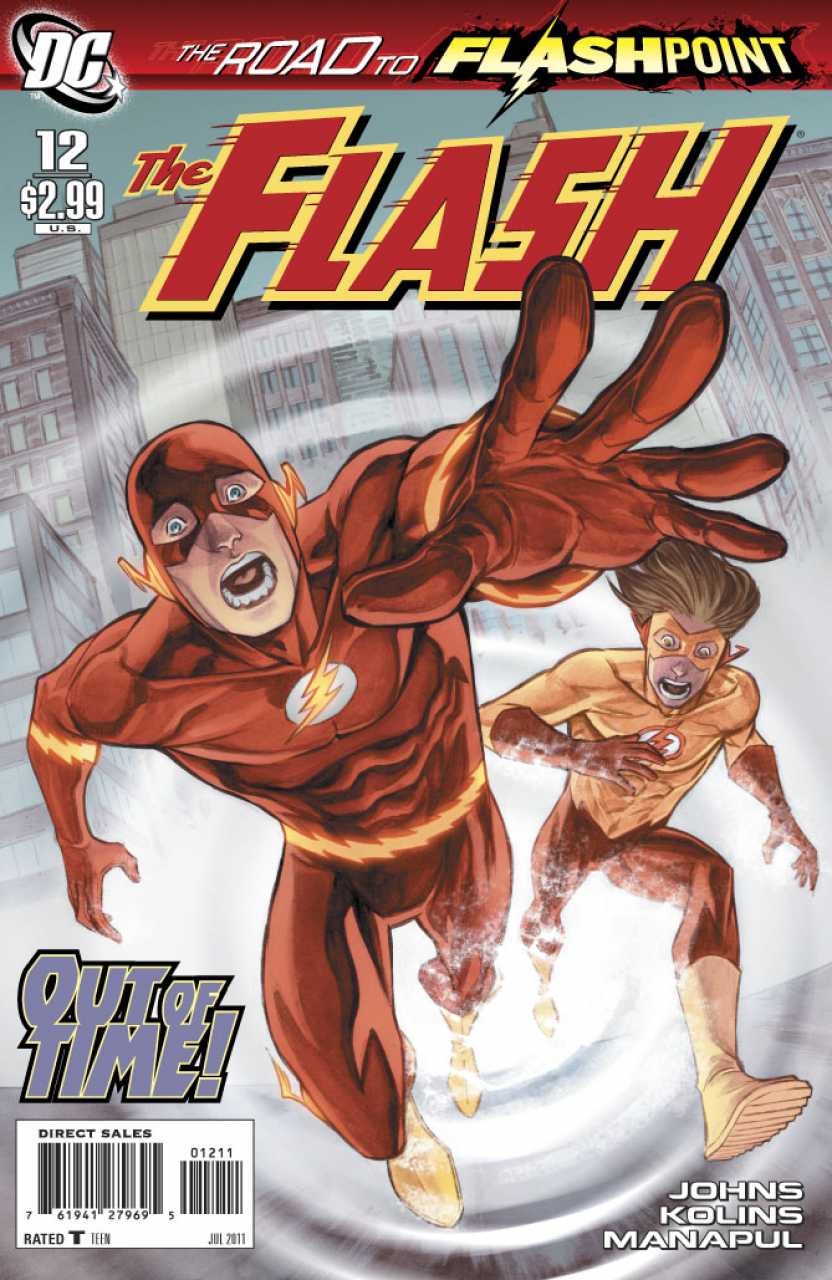
Flashpoint was a seminal comics moment for me, and it remains one of my happiest memories and favorite stories.  I'd been bummed that Geoff Johns started writing The Flash again, only to end after twelve issues, but I never got to finish reading those issues until now.  Of course, I was happy once I read Flashpoint, and even happier about his New 52 work (Justice League and Green Lantern were highlights of many a year), so I gave up being upset that these were the final issues.

The Flash #10-12 (DC)
from June, July 2011.

Drawn by Scott Kolins (who'd done a lot of Johns's Wally West Flash series) and Francis Manapul (who'd launched this one with Johns, and would lead the New 52 reboot), these are "Road to Flashpoint" stories that teased a character called Hot Pursuit, who turned out to be Barry Allen from an alternate reality (he probably needs to return at some point, despite his fate here), only to feature the return of Eobard Thawne, the Reverse-Flash, ahead of his role in Flashpoint.

There's a strong emphasis on Bart Allen who I enjoyed reading so much in the '90s as Impulse but who Johns transformed into Kid Flash in the pages of Teen Titans, which was nice.  The new 52 version of the character totally revamped the concept, which angered a lot of fans, but I never let it bother me.

Ironically, this was the last time DC had letters in its comics, and in the last two issues apparently Flash finally joined the bandwagon, only for the idea to go away again and never (so far) return.

Tuesday, May 23, 2017

The Flash #22, and thoughts on "The Button" in general

The four-part "Button" arc concludes with the dramatic return of Jay Garrick, the Golden Age Flash, as well as prelude to Doomsday Clock, Geoff Johns's November-launching DC Rebirth event that finally delivers on the promise of integrating Watchmen into regular company lore.  I know at least one fan who thinks this is inherently a terrible idea.  Spent a great deal of time last year arguing against his brick wall about the sacredness of Alan Moore's iconic original story.  Alan Moore has a way of inspiring that kind of lunatic devotion, and I can't say I'll ever really understand that.  As far as I'm concerned, the guy is a hypocrite.  He thinks he operates by a separate set of rules just because in the '80s he was considered the greatest comic book writer of that time, a reputation that more or less still persists.  He borrowed the creator rights crusade other creators from that time staked a lot more of their careers on, creators who spent their time creating original works as a matter of course, rather than spending it working very deliberately on the ideas of others, as he very demonstrably did, regardless of what else can be said about his work...

But that's neither here nor there, really.  Let's talk about some creators who are proving vital in 2017.  (Jerusalem may be an eminently worthy piece of literature.  Moore's ego will probably prevent me from judging for myself anytime soon.  Shame.  That's the first rule of literature, that you don't put the cart before the horse.  But then, there's also a tradition of writers attempting to make themselves more famous by reputation than by their actual creative prowess.  Seemingly to give their work a little attention.  Except with Moore he seems to begrudge attention.  And that's the real problem, here.)

I'm talking about Geoff Johns, who is given conceptual credit for "The Button," because it follows DC Universe Rebirth, and leads to Doomsday Clock, so naturally he has a vested interest in how "Button" worked out.  I'm talking Tom King, who wrote one of its four chapters.  I'm talking Howard Porter, who since JLA has never really had the spotlight put on his art.  I'm talking Josh Williamson, whose work in the pages of The Flash has been excellent all along, but whose role in writing three of the four chapters of "Button" has suddenly thrust him into a new level of significance within the elites of DC creators.  As is, he's becoming one of the elites.

Even at four chapters, "The Button" is a story that progressed so deliberately that there seems to have been very little actual story to it, but as a sequel to Flashpoint along with every other thing that can be said about it, everything about it seemed inevitable, except the skill and finesse of the storytelling is actually what makes it read so smoothly, and again, that falls completely at the feet of Williamson.  Anyone can be told what's expected of them, what elements to use, what's supposed to happen, but if they don't make it work, that's pretty clear.  Williamson makes it work.  He makes it work so effortlessly, the result is that he seems to have done hardly anything at all.  Yet he's done a truly incredible job.  Superhero comics can be such thankless storytelling, with a long tradition of generic storytelling, adventure quests filled with scene after scene of good guys and bad guys doing their thing, and yet, even Williamson's Reverse-Flash, who ends up making a comeback of his own, aside from everyone else making splashy appearances, it's just as easy to overlook his significance as everything else.  Reverse-Flash, the classic one who caused Barry Allen hell not only in Flashpoint but "The Trial of the Flash," one of the longest Flash stories ever, until a few years ago virtually forgotten in the face of Barry's death in Crisis on Infinite Earths, who actually becomes a kind of new Psycho-Pirate, the character who remembered Crisis happened when everyone else forgot.  And you can see where even that's significant, how it ties everything together.

Williamson, in just the material I've read so far, has been telling excellent Flash stories already, but "The Button" has put him over the top.  I loved Flashpoint.  At the very start of this blog, it saved me as a reader.  I love that it has once again proven important (and also in the Flash TV series in the just-concluded third season, which presented its own interpretation of Flashpoint and its consequences). 

I love that kind of resonant storytelling.  I'm glad Moore was able to write things that connected so powerfully with readers.  But I'm sorry it came at the expense of his willingness to stay connected with the stories that made it possible.  He closed himself off.  What I value so much about storytelling is the ability to make connections, not wall them off.  That's what Moore loves, too, but he seems incapable of admitting it at this point.  He thinks everything exists in isolation, unless he says otherwise.  Things like "The Button," and the work of Josh Williamson in general, prove otherwise, as far as I'm concerned. 

Tuesday, May 9, 2017

Reading Comics 204 "Fifth Trip 2017"

American Gods #2 (Dark Horse)
Amazingly, this adaption of the Neil Gaiman book still really hasn't reached the actual concept of the story.  Although Spider does drink an amazing amount of mead, and beats up a rather tall leprechaun.

Bane: Conquest #1 (DC)
Chuck Dixon and Graham Nolan reunite and return to the chronicles of Bane.  The results may baffle readers who are less familiar with Vengeance of Bane (parts 1 & 2) and more "Knightfall," Dark Knight Rises, Tom King's recent "I Am Bane," or any manner of terrible Bane appearances over the years, but they're entirely in-character, especially, again, for the Bane of Vengeance of Bane (parts 1 & 2).  The luchadore mask Nolan gives Bane for this comic is a fun little nod to the fact that the character is, technically, Latino, even though that never seems to come up other than his base of operations and/or origins.

Batman #21 (DC)
The Flash #21 (DC)
Batman #22 (DC)
Parts 1-3 of "The Button" see Tom King and Josh Williamson collaborate on a sequel to Flashpoint (the importance of this classic story to yours truly is chronicled in the early period of this blog) that also helps set up later DC-wide storytelling first introduced by DC Universe Rebirth.  Very, very good storytelling here.

Blue Beetle #8 (DC)
Giffen/DeMatteis have apparently taken over the title as of this issue, and bring a strong Larfleeze feel to the proceedings.  I loved the original Jaime Reyes series post-Infinite Crisis, and so it's great to read his Blue Beetle again.  The big draw for the issue, however, is that the magical scarab that has granted him powers (and/or de facto Iron Man suit) all these years has been taken from him.  So he and Ted Kord (the second and most famous Blue Beetle) make a bold decision: Jaime will now, even if temporarily, revive Ted's classic costume.  Yeah!

Divinity III: Stalinverse #4 (Valiant)
Matt Kindt will be moving on to Eternity, a sequel rather than continuation to Divinity, so this is the conclusion of this particular vision.  And I think, having read it twice, he came up with a good one:
"This world you've built may be real.  But you know it is not true.  You read books when you were younger.  Just as I did.  Do you not remember?  We are similar, you and I.  We were not forced to read.  We were encouraged.  But my adoptive parents raised me.  Treated me as their own.  They gave me books.  Science fiction was my favorite.  I read everything they gave me.  It wasn't until much later that I realized what they'd really done.  My parents couldn't force me...or anyone to be good.  Just as the Soviet Union cannot.  All they could do was present me with their example.  And with stories.  With writing.  With ideas.  Through those books I learned the danger of power.  I learned of the terrible effects of violence and conflict.  Of the unending cycle of war that we should be working to break.  And I learned the importance of love and to be loved.  Earth...humanity?  They are our children, Kazmir.  They can't be forced to learn.  They must learn by example.  They must be taught with stories.  With experience.  We have the power of gods, Kazmir.  Yet you choose to live a parasitic life inside Myshka.  And you choose to obey a small-minded oligarch.  But there is an entire universe out there for you.  Worlds to see.  Galaxies to explore.  Just like in the books we read when we were younger.  I am sorry for what happened to us out there...in the unknown.  I am sorry I did not bring you back when I returned.  And I am sorry that Myshka broke your heart.  I understand why you came back for revenge.  What I don't understand is why wouldn't you stay out there?  Why wouldn't you go further?  Why wouldn't you want to see more?  Our conflict will have a winner and a loser.  That is the nature of the game.  But why should we confine ourselves to the game?  Ti these pieces?  To this artificial boundary?  To Earth?  When there is the unknown all around us?  Waiting to be explored?  I tell you all of this, Kazmir, not to "win."  But to set you free."
That's the best argument an hero has probably ever made to their enemy, in a comic book.  It's an argument that can only be made in a comic book, I think.  It's a perfect synopsis of superhero logic, as has Divinity been from the start.  I don't know why Divinity hasn't become more important among comic book readers.  It's the Watchmen of intellectual superhero storytelling.  It's surely one of the most fascinating comics I've ever read.  Every issue has someone involved in creating the issue provide commentary.  Most of it is somewhat hugely overblown praise. Most of it seems to miss the point.  It's not just how it's executed that makes Divinity great, but its ideas.  I'm hugely glad to have read along.  And to see where Kindt goes next.

Planet of the Apes/Green Lantern #3 (Boom!/DC)
This latest mash-up is about as good as Green Lantern/Star Trek (which is to say, good), but it's the art I came to see.  Omega Men's Barnaby Bagenda, to be precise.  That guy deserves to reach the stratosphere, like his collaborator, Tom King.  Hopefully it'll happen at some point.

Green Lanterns #22 (DC)
The adventures of upstarts Simon Baz and Jessica Cruz have now reached the stage where they're actively interacting with the rest of the Green Lantern Corps.  Continues to be what I've long hoped to read in a Green Lantern comic again.

Nightwing #19, 20 (DC)
Well, hot damn.  Tim Seeley has turned Nightwing into a must-read after all.  Nightwing has been so hit-and-miss since the Dixon/Grayson years, a lot of creators coming in hot and then sort of sputtering out.  This includes Grayson, Seeley and Tom King's bold revision that saw Nightwing become a spy for a couple years.  But to take Nightwing away from Dick Grayson is to take away the essential part of the character, no matter how intriguing the results.  Too many of these writers have tried to forget this or that element of the character.  Seeley seems to have built not only on the Grayson momentum, but folded Dick's Batman and Robin days back into his adventures.  "Nightwing Must Die" is a Dr. Hurt story (the whole thing plays nicely with Batman and Robin, Grant Morrison memories), but it remembers that Dick's whole history is what defines him, perhaps more than any other superhero.  Possibly the two best issues of Nightwing I've ever read (Grayson: Futures End notwithstanding).

Savage Dragon #223 (Image)
If you were to read, in 2017, only one comic book series in its entirety to figure out what superheroes are all about, I think Savage Dragon would have to be that series.  Erik Larsen is the Image creator who never gave up on the original vision of the company, who never decided to pursue other interests at the expense of the creative freedom and opportunity his vision gave him.  The letters column is almost more important than the comic itself this time:


"Change is inevitable and being more stuck in the past is no solution. Styles change, people change. You loved that old stuff because you were 12 and that was your sweet spot. You may not want change but I crave it. Doing the same drawings the same way for decades is mind-numbingly monotonous. I love nothing more than finding new ways of tackling a similar problem. I look at the older issues and see all the mistakes. I see all the poor drawings and attempts to hide my deficiencies behind a wall of crosshatching and it doesn't do much for me. The lines aren't defining shapes and establishing light sources. They're lines for the sake of lines. Emulating that seems insane. 

Strong iconic poses are great, sure, but ultimately, I'm trying to tell a story here, not compose pictures to be popped onto T-shirts and lunchboxes. And given the choice of repeating a familiar shot or finding something new--nine times out of ten I'll go with the new.

It's not an easy path. Some artists get stuck in a rut, forever repeating and emulating their old work. Readers get bored and move on. Others keep trying new and different approaches but that can alienate old readers who liked the way things had been. There's no simple solution, clearly, but in order to preserve my sanity, I need to keep moving. If I'm not kept engaged, I can't expect my audience to be. If I'm bored, it's reflected in the work. So I tend to try something new. Sometimes it's successful and sometimes it's not, but hopefully it's worth your attention.
 
And honestly, it's important to unlearn what you've learned. A lot of what made earlier work vibrant and full of life was the learning process. I was figuring stuff out. And part of that involved screwing up. I can look back at old art and see where arms were clearly too long or faces were constructed poorly, where compositions and anatomy and perspective are all skewed and line work makes no sense. It's hard to recreate that--and why would I want to? It would be like going back to high school."
To my mind, it reads like Larsen becoming the Bill Watterson of comic books.

Superman #22 (DC)
I really need to read more of this run.

Old Man Logan #22 (Marvel)
Jeff Lemire continues his concluding run with Wolverine exploring the character's fictional past, brilliantly, literally revisiting famous stories (at one point his origin in the pages of a Hulk comic, complete with the original dialogue).  If anyone had to tell Old Man Logan stories as a surrogate to actual Wolverine stories, I'm glad it was Lemire.  He proves why it was such a good idea all over again.

Thursday, July 28, 2016

Reading Comics 196 "DC Rebirth Week Eight, Divinity II, Moon Knight"

Covered this edition: Detective Comics #937, Divinity II #4, The Flash #3, Moon Knight #4, Nightwing #1, Red Hood and the Outlaws: Rebirth #1, Action Comics #960, Titans #1, and Wonder Woman #3.

Detective Comics #937 (DC)
Batman escapes from the custody of the bad guys this issue, which features the return of Ulysses Hadrian Armstrong (I remember him fondly from the pages of '90s Robin), who is a little criminal genius in the making.  As this is the bulk of the issue, it's a slam dunk of a sequence.

Divinity II #4 (Valiant)
The final issue of this particular story in the saga (an ad promises Divinity III this December, as does some quick foreshadowing) is a remarkable conclusion to Abram Adams' war with Myshka in which he's able to connect with his fellow cosmonaut-turned-god on a strangely human level.  Matt Kindst's work with Divinity remains some of the best stuff being published today.

The Flash #3 (DC)
I can't even begin to describe how happy I continue to be about this relaunch.  I haven't been (with all due apologies to Geoff Johns) been this interested in a Flash comic since Mark Waid's prime.  The cleverness just doesn't stop.  One would think Central City being flooded with new speedsters would diminish the role of Barry Allen as a significant figure, other than as budding mentor (can you say Max Mercury?), but then his new sidekick August Heart says something brilliant like, "Do you know how fast you were going?" 

Moon Knight #4 (Marvel)
Jeff Lemire continues to knock this one out of the park.  (If chosen carefully, the things you enjoy shouldn't be so difficult to enjoy.)  I decided to catch up with this weeks-old issue, and damn if this isn't one of my favorite comics in recent years.  It's really that good.

Nightwing #1 (DC)
This is a strong follow-up to the Rebirth one-shot, in which Nightwing repositions himself as a mole in the Parliament of Owls and then meets Raptor, the latest dude who thinks Dick Grayson can't hack it on his own.

Red Hood and the Outlaws: Rebirth #1 (DC)
This is Scott Lobdell's restating of the Jason Todd biography, although this time he makes the point that Jason is uniquely suited to appear like he's the compromised Batman, which is interesting.  I know Frank Miller probably has conniptions every time a comic book suggests Boy Wonders aren't destined to become lunatics, but I don't have a problem with it.

Action Comics #960 (DC)
Wonder Woman enters the fight, but other than getting some readers up to date about Doomsday's origins, nothing much significant happens this issue.

Titans #1 (DC)
This fairly Wally West-centric issue also features Linda Park.  Hey, I can't argue with that.  Dan Abnett lets other Titans in on the act, notably Lilith, who's one of the more obscure members of this family, before shockingly revealing that Abra Kadabra is claiming responsibility for Wally's disappearance.

Wonder Woman #3 (DC)
Greg Rucka does a pretty powerful study of Cheetah, one of Wonder Woman's most famous foes, who probably comes off better in this one issue than she has in all her other collective appearances combined.

Thursday, July 14, 2016

Reading Comics 194 "DC Rebirth Week Six, Earth 2, Millarworld Annual, The Vision, Old Man Logan"

Covered this edition: Detective Comics #936, Earth 2: Society #14, The Flash #2, Hal Jordan and the Green Lantern Corps: Rebirth #1, Millarworld Annual 2016, Nightwing: Rebirth #1, Action Comics #959, New Super-Man #1, The Vision #9, Old Man Logan #8, and Wonder Woman #2.

Gosh, so I kind of got all the DC Rebirth releases this week...

Detective Comics #936 (DC)
This isn't the first Detective Comics issue of the Rebirth era, but I was curious to read an issue because the spotlight was on Batwoman, Kate Kane, a character that's fascinated me since her debut in 52.  As one of the more high profile openly homosexual characters in comics, Batwoman has had a certain level of prominence over the years, although since she was created by Greg Rucka and had J.H. Williams III as her artist for a number of years, she was allowed a great deal of creative freedom, too, up to and...excluding, infamously, a wedding in her New 52 series.  The writer of Detective Comics is James Tynion IV, whom I've somewhat unfairly judged over the years due to his association with Scott Snyder, whom I've sometimes found difficult to appreciate.  But Tynion is a pretty good writer, and as this issue is a pretty good Batwoman story, I may have to once and for resolve to consider Tynion positively going forward. 

Earth 2: Society #14 (DC)
I'm not sure how much Dan Abnett is commenting on the creative reputation of the series he inherited several issues ago or if it's just coincidence, but there's much ado about the broken nature of the new society this alternate world of heroes represents.  Still, there's a strong focus on Dick Grayson's Batman, which hasn't really happened since Convergence, and that was good to see, as was the return of his son.  Which, all told, Dick himself is far less pleased about, given the unfortunate circumstances...I still think Earth 2, under its various creative directors, has been one of the shining successes of the New 52 era.

The Flash #2 (DC)
Barry Allen begins training his friend and colleague August Heart, who has just acquired access to the Speed Force, and that's fun in and of itself, their contrasting stances on what they should do with it, when the series takes a page from the unrelated TV show and has STAR Labs become the source of trouble, revealing who's behind the freak lightning storms, and what they're after.  It's such a good feeling, knowing I love reading The Flash again...

Hal Jordan and the Green Lantern Corps: Rebirth #1 (DC)
Maybe it was because I never intended to read it full-time, but Robert Venditti's Green Lantern eventually lost its status as a worthy creative follow-up to the work of Geoff Johns, in my estimation, and once it fell, it plummeted.  Funny enough, Venditti explains his thought process in this issue, and it has great relevance in the policing controversies spread across newspapers seemingly every day for the past few years.  I have no idea where Venditti started the idea, but it begins to make more sense, seeing it all laid out, and where he has Hal Jordan continue to go with it.  So I'm glad I can finally say I get his take.  It's not Johns (but few could be).  And I'm okay with that.

Millarworld Annual 2016 (Image)
Putting all the cards on the table, the international competition for this thing that sought submissions from new creators was something I entered last year, basing my entry on Starlight, which you can look elsewhere to see how much I enjoyed.  I've been a member of the Millarworld message boards ever since, and so was able to keep tabs on when this would be released.  Obviously I had something of a vested interest in it.  The writer I got to know the best from the boards, perhaps somewhat naturally, was Deniz Camp, whose Starlight effort did win.  I can admire Camp, because he too admires Grant Morrison.  But the standout entry in the annual, for me, very easily, was Cliff Bumgardner's American Jesus script (just as amazingly illustrated by Steve Beach), which took a moment out of time from Mark Millar's original comic (originally titled Fallen) and explored the consequences of saving a dog's life, which was to inadvertently have the effect of stopping death from occurring, during those moments, around the whole world.  It gave me chills to read.  It was like reading Stephen King, or at any rate, a first-fate professional.  Kudos, Cliff!

Nightwing: Rebirth #1 (DC)
This was exactly the connecting story fans of Dick Grayson could have hoped for, as Dick's adventures with Spyral aren't just unceremoniously dumped, but incorporated into his greater adventures, as he realizes he probably really does have to become Nightwing again, an identity Tim Seeley (Dick Grayson's amazing co-writer, along with the incomparable Tom King, but more on him a little later) explains, as been explained many times before but still comes out fresh, because for the duration of the New 52 it was kind of ignored, as having been inspired by Superman and not Batman, as might be easy to assume.  There's also some good Parliament of Owls stuff in the issue, proving that maybe that whole story really should have been Dick's all along...

Action Comics #959 (DC)
The Rebirth era Doomsday saga continues, with parallels popping up all over the places, plus a few new wrinkles, like Superman being forced to concede that the New 52 Lex Luthor may not actually be an exact match for the one he used to know.  Otherwise, the reader will just have to continue waiting to see just where the new wrinkles are really headed...

New Super-Man #1 (DC)
I loved, loved, loved Tony Bedard's The Great Ten, which was about a group of Chinese superheroes.  Each issue told each member's story.  It was a true overlooked masterpiece.  Fortunately, someone realized China is perhaps a hotter topic today than when Great Ten was published only a handful of years ago.  And even more fortunately, a writer of Gene Luan Yang's quality is around to explore the landscape all over again.  Yang's Superman wasn't everyone's cup of tea, perhaps unfortunately coinciding with the "Truth" arc that wasn't really what anyone wanted to read in the Man of Steel's adventures.  His New Super-Man features as unlikely a protagonist as you'll find.  When first seen he appears to be a jerk!  (Bonus points to the Silver Age for being relevant again.)  But his personality is entirely in keeping with Chinese society, which is an extreme example of what we experience in the States (and you thought it was bad here!), with income disparity resulting in social dynamics that will probably surprise readers.  Yang's origin continues along so that his Chinese Superman ends up kind of being a DC Captain America, with his powers literally being infused into him (and making Chinese Superman to be something of the Rebirth Superboy).  I applaud DC and Yang for coming up with this, and I hope enough readers are culturally curious enough to keep it going a while.

The Vision #9 (Marvel)
For me, there was no question that Tom King's greatest superhero work of the past year was The Omega Men, to the point where I was willing to sell his Vision short (heh).  Yet, as of this issue, which details how Runaways character Victor Mancha went from uncle to murderer, explaining all over again how rich a creative source King's war experience really is, I'm completely sold on it.  So clearly King had room for two masterworks, in a very short time.  Here's hoping he has many more.

Old Man Logan #8 (Marvel)
This spin-off of Mark Millar's original story, generated in the wake of Secret Wars and I'm not sure how related to a similar Brian Michael Bendis mini-series during that event, was something I was slow to give much credit to (there I go again), because I just didn't see the point.  But if comic book logic counts for anything, then something like this makes its own kind of sense.  And it can't possibly hurt to have Jeff Lemire writing.  This is the story of Wolverine, decades older, whose whole life and world crumbled in the wake of a catastrophic supervillain victory (think Final Crisis or  Forever Evil, but more permanent), and he was left virtually alone to pick up the pieces.  Somehow he was transported to the present.  This issue, Lemire helpfully spells out the whole thing, and helps Logan come to a kind of peace with his situation.  He's been in constant dread that he's going to have to experience the fall all over again.  Curiously, the time-displaced Jean Grey, from Bendis's (it figures, right?) All-New X-Men, is the one who helps him.  This is Jean at the start of her career.  She hadn't even met Logan yet, when she was pulled from the past.  And all over again, the value of Jean Grey is exhibited.  Great issue.

Wonder Woman #2 (DC)
Greg Rucka's origin of Wonder Woman begins.  Suddenly, there are a million Wonder Woman origin stories going on.  There's Legend of Wonder Woman, Wonder Woman: Earth One, the upcoming Wonder Woman movie, the upcoming Wonder Woman: The True Amazon...  Yet, for all that, it is worth visiting and revisiting.  Every creator has a fresh perspective, and with Wonder Woman, finally getting her creative due, it's more relevant than ever before.  This is a character who's always been touted as one of DC's most important characters, but she's never been near as popular as Superman or Batman, and as such her origin isn't as well-known.  As more fans come to check out what she's all about, it presents, obviously, a rich opportunity to explore, right from the beginning of the story.  Rucka's vision is pretty focused, as the Amazonian princess Diana is alone interested in a world she never knew, as she's the first of her kind to be born since they were sealed off from Man's World.  He assumes you already know, or don't care, about the particulars of her birth (although the alternating arc in this twice-monthly series does feature exactly that), and just runs from there.  The in-house ads talk about each series of the Rebirth era featuring a new epic that starts now, and as far as I can tell, that's exactly what DC has been delivering.  Azzarello set such a high mark in the New 52 with Wonder Woman.  Rucka seems intent to, and capable of, surpassing it.

Thursday, June 23, 2016

Reading Comics 191 "DC Rebirth Week Four, Divinity II, Totally Awesome Hulk, Justice League, Robin"

Covered this edition: Divinity II #3, The Flash #1, The Totally Awesome Hulk #7, Justice League #52, Robin: Son of Batman #13, Action Comics #958, and Wonder Woman #1.

Divinity II #3 (Valiant)
Matt Kindt continues the second volume of his visionary superhero saga, in which Russian cosmonauts Abram Adams and Myshka engage in the ultimate duel, across time and reality, as they attempt to determine whose will triumphs in this high-stakes game of god-like beings.  For the second straight issue, it seems the villainous Myshka has once again come out on top, but there's a telling moment when Abram visits the young Myshka, years before the mission that was to change their lives and the whole world, and whispers something into her ear.  Abram has taken great pains in explaining to the adult Myshka that you can't change the past. The suggestion is that whatever he said to the girl is more crucial than the adult currently realizes.  I assume something of that sort will be involved in the conclusion next issue...

The Flash #1 (DC)
My name is Tony Laplume, and I am the happiest Flash fan alive.  Well, maybe one of them, because this debut issue of the series proper lives up to the promise of the Rebirth preview, as Josh Williamson sets up a bold new arc in which the gift of the Speed Force starts spreading around.  Williamson's best bit of storytelling is actually the whole issue, which starts out explaining Barry Allen's origin again, while inserting a key new player, who by the end of the issue is the first (there will be others) to experience the expansion of speedsters.  This series is in excellent hands.

The Totally Awesome Hulk #7 (Marvel)
Easiest some of the best Marvel comics I ever read were Incredible Hercules and its several continuations, which featured Amadeus Cho as the Hulk's (and yes, Herc's) biggest fan.  This shouldn't have worked, right?  In the modern era, the "kid sidekick" idea is passe, but Cho's enthusiasm, not to mention his smarts, puts him in a league all his own.  And in this era where every Marvel superhero is being replaced by their biggest cheerleader (of various extractions), this is the best variation possible.  But the issue actually puts the focus on Bruce Banner, who is totally free of the Hulk for the first time ever, and he's struggling to deal with it.  You'd think it would be a good thing, but when you're Bruce Banner, it's much more complicated than that.  If you like your Hulk to be good for something other than smashing (although that's good, too), then this is a good time to be a fan.  Spearheading this new era is Greg Pak, who knows a thing or two about the big green guy.

Justice League #52 (DC)
The final issue of the series strangely harkens back to the very beginning, as a new hero is introduced to the world.  This time it's Lex Luthor, presenting his version of Superman.  The writer is Dan Jurgens, providing a bridge between where Geoff Johns left off with Luthor and where Jurgens picks up again in the pages of Action Comics.  Lex Luthor was one of the characters who benefited greatly from the New 52, and Justice League.  It's only appropriate to give him the nod like this.  What I love perhaps even more is that the artist is Tom Grummett, making this a mini '90s Superman reunion. 

Robin: Son of Batman #13 (DC)
The final issue of the series, which I decided to read so I could say I was fair to the creators not named Patrick Gleason who worked on it.  (Okay, so technically it would have been more fair to read more than one issue, but still...)  As it turns out, Ray Fawkes is once again better than I seem to have given him credit for, as his version of Damian and friends fits in wonderfully with Gleason's, and even serves as a truly fitting finale.  Nice one, Fawkes.  I'll try to remember next time.

Action Comics #958 (DC)
Jurgens, Lex Luthor, and Superman, and Doomsday, and Clark Kent, oh my!  Clearly there are things going on that aren't quite what they seem, but I love, love, love that Jurgens is getting the chance to further expand on his Superman legacy, which admittedly he's had many chances to do over the years.  I think he's really nailed it this time.

Wonder Woman #1 (DC)
I thought Greg Rucka would be fixating somewhat exclusively on Wonder Woman's origins, despite the alternating storylines ahead, but this issue presents a wrinkle in that idea, as the end of the issue reveals that she's been locked out of Themyscira, and she's had to turn to Cheetah, of all people, for help.  I also like Rucka's characterization of Wonder Woman's reluctance to fight, and Steve Trevor's reclassification back into a military guy.  All around good stuff here.

Tuesday, June 14, 2016

Quarter Bin 80 "Mark Waid's Flash, Generation X, Guy Gardner, Harley Quinn, and Caleb Monroe"

No, not all comics featured in this feature were literally bought in a quarter bin.  But these were.

The Flash #93 (DC)
From August 1993.
From the files of Mark Waid's excellent run on The Flash comes this second issue of Bart Allen's introduction.  Waid was literally the guru of the Speed Force, and if any character greater embodied his philosophy than Wally West, it was Bart, who would variously be known as Impulse, Kid Flash, and even the Flash himself (it...didn't go particularly well, however).  Bart was the grandchild of Barry and Iris Allen, raised in the future but mistakenly caught up in a program that sought to study him, which accidentally accelerated his growth because no one actually knew what to do with him.  (Waid cleverly explains that in this issue.)  Later the star of Waid's second Flash series, Impulse, Bart would appear in a more sinister version within the pages of the New 52's Teen Titans (which was one of the many things that angered fans about the New 52).  I revisited this issue hoping for some sweet art from the late Mike Wieringo, but if I'd read the cover more closely, I'd have noticed that Carlos Pachelo was filling in for him.  Somewhat ironically, while Ringo gained a massive cult following before and following his untimely death, the letters column for this issue features a decidedly cautious interest in his work. 

Generation X #25, -1 (Marvel)
From March and July 1997.
Scott Lobdell's contributions to '90s X-Men lore have largely been marginalized in recent years, mostly because fans have generally marginalized '90s X-Men in general.  His Generation X (which famously forced Gen 13 to come up with its alternate title, which didn't stop it from becoming one of Image's signature '90s hits) introduced, as the title may indicate, a new generation of mutants, who have since largely vanished.  I just don't get it.  Lobdell has been working with DC since the New 52, and he still doesn't get any credit, even though he's generally one of the best character-driven storytellers in the business.  The "-1" issue was Marvel's response to the "0" issue phenomenon, part of a whole flashback month.  Neither issue actually features the new generation too directly, but that was okay.  It was still good stuff.  James Robinson wrote the "-1" issue, and Carlos Pachelo, in his first signature work, was on art for both.

Guy Gardner #1, 2 (DC)
From October and November 1992.
Gerard Jones was absolutely on fire with the Green Lantern franchise during this period.  He not only dominated it, but expanded it as never before.  Besides the lead series, there was also Green Lantern: Mosaic (previously discussed here), and Guy Gardner, which launched with Guy having just acquired Sinestro's yellow ring, but would later feature him gaining different powers entirely.  Geoff Johns would expand on the mythology of the yellow ring, but at the moment, it was just something that wasn't a Green Lantern ring, and still allowed Guy to run roughshod on the concept of superheroes.  Basically, Guy was one of DC's answers to the burning '90s topic of breaking from tradition, and boy was his ready for it, even if his nifty new ring, in these issues, didn't feel like fully cooperating.

Harley Quinn and Power Girl #6 (DC)
From February 2016.
The creative team of Amanda Conner, Jimmy Palmiotti, and Justin Gray had previously collaborated on a pre-New 52 Power Girl ongoing series (which featured the dubious distinction of Vartox's debut), and so it was nice to see them taking the opportunity provided by Harley Quinn's massive popularity to reprise the act (with Vartox!).  This is irreverent storytelling pure and simple, with Harley literally acting the part of the jester as Power Girl tries to once and for all end her Leela/Zapp Brannigan relationship with Vartox.  Good luck with that...

Hunter's Fortune #4 (Boom!)
From January 2010.
As with Skipper Martin and Drew Melbourne, Caleb Monroe was a budding creator I came across a decade ago, and when he scripted this series I enjoyed watching him find success.  (Despite how it can sometimes seem, I don't actively wish ill on any creators.  Everyone's work has an audience.)  The concept, developed by Andrew Crosby, is basically Indiana Jones/National Treasure/Lara Croft without a sensational lead character.  Hunter is merely the recipient of a fortuitous bequeathal.  Monroe's signature gift to his fellow budding creators was setting up a list of submission guidelines, which was above and beyond what you'd expect from someone basically at the same level as you.  He's remained active in comics, at least as of two years ago, when he was still writing stuff for Boom!, and that was good to see. 

Thursday, June 9, 2016

Reading Comics 189 "DC Rebirth Week Two, Empress, Superman: American Alien"

Aquaman: Rebirth #1 (DC)
The big push Dan Abnett takes in this Rebirth reintroduction issue is poking fun at all the people who make fun of Aquaman, the superhero who "talks to fish."  As Abnett points out in the captions, "This is untrue.  He has a telepathic gift that allows him to compel marine life, but fish do not possess enough intelligence to conduct meaningful dialogue."  But such subtleties are hardly likely to convince people who like their reactions pithy and pointless...

Empress #3 (Icon)
The adventures of the escaping queen continue in this Mark Millar/Stuart Immonen comic rife with breakneck adventure.  Look, I read Saga for years, but after a while, it kind of seems like a soap opera, like The Walking Dead, where the thrust of the story is lost in just kind of keeping it going.  Empress is punchy, even while at its heart it kind of is a soap opera.  Millar is far too impatient for full-on soap opera, though, so there's not a chance of Empress becoming another Saga.

The Flash: Rebirth #1 (DC)
I was kind of shocked that DC allowed this property to all but go to complete waste in the New 52 era, after reviving Barry Allen with Geoff Johns at the helm just before it.  The New 52 Flash was one long attempt at struggling to catch up with better material that had come before it.  Josh Williamson, previously best known for Image comics like Nailbiter, seems to have been chosen precisely because he's both capable and willing to reverse this trend.  And thank god, because as the issue fans will be reading post-DC Universe Rebirth to see what happens next, we don't need another post-Flashpoint disappointment.  A story that makes Flash look like one of DC's most important characters needs a decent follow-up.  This time that's exactly what happens.

Superman: American Alien #7 (DC)
The finale of this mini-series sees Max Landis brilliantly reimagine, essentially, the scenario J. Michael Straczynski featured in his first volume of Superman: Earth One, wherein an alien comes to Earth, causes a lot of trouble, and helps Superman find out where he came from.  Where Straczynski settled for a surprisingly dull new creation, Landis chooses Lobo, as fans recognize him from pre-New 52 continuity (the good ol' bounty hunter bastiche with the bike and everything).  It's brilliant, as everything has been about American Alien.  Lobo is here to send a message to Hawkman (alluded to, which is even better), and ends up provoking Superman into his first big brawl.  I know I tend to sound fairly dismissive of Straczynski's creative output, but in this instance, a clear parallel can be found, and I think Landis does it better.  However, I'd still recommend Straczynski's Superman: Earth One work for those interested in less complicated Superman continuity.

Action Comics #957 (DC)
Interestingly, Lex Luthor is the star of this title, but the Convergence (and new Rebirth) Superman is a co-star, too, so Dan Jurgens gets to continue his recent storytelling along with Tomasi & Gleason's Superman, which I hadn't really anticipated.  The rivalry between Luthor and Superman has kind of been turned on its head, which is brilliant.  There's also Clark Kent running around (how? this continuity's Superman is dead, right?), and the threat of Doomsday once again.  After "Doomed," is it too early?  Who cares!  This is Jurgens' (ugly, ugly) baby.  It's about time he gets to revisit him again...

Wonder Woman: Rebirth #1 (DC)
It's interesting that so many Wonder Woman stories, from about Jodi Picoult onward, have dealt with a fairly insular world, and that once again, her origin (kind of like Donna Troy, actually) is causing all sorts of continued drama.  That's what Greg Rucka, returning after too many years to follow-up on his brilliant Infinite Crisis-era work, will be dealing with, all over again.  I trust he'll have some interesting stuff to say about all of this.

Thursday, February 11, 2016

Reading Comics 179 "Flash Appreciation Day"

As established in the Justice League Unlimited episode "Flash and Substance" (and borrowing heavily from the comics, which have long celebrated the Scarlet Speedster's popularity in his native Central City), today is Flash Appreciation Day.

So yeah, I'm going to join in the festivities.  I've previously called Mark Waid's "The Return of Barry Allen" my favorite comic book ever (read about it here), a perfect story for long-time fans of superheroes.  It happened to be my introduction as a fan to the Flash, and it couldn't have been better or harder to live up to in subsequent years, but there were certainly contenders, such as the seminal Flashpoint (both of them; look it up here).

I remember the TV advertisements for the 1990 TV series, and later getting to enjoy this unique contribution to live action superhero lore.  Recently, I've gotten into the new show in a big way.  I can't speak highly enough about it.  Whereas Smallville or the Justice League cartoons or even the series of Avengers movies continuing to play out in theaters have done an excellent job conveying the richness of superhero lore to more mainstream audiences, I don't think any of them compare to what The Flash is doing.  Even with companion shows like Arrow and Legends of Tomorrow further expanding the same vision, neither has the heart or depth of Barry Allen's, arguably, greatest adventures, currently in their second season.  Playing off continuity previously established by Geoff Johns in the comics, Barry's life is complicated by the Reverse Flash manipulating time so that Barry grows up without a mother, and his father convicted for her murder.  More clever still, his would-be mentor Harrison Wells was replaced by the Reverse Flash, and in the second season Wells is once again compromised, but in an equally clever way.  It keeps everyone on their toes, and also makes the character of Vibe the best he's ever been.

The Flash will also be involved in the upcoming Justice League movies, and there's no way to know if he'll have as impactful a showing there as well (but it's likely easy to assume so).  At this point, he's easily DC's fourth guy, after Superman and Batman, who have had numerous live action incarnations over the years, and Wonder Woman, who's celebrating her impending cinematic debut as well.  This will be Flash's third live action incarnation, which is pretty significant.

You can see more of how today has been celebrated here, and also take Speedforce.org's recommendation and consider checking out Hero Initiative to see how you can give back to creators who have helped breathe life into legends like the Flash.

Monday, April 27, 2015

Digitally Speaking...49

This column details my adventures reading comics from my comiXology account...

Fade Out: Painless Suicide (WiseDog)
From 2014.

I'm not entirely sure what this was supposed to be.  It starts out like it's going to be about suicide.  And then young love.  Young love and suicide?  Makes sense.  But then it's about a murder mystery.  And then the murder mystery ends with the main character being murdered.  Not, you know, committing suicide.  So I guess...I just don't get it.

Fantastic Four #1 (Marvel)
From 1961.

History could have read this so much differently.  Mister Fantastic (Plastic Man/Elongated Man) and Human Torch (the Golden Age Human Torch) were archetypes of existing superheroes, while the Thing and Invisible Girl were culled straight from horror movies...In fact, the whole thing seemed to be Stan Lee and Jack Kirby creating horror characters more than superheroes, but using them as superheroes.  The team launched the Marvel Age, and as such became known as the first superheroes to inhabit the angst-ridden, "human level" variety Marvel became known for, but...they were horror creations, tossed together like Van Helsing meets League of Extraordinary Gentlemen.  Doom Patrol, the X-Men, the Incredible Hulk, these were all characters more akin to horror, which at that time cinematically was still steeped in the classic horror age, before the dawn of the slasher flicks twenty years later.  Just imagine if the team had remained known as horror characters, rather than superheroes...But then, Marvel became known as DC's main competition, and the rest is history.  Characters who slipped in from the frames of movies have transitioned into the movies, where they have become a whole genre like, well, the horror movies that inspired them.  It figures.

Fatherhood #1 (Challenger)
From 2013.

This one-shot is much like Fade Out, tonally somewhat baffling.  The writer describes it as attempting to explore what it means to be a father (hence the, ah, title), fighting between impulses of great devotion and the ability to do very questionable things because of that great devotion...but the story abruptly shifts from being about the pain of a separated marriage to the father going all psycho and pseudo-noir as he gets the latest popular toy for his daughter.  Like Fade Out, I can say I just don't get it.  You understand, this essentially means, these are poorly-reasoned comics.

Fighting Stranger: Chapter One (HicksVillain)
From 2013.

Fighting Stranger is...strange.  And it becomes stranger.  The good news is that it's a good kind of strange.  The writing is at turns incredibly clever and clunky.  Thankfully the cleverness outweighs the clunk.  And the cleverness extends a few ways, from how the stereotypical story of an amnesiac being guided along a journey to discovering he has certain skills and purpose is reshaped by how it's done (by the end of this chapter, there's a whole new level added) and with what kind of characters.  The most important character isn't the lead at all, but his guide, the dancing entertainbot C4D, who proves endlessly amusing.  Good stuff.

First Law of Mad Science #1 (Noreon)
From 2012.

By the time a quote from H.P. Lovecraft shows up at the end, I guess what precedes it makes perfect sense.  Lovecraft has inspired something of a religion.  I doubt his fans would consider their devotion to be a religion...but yeah, it's something like a religion at this point.  The story involves a scientist who's a pretty crummy father, a son who is resentful of his scientist father being so crummy, cybernetic eyes, robot daughters, seeing monsters that aren't there...Damn Lovecraft fans.  I rue the day I ever learned about Lovecraft!

The Flash (DC)
#30 (from 1989)
#54 (from 1991)
#162 (from 2000)

I was recommended the first two when Flash comics went on sale in celebration of the new TV series launching.  For me they're rare Wally West stories not written by Mark Waid, but rather William Messner-Loebs.  There came a point where I no longer believed this, but during the '90s, when he was writing The Flash, Waid could do no wrong.  He was, for me, the definitive writer of not only Wally West but the Flash in general.  So for someone to recommend reading issues from the same series Waid later made his own felt like an impossible mission.  Waid came onboard years after the series launched, which meant he wasn't the first writer to attempting defining what it meant for Wally to have assumed the scarlet cowl, succeeding his friend and mentor Barry Allen.  But the recommendation was, Messner-Loebs made Wally's life as a speedster interesting.  And so?

The first issue features Wally in a theater realizing that time seems to have stopped.  But it didn't, he merely sped up without realizing it.  That's a pretty neat trick.  Not that special, but pretty neat.  The second issue is probably better.  This recommendation made it known that Wally's "Nobody dies" edict alone was special, but there's also diving out of a plane to catch someone, and that was special.  Messner-Loebs, it seems, got what being a speedster could feel like.  Waid always concentrated on the legacy, but here's a writer who slowed things down (heh) and let Wally, and the reader, experience how the powers actually work.  Sometimes it takes a great deal of effort.  This is something that's rarely touched on in superhero comics.  That alone makes #54 unique.

The third issue, meanwhile, was Waid's final one (until All Flash #1 in 2007, which kicked off the era recently resurrected in Convergence: Speed Force) after his long, historic tenure.  By this point he'd been transitioning away, giving more and more responsibility to Brian Augustyn, and so maybe it's not surprising that there's not really a farewell message here, as I would have expected.  I took a break from comics in early 1999, when Waid was working on his last great Flash arc, "Chain Lightning," a story whose conclusion I finally read a few years back.  The truth is, I thought for years that Waid left after "Chain Lightning," that it was his big goodbye.  Turns out he lingered.  The issue instead is a pretty random Captain Marvel team-up.  I consider this disappointing.  Or maybe the disappointment was Waid's.  Either way, he did return to the character (fans always considered that work disappointing), but by that point Wally had become a Geoff Johns guy.  Which turned out pretty well, until Johns decided he was more of  Barry Allen guy...

Flash Gordon #1 (Dynamite)
From 2014.

Flash Gordon is one of those characters most people know but don't really know much about.  He's a space adventurer in the vein of Star-Lord, the currently popular model as seen in last year's popular Guardians of the Galaxy flick.  And he's more or less fallen completely by the wayside.  So of course he gets a revival.  The question is, does the revival remind us what makes Flash Gordon unique?  Not really.  Very quickly, we're dumped in the middle of an adventure, Ming, all of that.  Which is fine.  if you like random adventure stories set on alien worlds, then this is your thing.  But if you want a reason to care for Flash Gordon specifically again, this may not be.  Because otherwise the character has become as equally random as the story he's in.  I personally don't see this as a particularly good development.

Footprints Vol. 1 (Soup Dad)
From 2014.

If you ever wanted to find out what it would be like if Alan Moore wrote Hellboy in the same general style he did Watchmen...Footprints follows Bigfoot in much the way the early issues of Fables followed the Big Bad Wolf.  You don't know why Bigfoot became a private investigator except that the story felt like putting him in that role.  And then he has to solve the mystery of what's been happening to the cryptoid community.  Tries to make bold statements about the 20th century.  Fails.  Scott Snyder provides an introduction, although he unwittingly reveals what kind of experience you're really headed for when he begins by explaining how he used to watch a bad Bigfoot special on TV all the time, and he got hooked on it.  That's what this basically is.

FUBAR: FCBD Edition (Alterna)
From 2013.

Soldiers in various eras blah-blah-blah random monsters!  And that's basically all this is.  If you like random monsters, I guess you'd probably like this more than I did.  And as for all those acronyms...FUBAR = F***ed Up Beyond All Reason (it's a military term, naturally), FCBD = Free Comic Book Day.  Which incidentally is this Saturday!

Fun Fun Comics #1 (Fun Fun)
From 2013.

Deliriously funny stuff from Michael D. Koch (presumably not related to the Derek Koch I got to know from Paperback Reader, who actually probably would like stuff like Footprints), a collection of some old indy comic strip material filled with terrific gags and wacky situations that are kind of what Family Guy tries to do (which is not to say that Family Guy fails so much that Koch does it better).  His noble work continues, weirdly enough, at a site called Fun Fun Comics.  Later in the collection, Hamlet tries to warn Mel Gibson about the talking skull.  But of course it doesn't matter.  I guess I'm just a sucker for this kind of stuff.  And what about Michael Bolton?  As everyone who's seen Office Space knows, Michael Bolton sucks.  But that's hardly the last word on him.  Probably you should read this to find out more...


The Fuse #1 (Image)
From 2014.

I may have sold The Fuse short.  This is because I know the writer, Antony Johnston, from something that I love, the recently concluded post-apocalyptic epic Wasteland, and so when Fuse launched a little over a year ago, I wasn't quite ready to dive into another Johnston project.  I mean, Wasteland happens once a lifetime, right?  And Johnston launched another series at the same time, Umbral.  The thing is, Umbral is a lot more like Wasteland than Fuse.  What they all share is Johnston's knack for world-building.  But where Wasteland and Umbral set up years-long stories, Fuse is, basically, a procedural set on a space station (the title is the name of the station).  I actually liked what I read when I sampled Fuse previously, but again, I wasn't ready to make another commitment.  Reading the first issue for the first time, after the end of Wasteland, I think I'm ready.  This is good stuff.  And so I will be correcting my oversight first chance I get.

Monday, February 2, 2015

The Flash: Season Zero #1 (DC)

via speedforce.org
writer: Andrew Kreisberg, Brooke Eikmeier, Katherine Walczak

artist: Phil Hester

There's no TV series I'd rather be watching right now than The Flash.  No, this isn't 1990, but you might be mistaken for believing so, because the new show has acknowledged its predecessor by bringing back many of the original stars.  That's just one of the reasons I can't believe this is happening.

Well, thank goodness Smallville happened, made it safe for DC superheroes in prime time again.  I don't care for Arrow, but at least it gave us The Flash.

Yet I still haven't seen an episode.  I know, we live in a multi-platform age where being unable to watch live is no longer even a ghost of an excuse, but hey, things happen.  I'll catch it on DVD, just like the first one.  That's the speed at which I run, yo.

And there's a comic.  The first one had a special that recapped the whole series, but this one has a whole, digital-first, comic book series to call its own.  Miracles of modern times.

And the best part about it is another resurrection.  The artist, Phil Hester.
via DC Comics


Hester is a writer/artist, actually, and a lot of his recent work has been as a writer, but he first came to prominence as an artist, where among other projects he helped Kevin Smith on a Green Arrow relaunch (appropriately enough).

I'd begun getting used to the idea of Hester as a writer, working on his own projects (one of many writer/artists I don't understand why the comics industry hasn't thrown itself all over them to deliver a steady stream of such work), but heck, I can't kid myself.  I love Hester's art.

And it looks much as it did before.  Sometimes there's something to be said for consistency.  I don't know that Hester has worked on the Flash before.  I don't know if he's necessarily ideal at depicting speed, but apparently that's not completely necessary for this version of the character.

As represented in the comic, this is a Barry Allen who seems to have taken a lot from the Mark Waid comics featuring Wally West, as well as the Barry comics from Geoff Johns.  I like.

And it beats whatever they've been doing in the New 52 with the canonical version of the Fastest Man Alive.  

Monday, August 18, 2014

Reading Comics #130 "Bull Moose Grab Bag IV"

Local physical-things shop Bull Moose has recently changed the way it sells comics.  It remains to be seen whether it will be selling comics much longer.  But until recently it sold new comics and then slightly-less-new comics in grab bag form.  I like grab bags, and on the whole I liked what I got in these Bull Moose grab bags.  This is the last official Bull Moose grab bag, though I get to continue this sub-feature in future editions of this column as Bull Moose Bargains.  More on that when it happens!  Until then, the contents of the last grab bag.

Batman '66 #12 (DC)
The comic based on the '60s TV series that has swung back around to being culturally tolerated remains amusing for what it is.

Bravest Warriors #21 (KaBOOM!)
One of those cartoons clearly inspired by the success of Adventure Time.  Bull Moose Grab Bag did me wrong in giving me two copies, thanks to there being two different covers for some reason.

Chew #42 (Image)
I read some of the earliest issues of Chew, liked them well enough, but it was also fairly easy to...not read Chew anymore.  When John Layman wrote Detective Comics I was actually more impressed with him.  In his own sandbox, Layman is free to do what he wants...and I don't know, I guess he just wants to screw around.  These days I compare this kind of comic to Atomic Robo, and bottom line is, Chew doesn't seem as inspired.  Weirdo concept though it sports and the ability to exploit said weirdo concept, Chew is ultimately fairly throwaway.  Hey Layman, feel free to jump back into the mainstream.  Or find something more interesting to do with Chew.  Apparently he's one of the Batman Eternal writers, but does that really count?  I guess I'll keep myself posted...

C.O.W.L. #2 (Image)
A few years back I was ready to consider myself a pretty big fan of Kyle Higgins.  These days I'm wondering what happened.  Something that bothers me is that he often has a co-writer.  This is not in itself a bad thing.  He first burst onto the scene with Scott Snyder as co-writer (Batman: Gates of Gotham).  Given Snyder's reputation these days, that's not a bad association at all.  (Even Snyder had a co-writer tagging along when he worked on Severed for whatever reason.)  With C.O.W.L., Higgins is working alongside Alec Siegel.  I have no idea.  What I've read of this project, Higgins has been getting all the credit.  As far as the need for co-writers goes (it should be noted even Geoff Johns worked with James Robinson in his early years, and Robinson worked with a co-writer, too, for part of Starman), I'm wondering if this is something he really does need.  Maybe as a kind of focusing lens?  Because as far as his Nightwing ended up going, I wonder if he needed such a lens, and just never got one.  C.O.W.L., like the final issues of the Nightwing run, is set in Chicago.  There's been speculation that this is, in fact, what Higgins would have done if given the chance in his mainstream effort.  Well, maybe?  Anyway, regardless of my personal feelings on its (co-)writer, this series has gotten a fair bit of hype.  "C.O.W.L." is short for Chicago Organized Workers League, otherwise known as the World's First Superhero Labor Union.  That's interesting and all, and this is even a period piece, for whatever reason.  Maybe I just can't figure Higgins out.  Maybe I'm approaching this wrong from the start, but as with my Higgins experience in general lately, I...just wish there was as much on the page as I wish there was.

Deadly Class #6 (Image)
Speaking of Image series from writers I really wish I could like as much as it sometimes seems I should, this one's from Rick Remender, who's recently impressing me with the scope of what he's doing in Captain America.  Apparently, Deadly Class is a personal project for him.  I wish I could say I loved it and totally understood how it's so important to him, but I can't.  This and C.O.W.L. are the kinds of disappointments I think I probably need to reread.  Maybe I will.  (I generally don't do a lot of that.)

All-New Doop #3 (Marvel)
Peter Milligan is a writer I feel guilty for not liking.  He's like the advanced stage of where Higgins and Remender could be years from now.  Milligan has been around for years, a kind of junior member of the British Invasion who helped forge the early years of Vertigo.  His most recent prominent work was nearly the first two years of Red Lanterns, a series I've recently fallen madly in love with...under the auspices of Charles Soule.  As for what Milligan is doing now (not meant as a pun, but there's that, too), I...guess this is related to his earlier X-Statix, a cartoony corner of the X-Men franchise that was much cult-loved at the time.  But Doop reads like instantly pointless drivel.  I'd read Chew over this.

The Flash #32 (DC)
And what is this, a trend or something?  Another writer I wish I liked is Robert Venditti, who happens to have been the guy who took over Green Lantern following the historic near-decade Geoff Johns run.  I haven't read too much of that.  Sometimes I wish I did, because I've liked what I have read.  But then I read something like this.  I have great history with The Flash.  For some reason that history ended with the New 52 relaunch.  No disrespect to the early run, because I just never really got around to reading it, probably because I was disappointed that Johns ended a pre-New 52 run prematurely following the excellent Flashpoint event.  So I wish I liked what I read here.  But I just didn't.  The best material is still pretty weak, Barry Allen bonding with the new version of Wally West.  I don't know if Veditti's heart just isn't in this title, but it just reads so tepidly, a very far cry from Johns or Mark Waid.  For a Flash reader who wishes The Flash would always be a must-read, as it certainly was under Waid and a slightly lesser extent Johns, this is not just disappointing, it's kind of disheartening.

Justice League Dark #32 (DC)
I actually like this series.  I'm waiting to be really wowed by it.  Hollywood was wowed enough to option a movie based on it, so there's that.  Frankenstein is usually featured in it, but not this issue.  As referenced during his recent appearances in Batman and Robin, he's been on a sabbatical.  We've got Zatanna, Deadman, and we-have-our-own-titles-too guys Constantine and Swamp Thing.  J.M. DeMatteis is a writer I greatly respect, but he doesn't always write to potential.  He's someone who's better than the lot I've been grappling with in this column, but I sometimes wish he'd be better.  If this were a truly dark series, maybe that might be the case here.  I don't know.

The New 52: Futures End #8 (DC)
Futures End badly wants to be a new 52.  I know, with wording like that, I could easily confuse you.  52, as opposed to the New 52, was the 2006-2007 weekly series that helped prove possible the modern viability of such a format.  I loved it.  I mean, I loved it.  (It ranked fourth in my list of all-time favorites.)  I've been trying to make comparisons between Futures End and 52 since the newer title launched, based on my sporadic experience with it.  Maybe if I read it every week my opinion would be different, but I just don't see it as hitting the mark quite as truly as its predecessor.  This is disappointing, too.

...Yesh.  With all these disappointments, is this because this was all part of the final Grab Bag?  The world may never know...