Divinity #4 (Valiant)
The conclusion to the first Divinity mini-series (this issue announces the next one) is a worthy ending to an outstanding story that not only explores the potential of a character with infinite abilities in ways that you normally don't see, but explores Valiant's superheroes in general (grouped together as Unity) to a remarkable degree, all of which previous issues suggested, and so it's nice to see everything come together so nicely. And we see Divinity himself, in a move that if it's ever happened I'm not particularly aware of it, actually inspire a religion. (Seriously, I have no idea why DC's New Gods have never been presented this way.) Another feather in the cap of Matt Kindt.
Mister X: Razed #4 (Dark Horse)
Dean Motter's latest Mister X concludes a little more intimately than usual, as usual referencing the setup of the whole concept, but also presenting Mister X himself as a character with more than just an obsessive quest (for redemption, among other things) going for him. I haven't read all of Motter's Mister X, although at some point I'd certainly like to. I like its cerebral approach, how it evokes a previous era while at the same time presenting something new. What I've always wanted is for the narrative to move forward a bit. I think this issues represents exactly that, so I'm glad to have read my first-ever Mister X in original serialized form. Anyone curious about Motter's work might actually start with this issue, because it sums up the whole thing nicely.
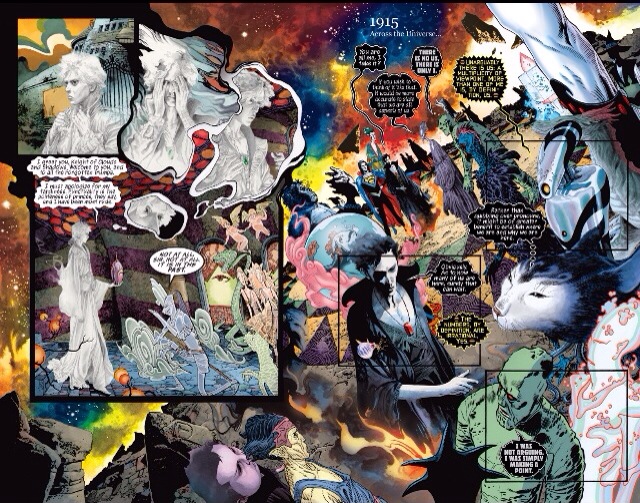
The Sandman: Overture #5 (Vertigo)
The first issue published this year??? Indeed. And the mini-series launched at the end of 2013, so...five issues across three calendar years. Obviously not a very fast pace...I've had my issues enjoying this effort from Neil Gaiman and J.H. Williams III, but at this point I think I've put them behind me. This was never supposed to be the Sandman of the original series, but rather an expansive view of the whole thing, Dream himself. The next issue (whenever that happens) is actually the conclusion, so I'll wait until then to come up with a more comprehensive reaction to Overture. But as with Mister X, I'm just glad to have an opportunity to correct something I hadn't done previously, which is read the serialized version of something I previously knew from collected editions...
Showing posts with label J.H. Williams. Show all posts
Sunday, May 31, 2015
Sunday, December 28, 2014
The Sandman: Overture #4 (Vertigo)
![]() |
| via Lady Geek Girl |
artist: J.H. Williams III
The Sandman: Overture is being released so gradually, you can almost forget sometimes that it's even happening. I think that's exactly what's happened, too.
It probably doesn't help that this is not at all easy reading.
All the same, we're four issues in now and Dream is talking to stars. Stars, mind you, that don't particularly respect him.
And is this the issue where we finally get something to hold onto? Dream is endangered by the troublesome stars, and he speaks with his father, and this is what the father has to say about Dream's companion, the little alien girl called Hope:
"There is always a time in which she will have been alive. Always a time in which she does not exist. That is the nature of existence. I cannot think why nobody except me seems to see things like that."
Such is the value of this effort, I suspect, trying to address some terrifically big ideas.
Wednesday, August 27, 2014
The Sandman: Overture #3 (Vertigo)
writer: Neil Gaiman
artist: J.H. Williams III
It sucks, because I never know if I'm missing something that directly references prior Sandman material. I know, for instance, that we have a secret origin for Dream's helm, which was famously recovered in the original series' opening arc. But then again, maybe this is something that fans have seen before?
artist: J.H. Williams III
| via IGN |
It seems as if the romance around that moment is first-run material, but then what do I know? And should I even be worrying about this? The third volume of The Annotated Sandman is being released in October. I hope to get both that one and the second volume and read them either by the end of the year or earlier in 2015. By that point I'll have caught up with the bulk of the mythology, and maybe will be less confused about these matters.
But then again, maybe I really shouldn't be worrying so much about these matters. This issue is probably the most enjoyable, for me anyway, of Overture so far. There appear to be direct references to Dream's ultimate fate, so that this is a prequel for all I understand. Regardless, Dream is on a quest. There are multiple versions of him running around. In fact, he's at the moment hanging out with a cat version of himself. This leads to an amusing moment when they pick up a tagalong, who suggests when she doesn't walk by herself, "I could ride your cat." To which Dream responds:
"My cat is Dream of the Endless. He does not give rides."
Classic. Gaiman is a master storyteller, and is a better writer, generally, than pretty much anyone else. Regardless of how lost I sometimes feel, he's always in control. Reading Overture for me is a little like what reading Grant Morrison must be like for all those people who don't get him.
And as always, J.H. Williams III is stunning on art. The way he composes his layouts can sometimes be challenging to follow even for veteran comics readers, but it's always a welcome challenge.
Friday, June 13, 2014
The Sandman: Overture #2 (Vertigo)
writer: Neil Gaiman
artist: J.H. Williams III
I came very late to Neil Gaiman's Sandman, but I became as much a fan as anyone has. That being said, and also that I'm very happy that they've once again come together, I'm not sure what I think of Overture after two issues. The above image is part of my dilemma.
artist: J.H. Williams III
| via Nothing But Comics |
Gaiman so far has been setting the stage, and that's about it. This is not one of those complaints that has anything to do with delays. I'm not so starved for entertainment that I must hang all of my attention on a single story. That being said, I'm pretty sure the schedule was always more elongated than usual. Now it seems it's a little longer still. Whatever.
No, this is more a matter of how much time Gaiman is spending talking about Dream rather than tossing him into another story. My limited experience of Sandman to date is that it's less to do with the central character and more his tangential role in a whole tapestry of stories. With Overture, Gaiman seems to have reversed that. I get the sense that the whole reason he's even working on this project is because like a lot of writers at later stages in their careers (although considering Gaiman is only 53, this is kind of ridiculous to be saying, I know) and years removed from their most famous projects, they either try to distance themselves from said project or try and do whatever they can to remind everyone of what made them so special to begin with.
So on that score it makes sense for Overture to be more about Dream than feature him. This is a chance to revisit the character and everything else around him, to celebrate, and so that's a little of what's going on here. This second issue doesn't do a ton more than the first one. The multiple versions of Dream do a lot of talking with each other. In theory this is right up my alley. I like cerebral material, people talking about things rather merely doing things. But as far as my expectations go, I kind of what, I guess (and I just realized what I was thinking as I was writing this sentence, and how it suddenly sounds kind of stupid) what Gaiman has done before.
And I guess, that's an important thing to realize. Maybe Overture is doing exactly what it's supposed to be doing. I'm still a neophyte as a fan. I'm not lost, really, but maybe because I still haven't actually read the whole of the original material, I wanted something that evoked it more than I should have. I was probably being a little ridiculous.
Ha.
So I guess I'll relax a little. The next issue is scheduled for release at the end of next month. Sometimes it bears reminding in a monthly format that it's not always as easy as it can seem to appreciate what a finite story is accomplishing from issue to issue.
In the meantime, have another look at that art! All praise to J.H. Williams III!
Monday, May 5, 2014
Reading Comics #122 "Bull Moose Grab Bag"
I love grab bags. One of the shops I frequent these days, which is actually an indy music/movie chain store that also has comic books, is Bull Moose in Lewiston, Maine. I've gotten a few grab bags from them over the last few months, and during the course of my reviews of the stuff I've been reading lately you might have seen some fairly negative ones. Since I've cut back on my spending, I've been reading far fewer comics than I used to, only the stuff that I'm really certain I'll appreciate, so that's the secret origin of that. Bull Moose grab bags are a great bargain (since it's highly unlikely that there will be a lot of Lewiston, Maine, natives in my reading audience, this does not count as a shameless plug), ten recent comics for five bucks. "Recent" means within the past year, usually within the last few months (although the one I got this Saturday must have been one of the older bags they had, because its contents were near a year old).
So at this point I've decided to bring back the roundup feature I sometimes fall back on here. When there's something I haven't really enjoyed I don't have to try and justify it too much. But there can be real gems in the bunch as well!
Cable and X-Force #18 (Marvel)
Cable and Bishop are time-traveling mutants who are fascinating in theory but are more often than not incapable of living up to their potential, possibly because writers aren't really thinking about what they can do but rather what they can't, which is explore the dystopias they come from. Bishop has had a much rougher path to follow than Cable (notice which one is in the title, and has had a lot of series over the years and which...hasn't), although he's been a favorite of mine since I first saw him in the old early '90s X-Men cartoon. (Hey, and speaking of which, is either one of these guys in X-Men: Days of the Future Past?) They've got the same curse every Marvel mutant has, actually, only amplified. Everyone knows that the X-Men are supposed to be a persecuted lot, but the logical gymnastics writers take to keep them that way, or ignore this concept entirely, can sometimes be ridiculous. Recently they've settled on making more Magneto characters, which is to say compromised figures trying to do the right thing but making all the wrong moves (read: Cyclops). Add Bishop to that bunch, unfortunately. And so that's what this issue is all about. Apparently someone also thought it was a good idea to have not one but two teams of X-Force running around (because you can never have too many competing concepts in Marvel), and so that's also what this comic's about. It's not very good, alas. And the art looks a little weird at points. It screws up Cable, for instance. (Since when was his metallic arm a covering for an actual arm? Who am I kidding? I don't care!) Long story short: this is not a comic book I would have read deliberately.
Earth 2 #19 (DC)
I kept trying to find the recent annual that basically mainlined the awesome Flashpoint concept from a few years back of Thomas Wayne becoming Batman instead of his son, but failed everywhere I looked (even though I do digital comics now and am clearly aware of the Internet, I still love operating in the physical world), so it was pretty awesome to randomly come across an issue of the regular series. This series, in case you're not aware, is set in one of DC's alternate realities. It was launched by James Robinson as a surrogate Justice Society landscape but set in the same context as the debut arc from Geoff Johns' Justice League, so that the Darkseid siege of Earth was more successful and so everyone had to figure out how to pick up the pieces. At the start the new versions of the classic JSA superheroes were occupying a landscape devoid of the more familiar DC icons because those guys had been eliminated. But recently they've been resurfacing, including the new Batman. I think it's evolved beautifully, and under the auspices of Tom Taylor remains a leading contender for a mainstream superhero comic that you could pick as your standalone experience should you want to know what that's like without having to worry about picking up any other series. And this is a good issue. Like I've said about Justice League all along, Earth 2 could easily be construed as an ongoing event book. Closing in on two years, that's not a bad thing to consider reading at all. At the moment, Batman and the altered version of Superman have been occupying the center stage, coming ever closing to a reckoning. Well, like I said, good stuff.
Infinity #6 (Marvel)
This was last year's big Marvel event, sort of like something-something Thanos, something-something Inhumans (because Marvel keeps trying to make them a thing just like DC keeps trying to make the New Gods a thing, and only one of them actually has something interesting to explore) (and it's not Marvel). This was Jonathan Hickman's effort to duplicate the classic Jim Starlin stories featuring Thanos, no doubt thanks to the large-chin villain's cameo at the end of Avengers (although he won't appear as a main character until the third movie) (probably). I've always admired Hickman's ambition, but I'm not sure he's quite what Marvel keeps hoping he'll be, which is their own Grant Morrison. He's better than other writers who've tried to handle Thanos recently, but the result is still a fairly poor echo of Starlin's material. Still, the art is from Jim Cheung, who was half of the iconic original team on Young Avengers (along with Allan Heinberg). Good strong stuff there, anyway, as always. Glad to see him still considered a significant player.
Marvel Previews #14 (Marvel)
This is Marvel's separate catalog to the industry-standard, Diamond distributor version that handles...everyone else. I don't really know why this ended up in the grab bag. But it didn't exactly convince me to think any differently about Marvel's current output than I have been. On the cover is Nightcrawler, the latest returned-from-the-dead character. Oh, which reminds me, in case you had no idea, Nightcrawler's been dead lately. But apparently he got better.
Red Lanterns #25 (DC)
I haven't really been following the Green Lantern franchise, other than Geoff Johns, since the New 52 relaunch in 2011, but it's been nice knowing it exists, and in such force. One of the odder additions to the lineup was a Red Lanterns series, but it seems the longer it's lasted the better it's gotten. With Charles Soule, always good news, writing it these days, and Guy Gardner having become the face, it's probably as good or better than anything else you'll find in the lineup. Guy has repositioned the remaining members of the corps into defenders of his home turf, not so much on Earth but the territory (Space Sector 2814, to be precise). Soule has particular fun with Guy's allies, while he also continues the saga of Atrocitus, who once ruled the roost. It's as good a sci-fi title as I've read, which is actually pretty rare for a Green Lantern series. Which is pretty odd when you think about it.
The Sandman: Overture Special Edition #1 (Vertigo)
So, clearly I'm kind of the target audience for this series. I'm not sure how many new readers will be coming aboard for the journey, except maybe Neil Gaiman fans who came about after the end of the original series when he'd begun making a name for himself as a prose writer. The casual comics reader probably won't be spending too much time in the Vertigo sandbox, because with Image and a thousand indies running around, there's a lot more competition for the nonsuperhero set than ever before. As someone who loves Gaiman's Sandman but who hasn't read the complete series, I'm a curious phenomenon (for a lot of other reasons, too). I caught the original version of this debut issue of Overture, but was glad to randomly catch the special edition as well. It helped me digest it a little more, not just the bonus features, but being forced to read the comic itself over again. The Corinthian (the creepy dude with two additional mouths where his eyes ought to be) is in the spotlight once again, but only until our title hero stumbles into an existential conundrum that is not anywhere near finished by the end of the issue. Gaiman's approach is serialized in this effort, rather than in some of the fairly self-contained stories he told even in his arcs from the original Sandman. There's plenty to find familiar and interesting here. It certainly helps to have an artist the caliber of J.H. Williams III (there are few others capable of being anywhere near as awesome), whose sense of the page is virtually unparalleled, which as host of the special edition he's capable of walking through with the reader. If you're unsure of Overture, these special editions may actually be your better bet.
Sonic Universe #58 (Archie)
I'm just going to skip over this one. Better for you. Better for me. Better for them.
Swamp Thing #27 (DC)
There's whole corners of the New 52 landscape that have nothing to do with Superman or Batman or Green Lantern. No, really! One of them involves the so-called "dark" characters who most recently were handled by Vertigo rather than DC. Their return has been one of the most interesting things about the relauch (I know, if you hear much about it I bet you much more regularly hear all the complaints about what was lost rather than gained). I confess to not having really taken advantage of this stuff. But it's good. It's probably some of the best stuff DC has. But even fans who know about this corner find reasons to complain, especially since there have been a lot of crossovers. I don't see the problem with crossovers. If it's a shared universe, it's a lot more useful, sometimes, to have an out-and-out crossover rather than have a guest-star. Crossovers, when done right, have a good way of establishing context, and as far as I can tell, books like Swamp Thing have definitely understood that. Unsurprisingly, the writer here is also Charles Soule. The dude has quickly become indispensable. Where the heck did he come from??? A lot of what this particular character means comes from Alan Moore work from thirty years ago. This run, and even this very issue, is a chance for a fresh start. Good stuff.
Walking Dead #119 (Image)
(Comic Book Datebase locked me out of the issue listing without a login, so no cover for you.)
Obviously you know about Walking Dead. Whether from the comic or the TV series or both. Rather than discuss anything specifically from the issue, I want to address the letters column. In it, creator/writer Robert Kirkman discusses the future of the comic, how long he envisions it to last. A couple years ago he was talking a total length of 300 issues. And keep in mind we're only a third of the way there. But apparently now he's thinking 500. And he's already got fans talking about him padding his storytelling. Because of the huge success of the TV show, Kirkman could keep this thing going as long as he wants, long after the show is over. The one doesn't depend on the other. It just sounds ridiculous to me. No writer has five hundred issues worth of material to tell about one story. It's just this dude realizing he's got it made. No matter what else happens, he'll always have this in his back pocket. Now, there are certainly creators in any medium who spend their whole careers on the same property. In comics that's certainly been the case. But other than Dave Sim (who by the way did accomplish 300 issues, over the course of thirty years, on his Cerebus), there hasn't really been anyone who has managed to make such a dedicated run (it's worth noting Sim was his own artist). Kirkman probably ought to stop prognosticating. If fans are already complaining about his output now, he may have very few fans indeed decades from now who care about the latest shenanigans of survivors stumbling from scenario to scenario. Just saying.
Savage Wolverine #14 (Marvel)
Like Walking Dead above, I'm not really going to talk about the issue or the capable talents of Richard Isanove, but rather some of the ridiculous recent habits of Marvel. On the cover, as you can see, there's a giant #1 in the corner, even though this is not the first issue or some reboot (of a reboot of a reboot of a reboot...over the span of...just a handful of years). Marvel has always prided itself as never having rebooted its line. The stories you read today are theoretically related to stories that were done decades ago. And yet, there've been so many shenanigans that it doesn't really matter anymore. It's just one successful gimmick to keep fans interested after another. Such as the equally ridiculous Marvel Now! branding that is clearly Marvel's lackluster answer to DC's New 52. The cover also has the copy #14.now, which means...absolutely nothing. It's just one stupid, we're accessible! argument after another. I think in a few years Marvel will have finally worn out its welcome at the top. Hopefully. Well, I wish...
All images via Comic Book Database.
So at this point I've decided to bring back the roundup feature I sometimes fall back on here. When there's something I haven't really enjoyed I don't have to try and justify it too much. But there can be real gems in the bunch as well!
Cable and X-Force #18 (Marvel)
Cable and Bishop are time-traveling mutants who are fascinating in theory but are more often than not incapable of living up to their potential, possibly because writers aren't really thinking about what they can do but rather what they can't, which is explore the dystopias they come from. Bishop has had a much rougher path to follow than Cable (notice which one is in the title, and has had a lot of series over the years and which...hasn't), although he's been a favorite of mine since I first saw him in the old early '90s X-Men cartoon. (Hey, and speaking of which, is either one of these guys in X-Men: Days of the Future Past?) They've got the same curse every Marvel mutant has, actually, only amplified. Everyone knows that the X-Men are supposed to be a persecuted lot, but the logical gymnastics writers take to keep them that way, or ignore this concept entirely, can sometimes be ridiculous. Recently they've settled on making more Magneto characters, which is to say compromised figures trying to do the right thing but making all the wrong moves (read: Cyclops). Add Bishop to that bunch, unfortunately. And so that's what this issue is all about. Apparently someone also thought it was a good idea to have not one but two teams of X-Force running around (because you can never have too many competing concepts in Marvel), and so that's also what this comic's about. It's not very good, alas. And the art looks a little weird at points. It screws up Cable, for instance. (Since when was his metallic arm a covering for an actual arm? Who am I kidding? I don't care!) Long story short: this is not a comic book I would have read deliberately.
Earth 2 #19 (DC)
I kept trying to find the recent annual that basically mainlined the awesome Flashpoint concept from a few years back of Thomas Wayne becoming Batman instead of his son, but failed everywhere I looked (even though I do digital comics now and am clearly aware of the Internet, I still love operating in the physical world), so it was pretty awesome to randomly come across an issue of the regular series. This series, in case you're not aware, is set in one of DC's alternate realities. It was launched by James Robinson as a surrogate Justice Society landscape but set in the same context as the debut arc from Geoff Johns' Justice League, so that the Darkseid siege of Earth was more successful and so everyone had to figure out how to pick up the pieces. At the start the new versions of the classic JSA superheroes were occupying a landscape devoid of the more familiar DC icons because those guys had been eliminated. But recently they've been resurfacing, including the new Batman. I think it's evolved beautifully, and under the auspices of Tom Taylor remains a leading contender for a mainstream superhero comic that you could pick as your standalone experience should you want to know what that's like without having to worry about picking up any other series. And this is a good issue. Like I've said about Justice League all along, Earth 2 could easily be construed as an ongoing event book. Closing in on two years, that's not a bad thing to consider reading at all. At the moment, Batman and the altered version of Superman have been occupying the center stage, coming ever closing to a reckoning. Well, like I said, good stuff.
Infinity #6 (Marvel)
This was last year's big Marvel event, sort of like something-something Thanos, something-something Inhumans (because Marvel keeps trying to make them a thing just like DC keeps trying to make the New Gods a thing, and only one of them actually has something interesting to explore) (and it's not Marvel). This was Jonathan Hickman's effort to duplicate the classic Jim Starlin stories featuring Thanos, no doubt thanks to the large-chin villain's cameo at the end of Avengers (although he won't appear as a main character until the third movie) (probably). I've always admired Hickman's ambition, but I'm not sure he's quite what Marvel keeps hoping he'll be, which is their own Grant Morrison. He's better than other writers who've tried to handle Thanos recently, but the result is still a fairly poor echo of Starlin's material. Still, the art is from Jim Cheung, who was half of the iconic original team on Young Avengers (along with Allan Heinberg). Good strong stuff there, anyway, as always. Glad to see him still considered a significant player.
Marvel Previews #14 (Marvel)
This is Marvel's separate catalog to the industry-standard, Diamond distributor version that handles...everyone else. I don't really know why this ended up in the grab bag. But it didn't exactly convince me to think any differently about Marvel's current output than I have been. On the cover is Nightcrawler, the latest returned-from-the-dead character. Oh, which reminds me, in case you had no idea, Nightcrawler's been dead lately. But apparently he got better.
Red Lanterns #25 (DC)
I haven't really been following the Green Lantern franchise, other than Geoff Johns, since the New 52 relaunch in 2011, but it's been nice knowing it exists, and in such force. One of the odder additions to the lineup was a Red Lanterns series, but it seems the longer it's lasted the better it's gotten. With Charles Soule, always good news, writing it these days, and Guy Gardner having become the face, it's probably as good or better than anything else you'll find in the lineup. Guy has repositioned the remaining members of the corps into defenders of his home turf, not so much on Earth but the territory (Space Sector 2814, to be precise). Soule has particular fun with Guy's allies, while he also continues the saga of Atrocitus, who once ruled the roost. It's as good a sci-fi title as I've read, which is actually pretty rare for a Green Lantern series. Which is pretty odd when you think about it.
The Sandman: Overture Special Edition #1 (Vertigo)
So, clearly I'm kind of the target audience for this series. I'm not sure how many new readers will be coming aboard for the journey, except maybe Neil Gaiman fans who came about after the end of the original series when he'd begun making a name for himself as a prose writer. The casual comics reader probably won't be spending too much time in the Vertigo sandbox, because with Image and a thousand indies running around, there's a lot more competition for the nonsuperhero set than ever before. As someone who loves Gaiman's Sandman but who hasn't read the complete series, I'm a curious phenomenon (for a lot of other reasons, too). I caught the original version of this debut issue of Overture, but was glad to randomly catch the special edition as well. It helped me digest it a little more, not just the bonus features, but being forced to read the comic itself over again. The Corinthian (the creepy dude with two additional mouths where his eyes ought to be) is in the spotlight once again, but only until our title hero stumbles into an existential conundrum that is not anywhere near finished by the end of the issue. Gaiman's approach is serialized in this effort, rather than in some of the fairly self-contained stories he told even in his arcs from the original Sandman. There's plenty to find familiar and interesting here. It certainly helps to have an artist the caliber of J.H. Williams III (there are few others capable of being anywhere near as awesome), whose sense of the page is virtually unparalleled, which as host of the special edition he's capable of walking through with the reader. If you're unsure of Overture, these special editions may actually be your better bet.
Sonic Universe #58 (Archie)
I'm just going to skip over this one. Better for you. Better for me. Better for them.
Swamp Thing #27 (DC)
There's whole corners of the New 52 landscape that have nothing to do with Superman or Batman or Green Lantern. No, really! One of them involves the so-called "dark" characters who most recently were handled by Vertigo rather than DC. Their return has been one of the most interesting things about the relauch (I know, if you hear much about it I bet you much more regularly hear all the complaints about what was lost rather than gained). I confess to not having really taken advantage of this stuff. But it's good. It's probably some of the best stuff DC has. But even fans who know about this corner find reasons to complain, especially since there have been a lot of crossovers. I don't see the problem with crossovers. If it's a shared universe, it's a lot more useful, sometimes, to have an out-and-out crossover rather than have a guest-star. Crossovers, when done right, have a good way of establishing context, and as far as I can tell, books like Swamp Thing have definitely understood that. Unsurprisingly, the writer here is also Charles Soule. The dude has quickly become indispensable. Where the heck did he come from??? A lot of what this particular character means comes from Alan Moore work from thirty years ago. This run, and even this very issue, is a chance for a fresh start. Good stuff.
Walking Dead #119 (Image)
(Comic Book Datebase locked me out of the issue listing without a login, so no cover for you.)
Obviously you know about Walking Dead. Whether from the comic or the TV series or both. Rather than discuss anything specifically from the issue, I want to address the letters column. In it, creator/writer Robert Kirkman discusses the future of the comic, how long he envisions it to last. A couple years ago he was talking a total length of 300 issues. And keep in mind we're only a third of the way there. But apparently now he's thinking 500. And he's already got fans talking about him padding his storytelling. Because of the huge success of the TV show, Kirkman could keep this thing going as long as he wants, long after the show is over. The one doesn't depend on the other. It just sounds ridiculous to me. No writer has five hundred issues worth of material to tell about one story. It's just this dude realizing he's got it made. No matter what else happens, he'll always have this in his back pocket. Now, there are certainly creators in any medium who spend their whole careers on the same property. In comics that's certainly been the case. But other than Dave Sim (who by the way did accomplish 300 issues, over the course of thirty years, on his Cerebus), there hasn't really been anyone who has managed to make such a dedicated run (it's worth noting Sim was his own artist). Kirkman probably ought to stop prognosticating. If fans are already complaining about his output now, he may have very few fans indeed decades from now who care about the latest shenanigans of survivors stumbling from scenario to scenario. Just saying.
Savage Wolverine #14 (Marvel)
Like Walking Dead above, I'm not really going to talk about the issue or the capable talents of Richard Isanove, but rather some of the ridiculous recent habits of Marvel. On the cover, as you can see, there's a giant #1 in the corner, even though this is not the first issue or some reboot (of a reboot of a reboot of a reboot...over the span of...just a handful of years). Marvel has always prided itself as never having rebooted its line. The stories you read today are theoretically related to stories that were done decades ago. And yet, there've been so many shenanigans that it doesn't really matter anymore. It's just one successful gimmick to keep fans interested after another. Such as the equally ridiculous Marvel Now! branding that is clearly Marvel's lackluster answer to DC's New 52. The cover also has the copy #14.now, which means...absolutely nothing. It's just one stupid, we're accessible! argument after another. I think in a few years Marvel will have finally worn out its welcome at the top. Hopefully. Well, I wish...
All images via Comic Book Database.
Sunday, February 9, 2014
Digitally Speaking...#5 "Batman"
Batman #13 (DC)
From 2012. This is Scott Snyder's introduction to the "Death of the Family" arc. And surprise to say, but it's kind of shockingly bad. Not bad as in it's written or drawn poorly, but conceptually it's so poorly executed that it's surprising something like this would be the start of a major story arc for a major character in a major company. Internet critics say that sort of thing all the time. I was following a blogger who trashed just about every issue of AvX that way, and that was an event written by Marvel's top creators. I've ragged on Snyder in the past. I know he's supposed to be the best Batman writer in years. I even recently came to his defense in terms of the conclusion to this very arc and what he might have planned for some grand greater scheme. But in terms at least of this issue, out of all the "Death of the Family" issues I've read, it's easily the worst.
It begins randomly, Commissioner Gordon and Harvey Bullock talking about omens, and then the next page taking all the steam out of the conversation, and then transitioning to Gordon's smoking habit, and then the Joker randomly appears, and then Batman arrives, and then we have a recap of an apparently aborted story Tony Daniel began at the start of the New 52 in the pages of Detective Comics, the one that got the Joker's face peeled off in the first place. Snyder never really convincingly explains any of that, but it's okay, because it's the creepy Joker. Then the Joker becomes all methodical, copying the events of the first time he ever struck Gotham, which becomes a pastiche on how the character operates in Tim Burton's Batman. And finally we reach the Joker and Batman, and the real story is teased.
Honestly, I have no idea why Snyder had to be so obtuse about it. Damian mocks the whole thing right from the start. Maybe that's why Grant Morrison realized he had to go, because he's a barometer. Unlike how Snyder attempts to present Joker, it's really Damian who cuts every situation down to what it really is. So it's no wonder that the best "Death of the Family" issue came from Batman and Robin.
It's certainly not this issue. Definitely not. I have no idea what Snyder was thinking. He's not really that bad a writer. To start a major arc like this, though...When Kyle Higgins started at DC, he was paired with Snyder for the Gates of Gotham mini-series. But now I'm thinking it's Snyder who needs a co-writer. There's no great shame in this. Geoff Johns had co-writers, too. Snyder had one when American Vampire began (some dude named Stephen King). He needs someone to help formulate stories better. He's apparently reached the point where editors can't approach him that way (although the buzz in Negative DC Talk is that all the writers who've abruptly departed the New 52 have done so because of meddling editors), but seriously, reading this issue alone? Any objective analysis begs for Snyder to get a little help.
That's all he needs really. He has a lot of good instincts. He also has a lot of bad ones. Comics are ripe with this kind of talent. Ed Brubaker, for example. Brian Michael Bendis. Even Mark Waid. Fans like to lump Morrison in with them, Johns too. I put Brubaker in with that lot because the best and really only good stuff he did with Captain America involved the Winter Soldier arc. He got his reward with a whole movie based on that work. Bendis is an undeniable talent, but he suffers from an acute case of verbal diarrhea that constantly gets in the way of telling real, actual stories (then again, sometimes maybe that's the point). Waid is his own worst enemy. He's literally a comics savant, but all his best instincts are usually stymied by his nervous need to rebel. I don't include Morrison or Johns because it's really a matter of creative differences. Whereas with Snyder, he can't formulate a story completely. At a certain point, he just throws out whatever he's got. He's at a point in his career where most people don't care. But in the long run, it'll absolutely matter.
And this issue is proof of that.
Batman 101
This compilation is a primer comiXology has that at once serves to provide a checklist for a few noteworthy stories from throughout Batman's publication history, as well as provide previews for all the original New 52 series (plus some vintage covers to round out the set). As far as the preview pages go, they certainly illuminate the original worth of those series. Scott Snyder's Batman starts out as promising as most Scott Snyder series. He's usually good at setting a mood (the above example notwithstanding). He also helps set the tone for most of the other entries, dominated as they are by caption narration (which as a rule I love in comics). Tony Daniel's Detective Comics comes off extremely well. At the time, Tony was more or less being demoted. After serving as artist during pivotal Grant Morrison issues, he'd become primary writer/artist on Batman. When the New 52 began, he was shifted to the secondary Batman title. I'd hoped he'd stick around for a while, but he was one of the earliest disappointments in that regard. Since being booted from Detective Comics, he's bounced from Superman to Justice League to Superman/Wonder Woman. I'd prefer the guy have some permanent home. There's also Peter Tomasi's Batman and Robin, which kicks off a more visual story (which is only fitting, given he's working with ideal collaborator Patrick Gleason). If these few pages intrigue you, know that there's much more interesting material that follows. David Finch's Batman: The Dark Knight, a title I never had much faith in, reads about as well as any other in these opening pages. I guess this one's my bad. Kyle Higgins' Nightwing doesn't come off as well as it could. I read a lot of the early issues, and it was pretty good stuff, but here it's surprisingly incoherent. (Maybe Snyder and Higgins ought to stick together more often?) Gail Simone's Batgirl might presumably be in the same ballpark as Tomasi's relatively feet-first introduction, but as I have far less faith in Simone than Tomasi, I never found out where she went with it. Judd Winick's Catwoman is a highlight, but then Winick is far better than most fans care to admit. Which might explain why his role was so tiny in the New 52, because the stupid fans never admitted as awesome he is. The only real quibble here is why Catwoman has by default become Sexy Catwoman for the past twenty years. I mean, I know there was the Jim Balent era in the '90s, but then by default every female character in the '90s was presented that way. It was more the inexplicable fetish version from the early '00s that decided because she wears latex Catwoman must be Sexy Catwoman, her zipper apparently never able to find the top of her costume (and more often than not, finding it incredibly easy to find the bottom). Winick is also responsible for the similarly impressive Batwing. This incredibly long paragraph ends by wondering why the hell J.H. Williams' long-anticipated Batwoman ended up becoming one of the earliest lost titles of the New 52. Seriously. Sure, it's still being published (and now written by Manhunter mystic Marc Andreyko), but you'd hardly know it. What's up with that? It's enough to make me have to read it myself. And people, I can't read everything I want to anymore. I learned the hard way. But it looks like I'll have to make another exception...
Batman: Black & White - A Black and White World (DC)
From 1996. This is an excerpt from Batman: Black & White #2, from an innovative anthology series DC recently revived. "A Black and White World" is written by Neil Gaiman, which pretty much by default makes in the best story featured in today's column. The story more than earns the distinction, and in classic Gaiman fashion, deconstructing the world of Batman so that he and the Joker are filming their own roles in a movie straight out of a comic book script (or perhaps are simply aware that they are characters in a comic book). The funny thing is, Grant Morrison has had them participate in similar conversations, so it wouldn't be so much of a stretch to assume that between encounters, Batman really does visit Joker at Arkham Asylum and they talk exactly like this, the Joker especially, just as if it's all a game. It's enough to wish Gaiman would write more Batman (he also wrote "Whatever Happened to the Caped Crusader?", a coda to Morrison's "Batman R.I.P." arc), and especially more Joker. This few pages is more insightful to the dynamic between the two than everything Snyder did in "Death of the Family" (besides my supposition as to his ultimate, as-yet-unrevealed purpose), especially in the above opening issue. But that's Neil Gaiman for you.
From 2012. This is Scott Snyder's introduction to the "Death of the Family" arc. And surprise to say, but it's kind of shockingly bad. Not bad as in it's written or drawn poorly, but conceptually it's so poorly executed that it's surprising something like this would be the start of a major story arc for a major character in a major company. Internet critics say that sort of thing all the time. I was following a blogger who trashed just about every issue of AvX that way, and that was an event written by Marvel's top creators. I've ragged on Snyder in the past. I know he's supposed to be the best Batman writer in years. I even recently came to his defense in terms of the conclusion to this very arc and what he might have planned for some grand greater scheme. But in terms at least of this issue, out of all the "Death of the Family" issues I've read, it's easily the worst.
It begins randomly, Commissioner Gordon and Harvey Bullock talking about omens, and then the next page taking all the steam out of the conversation, and then transitioning to Gordon's smoking habit, and then the Joker randomly appears, and then Batman arrives, and then we have a recap of an apparently aborted story Tony Daniel began at the start of the New 52 in the pages of Detective Comics, the one that got the Joker's face peeled off in the first place. Snyder never really convincingly explains any of that, but it's okay, because it's the creepy Joker. Then the Joker becomes all methodical, copying the events of the first time he ever struck Gotham, which becomes a pastiche on how the character operates in Tim Burton's Batman. And finally we reach the Joker and Batman, and the real story is teased.
Honestly, I have no idea why Snyder had to be so obtuse about it. Damian mocks the whole thing right from the start. Maybe that's why Grant Morrison realized he had to go, because he's a barometer. Unlike how Snyder attempts to present Joker, it's really Damian who cuts every situation down to what it really is. So it's no wonder that the best "Death of the Family" issue came from Batman and Robin.
It's certainly not this issue. Definitely not. I have no idea what Snyder was thinking. He's not really that bad a writer. To start a major arc like this, though...When Kyle Higgins started at DC, he was paired with Snyder for the Gates of Gotham mini-series. But now I'm thinking it's Snyder who needs a co-writer. There's no great shame in this. Geoff Johns had co-writers, too. Snyder had one when American Vampire began (some dude named Stephen King). He needs someone to help formulate stories better. He's apparently reached the point where editors can't approach him that way (although the buzz in Negative DC Talk is that all the writers who've abruptly departed the New 52 have done so because of meddling editors), but seriously, reading this issue alone? Any objective analysis begs for Snyder to get a little help.
That's all he needs really. He has a lot of good instincts. He also has a lot of bad ones. Comics are ripe with this kind of talent. Ed Brubaker, for example. Brian Michael Bendis. Even Mark Waid. Fans like to lump Morrison in with them, Johns too. I put Brubaker in with that lot because the best and really only good stuff he did with Captain America involved the Winter Soldier arc. He got his reward with a whole movie based on that work. Bendis is an undeniable talent, but he suffers from an acute case of verbal diarrhea that constantly gets in the way of telling real, actual stories (then again, sometimes maybe that's the point). Waid is his own worst enemy. He's literally a comics savant, but all his best instincts are usually stymied by his nervous need to rebel. I don't include Morrison or Johns because it's really a matter of creative differences. Whereas with Snyder, he can't formulate a story completely. At a certain point, he just throws out whatever he's got. He's at a point in his career where most people don't care. But in the long run, it'll absolutely matter.
And this issue is proof of that.
Batman 101
This compilation is a primer comiXology has that at once serves to provide a checklist for a few noteworthy stories from throughout Batman's publication history, as well as provide previews for all the original New 52 series (plus some vintage covers to round out the set). As far as the preview pages go, they certainly illuminate the original worth of those series. Scott Snyder's Batman starts out as promising as most Scott Snyder series. He's usually good at setting a mood (the above example notwithstanding). He also helps set the tone for most of the other entries, dominated as they are by caption narration (which as a rule I love in comics). Tony Daniel's Detective Comics comes off extremely well. At the time, Tony was more or less being demoted. After serving as artist during pivotal Grant Morrison issues, he'd become primary writer/artist on Batman. When the New 52 began, he was shifted to the secondary Batman title. I'd hoped he'd stick around for a while, but he was one of the earliest disappointments in that regard. Since being booted from Detective Comics, he's bounced from Superman to Justice League to Superman/Wonder Woman. I'd prefer the guy have some permanent home. There's also Peter Tomasi's Batman and Robin, which kicks off a more visual story (which is only fitting, given he's working with ideal collaborator Patrick Gleason). If these few pages intrigue you, know that there's much more interesting material that follows. David Finch's Batman: The Dark Knight, a title I never had much faith in, reads about as well as any other in these opening pages. I guess this one's my bad. Kyle Higgins' Nightwing doesn't come off as well as it could. I read a lot of the early issues, and it was pretty good stuff, but here it's surprisingly incoherent. (Maybe Snyder and Higgins ought to stick together more often?) Gail Simone's Batgirl might presumably be in the same ballpark as Tomasi's relatively feet-first introduction, but as I have far less faith in Simone than Tomasi, I never found out where she went with it. Judd Winick's Catwoman is a highlight, but then Winick is far better than most fans care to admit. Which might explain why his role was so tiny in the New 52, because the stupid fans never admitted as awesome he is. The only real quibble here is why Catwoman has by default become Sexy Catwoman for the past twenty years. I mean, I know there was the Jim Balent era in the '90s, but then by default every female character in the '90s was presented that way. It was more the inexplicable fetish version from the early '00s that decided because she wears latex Catwoman must be Sexy Catwoman, her zipper apparently never able to find the top of her costume (and more often than not, finding it incredibly easy to find the bottom). Winick is also responsible for the similarly impressive Batwing. This incredibly long paragraph ends by wondering why the hell J.H. Williams' long-anticipated Batwoman ended up becoming one of the earliest lost titles of the New 52. Seriously. Sure, it's still being published (and now written by Manhunter mystic Marc Andreyko), but you'd hardly know it. What's up with that? It's enough to make me have to read it myself. And people, I can't read everything I want to anymore. I learned the hard way. But it looks like I'll have to make another exception...
Batman: Black & White - A Black and White World (DC)
From 1996. This is an excerpt from Batman: Black & White #2, from an innovative anthology series DC recently revived. "A Black and White World" is written by Neil Gaiman, which pretty much by default makes in the best story featured in today's column. The story more than earns the distinction, and in classic Gaiman fashion, deconstructing the world of Batman so that he and the Joker are filming their own roles in a movie straight out of a comic book script (or perhaps are simply aware that they are characters in a comic book). The funny thing is, Grant Morrison has had them participate in similar conversations, so it wouldn't be so much of a stretch to assume that between encounters, Batman really does visit Joker at Arkham Asylum and they talk exactly like this, the Joker especially, just as if it's all a game. It's enough to wish Gaiman would write more Batman (he also wrote "Whatever Happened to the Caped Crusader?", a coda to Morrison's "Batman R.I.P." arc), and especially more Joker. This few pages is more insightful to the dynamic between the two than everything Snyder did in "Death of the Family" (besides my supposition as to his ultimate, as-yet-unrevealed purpose), especially in the above opening issue. But that's Neil Gaiman for you.
Subscribe to:
Posts (Atom)