Showing posts with label Quarter Bin. Show all posts

Saturday, December 21, 2019

Back Issue Bin 125 "Exit Stage Left, Havok & Wolverine: Meltdown, and other comics"

A clerk walked up to me and whispered into my ear, "You know, they're five for a dollar at the moment," and that's why I got a bunch of old comics recently.

Air #1 (Vertigo)
from October 2008

I still fondly remember getting into G. Willow Wilson's Air.  My interest at first was tentative, but then it became one of my favorite comics.  I still think it's Wilson's best comics work, which she doesn't seem to have been in too much of a rush to replicate, even after finding popular success years later with Ms. Marvel.  I've never added it to my graphic novel collection, though, so revisiting it was a long time coming, so it was great to find the first issue itself.  And I still enjoyed it.

Azrael #40 (DC)
from April 1998

I always find it funny to be reminded of comics I decided not to read, and there were some in the '90s that in retrospect really leave me scratching my head.  Even if I had no interest in Azrael itself, it's still strange to think there were rematches between the one-time Batman and Bane that didn't feel important enough to catch. About seven years back I read other encounters in the series between them (and maybe even this one?), so it was fun to do it again.  That the series lasted a hundred issues seems incomprehensible today, whether or not I was reading it myself.  But then, companies back then didn't have as itchy a trigger finger as they do now, constantly rebooting the big ones much less being patient with the smaller ones.  You can see how Azrael's lack of appearances in recent years would bode for any new attempt at a solo book.  The best of this issue is being reminded how long the original depiction of Bane managed to stick around, before subsequent generations screwed him up (well after the clownish version in Batman & Robin).  Thank goodness Christopher Nolan and Tom King came around!  This is a legitimately great character, with even greater potential still possible, which seems even more unlikely for a villain seemingly created just to provoke one of those endless '90s crises.

Batman and the Signal #3 (DC)
from June 2018

Duke Thomas was at one time pegged to be the next Robin, at least as far as fans expected, but eventually he assumed his own heroic identity, the Signal (Scott Snyder can be remarkably insular in his imaginative thought).  This was his first spotlight with the new handle.  Cully Hamner seems somehow less assured than usual on art, which was kind of strange.

DC Sampler (um, DC?)
from 1983

Ha!  A few years before Crisis on Infinite Earths, DC seemed pretty assured of its comics line.  This was a freebie they sent out with creative teams giving a small taste of what to expect from most of the titles at the time.  For flimsy reasons, it omits some pretty significant titles: Justice League of America, Green Lantern, and Camelot 3000 (one of the projects the company used to heavily promote alongside Watchmen, Dark Knight Returns, and the slightly less forgotten Ronin).

Exit Stage Left: The Snagglepuss Chronicles #5 (DC)
from July 2018

I've been talking about Mark Russell quite a bit here lately, and with good reason: He's struck me as one of the most significant creators to emerge in recent years, and in recent years, he's finally started cementing his reputation.  And for intents and purposes, that reputation begins with Exit Stage Left.

Using as its central conflict the familiar McCarthy Red Scare witch trials of the '50s, Russell reimagines a familiar Hanna-Barbera cartoon property as an allegory for the struggles of the LBGTQ community to find mainstream acceptance.  It was immediately picked up on by observers that Russell had struck upon a compelling concept.  I never had a chance to read it myself, having fallen into a black hole of sporadic comics reading at the time, and the later collection has been impossible to find in places other than the interwebs.  Now I think I may have to finally go that route, because more than Prez, more than Flintstones, it seems Exit Stage Left pushes Russell beyond the concept of social commentary into truly great writing, and finds him at his very best, just as the reports have had it.

The Red Scare is always going to be a fascinating concept in and of itself, what it was, what it provoked, and the general response to it, whether or not we learned anything from it, or might still have a chance to.  Clearly Russell believes it still has things to teach us, and as far as I'm concerned, he was absolutely right.  What emerges is at least the perception of an effect on society similar to the Nazis in Germany, which is an interpretation that history normally flattens into "naming names," something that seemingly only affected Hollywood.  DC itself has used the trials to explain what happened to the Justice Society after WWII, which the same flat interpretation.

Bottom line is, Russell created something that far exceeded a simple Hanna-Barbera nostalgia comic, into something that's valuable in a truly transcendent manner.  It should be a lot easier to find.

Havok & Wolverine: Meltdown #1 (Marvel)
from 1988

What I really like discovering are comics I didn't even know existed but turn out to be far more interesting than such a fate suggests.  This is obviously one of those.

From the husband-and-wife writing team of Walt and Louise Simonson (the latter of which I'd really only previously seen in the pages of Superman: The Man of Steel) and featuring art from Jon J. Muth (whom I'd previously seen in Grant Morrison's Mystery Play), this seems like another of Marvel's inexplicably lost evergreens.  The biggest difference between Marvel and DC that I've seen is that where DC actively celebrates its best stories, Marvel is most content basking in its great legacy.  Even the X-Men have gradually lost their once-celebrated memory for their '80s heyday. 

And this is part of it, perhaps the best part of it.  Wolverine, the poster child for breakout '80s X-Men success, and Havok (you know, Cyclops' brother).  (Oh, wait, you probably don't.  Because Havok has a tiny legacy.)

The Simonsons spend part of the story recounting the then-recent Chernobyl disaster (as recently depicted in a much-celebrated TV mini-series, called Chernobyl).  That was itself fun to read, real history unfolding in the pages of a comic that subsequently has great historic value.

Of course, Muth's art is spectacular in and of itself.  I have no idea, without researching, why Muth didn't make a much bigger name for himself, but it's not for lack of breathtaking talent.

Of course, at its heart Meltdown is a buddy adventure, and Wolverine & Havok play well off each other, in a story that's far removed from typical superhero comics material.

Marvel obviously knew it was a worthwhile project at some point: it was published in the prestige format.  It would be nice for Marvel to remember at some point, so fans can, too.  But thanks to whatever idiot gave up a treasure like this so I could discover it.

Justice League United #16 (DC)
from February 2016

I got this as much to see where the series had gone as astonishment that it had actually lasted that long, because it melted pretty much into oblivion, and I was just interested to see an issue from that late in the game (really only a few months before Rebirth).

JSA Classified #25 (DC)
from June 2007

I loved that DC expanded its Legends of the Dark Knight concept for a number of titles, between this, the JLA (Classified) and Batman and Superman (both Confidential), giving the company some anthology platforms.  This issue has the spotlight on the original Green Lantern, Alan Scott.

Legends of the DC Universe #9 (DC)
from October 1998

This is another '90s series I'm surprised I mostly skipped completely over, and of course it's a precursor to what I was just talking about, with this issue revisiting the classic team-up of Green Lantern (in this instance, Hal Jordan) and Green Arrow, with a tale of how they first met.

Legion of Super-Heroes #88 (DC)
from January 1997

I'm really sure I didn't read this issue when it was originally published, even though 2019 Tony thought it was an immediate necessity, as it features Impulse on the cover, and obviously a guest appearance by him inside, which 1997 should have been far more interested in, as I was a big fan of Bart Allen, and have since begun considering Mark Waid's Impulse perhaps a better overall experience than his Flash, which was itself one of my favorite '90s comics.  And I was happy to discover, even at the late date of 2019, that Impulse still amuses me.  This was a great spotlight for the character.

Marvel Boy: The Plutonian #1 (Marvel)
from March 2010

I thought this was another great discovery.  And I mean, it's interesting, but...Not as much as Havok & Wolverine.  I demand a Havok & Wolverine movie.  Or TV mini-series!  Starring Jared Harris!  As, I don't know, Wolverine!

Millennium #2, 3, 4, 6 & 8 (DC)
from 1987

Yey gods...I had never read Millennium, one of the event comics DC did after the great success of Crisis on Infinite Earths, but was pretty familiar with the concept, the Manhunters story where various characters were revealed to be infiltrators of the nefarious robot predecessors to the Guardians' Green Lantern Corps.  Now I wish I still had never read Millennium, because it's...dreck.  A totally botched event comic.  By the end, it feels like one of DC's perennial excuses to try and introduce a new generation of superheroes.  And absolutely none of them made it past Millennium itself.  At least as far as I can tell.  I had never heard of any of them until I saw their would-be spectacular debuts in the final issue.  And even I, who pride myself in being able to see great potential where others usually can't, couldn't imagine rehabilitating.  Any of them...

Mister X #1 (Vortex)
from June 1984

Mister X: Razed #4 (Dark Horse)
from May 2015

I had a great affinity for Dean Motter's Mister X.  I didn't discover it in that first issue from 1984, but rather years later, in a reprint collection, when interest was just beginning to surface again, leading to the Dark Horse revivals.  I got into Dean Motter comics, including finally reading Terminal City, which Motter had done for DC, and became a pretty big fan.  But Mister X itself is a somewhat peculiar beast.  The whole concept is almost only a concept, in which a character who's never really anything but a background character in his own comic exists mostly for a backstory, in a comic that looks spectacularly designed, regardless of who's drawing it (the original wasn't even written or drawn by Motter).  Yet strangely, I remain attached to it, even as I grow detached from my original excitement.  Seems almost like a secret handshake for true comics aficionados.  One I'm proud to be a part of.

Primal Force #12 (DC)
from October 1995

DC made the curious decision to publish a lot of titles that would've fit nicely with the original Vertigo conceit (an offbeat look at superheroes) under the regular DC label, and I think a lot of great material got buried as a result.  It only occurred to me that Primal Force is a part of that strange distinction upon this latest revisiting.  I didn't read this one at the time, either, of course, but I discovered and devoured it years later, and am always happy to be reminded of it.  I wish more fans understood what it accomplished, too, so that DC could add it to the trade collections always in-print.

The Sandman #4 (DC) 
from September 1975

As you can see from its publication stamp above, not the Neil Gaiman comic!  (Which of course I didn't read in the '90s!)  This is the earlier one, which at least as of this issue featured Jack Kirby art!  And exclamation points!  After!  Every!  Utterance!  Interestingly, features an add for a DC line expansion that includes Warlord (who endures in random appearances to this day) and Claw (who resurfaced in Primal Force and...doesn't endure to this day).

Seaguy#2 (Vertigo)
from August 2004

A lie!  A vicious lie!  Some jerk slipped this cover onto an issue of Fables.  I didn't discover this until I had already brought it home.  Some customers would probably bring it back and demand satisfaction.  I am not one of those costumers.  Makes for a better write-up here, anyway.

Starman #30 (DC)
from May 1997

Of course I didn't read Starman in the '90s.  What were you thinking, even wondering?  But I like to revisit it every now and then. 

Titans #30 (DC)
from August 2001

Hard to think of any date immediately preceding 9/11 without thinking of 9/11 (even though, as time stamps in comics go, this was actually released probably in June 2001, well ahead of that day).  Anyway, as Roy Harper comics go, at this point he was pretty much exclusively associated with Cheshire, the Elektra to his Daredevil, and this tale actually pivots more accurately on Cheshire herself, as she awaits the verdict for a trial concerning her villainous ways.  And then Roy Harper dies in Heroes in Crisis, and all anyone can fixate on is what Tom King did to poor Wally West.  What about Roy, fans.  What about Roy?

Wednesday, June 13, 2018

Back Issue Bin 122 "The Batgirl of Burnside and other Throwbacks"

Batgirl #42 (DC)
(from September 2015)


The Batgirl of Burnside will be remembered as a turning point in DC lore, not only for permanently reviving Barbara Gordon's superhero career, but as part of the youth movement that also saw Marvel introduce Kamala Khan and a whole generation of young heroes, as well as inspiring the brief DCYou era.  I was already well into a more limited comics reading experience by the time Batgirl went to Burnside, but I appreciated the idea even if I didn't get a chance to read it myself.  (There's a silly notion that just because you haven't personally enjoyed something you somehow automatically count as uninterested; that's poor perception of economics.)  The Burnside revival began in Batgirl #35, and it was as much cosmetic as approach.  Babs suddenly looked youthful again, and she was given a bold new costume and art direction, the latter of which was another primary feature of DCYou.  This issue features a different redesigned member of the Batman family, namely Batman himself, or rather Commissioner Batman, James Gordon.  Y'know, Batgirl's dad.  Commissioner Batman was also a bold creative left turn, always meant to be temporary.  It was only fitting for Batman and Batgirl to team up during this era, so I'm glad it happened.

Batman #457 (DC)
(from December 1990)

Ah!  This was Tim Drake's costumed debut!  Tim Drake, otherwise known as the third Robin, after Dick Grayson and Jason Todd.  In the Rebirth era, continued efforts to distinguish Tim led to his "death" in Detective Comics, as part of the Oz arc that eventually revealed the mystery figure to be Superman's dad Jor-El.  Tim was originally designed to be a dynamic new Robin, a faithful partner of Batman in standing with tradition, but "Knightfall" and its aftermath actually shoved him into full-fledged independence.  He eventually assumed the mantle of Red Robin in an ode to Kingdom Come, even wearing the same costume Dick does in that comic.  In the New 52, even though he was the first Robin to have his own ongoing series, Tim had to make do with leading the Teen Titans while Dick starred in Nightwing and then Grayson, and Jason in Red Hood and the Outlaws while Batman's kid Damian Wayne costarred in Batman and Robin.  For a generation of Robin fans, Tim Drake is the Boy Wonder, so this is a landmark issue.  It's the first time the traditional costume gets a complete overhaul, too!

Captain America #698 (Marvel)
(from April 2018)

Okay, so this one's pretty recent, a victim of a cover tear and subsequent banishment to the cheap bin.  I love that stuff!  This is one of Mark Waid's early comics in the post-Secret Empire revival, Marvel's effort to redeem the character after spending roughly a year with him operating as a natural born agent of Hydra.  Waid kicks off an arc where Cap wakes up after having been frozen again, with America in the grip of tyranny.  Only Captain America can save the day!  Ironically!

Earth 2 #25 (DC)
(from September 2014)


After James Robinson set up the concept, Tom Taylor took over and got to use versions of Superman and Batman.  I loved the New 52 Earth 2.  The Society continuation wrapped up in the early days of the Rebirth era, but at that point really only the DC office cared, which was too bad.  The Earth 2 Batman was actually Thomas Wayne!  I don't know if this was inspired by the Flashpoint Batman, but it was fun to see DC revive the idea in some fashion.  Obviously Batman couldn't dominate the title, even if he makes the cover this issue, at least the Batman 75th Anniversary edition.  Because the issue also features Val-Zod, the Earth 2 Superman, finally decide to embrace being Superman, so he rates the standard cover.
And there he is!  Both the Earth 2 Batman and Earth 2 Superman had unique costume variants on the classic templates.  Thomas Wayne Batman had red where Bruce Wayne typically has white, and Val-Zod sports silver where Clark Kent has red, with a red substitute as the field behind the s-shield.  As events later developed, neither Thomas Wayne nor Val-Zod were adequate substitutes for the icons who died in the first issue, but Dick Grayson later assumes the mantle of Batman in Convergence and Earth 2: Society, marking a true progression in the lineage he only gets to temporarily fulfill in regular continuity.


The Flash #48 (DC)
(from March 1991)

With no offense to William Messner-Loebs (help him here!), Wally West didn't properly become the Flash until Mark Waid started writing him.  That may have something to do with the fact that I was introduced to Wally as Flash by Waid's comics.  So I like to look into Messner-Loebs' work when I get the chance.  Among the interesting guest-stars this issue include Elongated Man Ralph Dibney (as a Flash continuity nerd it's surprising that Waid never got around to that) and a severely aged Vandal Savage (really want to read that next issue now!).  Plus Wally learning new things about his mom.  Waid was definitely part of the mythology movement that came to dominate DC, whereas Messner-Loebs embodied the more grounded ideas of the receding era that came before it.  It's not surprising their takes on Wally were different. 

Gotham Academy #7 (DC)
(from August 2015)

Batman tends to dominate DC's publishing schedule, as he's been their most consistent seller for...fifty years?  That's about right.  So that gives him a lot of sway, and gives creators a lot of space to play in.  This concept takes place in Gotham but doesn't necessarily involve Batman, although I chose this particular issue because it features his kid, Damian Wayne.  At this point, really only Grant Morrison and Pete Tomasi had written Damian, so this was an opportunity for a fresh set of eyes.  The result is a much softer version, which stands to reason, as Gotham Academy was itself a much more kid-friendly Batman comic.

Grayson #11 (DC)
(from October 2015)
It's sometimes easy to assume Tom King ended up getting the Batman assignment because of DC's respect for his Omega Men, but it's really down to his work on Grayson, where he got to explore the Batman landscape with a writing partner (Tim Seeley, who later built on Grayson's legacy with his Nightwing Rebirth material).  And King even had Mikel Janin on art!  Janin later proved to be a signature collaborator in the pages of Batman, too, of course, which makes it all the more obvious how important Grayson was for both their careers.  This issue, with a typically fantastic cover from Janin, helps the title reach a culmination of the Spyral arc it continued from Grant Morrison's Batman Incorporated (first volume).  Really, even I sometimes underestimate the importance of this groundwork material for King.  Someday I hope to read the complete run, add it to my King collection.  I have pretty much everything else already.


The Adventures of Superman Annual #3 (DC)
(from 1991)

The Armageddon 2001 annuals arc was one of the early themed events DC did that helped set the precedent for what it would later make an annual tradition in the New 52.  In fact, this particular arc is not all that different from Futures End, a kind of fast-forward.  Waverider, a character who could really use a revival, peers into the future of every hero trying to determine who becomes the villainous Monarch.  DC lore has it that it was originally intended to be Captain Atom, who in fact does become a different Monarch years later in the pages of Extreme Justice, but in the meantime it was switched to Hawk of Hawk & Dove (soon to appear on television!).  At any rate, it was never going to be Superman, right?  This issue instead focuses on the then-recent introduction of Maxima as an alien who fancies Superman to be her ideal mate.  Ah...they're later in Dan Jurgens' Justice League together! 

Adventures of Superman #632 (DC)
(from November 2004)

There's a number of things Greg Rucka is known for in his first run with DC (Wonder Woman, Gotham Central chief among them, and eventually Batwoman), but writing Superman isn't one of them.  And yet here he is!  There are two things to know about the issue: one is that Lois has been shot and is possibly dying (hindsight says probably not), and that Ruin is trying to become the next great Superman villain (hindsight says probably not, possibly owing to the fact that he's basically Lex Luthor).  Please also note Paul Pelletier on art!

Marvel Knights: X-Men #5 (Marvel)
(from May 2014)

Industry observers hailed Marvel Knights, along with the Ultimate line, to be one of Marvel's creative saviors in the early millennium.  Somewhere along the way both of them petered out, the Ultimate comics with a bang, the Knights with a whimper.  This is one of those projects that just kind of happened.  It's an ambitious attempt by new creators to give the X-Men new creative relevance (which was the Knights mandate as a whole) without necessarily reinventing the wheel.  Maybe the results this time were a little too woolly to stick the landing, too caught up with the emerging indy aesthetic Marvel would come to try and embrace across its line.  So it didn't really stick out.  But for an X-Men comic it still looks unique.  I think the problem mostly was that it tried to introduce new characters but didn't trust them to guide the story.  The X-Men gained new life when new characters started guiding the story.  Maybe time to try that again?

Back Issue Bin 121 "DC 3-Packs Again"

As far as I can tell, DC quit its Walmart 3-pack initiative  sometime last year.  I kept hoping to find new packs, but they were eventually outright pulled from the shelves at my local store, only to recently resurface, all the familiar stock they had the last time the packs were available.  I figured I'd pick some of those up just for argument's sake.  Three more packs, nine comics, here's the results:

Batman #1 (Batman #9)
This is the start of Tom King's second arc, "I Am Suicide," and I really don't mind reading it again, as it's a great issue, a walkthrough of his recruits for a private Suicide Squad including Ventriloquist, Bronze Tiger, Punch & Jewlee, and Catwoman.  The issue holds a lot of nice little tidbits, including one of King's early Kite Man appearances, not to mention a direct reference to "War of Jokes and Riddles" (at that point two arcs away), an appearance by a member of the Legion of Super-Heroes (probably) locked up in Arkham, and of course the start of King's Catwoman arc, where readers were initially shocked to learn she was suddenly a mass murderer.  Of course, we later learn that she was covering for a friend, Holly Robinson, which itself becomes a running subplot.  The Legion arc is still a ways away, as evidenced by several months worth of advance solicitations here in 2018 still yet to feature a follow-up, not to mention that "Suicide" is also part of King's long-term plans for Gotham Girl, which likewise have seen no advancement with the focus shifting to Batman's upcoming nuptials to Catwoman.  "Suicide" was the start of Bane's appearances in the series, so far culminating in the later "I Am Bane" arc.  "Suicide" also features King's addition to Batman's origin that the young Bruce Wayne was in fact suicidal prior to making his vow of a war on crime.  This arc was actually the start of massive complaints against King's Batman, which have never affected sales.  I don't really get readers not appreciating all this, especially with such a strong kickoff.  Too many readers, I think, don't let the work carry its obvious momentum.  Then again, there are plenty of readers who do.  The wedding is a clear lure, and buzz is crucial for all forms of popular entertainment, usually crushing any immediate backlash.  And hopefully in the future all this will be duly appreciated for the landmark work it is.

I'm not sure whether this is the first time I've obtained the Walmart variant (minus the "I Am Suicide" arc dressing in the Rebirth banner, and the numbering as indicated), but it's at least the third time I've read the issue, including the original publication and the later I Am Suicide collection.

Batman/Superman #31
(from July 2016)

Part of Pete Tomasi's "Final Days of Superman," what turned out to be a New 52 Death of Superman arc, far less heralded in the media than the 1992 version. 

Bizarro #3
(from October 2015)

A humor title launched in the DCYou initiative inspired by the success of "the Batgirl of Burnside" and coinciding with, among other things, the launch of King's Omega Men.

Convergence: Harley Quinn #2
(from July 2015)

I loved Convergence as an event.  Turns out the whole idea was probably executed mostly to help DC move to California with minimal publication disruption (insofar as material was still be released, just not regular series material) for a couple of months.  Captain Carrot appears here, part of an unlikely revival for the character that included appearances in Grant Morrison's Multiversity.  The Divergence title previewed in the issue is Garth Ennis's Section Eight.  I remain uninterested in Garth Ennis comics.

Infinity Man and the Forever People: Futures End
(from November 2014)

This is another 3-pack alum I suspect I've gotten before but not in the past half-year.  Anyway, as with all Futures End specials, its story jumps five years into the future but not necessarily related to the events of the weekly Futures End itself.  Beautiful Dreamer finds herself cursed to try and escape the pain of the team's destruction.  With the right creative approach, all of Jack Kirby's New Gods concepts could have massive breakout appeal, including the Forever People.  I'm glad DC keeps plugging away at its periodic attempts.

Batman and the Justice League: Outbreak #1 (Justice League #10)

The lead comics in these packs all had altered covers to varying degrees.  Many of them were calculated to broaden their appeal, hence the League lining up with Batman's popularity.  This was part of Bryan Hitch's run, which recently came to an end in favor of Scott Snyder's revival.  Hitch was good for fairly standard League material, but the outsize quality Grant Morrison popularized and DC keeps chasing is definitely something Snyder is interested in delivering.  The whole Dark Nights: Metal event turned out to be a League story, demonstrating how wild they can be. 

Red Hood and the Outlaws #34
(from October 2014)

Scott Lobdell's work in this series and its sequels has never gotten the respect its due, mainly because of Kenneth Rocafort's early artwork, his depiction of Starfire, which was part of the renewed culture wars we're still enjoying today.  This later issue is a Starfire spotlight (no Rocafort in sight), featuring her backstory of having once been a slave. 

Swamp Thing #37
(from February 2015)

I've been amazed to find Charles Soule's reputation evaporate so quickly during his tenure at Marvel; at DC he'd been considered one of the fastest rising stars in comics, thanks in part to stuff like his Swamp Thing.  This issue features the birth of the Machine Queen, part of the tapestry of kingdoms that was the focus of the New 52 Swamp King mythology.  A lot of fans seem to have been turned off by the kingdom concept in the Dark titles, especially the "Rotworld" crossover arc and related material, thinking it took up too much attention.  But I consider focus to be a good thing, putting things into perspective, and I find the kingdoms fascinating.  I'm often at odds with the logic of other fans...

Batman: Trinity #1 (Trinity #1)

Here was the last of the headlining acts, as evidenced by the variable title.  This was, aside from all other considerations, the launch of Francis Manapul's title focusing on Batman, Superman, and Wonder Woman, offering his insights into their character at the start of the Rebirth era, all of them still trying to make sense of Superman's new status quo.  While Manapul's art had apparently once again begun to evolve, it's still his recognizable hopeful style, "hopeful" insofar as it invites the reader in as a friend of these characters, which is always, for me, a good thing.

Unless new packs appear, I think I'm probably done buying these things.  Fun ride while it lasted.

Wednesday, October 18, 2017

Quarter Bin 120 "BX Thor!"


Thor (Marvel)
from 2013

One of the neat things about being associated with the military over the years has been sporadic access to the comics specifically for it.  This is the latest Marvel comic I've seen from the tradition.  What made it particularly interesting was that the art was from Tom Grummett, whom I know best from his Superman and Superboy work.  His last notable mainstream comic was Justice League #52 (the final New 52 issue) with Dan Jurgans.  Otherwise he seems to have done a lot of stuff like this, as well as media tie-in giveaways.  Hey, sometimes it's whatever work you can get, and at least he's still working.  But Grummett definitely seems like he should have had a better fate.  Maybe I just don't know how this medium treats its veterans well enough.

This Thor issue, at any rate, was the sixteenth such release by Marvel, with more that followed, and one of several with art from Grummett.  The story is pretty basic, with actually a lot more focus on Jarvis (the Avengers butler) than Thor (whose scenes are incredibly repetitive, especially the utterances of the frost giant he's battling).

Well, it's just nice they're making them for the military.

Quarter Bin 119 "DC 3-Packs Strike Back!"

DC doesn't seem to have released new packs recently; these are just more from the last round I hadn't gotten yet (each one has a featured lead comic). 

Batman Eternal #1, 16 (DC)
from 2014

I consider Batman Eternal to have been Snyder and Tynion's attempt to sprint through everything they were never going to get a chance to explore during the New 52 as they explored their own arcs, revisiting classic characters and even letting some new ones (Harper Row) a chance to breathe.  The first issue is early DC Jason Fabok, who would later have his true breakthrough in the pages of Justice League.  #16 is another one featuring art from Dustin Nguyen and Derek Fridolfs. 

Batman #7 (DC)
from 2016

This was one of the featured lead comics, reprinted as Batman: Night of the Monster Men #1.  As I've said before, I love that these are true variants.  I have no idea if they'll ever be worth money, but I just love that they exist.  "Night of the Monster Men" was billed as the first crossover event of the Rebirth era, and it seems positively tame in hindsight.  It's also funny that Tom King bowed out as writer for the tie-in issues, allowing Steve Orlando, fast emerging as a new force in the company, a chance to step in. 

Green Arrow #48 (DC)
from March 2016

It's downright baffling that DC didn't make a greater priority of Green Arrow once Arrow, the TV series, began and eventually expanded into a whole franchise.  This late issue from the New 52 era seems to have left Oliver Queen a...werewolf?

Infinite Crisis: Fight for the Multiverse #10 (DC)
from June 2015

Injustice: Harley Quinn (DC)
from 2016

The later was originally published as Injustice: Ground Zero.  But being reprinted with Harley Quinn in the title isn't merely gratuitous, it's also acknowledging that the story is all about her, plus a review of everything that's happened in the Injustice comics.  I'm not a video game guy, so the Injustice comics, and the Infinite Crisis comic listed above, are as close as I'll get to those experiences. 

The New 52: Futures End #13 (DC)
from September 2014

It's really shocking that fans didn't really care about this weekly series.  The assembled writers were certainly impressive enough: Azzarello (synonymous with prestige), Giffen (synonymous with DC weekly comics at this point), Jurgens (still synonymous with "Doomsday," the biggest comics event of the modern era), and Lemire (now synonymous with the modern vanguard).  I still want to catch up with it.  This issue features part of the Superman arc, where he's been amnesiac about being Superman.  It was also the mainstreaming of Batman Beyond.  Terry McGinnis seems on his way to...involuntarily bequeathing the role to Tim Drake in this issue...

Convergence: Action Comics #2 (DC)
from July 2015

I still love Convergence.  Maybe it's because it came at a dark moment for me, and it was a rare beacon of life.  I didn't read the Action Comics two-parter at the time, and I'm not sure what I missed.  Maybe not too much.

Trinity of Sin: Pandora - Futures End (DC)
from November 2014

I've written about Pandora often enough.  This version of her story reveals an alternate explanation for the character (Geoff Johns had a different one during the Justice League "Trinity War" event, and a much different fate in DC Universe Rebirth).  But it was certainly interesting to see this one, even if the art didn't really do it much justice.

Quarter Bin 118 "Fan Fuel"

Batman: Master of the Future (DC)
from 1991

Master of the Future is a sequel to Batman: Gotham by Gaslight, a Victorian Age tale that has stood the test of time from the Elseworlds era, the unofficial multiverse that existed between Crisis On Infinite Earths and its sequel, Infinite CrisisGaslight was part of the 1989 barrage (along with Batman, the movie, and Arkham Asylum, the Grant Morrison tale).  Like Master it's written by Brian Augustyn, who otherwise is best known as editor of Mark Waid's Flash, and the first guy who tried succeeding Waid in that series.  Gaslight was one of Mike Mignola's DC projects (other notable examples: Cosmic Odyssey and the covers from "A Death in the Family").  The artist for Master is Eduardo Barreto (other notable works: Martian Manhunter: American Secrets and Superman: Under A Yellow Sun, like Master both prestige format projects).  There's a DC animated film based on Gaslight in production at the moment.  Master, as I've never actually read Gaslight, doesn't particularly read as terribly noteworthy.  I don't know if it reads better as a sequel.  But it's still interesting, having finally read something Gaslight related.

The Flash: Our Worlds At War (DC)
from 2001

Our Worlds At War was at the time intended to be a next-level Crisis event, redefining the concept in a modern, literate manner.  Lead writer was Jeph Loeb, in-between Batman: The Long Halloween and the one-two punch of "Hush" and Superman/Batman, the three major works that still define his legacy (Marvel fans seem to remember him only for his later Ultimatum, which is a huge shame).  But the concept was overshadowed by the coincidental real-life catastrophe that was 9/11, which occurred in Our Worlds' aftermath.  The comic ended up looking like just another of the unfortunate reminders of that day.  But it's always fascinated me, as I wasn't reading comics at the time.  A couple years ago I read an omnibus of the event, so finally got caught up.  I forget if it was in that or a Geoff Johns Flash omnibus where I've read this particular extract previously.  I don't think it's a great way to sample Johns except to see Cyborg pop up in another of his stories; later, Johns had him join the New 52 Justice League as a founding member, which is how he shows up in the upcoming movie, too.  The dramatic heft of the story, actually, belongs to the New God known as the Black Racer, who is best known as the guy who inexplicably skis everywhere.  But he's got a great, emotional story, being tied to a human trapped in a hospital bed.  I'm not sure if Johns used him again in his "Darkseid War," but not as I remember or have read (haven't read that whole story yet, either).

Justice League of America #58 (DC)
from August 2011

This is from the Brad Meltzer relaunch era, but once James Robinson, post-Cry for Justice, had taken over, in its final days before the New 52.  Robinson had cobbled together his own League, including Congo Bill, whom he doesn't seem to have made relevant again (six years later and no additional Congo Bill, right?), but basically another B-League, which has always been curious to see even considered again post-JLA.  But Robinson certainly seems to have also used the opportunity to subtly promote his best-known work, the 90s Starman, although not with lead character Jack Knight (alas).  The Starman here is the blue alien, whom a letter writer (this is the brief era in which DC brought them back!) celebrates for helping make gays visible.  And also the Shade, who is somewhat absurdly praised as being basically the most powerful dude around.  But Robinson would later produce The Shade, a fascinating maxi-series during the New 52 that curiously never really got much love (fickle fans!).  I'd always wanted to sample this work, as Saint Walker, the Blue Lantern, is also a member of the team.  And on the cover?  Seven Soldiers of Victory's Bulleteer!  But...not so much in the issue.  But Zauriel is!  Also funny to see all the Green Lantern movie hype in the issue.  And...!  Josh Williamson writing a Subway comic ad insert!  After an...unfortunate formative interlude with Dark Horse where I may have questioned his ability to produce distinctive comics, he's now become one of my favorite writers of The Flash...

Justice League of America #3 (DC)
from June 2013

...This incarnation of the title started off with a bang (it's the Justice League's opposite number!), and was even written, in the beginning, by Geoff Johns, who of course was also writing the New 52's Justice League at the time.  (Yet another iteration of the title launched in the Rebirth era, where it looks like the curse may have finally broken; fingers crossed!)  Anyway, so aside from reading another Johns issue (I had only read the first, previously, the one with covers for every state in the United States), I was eager to read it mostly for Vibe, who was hyped with his own ongoing series simultaneously launched with it.  Vibe was previously known as a joke from the Justice League Detroit era.  Thanks to this revival, he gained a third chance at relevance, where as far as I'm concerned he's earned it, in the second TV Flash series, where I think he may actually be the best character, aside from maybe the many incarnations of Harrison Wells.  Anyway, the art is by David Finch, who was brought in by DC with little clue, at first with what to do with him, so he was given his own New 52 series, at first, Batman: The Dark Knight.  Eventually, he did Forever Evil with Johns, Wonder Woman with his wife, and finally Tom King's Rebirth Batman.  Where, I think, the signing finally really paid off.

Superman Special #2 (DC)
from 1984

From classic creators Cary Bates (a legend at DC in the '70s) and Gil Kane (a classic Green Lantern artist), this one features Brainiac tricking an alien civilization into thinking Superman is the bad guy.  It's the kind of storytelling that feels quaint today, but served as the backbone of comics for decades.  Which is kind of way a lot of fans still have a problem with how comics read today.  They lament the British explosion in the same breath they celebrate it, without really realizing it.  Alan Moore was credited with making superheroes perhaps too mature, but he and his cohorts were really guilty of one thing and one thing only: making this stuff permanently more sophisticated.  Fans still want to argue this alienated the inherent juvenile audience of the medium.  But, again, comics were never actually intended for kids.  Funny joke in hindsight, Wertham.  You convinced the fans...

It's worth noting that these comics are the first ones I bought as, once again, a resident of Florida, this time on an ongoing basis.  I was last here two years ago.  I haven't actually visited a comics shop yet.  These came from a kind of vendor shop at a mall. 

Tuesday, September 19, 2017

Quarter Bin 117 "More DC 3-Pack Comics"

I love these DC 3-packs.  I love that I can find any comics in retail stores, even if they're grab bags, but the consistency of these 3-packs has been a continuous joy for the past few years.  So here's what I got in the last two:

Batman and Robin: Futures End (DC)
from November 2014

I love reading these Futures End issues.  I love that so many writers ignored, and possibly at editorial suggestion, the Futures End event itself and just had a look at whatever was most probably five years down the line in whatever was happening in the titles at the time.  Ray Fawkes was riffing, here, on Damian's death, and Batman's penchant for going gunshy on his new partners because of things like that.  This time he's pulling it on Duke Thomas, who in this Futures End timeline actually did become Robin, as so many fans long anticipated (Snyder has instead opted to give him his own identity: the Signal).  The art is by Dustin Nguyen, with inks by frequent collaborator Derek Fridolfs.  It's funny to see Nguyen presented as a traditional artist again, after getting so used to his Descender water colors look.


What's funny is that it makes his work look like Jorge Corona's.


Yeah, Corono drew Duke, too, as a kind of Robin, in the pages of We Are Robin.  Seems appropriate, anyway.

Here's what Nguyen looks like in Descender, by the way:


The story, by the way, involves Batman's showdown with a revived Heretic, most likely a clone, the villain who killed Damian in the pages of Morrison's Batman Incorporated.  I'm sure I've read it before, but it's another of the excellent Futures End specials. 

Green Arrow #1 (DC)
Wal-Mart reprint from July 2017

This is a reprint of the Rebirth debut issue from the ongoing series, and does an excellent job of spotlighting Benjamin Percy's vision for the series, integrating a lot of different elements of Green Arrow's publishing history, including his social views, relationship with Black Canary, and penchant for having a sidekick, except this one...It becomes a wonderful development for the character, having Ollie take on a half-sister, whose mother turns out to be his enemy Shado.  Makes me think I really should've made this series a priority read at some point.  Will have to check back in...

Justice League #36 (DC)
from January 2015

This is the first chapter in the "Amazo Virus," where Geoff Johns started amping the series back up to its "monthly event book" (my designation) status as it geared toward "Darkseid War."  The art of Jason Fabok was an immediate sensation, and certainly helped drive eyeballs back to the title. 

Justice League United #2, 5 (DC)
from August, December 2014

I never did get around to sampling this series at the time, but I'm glad I finally have.  Jeff Lemire (writer of Descender, by the way!) launched it, and these issues make it clear that United helped launch the New 52 version of Adam Strange, which was fun to read, especially for someone who's just finished rereading 52.

Batman and the Justice League: Outbreak #1 (DC)
Wal-Mart reprint from July 2017

This is what's really fascinating about these 3-packs, that the comic in front is always the newest, and often features a custom Wal-Mart cover and even, with some of them, custom titles.  Batman and the Justice League is actually the Rebirth Justice League from Bryan Hitch, and this is actually #10 from the series.  It's kind of funny, too, or maybe calculated, that the issue is related to the above Justice League, as it also features Amazo.

Monday, September 18, 2017

Quarter Bin 116 "JLA"

JLA #8 (DC)
from August 1997

This is the setup to the Key revamp Grant Morrison pulled early in his run, but I remember it best for Green Arrow Connor Hawke's memorable statement: "Dad.  Oh, dad.  You're going to be the death of me."  He's referencing having to use his then-late father Oliver Queen's infamous trick arrows.  I used a similar line for a story I later wrote. It's just perfectly executed, and still one of the most memorable endings to any single issue I've ever read.  It's also worth noting the excellent art of Oscar Jimenez, which he seems incapable of delivering on an ongoing basis.  How about signing him up for a limited series, folks?  Also, worth noting that Morrison's Key uses tactics that are very similar to The Matrix, an irony, as Morrison's The Invisibles has long been said to be an unacknowledged source of inspiration for the movie.  I don't know Invisibles well enough to offer a judgment about that, but clearly Morrison was on the right wavelength somewhere...

JLA #14 (DC)
from January 1998

Yeah, so I mistakenly thought this was the "Darkseid Is" issue (it's on the cover an' everything!), but it's the one after it.  It's also "Part 5 of 6" in the "Rock of Ages" arc, but for all intents and purposes, is probably to be considered, along with its immediate predecessor, the best stuff in the arc.  It's Morrison's first crack at Darkseid.  C'mon!  He responds with possibly his best JlA material.  Howard Porter provides art.  It's crazy to think Porter, when JLA launched, was instantly considered an elite artist, but has never received another elite assignment.  What the Apokolips is up with that???

JLA #88 (DC)
from December 2003

Truth be told, after Morrison left the title, I didn't really see much point in trying to see what his successors were up to, despite the fact that there's a lot more non-Morrison JLA issues than ones he actually wrote.  This one's from Joe Kelly, who at the time was threatening to become one of DC's most important writers.  Instead he and a bunch of his pals went and did their own projects, not in the Image way, but bigger, arguably.  Anyway, I chose this issue because the cover promised a strong Martian Manhunter spotlight ("vs the Martian Manhunter! and J'onn Jonzz! and John Jones!"), but as it turns out, Plastic Man is the one who receives the best spotlight.  Plastic Man was Morrison's most outlandish addition to the League, so it's really good to see that his presence in the team wasn't overlooked or forgotten years after the fact.  Kelly spins some poignant material that segues nicely with the Offspring character Mark Waid envisioned as Plastic Man's son.  Waid apparently considers Offspring the best thing about The Kingdom.  You'd really think there would've been more with these two.  There's always the future...Also quite fun to see Doug Mahnke's work, as always.  He seems to have developed, by this point, more or less the style he still uses today.

Wednesday, August 9, 2017

Quarter Bin 115 "Comics from Target grab bags"

Stopped in at a Target for the first time in about a year, and discovered that they've joined the retail crowd offering discounted comics grab bags.  So I grabbed a couple.  I think the results were pretty good:

Deathmate: Yellow (Valiant/Image)
from September 1993

Deathmate was one of the projects that helped spoil the Image mystique, galvanizing the complaints of the company's inability to keep a publishing schedule.  But it also gave Valiant a spotlight.  Twenty years later Valiant was rebooted, brilliantly, but in this incarnation, it was just trying to get its concepts out there.  It's strange, because there are repeated WildCATs crossovers in here, and sometimes they're obvious and other times they're not.  I know most of the Valiant characters who appear, other than HARD Corps.  Shadowman comes off...incredibly '90s.  Ninjak should really be better exposed than he is.  Toyo Harada continues to be the best name in comics that doesn't really have the spotlight worthy of it.  Archer & Armstrong...I guess this is a buddy concept that's really just about the buddy concept, because other than the basic setup I never really get why I should care about them.  The best any Image character comes off is Zealot, mostly because she gets the best spotlight, even though as far as I can tell there's absolutely no effort to explain her WildCATs context.  Grifter's here, but his mask looks terrible.  Makes me wonder why anyone ever thought it was a good idea.  If it can be made to look like a face curtain, it's a bad idea.  So I don't think this comic would've made me interested in either company, if it'd been my first exposure.  After a while, the idea of the companies locked in a death match (hence the title) gets old, especially since no effort is made to explain why it's happening.

Fantastic Four: 40th Wedding Anniversary Special (Marvel)
from January 2006

After a rocky start, this ends up being an incredibly charming look at the relationship between Reed Richards and Sue Storm.  It features a premise where they end up meeting versions of themselves from throughout their lives, including points in the future.  Any Marvel editors really struggling to understand the concept could do worse than read this again.  It also features a reprint of the 1965 wedding, with an embarrassment of guest-stars (read: just about everyone).

House of M: Fantastic Four #3 (Marvel)
from November 2005

This proves that the recent Secret Wars drew a lot of inspiration from House of M, the famous "no more mutants" event that saw the Scarlet Witch decimate both the Avengers and X-Men.  This spin-off features Magneto (the "M" of House of M) at war with Doctor Doom, because they're the two most iconic villains of Marvel comics.  It's kind of strange, a comic where you're forced to root for a bad guy because they're your only options.  But it's kind of neat, too.  Subtly, even though it doesn't feature the actual Fantastic Four, Ben Grimm ends up the central character, who turns out to be the real winner in the mayhem.

Starman #20 (DC)
from March 1990

The later James Robinson Starman basically reduced any Starman who didn't have the Knight surname to a supporting player in the saga, making this incarnation all but meaningless, which readers of the run, as represented in the letters column, would surely have found shocking, because even if they were small in number, they ate this stuff up. 

DC Comics Presents: Superman and OMAC #61 (DC)
from September 1983

OMAC was one of Jack Kirby's many later DC creations, from the same period as the New Gods.  The original version was later adapted into the Infinite Crisis era OMAC army (kind of ironic, as Kirby envisioned OMAC as a "One Man Army Corps") controlled by Brother Eye (where Kirby's was kind of like Booster Gold's Skeets).  Watching the original in action, even if it's not Kirby running the show, is fascinating.  Later, the New 52 revived the original (pretty much).  But let's talk about Dick Giordano's Meanwhile...column.  In it he lists DC's projects for the coming year, as well as stuff that was happening at the time.  I love reading old comics almost because of stuff like this.  Frank Miller's Ronin was being published.  This used to be one of DC's perennial classics, until Miller's legacy collapsed into his Batman work.  Omega Men had just launched, and I recently talked about its final issue (heh).  Star Raiders is listed as DC's first graphic novel.  Apparently this was an Elliot S! Maggin comic, based on an Atari game.  The real historic draw would be the art of Jose Garcia Lopez.  Superman III was being released in theaters (the prizes listed for a contest advertised in the issue are pretty neat; they include for some reason Superman peanut butter).  Someone honestly thought it was worth mentioning the JLA/Avengers crossover project, which wouldn't actually happen for something like...thirty years.  Anyway, later Giordano projects into 1984 and attempts to guess what projects will become a reality.  He references DC's recent acquisition of the Charlton superheroes, which nearly became Watchmen, but later became the successful integration of characters like Blue Beetle, Captain Atom, and the Question.  He seems to reference what became a renaming of Firestorm's comic.  He mentions Greg Potter joining the company (misspelling his first name with one too many "g"s).  Potter launches Jemm: Son of Saturn in 1984, which ends up being...his only significant contribution to the company.  He references a Robert Loren Fleming mini-series in development, probably Ambush Bug.  The biggest scoop?  Mentioning Marv Wolfman's upcoming mini-series ("Some of the creative people have promised me bodily damage if I divulge too much..."), which is probably the continuity-restructuring Crisis On Infinite Earths.  Also interesting to note that readers in the letters column responded passionately to a different continuity-restructuring, that of the Atomic Knights, who'd later get a revival post-Infinite Crisis (that's called irony).

WildStar #2 (Image)
from May 1993

This was part of Image's second wave of titles.  Most notable, as far as I'm concerned, for its Jerry Ordway art.  I'm familiar with Ordway from his Superman and Power of Shazam! work, so it's neat seeing it in a different, very Image context (as far as the storytelling goes).  The character lasted two mini-series and then...drifted into obscurity.  Ordway didn't work on the second one.  Fascinating to see him associated with Image at all, though.  His work is pretty much the opposite of what you'd associate with Image's early days.

X-Factor #76 (Marvel)
from March 1992

Seems about par for the course with Marvel comics at the time.

New X-Men #145 (Marvel)
from October 2003

Slowly catching up with Grant Morrison's X-Men.  By the time it was wrapping up I was getting back into comics, but I made no effort to read it.  I had been a huge fan of Morrison's JLA, but it wouldn't be until the Seven Soldiers of Victory project that I got back into him (just a few years later), so I didn't really appreciate how much I would actually be interested in it, later.  I don't know if I've read this one already, but the material with Wolverine reading his Weapon X profile, and learning for the first time who he used to be (before Origin spelled it out) looked familiar, however I'd seen it previously.  Obviously Morrison had a much different idea than what Marvel ended up doing (as with the rest of his New X-Men), as reflected in X-Men Origins: Wolverine.  But Marvel's loss was once again DC's gain, and he's never looked back. 

Wednesday, August 2, 2017

Quarter Bin 114 "Omega Men #38"


Omega Men #38 (DC)
from May 1986

So this is how the story originally ended.  I love that cover.  As a huge, huge fan of Tom King's Omega Men, it looks relevant.  Reading the actual comic, the contents are relevant, too.  Surprisingly relevant.  There's Primus and Kalista leading a popular revolt against the Citadel.  I mean, that's the crux of the story even in King's version.  Put aside everything else, and King was telling exactly the same story.  I mean, clearly he tells it differently, but it's the same story all the same.  So that's really, really good to see.  I mean, there's plenty I don't recognize, whole characters, but there's also Tigorr and Doc, regardless of how different they are here.  Planets in the Vega System like Karna and Euphorix.  I mean, obviously King was drawing on existing material, but it's just...really great to see some of that stuff, and identify it so easily, and see the connective tissue...

It's fascinating, it really is.  So I get to the letters column, and I see what readers were thinking, and...

"Today I found out DC is cancelling..."

"It lacks direction."

"Even I felt my loyalties waning after the poor showing this issue."

To think even when everything was done absolutely right, Omega Men still suffered poor sales, it's kind of like the concept is cursed, really.  The letters and their responses from the editor present a heartbreaking portrait.  It's easy, in letters columns, to see how passionate creators really are, which is half of why they're so valuable.  I mean, sometimes they're clearly just the creators blowing smoke up their readers...well, you know, creating a cult-like atmosphere (which has become all too common in the columns being put together these days), but sometimes they seem absolutely genuine.

Or maybe it's just me reading into this one, because I know what happened next, well, several nexts later, and I find it so easy to find parallels...

The creators of the original Omega Men series have interesting legacies.  Todd Klein, the writer, ended up having a hugely distinguished career as a letterer.  He's singled out in these letters, as indicated above, as failing to present a clear picture of the series, which is kind of funny, since King clearly picked it out years later so effectively, and this issue proves that he didn't have to look very hard to find it.  Which means it's sad he never really got a chance to pursue writing in comics, even though he now seems like a visionary.  Still, legendary status in any creative capacity is no small potatoes.

Shawn McManus, the artist, did "A Game of You" in Neil Gaiman's Sandman, and so he's guaranteed to be remembered, too.  Seems he caught a number of bad breaks while working on Omega Men, necessitating apparently inadequate fill-in replacements on a number of issues.  But that cover...! 

So I'm very, very glad I found this issue and decided to read it.  Knowing the Omega Men existed before Tom King is one thing, but to see what they actually were, and how they originally ended their stories, is quite another. 

Thursday, June 15, 2017

Quarter Bin 112 "Teen Titans Turning Points"


Tales of the Teen Titans #59, 78 (DC)
The New Titans #71 (DC)
Teen Titans #16 (DC)
from November 1985, June 1987, November 1990, November 2004

Each of these issues kind of encapsulates a turning point for the Teen Titans, so that was pretty neat.  Tales #59 is a reprint of their first adventure under Marv Wolfman and George Perez, the start of a wildly popular run that rivaled the X-Men in the '80s.  Tales #78, meanwhile, features the team apparently splitting up.  New Titans #71, as you can tell from the cover, is an anniversary celebration.  Teen Titans #16 kind of once again reintegrates Superboy into Legion lore (long complicated history, there).

I don't think the Wolfman/Perez run ages particularly well.  I've read "The Judas Contract," and that did age well, but a lot of the soap opera elements that made the run so popular don't work as well today.  Reading Geoff Johns' Teen Titans again is always interesting, because that was one of the runs where he cut his teeth, that and JSA, as DC's resident continuity guy, which is funny because his Titans drastically revamped characters like Superboy [insert classic anecdote about the letter here] and Kid Flash while also giving the team its first successful run in more than a decade.

New Titans #71 also has the distinction of having Tom Grummett art.  Grummett went on to be a Superman artist, and in that way helped introduce the modern Superboy.  By 1990, apparently, his style was already set, so there was no trouble recognizing his work.

It's kind of amazing that Wolfman thought in the '80s that a Titans movie was imminent, which is far more humbling in 2017 than Stan Lee hyping a Spider-Man movie in the '90s.  But that's one of the many reasons to read back issues, to see what people were thinking back in the day...

Wednesday, June 14, 2017

Quarter Bin 111 "Whitman Star Trek"


Star Trek: The Psychocrystals (Whitman)
from 1976

Some of the early Star Trek comics, before the franchise revival.  Technically at this point not only the original series but The Animated Series existed.  But this comic is pretty rubbish.  It barely seems to care about characterization.  Scotty's accent comes and goes, for instance, depending on whether or not the writer cares to make the effort. 

Whitman was repackaging Gold Key material, by the way:


Gold Key is the publisher history knows better.  Marvel briefly had rights to Star Trek around the release of The Motion Picture, but DC had gained control by Wrath of Khan, and held onto it for years.  At the moment, and on the whole doing a really good job, is IDW.  But Star Trek comics have never been as famous as Star Wars comics.  There the rights have always been pretty clear-cut: from Marvel (Howard Chaykin! drew the original adaptations) to Dark Horse to Marvel again.

But if you like the original series, Gold Key/Whitman's output would probably satisfy you.  The intent seems to have been to closely mirror the spirit of the TV adventures.  No doubt helped fans keep in touch with the spirit of the TV show.

Monday, June 12, 2017

Quarter Bin 109 "Rocketman"


Rocketman #4 (Innovation)
from 1991

So apparently this was based on a classic serial, one that has been lost to history, much like this later comics adaptation.  The idea of the movie might have inspired the Rocketeer.  The comic, in its final issue, barely features the hero, but it seems pretty relevant, on the whole, to modern times, the age of terror.  I wonder if anyone else noticed that.


(In case you thought the serial wasn't real.)

The Rocketeer, meanwhile, was a kind of comic book version of Indiana Jones, insofar as it was an update of classic serials developed in the '80s, and later it became a movie, one of the '90s attempts at cashing in on the superhero success of Tim Burton's Batman, well before anyone was really ready for a lot more superheroes.

Maybe Rocketman (kind of reads like Dean Motter's Mister X, in some ways) will be revived again?

Sunday, June 11, 2017

Quarter Bin 108 "Alan Moore's From Hell"


From Hell #7 (Kitchen Sink Press)
from April 1995

I'm not an Alan Moore fan.  I appreciate the guy's legacy, but...I'm not an Alan Moore fan.  So I haven't gone out of my way to read his work.  When I see it in a back issue bin, I'll scoop it up, which is what happened here, but I've yet to find the thing that will change that basic fact.

From Hell was adapted into one of the many movies that disappointed Moore, and that's mostly how I even knew it existed.  It's a Jack the Ripper story, which seems right up Moore's alley, so it's not at all surprising that he wrote it.

The art, if I were to pick this up on the basis of the art alone, I think anyone would agree, not factoring Alan Moore into the equation, does not sell this material. So it's good that this particular issue seems important to the overall work.

In it, Moore has his Ripper perform a gruesome murder and mutilation.  During it, his Ripper loses his grip on reality.  I have to say, it's riveting.  Then Moore explains his creative process at the end of the issue, and that's worth reading, too. 

I didn't end up changing my opinion of Moore, but it was probably the best Moore I've read since Watchmen

Saturday, June 10, 2017

Quarter Bin 107 "Aron Wiesenfeld"


Deathblow and Wolverine #1 (Image)
from September 1996

Wow.  So I guess I'm not the first person to wonder whatever happened to Aron Wiesenfeld.  Read about that here.  Because the minute I saw this art, I had to wonder why he never became a comics superstar.  That art is positively phenomenal.  The coloring is itself completely out of the ordinary, but the level of detail is astonishing.

And the whole issue is like that.  Unbelievable.

The best thing I stumbled upon that day, by far.  This was one of those team-up comics between Image and various other companies that happened throughout the '90s, right about the point everyone was wondering how long the Image revolution was really going to last.  Deathblow in 2017 means absolutely nothing, and weirdly enough he barely registers in this issue, too, and maybe that's one of the reasons why.  Wolverine, though: not only does Wiesenfeld draw an exceptional Logan, he writes one, too. 

Here I'll acknowledge that Richard Bennett apparently "finished" the art, something that happens in a lot of Dan Jurgens comics, and I guess I'm still a little shaky on the concept.  Was Bennett merely the inker?  Or was he more involved?  Should I be heaping the Wiesenfeld praise on Bennett?  Or sharing it?

Either way, Wiesenfeld abruptly left comics, and became a traditional artist.  I suppose it's not unexpected.  Comics in some respects represent the formative development of any artist, learning perspective, detail, the "rules."  Which artists then tend to break.  I'm sure Wiesenfeld doesn't miss comics at all, but I gotta say, comics surely miss him...

Friday, June 9, 2017

Quarter Bin 106 "Challengers of the Unknown"


Challengers of the Unknown #5 (DC)
from July 1991

This was a series I originally discovered, randomly, rummaging through back issues, so it's always nice finding it again that way, even though eventually I read the complete story in the trade paperback collection that ought to be reprinted, perennially, as the classic it is.  Unfortunately it's mostly remembered, if at all, as the first pairing of Jeph Loeb and Tim Sale, who later ended up collaborating on Batman: The Long Halloween, and a host of other stuff that brought them far greater acclaim.

Reading an issue again, now, is to be reminded just how special it really was, a truly inspired work of art in which Loeb felt free to write exactly as he wanted, completely untethered.  I became an amateur fan of the Challengers after discovering this, and sampled later versions, but beside the fact that none of those could ever hope to compete with it, I'm still surprised that DC hasn't even tried to bring them back recently, whether in the New 52 or, so far, in Rebirth.  Heck, even in the new Young Animal line.  Loeb's Challengers, like disgraced Gerard Jones's Green Lantern: Mosaic, was Vertigo material that was never identified as Vertigo material, even though in hindsight it clearly was, as Vertigo was in its nascent days, when Grant Morrison was doing Animal Man and Doom Patrol, and not so much The Invisibles

Reading these original issues also helps me keep tabs with what readers were thinking.  And you know the concept is doomed when the editor is begging those readers to spread the word, "and with any hope there will be more!"  This never means anything good.  And it's a shame to report, more than a quarter century later, that this stuff is still waiting to be discovered.

Thursday, June 8, 2017

Quarter Bin 105 "Bone"


Bone #20, 22 (Cartoon, Image)
from October 1995, February 1996

I'm an avowed fan of Jeff Smith's Bone (and Jeff Smith in general), so I read the complete Bone saga some time ago, finally, in the handy One Volume Edition.  I have a friend to thank for turning me on to Bone in the first place, because otherwise such a comic would never have been on my radar, but I started reading around the time Smith ceded publishing to Image, for a time.  These issues actually catch the series in transition, and that's pretty fascinating in and of itself.  Smith finds himself justifying the business decision in the letters column.  History shows he later brought Bone back to its self-publishing roots at Cartoon Books, and later still reprint rights at Scholastic, where it found a whole new audience.

I stopped reading Bone regularly well before the end of the series, so reading the One Volume Edition was a way for me to find out just how much the story evolved, over time, how it became truly epic fantasy.  That's still developing in these issues, but in hindsight it's already apparent, although there's still plenty of the Bone cousins being the Bone cousins, more Peter Jackson's Fellowship of the Ring than his Return of the King, in terms of the hobbits. 

This is a series always worth revisiting.

Wednesday, June 7, 2017

Quarter Bin 104 "Detective Comics #627"


Detective Comics #627 (DC)
from March 1991

The New 52's Detective Comics #27 was one of my favorite single issues from that particular era, so it was pretty interesting to get my hands on a similar issue from an earlier era.  Like the later one, this celebratory issue reprints Batman's origin, but it also has other interpretations.  In fact, that's the whole issue, different eras presenting their versions of the classic first appearance of Batman.

Yeah, it's interesting.  You can tell each team based its versions on whatever it thought defined their particular age.  There's nothing particularly timeless about any of them.  This was before DC allowed its creators to deviate from the typical superhero script, something that didn't really happen until the lessons of Alan Moore and Frank Miller had become internalized and brought back from Vertigo, where they'd incubated. 

So suffice to say, this is one of those comics that's tough to read from a modern perspective.  You know there are different creative impulses at work, and you know there are different creative eras represented, but the best way to approach it is as a curiosity.  It doesn't really stand the test of time.


Tuesday, June 6, 2017

Quarter Bin 103 "Moon Knight"


Moon Knight #4, 7-10, 13-17 (Marvel)
from August 2014-September 2015

So, inspired by Jeff Lemire's recently concluded Moon Knight, and remembering I'd once read the last issue of Brian Michael Bendis's run, too, and last year so other back issues (I could check to see how much I may have duplicated my reading, but...nah), I decided to have a look at some older stuff, from the likes of Warren Ellis (I figured if anyone was comparable to Lemire it'd be him), Brian Wood (I have a spotty history with him), and Cullen Bunn (not the biggest fan).

And Greg Smallwood, by the way.  He illustrates the Wood issues.  It's clear he hadn't yet developed the intricacy of what he'd later bring to Lemire's run, but it's still fun having that continuity.

Of course none of them were ever going to do exactly what Lemire later did.  That would kind of diminish Lemire's work, I think.  But there's stuff here and there. I mean, it's the same character, who long ago developed a reputation for multiple personas. 

Ellis has Declan Shalvey on art.  Shalvey has kind of become a big deal recently.  Bunn doesn't have anyone with name value doing his run, and he has the least distinguished storytelling, the stuff you'd expect from someone who has a far more generalized concept of the character, who recognizes the trappings but can't quite exploit them. 

It was interesting, reading more Moon Knight.  That's about all I can say about these issues, seeing where the character came from immediately before Lemire.

Monday, June 5, 2017

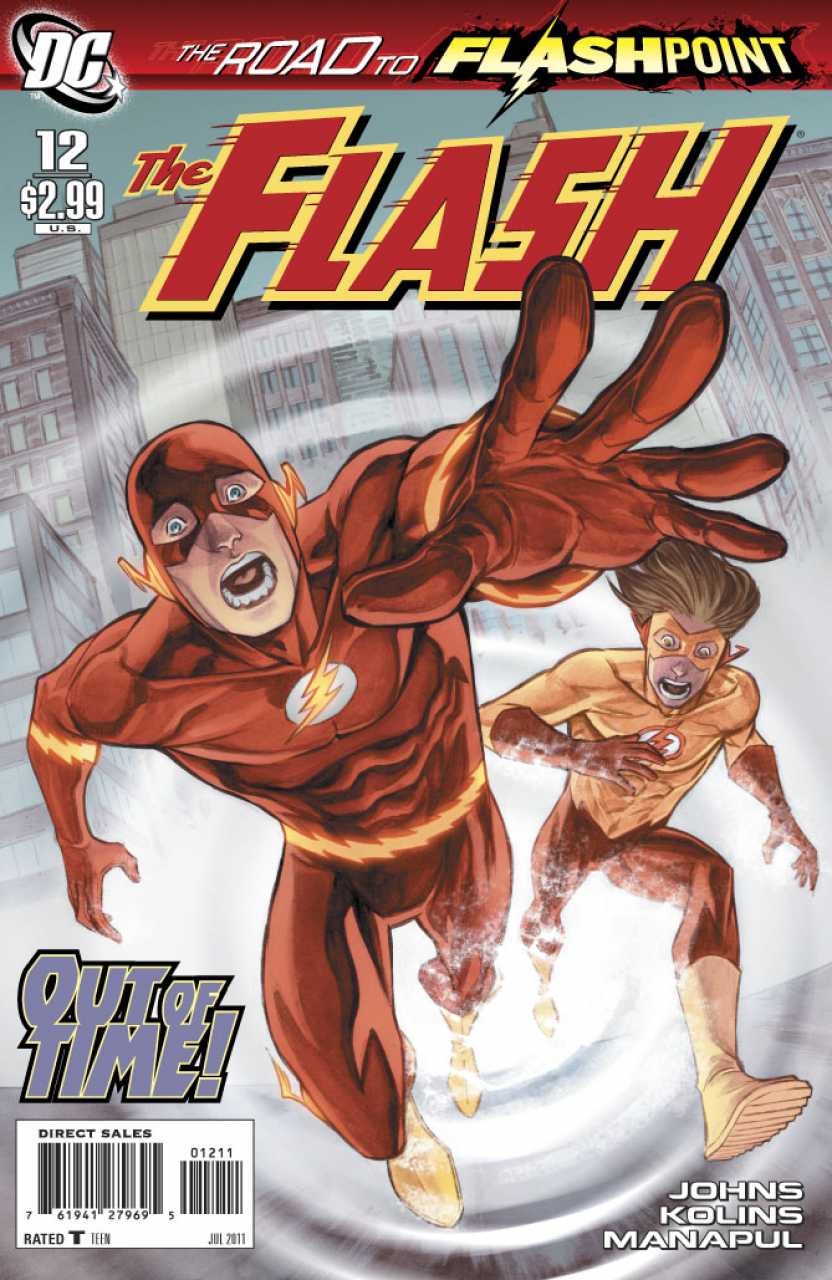
Quarter Bin 102 "Road to Flashpoint"


Flashpoint was a seminal comics moment for me, and it remains one of my happiest memories and favorite stories.  I'd been bummed that Geoff Johns started writing The Flash again, only to end after twelve issues, but I never got to finish reading those issues until now.  Of course, I was happy once I read Flashpoint, and even happier about his New 52 work (Justice League and Green Lantern were highlights of many a year), so I gave up being upset that these were the final issues.

The Flash #10-12 (DC)
from June, July 2011.

Drawn by Scott Kolins (who'd done a lot of Johns's Wally West Flash series) and Francis Manapul (who'd launched this one with Johns, and would lead the New 52 reboot), these are "Road to Flashpoint" stories that teased a character called Hot Pursuit, who turned out to be Barry Allen from an alternate reality (he probably needs to return at some point, despite his fate here), only to feature the return of Eobard Thawne, the Reverse-Flash, ahead of his role in Flashpoint.

There's a strong emphasis on Bart Allen who I enjoyed reading so much in the '90s as Impulse but who Johns transformed into Kid Flash in the pages of Teen Titans, which was nice.  The new 52 version of the character totally revamped the concept, which angered a lot of fans, but I never let it bother me.

Ironically, this was the last time DC had letters in its comics, and in the last two issues apparently Flash finally joined the bandwagon, only for the idea to go away again and never (so far) return.