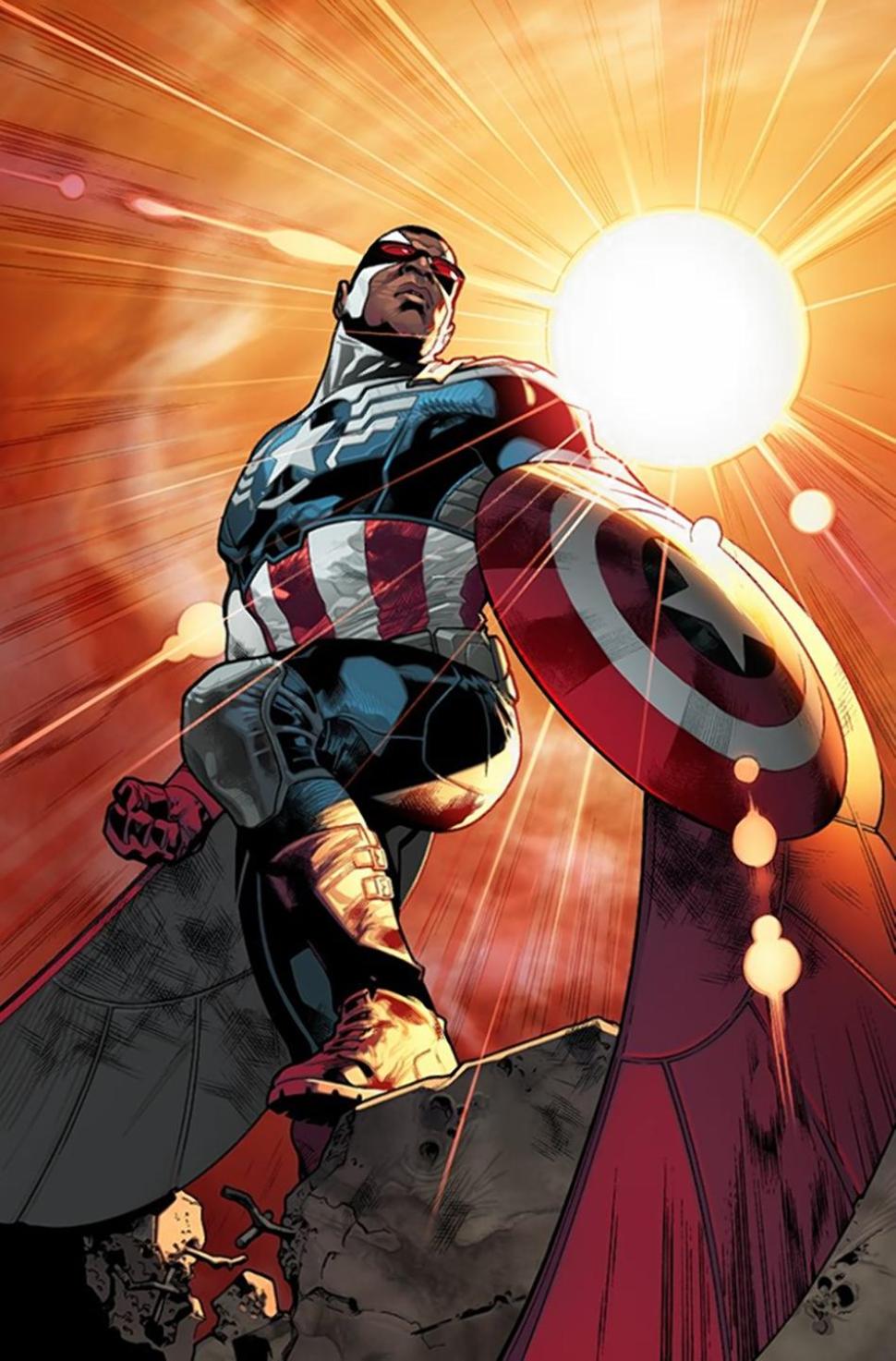
Captain America #6
Let's start this off by remarking that I'm apparently making labels not only for the writer (Ta-Nehisi Coates) but the artist (Leinil Francis Yu) as well. I'm more surprised by the latter, as Yu is a well-established comics superstar I've enjoyed on a number of projects over the years, and his continued presence at Marvel has been one of the big lies fans have had to swallow in recent years when complaining that "all the good artists left."
Coates himself has been a hugely prominent literary figure in recent years, not just among black readers but in general; last year's The Water Dancer has been widely hailed as one of 2019's best books. I haven't read him outside of a few comics, including his Black Panther, and now this.
Ironically, this particular issue could just as easily have been written by Ed Brubaker. During his historic run, Brubaker, as least as far as I was concerned, often seemed as if he wasn't interested in Captain America himself so much as...anything around him, even before the Civil War death. Coates actually uses a Brubaker villain(s family) to achieve the effect, the Russian Lukins (including one brought back from the grave).
There was some concern, when Coates took over the title, that he wouldn't be the right fit for Cap, being as he is primarily interested in the black perspective. Such concerns were probably already racist, and at any rate have been proven baseless, given how, as noted, he delivers an issue like this that could've easily been part of someone else's (and notably a white dude who writes primarily white dude comics) run.
The next issue promised to continue the plot, another of those "Man Without a Country" arcs Cap has enjoyed repeatedly over the years. So yeah, I think Coates fits in nicely with Captain America.
Showing posts with label Captain America. Show all posts
Sunday, January 19, 2020
Sunday, January 12, 2020
Sunday Marvel Sunday "Captain America #696"
Captain America #696
After Nazi Rogers happened, fans acted as if they had...never read a comic book before. It was one of the most bizarre things that ever happened in comics. Steve Rogers, thanks to a fragment of the Cosmic Cube, existed in a reality where he was raised as a loyal agent of Hydra. Avengers: Endgame kind of cleverly played into that in the reprise of the excellent Captain America: Winter Soldier elevator sequence (probably, for me, best moment of both movies, really). But then comic book logic undid it, of course, and Captain America wasn't a secret agent of Hydra anymore.
The whole thing was an exercise in the pointless outrage culture. Of course, a lot of Golden Age comic book creators, including Cap's, were Jewish, so it was considered particularly offensive, even for a storytelling stunt, to create Nazi Rogers. But, again, this is comic books we're talking about. If there's a single mainstream superhero who has never undergone an outrageous crisis, I'd really know who it is.
And Secret Empire was a brilliant story. Taking a paragon of virtue and making him the face of the enemy, it was fresh territory, which is a hard thing to do in superhero comics.
But everyone panicked, and Marvel thought taking an abrupt turnaround was in order. And so was brought in Mark Waid, that guy who made his name being a huge fan who knew everything, but eventually broke out taking existing Flash lore and greatly expanding it. Turns out Waid was only capable of doing that once. So he fell back on being a being a huge fan who knew everything. And basically producing feel-good comics with Marvel properties like the Fantastic Four, Daredevil, and yes, Captain America.
His idea of Cap's comeback tour was literally a tour, in itself not an entirely original idea in comics, of America, just trying to step away from the grind. And of course learning along the way that the regular folk do still love him.
Kind of on the nose, of course, but that's been my impression of all Waid's Marvel work. I don't know if he burned out, like James Robinson did writing Starman, on trying to do big things. The longer he wrote Flash, the harder he found it to hit the high notes, and perhaps as a result, fans today still don't really appreciate what he accomplished. His was basically the template Geoff Johns later followed. And ironically, Johns was doing Waid's Marvel act until he figured out how to do Waid's Flash act. And has never looked back.
Waid continues to grasp for relevance. He did Flash. He did Kingdom Come. He even did Strange Fruit. Fans can believe whatever they like about his best work. But it's really Waid who seems incapable of understanding his best instincts.
After Nazi Rogers happened, fans acted as if they had...never read a comic book before. It was one of the most bizarre things that ever happened in comics. Steve Rogers, thanks to a fragment of the Cosmic Cube, existed in a reality where he was raised as a loyal agent of Hydra. Avengers: Endgame kind of cleverly played into that in the reprise of the excellent Captain America: Winter Soldier elevator sequence (probably, for me, best moment of both movies, really). But then comic book logic undid it, of course, and Captain America wasn't a secret agent of Hydra anymore.
The whole thing was an exercise in the pointless outrage culture. Of course, a lot of Golden Age comic book creators, including Cap's, were Jewish, so it was considered particularly offensive, even for a storytelling stunt, to create Nazi Rogers. But, again, this is comic books we're talking about. If there's a single mainstream superhero who has never undergone an outrageous crisis, I'd really know who it is.
And Secret Empire was a brilliant story. Taking a paragon of virtue and making him the face of the enemy, it was fresh territory, which is a hard thing to do in superhero comics.
But everyone panicked, and Marvel thought taking an abrupt turnaround was in order. And so was brought in Mark Waid, that guy who made his name being a huge fan who knew everything, but eventually broke out taking existing Flash lore and greatly expanding it. Turns out Waid was only capable of doing that once. So he fell back on being a being a huge fan who knew everything. And basically producing feel-good comics with Marvel properties like the Fantastic Four, Daredevil, and yes, Captain America.
His idea of Cap's comeback tour was literally a tour, in itself not an entirely original idea in comics, of America, just trying to step away from the grind. And of course learning along the way that the regular folk do still love him.
Kind of on the nose, of course, but that's been my impression of all Waid's Marvel work. I don't know if he burned out, like James Robinson did writing Starman, on trying to do big things. The longer he wrote Flash, the harder he found it to hit the high notes, and perhaps as a result, fans today still don't really appreciate what he accomplished. His was basically the template Geoff Johns later followed. And ironically, Johns was doing Waid's Marvel act until he figured out how to do Waid's Flash act. And has never looked back.
Waid continues to grasp for relevance. He did Flash. He did Kingdom Come. He even did Strange Fruit. Fans can believe whatever they like about his best work. But it's really Waid who seems incapable of understanding his best instincts.
Saturday, May 6, 2017
Thoughts on FCBD 2017
Well, Free Comic Book Day 2017 is in the books. How was yours truly's experiences this year?
I'd say pretty good. The turnout at Zimmie's (Lewiston, Maine), at least at the point I went, was fairly tepid, but that was because of the weather. For the preceding few days rain had been predicted and I think most people were driven away even by the drizzly conditions that actually surfaced. I got in line with about a dozen minutes to spare, and it wasn't an especially long line, based on past experience. It was mostly families with small kids (a reliable presence any FCBD), plus a few typical comic book store patrons.
The most shocking thing was that no one seemed particularly interested in excited chatter. That's the biggest change from past FCBD experiences. I blame, again, the weather, although again, I wasn't in line for very long. I like to get there early, try and be the first one there, or among the first, and that didn't happen this year. I don't know if all the chatter died during the wait, in the anxious anticipation of the last few minutes until the store opened. The most exciting thing that happened was someone behind me dropping a little rubber ball they'd been playing with, the ball rolling under a car, and someone they were with saying that was for the best. But yeah, the ball rolled back into reach, in case you were worried.
Then the store opened, and the cosplay presence, at the opening hour, was a New Hampshire Ghostbuster. Ghostbusters have showed up at this store's FCBD in the past, so that wasn't a big surprise. Their display in the store included several books, encompassing both the original movie era and the new one, two of them the "real" books referenced in the movies. So that was fun.
Shuffling up to the offerings, I'd already decided what I wanted to get, and that's exactly what I got, so there wasn't much of a surprise or debate there. This year I decided to be happy to not even have a shot at just anything that looked interesting. I didn't plot to go to another participating store (there aren't any in the area anyway), or become upset about missing one or another release.
Besides, I took advantage of the sales in the store, too, and treating the visit as another of my sporadic trips to the store, catching up with stories I wanted to read, and anything else that caught my eye. I got a lot of good stuff, but I'm going to talk only about the freebies here.
So here's what I got and what I thought:
I Hate Image (Image)
Yeah, I wouldn't have predicted, just a few weeks ago, that I would've been interested in this. Skottie Young was an artist I loved passionately a few years ago, when he was doing the Oz adaptations with Eric Shanower, but then those comics ended and he moved on to I Hate Fairyland at Image. I Hate Fairyland, to all intents and purposes, looked like a release valve, a way for Skottie to express how much he hated doing the Oz stuff. And I was greatly taken aback. Shocked! But then a few weeks back, I revisited the Oz stuff. Time and distance and all that. It became less precious. Artists like to stretch themselves. Skottie had become tied down to one particular association, and it was kind of bigger than him. Even as he was making his name doing it, it was also as much if not more about the material than Skottie Young. So of course he wanted to distance himself from it.
I Hate Image, meanwhile, is part of the company's 25th anniversary celebration. In the same way Skottie skewers fairyland tropes in the series this special is based on, he viciously skewers Image. Kind of refreshing! Definitely fun to read! And it also kind of shows what Skottie thinks most fans will know about Image's legacy in 2017. Here's what I learned:
Keyser Soze: Scorched Earth (Red 5)
Red 5 used to be known, at least by me, for releasing a new Atomic Robo FCBD story every year. But Red 5 doesn't publish Atomic Robo anymore (that would be IDW). But the company still managed to interest me this year. Keyser Soze is the infamous lead character of Bryan Singer's breakout movie, The Usual Suspects, the character Kevin Spacey is playing all along but you don't know it until the end. (Edward Norton is actually the actor who attempted to make a career out of characters like this, starting the year after Usual Suspects was released, in Primal Fear.) You might think doing a Keyser Soze follow-up is about twenty-two years late, but the character and the concept behind the character totally holds up, as this comic demonstrates. It's the mystique of Keyser Soze that makes him so fascinating, his ability to dominate even in his (apparent) absence, a storytelling idea that still remains largely absent in fiction today. There's some hoodoo in the story, Keyser lighting his glove on fire and eventually leaving a highly visible calling card for investigators, including one who considers Keyser his "white whale" (Moby Dick reference). It's not perfectly executed, but it gets the job done. It proves all over again what a great idea Keyser Soze is.
Secret Empire (Marvel)
Like Skottie Young, I wouldn't have guessed I'd be interested in this one just a few weeks back. But the Captain America Is A Nazi!!! controversy has only heated up in recent weeks and it's made it impossible to ignore the existence of Secret Empire. Much has been made about Marvel's creative choices, but none of it means Marvel isn't telling good stories. I learned that all over again last year, with FCBD itself, when I dove into Civil War II, which turned out to be one of my favorite comics of 2016. I don't know how much of Secret Empire I'll actually read, but I love that Nick Spencer, well before the results of the 2016 election could have possibly been known, had struck on an idea that so closely mirrors the turmoil of the times (much as Civil War II did). The idea of Captain America being a secret agent of Hydra, no matter how it happened or how it's ultimately resolved, is absolutely perfect, suddenly. A lot of Americans woke up to a different country, in their minds, the day Trump won the presidency. This story is like a metaphor about that.
I've had my problems with Nick Spencer. I've read a little of his Captain America, and found his creative merits somewhat dubious as a result. I've read Nick Spencer before. He was the guy responsible for "bowtie Jimmy Olsen," and he's been tinkering around Image for a few years, too (Infinite Vacation, Morning Glories). But this FCBD edition of Secret Empire is absolutely pitch-perfect, the best stuff I've ever seen from Spencer. He's in total narrative command, and he sells the concept like crazy. That's exactly what you want to see from any creator, much less one deep into one of the biggest controversies in recent comics.
He's also got Andrea Sorrentino on art, and that's a huge plus. Sorrentino has quietly been producing some of the best art in comics for years now. He knocked I, Vampire out of the park. He knocked Old Man Logan out of the part. It's high, high time everyone notices how fantastic his art really is.
So I was pretty happy to read this one. There's also a preview of Chip Zdarsky's forthcoming Peter Parker: The Spectacular Spider-Man, which brims with spidery greatness. No offense to Dan Slott, but Chip's material here harkens back to the gloriousness of the "Brand New Day" era, still my personal touchstone for the character.
X-O Manowar (Valiant)
This presentation of Matt Kindt's relaunch of the character isn't substantially different from what's found in the recently launched series itself, so instead I'll focus on the other material in the release. There's a preview of Secret Weapons, which among other things features Nicole Finch, who can talk to birds. Among a host of characters trying desperately to strike on a current sensibility, I think she fits it as well as anyone else. I'd read a Nicole Finch, Bird Talker comic, easily. The series also touches on the new era of data leaks, which is brilliant.
There's also a look at Jeff Lemire's latest evolution of Bloodshot, Bloodshot Salvation. Lemire has become one of the best writers working in comics today, and his Bloodshot is a leading example of how that happened, and he shows no signs of slowing down.
There are also incredibly vague references to other stuff Valiant will be publishing in the future, none of which I found particularly effective. Would love more Death-Defying Doctor Mirage, though...
I'd say pretty good. The turnout at Zimmie's (Lewiston, Maine), at least at the point I went, was fairly tepid, but that was because of the weather. For the preceding few days rain had been predicted and I think most people were driven away even by the drizzly conditions that actually surfaced. I got in line with about a dozen minutes to spare, and it wasn't an especially long line, based on past experience. It was mostly families with small kids (a reliable presence any FCBD), plus a few typical comic book store patrons.
The most shocking thing was that no one seemed particularly interested in excited chatter. That's the biggest change from past FCBD experiences. I blame, again, the weather, although again, I wasn't in line for very long. I like to get there early, try and be the first one there, or among the first, and that didn't happen this year. I don't know if all the chatter died during the wait, in the anxious anticipation of the last few minutes until the store opened. The most exciting thing that happened was someone behind me dropping a little rubber ball they'd been playing with, the ball rolling under a car, and someone they were with saying that was for the best. But yeah, the ball rolled back into reach, in case you were worried.
Then the store opened, and the cosplay presence, at the opening hour, was a New Hampshire Ghostbuster. Ghostbusters have showed up at this store's FCBD in the past, so that wasn't a big surprise. Their display in the store included several books, encompassing both the original movie era and the new one, two of them the "real" books referenced in the movies. So that was fun.
Shuffling up to the offerings, I'd already decided what I wanted to get, and that's exactly what I got, so there wasn't much of a surprise or debate there. This year I decided to be happy to not even have a shot at just anything that looked interesting. I didn't plot to go to another participating store (there aren't any in the area anyway), or become upset about missing one or another release.
Besides, I took advantage of the sales in the store, too, and treating the visit as another of my sporadic trips to the store, catching up with stories I wanted to read, and anything else that caught my eye. I got a lot of good stuff, but I'm going to talk only about the freebies here.
So here's what I got and what I thought:
I Hate Image (Image)
Yeah, I wouldn't have predicted, just a few weeks ago, that I would've been interested in this. Skottie Young was an artist I loved passionately a few years ago, when he was doing the Oz adaptations with Eric Shanower, but then those comics ended and he moved on to I Hate Fairyland at Image. I Hate Fairyland, to all intents and purposes, looked like a release valve, a way for Skottie to express how much he hated doing the Oz stuff. And I was greatly taken aback. Shocked! But then a few weeks back, I revisited the Oz stuff. Time and distance and all that. It became less precious. Artists like to stretch themselves. Skottie had become tied down to one particular association, and it was kind of bigger than him. Even as he was making his name doing it, it was also as much if not more about the material than Skottie Young. So of course he wanted to distance himself from it.
I Hate Image, meanwhile, is part of the company's 25th anniversary celebration. In the same way Skottie skewers fairyland tropes in the series this special is based on, he viciously skewers Image. Kind of refreshing! Definitely fun to read! And it also kind of shows what Skottie thinks most fans will know about Image's legacy in 2017. Here's what I learned:
- Lying Cat really is the star of Saga.
- The Walking Dead has kind of become the most famous thing Image ever did. It's referenced twice by Skottie, once for the comic and once for the TV show.
- There are a ton of references to other material, some more obvious than others. You kind of really need to know more about them to really get the more obvious ones.
- Chew has reached the status of definitely standing out from the pack. In just three panels the concept is sold better than another one a few pages earlier that I assume references Jason Aaron's Southern Bastards, but wouldn't know without looking it up.
- The Wicked + The Divine, which has been one of the company's biggest buzz books in recent years, doesn't seem to rate anything more than a kind of mocking reference about a dance club that actually spends more time referencing recently deceased pop music acts than the comic.
- Which brings about a montage of semi-famous Image superheroes. For whatever reason, Savage Dragon is lumped into this scene, even though he's one of two company-existence-spanning characters still in print today. More on the other in a moment.
- Yeah, the other's Spawn. He gets one of the featured acts of the comic, even though he's been about as irrelevant as Savage Dragon for years, despite the fact that both are two hundred plus issues into their runs.
- Then Skottie ruthlessly mocks famous Image creators themselves. Apparently Todd McFarlane really loves to call people "bud." The mot hilarious scene of the whole comic.
Keyser Soze: Scorched Earth (Red 5)
Red 5 used to be known, at least by me, for releasing a new Atomic Robo FCBD story every year. But Red 5 doesn't publish Atomic Robo anymore (that would be IDW). But the company still managed to interest me this year. Keyser Soze is the infamous lead character of Bryan Singer's breakout movie, The Usual Suspects, the character Kevin Spacey is playing all along but you don't know it until the end. (Edward Norton is actually the actor who attempted to make a career out of characters like this, starting the year after Usual Suspects was released, in Primal Fear.) You might think doing a Keyser Soze follow-up is about twenty-two years late, but the character and the concept behind the character totally holds up, as this comic demonstrates. It's the mystique of Keyser Soze that makes him so fascinating, his ability to dominate even in his (apparent) absence, a storytelling idea that still remains largely absent in fiction today. There's some hoodoo in the story, Keyser lighting his glove on fire and eventually leaving a highly visible calling card for investigators, including one who considers Keyser his "white whale" (Moby Dick reference). It's not perfectly executed, but it gets the job done. It proves all over again what a great idea Keyser Soze is.
Secret Empire (Marvel)
Like Skottie Young, I wouldn't have guessed I'd be interested in this one just a few weeks back. But the Captain America Is A Nazi!!! controversy has only heated up in recent weeks and it's made it impossible to ignore the existence of Secret Empire. Much has been made about Marvel's creative choices, but none of it means Marvel isn't telling good stories. I learned that all over again last year, with FCBD itself, when I dove into Civil War II, which turned out to be one of my favorite comics of 2016. I don't know how much of Secret Empire I'll actually read, but I love that Nick Spencer, well before the results of the 2016 election could have possibly been known, had struck on an idea that so closely mirrors the turmoil of the times (much as Civil War II did). The idea of Captain America being a secret agent of Hydra, no matter how it happened or how it's ultimately resolved, is absolutely perfect, suddenly. A lot of Americans woke up to a different country, in their minds, the day Trump won the presidency. This story is like a metaphor about that.
I've had my problems with Nick Spencer. I've read a little of his Captain America, and found his creative merits somewhat dubious as a result. I've read Nick Spencer before. He was the guy responsible for "bowtie Jimmy Olsen," and he's been tinkering around Image for a few years, too (Infinite Vacation, Morning Glories). But this FCBD edition of Secret Empire is absolutely pitch-perfect, the best stuff I've ever seen from Spencer. He's in total narrative command, and he sells the concept like crazy. That's exactly what you want to see from any creator, much less one deep into one of the biggest controversies in recent comics.
He's also got Andrea Sorrentino on art, and that's a huge plus. Sorrentino has quietly been producing some of the best art in comics for years now. He knocked I, Vampire out of the park. He knocked Old Man Logan out of the part. It's high, high time everyone notices how fantastic his art really is.
So I was pretty happy to read this one. There's also a preview of Chip Zdarsky's forthcoming Peter Parker: The Spectacular Spider-Man, which brims with spidery greatness. No offense to Dan Slott, but Chip's material here harkens back to the gloriousness of the "Brand New Day" era, still my personal touchstone for the character.
X-O Manowar (Valiant)
This presentation of Matt Kindt's relaunch of the character isn't substantially different from what's found in the recently launched series itself, so instead I'll focus on the other material in the release. There's a preview of Secret Weapons, which among other things features Nicole Finch, who can talk to birds. Among a host of characters trying desperately to strike on a current sensibility, I think she fits it as well as anyone else. I'd read a Nicole Finch, Bird Talker comic, easily. The series also touches on the new era of data leaks, which is brilliant.
There's also a look at Jeff Lemire's latest evolution of Bloodshot, Bloodshot Salvation. Lemire has become one of the best writers working in comics today, and his Bloodshot is a leading example of how that happened, and he shows no signs of slowing down.
There are also incredibly vague references to other stuff Valiant will be publishing in the future, none of which I found particularly effective. Would love more Death-Defying Doctor Mirage, though...
Tuesday, April 25, 2017
Turtlepop! #3 "Secret Empire"
![]() |
| Always operating on PEDs. Completely unapologetic. |
STORY RECAP: TURTLE IS SARCASTIC! PROCEED WITH NONSENSICAL INTERVIEW!
Comics Reader: So, we're back.
Turtle: Are we pretending we're consistent with how this feature began?
Comics Reader: Hey, I ask the questions!
Turtle: Apparently not.
Comics Reader: So anyway, the Captain America Is An Agent of Hydra story is still going on, almost a year later?
Turtle: True. This is happening because Marvel had not yet glimpsed the scope of the backlash to literally its every creative decision for the past five years.
Comics Reader: How is that even possible?
Turtle: Marvel has been operating on recreational narcotics for fifty years. Next question!
Comics Reader: So Secret Empire is a whole event based on a terrible idea that should never have seen the light of day?
Turtle: Of course it is!
Comics Reader: I remember we were a lot more flippant about this last time.
Turtle: I remember pretending to be the writer of a terrible Marvel stunt idea the first time. But that was dropped the second time.
Comics Reader: Wait, you were pretending to be Dan Slott the first time?
Turtle: Yes.
Comics Reader: But you didn't want to play Nick Spencer the second time?
Turtle: No.
Comics Reader: Care to elaborate?
Turtle: No! Although I think it's funny how in some of these interviews the respondent goes on and on, and in others the questioner goes on and on. I like to strike a balance. You're welcome!
Comics Reader: As the one asking questions, I should be neutral?
Turtle: Oh, good heavens no! Wear your bias on your sleeve!
Comics Reader: I'm a DC guy.
Turtle: Clearly.
Comics Reader: Notice that in this completely erratic series of features they've all been about Marvel ideas.
Turtle: It's the House of Ideas!
Comics Reader: But we hardly discuss the ideas.
Turtle: Yes.
Comics Reader: Anything you'd like to add?
Turtle: Good day, sir!
Sunday, September 25, 2016
Quarter Bin 91 "Captain America: Sam Wilson #1"
Captain America: Sam Wilson #1 (Marvel)
From December 2015
writer: Nick Spencer
artist: Daniel Acuna
Lately Marvel has been given a whole franchise to one writer, be it Brian Michael Bendis and Iron Man or Nick Spencer and Captain America. Recently, Spencer debuted his second series, Captain America: Steve Rogers, which ignited a lightning rod when he revealed Steve has kind of been a Hydra agent all along (pay no attention to the Cosmic Cube behind the curtain). So what about his Sam Wilson series?
Following on the heels of the earlier Sam Wilson/Captain America (which featured artwork from Stuart Immonen), this reboot picks things up in medias res, quite literally, with Sam in big trouble with everyone because he dares ask Americans to pay attention to crime around them. Anyway, it's Spencer's bid to make Sam's Cap socially relevant.
If you had no idea why Sam even was Captain America, this issue is not going to help you. It's part of Marvel's increasingly clumsy efforts to keep sales good by rebooting every series without a good reason, because for a lot of these series, the only thing changing is the creative team, such as the case is here. Otherwise, there's no reason to have a new first issue if there's nothing but some engineered controversy to try and make it stand out.
That makes it ironic that Spencer's own Steve Rogers series has a real controversy, but then, it also has a rejuvenated Steve Rogers, who for a little while was an old man without super-soldier serum anymore. This one just has Sam Wilson, randomly being Captain America, because he used to be his partner, as the otherwise totally unrelated Falcon (who has a falcon as an ally).
Sorry, I'm sounding negative again. I swear I'll tone that down.
The art is from Daniel Acuna, who's been a Marvel guy for a few years now, but I still best remember as a DC guy, doing Freedom Fighters comics. Here his work, whether intentionally or not, evokes Stuart Immonen's. (See the note above.) Still, I like his work and won't complain about that.
From December 2015
writer: Nick Spencer
artist: Daniel Acuna
Lately Marvel has been given a whole franchise to one writer, be it Brian Michael Bendis and Iron Man or Nick Spencer and Captain America. Recently, Spencer debuted his second series, Captain America: Steve Rogers, which ignited a lightning rod when he revealed Steve has kind of been a Hydra agent all along (pay no attention to the Cosmic Cube behind the curtain). So what about his Sam Wilson series?
Following on the heels of the earlier Sam Wilson/Captain America (which featured artwork from Stuart Immonen), this reboot picks things up in medias res, quite literally, with Sam in big trouble with everyone because he dares ask Americans to pay attention to crime around them. Anyway, it's Spencer's bid to make Sam's Cap socially relevant.
If you had no idea why Sam even was Captain America, this issue is not going to help you. It's part of Marvel's increasingly clumsy efforts to keep sales good by rebooting every series without a good reason, because for a lot of these series, the only thing changing is the creative team, such as the case is here. Otherwise, there's no reason to have a new first issue if there's nothing but some engineered controversy to try and make it stand out.
That makes it ironic that Spencer's own Steve Rogers series has a real controversy, but then, it also has a rejuvenated Steve Rogers, who for a little while was an old man without super-soldier serum anymore. This one just has Sam Wilson, randomly being Captain America, because he used to be his partner, as the otherwise totally unrelated Falcon (who has a falcon as an ally).
Sorry, I'm sounding negative again. I swear I'll tone that down.
The art is from Daniel Acuna, who's been a Marvel guy for a few years now, but I still best remember as a DC guy, doing Freedom Fighters comics. Here his work, whether intentionally or not, evokes Stuart Immonen's. (See the note above.) Still, I like his work and won't complain about that.
Friday, July 8, 2016
Reading Comics 193 "A skip week can be so dangerous..."
Covered this edition: Dark Knight III #5, Blood Feud #1, Steve Rogers: Captain America #2, The Rocketeer at War #4, We Are Robin #12, X-O Manowar Annual #1, and Heavy Metal #280.
Now, the whole point of this edition is that it comes from last week, which was a skip week for DC Rebirth, which meant there were no Rebirth titles published. I shouldn't even have gone to the comic shop, right? Well, I did go, and ended up finding stuff anyway...
Dark Knight III: The Master Race #5 (DC)
Admittedly, I haven't made a great effort reading the complete story, but it's always been worth checking in. It's interesting, this issue, as Batman has been cast as a target the Kryptonians who are running amok (they escaped from the Bottle City of Kandor) trying to be gods consider him an element that needs to be eliminated in order to complete their conquest. Batman, whether in Miller or Azzarello's voice, describes fear as his greatest ally. "Fear is why I don't kill. There is so much that I'm afraid of -- that we all are -- While you? Just look at you, all -- Fearless. You Don't stand a chance." That reads like classic Dark Knight. The depiction of other characters is excellent, too. The Flash observes about Superman, "I know you were raised as a human, but every time you say, 'Oh my god,' I want to hand you a mirror." In that particular sequence, Barry, whose feet have been crushed earlier, has been immobilized, but now he's using his speed to keep up with the Information Superhighway (remember that term?). Who has ever thought of the Flash that way? We see Aquaman riding majestically on a giant sea creature (I know there are plenty of people who will never lose the impression of him as a joke, but images like this are made to show us he's anything but). But the greatest line of the issue belongs, again, to Batman: "I've never wielded an angry mob as a weapon before." The issues ends as Batman realizes he really can't engage in the fight physically. But it's okay, because Superman is fighting at his side again. This really does feel like a necessary closing chapter in the Dark Knight saga.
Blood Feud #1 (Oni)
I got this one (the issue was actually released last October) because artist Drew Moss frequents the comic shop I've been going to, and I actually saw him drawing pages for this series (his editor was calling him to complain about how long it was taking). I figured I owed Drew at least one issue. (He just recently scored a new assignment: Jay Faerber's Copperhead, which I've sampled as part of my comiXology adventures, and I can vouch for as a result.) The writer of Blood Feud is Cullen Bunn. Having read this, I think I can finally contextualize Bunn for myself: he's another Scott Snyder. Snyder first rose to prominence with American Vampire, which Blood Feud resembles in several ways, such as tone, and the presence of, well, vampires. I've never read Bunn's Sixth Gun, the series he made his name on, but his mainstream work has always struck me as unwieldy, as if it were an ill-fit. And maybe that's exactly what it is for him. Not everyone is meant to write superheroes.
Steve Rogers: Captain America #2 (Marvel)
The all-important follow-up to Steve Rogers, Agent of Hydra unexpectedly spells out exactly what's going on, and I can see where people who had no idea what was going on before last issue might not have seen this coming, because even I didn't, because it just seems too simple: it's that Cosmic Cube running around as a little girl, and Red Skull (of course Red Skull). The issue reads better than the last one, possibly because it's so heavily centered on exposition (I'm not a reader bothered by that sort of thing) and as such the more cartoony elements of characterization are kept to a minimum (although, somewhat unfortunately, the Cosmic Cube girl suffers from it). It's just unfortunate that this big idea was conceived, as can so easily be resolved, because the bad buy's plans always fall apart, which makes it all the more perverse to have Red Skull declaring that this time he's finally prevailed. Yeah, right. I'm not convinced that Nick Spencer is a much better writer than Ed Brubaker (I eventually soured on that run, although conversely acknowledge that it's probably Captain America's best-ever), but at least he gets right to the point. Brubaker had a whole arc before he got around to explaining the Winter Soldier. Points for speed, Spencer.
The Rocketeer at War #4 (IDW)
As an Atomic Robo fan, reading this sort of thing is kind of old hat at this point, but the Rocketeer is one of those superheroes that stands out from the pack of everyone outside the Big Two. He even had his own movie in the '90s! Although he's a thoroughly retro character, set in the era of WWII, Rocketeer actually dates only to 1982. His helmet evokes Robo, but it also looks like Iron Man. This is the character you've been looking for if Iron Man's actual comics have left you disappointed after all those movie appearances, because until recently Marvel never thought to duplicate that. Marc Guggenheim, a screenwriter who dabbles in comics, and whom I discovered in this medium from his Resurrection, published at Oni, is the writer for this story, which centers as much on heroics as Rocketeer's effects on the ladies. There's also a prose story, and in IDW's listings for other recent published works, Mark Russell's Apocrypha Now, a follow-up to his God is Disappointed in You. I became a big fan of Russell from his Prez over at DC. I will read this stuff eventually.
We Are Robin #12 (DC)
Catching up with this final issue, the group disbands after one last adventure involving a rogue member who's been convinced to participate in burglarizing Bruce Wayne, who's seen a faceless enemy of the people. Alfred comes to the rescue, and Duke Thomas ends his days as a quasi Boy Wonder. Some interesting observations to close out the series.
X-O Manowar Annual #1 (Valiant)
Speaking of finally figuring out Cullen Bunn, I think I finally figured out why Robert Venditti was tapped to replace Geoff Johns as the writer of Green Lantern in the New 52, because what Johns did for that franchise, Venditti did for X-O Manowar, and Valiant in general, establishing a bold new vision on which to hang further adventures across a variety of concepts. It's just, I don't think Venditti was at all prepared to do it all over again. Hey, not everyone is, especially when he's never left X-O, where he contends with alien armor being sported by a Visigoth who ended up as a superhero on Earth but is seen as a villain by the aliens he got it from. The full scope of the concept is on display in this annual. I'm glad I finally had a real look at Venditti's work. As much as I've gotten into Valiant in the last few years, I never did get around to X-O, because I was disappointed with what I saw in X-O's early issues, and underwhelmed by Venditti's later Green Lantern work. That's why it's always worth giving something additional chances.
Heavy Metal #280
Kind of the American version of 2000AD, this is a longstanding mature readers comics anthology magazine. The reason I finally read an issue is because the new editor is Grant Morrison, who is also a contributor. His story "Beachhead" is an ironic commentary on the relentlessness of military campaigns (aliens come to Earth when life is still at the bacterial phase, and the commander isn't satisfied with that as a reason to rethink his strategy). The rest of the material is certainly interesting, in a variety of ways. The one that strikes my fancy the most is the first installment of Mozchops' "Salsa Invertebraxa," which features some sweet poetry. Besides that, there's Morrison's introduction, in which I have to face, all over again, the full brunt of his personality, which is always more complicated than I sometimes give him credit for. The idealized version of Morrison, like how anyone imagines their idols, is someone much like themselves. But Grant Morrison really is pretty wild, although he's not as gonzo as he can sometimes seem, if that makes any sense. He's someone who's earned the confidence to voice his thoughts exactly as he thinks them, is all, and maybe isn't afraid to cater to the audience he's currently addressing, such as Heavy Metal readers...This feels like an ideal format for someone like Morrison, who's interested in the full possibilities of his chosen creative medium, with few restrictions when the story calls for it. Not every story here is for mature readers, but none of it is particularly mainstream, without going the full underground that you might otherwise expect from material of that nature. At any rate, I found myself capable of reading pretty much the whole thing without too much skimming, which is more than I can say for a lot of anthologies.
Now, the whole point of this edition is that it comes from last week, which was a skip week for DC Rebirth, which meant there were no Rebirth titles published. I shouldn't even have gone to the comic shop, right? Well, I did go, and ended up finding stuff anyway...
Dark Knight III: The Master Race #5 (DC)
Admittedly, I haven't made a great effort reading the complete story, but it's always been worth checking in. It's interesting, this issue, as Batman has been cast as a target the Kryptonians who are running amok (they escaped from the Bottle City of Kandor) trying to be gods consider him an element that needs to be eliminated in order to complete their conquest. Batman, whether in Miller or Azzarello's voice, describes fear as his greatest ally. "Fear is why I don't kill. There is so much that I'm afraid of -- that we all are -- While you? Just look at you, all -- Fearless. You Don't stand a chance." That reads like classic Dark Knight. The depiction of other characters is excellent, too. The Flash observes about Superman, "I know you were raised as a human, but every time you say, 'Oh my god,' I want to hand you a mirror." In that particular sequence, Barry, whose feet have been crushed earlier, has been immobilized, but now he's using his speed to keep up with the Information Superhighway (remember that term?). Who has ever thought of the Flash that way? We see Aquaman riding majestically on a giant sea creature (I know there are plenty of people who will never lose the impression of him as a joke, but images like this are made to show us he's anything but). But the greatest line of the issue belongs, again, to Batman: "I've never wielded an angry mob as a weapon before." The issues ends as Batman realizes he really can't engage in the fight physically. But it's okay, because Superman is fighting at his side again. This really does feel like a necessary closing chapter in the Dark Knight saga.
Blood Feud #1 (Oni)
I got this one (the issue was actually released last October) because artist Drew Moss frequents the comic shop I've been going to, and I actually saw him drawing pages for this series (his editor was calling him to complain about how long it was taking). I figured I owed Drew at least one issue. (He just recently scored a new assignment: Jay Faerber's Copperhead, which I've sampled as part of my comiXology adventures, and I can vouch for as a result.) The writer of Blood Feud is Cullen Bunn. Having read this, I think I can finally contextualize Bunn for myself: he's another Scott Snyder. Snyder first rose to prominence with American Vampire, which Blood Feud resembles in several ways, such as tone, and the presence of, well, vampires. I've never read Bunn's Sixth Gun, the series he made his name on, but his mainstream work has always struck me as unwieldy, as if it were an ill-fit. And maybe that's exactly what it is for him. Not everyone is meant to write superheroes.
Steve Rogers: Captain America #2 (Marvel)
The all-important follow-up to Steve Rogers, Agent of Hydra unexpectedly spells out exactly what's going on, and I can see where people who had no idea what was going on before last issue might not have seen this coming, because even I didn't, because it just seems too simple: it's that Cosmic Cube running around as a little girl, and Red Skull (of course Red Skull). The issue reads better than the last one, possibly because it's so heavily centered on exposition (I'm not a reader bothered by that sort of thing) and as such the more cartoony elements of characterization are kept to a minimum (although, somewhat unfortunately, the Cosmic Cube girl suffers from it). It's just unfortunate that this big idea was conceived, as can so easily be resolved, because the bad buy's plans always fall apart, which makes it all the more perverse to have Red Skull declaring that this time he's finally prevailed. Yeah, right. I'm not convinced that Nick Spencer is a much better writer than Ed Brubaker (I eventually soured on that run, although conversely acknowledge that it's probably Captain America's best-ever), but at least he gets right to the point. Brubaker had a whole arc before he got around to explaining the Winter Soldier. Points for speed, Spencer.
The Rocketeer at War #4 (IDW)
As an Atomic Robo fan, reading this sort of thing is kind of old hat at this point, but the Rocketeer is one of those superheroes that stands out from the pack of everyone outside the Big Two. He even had his own movie in the '90s! Although he's a thoroughly retro character, set in the era of WWII, Rocketeer actually dates only to 1982. His helmet evokes Robo, but it also looks like Iron Man. This is the character you've been looking for if Iron Man's actual comics have left you disappointed after all those movie appearances, because until recently Marvel never thought to duplicate that. Marc Guggenheim, a screenwriter who dabbles in comics, and whom I discovered in this medium from his Resurrection, published at Oni, is the writer for this story, which centers as much on heroics as Rocketeer's effects on the ladies. There's also a prose story, and in IDW's listings for other recent published works, Mark Russell's Apocrypha Now, a follow-up to his God is Disappointed in You. I became a big fan of Russell from his Prez over at DC. I will read this stuff eventually.
We Are Robin #12 (DC)
Catching up with this final issue, the group disbands after one last adventure involving a rogue member who's been convinced to participate in burglarizing Bruce Wayne, who's seen a faceless enemy of the people. Alfred comes to the rescue, and Duke Thomas ends his days as a quasi Boy Wonder. Some interesting observations to close out the series.
X-O Manowar Annual #1 (Valiant)
Speaking of finally figuring out Cullen Bunn, I think I finally figured out why Robert Venditti was tapped to replace Geoff Johns as the writer of Green Lantern in the New 52, because what Johns did for that franchise, Venditti did for X-O Manowar, and Valiant in general, establishing a bold new vision on which to hang further adventures across a variety of concepts. It's just, I don't think Venditti was at all prepared to do it all over again. Hey, not everyone is, especially when he's never left X-O, where he contends with alien armor being sported by a Visigoth who ended up as a superhero on Earth but is seen as a villain by the aliens he got it from. The full scope of the concept is on display in this annual. I'm glad I finally had a real look at Venditti's work. As much as I've gotten into Valiant in the last few years, I never did get around to X-O, because I was disappointed with what I saw in X-O's early issues, and underwhelmed by Venditti's later Green Lantern work. That's why it's always worth giving something additional chances.
Heavy Metal #280
Kind of the American version of 2000AD, this is a longstanding mature readers comics anthology magazine. The reason I finally read an issue is because the new editor is Grant Morrison, who is also a contributor. His story "Beachhead" is an ironic commentary on the relentlessness of military campaigns (aliens come to Earth when life is still at the bacterial phase, and the commander isn't satisfied with that as a reason to rethink his strategy). The rest of the material is certainly interesting, in a variety of ways. The one that strikes my fancy the most is the first installment of Mozchops' "Salsa Invertebraxa," which features some sweet poetry. Besides that, there's Morrison's introduction, in which I have to face, all over again, the full brunt of his personality, which is always more complicated than I sometimes give him credit for. The idealized version of Morrison, like how anyone imagines their idols, is someone much like themselves. But Grant Morrison really is pretty wild, although he's not as gonzo as he can sometimes seem, if that makes any sense. He's someone who's earned the confidence to voice his thoughts exactly as he thinks them, is all, and maybe isn't afraid to cater to the audience he's currently addressing, such as Heavy Metal readers...This feels like an ideal format for someone like Morrison, who's interested in the full possibilities of his chosen creative medium, with few restrictions when the story calls for it. Not every story here is for mature readers, but none of it is particularly mainstream, without going the full underground that you might otherwise expect from material of that nature. At any rate, I found myself capable of reading pretty much the whole thing without too much skimming, which is more than I can say for a lot of anthologies.
Friday, June 3, 2016
Captain America: Steve Rogers #1 (Marvel)
This is the comic that revealed the big bad secret about Steve Rogers. I figured I should read it for myself.
Now, I've read Nick Spencer before. This is the guy who famously gave Jimmy Olsen his bowtie back. (Trust me, people talked about it.) True, I lost track of Spencer for a few years, but I never forgot about him. Now I'm wondering if that was a good thing.
The Nick Spencer who shows up in the pages of this comic has either been neutered, or has willingly embraced the Marvel ideology of putting in as many irreverent elements as possible. Baron Zemo is made into a joke. I have no affinity for Baron Zemo, but it makes little sense for him to have been relegated to comedic beats in the issue.
But what bothers me more is that to get Steve Rogers to the point where he ends the issue uttering, "Hail Hydra!," Spencer uses a series of flashbacks to find out what his parents were like. Now, for a DC guy, family background can usually be depended on to have played a pretty important part in a character's moral development. In Marvel comics, the only such character is Uncle Ben, who is famously sacrificed in Spider-Man's origin story to flesh out the "great powers, great responsibility" mandate. Otherwise, families don't mean much for Marvel. It's a superhero clubhouse where you either get along, or don't (Civil War).
Spencer's idea is that Rogers' little-seen parents do have a significant impact on him. His father is a bum, and his mother is an overworked woman who finds solace in a friend who eventually introduces her to the wonders of Hydra. It's implied, though not spelled out at this point, that she takes up the membership offer, and that Steve has thusly been an agent of Hydra the entire time we've known him.
It's not even the Hydra twist that bothers me, but how Spencer runs roughshod over the Rogers family to reach that point. The Steve Rogers we've always known has had a stronger-than-average morality, which is the while reason he was chosen for the Super Soldier program in the first place. I know they make a big deal out of this in Captain America: The First Avenger, anyway.
The Hydra presented by Spencer is a movement geared toward the terrible economy of today, and those willing to exploit it for their own ends. He trots out Red Skull (the sad part about Captain America is that he seems to inspire an incredibly limited rogues gallery, one that invariably trots out Nazis, because that's who the bad guys were when he first became a superhero) as a recruiter in the present day. If this were a DC comic, the Rogers family status as immigrants would have been relevant. I mean, DC is full of immigrants. DC wouldn't have missed that. Spencer ignores this, however, and looks for shortcuts like what he does to Steve's dad.
I know all this sounds like I'm merely reiterating that I'm a DC guy and not a Marvel guy, and playing into my own prejudices. And maybe it is. But this is a whole story about prejudices, that completely ignores the role prejudice plays in it. You can see how Hydra ended up inspiring Cobra in the G.I. Joe comics. But even Cobra has better characterization than Hydra these days.
It's simplistic storytelling. That's what bothers me. It speaks to fans who like simplistic storytelling. That's the only reason why Marvel would tell stories like this. It focuses on the big twist, and ignores any other calls for subtlety. Marvel is a place where you'll find a comic for every reader (and there are some for me), but it presses hard for the hardcore fan, the one who will unquestioningly accept anything, and so to shock these fans, they have to do truly outrageous things.
Well, one would be to ask their writers to hold themselves to a higher standard.
Now, I've read Nick Spencer before. This is the guy who famously gave Jimmy Olsen his bowtie back. (Trust me, people talked about it.) True, I lost track of Spencer for a few years, but I never forgot about him. Now I'm wondering if that was a good thing.
The Nick Spencer who shows up in the pages of this comic has either been neutered, or has willingly embraced the Marvel ideology of putting in as many irreverent elements as possible. Baron Zemo is made into a joke. I have no affinity for Baron Zemo, but it makes little sense for him to have been relegated to comedic beats in the issue.
But what bothers me more is that to get Steve Rogers to the point where he ends the issue uttering, "Hail Hydra!," Spencer uses a series of flashbacks to find out what his parents were like. Now, for a DC guy, family background can usually be depended on to have played a pretty important part in a character's moral development. In Marvel comics, the only such character is Uncle Ben, who is famously sacrificed in Spider-Man's origin story to flesh out the "great powers, great responsibility" mandate. Otherwise, families don't mean much for Marvel. It's a superhero clubhouse where you either get along, or don't (Civil War).
Spencer's idea is that Rogers' little-seen parents do have a significant impact on him. His father is a bum, and his mother is an overworked woman who finds solace in a friend who eventually introduces her to the wonders of Hydra. It's implied, though not spelled out at this point, that she takes up the membership offer, and that Steve has thusly been an agent of Hydra the entire time we've known him.
It's not even the Hydra twist that bothers me, but how Spencer runs roughshod over the Rogers family to reach that point. The Steve Rogers we've always known has had a stronger-than-average morality, which is the while reason he was chosen for the Super Soldier program in the first place. I know they make a big deal out of this in Captain America: The First Avenger, anyway.
The Hydra presented by Spencer is a movement geared toward the terrible economy of today, and those willing to exploit it for their own ends. He trots out Red Skull (the sad part about Captain America is that he seems to inspire an incredibly limited rogues gallery, one that invariably trots out Nazis, because that's who the bad guys were when he first became a superhero) as a recruiter in the present day. If this were a DC comic, the Rogers family status as immigrants would have been relevant. I mean, DC is full of immigrants. DC wouldn't have missed that. Spencer ignores this, however, and looks for shortcuts like what he does to Steve's dad.
I know all this sounds like I'm merely reiterating that I'm a DC guy and not a Marvel guy, and playing into my own prejudices. And maybe it is. But this is a whole story about prejudices, that completely ignores the role prejudice plays in it. You can see how Hydra ended up inspiring Cobra in the G.I. Joe comics. But even Cobra has better characterization than Hydra these days.
It's simplistic storytelling. That's what bothers me. It speaks to fans who like simplistic storytelling. That's the only reason why Marvel would tell stories like this. It focuses on the big twist, and ignores any other calls for subtlety. Marvel is a place where you'll find a comic for every reader (and there are some for me), but it presses hard for the hardcore fan, the one who will unquestioningly accept anything, and so to shock these fans, they have to do truly outrageous things.
Well, one would be to ask their writers to hold themselves to a higher standard.
Wednesday, May 25, 2016
Turtlepop! #2 "Captain America: Steve Rogers #1"
PLEASE DO NOT READ UNLESS YOU WANT SPOILERS.
AGAIN, SPOILER ALERT.
ALSO, TURTLE DOES NOT RESPECT ANYTHING. I JUST THOUGHT YOU SHOULD BE FOREWARNED.
Comics Reader: Turtle, there seems to be some controversy surrounding the decision to reveal in Captain America: Steve Rogers #1 that Steve was an agent of Hydra all along.
Turtle: True, that absolutely just happened!
Comics Reader: Do you feel that this was nothing but a shameless publicity stunt?
Turtle: Absolutely not! Wacky things happening in comics have been happening from the very start! For instance, did you know that none of these characters, technically, actually exist?
Comics Reader: Come on, Turtle, please try to take this seriously.
Turtle: As seriously as rabid comic book fans? Why in the world would I do that?
Comics Reader: Because, well, rabid comic book fans do take this stuff seriously. They'll read this news like it's the end of the world.
Turtle: And that's my problem, why?
Comics Reader: Because.
Turtle: What an argument!
Comics Reader: You know as well as I do that rabid comic book fans take this sort of thing like it's a matter of life and death.
Turtle: That's their problem, man, not mine.
Comics Reader: Remind me again why I interview you for these things?
Turtle: Actually, I'm just flattered that you remembered I exist! We haven't done one of these since the first one.
Comics Reader: Remind me again about the topic?
Turtle: Two words: Doctor Spider-Man.
Comics Reader: Ah. Right.
Turtle: We should have done one of these for Commissioner Batman. And yet we didn't. What's up with that?
Comics Reader: My bad.
Turtle: Of course it is!
Comics Reader: I see what you did there.
Turtle: Sure you did. This interview's over, jerk.
Friday, April 1, 2016
Reading Comics 182 "Making a commitment"
Yesterday I went to see Deadpool and Batman v Superman: Dawn of Justice (thought it was entertaining, loved it, respectively) and in between visited Heroes & Villains again. I wanted to order a copy of Omega Men #3 (the only one missing from my physical collection) and pick up the latest issue, #10. Then I put in reserves for the two remaining issues, and next week's Wonder Woman: Earth One from Grant Morrison. Omega Men, as anyone who's been reading this blog since last fall will know, has become my favorite recent comic, certainly favorite since Morrison's Annihilator which concluded early last year (and topped the last two annual QB50 lists). Things rarely work out this way for me (yet), but ideally I'd like to see Omega Men remembered in the same ranks as Alan Moore's Watchman as a seminal superhero comic. It's just that good. It changes everything. At least DC has rewarded writer Tom King with the plush assignment of Batman in the impending Rebirth era.
I walked away with a few other comics, and so I'll talk about that stuff:
Sam Wilson: Captain America #7 (Marvel)
Billed on the cover as celebrating Cap's 75th anniversary, this supersize issue features a pivotal moment in the "Standoff" crossover arc, for Steve Rogers, and a few extra stories from some acclaimed creators. The lead features Sam Wilson, who's been Captain America for the past year or so but is also familiar to fans as Falcon, as he enters Maria Hill's misguided supervillain reconstruction town. He teams up with Bucky, who still responds to the name of Winter Soldier these days. The writer is Nick Spencer, who made a splash with DC a handful of years ago but has otherwise been making his name with the Image series Morning Glories. (I'm surprised his name didn't already have a label here, because I was reading him in those early years, including the start of Glories, but I guess that was just before I started this blog.) Joss Whedon teams with superstar artist John Cassaday for a tale from Cap's WWII past, Tim Sale does a mostly wordless story concerning Cap's oft-overlooked parents, and Greg Rucka features Steve Rogers at the ballet, along with artist Mike Perkins, who worked on Ed Brubaker's Captain America, as well as Marvel's ambitious adaption of Stephen King's The Stand. Rucka and Perkins easily have the best work in the issue.
Omega Men #10 (DC)
King finally gets to the war the Omega Men have been plotting against the Citadel from the very start, and predictably, there's very little glory to be found, just mere survival. Kyle Rayner stumbled into the fight of his life, one that has nothing to do with Green Lanterns, and by the end of the issue he walks off into the distance, and his last words in the issue are, "No. No, I'm...I'm just another Omega Man." King's quote from William James (always one of my favorite features in this series) says, "Truth happens to an idea. It becomes true, is made true by events." It's not until this issue that the Omega Men have truly been allowed to do what they've been promising all along, to be the heroes in a great fight for freedom. What does it feel like to be a part of that? Although King has been featuring the secret origins of the team itself, the series has had Kyle at its core since the start. He doesn't revel in the results they've had so far. Not having a personal stake, it means something different to him, but it has become personal. That's King's genius.
Prez #6 (DC)
This is the final issue of the initial run. DC's promised to let Prez complete its twelve issue run, just as with Omega Men, but it'll take a little longer. Ben Caldwell has since started work at Marvel. I hope he'll be back to finish Prez, because Mark Russell's biting political satire is truly some of the best mainstream work I've seen in years, challenging what I believe, and I still love it. That's just one of the many things to love about it. I'm glad to have finally read the issue.
Superman/Batman #1 Special Edition (DC)
This was a freebie released in conjunction with Dawn of Justice, reprinting the debut issue of Jeph Loeb's modern World's Finest series. Loeb had become one of the most acclaimed writers in comics at the time, and this series continued his trademark psychological insight into superheroes he'd previously brought to works like Batman: The Long Halloween and Superman For All Seasons, plus the more contemporary Hush arc with Jim Lee, in which he helped shape the landscape of DC at that time. In this issue, President Luthor is still in office, one of the key developments that stretched from the dawn of the millennium to Infinite Crisis, characterization that reflects Lex's role in the later Geoff Johns Justice League and Zack Snyder's Dawn of Justice. There are far worse free comics out there...
I walked away with a few other comics, and so I'll talk about that stuff:
Sam Wilson: Captain America #7 (Marvel)
Billed on the cover as celebrating Cap's 75th anniversary, this supersize issue features a pivotal moment in the "Standoff" crossover arc, for Steve Rogers, and a few extra stories from some acclaimed creators. The lead features Sam Wilson, who's been Captain America for the past year or so but is also familiar to fans as Falcon, as he enters Maria Hill's misguided supervillain reconstruction town. He teams up with Bucky, who still responds to the name of Winter Soldier these days. The writer is Nick Spencer, who made a splash with DC a handful of years ago but has otherwise been making his name with the Image series Morning Glories. (I'm surprised his name didn't already have a label here, because I was reading him in those early years, including the start of Glories, but I guess that was just before I started this blog.) Joss Whedon teams with superstar artist John Cassaday for a tale from Cap's WWII past, Tim Sale does a mostly wordless story concerning Cap's oft-overlooked parents, and Greg Rucka features Steve Rogers at the ballet, along with artist Mike Perkins, who worked on Ed Brubaker's Captain America, as well as Marvel's ambitious adaption of Stephen King's The Stand. Rucka and Perkins easily have the best work in the issue.
Omega Men #10 (DC)
King finally gets to the war the Omega Men have been plotting against the Citadel from the very start, and predictably, there's very little glory to be found, just mere survival. Kyle Rayner stumbled into the fight of his life, one that has nothing to do with Green Lanterns, and by the end of the issue he walks off into the distance, and his last words in the issue are, "No. No, I'm...I'm just another Omega Man." King's quote from William James (always one of my favorite features in this series) says, "Truth happens to an idea. It becomes true, is made true by events." It's not until this issue that the Omega Men have truly been allowed to do what they've been promising all along, to be the heroes in a great fight for freedom. What does it feel like to be a part of that? Although King has been featuring the secret origins of the team itself, the series has had Kyle at its core since the start. He doesn't revel in the results they've had so far. Not having a personal stake, it means something different to him, but it has become personal. That's King's genius.
Prez #6 (DC)
This is the final issue of the initial run. DC's promised to let Prez complete its twelve issue run, just as with Omega Men, but it'll take a little longer. Ben Caldwell has since started work at Marvel. I hope he'll be back to finish Prez, because Mark Russell's biting political satire is truly some of the best mainstream work I've seen in years, challenging what I believe, and I still love it. That's just one of the many things to love about it. I'm glad to have finally read the issue.
Superman/Batman #1 Special Edition (DC)
This was a freebie released in conjunction with Dawn of Justice, reprinting the debut issue of Jeph Loeb's modern World's Finest series. Loeb had become one of the most acclaimed writers in comics at the time, and this series continued his trademark psychological insight into superheroes he'd previously brought to works like Batman: The Long Halloween and Superman For All Seasons, plus the more contemporary Hush arc with Jim Lee, in which he helped shape the landscape of DC at that time. In this issue, President Luthor is still in office, one of the key developments that stretched from the dawn of the millennium to Infinite Crisis, characterization that reflects Lex's role in the later Geoff Johns Justice League and Zack Snyder's Dawn of Justice. There are far worse free comics out there...
Saturday, December 13, 2014
Reading Comics #139 "November 2014"
Batman and Robin #36 (DC)
writer: Peter J. Tomasi
writer: Antony Johnston
writer: Charles Soule
writer: Geoff Johns
writer: Scott Snyder
writer: Antony Johnston
| via Comic Book Roundup |
artist: Patrick Gleason
"Robin Rises" continues! In Part IV, Batman's backup (Red Robin, Batgirl, Red Hood, Titus, and the reluctant Cyborg) has arrived on Apokolips as Batman himself continues to deploy the Hellbat armor to full effect in his rampage through hell as he seeks to reclaim the body of Damian. I love when Red Hood (Jason Todd) says, "Went a little Red Lantern here, don'tcha think?" as it evokes Tomasi's time in the Green Lantern titles. It's a full-on action installment of the arc, allowing Gleason ample opportunity to demonstrate how awesome his work is. The big payoff is on the last page, one of those perfect cliffhangers: standing behind Batman is the shadow of Darkseid himself. The Dark Knight merely states, "Hrrn. About time you showed up." This moment evokes not only the opening arc of the New 52 Justice League reboot, but the dramatic events of Final Crisis. Tomasi has succeeded in capturing the Batman every geek always knew existed, one who could take on any challenge without sweating it. December promises big, big things...
All-New Captain America #1 (Marvel)
| via Marvel Wikia |
writer: Rick Remender
artist: Stuart Immonen
I had already been intrigued by what Remender had been doing with Captain America, but then Sam Wilson, the Falcon, was announced as inheriting the role, a whole reboot of the series was in order, and Stuart Immonen was tapped as artist. I last caught Immonen's Marvel work in the pages of Brian Michael Bendis's All-New X-Men, and it was the best work I'd seen from him for the company, a subtle return to the form I'd admired so much in his Superman work. His All-New Captain America may be the closest yet. Times have changed since Immonen's Superman, certainly. Coloring has become a major business, adding whole new dimensions to the art, regardless of the artist. Sometimes the colorist is actually the most prominent contributor these days (on that score, aiding Immonen and inker Wade von Grawbadger are Marte Gracia and Eduardo Navarro), along with more detailed shading (whether attributed to Immonen or von Grawbadger; shading was usually conspicuously absent from Immone's Superman, which was what helped make it so striking). Visually a very stunning comic, then. Story-wise is pretty interesting, too. The last time Steve Rogers, for one reason or another, was replaced as the Sentinel of Liberty it was by James "Bucky" Barnes, the Winter Soldier, who was billed for all intents and purposes as pretty permanent. There was a giant hubbub about the updated uniform Alex Ross created for the occasion. Wilson gets a new uniform, too, that looks a little like a cross between his Falcon garb, the S.H.I.E.L.D. design Rogers for a time ran around in, and of course the traditional Captain America look. Upstaging Wilson's Cap is the son Remender introduced in his clever Dimension Z story, Ian, who is actually Arnim Zola's kid. Ian, by the way, has adopted the moniker Nomad, which has become a part of Cap lore ever since Rogers himself used it in one of his earlier exiles from the cowl. The dynamic between Wilson and Ian is unusual, almost as if Wilson is less Cap than Ian is. Remender provides a one-page review of Wilson's origins in the likely event readers will not have been familiar with it. It's a darn good issue regardless of all the altered dynamics.
The Fuse #7 (Image)
| via Image Comics |
artist: Justin Greenwood
I became a devoted fan of Johnston's thanks to his soon-to-conclude opus Wasteland, so to see a couple of new projects launch at Image this year was a nice way to see that others have noticed his talent, too. In this futuristic cop procedural he's joined by Greenwood, who helped on Wasteland but should better be known for Marc Guggenheim's Resurrection. This issue begins the "Gridlock" arc, which concerns contestants in a reality show. While I don't read the series regularly, I like reading the letters column featuring those that do, and their observations of the main characters, who are doubtless easier to keep track of when you don't skip around like I do...
Red Lanterns #35 (DC)
| via Darkstar Sci Fi |
artist: J. Calafiore
Here's where I interrupt the proceedings for a moment and complain about the unreliability of the pull list service I've been receiving from my local comics shop. I don't know why they've had such problems, and maybe they have good reasons, but it's certainly been annoying. I haven't read the Starlight finale because of this and after a few months I've only now just gotten them to produce an issue of Supreme: Blue Rose for me. And I read this issue of Red Lanterns late because of the same problems.
Anyway, enough complaints. This was part of the first month of the "Godhead" crossover event in the Green Lantern titles, featuring the New Gods as they've targeted the various power rings as the answer to the Life Equation. When we last saw Guy Gardner he'd just defeated Atrocitus and taken a sabbatical. We pick up with Guy on vacation with his sometimes beau, Ice (not to be confused with Bea, Ice's sometimes bestie, Fire). The issue is heavily Red Lanterns-centric, possibly because Soule's days, sadly, are numbered in the series and at DC in general (darn exclusive contract at Marvel!). New Gods show up, and then Simon Baz does, too. I'm glad to see Baz, who was Geoff Johns' late addition to Green Lantern lore at the end of his tenure (he remains, though, at DC, obviously).
Superman #36 (DC)
| via IGN |
artist: John Romita, Jr.
Speaking of Johns, arguably his biggest gig at the moment is in the pages of Superman (I check in over at Justice League more than read it regularly these days, alas, after having missed so much of the last few years). Ulysses, the latest strange visitor, has finally tipped his hand. For maybe half the issue things still seem exactly as they have in previous issues of the arc, but then Neil Quinn (Ulysses) visits his parents and begins to reveal what's really going on ("I love you both so much. That's why you can't come with me." "I don't understand." "I didn't know you were still alive! They didn't tell me you were still alive! I'm trying to protect you!") It seems the offer he made to humanity at the end of last issue is the ulterior motive most readers were probably expecting from his first appearance. And soon Ulysses and Superman are fighting, at last. Romita is a big-impact kind of artist (he did work on Millar's Kick-Ass after all), and he gets to do a good bit of that here. Wherever Johns is headed with all of this, it remains expertly paced.
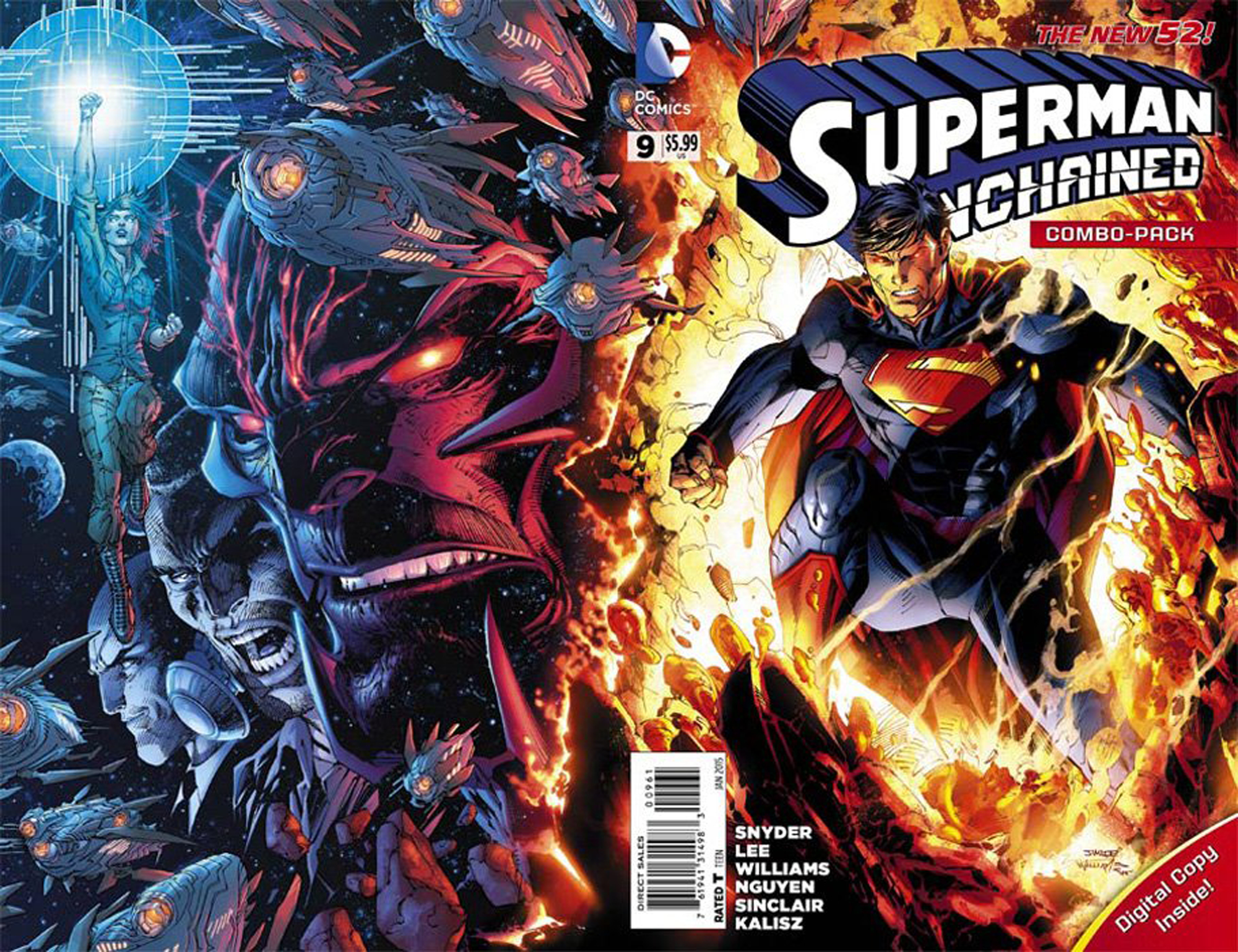
Superman Unchained #9 (DC)
| via Previews World |
artist: Jim Lee
Given my complicated feelings toward Snyder, I was reluctant to check out his big Superman story. This final issue, however, may have proven my doubts wrong in a fairly major way. It's not even so much how he handles Superman but rather Lex Luthor. Here's some prime Luthor dialogue to illustrate:
"You look at him, and you see a light leading the way...But instead he is a light lost in the darkness."
[...]
"What I expected to see, looking backwards through time at his efforts, was, as you said, Ms. Lane: someone who stood for something. I thought a profile would emerge, the profile of someone sure of himself. Someone sure he knew what was best for all of us. But I saw that Superman, whoever he is, is trial and error."
[...]
"The point I'm making is that Superman doesn't stand for anything. He's just a man, stumbling through life. He's not a great beacon, he's barely a candle, lighting a path for himself the best he can. And as we all know, eventually...candles go out."
"I reject him," he goes on to say. In essence, of course, Luthor is equating Superman with America. It's the first time I've noticed a particular perspective from Snyder, and it's one I completely recognize, as very similar to my own. It's a revelation. Regardless of your own perspective, this is Luthor making the same observation that is supposed to have been made of Superman all along ("...and the American way!"), only from a modern perspective. It's really quite startling. Bravo, Mr. Snyder. Lee's Superman is distinct from the work he did in the early issues of Justice League, which is interesting to note.
Superman/Wonder Woman #13 (DC)
artist: Doug Mahnke
Charles Soule's year on the title was capped with a statement on the whole concept readers considered pretty definitive. What can Tomasi add? Plenty, as it turns out. When Wonder Woman showed up in the pages of Batman and Robin, it was one of the rare odd notes in that series. This is proof that Tomasi more than understands the Amazon Princess. "You fight with too much on your mind. Who did you train under?" "My father," Superman responds. "Obviously," she says. Fight scenes are rampant in the series, and the contrasting approaches these lovers take as always been a focal point. Tomasi leaves room for these observations from Wonder Woman, too [spoken to a civilian]:
"In my culture this fragility would be your downfall. Here it's practically a virtue. I've been doing my best to help some of you since my arrival, but how will you ever grow stronger if you need us every waking moment?"
Superman has this in way of a response: "This man has internal bleeding and needs immediate help. You should've done something instead of talking to him."
It's the kind of Wonder Woman that Geoff Johns tried to introduce in the early issues of Justice League, who has recently come to what she calls "man's world" and struggles to fully comprehend it, so that what ends up defining her is the gap that exists between herself and those she is theoretically here to champion. For Superman, there is no gap, and for Batman, the third member of DC's Trinity, the gap is something he's constantly trying to create with his enemies. One is human but alien (Wonder Woman), one is alien but human (Superman). Tomasi is excellent at these kinds of interpersonal observations. He'd perfect for this series.
Umbral #10 (Image)
| via Image Comics |
artist: Christopher Mitten
Hey, remember when I was giving props to colorists earlier, this is definitely a series that owes a huge debt to its colorist. Otherwise it's a Wasteland reunion between Johnston and once-and-final artist Mitten. For anyone, and that would be just about everyone, who struggled to understand the appeal of Wasteland, Umbral is your shot to embrace the fantastic vision of Johnston and Mitten. Like The Fuse I haven't been reading it regularly, so it's a little tough to completely appreciate the proceedings, and because Umbral is a continuing story it's all the harder. I think of the two, I can see myself making a commitment to this one next year. Although I may end up reading both regularly. We'll see!
Tuesday, August 5, 2014
Captain America #22 (Marvel)
writer: Rick Remender
artist: Carlos Pacheco
Hey, so you know the monkey in the room concerning classic Marvel comics and movie personality Captain America, that he's practically the poster child for steroids? Someone finally wrote a story where his juice is taken away.
artist: Carlos Pacheco
| via Comic Book Movie |
This leaves Steve Rogers as a shriveled old man, kind of what he'd be if he'd aged naturally from his original WWII existence. Instead someone finally magically stripped him of whatever happened to have allowed him to originally escape such a fate. And that's something DC fans saw twenty years ago in the pages of Zero Hour.
Anyway, so as part of the Marvel Even-More-Now initiative, as you might have read, the big three Avengers (Cap, Iron Man, Thor) will be going through a simultaneous identity crisis. I'm not really clear on Iron Man's, but as far as Thor goes, apparently you can become the Norse god of thunder just because you can possess his power by lifting his hammer (I don't know, it sounded less stupid in my head explaining it that way, but anyway, they really stretched temporarily replacing him, one way or another).
I like Rick Remender's idea for Cap best. I wish someone really would address his steroids more directly, but this is pretty good. Sure, he'll get his steroids back (keep saying it and maybe it'll sink in), Falcon will go back to being Falcon, after being Cap for a while, but in the meantime there's an interesting wrinkle.
This is another instance of Remender writing Steve Rogers and/or Captain America more directly and relevantly than Ed Brubaker ever managed. (The Winter Soldier thing was a great idea, but it's also a great gimmick, as in...gimmick.)
Having once randomly caught an issue and finding much to my surprise that I liked it, I was glad to give Remender's run a more deliberate look, and this was a good issue to sample.
Wednesday, July 2, 2014
Reading Comics #125 "Bull Moose Grab Bag II"
Ten comics packaged together with a remarkable bargain price! These are all from last year, but that's okay...
Angel & Faith #23 (Dark Horse)
I don't particularly care for Buffy and/or related franchises, so I don't have anything to say about this one. Sometimes you get comics you just don't care about in these things. It's a risk!
Secret Avengers #5 (Marvel)
Even more blatantly than the other time I read an issue from this series (and hopefully this is the last time, but again: brag bags) this is so blatantly a S.H.I.E.L.D. comic, I have no idea why it's called anything but. Are people really assumed not to know that term better than "Avengers" of some extrapolation? Really?
Batman: The Dark Knight #21 (DC)
The New 52 Batman launch that was meant to be a vehicle for David Finch (and, incidentally, has since ceased publication), one that until now I hadn't read (there was a Bane issue early on that...looked like the kind of Bane story I try very hard to avoid). This particular issue was written by Gregg Hurwitz with art from Ethan Van Sciver, who I'm still surprised has been reduced to relative obscurity after being a huge deal not so long ago. Notable people get lost in the shuffle no matter the context. It happens. It's still sad to see happen. Dark Knight was always more of a visceral experience than other Batman comics, and this one's no exception. It features Mad Hatter, but Batman is still in pretty dramatic mode (perhaps only in the pages of Dark Knight would this have happened). It's funny, because within the context of Dark Knight this is kind of the story Scott Snyder has been telling within the pages of Batman proper, whether in the Court of Owls stories or "Death of the Family," what have you. (I noticed as I was making the Ethan Van Sciver label that I was, in fact, making that label. Just goes to show. I've been blogging here since 2011. That's a long trip in obscurity, alas.)
Before Watchmen: Silk Spectre #4 (DC)
I'm on record as supporting the whole Before Watchmen project. As it was being published I eventually had to back off reading the whole thing, and so eventually boiled my experience down to the excellent Comedian, but I enjoyed what I'd read of Darwyn Cooke and Amanda Conner's Silk Spectre when it began, so it's nice to have randomly come across its final issue. This was a story that was thoroughly about Laurie's journey out from the shadow of her mother, the original Silk Spectre. Famously in Alan Moore's Watchmen, Laurie's arc was much more about her relationship with Doctor Manhattan and Nite-Owl as well as reconciling the fact that Comedian was her father. In this comic it was much more about mother and daughter, and so that's how things conclude, a different and perhaps more important reconciliation. That's the whole thing about Before Watchmen, that it was able to explore significant aspects of the Watchmen canon that benefited from being brought to the forefront in ways that were not possible during the original story. If it had been a matter of exploitation for exploitation's sake, I think that would have been obvious. To call Watchmen a finite work and say there were no other stories possible is to miss the point of storytelling entirely, and to limit the impact of the original story, to say these characters who became instantly iconic ultimately had no potential, which is also to say Moore created something that didn't inspire anything. I think we all agree he inspired a lot of what comics became after Watchmen. What about before? In a new context, superheroes mean something else. Not just allegory. A place where superheroes and their own narratives can be taken seriously. Such as this tale of mother and daughter.
Captain America #8 (Marvel)
I'm drawing special distinction to this one because my whole perception of the issue changed remarkably while I was reading it. I don't, or perhaps didn't would be more accurate at this point, have a high estimation of Rick Remender. I figured, based on my experience with his work, that Remender is a goofy sensationalist (perhaps typified by the whole Zombie Punisher run known as "FrankenCastle"). Long story short, when I heard he was the guy replacing Ed Brubaker as writer of Captain America, I couldn't understand it at all. I mean, Remender is pretty much the opposite of Brubaker's gritty realism. And when I heard that he'd definitely gone in that opposite direction, I thought, Well that's all you need to know. So when I found this in the grab bag, I figured it would be just another one in this particular selection that I didn't particularly have to care about. Then I read it. And then the moment happened. Captain America has basically been in a Superman-in-space-exile, "Planet Hulk" moment, and there's this boy he's formed a relationship with, and right away I'm completely lost. But then the relationship between Steve Rogers (that's Captain America, naturally) and the boy crystallizes. And I think Remender totally gets Steve, in a way Brubaker never did. He understands that Steve's journey is a matter of deliberate choices, not random chance (as it can sometimes seem post-thaw). The art is from John Romita, Jr., who has just begun his first-ever DC run, with Geoff Johns, Superman #32. Romita has a distinctive style I've always enjoyed (among many other projects, he's the guy who helped Mark Millar bring Kick-Ass to life), which is perfect for Remender's Captain America, certainly this particular issue. The criticism I always leveled against Brubaker was that he didn't really know what to do with Steve Rogers himself (his most famous contribution was the creation of the Winter Soldier, which audiences everywhere got to see in the movies earlier this year). On that score, I shouldn't have been so critical of Remender, or Marvel's decision. It was just surprising. As of now, I might actually argue that Remender's run has a chance of being better. Start with this issue for yourself if you want to see.
Angel & Faith #23 (Dark Horse)
I don't particularly care for Buffy and/or related franchises, so I don't have anything to say about this one. Sometimes you get comics you just don't care about in these things. It's a risk!
Secret Avengers #5 (Marvel)
Even more blatantly than the other time I read an issue from this series (and hopefully this is the last time, but again: brag bags) this is so blatantly a S.H.I.E.L.D. comic, I have no idea why it's called anything but. Are people really assumed not to know that term better than "Avengers" of some extrapolation? Really?
Batman: The Dark Knight #21 (DC)
The New 52 Batman launch that was meant to be a vehicle for David Finch (and, incidentally, has since ceased publication), one that until now I hadn't read (there was a Bane issue early on that...looked like the kind of Bane story I try very hard to avoid). This particular issue was written by Gregg Hurwitz with art from Ethan Van Sciver, who I'm still surprised has been reduced to relative obscurity after being a huge deal not so long ago. Notable people get lost in the shuffle no matter the context. It happens. It's still sad to see happen. Dark Knight was always more of a visceral experience than other Batman comics, and this one's no exception. It features Mad Hatter, but Batman is still in pretty dramatic mode (perhaps only in the pages of Dark Knight would this have happened). It's funny, because within the context of Dark Knight this is kind of the story Scott Snyder has been telling within the pages of Batman proper, whether in the Court of Owls stories or "Death of the Family," what have you. (I noticed as I was making the Ethan Van Sciver label that I was, in fact, making that label. Just goes to show. I've been blogging here since 2011. That's a long trip in obscurity, alas.)
Before Watchmen: Silk Spectre #4 (DC)
I'm on record as supporting the whole Before Watchmen project. As it was being published I eventually had to back off reading the whole thing, and so eventually boiled my experience down to the excellent Comedian, but I enjoyed what I'd read of Darwyn Cooke and Amanda Conner's Silk Spectre when it began, so it's nice to have randomly come across its final issue. This was a story that was thoroughly about Laurie's journey out from the shadow of her mother, the original Silk Spectre. Famously in Alan Moore's Watchmen, Laurie's arc was much more about her relationship with Doctor Manhattan and Nite-Owl as well as reconciling the fact that Comedian was her father. In this comic it was much more about mother and daughter, and so that's how things conclude, a different and perhaps more important reconciliation. That's the whole thing about Before Watchmen, that it was able to explore significant aspects of the Watchmen canon that benefited from being brought to the forefront in ways that were not possible during the original story. If it had been a matter of exploitation for exploitation's sake, I think that would have been obvious. To call Watchmen a finite work and say there were no other stories possible is to miss the point of storytelling entirely, and to limit the impact of the original story, to say these characters who became instantly iconic ultimately had no potential, which is also to say Moore created something that didn't inspire anything. I think we all agree he inspired a lot of what comics became after Watchmen. What about before? In a new context, superheroes mean something else. Not just allegory. A place where superheroes and their own narratives can be taken seriously. Such as this tale of mother and daughter.
Captain America #8 (Marvel)
| via IGN |
Deadpool #12 (Marvel)
This is part of the Brian Posehn/Gerry Duggan run that I've previously written as making me as close to a believer in this goofy character as I've ever come. I don't have much to say about this issue.
The Malevolent Mr. Burns #1 (Bongo)
With stories from Gail Simone (yes, that Gail Simone) and others. Mr. Burns, of course, from The Simpsons. Reliably entertaining whether in cartoon or comic book form.
Star Trek #22 (IDW)
"Amok Time" as reinterpreted post-Abrams reboot.
Teenage Mutant Ninja Turtles #23 (IDW)
Hey, so for what it's worth, reading this issue, which is also part of the "City Fall" arc from the other grab bag-instilled issue I read previously, is a less painful experience. So there's that.
Ultimate Comics X-Men #28 (Marvel)
Basically, I'm really of the opinion that Marvel ought to scrap the whole Ultimate line at this point, other than Brian Michael Bendis's Spider-Man.
Subscribe to:
Posts (Atom)