This finale in the series of impressions from an actual quarter bin still does not indicate that the title of this feature should be taken literally every time. It's a back issues feature.
Trouble #1 (Marvel Epic)
From September 2003.
From the period where Marvel was trying really hard to be sexy (which included the one time I intensely disliked Geoff Johns) comes this last stab at romance comics, although technically it was a soft revamp of Spider-Man's origins, featuring the young Ben and May as well as Peter Parker's mostly-dead parents, Richard and Mary (that's one of the big differences, right there, between Marvel & DC; DC would never in a million years let the parents of their icons be so easily neglected, regardless of the circumstances). The writer is Mark Millar, who at this point was still establishing what would become a distinctive brand, partly because he would literally name his group of comics Millarworld. The photo covers employed for this mini-series were part of the concept, but Marvel likely had no idea they were a few years too early for the intended teenage market to care, because those readers were still weaning themselves off Harry Potter and looking for the next big franchises for their age group (Twilight, Hunger Games, etc.). Although ironically, that market wouldn't particularly settle for straight romance, either, so Trouble was kind of always doomed. Apparently Millar angered Spider-Man fans by fudging the relationships between Peter's different sets of parental figures, although I seriously have no idea how it could possibly matter...
Tuesday #1 (KRP)
From October 2002.
Perhaps no other creative medium fixated on 9/11 as much as comics, which is strange, because they're usually identified with superheroes, whose obvious absence from the real world on that morning led to how the disaster played out. From the coincidental aftermath of the Our Worlds at War arc and Superman's subsequent adoption of a black shield of mourning a day after the events (Adventures of Superman #596) to the graphic novel Can't Get No by Rick Veitch, plus the tribute books put together to help raise funds for the families of the victims, there was no shortage of comic book response. Tuesday is a first-person account by Henrik Rehr, in which he details the agonies of evacuation and forced separation from his family. I vividly remember my mother's panic in trying to track down the members of my family, even though none of us were near New York, or scheduled to be flying that day, so I can only imagine what it was like to actually be there as it was unfolding. That's why comics like this are important. Rehr adopts a style similar to the late Harvey Pekar to give his account (there's a second issue to conclude it). I can only say it's an incredibly humbling thing to read something like this. We've been so caught up in fanciful conspiracy theories and debates about what Bush decided to do in response that sometimes it can seem we somehow completely forgot that 9/11 actually happened, that real people were involved. We tend to fixate on so many things we lose sight of what's really important. Comics can help bring the focus back, in unexpected ways, like finding this issue in a quarter bin...
Valor #14, 18 (DC)
From December 1993, April 1994.
This was one of the titles I sampled back in the '90s, knowing only vaguely its significance to the Legion of Super-Heroes. In later years I became more familiar with the legacy of Mon-El, who was created to replace Superboy in Legion lore. Always a kind of hapless figure, this guy was a Daxamite, who were kind of like Kryptonians, but not. By the time Mark Waid signed on to write a few issues, in the wake of his early success writing The Flash, this version of the character was having trouble connecting with readers, and so Waid very deliberately set about streamlining the mythos, which was later completed by Kurt Busiek as the series wound down in the run-up to Zero Hour (I think the last issue was the first one I read, but that was twenty years ago, now, so I don't remember how it concluded). Waid brought with him artist Colleen Doran, who had previously worked on Sandman and A Distant Soil, among other projects. Her style was a tad unwieldy for something like Valor, which needed something, well, like Stuart Immonen's clean work. Immonen, who was just beginning his mainstream career on Legion, started doing covers for Valor, starting this issue. The difference in approach between Immonen and Doran is striking. Whereas readers in the letters column complained about a meandering and overall pointlessness to the proceedings under the prior regime, Waid's approach, as with Wally West, was character-centric, a style that was to become increasingly popular, to the point where stories extended into regular arcs that defined the character as much as their future, as featured in Starman or Saga. Immonen gives the covers the iconic status they need. Doran gives the character a throwaway look, although similar to Chris Sprouse, whose early career was spent in the pages of Legion, or Jeffrey Moy, but without the charm. Sprouse and Moy employed a style similar to the late Mike Wieringo. With apologies to Doran, I think even she'll agree that this was never the direction she intended her art to go.
Vibe #7 (DC)
From October 2013.
Launched in conjunction with Justice League of America that year (and like Katana, saddled with that whole name added to the title), the revamp of former Justice League Detroit joke Vibe was one of the New 52's creative triumphs. Sterling Gates had taken over from series co- and initial co-writer Geoff Johns starting with the third issue, and as such is responsible for shepherding the further reveal of Cisco Ramon's new mythology, including the revelation that his brother, whom he thought was dead, not only survived but became his archenemy Rupture...Anyway, you don't have to take my word for it, because Cisco later became a breakout star in The Flash TV series as one of Barry's closest allies, by the end of the first season discovering the powers his comic book counterpart had been playing with for his ten-issue run. Well, now the comics have another chance to help him stand out in his home medium. Hopefully it won't take too long to happen.
Wasteland #42 (Oni)
From December 2012.
My love for this series is well-documented. At this point I've read the complete run, but couldn't pass up the opportunity to read one of the later issues in its original format, in which Abi stumbles across a town where the reader will know, as the story subtly points out, the narrator of the prose pieces that ran throughout most of the series had already been. It's a nice confluence, and once again, I'm motivated to read the whole thing again. Fans of Game of Thrones would probably find much to like about Wasteland. I realized that the more I looked into Game itself. Considering the unmistakable impression that at least HBO was motivated to greenlight the series so viewers could see the human element of Lord of the Rings play out with fewer distractions, I don't think it's much of a leap to suggest Wasteland could appeal to those looking for that evasive element from Game, the wider implications of all the drama. Because Wasteland absolutely nails that, and has all the power struggle intrigue, too.
Showing posts with label Wasteland. Show all posts
Showing posts with label Wasteland. Show all posts
Wednesday, July 6, 2016


Tuesday, November 10, 2015
Officially part of Wasteland history
In the midst of reading Wasteland Vol. 10, Last Exit for the Lost, which I recently bought along with Vol. 11, Floodland, I happened to pick up the latter and have a look at the critics blurb section on the back cover. And guess what I found? A blurb from Comics Reader.
Yeah, this blog. (It's since been slightly rechristened as Comics Readr, of course.) From me.
The blurb comes from my review for Wasteland #58, two before the final issue of the series. I got both volumes at my final visit to Zimmies, the comics shop I frequented in Lewiston, Maine, off and on for some twenty years. I had requested they order the volumes for me, and it was only when I was getting ready to leave the shop for the last time before heading off to Virginia (and then Florida) in the midst of a hasty transition period that I remembered to ask if they'd come in. They had, of course.
I spent some time talking with the store owner about Wasteland (which I had had to get special-ordered to read in its final issues, too). Now that the series is complete and all its collections are available, it may be easier than ever to spread word about it. Whether from my influence or not, the store was now carrying the first couple volumes already.
Most of the collections feature a blurb from Warren Ellis, apparently the most famous fan of the series (in addition to being an acclaimed comic book writer), plus critical voices offering Wasteland praise. As long as Wasteland was being published I wrote about comic books in one venue or another. By the time I started this blog, Wasteland had become increasingly hard to find stocked in an actual comic book store without a specific request. I've read about half the series in collections and the other half in the original serialized format. It turned out to be a very good thing to read the final issues directly, because it allowed me to spread the word about Wasteland again.
And yes, to be excerpted as a blurb, but also as a voice for writer Antony Johnston and other invested parties to have come across. The blurb reads:
Whether for potential readers or to the creators of Wasteland, it's a statement that speaks directly to what I've longed believed, that this was an effort that deserves special distinction. Other than Ellis, a lot of the other blurbs come off as if it's "merely" worth reading or good for existing fans. I don't think that quite encapsulates the achievement, especially in its operatic conclusion. So I'm glad to have provided the statement that suggests something greater.
Yeah, this blog. (It's since been slightly rechristened as Comics Readr, of course.) From me.
The blurb comes from my review for Wasteland #58, two before the final issue of the series. I got both volumes at my final visit to Zimmies, the comics shop I frequented in Lewiston, Maine, off and on for some twenty years. I had requested they order the volumes for me, and it was only when I was getting ready to leave the shop for the last time before heading off to Virginia (and then Florida) in the midst of a hasty transition period that I remembered to ask if they'd come in. They had, of course.
I spent some time talking with the store owner about Wasteland (which I had had to get special-ordered to read in its final issues, too). Now that the series is complete and all its collections are available, it may be easier than ever to spread word about it. Whether from my influence or not, the store was now carrying the first couple volumes already.
Most of the collections feature a blurb from Warren Ellis, apparently the most famous fan of the series (in addition to being an acclaimed comic book writer), plus critical voices offering Wasteland praise. As long as Wasteland was being published I wrote about comic books in one venue or another. By the time I started this blog, Wasteland had become increasingly hard to find stocked in an actual comic book store without a specific request. I've read about half the series in collections and the other half in the original serialized format. It turned out to be a very good thing to read the final issues directly, because it allowed me to spread the word about Wasteland again.
And yes, to be excerpted as a blurb, but also as a voice for writer Antony Johnston and other invested parties to have come across. The blurb reads:
"Epic, epic stuff...One for the ages."
Whether for potential readers or to the creators of Wasteland, it's a statement that speaks directly to what I've longed believed, that this was an effort that deserves special distinction. Other than Ellis, a lot of the other blurbs come off as if it's "merely" worth reading or good for existing fans. I don't think that quite encapsulates the achievement, especially in its operatic conclusion. So I'm glad to have provided the statement that suggests something greater.
Monday, April 13, 2015
Wasteland #60 (Oni)

artist: Christopher Mitten
I want to go on record, once again, for how much I loved how Lost concluded. I thought it was a brilliant experience all the way through. And two of the most brilliant things it did came in the final season, specifically two episodes: 1) "Ab Aeterno," which detailed the previously mysterious Richard Alpert's complete backstory, and 2) "Across the Sea," which similarly explored Jacob and the Man in Black.
The only thing that would have been better is if one or both of them had been held until after the finale.
Because that's exactly what Antony Johnston chose to do with Wasteland, explaining once and for all what exactly was going on all along. Technically, the story ended last issue, and that one was circular, too, but in a different way. This one's strictly explaining, once and for all, how Michael first came to take up his quest for the mysterious A-Ree-Yass-I, and how his dark counterpart Marcus established the fateful town of Newbegin.
Like the Lost episodes, it features time-lapse so as to better cover a large chunk of Wasteland history. The series always had a strong generational theme to it, and so watching that play out again is one of the issue's pleasures.
And yeah, now with all this added perspective, for the first time I can probably suggest Wasteland to fans of Lost. I'd never realized that before.
Writer Antony Johnston includes a heartfelt essay about what it was like to finish his grand story. Omitted is any mention of what he's working on now, but there's more bad news for Johnston fans in that he's recently put Umbral on hold. Umbral is his second project with Christopher Mitten, Johnston's first and last collaborator on Wasteland, that in many ways was a more playful version of their first. From what he says in his essay here, it's easy to imagine that it's not easy being Johnston at the moment.
For readers like me, who have remained faithful for sixty issues, despite breaks in publication and rotating artists (when at the very least it would have been preferable for Mitten to have stuck around the whole time; Saga has built in breaks in its publication so that Fiona Staples can faithfully continue with each issue, but sometimes times change too slowly, although even that is a part of Wasteland mythology), it's great to see the end at last, so that we can commence enjoying the whole thing, over and over again, at our leisure. And continue praising its merits for the vast legions of the uninitiated.
Because this one's a classic.
Sunday, December 28, 2014
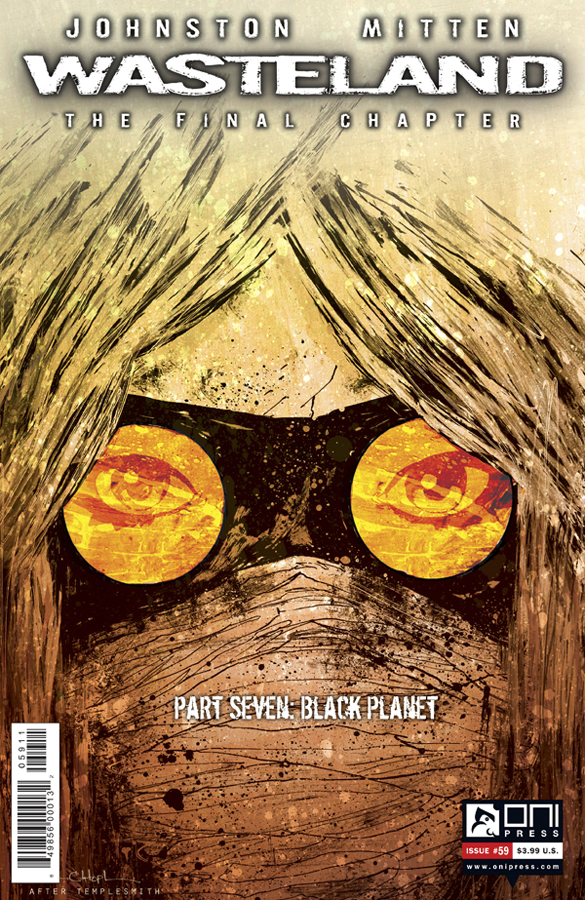
Wasteland #59 (Oni)
 |
| via Previews World |
artist: Christopher Mitten
Technically, this is the last issue of the Wasteland saga. And it is deliciously cyclical, as most of the best stories are.
I say "technically" because there's one issue left, an epilogue as it turns out. All the better for Wasteland's few but hopelessly devoted fans, who will savor this story for years.
The very first issue featured a cover remarkably similar to this one. The person behind the goggles and the mask was Michael, whom I've always identified as a Wolverine figure, and somewhat rightly so as it turns out. The person behind the goggles and the mask this time is Abi. Both are characters we've spent the whole series following, and both split off from what had begun to seem like the main narrative of Wasteland when they left the city of Newbegin behind, in search of fabled A-Ree-Yass-I.
(Which is finally identified, by the way.)
When we first met Abi, she didn't know she was exactly like Michael. She knew she had peculiar abilities, but she'd forgotten, just as the world did, what had come before. And now she has replaced him.
The story begins anew, at the end. Hopefully the mistakes of the past won't be repeated? That's what it's all been about, remembering the past, learning from it.
And it's been a grand journey.
Friday, November 7, 2014
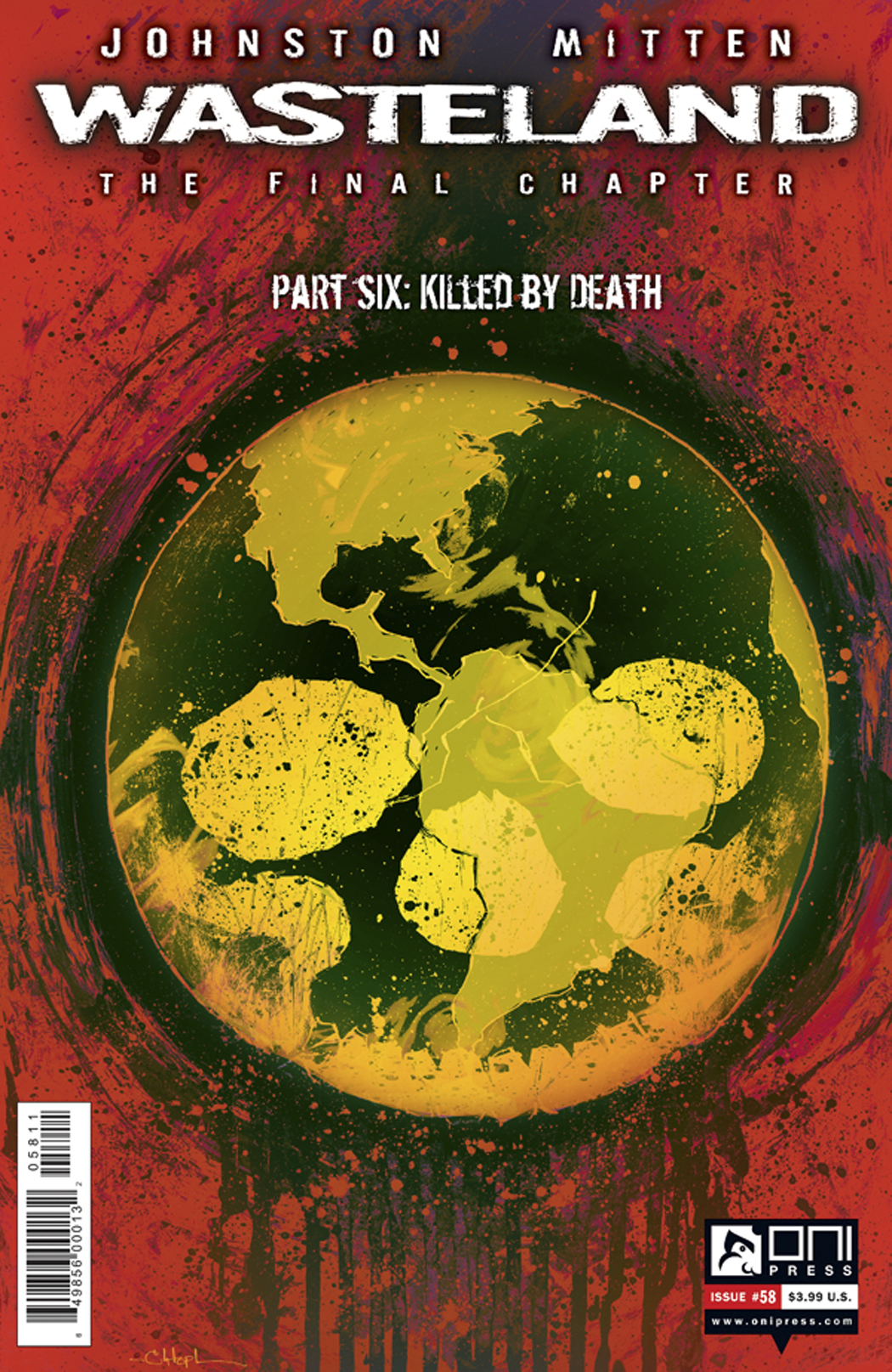
Wasteland #58 (Oni)
writer: Antony Johnston
artist: Christopher Mitten
"The Final Chapter" Part 6 (of 8), also known as the big reveal of what exactly the apocalypse looked like that created the world of Wasteland, or what exactly the Big Wet was.
Epic, epic stuff. I have not had the opportunity to read the whole arc yet, but I'm very happy to have at least read the previous issue and especially this one, which as far as I'm concerned does a large part of explaining the whole series.
Way back when the series started I liked to try and sell the series to potential new readers by pointing out the similarities between the character of Michael and the, ah, far more famous Wolverine. Nine years later or so and I still stand by that assertion, but as it turns out there may be a better comparison, one that wasn't even possible at the time: Wasteland, as it turns out, may be a lot like Hancock.
Hey, remember this year's Noah, and pop culture's first-ever exposure to the idea of the Nephilim, a concept probably even most Christians had never heard of? (You know, the rock creatures in the movie? The movie no one else has described this way but it really is: brilliant. By the way.) That's part of it, too.
You remember how in Hancock you thought you were just watching Will Smith being Bad Superhero, but then you realize that not only is Charlize Theron in it, too, but she's incredibly important, and that the story is really about a couple of angel protectors who can't spend any significant time together without massive consequences?
So it turns out the good folks such as Michael and Abi and Marcus (...okay, not all of them good folks) are a lot like Hancock. The whole extended Newbegin arc that sometimes seemed like it was the whole point of the series was actually a massive illustration that these guys were not actually cut out to be rulers (thanks again, Marcus!) of mankind.
I don't want to spend too much time analyzing that whole situation, because I need to read the whole sequence, and that probably won't happen until next year, and besides, there are two issues remaining and who knows what else Antony Johnston has yet to reveal?
The crux of what makes this issue so brilliant, so important to the whole series, is how perfectly it presents a portrait of the panicked end times of the hundred years in the past, the Big Wet that was the hidden mythology of Wasteland all this time. There was some of that tapestry last issue, and maybe there was more in previous ones, too, I don't know at this point. I know that I loved how it was done in this one. Loved it.
For a series built on a mystery that could easily have been, in anyone else's hands, the way it actually started, I'm loving having reached this point. Sad that it's the end of the series, but great that soon the whole story will be available so that maybe us die hard fans will finally be able to convince everyone else to read it. No more excuses, right? It's been a fantastic journey. One for the ages.
artist: Christopher Mitten
 |
| via Previews World |
Epic, epic stuff. I have not had the opportunity to read the whole arc yet, but I'm very happy to have at least read the previous issue and especially this one, which as far as I'm concerned does a large part of explaining the whole series.
Way back when the series started I liked to try and sell the series to potential new readers by pointing out the similarities between the character of Michael and the, ah, far more famous Wolverine. Nine years later or so and I still stand by that assertion, but as it turns out there may be a better comparison, one that wasn't even possible at the time: Wasteland, as it turns out, may be a lot like Hancock.
Hey, remember this year's Noah, and pop culture's first-ever exposure to the idea of the Nephilim, a concept probably even most Christians had never heard of? (You know, the rock creatures in the movie? The movie no one else has described this way but it really is: brilliant. By the way.) That's part of it, too.
You remember how in Hancock you thought you were just watching Will Smith being Bad Superhero, but then you realize that not only is Charlize Theron in it, too, but she's incredibly important, and that the story is really about a couple of angel protectors who can't spend any significant time together without massive consequences?
So it turns out the good folks such as Michael and Abi and Marcus (...okay, not all of them good folks) are a lot like Hancock. The whole extended Newbegin arc that sometimes seemed like it was the whole point of the series was actually a massive illustration that these guys were not actually cut out to be rulers (thanks again, Marcus!) of mankind.
I don't want to spend too much time analyzing that whole situation, because I need to read the whole sequence, and that probably won't happen until next year, and besides, there are two issues remaining and who knows what else Antony Johnston has yet to reveal?
The crux of what makes this issue so brilliant, so important to the whole series, is how perfectly it presents a portrait of the panicked end times of the hundred years in the past, the Big Wet that was the hidden mythology of Wasteland all this time. There was some of that tapestry last issue, and maybe there was more in previous ones, too, I don't know at this point. I know that I loved how it was done in this one. Loved it.
For a series built on a mystery that could easily have been, in anyone else's hands, the way it actually started, I'm loving having reached this point. Sad that it's the end of the series, but great that soon the whole story will be available so that maybe us die hard fans will finally be able to convince everyone else to read it. No more excuses, right? It's been a fantastic journey. One for the ages.
Wednesday, October 22, 2014
Wasteland #57 (Oni)
writer: Antony Johnston
artist: Christopher Mitten
We're in the homestretch of the whole series itself. That means answers.
artist: Christopher Mitten
 |
| via Antony Johnston |
Answers to how the whole story happened to begin with, the mystery of "The Big Wet," the event that created the post-apocalyptic world of Wasteland, and who exactly Michael, Abi, and others of their kind really are.
This is what Robert Kirkman will be getting around to, as he currently sees it, probably decades from now over in The Walking Dead. For my money, Wasteland was always better than Walking Dead.
But far more complicated. This is what fans like me have been dreaming about for years, these answers. But fans like me have been in short supply, which is why my record of reading the series has been spotty in recent years. I've tended to read my comics in print, and even though I've started reading them digitally this year, which happens to coincide with Mitten's return to the series for its final chapter, I wanted to read the end of Wasteland the way I began. Which meant getting my local comics shop to order it for me, which has turned out to be a little more difficult than I thought it would.
But here we are. I can only say, with this particular issue, that the answers have started to come. I don't know when, exactly, the answers began, because this is the first issue I've caught all year. I will play catch-up next year in the trade collections. I'm already three volumes behind in those, which is also the exact material covering the period where I stopped being able to catch the series regularly, and I guess one or two more to cover the final issues.
I'd say more about what this particular issues does, but I've just read the next one, and that one's pure dynamite, and I'll have a lot more to that about that one and how it reflects on the journey of the whole series. And after that, there are only two issues left of the series. The last one will apparently have to wait until next year to see publication.
I can wait. Probably.
Bottom line, I consider Wasteland to be among the best comics being published as much today as the day I first fell in love with it. With the second issue (only because I didn't catch the first).
Monday, January 27, 2014
Digitally Speaking...#4 "Avengers, Bad Medicine"
Avengers #12.1 (Marvel)
From 2011. This was part of the kick-off to the "Age of Ultron" event that has nothing at all to do with the upcoming Avengers: Age of Ultron movie. But it's also perfectly readable as a window into the decade-long Brian Michael Bendis era in the franchise, which ended a year ago. The Avengers you know from the movies more or less came ready-made from a Brian Bendis comic. Bendis is known as the godfather of decompressed storytelling, in that he can string any story out for many issues at a time. The funny thing about this issue, however, is that it seems to be severely compressed, the exact opposite. We go from the captured Spider-Woman to the Avengers arguing about how to handle the news (being delivered by a fairly complete nobody) to the Avengers finding Spider-Woman in a split second, right after we've heard her kidnappers hint at why they did it, to the revelation of Ultron's involvement.
There's a lot of trademark Bendis banter. I mean, that's the playbook to every Bendis script, bantering between a large number of characters. Especially in this issue, he might have benefited to streamline the players, so that the ones who actually contribute to the story better stand out rather than randomly comment here and there. It makes the whole team seem poorly led and extremely inexperienced. On the one hand, it makes things less intimidating to new readers. And obviously, when adapted to the big screen very popular, but...it fails for anyone looking to have a more-than-decent comics reading experience. Maybe when Bendis is writing a thousand different Avengers books (besides everything else he writes), it's easy to spit out the Bendis banter, but it's probably not great for his overall legacy, except to say that he's spent a huge amount of time writing Avengers (and Ultimate Spider-Man) adventures.
I'm always flip-flopping on Bendis. This particular experience is no different. A focused Bendis would be ideal, but a popular Bendis is an in-demand Bendis, and so I guess maybe that's not really an option. Obviously the guy has talent, and can come up with enough stories to fill a thousand monthly adventures...It'd be nice to find out what's possible if he tried to do a more finite story, I guess is what I'm saying.
FCBD 2012 Bad Medicine (Oni)
The comic itself seems to be a gloss on the TV series Fringe (and hopefully the writers knew that, because nearly element is an exact duplicate, although in every sense less inspired), so why did I bother reading this? Because of the art, from Christopher Mitten. Mitten drew much of one of my all-time favorite comics, Wasteland, also published by Oni, in collaboration with writer Antony Johnston. He became a little burned out and subsequently bowed out of the project, but is returning in time for the final ten issues, hopefully all of them to be released this year. His artwork in Bad Medicine is similar to his Wasteland work although not as distinctive, perhaps because Bad Medicine itself is not all that distinctive. The real bonus, the real treat for me, was the unexpected Wasteland backup tale from Mitten and Johnston, which nails perfectly everything to love about the series, the main characters Abi and Michael along their journey to I-Ree-Yass-I stumbling in classic Wasteland fashion into the middle of someone else's story (which is what half the series became in the city of Newbegin) even while providing more dazzling hints into the true nature of these deceptively complicated characters (their magic healing powers do not seem to be limited by decapitation, a throwaway joke aimed at Highlander fans).
From 2011. This was part of the kick-off to the "Age of Ultron" event that has nothing at all to do with the upcoming Avengers: Age of Ultron movie. But it's also perfectly readable as a window into the decade-long Brian Michael Bendis era in the franchise, which ended a year ago. The Avengers you know from the movies more or less came ready-made from a Brian Bendis comic. Bendis is known as the godfather of decompressed storytelling, in that he can string any story out for many issues at a time. The funny thing about this issue, however, is that it seems to be severely compressed, the exact opposite. We go from the captured Spider-Woman to the Avengers arguing about how to handle the news (being delivered by a fairly complete nobody) to the Avengers finding Spider-Woman in a split second, right after we've heard her kidnappers hint at why they did it, to the revelation of Ultron's involvement.
There's a lot of trademark Bendis banter. I mean, that's the playbook to every Bendis script, bantering between a large number of characters. Especially in this issue, he might have benefited to streamline the players, so that the ones who actually contribute to the story better stand out rather than randomly comment here and there. It makes the whole team seem poorly led and extremely inexperienced. On the one hand, it makes things less intimidating to new readers. And obviously, when adapted to the big screen very popular, but...it fails for anyone looking to have a more-than-decent comics reading experience. Maybe when Bendis is writing a thousand different Avengers books (besides everything else he writes), it's easy to spit out the Bendis banter, but it's probably not great for his overall legacy, except to say that he's spent a huge amount of time writing Avengers (and Ultimate Spider-Man) adventures.
I'm always flip-flopping on Bendis. This particular experience is no different. A focused Bendis would be ideal, but a popular Bendis is an in-demand Bendis, and so I guess maybe that's not really an option. Obviously the guy has talent, and can come up with enough stories to fill a thousand monthly adventures...It'd be nice to find out what's possible if he tried to do a more finite story, I guess is what I'm saying.
FCBD 2012 Bad Medicine (Oni)
The comic itself seems to be a gloss on the TV series Fringe (and hopefully the writers knew that, because nearly element is an exact duplicate, although in every sense less inspired), so why did I bother reading this? Because of the art, from Christopher Mitten. Mitten drew much of one of my all-time favorite comics, Wasteland, also published by Oni, in collaboration with writer Antony Johnston. He became a little burned out and subsequently bowed out of the project, but is returning in time for the final ten issues, hopefully all of them to be released this year. His artwork in Bad Medicine is similar to his Wasteland work although not as distinctive, perhaps because Bad Medicine itself is not all that distinctive. The real bonus, the real treat for me, was the unexpected Wasteland backup tale from Mitten and Johnston, which nails perfectly everything to love about the series, the main characters Abi and Michael along their journey to I-Ree-Yass-I stumbling in classic Wasteland fashion into the middle of someone else's story (which is what half the series became in the city of Newbegin) even while providing more dazzling hints into the true nature of these deceptively complicated characters (their magic healing powers do not seem to be limited by decapitation, a throwaway joke aimed at Highlander fans).
Monday, November 25, 2013
My All-time Favorite Comic Books, 10-1
The final countdown...!
#10. Geoff Johns's Green Lantern

Creators: Geoff Johns, Doug Mahnke, Ethan Van Sciver, Ivan Reis, various
Publication dates: 2004-2013
Issues: Green Lantern: Rebirth 1-6, Green Lantern 1-67, 0-20, Blackest Night 1-8
Green Lantern was already my favorite comic book franchise when Johns strolled into the story in 2004. I thought I already had my definitive era in Ron Marz's Kyle Rayner. Then Johns brought Hal Jordan back, and exploded the whole mythology. I mean, literally, he took the basic building blocks and figured out the best possible expansion, and led the whole thing to its greatest heights. It's the epitome of creative storytelling, the single best innovative run in superhero comic book history, one that will continue to be felt for years. I mean, even Larfleeze has gotten his own ongoing series now. Larfleeze! How awesome is that? Saint Walker made it into the pre-New 52 Justice League, the Red Lanterns have had their own series since the DC relaunch, and Johns has made a strong case for a Sinestro series. No one would have ever thought that possible before 2004. That's the definition of a substantial legacy.
#9. Air

Creators: G. Willow Wilson, M.K. Perker
Publication dates: 2008-2010
Issues: 1-24
Along with 52 part of a very select group to top my annual QB50 list twice, Air was an unabashed obsession of mine throughout its publication, even though it struggled to find an audience that did not have the name "Tony Laplume." But it was brilliant, typical of the Vertigo breed in having a distinct and imaginative mythology, but atypical in its intimate approach, like Sandman without all the Goth touches. G. Willow Wilson managed to spin a conspiracy and hero journey into one yarn. The closest proximity I've found since was the similarly short-lived Saucer Country. As with most of my selections, widely deserves a much larger audience.
#8. Cobra

Creators: Mike Costa, Antonio Fuso, Christos Gage
Publication dates: 2009-2013
Issues: 1-4, Special 1-2, 1-13, 1-21, The Cobra Files 1-9
This is basically everything I loved about Superboy and the Ravers, The Great Ten, Seven Soldiers of Victory, and Young Avengers in a nonsuperhero title, and surprisingly with another famous franchise it managed to totally reinvent from the outset, featuring an obscure Joe named Chuckles in the mission of his life, a reboot timeline where Cobra is just being discovered. And from there, it's basically the Assange/Snowden/NSA era well before any of those scandals broke, one brilliant bit of character exploration after another in a world of paranoia and secrets, an unexpected phenomenon publisher IDW never expected, assuming it had merely a good mini-series when it acquired G.I. Joe in 2008, leading to a series of extensions that eventually transformed the whole line with the sensational death of Cobra Commander. You don't need to know or care about the franchise to love this saga. You just need to love great comics.
#7. Sandman

Creators: Neil Gaiman, Dave McKean, various
Publication dates: 1989-1996
Issues: 1-75
For simplicity's sake I'm sticking to the original series rather than also include subsequent additional materials, such as the recently-launched Sandman Overture mini-series. Simply put, this one needs no introduction. It's perhaps the most literary comic book ever published, filled with classical elements and one of the best-known mythologies outside of superheroes ever created. It's a masterpiece. Move along, move along.
#6. Bone

Creators: Jeff Smith
Publication dates: 1991-2004
Issues: 1-55
This one I owe entirely to a friend who was obsessed with it. For a while, there was a very small cult audience obsessed with it. And it expanded, thanks to word of mouth. It started making in-roads to full-blown mainstream awareness. There was talk of a movie. All of this is for good reason. Like a cartoon strip wedded perfectly to epic fantasy (such as you would never have believed possible until Bone), Jeff Smith's vision was a dream come to life, so popular Image for a while took over publication, until it went back to Smith's own company, where it completed its epic journey, only to be reborn in a series of reprints, where its legacy (as I've been hoping throughout this list for many other series) has grown. Oh, and because it's my favorite phrase from Bone: stupid, stupid rat creatures...
#5. Wasteland

Creators: Antony Johnston, Christopher Mitten, Justin Greenwood
Publication dates: 2006-2014
Issues: 1-60
I've attempted for years to be an ambassador to this series, a classic post-apocalyptic yarn that explodes the genre into a startlingly rich landscape filled with intricate relationships between isolated figures. Unlike The Walking Dead, Wasteland has made the riddle of what created the world after the Big Wet the whole point, except it's taken the whole journey to reach it. In the meantime social politics have defined the story, especially the betrayals at the heart of life in Newbegin, the perfect representation of civilization after civilization's end. My favorite character remains Michael, a sort of Wolverine if Wolverine had never joined the X-Men.
#4. 52

Creators: Geoff Johns, Grant Morrison, Greg Rucka, Mark Waid, Keith Giffen, various
Publication dates: 2006-2007
Issues: 1-52
DC's first weekly series in years, an ambitious effort to put out a new issue every week for a year, could have been its riskiest gamble ever. Instead it turned out to be a stroke of genius, one of the best single comics it ever put out, following a hodgepodge of characters who could never have been mistaken for the mainstream (although some of them, including Booster Gold and the new Batwoman, received their own ongoing series as a result) as they embark on the greatest stories of their careers, including the Elongated Man's long-awaited response to Identity Crisis and Black Adam's shot at redemption. The league of creators who wrote it remains a who's who, and to my mind in no small part to their participation in this book. The company's later attempts to duplicate this remarkable accomplishment never seemed to capture the same interest from the fans, but that's to be expected, although I would highly recommend Countdown, while the bi-weekly Brightest Day is another winner.
#3. The Death of Captain Marvel

Creators: Jim Starlin
Publication date: 1982
Issues: [graphic novel]
This is the comic book that made me a fan of comic books, and it is also among the first I ever read, and completely by accident, something my sister had randomly come across and I stole a look, and no joking, I was changed forever. The death of any comic book character wasn't as common in 1982 as it is today, and the true testament of this event is that Captain Marvel remains respectfully deceased. It's a surreal, literary exploration and epitaph for a character who was never really that popular but whose legacy was instantly cemented by this effort. What more could you ask for?
#2. Kingdom Come

Creators: Mark Waid, Alex Ross
Publication dates: 1996
Issues: 1-4
You might notice that I love my comics to be literary, and no superhero comic was ever more literary, not to mention seminal in my own creative development, than this landmark event that peered into the future of DC's icons and saw nothing good. Lois Lane dead. Superman forced into retirement. The next generation, led by Magog, the reverse of everything that had come before them. Narrated by a simple preacher and steeped in religious imagery (this is the secret origin of my obsession with the number 7, and why I subsequently adopted the term "seven thunders" from the Book of Revelations for what I always assumed must be my own magnum opus, because it was used in the previews for Kingdom Come), this was both creators at their absolute finest. One of them ended up chasing this achievement for years (Ross) while the other only occasionally revisited it (Waid, in The Kingdom event that was as close to Seven Soldiers of Victory as DC ever got before Grant Morrison), while Geoff Johns famously brought it all back in the pages of his Justice Society of America. Even Magog eventually entered the regular canon and had an ongoing series. Often seen as DC's response to Marvels, it is more accurately seen in its own distinctive light, which is ultimately a more hopeful version of The Dark Knight Returns, taken on the grand scale.
#1. "The Return of Barry Allen"

Creators: Mark Waid, Greg LaRocque
Publication dates: 1993
Issues: The Flash 74-79
I choose to include only one storyline from Mark Waid's extended run on The Flash for a specific reason, because it was the earliest and best example of the whole thing, which often lived up to its potential and sometimes didn't (and the best of it wasn't even in the pages of The Flash but rather Impulse), so it's better to remember what remains the most memorable than complicate matters. Because "The Return of Barry Allen" is most certainly the best of it. And for the record, it doesn't even feature Barry Allen. This was years before Barry came back. The Flash throughout Waid's run was Wally West ("and I'm the Fastest Man Alive"), the third speedster to carry the name, and he was keenly aware of the whole mythology, which before Geoff Johns on Green Lantern, Waid was the first to attempt a wholesale expansion, introducing the concept of the Speed Force and old as well as new faces to the family, including my personal favorite, Max Mercury, the Zen Master of Speed. If there is any weakening to this legacy, it's perhaps that even Waid seemed to let it slip by the wayside after a while, perhaps after "Dead Heat" (acknowledged within the pages of Johns's The Flash: Rebirth with a cameo by the villain Savitar), while Johns himself in two separate runs (with Wally and Barry) went in different directions. Better, again, to remember it at its most pure, most perfect, most serene, most effective, when it's Wally struggling with his role in the grand scheme of things. James Robinson would later take the same basic concept to similar heights in the pages of Starman, but has no comparable single storyline to this one. This is the one, if you love superheroes and their legacies, that you have to read. This is the love letter of all love letters to the whole phenomenon.
(All covers via Comic Book Database.)
#10. Geoff Johns's Green Lantern

Creators: Geoff Johns, Doug Mahnke, Ethan Van Sciver, Ivan Reis, various
Publication dates: 2004-2013
Issues: Green Lantern: Rebirth 1-6, Green Lantern 1-67, 0-20, Blackest Night 1-8
Green Lantern was already my favorite comic book franchise when Johns strolled into the story in 2004. I thought I already had my definitive era in Ron Marz's Kyle Rayner. Then Johns brought Hal Jordan back, and exploded the whole mythology. I mean, literally, he took the basic building blocks and figured out the best possible expansion, and led the whole thing to its greatest heights. It's the epitome of creative storytelling, the single best innovative run in superhero comic book history, one that will continue to be felt for years. I mean, even Larfleeze has gotten his own ongoing series now. Larfleeze! How awesome is that? Saint Walker made it into the pre-New 52 Justice League, the Red Lanterns have had their own series since the DC relaunch, and Johns has made a strong case for a Sinestro series. No one would have ever thought that possible before 2004. That's the definition of a substantial legacy.
#9. Air

Creators: G. Willow Wilson, M.K. Perker
Publication dates: 2008-2010
Issues: 1-24
Along with 52 part of a very select group to top my annual QB50 list twice, Air was an unabashed obsession of mine throughout its publication, even though it struggled to find an audience that did not have the name "Tony Laplume." But it was brilliant, typical of the Vertigo breed in having a distinct and imaginative mythology, but atypical in its intimate approach, like Sandman without all the Goth touches. G. Willow Wilson managed to spin a conspiracy and hero journey into one yarn. The closest proximity I've found since was the similarly short-lived Saucer Country. As with most of my selections, widely deserves a much larger audience.
#8. Cobra

Creators: Mike Costa, Antonio Fuso, Christos Gage
Publication dates: 2009-2013
Issues: 1-4, Special 1-2, 1-13, 1-21, The Cobra Files 1-9
This is basically everything I loved about Superboy and the Ravers, The Great Ten, Seven Soldiers of Victory, and Young Avengers in a nonsuperhero title, and surprisingly with another famous franchise it managed to totally reinvent from the outset, featuring an obscure Joe named Chuckles in the mission of his life, a reboot timeline where Cobra is just being discovered. And from there, it's basically the Assange/Snowden/NSA era well before any of those scandals broke, one brilliant bit of character exploration after another in a world of paranoia and secrets, an unexpected phenomenon publisher IDW never expected, assuming it had merely a good mini-series when it acquired G.I. Joe in 2008, leading to a series of extensions that eventually transformed the whole line with the sensational death of Cobra Commander. You don't need to know or care about the franchise to love this saga. You just need to love great comics.
#7. Sandman

Creators: Neil Gaiman, Dave McKean, various
Publication dates: 1989-1996
Issues: 1-75
For simplicity's sake I'm sticking to the original series rather than also include subsequent additional materials, such as the recently-launched Sandman Overture mini-series. Simply put, this one needs no introduction. It's perhaps the most literary comic book ever published, filled with classical elements and one of the best-known mythologies outside of superheroes ever created. It's a masterpiece. Move along, move along.
#6. Bone

Creators: Jeff Smith
Publication dates: 1991-2004
Issues: 1-55
This one I owe entirely to a friend who was obsessed with it. For a while, there was a very small cult audience obsessed with it. And it expanded, thanks to word of mouth. It started making in-roads to full-blown mainstream awareness. There was talk of a movie. All of this is for good reason. Like a cartoon strip wedded perfectly to epic fantasy (such as you would never have believed possible until Bone), Jeff Smith's vision was a dream come to life, so popular Image for a while took over publication, until it went back to Smith's own company, where it completed its epic journey, only to be reborn in a series of reprints, where its legacy (as I've been hoping throughout this list for many other series) has grown. Oh, and because it's my favorite phrase from Bone: stupid, stupid rat creatures...
#5. Wasteland

Creators: Antony Johnston, Christopher Mitten, Justin Greenwood
Publication dates: 2006-2014
Issues: 1-60
I've attempted for years to be an ambassador to this series, a classic post-apocalyptic yarn that explodes the genre into a startlingly rich landscape filled with intricate relationships between isolated figures. Unlike The Walking Dead, Wasteland has made the riddle of what created the world after the Big Wet the whole point, except it's taken the whole journey to reach it. In the meantime social politics have defined the story, especially the betrayals at the heart of life in Newbegin, the perfect representation of civilization after civilization's end. My favorite character remains Michael, a sort of Wolverine if Wolverine had never joined the X-Men.
#4. 52

Creators: Geoff Johns, Grant Morrison, Greg Rucka, Mark Waid, Keith Giffen, various
Publication dates: 2006-2007
Issues: 1-52
DC's first weekly series in years, an ambitious effort to put out a new issue every week for a year, could have been its riskiest gamble ever. Instead it turned out to be a stroke of genius, one of the best single comics it ever put out, following a hodgepodge of characters who could never have been mistaken for the mainstream (although some of them, including Booster Gold and the new Batwoman, received their own ongoing series as a result) as they embark on the greatest stories of their careers, including the Elongated Man's long-awaited response to Identity Crisis and Black Adam's shot at redemption. The league of creators who wrote it remains a who's who, and to my mind in no small part to their participation in this book. The company's later attempts to duplicate this remarkable accomplishment never seemed to capture the same interest from the fans, but that's to be expected, although I would highly recommend Countdown, while the bi-weekly Brightest Day is another winner.
#3. The Death of Captain Marvel

Creators: Jim Starlin
Publication date: 1982
Issues: [graphic novel]
This is the comic book that made me a fan of comic books, and it is also among the first I ever read, and completely by accident, something my sister had randomly come across and I stole a look, and no joking, I was changed forever. The death of any comic book character wasn't as common in 1982 as it is today, and the true testament of this event is that Captain Marvel remains respectfully deceased. It's a surreal, literary exploration and epitaph for a character who was never really that popular but whose legacy was instantly cemented by this effort. What more could you ask for?
#2. Kingdom Come

Creators: Mark Waid, Alex Ross
Publication dates: 1996
Issues: 1-4
You might notice that I love my comics to be literary, and no superhero comic was ever more literary, not to mention seminal in my own creative development, than this landmark event that peered into the future of DC's icons and saw nothing good. Lois Lane dead. Superman forced into retirement. The next generation, led by Magog, the reverse of everything that had come before them. Narrated by a simple preacher and steeped in religious imagery (this is the secret origin of my obsession with the number 7, and why I subsequently adopted the term "seven thunders" from the Book of Revelations for what I always assumed must be my own magnum opus, because it was used in the previews for Kingdom Come), this was both creators at their absolute finest. One of them ended up chasing this achievement for years (Ross) while the other only occasionally revisited it (Waid, in The Kingdom event that was as close to Seven Soldiers of Victory as DC ever got before Grant Morrison), while Geoff Johns famously brought it all back in the pages of his Justice Society of America. Even Magog eventually entered the regular canon and had an ongoing series. Often seen as DC's response to Marvels, it is more accurately seen in its own distinctive light, which is ultimately a more hopeful version of The Dark Knight Returns, taken on the grand scale.
#1. "The Return of Barry Allen"

Creators: Mark Waid, Greg LaRocque
Publication dates: 1993
Issues: The Flash 74-79
I choose to include only one storyline from Mark Waid's extended run on The Flash for a specific reason, because it was the earliest and best example of the whole thing, which often lived up to its potential and sometimes didn't (and the best of it wasn't even in the pages of The Flash but rather Impulse), so it's better to remember what remains the most memorable than complicate matters. Because "The Return of Barry Allen" is most certainly the best of it. And for the record, it doesn't even feature Barry Allen. This was years before Barry came back. The Flash throughout Waid's run was Wally West ("and I'm the Fastest Man Alive"), the third speedster to carry the name, and he was keenly aware of the whole mythology, which before Geoff Johns on Green Lantern, Waid was the first to attempt a wholesale expansion, introducing the concept of the Speed Force and old as well as new faces to the family, including my personal favorite, Max Mercury, the Zen Master of Speed. If there is any weakening to this legacy, it's perhaps that even Waid seemed to let it slip by the wayside after a while, perhaps after "Dead Heat" (acknowledged within the pages of Johns's The Flash: Rebirth with a cameo by the villain Savitar), while Johns himself in two separate runs (with Wally and Barry) went in different directions. Better, again, to remember it at its most pure, most perfect, most serene, most effective, when it's Wally struggling with his role in the grand scheme of things. James Robinson would later take the same basic concept to similar heights in the pages of Starman, but has no comparable single storyline to this one. This is the one, if you love superheroes and their legacies, that you have to read. This is the love letter of all love letters to the whole phenomenon.
(All covers via Comic Book Database.)
Thursday, March 14, 2013
Quick Hits: Wasteland #42 (Oni)
My favorite indy comic is Wasteland and I am happy to continue talking about it even while no one else seems to. On the way to A-Ree-Yass-I and now separated from Michael, Abi is confronted with the limits of her powers. All of these are immediately relevant details to the overall series, but you can appreciate most of it individually this issue, which is something Antony Johnston has been getting better at the longer the series has continued. Which is another reason that there's absolutely no excuse not to discover Wasteland for yourself.
Saturday, January 26, 2013
Wasteland #41 (Oni)
writer: Antony Johnston
artist: Russel Roehling

The continuing saga of the world after the Big Wet continues. As with recent issues, Wasteland #41 sees Michael and Abi continue their search for A-Ree-Yass-I.
Now, let me explain why any of that is interesting. The Big Wet is a vaguely-defined apocalyptic event, which means that by definition Wasteland is a post-apocalyptic tale. Humanity has regressed to a more primitive mode of existence. There are still remnants of what once was, and in fact the series is set in America (I'm just now realizing that as far as speculations go, A-Ree-Yass-I could very well be Arizona; I'd never really thought about that before).
Most of the series to this point centered on the political turmoil of Newbegin, where Michael ended up traveling along with a caravan that included Abi. There we met Marcus, the self-styled ruler of the city, and eventually Mary. Michael, Abi, Marcus and Mary are unique among the people living in this world. For one, they're far older, though they age slowly. For another, they each possess special abilities. A recent issue (#39) was a flashback to some of their earliest days, before their failing memories caused them to forget each other. What's all the more intriguing about them is that they come from a time before the Big Wet, about a hundred years in the past.
Michael may have the clearest memory of the four we've followed to this point, yet he tends to play things pretty close to the vest. I've repeatedly compared him to Wolverine, not just because he's a bad-ass loner, but because of this secret history that's still unfolding. Though he tends to share the ensemble nature of the series, Michael is a regular standout.
Michael and Abi left (or rather, escaped from) Newbegin a while ago, and some of what recent issues have done is simply to make the series easier for new readers to follow. They've been searching for A-Ree-Yass-I, which is fabled to hold the key to explaining the past and perhaps making the present better. They've recently come across another small community, and a man named Joseph is its most notable resident, mainly because he's like our four extraordinary characters. This whole issue, in fact, is a little like exploring that aspect of the series with lesser consequence, so that you can catch up on what being Michael and Abi means without worrying too much about where Joseph specifically is going. Marcus was such a huge hassle for them in Newbegin, it's nice to see one of them in more flattering light, like Abi to a lesser extent. What sets Abi apart is her keen interest in A-Ree-Yass-I.
By the end of the issue, Michael and Abi have moved on again but come to an argument as to how to proceed, which direction to go. And so they finally part company. This will have the advantage of further narrowing the perspective between issues, something that came up in the Newbegin era after their departure.
The original artist for Wasteland, Christopher Mitten, provides the cover, but interiors belong to Russel Roehling. Roehling has a completely different style from Mitten, more cartoonish, and it can be a little distracting, something I had to get a grip on when I first saw his work in the series. Yet the excellent writing of Antony Johnston remains. Johnston has been getting increased attention from the comic book world, but unfortunately that hasn't translated to greater exposure for Wasteland, which has been a favorite of mine since the start of the series. I still cannot possibly recommend it enough.
artist: Russel Roehling

(via onipress.com)
The continuing saga of the world after the Big Wet continues. As with recent issues, Wasteland #41 sees Michael and Abi continue their search for A-Ree-Yass-I.
Now, let me explain why any of that is interesting. The Big Wet is a vaguely-defined apocalyptic event, which means that by definition Wasteland is a post-apocalyptic tale. Humanity has regressed to a more primitive mode of existence. There are still remnants of what once was, and in fact the series is set in America (I'm just now realizing that as far as speculations go, A-Ree-Yass-I could very well be Arizona; I'd never really thought about that before).
Most of the series to this point centered on the political turmoil of Newbegin, where Michael ended up traveling along with a caravan that included Abi. There we met Marcus, the self-styled ruler of the city, and eventually Mary. Michael, Abi, Marcus and Mary are unique among the people living in this world. For one, they're far older, though they age slowly. For another, they each possess special abilities. A recent issue (#39) was a flashback to some of their earliest days, before their failing memories caused them to forget each other. What's all the more intriguing about them is that they come from a time before the Big Wet, about a hundred years in the past.
Michael may have the clearest memory of the four we've followed to this point, yet he tends to play things pretty close to the vest. I've repeatedly compared him to Wolverine, not just because he's a bad-ass loner, but because of this secret history that's still unfolding. Though he tends to share the ensemble nature of the series, Michael is a regular standout.
Michael and Abi left (or rather, escaped from) Newbegin a while ago, and some of what recent issues have done is simply to make the series easier for new readers to follow. They've been searching for A-Ree-Yass-I, which is fabled to hold the key to explaining the past and perhaps making the present better. They've recently come across another small community, and a man named Joseph is its most notable resident, mainly because he's like our four extraordinary characters. This whole issue, in fact, is a little like exploring that aspect of the series with lesser consequence, so that you can catch up on what being Michael and Abi means without worrying too much about where Joseph specifically is going. Marcus was such a huge hassle for them in Newbegin, it's nice to see one of them in more flattering light, like Abi to a lesser extent. What sets Abi apart is her keen interest in A-Ree-Yass-I.
By the end of the issue, Michael and Abi have moved on again but come to an argument as to how to proceed, which direction to go. And so they finally part company. This will have the advantage of further narrowing the perspective between issues, something that came up in the Newbegin era after their departure.
The original artist for Wasteland, Christopher Mitten, provides the cover, but interiors belong to Russel Roehling. Roehling has a completely different style from Mitten, more cartoonish, and it can be a little distracting, something I had to get a grip on when I first saw his work in the series. Yet the excellent writing of Antony Johnston remains. Johnston has been getting increased attention from the comic book world, but unfortunately that hasn't translated to greater exposure for Wasteland, which has been a favorite of mine since the start of the series. I still cannot possibly recommend it enough.
Wednesday, September 5, 2012
Sagas
Aquaman #12 (DC)
writer: Geoff Johns
artist: Ivan Reis
Chapter Six of "The Others," in which Johns explores a different kind of mythology for Aquaman, who has been marginalized in pop culture as "the dude who talks to fish." Unlike other creators, Johns doesn't just see the character as a fish out of water or connected to undersea kingdoms, but in connection to an intricate mythology that embraces arch foe Black Manta as never before and creates a web of allies that redefines Aquaman's greater scope. The Others (not to be confused with the good folks from Lost) are a network of world superheroes unrelated to the Justice League. As of this issue, Manta has killed two of them now in his efforts to lay claim to a scepter, one of seven relics of an older world destined to be possessed by Aquaman, but instead claimed by Manta. Aquaman has been avoiding both the Others and his Justice League pals, not to mention Mera, his mate. He thinks it's safer for everyone if he finally puts Manta behind him on his own. After this issue, maybe everyone will understand?
Green Lantern Corps #12 (DC)
writer: Peter J. Tomasi
artist: Fernando Pasarin
Green Lantern #12 (DC)
writer: Geoff Johns
artist: Renato Guedes, Jim Calafiore
Green Lantern: New Guardians #12 (DC)
writer: Tony Bedard
artist: Tyler Kirkham
Green Lantern Annual #1 (DC)
writer: Geoff Johns
artist: Ethan Van Sciver, Pete Woods
I had a recommendation that the twelfth issue of the Green Lantern books (which also include Red Lanterns) were worth checking out. As they're soon to launch into "Rise of the Third Army" (which the Annual previews), chances are that they were at least reaching a boiling point. In Tomasi's Corps, the Guardians are building Guy Gardner's confidence up, because a cocky Guy is a careless Guy. Guy Gardner is already the cockiest Green Lantern, human or otherwise. In this issue, he completes a rescue of John Stewart, whom the Guardians have destabilized by once again playing on his fears of inadequacy. The obstacle is the Alpha Lanterns, whom the Guardians previously created as Manhunter versions of their Green Lanterns. The Manhunters, by the way, were the First Army, the Lanterns the second. The Alpha Corps has been a plague since Final Crisis, a huge hassle that has proven time and again to be more trouble than it's worth. In Bedard's New Guardians, Kyle Rayner (the fourth human to hold a green ring from Oa) finally gets to the bottom of troubles his fledgling alliance of members from the Blue Lanterns, Red Lanterns, Sinestro Corps, Indigo Tribe, Star Sapphire, and crazy Larfleeze (easily the best creation of the Geoff Johns era) has been experiencing, and why Ganthet originally made him the torchbearer, because he alone can wield the power of the whole spectrum.
Johns as head writer of the franchise gets to write the big guns, Hal Jordan and Sinestro, the two most famous Green Lanterns, and the ones the Guardians absolutely need out of the way in order to enact their plans for a Third Army that will unquestionably and effectively obey them (removing free will, and thus making the Green Lantern Corps obsolete, as it is entirely powered by will). Jordan and Sinestro have been trying to handle Black Hand, emissary of the Black Lanterns, a quirk that introduced the zombie craze to DC. In both the ongoing series and annual, this proves increasingly complicated. From the Book of the Black, it's revealed that Jordan is meant to become the greatest Black Lantern (that's the shock of Green Lantern #12). The Guardians facilitate their plans by tapping into the power of the imprisoned First Lantern, and use Black Hand to apparently permanently eliminate Jordan and Sinestro (that's from Green Lantern Annual). All in all, big things continue to develop in this franchise.
Justice League #12 (DC)
writer: Geoff Johns
artist: Jim Lee, Ivan Reis, David Finch
Closing out the saga of the mad David Graves has some great features to it. For one, each member of the League is forced to confront some hard truths about their pasts, loved ones they would rather still have in their lives. There's a twist that may seem like it guts this element, but it's still worthwhile. For another, we learn that Steve Trevor is in fact not dead, but that doesn't simplify his relationship with Wonder Woman, though at least on her end there's finally a reckoning and resolution. For a third, well, there's been a lot of media attention to Wonder Woman's other relationship from this issue, the bond she realizes exists with Superman. It's on the cover and everything. Another development, meanwhile, sees Hal Jordan (Green Lantern, in a continuity that exists outside of the Green Lantern books, it should be noted) leaves the team, realizing that from the public perception side of things, he's something of a problem, having sparked a fight among several members of the team and thus helped everyone question its continuing effectiveness. I've been surprised at the tepid reception to this series, since it's been a favorite of mine since the launch of the New 52 last fall. It's precisely Johns' ability to see the humans in the mythic team that I've enjoyed so much, something Brad Meltzer previously tried to do (succeeding with Red Tornado but overlooking everyone else). The series has arguably done far better working with the characters than throwing Grant Morrison-level threats at them. Maybe that's something of what fans have lamented. But the main thing is, Johns has managed to do something with the team that no one else has, and that's something you want for any creator trying to leave a mark on something as big as the Justice League.
Saga #s 4-6 (Image)
writer: Brian K. Vaughan
artist: Fiona Staples
As you may or may not recall, I previously wrote about this series in a roundup of significantly hyped new series from established creators, and it was my pick for the best of them. I didn't realize how much I loved what I'd read until I had the chance to read more of it. Three additional issues of Saga is more than enough for me to establish my love for this book. It's a little like Grant Morrison doing Hitchhiker's Guide to the Galaxy. In books like Seaguy and The Filth, Morrison has certainly come close. But not as close as Saga. Vaughan has previously done stellar work in Y: The Last Man and Ex Machina, and has now come up with a third totally distinctive world that's impossible to overlook. The work of Staples should not be overlooked, either. Her art is astounding, from the iconic covers to interior art that surprises with every panel. There are a number of plotlines converging so far, from the relationship between Marko and Alana to The Will and Prince Robot IV, both of whom are looking for the fugitives, like a version of Farscape that isn't just a tad precious. Constantly evolving, it's the best science fiction epic to come along in a while. Considering that this is a genre that's (at least to my mind) notoriously hard to pull off in comics, that's saying something.
The Shade #11 (DC)
writer: James Robinson
artist: Frazer Irving
Featuring a main character who is entirely ambiguous, neither good nor evil (though he's been known as the latter in the past), this has been a rare opportunity for comics to be existential, and Robinson has embraced it wholeheartedly. This is the last issue that attempts to pretend that there was ever any other point than simply exploring The Shade, wrapping up a quick struggle with Egyptian gods recruited by the descendant who tried to have him killed at the start of the series. Proving that he's smarter than them, our protagonist does what he does best, talk himself out of a problem, using his powers less as a means to get something achieved than because he has them.
Velvet Garden #1 (RC)
writer: Ryan Davis
artist: Gunther Goltz
Not a fantastic book, but worth checking out. Based on an arcade game that was notoriously pulled from the general public for its destructive effects (Polybius, for the record), it's a mystery adventure I bought on the strength that it's from some local creators.
Wasteland #39 (Oni)
writer: Antony Johnston
artist: Sandy Jarrell
A fascinating glimpse into the mythology of the series. Ten years (instead of the usual hundred) after the apocalyptic event known as the Big Wet, we meet Michael, Marcus, and Mary as children wandering through territory already on the savage side. Michael is the Ruin Runner who's been the main protagonist of the book, while Marcus runs Newbegin with an iron fist, and has recently gained Mary as an ally. All three of them (along with Abbi, our other protagonist, who is currently searching for the mythic A-Ree-Yass-I with Michael) have special abilities, though they don't each have all the same gifts. That's one of the things that becomes a problem in this formative trio, not to mention the fact that both Marcus and Michael have an interest in Mary, whom they think is dead by the end of the issue. As always, one of the best books being published today.
writer: Geoff Johns
artist: Ivan Reis
Chapter Six of "The Others," in which Johns explores a different kind of mythology for Aquaman, who has been marginalized in pop culture as "the dude who talks to fish." Unlike other creators, Johns doesn't just see the character as a fish out of water or connected to undersea kingdoms, but in connection to an intricate mythology that embraces arch foe Black Manta as never before and creates a web of allies that redefines Aquaman's greater scope. The Others (not to be confused with the good folks from Lost) are a network of world superheroes unrelated to the Justice League. As of this issue, Manta has killed two of them now in his efforts to lay claim to a scepter, one of seven relics of an older world destined to be possessed by Aquaman, but instead claimed by Manta. Aquaman has been avoiding both the Others and his Justice League pals, not to mention Mera, his mate. He thinks it's safer for everyone if he finally puts Manta behind him on his own. After this issue, maybe everyone will understand?
Green Lantern Corps #12 (DC)
writer: Peter J. Tomasi
artist: Fernando Pasarin
Green Lantern #12 (DC)
writer: Geoff Johns
artist: Renato Guedes, Jim Calafiore
Green Lantern: New Guardians #12 (DC)
writer: Tony Bedard
artist: Tyler Kirkham
Green Lantern Annual #1 (DC)
writer: Geoff Johns
artist: Ethan Van Sciver, Pete Woods
I had a recommendation that the twelfth issue of the Green Lantern books (which also include Red Lanterns) were worth checking out. As they're soon to launch into "Rise of the Third Army" (which the Annual previews), chances are that they were at least reaching a boiling point. In Tomasi's Corps, the Guardians are building Guy Gardner's confidence up, because a cocky Guy is a careless Guy. Guy Gardner is already the cockiest Green Lantern, human or otherwise. In this issue, he completes a rescue of John Stewart, whom the Guardians have destabilized by once again playing on his fears of inadequacy. The obstacle is the Alpha Lanterns, whom the Guardians previously created as Manhunter versions of their Green Lanterns. The Manhunters, by the way, were the First Army, the Lanterns the second. The Alpha Corps has been a plague since Final Crisis, a huge hassle that has proven time and again to be more trouble than it's worth. In Bedard's New Guardians, Kyle Rayner (the fourth human to hold a green ring from Oa) finally gets to the bottom of troubles his fledgling alliance of members from the Blue Lanterns, Red Lanterns, Sinestro Corps, Indigo Tribe, Star Sapphire, and crazy Larfleeze (easily the best creation of the Geoff Johns era) has been experiencing, and why Ganthet originally made him the torchbearer, because he alone can wield the power of the whole spectrum.
Johns as head writer of the franchise gets to write the big guns, Hal Jordan and Sinestro, the two most famous Green Lanterns, and the ones the Guardians absolutely need out of the way in order to enact their plans for a Third Army that will unquestionably and effectively obey them (removing free will, and thus making the Green Lantern Corps obsolete, as it is entirely powered by will). Jordan and Sinestro have been trying to handle Black Hand, emissary of the Black Lanterns, a quirk that introduced the zombie craze to DC. In both the ongoing series and annual, this proves increasingly complicated. From the Book of the Black, it's revealed that Jordan is meant to become the greatest Black Lantern (that's the shock of Green Lantern #12). The Guardians facilitate their plans by tapping into the power of the imprisoned First Lantern, and use Black Hand to apparently permanently eliminate Jordan and Sinestro (that's from Green Lantern Annual). All in all, big things continue to develop in this franchise.
Justice League #12 (DC)
writer: Geoff Johns
artist: Jim Lee, Ivan Reis, David Finch
Closing out the saga of the mad David Graves has some great features to it. For one, each member of the League is forced to confront some hard truths about their pasts, loved ones they would rather still have in their lives. There's a twist that may seem like it guts this element, but it's still worthwhile. For another, we learn that Steve Trevor is in fact not dead, but that doesn't simplify his relationship with Wonder Woman, though at least on her end there's finally a reckoning and resolution. For a third, well, there's been a lot of media attention to Wonder Woman's other relationship from this issue, the bond she realizes exists with Superman. It's on the cover and everything. Another development, meanwhile, sees Hal Jordan (Green Lantern, in a continuity that exists outside of the Green Lantern books, it should be noted) leaves the team, realizing that from the public perception side of things, he's something of a problem, having sparked a fight among several members of the team and thus helped everyone question its continuing effectiveness. I've been surprised at the tepid reception to this series, since it's been a favorite of mine since the launch of the New 52 last fall. It's precisely Johns' ability to see the humans in the mythic team that I've enjoyed so much, something Brad Meltzer previously tried to do (succeeding with Red Tornado but overlooking everyone else). The series has arguably done far better working with the characters than throwing Grant Morrison-level threats at them. Maybe that's something of what fans have lamented. But the main thing is, Johns has managed to do something with the team that no one else has, and that's something you want for any creator trying to leave a mark on something as big as the Justice League.
Saga #s 4-6 (Image)
writer: Brian K. Vaughan
artist: Fiona Staples
As you may or may not recall, I previously wrote about this series in a roundup of significantly hyped new series from established creators, and it was my pick for the best of them. I didn't realize how much I loved what I'd read until I had the chance to read more of it. Three additional issues of Saga is more than enough for me to establish my love for this book. It's a little like Grant Morrison doing Hitchhiker's Guide to the Galaxy. In books like Seaguy and The Filth, Morrison has certainly come close. But not as close as Saga. Vaughan has previously done stellar work in Y: The Last Man and Ex Machina, and has now come up with a third totally distinctive world that's impossible to overlook. The work of Staples should not be overlooked, either. Her art is astounding, from the iconic covers to interior art that surprises with every panel. There are a number of plotlines converging so far, from the relationship between Marko and Alana to The Will and Prince Robot IV, both of whom are looking for the fugitives, like a version of Farscape that isn't just a tad precious. Constantly evolving, it's the best science fiction epic to come along in a while. Considering that this is a genre that's (at least to my mind) notoriously hard to pull off in comics, that's saying something.
The Shade #11 (DC)
writer: James Robinson
artist: Frazer Irving
Featuring a main character who is entirely ambiguous, neither good nor evil (though he's been known as the latter in the past), this has been a rare opportunity for comics to be existential, and Robinson has embraced it wholeheartedly. This is the last issue that attempts to pretend that there was ever any other point than simply exploring The Shade, wrapping up a quick struggle with Egyptian gods recruited by the descendant who tried to have him killed at the start of the series. Proving that he's smarter than them, our protagonist does what he does best, talk himself out of a problem, using his powers less as a means to get something achieved than because he has them.
Velvet Garden #1 (RC)
writer: Ryan Davis
artist: Gunther Goltz
Not a fantastic book, but worth checking out. Based on an arcade game that was notoriously pulled from the general public for its destructive effects (Polybius, for the record), it's a mystery adventure I bought on the strength that it's from some local creators.
Wasteland #39 (Oni)
writer: Antony Johnston
artist: Sandy Jarrell
A fascinating glimpse into the mythology of the series. Ten years (instead of the usual hundred) after the apocalyptic event known as the Big Wet, we meet Michael, Marcus, and Mary as children wandering through territory already on the savage side. Michael is the Ruin Runner who's been the main protagonist of the book, while Marcus runs Newbegin with an iron fist, and has recently gained Mary as an ally. All three of them (along with Abbi, our other protagonist, who is currently searching for the mythic A-Ree-Yass-I with Michael) have special abilities, though they don't each have all the same gifts. That's one of the things that becomes a problem in this formative trio, not to mention the fact that both Marcus and Michael have an interest in Mary, whom they think is dead by the end of the issue. As always, one of the best books being published today.
Tuesday, June 12, 2012
Controversies Edition!
ACTION COMICS #10 (DC)
Grant Morrison is probably the first writer after Geoff
Johns to write the Justice League in the New 52. Perhaps predictably, he goes against the
grain. This is the Morrison of JLA, but
rather the one willing to subvert the mainstream, defy expectations, and end up
with Superman as an outsider rather than the cheerful face of “normal.” That’s about what Morrison has done with the
Man of Steel since ALL STAR SUPERMAN, where he first postulated that Kal-El
possesses a hyper sense of responsibility, rather than the more usual notion
that he’s nothing more than a Big Blue Boy Scout. He’s the one trying to get the team to have a
little ambition, not to mention compassion, and if you really stop to think
about it, it makes sense. The rest of
the team has very specific areas of interest and the one most identified as his
opposite number is obsessive and controlling (that would be Batman, who even in
Morrison’s interpretation of his best possible mode has established a network of
allies that are most effective only in relation to him). The thing that Morrison has been trying to
stress in ACTION COMICS is the humanity of Clark Kent, which is an identity he
readily sacrifices this issue (SPOILER ALERT, by the way), something he doesn’t
even think twice about, because he’s more interested in his humanitarian mission
than his own reputation. Yes, he no
doubt hears when Batman cracks that he’s going to be the League’s problem some
day (and not in an IRREDEEMABLE way), but that’s not his problem, and he cares
a great deal that his teammates don’t care about what he does. That makes him irreplaceable. Just like Grant Morrison.
AQUAMAN #9 (DC)
Okay, so this issues pretty much makes it official: Geoff
Johns has gotten into GREEN LANTERN mode.
For the past few issues, he’s been exploring Aquaman’s association with
a whole different set of superheroic allies from around the world, totally
different from the Justice League, a lot more similar to him, actually. He’s also brought back Black Manta, Aquaman’s
greatest foe. This issue, he inserts a
key bit of mythology into their relationship, one that deepens both characters
as well as the story I hope Johns will be telling for years to come. I guess in hindsight it was clear that he
wasn’t going to stick around THE FLASH with Barry Allen for too long, because
that’s not something he did on that book (but definitely something he did in
FLASHPOINT). When he starts to shape an
entire world that’s when you know he’s really invested, and that’s something he’s
started to really get into here. Here is
an issue any self-respecting fan of superhero comics ought to read, because it’ll
be important later.
AVENGERS VS. X-MEN #5 (Marvel)
This should be another of those moments, but owing to the
length of the event book, the Phoenix choosing its new host becomes a little
convoluted, leaving Hope behind and entering into a few of the X-Men, who are still
contractually obligated to be diametrically opposed to the Avengers. On the other hand, Matt Fraction does a good
job writing Iron Man as he appears in the movies, so that’s something right
there, right?
BEFORE WATCHMEN: MINUTEMEN #1 (DC)
The big controversy here is that someone other than Alan
Moore, and without his consent, is playing in the Watchmen sandbox. This is being viewed as a violation of
creator rights, mostly because everyone really loves WATCHMEN (but not the movie,
which I always found odd, because the movie rocks). MINUTEMEN is the first of several
mini-series, and is handled by nostalgia-rich Darwyn Cooke. It concerns the first generation of heroes
envisioned by Moore, essentially the golden age, the birth of superheroes, and
narrated by Hollis Mason, the original Night-Owl and author of the fictional
UNDER THE HOOD autobiography that served to give the original story its first
measure of authenticity, the quality that everyone dances around when speaking
about WATCHMEN. At heart, the story of
the Watchmen is about weaving a self-contained world where everything makes
sense, even the bits that get swept under the rug, and so it’s about perspective. It’s always seemed odd to me that fans of
WATCHMEN seem to utterly lack perspective, including Moore himself, a man so
steeped in his own favorite memories that he barely seems to exist in the
present. Cooke is very much like that,
but like his art style, he’s far more whimsical about it. Perhaps it’s because he exists to play in not
just other people’s sandboxes but their memories as well, that he serves as the
perfect introduction to the BEFORE WATCHMEN project, which seeks to expand the
narrative back to the characters and not just their story, because as Moore so
cleverly demonstrated in the first place, without them the story couldn’t
exist. He already took the liberty of
modifying the creations of others to reach that point in the first place. Now we get to see how strong his own
creations were.
EARTH 2 #2 (DC)
Years ago I had the pleasure of meeting Mart Nodell, creator
of Alan Scott. He was a gracious man who
didn’t mind signing comics that featured Hal Jordan and Kyle Rayner, even
though they had nothing to do with his Green Lantern. I’m thinking he would have been fine with a
little reinvention of his own character.
You may have heard by now that James Robinson made Green Lantern
gay. This is no surprise on the part of
Robinson, who’s incorporated gay characters in his other comics, and was made
as an official press release only days before this issue was published, just to
allay, or at least moderate, the reaction.
The whole EARTH 2 series is about redefining a whole generation of
superheroes, some of the oldest in comics, by ironically making them once again
the successors of Superman and Batman.
Robinson has handled it beautifully so far, with the second issue better
than the first, with more time to explore his brave new world. The character on the cover is Jay Garrick,
the original Flash, now endowed with the powers of Mercury but an inexperienced
hothead (like a certain Bart Allen!), and it’s not until the third issue that
Alan Scott is supposed to steal the spotlight.
He’s already been cast as a key figure in the narrative, shaping the
public reaction to the aftermath of a parallel version of what happened in the
first handful of JUSTICE LEAGUE issues, where events turned tragic and created
a bleak (brave?) new world with awesome consequences. So he also happens to be gay. Some observers are saying it’s convenient,
that he’s an alternate version in his own pocket world, but I don’t think
Robinson ever had the media in mind when he made his decision. Oh, well, it’s just that much easier to
ignore if that’s easier for you. Except
you’ll be missing out on a great read.
THE SUMMER OF SPIDER-MAN/ WOLVERINE: SABRETOOTH REBORN
(Marvel)
This is another of those free preview flipbooks, showcasing
a bunch of upcoming Spider-Man stories as well as the latest from Jeph
Loeb. The Spidey previews are a little
awkward. First there’s something from
Dan Slott’s AMAZING SPIDER-MAN that involves the Lizard but has no relation to
the upcoming movie. It paints a pretty
generic portrait of the Lizard and leaves anything human out of the picture. Is that really the point of the
character? Then there’s SPIDER-MEN, from
Brian Michael Bendis, a crossover between the regular wallcrawler and is
Ultimate doppelganger, who happens to be Miles Morales these days. The only problem is this excerpt is generic
Peter Parker bemoaning his life, and only begins to suggest what will actually
happen in the book. This goes on for
pages. Finally there’s AVENGING
SPIDER-MAN that’s supposed to sell you on the new, female Captain Marvel, but
ends up doing a far better job for a character who doesn’t even technically
have a name yet. Get that girl her own
book! On the other side, Loeb and artist
Simone Bianchi talk about their new Sabretooth project (they previously collaborated
on WOLVERINE: EVOLUTION). I wish Loeb
hadn’t gotten so skittish about working with Tim Sale, but it seems these
Wolverine tales are in that same basic tradition, character-rich stories that
are probably worth checking out, even though they’re on the fringe of
continuity.
WASTELAND #38 (Oni)
At this point Justin Greenwood has nicely settled in as the
new artist of the book, and Antony Johnston is free to dive back into the
mythology of the story, finally explaining the deal with Gerr, the assassin
sent by Lord Founder Marcus of Newbegin to dispatch Michael and Abi, but only
after they find A-Ree-Yass-I, fabled oasis of the Big Wet, the apocalypse that
led to our little wasteland. The bigger
news is that next issue we may actually learn more about Marcus, Michael, and
Abi, who share superhuman abilities, including the inability to age, that has
kept them youthful for some hundred years.
But that’s next issue. This issue
finally provides closure to at least one long-standing arc in the series: Gerr
has loomed as a threat over Michael and Abi for some twenty issues now (ever
since BOOK 3: BLACK STEEL IN THE HOUR OF CHAOS, to be precise). This is what THE WALKING DEAD should be like.
Tuesday, May 15, 2012
Swear to Bendis, I'm Not Becoming a Convert
BATMAN AND ROBIN #9 (DC)
I feel like I’ve been reading a lot of this book recently
for some reason, don’t know why…Anyway, this particular issue is the newest one
and is a tie-in with the “Night of the Owls” event inspired by events in Scott
Snyder’s BATMAN, and features young Damian Wayne getting to exert himself
against a Talon and a bunch of army officers he’s attempting to rescue, one in
particular who has become a target of the Court thanks to some unresolved
business from centuries ago, the American Revolution to be precise. If anything, Peter Tomasi helps make clear
that the Court of Owls is basically a Freemasons type of secret society in this
episode, even if he kind of stumbles in the few scenes not dominated by Damian
(any scene with Damian is dominated by Damian).
Nothing overtly connected to previous issues occurs, but there are
subtle connections. Patrick Gleason will
be back, and hopefully the regularly scheduled storytelling will also resume
next issue.
CHARMED #21 (Zenescope)
My sister is kind of obsessive about CHARMED, the TV show,
though she enjoys the comic book, too.
My access to the comic was severed last year when I backed out of my
subscriptions with Midtown, so I jumped at the opportunity to resume access to
this book, along with some others. My
sister seems content to read the trade collections (there are now three), so I’m
actually wondering if I should even pass these individual issues to her
anymore. The comics tend to be a little
less about the Halliwell sisters and more about the big stories, which I
suppose might simply be a difference of the mediums. Another difference? Prue can finally return, as has apparently
happened. Prue was the sister played by
Shannon Doherty, who left the TV show at the end of the third season, never to
be seen again. Hopefully Paul Ruditis
nails this opportunity. The current big
story? The sisters have lost their
powers, while everyone else in the world now has them, and disaster has
resulted. And yes, this is when Prue
returns.
DEMON KNIGHTS #9 (DC)
I’ve been investigating exactly the background Paul Cornell enjoyed
before entering the exciting world of comics, and it was usually summed up
with, “worked on DOCTOR WHO.” Turns out
he started out as a fan who got to write some fiction, book-form, and some of
that led to work on the actual TV version of DOCTOR WHO, and he’s also got a
few pieces of original fiction out there, but it may be safe to say that his
name has gained greater recognition as he’s begun his career in comics. Since coming to DC, Cornell has truly
blossomed, certainly in his Lex Luthor arc in the pages of the pre-New 52
ACTION COMICS (must-read material), and now in the pages of DEMON KNIGHTS, a
fantasy series that functions much in the same way as his acclaimed CAPTAIN
BRITAIN AND MI:13, sadly cut short before its time. DEMON KNIGHTS is what that series would have
been like had Cornell been given complete creative control (one of CB&MI13’s
most notable arcs was a tie-in with SECRET INVASION), and in many ways feels
like what Grant Morrison’s SEVEN SOLDIERS OF VICTORY would have read like as an
ongoing series. Most of the characters
involved have their own agendas, but their common destinies (as of this moment,
since characters like Jason Blood/Etrigan and Vandal Savage are active in
modern times as well) are currently involved in the continuing legacy of
Camelot. The famed wizard Merlin is a
virtual stand-in for Walter Bishop from FRINGE, which I find utterly
fascinating. It’s Cornell’s ability to
make anything fantastic to be relevant that marks him not only to be one of the
best writers in comics today but arguably a threat to be the best writer of
tomorrow. If that’s not enough reason to
read him now, I don’t know what is.
GREEN LANTERN #9 (DC)
The secret origin of the Indigo Tribe is exploded by Geoff
Johns in this issue, and as usual, he manages to tie it in with the intricate
mythology he’s both inherited and greatly expanded on within the Green Lantern
mythos. If you’re a fan, you know who
Abin Sur is, and how he helped set BLACKEST NIGHT into order; now it becomes
clear that he was looking past those events, too, and that’s why he helped
create the Indigo Tribe, under circumstances and with a partner you’ll have to
read this issue to fully enjoy. Suffice
it to say, but this is probably the most important issue so far in the New 52
era, and is probably the one that finally links the work Johns was doing
previously with the soft reboot that “War of the Green Lanterns” helped usher.
MOON KNIGHT #12 (Marvel)
One of the things referenced in the letters column
substitute from BRILLIANT #3 was this wrap-up of the series Brian Michael
Bendis improbably agreed to do, handling one of Marvel’s problem children, a
character who’s had multiple chances at ongoing series and pretty much failed
at all of them, for decades now. Bendis,
so far as I can tell with this issue, seems to have concluded it makes sense to
make Moon Knight actually seem crazy and isolated, given that his tenuous grip
on reality has always suggested that. If
I’d known this earlier, I might have sampled the series earlier, but for many
years now, I assumed Bendis was a Marvel stooge the company’s fanboys embraced
simply because he was ubiquitous and seemed to write every other title for
them. Granted, a lot of his Avengers
work (and there was an avalanche of it) definitely seemed to support that
theory every time I sampled it, but there was other stuff that suggested he was
more competent than that. BRILLIANT
nailed that for me, and so now I’m free to approach Bendis from a new
perspective. This is one of my rewards.
ULTIMATE COMICS SPIDER-MAN #10 (Marvel)
This is another. I
sampled the first issue of this second reboot of the Ultimate Spider-Man adventures
(the first to not feature Peter Parker), featuring the introduction of Miles
Morales as only the third new Spider-Man in Marvel history (I’ll give you a
nickel for naming the other one, and I’m not referring to clones who may or may
not answer to the name Ben Reilly). It’s
amazing how vividly inspired Bendis has been by his long tenure with Ultimate
Spider-Man. This alone has secured his
status in comics history, and I’m kind of hitting myself for not reading
another Morales adventure until now. But
this is a good one to jump back into with, as he finally learns the truth about
Uncle Aaron, which is another of those brain-numbingly obvious superhero
stories that few writers have actually done it.
Treat yourself and discover it for yourself.
WASTELAND #37 (Oni)
Another issue!
Concluding “Under the God,” Michael and Abi finally get to leave the
Cross Chains town of Godsholm, sort of like THE BOOK OF ELI but with less
Denzel Washington, and shev off back along their journey to A-Ree-Yass-I, along
with Gerr, who will soon help all of us better understand what exactly is going
on. This is an epic adventure that may
finally find its audience once it concludes so that there can no longer be any
doubt concerning its brilliance. Christopher
Mitten may be working on other stuff, too, but this will be his legacy.
Tuesday, May 1, 2012
Teenage Wasteland
Here I go again. I
really shouldn’t have, but I opened a box at Heroes & Dragons, meaning I
will be reading comics on a regular basis again, in a more limited capacity
than I have in the past, when I didn’t have a ton of impulse control. This time I’ll be reading on the stuff I
really want to read. Some of my
selections have been shaped by the extended trial I’ve been on for the past
year, some by decisions I made before it.
It’s really an effort to read books that may be unavailable typically,
things I don’t want to miss, things I won’t have had the ability to catch if I
hadn’t made this decision. For instance,
as visitors to Comics Reader will know by now, I’m a fan of Oni Press’s
WASTELAND, a comic that spent a great deal of time recently not actually being
published, but the circumstances that forced that particular break were
recently resolved, and throughout 2012 it’s been back on a regular basis. I haven’t seen it in any comic book store I’ve
visited since Newbury Comics, so in order to read it without a lot of hassle,
opening up a box was a decision that was more or less necessary.
There are two kinds of people who read comics: those with
arrested development and those who are simply developing. I don’t mean to disparage either group, but
the fact is, it takes a special kind of person to be interested in stories told
in illustrated form, especially when the most popular stories in the medium
feature outsized personalities in colorful costumes. Part of what drove me to reading comics in
the first place was vindicated frustration from a childhood deprived of them
when I was most keen to do so; I’ve been playing catch-up for twenty
years. I was a teenager by the time I
was able to fulfill this ambition, and it so happened that at the time, there
were a lot of comics being published that rewarded continued interest, and that
helped develop a habit. Yes, reading
comics is a habit; otherwise they wouldn’t be released in monthly increments.
Again, none of this is a bad thing. In fact, I think it’s a very good thing,
because comics have an ability to remove the filter many storytellers force on
themselves, making their tales more mundane, more ordinary, more constrained by
things that have actually happened. That
in itself isn’t a bad thing, and in some instances can be a very good thing,
but the universal is at its best in the sublime, when it activates the
imagination. There are more benefits to
looking beyond the simple and embracing the abstract. Comics do this better than any other expressive
form except perhaps music. For some
reason, but you combine a static image with words, the words become more
important, if you let them.
That being said, let’s look at some examples:
AQUAMAN #8 (DC)
Geoff Johns continues to expand his vision of Aquaman beyond
the simple parody that pop culture has embraced in the past ten years, abetted
by lackluster comic book portrayals in endless relaunches throughout many
decades (Tad Williams, I contend, remains the sole exception) since the
character’s creation. Some creators have
understood the potential of his unique setting, the mythology that Aquaman
alone can truly tap into, but Johns is looking beyond that simple vision and
tapping into how Aquaman’s life and career can be shaped outside his
connections to the Justice League and embrace, like his Green Lantern stories,
a far greater world than ever before. To
wit, Johns opens this issue with the young Arthur Curry attempting to distance
himself from humans who could never understand him, following the death of his
father, thrusting him into a dawning awareness of his Atlantean heritage. He eventually meets others who understand
him, but they aren’t the Justice League, but rather a whole myriad of outcasts. As I’ve been saying, anyone who hasn’t read
AQUAMAN yet should probably start doing so soon, because if history is any
indication, Johns has a lot more planned, and this is just the foundation.
THE AVENGERS #1 (Marvel)
A reprint of the 2010 relaunch, Brian Michael Bendis (guru
of all things Earth’s Mightiest Heroes) picks up the pieces of many conflicts
he himself has helped engineer, reassembling the team once more and then
bringing back time-traveling Kang for a more specific purpose. There are moments where the gravity of what
everyone’s been through is clear, but there’s also the trademark flippant style
of Bendis that has likely built him his following (it’s no wonder he moonlights
as the Ultimate chronicler of Spider-Man, since that’s his natural character
vein). This one’s a freebie, which is
really smart, given the movie that pretty much everyone is going to see this
summer, many in multiple visits.
AVENGERS VS X-MEN #0 (Marvel)
I got this reprint, too (had to pay for it, though), the one
that looks like the most obvious gimmick in a long series of Marvel events
since Bendis came aboard, but it spears someone really did figure out that
there’s a story to be had, too. Bendis
started the ball rolling with HOUSE OF M (not to mention “Disassembled”), but
the House of Ideas finally figured out what to do with mutant messiah Hope,
too, tying her in with the Phoenix saga that was the highlight of the Claremont
era that made the X-Men rise to the prominence it still enjoys today. If this event figures out how to handle all
of what it promises competently, it may be the most important story from Marvel
in the past decade.
BATMAN AND ROBIN #5 (DC)
Seeing this even earlier issue from the story I snapped up in
one of my previous visits, I couldn’t pass it up. I am now thoroughly convinced that the series
has already earned a prominent spot in the eventual 2012 QB50. Peter Tomasi and Patrick Gleason are creating
the most important in-continuity Batman stories, period.
DEMON KNIGHTS #7 (DC)
Another issue that fills in one of my gaps, Paul Cornell’s
period heroics are just as astonishing as everything else he does, featuring
historic heroes in ways only Grant Morrison previously approached with SEVEN
SOLDIERS OF VICTORY. If you want,
consider this an ongoing series inspired by some of the mini-series in that
project.
JUSTICE LEAGUE #8 (DC)
Geoff Johns again, once again putting the focus on a
relative outsider, approaching the League from the outside in. This time it’s Green Arrow, more famously
depicted as an older, more cynical hero obsessed with social causes and his own
legacy. As a younger version, he does
seem a little more superfluous, so it’s no wonder the League wants nothing to
do with him (even if they have other reasons besides), even when he finally,
petulantly, gives voice to the reasons he wants to join, which more accurately
reflect the Oliver Queen we know and love.
The backup Shazam feature continues, and is already a definitive version
of the character. But what else did you
expect from Geoff Johns?
RED HOOD AND THE OUTLAWS #8 (DC)
I can’t decide whether I actually want to read this series
on a regular basis, but I keep getting drawn to it because Jason Todd is such a
compelling character, a damaged individual with a tragic past, sometimes awful
tendencies, and a road to redemption.
Scott Lobdell has captured this perfectly, and Kenneth Rocafort is an
extremely unusual artist for DC (the only negative this issue is the cartoonish
fat woman who’s the villain of the story), and another strong draw. Forget the backlash concerning the costume of
Starfire. You need to at least sample
this series.
SAUCER COUNTRY #2 (Vertigo)
Sometimes it’s better to miss the first issue of a comic
book, and in this case, it’s almost mandatory.
Arcadia Alvarado will be running for President, but she believes she was
abducted by aliens. Do you believe
her? That’s the whole thrust of this
series from Paul Cornell, finally getting the chance to stretch himself a
little, with a concept entirely created by himself, in a book that has the
potential to be the next great Vertigo project.
THE TWELVE #12 (Marvel)
WATCHMEN as retold by J. Michael Straczynski and Chris
Weston finally concludes. Okay, it’s not
really WATCHMEN, more like Captain America retold in the manner of
WATCHMEN. Regardless, this was an
ambitious project of motivations and fate that proved fascinating and then
frustrating when Straczynski took an extended break, leading many fans for
several years to fear that it would never be concluded. So important to Weston, actually, that he
produced a one-shot on his own to continue the saga of the WWII heroes
suspended and then revive in modern times, only to succumb to their own
failings, THE TWELVE comes to a worthy if quiet conclusion, befitting its focus
on character ahead of sensation.
Hopefully it will take its place among the seminal superhero stories.
WASTELAND #36 (Oni)
It’s a little strange for this reader to dive
back into the series now that RESURRECTION artist Justin Greenwood has settling
in as replacement for Christopher Mitten, whose distinctive style helped shape
the early issues of Antony Johnston’s epic vision of the future, especially
after having read (and written synopses for here at Comics Reader) the first
six collected editions. I have missed
four issues between the last one featured in the paperbacks and what I was
surprised to find waiting for me last week.
Michael and Abi, on their way to A-Ree-Yass-I, have stumbled into
another town overrun with overblown egos.
If you were at all hesitant about WASTELAND before, it may be easier to
catch exactly what this series is all about with these new issues, with new art
but the same complex storytelling Johnston has been employing from the start.
Wednesday, April 18, 2012
Wasteland, Book 6: The Enemy Within
WASTELAND, BOOK 6: THE ENEMY WITHIN
Collects WASTELAND #s 26-31
Individual narratives tracking the experiences of Yan, Jakob,
Skot, Dexus, and Golden Voice, the movers and shakers of Newbegin, across six
months push the story of WASTELAND ever forward. Writer Antony Johnston covers the same basic
framework in each of the stories, but never loses the fascinating thread of
those who are trying to survive the insane politics of a fallen world.
Yan is the son of the late fallen Primate of the Newbegin
governing council, Heddor, who died in the recent Sand-Eater attack. The boy betrayed his own father to the
benevolent tyrant Lord Founder, Marcus, and was easily one of the more
despicable characters in earlier issues for it, though not a particularly major
one, hence the reason I have not yet mentioned him in any significant
fashion. Ironically, his narrative
thrusts him into ever more complicated relationships, with Marcus putting him
in the household of the near-treasonous Neelan, who ailing daughter Lyndder
holds the key to awakening Yan’s compassion, and his ability to see nuance in
the world.
Jakob, meanwhile, has been on the opposite trajectory,
becoming more embroiled in the messy politics that have him betraying his own
people, the Sunners, in return for serving as High Disciple of the Watch under
Dexus, all because he believes his adopted mother Abi has been killed (she wasn’t,
and is presently traveling with Michael to fabled A-Ree-Yass-I).
As he always is, Skot is the pivot upon which everything
turns. Serving as Primate on the
Council, he holds authority he doesn’t want and can’t use because he loyalties
lie with the Sunners, who at the beginning of this six-month period have just
won their general freedom, though they’ve traded oppression under the lash for
oppression by occupation (little difference) and have reacted by turning to
terrorist acts to express their unrest.
The only one pleased about any of this is Dexus, Watchman,
who is increasingly unrestrained in his activities, even though like everyone
else he’s complicit in events that have only complicated matters, having been
witness to Skot helping Michael and Abi exit Newbegin and participating in the
web of lies over Jakob and he was thusly manipulated in working against his own
people. Imposing more civil
restrictions, Dexus actually achieves his goal of learning the identity of the Sunner
leading the revolt, who turns out to be Golden Voice.
Represented early on as leaving Newbegin in disgust over the
Sunners willingly submitting to service in the Watch, Golden Voice actually
stuck around and prepared to usher a revolution, and he might have been
successful, too, or at least lived to tell about it, if he weren’t in
Newbegin. His execution is the single
dramatic moment that pushes the story of WASTELAND definitively forward after
so many issues of fascinating quagmire and moral ambiguity.
Wasteland, Book 5: Tales of the Uninvited
WASTELAND, BOOK 5: TALES OF THE UNINVITED
Collects WASTELAND #7, 14, 20, & 25
Four separate tales comprise this collection from writer
Antony Johnston, artist Christopher Mitten, and guests. Filling in some missing pieces of the
mythology as readers have thus far learned it, TALES OF THE UNINVITED features
a heavier concentration of the mysterious Ruin Runner known as Michael than
other volumes, and thus might be a good place to start for new readers looking
for a way into the masterful Oni Press series.
Before you reach Michael, however, there’s the strange
relationship between Newbegin watchman Dexus and Skot, a member of the governing
council under Lord Founder Marcus who is chosen to be the new Primate thanks to
the kind of political maneuvering that would make any election season proud (or
something akin to it). After a half
dozen issues (directly following the events BOOK 1: CITIES IN DUST, actually),
readers received a little break from the action. Skot is caught up in just about
everything. He’s secretly a homosexual,
something that’s more taboo a hundred years after the Big Wet than today,
probably because society has shrunk down to its most manageable roles, and
Dexus is the only one who knows, discovering by accident and thereafter using
it as leverage over Skot so he can wield more power. Skot is also a secret Sunner, making his
position all the more precarious if Marcus, who centers religion preferably on
himself, were to find that out.
In the third story, some Newbegin youths trade stories of
just how Marcus assumed authority over the city, none of them really questioning
whether or not Marcus should be in such a perpetual position of power. He’s always been there, and so regardless of
how he got there he obviously deserves it and probably did something
great. Tellingly, not one of the kids
suspects anything more sinister, though there is room for doubt as to whether
the citizens of Newbegin really know more than strangers who travel by caravan
and can offer some alternative thoughts.
Anyway, Michael stars in the two remaining tales. In the first, there’s a good example of the
kind of life he’s typically led up until the start of the series. Published between the issues collected in the
second and third volumes, it’s a little insight into the hardiness required to
survive when so few people trust him, even those who might know better. It begins as he arrives in Providence, the
town destroyed by Sand-Eaters in the first issue, years before that time, a
generation earlier, in fact (though life is pretty much exactly the same, as is
Michael, because he never ages). He’s
asked to explain how he came into possession of a Bible, but he decides that
everyone’s better off if he doesn’t. Not
only would he have to admit that he killed the priest it belonged to, but the
sad truth of the exact circumstances don’t reflect well on anyone. Instead he just makes his purchases and moves
on. WASTELAND is a harsh world, and
Michael is the one character ideally suited to live in it on his own
terms. They’re just not terms most
people would find comfortable.
The last story is taken from the anniversary 25th
issue of the series, the only one to date with color (more like tinted
accenting on a golden scale), an extra-sized tale that has a look back at
Sultan Ameer, who rules the caravan that brought the survivors of Providence to
Newbegin. Ameer and Michael had a rocky
relationship at that time, and here’s where we find out why. It’s no surprise that the harsh realities
everyone’s just trying to survive are the cause, but it’s a fine thing to
experience, the best entry in the collection.
It’s also the issue that burned out Mitten, who hadn’t
considered the impact of the effort to produce the art required for the
tale. It’s the best art of the series to
date, but it came with a cost, as it directly led to Mitten’s later withdrawal
from WASTELAND. Sad as that is, at least
the achievement is there for fans to enjoy.
Wednesday, April 11, 2012
Wasteland, Book 4: Dog Tribe
WASTELAND, BOOK 4: DOG TRIBE
Collects WASTELAND #s 21-24
The shortest collection so far sets aside the intrigue of
Newbegin for the moment and redirects attention to Michael and Abi, our strange
humans with supernatural abilities neither is eager to advertise, as they make
their way to A-Ree-Yass-I, which may either hold the key to salvation or prove
as big a disappointment as Newbegin was for the survivors of Providence at the
start of the series.
Much of the action still centers around politics, however,
this time around competing Dog Tribes, intricate creations of Antony Johnston
(once again ably illustrated by Christopher Mitten) that further reflect how
society can splinter and grow eccentric from what we now consider normal, given
circumstances extreme enough to demand it.
Basically, as Johnston’s own outline included in the
collection details, Dog Tribes take their cue from canine behavior, but are
otherwise elaborate versions of Indians as they might appear a hundred years
after an apocalyptic event like the Big Wet.
And like medieval European societies, intertribal associations can be
fixed with strategically arranged marriages, which is exactly the occasion
Michael and Abi stumble into. The whole
collection tells you everything you need to know about Dog Tribes and the
events that lead to another fine mess that quickly devolves into opportunistic
chaos, in case there was any doubt that Newbegin was an aberration in these
times.
The bad news is that this detour proves a wicked opportunity
for someone else, Gerr, the assassin sent by Marcus to finish the job
interrupted by the Sand-Eater attack, who manages to worm his way into the
unsuspecting good graces of our heroes as they struggle to extricate themselves
from the Dog Tribes.
Gerr is so successful that Michael actually invites him
along on their journey. Michael has
already admitted to reaching A-Ree-Yass-I once before, and he confesses under
duress to Abi what is likely an unreliable version of that experience during
their captivity.
There is much decompression of the basic narrative in
WASTELAND, but Johnston is endlessly inventive and immersive in his own
mythology, so where this kind of storytelling can be a problem in other comic
books, here you don’t really mind. In
fact, the more you read of WASTELAND, the more you hope the stories continues
however Johnston wishes to tell it. DOG
TRIBE is a perfect example of how brilliantly he can do just that.
Subscribe to:
Posts (Atom)