Marvel Comics #1000 (Marvel)
(Review copied from Goodreads)
I'm not a Marvel guy. I'm a DC guy. Generally speaking, I think Marvel is what fans in general think of when they think of superhero comics, what they expect. DC tends to be where the more interesting things actually happen. I think it's true of the movies, too, by the way. But I'm not averse to enjoying Marvel when there's something really worth enjoying. Marvel Comics #1000 is one of those things.
Strictly speaking, this is a gimmick book that's playing off the legitimate, historic thousandth issues of Action Comics (last year) and Detective Comics (earlier this year). Marvel likes the do that sort of thing, sort of fake a milestone just because it's been good business at the competition. But this one is not just a gimmick. Marvel put real effort into it, and it's probably somewhat instantly one of the best things it ever did.
The main writer is Al Ewing, part of the more or less uncelebrated modern creative generation at Marvel. He weaves a sporadic narrative introducing the concept of the Eternity Mask, which goes all the way back to the beginning, linked to the debut of the original Human Torch (who along with Namor established Marvel's superhero credentials). Marvel's periodically mined its early years for new material, most famously when Captain America was defrosted in the '60s to help assemble the Avengers, but more recently in the underrated Twelve that was sort of half Captain America and half Watchmen. But this time I think the trick was really nailed in an ingenious way. Ewing weaves a secret history while bringing up a series of forgotten heroes, all while discussing the idea that it's the rebels who've forged American history, free from the tyranny of kings.
Every page revisits a milestone for all eighty years of Marvel lore, and each is a master class in creativity, from a host of famous writers and showcasing the stellar art the company is still capable of even in an era that has more often been derided on that score than celebrated (seriously; known and unknown artists alike combine to fill every page with works of technical achievement).
Since there are so many creators, each working a single page (with a few exceptions, including Ewing), I don't want to bog down the review referencing individual talent (though there are some surprises, such as Patrick Gleason, who until this celebration has long been associated with DC). Suffice to say, you won't be disappointed with the turnout.
The whole thing is a playful examination of the mounting legacy of the company, without leaning heavily on anything (which is something Marvel, or its fans, often can be guilty of), letting the characters speak for themselves. Maybe it's that very element that's lets a DC guy appreciate a Marvel comic, since as far as I'm concerned, Marvel doesn't stop and smell the roses nearly often enough, too busy throwing itself into another wild adventure to let things sink in a little, or conversely, taking itself too seriously (as I noted above; that's part of why I never got into Marvels and instead admired that other Alex Ross-painted epic, Kingdom Come).
This is a comic that'll be very easy to revisit in years to come, regardless of how significant the Eternity Mask thing becomes. It's also something that would be very easy to recommend to fans who really only know Marvel from the movies. Not only will they get an idea or two about what could come next to the big screen, they'll see just how much there has always been, and will be for a long time to come.
That's the end of the review as previously written. Here I'll mention that I loved seeing Stuart Immonen (with wife Kathryn) showing up for one of the spotlights. Jeff Lemire was another welcome sight (a full-blown Cable project would be fun; although I almost would want to see Matt Kindt's interpretation even more). Loved Jeph Loeb and Tim Sale reprising their act in a lighthearted entry.
Also read:
The Vigilant Legacy #2 (Rebellion)
Simon Furman, although more specifically the various house ads concerning reprint material, leans pretty heavily on how this is a legacy comic, too, revisiting various British superheroes who are virtually unknown across the pond, creating a kind of integrated landscape and, eventually, a team, that reads like Valiant's best comics from recent years. Glad I stumbled across it during a recent trip to Barnes & Noble, where it was the lone actual comic in the magazine section, nestled in with the genre stuff (the bookstore chain quit selling individual issues of comics, in general, several years back). In today's age it can sometimes seem impossible to showcase new characters, or at least ones that can be presented as such, but it's things like this that prove what nonsense that really is. All you need are competent creators willing to work with them, and each other, to pull it off.
Showing posts with label Jeph Loeb. Show all posts
Showing posts with label Jeph Loeb. Show all posts
Saturday, October 12, 2019


Friday, June 9, 2017
Quarter Bin 106 "Challengers of the Unknown"

Challengers of the Unknown #5 (DC)
from July 1991
This was a series I originally discovered, randomly, rummaging through back issues, so it's always nice finding it again that way, even though eventually I read the complete story in the trade paperback collection that ought to be reprinted, perennially, as the classic it is. Unfortunately it's mostly remembered, if at all, as the first pairing of Jeph Loeb and Tim Sale, who later ended up collaborating on Batman: The Long Halloween, and a host of other stuff that brought them far greater acclaim.
Reading an issue again, now, is to be reminded just how special it really was, a truly inspired work of art in which Loeb felt free to write exactly as he wanted, completely untethered. I became an amateur fan of the Challengers after discovering this, and sampled later versions, but beside the fact that none of those could ever hope to compete with it, I'm still surprised that DC hasn't even tried to bring them back recently, whether in the New 52 or, so far, in Rebirth. Heck, even in the new Young Animal line. Loeb's Challengers, like disgraced Gerard Jones's Green Lantern: Mosaic, was Vertigo material that was never identified as Vertigo material, even though in hindsight it clearly was, as Vertigo was in its nascent days, when Grant Morrison was doing Animal Man and Doom Patrol, and not so much The Invisibles.
Reading these original issues also helps me keep tabs with what readers were thinking. And you know the concept is doomed when the editor is begging those readers to spread the word, "and with any hope there will be more!" This never means anything good. And it's a shame to report, more than a quarter century later, that this stuff is still waiting to be discovered.
Saturday, September 24, 2016
Quarter Bin 90 "Captain America: White #1"
Captain America: White #1 (Marvel)
From November 2015
writer: Jeph Loeb
artist: Tim Sale
I'd already read this issue when it was originally released, but it came in one of the packs of slightly oldish comics I picked up recently (I love that comics are being packaged and sold in diverse retail environments again), so here I am, reading and writing about it again.
I've continued to be a fan of Loeb/Sale even after they've stopped being popular (I tend to do that), especially in a project (this one) that didn't seem to interest anyone, even though Marvel does few enough projects like it, and for fans like me it's an ideal way to read a company that more often than not alienates me.
Like Loeb/Sale's other Marvel projects over the years (Spider-Man: Blue, Daredevil: Yellow, and Hulk: Gray), Captain America: White is a kind of origin story that takes the form of a reminiscence over a lost loved one. In this case, Steve Rogers lamenting Bucky Barnes.
It's kind of odd, because Bucky finally came back from the dead (you may have heard about it), and so trying to get people interested in a concept that's now completely retro is probably one of the reasons nobody cared about this. Marvel fans are hopelessly nostalgic to a fault, but they also love the idea of being eternally current. If that makes any sense. Very few Marvel stories stand the test of time in the ways DC's routinely do. It's more about nostalgia, like I said, and whatever's happening now (heh).
It comes off as a little homoerotic (not that there's anything wrong with that, but unlike Batman & Robin I don't think anyone ever really suggested such a relationship before) for Steve to be pining away for Bucky in the classic Loeb/Sale/Marvel manner, which I think is another reason fans skipped over this one. The biggest problem is that other than Peggy Carter or her descendant Sharon (a thing that mostly has its roots in the movies), Steve Rogers has never been depicted as someone with any close relationships. He's a soldier, and soldiers bond with other soldiers. But Bucky is usually depicted as much younger than him (Loeb describes the relationship as father/son). The great irony of Steve that few writers choose to spotlight is that in a lot of ways he's still the skinny little guy who originally couldn't make it into the army. Loeb/Sale bring this up in terms of his relationship with women, but even in that it just makes it seem that much more that the real problem is that he's gay and just doesn't seem to know it. You don't have women throwing themselves all over you and remain totally oblivious to it, just because of who you used to be. You can probably ask any given celebrity about that sort of thing.
The issue prints not only the first one but reprints the zero issue as well, from nearly a decade ago. For whatever reason there was a massive delay between the start and completion of this project, whether because Loeb got too busy in Hollywood or Sale just wasn't feeling motivated, or whatever. Neither really deals with Steve's transformation, but rather throws him and Bucky into the war (there's a little contradiction as to whether the story starts with their first or last excursion).
Regardless, if you'd never read Loeb/Sale before, I'm sure this would all read a lot better. I tend to read too much into things, or think too much in general. But then, this series hasn't exactly been a blockbuster, either. But it's definitely worth a look, as a curiosity at the very least.
From November 2015
writer: Jeph Loeb
artist: Tim Sale
I'd already read this issue when it was originally released, but it came in one of the packs of slightly oldish comics I picked up recently (I love that comics are being packaged and sold in diverse retail environments again), so here I am, reading and writing about it again.
I've continued to be a fan of Loeb/Sale even after they've stopped being popular (I tend to do that), especially in a project (this one) that didn't seem to interest anyone, even though Marvel does few enough projects like it, and for fans like me it's an ideal way to read a company that more often than not alienates me.
Like Loeb/Sale's other Marvel projects over the years (Spider-Man: Blue, Daredevil: Yellow, and Hulk: Gray), Captain America: White is a kind of origin story that takes the form of a reminiscence over a lost loved one. In this case, Steve Rogers lamenting Bucky Barnes.
It's kind of odd, because Bucky finally came back from the dead (you may have heard about it), and so trying to get people interested in a concept that's now completely retro is probably one of the reasons nobody cared about this. Marvel fans are hopelessly nostalgic to a fault, but they also love the idea of being eternally current. If that makes any sense. Very few Marvel stories stand the test of time in the ways DC's routinely do. It's more about nostalgia, like I said, and whatever's happening now (heh).
It comes off as a little homoerotic (not that there's anything wrong with that, but unlike Batman & Robin I don't think anyone ever really suggested such a relationship before) for Steve to be pining away for Bucky in the classic Loeb/Sale/Marvel manner, which I think is another reason fans skipped over this one. The biggest problem is that other than Peggy Carter or her descendant Sharon (a thing that mostly has its roots in the movies), Steve Rogers has never been depicted as someone with any close relationships. He's a soldier, and soldiers bond with other soldiers. But Bucky is usually depicted as much younger than him (Loeb describes the relationship as father/son). The great irony of Steve that few writers choose to spotlight is that in a lot of ways he's still the skinny little guy who originally couldn't make it into the army. Loeb/Sale bring this up in terms of his relationship with women, but even in that it just makes it seem that much more that the real problem is that he's gay and just doesn't seem to know it. You don't have women throwing themselves all over you and remain totally oblivious to it, just because of who you used to be. You can probably ask any given celebrity about that sort of thing.
The issue prints not only the first one but reprints the zero issue as well, from nearly a decade ago. For whatever reason there was a massive delay between the start and completion of this project, whether because Loeb got too busy in Hollywood or Sale just wasn't feeling motivated, or whatever. Neither really deals with Steve's transformation, but rather throws him and Bucky into the war (there's a little contradiction as to whether the story starts with their first or last excursion).
Regardless, if you'd never read Loeb/Sale before, I'm sure this would all read a lot better. I tend to read too much into things, or think too much in general. But then, this series hasn't exactly been a blockbuster, either. But it's definitely worth a look, as a curiosity at the very least.
Thursday, June 30, 2016
Quarter Bin 84 "Spider-Man, Starman, Superman, '90s edition"
This penultimate edition of a series covering comics found in an actual quarter bin is no indication that this feature's title can always be taken literally.
Sensational Hornet #1 (Marvel)
(Sensation Spider-Man #27)
From May 1998.
This was part of a storyline in which Peter Parker felt his Spider-Man persona was becoming more trouble than it was worth, and so he adopted several new superhero identities. Clearly a nod to the Superman replacements of a few years earlier (although as far as I know none of these identities made it past this arc, in any form), this was '90s Spider-Man once again taking a direct page from DC, as anyone would easily argue that extended Clone Saga was created to do, to the chagrin of readers who had absolutely no interest in it. For me, I had a look at the issue for the Mike Wieringo art, which if you'll remember was also the intent with the Flash comic I read earlier in this series of Quarter Bin columns (follow them alphabetically, or just root around the recent ones). Ringo was a big part of my enjoyment of '90s comics, whether in his Flash or Robin runs. Like every other creator that decade, he went on to launch a creator-owned series, Tellos, except fate played a cruel trick on him, and his fans, and comics fans in general, when he died unexpectedly in 2007, at the far-too-young age of 44. His was a playful, expressive style that proved incredibly adaptable, and he was a natural to draw Spider-Man's adventures.
Spider-Man: Blue #4 (Marvel)
From October 2002.
The magic team of Jeph Loeb & Tim Sale produced a series of stories for Marvel's superheroes, each of them featuring narration directed at the biggest influences in the characters' lives. For Spider-Man, they chose Gwen Stacy, whose untimely death in a 1973 comic forever altered the destiny of Peter Parker, again. Interestingly, both this and the above issue feature one of Spider-Man's most intriguing, and oldest villains, although the Vulture takes the latter title pretty literally. I would almost say that the melancholy Sandman of Spider-Man 3 might almost have been better replaced with Vulture, who still has yet to appear in the movies.
Starman #45 (DC)
From August 1998.
For a lot of fans, James Robinson's Starman was the comic that redeemed '90s DC as something that wasn't merely reacting to the scene around it but producing something new, a commentary on the superhero tradition. Which admittedly, for me, already existed in the pages of Mark Waid's Flash, but Robinson's efforts were perhaps easier to spot because he began them in a fresh title, with a fresh, new character in Jack Knight, who as of this issue launches himself into space, which someone observes in the issue is only appropriate for someone calling himself Starman. His task is to locate one of his predecessors in the role, and he's accompanied by another of them, an alien who happens to also be gay. For me, I always kind of saw Starman as being perhaps a little too impressed with itself, although its role as the DC equivalent of what had previously resulted in the birth of the Vertigo line remains a unique achievement, duplicated in brief by such efforts as Chronos and Primal Force, and most recently by Tom King's Omega Men, but on the whole a lasting testament to what's possible when a creator is allowed truly free reign in a mainstream comic, has the talent to pull it off, and seizes the opportunity.
Superman #57 (DC)
Action Comics #667-668 (DC)
From July, August 1991.
The truly sensational thing about the post-Crisis on Infinite Earths Superman was that it was allowed to break all the rules. Superman reveals his secret identity to Lois. Lex Luthor dies. The death. The wedding. And now, because of the Convergence rebirth, even a child. There was also the time Superman executed some of his foes, and the Eradicator, a Kryptonian menace that presaged Doomsday, and in fact was incorporated in the monster's aftermath. The first two of the three comics above feature the end-battle with the first humanoid version of the Eradicator, who originally appeared as a robotic relic with a mission similar to what later played out on the big screen in Man of Steel. The replacement Superman with the visor? That was the Eradicator, too. First, Superman engages in mortal combat with this foe, and is probably the moment this generation of creators first dreamt of going all the way with such a scenario. The last issue features the specter of Lex Luthor, who had died, ironically, due to Kryptonite exposure, having worn a ring embedded with a chunk of the stuff. Later, the clone would be introduced, and later still, be magically reborn following a lethal clone illness back into the familiar bald form we all know (the clone, "his son," had the youthful look of the vision of the villain's father as portrayed in Smallville). The issue is fascinating, because it opens the door to the perception that among ordinary citizens of Metropolis, Lex Luthor really was seen as the good guy, which is usually impossible in comics that relentlessly feature his war against Superman. The creator involved include Roger Stern and Dan Jurgens, both classic members of the '90s generation, Stern near the end of his career and Jurgens near the beginning. I'd known the post-Doomsday comics I enjoyed the rest of that decade were a direct continuation of material I hadn't read, and so every now and then I like to have a look at the earlier stuff. And now, this period gets little respect, but it deserves it. For anyone who started reading at, and only ever cared about, Doomsday, the lasting impression probably makes perfect sense. But it really doesn't. This was truly a rich vision, an impressive tapestry, a whole era that saw some of the best-ever Superman stories told, a cohesive, comprehensive story that didn't end until the end of the millennium, when DC started looking at ways to "make Superman relevant again." The stories changed, the vision changed, but it took a while for anyone to even approach getting better than what had come before...
Sensational Hornet #1 (Marvel)
(Sensation Spider-Man #27)
From May 1998.
This was part of a storyline in which Peter Parker felt his Spider-Man persona was becoming more trouble than it was worth, and so he adopted several new superhero identities. Clearly a nod to the Superman replacements of a few years earlier (although as far as I know none of these identities made it past this arc, in any form), this was '90s Spider-Man once again taking a direct page from DC, as anyone would easily argue that extended Clone Saga was created to do, to the chagrin of readers who had absolutely no interest in it. For me, I had a look at the issue for the Mike Wieringo art, which if you'll remember was also the intent with the Flash comic I read earlier in this series of Quarter Bin columns (follow them alphabetically, or just root around the recent ones). Ringo was a big part of my enjoyment of '90s comics, whether in his Flash or Robin runs. Like every other creator that decade, he went on to launch a creator-owned series, Tellos, except fate played a cruel trick on him, and his fans, and comics fans in general, when he died unexpectedly in 2007, at the far-too-young age of 44. His was a playful, expressive style that proved incredibly adaptable, and he was a natural to draw Spider-Man's adventures.
Spider-Man: Blue #4 (Marvel)
From October 2002.
The magic team of Jeph Loeb & Tim Sale produced a series of stories for Marvel's superheroes, each of them featuring narration directed at the biggest influences in the characters' lives. For Spider-Man, they chose Gwen Stacy, whose untimely death in a 1973 comic forever altered the destiny of Peter Parker, again. Interestingly, both this and the above issue feature one of Spider-Man's most intriguing, and oldest villains, although the Vulture takes the latter title pretty literally. I would almost say that the melancholy Sandman of Spider-Man 3 might almost have been better replaced with Vulture, who still has yet to appear in the movies.
Starman #45 (DC)
From August 1998.
For a lot of fans, James Robinson's Starman was the comic that redeemed '90s DC as something that wasn't merely reacting to the scene around it but producing something new, a commentary on the superhero tradition. Which admittedly, for me, already existed in the pages of Mark Waid's Flash, but Robinson's efforts were perhaps easier to spot because he began them in a fresh title, with a fresh, new character in Jack Knight, who as of this issue launches himself into space, which someone observes in the issue is only appropriate for someone calling himself Starman. His task is to locate one of his predecessors in the role, and he's accompanied by another of them, an alien who happens to also be gay. For me, I always kind of saw Starman as being perhaps a little too impressed with itself, although its role as the DC equivalent of what had previously resulted in the birth of the Vertigo line remains a unique achievement, duplicated in brief by such efforts as Chronos and Primal Force, and most recently by Tom King's Omega Men, but on the whole a lasting testament to what's possible when a creator is allowed truly free reign in a mainstream comic, has the talent to pull it off, and seizes the opportunity.
Superman #57 (DC)
Action Comics #667-668 (DC)
From July, August 1991.
The truly sensational thing about the post-Crisis on Infinite Earths Superman was that it was allowed to break all the rules. Superman reveals his secret identity to Lois. Lex Luthor dies. The death. The wedding. And now, because of the Convergence rebirth, even a child. There was also the time Superman executed some of his foes, and the Eradicator, a Kryptonian menace that presaged Doomsday, and in fact was incorporated in the monster's aftermath. The first two of the three comics above feature the end-battle with the first humanoid version of the Eradicator, who originally appeared as a robotic relic with a mission similar to what later played out on the big screen in Man of Steel. The replacement Superman with the visor? That was the Eradicator, too. First, Superman engages in mortal combat with this foe, and is probably the moment this generation of creators first dreamt of going all the way with such a scenario. The last issue features the specter of Lex Luthor, who had died, ironically, due to Kryptonite exposure, having worn a ring embedded with a chunk of the stuff. Later, the clone would be introduced, and later still, be magically reborn following a lethal clone illness back into the familiar bald form we all know (the clone, "his son," had the youthful look of the vision of the villain's father as portrayed in Smallville). The issue is fascinating, because it opens the door to the perception that among ordinary citizens of Metropolis, Lex Luthor really was seen as the good guy, which is usually impossible in comics that relentlessly feature his war against Superman. The creator involved include Roger Stern and Dan Jurgens, both classic members of the '90s generation, Stern near the end of his career and Jurgens near the beginning. I'd known the post-Doomsday comics I enjoyed the rest of that decade were a direct continuation of material I hadn't read, and so every now and then I like to have a look at the earlier stuff. And now, this period gets little respect, but it deserves it. For anyone who started reading at, and only ever cared about, Doomsday, the lasting impression probably makes perfect sense. But it really doesn't. This was truly a rich vision, an impressive tapestry, a whole era that saw some of the best-ever Superman stories told, a cohesive, comprehensive story that didn't end until the end of the millennium, when DC started looking at ways to "make Superman relevant again." The stories changed, the vision changed, but it took a while for anyone to even approach getting better than what had come before...
Friday, June 17, 2016
Quarter Bin 81 "Starlin's Infinity saga, Loeb's Iron Man, Moench's JLA, Hitch's JLA, Waid's Offspring, Moore's LXG"
Although this is a back issues feature that doesn't necessarily always feature comics literally found in a quarter bin, this time you can once again safely assume that.
The Infinity Entity #1 (Marvel)
From May 2016.
I love that my local shop puts damaged new releases in the discount bins. It makes it incredibly simple to sample stuff I might have otherwise overlooked, such as Jim Starlin once again revisiting his Infinity saga. Starlin's the guy who has been guiding this stuff from the beginning. You have him to thank for Thanos, that guy who's kind of the big bad in the Avengers movies, and basically, the Infinity saga is Starlin's ongoing narrative of the further exploits of Thanos, and other interested parties, such as Adam Warlock. This mini-series actually takes place between two Starlin graphic novels, Thanos: The Infinity Relativity and Thanos: The Infinity Finale, which was released this past April. Infinity Entity focuses on Adam Warlock as he reintroduces himself following one of those untidy comic book deaths. It's amusing, seeing him interact with the original Avengers. These are Marvel comics I eagerly anticipate reading at some later date, the older and newer stuff. This is, you understand, not something I usually say about Marvel comics...
Iron Man #9 (Marvel)
From July 1997.
I think so much of what Marvel was doing in the '90s came off as desperately trying to look cool (possibly because, oh, the fate of the entire company was in the air thanks to potential bankruptcy) that it ended up alienating older fans and leaving newer fans with the impression that none of this mattered, once the company shifted focus back to more familiar ground. I rarely read Iron Man comics (I've just never been interested), but I figured I had to read this one, as it was written by Jeph Loeb, during that whole period where he was writing Marvel comics without anyone realizing it was Jeph Loeb, because being Jeph Loeb didn't matter until fans got excited about him thanks to DC work like Batman: The Long Halloween and Superman/Batman (which is ironic, because he never gets the same respect at Marvel, and yet that's where he's been for about a decade now). This story features an old Tony Stark colleague who was actually partly responsible for the original set of Iron Man armor, and has since kind of gone off the deep end. Naturally, the guy is totally unknown in today's lore (didn't see him in 2008's Iron Man, right?), and so he's been lost to the same comic book vagaries and/or '90s amnesia that are so easy to rely on with fans. I didn't find it to be such a bad read.
JLA: Act of God #3 (DC)
From 2001.
Doug Moench was one of the lead Batman writers in the '90s (among other things, helping spearhead "Knightfall" and the vampire saga with Kelley Jones; he also created Bane and Black Mask, as well as Deathlok and Moon Knight over at Marvel, where he did most of his formative work). One of his last projects with DC was a prestige format JLA mini-series, Act of God, where he imagined what it would look like if all superpowered heroes suddenly lost their superpowers. By this finale, several of them had banded under the direction of Batman, while Superman and Wonder Woman struggle with finding new meaning in their lives. It's not terribly hard, in retrospect, to read it as Moench's swan song statement, and so I'm glad to have read it.
Justice League of America #8 (DC)
From May 2016.
Bryan Hitch's Rao saga continues in this issue, and I suspect the next one finally explains why all those dead Superman bodies kept showing up, as depicted in the first issue of the series. Hitch's art was once known for its hyper realism, but in this series it's been simplified so that it kind of looks like the work of Stuart Immonen. As a fan of Immonen, I find this acceptable. Hitch is the writer of the Rebirth Justice League (along with art from Tony Daniel), and I think this was a good choice.
The Kingdom: Offspring (DC)
From February 1999.
The Kingdom was Mark Waid's follow-up to Kingdom Come insofar as it depicted many of the next generation heroes from the original story, and featured the menace of Gog, who was responsible for next generation hero Magog. The Kingdom was split up between bookend issues where the overall story was told, and several one-shots. This may be the first time I've read Offspring, which features the son of Plastic Man. Both of them are struggling with the idea of being taken seriously, and as such Offspring makes for a good standalone story in and of itself. It doesn't hurt that Frank Quitely provides the art, because Quitely isn't really capable of doing ho-hum work.
It's interesting, though, The Kingdom, because it's an example of what DC always wanted to do, and eventually did, with Watchmen. I've talked far too much recently about Alan Moore (elsewhere), but suffice to say I find it disappointing that he left mainstream work the way he did, and wanted no part in revisiting Watchmen. For a lot of fans, that's become axiomatic, which strikes me as interesting, because this is the comics medium, the place where storytellers are most free to reinterpret, the basic job of storytellers everywhere, ever. And yet, there's Waid, doing it with Kingdom Come, not very long after. I mean, it makes sense from a business standpoint. DC, and its parent company Warners, would understandably be interested in maximizing the profitability of a proven hit. That's just basic business sense. I never thought The Kingdom was or was intended to be the same kind of creative statement as its predecessor, but it still provided room for material like Offspring, which represents excellent material in and of itself. To assume that this is impossible is, to my mind, to completely misunderstand the art of storytelling.
It's interesting, too, just to reconsider Kingdom Come, thanks to something like Offspring. This was something that was a major deal twenty years ago. It's not inconceivable to think that fans really did think this was something akin to Watchmen or Dark Knight Returns. Yet, twenty years on, you really don't find anyone talking about it like that anymore. I find that odd. The more I think about it, the more I wonder, have we just lost the ability to conceive new touchstones as actually existing? Without Kingdom Come, you wouldn't have Civil War. I mean, Mark Millar's Civil War, when you strip it down to its essentials, is essentially Kingdom Come, done in regular continuity. Tragedy strikes, and the superhero community is forced to decide what to do next. Isn't that argument enough that Kingdom Come is still important? It's just, we stopped trying to see it as important, when it proved about as important as a superhero comic could get. DC had Identity Crisis, later, and Marvel finally jumped on the bandwagon. Civil War was clearly a creative watershed for the company. And you wouldn't have it without Kingdom Come. I'll leave it at that for now.
The League of Extraordinary Gentlemen #6 (ABC)
From September 2000.
Alan Moore's last significant creation was LXG, in which he envisioned a unified Victorian literary canon, which infamously was adapted into a 2003 movie that not only proved to be Sean Connery's last, but the straw that broke the camel's back in terms of Moore's ability to interact positively with the mainstream. (The movie also made it important among fans that movies not treat, to their mind, adapted material with disrespect, which actually had the result of superhero movies after that time being more important in terms of mainstream crossover appeal than appealing directly to fans, which in 2016 seems to have taken on new wrinkles thanks to Batman v Superman: Dawn of Justice, in which fans have once again sunk their teeth into the debate). Anyway, reading LXG itself is something of an odd experience. Creatively it's not much of a statement. More seems to have been put into the novelty of packaging the comic in vintage ads and, in the letters column, being wonderfully droll than in distinguishing the story experience itself. At this point Moore had started to retreat into the familiar comforts of home, and yet the comic doesn't read as particularly British (that's why Paul Cornell's Knight & Squire was such a delight to read), and even if that wasn't the intent, just tossing familiar characters together reads like a cheat. I mean, the old Allan Quatermain makes a fascinating subject, surely, in the same sense that comics with old superheroes (say, The Dark Knight Returns) tend to be, but it's odd to juxtapose him with, say, Moore's somewhat racist impression of Captain Nemo. Quatermain (best known as the protagonist of King's Solomon's Mines, and as a cultural predecessor of Indiana Jones) and Nemo (20,000 Leagues Under the Sea) are surrounded by Mina Murray (Dracula), although for what reason, if not a vampire (as in the movie), I have no idea, at least as depicted in this story (more sense would have been Van Helsing, who was the subject of Van Helsing, which like LXG served as a template for Marvel's Avengers), the Invisible Man, and Jekyll/Hyde, plus Professor Moriarty as the antagonist (by the end, as much of a genius as Star Trek II: The Wrath of Khan's Khan), a predecessor to James Bond, and some Chinese characters who perhaps deserve about as much speculation as Moore's Nemo...
I feel I have to reiterate that I don't come by my impression of Alan Moore lightly. I haven't read everything he's done, and wouldn't particularly care to, even if the best of it is better than the worst that I have read. I'm just irritated, irrationally, by the notion that to some fans Alan Moore is a god, and that his views and his work can't stand criticism, when to my mind not only is it possible, but necessary for any true reader. I mean, it's not like I'm not used to people picking on the stuff I like. I know how it goes. Maybe some of this logic is best left to fanatics. We all form strong opinions, and to give voice to them, whether in the privacy of friends or in the wide reaches of the Internet, is to invite contrary opinions. To dismiss the opposite as an idiot is maybe the easiest response. But just maybe, it ought to have you reconsider why it is you formed those strong opinions in the first place.
Well, we all reconsider our thoughts, eventually. Hopefully. I guess I really shouldn't worry about it.
The Infinity Entity #1 (Marvel)
From May 2016.
I love that my local shop puts damaged new releases in the discount bins. It makes it incredibly simple to sample stuff I might have otherwise overlooked, such as Jim Starlin once again revisiting his Infinity saga. Starlin's the guy who has been guiding this stuff from the beginning. You have him to thank for Thanos, that guy who's kind of the big bad in the Avengers movies, and basically, the Infinity saga is Starlin's ongoing narrative of the further exploits of Thanos, and other interested parties, such as Adam Warlock. This mini-series actually takes place between two Starlin graphic novels, Thanos: The Infinity Relativity and Thanos: The Infinity Finale, which was released this past April. Infinity Entity focuses on Adam Warlock as he reintroduces himself following one of those untidy comic book deaths. It's amusing, seeing him interact with the original Avengers. These are Marvel comics I eagerly anticipate reading at some later date, the older and newer stuff. This is, you understand, not something I usually say about Marvel comics...
Iron Man #9 (Marvel)
From July 1997.
I think so much of what Marvel was doing in the '90s came off as desperately trying to look cool (possibly because, oh, the fate of the entire company was in the air thanks to potential bankruptcy) that it ended up alienating older fans and leaving newer fans with the impression that none of this mattered, once the company shifted focus back to more familiar ground. I rarely read Iron Man comics (I've just never been interested), but I figured I had to read this one, as it was written by Jeph Loeb, during that whole period where he was writing Marvel comics without anyone realizing it was Jeph Loeb, because being Jeph Loeb didn't matter until fans got excited about him thanks to DC work like Batman: The Long Halloween and Superman/Batman (which is ironic, because he never gets the same respect at Marvel, and yet that's where he's been for about a decade now). This story features an old Tony Stark colleague who was actually partly responsible for the original set of Iron Man armor, and has since kind of gone off the deep end. Naturally, the guy is totally unknown in today's lore (didn't see him in 2008's Iron Man, right?), and so he's been lost to the same comic book vagaries and/or '90s amnesia that are so easy to rely on with fans. I didn't find it to be such a bad read.
JLA: Act of God #3 (DC)
From 2001.
Doug Moench was one of the lead Batman writers in the '90s (among other things, helping spearhead "Knightfall" and the vampire saga with Kelley Jones; he also created Bane and Black Mask, as well as Deathlok and Moon Knight over at Marvel, where he did most of his formative work). One of his last projects with DC was a prestige format JLA mini-series, Act of God, where he imagined what it would look like if all superpowered heroes suddenly lost their superpowers. By this finale, several of them had banded under the direction of Batman, while Superman and Wonder Woman struggle with finding new meaning in their lives. It's not terribly hard, in retrospect, to read it as Moench's swan song statement, and so I'm glad to have read it.
Justice League of America #8 (DC)
From May 2016.
Bryan Hitch's Rao saga continues in this issue, and I suspect the next one finally explains why all those dead Superman bodies kept showing up, as depicted in the first issue of the series. Hitch's art was once known for its hyper realism, but in this series it's been simplified so that it kind of looks like the work of Stuart Immonen. As a fan of Immonen, I find this acceptable. Hitch is the writer of the Rebirth Justice League (along with art from Tony Daniel), and I think this was a good choice.
The Kingdom: Offspring (DC)
From February 1999.
The Kingdom was Mark Waid's follow-up to Kingdom Come insofar as it depicted many of the next generation heroes from the original story, and featured the menace of Gog, who was responsible for next generation hero Magog. The Kingdom was split up between bookend issues where the overall story was told, and several one-shots. This may be the first time I've read Offspring, which features the son of Plastic Man. Both of them are struggling with the idea of being taken seriously, and as such Offspring makes for a good standalone story in and of itself. It doesn't hurt that Frank Quitely provides the art, because Quitely isn't really capable of doing ho-hum work.
It's interesting, though, The Kingdom, because it's an example of what DC always wanted to do, and eventually did, with Watchmen. I've talked far too much recently about Alan Moore (elsewhere), but suffice to say I find it disappointing that he left mainstream work the way he did, and wanted no part in revisiting Watchmen. For a lot of fans, that's become axiomatic, which strikes me as interesting, because this is the comics medium, the place where storytellers are most free to reinterpret, the basic job of storytellers everywhere, ever. And yet, there's Waid, doing it with Kingdom Come, not very long after. I mean, it makes sense from a business standpoint. DC, and its parent company Warners, would understandably be interested in maximizing the profitability of a proven hit. That's just basic business sense. I never thought The Kingdom was or was intended to be the same kind of creative statement as its predecessor, but it still provided room for material like Offspring, which represents excellent material in and of itself. To assume that this is impossible is, to my mind, to completely misunderstand the art of storytelling.
It's interesting, too, just to reconsider Kingdom Come, thanks to something like Offspring. This was something that was a major deal twenty years ago. It's not inconceivable to think that fans really did think this was something akin to Watchmen or Dark Knight Returns. Yet, twenty years on, you really don't find anyone talking about it like that anymore. I find that odd. The more I think about it, the more I wonder, have we just lost the ability to conceive new touchstones as actually existing? Without Kingdom Come, you wouldn't have Civil War. I mean, Mark Millar's Civil War, when you strip it down to its essentials, is essentially Kingdom Come, done in regular continuity. Tragedy strikes, and the superhero community is forced to decide what to do next. Isn't that argument enough that Kingdom Come is still important? It's just, we stopped trying to see it as important, when it proved about as important as a superhero comic could get. DC had Identity Crisis, later, and Marvel finally jumped on the bandwagon. Civil War was clearly a creative watershed for the company. And you wouldn't have it without Kingdom Come. I'll leave it at that for now.
The League of Extraordinary Gentlemen #6 (ABC)
From September 2000.
Alan Moore's last significant creation was LXG, in which he envisioned a unified Victorian literary canon, which infamously was adapted into a 2003 movie that not only proved to be Sean Connery's last, but the straw that broke the camel's back in terms of Moore's ability to interact positively with the mainstream. (The movie also made it important among fans that movies not treat, to their mind, adapted material with disrespect, which actually had the result of superhero movies after that time being more important in terms of mainstream crossover appeal than appealing directly to fans, which in 2016 seems to have taken on new wrinkles thanks to Batman v Superman: Dawn of Justice, in which fans have once again sunk their teeth into the debate). Anyway, reading LXG itself is something of an odd experience. Creatively it's not much of a statement. More seems to have been put into the novelty of packaging the comic in vintage ads and, in the letters column, being wonderfully droll than in distinguishing the story experience itself. At this point Moore had started to retreat into the familiar comforts of home, and yet the comic doesn't read as particularly British (that's why Paul Cornell's Knight & Squire was such a delight to read), and even if that wasn't the intent, just tossing familiar characters together reads like a cheat. I mean, the old Allan Quatermain makes a fascinating subject, surely, in the same sense that comics with old superheroes (say, The Dark Knight Returns) tend to be, but it's odd to juxtapose him with, say, Moore's somewhat racist impression of Captain Nemo. Quatermain (best known as the protagonist of King's Solomon's Mines, and as a cultural predecessor of Indiana Jones) and Nemo (20,000 Leagues Under the Sea) are surrounded by Mina Murray (Dracula), although for what reason, if not a vampire (as in the movie), I have no idea, at least as depicted in this story (more sense would have been Van Helsing, who was the subject of Van Helsing, which like LXG served as a template for Marvel's Avengers), the Invisible Man, and Jekyll/Hyde, plus Professor Moriarty as the antagonist (by the end, as much of a genius as Star Trek II: The Wrath of Khan's Khan), a predecessor to James Bond, and some Chinese characters who perhaps deserve about as much speculation as Moore's Nemo...
I feel I have to reiterate that I don't come by my impression of Alan Moore lightly. I haven't read everything he's done, and wouldn't particularly care to, even if the best of it is better than the worst that I have read. I'm just irritated, irrationally, by the notion that to some fans Alan Moore is a god, and that his views and his work can't stand criticism, when to my mind not only is it possible, but necessary for any true reader. I mean, it's not like I'm not used to people picking on the stuff I like. I know how it goes. Maybe some of this logic is best left to fanatics. We all form strong opinions, and to give voice to them, whether in the privacy of friends or in the wide reaches of the Internet, is to invite contrary opinions. To dismiss the opposite as an idiot is maybe the easiest response. But just maybe, it ought to have you reconsider why it is you formed those strong opinions in the first place.
Well, we all reconsider our thoughts, eventually. Hopefully. I guess I really shouldn't worry about it.
Friday, April 1, 2016
Reading Comics 182 "Making a commitment"
Yesterday I went to see Deadpool and Batman v Superman: Dawn of Justice (thought it was entertaining, loved it, respectively) and in between visited Heroes & Villains again. I wanted to order a copy of Omega Men #3 (the only one missing from my physical collection) and pick up the latest issue, #10. Then I put in reserves for the two remaining issues, and next week's Wonder Woman: Earth One from Grant Morrison. Omega Men, as anyone who's been reading this blog since last fall will know, has become my favorite recent comic, certainly favorite since Morrison's Annihilator which concluded early last year (and topped the last two annual QB50 lists). Things rarely work out this way for me (yet), but ideally I'd like to see Omega Men remembered in the same ranks as Alan Moore's Watchman as a seminal superhero comic. It's just that good. It changes everything. At least DC has rewarded writer Tom King with the plush assignment of Batman in the impending Rebirth era.
I walked away with a few other comics, and so I'll talk about that stuff:
Sam Wilson: Captain America #7 (Marvel)
Billed on the cover as celebrating Cap's 75th anniversary, this supersize issue features a pivotal moment in the "Standoff" crossover arc, for Steve Rogers, and a few extra stories from some acclaimed creators. The lead features Sam Wilson, who's been Captain America for the past year or so but is also familiar to fans as Falcon, as he enters Maria Hill's misguided supervillain reconstruction town. He teams up with Bucky, who still responds to the name of Winter Soldier these days. The writer is Nick Spencer, who made a splash with DC a handful of years ago but has otherwise been making his name with the Image series Morning Glories. (I'm surprised his name didn't already have a label here, because I was reading him in those early years, including the start of Glories, but I guess that was just before I started this blog.) Joss Whedon teams with superstar artist John Cassaday for a tale from Cap's WWII past, Tim Sale does a mostly wordless story concerning Cap's oft-overlooked parents, and Greg Rucka features Steve Rogers at the ballet, along with artist Mike Perkins, who worked on Ed Brubaker's Captain America, as well as Marvel's ambitious adaption of Stephen King's The Stand. Rucka and Perkins easily have the best work in the issue.
Omega Men #10 (DC)
King finally gets to the war the Omega Men have been plotting against the Citadel from the very start, and predictably, there's very little glory to be found, just mere survival. Kyle Rayner stumbled into the fight of his life, one that has nothing to do with Green Lanterns, and by the end of the issue he walks off into the distance, and his last words in the issue are, "No. No, I'm...I'm just another Omega Man." King's quote from William James (always one of my favorite features in this series) says, "Truth happens to an idea. It becomes true, is made true by events." It's not until this issue that the Omega Men have truly been allowed to do what they've been promising all along, to be the heroes in a great fight for freedom. What does it feel like to be a part of that? Although King has been featuring the secret origins of the team itself, the series has had Kyle at its core since the start. He doesn't revel in the results they've had so far. Not having a personal stake, it means something different to him, but it has become personal. That's King's genius.
Prez #6 (DC)
This is the final issue of the initial run. DC's promised to let Prez complete its twelve issue run, just as with Omega Men, but it'll take a little longer. Ben Caldwell has since started work at Marvel. I hope he'll be back to finish Prez, because Mark Russell's biting political satire is truly some of the best mainstream work I've seen in years, challenging what I believe, and I still love it. That's just one of the many things to love about it. I'm glad to have finally read the issue.
Superman/Batman #1 Special Edition (DC)
This was a freebie released in conjunction with Dawn of Justice, reprinting the debut issue of Jeph Loeb's modern World's Finest series. Loeb had become one of the most acclaimed writers in comics at the time, and this series continued his trademark psychological insight into superheroes he'd previously brought to works like Batman: The Long Halloween and Superman For All Seasons, plus the more contemporary Hush arc with Jim Lee, in which he helped shape the landscape of DC at that time. In this issue, President Luthor is still in office, one of the key developments that stretched from the dawn of the millennium to Infinite Crisis, characterization that reflects Lex's role in the later Geoff Johns Justice League and Zack Snyder's Dawn of Justice. There are far worse free comics out there...
I walked away with a few other comics, and so I'll talk about that stuff:
Sam Wilson: Captain America #7 (Marvel)
Billed on the cover as celebrating Cap's 75th anniversary, this supersize issue features a pivotal moment in the "Standoff" crossover arc, for Steve Rogers, and a few extra stories from some acclaimed creators. The lead features Sam Wilson, who's been Captain America for the past year or so but is also familiar to fans as Falcon, as he enters Maria Hill's misguided supervillain reconstruction town. He teams up with Bucky, who still responds to the name of Winter Soldier these days. The writer is Nick Spencer, who made a splash with DC a handful of years ago but has otherwise been making his name with the Image series Morning Glories. (I'm surprised his name didn't already have a label here, because I was reading him in those early years, including the start of Glories, but I guess that was just before I started this blog.) Joss Whedon teams with superstar artist John Cassaday for a tale from Cap's WWII past, Tim Sale does a mostly wordless story concerning Cap's oft-overlooked parents, and Greg Rucka features Steve Rogers at the ballet, along with artist Mike Perkins, who worked on Ed Brubaker's Captain America, as well as Marvel's ambitious adaption of Stephen King's The Stand. Rucka and Perkins easily have the best work in the issue.
Omega Men #10 (DC)
King finally gets to the war the Omega Men have been plotting against the Citadel from the very start, and predictably, there's very little glory to be found, just mere survival. Kyle Rayner stumbled into the fight of his life, one that has nothing to do with Green Lanterns, and by the end of the issue he walks off into the distance, and his last words in the issue are, "No. No, I'm...I'm just another Omega Man." King's quote from William James (always one of my favorite features in this series) says, "Truth happens to an idea. It becomes true, is made true by events." It's not until this issue that the Omega Men have truly been allowed to do what they've been promising all along, to be the heroes in a great fight for freedom. What does it feel like to be a part of that? Although King has been featuring the secret origins of the team itself, the series has had Kyle at its core since the start. He doesn't revel in the results they've had so far. Not having a personal stake, it means something different to him, but it has become personal. That's King's genius.
Prez #6 (DC)
This is the final issue of the initial run. DC's promised to let Prez complete its twelve issue run, just as with Omega Men, but it'll take a little longer. Ben Caldwell has since started work at Marvel. I hope he'll be back to finish Prez, because Mark Russell's biting political satire is truly some of the best mainstream work I've seen in years, challenging what I believe, and I still love it. That's just one of the many things to love about it. I'm glad to have finally read the issue.
Superman/Batman #1 Special Edition (DC)
This was a freebie released in conjunction with Dawn of Justice, reprinting the debut issue of Jeph Loeb's modern World's Finest series. Loeb had become one of the most acclaimed writers in comics at the time, and this series continued his trademark psychological insight into superheroes he'd previously brought to works like Batman: The Long Halloween and Superman For All Seasons, plus the more contemporary Hush arc with Jim Lee, in which he helped shape the landscape of DC at that time. In this issue, President Luthor is still in office, one of the key developments that stretched from the dawn of the millennium to Infinite Crisis, characterization that reflects Lex's role in the later Geoff Johns Justice League and Zack Snyder's Dawn of Justice. There are far worse free comics out there...
Monday, April 20, 2015
Digitally Speaking...48
Digitally Speaking...covers comics I've read from my comiXology account...
CBLDF Defender #1 (Creator Owned)
From April 2015.
The Comic Book Legal Defense Fund takes comics seriously, as in they champion creator rights, and the right for readers to have access to comic book material. It's basically the comic book version of the inexplicable banned book phenomenon. Banned books, as in the concept of allowing ninnies to censor what you're allowed to access. Mostly this takes place at schools and libraries, which means the very institutions intended for society to build itself up are in fact breeding ground for people to tear each other's potential down. This strikes me as wrong. This debut issue of a journal detailing CBLDF's activities and relevant discussions such as Neil Gaiman's experiences (via an interview) and the Charlie Hebdo controversy (in which one culture violently attempts to tell another what is acceptable, and the other responds with cartoon drawings) is pretty dry. Usually the Defense Fund enlists industry veterans to make actual comic book material out of the discussion first begun with Seduction of the Innocent (also covered in the issue, by the way), but for whatever reason chose not to do so here. Insightful material, but could use more innovative analysis. Personally, using more examples of challenged material would be more interesting. An excerpt from Persepolis is almost completely unreadable in even the greatest enlargement, which only enhances the size of the pixels. Alas, comiXology's Guided View is useless in this instance.
Daredevil: The Man Without Fear #1 (Marvel)
From 1993.
This issue begins Frank Miller's origin of Daredevil alongside artist John Romita, Jr. This was years after Miller's famous work on the character, and it shows, how well he knows Matt Murdock, calling back to mind things Miller had done previously. By the end of the issue, Matt's father has refused to throw a fight (this is depicted in the movie released a decade later) and been murdered for it, following Matt's blinding and subsequent training under Stick, although his interest in the law and even nickname "Daredevil" is presented as predating all of this. Romita has a distinctive style that is already in full evidence, pretty much exactly as seen in his current Superman work. Perhaps tellingly, it looks much like Tim Sale's work. And hey! speaking of which...
Daredevil: Yellow #1 (Marvel)
From 2001.
After years of telling Batman stories together, Jeph Loeb and Tim Sale went over to Marvel and started a series of character sketches there, too. Their Daredevil read a lot like Frank Miller's, and looked like it, too. Probably not a coincidence. Miller's work paved the way for Loeb, who always seemed to have an instinct for superhero psychology and an intuitive grasp of their personal narratives. Later he'd bring this to his greatest success, Superman/Batman, which began life as a series of dueling monologues straight out of the work he'd done in Batman: The Long Halloween and Daredevil: Yellow, among others. Yellow is another origin story, and the first issue covers the same fateful sequence concerning Matt's father as detailed above. Yet repetition, as always, creates resonance, especially when covered by expert hands. One master to another...
The Defense Fund could find a lot of illustrations in Matt Murdock's story. Miller depicts the formative days of the boy who would become Daredevil as full of delinquency and fallen heroes. Yet this only serves to create the man who would become a hero best known for never giving up. Surely a message worth spreading? Comic book fans, especially superhero fans of the Marvel persuasion, are always arguing that this is a medium that celebrates triumph over adversity. Isn't that the CBLDF mission statement?
Django/Zorro #5 (Dynamite)
From 2015.
Django/Zorro, and Grant Morrison's Annihilator, became the first time I read a comic book first-run digitally. I haven't made that clear until now. My local comics shop is supposed to have the series (both of them, actually) pulled for me, but then, the guys who run this store are always screwing up. So I didn't even realize I hadn't read this particular issue yet until I checked in on my comiXology account. I don't always have time to read the material there, which is why my alphabetical journey through it has taken such a long time. As it turns out, this is the issue of Django/Zorro I've been waiting for all along, the moment the Quentin Tarantino in the story really pops. Not just because the late Dr. King Schultz makes a cameo, or that Don Diego de la Vega (a.k.a. Zorro) pulls off the same trick Schultz does in Django Unchained concerning revealing the identity of someone he has a bounty on, or that gunfire irrupts abruptly. Okay, maybe a combination of all these is enough. It's the first time Matt Wagner seems interested in more than a superficial juxtaposition. Here he's making a clear effort to evoke not just the spirit of Tarantino's movie but its feel as well. And this is a good thing.
(I've also added Descender to my subscriptions. Where will I strike next???)
CBLDF Defender #1 (Creator Owned)
From April 2015.
The Comic Book Legal Defense Fund takes comics seriously, as in they champion creator rights, and the right for readers to have access to comic book material. It's basically the comic book version of the inexplicable banned book phenomenon. Banned books, as in the concept of allowing ninnies to censor what you're allowed to access. Mostly this takes place at schools and libraries, which means the very institutions intended for society to build itself up are in fact breeding ground for people to tear each other's potential down. This strikes me as wrong. This debut issue of a journal detailing CBLDF's activities and relevant discussions such as Neil Gaiman's experiences (via an interview) and the Charlie Hebdo controversy (in which one culture violently attempts to tell another what is acceptable, and the other responds with cartoon drawings) is pretty dry. Usually the Defense Fund enlists industry veterans to make actual comic book material out of the discussion first begun with Seduction of the Innocent (also covered in the issue, by the way), but for whatever reason chose not to do so here. Insightful material, but could use more innovative analysis. Personally, using more examples of challenged material would be more interesting. An excerpt from Persepolis is almost completely unreadable in even the greatest enlargement, which only enhances the size of the pixels. Alas, comiXology's Guided View is useless in this instance.
Daredevil: The Man Without Fear #1 (Marvel)
From 1993.
This issue begins Frank Miller's origin of Daredevil alongside artist John Romita, Jr. This was years after Miller's famous work on the character, and it shows, how well he knows Matt Murdock, calling back to mind things Miller had done previously. By the end of the issue, Matt's father has refused to throw a fight (this is depicted in the movie released a decade later) and been murdered for it, following Matt's blinding and subsequent training under Stick, although his interest in the law and even nickname "Daredevil" is presented as predating all of this. Romita has a distinctive style that is already in full evidence, pretty much exactly as seen in his current Superman work. Perhaps tellingly, it looks much like Tim Sale's work. And hey! speaking of which...
Daredevil: Yellow #1 (Marvel)
From 2001.
After years of telling Batman stories together, Jeph Loeb and Tim Sale went over to Marvel and started a series of character sketches there, too. Their Daredevil read a lot like Frank Miller's, and looked like it, too. Probably not a coincidence. Miller's work paved the way for Loeb, who always seemed to have an instinct for superhero psychology and an intuitive grasp of their personal narratives. Later he'd bring this to his greatest success, Superman/Batman, which began life as a series of dueling monologues straight out of the work he'd done in Batman: The Long Halloween and Daredevil: Yellow, among others. Yellow is another origin story, and the first issue covers the same fateful sequence concerning Matt's father as detailed above. Yet repetition, as always, creates resonance, especially when covered by expert hands. One master to another...
The Defense Fund could find a lot of illustrations in Matt Murdock's story. Miller depicts the formative days of the boy who would become Daredevil as full of delinquency and fallen heroes. Yet this only serves to create the man who would become a hero best known for never giving up. Surely a message worth spreading? Comic book fans, especially superhero fans of the Marvel persuasion, are always arguing that this is a medium that celebrates triumph over adversity. Isn't that the CBLDF mission statement?
Django/Zorro #5 (Dynamite)
From 2015.
Django/Zorro, and Grant Morrison's Annihilator, became the first time I read a comic book first-run digitally. I haven't made that clear until now. My local comics shop is supposed to have the series (both of them, actually) pulled for me, but then, the guys who run this store are always screwing up. So I didn't even realize I hadn't read this particular issue yet until I checked in on my comiXology account. I don't always have time to read the material there, which is why my alphabetical journey through it has taken such a long time. As it turns out, this is the issue of Django/Zorro I've been waiting for all along, the moment the Quentin Tarantino in the story really pops. Not just because the late Dr. King Schultz makes a cameo, or that Don Diego de la Vega (a.k.a. Zorro) pulls off the same trick Schultz does in Django Unchained concerning revealing the identity of someone he has a bounty on, or that gunfire irrupts abruptly. Okay, maybe a combination of all these is enough. It's the first time Matt Wagner seems interested in more than a superficial juxtaposition. Here he's making a clear effort to evoke not just the spirit of Tarantino's movie but its feel as well. And this is a good thing.
(I've also added Descender to my subscriptions. Where will I strike next???)
Saturday, December 6, 2014
Quarter Bin #62 "Binge-worthy VII: Superman"
The Adventures of Superman #473 (DC)
From 1990.
Dan Jurgens is known for creating Booster Gold and killing Superman. Before Superman #75 he spent a considerable apprenticeship to become the successor of Man of Steel rebooter John Byrne. It's not like he came out of nowhere to introduce Doomsday, though it probably seemed that way to everyone who came just for the big event. It turns out there was also considerable lead-in to the crucial role Hal Jordan would play in the follow-up "Reign of the Supermen" climax. Jurgens had also been employing Guy Gardner in another of his successor projects, Justice League, in which he followed the Giffen/DeMatteis/Maguire act. Gardner and Superman were teammates in that book. This is an issue that brings Superman, Jordan, and Gardner together, and even by the cover alone is a reminder that Jordan had a rough time of it from the start of that particular Green Lantern reboot, which was also the start of Gardner's solo push. Seeing these elements interact well before they hit the grand stage was a moment I had to include in the binge, beyond a doubt. The story itself is meaningless, but it's also more than worth noting that the issue opens with Lois showing off the engagement ring she's just gotten from Clark, because the later wedding was postponed deliberately by the Doomsday business because of the Lois & Clark TV series. It's always good to remember context. Jurgens also used Jordan to considerable effect in the pages of Zero Hour, meanwhile, the conclusion of his hot streak. And then everyone started reducing his career to "the guy who killed Superman." Even his art, here inked by Art Thiburt, is crisp, something altogether removed from the Jurgens who would later be accused of being out of touch. I think it was his notoriety that made it so easy for Jurgens to be dismissed, being so closely associated with one of the biggest moments in comics history, and one of the first to be later dismissed as a publicity stunt, although it wasn't.
The Adventures of Superman #516 (DC)
From 1994.
The debut of Alpha Centurion, although the supporting character who appeared in later comics is more or less a completely different character, this one's written by the frequently underrated Karl Kesel, who along with Stuart Immonen provided the most reliable material for the concept. The Zero Hour issues across the line provided DC a chance to revisit older continuity due to the changes that were occurring in the timeline thanks to the event, but this was a marked departure. The Superman zero issues themselves introduced another new character, Conduit, a villain this time, which was in-step with a company-wide effort to refresh the landscape with new and updated concepts. Alpha Centurion is much like the current Ulysses, although in the Roman's case he became soiled by association with Lex Luthor and the Contessa, a relationship featured in...
Man of Tomorrow was a "skip week" title, as in what DC published in its weekly Superman cycle when there were five instead of four weeks in a month, or in other words perhaps the series that made the franchise wear out its welcome in the '90s, that and the steady stream of climactic arcs ("Doomsday"! "The Death of Clark Clark"! Electric Superman!). At the time it also brought back creators who hadn't been used in the titles for a while, in this instance Roger Stern, who at one time had written Action Comics, and Tom Grummett, whose work on Adventures of Superman had included the debut of Superboy. This issue involves Lex Luthor's post-Underworld Unleashed revitalization (the long red hair and beard of the '90s Luthor who was originally called Luthor's son was in fact a clone meant to replace the body poisoned by years of wearing a kryptonite-studded ring; the frail body left when the ruse was exposed lead to the Lex Luthor we know best today, the calculating villain who could pose a positive public face) as well as his relationship with the Contessa, the only character who ever stood toe-to-toe with him, and the in-continuity version of Alpha Centurion's debut. The noble time-displaced hero becomes a pawn of the Contessa's but never a villain, it should be noted.
The Adventures of Superman #1,000,000 (DC)
From 1998.
DC One Million was a Grant Morrison event spinning out of his JLA. This particular tie-in is a reminder that the event attempted to elevate Resurrection Man, whose title character is heavily spotlighted in the issue. Creators Dan Abnett and Andy Lanning later became known for their Marvel sci-fi titles and DC Western efforts, but the hero who died, came back with a different power, and was as such one of several immortals on the playground added one of the many twists to the event as far as legacies explored were concerned. DC liked the idea well enough to attempt a, well, resurrection of Resurrection Man in the New 52 reboot, but the concept wasn't much more popular then, either.
Superman: The Man of Tomorrow #1,000,000 (DC)
From 1998.
In this DC One Million issue, the histories of the Superman dynasty and Solaris, the Tyrant Sun and villain of the event are explored, making it a pretty crucial tie-in. For me the most significant aspect of the issue is artist Georges Jeanty, one of the first artists to convince me Superboy could survive without Tom Grummett. Jeanty later went on to have an extended run illustrating Buffy the Vampire Slayer comics for Dark Horse, and has returned to DC in the pages of Batwoman.
One of the things I never really understood was why, if it was a shared universe, there was always so little emphasis on who the Green Lantern for the sector of space Krypton occupied, they had so little to do with its destruction. Actually, that Lantern was Tomar-Re, a now-deceased Corpsman who was integral to Hal Jordan's early career (as reflected in the Green Lantern movie). Superman himself would seem to be a natural as a selection for the Corps (the idea was bandied about to have Clark Kent glimpsed as the ring looked for a new host in the movie). There was a neat Elseworlds comic called Batman: In Darkest Knight, which you can figure out for yourself. This comic comes from 1999, the year I gave up reading comics for half a decade to save money for college, so it features an arc I hadn't previously known about, Superman exploring various different fates had things turned out differently for him. You've got to remember, too, that at the time, there was no Green Lantern Corps, only the one, Kyle Rayner, so a cover with a Corps is itself a novelty. The writer is Ron Marz, who guided Rayner throughout his early career, so he certainly knew the lore. The issue also features one of those periodic Hal Jordan appearances post-Parallax, although this is a reality where none of that happened. Also present is Sinestro, who had more presence "Emerald Twilight" and afterward than he'd had in years. In fact it might be said that Jordan's downfall was a huge windfall for Sinestro. He became relevant again, which eventually led to everything Geoff Johns did with him, and now an ongoing series of his own.
Superman #155 (DC)
From 2000.
Another thing I missed was Jeph Loeb's Superman prior to Superman/Batman, his last universally-heralded creative run, which included one of his collaborators during that time, Ed McGuinness. This was the start of a soft reboot, in which you could pretty much forget the '90s ever happened, when DC was once again struggling to prove that the Man of Steel was still relevant. (On a side note, isn't it a little odd that McGuinness has never done an out-and-out Shazam project? Just going by that cover, you'd think he would be an obvious selection!) One of the biggest beneficiaries of the soft reboot, in a way, was Lex Luthor, who was extricated in a heartbeat from all the shenanigans of the previous decade (which in a way was a very bad thing, at least concerning the Contessa and Luthor's daughter with her). The issue opens with Superman and Luthor in one of those improbable we're-buddies moments Luthor helps stage for the benefit of the public. It also has, as the cover shows, Superboy in one of his earliest let's-hang-out-with-the-Kents moments. Some of the developments are keyed in to that era: Luthor about to run for president, Lois being estranged from Clark. Loeb's trademark narration, used sparingly this time, comes from Pa Kent. I know Loeb is working for Marvel's media division these days, but I'd love for him to make a committed return to comics themselves...
The story continues! Loeb's narration begins by quoting a Clark Kent newspiece on Superman's activities, but then becomes Perry White's thoughts on Clark's problems with Lois (it should be noted that Lois & Clark had been over since 1997, so any soap opera elements were strictly comic book material). Involved in this state of affairs is Wonder Woman. This was years before the New 52 reboot, mind you, years before Superman/Wonder Woman, years before Clark and Lois actually split up and a romance formed between the Man of Steel and the Amazon Princess. But an idea that was too good to pass up apparently came up at least once before, in more innocent form. It should be noted that if the soft reboot hadn't taken place, Lois's behavior in the issue wouldn't make any sense. I wonder how readers reacted at the time. The ones who write into letters columns always tend to like bold new creative teams. It was likely a different story in the budding online community, where everyone basically hates everything...
I picked this one up because of its gorgeously offbeat, evocative cover, which looks like it has Tim Sale written all over it, but the artist is actually John Paul Leon. The story inside takes a flashback to Clark Kent's Smallville days, as the cover might also tell you, and it's about bullying, but it also reveals that Clark isn't just a superhero because of his powers, but because of the values instilled in him by the Kents, something that's sometimes overlooked. The perspective of the story is interesting, because by some interpretations the feelings of isolation in the girl Clark (yes, Clark, not Superman) saves are shared by Clark himself (certainly in the movie Man of Steel, less so in Smallville), who is sometimes depicted as a jock and sometimes as someone who can't be a jock (Superman the movie). It's a nice issue, and certainly fits in with the era nicely.
Here's the conclusion to a different Johns story entirely, when he'd returned years later for the start of a proper Geoff Johns run on Superman, starting out working alongside Richard Donner for the second time in his career (Johns famously began his working career as Donner's personal assistant), the finale of "Last Son," in which the son of General Zod becomes the adopted son of Superman (Rick Remender has recently done a kind of echo of this in the pages of Captain America), the Chris Kent later featured in the pages of Grant Morrison's The Multiversity: The Just. The character was also featured in the "New Krypton" arc in the guise of the Kryptonian hero Nightwing, after whom Dick Grayson named his post-Robin superhero personna, and in a different incarnation is the Superman of Earth 2.
A Mark Waid project. There was a time when I was hopelessly devoted to Waid's career and believed he could do no wrong. That version of me would still have existed in 2004, but ten years later things are a little different. What about a project from 2004? A twelve-issue miniseries where I've read only the concluding chapter, and without doing the research I must assume that the whole story is basically a Year One story where Lex Luthor tries to prove how bad Superman is by perpetrating a whole hoax of a Kryptonian crisis, which culminates, of course, in Luthor's defeat, but on a pretty nice note where it's this context where Superman learns about his origins for the first time (there are many versions of that, too). It strikes me as very similar to Scott Snyder's Superman Unchained. But more on that another time...
From 1990.
 |
| via DC Wikia |
The Adventures of Superman #516 (DC)
From 1994.
 |
| via DC Wikia |
Superman: The Man of Tomorrow #2 (DC)
From 1995.
 |
| via Comic Vine |
The Adventures of Superman #1,000,000 (DC)
From 1998.
 |
| via DC Wkkia |
Superman: The Man of Tomorrow #1,000,000 (DC)
From 1998.
 |
| via DC Wikia |
Superman #147 (DC)
From 1999.
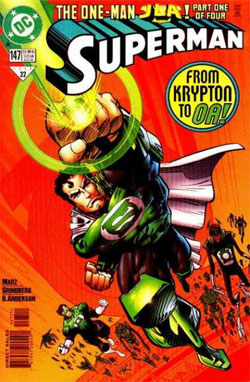 |
| via Superman Homepage |
Superman #155 (DC)
From 2000.
 |
| via DC Wikia |
Superman #156 (DC)
From 2000.
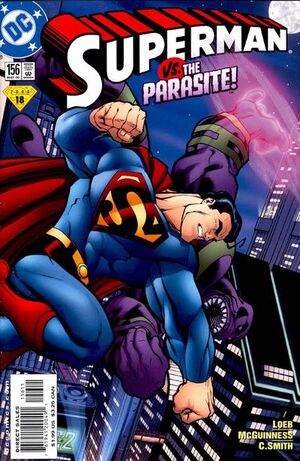 |
| via DC Wikia |
The Adventures of Superman #596 (DC)
From 2001.
This issue shipped the day after 9/11. The debut of the black S-shield and the aftermath of the Our Worlds At War event are one of the coincidences that cropped during that time. Featured is a confrontation between Superman and Flash villain Weather Wizard. Suffice to say but Superman handles this particular Rogue a little more...directly. Also featured is President Luthor, who attempts once again to paint Superman in a bad light, only for an ordinary construction worker to put things into perspective. The artist might seem to be more Ed McGuinness, but it's actually the late, much-lamented Mike Wieringo, known as Ringo to his fans. I loved his work in the pages of The Flash and Robin. Even though he died in 2007, it seems like it's been far longer. He remains greatly missed.
This is one of the stories that addressed Superman's continued relevance directly, as he ends up in a black neighborhood and confronted by a black superhero he's never even heard of, Muhammad X (Jeph Loeb cobbled the name from Muhammad Ali and Malcolm X, as the character himself explains). Although the whole lesson is pretty obvious, I like the unusual perspective the character still manages to bring to the proceedings. It'd be interesting to see him return, if he would feel compromised. Anyway, Lois (their relationship, it seems, didn't end after all, at least at that point) convinces Superman to talk with Steel about his concerns, but he ends up with talking with Steel's niece, Natasha Irons, instead. Stargirl happens to be present as well. "Have you ever heard of 'Muhammad X'?" he asks. "Have you ever heard of Batman?" she responds. She lists a bunch of other black heroes, Rush, Silence, Stoneyard, Underground, none of whom exist outside this issue. Superman later talks to Martian Manhunter (one of the green skins another black man might have referred to in Green Lantern/Green Arrow #76) and references Black Lightning (he's a member of Luthor's cabinet, it might be noted) and Mr. Terrific. Aside from the point the comic is trying to make, it's also interesting to note that Loeb at least is capable of acknowledging that no matter how many heroes DC has running around that readers know about, there are likely many more that they don't, a little of what happens to characters after their series have been cancelled, only it applies to others as well. Muhammad X also represents some of the more violent superheroes DC experimented with, such as those who appeared in Justice League Elite following the appearances of Manchester Black, another character who challenged Superman during this period.
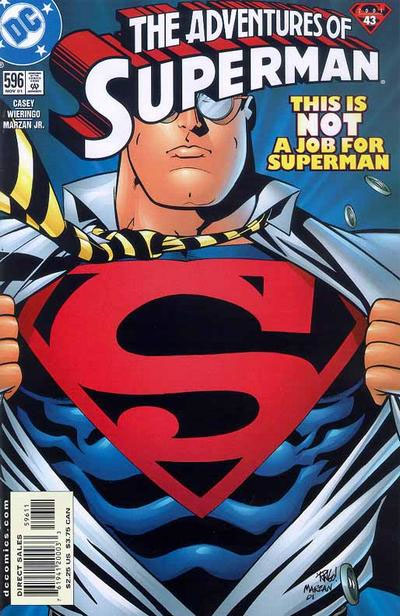 |
| via Recalled Comics |
Superman #179 (DC)
From 2002.
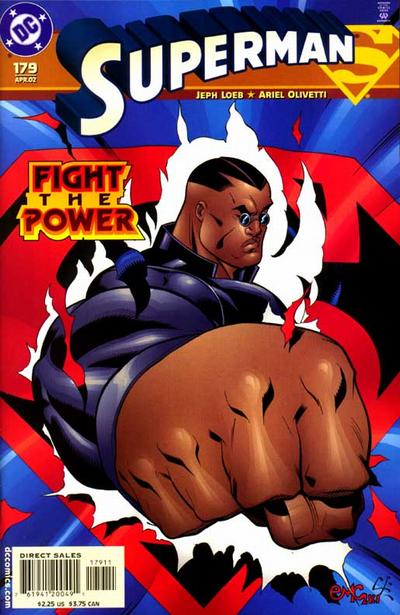 |
| via DC Wikia |
Action Comics #791 (DC)
From 2002.
 |
| via DC Wikia |
Superman #185 (DC)
From 2002.
Here's one of Geoff Johns' earliest Superman stories. The Man of Steel smashes into a softball field (there's a real American image right there!) in the midst of a fight with Major Force (who may forever be associated with the women-in-fridges moment from Green Lantern), one of those real brawls fans always want Superman to have in the movies (uh...until they got it in Man of Steel). Johns seems to use Major Force in much the way Grant Morrison later would classic Superman villain Metallo, as a kind of experiment in what would have happened in the Man of Steel had become a tool of the U.S. military. At the end of the fight, Superman leaves Major Force looking...very much like what happened to Wolverine at the end of Death of Wolverine recently. I don't think any of these kinds of parallels are intentional, but it's certainly interesting to see them happen.
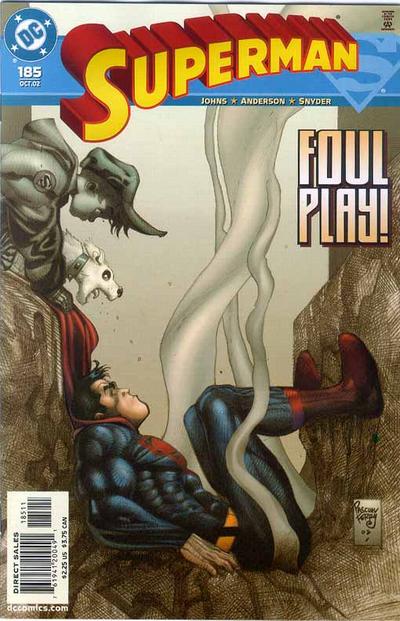 |
| via DC Wikia |
Action Comics Annual #11 (DC)
From 2008.
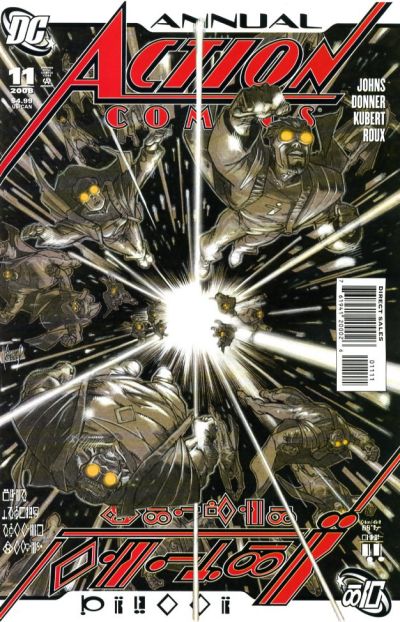 |
| via DC Wikia |
Superman: Birthright #12 (DC)
From 2004.
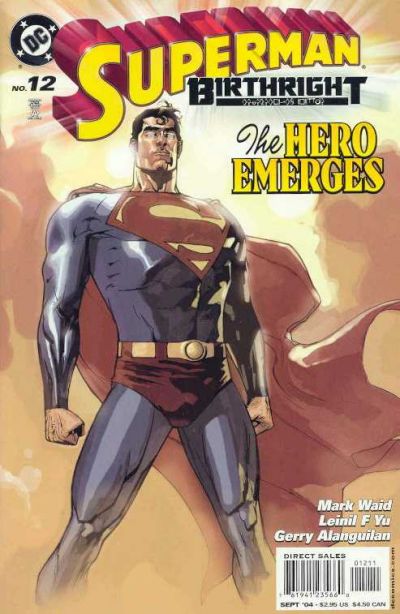 |
| via DC Wikia |
Superman/Shazam: First Thunder #4 (DC)
From 2006.
If you asked the survivors of Fawcett Comics decades ago what they would've thought of a shiny happy Superman/Captain Marvel team-up mini-series...the results would probably not have been suitable for a family-friendly blog. DC put Fawcett out of business when it successfully accused its hugely popular lead character of being a shameless ripoff of Superman (just one of the many legal battles Captain Marvel spawned; there's a whole saga associated with his British counterpart Marvelman, also known as Miracleman, a revival Marvel has only recently made possible after remaining in limbo for two decades). The writer is Judd Winick, who at one time had a massive tide of his own popular acclaim, but gradually lost, well, pretty much all of it, and I guess I still don't quite understand why. I've always liked what I've seen of his work. Actually, I guess I'm not really a Barry Ween fan. Still haven't read Pedro and Me. This comic seems like it's more of the good stuff, perhaps even some of his best stuff. Captain Marvel/Shazam (because Marvel ended up creating an unrelated character named Captain Marvel, an incarnation of which was famously killed off by Jim Starlin in an groundbreaking graphic novel, this Captain Marvel eventually lost the right to be called anything else but Shazam by DC) has had a number of efforts given him at re-establishing his credentials, and like Martian Manhunter, by my estimation, has looked excellent in all of them, but he's lost the popular vote. It's a shame. It's ironic that this particular effort exists at all, because in a weird kind of way, Shazam as interpreted from a Superman perspective totally works...
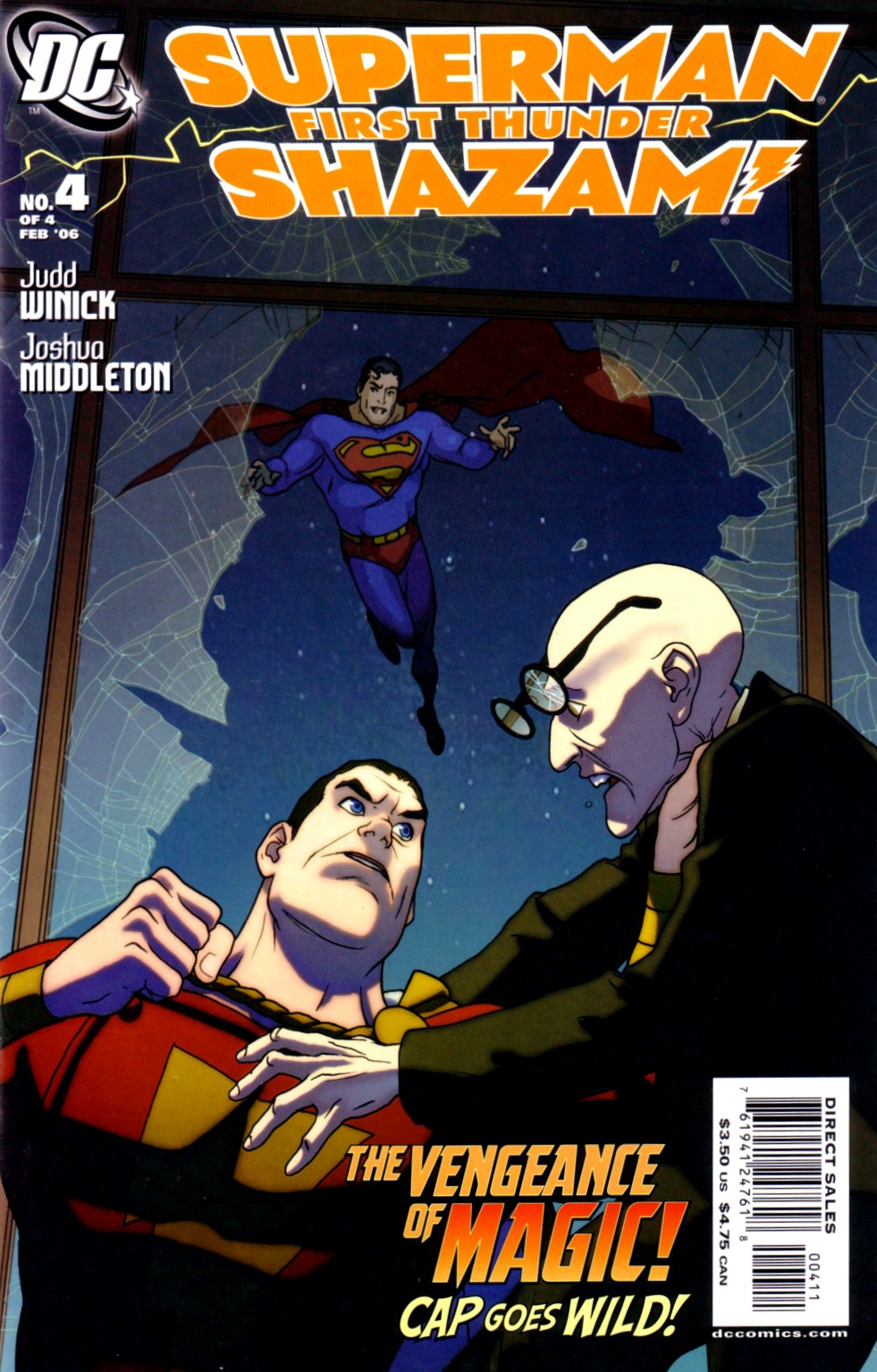 |
| via DC Wikia |
Monday, November 10, 2014
Digitally Speaking...#22 "Greg Rucka, Loeb & Sale, Beast of Wolfe's Bay, Bikini Cowboy, Binary, The Black Well, Blastosaurus, Bob and His Beer, Boobage, Brandi Bare, The Bunker"
Batman: The Ten Cent Adventure (DC)
From 2002.
Yeah, a comic that cost ten cents! This was also the start of the "Bruce Wayne: Murderer?" arc. This lead-off was written by Greg Rucka; the art from Rick Burchett (best known for his Batman: The Animated Series comics) and lettering by Willie Schubert (I know, I never mention the people who work on these things other than the writers and artists, but it's a whole team effort) combined with Rucka's scripting end up with the closest I've ever seen any team match the classic duo of Jeph Loeb and Tim Sale (The Long Halloween). It's Rucka who I've got to spend this time talking about, though. He's one of the four writers responsible for one of my all-time favorite comics, 52, along with Grant Morrison, Geoff Johns and Mark Waid. Of the four I'm least familiar with Rucka's work. At DC he was best known for his Wonder Woman and Gotham Central, which among other things was best known for fleshing out the character of Renee Montoya, who in the pages of 52 would go on to become the new Question while at the same time Batwoman emerged. Suffice to say Rucka's had a vested interest in strong female characters. Ten Cent Adventure features another of those, Sasha Bordeaux, who eventually went on to have a career in Checkmate and an interesting relationship with OMAC. It's Rucka's depiction of Batman as a tragic story that may have deserved a different payoff than the "Murderer?" arc, something other than the Dark Knight Returns future, something bleaker. It'd be nice to see if Rucka could nail such a story if he ever returned to the DC fold. Rucka is also known for creator-owned titles like Queen & Country, Whiteout, Lazarus, and Stumptown.
Batman: Legends of the Dark Knight Special Edition (DC)
From 2014/1993.
Speaking of Loeb and Sale, here's their first Batman collaboration, the first of three Halloween one-shots later collected in Batman: Haunted Knight. It reads a lot more like their brilliantly underrated first collaboration, collected as The Challengers of the Unknown Must Die! but long out of print, than their later work, and a freebie this year hopefully helped remind readers, or make new ones aware, of their considerable legacy.
Well, this was pretty darn brilliant. Well before I reached the background material that acknowledged the graphic novel's origins, including the Kickstarter campaign that helped make it a reality, I'd been thinking this was like the Scream version of monster movies, what I wished the dreadfully overrated Blair Witch Project had actually been like. But as it turns out, Erik Evensen actually started out with the concept of modernizing Beowulf. And in that context, the whole thing may be more fascinating than it first seems. Other than that, this is a Bigfoot story, and in the past I've been a very amateur Bigfoot buff, so I always like to revisit that territory. Evensen pulls double duty as writer and artist, and the remarkable thing is that he not only knows how to tell a story but visualize it as well. The art gets better as the story continues, to the point where it started looking a lot like the excellent Fiona Staples' (Saga). This guy has a bright future, but as far as I'm concerned, he's already given himself a head-start in building a legacy.
Not surprisingly, the best "regular" comic experience of the bunch belongs to a seasoned pro, Joshua Hale Fialkov. For a few years now he's been plying his trade in superhero books, but Hale made his reputation on Elk's Run, and it looks like he's interested in getting back into that vibe. The Bunker is like Lost by way of Robert Sawyer's FlashForward, which not so coincidentally was adapted into one of the many TV series that tried to be Lost. It also reads a lot like Stephen King, actually. A group of friends discover a hatch that leads them to a set of letters addressed individually to each of them. The letters come from the future and don't speak especially well of what's to come. Do they believe the letters? It's fascinating stuff, and instantly becomes some of the best 2014 material I've read. I'll be coming back to this series for sure. It's just a matter of when.
From 2002.
 |
| via comiXology |
Batman: Legends of the Dark Knight Special Edition (DC)
From 2014/1993.
 |
| via View Comic |
The Beast of Wolfe's Bay (Evensen Creative)
From 2013.
 |
| via Wolfe's Bay |
***** (out of five)
Bikini Cowboy Vol. 1 (Fresherluke)
From 2013.
Once in a while you come across something that transcends your normal evaluation of "great." I've read a number of comics from the handy pack comiXology put together that I've really liked, including the above Beast of Wolfe's Bay and the Archeologists of Shadows series. But Bikini Cowboy is better than all of them. If this were a movie, I'd be ranking it alongside similar discoveries like The Fall and The Assassination of Jesse James by the Coward Robert Ford. In my Goodreads review I referenced Quentin Tarantino's Django Unchained as a similarly Weest-shattering experience, and called Bikini Cowboy a modern Peter Pan. It's phenomenal. It's astonishing. And it sneaks up on you. At first it seems as close to absurd as you can get. Girls did not wear bikinis back then. They just didn't. But the longer L. Frank Weber spins his tale, the more it works. The artwork is similar to Sean Murphy, and the story itself is comparable to Murphy's own breakthrough work Punk Rock Jesus. And this is only the first volume? I want to read more. Holy a-cow, Batman!
Based on Chris Hinz's own book Liege Killer, this graphic novel reads like the Philip K. Dick genre but needed a lot more streamlining to have a real impact. The art of Jon Proctor is similar to Tony Harris (Ex Machina), so that kept it visually appealing. Interesting concepts, anyway.
A little too convenient in how it all plays out, and it reads like a student's effort for a classroom writing assignment, but it works, generally, and at least for me, it's a unique comics experience. There's one point where it even takes advantage of the digital format, which is all too rare even today, more than a decade after Scott McCloud gave a lecture in my own school days about the possibilities of the form. I'd encourage a little more of that the next time the Stringfields collaborate.
Bikini Cowboy Vol. 1 (Fresherluke)
From 2013.
 |
| via comiXology |
*****
Binary (ilfeld comix)
From 2013.
 |
| via Amazon |
***
The Black Well
From 2012.
A graphic novel that features the style of underground comix but is generally easier to read, even if Jamie Tanner leaves his story somewhat open-ended. The Black Well might be described as a cross between The Island of Dr. Moreau and Kafka's Metamorphosis. It's pretty interesting.
 |
| via Lulu |
****
Blastosaurus #1 (Square Planet)
From 2014.
I...guess this is kind of the dinosaur version of Terminator. Not terrible. It is terribly imaginative, but all I can really say beyond that is that it's not really for me.
From 2014.
 |
| via All Comic |
***
Bob and His Beer
From 2012.
 |
| via Comic Vine |
****
Boobage (Lipstick Kiss Press)
From 2013.
Literary-style, you know, the kind of comic book and/or graphic novel that usually gets all the mainstream love and/or awards; more graphic novella than novel, basically a one-shot, because it's about as long as a standard issue; all that being said it's a pretty good, enlightening read on the insecurities of a small-chested woman, her perspective growing up. The only problem is that it doesn't really nail the landing. Is this an excerpt, then, for something Gallagher will later release? She's talented either way.
****
Brandi Bare
From 2014.
It's not really bad, per say, but the book remains open, as it were, if Joe Pekar is doing this comic for reasons other than the cheesecake factor. There are plenty of cheesecake comics out there, and most of them disguise their intentions by doing genre work of some extraction.
From 2013.
 |
| via Comic Vine |
****
Brandi Bare
From 2014.
 |
| via comiXology |
***
The Bunker #1 (Oni)
From 2014.
 |
| via Rhymes with Geek |
*****
Sunday, September 14, 2014
Reading Comics #134 "Bull Moose Bargains II"
The second (possibly of two) batch of comics I got for fifty cents each at my friendly neighborhood Bull Moose:
Justice League #26 (DC)
I used to have an excellent track record with this series. I'd like to think I used to be one of its biggest fans (a statement not to be misunderstood as meaning I decided at some point I don't love it anymore). But I lost track last year and have had a hard time getting back into it. The whole Forever Evil event was something I failed to follow monthly, and so I skipped the majority of it. Unfortunately that meant skipping out on a lot of Justice League, too, because throughout the event this series was directly tied into it. So I've slowly started making my way back in. This issue features an origin story for Power Ring, which allowed Geoff Johns to write an alternate version of the classic Green Lantern origin. Obviously he had great fun with it. Obviously it made me wish all over again that he was still writing Green Lantern. The other most interesting element of the issue, for me, was the page dedicated to Deathstorm, who of course is the evil version of Firestorm. This made me nostalgic for the great Stuart Moore Firestorm comics. Anyway, a lot of fans had a hard time with Forever Evil. I still don't get that.
The Mysterious Strangers #4 (Oni)
A while back I wondered whatever would become of Chris Roberson, who was part of a flood of writers who fled DC over creative rights issues. Well, here he is again. I have to admit, he impressed me here, turned the Beatles into accidental harbingers of a near-apocalypse, based on their Maharishi period (John Lennon receives the brunt of the blame). The Strangers who help prevent it are a little less distinctive than that, but it was certainly interesting to read another comic based on classic 60s rock (after the Hawkeye issue that spun off from the Smile! project that was such an issue between Brian Wilson and the rest of the Beach Boys).
Nova #5 (Marvel)
You may recall how much I loved the first issue of this series, and how disappointed I was that subsequent issues didn't seem to catch the same vibe (and how I love Starlight so much in part because it does). The cover to this issue
strongly suggests that Jeph Loeb, before he abruptly left the series, actually did what I'd hope he would, and return to the emotional crux of Sam Alexander's quest to reconnect with his father. But it's basically a case of bait-and-switch, alas. There's a stronger link to Nova's appearance in the Original Sin prelude. I suppose there's nothing wrong with the series if it doesn't have what I want to see from it. You can enjoy it for other reasons. But for me, if it doesn't feature what for me is clearly it best material, then I personally have no reason to read it. And besides, Loeb left. I don't see a point in sampling it again. Feel free to give me a heads-up if any of that changes in the future, if you haven't given up on it like I have.
Justice League #26 (DC)
I used to have an excellent track record with this series. I'd like to think I used to be one of its biggest fans (a statement not to be misunderstood as meaning I decided at some point I don't love it anymore). But I lost track last year and have had a hard time getting back into it. The whole Forever Evil event was something I failed to follow monthly, and so I skipped the majority of it. Unfortunately that meant skipping out on a lot of Justice League, too, because throughout the event this series was directly tied into it. So I've slowly started making my way back in. This issue features an origin story for Power Ring, which allowed Geoff Johns to write an alternate version of the classic Green Lantern origin. Obviously he had great fun with it. Obviously it made me wish all over again that he was still writing Green Lantern. The other most interesting element of the issue, for me, was the page dedicated to Deathstorm, who of course is the evil version of Firestorm. This made me nostalgic for the great Stuart Moore Firestorm comics. Anyway, a lot of fans had a hard time with Forever Evil. I still don't get that.
The Mysterious Strangers #4 (Oni)
A while back I wondered whatever would become of Chris Roberson, who was part of a flood of writers who fled DC over creative rights issues. Well, here he is again. I have to admit, he impressed me here, turned the Beatles into accidental harbingers of a near-apocalypse, based on their Maharishi period (John Lennon receives the brunt of the blame). The Strangers who help prevent it are a little less distinctive than that, but it was certainly interesting to read another comic based on classic 60s rock (after the Hawkeye issue that spun off from the Smile! project that was such an issue between Brian Wilson and the rest of the Beach Boys).
Nova #5 (Marvel)
You may recall how much I loved the first issue of this series, and how disappointed I was that subsequent issues didn't seem to catch the same vibe (and how I love Starlight so much in part because it does). The cover to this issue
 |
| via IGN |
Steam Wars #2 (Antarctic)
I caught the first issue back on Free Comic Book Day and was surprised to find that I loved it a great deal. So when the opportunity came around to read another one, I figured I might as well, right? As the title may or may not imply to you, Steam Wars is Star Wars as steampunk. It's from Fred Perry, who otherwise is better known for his long-running Gold Digger. Alas, once again I am quasi-disappointed. It's not particularly that the second issue is worse than the first, but I guess, for me, much more so than with Nova, the magic simply wore off. But we'll always have FCBD!
The Unwritten #51 (Vertigo)
This was a series that perhaps was impossibly high-concept when it debuted. Mike Carey envisioned Harry Potter as if Harry Potter himself were a real boy whose life inspired his author to create a fictional version of him. The author disappears and Tom Taylor (our Harry; it strikes me as funny that DC later acquired the services of a writer named Tom Taylor, current writer of Earth 2) has to put up both with his celebrity status and the apparently very real magical life his father left behind. As I said, almost impossibly high-concept. When it launched I was hugely intrigued, but I wasn't sure Carey pulled it off, or I simply didn't stick around near long enough to find out if he had. It's a series I definitely want to revisit in the trades at some point. And it's also a series that came to an end last year without my realizing it, right around the time of a tie-in arc with the more popular Fables. Kind of an inglorious end, being told in no uncertain terms you're not as success as that, so we'll bring that in to make the point clear, and then we'll cancel you. It does seem as if Tom became Harry pretty literally by the end. I guess I want to see how that happened. As convoluted as my relationship with Unwritten was, I'm sad to have seen it go so relatively early. Vertigo already had a Harry Potter kind of comic years ago, before Harry even existed, in Neil Gaiman and subsequent writers' Books of Magic. Because I'm obliged to reference either Geoff Johns or Grant Morrison as often as possible, I'd love to see Morrison do an out-and-out magic series. The dude did make himself known as a practitioner of chaos magic at one point...
Wonder Woman #22 (DC)
Clearly these bargain comics were/have been a great way for me to catch up with some series and/or creators I've been meaning to revisit. Some of them have been ones that in other circumstances I would probably have been reading religiously. This is one of those series. I've been impressed with the level of quality Brian Azzarello and Cliff Chiang have brought to Wonder Woman, not the least for the apparent fact that this is much harder than it seems. When Orion and/or the rest of the New Gods was brought into the mix, I was beyond intrigued, so it's nice to finally read some of that material. This is one of those developments that seems like it should have happened a long time ago. Maybe it's because Jack Kirby created his Fourth World with Superman in mind that someone didn't think of it sooner (although for some reason Darkseid long ago made the jump to Legion of Super-Heroes lore with the "Great Darkness Saga," while this much more logical conclusion remained ignored). Anyway, half the reason Orion joined the narrative was as a way to link the series with the rest of DC proper, which was always the one stumbling block. As great as Azzarello's run has been, it's also been isolated. Orion serves as a romantic possibility, and therefore default rival for Superman, which became a thing last year and then became a whole series (Orion/Big Barda Superman/Wonder Woman). Wonder Woman as a result also boasted the distinction of getting a jump on the New 52 version of the New Gods, which is fast expanding this year (Batman and Robin, Green Lantern, Infinity Man and the Forever People). I skipped out initially because I didn't particularly want to see just Orion hanging around. I wanted to see the whole line-up. Rest assured, they're here this issue.
X-O Manowar #13 (Valiant)
This is the series that won Robert Venditti the right to write Green Lantern. I've meant to sample it ever since I learned he'd be succeeding Geoff Johns (a very tall order, one he's sometimes seemed up to) in that regard. X-O is one of those heroes who keeps getting revived in the hopes he'll be a legitimate alternative to the DC/Marvel big leagues. This does not appear to have been the best issue to sample.
Sunday, November 17, 2013
My All-time Favorite Comic Books, 25-21
Every comic book reader worth their salt has a list of their favorite comics, the ones they treasure the most and most recommend to new and fellow readers. Here's mine:
#25. Spider-Man Reign
 Creators: Kaare Andrews
Publication dates: 2007
Issues: 1-4
This is my personal favorite version of The Dark Knight Returns, one of the most famous Batman stories ever told. Marvel was a little slow to respond to it, but along with the excellent Wolverine story arc "Old Man Logan," it was easily Spider-Man Reign that finally rose to the challenge. Where Reign trumps DKR is its ability to capture the essential message of the lead character in a way that goes backward and forward. In the future, Peter Parker is an old man who once more dons his costume to battle an insidious plot to enslave all of New York City. It's the quintessential "pathetic loner" Spider-Man story, told evocatively and sparsely, featuring most of the familiar supporting cast although each of them in surprising ways. When you picture Spider-Man you usually have the wise-cracker in mind, but far more deep to the core is a guy who has never fit in and never quite got over that feeling of exclusion. That's what this story is all about, how the story ends for one of the greatest heroes ever.
#24. Mister X

Creators: Dean Motter
Publication dates: 1984-present
Issues: 1-14, Brides of Mister X, Condemned, Eviction, Hard Candy
One of the greatest comic book characters I've ever read isn't a superhero, but rather Dean Motter's archetypal retro-futurist creation, the reclusive Mister X, originally published by Vortex Comics but by increasing demand finally staging a comeback at Dark Horse with new graphic novel releases every few years. Along with Motter has been a number of other creators who have helped shape one of the most breathtaking artistic achievements in comics history, comparable to Will Eisner's more famous Spirit, creating an impact that's still only beginning to be felt.
#23. Peter Tomasi and Patrick Gleason's Batman and Robin

Creators: Peter J. Tomasi, Patrick Gleason
Publication dates: 2011-present
Issues: Batman and Robin Vol. 1 20-22, Vol. 2 0-present
I've been increasingly impressed with this dynamic duo, who first came together for Green Lantern Corps and were later again paired together in the pages of Brightest Day. Yet it's in Batman and Robin where Tomasi and Gleason have truly peaked (so far), creating a book that's almost a companion to contemporary Batman lore, offering the best commentaries on current storylines while also immersing themselves in the private lives of Bruce Wayne and his son Damian. Key issues include #0 (Damian's origin) and 23 (a perfect eulogy to Damian's death). Bucking every expectation, this has the potential to climb much higher. Or Tomasi and Gleason can somehow top themselves in a different collaboration entirely.
#22. Allan Heinberg and Jim Cheung's Young Avengers

Creators: Allan Heinberg, Jim Cheung
Publication dates: 2005-2012
Issues: 1-12, Avengers: The Children's Crusade 1-9
To my mind still the most perfect of the monthly depictions of the Marvel universe, even if it lasted for one year and then years later for a reprise about as long. Heinberg took the Infinity Inc. formula of looking at how the next generation of famous archetypes would perform (a thing Marvel had tried before in things like M2 and 2099) and perfected it, with an entire bumper crop of characters with the same angst as the '60s boom generation and all the room to explore and grow as their story continued. Children's Crusade remains inexplicably underrated, even though it was the sequel to House of M years in the making and completely unexpected, as well as a natural sequel to Heinberg and Cheung's original run.
#21. Jeph Loeb and Tim Sale's Challengers of the Unknown

Creators: Jeph Loeb, Tim Sale
Publication dates: 1991
Issues: 1-8
Later collected under the title Challengers of the Unknown Must Die!, this is Loeb and Sale's earliest and to my mind best collaboration, a complete deconstruction of the superhero narrative in a way Watchmen could only dream, literary and therefore mostly untouchable to anyone expecting traditional material. And the fact that it features a group of undiscovered icons makes it all the better.
(All covers via Comic Book Database.)
#25. Spider-Man Reign

Publication dates: 2007
Issues: 1-4
This is my personal favorite version of The Dark Knight Returns, one of the most famous Batman stories ever told. Marvel was a little slow to respond to it, but along with the excellent Wolverine story arc "Old Man Logan," it was easily Spider-Man Reign that finally rose to the challenge. Where Reign trumps DKR is its ability to capture the essential message of the lead character in a way that goes backward and forward. In the future, Peter Parker is an old man who once more dons his costume to battle an insidious plot to enslave all of New York City. It's the quintessential "pathetic loner" Spider-Man story, told evocatively and sparsely, featuring most of the familiar supporting cast although each of them in surprising ways. When you picture Spider-Man you usually have the wise-cracker in mind, but far more deep to the core is a guy who has never fit in and never quite got over that feeling of exclusion. That's what this story is all about, how the story ends for one of the greatest heroes ever.
#24. Mister X

Creators: Dean Motter
Publication dates: 1984-present
Issues: 1-14, Brides of Mister X, Condemned, Eviction, Hard Candy
One of the greatest comic book characters I've ever read isn't a superhero, but rather Dean Motter's archetypal retro-futurist creation, the reclusive Mister X, originally published by Vortex Comics but by increasing demand finally staging a comeback at Dark Horse with new graphic novel releases every few years. Along with Motter has been a number of other creators who have helped shape one of the most breathtaking artistic achievements in comics history, comparable to Will Eisner's more famous Spirit, creating an impact that's still only beginning to be felt.
#23. Peter Tomasi and Patrick Gleason's Batman and Robin

Creators: Peter J. Tomasi, Patrick Gleason
Publication dates: 2011-present
Issues: Batman and Robin Vol. 1 20-22, Vol. 2 0-present
I've been increasingly impressed with this dynamic duo, who first came together for Green Lantern Corps and were later again paired together in the pages of Brightest Day. Yet it's in Batman and Robin where Tomasi and Gleason have truly peaked (so far), creating a book that's almost a companion to contemporary Batman lore, offering the best commentaries on current storylines while also immersing themselves in the private lives of Bruce Wayne and his son Damian. Key issues include #0 (Damian's origin) and 23 (a perfect eulogy to Damian's death). Bucking every expectation, this has the potential to climb much higher. Or Tomasi and Gleason can somehow top themselves in a different collaboration entirely.
#22. Allan Heinberg and Jim Cheung's Young Avengers

Creators: Allan Heinberg, Jim Cheung
Publication dates: 2005-2012
Issues: 1-12, Avengers: The Children's Crusade 1-9
To my mind still the most perfect of the monthly depictions of the Marvel universe, even if it lasted for one year and then years later for a reprise about as long. Heinberg took the Infinity Inc. formula of looking at how the next generation of famous archetypes would perform (a thing Marvel had tried before in things like M2 and 2099) and perfected it, with an entire bumper crop of characters with the same angst as the '60s boom generation and all the room to explore and grow as their story continued. Children's Crusade remains inexplicably underrated, even though it was the sequel to House of M years in the making and completely unexpected, as well as a natural sequel to Heinberg and Cheung's original run.
#21. Jeph Loeb and Tim Sale's Challengers of the Unknown

Creators: Jeph Loeb, Tim Sale
Publication dates: 1991
Issues: 1-8
Later collected under the title Challengers of the Unknown Must Die!, this is Loeb and Sale's earliest and to my mind best collaboration, a complete deconstruction of the superhero narrative in a way Watchmen could only dream, literary and therefore mostly untouchable to anyone expecting traditional material. And the fact that it features a group of undiscovered icons makes it all the better.
(All covers via Comic Book Database.)
Subscribe to:
Posts (Atom)