Showing posts with label Red Lanterns. Show all posts

Monday, April 13, 2015

Red Lanterns #40 (DC)

writer: Landry Q. Walker

artist: J. Calafiore

At times in this final issue, Landry Walker seems to be taking some serious digs at his predecessor, Charles Soule.  Pretty bold, Mr. Walker.

The funny thing is, he still comes to the same conclusion.  The only way to extricate Guy Gardner from being a Red Lantern is with hope.  In Red Lanterns: Futures End, Soule envisioned Guy as becoming a Blue Lantern.  Walker has Guy spend this issue talking with his sister, who thinks Guy's attitude about what Atrocitus tried to do to Earth, and Guy's belief that he alone can or needs to make things right, is complete nonsense.  She calls him on it numerous times.

Like I said, Walker suggesting perhaps in a very subtle way that, at the very least, some of the ways Green Lantern comics in general have been written over the years might not be very, well, subtle.

He also spends pages on end allowing J. Calafiore to draw big blazing images of angry, angry Guy trying very hard to make things right, stooped in anguish the likes of which, well, only Atrocitus had previously exhibited, early in the series when everyone wondered what the whole point of a Red Lanterns comic could possibly be.  Why wonder about the torment of monsters?  Walker's concluding thought is that rage isn't the be-all some people can make it out to be.

Which, again, is him basically refuting the whole concept.  I don't know whether to congratulate Walker or offer condolence.

Once again I have to say how much I admire Calafiore's remaining with the series, a point of continuity that's incredibly rare when another creator has suddenly departed.  It's more common for both headlining acts to vacate the premises, and for the new artist to fail miserably in helping smooth the transition.  Walker gets away with as much as he does in part because Calafiore creates the illusion of continuity.  If you didn't know someone else was writing, you wouldn't notice.  This is a testament to the writer, the artist, and probably the editor, too.

Monday, March 2, 2015

Quick Hits February 2015

Batman and Robin #39 (DC)
Still trying to adjust to the impending status change to Gleason's solo Robin, Son of Batman.  But this was a fun, and far less emotionally heavy issue from the waning days of the Tomasi era.  Damian and Billy Batson.  Need.  To.  Have.  Their own.  Series.

Django/Zorro #4 (Dynamite) 
Wagner has slowly brought Django into the narrative.  Now we're seeing how he fits in to Zorro's grand Arizona adventure.

G.I. Joe: Snake Eyes, Agent of Cobra #2 (IDW) 
Well, now Costa ain't even pretending this is not a direct continuation of his previous Cobra saga.  This is a good thing.

Justice League #39 (DC) 
A rather abrupt end to "The Amazo Virus."  Ever since Citizen Cold, I've been thinking Leonard Snart could easily use a bigger spotlight.  This issue continues that.

Ms. Marvel #12 (Marvel) 
The Loki issue.  Honestly, I've started cooling on this series.

The Multiversity: Mastermen (DC) 
Morrison and Lee keep the Multiversity in high gear.

Red Lanterns #39 (DC) 
Walker is slightly less impressive in his second issue, but is still on-point.

Thor Annual #1 (Marvel) 
CM Punk's story is hilarious, and hilariously aided by Chew artist Rob Guillory.  It's also surprising to see a Raphael Albuquerque cover on a Marvel comic.
And an older issue:

Justice League #23.4 (DC) 
Featuring a direct Forever Evil tie-in and another Flashpoint link-of-sorts.

Monday, February 2, 2015

Reading Comics #150 "Red Lanterns"

via DC Comics
Charles Soule is now all but done with DC.

...Sorry, got a little emotional there.  The transition within the pages of Red Lanterns, one of his signature runs, turns out to be better than I could have imagined.

His final issue, Red Lanterns #37, is also a "Godhead" tie-in, but Soule doesn't let that get in the way (much).  A lot of writers like to comment directly on their departures.  Based on his theoretical continuation of the tradition, and keep in mind I haven't looked directly into this, but Soule seems to make comments to the effect that DC done him wrong, in a manner of speaking, and so that's why he signed the exclusive with Marvel.  He wouldn't be the first one to make such claims, but it's certainly sucks, because he's another writer I would've loved to see help build the future of the company.  His work is frequently sensational, and his grasp of continuity, and how to push it forward, is exceptional.

"People being petty, and bitter, and refusing to give something unless they get something in return.  Broken trust.  People who refuse to see how good they've got it."

That's some caption narration from Guy Gardner.  Then again, it could also suggest that Soule somewhat regrets making that deal with Marvel.  Who knows?  Charles Soule.

But the new writer, Landry Q. Walker, in Red Lanterns #38 turns out to be a pretty good continuation of Soule's run, focusing on Guy's return to Earth and witnessing the lingering effects of the "Atrocities" arc.  He's kind of lost all hope, and so Walker's captain narration is bleak to go along with what Guy experiences, but it reads as immediately relevant to what's come before.  Too often in the past, I've seen replacement writers, especially those coming in at the end of a series (Red Lanterns ends in March; whatever may or may not appear in July, after the two-month Convergence event, is anyone's guess, although I've started to wonder if Guy and John Stewart and Kyle Rayner won't simply receive solo titles) muff it.  But that's not what happens here.

It doesn't hurt to have artist J. Calafiore for continuity between runs.  Calafiore's been dependable for years, and that's all the more welcome to see in Red Lanterns, where he's done excellent work with Guy Gardner, helping to shape a new era for the character, one that grounded Guy far better than the caricature he's sometimes been.  Walker's script even helps provide some context: "You wear a ring long enough, you stop seeing real people.  All you see is costumed nut jobs and super-powered idiots."

Let's hope this ride continues in some form. 

Sunday, December 28, 2014

Red Lanterns #36 (DC)

via DC Comics
writer: Charles Soule
artist: J. Calafiore

From the second month of the Green Lantern "Godhead" crossover event, Charles Soule marches ever closer to the end of his Red Lanterns tenure and helpfully has Guy Gardner explain to Simon Baz everything he's done in the series.

Which is a nice touch.

Although the issue also features one of those awkward continuity moments that are bound to crop up when there are dozens of comics books under multiple editors needing to be juggled on a monthly basis.  Cyborg has been heavily featured in the pages of Batman and Robin recently for a New Gods arc.  And here he is in Red Lanterns for a New Gods arc appearance.  And nary the twain shall meet.

And it's kind of all the more clear that Soule correctly identified Red Lanterns: Futures End as his real last word on the series.

Saturday, December 13, 2014

Reading Comics #139 "November 2014"

Batman and Robin #36 (DC)
via Comic Book Roundup
writer: Peter J. Tomasi
artist: Patrick Gleason

"Robin Rises" continues!  In Part IV, Batman's backup (Red Robin, Batgirl, Red Hood, Titus, and the reluctant Cyborg) has arrived on Apokolips as Batman himself continues to deploy the Hellbat armor to full effect in his rampage through hell as he seeks to reclaim the body of Damian.  I love when Red Hood (Jason Todd) says, "Went a little Red Lantern here, don'tcha think?" as it evokes Tomasi's time in the Green Lantern titles.  It's a full-on action installment of the arc, allowing Gleason ample opportunity to demonstrate how awesome his work is.  The big payoff is on the last page, one of those perfect cliffhangers: standing behind Batman is the shadow of Darkseid himself.  The Dark Knight merely states, "Hrrn.  About time you showed up."  This moment evokes not only the opening arc of the New 52 Justice League reboot, but the dramatic events of Final Crisis.  Tomasi has succeeded in capturing the Batman every geek always knew existed, one who could take on any challenge without sweating it.  December promises big, big things...

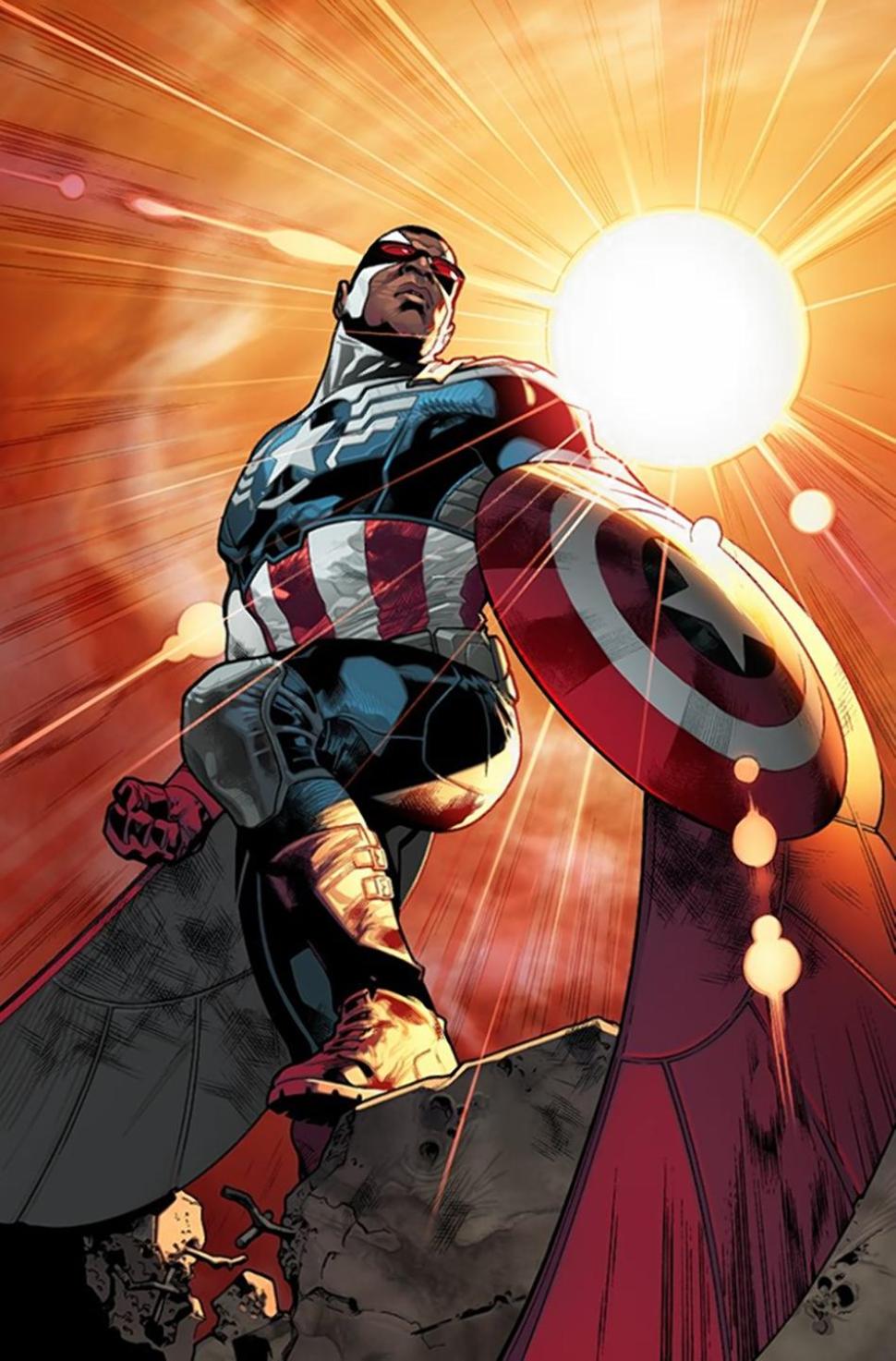
All-New Captain America #1 (Marvel)
via Marvel Wikia
writer: Rick Remender
artist: Stuart Immonen

I had already been intrigued by what Remender had been doing with Captain America, but then Sam Wilson, the Falcon, was announced as inheriting the role, a whole reboot of the series was in order, and Stuart Immonen was tapped as artist.  I last caught Immonen's Marvel work in the pages of Brian Michael Bendis's All-New X-Men, and it was the best work I'd seen from him for the company, a subtle return to the form I'd admired so much in his Superman work.  His All-New Captain America may be the closest yet.  Times have changed since Immonen's Superman, certainly.  Coloring has become a major business, adding whole new dimensions to the art, regardless of the artist.  Sometimes the colorist is actually the most prominent contributor these days (on that score, aiding Immonen and inker Wade von Grawbadger are Marte Gracia and Eduardo Navarro), along with more detailed shading (whether attributed to Immonen or von Grawbadger; shading was usually conspicuously absent from Immone's Superman, which was what helped make it so striking).  Visually a very stunning comic, then.  Story-wise is pretty interesting, too.  The last time Steve Rogers, for one reason or another, was replaced as the Sentinel of Liberty it was by James "Bucky" Barnes, the Winter Soldier, who was billed for all intents and purposes as pretty permanent.  There was a giant hubbub about the updated uniform Alex Ross created for the occasion.  Wilson gets a new uniform, too, that looks a little like a cross between his Falcon garb, the S.H.I.E.L.D. design Rogers for a time ran around in, and of course the traditional Captain America look.  Upstaging Wilson's Cap is the son Remender introduced in his clever Dimension Z story, Ian, who is actually Arnim Zola's kid.  Ian, by the way, has adopted the moniker Nomad, which has become a part of Cap lore ever since Rogers himself used it in one of his earlier exiles from the cowl.  The dynamic between Wilson and Ian is unusual, almost as if Wilson is less Cap than Ian is.  Remender provides a one-page review of Wilson's origins in the likely event readers will not have been familiar with it.  It's a darn good issue regardless of all the altered dynamics.

The Fuse #7 (Image)
via Image Comics
writer: Antony Johnston
artist: Justin Greenwood

I became a devoted fan of Johnston's thanks to his soon-to-conclude opus Wasteland, so to see a couple of new projects launch at Image this year was a nice way to see that others have noticed his talent, too.  In this futuristic cop procedural he's joined by Greenwood, who helped on Wasteland but should better be known for Marc Guggenheim's Resurrection.  This issue begins the "Gridlock" arc, which concerns contestants in a reality show.  While I don't read the series regularly, I like reading the letters column featuring those that do, and their observations of the main characters, who are doubtless easier to keep track of when you don't skip around like I do...

Red Lanterns #35 (DC)
via Darkstar Sci Fi
writer: Charles Soule
artist: J. Calafiore

Here's where I interrupt the proceedings for a moment and complain about the unreliability of the pull list service I've been receiving from my local comics shop.  I don't know why they've had such problems, and maybe they have good reasons, but it's certainly been annoying.  I haven't read the Starlight finale because of this and after a few months I've only now just gotten them to produce an issue of Supreme: Blue Rose for me.  And I read this issue of Red Lanterns late because of the same problems. 

Anyway, enough complaints.  This was part of the first month of the "Godhead" crossover event in the Green Lantern titles, featuring the New Gods as they've targeted the various power rings as the answer to the Life Equation.  When we last saw Guy Gardner he'd just defeated Atrocitus and taken a sabbatical.  We pick up with Guy on vacation with his sometimes beau, Ice (not to be confused with Bea, Ice's sometimes bestie, Fire).  The issue is heavily Red Lanterns-centric, possibly because Soule's days, sadly, are numbered in the series and at DC in general (darn exclusive contract at Marvel!).  New Gods show up, and then Simon Baz does, too.  I'm glad to see Baz, who was Geoff Johns' late addition to Green Lantern lore at the end of his tenure (he remains, though, at DC, obviously).  

Superman #36 (DC)
via IGN
writer: Geoff Johns
artist: John Romita, Jr.

Speaking of Johns, arguably his biggest gig at the moment is in the pages of Superman (I check in over at Justice League more than read it regularly these days, alas, after having missed so much of the last few years).  Ulysses, the latest strange visitor, has finally tipped his hand.  For maybe half the issue things still seem exactly as they have in previous issues of the arc, but then Neil Quinn (Ulysses) visits his parents and begins to reveal what's really going on ("I love you both so much.  That's why you can't come with me."  "I don't understand."  "I didn't know you were still alive!  They didn't tell me you were still alive!  I'm trying to protect you!")  It seems the offer he made to humanity at the end of last issue is the ulterior motive most readers were probably expecting from his first appearance.  And soon Ulysses and Superman are fighting, at last.  Romita is a big-impact kind of artist (he did work on Millar's Kick-Ass after all), and he gets to do a good bit of that here.  Wherever Johns is headed with all of this, it remains expertly paced.

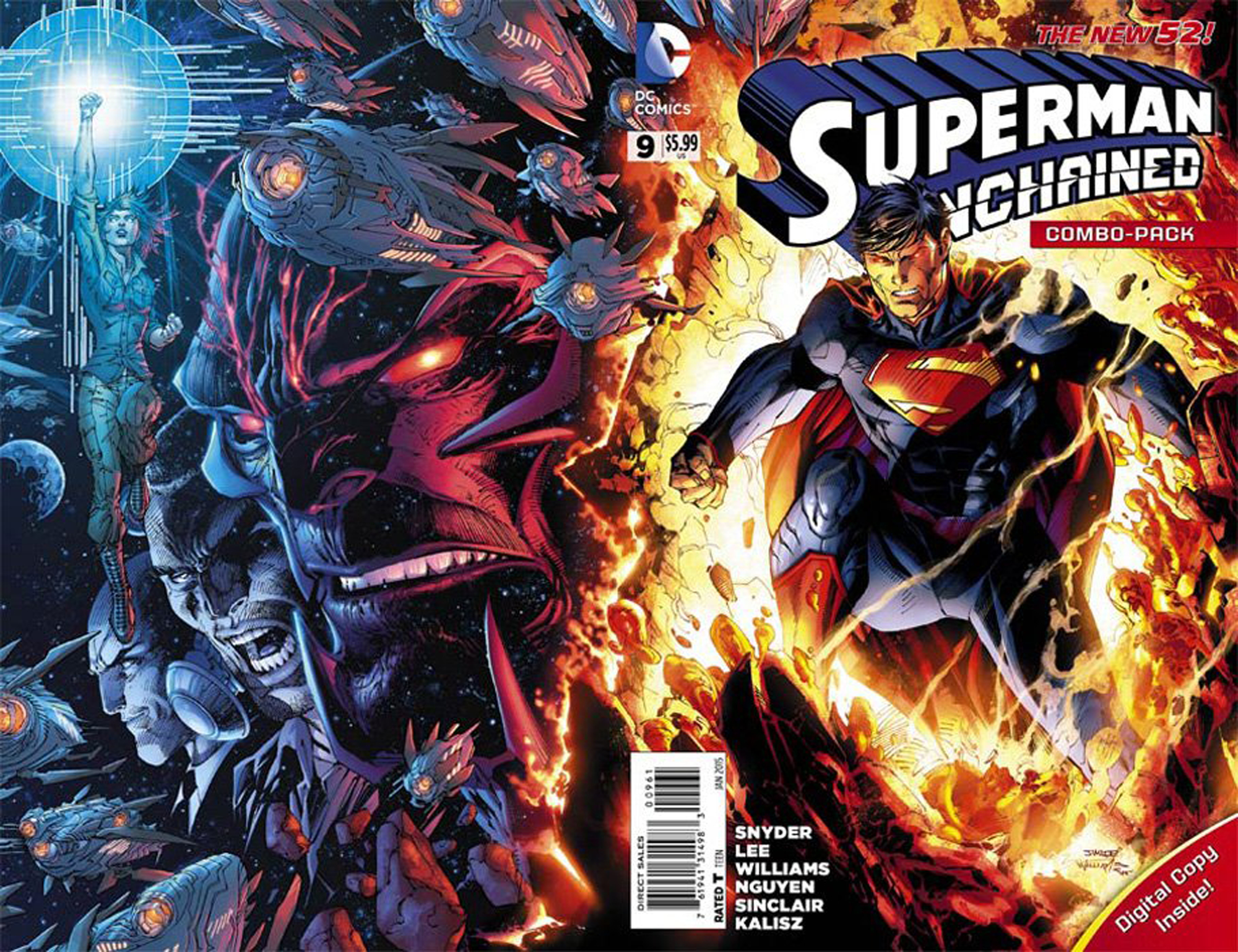
Superman Unchained #9 (DC)
via Previews World
writer: Scott Snyder
artist: Jim Lee

Given my complicated feelings toward Snyder, I was reluctant to check out his big Superman story.  This final issue, however, may have proven my doubts wrong in a fairly major way.  It's not even so much how he handles Superman but rather Lex Luthor.  Here's some prime Luthor dialogue to illustrate:

"You look at him, and you see a light leading the way...But instead he is a light lost in the darkness."
[...]
"What I expected to see, looking backwards through time at his efforts, was, as you said, Ms. Lane: someone who stood for something.  I thought a profile would emerge, the profile of someone sure of himself.  Someone sure he knew what was best for all of us.  But I saw that Superman, whoever he is, is trial and error."
[...]
"The point I'm making is that Superman doesn't stand for anything.  He's just a man, stumbling through life.  He's not a great beacon, he's barely a candle, lighting a path for himself the best he can.  And as we all know, eventually...candles go out."
"I reject him," he goes on to say.  In essence, of course, Luthor is equating Superman with America.  It's the first time I've noticed a particular perspective from Snyder, and it's one I completely recognize, as very similar to my own.  It's a revelation.  Regardless of your own perspective, this is Luthor making the same observation that is supposed to have been made of Superman all along ("...and the American way!"), only from a modern perspective.  It's really quite startling.  Bravo, Mr. Snyder.  Lee's Superman is distinct from the work he did in the early issues of Justice League, which is interesting to note.  

Superman/Wonder Woman #13 (DC)
via IGN
writer: Peter J. Tomasi
artist: Doug Mahnke

Charles Soule's year on the title was capped with a statement on the whole concept readers considered pretty definitive.  What can Tomasi add?  Plenty, as it turns out.  When Wonder Woman showed up in the pages of Batman and Robin, it was one of the rare odd notes in that series.  This is proof that Tomasi more than understands the Amazon Princess.  "You fight with too much on your mind.  Who did you train under?"  "My father," Superman responds.  "Obviously," she says.  Fight scenes are rampant in the series, and the contrasting approaches these lovers take as always been a focal point.  Tomasi leaves room for these observations from Wonder Woman, too [spoken to a civilian]: 

"In my culture this fragility would be your downfall.  Here it's practically a virtue.  I've been doing my best to help some of you since my arrival, but how will you ever grow stronger if you need us every waking moment?"  

Superman has this in way of a response: "This man has internal bleeding and needs immediate help.  You should've done something instead of talking to him."

It's the kind of Wonder Woman that Geoff Johns tried to introduce in the early issues of Justice League, who has recently come to what she calls "man's world" and struggles to fully comprehend it, so that what ends up defining her is the gap that exists between herself and those she is theoretically here to champion.  For Superman, there is no gap, and for Batman, the third member of DC's Trinity, the gap is something he's constantly trying to create with his enemies.  One is human but alien (Wonder Woman), one is alien but human (Superman).  Tomasi is excellent at these kinds of interpersonal observations.  He'd perfect for this series.

Umbral #10 (Image)
via Image Comics
writer: Antony Johnston
artist: Christopher Mitten

Hey, remember when I was giving props to colorists earlier, this is definitely a series that owes a huge debt to its colorist.  Otherwise it's a Wasteland reunion between Johnston and once-and-final artist Mitten.  For anyone, and that would be just about everyone, who struggled to understand the appeal of Wasteland, Umbral is your shot to embrace the fantastic vision of Johnston and Mitten.  Like The Fuse I haven't been reading it regularly, so it's a little tough to completely appreciate the proceedings, and because Umbral is a continuing story it's all the harder.  I think of the two, I can see myself making a commitment to this one next year.  Although I may end up reading both regularly.  We'll see!


Sunday, October 19, 2014

Red Lanterns: Futures End #1 (DC)

writer: Charles Soule
artist: J. Calafiore
via Comic Book Resources
Aside from the brilliant Grayson: Futures End, no other one-shot from the event last month, so far as I know, took the opportunity to explore the parent title's continuity as richly as Red Lanterns.

There was good reason.  Just as the new series Grayson saw a chance to help define a new series, the Red Lanterns effort was one of Charles Soule's final issues and therefore a way to flashforward to an ending that might otherwise never happen.  

When he debuted in the series, Soule brought Guy Gardner along with him, and he used this crucial element to transform Red Lanterns into a focused character study, with the rest of the established characters free to evolve the same way. The greatest beneficiary was Bleez, the demonic-looking lass originally introduced by Geoff Johns in Final Crisis: Rage of the Red Lanterns #1.  (The other way of describing her would be to take Farscape's Scorpius, make him female and add bone wings.)  It's fair to say that Soule helped make her into one of the most fleshed-out characters Johns has created.

Along with Gardner and Bleez there's Rankorr, the human introduced in Red Lanterns as an intended bridge character for readers who might otherwise have been dubious about the series when it originally launched.  It's fair to say that Soule vastly improved him, too.  Eventually an unwitting pawn of Atrocitus, the original star of the series (fans weren't never quite convinced by that one) until the events of the recent "Atrocities" arc finally concluded that arc, it's Rankorr who serves as the the third necessary character to conclude Gardner's journey.

Soule's work has transformed Guy Gardner from a frequently combative hothead to someone who has finally made peace with himself, and therefore been able to function profitably among others.  Anyone who knows the character's history would probably have never seen that coming.  This issue makes a compelling case for Gardner as a Blue Lantern.  He's been a Green Lantern, a Red Lantern, even had Sinestro's yellow ring (someone still has to revisit that in the new Johns context).  Who would've thought that the formerly rage-defined Red Lanterns would've put him on the path to inner peace?

Soule is joined by regular Red Lanterns artist J. Calafiore, another reason to accept this as part of regular series continuity regardless of how Futures End concludes.  Five years into a future that probably won't exist in that form by next year.  Not that you'll care after reading something like this. 

Wednesday, September 17, 2014

Red Lanterns #34 (DC)

writer: Charles Soule
artist: Alessandro Vitti
via DC Comics News
This is the finale of "Atrocities."  Guy Gardner's version of the Red Lanterns versus the Atrocitus (y'know, the founder) version.  I'll let you guess who wins.

Ha!  Na, it's pretty obvious.  I mean, Guy Gardner not winning?  Not gonna happen.  Guy becoming the headlining act of this series is the best thing to happen to it.  I've got to believe that, since the other best thing to happen to it won't be around for much longer.  That would be Charles Soule, the rising superstar who recently signed an exclusive contract with Marvel.  Best wishes to him.  I hope to find a project over at the House as equally stimulating as a fan of Soule as I have here at DC.

If "Atrocities" is technically his grand finale (this month is the Futures End issue, and then three months of the Green Lantern "Godhead" crossover follow and then I don't know how much longer he's around), then it's certainly a big way to bow, clearing house as it were.  And Soule pulls no punches.

Another member of Guy's Lanterns bites the bullet before victory is achieved (moosehead Skallox), leaving Guy himself (who technically leaves the team to spend time on Earth alone by the end of the issue), Bleez (blue chick with bone wings) and Rankorr (the other human enlistee).

The showdown between Guy and Atrocitus is the kind of event you'd expect between Hal Jordan and Sinestro.  In fact, after "Atrocities," I'd be okay with proclaiming Atrocitus to be Guy's Sinestro.  That would make the arc downright historic all the way around.  As far as I'm concerned, Red Lanterns has become a permanent and legitimate part of the Green Lantern legacy, regardless of where it heads from here or how much longer it lasts.  It's a better Guy Gardner series at this point than the long-running one he had in the '90s.

There's also Soule pulling the trigger on the Judge, one of those mysterious observer/teammate figures.  The standout of that type, for me, will always be Bloodwynd, who was introduced during the Dan Jurgens era of Justice League America and subsequently, mistakenly assumed by fans to have been Martian Manhunter all along.  (It didn't help that after Jurgens left Bloodwynd's significance dropped like a rock, and then he virtually vanished for good.  Although hey! there he is in The Multiversity!  Which is ironic, because Grant Morrison viciously dismissed the character in Supergods.)  I wasn't around enough to see how interesting the Judge actually was as a character, but it's nice to see that arc have speedy resolution.

And can I just reiterate that Guy has never looked better design-wise?  When he debuted, he was basically a red-headed version of Hal Jordan.  And then he grew more visually...obnoxious.  We'll leave it at that.  For the first time ever he actually looks cool.  Another plus for the series, surely.

Tuesday, August 26, 2014

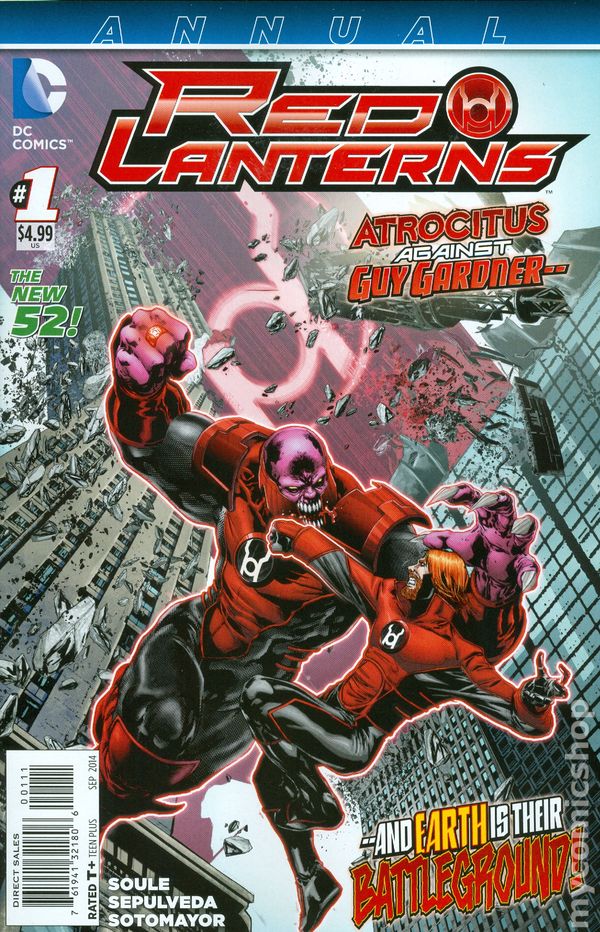
Red Lanterns Annual #1 (DC)

writer: Charles Soule
artist: Miguel Sepulveda
via My Comic Shop

Recently I've really gotten to love Red Lanterns.  With Charles Soule, it's a series firing on all cylinders, as far as I can tell the best of the Green Lantern titles at the moment.  This particular issue, which as you might notice is also it's first annual, happens to be Part 3 of "Atrocities," otherwise known as Guy Gardner and Red Lanterns founder Atrocitus (you can find out his original significance in Green Lantern: Secret Origin), who has been undergoing a personal crisis since the start of the series.  He's finally back in fighting mode and wants to reclaim his rage-fueled corps from Gardner, who recently won jurisdiction of Earth from the Green Lanterns.

Under Gardner, it's no longer necessary to be angry all the time to be a Red Lantern.  The red ring has become a lot more rational and a lot more like a green ring.  Still, Red Lanterns are by definition damaged individuals.  Unlike, say, the Indigo Tribe, these guys have the chance to determine the course of their own future.

Anyway, as I said, Gardner and Atrocitus: mano-e-monstero.

Atrocitus attacks Earth in this issue.  It's a big giant crisis, too, with his cronies attacking key landmarks across the globe.  If Red Lanterns were at a level where it's beginning to belong, this might have been a whole crossover event.  Mass chaos.  Red rings find countless hosts, all of them adding to the disaster.  

Rankorr, the other human Red Lantern, is revealed to have been compromised by Atrocitus under artificial means.  He's another thread for long-time readers.

All told, it's a crucial issue.  I kind of assumed when I saw it that it was the end of the arc, but for some reason there's one more chapter to go.  I guess in this instance the series was given it's first annual as a bonus issue to help draw awareness to the arc.  That said, the issue certainly does its share of heavy lifting for "Atrocities."

Gardner comes across Supergirl, who has recently been a Red Lantern but was able to walk away, and she voluntarily joins the cause again.  It's a nice moment, just one of many that rewards readers who've already discovered the series.  Hopefully more readers will with material like this!

Wednesday, August 13, 2014

Red Lanterns #32 (DC)

writer: Charles Soule
artist: J. Calafiore
via Comic Box Commentary
This was a series I reconnected with thanks to some grab bags I'd been getting.  It's a New 52 launch, one of four Green Lantern titles from that time.  I'd sampled it before but hadn't really been able to get into it despite thinking it was a better idea than fans generally considered it.  It seems time has been kind to Red Lanterns.

It doesn't hurt at all for emerging superstar Charles Soule to have taken the helm.  The scene above features Rankorr, the human recruit who was introduced early in the series as someone who might be more sympathetic for the reader than other members of the rage corps originally led by Atrocitus, who was the first of the Red Lanterns introduced by Geoff Johns.  Atrocitus has been undergoing a crisis since the start.  Recently Guy Gardner revamped the Red Lanterns entirely, making it possible for them to control their rage and thereby retroactively making the red ring more comparable to the more familiar green one.  He's also successfully negotiated control of patrol over Earth from the Green Lanterns.

Oh, and that blonde in the foreground?  It's Supergirl.  That was a whole recent event.  She didn't stay a member for long, but it was certainly an interesting and key development for this version of the character.

This issue begins the four-part "Atrocities" arc that brings the conflict of leadership between Gardner and Atrocitus to a head.  It's a perfect point to recognize how great the series has become.  In fact, it's the only Green Lantern series I'm interested in reading on a regular basis these days.  As a long-time fan of the franchise, I didn't really see that coming.  The thing is, Red Lanterns gets that the franchise is a sci-fi franchise.  I know.  This is kind of weird.  It's also a lot like Guardians of the Galaxy, actually.  One might say that the Red Lanterns themselves, or their Sinestro Corps predecessors, played a huge part in laying the comic book ground for the GotG revival and current movie incarnation success.

Big epic stuff in a totally unexpected corner.  I like that.

Thursday, July 3, 2014

Reading Comics #126 "Bull Moose Grab Bag III"

Ten comics for a steal.  Even when the contents go wrong, you can't go wrong.  These happened to all be bagged and boarded.  Always a plus.  I used to do that with all my comics.  Became less of a priority after the first break in reading at the start of the millennium, and then I sold that collection, and sold the next one.  What're you gonna do?

Uncanny Avengers #16 (Marvel)
Here's Rick Remender again, our new friend from the pages of Captain America, apparently in the thick of some gigantic crisis that will likely have been rebooted, given all the characters who are killed off during it.  The big threat constitutes the Apocalypse Twins (this series is part of the X-Men/Avengers mash-up that has persisted since the end of, well, AvX, so the referenced Apocalypse is the one and same Apocalypse you may or may not have recognized as teased at the end of X-Men: Days of the Future Past).  This story kind of wraps up next issue, but carries over into the next storyline.  Well, whatever.  The big development in this particular installment involves Thor and Captain America being all climactic, in typical Avengers fashion.  The artist is Steve McNiven, whom I remember most fondly from the "Old Man Logan" arc in Wolverine.  Good reliable talent right there, makes this looks sufficiently impressive.  As usual, I don't really understand what Remender is up to.  Like Jonathan Hickman, Remender for me is what Grant Morrison seems to be for a lot of other readers.

Batwing #28 (DC)
For a while, Batwing was the African representative of Batman Incorporated.  I enjoyed what I read of that from the start of the New 52 era.  Recently the armor has gone to Lucius Fox's son.  Based on this issue I don't see this as an improvement.  Writers Justin Gray and Jimmy Palmiotti have plenty of good credentials behind them (various Jonah Hex and Uncle Sam & the Freedom Fighters comics chief among them), but they're felled by the typical trap of trying to fake their way through the stereotype urban scene (ready to write Milestone adventures they are not).

The Flash #27 (DC)
At one time I read The Flash regularly without exception, thanks in large part to the remarkable Mark Waid run that began a little over twenty years ago.  I haven't really done much of that lately, not really at all since the New 52 launch, perhaps out of disappointment that Geoff Johns cut short his second run with the latest relaunch.  This issue, from recently departed (co-)writer Brian Buccellato, who along with Francis Manapul has shifted over to Detective Comics, is actually pretty good, mixing Rogues with history, playing with the revised Barry Allen story of having the death of his mother hanging over him thanks in part to fact that her murder was pinned on his father (made for truly excellent material in Flashpoint).  I still have to wonder if this increasingly revolving game of musical chairs will lead to resolution on that.  Or simply hope Johns will return to the thread he left behind...

Forever Evil: A.R.G.U.S. #4 of 6 (DC)
I remember Martin Gray over at Too Dangerous for a Girl calling this perhaps the best part of the Forever Evil crossover event.  A.R.G.U.S. is the we're-not-S.H.I.E.L.D.? group from DC (which is funny, because Checkmate is a perfectly viable and distinctive alternative).  The main draw for me is the presence of Steve Trevor, who in a previous incarnation was the, ah, Lois Lane to Wonder Woman's Superman.  Since the New 52, he's best been defined by his inability to retain that relationship, and thus his efforts to find a surrogate.  I thought he'd found it in Justice League of America, but things might've changed when I wasn't looking.  Another sometimes-supporting cast member for Wonder Woman, Etta Candy, is present in the issue.  Wonder Woman herself isn't in the issue (mostly), but curiously she is on the cover, and her frequent enemy Cheetah shows up both on the cover and on the last page (it's actually artist Neil Edwards' weakest moment the whole issue, besides mouthless Psi).  One has the sense that the whole point of the mini-series was to further establish the Wonder Woman brand in the New 52.  This is overall a good thing.

Green Lantern #28/Red Lanterns #28 (DC)
via Hit Fix

via Green Lantern Wikia
This is another another comic I was glad to have gotten randomly in one of these grab bags, especially based on my increased appreciation for Red Lanterns from other grab bags.  This was the flip book saga featuring the debut of Supergirl as a Red Lantern.  This is a saga that completely capitalizes on the New 52 version of Supergirl, who isn't the well-known superhero she was in previous incarnations.  In fact, no one knows who she is when she pops up as a Red Lantern.  They in fact think she is just a random Red Lantern.  This occurs in the midst of other things that've been developing in the Green Lantern franchise, likely by the lead of Robert Venditti, who was given the unenviable task of following Geoff Johns in that regard (unless people were just looking for a fresh start, which Green Lantern itself didn't really get at the start of the New 52).  One of his ideas has been to restrict the use of all those rings floating around, with the idea that unrestricted usage drains the universe of essential energy.  Something like that.  Star Trek: The Next Generation toyed with that idea concerning warp drives.  Venditti also seems to have reconfigured a few semi-familiar faces from days past, including Evil Star (totally reinvented and it seems quite interestingly), Kanjar Ro, and Bolphunga the Unrelenting (famously debuted in the same Alan Moore as Mogo, "Mogo Doesn't Socialize").  Each time I sample Venditti's Green Lantern I like it.  Certainly the same goes for Red Lanterns these days.  The writer on the flipside is Charles Soule, who's always impressing me.  The man running the Red Lanterns in the comics is Guy Gardner, who is actually less of a hothead than ever before.  He's also got Ice by his side once again (more fond memories from two decades ago), although it's as contentious a relationship as ever.  (By the way, Guy looks awesome these days.  About the first time ever that can be said.)  The main thrust of the flip book actually has far more to do with Green and Red Lanterns not getting along (but for different reasons than before, more like a professional rivalry these days).  When they realize this mysterious girl is Kryptonian, they of course realize she has something to do with Superman.  If you're not reading either (or I guess any of these, including Supergirl), this would be a good sampling occasion.

The Superior Spider-Man #26 (Marvel)
I recently talked a little bit about how the Doctor Spider-Man era ended, but on its way to that ending there was (seemingly as always) Green Goblin to deal with.  But in this particular issue Goblin is dealing with the Hobgoblin, trying to figure out who's behind the latest incarnation.  He thinks he knows.  He's wrong.  There are a number of stories in the issue with a number of artists drawing them.  One is Peter Parker inside the so-called mindscape figuring out how he'll find his way back.  Another is the Avengers finally rejecting Doctor Spider-Man (I won't explain that again).  The final is the Goblin/Hobgoblin one, which amounts to the most significant one (it does rate the cover), and feature the work of Humberto Ramos.  I was a huge fan of Ramos for years thanks in large part to, ah, his collaboration with Mark Waid (I just can't avoid mentioning that guy!) on Impulse.  I'm glad he's remained relevant, and that he's become one of Dan Slott's chief collaborators on whatever version of Spider-Man he's writing.  His Goblins are fantastic.  Who knew?  Plays completely against type (as far as I knew), but it's a huge reason why that's the best thing about this issue.

Superman #27 (DC)
One of the major developments of the New 52 was the sudden end of the romance between Lois & Clark.  (Guess she didn't want to become a desperate housewife.  Ha!)  But thankfully, Lois Lane has stuck around.  And even gained powers.  But I guess with this issue she lost them, which as far as current logic goes is a good thing.  Superman risks a giant gamble in allowing Parasite to siphon them from her.  Scott Lobdell is at the helm.  Apparently his run wasn't very popular.  I still have no idea why fans find him so hard to love.  (But, ah, the next issue promises Starfire.  There you go.)

Swamp Thing #28 (DC)
Swamp Thing, with about a decade lead time, was a poster child for the early Vertigo, thanks to Alan Moore's psychological approach.  In the New 52 the character has returned to his own mythology, which Charles Soule goes about exploring in this issue.  The character of Capucine, featured and named on the cover, is fascinating, a long-lived woman with an incredible story all her own.  This is good stuff.  Another series I've never really thought to buy deliberately, but am infinitely glad each time I've found it in a grab bag.

Talon #15 (DC)
A spin-off from Scott Snyder's Batman...not hugely compelling a concept on its own.

Teen Titans #27 (DC)
Remember Impulse, which I mentioned earlier.  That was Bart Allen's earliest incarnation.  Geoff Johns turned him into Kid Flash.  And the New 52, thanks to Scott Lobdell and a new backstory, or I guess forestory, is a freedom fighter from the future.  I've long been interested in reading some of this for myself, and I think it's pretty interesting.  The only curious element is the strange looks Kid Flash keeps giving people, as if he really is the villain fans have been interpreting this new version of the character to have suddenly become.  One of Lobdell's original Titans, Solstice, has her story explained in the issue, too, while the Superboy situation is explore, too.  (From what I've read about it, I think that's pretty interesting, too.)  Besides all that, I also found it interesting that Scott McDaniel provided breakdowns.  I found this particular image to make that most obvious:
via Up Roxx
If you know McDaniel's work at all, you can see it most clearly in the shoulder.  He's another talent I wish would get a better break these days.  He's long been a favorite of mine (how long? twenty years of course!).  The last significant work he's done was the short-lived Static Shock at the start of the New 52, which to say it was received poorly would be an understatement.  This is unfortunate, since McDaniel started out that one as both artist and writer (his first real effort in that regard), which was a statement of confidence from DC.  I don't know what's happened, but it certainly seems like he lost it, apparently in both regards.  I wish him luck digging his way back to where he belongs.

Monday, May 5, 2014

Reading Comics #122 "Bull Moose Grab Bag"

I love grab bags.  One of the shops I frequent these days, which is actually an indy music/movie chain store that also has comic books, is Bull Moose in Lewiston, Maine.  I've gotten a few grab bags from them over the last few months, and during the course of my reviews of the stuff I've been reading lately you might have seen some fairly negative ones.  Since I've cut back on my spending, I've been reading far fewer comics than I used to, only the stuff that I'm really certain I'll appreciate, so that's the secret origin of that.  Bull Moose grab bags are a great bargain (since it's highly unlikely that there will be a lot of Lewiston, Maine, natives in my reading audience, this does not count as a shameless plug), ten recent comics for five bucks.  "Recent" means within the past year, usually within the last few months (although the one I got this Saturday must have been one of the older bags they had, because its contents were near a year old).

So at this point I've decided to bring back the roundup feature I sometimes fall back on here.  When there's something I haven't really enjoyed I don't have to try and justify it too much.  But there can be real gems in the bunch as well!

Cable and X-Force #18 (Marvel)
Cable and Bishop are time-traveling mutants who are fascinating in theory but are more often than not incapable of living up to their potential, possibly because writers aren't really thinking about what they can do but rather what they can't, which is explore the dystopias they come from.  Bishop has had a much rougher path to follow than Cable (notice which one is in the title, and has had a lot of series over the years and which...hasn't), although he's been a favorite of mine since I first saw him in the old early '90s X-Men cartoon.  (Hey, and speaking of which, is either one of these guys in X-Men: Days of the Future Past?)  They've got the same curse every Marvel mutant has, actually, only amplified.  Everyone knows that the X-Men are supposed to be a persecuted lot, but the logical gymnastics writers take to keep them that way, or ignore this concept entirely, can sometimes be ridiculous.  Recently they've settled on making more Magneto characters, which is to say compromised figures trying to do the right thing but making all the wrong moves (read: Cyclops).  Add Bishop to that bunch, unfortunately.  And so that's what this issue is all about.  Apparently someone also thought it was a good idea to have not one but two teams of X-Force running around (because you can never have too many competing concepts in Marvel), and so that's also what this comic's about.  It's not very good, alas.  And the art looks a little weird at points.  It screws up Cable, for instance.  (Since when was his metallic arm a covering for an actual arm?  Who am I kidding?  I don't care!)  Long story short: this is not a comic book I would have read deliberately.

Earth 2 #19 (DC)
I kept trying to find the recent annual that basically mainlined the awesome Flashpoint concept from a few years back of Thomas Wayne becoming Batman instead of his son, but failed everywhere I looked (even though I do digital comics now and am clearly aware of the Internet, I still love operating in the physical world), so it was pretty awesome to randomly come across an issue of the regular series.  This series, in case you're not aware, is set in one of DC's alternate realities.  It was launched by James Robinson as a surrogate Justice Society landscape but set in the same context as the debut arc from Geoff Johns' Justice League, so that the Darkseid siege of Earth was more successful and so everyone had to figure out how to pick up the pieces.  At the start the new versions of the classic JSA superheroes were occupying a landscape devoid of the more familiar DC icons because those guys had been eliminated.  But recently they've been resurfacing, including the new Batman.  I think it's evolved beautifully, and under the auspices of Tom Taylor remains a leading contender for a mainstream superhero comic that you could pick as your standalone experience should you want to know what that's like without having to worry about picking up any other series.  And this is a good issue.  Like I've said about Justice League all along, Earth 2 could easily be construed as an ongoing event book.  Closing in on two years, that's not a bad thing to consider reading at all.  At the moment, Batman and the altered version of Superman have been occupying the center stage, coming ever closing to a reckoning.  Well, like I said, good stuff.

Infinity #6 (Marvel)
This was last year's big Marvel event, sort of like something-something Thanos, something-something Inhumans (because Marvel keeps trying to make them a thing just like DC keeps trying to make the New Gods a thing, and only one of them actually has something interesting to explore) (and it's not Marvel).  This was Jonathan Hickman's effort to duplicate the classic Jim Starlin stories featuring Thanos, no doubt thanks to the large-chin villain's cameo at the end of Avengers (although he won't appear as a main character until the third movie) (probably).  I've always admired Hickman's ambition, but I'm not sure he's quite what Marvel keeps hoping he'll be, which is their own Grant Morrison.  He's better than other writers who've tried to handle Thanos recently, but the result is still a fairly poor echo of Starlin's material.  Still, the art is from Jim Cheung, who was half of the iconic original team on Young Avengers (along with Allan Heinberg).  Good strong stuff there, anyway, as always.  Glad to see him still considered a significant player.

Marvel Previews #14 (Marvel)
This is Marvel's separate catalog to the industry-standard, Diamond distributor version that handles...everyone else.  I don't really know why this ended up in the grab bag.  But it didn't exactly convince me to think any differently about Marvel's current output than I have been.  On the cover is Nightcrawler, the latest returned-from-the-dead character.  Oh, which reminds me, in case you had no idea, Nightcrawler's been dead lately.  But apparently he got better.

Red Lanterns #25 (DC)
I haven't really been following the Green Lantern franchise, other than Geoff Johns, since the New 52 relaunch in 2011, but it's been nice knowing it exists, and in such force.  One of the odder additions to the lineup was a Red Lanterns series, but it seems the longer it's lasted the better it's gotten.  With Charles Soule, always good news, writing it these days, and Guy Gardner having become the face, it's probably as good or better than anything else you'll find in the lineup.  Guy has repositioned the remaining members of the corps into defenders of his home turf, not so much on Earth but the territory (Space Sector 2814, to be precise).  Soule has particular fun with Guy's allies, while he also continues the saga of Atrocitus, who once ruled the roost.  It's as good a sci-fi title as I've read, which is actually pretty rare for a Green Lantern series.  Which is pretty odd when you think about it.

The Sandman: Overture Special Edition #1 (Vertigo)
So, clearly I'm kind of the target audience for this series.  I'm not sure how many new readers will be coming aboard for the journey, except maybe Neil Gaiman fans who came about after the end of the original series when he'd begun making a name for himself as a prose writer.  The casual comics reader probably won't be spending too much time in the Vertigo sandbox, because with Image and a thousand indies running around, there's a lot more competition for the nonsuperhero set than ever before.  As someone who loves Gaiman's Sandman but who hasn't read the complete series, I'm a curious phenomenon (for a lot of other reasons, too).  I caught the original version of this debut issue of Overture, but was glad to randomly catch the special edition as well.  It helped me digest it a little more, not just the bonus features, but being forced to read the comic itself over again.  The Corinthian (the creepy dude with two additional mouths where his eyes ought to be) is in the spotlight once again, but only until our title hero stumbles into an existential conundrum that is not anywhere near finished by the end of the issue.  Gaiman's approach is serialized in this effort, rather than in some of the fairly self-contained stories he told even in his arcs from the original Sandman.  There's plenty to find familiar and interesting here.  It certainly helps to have an artist the caliber of J.H. Williams III (there are few others capable of being anywhere near as awesome), whose sense of the page is virtually unparalleled, which as host of the special edition he's capable of walking through with the reader.  If you're unsure of Overture, these special editions may actually be your better bet.

Sonic Universe #58 (Archie)
I'm just going to skip over this one.  Better for you.  Better for me.  Better for them.

Swamp Thing #27 (DC)
There's whole corners of the New 52 landscape that have nothing to do with Superman or Batman or Green Lantern.  No, really!  One of them involves the so-called "dark" characters who most recently were handled by Vertigo rather than DC.  Their return has been one of the most interesting things about the relauch (I know, if you hear much about it I bet you much more regularly hear all the complaints about what was lost rather than gained).  I confess to not having really taken advantage of this stuff.  But it's good.  It's probably some of the best stuff DC has.  But even fans who know about this corner find reasons to complain, especially since there have been a lot of crossovers.  I don't see the problem with crossovers.  If it's a shared universe, it's a lot more useful, sometimes, to have an out-and-out crossover rather than have a guest-star.  Crossovers, when done right, have a good way of establishing context, and as far as I can tell, books like Swamp Thing have definitely understood that.  Unsurprisingly, the writer here is also Charles Soule.  The dude has quickly become indispensable.  Where the heck did he come from???  A lot of what this particular character means comes from Alan Moore work from thirty years ago.  This run, and even this very issue, is a chance for a fresh start.  Good stuff.

Walking Dead #119 (Image)
(Comic Book Datebase locked me out of the issue listing without a login, so no cover for you.)
Obviously you know about Walking Dead.  Whether from the comic or the TV series or both.  Rather than discuss anything specifically from the issue, I want to address the letters column.  In it, creator/writer Robert Kirkman discusses the future of the comic, how long he envisions it to last.  A couple years ago he was talking a total length of 300 issues.  And keep in mind we're only a third of the way there.  But apparently now he's thinking 500.  And he's already got fans talking about him padding his storytelling.  Because of the huge success of the TV show, Kirkman could keep this thing going as long as he wants, long after the show is over.  The one doesn't depend on the other.  It just sounds ridiculous to me.  No writer has five hundred issues worth of material to tell about one story.  It's just this dude realizing he's got it made.  No matter what else happens, he'll always have this in his back pocket.  Now, there are certainly creators in any medium who spend their whole careers on the same property.  In comics that's certainly been the case.  But other than Dave Sim (who by the way did accomplish 300 issues, over the course of thirty years, on his Cerebus), there hasn't really been anyone who has managed to make such a dedicated run (it's worth noting Sim was his own artist).  Kirkman probably ought to stop prognosticating.  If fans are already complaining about his output now, he may have very few fans indeed decades from now who care about the latest shenanigans of survivors stumbling from scenario to scenario.  Just saying.

Savage Wolverine #14 (Marvel)
Like Walking Dead above, I'm not really going to talk about the issue or the capable talents of Richard Isanove, but rather some of the ridiculous recent habits of Marvel.  On the cover, as you can see, there's a giant #1 in the corner, even though this is not the first issue or some reboot (of a reboot of a reboot of a reboot...over the span of...just a handful of years).  Marvel has always prided itself as never having rebooted its line.  The stories you read today are theoretically related to stories that were done decades ago.  And yet, there've been so many shenanigans that it doesn't really matter anymore.  It's just one successful gimmick to keep fans interested after another.  Such as the equally ridiculous Marvel Now! branding that is clearly Marvel's lackluster answer to DC's New 52.  The cover also has the copy #14.now, which means...absolutely nothing.  It's just one stupid, we're accessible! argument after another.  I think in a few years Marvel will have finally worn out its welcome at the top.  Hopefully.  Well, I wish...

All images via Comic Book Database.

Sunday, June 17, 2012

Unbeatable Comics: Green Lantern

Green Lantern #10
writer: Geoff Johns
artist: Doug Mahnke

Green Lantern Corps #9
writer: Peter J. Tomasi
artist: Fernando Pasarin

Green Lantern: New Guardians #8
writer: Tony Bedard
artist: Tyler Kirkham

Red Lanterns #7
writer: Peter Milligan
artist: Ed Benes & Diego Bernard

The Green Lantern franchise may be a big question mark on the big screen, but in the comics, it's hard to think of a better era.

The latest issue of Green Lantern from Geoff Johns concludes the Indigo Tribe arc, in which we've finally discovered the origins and intentions of the mysterious compassion corps.  (In related news, I beg DC, beg, for an extended look at the life and career of Abin Sur, Hal Jordan's predecessor and originator of the Indigo Tribe, a theoretical answer to the Guadians of the Universe's plans for a Third Army.)

The Indigo Tribe lost its central power battery thanks to Natromo, the native of Nok who helped Abin Sur realize his vision, but its members prove more worthy of the cause than he realized, resparking their own rings with their faith and need for redemption.  The only ones who are able to walk away from the cause are Sinestro and William Hand, who inadvertently kills himself, only to be once again claimed by the black rings of death.  It's Hal Jordan who fights for Sinestro's future, because he's discovered his old foe just may be the greatest ally he ever had.

I haven't read a single issue of the other books in the expanded franchise of the New 52 since their September launches, part of my effort to save money I don't technically have.  I decided it was time to check in, and I discovered that they're doing better than I would've thought.

Pete Tomasi, for instance, so good in Batman and Robin, continues to be a worthy chronicler in  for emerald warriors in Green Lantern Corps.  In this issue, for instance, he helps me understand something I've been going through in my own life as John Stewart faces the consequences of owning up to responsibility, even when those who are to be his judges aren't likely to look after his, or their, best interests. having murdered a member of the Corps, he's once again in hot water.  It's not the first time his actions have resulted in jeopardy for his career as a Green Lantern, or a superhero.  In Cosmic Odyssey, he was responsible for the destruction of the planet Xanshi (where the character Fatality, once a villain and now a Star Sapphire and not to mention featured player in New Guardians, comes from).  He considers his actions justified because the murdered colleague would have betrayed the integrity of the Corps.  Guy Gardner, the most famous hothead in comics, is John's main advocate.  The Guardians don't want to interfere, since their plans no longer concern a Corps, but an impending Third Army.

In New Guardians, meanwhile, Tony Bedard continues his own fruitful contributions to the franchise, playing in the expanded sandbox of the spectrum created by Geoff Johns.  In Green Lantern, Johns did away with the Sinestro Corps.  In New Guardians, Bedard gets to explore what happens to its remaining members, including Arkillo, who gets help from the Weaponer whose story Bedard himself previously explored in shaping a new ring and new battery to continue the legacy of the Yellow Lanterns.

Pete Milligan, meanwhile, is still working at Red Lanterns, including the first human to become a member, Jack Moore; as well as Atrocitus, the founder of the brood, who is currently seeking vengeance on Krona, the rogue Guardian, but instead running into the undead revenge of his own son; and Bleez, the new leader of the Red Lanterns who also co-stars in New Guardians.  Another crossover this issue is Guy Gardner, who once wore a red ring, trying to process the significance of Jack Moore, who is himself trying to figure out what his new life means.  For anyone who struggles to see the need for a series based on anger, this may be the issue to read.

I found quite a lot to like about this family.