Yes, it would be safe to assume that these particular comics were, in fact, bought in a literal quarter bin.
Sandman #39 (Vertigo)
From July 1992.
This is the last issue in the Annotated Sandman Vol. 2 so at some point in the next year, hopefully, I'll be reading and talking about it again. (And just as hopefully, I will eventually collect and read the third and forth volumes in this version of the series.) It features Marco Polo in a dream sequence (naturally), the young boy version of the famous explorer, so we get a peak at his less-publicized origins traveling with his dad. Also present, G.K. Chesterton, naturally. This is a classic example of what made Sandman so great, how Neil Gaiman could do just about anything he wanted and it made perfect thematic sense. This is the epitome of comic book storytelling.
Shattered Image #1 (Image)
From August 1996.
This Image version of the superhero crossover event is a hot mess, even though it's written by some fairly well-established and well-respected creators, Kurt Busiek and Barbara Kesel. I can only imagine they felt pressured to present the Image version, which at that time, still only a handful of years after the company's infamous founding, was still infused with the arrogance of attempting to ignore everything that made superhero comics great, and just try and be cool and hope (as it was for a while) that was good enough. Still, it's interesting to remember that Tony Daniel made his name in this period, and that he's probably the creator whose work evolved the most, and most positively, in the past twenty years. Busiek has been doing Astro City all this time, and it's been increasingly less relevant ever since, which is not to say anything about the quality, but that it's a shame that of the major superheroes created at Image in those early years who're still operating, that one big attempt at true respectability has become so easy to ignore. Then again, maybe it's because he is still working at it. After Marvels, Busiek became known for his interest in defining the tradition of the superhero. I wonder if anyone still believes he's interested in that.
Shockrockets #6 (Gorilla)
From October 2000.
Speaking of Busiek, Shockrockets was kind of his take on the Rogue Squadron pilots from Star Wars, but set in near-future Earth. For me, it was always more notable as one of Stuart Immonen's first big projects post-Superman. Between this and his early Legion of Super-Heroes, his later Star Wars, and his current Empress, Immonen may have established himself as a go-to sci-fi artist, which I find pretty interesting, because yeah, I still think of him for his '90s Superman. Which Immonen obliquely references in Gorilla promotional material from the issue: "My ideas, drawings, and designs are not only met with approval but I feel valued and appreciated as a person!" I have to admit, the end of his Superman run had DC take him off art (by that time he'd become a writer/artist, which he's never again been) but also had Mark Millar punch up his scripts by providing dialogue. And then he was somewhat obviously asked to move aside so that a new generation could take over, or otherwise made the decision himself. Which is sad, because I still think he's never gotten the respect he deserves for his Superman work. Also included is a preview of Busiek and Immonen's Superstar graphic novel, which was actually pretty great.
Skrull Kill Krew #2, 5 (Marvel)
From October 1995, January 1996.
This was a Grant Morrison project I'd long wanted to see, as it was one of his earliest Marvel projects. Teamed up with then-frequent collaborator Mark Millar, I found the concept to be kind of a Marvel version of Morrison's Invisibles, his first widely-known creation. The second issue features a heavy Pulp Fiction vibe, in which the character of Ryder closely matches up with Samuel L. Jackson's Jules in his speech patterns (no epic biblical quote, alas, at least not in this issue). I wonder if that's how people really viewed Pulp Fiction, in the guise of the character Jules (which wouldn't be a terrible thing, but it isolates the experience far too much), or how they viewed United Kingdom creators, the punk Vertigo impression that took years to shake and was in part inspired, naturally, by Morrison's Invisibles. (Clearly Gaiman's Sandman didn't have punk so much as Goth in mind, while spiritual predecessor Alan Moore had horror as his guiding Swamp Thing principle.) Morrison eventually distanced himself, for the most part, from this style, somewhat dramatically in his major superhero debut with JLA nearly a year later, but I wonder if Millar kept it in mind longer. Certainly, he became enamored with the concept of the mini-series, a style he works in almost exclusively these days.
Showing posts with label Sandman. Show all posts
Showing posts with label Sandman. Show all posts
Wednesday, June 22, 2016


Thursday, May 12, 2016
Quarter Bin 76 "Automatic Kafka, and other stuff"
A lot of comics bought from an actual quarter bin. Don't say it never happens...
Automatic Kafka #2 (WildStorm)
From October 2002.
Joe Casey was one of the big names in comic at that time, but then he split off with a couple of his fellow luminaries to form Man of Action, which produced hit concepts like Ben 10 and Big Hero 6. But before he left, he left a splash, with stuff like Automatic Kafka. Chances are if he hadn't left, Kafka would have a lasting memory. Like a lot of Casey and WildStorm's efforts from that time, it was a post-millennial superhero deconstruction project, although today it looks like a precursor to Matt Kindt's MIND MGMT, which to my mind is a very good thing. So it was certainly a pleasure to read some of it, and I certainly wouldn't mind reading more. It was certainly the most pleasant discovery of this particular lot, although there was plenty of other good stuff, such as:
Batman: Futures End #1 (DC)
From November 2014.
The Futures End specials were such a rich creative opportunity, and I love checking out what the more adventurous ones attempted. This one wasn't an attempt, it was Scott Snyder, with Ray Fawkes scripting, revisiting his fascinating vision of the future Batman, so obsessed with his mission that he sets up a series of clones who will continue it indefinitely. It was easily Snyder's richest Batman concept, and one seen otherwise only sparingly, from a short story in the pages of the anniversary Detective Comics #27. I didn't read this special when it was originally released, because I didn't imagine that Snyder would revisit the concept, and fan reactions at the time didn't catch on to the significance of the issue, but I eventually read it digitally, and so now I've got a physical copy as well. This is the origin of the clone initiative, an older Batman who defies the odds and breaks into Lex Luthor's secret lab to get what he needs for it. I'd love if Snyder eventually returned again to the concept, but a small collection of these two stories wouldn't be out of order, either, so fans know they exist...
Bone Holiday Special (Hero)
From 1993.
This was something of an unbelievable find, a Hero magazine special from the early days of Jeff Smith's Bone. In it is an exclusive story, plus an interview (Smith comes off as less than impressive, alas), and reprints of early strips predating Bone, back when it was called Thorn. Bone is an endlessly charming memory, one of my all-time favorite comics, and Smith has proven to be an enduring talent as well, with RASL and Tuki (an ongoing project) also under his belt by this point.
Cerebus #201 (Aardvark-Vanaheim)
From December 1995.
Dave Sim is such a unique character in comics lore. He was a virtual god of the indy press at his prime, but since Cerebus ended fans have tended to reflect more on his alleged shortcomings than on what he accomplished. This issue begins the "Guys" arc, and seems to feature parodies of George Harrison and Ringo Starr (and virtually incomprehensible dialogue to match their accents). I have no idea how representative it is of Cerebus as a whole, but it was certainly unique reading. Sim includes an origin of Cerebus (and the name of its publisher, Aardvark-Vanaheim) in an essay, so that was pretty lucky for a guy who's not usually lucky enough to find an issue...
Chosen #2 (Dark Horse)
One of Mark Millar's formative projects (he's since retitled it American Jesus, and plans on further volumes) features a boy who may or may not be the reincarnation of Jesus Christ. It's actually pretty interesting.
Empire #3 (DC)
From November 2003.
Mark Waid was my favorite '90s comic book writer. Eventually, he started to try and figure out how he was going to follow up all the stuff he'd accomplished in that decade, and everything he's done since has been a continuation of that. Empire was his first shot at what the kind of superhero storytelling he later developed in his Irredeemable comics. The concept was, What if the bad guy wins? This issue features the superhero who the villain only wants the world to think died. I don't know, maybe my lackluster opinion of Waid in the last few decades colors my impression of Empire, but it's hard to see now why fans were so wild about it. But they've consistently been wild about a lot of minor work from Waid. I should know. I knew his work when it was great...
Green Lantern: Mosaic #6 (DC)
From November 1992.
1992 was from the era I last saw bargain packs all over the place, and how I first discovered Green Lantern: Mosaic. This was, as I know understand it, the Vertigo version of Green Lantern. Gerard Jones ruled the whole Green Lantern landscape at that time, and it was surprisingly expansive landscape at that time. Mosaic was the big gamble. I guess I couldn't really appreciate how big a gamble it was until I read its letters column. The first issue of the series was the first issue I read, and for decades remains the only issue. But I loved that issue. Eventually, I caught another issue, and then even the arc from Green Lantern where it originated. Turns out, fans really didn't know what to make of it, and Jones didn't go out of his way to make it any easier. I mean, this was a Vertigo title. And it seriously needs to be rediscovered. It's pretty much the Green Lantern version of Grant Morrison's Animal Man. And this is how you make John Stewart relevant.
Haven: The Broken City #9 (DC)
From October 2002.
A couple of upstart creators were given a shot at creating something new at DC. This was a time of pretty wild experimentation at DC, and so it was as good a time to let upstart creators try their thing as any. The result is better than its complete lack of impact indicates. I caught the first issue from the same quarter bin a little while back, so it only seemed appropriate that I caught the last issue, too. Bookending the series were two specials featuring the Justice League. I don't really know what happened, why the upstarts vanished and the whole thing forgotten. But it didn't really deserve that fate.
Hawkeye #3 (Marvel)
From December 2012.
But then again, the much better established Matt Fraction couldn't help this series make a bigger impact...
Infinite Vacation #5 (Image)
Back when I thought I was going to continue to be a big fan of Nick Spencer, I caught the first issue of this one, and so reading the last one seemed like it would finally be appropriate. In hindsight Infinite Vacation may be remembered, if anything, for helping launch Image's continuing obsession with really bold coloring. This is the era of colorists, folks.
Infinity Man and the Forever People: Futures End #1 (DC)
From November 2014.
This Futures End special is pretty good, too, and is the first time I actually read this New Gods series. I think its only shortcoming is that it...really doesn't seem all that relevant a New Gods concept. But it's still a good read!
Justice League Europe #36 (DC)
From March 1992.
Gerard Jones again, this time helping smooth the transition from the Giffen/DeMatteis era to the Jurgens era, as he dismantles the old Bwa-Ha-Ha League (a lot of the members in this issue join Jurgens' Justice League America).
The Mice Templar: Volume IV - Legend #3 (Image)
From June 2013.
I was such a fan of Mice Templar, but I kind of got...tired of it after a while. The black and white art doesn't help, because it's hard to distinguish characters, especially since they're all rodents. But it was such an ambitious concept, and eventually ran for, I think, forty-two issues across five mini-series. This is actually a pretty good issue, and the new essay writer explains the history of anthropomorphic storytelling, which is kind of handy. So it was a good random issue to help revisit the concept. Plus, the Salmon of Knowledge!
Moon Knight #16 (Marvel)
From August 2015.
Predictably, Cullen Bunn features the least imaginative version of Marvel's project to make Moon Knight its second most interesting character (actual storytelling results may vary), after Deadpool. Although I hear Jeff Lemire is doing some truly killer work with the concept at the moment...
Promethea #22 (ABC)
From November 2002.
Alan Moore is the comics genius (so proclaimed by at least one whole generation of fans) I consider more lackluster than not. Promethea was his project with future superstar J.H. Williams III, who later collaborated with Neil Gaiman on a new Sandman. Speaking of which, this issue reads like a lackluster, Alan Moore version of Sandman. And speaking of which...
Sandman #63 (Vertigo)
I've been trying to catch up with Gaiman's seminal comics saga for a while (as evidenced by my annotations of The Annotated Sandman, a project that will continue at some point). This issue is from late in the series and, more specifically, "The Kindly Ones." It is not, however, particularly an issue to hold against counterfeit Alan Moore Sandman. It's a pretty busy issue, and certainly better than Moore's effort, but not an easy issue to laud among the greater Gaiman material available...
Smax #3 (ABC)
From December 2003.
"ABC," by the way, stands for "America's Best Comics." Which these really aren't. They were pretty popular at the time, and Alan Moore's last real stab at popular work (League of Extraordinary Gentlemen came from this era), and the funny thing is, they were all variations on stuff he originally did for Rob Liefeld. It makes sense somehow. Anyway, if Moore weren't so completely obsessed with sex, he might do better work. That's my theory, anyway...
Superman/Wonder Woman Annual #2 (DC)
From February 2016.
This is pretty much how the romance ends. It's kind of sad.
The New Titans #66 (DC)
From May 1990.
The cover of this later issue from the seminal Wolfman/Perez collaboration features Raven...not making out with Dick Grayson. It only looks that way. Raven's meddling in Dick's love life would come a little later in Wolfman's run (a development that's routinely overlooked by fans, by the way). It's worth noting that George Perez is not on art duties this issue, but rather co-scripting (the beginning, perhaps, of his writing career). The art, rather, comes from the formative pen of Tom Grummett, whose style is somewhat evident in this early work. If memory serves me right, he's also drawing when Wolfman has Raven crash Dick's would-be nuptials with Starfire...
The Legend of Will Power #1, 2 (Primal Paper)
From March, August 2011.
A local comics creator produced these comics (it's always worth sampling the native talent, which includes Drew Moss, who was in the store sketching once, and complaining about his publisher complaining about him...). This isn't Moss, however, but Vince White, and the reason I picked up these issues was because I had the suspicion there might be some Green Lantern in these pages. But the utter lack of connection between the superhero and his name (which is actually his real name) shows the disconnect between White's ambitions and his actual talent. He's a better artist. He needed a co-writer. Live and learn?
Automatic Kafka #2 (WildStorm)
From October 2002.
Joe Casey was one of the big names in comic at that time, but then he split off with a couple of his fellow luminaries to form Man of Action, which produced hit concepts like Ben 10 and Big Hero 6. But before he left, he left a splash, with stuff like Automatic Kafka. Chances are if he hadn't left, Kafka would have a lasting memory. Like a lot of Casey and WildStorm's efforts from that time, it was a post-millennial superhero deconstruction project, although today it looks like a precursor to Matt Kindt's MIND MGMT, which to my mind is a very good thing. So it was certainly a pleasure to read some of it, and I certainly wouldn't mind reading more. It was certainly the most pleasant discovery of this particular lot, although there was plenty of other good stuff, such as:
Batman: Futures End #1 (DC)
From November 2014.
The Futures End specials were such a rich creative opportunity, and I love checking out what the more adventurous ones attempted. This one wasn't an attempt, it was Scott Snyder, with Ray Fawkes scripting, revisiting his fascinating vision of the future Batman, so obsessed with his mission that he sets up a series of clones who will continue it indefinitely. It was easily Snyder's richest Batman concept, and one seen otherwise only sparingly, from a short story in the pages of the anniversary Detective Comics #27. I didn't read this special when it was originally released, because I didn't imagine that Snyder would revisit the concept, and fan reactions at the time didn't catch on to the significance of the issue, but I eventually read it digitally, and so now I've got a physical copy as well. This is the origin of the clone initiative, an older Batman who defies the odds and breaks into Lex Luthor's secret lab to get what he needs for it. I'd love if Snyder eventually returned again to the concept, but a small collection of these two stories wouldn't be out of order, either, so fans know they exist...
Bone Holiday Special (Hero)
From 1993.
This was something of an unbelievable find, a Hero magazine special from the early days of Jeff Smith's Bone. In it is an exclusive story, plus an interview (Smith comes off as less than impressive, alas), and reprints of early strips predating Bone, back when it was called Thorn. Bone is an endlessly charming memory, one of my all-time favorite comics, and Smith has proven to be an enduring talent as well, with RASL and Tuki (an ongoing project) also under his belt by this point.
Cerebus #201 (Aardvark-Vanaheim)
From December 1995.
Dave Sim is such a unique character in comics lore. He was a virtual god of the indy press at his prime, but since Cerebus ended fans have tended to reflect more on his alleged shortcomings than on what he accomplished. This issue begins the "Guys" arc, and seems to feature parodies of George Harrison and Ringo Starr (and virtually incomprehensible dialogue to match their accents). I have no idea how representative it is of Cerebus as a whole, but it was certainly unique reading. Sim includes an origin of Cerebus (and the name of its publisher, Aardvark-Vanaheim) in an essay, so that was pretty lucky for a guy who's not usually lucky enough to find an issue...
Chosen #2 (Dark Horse)
One of Mark Millar's formative projects (he's since retitled it American Jesus, and plans on further volumes) features a boy who may or may not be the reincarnation of Jesus Christ. It's actually pretty interesting.
Empire #3 (DC)
From November 2003.
Mark Waid was my favorite '90s comic book writer. Eventually, he started to try and figure out how he was going to follow up all the stuff he'd accomplished in that decade, and everything he's done since has been a continuation of that. Empire was his first shot at what the kind of superhero storytelling he later developed in his Irredeemable comics. The concept was, What if the bad guy wins? This issue features the superhero who the villain only wants the world to think died. I don't know, maybe my lackluster opinion of Waid in the last few decades colors my impression of Empire, but it's hard to see now why fans were so wild about it. But they've consistently been wild about a lot of minor work from Waid. I should know. I knew his work when it was great...
Green Lantern: Mosaic #6 (DC)
From November 1992.
1992 was from the era I last saw bargain packs all over the place, and how I first discovered Green Lantern: Mosaic. This was, as I know understand it, the Vertigo version of Green Lantern. Gerard Jones ruled the whole Green Lantern landscape at that time, and it was surprisingly expansive landscape at that time. Mosaic was the big gamble. I guess I couldn't really appreciate how big a gamble it was until I read its letters column. The first issue of the series was the first issue I read, and for decades remains the only issue. But I loved that issue. Eventually, I caught another issue, and then even the arc from Green Lantern where it originated. Turns out, fans really didn't know what to make of it, and Jones didn't go out of his way to make it any easier. I mean, this was a Vertigo title. And it seriously needs to be rediscovered. It's pretty much the Green Lantern version of Grant Morrison's Animal Man. And this is how you make John Stewart relevant.
Haven: The Broken City #9 (DC)
From October 2002.
A couple of upstart creators were given a shot at creating something new at DC. This was a time of pretty wild experimentation at DC, and so it was as good a time to let upstart creators try their thing as any. The result is better than its complete lack of impact indicates. I caught the first issue from the same quarter bin a little while back, so it only seemed appropriate that I caught the last issue, too. Bookending the series were two specials featuring the Justice League. I don't really know what happened, why the upstarts vanished and the whole thing forgotten. But it didn't really deserve that fate.
Hawkeye #3 (Marvel)
From December 2012.
But then again, the much better established Matt Fraction couldn't help this series make a bigger impact...
Infinite Vacation #5 (Image)
Back when I thought I was going to continue to be a big fan of Nick Spencer, I caught the first issue of this one, and so reading the last one seemed like it would finally be appropriate. In hindsight Infinite Vacation may be remembered, if anything, for helping launch Image's continuing obsession with really bold coloring. This is the era of colorists, folks.
Infinity Man and the Forever People: Futures End #1 (DC)
From November 2014.
This Futures End special is pretty good, too, and is the first time I actually read this New Gods series. I think its only shortcoming is that it...really doesn't seem all that relevant a New Gods concept. But it's still a good read!
Justice League Europe #36 (DC)
From March 1992.
Gerard Jones again, this time helping smooth the transition from the Giffen/DeMatteis era to the Jurgens era, as he dismantles the old Bwa-Ha-Ha League (a lot of the members in this issue join Jurgens' Justice League America).
The Mice Templar: Volume IV - Legend #3 (Image)
From June 2013.
I was such a fan of Mice Templar, but I kind of got...tired of it after a while. The black and white art doesn't help, because it's hard to distinguish characters, especially since they're all rodents. But it was such an ambitious concept, and eventually ran for, I think, forty-two issues across five mini-series. This is actually a pretty good issue, and the new essay writer explains the history of anthropomorphic storytelling, which is kind of handy. So it was a good random issue to help revisit the concept. Plus, the Salmon of Knowledge!
Moon Knight #16 (Marvel)
From August 2015.
Predictably, Cullen Bunn features the least imaginative version of Marvel's project to make Moon Knight its second most interesting character (actual storytelling results may vary), after Deadpool. Although I hear Jeff Lemire is doing some truly killer work with the concept at the moment...
Promethea #22 (ABC)
From November 2002.
Alan Moore is the comics genius (so proclaimed by at least one whole generation of fans) I consider more lackluster than not. Promethea was his project with future superstar J.H. Williams III, who later collaborated with Neil Gaiman on a new Sandman. Speaking of which, this issue reads like a lackluster, Alan Moore version of Sandman. And speaking of which...
Sandman #63 (Vertigo)
I've been trying to catch up with Gaiman's seminal comics saga for a while (as evidenced by my annotations of The Annotated Sandman, a project that will continue at some point). This issue is from late in the series and, more specifically, "The Kindly Ones." It is not, however, particularly an issue to hold against counterfeit Alan Moore Sandman. It's a pretty busy issue, and certainly better than Moore's effort, but not an easy issue to laud among the greater Gaiman material available...
Smax #3 (ABC)
From December 2003.
"ABC," by the way, stands for "America's Best Comics." Which these really aren't. They were pretty popular at the time, and Alan Moore's last real stab at popular work (League of Extraordinary Gentlemen came from this era), and the funny thing is, they were all variations on stuff he originally did for Rob Liefeld. It makes sense somehow. Anyway, if Moore weren't so completely obsessed with sex, he might do better work. That's my theory, anyway...
Superman/Wonder Woman Annual #2 (DC)
From February 2016.
This is pretty much how the romance ends. It's kind of sad.
The New Titans #66 (DC)
From May 1990.
The cover of this later issue from the seminal Wolfman/Perez collaboration features Raven...not making out with Dick Grayson. It only looks that way. Raven's meddling in Dick's love life would come a little later in Wolfman's run (a development that's routinely overlooked by fans, by the way). It's worth noting that George Perez is not on art duties this issue, but rather co-scripting (the beginning, perhaps, of his writing career). The art, rather, comes from the formative pen of Tom Grummett, whose style is somewhat evident in this early work. If memory serves me right, he's also drawing when Wolfman has Raven crash Dick's would-be nuptials with Starfire...
The Legend of Will Power #1, 2 (Primal Paper)
From March, August 2011.
A local comics creator produced these comics (it's always worth sampling the native talent, which includes Drew Moss, who was in the store sketching once, and complaining about his publisher complaining about him...). This isn't Moss, however, but Vince White, and the reason I picked up these issues was because I had the suspicion there might be some Green Lantern in these pages. But the utter lack of connection between the superhero and his name (which is actually his real name) shows the disconnect between White's ambitions and his actual talent. He's a better artist. He needed a co-writer. Live and learn?
Monday, October 5, 2015
Countdown to QB50 2015: September
18 DAYS #3 (Graphic India)
In which I realize Grant Morrison will not actually be writing the series. But turns out not to drastically affect its quality.
ATOMIC ROBO AND THE RING OF FIRE #1 (IDW)
New home, same great storytelling. Very glad to see Clevinger and Wegener back in print.
BATMAN #44 (DC)
Snyder and Azzarello make for a potent combination. Out of current continuity, this flashback tale made the news thanks to its commentary on the spate of police shootings making news.
ROBIN: SON OF BATMAN #4 (DC)
If Deathstroke (with all due apologies to Tony Daniel, etc.) were as awesome in his own comic as here is here, I'd read that, too. Reminds me how awesome it was to see him in The Shade, too.
BLOODSHOT REBORN #6 (Valiant)
In which Bloodshot realizes there's a bad guy who's also attempting to absorb all the stray nanites...
CAPTAIN AMERICA: WHITE #1, 2 (Marvel)
Seven years in the making, Loeb and Sale finally return to this latest collaboration. I'm ecstatic to see this happening. Curiously, the first issue reprints the long-ago zero issue, but after the contents of the new material.
CIVIL WAR #4 (Marvel)
Black Panther turns out to be a Skrull. And suddenly the follow-up to the original Civil War, Secret Invasion, seems less random. Yet another thing this reprise gets more right than the original. Thanks, Soule. Again.
DAREDEVIL #18 (Marvel)
I assumed all along that Waid was headed to a quasi-rehash of the classic Daredevil narative, and in this finale that's exactly what he does. The comic itself is not so bad, but then Waid writes in his going-away thoughts how this run has been his most creatively-rewarding to date. How he forgotten writing Wally West? Even if the style was more deliberate, I'd hold the best of that run to anything Waid has written in a regular superhero comic since...
DIRK GENTLEY'S HOLISTIC DETECTIVE AGENCY #4 (IDW)
I've settled in to really enjoying the random pleasures of this experience. Viva Douglas Adams! Who makes a cameo this issue!
DOCTOR WHO: FOUR DOCTORS #4, 5 (Titan)
Cornell concludes the crossover epic. Eventually gets around to explaining why the Ninth Doctor (Christopher Eccleston) wasn't included.
DOOMED #4 (DC)
The only objection I have to this series, as it turns out, is the poor choice in style for the lead's narrative captions. Otherwise, more solid material from Lobdell.
E FOR EXTINCTION #4 (Marvel)
The conclusion to this Secret Wars tie-in seems to be a comics version of X-Men: The Last Stand's final encounter between Wolverine and Jean Grey. Nice save, Burnham.
EARTH 2: SOCIETY #4 (DC)
I love, love, love how this series has completely embraced the full potential of being its own continuity.
FIGHT CLUB 2 #5 (Dark Horse)
Finally had a look at this. That's about all I've got to say about that.
THE FUSE #14 (Image)
I'm settling in as a regular reader.
GRAYSON #11, 12, Annual #2 (DC)
Yeah, I've finally decided to read this series more regularly. It's just too darn good to continue overlooking.
GREEN LANTERN Annual #4 (DC)
Venditti promised, or someone promised, answers. But there are frustratingly few. Darn you, Venditti!
IMPERIUM #8 (Valiant)
Divinity, the guy from Divinity (no, seriously!) pops up in something other than Divinity. Although this is kind of more or less a rephrasing of Divinity except in an Imperium context...
JUSTICE LEAGUE #44 (DC)
Don't tell anyone else that Darkseid dies in this installment of "Darkseid War"!
JUSTICE LEAGUE 3001 #3, 4 (DC)
Don't tell anyone that I snuck back into this series because I realized all over again, this is supposed to be Legion of Super-Heroes territory. But Giffen/DeMatteis have managed to create yet another platform for their genius instead...
MAGNUS, ROBOT FIGHTER #12 (Dynamite)
I caught up with this release from earlier in the year because it concludes a story I finally got around to seeing in its inception from a first issue I read in my comiXology account (don't tell anyone I'm still working away at that!). I don't think the muted impact (the first issue was better) is because I skipped, oh, ten issues. But it's still fun seeing Van Lente in something I actually wanted to read again.
MARTIAN MANHUNTER #4 (DC)
Through no real fault on my own, I missed the previous issue. But I still love this series.
MIRACLEMAN #1 (Marvel)
This new first issue marks the start of the reprints as they reach the Gaiman material, having concludedAlan Moore's The Original Writer's. Turns out to be very similar to Sandman, somehow...
MS. MARVEL #18 (Marvel)
Kamala's mother knew!
NAMELESS #5 (Image)
Morrison's weird comic (his latest weird comic) finally saw another issue published. Burnham shows restraint (for a change). Reads a lot like the first issue. Made me interested again.
THE NEW DEAL (Dark Horse)
See thoughts elsewhere.
PREZ #4 (DC)
The comics shop had a giant mix-up in its shipments that week. So I panicked and got a digital edition. I've had some fun digitally lately, but I'm not gonna tell you anything else. Then the shop got the print edition. And this becomes the latest comic where I have both, and don't mind. Just two issues left, alas.
SANDMAN: OVERTURE #6 (Vertigo)
All along I've been reading how this whole story leads back to Sandman #1. And that's exactly what happens. This was probably my favorite issue of the series. Sad to see it go. Very, very gorgeous work, Williams (III).
STAR TREK/GREEN LANTERN #3 (DC)
Larfleeze on the cover...!
STAR WARS #9 (Marvel)
I thought they promised answers from Sana Solo this issue?
STAR WARS: SHATTERED EMPIRE #1 (Marvel)
Takes place concurrently with the Battle of Endor (at least during this issue). Features Poe Dameron's parents. No idea who Poe Dameron is? Perhaps this prequel to The Force Awakens just isn't meant for you, son...
The, ah, misshipment issue prevented me from reading a new Star Wars: Lando...
STRINGERS #1 (Oni)
Guggenheim and Greenwood (Resurrection) started working on this years ago. Guggenheim and Greenwood, meet Loeb and Sale...
SUPERMAN #44 (DC)
As far as I'm concerned, some of the best Superman storytelling...ever.
THIS DAMNED BAND #2 (Dark Horse)
Cornell's second issue was good enough to helped the series get a foothold in the QB50 running.
WE ARE ROBIN #3, 4 (DC)
In the fine tradition of the original Robin ongoing being the best thing about Jean-Paul Valley's stint as Batman, Bermejo has turned this one into the best thing about the Commissioner Batman era. That second issue, which doesn't feature Duke, is the best one to date.
SUPERMAN/WONDER WOMAN #21 (DC)
My periodic sampling of this series continues. Superman is a dick. But he kind of has a reason to be.
In which I realize Grant Morrison will not actually be writing the series. But turns out not to drastically affect its quality.
ATOMIC ROBO AND THE RING OF FIRE #1 (IDW)
New home, same great storytelling. Very glad to see Clevinger and Wegener back in print.
BATMAN #44 (DC)
Snyder and Azzarello make for a potent combination. Out of current continuity, this flashback tale made the news thanks to its commentary on the spate of police shootings making news.
ROBIN: SON OF BATMAN #4 (DC)
If Deathstroke (with all due apologies to Tony Daniel, etc.) were as awesome in his own comic as here is here, I'd read that, too. Reminds me how awesome it was to see him in The Shade, too.
BLOODSHOT REBORN #6 (Valiant)
In which Bloodshot realizes there's a bad guy who's also attempting to absorb all the stray nanites...
CAPTAIN AMERICA: WHITE #1, 2 (Marvel)
Seven years in the making, Loeb and Sale finally return to this latest collaboration. I'm ecstatic to see this happening. Curiously, the first issue reprints the long-ago zero issue, but after the contents of the new material.
CIVIL WAR #4 (Marvel)
Black Panther turns out to be a Skrull. And suddenly the follow-up to the original Civil War, Secret Invasion, seems less random. Yet another thing this reprise gets more right than the original. Thanks, Soule. Again.
DAREDEVIL #18 (Marvel)
I assumed all along that Waid was headed to a quasi-rehash of the classic Daredevil narative, and in this finale that's exactly what he does. The comic itself is not so bad, but then Waid writes in his going-away thoughts how this run has been his most creatively-rewarding to date. How he forgotten writing Wally West? Even if the style was more deliberate, I'd hold the best of that run to anything Waid has written in a regular superhero comic since...
DIRK GENTLEY'S HOLISTIC DETECTIVE AGENCY #4 (IDW)
I've settled in to really enjoying the random pleasures of this experience. Viva Douglas Adams! Who makes a cameo this issue!
DOCTOR WHO: FOUR DOCTORS #4, 5 (Titan)
Cornell concludes the crossover epic. Eventually gets around to explaining why the Ninth Doctor (Christopher Eccleston) wasn't included.
DOOMED #4 (DC)
The only objection I have to this series, as it turns out, is the poor choice in style for the lead's narrative captions. Otherwise, more solid material from Lobdell.
E FOR EXTINCTION #4 (Marvel)
The conclusion to this Secret Wars tie-in seems to be a comics version of X-Men: The Last Stand's final encounter between Wolverine and Jean Grey. Nice save, Burnham.
EARTH 2: SOCIETY #4 (DC)
I love, love, love how this series has completely embraced the full potential of being its own continuity.
FIGHT CLUB 2 #5 (Dark Horse)
Finally had a look at this. That's about all I've got to say about that.
THE FUSE #14 (Image)
I'm settling in as a regular reader.
GRAYSON #11, 12, Annual #2 (DC)
Yeah, I've finally decided to read this series more regularly. It's just too darn good to continue overlooking.
GREEN LANTERN Annual #4 (DC)
Venditti promised, or someone promised, answers. But there are frustratingly few. Darn you, Venditti!
IMPERIUM #8 (Valiant)
Divinity, the guy from Divinity (no, seriously!) pops up in something other than Divinity. Although this is kind of more or less a rephrasing of Divinity except in an Imperium context...
JUSTICE LEAGUE #44 (DC)
Don't tell anyone else that Darkseid dies in this installment of "Darkseid War"!
JUSTICE LEAGUE 3001 #3, 4 (DC)
Don't tell anyone that I snuck back into this series because I realized all over again, this is supposed to be Legion of Super-Heroes territory. But Giffen/DeMatteis have managed to create yet another platform for their genius instead...
MAGNUS, ROBOT FIGHTER #12 (Dynamite)
I caught up with this release from earlier in the year because it concludes a story I finally got around to seeing in its inception from a first issue I read in my comiXology account (don't tell anyone I'm still working away at that!). I don't think the muted impact (the first issue was better) is because I skipped, oh, ten issues. But it's still fun seeing Van Lente in something I actually wanted to read again.
MARTIAN MANHUNTER #4 (DC)
Through no real fault on my own, I missed the previous issue. But I still love this series.
MIRACLEMAN #1 (Marvel)
This new first issue marks the start of the reprints as they reach the Gaiman material, having concluded
MS. MARVEL #18 (Marvel)
Kamala's mother knew!
NAMELESS #5 (Image)
Morrison's weird comic (his latest weird comic) finally saw another issue published. Burnham shows restraint (for a change). Reads a lot like the first issue. Made me interested again.
THE NEW DEAL (Dark Horse)
See thoughts elsewhere.
PREZ #4 (DC)
The comics shop had a giant mix-up in its shipments that week. So I panicked and got a digital edition. I've had some fun digitally lately, but I'm not gonna tell you anything else. Then the shop got the print edition. And this becomes the latest comic where I have both, and don't mind. Just two issues left, alas.
SANDMAN: OVERTURE #6 (Vertigo)
All along I've been reading how this whole story leads back to Sandman #1. And that's exactly what happens. This was probably my favorite issue of the series. Sad to see it go. Very, very gorgeous work, Williams (III).
STAR TREK/GREEN LANTERN #3 (DC)
Larfleeze on the cover...!
STAR WARS #9 (Marvel)
I thought they promised answers from Sana Solo this issue?
STAR WARS: SHATTERED EMPIRE #1 (Marvel)
Takes place concurrently with the Battle of Endor (at least during this issue). Features Poe Dameron's parents. No idea who Poe Dameron is? Perhaps this prequel to The Force Awakens just isn't meant for you, son...
The, ah, misshipment issue prevented me from reading a new Star Wars: Lando...
STRINGERS #1 (Oni)
Guggenheim and Greenwood (Resurrection) started working on this years ago. Guggenheim and Greenwood, meet Loeb and Sale...
SUPERMAN #44 (DC)
As far as I'm concerned, some of the best Superman storytelling...ever.
THIS DAMNED BAND #2 (Dark Horse)
Cornell's second issue was good enough to helped the series get a foothold in the QB50 running.
WE ARE ROBIN #3, 4 (DC)
In the fine tradition of the original Robin ongoing being the best thing about Jean-Paul Valley's stint as Batman, Bermejo has turned this one into the best thing about the Commissioner Batman era. That second issue, which doesn't feature Duke, is the best one to date.
SUPERMAN/WONDER WOMAN #21 (DC)
My periodic sampling of this series continues. Superman is a dick. But he kind of has a reason to be.
Sunday, May 31, 2015
Reading Comics 163 "More Comics from 5/27/15"

The conclusion to the first Divinity mini-series (this issue announces the next one) is a worthy ending to an outstanding story that not only explores the potential of a character with infinite abilities in ways that you normally don't see, but explores Valiant's superheroes in general (grouped together as Unity) to a remarkable degree, all of which previous issues suggested, and so it's nice to see everything come together so nicely. And we see Divinity himself, in a move that if it's ever happened I'm not particularly aware of it, actually inspire a religion. (Seriously, I have no idea why DC's New Gods have never been presented this way.) Another feather in the cap of Matt Kindt.
Mister X: Razed #4 (Dark Horse)
Dean Motter's latest Mister X concludes a little more intimately than usual, as usual referencing the setup of the whole concept, but also presenting Mister X himself as a character with more than just an obsessive quest (for redemption, among other things) going for him. I haven't read all of Motter's Mister X, although at some point I'd certainly like to. I like its cerebral approach, how it evokes a previous era while at the same time presenting something new. What I've always wanted is for the narrative to move forward a bit. I think this issues represents exactly that, so I'm glad to have read my first-ever Mister X in original serialized form. Anyone curious about Motter's work might actually start with this issue, because it sums up the whole thing nicely.
The Sandman: Overture #5 (Vertigo)
The first issue published this year??? Indeed. And the mini-series launched at the end of 2013, so...five issues across three calendar years. Obviously not a very fast pace...I've had my issues enjoying this effort from Neil Gaiman and J.H. Williams III, but at this point I think I've put them behind me. This was never supposed to be the Sandman of the original series, but rather an expansive view of the whole thing, Dream himself. The next issue (whenever that happens) is actually the conclusion, so I'll wait until then to come up with a more comprehensive reaction to Overture. But as with Mister X, I'm just glad to have an opportunity to correct something I hadn't done previously, which is read the serialized version of something I previously knew from collected editions...
Sunday, December 28, 2014
The Sandman: Overture #4 (Vertigo)
 |
| via Lady Geek Girl |
artist: J.H. Williams III
The Sandman: Overture is being released so gradually, you can almost forget sometimes that it's even happening. I think that's exactly what's happened, too.
It probably doesn't help that this is not at all easy reading.
All the same, we're four issues in now and Dream is talking to stars. Stars, mind you, that don't particularly respect him.
And is this the issue where we finally get something to hold onto? Dream is endangered by the troublesome stars, and he speaks with his father, and this is what the father has to say about Dream's companion, the little alien girl called Hope:
"There is always a time in which she will have been alive. Always a time in which she does not exist. That is the nature of existence. I cannot think why nobody except me seems to see things like that."
Such is the value of this effort, I suspect, trying to address some terrifically big ideas.
Wednesday, August 27, 2014
The Sandman: Overture #3 (Vertigo)
writer: Neil Gaiman
artist: J.H. Williams III
It sucks, because I never know if I'm missing something that directly references prior Sandman material. I know, for instance, that we have a secret origin for Dream's helm, which was famously recovered in the original series' opening arc. But then again, maybe this is something that fans have seen before?
artist: J.H. Williams III
 |
| via IGN |
It seems as if the romance around that moment is first-run material, but then what do I know? And should I even be worrying about this? The third volume of The Annotated Sandman is being released in October. I hope to get both that one and the second volume and read them either by the end of the year or earlier in 2015. By that point I'll have caught up with the bulk of the mythology, and maybe will be less confused about these matters.
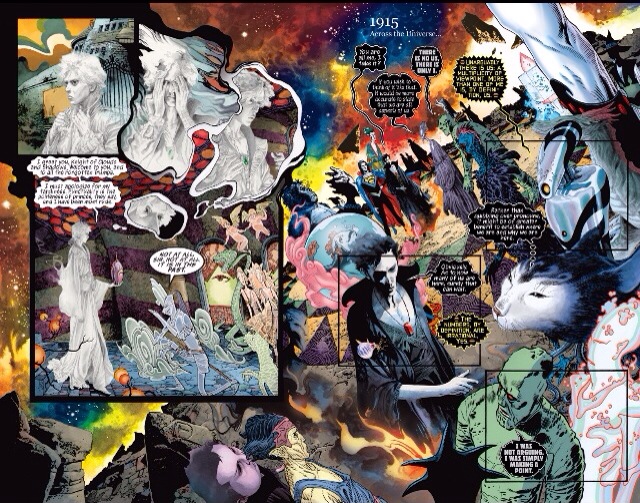
But then again, maybe I really shouldn't be worrying so much about these matters. This issue is probably the most enjoyable, for me anyway, of Overture so far. There appear to be direct references to Dream's ultimate fate, so that this is a prequel for all I understand. Regardless, Dream is on a quest. There are multiple versions of him running around. In fact, he's at the moment hanging out with a cat version of himself. This leads to an amusing moment when they pick up a tagalong, who suggests when she doesn't walk by herself, "I could ride your cat." To which Dream responds:
"My cat is Dream of the Endless. He does not give rides."
Classic. Gaiman is a master storyteller, and is a better writer, generally, than pretty much anyone else. Regardless of how lost I sometimes feel, he's always in control. Reading Overture for me is a little like what reading Grant Morrison must be like for all those people who don't get him.
And as always, J.H. Williams III is stunning on art. The way he composes his layouts can sometimes be challenging to follow even for veteran comics readers, but it's always a welcome challenge.
Friday, June 13, 2014
The Sandman: Overture #2 (Vertigo)
writer: Neil Gaiman
artist: J.H. Williams III
I came very late to Neil Gaiman's Sandman, but I became as much a fan as anyone has. That being said, and also that I'm very happy that they've once again come together, I'm not sure what I think of Overture after two issues. The above image is part of my dilemma.
artist: J.H. Williams III
 |
| via Nothing But Comics |
Gaiman so far has been setting the stage, and that's about it. This is not one of those complaints that has anything to do with delays. I'm not so starved for entertainment that I must hang all of my attention on a single story. That being said, I'm pretty sure the schedule was always more elongated than usual. Now it seems it's a little longer still. Whatever.
No, this is more a matter of how much time Gaiman is spending talking about Dream rather than tossing him into another story. My limited experience of Sandman to date is that it's less to do with the central character and more his tangential role in a whole tapestry of stories. With Overture, Gaiman seems to have reversed that. I get the sense that the whole reason he's even working on this project is because like a lot of writers at later stages in their careers (although considering Gaiman is only 53, this is kind of ridiculous to be saying, I know) and years removed from their most famous projects, they either try to distance themselves from said project or try and do whatever they can to remind everyone of what made them so special to begin with.
So on that score it makes sense for Overture to be more about Dream than feature him. This is a chance to revisit the character and everything else around him, to celebrate, and so that's a little of what's going on here. This second issue doesn't do a ton more than the first one. The multiple versions of Dream do a lot of talking with each other. In theory this is right up my alley. I like cerebral material, people talking about things rather merely doing things. But as far as my expectations go, I kind of what, I guess (and I just realized what I was thinking as I was writing this sentence, and how it suddenly sounds kind of stupid) what Gaiman has done before.
And I guess, that's an important thing to realize. Maybe Overture is doing exactly what it's supposed to be doing. I'm still a neophyte as a fan. I'm not lost, really, but maybe because I still haven't actually read the whole of the original material, I wanted something that evoked it more than I should have. I was probably being a little ridiculous.
Ha.
So I guess I'll relax a little. The next issue is scheduled for release at the end of next month. Sometimes it bears reminding in a monthly format that it's not always as easy as it can seem to appreciate what a finite story is accomplishing from issue to issue.
In the meantime, have another look at that art! All praise to J.H. Williams III!
Monday, May 5, 2014
Reading Comics #122 "Bull Moose Grab Bag"
I love grab bags. One of the shops I frequent these days, which is actually an indy music/movie chain store that also has comic books, is Bull Moose in Lewiston, Maine. I've gotten a few grab bags from them over the last few months, and during the course of my reviews of the stuff I've been reading lately you might have seen some fairly negative ones. Since I've cut back on my spending, I've been reading far fewer comics than I used to, only the stuff that I'm really certain I'll appreciate, so that's the secret origin of that. Bull Moose grab bags are a great bargain (since it's highly unlikely that there will be a lot of Lewiston, Maine, natives in my reading audience, this does not count as a shameless plug), ten recent comics for five bucks. "Recent" means within the past year, usually within the last few months (although the one I got this Saturday must have been one of the older bags they had, because its contents were near a year old).
So at this point I've decided to bring back the roundup feature I sometimes fall back on here. When there's something I haven't really enjoyed I don't have to try and justify it too much. But there can be real gems in the bunch as well!
 Cable and X-Force #18 (Marvel)
Cable and Bishop are time-traveling mutants who are fascinating in theory but are more often than not incapable of living up to their potential, possibly because writers aren't really thinking about what they can do but rather what they can't, which is explore the dystopias they come from. Bishop has had a much rougher path to follow than Cable (notice which one is in the title, and has had a lot of series over the years and which...hasn't), although he's been a favorite of mine since I first saw him in the old early '90s X-Men cartoon. (Hey, and speaking of which, is either one of these guys in X-Men: Days of the Future Past?) They've got the same curse every Marvel mutant has, actually, only amplified. Everyone knows that the X-Men are supposed to be a persecuted lot, but the logical gymnastics writers take to keep them that way, or ignore this concept entirely, can sometimes be ridiculous. Recently they've settled on making more Magneto characters, which is to say compromised figures trying to do the right thing but making all the wrong moves (read: Cyclops). Add Bishop to that bunch, unfortunately. And so that's what this issue is all about. Apparently someone also thought it was a good idea to have not one but two teams of X-Force running around (because you can never have too many competing concepts in Marvel), and so that's also what this comic's about. It's not very good, alas. And the art looks a little weird at points. It screws up Cable, for instance. (Since when was his metallic arm a covering for an actual arm? Who am I kidding? I don't care!) Long story short: this is not a comic book I would have read deliberately.
 Earth 2 #19 (DC)
I kept trying to find the recent annual that basically mainlined the awesome Flashpoint concept from a few years back of Thomas Wayne becoming Batman instead of his son, but failed everywhere I looked (even though I do digital comics now and am clearly aware of the Internet, I still love operating in the physical world), so it was pretty awesome to randomly come across an issue of the regular series. This series, in case you're not aware, is set in one of DC's alternate realities. It was launched by James Robinson as a surrogate Justice Society landscape but set in the same context as the debut arc from Geoff Johns' Justice League, so that the Darkseid siege of Earth was more successful and so everyone had to figure out how to pick up the pieces. At the start the new versions of the classic JSA superheroes were occupying a landscape devoid of the more familiar DC icons because those guys had been eliminated. But recently they've been resurfacing, including the new Batman. I think it's evolved beautifully, and under the auspices of Tom Taylor remains a leading contender for a mainstream superhero comic that you could pick as your standalone experience should you want to know what that's like without having to worry about picking up any other series. And this is a good issue. Like I've said about Justice League all along, Earth 2 could easily be construed as an ongoing event book. Closing in on two years, that's not a bad thing to consider reading at all. At the moment, Batman and the altered version of Superman have been occupying the center stage, coming ever closing to a reckoning. Well, like I said, good stuff.
 Infinity #6 (Marvel)
This was last year's big Marvel event, sort of like something-something Thanos, something-something Inhumans (because Marvel keeps trying to make them a thing just like DC keeps trying to make the New Gods a thing, and only one of them actually has something interesting to explore) (and it's not Marvel). This was Jonathan Hickman's effort to duplicate the classic Jim Starlin stories featuring Thanos, no doubt thanks to the large-chin villain's cameo at the end of Avengers (although he won't appear as a main character until the third movie) (probably). I've always admired Hickman's ambition, but I'm not sure he's quite what Marvel keeps hoping he'll be, which is their own Grant Morrison. He's better than other writers who've tried to handle Thanos recently, but the result is still a fairly poor echo of Starlin's material. Still, the art is from Jim Cheung, who was half of the iconic original team on Young Avengers (along with Allan Heinberg). Good strong stuff there, anyway, as always. Glad to see him still considered a significant player.
Marvel Previews #14 (Marvel)
This is Marvel's separate catalog to the industry-standard, Diamond distributor version that handles...everyone else. I don't really know why this ended up in the grab bag. But it didn't exactly convince me to think any differently about Marvel's current output than I have been. On the cover is Nightcrawler, the latest returned-from-the-dead character. Oh, which reminds me, in case you had no idea, Nightcrawler's been dead lately. But apparently he got better.
 Red Lanterns #25 (DC)
I haven't really been following the Green Lantern franchise, other than Geoff Johns, since the New 52 relaunch in 2011, but it's been nice knowing it exists, and in such force. One of the odder additions to the lineup was a Red Lanterns series, but it seems the longer it's lasted the better it's gotten. With Charles Soule, always good news, writing it these days, and Guy Gardner having become the face, it's probably as good or better than anything else you'll find in the lineup. Guy has repositioned the remaining members of the corps into defenders of his home turf, not so much on Earth but the territory (Space Sector 2814, to be precise). Soule has particular fun with Guy's allies, while he also continues the saga of Atrocitus, who once ruled the roost. It's as good a sci-fi title as I've read, which is actually pretty rare for a Green Lantern series. Which is pretty odd when you think about it.
 The Sandman: Overture Special Edition #1 (Vertigo)
So, clearly I'm kind of the target audience for this series. I'm not sure how many new readers will be coming aboard for the journey, except maybe Neil Gaiman fans who came about after the end of the original series when he'd begun making a name for himself as a prose writer. The casual comics reader probably won't be spending too much time in the Vertigo sandbox, because with Image and a thousand indies running around, there's a lot more competition for the nonsuperhero set than ever before. As someone who loves Gaiman's Sandman but who hasn't read the complete series, I'm a curious phenomenon (for a lot of other reasons, too). I caught the original version of this debut issue of Overture, but was glad to randomly catch the special edition as well. It helped me digest it a little more, not just the bonus features, but being forced to read the comic itself over again. The Corinthian (the creepy dude with two additional mouths where his eyes ought to be) is in the spotlight once again, but only until our title hero stumbles into an existential conundrum that is not anywhere near finished by the end of the issue. Gaiman's approach is serialized in this effort, rather than in some of the fairly self-contained stories he told even in his arcs from the original Sandman. There's plenty to find familiar and interesting here. It certainly helps to have an artist the caliber of J.H. Williams III (there are few others capable of being anywhere near as awesome), whose sense of the page is virtually unparalleled, which as host of the special edition he's capable of walking through with the reader. If you're unsure of Overture, these special editions may actually be your better bet.
 Sonic Universe #58 (Archie)
I'm just going to skip over this one. Better for you. Better for me. Better for them.
 Swamp Thing #27 (DC)
There's whole corners of the New 52 landscape that have nothing to do with Superman or Batman or Green Lantern. No, really! One of them involves the so-called "dark" characters who most recently were handled by Vertigo rather than DC. Their return has been one of the most interesting things about the relauch (I know, if you hear much about it I bet you much more regularly hear all the complaints about what was lost rather than gained). I confess to not having really taken advantage of this stuff. But it's good. It's probably some of the best stuff DC has. But even fans who know about this corner find reasons to complain, especially since there have been a lot of crossovers. I don't see the problem with crossovers. If it's a shared universe, it's a lot more useful, sometimes, to have an out-and-out crossover rather than have a guest-star. Crossovers, when done right, have a good way of establishing context, and as far as I can tell, books like Swamp Thing have definitely understood that. Unsurprisingly, the writer here is also Charles Soule. The dude has quickly become indispensable. Where the heck did he come from??? A lot of what this particular character means comes from Alan Moore work from thirty years ago. This run, and even this very issue, is a chance for a fresh start. Good stuff.
Walking Dead #119 (Image)
(Comic Book Datebase locked me out of the issue listing without a login, so no cover for you.)
Obviously you know about Walking Dead. Whether from the comic or the TV series or both. Rather than discuss anything specifically from the issue, I want to address the letters column. In it, creator/writer Robert Kirkman discusses the future of the comic, how long he envisions it to last. A couple years ago he was talking a total length of 300 issues. And keep in mind we're only a third of the way there. But apparently now he's thinking 500. And he's already got fans talking about him padding his storytelling. Because of the huge success of the TV show, Kirkman could keep this thing going as long as he wants, long after the show is over. The one doesn't depend on the other. It just sounds ridiculous to me. No writer has five hundred issues worth of material to tell about one story. It's just this dude realizing he's got it made. No matter what else happens, he'll always have this in his back pocket. Now, there are certainly creators in any medium who spend their whole careers on the same property. In comics that's certainly been the case. But other than Dave Sim (who by the way did accomplish 300 issues, over the course of thirty years, on his Cerebus), there hasn't really been anyone who has managed to make such a dedicated run (it's worth noting Sim was his own artist). Kirkman probably ought to stop prognosticating. If fans are already complaining about his output now, he may have very few fans indeed decades from now who care about the latest shenanigans of survivors stumbling from scenario to scenario. Just saying.
 Savage Wolverine #14 (Marvel)
Like Walking Dead above, I'm not really going to talk about the issue or the capable talents of Richard Isanove, but rather some of the ridiculous recent habits of Marvel. On the cover, as you can see, there's a giant #1 in the corner, even though this is not the first issue or some reboot (of a reboot of a reboot of a reboot...over the span of...just a handful of years). Marvel has always prided itself as never having rebooted its line. The stories you read today are theoretically related to stories that were done decades ago. And yet, there've been so many shenanigans that it doesn't really matter anymore. It's just one successful gimmick to keep fans interested after another. Such as the equally ridiculous Marvel Now! branding that is clearly Marvel's lackluster answer to DC's New 52. The cover also has the copy #14.now, which means...absolutely nothing. It's just one stupid, we're accessible! argument after another. I think in a few years Marvel will have finally worn out its welcome at the top. Hopefully. Well, I wish...
All images via Comic Book Database.
So at this point I've decided to bring back the roundup feature I sometimes fall back on here. When there's something I haven't really enjoyed I don't have to try and justify it too much. But there can be real gems in the bunch as well!

Cable and Bishop are time-traveling mutants who are fascinating in theory but are more often than not incapable of living up to their potential, possibly because writers aren't really thinking about what they can do but rather what they can't, which is explore the dystopias they come from. Bishop has had a much rougher path to follow than Cable (notice which one is in the title, and has had a lot of series over the years and which...hasn't), although he's been a favorite of mine since I first saw him in the old early '90s X-Men cartoon. (Hey, and speaking of which, is either one of these guys in X-Men: Days of the Future Past?) They've got the same curse every Marvel mutant has, actually, only amplified. Everyone knows that the X-Men are supposed to be a persecuted lot, but the logical gymnastics writers take to keep them that way, or ignore this concept entirely, can sometimes be ridiculous. Recently they've settled on making more Magneto characters, which is to say compromised figures trying to do the right thing but making all the wrong moves (read: Cyclops). Add Bishop to that bunch, unfortunately. And so that's what this issue is all about. Apparently someone also thought it was a good idea to have not one but two teams of X-Force running around (because you can never have too many competing concepts in Marvel), and so that's also what this comic's about. It's not very good, alas. And the art looks a little weird at points. It screws up Cable, for instance. (Since when was his metallic arm a covering for an actual arm? Who am I kidding? I don't care!) Long story short: this is not a comic book I would have read deliberately.

I kept trying to find the recent annual that basically mainlined the awesome Flashpoint concept from a few years back of Thomas Wayne becoming Batman instead of his son, but failed everywhere I looked (even though I do digital comics now and am clearly aware of the Internet, I still love operating in the physical world), so it was pretty awesome to randomly come across an issue of the regular series. This series, in case you're not aware, is set in one of DC's alternate realities. It was launched by James Robinson as a surrogate Justice Society landscape but set in the same context as the debut arc from Geoff Johns' Justice League, so that the Darkseid siege of Earth was more successful and so everyone had to figure out how to pick up the pieces. At the start the new versions of the classic JSA superheroes were occupying a landscape devoid of the more familiar DC icons because those guys had been eliminated. But recently they've been resurfacing, including the new Batman. I think it's evolved beautifully, and under the auspices of Tom Taylor remains a leading contender for a mainstream superhero comic that you could pick as your standalone experience should you want to know what that's like without having to worry about picking up any other series. And this is a good issue. Like I've said about Justice League all along, Earth 2 could easily be construed as an ongoing event book. Closing in on two years, that's not a bad thing to consider reading at all. At the moment, Batman and the altered version of Superman have been occupying the center stage, coming ever closing to a reckoning. Well, like I said, good stuff.

This was last year's big Marvel event, sort of like something-something Thanos, something-something Inhumans (because Marvel keeps trying to make them a thing just like DC keeps trying to make the New Gods a thing, and only one of them actually has something interesting to explore) (and it's not Marvel). This was Jonathan Hickman's effort to duplicate the classic Jim Starlin stories featuring Thanos, no doubt thanks to the large-chin villain's cameo at the end of Avengers (although he won't appear as a main character until the third movie) (probably). I've always admired Hickman's ambition, but I'm not sure he's quite what Marvel keeps hoping he'll be, which is their own Grant Morrison. He's better than other writers who've tried to handle Thanos recently, but the result is still a fairly poor echo of Starlin's material. Still, the art is from Jim Cheung, who was half of the iconic original team on Young Avengers (along with Allan Heinberg). Good strong stuff there, anyway, as always. Glad to see him still considered a significant player.
Marvel Previews #14 (Marvel)
This is Marvel's separate catalog to the industry-standard, Diamond distributor version that handles...everyone else. I don't really know why this ended up in the grab bag. But it didn't exactly convince me to think any differently about Marvel's current output than I have been. On the cover is Nightcrawler, the latest returned-from-the-dead character. Oh, which reminds me, in case you had no idea, Nightcrawler's been dead lately. But apparently he got better.

I haven't really been following the Green Lantern franchise, other than Geoff Johns, since the New 52 relaunch in 2011, but it's been nice knowing it exists, and in such force. One of the odder additions to the lineup was a Red Lanterns series, but it seems the longer it's lasted the better it's gotten. With Charles Soule, always good news, writing it these days, and Guy Gardner having become the face, it's probably as good or better than anything else you'll find in the lineup. Guy has repositioned the remaining members of the corps into defenders of his home turf, not so much on Earth but the territory (Space Sector 2814, to be precise). Soule has particular fun with Guy's allies, while he also continues the saga of Atrocitus, who once ruled the roost. It's as good a sci-fi title as I've read, which is actually pretty rare for a Green Lantern series. Which is pretty odd when you think about it.

So, clearly I'm kind of the target audience for this series. I'm not sure how many new readers will be coming aboard for the journey, except maybe Neil Gaiman fans who came about after the end of the original series when he'd begun making a name for himself as a prose writer. The casual comics reader probably won't be spending too much time in the Vertigo sandbox, because with Image and a thousand indies running around, there's a lot more competition for the nonsuperhero set than ever before. As someone who loves Gaiman's Sandman but who hasn't read the complete series, I'm a curious phenomenon (for a lot of other reasons, too). I caught the original version of this debut issue of Overture, but was glad to randomly catch the special edition as well. It helped me digest it a little more, not just the bonus features, but being forced to read the comic itself over again. The Corinthian (the creepy dude with two additional mouths where his eyes ought to be) is in the spotlight once again, but only until our title hero stumbles into an existential conundrum that is not anywhere near finished by the end of the issue. Gaiman's approach is serialized in this effort, rather than in some of the fairly self-contained stories he told even in his arcs from the original Sandman. There's plenty to find familiar and interesting here. It certainly helps to have an artist the caliber of J.H. Williams III (there are few others capable of being anywhere near as awesome), whose sense of the page is virtually unparalleled, which as host of the special edition he's capable of walking through with the reader. If you're unsure of Overture, these special editions may actually be your better bet.

I'm just going to skip over this one. Better for you. Better for me. Better for them.

There's whole corners of the New 52 landscape that have nothing to do with Superman or Batman or Green Lantern. No, really! One of them involves the so-called "dark" characters who most recently were handled by Vertigo rather than DC. Their return has been one of the most interesting things about the relauch (I know, if you hear much about it I bet you much more regularly hear all the complaints about what was lost rather than gained). I confess to not having really taken advantage of this stuff. But it's good. It's probably some of the best stuff DC has. But even fans who know about this corner find reasons to complain, especially since there have been a lot of crossovers. I don't see the problem with crossovers. If it's a shared universe, it's a lot more useful, sometimes, to have an out-and-out crossover rather than have a guest-star. Crossovers, when done right, have a good way of establishing context, and as far as I can tell, books like Swamp Thing have definitely understood that. Unsurprisingly, the writer here is also Charles Soule. The dude has quickly become indispensable. Where the heck did he come from??? A lot of what this particular character means comes from Alan Moore work from thirty years ago. This run, and even this very issue, is a chance for a fresh start. Good stuff.
Walking Dead #119 (Image)
(Comic Book Datebase locked me out of the issue listing without a login, so no cover for you.)
Obviously you know about Walking Dead. Whether from the comic or the TV series or both. Rather than discuss anything specifically from the issue, I want to address the letters column. In it, creator/writer Robert Kirkman discusses the future of the comic, how long he envisions it to last. A couple years ago he was talking a total length of 300 issues. And keep in mind we're only a third of the way there. But apparently now he's thinking 500. And he's already got fans talking about him padding his storytelling. Because of the huge success of the TV show, Kirkman could keep this thing going as long as he wants, long after the show is over. The one doesn't depend on the other. It just sounds ridiculous to me. No writer has five hundred issues worth of material to tell about one story. It's just this dude realizing he's got it made. No matter what else happens, he'll always have this in his back pocket. Now, there are certainly creators in any medium who spend their whole careers on the same property. In comics that's certainly been the case. But other than Dave Sim (who by the way did accomplish 300 issues, over the course of thirty years, on his Cerebus), there hasn't really been anyone who has managed to make such a dedicated run (it's worth noting Sim was his own artist). Kirkman probably ought to stop prognosticating. If fans are already complaining about his output now, he may have very few fans indeed decades from now who care about the latest shenanigans of survivors stumbling from scenario to scenario. Just saying.

Like Walking Dead above, I'm not really going to talk about the issue or the capable talents of Richard Isanove, but rather some of the ridiculous recent habits of Marvel. On the cover, as you can see, there's a giant #1 in the corner, even though this is not the first issue or some reboot (of a reboot of a reboot of a reboot...over the span of...just a handful of years). Marvel has always prided itself as never having rebooted its line. The stories you read today are theoretically related to stories that were done decades ago. And yet, there've been so many shenanigans that it doesn't really matter anymore. It's just one successful gimmick to keep fans interested after another. Such as the equally ridiculous Marvel Now! branding that is clearly Marvel's lackluster answer to DC's New 52. The cover also has the copy #14.now, which means...absolutely nothing. It's just one stupid, we're accessible! argument after another. I think in a few years Marvel will have finally worn out its welcome at the top. Hopefully. Well, I wish...
All images via Comic Book Database.
Monday, November 25, 2013
My All-time Favorite Comic Books, 10-1
The final countdown...!
#10. Geoff Johns's Green Lantern

Creators: Geoff Johns, Doug Mahnke, Ethan Van Sciver, Ivan Reis, various
Publication dates: 2004-2013
Issues: Green Lantern: Rebirth 1-6, Green Lantern 1-67, 0-20, Blackest Night 1-8
Green Lantern was already my favorite comic book franchise when Johns strolled into the story in 2004. I thought I already had my definitive era in Ron Marz's Kyle Rayner. Then Johns brought Hal Jordan back, and exploded the whole mythology. I mean, literally, he took the basic building blocks and figured out the best possible expansion, and led the whole thing to its greatest heights. It's the epitome of creative storytelling, the single best innovative run in superhero comic book history, one that will continue to be felt for years. I mean, even Larfleeze has gotten his own ongoing series now. Larfleeze! How awesome is that? Saint Walker made it into the pre-New 52 Justice League, the Red Lanterns have had their own series since the DC relaunch, and Johns has made a strong case for a Sinestro series. No one would have ever thought that possible before 2004. That's the definition of a substantial legacy.
#9. Air

Creators: G. Willow Wilson, M.K. Perker
Publication dates: 2008-2010
Issues: 1-24
Along with 52 part of a very select group to top my annual QB50 list twice, Air was an unabashed obsession of mine throughout its publication, even though it struggled to find an audience that did not have the name "Tony Laplume." But it was brilliant, typical of the Vertigo breed in having a distinct and imaginative mythology, but atypical in its intimate approach, like Sandman without all the Goth touches. G. Willow Wilson managed to spin a conspiracy and hero journey into one yarn. The closest proximity I've found since was the similarly short-lived Saucer Country. As with most of my selections, widely deserves a much larger audience.
#8. Cobra

Creators: Mike Costa, Antonio Fuso, Christos Gage
Publication dates: 2009-2013
Issues: 1-4, Special 1-2, 1-13, 1-21, The Cobra Files 1-9
This is basically everything I loved about Superboy and the Ravers, The Great Ten, Seven Soldiers of Victory, and Young Avengers in a nonsuperhero title, and surprisingly with another famous franchise it managed to totally reinvent from the outset, featuring an obscure Joe named Chuckles in the mission of his life, a reboot timeline where Cobra is just being discovered. And from there, it's basically the Assange/Snowden/NSA era well before any of those scandals broke, one brilliant bit of character exploration after another in a world of paranoia and secrets, an unexpected phenomenon publisher IDW never expected, assuming it had merely a good mini-series when it acquired G.I. Joe in 2008, leading to a series of extensions that eventually transformed the whole line with the sensational death of Cobra Commander. You don't need to know or care about the franchise to love this saga. You just need to love great comics.
#7. Sandman

Creators: Neil Gaiman, Dave McKean, various
Publication dates: 1989-1996
Issues: 1-75
For simplicity's sake I'm sticking to the original series rather than also include subsequent additional materials, such as the recently-launched Sandman Overture mini-series. Simply put, this one needs no introduction. It's perhaps the most literary comic book ever published, filled with classical elements and one of the best-known mythologies outside of superheroes ever created. It's a masterpiece. Move along, move along.
#6. Bone

Creators: Jeff Smith
Publication dates: 1991-2004
Issues: 1-55
This one I owe entirely to a friend who was obsessed with it. For a while, there was a very small cult audience obsessed with it. And it expanded, thanks to word of mouth. It started making in-roads to full-blown mainstream awareness. There was talk of a movie. All of this is for good reason. Like a cartoon strip wedded perfectly to epic fantasy (such as you would never have believed possible until Bone), Jeff Smith's vision was a dream come to life, so popular Image for a while took over publication, until it went back to Smith's own company, where it completed its epic journey, only to be reborn in a series of reprints, where its legacy (as I've been hoping throughout this list for many other series) has grown. Oh, and because it's my favorite phrase from Bone: stupid, stupid rat creatures...
#5. Wasteland

Creators: Antony Johnston, Christopher Mitten, Justin Greenwood
Publication dates: 2006-2014
Issues: 1-60
I've attempted for years to be an ambassador to this series, a classic post-apocalyptic yarn that explodes the genre into a startlingly rich landscape filled with intricate relationships between isolated figures. Unlike The Walking Dead, Wasteland has made the riddle of what created the world after the Big Wet the whole point, except it's taken the whole journey to reach it. In the meantime social politics have defined the story, especially the betrayals at the heart of life in Newbegin, the perfect representation of civilization after civilization's end. My favorite character remains Michael, a sort of Wolverine if Wolverine had never joined the X-Men.
#4. 52

Creators: Geoff Johns, Grant Morrison, Greg Rucka, Mark Waid, Keith Giffen, various
Publication dates: 2006-2007
Issues: 1-52
DC's first weekly series in years, an ambitious effort to put out a new issue every week for a year, could have been its riskiest gamble ever. Instead it turned out to be a stroke of genius, one of the best single comics it ever put out, following a hodgepodge of characters who could never have been mistaken for the mainstream (although some of them, including Booster Gold and the new Batwoman, received their own ongoing series as a result) as they embark on the greatest stories of their careers, including the Elongated Man's long-awaited response to Identity Crisis and Black Adam's shot at redemption. The league of creators who wrote it remains a who's who, and to my mind in no small part to their participation in this book. The company's later attempts to duplicate this remarkable accomplishment never seemed to capture the same interest from the fans, but that's to be expected, although I would highly recommend Countdown, while the bi-weekly Brightest Day is another winner.
#3. The Death of Captain Marvel

Creators: Jim Starlin
Publication date: 1982
Issues: [graphic novel]
This is the comic book that made me a fan of comic books, and it is also among the first I ever read, and completely by accident, something my sister had randomly come across and I stole a look, and no joking, I was changed forever. The death of any comic book character wasn't as common in 1982 as it is today, and the true testament of this event is that Captain Marvel remains respectfully deceased. It's a surreal, literary exploration and epitaph for a character who was never really that popular but whose legacy was instantly cemented by this effort. What more could you ask for?
#2. Kingdom Come

Creators: Mark Waid, Alex Ross
Publication dates: 1996
Issues: 1-4
You might notice that I love my comics to be literary, and no superhero comic was ever more literary, not to mention seminal in my own creative development, than this landmark event that peered into the future of DC's icons and saw nothing good. Lois Lane dead. Superman forced into retirement. The next generation, led by Magog, the reverse of everything that had come before them. Narrated by a simple preacher and steeped in religious imagery (this is the secret origin of my obsession with the number 7, and why I subsequently adopted the term "seven thunders" from the Book of Revelations for what I always assumed must be my own magnum opus, because it was used in the previews for Kingdom Come), this was both creators at their absolute finest. One of them ended up chasing this achievement for years (Ross) while the other only occasionally revisited it (Waid, in The Kingdom event that was as close to Seven Soldiers of Victory as DC ever got before Grant Morrison), while Geoff Johns famously brought it all back in the pages of his Justice Society of America. Even Magog eventually entered the regular canon and had an ongoing series. Often seen as DC's response to Marvels, it is more accurately seen in its own distinctive light, which is ultimately a more hopeful version of The Dark Knight Returns, taken on the grand scale.
#1. "The Return of Barry Allen"

Creators: Mark Waid, Greg LaRocque
Publication dates: 1993
Issues: The Flash 74-79
I choose to include only one storyline from Mark Waid's extended run on The Flash for a specific reason, because it was the earliest and best example of the whole thing, which often lived up to its potential and sometimes didn't (and the best of it wasn't even in the pages of The Flash but rather Impulse), so it's better to remember what remains the most memorable than complicate matters. Because "The Return of Barry Allen" is most certainly the best of it. And for the record, it doesn't even feature Barry Allen. This was years before Barry came back. The Flash throughout Waid's run was Wally West ("and I'm the Fastest Man Alive"), the third speedster to carry the name, and he was keenly aware of the whole mythology, which before Geoff Johns on Green Lantern, Waid was the first to attempt a wholesale expansion, introducing the concept of the Speed Force and old as well as new faces to the family, including my personal favorite, Max Mercury, the Zen Master of Speed. If there is any weakening to this legacy, it's perhaps that even Waid seemed to let it slip by the wayside after a while, perhaps after "Dead Heat" (acknowledged within the pages of Johns's The Flash: Rebirth with a cameo by the villain Savitar), while Johns himself in two separate runs (with Wally and Barry) went in different directions. Better, again, to remember it at its most pure, most perfect, most serene, most effective, when it's Wally struggling with his role in the grand scheme of things. James Robinson would later take the same basic concept to similar heights in the pages of Starman, but has no comparable single storyline to this one. This is the one, if you love superheroes and their legacies, that you have to read. This is the love letter of all love letters to the whole phenomenon.
(All covers via Comic Book Database.)
#10. Geoff Johns's Green Lantern

Creators: Geoff Johns, Doug Mahnke, Ethan Van Sciver, Ivan Reis, various
Publication dates: 2004-2013
Issues: Green Lantern: Rebirth 1-6, Green Lantern 1-67, 0-20, Blackest Night 1-8
Green Lantern was already my favorite comic book franchise when Johns strolled into the story in 2004. I thought I already had my definitive era in Ron Marz's Kyle Rayner. Then Johns brought Hal Jordan back, and exploded the whole mythology. I mean, literally, he took the basic building blocks and figured out the best possible expansion, and led the whole thing to its greatest heights. It's the epitome of creative storytelling, the single best innovative run in superhero comic book history, one that will continue to be felt for years. I mean, even Larfleeze has gotten his own ongoing series now. Larfleeze! How awesome is that? Saint Walker made it into the pre-New 52 Justice League, the Red Lanterns have had their own series since the DC relaunch, and Johns has made a strong case for a Sinestro series. No one would have ever thought that possible before 2004. That's the definition of a substantial legacy.
#9. Air

Creators: G. Willow Wilson, M.K. Perker
Publication dates: 2008-2010
Issues: 1-24
Along with 52 part of a very select group to top my annual QB50 list twice, Air was an unabashed obsession of mine throughout its publication, even though it struggled to find an audience that did not have the name "Tony Laplume." But it was brilliant, typical of the Vertigo breed in having a distinct and imaginative mythology, but atypical in its intimate approach, like Sandman without all the Goth touches. G. Willow Wilson managed to spin a conspiracy and hero journey into one yarn. The closest proximity I've found since was the similarly short-lived Saucer Country. As with most of my selections, widely deserves a much larger audience.
#8. Cobra

Creators: Mike Costa, Antonio Fuso, Christos Gage
Publication dates: 2009-2013
Issues: 1-4, Special 1-2, 1-13, 1-21, The Cobra Files 1-9
This is basically everything I loved about Superboy and the Ravers, The Great Ten, Seven Soldiers of Victory, and Young Avengers in a nonsuperhero title, and surprisingly with another famous franchise it managed to totally reinvent from the outset, featuring an obscure Joe named Chuckles in the mission of his life, a reboot timeline where Cobra is just being discovered. And from there, it's basically the Assange/Snowden/NSA era well before any of those scandals broke, one brilliant bit of character exploration after another in a world of paranoia and secrets, an unexpected phenomenon publisher IDW never expected, assuming it had merely a good mini-series when it acquired G.I. Joe in 2008, leading to a series of extensions that eventually transformed the whole line with the sensational death of Cobra Commander. You don't need to know or care about the franchise to love this saga. You just need to love great comics.
#7. Sandman

Creators: Neil Gaiman, Dave McKean, various
Publication dates: 1989-1996
Issues: 1-75
For simplicity's sake I'm sticking to the original series rather than also include subsequent additional materials, such as the recently-launched Sandman Overture mini-series. Simply put, this one needs no introduction. It's perhaps the most literary comic book ever published, filled with classical elements and one of the best-known mythologies outside of superheroes ever created. It's a masterpiece. Move along, move along.
#6. Bone

Creators: Jeff Smith
Publication dates: 1991-2004
Issues: 1-55
This one I owe entirely to a friend who was obsessed with it. For a while, there was a very small cult audience obsessed with it. And it expanded, thanks to word of mouth. It started making in-roads to full-blown mainstream awareness. There was talk of a movie. All of this is for good reason. Like a cartoon strip wedded perfectly to epic fantasy (such as you would never have believed possible until Bone), Jeff Smith's vision was a dream come to life, so popular Image for a while took over publication, until it went back to Smith's own company, where it completed its epic journey, only to be reborn in a series of reprints, where its legacy (as I've been hoping throughout this list for many other series) has grown. Oh, and because it's my favorite phrase from Bone: stupid, stupid rat creatures...
#5. Wasteland

Creators: Antony Johnston, Christopher Mitten, Justin Greenwood
Publication dates: 2006-2014
Issues: 1-60
I've attempted for years to be an ambassador to this series, a classic post-apocalyptic yarn that explodes the genre into a startlingly rich landscape filled with intricate relationships between isolated figures. Unlike The Walking Dead, Wasteland has made the riddle of what created the world after the Big Wet the whole point, except it's taken the whole journey to reach it. In the meantime social politics have defined the story, especially the betrayals at the heart of life in Newbegin, the perfect representation of civilization after civilization's end. My favorite character remains Michael, a sort of Wolverine if Wolverine had never joined the X-Men.
#4. 52

Creators: Geoff Johns, Grant Morrison, Greg Rucka, Mark Waid, Keith Giffen, various
Publication dates: 2006-2007
Issues: 1-52
DC's first weekly series in years, an ambitious effort to put out a new issue every week for a year, could have been its riskiest gamble ever. Instead it turned out to be a stroke of genius, one of the best single comics it ever put out, following a hodgepodge of characters who could never have been mistaken for the mainstream (although some of them, including Booster Gold and the new Batwoman, received their own ongoing series as a result) as they embark on the greatest stories of their careers, including the Elongated Man's long-awaited response to Identity Crisis and Black Adam's shot at redemption. The league of creators who wrote it remains a who's who, and to my mind in no small part to their participation in this book. The company's later attempts to duplicate this remarkable accomplishment never seemed to capture the same interest from the fans, but that's to be expected, although I would highly recommend Countdown, while the bi-weekly Brightest Day is another winner.
#3. The Death of Captain Marvel

Creators: Jim Starlin
Publication date: 1982
Issues: [graphic novel]
This is the comic book that made me a fan of comic books, and it is also among the first I ever read, and completely by accident, something my sister had randomly come across and I stole a look, and no joking, I was changed forever. The death of any comic book character wasn't as common in 1982 as it is today, and the true testament of this event is that Captain Marvel remains respectfully deceased. It's a surreal, literary exploration and epitaph for a character who was never really that popular but whose legacy was instantly cemented by this effort. What more could you ask for?
#2. Kingdom Come

Creators: Mark Waid, Alex Ross
Publication dates: 1996
Issues: 1-4
You might notice that I love my comics to be literary, and no superhero comic was ever more literary, not to mention seminal in my own creative development, than this landmark event that peered into the future of DC's icons and saw nothing good. Lois Lane dead. Superman forced into retirement. The next generation, led by Magog, the reverse of everything that had come before them. Narrated by a simple preacher and steeped in religious imagery (this is the secret origin of my obsession with the number 7, and why I subsequently adopted the term "seven thunders" from the Book of Revelations for what I always assumed must be my own magnum opus, because it was used in the previews for Kingdom Come), this was both creators at their absolute finest. One of them ended up chasing this achievement for years (Ross) while the other only occasionally revisited it (Waid, in The Kingdom event that was as close to Seven Soldiers of Victory as DC ever got before Grant Morrison), while Geoff Johns famously brought it all back in the pages of his Justice Society of America. Even Magog eventually entered the regular canon and had an ongoing series. Often seen as DC's response to Marvels, it is more accurately seen in its own distinctive light, which is ultimately a more hopeful version of The Dark Knight Returns, taken on the grand scale.
#1. "The Return of Barry Allen"

Creators: Mark Waid, Greg LaRocque
Publication dates: 1993
Issues: The Flash 74-79
I choose to include only one storyline from Mark Waid's extended run on The Flash for a specific reason, because it was the earliest and best example of the whole thing, which often lived up to its potential and sometimes didn't (and the best of it wasn't even in the pages of The Flash but rather Impulse), so it's better to remember what remains the most memorable than complicate matters. Because "The Return of Barry Allen" is most certainly the best of it. And for the record, it doesn't even feature Barry Allen. This was years before Barry came back. The Flash throughout Waid's run was Wally West ("and I'm the Fastest Man Alive"), the third speedster to carry the name, and he was keenly aware of the whole mythology, which before Geoff Johns on Green Lantern, Waid was the first to attempt a wholesale expansion, introducing the concept of the Speed Force and old as well as new faces to the family, including my personal favorite, Max Mercury, the Zen Master of Speed. If there is any weakening to this legacy, it's perhaps that even Waid seemed to let it slip by the wayside after a while, perhaps after "Dead Heat" (acknowledged within the pages of Johns's The Flash: Rebirth with a cameo by the villain Savitar), while Johns himself in two separate runs (with Wally and Barry) went in different directions. Better, again, to remember it at its most pure, most perfect, most serene, most effective, when it's Wally struggling with his role in the grand scheme of things. James Robinson would later take the same basic concept to similar heights in the pages of Starman, but has no comparable single storyline to this one. This is the one, if you love superheroes and their legacies, that you have to read. This is the love letter of all love letters to the whole phenomenon.
(All covers via Comic Book Database.)
Tuesday, November 1, 2011
A Game of Dreams
Beyond a doubt one of the most famous and critically-acclaimed comic books of the past twenty years, Neil Gaiman’s SANDMAN helped usher the Vertigo revolution and remains one of the most visible works of the medium.
Neil Gaiman himself has become a successful and popular novelist since the conclusion of SANDMAN in 1996, writing such acclaimed books as AMERICAN GODS, THE GRAVEYARD BOOK, and NEVERMORE. I’ve read AMERICAN GODS as well as its sequel, ANANSI BOYS, plus his collaboration with Terry Pratchett, GOOD OMENS and short story collection FRAGILE THINGS, so I consider myself a fan of his work, but have never read SANDMAN the whole way through. When the series began in 1988, I was very far from being a member of the target audience (not the least because I was eight and wouldn’t become an actual comics reader for about five years). Even when I did start reading comics, SANDMAN was so far advanced, it didn’t seem like a smart thing to try and jump in, and not just because I read mostly superhero stories at that point, and the longer I didn’t read it, the easier it became not to.
As the years progressed, I couldn’t help but hear the continuous stream of accolades directed toward SANDMAN, especially as Gaiman’s reputation as a novelist expanded. I read the odd back issue I managed to come across without directly seeking them out, caught a reprint of the first issue, became suitably impressed, but still, there was a lot to this series, seventy-five issues and ten trade collections, all of which would have been easier to follow had I started in 1988 or been an eager collector of trade collections (the former of which we’ve already established, and the latter something I’ve been working on for a long time); so for the longest time I maintained my marginal experience of SANDMAN, despite a growing interest in its creator.
Stands to reason that I’ve since bought a trade, being the first volume, PRELUDES & NOCTURNES and gotten around to reading it. The Neil Gaiman I know from the books I’ve read is heavily interested in mythology, though not necessarily from a traditional approach. AMERICAN GODS, after all, deals with immigrants mistakenly bringing their old religions with them, sort of spiritual baggage that causes a link for these gods in unfamiliar and unappreciative territory (think how we view Greek gods as more narrative than spiritual entities; actually think that and read GODS BEHAVING BADLY, which is a fine little book from Marie Phillips which is being made into a film).
I knew from my experience with the first issue of SANDMAN that Morpheus begins his journey after being trapped in the world of man, with unexpected consequences for his captors and the greater world around them. The rest of PRELUDES & NOCTURNES, the first eight issues, originally published between 1988 and 1989, describes his escape and reclamation of the things that were stolen from him, the totems and tools he needs to perform his job as representative of Dream from a collective known as the Endless that oversees all human affairs.
Since I had no real experience with the series, I didn’t know what to expect, the tone of it, except my prior experiences with Gaiman in other stories. I didn’t quite expect a horror series, and possibly it’s not very reflective of the series as a whole, given the comments from Gaiman and editor Karen Berger included in the volume, but clearly the initial style was hugely influenced by the horror comics of decades past. Possibly as a tenuous link to its origins within the greater DC universe, the first batch of issues draws heavily from established continuity, whether Doctor Destiny, whose criminal career is revealed to have a debt from the entrapment of Morpheus, or the Golden Age Sandman, Wesley Dodds (who would gain his own Vertigo series, SANDMAN MYSTERY THEATRE, possibly as a direct result of Gaiman’s SANDMAN). Even Martian Manhunter makes an appearance, briefly.
By the time perky Goth chick Death appears in the eighth issue, the horror stylings and pace have slowed, and Gaiman finally starts to settle in to an examination of his central character’s possibilities, and not strictly his particulars. Needless to say, that was probably for the best, and helped SANDMAN attain a kind of timeless, expansive quality.
The first volume is worth a look. I have a feeling that the other nine are more involving. I’ll get around to them eventually.
Neil Gaiman himself has become a successful and popular novelist since the conclusion of SANDMAN in 1996, writing such acclaimed books as AMERICAN GODS, THE GRAVEYARD BOOK, and NEVERMORE. I’ve read AMERICAN GODS as well as its sequel, ANANSI BOYS, plus his collaboration with Terry Pratchett, GOOD OMENS and short story collection FRAGILE THINGS, so I consider myself a fan of his work, but have never read SANDMAN the whole way through. When the series began in 1988, I was very far from being a member of the target audience (not the least because I was eight and wouldn’t become an actual comics reader for about five years). Even when I did start reading comics, SANDMAN was so far advanced, it didn’t seem like a smart thing to try and jump in, and not just because I read mostly superhero stories at that point, and the longer I didn’t read it, the easier it became not to.
As the years progressed, I couldn’t help but hear the continuous stream of accolades directed toward SANDMAN, especially as Gaiman’s reputation as a novelist expanded. I read the odd back issue I managed to come across without directly seeking them out, caught a reprint of the first issue, became suitably impressed, but still, there was a lot to this series, seventy-five issues and ten trade collections, all of which would have been easier to follow had I started in 1988 or been an eager collector of trade collections (the former of which we’ve already established, and the latter something I’ve been working on for a long time); so for the longest time I maintained my marginal experience of SANDMAN, despite a growing interest in its creator.
Stands to reason that I’ve since bought a trade, being the first volume, PRELUDES & NOCTURNES and gotten around to reading it. The Neil Gaiman I know from the books I’ve read is heavily interested in mythology, though not necessarily from a traditional approach. AMERICAN GODS, after all, deals with immigrants mistakenly bringing their old religions with them, sort of spiritual baggage that causes a link for these gods in unfamiliar and unappreciative territory (think how we view Greek gods as more narrative than spiritual entities; actually think that and read GODS BEHAVING BADLY, which is a fine little book from Marie Phillips which is being made into a film).
I knew from my experience with the first issue of SANDMAN that Morpheus begins his journey after being trapped in the world of man, with unexpected consequences for his captors and the greater world around them. The rest of PRELUDES & NOCTURNES, the first eight issues, originally published between 1988 and 1989, describes his escape and reclamation of the things that were stolen from him, the totems and tools he needs to perform his job as representative of Dream from a collective known as the Endless that oversees all human affairs.
Since I had no real experience with the series, I didn’t know what to expect, the tone of it, except my prior experiences with Gaiman in other stories. I didn’t quite expect a horror series, and possibly it’s not very reflective of the series as a whole, given the comments from Gaiman and editor Karen Berger included in the volume, but clearly the initial style was hugely influenced by the horror comics of decades past. Possibly as a tenuous link to its origins within the greater DC universe, the first batch of issues draws heavily from established continuity, whether Doctor Destiny, whose criminal career is revealed to have a debt from the entrapment of Morpheus, or the Golden Age Sandman, Wesley Dodds (who would gain his own Vertigo series, SANDMAN MYSTERY THEATRE, possibly as a direct result of Gaiman’s SANDMAN). Even Martian Manhunter makes an appearance, briefly.
By the time perky Goth chick Death appears in the eighth issue, the horror stylings and pace have slowed, and Gaiman finally starts to settle in to an examination of his central character’s possibilities, and not strictly his particulars. Needless to say, that was probably for the best, and helped SANDMAN attain a kind of timeless, expansive quality.
The first volume is worth a look. I have a feeling that the other nine are more involving. I’ll get around to them eventually.
Subscribe to:
Posts (Atom)