Showing posts with label Ron Marz. Show all posts

Tuesday, April 28, 2020

Pandemic Comics #7 “Justice Leagues”

More comics from the Mile High mystery boxes! Apparently today is National Superhero Day? And apparently Marvel began it? Well, the comics I’ll be talking about, ah, were all published by DC. But the pandemic is teaching us the real superheroes probably have very different costumes than we previously imagined, and masks look very different, too.

Harley Quinn #1
Here’s the “newest comic in the mystery boxes,” from Rebirth, featuring the creative team from the previous series (Marvel’s Constant Reboot Engine sees this happen more frequently) offers a quick recap of relevant information, including Harley’s huge collection of sidekicks. And yet in the spotlight: Deadpool Red Tool.  This was a shiny Mile High variant cover, by the way.

Hawkgirl #54 
As far as I know, this is the only time Hawkgirl had her own book. Of course, it began as Hawkman (where it was written by Geoff Johns) and this issue features the return of Hawkman (probably?). But the good news is it’s from legends Walt Simonson and Howard Chaykin, which is a combination and a series that stood out for me back in 2006, but for some reason never actually read. So, another mystery box that finally addresses one of my comic book sins...

icandy #1
I think it’s the title. Yeah, the title. It’s a terrible title. The comic itself turns out to be pretty good (I mean, it’s written by Dan Abnett & Andy Lanning, the geek gods of that period), a concept that folds video games into a playable concept. I’m frankly shocked this hasn’t been done more, or more successfully. The last time I saw it was Heroes Reborn, which naturally was four seasons after the series was actually popular.

Ion #7 
A maxi-series starring Kyle Rayner post-Green Lantern: Rebirth (otherwise known as “Thanks, Torchbearer, you now get to join the Back-up Corps!), this is a fortuitous random issue, because it reunites Kyle with Radu, the coffee shop owner who was a signature element of Kyle’s early days as a Green Lantern. Ion was a concept they fobbed on Kyle as a consolation prize, before it was replaced by his becoming White Lantern, before he became, well, just another Green Lantern...At the time, I guess, I was still annoyed that “my Green Lantern” had been “kicked to the curb” (which happens to literally every Green Lantern not named Hal Jordan eventually), and so couldn’t properly appreciate Ion. Now it seems like correcting that amounts to another of my comic book sins...

Justice League America #61
The first appearance of Bloodwynd! And, ah, Dan Jurgens takes over the series! In hindsight, Weapons Master really doesn’t seem like that big a challenge. Prometheus was basically an upgraded version only a handful of years later, and even he quickly got turned into a chump. Lesson, villains? Don’t put all your eggs in a fancy gimmick giving you special weapons. Because the weapons can be, well, taken away...

Justice League Task Force #2
This particular Justice League series from the ‘90s will always be the most thankless. Literally its biggest claim to fame is an issue of “Knightfall: The Crusade,” with Crippled Bruce Wayne. This issue is kind of ironic in hindsight: Nightwing looks like a chump while desperately trying to prove he isn’t just a former Teen Titan and/or Batman’s sidekick. If Dan DiDio caught this issue, it might explain why he used to think Nightwing was superfluous...

JLA/WildC.A.T.s
This was a really nice surprise! From the Grant Morrison era, written by Morrison, and featuring Electric Superman (what a snapshot!), something I think I’ve read before, but I guess never really considered that significant. But it is a great little snapshot. But the name of Jim Lee’s big superhero team still sucks, at least as far as incorporating one of the most convoluted acronyms from a whole history of convoluted acronyms in comics...

JLA #79 
It’s always great to remember just how long and varied Doug Mahnke’s history at DC alone is (dude’s also the co-creator of The Mask!), and he’s as easy a talent to revisit for that reason alone as there’s ever been. His art, at least during his DC tenure, has been remarkably consistent, though endlessly adaptable...Hopefully will get a spotlight collection at some point.

Sunday, April 12, 2015

Convergence: Batman and Robin #1 (DC)

writer: Ron Marz

artist: Denys Cowan

Convergence has an interesting wrinkle above and beyond the mini-series itself, and that's all the spin-off titles, which function part much the way DC has put together other comics in the past, most recently the Retroactive one-shots exploring various titles by decade.

This one spotlights Grant Morrison's Batman and Robin, which at once is a little odd, considering that of all the eras given this honor Batman and Robin until Convergence was technically still ongoing under the auspices of Peter Tomasi.  Yet Morrison's run was distinctive (much as you would expect from any Grant Morrison effort).

Which is to say, the period when Damian Wayne was Robin, and you didn't have to worry about whether or not he was dead, about to become dead, or returned from the dead, as pretty much all of his New 52 stories have revolved around.

Which is to say, the Damian who can be impetuous, is in fact known for being impetuous.  But, you know, still Batman's son, and Robin to boot.

Which is also odd, mind you, because the majority of Morrison's Batman and Robin actually saw Damian working alongside Dick Grayson's Batman, not his own father's.  Putting that aside, Damian has been such a brilliant character since his introduction, seeing him in any context is always a pleasure, regardless of how unruly he is.  Along for the ride is also Jason Todd, popping up in his guise as Red Hood, making this a callback to not just Morrison's comics but the Judd Winick era in Batman, which preceded Damian.  And that's not even the Convergence battle that must inevitably happen!

The writer is Ron Marz, who was actually well-known for his Green Lantern.  He's one of several creators making a welcome return, and he doesn't waste the opportunity.  The artist is Denys Cowan, who does his typically excellent work.  I can't believe I haven't created a Denys Cowan label already.  I guess my collection grows, and he's a welcome addition.

Each Convergence spin-off also has a recap feature at the back of the issue detailing relevant developments from the era it's depicting.  This one follows Damian's adventures through Batman Incorporated: Leviathan Strikes!, which was the last issue of the series before the eventual New 52 reboot that was one long march to Damian's death and its immediate aftermath (later continued in the pages of, well, Batman and Robin).

Saturday, December 6, 2014

Quarter Bin #62 "Binge-worthy VII: Superman"

The Adventures of Superman #473 (DC)
From 1990.
via DC Wikia
Dan Jurgens is known for creating Booster Gold and killing Superman.  Before Superman #75 he spent a considerable apprenticeship to become the successor of Man of Steel rebooter John Byrne.  It's not like he came out of nowhere to introduce Doomsday, though it probably seemed that way to everyone who came just for the big event.  It turns out there was also considerable lead-in to the crucial role Hal Jordan would play in the follow-up "Reign of the Supermen" climax.  Jurgens had also been employing Guy Gardner in another of his successor projects, Justice League, in which he followed the Giffen/DeMatteis/Maguire act.  Gardner and Superman were teammates in that book.  This is an issue that brings Superman, Jordan, and Gardner together, and even by the cover alone is a reminder that Jordan had a rough time of it from the start of that particular Green Lantern reboot, which was also the start of Gardner's solo push.  Seeing these elements interact well before they hit the grand stage was a moment I had to include in the binge, beyond a doubt.  The story itself is meaningless, but it's also more than worth noting that the issue opens with Lois showing off the engagement ring she's just gotten from Clark, because the later wedding was postponed deliberately by the Doomsday business because of the Lois & Clark TV series.  It's always good to remember context.  Jurgens also used Jordan to considerable effect in the pages of Zero Hour, meanwhile, the conclusion of his hot streak.  And then everyone started reducing his career to "the guy who killed Superman."  Even his art, here inked by Art Thiburt, is crisp, something altogether removed from the Jurgens who would later be accused of being out of touch.  I think it was his notoriety that made it so easy for Jurgens to be dismissed, being so closely associated with one of the biggest moments in comics history, and one of the first to be later dismissed as a publicity stunt, although it wasn't.

The Adventures of Superman #516 (DC)
From 1994.
via DC Wikia
The debut of Alpha Centurion, although the supporting character who appeared in later comics is more or less a completely different character, this one's written by the frequently underrated Karl Kesel, who along with Stuart Immonen provided the most reliable material for the concept.  The Zero Hour issues across the line provided DC a chance to revisit older continuity due to the changes that were occurring in the timeline thanks to the event, but this was a marked departure.  The Superman zero issues themselves introduced another new character, Conduit, a villain this time, which was in-step with a company-wide effort to refresh the landscape with new and updated concepts.  Alpha Centurion is much like the current Ulysses, although in the Roman's case he became soiled by association with Lex Luthor and the Contessa, a relationship featured in...

Superman: The Man of Tomorrow #2 (DC)
From 1995.
via Comic Vine
Man of Tomorrow was a "skip week" title, as in what DC published in its weekly Superman cycle when there were five instead of four weeks in a month, or in other words perhaps the series that made the franchise wear out its welcome in the '90s, that and the steady stream of climactic arcs ("Doomsday"! "The Death of Clark Clark"! Electric Superman!).  At the time it also brought back creators who hadn't been used in the titles for a while, in this instance Roger Stern, who at one time had written Action Comics, and Tom Grummett, whose work on Adventures of Superman had included the debut of Superboy.  This issue involves Lex Luthor's post-Underworld Unleashed revitalization (the long red hair and beard of the '90s Luthor who was originally called Luthor's son was in fact a clone meant to replace the body poisoned by years of wearing a kryptonite-studded ring; the frail body left when the ruse was exposed lead to the Lex Luthor we know best today, the calculating villain who could pose a positive public face) as well as his relationship with the Contessa, the only character who ever stood toe-to-toe with him, and the in-continuity version of Alpha Centurion's debut.  The noble time-displaced hero becomes a pawn of the Contessa's but never a villain, it should be noted.

The Adventures of Superman #1,000,000 (DC)
From 1998.
via DC Wkkia
DC One Million was a Grant Morrison event spinning out of his JLA. This particular tie-in is a reminder that the event attempted to elevate Resurrection Man, whose title character is heavily spotlighted in the issue.  Creators Dan Abnett and Andy Lanning later became known for their Marvel sci-fi titles and DC Western efforts, but the hero who died, came back with a different power, and was as such one of several immortals on the playground added one of the many twists to the event as far as legacies explored were concerned.  DC liked the idea well enough to attempt a, well, resurrection of Resurrection Man in the New 52 reboot, but the concept wasn't much more popular then, either.

Superman: The Man of Tomorrow #1,000,000 (DC)
From 1998.
via DC Wikia
In this DC One Million issue, the histories of the Superman dynasty and Solaris, the Tyrant Sun and villain of the event are explored, making it a pretty crucial tie-in.  For me the most significant aspect of the issue is artist Georges Jeanty, one of the first artists to convince me Superboy could survive without Tom Grummett.  Jeanty later went on to have an extended run illustrating Buffy the Vampire Slayer comics for Dark Horse, and has returned to DC in the pages of Batwoman.


Superman #147 (DC)
From 1999.
via Superman Homepage
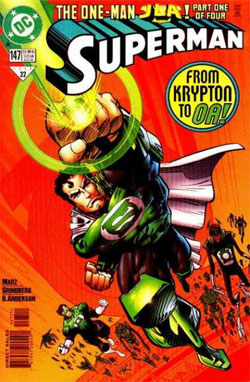
One of the things I never really understood was why, if it was a shared universe, there was always so little emphasis on who the Green Lantern for the sector of space Krypton occupied, they had so little to do with its destruction.  Actually, that Lantern was Tomar-Re, a now-deceased Corpsman who was integral to Hal Jordan's early career (as reflected in the Green Lantern movie).  Superman himself would seem to be a natural as a selection for the Corps (the idea was bandied about to have Clark Kent glimpsed as the ring looked for a new host in the movie).  There was a neat Elseworlds comic called Batman: In Darkest Knight, which you can figure out for yourself.  This comic comes from 1999, the year I gave up reading comics for half a decade to save money for college, so it features an arc I hadn't previously known about, Superman exploring various different fates had things turned out differently for him.  You've got to remember, too, that at the time, there was no Green Lantern Corps, only the one, Kyle Rayner, so a cover with a Corps is itself a novelty.  The writer is Ron Marz, who guided Rayner throughout his early career, so he certainly knew the lore.  The issue also features one of those periodic Hal Jordan appearances post-Parallax, although this is a reality where none of that happened.  Also present is Sinestro, who had more presence "Emerald Twilight" and afterward than he'd had in years.  In fact it might be said that Jordan's downfall was a huge windfall for Sinestro.  He became relevant again, which eventually led to everything Geoff Johns did with him, and now an ongoing series of his own.

Superman #155 (DC)
From 2000.
via DC Wikia
Another thing I missed was Jeph Loeb's Superman prior to Superman/Batman, his last universally-heralded creative run, which included one of his collaborators during that time, Ed McGuinness.  This was the start of a soft reboot, in which you could pretty much forget the '90s ever happened, when DC was once again struggling to prove that the Man of Steel was still relevant.  (On a side note, isn't it a little odd that McGuinness has never done an out-and-out Shazam project?  Just going by that cover, you'd think he would be an obvious selection!)  One of the biggest beneficiaries of the soft reboot, in a way, was Lex Luthor, who was extricated in a heartbeat from all the shenanigans of the previous decade (which in a way was a very bad thing, at least concerning the Contessa and Luthor's daughter with her).  The issue opens with Superman and Luthor in one of those improbable we're-buddies moments Luthor helps stage for the benefit of the public.  It also has, as the cover shows, Superboy in one of his earliest let's-hang-out-with-the-Kents moments.  Some of the developments are keyed in to that era: Luthor about to run for president, Lois being estranged from Clark.  Loeb's trademark narration, used sparingly this time, comes from Pa Kent.  I know Loeb is working for Marvel's media division these days, but I'd love for him to make a committed return to comics themselves...

Superman #156 (DC)
From 2000.
via DC Wikia
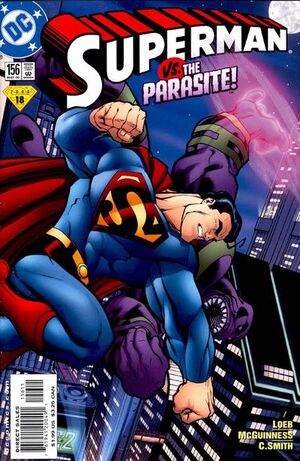
The story continues!  Loeb's narration begins by quoting a Clark Kent newspiece on Superman's activities, but then becomes Perry White's thoughts on Clark's problems with Lois (it should be noted that Lois & Clark had been over since 1997, so any soap opera elements were strictly comic book material).  Involved in this state of affairs is Wonder Woman.  This was years before the New 52 reboot, mind you, years before Superman/Wonder Woman, years before Clark and Lois actually split up and a romance formed between the Man of Steel and the Amazon Princess.  But an idea that was too good to pass up apparently came up at least once before, in more innocent form.  It should be noted that if the soft reboot hadn't taken place, Lois's behavior in the issue wouldn't make any sense.  I wonder how readers reacted at the time.  The ones who write into letters columns always tend to like bold new creative teams.  It was likely a different story in the budding online community, where everyone basically hates everything...

The Adventures of Superman #596 (DC)
From 2001.
via Recalled Comics
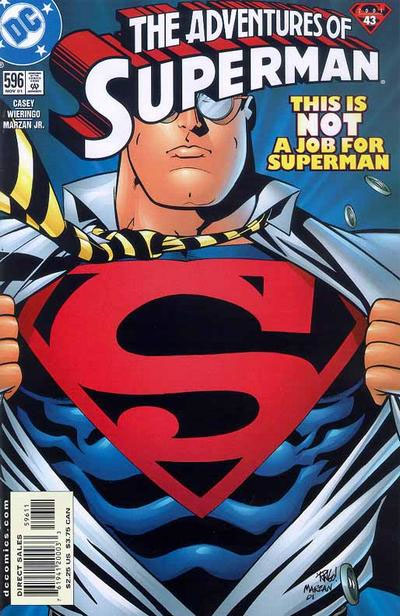
This issue shipped the day after 9/11.  The debut of the black S-shield and the aftermath of the Our Worlds At War event are one of the coincidences that cropped during that time.  Featured is a confrontation between Superman and Flash villain Weather Wizard.  Suffice to say but Superman handles this particular Rogue a little more...directly.  Also featured is President Luthor, who attempts once again to paint Superman in a bad light, only for an ordinary construction worker to put things into perspective.  The artist might seem to be more Ed McGuinness, but it's actually the late, much-lamented Mike Wieringo, known as Ringo to his fans.  I loved his work in the pages of The Flash and Robin.  Even though he died in 2007, it seems like it's been far longer.  He remains greatly missed.

Superman #179 (DC)
From 2002.
via DC Wikia
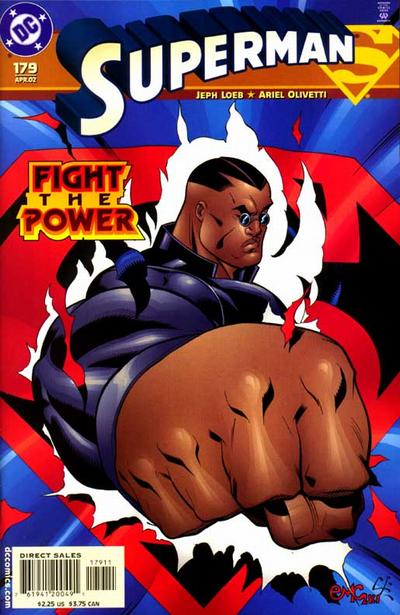
This is one of the stories that addressed Superman's continued relevance directly, as he ends up in a black neighborhood and confronted by a black superhero he's never even heard of, Muhammad X (Jeph Loeb cobbled the name from Muhammad Ali and Malcolm X, as the character himself explains).  Although the whole lesson is pretty obvious, I like the unusual perspective the character still manages to bring to the proceedings.  It'd be interesting to see him return, if he would feel compromised.  Anyway, Lois (their relationship, it seems, didn't end after all, at least at that point) convinces Superman to talk with Steel about his concerns, but he ends up with talking with Steel's niece, Natasha Irons, instead.  Stargirl happens to be present as well.  "Have you ever heard of 'Muhammad X'?" he asks.  "Have you ever heard of Batman?" she responds.  She lists a bunch of other black heroes, Rush, Silence, Stoneyard, Underground, none of whom exist outside this issue.  Superman later talks to Martian Manhunter (one of the green skins another black man might have referred to in Green Lantern/Green Arrow #76) and references Black Lightning (he's a member of Luthor's cabinet, it might be noted) and Mr. Terrific.  Aside from the point the comic is trying to make, it's also interesting to note that Loeb at least is capable of acknowledging that no matter how many heroes DC has running around that readers know about, there are likely many more that they don't, a little of what happens to characters after their series have been cancelled, only it applies to others as well.  Muhammad X also represents some of the more violent superheroes DC experimented with, such as those who appeared in Justice League Elite following the appearances of Manchester Black, another character who challenged Superman during this period.

Action Comics #791 (DC)
From 2002.
via DC Wikia
I picked this one up because of its gorgeously offbeat, evocative cover, which looks like it has Tim Sale written all over it, but the artist is actually John Paul Leon.  The story inside takes a flashback to Clark Kent's Smallville days, as the cover might also tell you, and it's about bullying, but it also reveals that Clark isn't just a superhero because of his powers, but because of the values instilled in him by the Kents, something that's sometimes overlooked.  The perspective of the story is interesting, because by some interpretations the feelings of isolation in the girl Clark (yes, Clark, not Superman) saves are shared by Clark himself (certainly in the movie Man of Steel, less so in Smallville), who is sometimes depicted as a jock and sometimes as someone who can't be a jock (Superman the movie).  It's a nice issue, and certainly fits in with the era nicely.

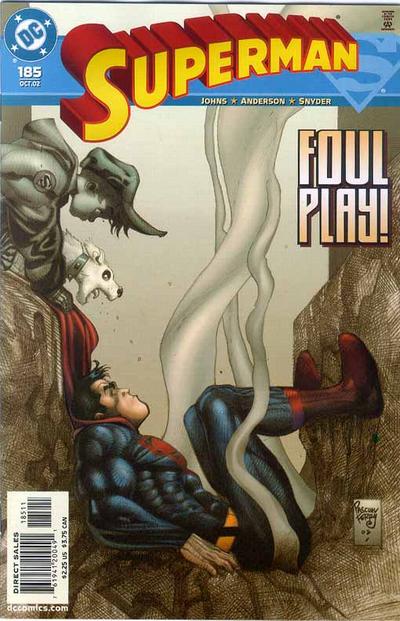
Superman #185 (DC)
From 2002.
via DC Wikia
Here's one of Geoff Johns' earliest Superman stories.  The Man of Steel smashes into a softball field (there's a real American image right there!) in the midst of a fight with Major Force (who may forever be associated with the women-in-fridges moment from Green Lantern), one of those real brawls fans always want Superman to have in the movies (uh...until they got it in Man of Steel).  Johns seems to use Major Force in much the way Grant Morrison later would classic Superman villain Metallo, as a kind of experiment in what would have happened in the Man of Steel had become a tool of the U.S. military.  At the end of the fight, Superman leaves Major Force looking...very much like what happened to Wolverine at the end of Death of Wolverine recently.  I don't think any of these kinds of parallels are intentional, but it's certainly interesting to see them happen.

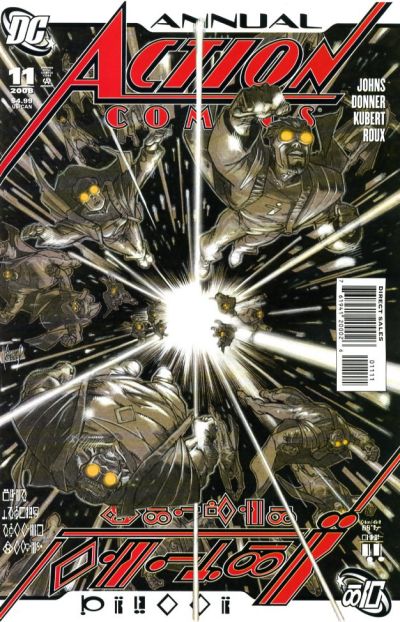
Action Comics Annual #11 (DC)
From 2008.
via DC Wikia
Here's the conclusion to a different Johns story entirely, when he'd returned years later for the start of a proper Geoff Johns run on Superman, starting out working alongside Richard Donner for the second time in his career (Johns famously began his working career as Donner's personal assistant), the finale of "Last Son," in which the son of General Zod becomes the adopted son of Superman (Rick Remender has recently done a kind of echo of this in the pages of Captain America), the Chris Kent later featured in the pages of Grant Morrison's The Multiversity: The Just.  The character was also featured in the "New Krypton" arc in the guise of the Kryptonian hero Nightwing, after whom Dick Grayson named his post-Robin superhero personna, and in a different incarnation is the Superman of Earth 2.

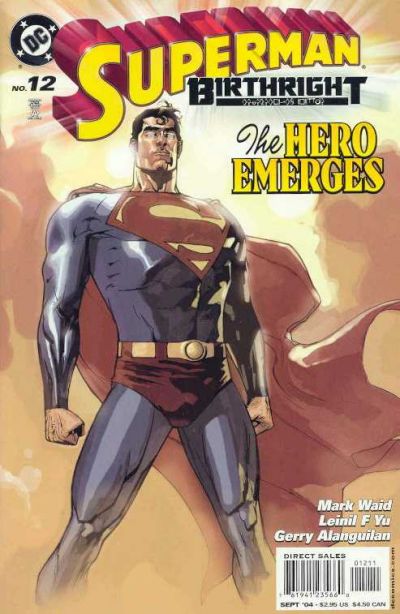
Superman: Birthright #12 (DC)
From 2004.
via DC Wikia
A Mark Waid project.  There was a time when I was hopelessly devoted to Waid's career and believed he could do no wrong.  That version of me would still have existed in 2004, but ten years later things are a little different.  What about a project from 2004?  A twelve-issue miniseries where I've read only the concluding chapter, and without doing the research I must assume that the whole story is basically a Year One story where Lex Luthor tries to prove how bad Superman is by perpetrating a whole hoax of a Kryptonian crisis, which culminates, of course, in Luthor's defeat, but on a pretty nice note where it's this context where Superman learns about his origins for the first time (there are many versions of that, too).  It strikes me as very similar to Scott Snyder's Superman Unchained.  But more on that another time...

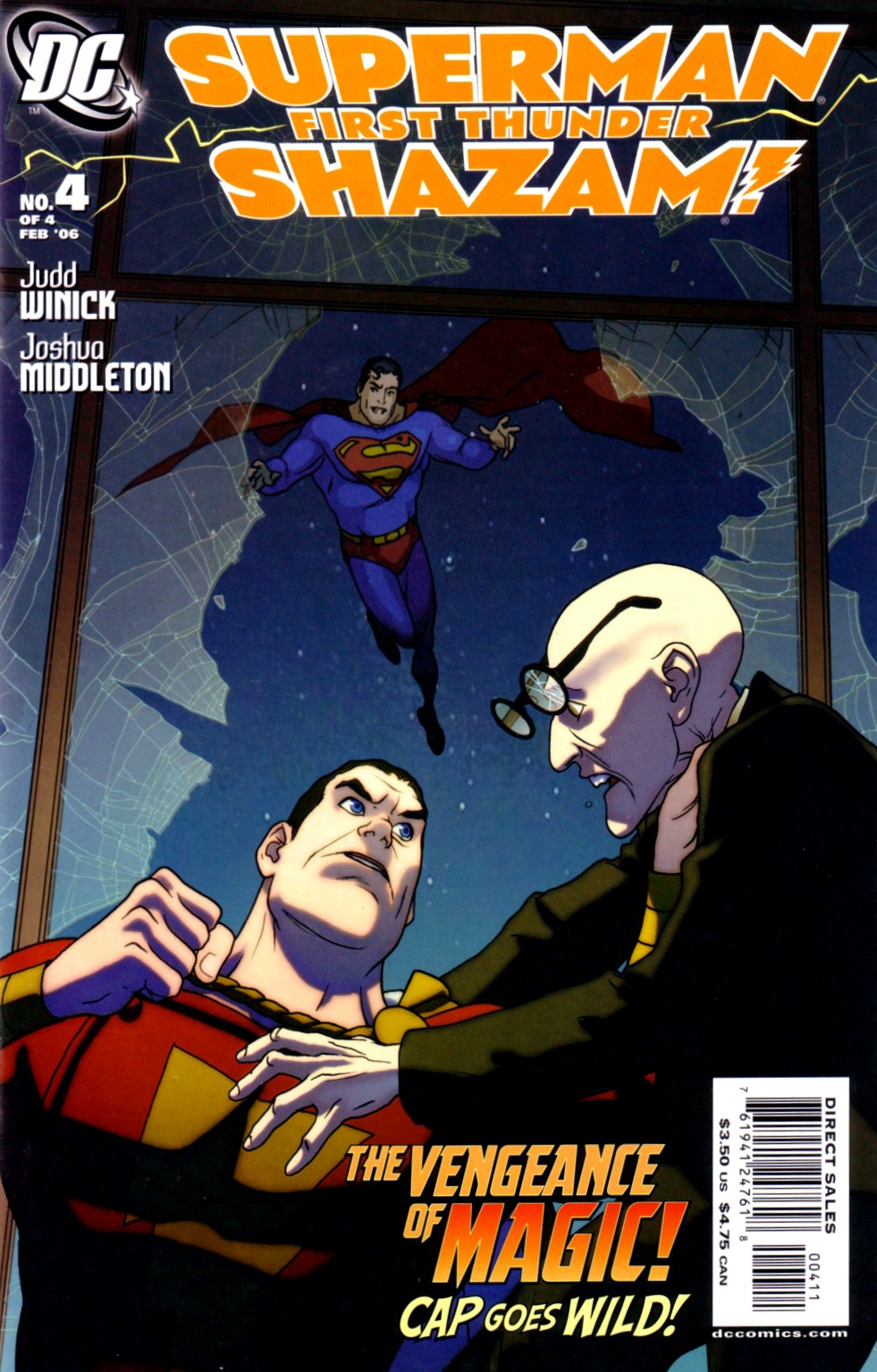
Superman/Shazam: First Thunder #4 (DC)
From 2006.
via DC Wikia
If you asked the survivors of Fawcett Comics decades ago what they would've thought of a shiny happy Superman/Captain Marvel team-up mini-series...the results would probably not have been suitable for a family-friendly blog.  DC put Fawcett out of business when it successfully accused its hugely popular lead character of being a shameless ripoff of Superman (just one of the many legal battles Captain Marvel spawned; there's a whole saga associated with his British counterpart Marvelman, also known as Miracleman, a revival Marvel has only recently made possible after remaining in limbo for two decades).  The writer is Judd Winick, who at one time had a massive tide of his own popular acclaim, but gradually lost, well, pretty much all of it, and I guess I still don't quite understand why.  I've always liked what I've seen of his work.  Actually, I guess I'm not really a Barry Ween fan.  Still haven't read Pedro and Me.  This comic seems like it's more of the good stuff, perhaps even some of his best stuff.  Captain Marvel/Shazam (because Marvel ended up creating an unrelated character named Captain Marvel, an incarnation of which was famously killed off by Jim Starlin in an groundbreaking graphic novel, this Captain Marvel eventually lost the right to be called anything else but Shazam by DC) has had a number of efforts given him at re-establishing his credentials, and like Martian Manhunter, by my estimation, has looked excellent in all of them, but he's lost the popular vote.  It's a shame.  It's ironic that this particular effort exists at all, because in a weird kind of way, Shazam as interpreted from a Superman perspective totally works...

Monday, November 24, 2014

Quarter Bin #60 "Binge-worthy V: Comics Frontiers"

The Girl with the Dragon Tattoo Free Special Edition Preview (Vertigo)
From 2012.
via Amazon
Working in a bookstore when Stieg Larsson's trilogy became a worldwide phenomenon made it all the more impossible to ignore, so when I finally read the books last month I was pleased to discover that I quite liked them.  I'd already seen David Fincher's adaptation of the first book, and read the graphic novel version of the second, so I was familiar with some of the variations before experiencing the originals.  It was nice to come across this preview of the first graphic novel, then.  I don't remember now if I'd caught it when it was originally released, because at any rate I don't have that copy anymore much less most of the comics I had at that time.  But I want to read the rest of it now, and I hope all the more that Vertigo will adapt the third book and complete its own version of the story, which has become a personal favorite.


Godland #16 (Image)
From 2007.
via comiXology
Since catching some of Tom Scioli's American Barbarian earlier this year I became all the more interested in his Godland, which is a version of Jack Kirby's New Gods.  It's interesting, but I think I'm more interested in American Barbarian.


Green Lantern #50 (DC)
From 1994.
via DC Wikia
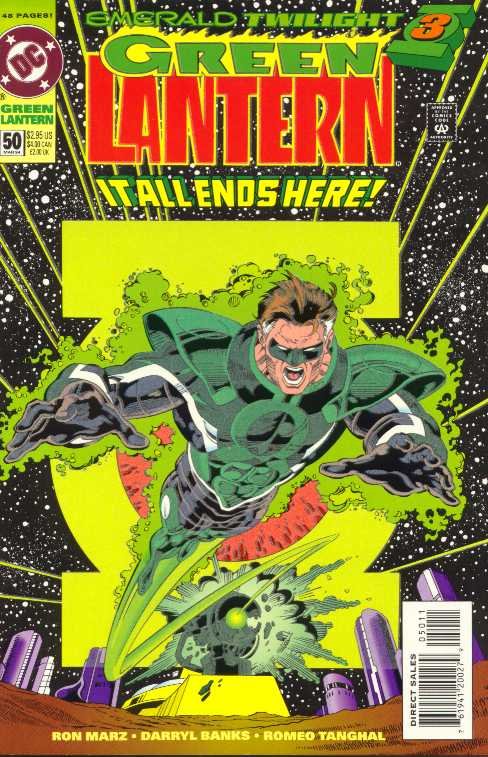
Hal Jordan's story reaches a climax in the conclusion to "Emerald Twilight," as the fallout from "Reign of the Supermen" and the destruction of Coast City causes him to turn violently against the Guardians and attempt to take matters dramatically into his own hands, a vigilante with the most powerful weapon in the universe.  Jordan has always been depicted at odds with the Guardians, and he'd frequently left the Green Lantern Corps because of it.  As Geoff Johns later explained in Green Lantern: Rebirth, the fear entity Parallax used his greatest personal crisis as a means to unleash its own potential.  Jordan's story continued within the pages of Zero Hour, The Final Night, and Day of Judgment.  In the wake of these events, Kyle Rayner temporarily became the last of the Green Lanterns, which was the other act that dramatically revamped the scope of the franchise within the DC landscape.  Watching Jordan battle Sinestro will always be the greatest moment from the issue, however, the moment Sinestro returned as a significant element of the mythos, regardless of the outcome at that time.


Green Lantern #81 (DC)
From 1996.
via Comic Vine
The '90s were littered with nods to longtime fans, a development that may have clashed with all the new ones the decade tried to bring in and probably part of the reason it ended up failing in permanently enlarging readership.  Hal Jordan had just sacrificed himself in the conclusion to The Final Night, and this was an issue dedicated to his memorial.  Fans like to point to James Robinson's Starman as an attempt to make a generational statement, but Ron Marz and was doing that within the pages of Green Lantern before Jack Knight inherited the cosmic rod, and Mark Waid had been doing that with Wally West in The Flash before Jordan had even heard of the Cyborg Superman.  It's funny to remember how angry fans were to what happened to Jordan, but he was constantly popping up and actually became far more relevant because of all that work.  In a span of a few years he became more important than his first three decades had managed, with the exception of the "Hard Traveling Heroes" arc.


Green Lantern #119 (DC)
From 1999.
via DC Wikia
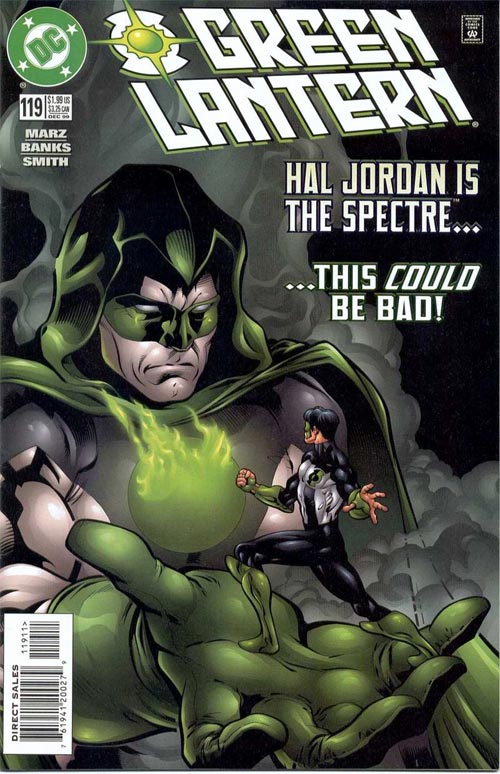
After his transformation into the Spectre, Jordan even had a whole series as the Spirit of Vengeance, but of course had to try out his new role within the pages of Green Lantern.  This was an issue I hadn't read previously.  Jordan sports, in human form, the same bomber jacket Geoff Johns would keep him in all the time.  In fact, this issue might even be considered a soft reboot for an era that hadn't been relevant to the characters for years.  It's very interesting to see that.


Jack Kirby's Galactic Bounty Hunters #6 (Icon)
From 2007.
via Comic Vine
Kirby nostalgia is something that never goes out of fashion in comics, where his legacy is still up for contention.  Since Marvel refuses to back away from its Stan Lee-heavy approach, it's up to everyone else and whatever scraps Kirby left behind to do the job.  Galactic Bounty Hunters is just one of the many obscure projects that attempt to fill that void.  One of the participants is Karl Kesel, who notably infused much of his long run on Superboy, including a version of Kamandi, with Kirby's ideas.  Kesel rarely gets enough respect for the work he's done.  It's not surprising to see him so closely linked to Kirby.  Hopefully he won't be entirely lost in the shuffle.  DC keeps making efforts, and clearly Dan DiDio is a big devotee.  Maybe he ought to bring Kesel back to give a helping hand.


JLA Eighty-Page Giant #3 (DC)
From 2000. 
DC Wikia
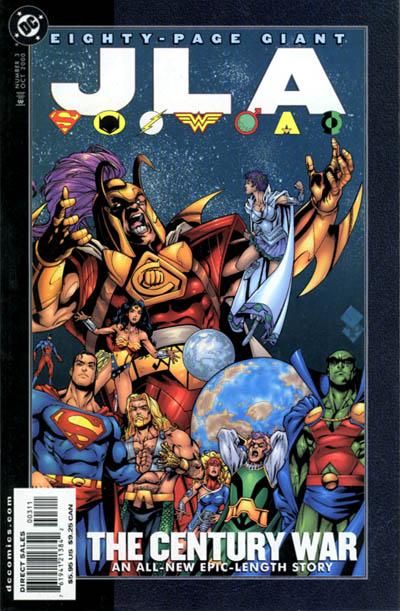
After Grant Morrison's run that relaunched the team, I confess to have skipped out on pretty much everything that followed in the pages of JLA.  This one-shot provides a king-size story that revisits the era.  It's definitely not Morrison's JLA but it was certainly worth a look.


JSA #67 (DC)
From 2005.
via DC Wikia
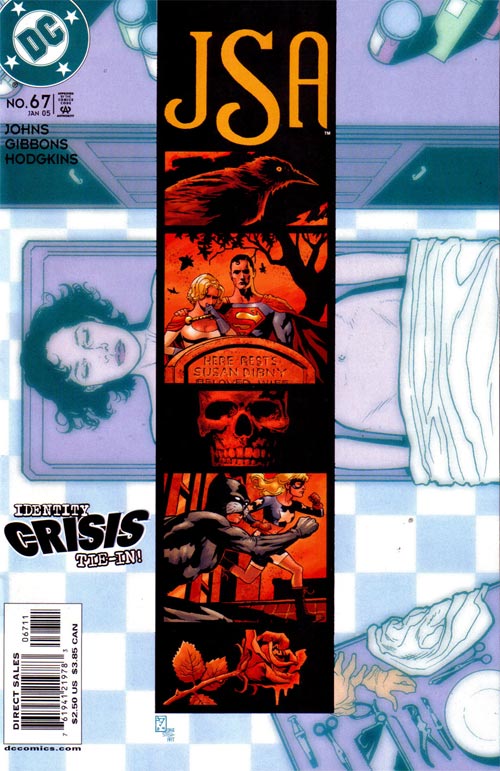
As you might see on the cover, this ties in with Identity Crisis, but for me it's another glimpse into the whole Geoff Johns run, which I didn't follow regularly until the Justice Society of America relaunch.  A lot of the issue reflects on and interacts with Identity Crisis developments, but by the end spins off in its own direction with a different story entirely featuring a villain who probably wouldn't have been on the radar if Johns were working then the way he works now, or at least he probably would have handled the story differently.  Per Degaton certainly doesn't have the same resonance that Black Adam ended up having.


Sunday, May 19, 2013

Quarter Bin #48 "Day of Judgment, Flash, and Green Lantern"

Comics featured in the Quarter Bin column were not necessarily bought from a quarter bin.  This is a back issues feature.

Day of Judgment #3 & 4 (DC)
From November 1999:
I've been wanting to read Day of Judgment for years.  For any number of reasons.  One of them is that it was released in 1999.  I quit reading comics in the spring of 1999 as I prepared for college.  Ever since then I've been trying to catch up with everything I missed between that time and 2004, when I started transitioning back into regular reading.  1999 was significant for a lot of reasons, and one of them was that it was the first big year for Geoff Johns at DC.  He started out writing the fairly innocuous Stars and S.T.R.I.P.E., a kid punches version of Starman.  And yet the company seemed to know it had something far bigger than that right out of the gate.  Years later Johns became an event machine for DC, but his very first one was Day of Judgment.  That's not even the only hallmark for this event.  It was also the last stop on the redemption tour for fallen Green Lantern Hal Jordan, who had gone on an epic rampage as Parallax before sacrificing himself in The Final Night.  Day of Judgment saw him assume hosting duties for DC's Spirit of Vengeance, the Spectre.  The Spectre is always a hard character to write on a regular basis.  He's envisioned as the embodiment of God's Wrath, dispensing justice in grim and ironic ways.

I spent years looking through back issue bins for Day of Judgment.  It was never collected, and it was impossible to find (unless you use the Internet cheat and were willing to pay for the pleasure of reading this increasingly obscure adventure).  Johns finished the redemption of Hal in the pages of Green Lantern: Rebirth, with the hero literally shedding the identity of the Spectre like changing an outfit.  If you want the lasting legacy of this phase in the character's history, it sits in the pages of Kevin Smith's Green Arrow: Quiver (which only figures, because Hal and Oliver Queen have their own brand of DC history).  Earlier this year, even knowing that DC was finally going to collect the mini-series, I was still looking for the back issues.  I came across these, like a preview (rest assured I have the collection and will write about that, too).  The most curious thing about it is the art, which is the reverse of anything you'd expect, much subdued.  (Soon enough DC would go in the opposite direction in that regard, immortalized in Our Worlds at War and the existence of Manchester Black.)

I'll leave this one for the moment with the thought that it was worth the wait.

The Flash 80-Page Giant (DC)
From April 1999:
In the spring of 1999 Mark Waid was still writing The Flash, immersed in the subsequently lost saga known as "Chain Lightning," but DC was already preparing for the post-Waid Speed Force.  He doesn't write a single story in this special, although his editor Brian Augustyn does.  There are seven tales from a variety of creators.  The first one is Augustyn's and features Wally West teaming up with Jay Garrick, something that not uncommon in the Waid era.  There's a vintage Teen Titans of the original lineup (with West again in his classic Kid Flash getup), then another Wally tale that evokes the pre-Waid era, then another Wally tale, then another one that at least ruminates on his relationship with Linda Park.  Finally we get one that features someone else entirely (mostly), the Flash featured in Kingdom, the Waid reality that evoked his own Kingdom Come.  The final tale features XS, the Legion of Super-Heroes speedster.  I always wondered why she was mostly neglected as a character.  I don't she even exists these days, which is pretty sad.  Soon enough, Geoff Johns was writing Wally's adventures and then rewriting the legacy of The Flash by bringing back Barry Allen.  This serves as a nice time capsule between these eras, so I guess it's only right that Waid was not technically involved.

Green Lantern #167 (DC)
From September 2003:
I got this issue from the Judd Winick era mostly because the cover image inadvertantly evokes the later Geoff Johns era with an alien who looks very much like a member of the Indigo Tribe.  Who knows, and that's as much as why I wanted to have this one, but maybe Johns was inspired by this very issue, or perhaps just the cover?  It seems reasonable enough.  There's even an alien on the very first page who looks exactly like Larfleeze.  It's worth noting that in the back page DC projects preview section, Geoff's Teen Titans #1 and Waid's Superman: Birthright #1 and Empire #1 are listed.  I don't plan all these connections.  They just happen.

Green Lantern #181 (DC)
From November 2004:
This one's the final issue of Kyle Rayner before Green Lantern: Rebirth.  It's fittingly written by Ron Marz, Kyle's creator, who hadn't actually written Kyle regularly for years at this point.  It'd been creators like Winick and Ben Raab in the meantime.  I'd caught a previous "final Rayner issue from Marz" during one of the rare comics I caught during my exile (Marz would later write a Rayner mini-series called Ion based on a character revision from Winick), so I'm happy to close this loop.  In the issue he battles Major Force, a villain whose main claim to fame was originating the hideous "women in fridges" syndrome in Kyle's early adventures when he shockingly murdered the new Green Lantern's girlfriend Alex, whom readers might have assumed would be a love interest with longevity.  The last bit of trivia I'll mention is that the issue is edited by Peter Tomasi, who would go on to a successful writing career with Green Lantern Corps being one of his first assignments.

Thursday, November 8, 2012

Artifacts #10 & Origins (Top Cow)

writer: Ron Marz, Marc Silvestri
artist: Jeremy Haun, Ryan Sook, various

First off, these are not new comic, but since I bought them off racks containing new comics, I figured I'd treat them as such.  Part of the reason for that is that I want to emphasize that Artifacts is a book currently in print that I very much want to support.

It just so happens that I didn't really know that until Top Cow announced a talent contest that will potentially allow a schmuck like me the chance to write the characters in this series.

The comics I found happen to feature Ji Xi.  The one-shot Origins features exactly that, origins for all thirteen bearers of the eponymous totems of power.

I haven't until now come to appreciate Artifacts because I tend to read most of my superhero comics from DC and sometimes Marvel.  For about a decade Image competed pretty heavily in the superhero genre, but now mostly sticks to Spawn, Savage Dragon, and Invincible, two out of three from its earliest days.  Top Cow was one of the studios that more or less spun off from Image, and thus counts as a solo entity, a small publisher in other words.  Most small publishers trying to do superheroes inevitably prove why they're small publishers trying to do superheroes.  Their effort are bush league.

I assumed Top Cow was the same.  Marc Silvestri launched the imprint with Witchblade (in essence the original Artifact), who originally appeared to be just another member of the '90s bad girls craze, mostly because her costume, which was an extension of her Artifact (worn one hand when not fully activated), covered her body just enough not to show private parts.  The short-lived live action TV series that followed was just one indication that she could be more than just another bad girl.

After The Darkness followed and became another successful franchise, Top Cow solidified itself as an imprint.  Some time later, Ron Marz came along and started to expand the concept that had become central to the imprint.  This eventually resulted in Artifacts.

Artifacts #10 was originally #10 of 13 issues.  It became an ongoing series once everyone realized what they had.  Therefore Marz has had the luxury to continue a slow build on everything he's done so far.  This has meant that a character like Ji Xi can sit back while other characters like Tom Judge take the front seat.  Of all the totem bearers, he's still known for possessing the so-called Thirteenth Artifact, because even the artifact doesn't have a name yet, much less a history.  His appearance in this issue is indicative of his role so far, trying to figure out how he fits in, if he's a villain or a hero (because these Artifacts can go both ways).  It may not be the wisest move to try and understand everything that's going on by reading a random issue like this, but it's still plenty of indication of the quality that's gone into the project, and the strong characters who exist.

Origins, again, presents two-page recaps of the major developments worth knowing about the thirteen characters at the heart of the Artifacts franchise.  Aside from Witchblade, the Darkness, and Ji Xi, there's Angelus (the light that counterbalances the dark), Tom Judge (the Rapture), Glorianna Silver (Ember Stone), Michael Finnegan (Glacier Stone), Alina Enstrom (Pandora's Box), Ian Nottingham (Blood Sword), Sabine (Wheel of Shadows), Magdalena (Spear of Destiny)Abby Van Alstine (Heart Stone), and Aphrodite IV (Coin of Solomon).  Angelus (also known as Dani Baptiste, who once served as a replacement Witchblade), is considered one of the big three in the franchise, along with Witchblade (Sara Pezzini) and the Darkness (Jackie Estacado).  The Magdalena and Aphrodite IV are also known elements of the Top Cow landscape.

What's impressive is that Artifacts has successfully transformed the Top Cow catalog into a working mythology.  I'm embarrassed to admit that it's taken me so long to discover it, much less appreciate it, but at least I have.  I'm making it a mission to try and spread the word, not because I have the vague hope of one day hoping to shape it, but because it's worth supporting in its own right.  If you have no working knowledge of it, Origins is a good way to go.  Otherwise pick up a random issue for yourself and see if it catches your fancy, too.

Friday, October 12, 2012

Reading Comics #74 "Making History"

AvX #12 (Marvel)
writer: Jason Aaron
artist: Adam Kubert
Avengers was the big event at the movies, but in the comics, Marvel's 2012 story belonged to Avengers vs. X-Men, which has finally come to a close.  A mass collaboration between the company's so-called architects) (Aaron, Brian Michael Bendis, Ed Brubaker, Matt Fraction, Jonathan Hickman), it's also a sequel of sorts to the classic "Dark Phoenix Saga" (featured in X-Men: The Last Stand) as well as House of M, and this basically means that the X-Men finally got to figure out how to level the playing field again.  The Scarlet Witch famously declared, "No more mutants" in House of M, and her subsequent absence was one of the defining elements of Avengers lore for the past decade (she finally returned in Avengers: The Children's Crusade).  This caused a rapid decline and possible extinction for mutant kind until the appearance of the so-called mutant messiah Hope.  AvX spent a lot of its time having the company's two most famous teams duke it out, ostensibly over control of the Phoenix, which eventually took control of Cyclops, who let the power go to his head.  In this issue he's defeated and the Phoenix is drawn out from him, and it falls to Hope and Scarlet Witch to decide what to do with the entity.  It's awesome that someone finally decided to do something notable with Hope, much less the Phoenix, and maybe killing off Professor X (which happened last issue) will stick this time, and Cyclops can become the new Magneto, if subsequent writers can exercise some restraint (though the fact that Captain America and Iron Man are once again bosom buddies despite the events of Civil War does not bode well for such a long-lasting change).  No, I did not read every issue, but it was certainly worth following, and this concluding issue does track well.

Action Comics #13 (DC) 
writer: Grant Morrison
artist: Travel Foreman
This issue has a kind of curious crossover appeal.  Grant Morrison's own celebrated Vertigo story We3 is certainly relevant to the issue, as is the Futurama episode "Jurassic Bark."  Hopefully you know the one.  Basically this is Morrison's Krypto story, though a lot of it also involves Phantom Zone villains and the like.  A lot of what Morrison has done in his run on Action Comics is provide a clear template on all the most notable elements of Superman lore, with an updated aesthetic that removes all its cobwebs.  One of the recurring pieces throughout the run is a gradual introduction of Mxyzptlk, the imp with the impossible name (and it also must be conquered backwards!) who has served as one of the most curious foes in the canon.  If anyone can make him work now, it's Morrison.  Sholly Fisch, meanwhile, emphasizes Krypto in his typically consummate backup feature, which has been another highlight of these comics.

Artifacts #s 17 & 19 (Top Cow)
writer: Ron Marz
artist: Stjepan Sejic
Preparing a script for a Top Cow talent contest has made me aware of the fact that I don't have a lot of practical experience with actual Top Cow comics.  This is a little surprising, because Ron Marz has been writing for them for several years now.  I became familiar with him (and a fan of his work) thanks to his Kyle Rayner years on Green Lantern.  He's worked hard to shape a working mythology for Top Cow's artifacts, originally represented in Witchblade and The Darkness, the latter of which is featured in the first of these two issues as Jackie Estacado concludes a confrontation with Tom Judge, the signature character of this particular series, which follows other similar mystical devices to the ones that helped define Top Cow in the first place.  All told, there are thirteen of them.  Judge isn't really defined by his artifact, however, but by how he attempts to navigate them and their bearers.  He's an ex-priest who now works for the FBI.  Apparently Top Cow has gone into Fringe territory by exploring subtly different versions of its familiar characters via an alternate reality in which old relationships can begin anew, which is what the second issue helps demonstrate with characters familiar to Angelus fans.  It's all pretty readable even for someone not terribly familiar with such nuances.  It's fair to say Top Cow does have a functioning superhero legacy developing, and Marz continues to be a strong part of making it happen.

Batman #0 (DC)
writer: Scott Snyder
artist: Greg Capullo
The lead story features a harbinger of the "Death of the Family" arc that features the return of the Joker, but its best aspect is Bruce Wayne's early attempts to figure out how to make his Batman function.  That's all well and good (and familiar to fans of Christopher Nolan's cinematic vision), but the highlight of the issue is James Tynion IV's backup feature (it's worth noting that Tynion has just launched Talon, a spinoff from the Court of Owls epic that dominated the title and franchise during its first year in the New 52 era), which follows Jim Gordon's decision to switch on the Bat-signal to hopefully make the citizens of Gotham aware of its strange new protector.  All of Batman's eventual allies see it, and the genius of it is that could easily inspire a whole series, something totally new to the franchise, exploring Tim Drake, Jason Todd, Dick Grayson, and even Barbara Gordon before they don the costumes of Robin and Batgirl.  Drake's part of the story dominates it, and for a long-time fan of the character (who now appears in Teen Titans almost exclusively, but maintained one ongoing series or another from 1993 to 2011) it still manages to be a revelation, a truly fresh take.  He's a wunderkind, naturally, well before he wears a cape.  Jason is a tragic figure as always.  Dick tracks consistently, and is familiar to anyone who's been following Nightwing in the past year.  Who wouldn't want to read more of how Barbara first decided to be inspired more by the Dark Knight than her cop father?  Such a comic would be like Smallville reclaimed by its native land (a little more directly than Birthright).

Batwing #0 (DC)
writer: Judd Winick
artist: Marcus To
It's funny, because Judd Winick originally prided himself on launching Batwing without a traditional origin story...This is that story.  It's actually very familiar to what Lost did for six seasons.  David Zavimbi's journey to joining Batman Incorporated (through which he gets his nifty armor) is a uniquely African adventure (something I'm not sure Marvel's Black Panther has ever achieved).  Although I haven't read an issue of the series since its debut last fall, I've long considered Batwing to be one of the highlights of the New 52, something new, even if it's connected to something familiar.  Yet for all intents and purposes, Zavimbi lives in his own world, something Winick has appreciated.  He's exactly the kind of character the writer has always excelled developing.  Even if I only read sporadic issues, it's good knowing something like this exists, and this issue is as rewarding as I expected.

DC Universe Presents Kid Flash #12 (DC)
writer: Fabian Nicieza
artist: Jorge Jimenez
Like Tim Drake, Bart Allen has been playing in the New 52 sandbox, but almost exclusively in the pages of Teen Titans.  This is a rare opportunity to stretch his legs a little.  Nicieza proves an unexpectedly compelling chronicler of his hyperactive escapades.  Originally introduced by Mark Waid as a humorously immature speedster who grew up in virtual reality, Bart was shaped by Geoff Johns into Kid Flash nearly a decade ago in another Teen Titans.  Here the transformation truly seems complete.  No longer callow so much as cocksure, Bart Allen is still a remarkably unique character to read, as this issue proves.

DC Universe Presents #0 (DC)
writer: various
artist: various
The anthology series that has featured a number of different properties over the past year takes Zero Month as an opportunity to explore characters whose New 52 first wave titles were cancelled.  That means Dan DiDio and Keith Giffen, for instance, can have one more crack at O.M.A.C., though they take the opportunity to explore Brother Eye, the sentient satellite best known for wrecking havoc in Infinite Crisis.  James Robinson does for Mister Terrific more justice than his comic ever did, which is encouraging, since the character is due to play a role in Robinson's Earth 2.  The highlight for me, however, is the reunion of Great Ten collaborators Tony Bedard and Scott McDaniel, who present a tale of Deadman, whose adventures launched this title (which to me was disappointing at the time, because I thought the momentum the character built from Brightest Day and Flashpoint would have led to an ongoing series, which I would certainly not mind from Bedard and McDaniel...), teaching him a lesson in humility (well, several).

The Flash #0 (DC)
writer: Francis Manapul, Brian Buccellato
artist: Francis Manapul
I haven't read an issue of The Flash since Geoff Johns left the title prior to the New 52 relaunch.  It's not because I no longer care for the character, but that I've been waiting for Manapul (who was artist in the Johns run) to find his legs.  The Flash has increasingly become a character defined more by his personal story than his adventures for me, and it seemed that Manapul was content to leave the stories at the adventure level.  I knew the minute Zero Month was announced that I would likely read my first Flash in a year.  Yes, this is an origin issue, retelling the new narrative of Barry Allen's life, how his mother was murdered and his father was blamed for it, and how Barry has been driven ever since to discover the truth.  Becoming the Flash is almost besides the fact.  If the quality of this sample is any indication, I may be reading more in the future.

Green Lantern #13 (DC)
writer: Geoff Johns
artist: Doug Mahnke
Very much like Batwing above, this new phase of Green Lantern is reading like Lost, as Simon Baz and the narrative of not just his emerging career as a ring-bearer but his life begins to take shape.  Baz seems to have stumbled into circumstances the US government can't help but confuse with terrorist activities, but he's far more troubled by what he's done to his beloved sister's husband.  There's also this ring and the two strange people (Sinestro and Hal Jordan) who broadcast rescue requests when it started to fully activate.  He adopts the distinctive mask when he realizes it would be expedient given his legal troubles.  Other than that, his is a story that's still very much unfolding.  So too is the "Rise of the Third Army" arc in which the Guardians of the Universe, founders of the Green Lantern Corps, who have devised something of an organic version of Star Trek's Borg.  And on the final page, Simon Baz is introduced to the Justice League...

Jack Kirby (Bluewater)
writer: John Judy
artist: Paul Cox
One of the founding father of the comic book, Jack Kirby co-created almost every major Marvel superhero, and became known as "The King," revered in the industry and by his peers.  This is his story.  It almost reads like a lost issue of Fred Van Lente's Comic Book Comics, but otherwise is a fairly standard Bluewater biography, skirting a lot of details and emphasizing anecdotes, which is a little disappointing for anyone who wanted a little more depth, but a good overview, even if it begins to heavily focus on the things that went wrong in his career rather than everything he achieved and has inspired.

Superman #0 (DC)
writer: Scott Lobdell
artist: Kenneth Rocafort
The company's reward for a couple of creators fans don't seem to have enjoyed as much, perhaps because they've previously collaborated on the divisive Red Hood and the Outlaws.  But the force of their magic is undeniable, and it's remarkable that they've been given a major character and title to work on next.  As compared to the Morrison-powered Action Comics, Superman has had a rocky course in the New 52.  This is its third major creative change in a year.  Tonally, Lobdell immediately marks himself as comparable to Morrison's inclinations, particularly in the opening pages of the issue, in which Superman's dad Jor-El picks up the familiar refrain of the character, the lone scientific genius capable of foreseeing the fate of Krypton.  Lobdell makes it seem fresh, and Jor-El vital.  It's the second time this column I'll suggest that a Zero Month story could easily support its own series.  It's a bright start to a bold new era.

Ultimate Comics The Ultimates #15 (Marvel)
writer: Sam Humphries
artist: Billy Tan
It's something of an irony that the year the Avengers movie inspired by the Ultimates comics coincides at a time when the Ultimates are at their least accessible.  The whole point of Marvel's Ultimate line was to make its characters more accessible.  In recent comics the United States has apparently splintered apart.  Last time I checked that hadn't happened in the real world.  Humphries makes up for this with the big bomb in the aftermath of a recall election for the presidency (several years late, but it still brings to mind the memorable California gubernatorial fiasco that gave us the Governator), Captain America taking the highest rank in the government he's served since WWII.  It's a pretty huge development that I had to check in on.  This is the issue where he wins the election (more hype is given to the following one, in which he takes office).  It's a good yarn as Humphries relates it.

Wednesday, June 6, 2012

It All Comes To This!


THE MAGDALENA #12 (Top Cow)
I’ve been visiting Comic Book Resources for a couple years now, as it’s become my major touchstone to the major goings-on of the comic book world, and every now again it’ll motivate me to read something I hadn’t previously planned on checking out.  It happened recently with HITMAN, and now again with Ron Marz, who has a regular column there.  When talking about THE MAGDALENA, a series I had no intention of reading (and only had experience with via a one-shot crossover with Daredevil a few years back), he made it just compelling enough to rouse my interest.  I’d previously assumed that it, along with every other Top Cow character, was still basically the flimsy pinup book the whole line was originally conceived as.  Marz has been writing for the company for several years now, but I assumed he was basically slumming it (I retain a great amount of respect for his Green Lantern work).  Also, it was just plain easier to keep on assuming that, as it allowed me to limit my reading pool.  Then he talked about the project like it really meant something to him, and so it seemed like it might mean something to me, too (this is sometimes, but always, the case with passion projects).  Magdalena is a DA VINCI CODE kind of gal, the descendent of Jesus and Mary Magdalene, now a protector of the Church.  Well, it turns out she also fights dragons.  I never really believed that the character’s adventures could be all that religious, because she’s still mainstream.  The art is surprisingly standard (something Top Cow probably switched to years ago).  If this were published by DC, no one would really consider it out of place.  Marz doesn’t really dig very deep into his story, and I don’t say that as someone who couldn’t figure out what was going on having only read the one issue, but rather as someone who read it and figured it to be fairly light storytelling.  One of those not-bad-could-have-been-better sort of deals.  I have no particular regrets, though.  Still worth a look, and I can see where it was probably a tad more interesting for those who read the rest of the series, cancelled after poor readership and many creative delays, unfortunately.  In another reality, I bet I was a fan.

PETER PANZERFAUST #4 (Image)
The latest issue of Peter Pan in WWII sees the erstwhile lost boys laying low with the Darlings and has a great deal of depth to it, a gratifying issue for someone who still wasn’t sure if their faith in the series was unfounded.  Almost every Image book is touted as a creative triumph only Image would have published (the reality is that Image publishes just about anything, and rarely makes sure it’s really going to stand out or amount to something), so there was no guarantee that something that sounded intriguing was actually going to be.  This book is.  I like Peter Pan, yes, and would’ve been interested one way or another, at least to sample, but this is the kind of issue that proves that there was no mistake, that this series really does have something to say, not just about Peter Pan in a different context, or about war, but both, and beyond even that, and that’s what really makes this book work.  This is the issue to persuade anyone to read it, for any reason they like.

RASL #14 (Cartoon)
Hard to believe there’s only one issue left of this Jeff Smith series.  Smith is best known for BONE, the novelty that turned into epic fiction and one of the biggest cult hits in comic book history.  I tried to argue with Tim at Heroes & Dragons my disappointment that RASL hasn’t gotten anywhere near the kind of interest BONE garnered.  He didn’t really seem to understand what I meant, but I can be a little obsessive about quality projects getting their due (which may be why I can never seem to focus on any one quality project, because I identify too many of them for my own good).  I originally believed that fans who loved BONE loved Smith enough to embrace, even at a diminished capacity, his next project, but that simply hasn’t been the case.  Perhaps RASL is a little too different, a little more ambitious than those fans were anticipating.  Then again, who seriously believed that someone like Smith had another great big idea in him?  It’s not uncommon for creators to have only one sure thing in their arsenal, and it’s just as easy to assume that this really is all there is to believe.  And maybe that’s something of what’s happened to RASL (or maybe I’m simply jumping the gun, and its popularity will rise in the collected edition, much as what happened with BONE).  Anyway, it’s a tale of science gone amok, parallel worlds, Nikola Tesla, and a guy’s enduring love for the woman he lost, and found again.  All that’s coming to a close, and this issue sort of suggests how.  I will leave concluding thoughts for the final issue.  

Wednesday, March 14, 2012

Shinku #3

writer: Ron Marz
artist: Lee Moder

I picked this one up because I kind of felt bad for the clerk who ordered a thousand copies which seemed destined to sit unappreciated (I was later told that this wasn't even what they'd actually ordered), and the fact that Ron Marz wrote it.

I've been a fan of Marz since he created Kyle Rayner in 1994, but I haven't actually read him much in the last few years, since he (as I would term it) exiled himself to lesser franchises and publishers. Yet I sensed there was something special to this particular effort, even though the main hook was a distinctively dressed female protagonist who busted out fancy ninja moves with a sword in the few pages I glanced at in the store.

The story, it seems, involves vampires, but in a thoroughly engaging way, more akin to Underworld and Blade than Twilight, but with richly envisioned characters. This is definitely one to keep an eye on.