Showing posts with label Bloodwynd. Show all posts

Tuesday, April 28, 2020

Pandemic Comics #7 “Justice Leagues”

More comics from the Mile High mystery boxes! Apparently today is National Superhero Day? And apparently Marvel began it? Well, the comics I’ll be talking about, ah, were all published by DC. But the pandemic is teaching us the real superheroes probably have very different costumes than we previously imagined, and masks look very different, too.

Harley Quinn #1
Here’s the “newest comic in the mystery boxes,” from Rebirth, featuring the creative team from the previous series (Marvel’s Constant Reboot Engine sees this happen more frequently) offers a quick recap of relevant information, including Harley’s huge collection of sidekicks. And yet in the spotlight: Deadpool Red Tool.  This was a shiny Mile High variant cover, by the way.

Hawkgirl #54 
As far as I know, this is the only time Hawkgirl had her own book. Of course, it began as Hawkman (where it was written by Geoff Johns) and this issue features the return of Hawkman (probably?). But the good news is it’s from legends Walt Simonson and Howard Chaykin, which is a combination and a series that stood out for me back in 2006, but for some reason never actually read. So, another mystery box that finally addresses one of my comic book sins...

icandy #1
I think it’s the title. Yeah, the title. It’s a terrible title. The comic itself turns out to be pretty good (I mean, it’s written by Dan Abnett & Andy Lanning, the geek gods of that period), a concept that folds video games into a playable concept. I’m frankly shocked this hasn’t been done more, or more successfully. The last time I saw it was Heroes Reborn, which naturally was four seasons after the series was actually popular.

Ion #7 
A maxi-series starring Kyle Rayner post-Green Lantern: Rebirth (otherwise known as “Thanks, Torchbearer, you now get to join the Back-up Corps!), this is a fortuitous random issue, because it reunites Kyle with Radu, the coffee shop owner who was a signature element of Kyle’s early days as a Green Lantern. Ion was a concept they fobbed on Kyle as a consolation prize, before it was replaced by his becoming White Lantern, before he became, well, just another Green Lantern...At the time, I guess, I was still annoyed that “my Green Lantern” had been “kicked to the curb” (which happens to literally every Green Lantern not named Hal Jordan eventually), and so couldn’t properly appreciate Ion. Now it seems like correcting that amounts to another of my comic book sins...

Justice League America #61
The first appearance of Bloodwynd! And, ah, Dan Jurgens takes over the series! In hindsight, Weapons Master really doesn’t seem like that big a challenge. Prometheus was basically an upgraded version only a handful of years later, and even he quickly got turned into a chump. Lesson, villains? Don’t put all your eggs in a fancy gimmick giving you special weapons. Because the weapons can be, well, taken away...

Justice League Task Force #2
This particular Justice League series from the ‘90s will always be the most thankless. Literally its biggest claim to fame is an issue of “Knightfall: The Crusade,” with Crippled Bruce Wayne. This issue is kind of ironic in hindsight: Nightwing looks like a chump while desperately trying to prove he isn’t just a former Teen Titan and/or Batman’s sidekick. If Dan DiDio caught this issue, it might explain why he used to think Nightwing was superfluous...

JLA/WildC.A.T.s
This was a really nice surprise! From the Grant Morrison era, written by Morrison, and featuring Electric Superman (what a snapshot!), something I think I’ve read before, but I guess never really considered that significant. But it is a great little snapshot. But the name of Jim Lee’s big superhero team still sucks, at least as far as incorporating one of the most convoluted acronyms from a whole history of convoluted acronyms in comics...

JLA #79 
It’s always great to remember just how long and varied Doug Mahnke’s history at DC alone is (dude’s also the co-creator of The Mask!), and he’s as easy a talent to revisit for that reason alone as there’s ever been. His art, at least during his DC tenure, has been remarkably consistent, though endlessly adaptable...Hopefully will get a spotlight collection at some point.

Sunday, July 26, 2015

Quarter Bin 68 "Grant Morrison, etc."

This is a back issue feature, which features all these this edition: The Filth #6, Green Lantern (1990) #1 and 46, Green Lantern Corps #38, The Helmet of Fate: Zauriel #1, The Invisibles #6, Justice League America #74, JLA Classified #45, JSA #81, Legion of Super-Heroes #0, Marvels #1, The Mighty #1, Millennium #5, Neil Gaiman's Neverwhere #3, Starman #46, Adventures of Superman Annual #5, All Star Superman #1 and 5, Sweet Tooth #13, Tangent: Superman's Reign #12, Wisdom #1, and New X-Men #149.

The Filth #6 (Vertigo)
From 2002.

I have previously owned the entire Filth collection.  When I purged a vast amount of my things two years ago, this and Supergods didn't survive, despite my professed great admiration for Grant Morrison.  There are limits to everything.  When I originally read the complete Filth, I was in a different place.  I was still in the midst of figuring out what exactly it was I liked about Morrison.  Turns out, I like it best when he's not trying so hard to be weird.  Stuff like this and his current Nameless are definitely Morrison trying hard to be weird.  And the thing about Filth is even when I reread this particular issue, I had some thoughts about what helped make it seem less like Morrison trying hard to be weird, but now I've forgotten.  So again I'll walk away from it and not wonder whether I'm missing something crucial.  I guess it's supposed to be social commentary, and not necessarily about, well, filth, and maybe how some people really do try too hard.  And so maybe Morrison took on Filth in full irony.  I think I read once that it is or was his personal favorite, and at one point I described it myself as possibly the Invisibles experience condensed...Still, obviously personally, I've backed off from it, and I think Morrison has done a lot of stuff since then that's far superior, not just Joe the Barbarian and Annihilator, but...I mean, even Seven Soldiers is in some ways Filth repackaged.  Made better.  Moving on...

Green Lantern #1 (DC)
From 1990.

It seems odd to think today that Hal Jordan ever had a problem being the headlining Green Lantern act.  I mean, other than everyone who wants the cinematic Green Lantern to be John Stewart (mostly because of the animated Justice League adventures where he was).  And yet there was a considerable period where Green Lantern had in fact been retitled Green Lantern Corps, and this particular reboot was all about Hal taking back the spotlight.  It was also the debut of the white temple look, which Geoff Johns later retconned as the first indication of Parallax taking control.  The Hal in this issue is drawn directly from the Green Lantern/Green Arrow era.  I mean, Hal was regularly depicted as bucking authority and reluctant to be a good little Green Lantern, which was the whole reason Guy Gardner and John Stewart had rings to begin with, but this was making it not just a phase, but a defining part of his character.  Sticking around, being Green Lantern, and still fretting about all that.  And this was the beginning of the modern era, too.  The franchise was in fact about to begin.  Guy and John both got their own ongoing series before long, and they were in this issue to assert their continuing presence from the start.  And to think, fifty issues in and everything would change...

Green Lantern #46 (DC)
From 1993.

I don't know who decided to begin a new Green Lantern on the heels of Superman's big death-and-return saga, but they were a genius.  How often does that happen, linking one such event to another, however tangentially?  Mongul and Cyborg Superman incidentally destroy Coast City at the end of "Reign of the Supermen," which is Hal's city, and it drops him off the deep end.  In this issue, it looks like he might be able to get over it.  He gets his revenge on Mongul, he's the one who gets to defeat the other major villain of the big Superman climax.  And it still ends up resulting in "Emerald Twilight," the end of Green Lantern as it had existed as a property since the dawn of the Silver Age...and yeah, eventually, Hal's big redemption and the return of everything, supersized...But at this point, the next issue is the last Green Lantern/Green Arrow team-up (in its original combination; strangely even upon Hal's return it's never happened again).  To me, this moment has always stood as about as iconic as "Emerald Twilight" itself.  The original Green Lantern trade collections of that time never included it.  There were separate "Emerald Twilight" and "New Dawn" (the start of the Kyle Rayner era), and then "Emerald Twilight"/"New Dawn" collections.  And this major component of the story was left out.  Every time.  I don't know, did the "Reign of the Supermen" collections include it?

Green Lantern Corps #38 (DC)
From 2009.

This is from the Tomasi/Gleason era that kicked off the series, the best non-Johns Green Lantern comics from that time, and enhanced in hindsight by their later collaboration in Batman and Robin, which was a definite amplification of their efforts.  So good, in fact, that I tend to forget what their GLC was actually like, other than the distinctive presence of Soranik Natu (this issue she tries to erase her just as distinctive face tattoo because it's a constant reminder of her father...Sinestro).  The Guardians are ramping up to going totally insane, executing bad guys, with the Corps somehow having a problem with that.  But it's that cover that is the best thing about the issue.  Not totally relevant to the contents, but it's strong Pat Gleason all the same, before Gleason truly came into his own (again, Batman and Robin).  It's not my favorite cover from this selection of back issues, however.  We'll get to that.

The Helmet of Fate: Zauriel #1 (DC)
From 2007)

This was a part of the late Steve Gerber's last big project, an attempted reboot of Doctor Fate.  Gerber's legacy will arguably always be Howard the Duck, which luckily these days once again means a good thing.  I read the complete Helmet of Fate at the time of its original publication, so it was good to revisit.  Zauriel was one of the less obscure characters featured in this kind of condensed Seven Soldiers (the issue recaps every other encounter to that point, which was actually the last before the intended big payoff).  Zauriel was a Grant Morrison creation from the pages of JLA, a literal angel, a surrogate Hawkman (several reboot attempts from that period had soured that particular character, who would need a dramatic comeback within Geoff Johns' JSA in order to become relevant again), and his story is ably recapped in the issue as well.  He got a new incarnation in the New 52 in the pages of Phantom Stranger, but it's not quite the same.

The Invisibles #6 (Vertigo)
From 1994.

You know what's ironic?  Every time I randomly come across a back issue of Invisibles, it's always from the Say You Want a Revolution collection, the first volume of the series.  And that's awful, in a way, because Say You Want includes the most of what I've read from one of Grant Morrison's early seminal works.  And darn it if I don't want to read something else from it!

Maybe there's a message in that?

In the meantime, I'll instead talk here about the On the Ledge feature in the back of the issue, the Vertigo press page that speaks about the Paradox Press experiment, which today is known, if for anything at all, for Road to Perdition, which later became a Tom Hanks movie.  But this hype feature also references Jerome Charyn in Paradox Press's stable of writers.  Years later, Charyn became a favorite writer of mine, and it amused me to learn that he sometimes dabbles in comics, and apparently, so I learned here, he was in fact part of the Paradox Press experiment.  The result was published in 1995, Family Man.  I will read that at some point.

Justice League America #74 (DC)
From 1993.

This issue is the reason there are fans who think Bloodwynd was in fact Martian Manhunter all along.  That's because at the end of the issue, that's exactly what it seems like.  Apparently all those fans never read the next issue, which explains what's really going on (maybe comics just shouldn't try and confuse readers so often...).  Bloodwynd's always been a favorite of mine.  He's the Dan Jurgens creation not named Booster Gold, and for my mine, infinitely more fascinating.  And yet he's got a scant publishing history, and it was Grant Morrison himself who explained why in the pages of Supergods, calling him a example of the worst the '90s had to offer.  But then Morrison himself dragged Bloodwynd back into comics in the pages of The Multiversity.

And you want to know the saddest thing about Bloodwynd?  This is his only spotlight cover, and you can't even see his face!  Okay, that's a total lie.  That face is splashed across Justice League America #88.  But still!  I've said all along, he's a great character.  Time to help everyone else realize that, I say.


JLA Classified #45 (DC)
From 2007.

Speaking of Martian Manhunter, this is my favorite cover from this selection, and it was instantly one of my favorites at the time of its original publication, too.  The contents are pretty good, part of the "Ghosts of Mars" arc that was part of the foundation of the character becoming one of my all-times favorites.  The material at that time was the strongest in the character's history.  And it's absolutely, so far as I'm concerned, the basis for the new ongoing series.

JSA #81 (DC)
From 2005.

This is pretty far into Geoff Johns' JSA, but I figure if it's before the Justice Society of America reboot (where I read every issue), but it's a good issue to randomly read because it puts Stargirl, Courtney Whitmore, in the spotlight, who was also the first character Johns ever wrote for DC, in the pages of Stars and S.T.R.I.P.E.  The issue, in fact, delves deeply into Stargirl's world, so it's almost a complete reprise/update of the prior series, so all around it's a nice one to have chosen (there were several others available), if not randomly sampling one of Johns' formative arcs (I've done that; it's not as easy to be satisfied that way) then to definitely catch it at its best.

Legion of Super-Heroes #0 (DC)
From 1994.

One of my ambitions is to own the complete Stuart Immonen Superman.  I'd planned to chronicle the run here at Comics Reader, but I don't have that kind of readership, alas.  Anyway, Immonen made his mark at DC, originally, within the pages of Legion, and he was suited to that in the original clean look he had at this time in his career, before he talked himself, or allowed others to talk him, into a busier look.  I sampled the Legion books (including Legionnaires) a lot during that time, and I'm certain now that I had this in my collection (until an earlier purge than the one referenced above), so I had already begun appreciating Immonen before I realized it.  But I didn't stick around Legion, so I in fact officially discovered Immonen in the pages of Superman comics.  Just so you don't wonder, I don't intend to track down the complete Immonen Legion, too...

Marvels #1 (Marvel)
From 1993.

One of the most famous comics of the '90s, this was also the epitome of Marvel's self-mythologizing, not just a character, but its entire line, the fictional version of Stan Lee, as it were.  I've always wanted to read it.  The first issue, it turns out, is not wildly impressive.  Photographer Phil Sheldon is a wimpy lead character, not exactly the Norman McCay of Kingdom Come.  Devised to be an everyman observing Marvel's giants from street level, Phil Sheldon is instead a Jimmy Olsen/Peter Parker who otherwise has nothing interesting going for him, just a random romance.  Yes, there are three other issues to the story, but I'm not as interested, now, to read the rest of the story.  The depictions of Namor, the Human Torch, and Captain America are a mixed bag.  The Human Torch is easily the superhero who comes off best.  But if later superheroes are treated more like Namor, who blows up the realism of the approach, it kind of ruins the concept.  And anyway, it was as much if not more so the art of Alex Ross that made Marvels such a sensation.

Curiously, Marvels, other than the stories of mini-series of Jeph Loeb (incredibly, Captain America: White is finally, finally on the publishing schedule, with a September debut, after the preview released in...2008), remains the lone example of Marvel taking an actual sober approach to superheroes.  Other than random issues of Ed Brubaker's Captain America, further examples just don't exist.  And that's why I'm a DC guy.

The Mighty #1 (DC)
From 2009.

Until Batman and Robin, this was my first indication that Peter Tomasi would be a truly exceptional writer.  The Mighty is one of those rare creator-owned projects published under the DC banner (Chris Claremont's Sovereign Seven was another...and I can't think of a third), and it's also one of the best alternate Superman stories ever told.  Curiously, at the time there was considerable competition.  Mark Waid's Irredeemable was one, and The Life and Times of Savior 28, from J.M. DeMatteis, was the other.  Yet The Mighty jumped out from the pack.  There was talk of a movie adaptation.  IDW later put out the trade collection.  Turns out from this revisit, it really stands up.  So next time I have an opportunity to pick up the complete collection, I just might...

Millennium #5 (DC)
From 1987.

This was the Manhunters event, the third big DC crossover event after Crisis On Infinite Earths and Legends.  But as I now realize, maybe it was also an attempt to capitalize on the New Age guru sensation, because that's what's going on in this particular issue, and it confuses me, otherwise, a great deal, to see that going on in the middle of a big DC crossover event.  And so even though it's the big Manhunters event that helped establish them, I've probably read about all I need to from it, I really have.  Because it's baffling.  I guess I perhaps should have known how confusing it was, because I already knew Millennium featured the big Manhunters story as a story of infiltration.  Which otherwise, conceptually, makes little sense in Manhunters context.

Neil Gaiman's Neverwhere #3 (Vertigo)
From 2005.

As the title suggests, this is a Neil Gaiman story, actually an adaption of his first novel, the career shift that helped establish him as a cultural phenomenon.  Comic books fans will always consider Gaiman's legacy unquestionably to be Sandman, but readers at large, and movie audiences, wouldn't know him unless he'd made the transition to prose.  It wasn't until American Gods, arguably, that he had his true breakthrough.  I remember when Neverwhere was released.  I never got around to reading it myself, so I figured sampling the comic book adaption might give me an idea what it was like.  And I guess it's really obvious that Gaiman hadn't yet shaken himself out of the comic book mode, because if this issue of this adaptation is any indication, he wasn't quite ready yet.  It's too busy, too unfocused.  The main character becomes lost in the shuffle.  In Sandman, the main character was always lost in the shuffle, and in that context, it made absolute sense.  But Gaiman eventually figured out that in books, the rules are different.  Unless you've got something to say creatively.  With Neverwhere, I don't think he did.

Starman #46 (DC)
From 1998.

Starman is another thing I want to read in total at some point, ideally catching up with the rest of the omnibus collections (I've read the fifth volume) because James Robinson provides extensive commentaries in those.  I picked this issue at random because it was a "Times Past" issue, so there was no chance of catching a story midstream, and because "Times Past," as well as the "Conversations with David" issues, was one of the best things about the series, the reasoning behind which is actually explain in this issue's letters column.  Although of note is acknowledging original artist Tony Harris's departure from the series.  He later collaborated with Brian K. Vaughan on Ex Machina, and Robinson managed to muscle his way through the rest of the series even though it got progressively less fun as, well, time passed.  Because this issue also acknowledges the death of original editor and DC icon Archie Goodwin, who was also the reason the series happened at all.  So this was an excellent random issue to sample.

Adventures of Superman Annual #5 (DC)
From 1993.

From the Bloodlines event that attempted to present an entire new generation of superheroes, perhaps rightly criticized, so I later discovered, as trying desperately to cash in on the budding Image phenomenon.  But I found a bunch of characters I loved from it, including Sparx, who would go on to costar in Superboy and the Ravers, one of my all-time favorite comic books.  What's fascinating about Sparx, and was hardly capitalized on outside of this debut, is that she comes from a whole family of metahumans, who apparently needed to activate their powers (presumably no two alike).  Donna Carol "D.C." Force somewhat rashly, along with the dubious consent of her Uncle Harry, chooses the alien parasites going around activating new superheroes during Bloodlines.  Also in this issue is Superboy, and this is actually at the end of the "Reign of the Supermen," literally, apparently taking place just before the final battle with Cyborg Superman.

But as much as I love Sparx, the most amusing thing in this issue is an add for Zero Hour way, way in advance.  I mean, Superboy didn't even have his own series yet, and Superboy #8 was released the month every DC title started interacting with the event.  Moving on...

All Star Superman #1 and 5 (DC)
From 2006.

Wait, they sold me a FCBD release?  Unscrupulous merchants!  Actually, that's pretty common in the back issue trade, alas.  Anyway, this is what is commonly considered one of Grant Morrison's definite works.  And I liked it just fine at the time (in the annual QB50s, it went from 12 to 37 to 17 from 2006-2008, always playing second-fiddle to Geoff Johns' Action Comics, among other material).

What strikes me about it now, especially All Star Superman #5, which ties in with what I'll be talking about a few comics later (the last one, in fact, to assure you that this is not an infinite list of nonsense), is how Morrison handles the villain, who in this case is Lex Luthor.  The whole idea behind All Star Superman was to create an iconic, and perhaps to say definitive, version of the Superman mythos.  Which makes this Lex Luthor all the more interesting.  This Lex is strictly interested in his Superman obsession because he sees himself as a world-conqueror Superman has blocked from fulfilling his ambitions.  I'm not sure how I should feel about that.  I like nuanced characters.  I love Geoff Johns' Lex Luthor in the pages of Justice League.  This is not that Lex.  He's in fact about as brilliant as Star Trek II: The Wrath of Khan's eponymous villain, with clear holes in his logic and not nearly as threatening as he seems.  Which is to say, all bark and no bite.  Where Morrison's Superman is meant to be exactly the all-powerful Superman that everyone has always the character is and therefore completely unrelatable...his Lex is in fact all but the exact opposite.

Which is actually kind of fascinating, when you think about it...I've never reread the complete All Star Superman.  That could be interesting.

It's also worth noting that the issue also features a promo section for a WildStorm reboot, the one that Morrison was supposed to be a significant part of, writing both WildCATs and The Authority.  I know Keith Giffen ended up writing the latter almost immediately.  The WildCATs experiment was even more brief.  I didn't even remember about that one.  There was also a Garth Ennis Midnighter series.  Which surprisingly didn't really catch on.  You'd think it would somehow be completely natural.  But this was pretty much the end of WildStorm, so maybe the whole thing fizzling out isn't so surprising after all.

Sweet Tooth #13 (Vertigo)
From 2010.

This was one of Jeff Lemire's early signature works, along with the earlier Essex County.  I remember when it launched, and it was impossible for me to think of it as anything other than the comic featuring the boy with the antlers.  I never read it.  Later, I finally did come to appreciate Lemire's brilliance (Descender), so I figured I'd finally sample Sweet Tooth.  Turns out it's pretty interesting.  Not having gotten into it originally, I really had no idea what the boy was doing having those antlers.  Turns out it's a little like the second season of Dark Angel, a TV series I happen to love a great deal.  I don't know if Lemire had Dark Angel in mind, or The Island of Dr. Moreau, or something else I don't currently know about.  Either way, I guess this is to say, I really ought to read more Lemire.

Tangent: Superman's Reign #12 (DC)
From 2009.

Convergence brought back a lot of old concepts and eras, and I was happy to see Tangent Comics among them.  This was an idea from the '90s that sought to recapture the feel of the dawn of the Silver Age (and, I guess, Just Imagine Stan Lee Creating...) by taking familiar names and reimagining them.  I loved it.  When it was revisited in the pages of Tangent: Superman's Reign, I loved it all over again, even though there was a significant attempt to broaden the appeal by bringing in the more familiar versions to sort everything out.  Since the writer is Dan Jurgens, it features somewhat blunt storytelling, not exactly what you might have seen out of Tangent Superman in the pages of Convergence: The Flash (if you even knew clue one about Tangent Superman to begin with).  I don't remember reading the conclusion to the mini-series originally.  Although I didn't really miss much, other than the sacrifice of Tangent Batman. #sadpanda

Wisdom #1 (Marvel)
From 2006.

Paul Cornell's Captain Britain and MI13 was one of the series that made me a fan of Marvel (the other was Incredible Hercules) for a few years, just something with a vibe I'd never seen from the company before.  It made me an immediate fan of Cornell, who I was happy to later read within the pages of Action Comics and Knight & Squire, not to mention Saucer Country.  Then he went back to things more British-centric, like Doctor Who.  Wisdom, as in Pete Wisdom, was Captain Britain's predecessor, with a sterling reputation but otherwise something I knew nothing about.  I assumed it was a story about Pete Wisdom.  But as it turns out, it's basically as deliberate a predecessor to Captain Britain as you can get, the exact same approach with only a variation of the cast of characters.  So I guess I didn't miss anything wildly different.  The other notable thing about Wisdom is artist Trevor Hairsine, whom I later enjoyed in the pages of Divinity.  That's worth noting about Wisdom.

New X-Men #149 (Marvel)
From 2003.

And now we've reached the end.  While discussing The Filth, I discussed that I have a more complicated history with Grant Morrison than it can sometimes seem.  While discussing All Star Superman I was able to get into a little of how I don't necessarily always agree with his creative choices even when I don't find them particularly weird.

And here's where I concede a point to Marvel.  Maybe they weren't wrong to retcon Morrison's X-Men run.  This issue is late in the run and is just after Xorn, the mutant healer, was revealed to be Magneto all along.  Morrison's Magneto is little different from Morrison's Lex Luthor.  They're both evil.  End of story.  In fact, as of this issue Magneto has all but won.  Like he does in Final Crisis, which is far different context but also wildly unpopular with fans, Morrison writes a story in which the bad guy manages to win.  Whereas the story in comics never really advances, the X-Men in particular have tended to be stagnant (except when House of M forced them to advance to a more ludicrous point than even Morrison managed), so to see New X-Men reach a point like this must have been disconcerting to Marvel, not because Morrison revealed Xorn to be someone else all along, regardless of who that was, but because of what happened next.

Morrison's last X-Men arc was "Here Comes Tomorrow," his version of "Days of Future Past," presenting an outcome fraught with mutants everywhere.  Yes, the mutants "win," but at great cost.  This is the opposite of what he'd done with JLA, the model by which he'd been brought in with great fanfare.  Except Morrison always goes for what he sees as the big picture, and his big picture is just about bigger than anyone's except maybe Geoff Johns.  So having him do X-Men was probably a mistake to begin with, if Marvel wanted something more safe than it turned out to be.

And putting all that aside, back to Tony level, yes I had become a fan of Grant Morrison through JLA, like a lot of other fans, but when I had to break from comics at the start of the millennium, I found it difficult to get back into him, once I started reading again.  I remember seeing New X-Men on the stands when I started wading back in 2004, and although I knew what was going on, I didn't want to read it.  Even when Morrison helped kick off JLA Classified, I skipped that, too.  I only came back with Seven Soldiers, and then in a very big way.  Once I understood that Morrison's scope was bigger than anyone else's, at the time, I gave him the time of day.  And I've rarely been disappointed since.

Tuesday, September 30, 2014

The Multiversity #1 (DC)

writer: Grant Morrison
artist: Ivan Reis
via DC Comics
Grant Morrison is going supersized again.  The Multiversity is a project he's been teasing and talking about for years, and his fans have been salivating for exactly as long.  Not that it hasn't been kind of obvious for all that time, but as it turns out, now that it's here and two issues have been released, it's kind of a mix between Seven Soldiers of Victory and The Return of Bruce Wayne.

But to be more accurate, it may actually be his bid to make good with Final Crisis.

Even Morrison's biggest fans have had a hard time with Final Crisis, an event that seemed to go in a thousand different directions at the same time without a great deal of coherence to it.  I personally never had a problem with it, but I'm sure that someone like Morrison would've found that to be a considerable problem for his legacy, a project he and DC were certain about being a surefire success instead becoming a critical nightmare.

As a creator Morrison has always been interested in embracing the total experience.  Famously, he broke the fourth wall in Animal Man, which in some ways still dominates his legacy.  Whenever he's done anything remotely like that again, it could then be argued that he was just repeating himself.  But what's he really been doing?  Pushing, always pushing forward.

A lot like Geoff Johns, the other DC mainstay of the modern era, Morrison loves to look at the history of a character or property, and instead of seeing problems sees opportunities.  Where Alan Moore and Frank Miller famously sought to introduce "realism" to superheroes, Morrison has sought to comprehend and therefore translate what it would mean for superheroes to exist in the worlds they've inhabited in their own context.  (Context, after all, is always king.  With apologies to Jack Kirby.)

The problem, if in fact there was a problem, with Final Crisis was that Morrison in fact was overly ambitious.  He tried to tie a bow around the whole DC experience, when in reality he ended up with a knot.

The Multiversity is Morrison undoing that knot.

It features, in this kickoff issue, one of Final Crisis's key figures, the Monitor known as Nix Uotan, who in that story was banished from among his brethren to the "real world."  Consider this a depiction of where he ended up.  Central to at least Superman's experience in Final Crisis was the unique DC storytelling element known today as the multiverse, where alternate realities sometimes explain how characters who used to be published by other companies suddenly exist in DC proper, or where problems of current continuity are resolved (such as the current series Earth 2, which revived the Justice Society).

As it was with the New Gods for a few years, the multiverse in its totality may be something only Morrison can approach and present in such a way that it stands a chance of being taken seriously.  It's one thing to have a standalone story take place in an alternate reality (one of the enduring examples of the abandoned Elseworlds brand is Superman: Red Son, which imagines, well, a Soviet Superman, although Morrison himself probably wouldn't like that example, since it was written by Mark Millar; he and Morrison were once good friends, but they aren't anymore), another to have them all running around at the same time.  A recipe for disaster.

Not for Morrison.  That's why he's taking the Seven Soldiers/Return of Bruce Wayne approach, but with a twist.  Each issue will feature a different alternate reality, but the interconnectedness of it is that it's all a mission to rescue Nix Uotan.

There are what might be considered meta tricks involved.  So what?  This is unabashedly Morrison's love letter to comic book geeks.  Perhaps that's all you really need to know.  It sounds complicated, but it's really just an excuse for him to let loose (hence Captain Carrot), and suitably, it's something of a fanfare for his current run with DC (he's been absent, actually, since Batman Incorporated and his Action Comics run wrapped up, which made the wait for this that much more interesting and all the more rewarding when it was finally announced to schedule, and of course now that it's finally in print).

For me, perhaps the most interesting thing about the debut issue is the appearance of Bloodwynd.
via The Escapist.  That dude in white is Bloodwynd
In his nonfiction book on superheroes, Supergods, Morrison thoroughly dismissed Bloodwynd as perhaps the prototypical DC version of the forgettable, laughable '90s comics image.  To see him in a Grant Morrison comic, then, is not only surprising, it may be the biggest turnaround in pop culture history (a slight exaggeration).  I happen to love Bloodwynd.  He was intriguing for all the right reasons, and perhaps disappeared at exactly the right moment, leaving his best moments still in his fans' imaginations.

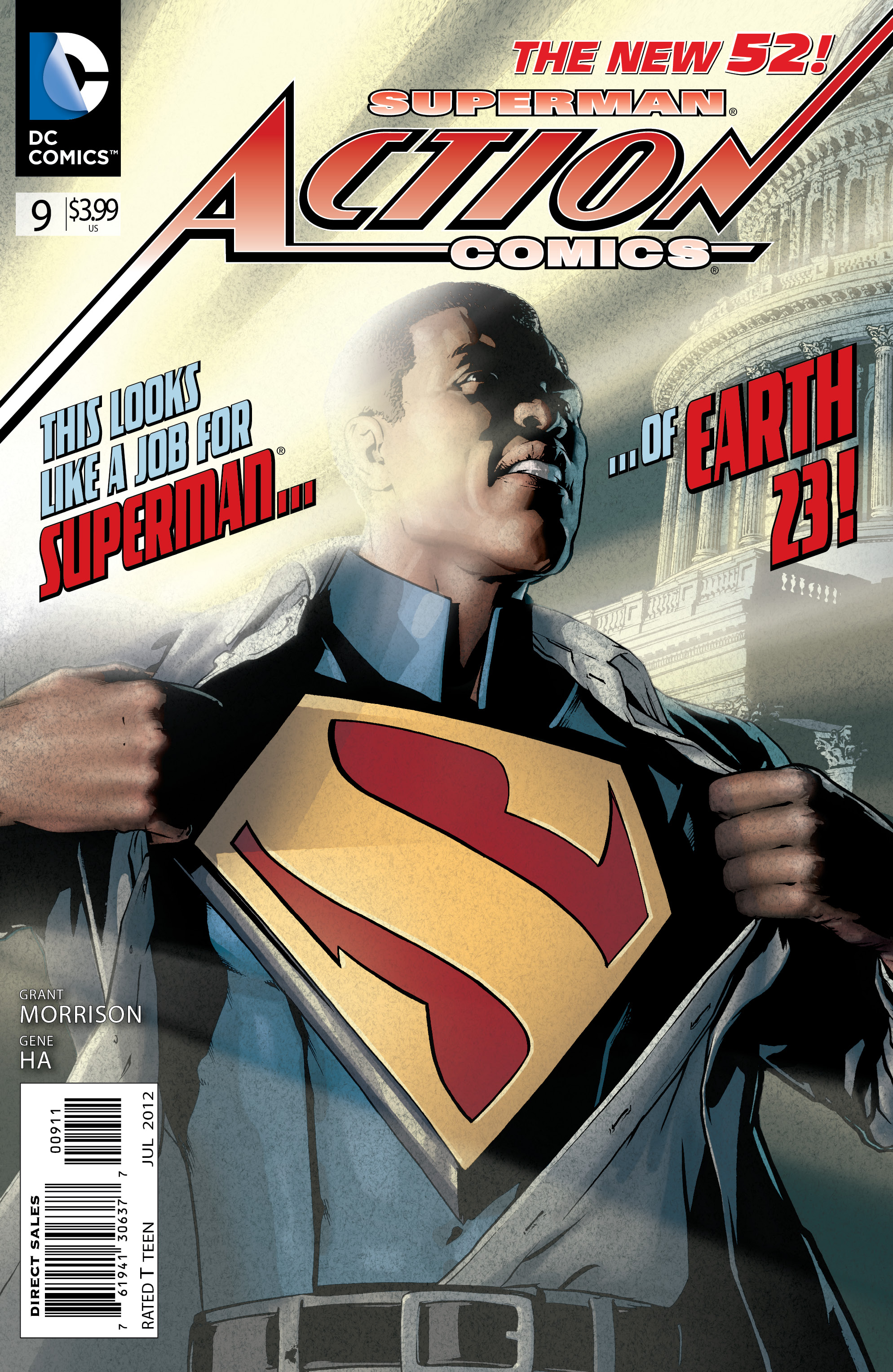
Aside from that, the other character I loved seeing again was President Superman, who first appeared in Final Crisis and was also memorably the featured character in Action Comics #9:
via DC Wikia
I loved that issue, and at the time thought it might be a tease for Multiversity.  Turns out I nailed it.

Tuesday, May 21, 2013

Quarter Bin #50 "Geoff Johns, Grant Morrison, Bloodwynd, Waverider, Etc."

Comics featured in this column were not necessarily bought in a quarter bin.  This is a back issues column.

Armageddon 2001 #1 (DC)
From May 1991:
DC tends to be obsessed with superheroes from the future (Booster Gold, Legion of Super-Heroes) who are obsessed with superheroes of the present.  Waverider is no exception.  Armageddon 2001 was Waverider's big story.  It was all about one of the icons of today turning into tomorrow's tyrant (sort of like Harvey Dent's line in The Dark Knight: "You either die the hero or live long enough to see yourself become the villain").  They say the original plan was for Captain Atom (the basis for Alan Moore's Dr. Manhattan in Watchmen) to be revealed as Monarch (something that ended up being done in the pages of Extreme Justice anyway), but instead (because it was always going to be someone obscure) it turned out to be Hawk, as in Hawk & Dove.  Hawk/Monarch eventually became Extant, who was the other villain in Zero Hour.  Still, like I said this was much more about Waverider.  The whole event was basically a crossover in the 1991 annuals (a yearly bonus issue that used to be a staple and has been staging a sporadic comeback).  Like the "Night of Owls" or "Death of the Family" or "Wrath of the First Lantern" crossovers recent fans might be familiar with, these annuals basically featured the same story with slight variations each issue, making it all the more relevant to care about Waverider himself, which is why this issue recounts his poignant origin, the Kingdom Come of its time.

Heroes & Legends (Marvel)
From October 1996:
The whole point of this jam issue is to commemorate the 1965 wedding of Reed & Sue Richards.  Although I suspect the real reason this was released was because of Superman: The Wedding Album released at the same time, featuring the long-awaited marriage ceremony between Lois Lane and Clark Kent, which featuring a similar jam session.  Every conceivable Marvel hero appears to make the Fantastic Four event pull off with as much incident as possible, just as DC's heroes gathered in Metropolis to give Superman peace of mind and a honeymoon.  I got this one because the cover was so vague I had no idea what was inside.  I just hoped it was interesting.  Another notable appearance in this issue is Phil Sheldon, the reporter who served as the guide in Marvels.

Icon #16 (Milestone)
From August 1994:
Milestone was the DC imprint filled with black superheroes, and Icon was its Superman.  In 1994 there was a crossover between the Milestone line and the Superman family called "World's Collide" (and that's...pretty much the whole story).  This issue was part of that.  The writer was the late Dwayne McDuffie, while the artist was M.D. Bright, who previously worked on Green Lantern.  I'd previously had a copy in my collection of a Superboy installment featuring the Boy of Steel's encounter with Icon's ally Rocket.  I guess Superboy could make a memorable encounter with any young female hero (his relationship with the Supergirl of that era was the highlight of any month it happened).  Here Superman and Icon are deathly dull and the story around them the epitome of paper thin crisis.  If DC wanted people to care about Milestone, this wasn't the way to go.  Milestone is better known today for Static, the teen hero who later starred in the Static Shock animated series and was briefly a part of the New 52 relaunch (and perhaps in hindsight it was a bad call to have artist Scott McDaniel figure out how to be a writer at the same time in the title).

Infinite Crisis #1 (DC)
From December 2005:
Obviously I read the complete Infinite Crisis as it was released.  I even made the rare decision to buy multiple covers of each issue.  The sequel to Crisis on Infinite Earths was an epic examination of generations and perspective.  The classic line from this issue is Batman speaking to Superman: "But they need to be inspired.  And let's face it, 'Superman'...the last time you inspired anyone was when you were dead."  The truly memorable thing about Infinite Crisis, though, as that it truly did focus on Superman and Batman, as well as Wonder Woman.  Yes, there were thousands of other characters at play, but the Big Three were the focus.  They weren't the focus of Crisis on Infinite Earths.  In fact, they were rarely the focus of these crossover events.  Geoff Johns can sometimes be described as a fanboy by his detractors.  In this instance maybe it indeed took a fanboy to finally do an event centered on the three central figures of the DC landscape.  It sounds so obvious to do that, but it's one of those things that are so obvious that no one had really thought of actually doing it before.  So here's what it looks like, and it's glorious.

The Invisibles #21 (Vertigo)
From June 1996:
This counts as the second issue I've ever read of Grant Morrison's Vertigo opus.  Technically I've read the entire first collection of stories, but individually just the first and now this one, and it really figures. The Invisibles is about discovering the scary truths hiding just beneath the surface of the mainstream, and our guide for the journey is initiate figure Dane.  This issue catches up with him as he's trying to process it by revisiting his regular, mundane life of friends and family from the time before he got to look behind the curtain.  Part of the real charm of reading individual issues from the series is having a look at the letters columns.  Back in yon olden days, this was the window into the fan community behind a series.  In these Internet days, everyone thinks they're experts (or just cynical) about everything, and so they don't tend to know or talk about anything in particular except in snide, condescending remarks that mean nothing.  Letters columns were like monthly Wikipedia entries, talking about events and the significance of those events from individual issues.  The best creators used these columns as their personal forum, not only as an open dialogue but a way to express their personalities outside of the stories that were their first impression.  Today it's a mark of distinction to include them against the new standard; Brian Michael Bendis and Brian K. Vaughan are perhaps the best practitioners of this new underground vibe.  I mention all this because Morrison was one of the creators in those days who absolutely made the most of it, and sometimes he used it to craft a dangerous version of himself I contend may or may not have been true.  These days it's not as much fun as I once thought to reread old letters columns, but Invisibles is probably as reliable a forum as you'll find in that regard. 

Justice League America #88 (DC)
From May 1994:
One of the best creative teams I've ever read in comics was Dan Vado and Marc Campos.  They briefly collaborated in the pages of Justice League America and Extreme Justice.  Fans will know the Giffen/DeMatteis/Maguire era and to a lesser extent the Jurgens era (mostly thanks to "Doomsday"), but the sheer awkward humanity reached a crescendo in the aftermath of all that as Booster Gold struggled to recover from losing his original costume, which was really about losing all faith in the superhero community.  Booster and pal Blue Beetle were previously the very incarnation of the carefree spirit, two of the goofiest bastards ever.  In a lot of ways, the forgotten Justice League crossover event "Judgment Day" was the culmination of the Vado/Campos era.  This was the event where beloved neophyte Ice was temporarily killed off (she and Fire...yes, Fire & Ice...were another signature element of this era).  It was also the culmination of the Bloodwynd mystery.  Bloodwynd was a mysterious (hence the mystery) new member created in the Jurgens era.  Some fans will always be convinced that Bloodwynd was finally revealed to be an alternate persona for Martian Manhunter, but that's a stupid misunderstanding.  Bloodwynd was awesome.  By the way, Grant Morrison takes Bloodwynd for a joke of a typical '90s character, and possibly he has the Vado/Campos era in mind (Campos might be said to resemble the typical Image style, but in a DC context he was pretty unique).  If you ever wanted conclusive proof that I'm not a slave to all things Morrison, know that we differ on the subject of Bloodwynd (although the character apparently appears in Morrison's upcoming Multiversity, which will mark his first appearance in...two decades?).  "Judgment Day" in some ways was kind of the story that finally forced everyone to face the elephant in the room.  Was he worth all the mystery the team put up with all those years?  I still hope he makes a triumphant return.

JLA: Our Worlds At War #1 (DC)
From September 2001:
Our Worlds At War was the signature crossover event of 2001, but if it remains notable at all today it's because of the eerie parallels with a far more significant event from that year.  The parallels went so far as several issues of Superman comics being released soon after 9/11 with still more hauntingly relevant images.  This issue is from Jeph Loeb and features the complete text of Franklin Roosevelt's address to Americans following "the date which will live in infamy," interspersed as captions through the story.  Seems pretty heavy, but Loeb is also quick to put Superman at the front of the story (making this the precursor to Infinite Crisis).  This was a time when DC was paranoid about the Man of Steel's continuing relevance, so it tried to make him as edgy as possible.  Goading him into an all-out state of war seemed to be the best way.

JLA Secret Files & Origins 2004 (DC)
From November 2004:
Speaking of making Superman edgy, the other notable story from the period involving this instinct was the saga of Manchester Black as depicted in Action Comics #775.  When DC realized that the story could probably continue, Black's sister Vera helped found the Justice League Elite, which as you might guess was the Justice League but more...edgy.  Actually, there were only two bona fide League-worthy members, Green Arrow and The Flash.  The Secret Files specials were a favorite of mine, primers that included profiles and short adventures (and sometimes handy timelines).  This one put the JLElite in the spotlight, plus a few other notable upcoming stories, including the then-forthcoming return of Grant Morrison's Ultramarine Corps in the pages of JLA Classified.  

JSA #49, 51, 70 (DC)
From August & October 2003, April 2005:
Geoff Johns did a lot of notable material before I caught up with him, and his long work with JSA lasted until the Justice Society of America reboot that I actually did read (notable for the "Thy Kingdom Come" arc that heavily featured an in-continuity Magog from the original Kingdom Come).  His JSA was the first time I read unabashedly good things about what he was doing, fun stories that involved a return to prominence for Hawkman and the emerging menace of the complicated Black Adam.  The first two issues are part of the "Prince of Darkness" arc that might have been the culmination of anyone else's run.  It featured Mordru and focused on elements like Dr. Fate (one of the coolest and most versatile designs for any superhero; check out the Helmet of Fate event for a primer) and Eclipso.  Mordru's name doesn't resonate no matter where you look (except King Arthur lore), but in a lot of ways this whole story was like Geoff preparing for Infinite Crisis, where Mordru would be the prototype Superboy-Prime.  I got the latter issue because it because the modern and Golden Age Mr. Terrific on the cover.  Mr. Terrific was my favorite member of Geoff's Society (although he was an unfortunate victim of the New 52 launch, he did finally receive his first ongoing series...for a few issues).  The issue itself doesn't really feature him so much as include him.  The best inclusion is Walker Gabriel, star of another short-lived series, Chronos (which demands a complete reprint collection).  The villain this time is Degaton, another villain best known to Society aficianados.

The Possessed #4 (Cliffhanger!)
From December 2003:
This was the period in the career of Geoff Johns where he was pretty much doing whatever he wanted.  He was working on The Flash and JSA at DC, Avengers at Marvel, and side projects like this, which was basically his Image work (Cliffhanger! was an imprint of WildStorm, which was at one time a founding imprint at Image).  Actually, The Possessed reads a lot like Robert Kirkman's later The Walking Dead, although there's a little more emphasis on the bogeymen around which the regular human characters are trying survive.  Like Olympus, Geoff co-wrote this with Kris Grimminger.  These days it's superheroes superheroes superheroes (with the odd Vertigo anthology tale), but the existence of material like this is like a promise that one day he'll try something different again.  We'll see.

Thursday, November 17, 2011

Quarter Bin #22 "Smattering of DC from 1986-2002"

NIGHTWING SECRET FILES & ORIGINS
From October 1999.

DC’s SECRET FILES & ORIGINS specials were some of the best things the company did in the 1990s, and something I still wish they’d bring back. This one, obviously, spotlights Dick Grayson from a few months after I was forced to abandon comics for the first time (I should probably reiterate, because 2011 hasn’t exactly seemed to prove it so far here at Comics Reader, but for economic reasons I’ve “retired” from collecting new comics for the second time), just three years after his first series launched. As readers will remember, Dick assigned himself to the We-only-wish-we-were-as-good-as-Gotham neighbor Bludhaven, which was filled with police corruption so thick Chuck Dixon’s Dudley Soames beat Geoff Johns’ Hunter Zolomon by a few years as a police inspector who later turned into a villain (Soames becoming the subsequently underutilized Torque, while Zolomon became the new Reverse Flash). It was during this time that Dick sort of became DC’s Daredevil, with Blockbuster becoming Bludhaven’s Kingpin (with an epic payoff Devin Grayson got to script; it still kills me that her tenure still gets very little respect). The contents were typically stellar: beyond profiles of characters relevant to the series (including a new villain named Shrike who apparently had close ties to Dick) and a chronology from the rise of Robin to the most recent developments in the NIGHTWING series; to a couple of short stories, one of which is written by Dixon with art from Scott McDaniel (the blockbuster team from the earliest run on the book) and actually involves a nod to Jason Todd and two by Devin Grayson, one harking back to the Wolfman/Perez Titans and the other to Dick’s torturous history with women. In short, this is a perfect book for any fan of Dick Grayson, from 1999 and even in 2011, something that will remind readers just how much potential the character has, as well as his rich history.

SUPERBOY #100
From July 2002.

The final issue of the modern Superboy’s first series is perhaps a good indication that at least at that point he really was ready to take a break. The fun starts off with Karl Kesel and Tom Grummett reuniting one more time (they were the creative team who helped launch the character in 1993, as well as the series, and a return engagement hugely inspired by Jack Kirby at the midpoint of the series), marred only by Grummett’s decreased ability (or willingness) to replicate the style he’d made famous throughout the previous decade (he’s one artist who should either be absolutely consistent or completely change his style, because his work in this issue is almost painful to see). From there, the creative team that’d been working on the book in its final issues takes over, and consists of Jimmy Palmiotti and Dan DiDio as writers (and it’s worth noting that DiDio did begin his DC tenure as a writer, which makes his current efforts, which began a few years ago with THE OUTSIDERS not as much of a stretch as some fans might believe) and John McCrea somehow doing even worse art than Grummett-in-this-issue. Clearly the new team had attempted to push Superboy in a completely new direction, almost completely revamping him (which is something I hate for creative teams to do, ignoring someone else’s continuity and replacing it with something that isn’t as interesting but is superficially similar and in short not inspired in the least). The elements they worked with might have actually worked with only a few keys differences (first of which would have been a different artist), but as it is, this left Superboy free to be reimagined by Geoff Johns (who had retroactively-famously proposed his vision in SUPERBOY’s letters column years earlier), and in turn receive a complete reboot this year as part of the New 52, which was probably for the best.

JUSTICE LEAGUE AMERICA #65
From August 1992.

As I wrote about in QB #19, Dan Jurgens and his brief run with the Justice League is probably more memorable to me than for most fans, and a large part of that is the debut of a subsequently obscure character, Bloodwynd. I have a feeling that Dan’s whole run with the League was meant to hinge around the “Doomsday” story (which as of this issue was only about five months ahead), and so it was probably shorter than he’d intended, or at least readers like me would’ve hoped. Maxima, who’s apparently returning in the New 52 with a more alien look, is in the spotlight this issue.

JUSTICE LEAGUE INTERNATIONAL #10
From February 1988.

From the early days of the Giffen/DeMatteis/Maguire run, it shows because the classic line-up isn’t even in place yet, but the spirit of the enterprise already well on display. There are four Green Lanterns featured in this issue, one of them being Hal Jordan, and all the others members who don’t really matter in the modern era (Arisia, who comes closest; G’Nort, who is actually referred to as Gnort in this early appearance; and Katma Tui, who was Soranik Natu’s predecessor as Sinestro’s successor). Features the Manhunters and is a “Millennium” crossover from Week 5 (so says the cover!).

SECRET ORIGINS #2
From May 1986.

From the post-CRISIS ON INFINITE EARTHS version of the New 52 reboot comes this dual origin for the original Blue Beetle, Dan Garrett, and his subsequent replacement, Ted Kord, from Len Wein and Gil Kane. It’d be interesting what a modern creator could do with either one, because what’s presented here hasn’t exactly dated very well. Still, extremely interesting to have, including the Beetle publishing history included in the letters column.

STARMAN #80
From August 2001.

The final issue of James Robinson’s epic (before the Blackest Night resurrection issue) is something I felt like reading long before the Omnibus business I talked about a few months back (and in fact thanks very much to the Blackest Night issue, to link these parenthetical phrases). As expected from the style of the series, the issue deals with Jack Knight’s farewell to Opal and his supporting cast, and in Robinson’s own farewell note, THE SHADE series that has only now just been undertaken is referenced, in case you were keeping score.

Friday, October 14, 2011

Quarter Bin #19 "Bloodwynd"

God, so sometimes it must seem like I yack on about Grant Morrison constantly, so I’m just going to briefly mention him here: in his book SUPERGODS, Morrison briefly mentions the character Bloodwynd as one of those forgettable members of the Justice League before his epic 1996 relaunch. For a lot of readers, that’s probably exactly what they think of Bloodwynd, a superhero who if he’s appeared in the last decade at all, it’s for a minor appearance as part of a forgettable alliance of supernatural figures.

SUPERGODS is replete in popular opinions (which is pretty weird, since Morrison’s reputation is basically as something of a cultural contrarian), so it’s a safe bet that he nailed Bloodwynd’s legacy (the fact that he mentioned him at all is more than two versions of the official DC ENCYCLOPEDIA managed), which for me is pretty sad, since at this point I am probably the character’s biggest and only fan.

JUSTICE LEAGUE AMERICA #61 (DC)
From April 1992.

This is Bloodwynd’s debut, along with Dan Jurgens’ debut as the successor of the Giffen/DeMatteis era, which is mostly known for its eventually participation in the “Doomsday” event. Maybe it’s because I have more experience in Jurgens’ League than the famous “Bwahaha” days, but my interest in Booster Gold and Blue Beetle (Ted Kord) can be traced directly back to this run, not to mention my interest in Fire, Ice, and even Guy Gardner. Along with Superman, Maxima, and Bloodwynd, they comprise my classic Justice League line-up. Bloodwynd, and the central mystery he represented, was an integral element of this chemistry, with Beetle driving himself crazy trying to figure it out. Where Morrison saw a useless figure, there is a classic example of how comic book creators used to introduce new characters, by drawing out their origins, rather than coming right out and explaining everything about them.

JUSTICE LEAGUE AMERICA #63 (DC)
From June 1992.

By necessity, Bloodwynd served as a deus ex machina in his early appearances, the wild card villains hadn’t counted on. Maybe that was more annoying than Jurgens realized. It’s always hard to introduce a new character, whether in their own book or as additions to an established team. Countless heroes have faded into obscurity this way. Since there was no effort in the early days to do anything with Bloodwynd other than be featured in the Jurgens League, history was almost doomed to repeat itself.

JUSTICE LEAGUE AMERICA #74
From May 1993.

Though prominently featured on the cover, Bloodwynd has already been virtually forgotten by his own creator, Dan Jurgens, who at this point has been juggling the aftermath of “Doomsday,” which reshaped the League prematurely, leading to a rebuilding process that basically never came to an end, until Zero Hour ushered in a whole new line-up (the crux of this incarnation was later featured in EXTREME JUSTICE, a book that never got the respect it was due).

JUSTICE LEAGUE AMERICA #76 (DC)
From July 1993.

It also didn’t help that when his origin was finally revealed, Bloodwynd became hopelessly entwined with Martian Manhunter. This one’s the first of two issues that explain how J’onn J’onz had unwitting been masquerading as Bloodwynd since the character’s first appearance, with the real deal trapped inside the distinctive red gem emblazoned on his chest (for those who won’t immediately track down their own information on the character, Bloodwynd was an African American hero whose costume was entirely white, with the gem and a black cape making up the rest of it; he definitely had immediate presence). Readers apparently didn’t read this story in its entirety, since years later most of them still seemed convinced that Bloodwynd was in fact Martian Manhunter. All the momentum that Jurgens had built in the early days of his run, besides, were already over. The mystery of Bloodwynd had lost its impact.

JUSTICE LEAGUE INTERNATIONAL #66 (DC)
From July 1994.

Once “Doomsday” ran through DC, the League books in general suffered, through no real fault of their own. Morrison later proved that fans really liked the big guns, but previous to that, the franchise enjoyed something of a Justice Society period, which reached a culmination in the epic “Judgment Day” arc, which killed off Ice (temporarily) and basically pushed everyone to their limits, forcing characters like Booster Gold and Blue Beetle to finally grow up in the process. But although he participated, Bloodwynd was an afterthought, whatever role he might have had usurped by that era’s Amazing Man (who dominates the cover for this issue, though Bloodwynd is one of several figures featured in a negative image seen battling the arc’s villain).

Featured in the pages of SHOWCASE on his own, Bloodwynd might have interested some people for a brief time, but he was quickly identified as belonging to a bygone era before long, and was quickly erased from the ongoing continuity. The fact that nobody seems to fondly recall Dan Jurgens as a creator of the Justice League can’t possible help matters, or the fact that Jurgens himself abandoned the character, even after finally revealing his origin about a year too late, and never seemed all that interested in revisiting him, even after returning in a full-time capacity to DC.

Why care about Bloodwynd, then? As a character with gothic potential (forged in redemptive fire from his slave heritage), he remains mostly untapped, while many similar characters with less direct magnetism have gotten second and third chances since. As a member of the Justice League, he is, with all due irony, second only to Martian Manhunter as someone with considerable power and an outsider’s perspective. He didn’t just keep to himself to maintain his mystery, it’s because that’s the way he was naturally, but he also had a fierce dedication to his teammates, whether they always appreciated it or not. He’s not the Spectre, bent on some holy mission, but he is a kindred spirit of vengeance, someone who is ideally suited to comment on the complexities of our modern times. There’s so much that could be done with him, and it just seems as if no one has bothered to notice. A good writer can do some exceptional with anything, but with material this rich, you’d think someone would have bothered by now to remember Bloodwynd exists.

Mired by his own publishing history, Bloodwynd has remained in comics limbo for years. But he doesn’t have to stay there.