I went shopping again, in part because Christian Mock got a letter in a comic book, and so I'll be heaping further praise on Tom King's masterful Omega Men, plus some other thoughts.
First, a word on Comic Shop News. This is a free weekly newsletter you can find in most comic book shops (although I've had a rough time finding it in recent years with a lot of stores simply not making enough to give away stuff like this). It's basically the last print source for fans in the age of the Internet, which is probably what killed Wizard. While its interior content is more or less superfluous these days, its main articles are an excellent resource, the rare all-inclusive source for notable projects throughout the medium. Without it, for instance, I may never have heard of Andi Ewington's breakthrough 45. I'm talking about it at all because I picked up a copy, which turned out to be #1,500, which is a milestone if there ever was one. The cover feature this issue concerns Paul Dini's forthcoming graphic novel Dark Night: A True Batman Story, which looks like an amazing project.
Before I get into the comics I bought, it's also worth noting that Batman v Superman: Dawn of Justice is opening this weekend, and the merchandising blitz is in full force, including select cereal boxes including mini-comics. Most of these mini-comics aren't much to write about, but Jeff Parker's "Playground Heroes" turned out to be a pretty good one. In it, he explores Superman's impact on a boy struggling with how to respond to bullies. It's a worthwhile character study where these things tend to be fairly generic storytelling. Presumably, the other three mini-comics in the set are equally worth reading.
Plus, y'know, that movie they're technically hawking is a pretty big deal. As a fan of Man of Steel, I'm glad the Justice League franchise is spinning out of it. Even if fans still prefer the irreverent hijinks of the Avengers and Deadpool at the box office, this is still some of the best superhero material on the big screen, ever.
Anyway, onto the comics proper:
Dark Knight III: The Master Race #3 (DC)
I nearly bought the deluxe version of the second issue. In my more limited comics experience these days, I won't read the complete story until the eventual collected edition. I previously read the first issue digitally. As of this issue, I would equate DKIII with DC's previous Before Watchmen, with Brian Azzarello once again stepping up to help make it a reality. Frank Miller's voice is still there, but there's clearly a filter this time around. I decided to pick up this issue because the mini-comic this time features Green Lantern, apparently from the perspective of the ring itself rather than Hal Jordan. It's interesting stuff.
Martian Manhunter #10 (DC)
I figured I had to revisit this series when the cover boasts, "The Secret Origin of J'onn J'onzz," which otherwise means Rob Williams is getting around to explaining exactly what's been going on, and that's exactly what this issue is all about, a new version of Mars mythology and origin of the Martian Manhunter, how J'onn is involved, and why he ended up splitting himself up into a variety of guises, including Mr. Biscuits. I liked it. Should anyone be interested in expanding on these concepts, they could easily once again tie in Bloodwynd with the rest of it, as confused readers two decades ago...
The Omega Men #2, 4, 5, and 9 (DC)
While accidentally duplicating my print collection of #5, now I'm only missing #3, which I'd read previously in digital form. I can't get over how brilliant this series is. Tom King obviously got to write the greatest non-Geoff Johns Green Lantern story of the New 52 era by making the ostensible leads the terrorists/freedom fighters Omega Men, making alien politics as realistic and intriguing as possible, and featuring a heavy dose of Kyle Rayner to move the narrative along, including #9 finally featuring him reuniting with the white ring. I think Omega Men represents what DC has routinely done better than Marvel, which is to look deeper into the superhero narrative, looking for alternatives in storytelling approach. Marvel does it on occasion, like Frank Miller's Daredevil, Matt Fraction's Hawkeye, and King's Vision, but more often than not it clings to the tradition more than anything else, even in the Ultimate Comics experiments. DC, meanwhile, routinely pushes the boundaries of literature storytelling, not as exceptions but increasingly as the rule. It frustrates fans to no end. They want simplicity and familiarity above everything else. They want what they always had. Omega Men flies in the face of all the rules. Nine issues in and we're still waiting for Kyle to pick a side. Shouldn't it be obvious? Isn't it obvious? And yet King is writing something truly great here, buried in a series that has some of the worst sales of DC's whole catalogue, which DC itself saved from cancellation in order to give King the chance to complete his story. Because, as I've said time and again, DC knows better than the readers what it has with Omega Men, and King. Word is that King will be writing Batman once the full details of DC Rebirth are revealed. I couldn't be happier.
Robin: Son of Batman #5, 6 (DC)
These are the remaining issues under Patrick Gleason's creative direction (although I guess I missed #4) in the follow-up series to his and Pete Tomasi's brilliant Batman and Robin. The more issues I read, the more I'm convinced that Gleason had more creative input in Robin: Son of Batman's predecessor than previously thought, because he proves a deft hand as writer, so similar to and in the same spirit as it that it's a seamless continuation. These issues features Damian's reunion with his mother Talia, confronting the matter of what happened in Grant Morrison's Batman, Inc. while also exploring Goliath's secret origin and rounding out Maya Ducard's story. I have no idea why fans wouldn't embrace this series.
Superman #50 (DC)
Gene Luen Yang's final issue is a big one, concluding both the 'Truth" and "Savage Dawn" arcs. I follow two blogs that both savaged (heh) the issue, and weren't particularly keen on Yang's run in general. For me, putting aside my incomplete reading of it to this point, it was a natural extension of Geoff Johns' (it's rare when two different writers can do this; previously I can think of Chuck Dixon and Devin K. Grayson in the pages of Nightwing, and...really, that's about it, except for maybe Karl Kesel and Stuart Immonen in the Superman comics). The whole point of it, taking away Superman's powers, was to provide one of those extreme situations that the '90s did on a constant basis. And in fact, Superman lost his powers in the '90s, too (in the wake of The Final Night). This time, however, his identity was exposed at the same time. He began to feel hounded, and no longer knew who to trust. For a lot of readers, this didn't feel true to character. Yang's fight club, I think, was what most alienated readers. It's a common trope, but as far as I could tell from the issue that debuted it, Yang's version was uniquely positioned to explore Superman's insecurities, kind of like if he'd ended up in the Bottle City of Kandor instead, or some other environment where he had to rediscover what being Superman means. Because that's really what it was all about. It was a place where he was safe when he felt unsafe everywhere else, both because of the powers and the identity being compromised. So this issue has him dealing with Vandal Savage, who presents him with further options, ultimately forcing Superman to once again affirm what he does and why he does it. At the end of the issue, he's reunited with Lois (and Jimmy), who tell him, "Go be Superman!" and, "Go be Clark." Because far too often, there's confusion as to which he is. When he's really both. Which, again, was the whole point of this crisis. We've become too comfortable with the notions of Superman and his secret identity. The modern era has been trying to dismantle that for twenty years. I guess it'll have to keep trying.
All-New Wolverine #5 (Marvel)
Mock's letter appears in the letters column of this comic. It's one of those letters from a fan who has found a comic that's let them be a fan again. Mock as been a reader longer than I have. He's probably a different kind of fan than I am. Which is fine. This is another of the many Marvel series in recent years featuring a new character in a familiar guise. It's an old DC trick but one Marvel has only recently begun to embrace. A lot of them have been about switching the gender. This is one of them. Since Death of Wolverine (which some have interpreted as Marvel's campaign to undermine the X-Men movies by removing the most popular mutant from the comics landscape, except in the pages of Old Man Logan), classic Wolverine has remained dead. In his place is now the character formerly known as X-23 Laura Kinney. This particular issue reminds me a great deal of Valiant's Bloodshot Reborn, which features a character who is very much a Wolverine variant himself. I can't say I find this to be a bad thing, because it's always nice to see the big guys pay attention to the competition, and to have a comic that pays attention to mythology in general. I can't say the issue made me want to read the series faithfully (all told, I guess I'm more interested in Bloodshot Reborn), but it was certainly worth reading at least once. Cheers, Mock!
I guess, if there's an overall lesson to be learned from this particular post, it's that I'm always going to be a fan, no matter how my readership evolves.
Showing posts with label Brian Azzarello. Show all posts
Showing posts with label Brian Azzarello. Show all posts
Tuesday, March 22, 2016


Wednesday, November 25, 2015
Reading Comics 176 "DK3, Klaus, Legend of Wonder Woman, Superman: American Alien"
Some comics you just have to read. These are some of them. 2015 wouldn't be complete without them.
The Dark Knight III: The Master Race #1 (DC)
Frank Miller is back, this time aided by co-writer Brian Azzarello and Andy Kubert. I have a feeling that Azzarello will be given all the credit for the results, but Miller's influence is powerful, not only in Kubert's efforts to evoke his art (at least as seen in The Dark Knight Strikes Again), but in the storytelling, perhaps best in the Atom backup tale. Most surprising, perhaps, is how Master Race reads almost like a sequel to someone else's Dark Knight entirely, Christopher Nolan's. Remember how Batman was being hounded by police at the end of the 2008 film? That's where DK3 picks up. With a few twists, of course. I think it's brilliant. Atom, meanwhile, reads like Miller voicing his own thoughts on this last great adventure, his frustration and, yes, gratitude.
Klaus #1 (Boom!)
This is Grant Morrison's Santa Claus origin story. As of this issue, infinitely more amusing than Nameless, for which I'm very grateful to report. A Wildman returns to a town he's frequented in the past, only to discover that it's changed under the auspices of a new regime. Ironically, the main problem is a spoiled child who is ruining Yuletime and being disappointed by it at the same time. Morrison slips in his magic, and quickly sends Klaus toward his destiny. It'll be interesting to see how the story continues to unfold, but this is certainly a promising start.
Legend of Wonder Woman Chapters 1-3 (DC)
Superman: American Alien #1 (DC)
Both of these are origin stories that revisit the children at the start of iconic journeys. Renae De Liz, and her lush art, are perfect for the girl who would be Wonder Woman, as she struggles against the confines of a life meant to shield her from harsh truths. It's a story the Amazon Warrior has badly needed, and in recent years has been working toward, ever since Ben Caldwell's serialized Wednesday Comics adventure. American Alien, meanwhile, revisits Smallville, and fruitfully. Max Landis and Nick Dragotta bring a far more inclusive version of the young Clark (and family) discovering his powers than I've ever seen (except maybe in the pages of Tom De Haven's It's Superman!).
Certainly the comics featuring DC's Big Three are entirely welcome additions to their respective mythologies. Hopefully Morrison will be doing the same for Santa. They're all very much worth a look.
The Dark Knight III: The Master Race #1 (DC)
Frank Miller is back, this time aided by co-writer Brian Azzarello and Andy Kubert. I have a feeling that Azzarello will be given all the credit for the results, but Miller's influence is powerful, not only in Kubert's efforts to evoke his art (at least as seen in The Dark Knight Strikes Again), but in the storytelling, perhaps best in the Atom backup tale. Most surprising, perhaps, is how Master Race reads almost like a sequel to someone else's Dark Knight entirely, Christopher Nolan's. Remember how Batman was being hounded by police at the end of the 2008 film? That's where DK3 picks up. With a few twists, of course. I think it's brilliant. Atom, meanwhile, reads like Miller voicing his own thoughts on this last great adventure, his frustration and, yes, gratitude.
Klaus #1 (Boom!)
This is Grant Morrison's Santa Claus origin story. As of this issue, infinitely more amusing than Nameless, for which I'm very grateful to report. A Wildman returns to a town he's frequented in the past, only to discover that it's changed under the auspices of a new regime. Ironically, the main problem is a spoiled child who is ruining Yuletime and being disappointed by it at the same time. Morrison slips in his magic, and quickly sends Klaus toward his destiny. It'll be interesting to see how the story continues to unfold, but this is certainly a promising start.
Legend of Wonder Woman Chapters 1-3 (DC)
Superman: American Alien #1 (DC)
Both of these are origin stories that revisit the children at the start of iconic journeys. Renae De Liz, and her lush art, are perfect for the girl who would be Wonder Woman, as she struggles against the confines of a life meant to shield her from harsh truths. It's a story the Amazon Warrior has badly needed, and in recent years has been working toward, ever since Ben Caldwell's serialized Wednesday Comics adventure. American Alien, meanwhile, revisits Smallville, and fruitfully. Max Landis and Nick Dragotta bring a far more inclusive version of the young Clark (and family) discovering his powers than I've ever seen (except maybe in the pages of Tom De Haven's It's Superman!).
Certainly the comics featuring DC's Big Three are entirely welcome additions to their respective mythologies. Hopefully Morrison will be doing the same for Santa. They're all very much worth a look.
Monday, April 13, 2015
The New 52: Futures End #48 (DC)

artists: many, many artists
And how does The New 52: Futures End, well, end? Apparently with Batman Beyond realizing, as the panel suggests, that he failed.
Yeah. Never quite see that coming, do you? But there were surely surprises along the way, and really, I think the whole point of Futures End was making Batman Beyond officially part of DC canon, giving him a whole event and everything. And as it turns out, replacing the original one with Tim Drake.
This wouldn't be the first time a weekly series has swapped one secret identity for another, even. Countdown to Final Crisis did that for Red Robin, a persona that debuted in Kingdom Come and originally featured Dick Grayson under the cowl. But as with the Boy Wonder version of Robin, Jason Todd succeeded him. And later, even Tim Drake. Drake has, in fact, been Red Robin throughout the New 52, though with a redesigned look and relegated mostly to Teen Titans comics except for appearances in various Batman crossovers.
Drake is the Robin who most selflessly supports the Batman legacy, so it's fitting that he finally gets a chance to be Batman, in one form or another. Unless there's another swerve, he's going to be the star of the upcoming Batman Beyond ongoing, which will also mean his first solo series in the New 52 era. He was famously the star of the first-ever Robin ongoing, not to mention the popular series of limited adventures that preceded it.
Second lead, at least as represented in this issue, for Futures End turned out to be Mr. Terrific, a character among several who was given a second chance in the weekly after having proven a bust at the start of the New 52 in his own series. He also appeared in Earth 2: World's End, although he was probably more crucial here, as one of two people (the other being Bruce Wayne) responsible for the unintentional unleashing of Brother Eye, who has been a standby villain since Infinite Crisis, and at one point even the intended foe in a Justice League movie, him and all his associated OMAC drones.
I'm still more than okay with not having read Futures End all the way through. It was launched under great fanfare as the most important of the three weeklies DC debuted last year, and had at least two writers with considerable critical pedigree behind them (Brian Azzarello and Jeff Lemire), supported by more traditional ones (Dan Jurgens and Keith Giffen). In the end, I would assume that the veterans seemed to run more of the show. I don't know.
The only thing I would really want to go back and read is Superman's arc from when he returned to how he eventually exited. Given how much attention was given to whether or not the real Man of Steel was even going to be present, one might have expected him to be featured in this final issue. At least, one might have expected that if they hadn't been reading faithfully.
As it turns out, the future that ended was Batman Beyond's. But now there's a new one.
Monday, December 15, 2014
Quarter Bin #64 "Binge-worthy IX: An Indulgence"
Air #8 (Vertigo)
From 2009.
From 1992.
From 1993.
From 1992.
From 2004.
From 1992.
From 2005.
From 2010.
From 2001.
I read Superboy pretty religiously after it launched in the wake of "Reign of the Supermen." Karl Kesel and Tom Grummett did some truly excellent work (to say nothing of the brilliant Superboy and the Ravers spin-off). When I gave up reading comics in 1999, the series was in the middle of its "Hypertension" arc that was one of the first times DC had allowed the concept of the multiverse return after Crisis on Infinite Earths theoretically ended it forever. I'd highly encourage DC to print up some trade collections from the Kesel/Grummett years. This particular issue doesn't involve Kesel or Grummett (except the latter on the cover), but it at least continues the feel of that era in its story, unlike later issues (before its eventual cancellation with #100, in which it had transformed into a completely unrecognizable series, alas). The highlight is a conversation between Roy Harper (known variously as Speedy, Arsenal, and Red Arrow) and Jim Harper (known as Guardian), something I'm not even sure had ever been thought of before, but there's Jay Faerber doing it, at the moment he had his apparently fleeting moment to work in the mainstream.
The Adventures of Superman #476 (DC)
From 1991.
From 2003.
From 2012.
 |
| via Vertigo Comics |
Air is the genius series that first introduced me to G. Willow Wilson, who has staged a remarkable comeback with Ms. Marvel. You see, even though I love Air, there wasn't much of that going on during its original publication. I named it twice to the top of my annual QB50 list. I passed on scooping up this random issue a couple of times before finally deciding to buy it. And once again I was reminded why I love Air so much. Blythe has just experienced mystery lover Zayn's life firsthand, but there's very little time to reflect on that, because piloting the hyperprax method takes great concentration. Did I mention Amelia Earhart was involved? The whole experience was like following pirates of the imagination whose goal was to try and invent the future. Hopefully Wilson's current success will help readers rediscover her masterpiece.
Detective Comics #648 (DC)
 |
| via Comic Vine |
I picked this one up in part because of that gorgeous Matt Wagner cover, and also to hopefully catch a little of that early Tim Drake era, after he'd become the new Robin and before the whole Bane business threw everything into chaos. I ended up gifted with an early Spoiler appearance. Stephanie Brown's journey to becoming a permanent institution in the Batman mythos has been incredibly complicated. At one point she succeeded Tim as Robin, was unceremoniously killed off, revived, and apparently rejected from the New 52 landscape until she showed up in the pages of Batman Eternal. She's also been Batgirl, by the way. But Spoiler is iconic all on her own, thank you very much.
Daredevil #323 (Marvel)
 |
| via Comic Vine |
The only reason for me to have gotten this one, as it turned out, was because of the Scott McDaniel art. Yeah, that cover promises Venom, and Venom was pretty big business for a while, but that's no reason to read this. The Daredevil costume inside the issue is one of those variants Marvel tried in the '90s, including a return to his original look, but that simple red one is really all you need. I had my first experience with McDaniel in the pages of Nightwing, which in a lot of ways might have been deemed in that first incarnation as a kind of DC version of Daredevil, complete with Blockbuster reinvented as a Kingpin figure with a similar singular focus on ruining the life of a pesky vigilante that went on to epic proportions (and under two creators: Chuck Dixon and Devin K. Grayson). So to finally see McDaniel in the pages of Daredevil itself was worth the trouble of ignoring everything else about the issue. And as it turns out, his work certainly evolved over the years. I mean, I guess it figures. But it's interesting to see it when it was less distinctive, though certainly recognizable. I still can't believe that McDaniel has apparently angered the comic book gods and now can't get a regular penciling gig. It boggles the mind. He's got insane talent.
Elongated Man #1 (DC)
 |
| via Pinterest |
After Identity Crisis, Ralph and Sue Dibney took on iconic proportions, for reasons most comic book characters probably wouldn't want to have associated with them even if it meant immortality. Elongated Man is a peculiar relic of the Silver Age, a costumed detective who along with Plastic Man and Mr. Fantastic is best defined for an admittedly wacky superpower. Being married always gave him special distinction. This mini-series, spinning out of the infamous Giffen/DeMatteis Justice League era, is quite shocking for post-Identity Crisis readers, actually. This debut issue sees the Dibneys in considerable discord. The art is from the late Mike Parobeck, who would later achieve his greatest recognition in the pages of the comics spinning out of The Batman Adventures TV series. I first saw his work in the pages of an attempted Justice Society relaunch from around the same time, and I always liked it. Another crying shame in comic book creators taken too soon. At this point he's been dead nearly twenty years!
Global Frequency #12 (WildStorm)
 |
| via Full-Page Bleed |
Warren Ellis is the acknowledged master of the big concept in comics, the writer Jonathan Hickman and Rick Remender have been chasing and what Grant Morrison would look like if he weren't the personification of caffeine in the medium. Maybe it's because his reign in that regard began while I wasn't reading them, but I always found it difficult to get into him. Every now and then I'll check in with what he's done, and if I'm honest about it I'll admit I've never been disappointed. Global Frequency is another such instance. This is the conclusion of the story, with various characters converging in a sequence that in a movie would definitely have left my heart pounding as they try to disable a fail-safe weapon the United States military put in place years ago.
Grendel: War Child #1 (Dark Horse)
 |
| via Comic Vine |
This is also technically Grendel #41. Grendel, along with Mage, is the defining work of Matt Wagner's insufficiently-heralded career. Wagner is one of the kings of the indy scene, a pioneer who helped pave the ground for Image (where Mage unfolded at one point), but now can't seem to get work unless it's related to some licensed property or another, which in itself is not a bad thing, but for a guy who's already struck gold twice on his own, it kind of comes off as a slap on the face. Anyway, this issue is brilliant, explains the whole concept perfectly (instantly makes me want to read more), and somehow the issue is still stolen by an account of Grendel's recent print history at that time, being tied up in legal hell after Comico went out of business until Dark Horse finally came to the rescue and the issue you've just read has been made possible. Anyway, Wagner is currently doing Grendel vs. The Shadow...
Justice League Europe #7 (DC)
From 1989.
 |
| via comiXology |
Here's the Giffen/DeMatteis era in full bloom, two series strong and crossing over for the first time. After Jurgens did his version and then later incarnations diluted the potential of having a non-all-stars version of the Justice League and we (happily) got Grant Morrison's JLA, it began to seem as if the whole run had been repudiated, but then the reunions began (and now we have Justice League 3000, which I've finally read for the first time). It might be sometimes hard to remember that not only was Batman present in these comics, but he was definitely the Batman you are probably thinking about, not Adam West and definitely the Dark Knight. Other than the "One punch!" moment with Guy Gardner, yeah, he was still around. And in this issue, doing his level best to counteract...everyone else. For me, it's inconceivable to even try to pretend these comics didn't happen. The line-up is classic in the same way the New Teen Titans were, and the many times Booster Gold and Blue Beetle have popped up together prove all over again that it's not all just "Bwa-ha-ha" but rather a solid era that left a positive impression on the landscape...
Spider-Man Unlimited #8 (Marvel)
.JPG) |
| via Martwa Strefa |
Here's one of those Joe Hill comics. Hill's the son of Stephen King, and the father helped inspire the son to write books, and I figure the son helped inspire the father to write comics. This early example is a little goofy, but it does feature the art of Seth Fisher, another comic book creator who left us far too soon. Dying at the very start of 2006, which made much of his last work, Fantastic Four/Iron Man: Big in Japan, published posthumously, he was also known for Green Lantern: Willworld and The Flash: Time Flies. The issue also contains the work of Ryan Sook, whose clean work I've always admired, and is perfectly suited to Spider-Man. Sook probably comes closest to evoking the Stuart Immonen I know and love from his Superman era.
The Spirit #6 (DC)
 |
| via Comic Vine |
I picked up a couple of Spirit comics because at the time I was reading a book that reminded me that there were Spirit comics that were probably similar to it. Yeah, so this issue in particular I grabbed because of the backup from Brian Azzarello and Eduardo Risso, the 100 Bullets team that have otherwise worked together a number of other times as well, and now I've caught a few of those instances for myself, even though I never got into 100 Bullets itself (when it reached the hundredth and final issue, I tried to catch that, but didn't manage to).
The Spirit #8 (DC)
From 2011.
 |
| via Xplosion of Awesome |
But to speak of The Spirit itself for a moment, of course this is the legendary Will Eisner's most famous creation, a pulp fiction vigilante who has since joined a whole collection of migratory characters constantly shuffling from company to company. It's not that this isn't good material, because it is. I wonder if it had been published under the Vertigo imprint that it might have had a different fate, or perhaps simply unconnected to the rest of the "First Wave" line. Who knows? One thing is for certain, however, and that the sneak preview included at the back of the issue for Scott Snyder's Batman debut in the pages of Detective Comics was another recent reminder that I've probably way too harsh on Snyder in recent years. Expect friendlier coverage on that front in 2015...
Superboy #82 (DC)
 |
| via Scans Daily |
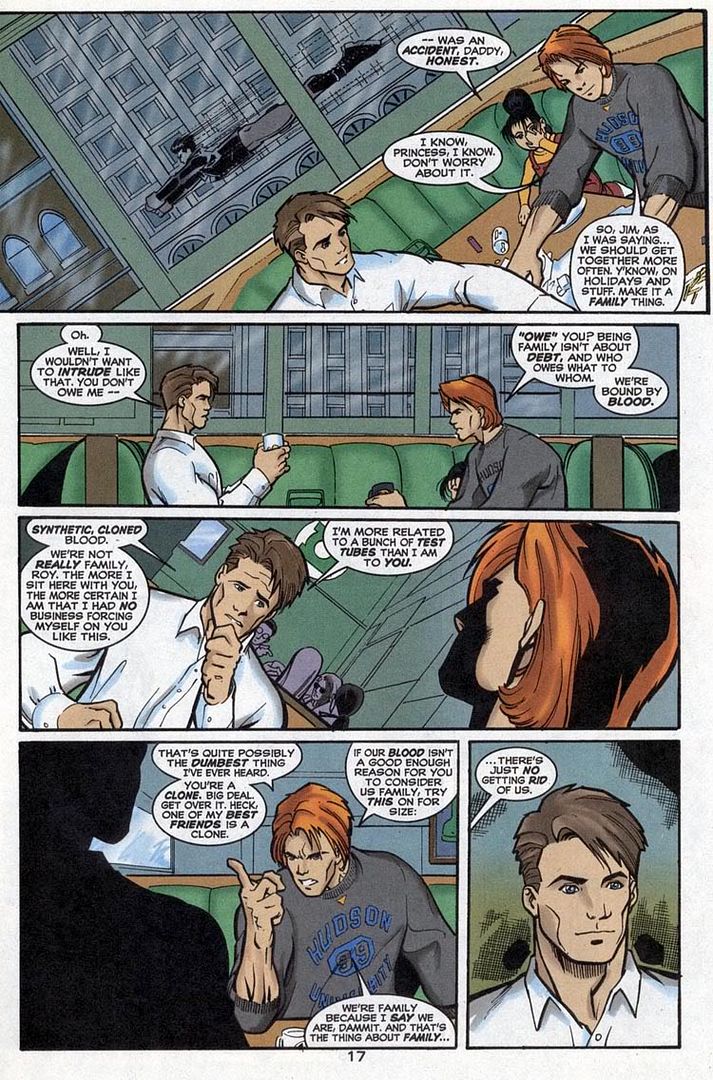
I read Superboy pretty religiously after it launched in the wake of "Reign of the Supermen." Karl Kesel and Tom Grummett did some truly excellent work (to say nothing of the brilliant Superboy and the Ravers spin-off). When I gave up reading comics in 1999, the series was in the middle of its "Hypertension" arc that was one of the first times DC had allowed the concept of the multiverse return after Crisis on Infinite Earths theoretically ended it forever. I'd highly encourage DC to print up some trade collections from the Kesel/Grummett years. This particular issue doesn't involve Kesel or Grummett (except the latter on the cover), but it at least continues the feel of that era in its story, unlike later issues (before its eventual cancellation with #100, in which it had transformed into a completely unrecognizable series, alas). The highlight is a conversation between Roy Harper (known variously as Speedy, Arsenal, and Red Arrow) and Jim Harper (known as Guardian), something I'm not even sure had ever been thought of before, but there's Jay Faerber doing it, at the moment he had his apparently fleeting moment to work in the mainstream.
The Adventures of Superman #476 (DC)
 |
| via Boosteriffic |
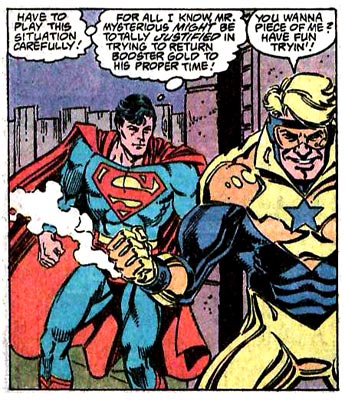
The "Time and Time Again!" arc was something I remember seeing advertised when it was later republished in a trade collection. It was the first notable arc Dan Jurgens orchestrated, and it involved Booster Gold, his most famous creation, and the Linear Men, and even the Legion of Super-Heroes. I wonder in hindsight if there was any discussion among fans that maybe this material was a little similar to the far more famous "Days of the Future Past" arc from X-Men, because there are definitely similarities. Either way, it's a reminder of how much Jurgens used to have fun with his Superman. When he wasn't, ah, killing him...
Superman #193 (DC)
sE9swm,u-GBRP6R0o+Og~~60_1.JPG) |
| via We Shop |
Here's Scott McDaniel again, being far more familiar in his art this time than the previous Daredevil work, because of course this is after the Nightwing material I remember so fondly (among other work, including The Great Ten). The writer for the issue is Steven T. Seagle, whose most notable Superman story is actually a Vertigo graphic novel entitled It's a Bird..., which was released a year later and details his reluctance to tackle the Man of Steel creatively. One of the best comics I've ever read, too. This issue, meanwhile, seems to involve Superman and Lois Lane's daughter. But I'm sure there was some other explanation...
The Twelve #12 (Marvel)
 |
| via Science Fiction |
Ha. Realizing the publication year is just one of those ironies about this issue that is only just now dawning on me. 2012. Of a series called The Twelve, twelve issues long, and here its twelfth issue. The other layer is that the series was famously delayed for quite a while two-thirds of the way through, seemed like it was never going to finish. And now several years later I catch this final installment, again, as a random discovery in a back issue bin. It remains a favorite comics memory, a variation on Watchmen from a more sober perspective, wondering what would happen to a whole generation of WWII heroes reawakened, years after Captain America received similar treatment, with all their stories opening up again and not to their benefit. The best I've ever seen from J. Michael Straczynski. Artist Chris Weston, who at one point cobbled together a one-shot all on his own just to keep awareness of the project alive, also worked with Grant Morrison on The Filth.
Sunday, December 7, 2014
Quarter Bin #63 "Binge-worthy VIII: Superstars"
Superstar: As Seen On TV (Image)
From 2001.
This is now the best thing I've read from Kurt Busiek. Busiek made his name on Marvels, the project also known for launching Alex Ross's career, and later as the creator of the sprawling Astro City, relaunched last year by DC. I've often found that Busiek is best read as a nostalgia writer, though, hesitant to do anything that would break away from his image. Superstar is a departure. It was an early millennium attempt from comic book creators in general to do something new. The lead character is a superhero whose worst enemy is also technically his biggest supporter: his own father. That's a dynamic that is itself a fresh concept, but the greater concept around that one is one that was actually years ahead of its time: Superstar was made for our social media age, as his power levels are literally fueled by public support. It's shocking that this was a one-shot deal, and that apparently no one has thought to revisit it (aside from an expanded IDW re-release three years ago). The main draw for me, though, was artist Stuart Immonen, who at the time was transitioning away from his then-career defining monthly commitment to Superman and embarking on the course that has led to the altered style he's employed at Marvel for years now. This is pure Immonen goodness, what might be considered now a what-if scenario if he and Busiek had expanded on the concept. That would've been nice...
The lead in this mini-series was the Crispus Allen version of the Spectre, but I picked up this issue because of the back-up featuring Dr. 13, an obscure occult detective recently somewhat featured in Trinity of Sin, and the reason I was interested was because the creative team for the story was Brian Azzarello and Cliff Chiang, who recently concluded a three-year arc on the New 52 Wonder Woman. It's interesting to see how Chiang's art evolved from then to now (positively, which is something I'm still struggling to say about Immonen), from a more cartoony look to...at least a more streamlined version of that look. The story itself is pretty good, too. Grant Morrison fans will probably love how it ends. Maybe it's because I was not necessarily aware of Dr. 13 until recently, but I was surprised to learn that the character of Traci 13, whom I first noticed in the pages of the original Jaime Reyes Blue Beetle series, is in fact Dr. 13's daughter. Yeah, it seems kind of obvious now...
New Teen Titans was one of the hottest comics of the '80s, and its legacy still looms large. My first exposure was a random back issue I found in an antique store, New Teen Titans #39, in which Dick Grayson officially quits his Robin persona; the debuts of Cyborg, Starfire, and the whole "Judas Contract" saga are elements that will always keep the Wolfman/Perez era relevant for fans. Last year I read a volume collecting the first handful of issues. This latest random selection was not nearly as lucky as the previous one, however. I know there are plenty of good Donna Troy stories, but this isn't one of them.
Wanted is the project that helped Mark Millar launch his MillarWorld, a unique distinction he's given his work since after having become Hollywood's third favorite comic book writer after Alan Moore and Neil Gaiman. Wanted was very loosely adapted into a major motion picture, and of course there have been two Kick-Ass movies, and now Kingsmen: The Secret Service. The movie version of Wanted had James McAvoy run around Angelina Jolie as assassins. The original comic involves a whole world of supervillains. I'm convinced Millar originally conceived of this as a DC project, and after DC opted for Brad Meltzer's Identity Crisis Millar revised his idea as a standalone concept. Who knows? He'd already helped make history with The Ultimates, and would do so again with Civil War, but my favorite Millar mainstream effort remains "Old Man Logan." The Wanted artist is J.G. Jones, who would later illustrate boldly the covers of 52, plus the interiors for the majority of Final Crisis.
From 2001.
 |
| via eBay |
Tales of the Unexpected #8 (DC)
From 2007.
 |
| via DCU Reviews |
The New Teen Titans #12 (DC)
From 1981.
 |
| via comiXology |
Tom Strong #36 (ABC)
From 2006.
Turns out this is the final Tim Strong story from Alan Moore. Tom was a kind of pulp hero that was also Moore's quasi-extension of his Supreme work, which was a quasi-extension of the Silver Age Superman (woo!); the headlining act of the America's Best Comics imprint that Moore walked away from once WildStorm was acquired by DC, a company Moore no longer had any interest in working for (despite having made virtually his whole reputation there, with Saga of Swamp Thing, Batman: the Killing Joke, Watchmen, and other projects). Tom remains in print, however, thanks to original artist Chris Sprouse. Moore's finale is strong even for those like me who have read very little Tom Strong. It wraps up his story, explaining certain elements of the mythology, and is arguably a much stronger read than "Whatever Happened to the Man of Tomorrow." If you're curious about the character, you could do worse than to start with Tom "At the End of the World."
 |
| via iTunes |
Wanted #4 (Top Cow)
From 2004.
 |
| via comiXology |
Sunday, November 16, 2014
Reading Comics #138 "Character rundown from The Multiversity: The Just, plus other October 2014 comics"
Boom! Studios Halloween Fright Fest 2014 (Boom!)
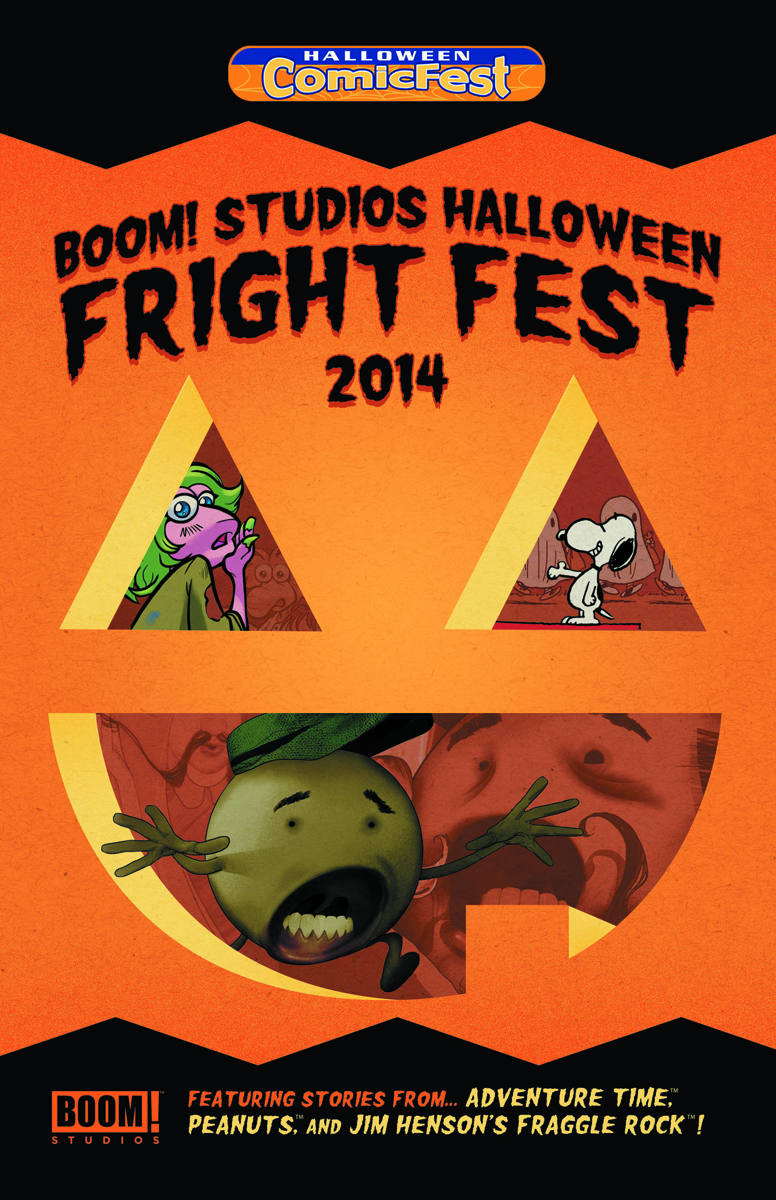
The only Halloween freebie I picked up this year. Frazer Irving illustrated the Adventure Time lead story, which was interesting insofar as Irving always does good work and Adventure Time is, well, interesting. There were a few vintage Peanuts strips reprinted, plus background information on Charlie Brown's infamous luck with kites explained by the late Charles Schultz. Finally, the lead-out was Fraggle Rock. Hey, it was free.
I'm not really a Marvel guy, but I like it when Marvel celebrates itself (which does seem to happen often). Anyway, this was a special that featured a couple of stories and retrospective essays. The first story is from James Robinson and is close to the Marvel version of Darwyn Cooke's New Frontier comics over at DC. It's also, I guess, like Marvels. Reflects on "where were you" when the Fantastic Four were born. Bruce Timm next adapts Stan Lee's first-ever Marvel story, featuring Captain America. Works better in a modern, Timm style. Also included is the original text version. Then there's Brian Michael Bendis revisiting Alias (his comic, not the unrelated TV show). I never read Alias, but if it was as good as this was, hopefully Bendis really does consider bringing it back, as is suggested in the story. A text piece explores forgotten Golden Age creations, and curiously includes Rockman, a character revived in the pages of the excellent The Twelve. Tom DeFalco does a pretty typical young Peter Parker Spider-Man tale. A text piece on Marvel's black superheroes. Len Wein returns to his most famous creation, Wolverine. A text piece on the real world intruding in Marvel's pages. Goofy covers that mock things that would never happen (What If? for the Instagram generation). All told, I thought it was a pretty good reflection.
The third issue of The Multiversity from Grant Morrison explores a world populated by all the DC characters created from the '90s onward, a next generation experience that takes a different tack from Kingdom Come, more akin to Morrison's ideas previously represented by Zenith and Super Young Team, superheroes straight from our media-obsessed age, who have less fighting and more angst to fill up their days.
The Brand enters (re-enters? I don't know) the picture, looking to figure out whatever happened to The Will, one of my favorite supporting characters who hasn't been around in a while. Just a truly excellent issue, classic example of what made me love the series in the first place. Pity, since the series now goes on hiatus until sometime early next year.
Geoff Johns returns after the Futures End interlude to continue the Ulysses saga as he and Superman step up their efforts to end the threat of the Machinist. Ulysses ends up making a bold move that may prove to be the definitive transition of the arc.
The conclusion of the Brian Azzarello/Cliff Chiang era has been getting mediocre reviews from the circles I visit, but I was going to have to read this one for myself even though I've had a spotty record reading the series so far. This is basically the end of the First Born arc, too, with the most feeling of conclusion coming from Azzarello revealing the true nature of one of his supporting characters, a twist that underwhelmed other observers, but to my mind tracks well with what the series had done previously, exploring the nature of conflicting allegiances that has always been one of the worst-explored aspects of Wonder Woman (previously relegated to "you represent us! you don't represent us!"). All along I've been convinced that this was a classic interpretation of the character, completely unusual and therefore with that much greater opportunity to say something new, which has been badly needed for decades. It's distinctive, not just because of the art, but because it's allowed Wonder Woman to completely own her own mythology, not just "Greek gods, Greek gods, Greek gods" but what that means to her specifically. Again, something that's needed to be done for a long time. The instinct in the future will be to distance Diana as much from this material as possible without outright erasing it from the record, but that would be a mistake. DC's already had other writers doing a more traditional interpretation simultaneously, including within the pages of Geoff Johns' Justice League and a burgeoning, unprecedented-in-the-modern-era line of sister titles, Superman/Wonder Woman and Sensation Comics. I don't think any of that would have been possible without Azzarello's confident take
 |
| via Previews World |
Marvel 75th Anniversary Celebration (Marvel)
 |
| via Hero Complex |
The Multiversity - The Just (DC)
 |
| via Comic Vine |
Here's a rundown of the characters who appear"
- Sister Miracle (Sasha Norman), new creation, based off Shilo Norman, the Mister Miracle alternate Morrison used in his Seven Soldiers of Victory project.
- Megamorpho (Saffi Mason), new creation, based off Metamorpho, also known as Rex Mason.
- The Atom (Ray Palmer), long-established character who in the '90s was de-aged and became a member of Dan Jurgens' Teen Titans.
- Alexis Luthor, Lex Luthor's daughter, based on a concept from late '90s Superman comics.
- Batman (Damian Wayne) one of Morrison's most famous characters.
- Superman (Chris Kent), based on the "Last Son" character created by Geoff Johns.
- Azrael (Jean-Paul Valley), his costume on display; the post-"Knightfall" replacement Batman.
- Offspring (Ernie O'Brian), featured in Mark Waid's follow-up to Kingdom Come, The Kingdom.
- Green Lantern (Kyle Rayner), the '90s addition to the franchise.
- Green Arrow (Connor Hawke), Oliver Queen's son and one-time successor.
- Loose Cannon, Chronos, Gunfire, Max Mercury, Anima, Risk; group shot. Loose Cannon, Anima and Gunfire were part of the "Bloodlines" generation from 1993. Chronos was the anti-hero star of a brilliant, short-lived series. Max Mercury was another Waid creation, within the pages of The Flash and Impulse. Risk was part of Jurgens' Titans. There are a few others I can't positively identify.
- Superboy (Kon-El), whom Morrison cleverly has suffering from Bizarro syndrome. I have no idea why this is the first time the idea has ever come up. Brilliant.
- Red Amazo, combining Red Tornado with classic Justice League villain Amazo.
- The Flash (Wally West), the defining Flash for a generation thanks to Waid and Johns.
- Alpha Centurion (Marcus Aelius), a character I've badly wanted to see make a comeback for years. This may be it. For now.
- Steel (Natasha Irons), daughter of John Irons, the original Steel, with a long history herself.
- Argus (Nick Kovak), another "Bloodlines" creation.
- Wonder Woman (Artemis), the Azrael of the Wonder Woman '90s.
- Aquaman (Garth), also known as Aqualad and Tempest.
- Menta (Holly Dayton), daughter of Mento, Steve Dayton, associated with Doom Patrol.
- Doctor Midnite (Pieter Cross), part of the revived Justice Society at the turn of the century.
- Bloodwynd, part of Dan Jurgens' Justice League, famously described by Morrison in the pages of Supergods as being one of the worst examples of '90s comics. Should be noted that his distinctive speech bubble (a crackly red outline) is omitted. He, Alpha Centurion and Max Mercury are characters I'd want to explore given any possible comics career.
- Arrowette (Cissie King-Hawke), taking the name of a character who was part of Young Justice.
- Gypsy (Cynthia Reynolds), a member of the '90s Justice League scene.
- Jakeem Thunder, a character Morrison created to join the revived Justice Society, succeeding one of the original members.
- Impulse (Bart Allen), later known as Kid Flash.
Anyway, loved this issue. Although of course I've loved all of them. But this one in particular.
Saga #24 (Image)
 |
| via Previews World |
Superman #35 (DC)
 |
| via Ain't It Cool |
Wonder Woman #35 (DC)
 |
| via Rhymes with Geek |
Tuesday, November 4, 2014
Quarter Bin #57 "Binge-worthy II: Batman"
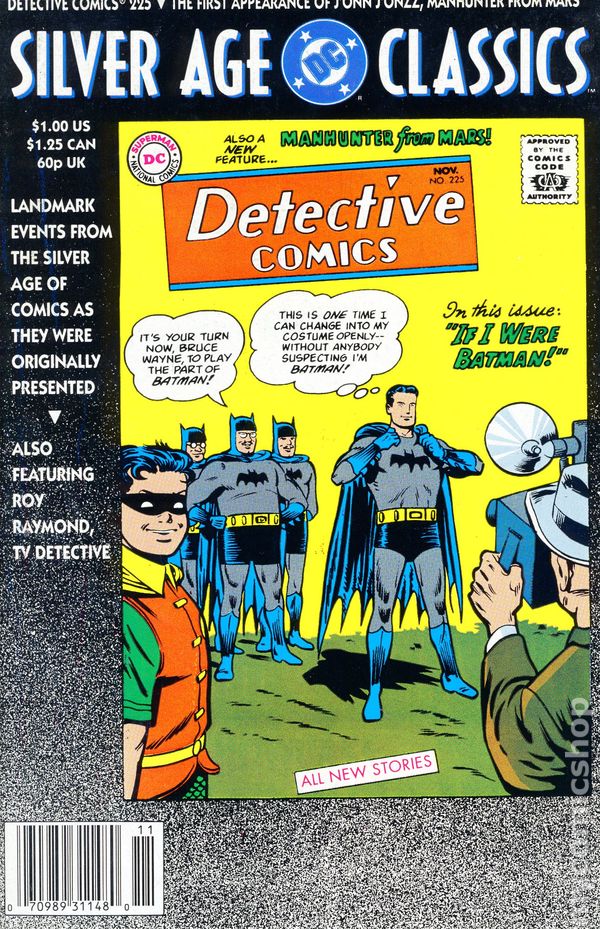
Detective Comics #225 (DC)
From 1955.
The cover story is a wacky Silver Age adventure concerning members of the public getting to be Batman for a day, which is one of those stories that made perfect sense at the time but would now require quite a bit more contextual justification. The more relevant story from the issue is the debut of Martian Manhunter! Although it might be funny to realize that he was probably intended to spend less time in his familiar green form and more in his human alter ego as, well detective John Jones. Just imagine if he'd remained that way...! The Silver Age Classics reprints were some of the first comics I ever owned, notably Showcase #22, the debut of Green Lantern Hal Jordan.
Harlan Ellison wrote this one (you, ah, might have been able to tell from the cover). For some people, he's best known for the classic Star Trek episode "The City on the Edge of Forever." In his Batman story, Batman keeps finding out he's not actually needed in any of the emergencies he comes across. It would have made for a wacky Silver Age adventure, no doubt.
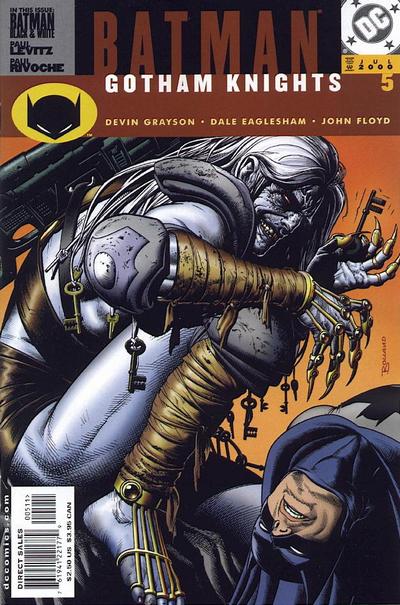
Devin K. Grayson, who sadly all but disappeared from comics nearly a decade ago, was at one time a leading writer of the Batman line, to the point where a whole series, Gotham Knights, was launched to give her a spotlight. This issue features the Key, who had last appeared in the pages of Grant Morrison's JLA. Here the depth of his psychoses are explored, a true villain who would be formidable indeed if only he could get out of his own way. The art comes from Dale Eaglesham, whom I know better from the pages of Geoff Johns' Justice Society of America. The idea behind Gotham Knights was to explore Batman in the context of his allies, and as such besides Robin there's Azrael in the story, although unfortunately the Azrael with his most terrible costume design. I have no idea what they were thinking, the more desperate DC was to keep him relevant, they actually made it easier to dismiss him. There's also a Batman: Black & White adventure from Paul Levitz featuring Commissioner Gordon.
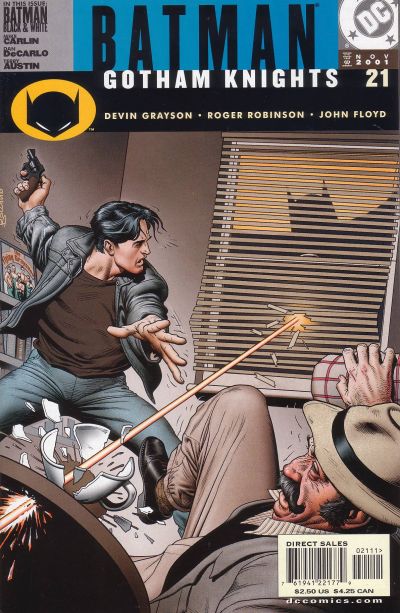
Here's Grayson again handling Dick Grayson, the character who became her true legacy, although much of what she did within the pages of Nightwing ended up being unpopular even though it followed directly in the footsteps of what Chuck Dixon had been doing before her, and both did some of the best work with the character I've read. The story involves someone trying to convince Dick that he's got a whole secret history, but as it turns out it's just a lot of manipulation (reminding me of the Star Trek: Deep Space Nine episode "Second Skin"). The idea of Dick having an aspect of his past he hadn't known about was later explored again during the recent "Night of the Owls" event. The art is from Roger Robinson, whom I usually find to be a far more pleasant presence than his general lack of reputation suggests, but he seems to have been working in a different style for the issue. The Batman: Black & White feature this time is from Mike Carlin (better known as an editor), although it's done more or less in the Bruce Timm style as featured in Batman: The Animated Series.
From 1955.
 |
| via My Comic Shop |
Detective Comics #567 (DC)
From 1986.
 |
| via comiXology |
Batman: Gotham Knights #5 (DC)
From 2000.
 |
| via DC Wikia |
Batman: Gotham Knights #21 (DC)
From 2001.
 |
| via DC Wikia |
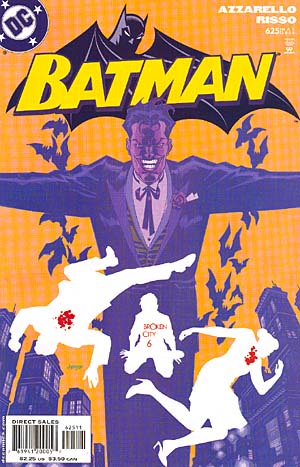
Batman #625 (DC)
From 2004.
 |
| via DC Wikia |
The conclusion to the "Broken City" arc from 100 Bullets team Brian Azzarello and Eduardo Risso reads like a preview of the Scott Snyder era, with a confrontation between Batman and the Joker that makes it clear just how obsessed with Batman the Joker really is. There's also a tribute to Julius Schwartz, legendary editor, who had just died.
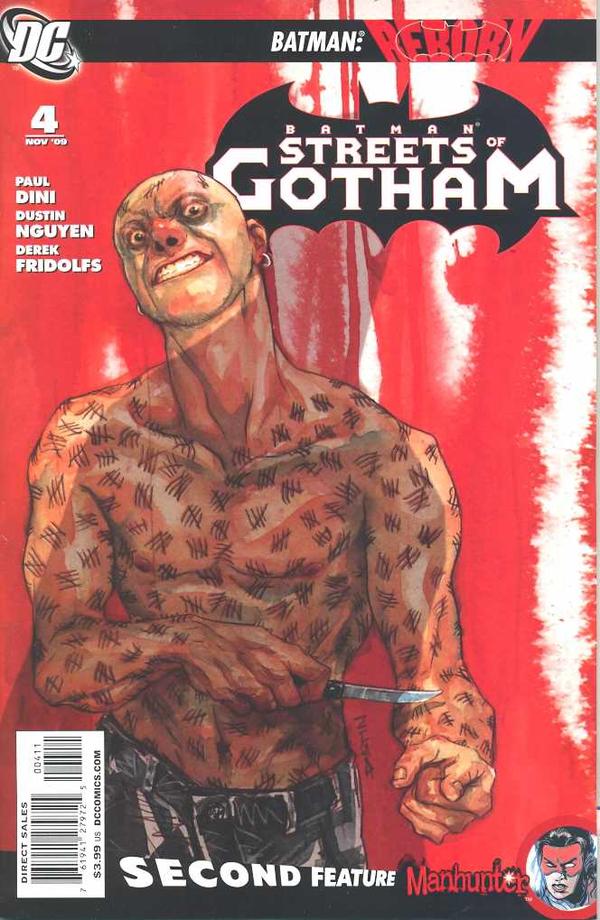
Streets of Gotham was Paul Dini's series, a highly underrated one that was better than the work he'd been doing in Detective Comics previously. Dini is best known for his collaboration with Bruce Timm in Batman: The Animated Series. Art for the issue is provided by Dustin Nguyen and Derek Fridolfs, who would keep the spirit of this initial collaboration alive within the delightful Li'l Gotham. The villain is Mr. Zsasz, the psycho best known for cutting himself for every murder he commits. This is also during Dini's Tommy Elliot arc, the underrated sequel material to "Hush," as he poses as Bruce Wayne. Marc Andreyko's Manhunter is featured in the back-up.
Batman: Streets of Gotham #4 (DC)
From 2009.
 |
| via DC Wikia |
Sunday, September 14, 2014
Reading Comics #134 "Bull Moose Bargains II"
The second (possibly of two) batch of comics I got for fifty cents each at my friendly neighborhood Bull Moose:
Justice League #26 (DC)
I used to have an excellent track record with this series. I'd like to think I used to be one of its biggest fans (a statement not to be misunderstood as meaning I decided at some point I don't love it anymore). But I lost track last year and have had a hard time getting back into it. The whole Forever Evil event was something I failed to follow monthly, and so I skipped the majority of it. Unfortunately that meant skipping out on a lot of Justice League, too, because throughout the event this series was directly tied into it. So I've slowly started making my way back in. This issue features an origin story for Power Ring, which allowed Geoff Johns to write an alternate version of the classic Green Lantern origin. Obviously he had great fun with it. Obviously it made me wish all over again that he was still writing Green Lantern. The other most interesting element of the issue, for me, was the page dedicated to Deathstorm, who of course is the evil version of Firestorm. This made me nostalgic for the great Stuart Moore Firestorm comics. Anyway, a lot of fans had a hard time with Forever Evil. I still don't get that.
The Mysterious Strangers #4 (Oni)
A while back I wondered whatever would become of Chris Roberson, who was part of a flood of writers who fled DC over creative rights issues. Well, here he is again. I have to admit, he impressed me here, turned the Beatles into accidental harbingers of a near-apocalypse, based on their Maharishi period (John Lennon receives the brunt of the blame). The Strangers who help prevent it are a little less distinctive than that, but it was certainly interesting to read another comic based on classic 60s rock (after the Hawkeye issue that spun off from the Smile! project that was such an issue between Brian Wilson and the rest of the Beach Boys).
Nova #5 (Marvel)
You may recall how much I loved the first issue of this series, and how disappointed I was that subsequent issues didn't seem to catch the same vibe (and how I love Starlight so much in part because it does). The cover to this issue
strongly suggests that Jeph Loeb, before he abruptly left the series, actually did what I'd hope he would, and return to the emotional crux of Sam Alexander's quest to reconnect with his father. But it's basically a case of bait-and-switch, alas. There's a stronger link to Nova's appearance in the Original Sin prelude. I suppose there's nothing wrong with the series if it doesn't have what I want to see from it. You can enjoy it for other reasons. But for me, if it doesn't feature what for me is clearly it best material, then I personally have no reason to read it. And besides, Loeb left. I don't see a point in sampling it again. Feel free to give me a heads-up if any of that changes in the future, if you haven't given up on it like I have.
Justice League #26 (DC)
I used to have an excellent track record with this series. I'd like to think I used to be one of its biggest fans (a statement not to be misunderstood as meaning I decided at some point I don't love it anymore). But I lost track last year and have had a hard time getting back into it. The whole Forever Evil event was something I failed to follow monthly, and so I skipped the majority of it. Unfortunately that meant skipping out on a lot of Justice League, too, because throughout the event this series was directly tied into it. So I've slowly started making my way back in. This issue features an origin story for Power Ring, which allowed Geoff Johns to write an alternate version of the classic Green Lantern origin. Obviously he had great fun with it. Obviously it made me wish all over again that he was still writing Green Lantern. The other most interesting element of the issue, for me, was the page dedicated to Deathstorm, who of course is the evil version of Firestorm. This made me nostalgic for the great Stuart Moore Firestorm comics. Anyway, a lot of fans had a hard time with Forever Evil. I still don't get that.
The Mysterious Strangers #4 (Oni)
A while back I wondered whatever would become of Chris Roberson, who was part of a flood of writers who fled DC over creative rights issues. Well, here he is again. I have to admit, he impressed me here, turned the Beatles into accidental harbingers of a near-apocalypse, based on their Maharishi period (John Lennon receives the brunt of the blame). The Strangers who help prevent it are a little less distinctive than that, but it was certainly interesting to read another comic based on classic 60s rock (after the Hawkeye issue that spun off from the Smile! project that was such an issue between Brian Wilson and the rest of the Beach Boys).
Nova #5 (Marvel)
You may recall how much I loved the first issue of this series, and how disappointed I was that subsequent issues didn't seem to catch the same vibe (and how I love Starlight so much in part because it does). The cover to this issue
 |
| via IGN |
Steam Wars #2 (Antarctic)
I caught the first issue back on Free Comic Book Day and was surprised to find that I loved it a great deal. So when the opportunity came around to read another one, I figured I might as well, right? As the title may or may not imply to you, Steam Wars is Star Wars as steampunk. It's from Fred Perry, who otherwise is better known for his long-running Gold Digger. Alas, once again I am quasi-disappointed. It's not particularly that the second issue is worse than the first, but I guess, for me, much more so than with Nova, the magic simply wore off. But we'll always have FCBD!
The Unwritten #51 (Vertigo)
This was a series that perhaps was impossibly high-concept when it debuted. Mike Carey envisioned Harry Potter as if Harry Potter himself were a real boy whose life inspired his author to create a fictional version of him. The author disappears and Tom Taylor (our Harry; it strikes me as funny that DC later acquired the services of a writer named Tom Taylor, current writer of Earth 2) has to put up both with his celebrity status and the apparently very real magical life his father left behind. As I said, almost impossibly high-concept. When it launched I was hugely intrigued, but I wasn't sure Carey pulled it off, or I simply didn't stick around near long enough to find out if he had. It's a series I definitely want to revisit in the trades at some point. And it's also a series that came to an end last year without my realizing it, right around the time of a tie-in arc with the more popular Fables. Kind of an inglorious end, being told in no uncertain terms you're not as success as that, so we'll bring that in to make the point clear, and then we'll cancel you. It does seem as if Tom became Harry pretty literally by the end. I guess I want to see how that happened. As convoluted as my relationship with Unwritten was, I'm sad to have seen it go so relatively early. Vertigo already had a Harry Potter kind of comic years ago, before Harry even existed, in Neil Gaiman and subsequent writers' Books of Magic. Because I'm obliged to reference either Geoff Johns or Grant Morrison as often as possible, I'd love to see Morrison do an out-and-out magic series. The dude did make himself known as a practitioner of chaos magic at one point...
Wonder Woman #22 (DC)
Clearly these bargain comics were/have been a great way for me to catch up with some series and/or creators I've been meaning to revisit. Some of them have been ones that in other circumstances I would probably have been reading religiously. This is one of those series. I've been impressed with the level of quality Brian Azzarello and Cliff Chiang have brought to Wonder Woman, not the least for the apparent fact that this is much harder than it seems. When Orion and/or the rest of the New Gods was brought into the mix, I was beyond intrigued, so it's nice to finally read some of that material. This is one of those developments that seems like it should have happened a long time ago. Maybe it's because Jack Kirby created his Fourth World with Superman in mind that someone didn't think of it sooner (although for some reason Darkseid long ago made the jump to Legion of Super-Heroes lore with the "Great Darkness Saga," while this much more logical conclusion remained ignored). Anyway, half the reason Orion joined the narrative was as a way to link the series with the rest of DC proper, which was always the one stumbling block. As great as Azzarello's run has been, it's also been isolated. Orion serves as a romantic possibility, and therefore default rival for Superman, which became a thing last year and then became a whole series (Orion/Big Barda Superman/Wonder Woman). Wonder Woman as a result also boasted the distinction of getting a jump on the New 52 version of the New Gods, which is fast expanding this year (Batman and Robin, Green Lantern, Infinity Man and the Forever People). I skipped out initially because I didn't particularly want to see just Orion hanging around. I wanted to see the whole line-up. Rest assured, they're here this issue.
X-O Manowar #13 (Valiant)
This is the series that won Robert Venditti the right to write Green Lantern. I've meant to sample it ever since I learned he'd be succeeding Geoff Johns (a very tall order, one he's sometimes seemed up to) in that regard. X-O is one of those heroes who keeps getting revived in the hopes he'll be a legitimate alternative to the DC/Marvel big leagues. This does not appear to have been the best issue to sample.
Friday, July 11, 2014
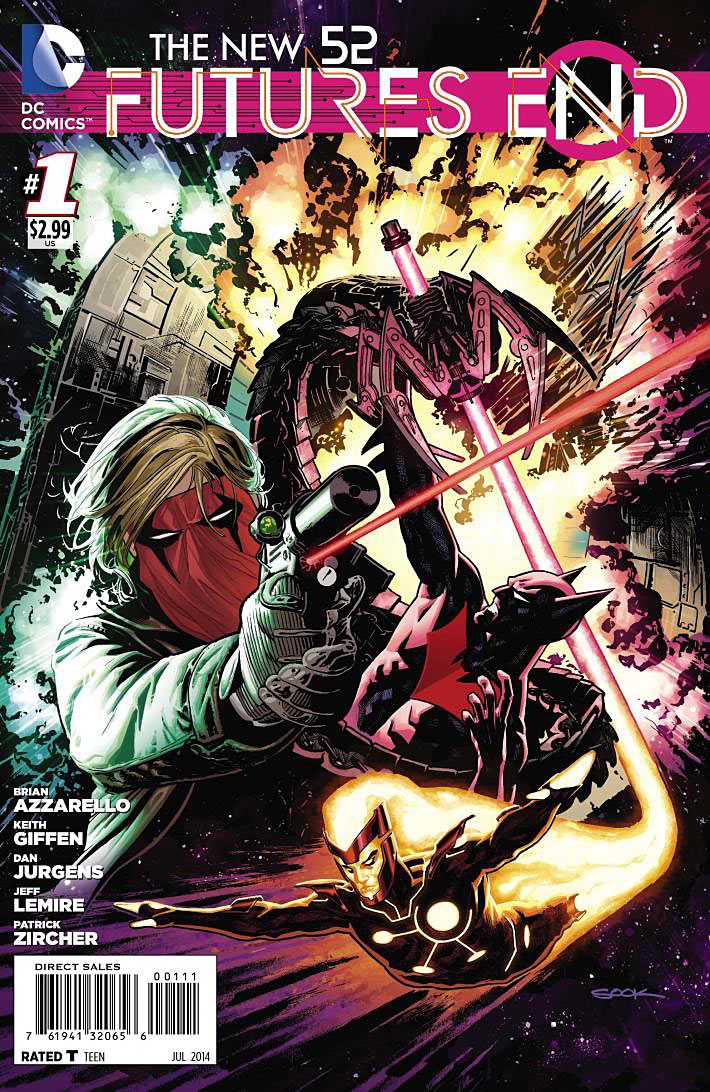
The New 52: Futures End #1 (DC)
writer: Brian Azzarello, Jeff Lemire, Dan Jurgens, Keith Giffen
artist: Patrick Zircher
Futures End is the latest weekly series from DC, launched on Free Comic Book Day earlier this year. There's been a lot of speculation on just how important it really is, whether it's leading to a significant event next year (how much the concurrent Batman Eternal is involved remains to be seen, but the upcoming Earth 2: World's End, which begins in October, will definitely be part of the loop). The New 52 trend of September being an event month continues with a full-blown Futures End tie-in across every ongoing series.
artist: Patrick Zircher
 |
| via DC Wikia |
So what about Futures End itself? Well, Batman Beyond, Terry McGinnis, has now joined official canon, sent from the future to slightly earlier in our future to prevent the end of the world. Conveniently, everyone involved seems to be characters DC tried to feature in their own New 52 series (although no sign of Static, so far as I know, so far). This is bad news for Stormwatch (as always; although in this new context I think maybe someone could finally help them find their DC groove) but good news for Grifter (mixed bag for WildStorm overall).
Also involved in this issue is Firestorm. For whatever reason, I seemed to skip the whole New 52 experience, but I loved what was being done with the character previous to the relaunch, after the third host, Jason Rusch, was introduced post-Infinite Crisis. With the brain (Martin Stein) and the brawn (Ronnie Raymond) thrown into the mix, there evolved full-blown potential for a Firestorm franchise, if the character ever became, y'know, popular.
Mostly, though, the biggest winner I foresee at this point is Grifter. The best thing about 52, the brilliant weekly that began this modern trend at DC, was how it took characters who had been overlooked and made them relevant, and Grifter's the one who most closely matches what I loved so much in those pages. If there was a true problem with Countdown, it was a lack of that kind of character. Trinity didn't have one either, but I think there were a lot of things calculated incorrectly with that one.
No, I haven't been reading Futures End regularly. In fact, this remains the most recent issue I've read. But I suspect it will be a pretty good weekly. I trust Brian Azzarello and Jeff Lemire, two of the key writers in the current DC fold, and they have a few guiding voices in Dan Jurgens and Keith Giffen to keep things not only interesting but grounded in the kind of work that has always been exemplary of this company, which is about as much as you can expect from a DC weekly.
Sunday, December 15, 2013
Essential Reading: Wonder Woman
With the recent hubbub over the casting of Gal Gadot in the forthcoming Superman/Batman movie, superhero fans may be wondering what there might be to find in terms of Wonder Woman material. Since she has been one of DC's icons, equally important for comic books in general as a strong female, Wonder Woman has long held a position of prominence.
The problem has always been how to present her at the same level as Batman or Superman, and so creators have been struggling over that for decades, and the resulting material can sometimes be hard to penetrate. Batman is a human with vengeance and redemption writ large beneath his shadow. Superman is the ultimate immigrant. What role does Wonder Woman play? That's always been the problem. She's hard to identify, much less identify with. She comes from a more or less Greek tradition, although her Amazons and the Amazons the ancient Greeks mythologized are pretty much polar opposites (as far as artists love to depict any woman in comics), and as such a lot of her background material comes from a culture readers may know far better than Thor's Asgard, which makes Wonder Woman's adventures at once easily comprehensible and hard to interpret solely on her merits. Unlike Thor, Wonder Woman is a new creation, and she inhabits a landscape that tries to be contemporary while also depicting its own society.
From my own experiences, here are some stories that may help define Wonder Woman's legacy a little better:
"The Contest," Wonder Woman 0, 90-93 (1994)

As close as any iconic presentation of her classic origin story goes (because this is another area where creators have not been as keen to explore in comparison to the scores provided Batman and Superman), this is actually the reverse, with Wonder Woman returning to Themyscira, home of the Amazons, to discover that the world she left behind no longer welcomes her. Mom Hippolyta (famous from Hercules mythology as the prototypical Amazon; she's actually filled in as Wonder Woman on a few occasions) deems Princess Diana no longer worthy of holding the role as champion of their people, their ambassador to Man's World. Enter Artemis, who wins the role and temporarily replaces her. This is a lot like the event stories Superman and Batman and everyone else experienced in the 90s, but it has everything to say very directly about Wonder Woman herself. Diana did, for the record, continue adventuring, in one of a few instances where she adopted a new costume (like every other instance of this that decade, it looks very 90s), and even remained a member of the Justice League, the only member of the Big Three at that point to hold the distinction. And then she got the role back, of course.
Greg Rucka, Wonder Woman 195-226 (2003-2006)

To my mind the single greatest and most significant creator run in the character's history, and certainly one of the most involved, Greg Rucka embraces Wonder Woman's role as an ambassador and tosses her into some of her most dramatic adventures. At one point she's even temporarily blinded. This is also the period of Infinite Crisis, where she murders Maxwell Lord, perhaps the most daring superhero act of the new millennium, with the fictional effect that Superman's similar act in Man of Steel had on moviegoers this past summer.
Amazons Attack!, 1-6 (2007)

One of the effects of Wonder Woman murdering Max Lord was placing her at odds with the public, which led to all Amazons coming under siege. Rarely has she been at the center of her own event, and while this was a minor one it is still a noteworthy story, which ably demonstrates all the potential that the character and her world has always held.
Allan Heinberg and Jodi Picoult, Wonder Woman 1-10 (2006-2007)

Simultaneously lifting her presence and also helping to sabotage it was Wonder Woman's receiving a relaunch under the successive early arcs of Allan Heinberg and author Jodi Picoult. Both of them were reactions to and continuations of the Greg Rucka run, centering heavily on Diana as she struggles to find her way forward, with one of her signature villains, Circe (essentially Wonder Woman's Loki) providing plenty of problems along the way. To have both Heinberg and Picoult was fantastic, but they combined for ten issues, and although the continuity was there they were both gone in an instant, and so the momentum dissipated in a heartbeat. Great for anyone coming late to the party, however.
"The Circle," Wonder Woman 14-17 (2008)

I don't generally like Gail Simone, but this story is a wild exception. It's another look at Wonder Woman's origin, but in a way that adds to it, which is generally hard to do. Diana was famously created from clay, which makes perhaps sense by way of Greek mythology. The Amazons not named Hippolyta kind of had a problem with this, the daughter of privilege who ended up inheriting everything that Wonder Woman essentially is, so they formed a conspiracy that tried to thwart her. Kind of an Occupy Wall Street story before there was an Occupy Wall Street. A key story in broadening the scope of the character.
The Blue Amazon (2003)

Another thing Wonder Woman rarely gets are her own standalone graphic novels, much less stories that dare feature art that doesn't completely glamorize her. This is that, plus a way of exploring the archetypes involved in her relationships with Batman and Superman, which is another thing DC loves to do every now and then.
Ben Caldwell, Wednesday Comics 1-12 (2009)

One of the more interesting comic book experiments of the recent past was Wednesday Comics, which presents superhero adventures in serialized cartoon strip form. The best of these strips was Ben Caldwell's visually impressive take on Wonder Woman's origin, which plays like a classic Disney animated feature. Arguably the best Wonder Woman story in this lot.
Brian Azzarello, Wonder Woman (2011-present)

Azzarello has been creating a new standard for Wonder Woman comics, ably blending the mythological elements that others can sometimes misinterpret into her overall story, so that you have an indy comic featuring a mainstream character. This may yet prove to be the best of all the stories.
Geoff Johns, Justice League (2011-present)

While this series is very much about the Justice League, Johns spent a good deal of the early issues exploring the Wonder Woman: Secret Origin story, at least as far as her introduction to Man's World goes, with all the classic elements like Steve Trevor involved. I keep mentioning this, so I might as well do it again here.
(All cover images via Comic Book Database.)
The problem has always been how to present her at the same level as Batman or Superman, and so creators have been struggling over that for decades, and the resulting material can sometimes be hard to penetrate. Batman is a human with vengeance and redemption writ large beneath his shadow. Superman is the ultimate immigrant. What role does Wonder Woman play? That's always been the problem. She's hard to identify, much less identify with. She comes from a more or less Greek tradition, although her Amazons and the Amazons the ancient Greeks mythologized are pretty much polar opposites (as far as artists love to depict any woman in comics), and as such a lot of her background material comes from a culture readers may know far better than Thor's Asgard, which makes Wonder Woman's adventures at once easily comprehensible and hard to interpret solely on her merits. Unlike Thor, Wonder Woman is a new creation, and she inhabits a landscape that tries to be contemporary while also depicting its own society.
From my own experiences, here are some stories that may help define Wonder Woman's legacy a little better:
"The Contest," Wonder Woman 0, 90-93 (1994)

As close as any iconic presentation of her classic origin story goes (because this is another area where creators have not been as keen to explore in comparison to the scores provided Batman and Superman), this is actually the reverse, with Wonder Woman returning to Themyscira, home of the Amazons, to discover that the world she left behind no longer welcomes her. Mom Hippolyta (famous from Hercules mythology as the prototypical Amazon; she's actually filled in as Wonder Woman on a few occasions) deems Princess Diana no longer worthy of holding the role as champion of their people, their ambassador to Man's World. Enter Artemis, who wins the role and temporarily replaces her. This is a lot like the event stories Superman and Batman and everyone else experienced in the 90s, but it has everything to say very directly about Wonder Woman herself. Diana did, for the record, continue adventuring, in one of a few instances where she adopted a new costume (like every other instance of this that decade, it looks very 90s), and even remained a member of the Justice League, the only member of the Big Three at that point to hold the distinction. And then she got the role back, of course.
Greg Rucka, Wonder Woman 195-226 (2003-2006)

To my mind the single greatest and most significant creator run in the character's history, and certainly one of the most involved, Greg Rucka embraces Wonder Woman's role as an ambassador and tosses her into some of her most dramatic adventures. At one point she's even temporarily blinded. This is also the period of Infinite Crisis, where she murders Maxwell Lord, perhaps the most daring superhero act of the new millennium, with the fictional effect that Superman's similar act in Man of Steel had on moviegoers this past summer.
Amazons Attack!, 1-6 (2007)

One of the effects of Wonder Woman murdering Max Lord was placing her at odds with the public, which led to all Amazons coming under siege. Rarely has she been at the center of her own event, and while this was a minor one it is still a noteworthy story, which ably demonstrates all the potential that the character and her world has always held.
Allan Heinberg and Jodi Picoult, Wonder Woman 1-10 (2006-2007)

Simultaneously lifting her presence and also helping to sabotage it was Wonder Woman's receiving a relaunch under the successive early arcs of Allan Heinberg and author Jodi Picoult. Both of them were reactions to and continuations of the Greg Rucka run, centering heavily on Diana as she struggles to find her way forward, with one of her signature villains, Circe (essentially Wonder Woman's Loki) providing plenty of problems along the way. To have both Heinberg and Picoult was fantastic, but they combined for ten issues, and although the continuity was there they were both gone in an instant, and so the momentum dissipated in a heartbeat. Great for anyone coming late to the party, however.
"The Circle," Wonder Woman 14-17 (2008)

I don't generally like Gail Simone, but this story is a wild exception. It's another look at Wonder Woman's origin, but in a way that adds to it, which is generally hard to do. Diana was famously created from clay, which makes perhaps sense by way of Greek mythology. The Amazons not named Hippolyta kind of had a problem with this, the daughter of privilege who ended up inheriting everything that Wonder Woman essentially is, so they formed a conspiracy that tried to thwart her. Kind of an Occupy Wall Street story before there was an Occupy Wall Street. A key story in broadening the scope of the character.
The Blue Amazon (2003)

Another thing Wonder Woman rarely gets are her own standalone graphic novels, much less stories that dare feature art that doesn't completely glamorize her. This is that, plus a way of exploring the archetypes involved in her relationships with Batman and Superman, which is another thing DC loves to do every now and then.
Ben Caldwell, Wednesday Comics 1-12 (2009)

One of the more interesting comic book experiments of the recent past was Wednesday Comics, which presents superhero adventures in serialized cartoon strip form. The best of these strips was Ben Caldwell's visually impressive take on Wonder Woman's origin, which plays like a classic Disney animated feature. Arguably the best Wonder Woman story in this lot.
Brian Azzarello, Wonder Woman (2011-present)

Azzarello has been creating a new standard for Wonder Woman comics, ably blending the mythological elements that others can sometimes misinterpret into her overall story, so that you have an indy comic featuring a mainstream character. This may yet prove to be the best of all the stories.
Geoff Johns, Justice League (2011-present)

While this series is very much about the Justice League, Johns spent a good deal of the early issues exploring the Wonder Woman: Secret Origin story, at least as far as her introduction to Man's World goes, with all the classic elements like Steve Trevor involved. I keep mentioning this, so I might as well do it again here.
(All cover images via Comic Book Database.)
Thursday, March 14, 2013
Quick Hits: Wonder Woman #15 (DC)
Like anyone else I'm always hoping that Wonder Woman will somehow become one of the most popular series DC publishes, thereby finally expanding our favorite Amazon into the role she holds by default in the company as the most prominent/important female character in comics. I thought it had another shot when it was announced Brian Azzarello would be writing the New 52 relaunch...and gradually I lost the hope. While he's definitely been doing distinctive work, I've begun to view as less and less essentially and therefore essential work with Wonder Woman herself. He's basically turned her into Percy Jackson. Yet I vowed to have another look when Orion popped up. Orion is one of Jack Kirby's New Gods, one of the few who really stands out, and has been sorely missed since Final Crisis. Yet I'm not sure he works here any better than Wonder Woman, though conceptually they appear to be headed in a much more interesting direction in the months to come, soon to be entangled in the Superman affair currently being featured in Justice League and therefore key to the upcoming Trinity War. All of which is to say this is a series that still bears monitors, works for what it is (basically an indy book starring one of the most famous superheroes of any company), and could still be more.
Quick Hits: Comedian #5 (DC)
I don't know why the publication of this particular Before Watchmen book has been drawn out for so long, but I've continued to enjoy it, and have even figured out why it's remained in Vietnam for several issues now, because Brian Azzarello figured out that it has more significance than what fans probably assumed just from the original Alan Moore story, along with everything else that's been done in Comedian. I'm pretty convinced that I won't be the only one calling this one the most significant part of the whole project once it's all done and sitting on bookshelves, maybe as regularly as Watchmen itself.
Tuesday, January 8, 2013
Before Watchmen: Comedian #4 (DC)
writer: Brian Azzarello
artist: J.G. Jones

I stopped reading Before Watchmen regularly a few months back. As it stands, I've read issues from Minutemen, Nite Owl, Silk Spectre, Ozymandias, and this one, Comedian, but not Rorschach, Dr. Manhattan, or Moloch. Eventually I will most likely read the complete story, in collected form (which was how I first read Watchmen itself), but for now I've limited myself to the story of Edward Blake.
So far Brian Azzarello has put a big stress on Blake's relationship with the Kennedys, his revision of Alan Moore's original suggestion that Comedian theoretically participated in the assassination of JFK. What Azzarello has done instead is put new emphasis on his moral development, from the idealism of Camelot to the quagmire of Vietnam, where we've been the last few issues. This issue, in fact, is more or less the birth of the Comedian we know from Watchmen (incidentally the one we know from his relationship with Silk Spectre might as well at this point be folded into his relationship with Jack Kennedy, himself a notorious womanizer, though not exactly the would-be rapist that all but defined Blake for Moore).
Comedian was the cynic's superhero, the one who looked at the world through a cracked lens, who saw the joke that was its idea of justice, which he quickly saw as not being particularly fair. (Although the cracked lens and fairness parts also speak to each of Moore's heroes. Edward Blake simply saw it before the rest of his old teammates, and not just Ozymandias's plans.) He was ahead of the curve, but in Vietnam he's behind it, at least as the civilian population goes. Last issue he memorably had a hard time reconciling his patriotic idealism with what was developing stateside. Now he's hoping for the war to end and finding it increasingly difficult to cope. The problem for Blake is that he's Captain American in the Vietnam War.
The drug culture introduced last issue (and at the same time in Silk Spectre) finally claims the Comedian, which is the major development of the story this time. Bobby Kennedy has declared his intention to run for the presidency, but won't accept Blake's calls, another sign that the times are indeed changing. Soon he's going to be everything we thought he was all along.
That's the value of Before Watchmen, revisiting and expanding on the familiar story so that new truths can be found. Why I keep reading about Edward Blake specifically is because in Watchmen he can almost be the boogeyman, the other hero-turned-villain who just happened to be eliminated by the other one, though granted a shot at redemption in the memories of those he leaves behind. He looms over the whole story, but almost entirely in the background. It's nice to see him at the front, and Azzarello is taking full advantage of the opportunity.
artist: J.G. Jones

(via dccomics.com)
I stopped reading Before Watchmen regularly a few months back. As it stands, I've read issues from Minutemen, Nite Owl, Silk Spectre, Ozymandias, and this one, Comedian, but not Rorschach, Dr. Manhattan, or Moloch. Eventually I will most likely read the complete story, in collected form (which was how I first read Watchmen itself), but for now I've limited myself to the story of Edward Blake.
So far Brian Azzarello has put a big stress on Blake's relationship with the Kennedys, his revision of Alan Moore's original suggestion that Comedian theoretically participated in the assassination of JFK. What Azzarello has done instead is put new emphasis on his moral development, from the idealism of Camelot to the quagmire of Vietnam, where we've been the last few issues. This issue, in fact, is more or less the birth of the Comedian we know from Watchmen (incidentally the one we know from his relationship with Silk Spectre might as well at this point be folded into his relationship with Jack Kennedy, himself a notorious womanizer, though not exactly the would-be rapist that all but defined Blake for Moore).
Comedian was the cynic's superhero, the one who looked at the world through a cracked lens, who saw the joke that was its idea of justice, which he quickly saw as not being particularly fair. (Although the cracked lens and fairness parts also speak to each of Moore's heroes. Edward Blake simply saw it before the rest of his old teammates, and not just Ozymandias's plans.) He was ahead of the curve, but in Vietnam he's behind it, at least as the civilian population goes. Last issue he memorably had a hard time reconciling his patriotic idealism with what was developing stateside. Now he's hoping for the war to end and finding it increasingly difficult to cope. The problem for Blake is that he's Captain American in the Vietnam War.
The drug culture introduced last issue (and at the same time in Silk Spectre) finally claims the Comedian, which is the major development of the story this time. Bobby Kennedy has declared his intention to run for the presidency, but won't accept Blake's calls, another sign that the times are indeed changing. Soon he's going to be everything we thought he was all along.
That's the value of Before Watchmen, revisiting and expanding on the familiar story so that new truths can be found. Why I keep reading about Edward Blake specifically is because in Watchmen he can almost be the boogeyman, the other hero-turned-villain who just happened to be eliminated by the other one, though granted a shot at redemption in the memories of those he leaves behind. He looms over the whole story, but almost entirely in the background. It's nice to see him at the front, and Azzarello is taking full advantage of the opportunity.
Subscribe to:
Posts (Atom)