Showing posts with label Fiona Staples. Show all posts

Monday, August 31, 2015

Countdown to QB50 2015: August

18 Days #2 (Graphic India)

  • Notable creators: Grant Morrison (writer)
  • This second issue jumps into the narrative of the superwar and features a show of respect from the good guys to the bad guys, some of whom turn out to be pretty okay, too.
  • Definitely a welcome issue for the project.
ARCHIE #1 (Archie)
  • Notable creators: Mark Waid (writer), Fiona Staples (artist)
  • I saw that my local shop had it available, so I decided to have a look at this Archie reboot.  The second issue was available at the time.  In hindsight I probably should have just gotten both.
  • Waid continues to look better than I've seen in him in years, after this and Strange Fruit.
  • Staples (Saga) somehow manages to charm without all the gross-out elements.  Imagine that!
BATMAN #43 (DC)
  • Notable creators: Scott Snyder (writer)
  • Commissioner Batman (I had another name the last time I talked about it, but I think I like this one better) continues.
  • In much more interesting news, Superman stops by, and Alfred discusses how Bruce Wayne came back, and the unlikelihood, at this point, of resuming the crusade.
  • Pivotal issue.  Has nothing much to do with Commissioner Batman.
ROBIN: SON OF BATMAN #3 (DC)
  • Notable creators: Patrick Gleason (writer/artist)
  • Damian's girlfriend, Nobody's daughter Maya, continues to prove to be excellent company for the errant Boy Wonder.
  • Talia returns from the dead.
  • Deathstroke shows up.
  • Seriously, could this series be any better?
BLOODSHOT REBORN #5 (Valiant)
  • Notable creators: Jeff Lemire (writer)
  • Bloodsquirt, Bloodshot's irritating figment of nanite imagination, surprisingly does an excellent job of moving the story along.
  • Like Wolverine before him, Bloodshot has a mysterious past.  This issue he allows someone to read the file that explains who he used to be.  Decides he doesn't want to know what it says.
  • Marvel never did figure out how to make Wolverine's past life as interesting as his post-Weapon X days.  This is probably a good decision.
CIVIL WAR #2, 3 (Marvel)
  • Notable creators: Charles Soule (writer), Leinil Francis Yu (artist)
  • I stand by the assertion I made previously that out of all the Secret Wars spin-offs/extensions of past arcs, Soule's Civil War is arguably the most significant.
  • Yes, the war continued.  No Captain America did not end up assassinated.  Yes, Spider-Man still has problems stemming from his decisions.  Infiltration is the name of the game on both sides,  
  • Then we discover a true game-changer, the presence of a character who did not previously make a Civil War impact: Black Panther.
Between Civil War and Star Wars: Lando, Soule was one of the August standouts, easily.  That was four solid issues from both series for Soule.  I used to dread his Marvel contract.  Now I am really, really happy.  He's doing excellent, relevant, subtle work with both series, and as far as I'm concerned significantly raised his profile.  He's poised to become a major force.

DARK HORSE PRESENTS #13 (Dark Horse)
  • Notable creators: Jerry Ordway (artist), Craig Rousseau (artist)
  • This anthology title offers a number of stories, including the start of a new chapter in Ordway and Alex de Campi's Semiautomagic.
  • My main interest, however, was for Rousseau and Rick Woodall's Kyrra: Alien Jungle Girl, which I got to see in print for the first time, after discovering it digitally from comiXology.
DESCENDER #6 (Image)
  • Notable creators: Jeff Lemire (writer)
  • Hey, there he is again!  Lemire, along with Charles Soule and Paul Cornell, was a welcome repeat creator.
  • Dr. Quon's full story is detailed, as we discover more about Descender itself while he relates exactly how he stole the awesome breakthroughs in robotics that made his name (and cost him an arm).  
  • And we meet another Tim!
DIRK GENTLY'S HOLISTIC DETECTIVE AGENCY #3 (IDW)
  • Notable creators: Chris Ryall (writer)
  • Dirk begins to make actual progress in his investigation.
  • (Somehow.)
DOCTOR WHO: FOUR DOCTORS #1, 2, 3 (Titan)
  • Notable creators: Paul Cornell (writer)
  • The four Doctors in question are David Tennant (Tenth Doctor), Matt Smith (Eleventh Doctor) and Peter Capaldi (Twelfth Doctor). 
  • Wait, did I say four?  The fourth is John Hurt (War Doctor).
  • There are also a bunch of companions running around.  Fans will probably be able to identify them a lot better than I can.
  • Even for someone who doesn't have too much experience with the Doctor(s), this is a fun read.
EARTH 2: SOCIETY #3 (DC)
  • Notable creators: Daniel H. Wilson (writer)
  • Evil mastermind (and one-time Mr. Terrific) Terry Sloan is assassinated!
  • Prime suspect: Superman!
  • (The other one.)
FABLES #150/FABLES VOL. 22: FAREWELL (Vertigo)
  • Notable creators: Bill Willingham (writer)
  • The final issue comes in the form of a collection, with the kind of ending Peter Jackson gave his Lord of the Rings.
  • As in, a lot of epilogues.
  • A little hard for someone who didn't actually, y'know, read the series to fully appreciate, but it's also a heck of a novelty.
  • I like novelties.

THE FUSE #13 (Image)
  • Notable creators: Antony Johnston (writer), Justin Greenwood (artist)
  • The series returns from hiatus for its "Perihelion" arc.
  • "Perihelion" means the space station is at its closest to the sun.
  • Which means everyone gets crazier than usual.
  • Which means plenty of crime for Klem and Marlene to investigate.  Yay!
GRAYSON #10 (DC)
  • Notable creators: Tim Seeley (writer), Tom King (writer)
  • Guest-stars Lex Luthor, erstwhile member of the Justice League and, oh, the guy who killed Dick Grayson during Forever Evil, which is the event that led to this innovative relaunch.
  • Yeah, even if I've failed to read this series regularly, there's no chance I was going to miss that.
JUSTICE LEAGUE #43 (DC)
  • Notable creators: Geoff Johns (writer)
  • "Darkseid War" continues!
  • The Mobius Chair won't tell Batman who the Anti-Monitor is.  The reader knows Anti-Monitor is Mobius.  
  • Superman and Lex Luthor have some nice quality time together.
  • Up next?  Darkseid versus Anti-Monitor!
JUSTICE LEAGUE: GODS AND MONSTERS: WONDER WOMAN, 1, 3 (DC)
  • Notable creators: J.M. DeMatteis (writer), Bruce Timm (writer)
  • To be clear, what I read here was the Wonder Woman one-shot, plus the first and third issues of the Gods and Monsters event itself.  
  • Wonder Woman emerges as the most likable of the alternate Big Three, and hailing from Jack Kirby's New Gods.
  • This could be seen as Timm's version of the complicated Man of Steel reality where Superman isn't automatically accepted as a bright shining superhero.  


MIND MGMT #36/NEW MGMT #1 (Dark Horse)
  • Notable creators: Matt Kindt (writer/artist)
  • This coda to the MIND MGMT saga reads like a blueprint to how to avoid the huge mess the series unraveled.
  • And its lingering effects.
  • With a big happy, completely unambiguous ending!
MS. MARVEL #17 (Marvel)
  • Notable creators: G. Willow Wilson (writer)
  • Ms. Marvel meets Captain Marvel!
  • Not quite as awesome as the Wolverine team-up.
  • (Would that even be possible?)
PREZ #3 (DC)
  • Notable creators: Mark Russell (writer), Ben Caldwell
  • Corndog Girl begins building her presidential cabinet!
  • The blogger reaction to Prez I've read has been considerably less enthusiastic than mine has been.
  • For me, this thing is an instant classic, a portrait of our current political cynicism in a satire of what it could lead to.
SPIDER-VERSE #4 (Marvel)
  • Notable creators: Mike Costa (writer)
  • Peter Parker and Gwen Stacy, together again at last!
  • Sort of!
STAR TREK/GREEN LANTERN #2 (IDW)
  • Notable creators: Mike Johnson (writer)
  • Again, what could be a horrible gimmick continues to show considerable restraint.
  • Uhura (Star Sapphire; best quote of the issue: "Spock!  I need your help, not your analysis!)), Chekov (Blue Lantern), Gorn warrior (Red Lantern), Chang (Sinestro Corps), Romulan politican (Orange Lantern), and Bones (Indigo Tribe) are all inspired crossover choices.  
  • Sinestro shows up on the last page.  
  • Larfleeze is featured on the cover next issue.
  • Seriously.  Good fun!
STAR WARS #8 (Marvel)
  • Notable creators: Jason Aaron (writer), Stuart Immonen (artist)
  • Seriously, Immonen begins art duties on Star Wars, and you thought I wouldn't be there?
  • The big story in this Marvel series is the appearance of Sana Solo, the apparent wife of Han Solo.
  • Guess who vigorously denies that throughout this issue?
  • Immonen is a perfect fit, by the way.
STAR WARS: LANDO #2, 3 (Marvel)
  • Notable creators: Charles Soule (writer), Alex Maleev (artist)
  • By the second issue, we may know why Lobot is considerably less animated in The Empire Strikes Back than Soule presents him here.
  • The Emperor's Imperial Guard (the dudes in read) in action!
  • Chanath Cha continues his efforts to prove he's as awesome a bounty hunter as Boba Fett.
  • Lando discovers what the reader already knows: that Palpatine is steeped in Sith lore.
SUPERMAN #43 (DC)
  • Notable creators: Gene Luen Yang (writer), John Romita, Jr. (artist)
  • This is it!  Lois Lane reveals Superman's secret identity to the world!
  • She does it so that Hordr can no longer bribe Superman.
  • It's a big, big moment, obviously.
  • In this continuity, it makes perfect sense.
  • Yang even makes a connection to Grant Morrison's Action Comics run.
  • Where, you'll remember, Superman himself briefly "killed" Clark Kent.
  • Probably will be endlessly debated.  But we already had a tidy wedding in previous continuity.  In this one, there are fewer certainties.  This is a good thing.  Allows the mythos to breathe.
THIS DAMNED BAND #1 (Dark Horse)
  • Notable creators: Paul Cornell (writer)
  • Seeing this listed in Previews originally, I didn't know how much I should be interested in it.  Besides Cornell...?
  • But it reminds me that I have a considerable history at this point reading comics that involve rock n' roll: Night Trippers, the Brian Wilson issue of Hawkeye, Mysterious Strangers, Comeback, even a Prince comic...
  • So this is kind of...destiny.
Cornell, meanwhile, more than earns being in the spotlight, between This Damned Band and Doctor Who: Four Doctors.  And I'm happy to see so much material from him.  From Captain Britain to Knight & Squire to Saucer Country to his Lex Luthor arc in Action Comics and even Demon Knights, Cornell carved out a considerable legacy for himself, and I always hoped he'd take his rightful place within the comics elite.  But wide success always eluded him, and he became the opposite of the famed British Invasion, in that he went back home.  Went all British.  Returned to one of his true loves, the very British but expanding Doctor Who.  I'm glad I've now had the opportunity to experience Cornell's Doctor interest first-hand, and to find something new from him, too.  Welcome back!

THE UNWRITTEN: APOCALYPSE #12 (Vertigo)
  • Notable creators: Mike Carey (writer)
  • I finally had the chance to read the conclusion to Carey's Unwritten saga.
  • To my mind, much more satisfying than Fables'.
  • Fables, in part, by the way, circled around to an allusion to Harry Potter.
  • Unwritten, meanwhile, was perhaps the most clever Harry allusion anyone's yet produced.
Four more months left in the year.  Miller and Azarello will be launching The Dark Knight III in November.  Gaiman's Sandman: Overture is ending.  Morrison is launching Klaus.  And I'm sure there are plenty of highlights yet remaining.  This has been a pretty good year.

Sunday, June 14, 2015

Reading Comics 164 "Comics from 6/10/15"

Featuring Batman #41, Descender #4, Earth 2: Society #1, Nameless #4, and Saga #29.


Batman #41 (DC)

This whole issue is Scott Snyder doing the hard sell for his new direction.  This can be seen as a good thing, even a smart thing.  But it might also be considered...an acknowledgment that maybe it's not such a good idea after all.  Veteran comics readers know how this game works.  Original character is replaced.  New character attempts to solidify their right to the role.  Original character returns.  Snyder has been playing a little fast and loose with the concept from the start, "killing off" Bruce Wayne while also making it clear (to anyone paying attention) that this didn't actually happen.  And this issue makes that clear, too.  He's sitting in a park on the first and last pages.  Some readers will wonder, is that really Bruce Wayne?  Of course it is.

And that's really Jim Gordon playing at being Batman, too.  Even he pokes fun at the new getup, by the way.  As I said, Snyder plays with fire in the issue.  And it's a little hard to swallow after a while.  I know what you'll say, you veteran of this blog.  I've acknowledged problems reading Snyder in the past.  The conclusion to "Endgame," I said, might have been the point where I put all that behind me.  But I guess it really doesn't work that way.

So this is Snyder trying to do his version of the replacement trope.  As you can see from the above panel, Snyder even gives lip service to all the reasons why this typically happens.  The oddest thing is that there's no one saying Batman needs this right now.  And so why is Snyder even doing it?  Because he's subverting even that part of the narrative?  Hey, since when was Scott Snyder even known as a guy who subverts expectations anyway?

So the issue is actually pretty uncomfortable, and once again I'm telling myself, I'm done with Snyder.  I won't be fooled again!  

We'll see...


Descender #4 (Image)

In strict contrast to Snyder and even to a comic I'll be talking about a little later is this one from the combined genius of Jeff Lemire and Dustin Nguyen.  I happen to love comics, or stories in general, with a lot of moving parts, which is to say components that are being used not necessarily in direct conjunction with each other but that keep things interesting, and this has nothing to do with being simple or complicated, but a general awareness that the creator(s) have figured out what they're doing in an obvious, even if subtle, way.  This means, for instance, what's illustrated above.  What Snyder's done in Batman has sometimes seemed like it wanted to do something like this, but then it turns out most of that was geared toward Batman Eternal and not Batman itself, which is fine and all, but there's a clear difference, and the distinction is that Snyder himself didn't want to affect what he was doing in trying to create an iconic Dark Knight by introducing a lot of dynamic new elements (Court of Owls notwithstanding, or perhaps included).

The above illustrates the difference nicely.  The Driller is somewhat one-dimensional, but serves as a nice contrast to Tim, the little boy robot who's the heart of Descender.  Tim convinces Driller not to be a killer because that would be bad for its future.  But later in the issue, when more mayhem surrounds Tim, he releases Driller from this restriction.  Lemire writes this perfectly, and of course Nguyen is doing the same killer work he's done since Batman: Li'l Gotham.  While Tim's creator Dr. Quon remains about as one-dimensional as Driller, there's also Telsa to be considered.  This is the issue where we begin to find out what makes her interesting.  At first not only as one-dimensional as Driller but as function-centered, she's a reflection of what the series may ultimately be about, breaking away from what others perceive you to be (and hence a sign that Quon will likely receive similar treatment at some point).  Tim himself, especially to Telsa, is just a boy robot programmed to be a "real" boy's best friend.  

Anyway, while Lemire has been careful to keep the action and plot moving, he doesn't do that at the expense of character development, and not just development, but exploration, which is a concept that is usually ignored.  Snyder, for instance, constantly flirts with it, but only in the safest ways possible, which was he allowed himself, and was allowed by DC, to do such a radical Batman/Joker story as "Endgame" ended up being.  But he always backs away.  When other writers aren't backing away, they aren't even attempting it.  Lemire pushes boldly ahead.  Descender, this is to say, is looking like an all-around classic.


Earth 2: Society #1 (DC)

Speaking of character exploration, the thing I liked best about Convergence was how it took Earth 2 and made it better.  When James Robinson started that series, it was about as character-centric as anything DC was publishing at the time.  Convergence came around and took one of Earth 2's characters, Dick Grayson, and pushed him forward.  And interestingly, as with Convergence as a whole, the story clearly didn't end there.  This is to be understood as a hook.  If you care at all about the character, you will want to know how the story continues.  The debut issue of Society keeps that idea going.

The panel above once again is selected for illustrative purposes.  A lot of the successful comics these days are ones that feature a hook for the real world.  The paralyzed Dick Grayson will hopefully join those ranks.  Most of the issue he is in fact running around, but this is also an issue that jumps back and forth in time.  The hook, then, is for the reader to want to continue reading the series, see how exactly Dick reaches the point where he is running around again.  Likely for the same reasons he was in Convergence, because he has some sort of artificial support.  This should be no big problem for someone looking to him as a role model.  Amputees, for instance, are very familiar with this narrative.

So for me, my interest in Earth 2 was absolutely elevated by Convergence, which I believe was one of the main points of the event, and Society is an excellent way to keep that momentum going.


Nameless #4 (Image)

For those two panels (the rest of the page becomes much like the rest of this particular story), Nameless evokes Grant Morrison's own We3, which is one of the best things he's ever done.  The problem is, Nameless is otherwise hellbent on being the weirdest thing Morrison has ever done, The Filth taken to the next level.  Weirdest as in most disturbing.  It's very easy to interpret Nameless as the culmination of Morrison realizing his Batman Inc. collaborator Chris Burnham as being capable of this exact kind of story.

For some comics readers, the weirder is in fact the better.  Comics, in their view, are supposed to shock.  And they have been shocking readers for many decades, sometimes deliberately so.  And Nameless is also a culmination of Morrison's own basic instincts, by the way.

But it's still very hard to enjoy.  I didn't particularly like Burnham in the pages of Batman Inc. either, by the way.  He's a definite proponent of gross-out material. It's sad, because in those panels above, he is clearly capable of stuff that doesn't need to do that.  (Sometimes I assume people who specialize in gross-out do it because they think they need to.)  To link more of this edition of Reading Comics together, Burnham can perhaps take lessons from Fiona Staples.  (I've been leading toward Saga.  There.)  Staples can do a lot of things.  Saga in one sense is designed to let her do a lot of things.  Some of it is explicitly to let her shock the reader.  But it never quite seems as shocking as what Burnham has routinely demonstrated in Nameless.

And it gets in the way, too.  That's the thing.  It distinctly feels as if Morrison is letting Burnham sell most of the concept for him.  And Morrison is routinely guilty of letting the story sell itself rather than bothering to explain it himself.  And when this works, it absolutely works.  But sometimes it doesn't.  And I think that's ultimately why I backed away from The Filth, too, because the more I thought about it, the more I wished Morrison didn't rely so much on the actual filth.  Imagine how much more readers would have hated Final Crisis if it had done that!

So more and more, that's what I think about Nameless.  I wish it evoked Morrison's best instincts more often.  But I also think this whole project is Morrison working his worst instincts out of his system, or simply trying to prove that old image he created of himself was real after all.  Except more and more, I'm convinced it really wasn't.  But what do I know?


Saga #29 (Image)

This issue is something of a bloodbath for supporting characters in Saga.  If this were Star Trek, it would be the redshirt issue.

And there's an image that's not about that at all, and may be one of the defining gross-out images of the whole series, and that's all I'm going to say about that.  Visually, this is about the sum of everything anyone who doesn't like what they've seen could possibly fear to see throughout a whole issue.

Which is also to say, just another issue of Saga.  But really, this really is Saga to the extreme.  And this is definitely one of the odder things about the series.  It doesn't need any of that to be awesome.  Why Brian K. Vaughan has done it at all, and repeatedly, is probably just because he absolutely knows he can get away with it, or because he just really always wanted to see a sci-fi story do it.  There are plenty of people who like their stories like this.  I'm not necessarily one of them.  Usually it's kept to a minimum, one shock per issue, and usually with a bunch of issues that don't feature this sort of thing at all (mostly).

And the thing of it all is that Fiona Staples otherwise has some of the most lush art around, and could as easily sell itself without any of that as Vaughan could write Saga without any of these distractions.  And yes, at this point it has to be considered one of the primary elements of the series, so there's little use complaining about it, especially so many issues into the series, and from a reader who has read a majority of the series...

Anyway, some of this was absolutely inevitable.  And I suppose Vaughan's greater point is that sci-fi that isn't dirty is simply ignoring a great too many realities.  But the long-term potential of Saga is somewhat compromised if this sort of issue will be routine.  Walking Dead does this all the time.  And I've mentioned before that I absolutely think Walking Dead was ruined by making this sort of thing routine.  You can't do a long-term story where the same thing happens over and over again.  After a certain point, the idea becomes routine and therefore pointless, especially if the writer clearly has nothing to say.

The point of this particular issue is that the things that have been happening throughout the series really have been messy, and are doomed to messy conclusions until and perhaps even when the same mistakes stop being made.  We'll see if that's where Vaughan is actually going with this.  The important thing is, the important people are still alive.  For now.

Monday, April 13, 2015

Saga #27 (Image)

writer: Brian K. Vaughan

artist: Fiona Staples

So yeah, Saga is basically a soap opera, which if you take the term "space opera" in full soap opera context, is exactly what you might have always expected a space opera to be like.

Which is to say, the story is still hinging on whether or not Marko has a chance of getting back together with Alana.  At the moment it looks pretty grim.  He was thrown out after he, uh, threw groceries at her (it's slightly more complicated than that, but she's basically treating it as spousal abuse; she doesn't trust him, he doesn't trust her, and oh wait! a psycho robot janitor kidnapped their baby girl!), and this issue sees him actually have a bad drug experience (which was kind of the whole reason he, uh, threw groceries at her), which reminds him of all the bad things he's done (worse than throwing groceries).  He emerges with a clear sense of what he has to do next.  Whether that ends up making sense remains to be seen.

This is a space opera filled with great characters, by the way.  That's kind of the real appeal of Saga, that it's the most clearheaded science fiction creation since Star Trek and Star Wars, fairly straightforward yet filled with moving parts.  Fortunately, they'll all very distinctive.  The two in the image I've included for this issue are: 1) the shorter one, Ghus, a deceptively cuddly-looking fellow who is more than willing to help 2) Prince Robot IV draw some blood.  Prince Robot is by definition awesome.  His Robot Kingdom features a population with television monitors for heads.  Pure awesomeness.

Saga is filled with moments like that.

Monday, February 16, 2015

Saga #25 (Image)

writer: Brian K. Vaughan

artist: Fiona Staples

The nature of the conflict between Landfall and Wreath is explored to considerable length this issue, which turns out to be a setup for an ending that adds a new wrinkle to the Saga, um, saga.

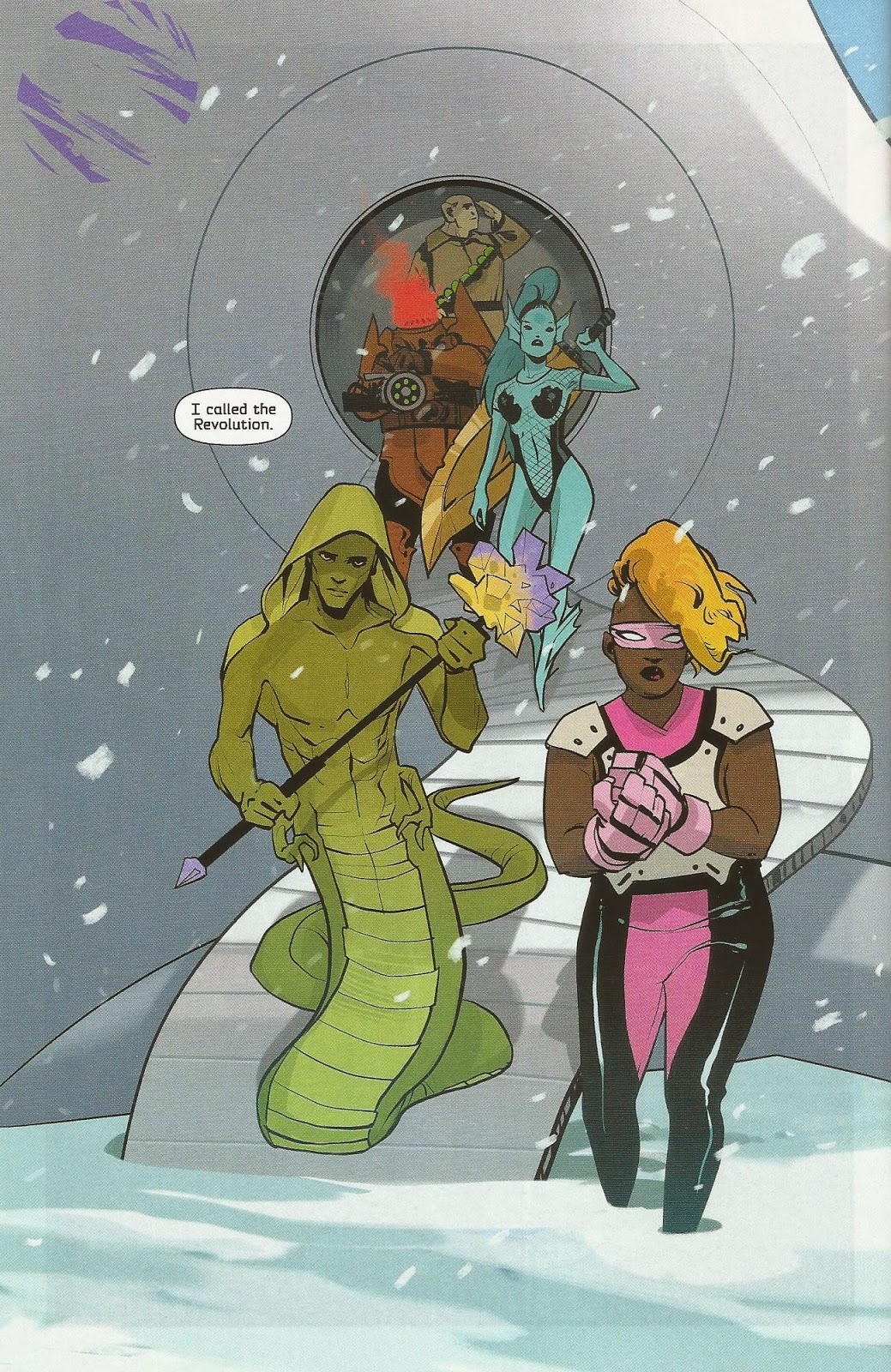
Dengo, the janitor from the Robot Kingdom who has been dictating a lot of the action lately as well as kidnapping Prince Robot IV's newborn and Hazel, the infant child of Alana and Marko, has the following exchange with Alana:

Alana: What the hell have you done now, android?"

Dengo: Commenced with Plan B.  I'd hoped to persuade others to join my campaign through words and images, but it's clear the only language people understand is action.

Alana: Dengo, who's out there?

Dengo: A heroic band of freedom fighters dedicated to ending both of your worlds' reigns of terror.

Alana: No.  Please tell me you didn't really bring the Rebellion here.

Dengo: "Rebellion" is for teenage girls.


Which means a bunch of new characters!  One of the great strengths of Saga is Vaughan's ability to create dynamic personalities out of clearly-defined roles.  Beyond that, the Revolution is a clever spin on a sci-fi trope made famous by Star Wars and featured most recently to great success in Guardians of the Galaxy.

Also of note for dedicated readers, as always, is the letters section, in which one correspondent hilariously explains how Saga ruined her relationship with her mother, and another from a prison inmate that continues a different saga entirely, the effects of a different prison inmate who brought the love of comics inside the institution.  Real Shawshank Redemption stuff there, folks.  

Have I mentioned how much I love the name of Vaughan's dog, Hamburger K. Vaughan?

Genius.

Monday, October 20, 2014

Saga #23 (Image)

writer: Brian K. Vaughan
artist: Fiona Staples
via Image Comics
There's a bunch of stuff that happens in this issue, but the crux of its impact is in this line from Hazel, the narrator of the series who speaks in retrospect because in the present she's the toddler offspring of lead characters Alana and Marko:
"This was the story of how my parents split up.  But it's not the end of our story."
You see, I can't decide if Brian K. Vaughan has pulled a bait-and-switch or not.   You see, back in #19, she originally declared the first part of that quote.  I was devastated.  Who wants to suddenly discover that you're reading a romantic tragedy when all along you think you've been reading the galactic Romeo & Juliet (oh, wait...)?

Did he reconsider?  Or is it a matter of potentially disgruntled readers to decide?

It's not a deal-breaker, mind.  I can imagine some readers considering it one.  If this were a TV series, it might even be considered a jump-the-shark moment.

I'm making a big deal about this because this is exactly what this issue should be remembered for, a crucial moment in the series.  There's a chance I've been misinterpreting these developments because I missed vital moments from issues I haven't read.  But for what it is, for the span of these past five issues (nearly half a year), it's seemed as if Vaughan had flipped the script on the whole story.  It's not as if Alana and Marko have had an easy ride to date.  In fact, the whole series is about how rough they've had it.  But the idea, seemingly, was that they always had a chance at a happy ending, or at least boom-boom death, which would therefore remove their fates once and for all from their own hands.  For Vaughan to have spent a span of the series suggesting otherwise might be considered reader manipulation.

I'll keep reading regardless.  But now there's an inkling of doubt in creator credibility.  In literature, Hazel might be considered an unreliable narrator, but she certainly took her sweet time reaching that point.  It's at a juncture like this that I begin to wonder how long this series will actually be.  The comparable Starflight is apparently ending after six issues, a fact I just learned.  Mark Millar tends to do stories like that, though (and if it's really popular, like Kick-Ass, a few additional mini-series to follow).  Vaughan sticks around for longer.  How much longer this time?

And do I have to worry about something like this again?

Thursday, September 18, 2014

Saga #22 (Image)

writer: Brian K. Vaughan
artist: Fiona Staples
via Image Comics
Have I ever actually read a Brian K. Vaughan comic for any extended period of time?  Well, no I haven't.  I think I read the last year or so of Y: the Last Man.  Never read Runaways.  Read a few issues of Ex Machina.  But I've now read more of Saga than anything else he's done.  And now that I'm getting back into reading it regularly for the first time since its early days, I've...got to get used to the idea again.

Every issue can't be pure magic, I guess.  Maybe it was just the thrill of the new that made it seem so initially.  There's a lot of soap opera drama between Alana and Marko these days.  This issue deals with the impending split (so our faithful narrator Hazel, their daughter, declared a few issues ago) and how it develops.  It's kind of sad, because in a lot of ways, Saga originally read like an intergalactic fairy tale romance.  Now it seems like Shakespearean tragedy waiting to happen.  Yay!

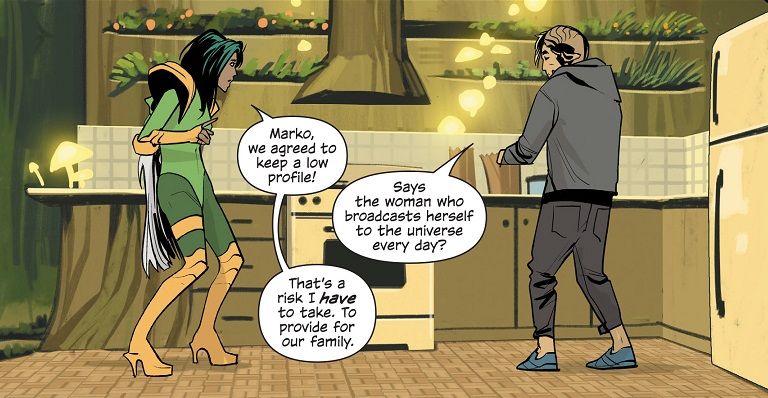
To matters worse, they're both in hiding.  Alana seems to be the one having a harder time realizing "in hiding" means keeping a low profile.  She quotes from an obscure book on her TV show.  This is considered a bad idea.

Anyway, there's always Prince Robot IV to entertain us!  But even he's got a case of the dramas going on since his newborn was born, his wife dying in childbirth and the baby kidnapped by disgruntled janitor Dengo, who seems to be on the verge of spoiling Alana and Marko's...less than ideal circumstances.  (Maybe he'll actually make things better?  Not for the people he shoots, but y'know...)  We meet Robot King, who has a massive...screen.  And no sympathy for Prince Robot.

Such is the way Saga turns.  At least there's always an excuse for Vaughan to throw Fiona Staples an interesting visual to tackle every few pages!  This book certainly remains gonzo.  And gonzo, as any self-respecting fan of Grant Morrison will have to admit, is always good.

Friday, July 25, 2014

Saga #19 (Image)

writer: Brian K. Vaughan
artist: Fiona Staples
via Henchman-4-Hire
I love Saga.  When it originally launched I scrambled to catch up and continue reading, one of the few series I followed like that at that time (I've been in survival mode as far as reading comics goes for a few years now).  Everyone said how awesome it was and they were right.

That's not always the case, mind.

But it certainly was with Saga.  I've realized recently that Brian K. Vaughan's latest epic, this time a sci-fi epic, is kind of like Hawkman.  If you're at all familiar with Thanagar, you know what I'm talking about.  There's nothing wrong with that.

But since I read with such horrible consistency these days (there were days of yore when I read dozens of series faithfully every month!), there are always sacrifices.  Even series I adore I can't/don't read regularly.  So the fact that my recent record with Saga has been spotty at best is no negative judgment on the series.

The saga of Saga revolves around the flight of Marko and Alana, members of warring alien species with a classic Romeo & Juliet romance going on.  Lately they've gone into hiding.  As the above panel suggests, they have different ideas of what that means.

(I should note that the panel is not the greatest representation of Fiona Staples' work.  She's brilliant.  Like this:
via comiXology
The, ah, opening page of the issue involves the birth of one of these robotheads.  It's one of many examples that this is a matures readers comic.  The robotheads, as represented by Prince Robot and his growing family, are just an example of the quirky awesome supporting cast of Saga.)

One of the great things about Saga is its narrator, Hazel, who is the daughter of Marko and Alana, who as the series progresses has just been born, so she's kind of like Richard Dreyfuss in Stand by Me or Bob Saget in How I Met Your Mother.  The last page of the issue offers a startling development that is heartbreaking if I'm interpreting it correctly.  I probably am.  It's awful!

But again, Saga is awesome!

Thursday, March 14, 2013

Quick Hits: Saga #2, 8, 9 (Image)

Saga was my favorite new launch of last year, and it seems to be settling comfortably into everyone else's, a perfect word-of-mouth comic that Image has gotten behind.  Half of this isn't so hard to understand, given that it's written by Brian K. Vaughan, and he's done this before with Y: The Last Man, Ex Machina, and Runaways, but that he's doing it again can still only be considered remarkable.

I've previously tracked down the first issue thanks to a reprint, mistakenly believing that I'd started reading the series with the second issue, but it was in fact the third, so I went tracking again and got the second and so completed that much of the reading experience (I'm now behind a few issues, and don't know if I'll be able to continue keeping up outside of the trades).  This issue features the first appearance of The Stalk, a bounty hunter who was killed off far too quickly for artist Fiona Staples' interests, because she loved designing and drawing the curiously attractive spider lady.  More on Stalk in a moment.

The eighth issue is made up of a bunch of sometimes disturbing family bonding moments, and so is just a fun one to read (but really, they all are), including how Marko and Alana met.  Honestly, I could read this series forever.

The ninenth issue, meanwhile, features the "return" of The Stalk but is really all about The Will being all Han Solo-y, which is good, because The Will is another excellent character and I could read him forever, too.

Friday, January 18, 2013

Saga #1 & 7 (Image)

writer: Brian K. Vaughan
artist: Fiona Staples

(via comicbookresources.com)

I consider myself to be a fan of Brian K. Vaughan.  He's known for a lot of comics at this point, but it's still Y: The Last Man for me.  If you have no idea what Y: The Last Man is, picture The Walking Dead and substitute a world full of women instead of zombies.

Saga, however, has me head over heels.  I named it in my top ten favorite comics for the 2012 QB50.  I knew Vaughan was pretty imaginative, which Lost acknowledged by bringing him into its prestigious family, and Lost is among the most imaginative stories I know.  Saga is a little like Lost if it featured aliens.  Main characters Marko and Alana are a little like what Jack and Kate (or Jack and Juliet, or Jack and Ana Lucia) if they weren't surrounded by a billion other characters.  Except Saga does have some notable supporting characters, like Prince Robot IV (who has a TV monitor as his head, and is named Prince Robot IV) and The Will (who wears a cape, and is a bit like what you'd get if you somehow combined Han Solo and Boba Fett into one character).

Image recently printed some dollar editions of some of its more notable current series.  I started reading Saga with its third issue (for some reason I thought or hoped it was the second), which is another way I knew I loved it at first sight because you have to be good to have a continuing story and not be at all confusing for someone to jump in after the beginning.  The story of Saga is simple enough, so you don't necessarily need to read the first issue, but it's also good enough that you'll want to.  It details the birth of Hazel, the narrator of the series who happens to be the daughter of Marko and Alana, and therefore only really present as a wordless baby as the story is actually happening.

The birth is complicated in that Marko and Alana are at this point prisoners, and so the issue also features them breaking out of prison, at the start of their life on the lam (which is why characters like Prince Robot IV and The Will are very much interested in tracking them down).  It's the introduction of the mythology you'll be following eagerly from here forward.

The seventh issue, meanwhile, finds Marko and Alana after they've escaped into space, with the awkward development of meeting Marko's parents.  It's awkward because Marko and Alana are technically from rival alien species (you can tell from the cover images because Marko has those ram horns and Alana doesn't), and Marko's parents are keenly aware of this.  Most of the issue follows Marko's father as he interacts with Alana, which is a good way for Vaughan to express some of the more human elements of the narrative, while Marko attempts to explain himself to his mother.

All of this is rendered in breathtakingly gorgeous art by Fiona Staples, as you can tell from the covers, which have all been iconic representations of the main characters.  Staples has a way of presenting fairly straightforward work in the most effective way possible, focusing mostly on the characters and leaving background details alone for the most part, allowing equally lush coloring to help flesh out the world of Saga.  I called Staples my favorite artist of 2012, by the way.  When Image was initially known for its art, I'll bet no one thought twenty years later that Fiona Staples was going to show up and steal everyone's thunder.  This is the best looking book Image has ever produced.

I'm in awe of Saga.  It's one of the best comics to come around in years, and it proves it with every issue.