Showing posts with label Digitally Speaking.... Show all posts

Sunday, June 4, 2017

Digitally Speaking...58 "Neil Gaiman's Eternals"


Okay, so I've been doing a pretty lousy job of talking through my comiXology library, but really it's because there hasn't been much to speak of.  I guess the material was kind of top-loaded or something.  But the good news is that very shortly I'll have finally read all of it, all the Submit stuff and the Image stuff that came in those massive bundles and everything else I got several years back.  What I'm talking about today, actually, is something I added recently because of that dwindling supply, something I'd read when it was originally released but hadn't thought that much about at the time, but having now reread it...
 
So yeah, I wish I'd read the whole thing.  I guess I wouldn't have appreciated it at the time, but at least I'd have read it.  I'm talking about Neil Gaiman's Eternals, a rare Marvel project from about a decade ago, when he was dabbling in comics again, figuring out where he might still fit in after having left the medium for a full-time career writing books.  Part of why I had a look at the freebie first issue comiXology had available was that I've now read the complete Sandman, and that's a great feeling in and of itself.  Part of it is that I've read a few issues of the comics adaption of American Gods, which is the Neil Gaiman book (along with its sequel Anansi Boys) that to date is my Neil Gaiman prose standout, and reading American Gods in any medium made me realize what Neil had done with it all over again, and so why not have a look at Eternals again, right?
 
I remember thinking, at the time, that Eternals didn't seem to live up to the reputation Neil had based on Sandman.  I don't know if it's Marvel's typical inability or lack of interest in keeping its back library visible, but Eternals seemed to blink in and out of existence.  It was Neil's version of a Jack Kirby concept that the King developed as his Marvel answer to his DC New Gods.  I thought that it was merely Marvel handing Neil something that seemed vaguely expansive in the Sandman sense, but that Neil didn't seem to have found as interesting as that, and so the result was easy to dismiss.
 
Well, I found it a great deal more interesting this time. It's a different story from Sandman, of course, although in a lot of ways you might consider the Eternals to be comparable to the Endless Ones.  I didn't really know much about the Endless Ones before actually reading Sandman, so I didn't know that.
 
But what really struck me was the art, from John Romita, Jr.  At the time he did Eternals, John was still very much a Marvel guy, and I was still very much a DC guy trying to figure out Marvel.  In fact, probably a large part of the reason I found it so easy to reject Eternals was because it was a Marvel project, and John was definitely a Marvel artist, whose style was something I'd never really tried to figure out.  Then I had a chance to associate it with something else, Mark Millar's Kick Ass, and still later, Superman, because John eventually became a DC guy. 
 
It's not because he became a DC guy that I suddenly started liking John's work.  I know plenty of DC readers who struggled a great deal with his Superman.  But it probably didn't hurt.  I know it was impossible to think of anything else when reading that issue of Eternals again.  All I could think was, I love this art!  And maybe that helped get me into the story, too.
 
Yeah, though, it's the combination of the plot, and my affinity for the writer and the artist.  I think that's a good equation for liking anything, really, what it is and who's responsible for it, and I guess whether they brought their best material to the table. 
 
Well, I guess at some point I will have to read the rest of it...

Friday, May 13, 2016

Digitally Speaking...57 "Lee Weeks' Daredevil"

Daredevil: Dark Nights #1 (Marvel)
From 2013.

I haven't been reading much from comiXology lately, and been talking even less about what I have been, but I had to make an exception for this.

And what makes it so special?  Well, for one, creator Lee Weeks.  I've been bumping into the guy's work with Dan Jurgens (Superman: Futures End, Convergence: Superman, Superman: Lois & Clark), and as far as I knew, that was pretty much his contribution to comics.  I mean, he popped in out of nowhere, as far as I was concerned. 

Now, of course, I know differently.  This issue is clue enough, for instance.  He's referenced as a Daredevil icon by the editor.  I had no clue, naturally.  The bulk of his Daredevil work came in the early '90s, so clearly he didn't come from nowhere.  Suddenly it seems a real shame that this is the first I'm hearing about him.

The issue itself is a clear revelation.  Weeks is writer/artist for it, the start of a three-issue arc in a greater mini-series featuring mini-arcs from other creators as well.  Since I knew Weeks as an artist (a truly remarkable one), I kind of wondered what his writing would be like.  It can always go either way.  But the more I read, the more I loved.

Simply put, Weeks figured it out.  He figured out how to further the Miller Narrative.  The Miller Narrative is Frank Miller's iconic reinvention of Daredevil, the Daredevil most fans know, the one who showed up in the 2003 movie, and the one currently dazzling folks in the Netflix series, the one who's an even sadder sack than Peter Parker, battling back from one colossal setback (notably, the Kingpin feud) after another.

I mean, I've seen the Bendis variation.  I saw the Waid refute.  But this is the real deal.  This is someone who truly understands what Matt Murdock is all about.

And from Lee Weeks?  Heck ya!  It's truly sensational work.  I don't care if the other two issues are crap.  This one alone is enough to sell me on the virtues of Weeks, well beyond what I thought they were already.  This guy's the real deal.  And needs lionizing!  So I'll do what I can.  Hopefully his Jurgens work will help other people discover or rediscover Weeks. 

Because he's one of the best talents in the game.

Monday, July 13, 2015

Digitally Speaking...56 "The Life After, etc."

Material in this feature is read from my comiXology account, which is to say, digitally...Covers this edition are: Lady Mechanika #0, The Legend of Bold Riley, The Legend of Oz: The Wicked West #1, The Life After #1, Life Begins at Incorporation, Little Nemo: Return to Slumberland #1, Lola XOXO #1, Lost in Space Anthology #1, and Lumberjanes #1.

Lady Mechanika #0 (Benitez)
From 2014.

Here's another of those pleasant surprises.  Maybe I don't know Joe Benitez well enough, but seeing him kick around without having previously secured a true spotlight (he's writer and artist here) is surprising having read this.  The concept is steampunk, a woman with mechanical parts who comes across a creature who turns out to be a figure from her forgotten past, clues to her origins, murdered before it can reveal them by an enemy who could be a friend but goes the other way.  Anyway, it's not really the concept but the competent execution, which is rare indeed, that's such a treat to read.  If you're looking for something new, Lady Mechanika would be a good pick.  Benitez has a strong voice as a writer, and excellent characterization.  His art is much as you'd expect from someone who has worked extensively with Aspen and Top Cow, but he's doing better work here than you'd typically find with them.

The Legend of Bold Riley (Northwest)
From 2012.

It's a little hard to know what to make of Bold Riley.  On the one hand, there's a lot of competence behind it creatively.  On the other, it seems like Weathington borrowed a lot of Indian folklore to create her stories, and kind of needlessly created a fictional version of India to do it.

So, what's wrong with that?  For one, Weathington creates a bunch of difficult-to-pronounce names, or just plain difficult.  Which in depicting another culture is fine, but she immediately undercuts that by giving the lead character a distinctly English nickname that once bestowed is clearly meant simply to make things easier for the reader.  But the thing is, if Weathington hadn't created all the fake Indian names in the first place...

And that about sums up what's wrong with otherwise better-than-decent material: there are too many gaps in the logic.  Because this is a series of somewhat-related stories, the individual parts work well enough, but taken as a whole, Weathington clearly left the wider vision of her main character unexplored, an empty template to be plugged into whatever's needed at the time.  And that drags down the product as a whole.

If you're a reader who doesn't have a problem with any of that, then you should enjoy Bold Riley without much reservation.  But to me, it's a way of saying, Weathington could do better.  And hopefully does, elsewhere.

The Legend of Oz: The Wicked West #1 (Big Dog Ink)
From 2013.

Yeah, so...An inexplicable variation on The Wizard of Oz, as a Western.  The title suggests that much.  Doesn't explain how poorly it's conceived and executed otherwise.  But there you are.  It sucks that there are so many bad Oz comics out there.  I mean, what gives?  At least there are the Shanower/Young adaptations...

The Life After #1 (Oni)
From 2014.

Huh.  By the time you finish this issue, your perspective kind of completely changes.  Because now you know what it's about.  I'm somewhat familiar with Joshua Hale Fialkov (Elk's Run), but maybe not well enough.  For most of the issue I was thinking this was a variation of The Adjustment Bureau, and that was after I thought it was a variation of The Truman Show.  But as the title suggests, this is in fact an afterlife story, but how exactly isn't very clear from the start.  But then it is, and so now I've got to...reevaluate.  It's actually pretty clever.  I mean, the reader should be as confused as the main character.  But then he meets Ernest Hemingway, who explains what's really going on.  Which in the interests of keeping the surprise intact for anyone who doesn't know and is maybe interesting in finding out, I will keep a secret.  Fialkov is doing another high-concept comic in The Bunker, so that makes him one of the more interesting creators out there at the moment.  It would be better if this weren't still such a well-kept secret...

Life Begins at Incorporation (Matt Bors)
From 2013.

So as to not get into political talk, I will simply remark that this collection of editorial cartoons of the kind you'd find in your local free alternative news weekly features funnier stuff than I had in the one I read while living in Colorado Springs, but somewhat oddly features more essay material than editorial cartoons.  Or it certainly feels like it.

Little Nemo: Return to Slumberland #1 (IDW)
From 2014.

Speaking of Eric Shanower (just a few comics ago), here he's adapting classic comic strip Little Nemo: Adventures in Slumberland for modern audiences.  Modern audiences, ah, had more recently, Calvin & Hobbes, which did the same thing Little Nemo did but, ah, better.  Shanower sticks to the original formula, with a boy constantly falling out of bed after his adventures getting, ah, near Slumberland.  Readers who know Shanower better from his Oz adaptions than his original Oz work, much less Age of Bronze (which hasn't seen a new issue in two years) might be disappointed to see less of the creative spark than they might expect (because that spark came from, ah, L. Frank Baum) can see signs of life here and there, but the reverse of his Oz adaptions is true here: he's too faithful.  And smothers his work for it.  But it's still pretty good.

Lola XOXO #1 (Aspen)
From 2014.

Technically this is better and more nuanced than typical Aspen material, and you can imagine how the company came up with it, by pretty much saying exactly that to itself.  The art is recognizably Aspen, but classed up a little.  And the story is topical, or in this issue tries to be, in the 9/11 era.  But yeah, things quickly even out.  But it was pretty neat, reading this directly after reading the above, because the issue opens with dreams on the brain.  If it gets better than this, I would have asked for the better material first...

Lost in Space Anthology #1 (Titan)
From 2015.

As anthologies go this (issue) is pretty good, though the title is taken pretty literally, as every story ends exactly that way (a nary a Dr. Smith to be found!).  I like the dog (poor dog!), monkey (love monkeys!), and opening (twisted tale about reluctant hitchhikers that's easily the one I'd love to read more of) ones best.  Good mix of styles, too, if that's what you like in anthologies, a true "something for everyone" vibe.

Lumberjanes #1 (Boom!)
From 2014.

This is another one that I totally got only as I got further into it.  At first it looks like a bunch of nonsense, but then it gets good.  Like all the comics based on all the cable animated series try to be (as far as I know, this one isn't based on a cable animated series), off the beaten path and following the beat of its own drum as it explores childhood, in this case a group of girl scouts known as Lumberjanes who (in this issue but maybe all of them, too) are camping, have some adventure, are caught by their troop leader (which is my favorite part of the issue, as she pompously marches them to the Lumberjanes leader herself, lecturing all the way).  Anyway, you don't have to be young, or a girl, or a scout to enjoy this.

I'm going to try something new again, which is rank the material read in this edition:

  1. The Life After
  2. Lady Mechanika
  3. Lumberjanes
  4. Lost in Space Anthology
  5. Little Nemo: Return to Slumberland
  6. Life Begins at Incorporation
  7. Lola XOXO
  8. The Legend of Bold Riley
  9. The Legend of Oz: The Wicked West

Sunday, June 28, 2015

Digitally Speaking...55 "Kyrra: Alien Jungle Girl, etc."

These are comics I've read from my comiXology account...This time that means Kinds of Blue Vol. 1, Kung Fu Skratch! #1, and Kyrra: Alien Jungle Girl #1.

Kinds of Blue Vol. 1 (Hive Mindedness)
From 2011.

When people talk about depression, when they try to help with depression, they invariably end up with something like Kinds of Blue: a well-meaning, expressive, demonstrative...lack of concrete dialogue.  Part of this is the comic book format.  Hey, I know from comic book format.  What people generally call the graphic novel when they want to distinguish from superhero stories and the like usually comes with a certain vagueness.  Anecdotal, spare...it's as if revealing too much would be a betrayal of the self.  But then what's the point?  The epitome of this kind of storytelling is Harvey Pekar, the late curmudgeon made famous by the film American Splendor.  So what it amounts to is sounding like you're complaining about everything, and admitting that there aren't any answers, that the world sucks and you just have to deal with it, or that you'll find a kind of happiness if you'll just look...

Listen, if I sound like I'm taking the material personally, it's because I am.  And overall it is good material, but it lacks anything but empathy.  The problem, anyone who carries around with them existential discontent, to use another term, is not overly comforted by the notion that they're not alone.  Or that one or two people may sympathize or will try and help them if and when they can.  Depression is something of a modern invention.  Life sucked a lot worse in times past.  Depression, I think, is an acknowledgment that life isn't completely bad, but it could be a lot better if only..., and it's the if only... that can never be addressed, because, well, life is in transition.  And maybe humans really are getting better.  But it happens in slow motion, and in the meantime...it sucks.

So my point is, instead of one or two people saying, "Hey! I realize you're having a tough time of it," it would perhaps be better if even whole pockets of a community could chip in.  Think of it like the school social pecking order.  You have the cool kids, and then you have the misfits who band together.  But what about the misfits who are misfits even among misfits?  This is what I'm talking about.  Depression is like being that loner misfit.  This is not addressed in Kinds of Blue.  In fact, if there's a concrete criticism of it, it's that of any real information provided in the vignettes, it's that the creators are reasonably comfortable in their lives.  It's just that they happen to be depressed.

I don't know.  How do you help the misfit loner?  How do you find that pocket of a community?  Kinds of Blue has a vignette about enjoying movies.  Escapism.  The problem is, society always has demands.  And maybe it's the demands that are the biggest cause of depression.  Can't very well acknowledge that, however.  Society depends on demands, even though we have so many people in the world, most of us have no practical use whatsoever.  (And maybe that's another cause of depression, realizing that.)  Maybe we just have to find better ways to make people feel useful.  Wanted.  Included.  No matter how they prefer to exist.

Because not existing at all is way more daunting.  That much Kinds of Blue nails.

Kung Fu Skratch! #1 (Adrian Engmann)
From 2013.

Yeah, um....Seems to be manga by way of white people.  The art is manga, and the story is white people...The combination is bad enough, but this reaction is coming from someone who struggles to understand just manga itself, so white people only make it more complicated...All of this is to say, I am completely baffled...

via...comiXology!
Kyrra: Alien Jungle Girl #1 (Artist Alley)
From 2013.

Well, this one's pretty awesome.  It's kind of a parody of all those other jungle girl comics, the ones meant squarely as cheesecake.  But it's more like a humor comic than straight parody.

But other than the storytelling, the big draw for me is the art.  I know Craig Rousseau from the pages of Impulse.  If he hadn't had the thankless task of following Humberto Ramos and having a fairly similar style, I would've loved his art a lot more back then.

The thing is, today Rousseau looks very little like the Rousseau from Impulse.  I'd say in terms of art evolution, it's a little like Dustin Nguyen's work from Batman: Streets of Gotham as compared to his more recent Descender.  Sometimes you like artist consistency.  And truthfully, I would've been plenty happy to see the Craig Rousseau from Impulse.  But this Rousseau is more distinctive.  And hopefully like Nguyen will get a project like Descender so that he can get the wide audience he deserves.

(Somewhat beside the point but totally relevant to Digitally Speaking..., I discovered in the new Previews catalog that Atomic Robo has found a new, more prominent home at IDW, starting in September.  Very happy to see that.  So long, obscure Red 5!)

None of which is to say Kyrra: Alien Jungle Girl can't be the project that shoots Rousseau into the stratosphere.  Because from this material it definitely looks to be worth considerable attention.  But this is also to say, if Kyrra remains obscure, now I'm definitely rooting for Craig Rousseau to find himself back in mainstream comics.

Sunday, June 21, 2015

Digitally Speaking...54 "Judge Dredd, etc."

This column features...digital comics.  Hence, ah, the title.  This edition features Jackie Rose Volume 1, John Carpenter's Asylum #1, and Judge Dredd FCBD Special.

Jackie Rose Volume 1: The Treasure of Captain Read (Josh Ulrich)
From 2013.

Somewhat completely hackneyed.  I used to spend a lot of time, in college creative writing classes, letting fellow students know in my comments on their work, how obviously they'd learned storytelling from movies, and not necessarily how to do storytelling, but merely aping the storytelling itself.  That's what Ulrich has done here, without any real finesse.  Actually, with no finesse at all.  The artwork is for the most part competent, except for the "bad guy mustache" (that otherwise seems to be on a boy who would be...too young for a mustache of any kind; just one of the many logic gaps present).  When you see this labeled as "all-ages," consider it most (if not completely) relevant for young ages.  A deeper analysis would only give me headaches...Darn you, comiXology bundles!

John Carpenter's Asylum #1 (Storm King)
From 2013.

I seem to be one of the few people who even knew the movie Deliver Us From Evil was even released, much less enjoyed it.  This is not Deliver Us From Evil.  But it does have copious nudity in it.  As if to make up for the lack of inspiration?

Judge Dredd FCBD Special (IDW)
From 2013.

This was published by IDW, but it's actually reprint material from 2000 A.D., where Dredd has also been featured in Free Comic Book Day material.  Dredd's a character you kind of have to already like in order to appreciate, which is why it's somewhat baffling that there have been two movies based on him (neither successful) without really addressing the lack of crossover appeal.  There's nothing inherently bad about Dredd comics (the FCBD 2000 A.D. material I've read the last two years is better than what's in this special), it's just, if IDW were going to go through the trouble of publishing him, maybe make the same effort DC made two decades ago?  New material?

I give up.  I struck out this time.

Monday, June 15, 2015

Digitally Speaking...53 "Impulse, etc."

This column covers material read digitally, oddly enough, from my comiXology account...And this particular edition covers: Impulse #1, The Infidel #1, Inhuman #1, Injustice: Gods Among Us: Year Three #1, The Mire #1, and Invincible #s 1 & 118...

Impulse #1 (DC)
From 1995.

This is not the first time I've read it.  Back in the '90s I was as big a fan of Mark Waid as you could find, and especially of his Flash comics.  And then he launched Impulse and I found something I loved even more.

Going back to this issue is something like rediscovering it.  In the early going it reads very much like Edward Furlong in Terminator 2, and even the great Humberto Ramos, in these pages, looks like that's exactly what he's evoking in the art.  It's not until Bart Allen is in the same room as Max Mercury that the issue truly becomes alive.  Now, Max was always my favorite.  From his introduction in the seminal "Return of Barry Allen" arc, Max was a brand-new character, a mentor who wasn't really a mentor at all, more like a reluctant observer/guardian, especially once given responsibility for the ADHD poster child Bart, Waid's vision of video game corruption as feared for years by excitable parents and social watchdogs everywhere.  Reading Max now is like discovering that he could easily be Arnold Schwarzenegger as seen in Maggie, that hulking figure who seems completely incongruous in the given situation but otherwise tries to make the best of it...

And Bart?  Never mind that Ramos finally becomes recognizable as Bart and Max interact, Bart suddenly seems like an emissary from the future.  No, not the fictional one from his origin, but from Pixar, from films like Frozen.  Yes, a full twenty years ahead of his time, instead of a teenager culled from a movie four years in the past.

Needless to say, but Bart didn't stay like that for long.  Even before Geoff Johns revamped the character in the pages of Teen Titans, Bart had become a victim of his own quirks, bereft of the innocent charm Waid and Ramos gave him and made into a cartoon of a cartoon.  And I liked that version.  But it wasn't Bart at his best.  That was always Waid's Bart.  And Humberto Ramos on art.  Ramos has actually aged the best out of all three.  He later graduated to another youthful character, Spider-Man, and seemed perfectly at home from the start.  More people know this work than ever cared about Bart and Max.  This is okay, because it's a rare second act in comics that builds on the first effortlessly.  Usually when a given act is transplanted, something is definitely lost in translation.

But this is to say, there's a good deal to rediscover.  With DC delving into its past so gleefully these days, now might be a good time to dig up this version of Bart Allen.  Something tells me that at the very least, a really good movie could be made out of it.

The Infidel, featuring Pigman #1 (Bosch)
From 2011.

For people who want a sanitized version of Frank Miller's Holy Terror.  The cover image even seems to evoke it.

Inhuman #1 (Marvel)
From 2014.

Hmm.  So, maybe the Inhumans are not completely pointless after all.  You'll forgive me for believing that all this time, because as far as I could tell previously, even with potential they had been completely pointless for, oh, fifty years.  They were an attempt to duplicate the idea of mutants but in a different context.  Handled better they could very easily be the best thing Marvel has ever done.  Well, imagine that.

This isn't the first step in making them relevant, but it's a neat little package and it's written by Charles Soule, signer of that infernal exclusive deal with Marvel that took him away from a lot of good DC work.  I can't ascribe all of this new potential to Soule, but as far as I'm concerned...why not?  Because there's the hallmark of work I am familiar with from the pages of Red Lanterns, blown up to epic proportions.  The Inhumans are the product of genetic engineering from an ancient Kree visit to Earth, and a society that until recently was pretty exclusive and self-contained.  Except now things have gone all to hell.  The Terrigen Mist was released as Inhumans are popping up left and right.  It's kind of like what Marvel tried doing with mutants once it had done a complete hash job of keeping them relevant, but done...better.  Possibly because this is a story that's building rather than attempting to continue.

And this may be one of the many reasons I finally give up on Ms. Marvel, because technically its premise is entirely predicated on this bold new Inhumans arc but without any real understanding as to its potential.

Here, as in something Brian Michael Bendis was the last X-Men writer I've seen trying to salvage the mutant version therein from the early issues of All-New X-Men, new Inhumans are being inducted to the ongoing war of ideology among this clan.  And I use clan because the full potential of all this could very much be a Game of Thrones situation, completely subverting the biggest weakness that had previously plagued the Inhumans in that they used to be just another superhero team with a quasi-gimmick to try and set them apart (which didn't work or didn't seem interesting, and so this long fallow publishing history).  Soule did some of that in Red Lanterns, and even Swamp Thing was ultimately about this very concept.

If he and/or other writers actually pull it off, the Inhumans really could be the next big thing.  As represented in this particular issue, it really could be.  If he's built on this foundation profitably in the meantime, that time could actually be now.  (Marvel Now!  Heh.)

I'll have to have a look around...

Injustice: Gods Among Us: Year Three #1 (DC)
From 2014.

Based on a video game...and wouldn't you know, that is not all you need to know!  Like Inhuman above, this is a pleasant surprise.  As the somewhat laborious title suggests, this has been going on for some time already.  This particular debut issue drops the reader in the middle of the action with minimal context (basically, key good guys are kind of key bad guys, leaving some of the more unconventional good guys to do the good guy bit), starring John Constantine (late of his own TV show these days) as he attempts to protect his daughter from things that go bump in the night.  Along the way we also come across Zatanna (along with Black Canary, perennially doing what she can to keep the spirit of fishnets alive!) and Dr. Fate (Constantine has a good quip against him).  And finally, Detective Chimp.  A veteran reader of Shadowpact, I know how awesome Detective Chimp is.  I'm curious what other readers (and/or game players?) think when they see him dropped into the story, with such an auspicious introduction.  I've heard that the Injustice comics were good, but I'd avoided them because, y'know, based on a video game.  But seriously, DC takes this stuff seriously.  You could very easily read this exclusively and get a very healthy DC fix.  The writer on record is Tom Taylor, who also helped out Earth 2 for a while.  But I think he's since slipped away from DC.  Either way, the dude's got talent.

The Mire #1 (Ink & Thunder)
From 2012.

...This is the kind of comiXology session you always hope for...Which is to say, I keep finding stuff that's fantastic today.  This was listed under Ink & Thunder, and so I listed that here as publisher.  But it's self-published by Becky Cloonan, a name I keep coming across, apparently because she's been around DC and/or Vertigo for a while now.  And suddenly she's another thing I want to further investigate.  Because The Mire is kind of that version of Lord of the Rings without all the quasi-epic history involved, just the intimate, character-centric kind you always suspected Tolkien could have focused on and made his work better, which is the thing Peter Jackson did that was absolutely the best part of his films (and so yes, when he went back with the Hobbit trilogy, you know exactly what I think he did best there)...And I guess this was pretty much a standalone tale, but I absolutely loved it.  Good stuff, Cloonan.

Invincible #1 (Image)
From 2003.

Launched before Walking Dead, this is Robert Kirkman's original breakout series, one of those this-is-a-self-contained-superhero-comic-that's-not-even-published-by-DC-or-Marvel efforts that attempts to give readers a new venue with which to explore the genre.  And it's probably a good way to know where Kirkman eventually takes Walking Dead, because unlike that series, he's already pushed Invincible to at least one climax (it's an Image thing; over in Spawn and Savage Dragon, the other long-lived superhero comics published by Image, definitive arcs have come and gone, and for some reason they keep getting published until the creators come up with, I don't know, another).  Launched a few years after Brian Michael Bendis' Ultimate Spider-Man, it's kind of the same experience as that, too.  And for some reason, even though Walking Dead has since gone onto massive crossover success, Invincible is still sitting there pretty much ignored but still in publication.  Probably because, Robert Kirkman, I guess.  The beginning is all sweet and innocent, actually not so different from the Impulse experience.  As a massive spoiler alert from the past, things become much, much more complicated.  And anyway, as I said, if you don't want to wait decades (or however long Kirkman can actually draw it out), you probably can find out Walking Dead's future, because really, the two comics aren't really that different thematically.  This is not a knock on Kirkman.  Good writers have resonant themes in their work.  This is the first time I realized Kirkman was probably doing that, too.

Invincible #118 (Image)
From 2015.

And...as it happens, the future is now.  I had an issue from this year waiting for me, too.  It's an isue designed to be a jumping-on point.  Or at least intended to be.  There's a massive recap of the series to date to start things off...and then we're dumped into the middle of the next arc just as if everything that follows makes perfect sense.  Just 'cause!  As I...may have suggested...I'm not really sure why Kirkman is still writing Incincible other than that it's a steady gig, and people...like steady gigs.  It gives them stability.  Life rarely comes prepackaged with that.  But this issue makes the whole series, everything that's recapped, seem like just another series of stories, and that's kind of wrong for a series that seems predicated on breaking the mold, making it okay to delve into a superhero's life, because this is one creator's vision, everything means something, and the future isn't something that's as fictional as the character himself.  Except...one-hundred and seventeen issues later, the lead character is still incredibly youthful, plopped into the middle of what comic books inevitably think growing up means, wife and one kid (see: Spider-Man: Renew Your Vows), trying desperately to figure out of that's a mistake or not.  Comic book creators are amazingly bad at making sense of such developments.  This issue also deals with the less-publicized notion of male rape victim, another thing comics inordinately fixate on (Dick Grayson was infamously such a victim, which fans reacted to as if this ruined the character, somewhat the obverse of the point I'm trying to make, and also a black stain on readers instead of just creators).  Not something I'm taking lightly, but...well, maybe victims of either gender will benefit from it being explored regardless.  Anyway, the greater point (that makes it sound like I'm sweeping aside the issue...) being, it doesn't paint the series in the best light, any of this.  Even Bendis eventually moved on to a different Ultimate Spider-Man.  Maybe Kirkman should do that?

Too bad I'm ending on a bad note, because most of this stuff really was good.  In the random way I tend to collect comiXology material, that is never a given.  So it really is good when it happens.

Sunday, June 7, 2015

Digitally Speaking...52 "Hawkeye, Henchmen, etc."

via Comic Vine
Artwork from Hawkeye #1.
This column covers comics read digitally (hence the title) from my comiXology account...

H.G. Wells' The Chronic Argonauts (New Baby)
From 2013.

Based on an obscure Wells book published prior to his well-known classics, as demonstrated by this comics adaptation Chronic Argonauts is actually pretty interesting.  Not having read the original prose edition, I can only speculate how much was altered, although it seems to be conspicuously faithful to a fault at times.  But the thing is, it gets better as it moves along, becoming far more comfortable with its considerable world-building, which may not be as iconic as, say, The Time Machine or straight-forward as War of the Worlds.  A kind of Doctor Who adventure taken to its logical conclusions with no concern to whether or not there will be another adventure next week, the fate of mankind is in the balance and the echoes of history examined, and maybe, just maybe we have an alternate look at, say, how Tesla could have turned out if he'd created a time machine.

Hawken: Genesis #1 (Archaia)
From 2012.

Apparently a preview for a graphic novel based on a video game...If I were more into video games, the prior sentence would not have included the word "apparently."  But that's where we are, folks.  Video games, it should be understood, are excellent at world-building, but the thing is, that's usually where the story ends, because actual game-play tends to be pretty...static.  Which is one of the many reasons why I don't generally play video games.  (Which is to say, another is that I'm actually pretty horrible at them.)  So this preview features world-building.  And only world-building.  And it must be said, excellent art.  Because art tends to be pretty important to video games, too.  In fact, of the things video games and comics have in common is the importance of art.  Good comics have good storytelling as well.  Good video games have...visceral qualities.  Which is why they're popular, like porn one of those hugely significant subcultures that's hard to talk about adequately in mainstream society, because it's just hard to talk about.  Anyway...

Hawkeye #1 (Marvel)
From 2012.

So, this is the little comic that helped revolutionize mainstream superhero comics, which is a ripple effect that is being felt more and more across DC's and Marvel's lines.  But the thing is...if it had been any other title but Hawkeye, the series that achieved this would be considered an instant classic.  And that probably won't happen for Hawkeye.  Writer Matt Fraction has parlayed this and other success into making a name for himself, but I wonder if he'll have the same amount of overall exposure as, say, Frank Miller or Mark Millar before him.  What Fraction achieved with Hawkeye was making a mainstream superhero title into an indy book.  But instead of, say, Daredevil, it stars Hawkeye(s).  And really, no one cares about Hawkeye.  He has no solo track record.  He's an Avenger.  This comic happened at all because of the movie The Avengers, where Hawkeye is one of two members (Black Widow) who will probably never have a solo movie (as opposed to the rest of the team).  And so while Hawkeye gets a series out of it, Marvel let Fraction do whatever he wanted because it just didn't care.  And fans still talk about whatever it is Mark Waid's been doing in the pages of Daredevil even though creatively it's not in the league of Fraction's Hawkeye.  And with an impact that's much greater...

FCBD 2011 Headache Preview (Kickstart)
From...2011.

Written by Lisa Joy, wife of Jonthan Nolan (brother of...Christopher Nolan), this is one of those variations-on-the-Greek-gods stories.  Knowing the Nolan connection, I wish there had been the full Nolan approach, focused on a strong character perspective.  Except there really isn't.  Jonathan frequently collaborates on his brother's films.  Now it seems he'll be working with his wife on such projects as a Westworld reboot.  I don't know.  Hopefully she's better than this...

Henchmen #1 (Robot Paper)
From 2014.

If I were better at math, I could come up with a convincing statistic concerning how much of this comiXology stuff I've got that ends up being a pleasant surprise.  A lot of it's mediocre or worse, but I've found a few really good ones in the mix.  Henchmen is one of those.  Although something of an awkward mix that may be selling the concept a little too hard, this is the story of, yes, henchmen, the goons who support the supervillains who are usually as dispensable as the redshirts in Star Trek.  Except Henchmen focuses on Gary, the guy whose world has crumbled around him, which means losing his job, his wife, and discovering a fortuitous ad in the paper while recovering from a somewhat obscured medical emergency.  Which is an invitation to become a henchman.  Some of the rough edges in the storytelling are easy to overlook because overall it's pretty darn good.  I can't say how Henchmen: I, Henchbot (what's currently being published) compares, but as far as how the story begins, there's a lot that's done right.  So it receives a recommendation from me at the very least.

The Heroes of Echo Company #1 (Joseph Henson)
From 2013.

What's with all the military comics at comiXology?  Because as you may or may not be able to tell from the title, this is one of them.  It's also a space-based comic, and one that kind of awkwardly tries to meld military with superhero comics (in the way G.I. Joe has code names and only sometimes outlandish costumes to go alone with them, and more often than not for the villains...this comic has the costumes and code names...taken from hero history...for reasons not properly relevant to the rest of the story, at least as presented here).  Something like that.  I think actual military-enthusiasts would like this one more than I did, but I'm not convinced at all that the concept was figured out.  Maybe it gets better?  But I'll never know...

Sunday, May 17, 2015

Digitally Speaking...51

The comics I talk about here were read from my comiXology account...

G.I. Joe #1 (IDW)
From 2009.

When IDW originally acquired the rights to G.I. Joe, it printed up a preview with all the titles it was going to launch.  I immediately identified G.I. Joe: Cobra as the one most likely to interest me, and never looked back (that series panned out nicely), which here means I never really gave the rest of the line a chance.  So this digital version of the debut for Chuck Dixon's flagship title was my first chance to see if I made a mistake.  I was a big Dixon fan in the '90s (he had a knack for Boy Wonders, working wonders in the pages of Robin and Nightwing), and so he's one of those creators who've since floated around that I should theoretically be interested to revisit.  I don't think this was a good fit for him, or at the very least, it's not a good fit for me.  Once I became hooked on Mike Costa's G.I. Joe, all interest in any other version fell completely by the wayside.  Dixon's G.I. Joe is nothing like Costa's.  I guess that's all there is to say about that...

Goblin Hood (Twin)
From 2013.

Interesting if a bit...pointless? head-scratching?  Basically, as the title may suggest, Robin Hood smashed with monsters, with Robin Hood and his crew as monsters, not so much the actual characters but entirely new characters...cast in the familiar roles.  This preview doesn't really sell the idea as particularly...necessary? but it does provide one or two interesting ideas, the more interesting one being the one that's not really explored outside of the character sketches...included in the story itself.  (Yes, this is a somewhat awkward affair overall.)  Little John has become Little Giant, who like Harry Potter's pal Hagrid is something of an undersized giant.  (I can't help but think of the correlation being less than completely coincidental.)  That's a character I'd want to read.  The rest of it...Creator Bobby Timothy is apparently another alumni from DC's Zuda experiment.

God Hates Astronauts #1 (Image)
From 2014.

I first heard of this series from a preview in an issue of Chew.  I thought it looked stupid.  In the interests of objectivity, if you're the kind of reader who takes Garth Ennis seriously, you might like God Hates Astronauts.  However, strictly speaking, this is an incredibly stupid comic that makes you doubt the existence of quality control at Image, and comics in general...

Guardians #0 (Black Magic Wolf)
From 2013.

The general idea here is that God (without calling him God) sends a couple of ready-made superheroes (they're basically angels, but not called angels) to...do superhero things.  And the twist is that these guys don't really know how to interact with humans other than to...save them.  And stuff.  The premise sounds interesting, but Guardians has no idea what to do with it.  Maybe the material previewing the concept just doesn't do a good job of showing its actual potential, but somehow I doubt that.  There are many, many writers out there who just don't know how to execute their material.  Some of them are outright bad, some merely mediocre.  It's not so much a matter of the story not working, but the writer having no clue what to do with it.  They have an idea, and without knowing what to do with it, they just kind of run with it.  And hope that's good idea.  It's not good enough.

 Guardians of the Galaxy Infinite Comic #1 (Marvel)
From 2013.

"Infinite Comic," as in taking full advantage of the digital medium.  Otherwise this is a Drax the Destroyer story, a version of the character movie-goers didn't quite get to see in Guardians of the Galaxy.  This is also part of Brian Michael Bendis's comics relaunch, which is what led to the movie in the first place.  He and artist Michael Avon Oeming (whom I know from Mice Templar, which after some consideration have decided to stop reading after many years) are better known as collaborators on Powers (now a TV show available via PlayStation).  This counts as the best material from everything presented here.  And easily so.

Monday, May 11, 2015

Digitally Speaking...50

This column features an ongoing tour of material I've read from my comiXology account...

The Trial of Atomic Robo (Tesladyne)
From 2015.

For the first time since Red 5 has existed and participated in Free Comic Book Day, it didn't feature Atomic Robo in its release.  No 2015 FCBD Robo.  That may have something to do with the fact that creators Brian Clevinger and Scott Wegener are migrating Robo to a new publishing platform, which is to say, he's becoming a webcomic.  Apparently that's how Clevenger started out his career, and so that's where he's returning, and he's taking Robo with him.  Trial is part of this transition, and as part of the festivities Doctor Dinosaur returns.  Atomic Robo is one of many, many comics that heavily feature absurdist humor, and there's no character in its history that better features this instinct than Doctor Dinosaur.  The title is somewhat misleading, since it's in fact a Doctor Dinosaur trial (which rapidly degenerates and is resolved in typical blunt Robo style).  The whole thing explains the appeal of Atomic Robo in one of its more charming aspects, but doesn't necessarily translate the overall thrust of Clevenger's storytelling, which is not always so absurdist.  Still, if you like your comics absurd, then Trial makes an excellent argument for joining the ranks of Robo's fans.

Descender #3 (Image)
From 2015.

The previous issue introduced emotional depth to the story, and so it was a matter of building on that for the follow-up, and not just the apparent death of the lead character...This issue manages to pull off such a difficult task by introducing new depth to the story itself, giving Tim a quest and even additional wrinkles to the existential matters inherent to Jeff Lemire's little robot.  Descender isn't the first story to tackle the rights of artificial life, but it's doing so with uncommon nuance, which once again is down to not only Lemire's writing but Dustin Nguyen's art.  Recently I became aware of the fact that the series launched to a sizable audience, and I couldn't be more pleased.

Fighting Stranger: Chapter Two (HicksVillain)
From 2013.

By the end of Chapter One, we learned somewhat unexpectedly that Stranger's day constantly repeats.  Chapter Two explains how this is an entirely orchestrated spectacle, and how a few citizens of the city Stranger escapes each day band together to change Stranger's day, break the loop, and hopefully one day overcome the mutant overlords that keep them all oppressed.  Fighting Stranger remains a pleasant discovery, filled with excellent storytelling and the occasional killer line, and this second installment enriches the whole thing even as the title character takes a backseat to help accomplish it.  The movie Edge of Tomorrow, I'm told was something like this.  If you were one of the people pleasantly surprised by that movie, you might enjoy Fighting Stranger as well.  The story continues here.

Swamp Thing #40 (DC)
From 2015.

The final issue of the series and also Charles Soule's last work for DC (for however long that lasts; at least Marvel had the good sense to let him write the Lando comic in its Star Wars line), something I'd hoped to read in print, had the local shop order me a copy when it sold out on original release, still haven't seen, gave up waiting for, and so I bought it digitally...I hopped around Soule's run and was always playing catch-up anyway, so it's only appropriate that I'm a little late to the conclusion.  Soule once again pulls off the unthinkable: imagine if Grant Morrison didn't go full meta in Animal Man and instead left it simply at Buddy Baker only realizing he was a fictional character.  That's what Swamp Thing discovers when he hides in the pages of a book.  By the end of the issue, he's seen reading One Hundred Years of Solitude, which is a novel about cyclical life that eventually ends.  It's clear that Soule parted with Swamp Thing reluctantly, but he also recognizes that above all else he was part of a whole tradition, and that regardless of what happens in this issue, Swamp Thing's story continues.  It's a fitting way to go, with far more grace than creators tend to exhibit, taking the ego out of the proceedings where it's far more common (even though this is usually pretty enjoyable to read) for the departing writer to weave some clever metaphor about why it's such a bittersweet if not outright bad development.  I may lament DC's loss, but it's not as if Soule hasn't left a lot of great storytelling behind.  That's a legacy, folks.

Monday, April 27, 2015

Digitally Speaking...49

This column details my adventures reading comics from my comiXology account...

Fade Out: Painless Suicide (WiseDog)
From 2014.

I'm not entirely sure what this was supposed to be.  It starts out like it's going to be about suicide.  And then young love.  Young love and suicide?  Makes sense.  But then it's about a murder mystery.  And then the murder mystery ends with the main character being murdered.  Not, you know, committing suicide.  So I guess...I just don't get it.

Fantastic Four #1 (Marvel)
From 1961.

History could have read this so much differently.  Mister Fantastic (Plastic Man/Elongated Man) and Human Torch (the Golden Age Human Torch) were archetypes of existing superheroes, while the Thing and Invisible Girl were culled straight from horror movies...In fact, the whole thing seemed to be Stan Lee and Jack Kirby creating horror characters more than superheroes, but using them as superheroes.  The team launched the Marvel Age, and as such became known as the first superheroes to inhabit the angst-ridden, "human level" variety Marvel became known for, but...they were horror creations, tossed together like Van Helsing meets League of Extraordinary Gentlemen.  Doom Patrol, the X-Men, the Incredible Hulk, these were all characters more akin to horror, which at that time cinematically was still steeped in the classic horror age, before the dawn of the slasher flicks twenty years later.  Just imagine if the team had remained known as horror characters, rather than superheroes...But then, Marvel became known as DC's main competition, and the rest is history.  Characters who slipped in from the frames of movies have transitioned into the movies, where they have become a whole genre like, well, the horror movies that inspired them.  It figures.

Fatherhood #1 (Challenger)
From 2013.

This one-shot is much like Fade Out, tonally somewhat baffling.  The writer describes it as attempting to explore what it means to be a father (hence the, ah, title), fighting between impulses of great devotion and the ability to do very questionable things because of that great devotion...but the story abruptly shifts from being about the pain of a separated marriage to the father going all psycho and pseudo-noir as he gets the latest popular toy for his daughter.  Like Fade Out, I can say I just don't get it.  You understand, this essentially means, these are poorly-reasoned comics.

Fighting Stranger: Chapter One (HicksVillain)
From 2013.

Fighting Stranger is...strange.  And it becomes stranger.  The good news is that it's a good kind of strange.  The writing is at turns incredibly clever and clunky.  Thankfully the cleverness outweighs the clunk.  And the cleverness extends a few ways, from how the stereotypical story of an amnesiac being guided along a journey to discovering he has certain skills and purpose is reshaped by how it's done (by the end of this chapter, there's a whole new level added) and with what kind of characters.  The most important character isn't the lead at all, but his guide, the dancing entertainbot C4D, who proves endlessly amusing.  Good stuff.

First Law of Mad Science #1 (Noreon)
From 2012.

By the time a quote from H.P. Lovecraft shows up at the end, I guess what precedes it makes perfect sense.  Lovecraft has inspired something of a religion.  I doubt his fans would consider their devotion to be a religion...but yeah, it's something like a religion at this point.  The story involves a scientist who's a pretty crummy father, a son who is resentful of his scientist father being so crummy, cybernetic eyes, robot daughters, seeing monsters that aren't there...Damn Lovecraft fans.  I rue the day I ever learned about Lovecraft!

The Flash (DC)
#30 (from 1989)
#54 (from 1991)
#162 (from 2000)

I was recommended the first two when Flash comics went on sale in celebration of the new TV series launching.  For me they're rare Wally West stories not written by Mark Waid, but rather William Messner-Loebs.  There came a point where I no longer believed this, but during the '90s, when he was writing The Flash, Waid could do no wrong.  He was, for me, the definitive writer of not only Wally West but the Flash in general.  So for someone to recommend reading issues from the same series Waid later made his own felt like an impossible mission.  Waid came onboard years after the series launched, which meant he wasn't the first writer to attempting defining what it meant for Wally to have assumed the scarlet cowl, succeeding his friend and mentor Barry Allen.  But the recommendation was, Messner-Loebs made Wally's life as a speedster interesting.  And so?

The first issue features Wally in a theater realizing that time seems to have stopped.  But it didn't, he merely sped up without realizing it.  That's a pretty neat trick.  Not that special, but pretty neat.  The second issue is probably better.  This recommendation made it known that Wally's "Nobody dies" edict alone was special, but there's also diving out of a plane to catch someone, and that was special.  Messner-Loebs, it seems, got what being a speedster could feel like.  Waid always concentrated on the legacy, but here's a writer who slowed things down (heh) and let Wally, and the reader, experience how the powers actually work.  Sometimes it takes a great deal of effort.  This is something that's rarely touched on in superhero comics.  That alone makes #54 unique.

The third issue, meanwhile, was Waid's final one (until All Flash #1 in 2007, which kicked off the era recently resurrected in Convergence: Speed Force) after his long, historic tenure.  By this point he'd been transitioning away, giving more and more responsibility to Brian Augustyn, and so maybe it's not surprising that there's not really a farewell message here, as I would have expected.  I took a break from comics in early 1999, when Waid was working on his last great Flash arc, "Chain Lightning," a story whose conclusion I finally read a few years back.  The truth is, I thought for years that Waid left after "Chain Lightning," that it was his big goodbye.  Turns out he lingered.  The issue instead is a pretty random Captain Marvel team-up.  I consider this disappointing.  Or maybe the disappointment was Waid's.  Either way, he did return to the character (fans always considered that work disappointing), but by that point Wally had become a Geoff Johns guy.  Which turned out pretty well, until Johns decided he was more of  Barry Allen guy...

Flash Gordon #1 (Dynamite)
From 2014.

Flash Gordon is one of those characters most people know but don't really know much about.  He's a space adventurer in the vein of Star-Lord, the currently popular model as seen in last year's popular Guardians of the Galaxy flick.  And he's more or less fallen completely by the wayside.  So of course he gets a revival.  The question is, does the revival remind us what makes Flash Gordon unique?  Not really.  Very quickly, we're dumped in the middle of an adventure, Ming, all of that.  Which is fine.  if you like random adventure stories set on alien worlds, then this is your thing.  But if you want a reason to care for Flash Gordon specifically again, this may not be.  Because otherwise the character has become as equally random as the story he's in.  I personally don't see this as a particularly good development.

Footprints Vol. 1 (Soup Dad)
From 2014.

If you ever wanted to find out what it would be like if Alan Moore wrote Hellboy in the same general style he did Watchmen...Footprints follows Bigfoot in much the way the early issues of Fables followed the Big Bad Wolf.  You don't know why Bigfoot became a private investigator except that the story felt like putting him in that role.  And then he has to solve the mystery of what's been happening to the cryptoid community.  Tries to make bold statements about the 20th century.  Fails.  Scott Snyder provides an introduction, although he unwittingly reveals what kind of experience you're really headed for when he begins by explaining how he used to watch a bad Bigfoot special on TV all the time, and he got hooked on it.  That's what this basically is.

FUBAR: FCBD Edition (Alterna)
From 2013.

Soldiers in various eras blah-blah-blah random monsters!  And that's basically all this is.  If you like random monsters, I guess you'd probably like this more than I did.  And as for all those acronyms...FUBAR = F***ed Up Beyond All Reason (it's a military term, naturally), FCBD = Free Comic Book Day.  Which incidentally is this Saturday!

Fun Fun Comics #1 (Fun Fun)
From 2013.

Deliriously funny stuff from Michael D. Koch (presumably not related to the Derek Koch I got to know from Paperback Reader, who actually probably would like stuff like Footprints), a collection of some old indy comic strip material filled with terrific gags and wacky situations that are kind of what Family Guy tries to do (which is not to say that Family Guy fails so much that Koch does it better).  His noble work continues, weirdly enough, at a site called Fun Fun Comics.  Later in the collection, Hamlet tries to warn Mel Gibson about the talking skull.  But of course it doesn't matter.  I guess I'm just a sucker for this kind of stuff.  And what about Michael Bolton?  As everyone who's seen Office Space knows, Michael Bolton sucks.  But that's hardly the last word on him.  Probably you should read this to find out more...


The Fuse #1 (Image)
From 2014.

I may have sold The Fuse short.  This is because I know the writer, Antony Johnston, from something that I love, the recently concluded post-apocalyptic epic Wasteland, and so when Fuse launched a little over a year ago, I wasn't quite ready to dive into another Johnston project.  I mean, Wasteland happens once a lifetime, right?  And Johnston launched another series at the same time, Umbral.  The thing is, Umbral is a lot more like Wasteland than Fuse.  What they all share is Johnston's knack for world-building.  But where Wasteland and Umbral set up years-long stories, Fuse is, basically, a procedural set on a space station (the title is the name of the station).  I actually liked what I read when I sampled Fuse previously, but again, I wasn't ready to make another commitment.  Reading the first issue for the first time, after the end of Wasteland, I think I'm ready.  This is good stuff.  And so I will be correcting my oversight first chance I get.

Monday, April 20, 2015

Digitally Speaking...48

Digitally Speaking...covers comics I've read from my comiXology account...

CBLDF Defender #1 (Creator Owned)
From April 2015.

The Comic Book Legal Defense Fund takes comics seriously, as in they champion creator rights, and the right for readers to have access to comic book material.  It's basically the comic book version of the inexplicable banned book phenomenon.  Banned books, as in the concept of allowing ninnies to censor what you're allowed to access.  Mostly this takes place at schools and libraries, which means the very institutions intended for society to build itself up are in fact breeding ground for people to tear each other's potential down.  This strikes me as wrong.  This debut issue of a journal detailing CBLDF's activities and relevant discussions such as Neil Gaiman's experiences (via an interview) and the Charlie Hebdo controversy (in which one culture violently attempts to tell another what is acceptable, and the other responds with cartoon drawings) is pretty dry.  Usually the Defense Fund enlists industry veterans to make actual comic book material out of the discussion first begun with Seduction of the Innocent (also covered in the issue, by the way), but for whatever reason chose not to do so here.  Insightful material, but could use more innovative analysis.  Personally, using more examples of challenged material would be more interesting.  An excerpt from Persepolis is almost completely unreadable in even the greatest enlargement, which only enhances the size of the pixels.  Alas, comiXology's Guided View is useless in this instance.

Daredevil: The Man Without Fear #1 (Marvel)
From 1993.

This issue begins Frank Miller's origin of Daredevil alongside artist John Romita, Jr.  This was years after Miller's famous work on the character, and it shows, how well he knows Matt Murdock, calling back to mind things Miller had done previously.  By the end of the issue, Matt's father has refused to throw a fight (this is depicted in the movie released a decade later) and been murdered for it, following Matt's blinding and subsequent training under Stick, although his interest in the law and even nickname "Daredevil" is presented as predating all of this.  Romita has a distinctive style that is already in full evidence, pretty much exactly as seen in his current Superman work.  Perhaps tellingly, it looks much like Tim Sale's work.  And hey! speaking of which...

Daredevil: Yellow #1 (Marvel)
From 2001.

After years of telling Batman stories together, Jeph Loeb and Tim Sale went over to Marvel and started a series of character sketches there, too.  Their Daredevil read a lot like Frank Miller's, and looked like it, too.  Probably not a coincidence.  Miller's work paved the way for Loeb, who always seemed to have an instinct for superhero psychology and an intuitive grasp of their personal narratives.  Later he'd bring this to his greatest success, Superman/Batman, which began life as a series of dueling monologues straight out of the work he'd done in Batman: The Long Halloween and Daredevil: Yellow, among others.  Yellow is another origin story, and the first issue covers the same fateful sequence concerning Matt's father as detailed above.  Yet repetition, as always, creates resonance, especially when covered by expert hands.  One master to another...

The Defense Fund could find a lot of illustrations in Matt Murdock's story.  Miller depicts the formative days of the boy who would become Daredevil as full of delinquency and fallen heroes.  Yet this only serves to create the man who would become a hero best known for never giving up.  Surely a message worth spreading?  Comic book fans, especially superhero fans of the Marvel persuasion, are always arguing that this is a medium that celebrates triumph over adversity.  Isn't that the CBLDF mission statement?

Django/Zorro #5 (Dynamite)
From 2015.

Django/Zorro, and Grant Morrison's Annihilator, became the first time I read a comic book first-run digitally.  I haven't made that clear until now.  My local comics shop is supposed to have the series (both of them, actually) pulled for me, but then, the guys who run this store are always screwing up.  So I didn't even realize I hadn't read this particular issue yet until I checked in on my comiXology account.  I don't always have time to read the material there, which is why my alphabetical journey through it has taken such a long time.  As it turns out, this is the issue of Django/Zorro I've been waiting for all along, the moment the Quentin Tarantino in the story really pops.  Not just because the late Dr. King Schultz makes a cameo, or that Don Diego de la Vega (a.k.a. Zorro) pulls off the same trick Schultz does in Django Unchained concerning revealing the identity of someone he has a bounty on, or that gunfire irrupts abruptly.  Okay, maybe a combination of all these is enough.  It's the first time Matt Wagner seems interested in more than a superficial juxtaposition.  Here he's making a clear effort to evoke not just the spirit of Tarantino's movie but its feel as well.  And this is a good thing.

(I've also added Descender to my subscriptions.  Where will I strike next???)

Sunday, March 15, 2015

Digitally Speaking...47 "Evil Inc."

via comiXology
Evil Inc. Monthly #7 (Greystone Inn)
From 2012.

This seems to be a tepid genre satire, in this issue featuring superheroes and movie monsters, taking the form of a web comic and subsequently collected in comic book format.

Except the jokes pull all their punches, and there are odd streaks of sentimentality, such as the opening arc featuring a superhero family with a father and son who can't say they love each other.

I guess the best you could say about Evil Inc. is that it would be ideal reading for a young audience which happens to already know the tropes.  I don't see it appealing to more mature readers except maybe that young audience's parents.  It's like that family movie that probably won't be very popular but still found wide release anyway.

Digitally Speaking...46 "Escape From the Dead"

via comiXology
Escape From the Dead #1 (Grind House)
From 2014.

This is a preview issue for the series, and as such doesn't really get into the story too much, other than generally introducing the main character and suggesting a problem with zombies.  But doesn't everyone?

More notable than the writing is the art, which comes from Cliff Richards, who has done plenty of mainstream work over at DC, which makes it kind of surprising to see him doing something like this.  Clearly a cut above your average indy art talent, Richards easily drives the story along even when you're not sure how much you care about it.

But the best thing about the story itself?  This line.  It's a classic, and includes the leading contender should I ever decide to change the name of this blog:
This mission was a chicken wire canoe from the beginning.

Digitally Speaking...45 "EGOs"

via Image
EGOs #1 (Image)
From 2014.

Sort of the Geoff Johns version of the Legion of Super-Heroes crossed with Firefly.

The writer is Stuart Moore, whom I actually liked a great deal circa One Year Later Firestorm.  His approach to EGOs is pretty interesting, using a narrator with a vested interest much like Saga.  He introduces two generations of a superhero team in the future (I don't particularly like the name of the team, and in conjunction, the title of the series, it must be said), and gradually we learn more about it.  Because the focus isn't really on the team (either generation), you don't have to worry too much if superheroes aren't particularly your thing.  This series is part of the new generation of science fiction comics first and foremost.

(The other thing I don't particularly like is that cover, but the art inside is better.  Also, the logo looks like something Top Cow coughed up.)

Recently I figured out that comiXology's Guided View mode is very much a reader's friend.  As its name suggests, it literally breaks each page into word-directed pieces, so there's far less trouble reading some of the peskier lettering jobs than might otherwise be the case.  The other benefit, which EGOs amply demonstrates, is that sometimes the particular art style of the given series really pops.  Guided View, which is to say, brings out the more sarcastic elements of Moore's script.

Monday, March 9, 2015

Digitally Speaking...44 "Dust: Withered Earth"

via Goodreads
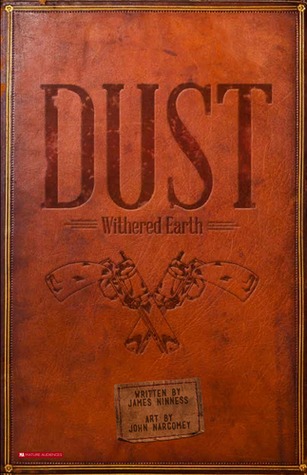
Dust: Withered Earth
From 2013.

There's really not much to say about this other than how crude it is.  Crude art.  Crude writing.  Crude storytelling.  Even the use of digital lettering is crude as used in conjunction with the crude art.  It's hard to imagine that anyone thought this was a project in its current state that was worth completing much less releasing.  But people tend to do that a lot.  (Hey, it is easier that way, right?  Sometimes you can forgive creators.  Sometimes you absolutely can't.)  Above and beyond all that, it's a Western, so it should be crude, right?  But crude in Westerns is Deadwood.  This is just inexcusable.  And the worst thing about it is the cover.  Don't judge a book by its cover, right?  That cover looks far too refined for what's to be found within.  But a lot of creators do that, too, right?  

Basically, run far, far away.

Digitally Speaking...43 "Dumbing of Age"

via Goodreads
Dumbing of Age Vol. 1: This Campus is a Friggin' Escher Print
From 2013.

When you're not a fan of a comic strip, or at least previously familiar with it, reading a whole collection can be something of a chore.  And Dumbing of Age isn't even a regular comic strip, but a web comic.  Dun dun duuuun!

What are web comics, you ask?  They're the Internet alternative to those things some people buy newspapers to read, or perhaps even read online, because so many newspapers don't have the good ones (or devote a decent amount of space to reprints of comic strips that aren't even being made anymore.  Some web comics have even gone on to have significant mainstream awareness.  None to the level of comic strips proper, mind you, but Internet famous is still famous (so says an age where YouTube stars boast millions of hits and...no name recognition).  As such, web comics are sometimes collected, and those collections might end up with the same little bits of commentary you'll find in collections for comic strips you, ah, actually heard of.

Anyway, so that's what this is.  It's not even the first iteration of the cartoon's creations as featured therein.  New readers will be completely lost about everyone that devoted fans will take for granted.  And hey, I used to read a bunch of web comics, too, but these things operate like illustrated sitcoms.  Not cartoons.  Not comic books.  Illustrated sitcoms.  Or a whole series of movies like SuperBad, or, basically, the American Pie films.

Dumbing of Age is great fun, until you realize it's not done yet, and it's still being created even as you're realizing it's not done yet just in the collection you're reading.  David Willis jokes about how the previous incarnation compressed so much of the early college experience.  Well, this version's massively decompressed indeed.  It's not bad, but it's a whole commitment.  Are you ready, punk?  Well, are you?

That's the only real obstacle here.  Imagine Scott Pilgrim but with a lot fewer video game references.  Or evil exes.  And no sweet garage bands.  Alas.

And yes, the reference to M.C. Escher in the title is something you would totally have gotten while you were still in school.

Digitally Speaking...42 "Doc Unknown"

via comiXology
Doc Unknown #1 (Believe In)
From 2013.

Sort of Batman: the Animated Series (acknowledged by writer Fabian Rangel Jr. as his chief inspiration) crossed with The Spirit, Doc Unknown is a fairly straightforward affair.  If Atomic Robo could be said to be the essence of science superheroes, Doc Unknown could be considered that same for detective superheroes.

Given that there are in fact so few detective superheroes these days, that Batman himself only occasionally functions that way, and The Spirit only makes sporadic engagements, does that leave Doc Unknown all alone?

Maybe so!

Bottom line is, this is a fine alternative for anyone who's tired of trying to keep up with years and years of continuity.  For all intents and purposes, Doc Unknown stands unique.  It's fast and loose (one second you feel bad for the villain, the next you can forget all about that).  I don't know if subsequent stories explain the hero's uncanny ability to speak with the dead (the issue includes a previous collaboration between the creators that makes it clear it's an idea of theirs that predates this comic), but it certainly seems like the most interesting element to me, and hopefully it's at least a continuing feature.

Digitally Speaking...41 "Diskordia"

via comiXology
Diskordia #1
From 2013.

Somehow this lasted for another ten issues, ending only late last year.  I have no explanation.  I know there's a certain amount of creativity going on here, and a lot of alternative lifestyling, too, a lot of rebellion.  If that sounds like it's worth it to you, then by all means, have a look.  The naked lady with the squid on her head is saying that the cover image is a lie.  A horrible, horrible lie!

But hey, that squid makes a pretty awesome hat.  How come Diskordia is the first time I've ever seen a squid used as a hat?

Digitally Speaking...40 "Detective Honeybear"

via Detective Honeybear
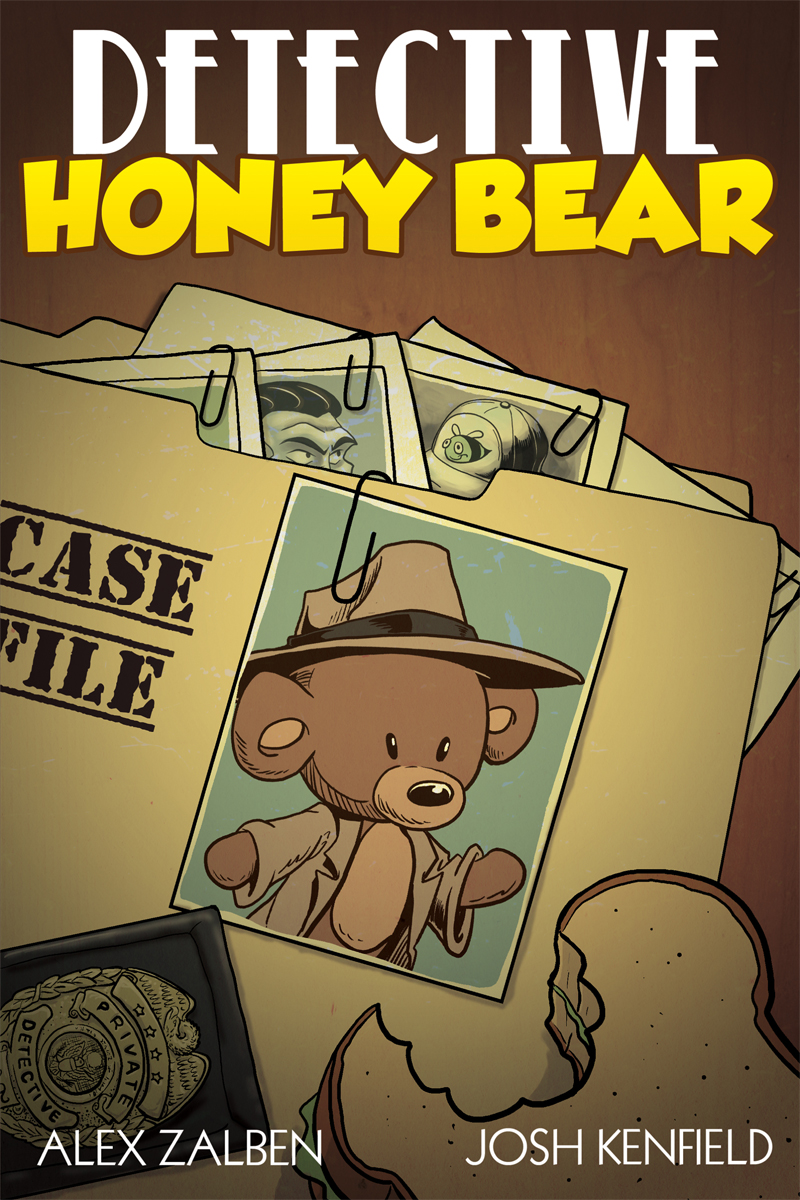
Detective Honeybear #1 (Creator Owned)
From 2013.

Please note, creators of Detective Honeybear: Speech inflections do not generally work in prose.  In an audio/visual medium (you know, film and television), this sort of character trait can work very well indeed.  Who doesn't love Kripke in The Big Bang Theory?

But in prose it's annoying.

Unfortunately, Detective Honeybear's speech inflection is exactly like Kripke's, and it's one of two defining features of the Detective Honeybear comic itself, including the fact that our dear Detective Honeybear is the only character to feature color in an otherwise black and white world.  

We get it.  It's supposed to be cutesy.  But it's not.  And the inflection is the worst idea.  Why cripple an idea that would be cutesy without drawing negative attention to this fact?

Solve that mystery, Detective Honeybear...

Digitally Speaking...39 "Department O"

via Monkey Pipe
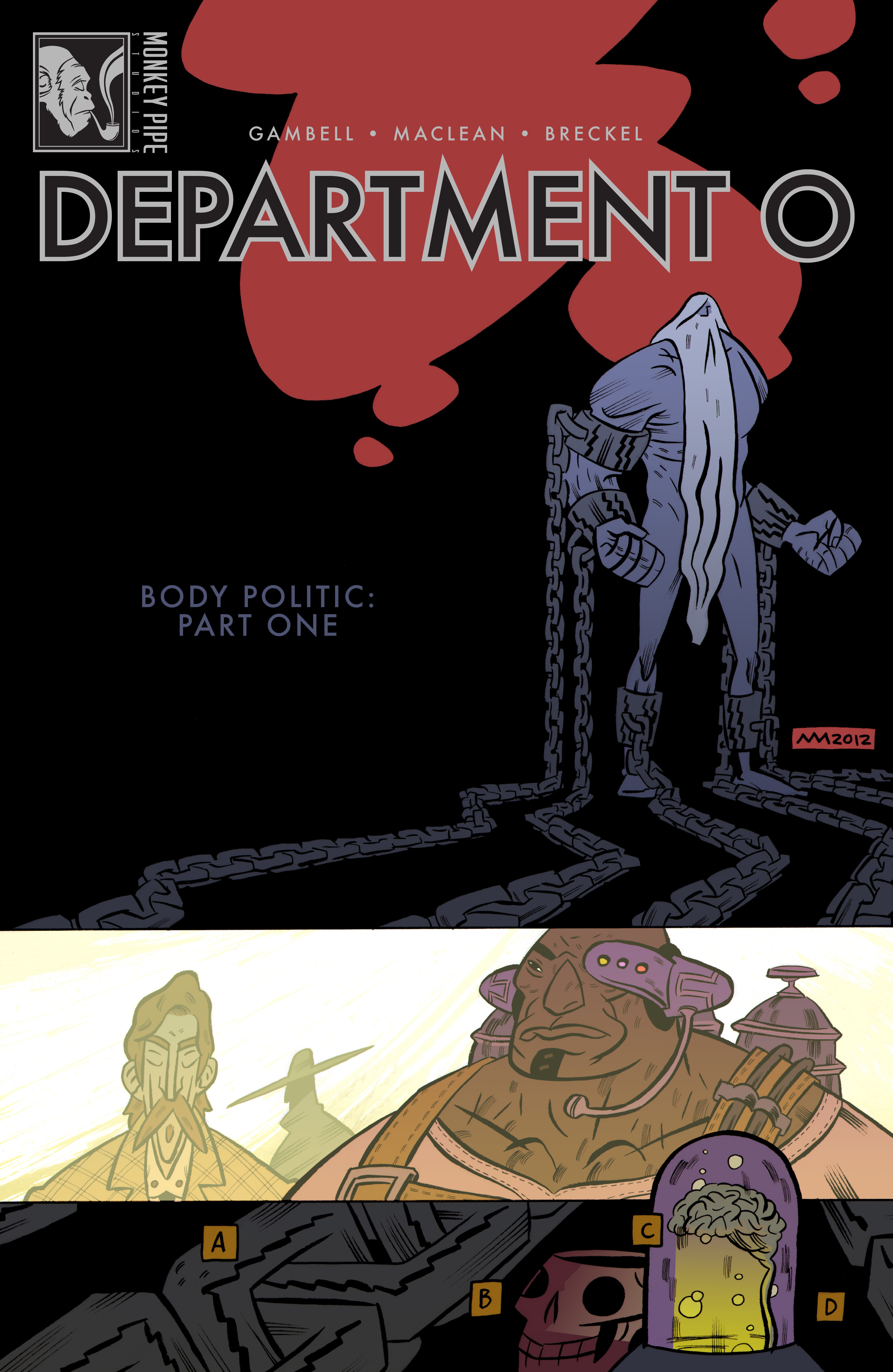
Department O #1 (Monkey Pipe)
From 2013.

It's extremely hard to explain what it is, so I'm going to have to explain what it's not.

Department O was not drawn by Brian Churilla.  You know, Brian Churilla, as featured in the pages of The Anchor and The Secret History of D.B. Cooper.  Both great, off-the-wall reads, by the way.  And hey, what's Brian Churilla up to these days, anyway?

Mostly, Department O can be summed up as not being drawn by Brian Churilla because the art does look vaguely like his, at least insofar as it's very hard not to notice.  In fact, in the early pages, it's really the only thing happening at all.

Which makes the whole thing more confusing.  Not because of the art, mind you.  Thank Andrew MacLean for the art, but not for the confusion.  It's not his fault Brian Churilla has worked with equally exceptional writers and he hasn't, at least in the pages of Department O.

If Department O actually explains what Department O is, I must have missed it.  The lettering isn't too great, either, mind you.

Also, Brian Churilla.  Apparently he's been doing a Big Trouble in Little China comic lately, in case you were wondering.