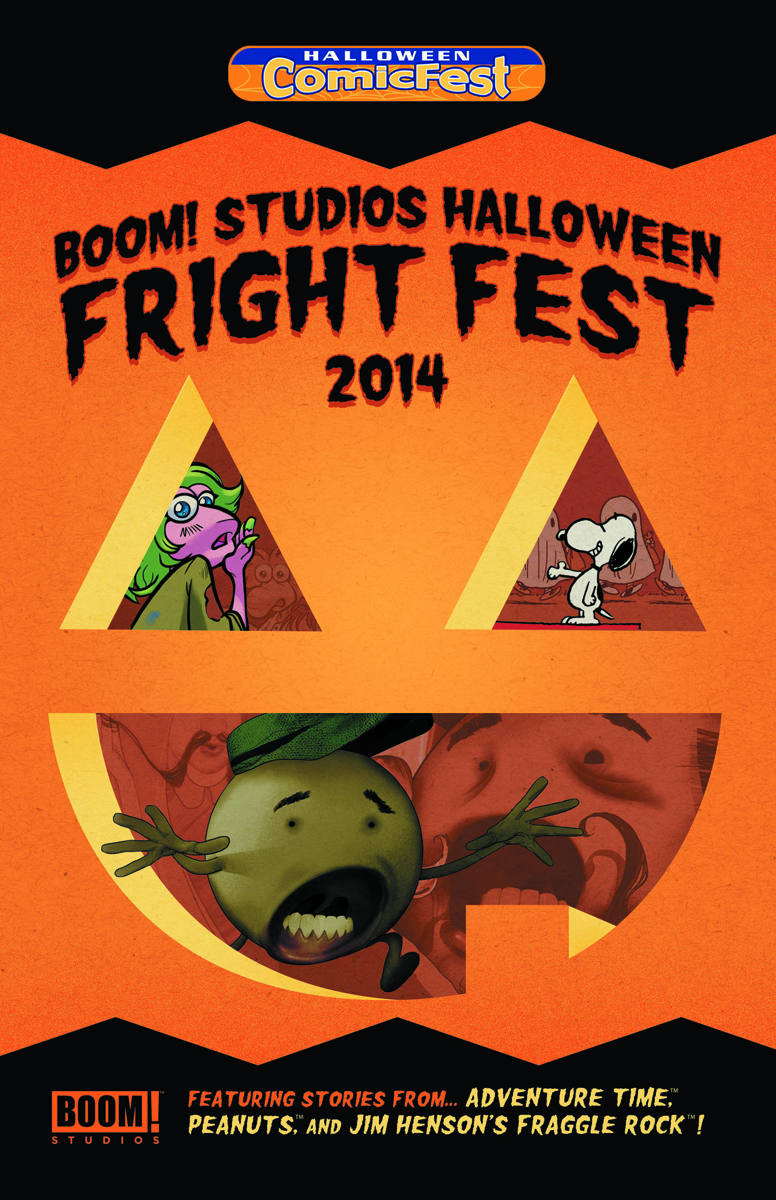
Boom! Studios Halloween Fright Fest 2014 (Boom!)
 |
| via Previews World |
The only Halloween freebie I picked up this year. Frazer Irving illustrated the
Adventure Time lead story, which was interesting insofar as Irving always does good work and
Adventure Time is, well, interesting. There were a few vintage
Peanuts strips reprinted, plus background information on Charlie Brown's infamous luck with kites explained by the late Charles Schultz. Finally, the lead-out was
Fraggle Rock. Hey, it was free.
Marvel 75th Anniversary Celebration (Marvel)
 |
| via Hero Complex |
I'm not really a Marvel guy, but I like it when Marvel celebrates itself (which does seem to happen often). Anyway, this was a special that featured a couple of stories and retrospective essays. The first story is from James Robinson and is close to the Marvel version of Darwyn Cooke's
New Frontier comics over at DC. It's also, I guess, like
Marvels. Reflects on "where were you" when the Fantastic Four were born. Bruce Timm next adapts Stan Lee's first-ever Marvel story, featuring Captain America. Works better in a modern, Timm style. Also included is the original text version. Then there's Brian Michael Bendis revisiting
Alias (his comic, not the unrelated TV show). I never read
Alias, but if it was as good as this was, hopefully Bendis really does consider bringing it back, as is suggested in the story. A text piece explores forgotten Golden Age creations, and curiously includes Rockman, a character revived in the pages of the excellent
The Twelve. Tom DeFalco does a pretty typical young Peter Parker Spider-Man tale. A text piece on Marvel's black superheroes. Len Wein returns to his most famous creation, Wolverine. A text piece on the real world intruding in Marvel's pages. Goofy covers that mock things that would never happen (
What If? for the Instagram generation). All told, I thought it was a pretty good reflection.
The Multiversity - The Just (DC)
 |
| via Comic Vine |
The third issue of
The Multiversity from Grant Morrison explores a world populated by all the DC characters created from the '90s onward, a next generation experience that takes a different tack from
Kingdom Come, more akin to Morrison's ideas previously represented by
Zenith and Super Young Team, superheroes straight from our media-obsessed age, who have less fighting and more angst to fill up their days.
Here's a rundown of the characters who appear"
- Sister Miracle (Sasha Norman), new creation, based off Shilo Norman, the Mister Miracle alternate Morrison used in his Seven Soldiers of Victory project.
- Megamorpho (Saffi Mason), new creation, based off Metamorpho, also known as Rex Mason.
- The Atom (Ray Palmer), long-established character who in the '90s was de-aged and became a member of Dan Jurgens' Teen Titans.
- Alexis Luthor, Lex Luthor's daughter, based on a concept from late '90s Superman comics.
- Batman (Damian Wayne) one of Morrison's most famous characters.
- Superman (Chris Kent), based on the "Last Son" character created by Geoff Johns.
- Azrael (Jean-Paul Valley), his costume on display; the post-"Knightfall" replacement Batman.
- Offspring (Ernie O'Brian), featured in Mark Waid's follow-up to Kingdom Come, The Kingdom.
- Green Lantern (Kyle Rayner), the '90s addition to the franchise.
- Green Arrow (Connor Hawke), Oliver Queen's son and one-time successor.
- Loose Cannon, Chronos, Gunfire, Max Mercury, Anima, Risk; group shot. Loose Cannon, Anima and Gunfire were part of the "Bloodlines" generation from 1993. Chronos was the anti-hero star of a brilliant, short-lived series. Max Mercury was another Waid creation, within the pages of The Flash and Impulse. Risk was part of Jurgens' Titans. There are a few others I can't positively identify.
- Superboy (Kon-El), whom Morrison cleverly has suffering from Bizarro syndrome. I have no idea why this is the first time the idea has ever come up. Brilliant.
- Red Amazo, combining Red Tornado with classic Justice League villain Amazo.
- The Flash (Wally West), the defining Flash for a generation thanks to Waid and Johns.
- Alpha Centurion (Marcus Aelius), a character I've badly wanted to see make a comeback for years. This may be it. For now.
- Steel (Natasha Irons), daughter of John Irons, the original Steel, with a long history herself.
- Argus (Nick Kovak), another "Bloodlines" creation.
- Wonder Woman (Artemis), the Azrael of the Wonder Woman '90s.
- Aquaman (Garth), also known as Aqualad and Tempest.
- Menta (Holly Dayton), daughter of Mento, Steve Dayton, associated with Doom Patrol.
- Doctor Midnite (Pieter Cross), part of the revived Justice Society at the turn of the century.
- Bloodwynd, part of Dan Jurgens' Justice League, famously described by Morrison in the pages of Supergods as being one of the worst examples of '90s comics. Should be noted that his distinctive speech bubble (a crackly red outline) is omitted. He, Alpha Centurion and Max Mercury are characters I'd want to explore given any possible comics career.
- Arrowette (Cissie King-Hawke), taking the name of a character who was part of Young Justice.
- Gypsy (Cynthia Reynolds), a member of the '90s Justice League scene.
- Jakeem Thunder, a character Morrison created to join the revived Justice Society, succeeding one of the original members.
- Impulse (Bart Allen), later known as Kid Flash.
Anyway, loved this issue. Although of course I've loved all of them. But this one in particular.
Saga #24 (Image)
 |
| via Previews World |
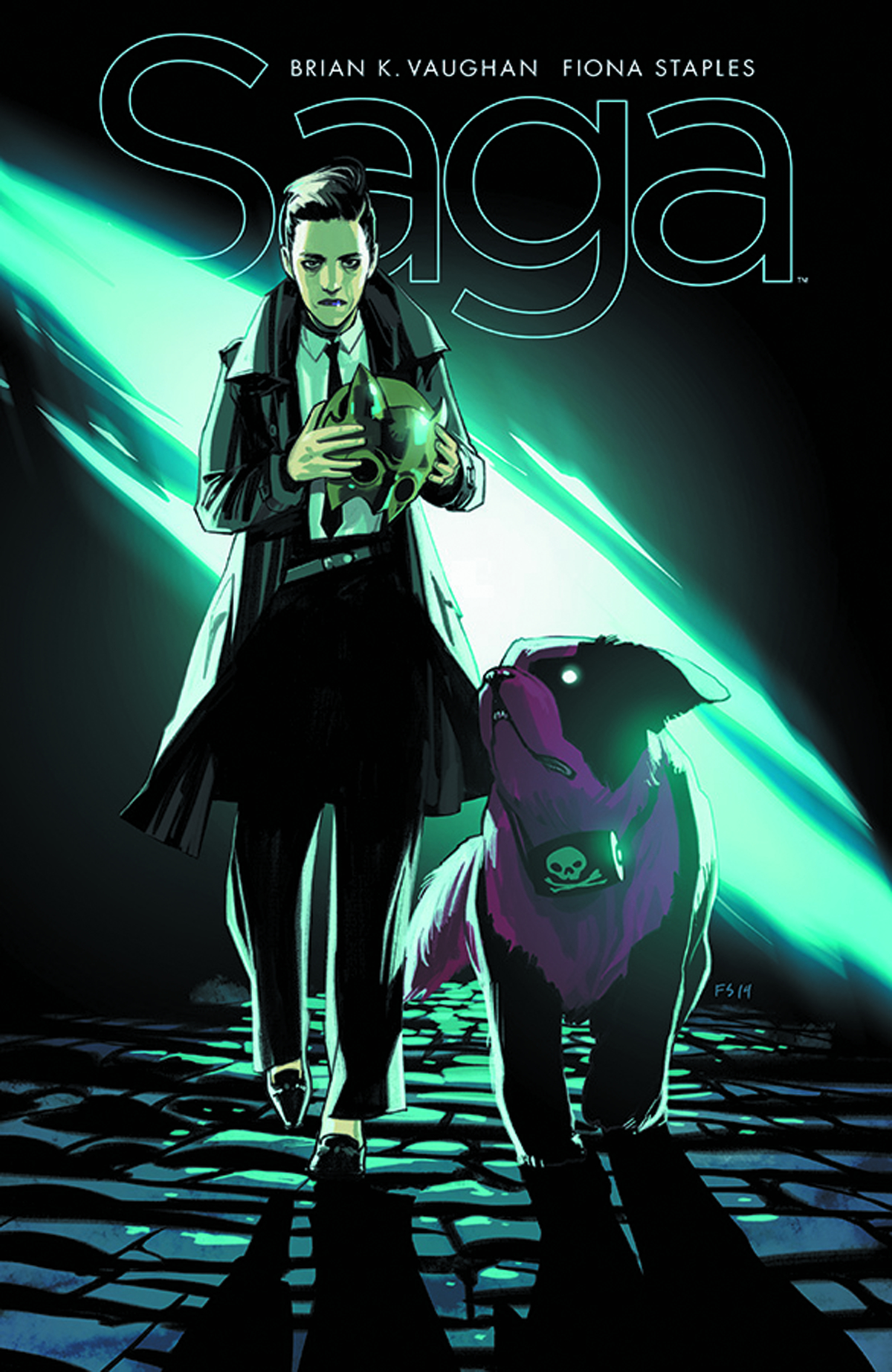
The Brand enters (re-enters? I don't know) the picture, looking to figure out whatever happened to The Will, one of my favorite supporting characters who hasn't been around in a while. Just a truly excellent issue, classic example of what made me love the series in the first place. Pity, since the series now goes on hiatus until sometime early next year.
Superman #35 (DC)
 |
| via Ain't It Cool |
Geoff Johns returns after the
Futures End interlude to continue the Ulysses saga as he and Superman step up their efforts to end the threat of the Machinist. Ulysses ends up making a bold move that may prove to be the definitive transition of the arc.
Wonder Woman #35 (DC)
 |
| via Rhymes with Geek |
The conclusion of the Brian Azzarello/Cliff Chiang era has been getting mediocre reviews from the circles I visit, but I was going to have to read this one for myself even though I've had a spotty record reading the series so far. This is basically the end of the First Born arc, too, with the most feeling of conclusion coming from Azzarello revealing the true nature of one of his supporting characters, a twist that underwhelmed other observers, but to my mind tracks well with what the series had done previously, exploring the nature of conflicting allegiances that has always been one of the worst-explored aspects of Wonder Woman (previously relegated to "you represent us! you
don't represent us!"). All along I've been convinced that this was a classic interpretation of the character, completely unusual and therefore with that much greater opportunity to say something new, which has been badly needed for decades. It's distinctive, not just because of the art, but because it's allowed Wonder Woman to completely own her own mythology, not just "Greek gods, Greek gods, Greek gods" but what that means to her specifically. Again, something that's needed to be done for a long time. The instinct in the future will be to distance Diana as much from this material as possible without outright erasing it from the record, but that would be a mistake. DC's already had other writers doing a more traditional interpretation simultaneously, including within the pages of Geoff Johns'
Justice League and a burgeoning, unprecedented-in-the-modern-era line of sister titles,
Superman/Wonder Woman and
Sensation Comics. I don't think any of that would have been possible without Azzarello's confident take