Okay, you got me. But the point is, I got these comics cheap, and they're older comics, so the chances are fewer people are talking about them right now...
Batman/Superman 3.1: Doomsday (DC)
From November 2013.
This is the newest comic I picked up in my most recent back issue binge. I've been collecting various Villains Month issues since they were released. It was a heck of an idea, letting the bad guys have their tales told, and for some of these guys, it was a chance to see what exactly their New 52 context was. Obviously Doomsday was pretty famous in older continuity as the monster that killed Superman, and Batman v Superman: Dawn of Justice saw his movie debut (considerably more auspicious than, say, Bane's). This version ties up Supergirl and General Zod into the mythos (the movie features Zod mixed in, too, oddly or not) and doesn't particularly focus on his origins so much as his significance to the Kryptonians people care about, including deeper cuts into the House of El, including a Knight of El and Lara.
The Possessed #3, 4, 5 (Cliffhanger)
From November, December 2003, January 2004.
I last caught an issue of this co-written non-superhero Geoff Johns (#4, actually) in 2013, so I guess I was only two-thirds more lucky this time around (still missing the ending, alas). It's not hard to see echoes of Johns' superhero work in it (particularly the current Darkseid War), and it's got some pretty heady thoughts in mind. The only odd part is Liam Sharp's ridiculously sexy women in what's essentially a religious comic. But I guess someone figured there ought to be something for readers who didn't particularly want to focus on existential matters, too...
The Spectre #11 (DC)
From January 2002.
It's such an interesting thing to remember that Hal Jordan, post-"Emerald Twilight," spent a lot of time away from the superhero gig, but nonetheless managed to remain, if anything, more relevant than ever. Following Day of Judgment, he played host to DC's Spirit of Vengeance, and even got another ongoing series out of it. This is always a fun series to visit with. This issue features the Phantom Stranger, a comic book character infinitely more arcane than Marvel's Doctor Strange and less likely to get a movie out of it, helping Hal figure out his gig, which is considerably more compassionate than Spectre is usually depicted. That's no doubt thanks to the literary stylings of J.M. DeMatteis, one of the more versatile writers in comics (especially when Keith Giffen infects him).
Action Comics #463 (DC)
From September 1976.
Yeah, this is an oldie, and was not kept in particularly good condition, but it was certainly worth a look, as it directly reflects the bicentennial. Classic creators Cary Bates and Curt Swan are at the helm as an alien who has a peculiar reaction to Superman's powers sends him back to 1776 to get him out of the way. A wacky gimmick, sure, but it was fun to read.
Superman #187 (DC)
From December 2002.
This is one of Geoff Johns' early forays with the Man of Steel, smack dab in the middle of a showdown with Manchester Black, who was a key early millennial threat. As someone dabbling in the waters amidst other writers, it's odd to think now that Johns could be so undersold, as it now seems.
Superman Confidential #10 (DC)
From February 2008.
I loved the Confidential/Classified books from this era, allowing creators to leap into whatever period they wanted to write about without having to make a mini-series out of it. This one features Dan Abnett and Andy Lanning bringing on the Apokolips, which I figured I'd have a look at, considering, you know, Johns' Darkseid War. Speaking of which...
Wonder Woman #103 (DC)
From November 1995.
Here's John Byrne bringing the Apokolips to Wonder Woman. Honestly, once DC figured it out, the New Gods were the best thing to come to its superheroes, always guaranteeing big moments, because these were heroes and villains who were literally visiting, or getting visited, with a story all their own, breaking the usual storytelling cycle. It seems every effort to feature the New Gods in their own stories is always doomed to fail, but they remain ridiculously reliable, because they're instantly operatic, like a whole alternative to everything fans normally follow, but always existing whether fans care about them or not, ready and waiting for another big moment...
Showing posts with label J.M. DeMatteis. Show all posts
Showing posts with label J.M. DeMatteis. Show all posts
Thursday, April 14, 2016


Thursday, July 30, 2015
Reading Comics 171 "A Frustrating Week"
Last week I ended up skipping on Justice League: Gods and Monsters - Batman #1 (DC), but I decided to get it this week, along with JL:GaM - Superman #1. These are comics that help flesh out Bruce Timm's return to the animated DC fold after helping shape its legacy (along with Paul Dini) in the '90s and early 2000s with Batman, Superman, and Justice League cartoons. I initially skipped out because the art inside Batman was nothing like the Timm I know, but I guess if these spin-offs go in a different direction artistically, it only goes to emphasize the stories more. Batman features Kirk Langstrom, the erstwhile Man-Bat, in the role of the Dark Knight, having transformed himself, instead of a giant bat, into a vampire. But the neat thing about the story is that it focuses on the matter of whether or not Batman does what he does because he enjoys it or out of a sense of justice. Superman features a Man of Steel, meanwhile, who ends up being raised by Mexican immigrants, ending up more resentful as a superhero as a result. I guess these are the variations that make them monsters...
Anyway, when I entitled this week's edition "A Frustrating Week," I wasn't really thinking about Gods and Monsters, but rather a couple of comics I tried for the first time because of my familiarity with the writers. (J.M. DeMatteis, by the way, wrote both GaM tie-ins.) The first sampling was Low #8 (Image) from Rick Remender, and the second was Sex Criminals #11 (Image) from Matt Fraction. Remender is one of those writers I seem to constantly go back and forth on. Recently I had gotten around to liking him again thanks to his Captain America work. Fraction, meanwhile, just concluded what ought to be considered a seminal run on Hawkeye. Both are well-known for their creator-owned work, as well. The problem is, these particular efforts seem to have been greenlit by Image with the express interest of trying to duplicate or at least build off the momentum of Saga (which in effect makes them like all the superhero comics that all these nonsuperhero comics are constantly trying to say they're more interesting than for the simple fact of being more original in a vast sea of superhero comics...).
Low, for instance, is the latest in an increasingly long list of comics that hinge a great deal on their art and distinctive coloring, not to mention general sci-fi adventure flavoring. In a lot of ways, Saga provoked Image into returning to the art-heavy days of its origins, but in a more thoughtful, nuanced way. The problem is, if Image starts to produce a lot of comics with the same general artistic interests (what is otherwise termed a house style), they all begin to be lost in the shuffle.
Like Deadly Class, Remender apparently takes Low personally, and has attracted, or so the letters column suggests, an audience that seems to have instinctively gotten exactly whatever it is he's trying to accomplish. Because the results, as with Deadly Class, are somewhat impenetrable. And again, part of that is because the art so thoroughly dominates the storytelling, the story itself becomes lost in the shuffle.
Sex Criminals, meanwhile, is one of those comics intended to appeal to that hip audience that gravitates to taboo material, or otherwise "mature audiences" that premium cable seems to think must include, well, sex. Graphic sex. And again, Saga opened those doors. The gimmick behind Fraction's comic is that the central characters stop time every time they have sex. This would be an excellent gimmick indeed, if this were any other medium besides a comic book, which by nature exists in static images. Which sort of limits the ability for time being stopped looking like anything other than your typical comic book panel...
But the thing is, Fraction seems to have gotten how slim a gimmick that really is, because Sex Criminals is at its best as metafiction, as he addresses the reader directly, explaining certain matters of the art that he talks over rather than allows to be depicted (but not the sex, naturally).
But are either worth reading, at least for someone like me? I wish. I really wish, because these are writers I want to like, and every time Remender talks about how personal something is or how much he's risking to do this particular project...I want to believe in the material, too. But I don't. I see creators doing stuff because no one told them to try harder. They go for something easy, or attempt to cash in on some other hot project...
So I was happy indeed to have broken my usual alphabetical reading order and started out with Superman #42 (DC), the continuation of Gene Luen Yang's origin behind the "Truth" crossover event. This issue we find out who the villain is, a cult figure who calls himself Hordr_Root. This is another instance of John Romita, Jr. remaining as continuity past the Geoff Johns run paying dividends, because along with the solar flare thing, this is truly a new era for Superman, with new villains popping up, sharing a similar technological bent that speaks to modern times (needless to say, but this guy is similar to but distinctive from Machinist). If you have no interest in "Truth," then Yang's storytelling at least has something to say about today's controversies over privacy.
Romita, meanwhile, continues to evolve. If his Superman remains the same, it's striking how his Lois Lane looks a lot like Ron Frenz's. Frenz was a Superman artist in the '90s. I actually hated his work a great deal. But to see it, in a roundabout way, again is to recognize that if just a few things had been different about it, maybe it wouldn't have been so bad. This is ironic, because Romita's Superman work has received a great deal of criticism, too. But I'd still take Romita's over Frenz's any day.
Needless to say, but Superman was my favorite read of the week, followed by the expectation-challenging Gods and Monsters and then whichever of the two remaining I can form a more favorable opinion at the given moment...
I won't be checking in for a couple of weeks, as I'll be visiting family in Virginia and hopefully finding a bunch of comics duly pulled for me. But I won't know for sure until I visit the shop next. We'll see!
Anyway, when I entitled this week's edition "A Frustrating Week," I wasn't really thinking about Gods and Monsters, but rather a couple of comics I tried for the first time because of my familiarity with the writers. (J.M. DeMatteis, by the way, wrote both GaM tie-ins.) The first sampling was Low #8 (Image) from Rick Remender, and the second was Sex Criminals #11 (Image) from Matt Fraction. Remender is one of those writers I seem to constantly go back and forth on. Recently I had gotten around to liking him again thanks to his Captain America work. Fraction, meanwhile, just concluded what ought to be considered a seminal run on Hawkeye. Both are well-known for their creator-owned work, as well. The problem is, these particular efforts seem to have been greenlit by Image with the express interest of trying to duplicate or at least build off the momentum of Saga (which in effect makes them like all the superhero comics that all these nonsuperhero comics are constantly trying to say they're more interesting than for the simple fact of being more original in a vast sea of superhero comics...).
Low, for instance, is the latest in an increasingly long list of comics that hinge a great deal on their art and distinctive coloring, not to mention general sci-fi adventure flavoring. In a lot of ways, Saga provoked Image into returning to the art-heavy days of its origins, but in a more thoughtful, nuanced way. The problem is, if Image starts to produce a lot of comics with the same general artistic interests (what is otherwise termed a house style), they all begin to be lost in the shuffle.
Like Deadly Class, Remender apparently takes Low personally, and has attracted, or so the letters column suggests, an audience that seems to have instinctively gotten exactly whatever it is he's trying to accomplish. Because the results, as with Deadly Class, are somewhat impenetrable. And again, part of that is because the art so thoroughly dominates the storytelling, the story itself becomes lost in the shuffle.
Sex Criminals, meanwhile, is one of those comics intended to appeal to that hip audience that gravitates to taboo material, or otherwise "mature audiences" that premium cable seems to think must include, well, sex. Graphic sex. And again, Saga opened those doors. The gimmick behind Fraction's comic is that the central characters stop time every time they have sex. This would be an excellent gimmick indeed, if this were any other medium besides a comic book, which by nature exists in static images. Which sort of limits the ability for time being stopped looking like anything other than your typical comic book panel...
But the thing is, Fraction seems to have gotten how slim a gimmick that really is, because Sex Criminals is at its best as metafiction, as he addresses the reader directly, explaining certain matters of the art that he talks over rather than allows to be depicted (but not the sex, naturally).
But are either worth reading, at least for someone like me? I wish. I really wish, because these are writers I want to like, and every time Remender talks about how personal something is or how much he's risking to do this particular project...I want to believe in the material, too. But I don't. I see creators doing stuff because no one told them to try harder. They go for something easy, or attempt to cash in on some other hot project...
So I was happy indeed to have broken my usual alphabetical reading order and started out with Superman #42 (DC), the continuation of Gene Luen Yang's origin behind the "Truth" crossover event. This issue we find out who the villain is, a cult figure who calls himself Hordr_Root. This is another instance of John Romita, Jr. remaining as continuity past the Geoff Johns run paying dividends, because along with the solar flare thing, this is truly a new era for Superman, with new villains popping up, sharing a similar technological bent that speaks to modern times (needless to say, but this guy is similar to but distinctive from Machinist). If you have no interest in "Truth," then Yang's storytelling at least has something to say about today's controversies over privacy.
Romita, meanwhile, continues to evolve. If his Superman remains the same, it's striking how his Lois Lane looks a lot like Ron Frenz's. Frenz was a Superman artist in the '90s. I actually hated his work a great deal. But to see it, in a roundabout way, again is to recognize that if just a few things had been different about it, maybe it wouldn't have been so bad. This is ironic, because Romita's Superman work has received a great deal of criticism, too. But I'd still take Romita's over Frenz's any day.
Needless to say, but Superman was my favorite read of the week, followed by the expectation-challenging Gods and Monsters and then whichever of the two remaining I can form a more favorable opinion at the given moment...
I won't be checking in for a couple of weeks, as I'll be visiting family in Virginia and hopefully finding a bunch of comics duly pulled for me. But I won't know for sure until I visit the shop next. We'll see!
Sunday, December 28, 2014
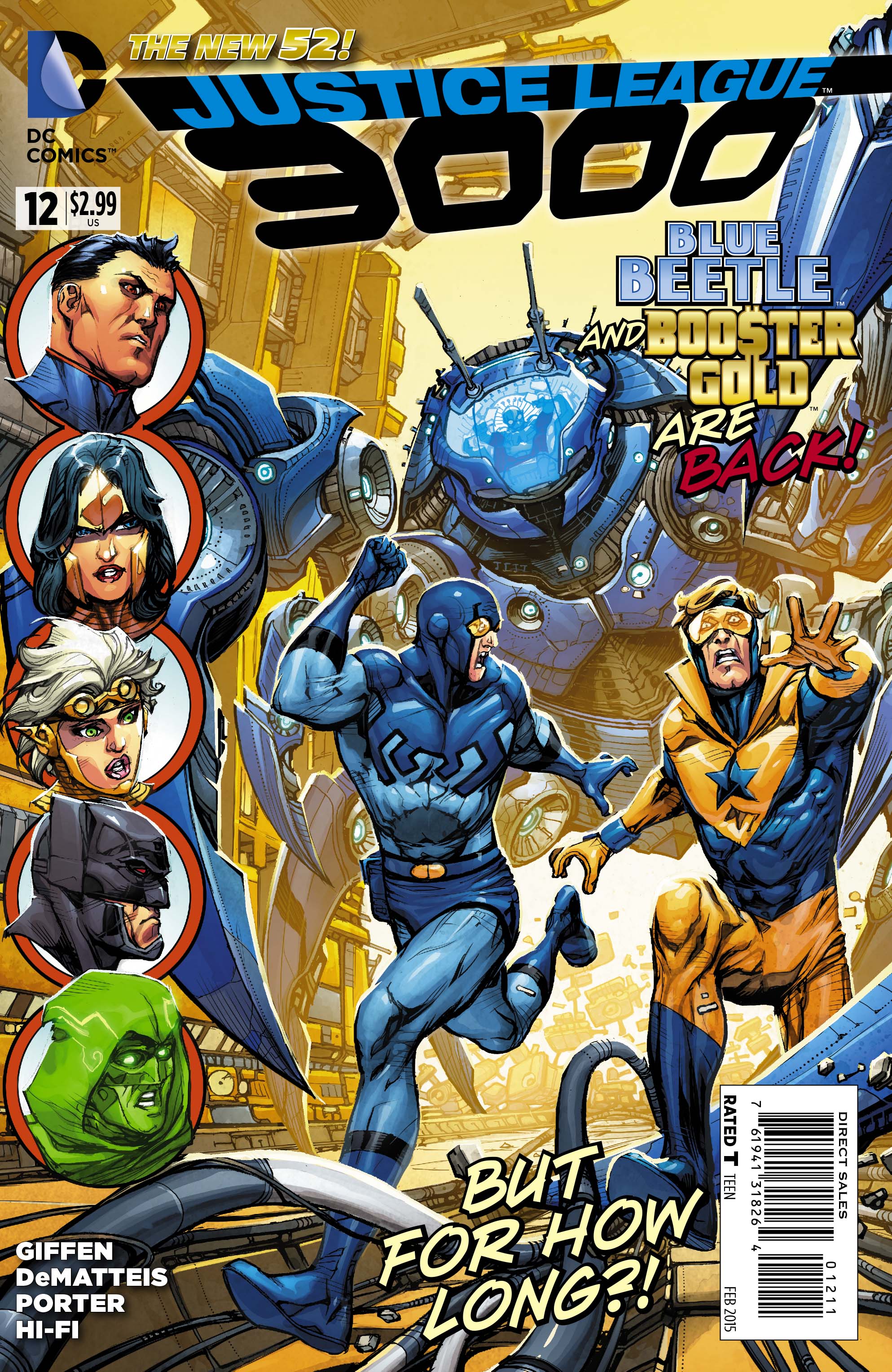
Justice League 3000 #12 (DC)
 |
| via 13th Dimension |
artist: Howard Porter
Here's the series that was originally conceived as a complete reunion of the "Bwa-ha-ha League" creator reunion. Except artist Kevin Maguire was replaced with JLA's Howard Porter. Clearly the writers, the inimitable duo of Keith Giffen and J.M. DeMatteis, are exactly the same!
I don't know if it was the Maguire/Porter swap, or ongoing interest in the "Bwa-ha-ha League" is never exactly what DC thinks it is, but Justice League 3000 has been struggling for relevance. Time for Blue & Gold?
Absolutely!
"Blue & Gold" are Blue Beetle and Booster Gold. And not just any Blue Beetle, but Ted Kord, the one who was, of course, an original member of the team, and whose last and most famous moment in DC lore was being blown away by Maxwell Lord in Countdown to Infinite Crisis. Later, Jaime Reyes took over as Blue Beetle, even at the start of the New 52, but a new incarnation of Ted showed up in Geoff Johns' Forever Evil. The Ted here is not that Ted. Booster jokes around about a time before Original Ted's death where he'd really let himself go.
And they steal this whole issue, by the way. Your regularly scheduled Justice League a thousand years in the future (apparently having new usurped that era from the Legion of Super-Heroes) are backup players in their own series! Does it matter? Only if you plan to read any issues that don't spotlight Blue & Gold.
It's great, because Porter clearly does his best to channel the distinctive Maguire facial features in the issue. I don't know if this is something he's done for other issues, but it's clearly noticeable in this one. And much appreciated.
It's a pretty great issue.
Thursday, November 6, 2014
Trinity of Sin #1 (DC)
writer: J.M. DeMatteis
artist: Yvel Guichet
Combining Trinity of Sin: Phantom Stranger and Trinity of Sin: Pandora and the nonexistent Trinity of Sin: The Question is the new series called Happy Fun Time Trinity of Sin.
artist: Yvel Guichet
 |
| via Comic Vine |
I figured I had to at least catch the debut issue, because both parent titles are among series I probably should have been reading all along anyway. I liked the issue I caught of Phantom Stranger, and Pandora comes with her a whole host of expectations as the most important new character of the New 52, although her actual story debut and subsequent adventures may have undermined her potential.
Originally introduced as the mystery figure who theoretically explained everything about the New 52, Pandora didn't actually enter into regular appearances until a year or so into the DC relaunch, and by that time her own series was almost immediately tied in with a crossover arc. Fans are increasingly uneasy with series that seem to spend too much of their time interrupted in crossover arcs. That left Pandora as the latest new character to seemingly become instantly forgotten.
Thankfully she has another shot, this time with a little less pressure. The first of the three to be featured in the issue, however, is the Question, who has been repositioned to be a mystical figure rather than a vigilante who wears a faceless flesh mask (who, I like to point out, was the inspiration for Watchmen's Rorschach), whose penchant for being defined, well, by questions has been taken to its greatest possible degree.
Next Phantom Stranger, who used to be known as the guy whose secret origin left him, well, to be a stranger, but has for a while been associated with the death of Jesus, making him the most obvious of the three to be forced to walk the earth (like Cain, as Jules points out in Pulp Fiction, although he might have been referring to Kung Fu and/or Kill Bill). He's seen palling around with Dr. Thirteen, a semi-obscure mystical detective, who's the most famous of the apparent victims in the issue.
Then comes Pandora. What defines her? She's immediately linked with the Greek myth of the box of sin, and as such is the obvious unifying figure for the whole concept for anyone who doesn't know what Phantom Stranger is supposed to be about much less the Question's current role. It seems Trinity of Sin continues to make her story more about her future than her past, a signal of what's to come. I guess we'll see about that. I assume the whole point of the series is to help keep her story going, and I think it's a good idea to keep her contextualized, whether it's in direct associations with better-known figures or the general concept. It forces everyone to remember what's supposed to make her special.
When the New 52 launched there were distinct corners of the landscape put into groups. These guys might otherwise have been placed in the Justice League Dark camp, but they're, well, darker, more haunted figures rather than a bunch of outcasts who tend to have had Vertigo series attached to their recent pasts. They're the guys who might have been Vertigo figures but never were, a little too superhero but also not superhero enough. If that makes any sense. The result, in the current DC landscape, is relatively the same. If that helps.
I'll be keeping my eye on this one.
Monday, October 27, 2014
Quarter Bin #56 "Binge-worthy I: Alan Moore"
These comics were sixty cents each. The title of this column is inaccurate.
Recently the good folks at Zimmie's in Lewiston, ME (my history with this shop stretches back to 1992) indulged one of my worst habits: scouring bargain bins. One week they had a whole table of long boxes filled with cheap comics. I've made multiple surveys of their contents and come up with some fun reading. This is the first in a series that explores what I found.
1963: Mystery Incorporated (Image)
From April 1993.
Alan Moore has become known for two kinds of comics: mature works that helped redefine the potential of the form, and nostalgic projects that looked backward at its most stereotypical instincts. 1963 comes from the latter instinct. After Moore left DC and mainstream superheroes behind, he began a journey toward finding a new platform, which would eventually lead to Tom Strong and then League of Extraordinary Gentlemen, the ongoing project that has become his most notable recent output. 1963 is probably his thickest nostalgia act, something he pulled out for the budding Image line that was probably among its first material not to heavily rely on the reputation of its artist. It's also the closest he's ever come to doing Marvel material. For whatever reason, although he famously holds a grudge against DC, for which he created Watchmen, Moore has never even worked for Marvel. Clearly, though, he was once a reader. Mystery Incorporated is a pastiche of Fantastic Four, with four characters who have equally fantastic powers and little interest but quipping their way through the given crisis. That's about all there is to find here. That may be why only die hard Alan Moore fans even know about this particular effort.
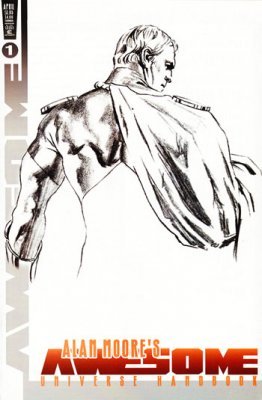
Alan Moore's Awesome Universe Handbook (Awesome)
From April 1999.
The bridge between 1963 and Tom Strong (as well as the rest of America's Best Comics) was laid down by, of all people, Rob Liefeld, whose Image offshoot imprint had a number of different titles but should best be remembered (and it should be remembered) as Awesome Entertainment. Moore had previously helped relaunch Liefeld's Supreme as one of his nostalgia acts, a version of the Silver Age Superman (as last seen in the famous "Whatever Happened to the Man of Tomorrow?"), which led to his involvement with a rejuvenation of the whole Liefeld landscape. This release detailed his plans for the whole thing, a rare public look at project proposals that only the name Alan Moore could possibly have justified. There's Supreme, of course, plus Suprema (patterned after Supergirl), Glory (revamped as his version of Wonder Woman), and Youngblood (once and always the Avengers). Alex Ross, still riding high at the time thanks to his Marvels breakthrough (with Kingdom Come yet to, well, come) provides the preview images of Supreme and family (including a Krypto equivalent). The Moore version of Supreme remained relevant for years (in fact, Tom Strong and the whole ABC line was based off this work) and recently Warren Ellis has started building on this legacy within the pages of Supreme: Blue Rose (I've yet to read an issue, but am very eager to correct that). This is really the only time I've been a first-hand fan of Moore. The whole thing fell apart rather quickly when Awesome itself disappeared, and that was disappointing.
Albion #1 (WildStorm)
From August 2005.
This one was plotted by Moore but scripted by the team of Leah Moore (daughter of Alan Moore) and John Reppion (husband of Leah Moore), whom I've previously experienced in the excellent Complete Dracula adaptation. It's sort of the British LXG mixed with Watchmen. The title refers to an ancient designation of England itself, a sort of mythic version of the country. This is the part where I admit I probably should reread this issue because it's pretty interesting, and this was my first exposure to the project. Truth is, I tend to talk a lot of smack about Moore (Alan Moore, you understand), and this is in large part due to the fact that Moore himself has made it difficult to like him. He's got a huge chip on his shoulder, a sense of entitlement he actually technically deserves as the most respected comic book writer of the past quarter century, which is also to say the most respected writer in comic book history itself. But I also think he cashed in his chips far too early, burned bridges (on his end) at a point when he was really only beginning to explore his potential. If you think his work as it is is impressive, it's my contention that his legacy could have been better if he'd simply gotten out of his own way. An Alan Moore who continued to evolve, who looked forward (even if he mixed in looking backward, too) would deserve the contempt he holds over everyone else in the industry, whose viewpoint on superheroes doesn't look like it was frozen in the Silver Age and only looks otherwise at his say-so. In short, someone who respects his contemporaries, and possibly even his own readers.
American Flagg! #40 (First)
From May 1987.
Although the series was created by Howard Chaykin, there's an Alan Moore connection, since he wrote material for a few issues. Those were the days when Moore still played well with others, which curiously, as you've already seen me indicate, ended with Rob Liefeld (which would seem, by reputation, to be self-explanatory). Chaykin, ironically, is the creator you get when you do everything right and you become a legend, but no one really seems to notice. That's American Flagg! in a nutshell, too, one of those '80s projects that fell outside of the Big Two, that didn't involve superheroes, and wasn't written by Alan Moore (for the most part). (Dean Motter's seminal Mister X is another example, although Dark Horse has been doing a commendable job at trying to correct this.) The title of the series refers to Reuben Flagg (no relation to Stephen King's Randall Flagg!), who probably has more significance in a post-Girl with the Dragon Tattoo world, a man who tries to fight back against a corrupt system. (Like Moore's fascination with Nixon, who's still president in Watchmen, this is a concept that probably made a lot of sense back then, and actually means more now than it has in a while.) Chaykin still pops up regularly with new projects, but his profile is so far diminished that only the comic book industry itself still thinks he's important. He's been forgotten by fans. This issue wasn't written by Chaykin, however, but by the team of J.M. DeMatteis (who remains relevant as he works on various superhero projects at the Big Two) and Mark Badger, making it a creator-owned title that could also thrive in the hands of others (which is always rare). If I'd had options, I'd have wanted one written and drawn in the inimitable style of Chaykin himself, though.
Recently the good folks at Zimmie's in Lewiston, ME (my history with this shop stretches back to 1992) indulged one of my worst habits: scouring bargain bins. One week they had a whole table of long boxes filled with cheap comics. I've made multiple surveys of their contents and come up with some fun reading. This is the first in a series that explores what I found.
1963: Mystery Incorporated (Image)
From April 1993.
 |
| via Wow Cool |
Alan Moore's Awesome Universe Handbook (Awesome)
From April 1999.
 |
| via Comic Book Realm |
Albion #1 (WildStorm)
From August 2005.
 |
| via Comic Book Realm |
American Flagg! #40 (First)
From May 1987.
 |
| via Cover Browser |
Monday, August 18, 2014
Reading Comics #130 "Bull Moose Grab Bag IV"
Local physical-things shop Bull Moose has recently changed the way it sells comics. It remains to be seen whether it will be selling comics much longer. But until recently it sold new comics and then slightly-less-new comics in grab bag form. I like grab bags, and on the whole I liked what I got in these Bull Moose grab bags. This is the last official Bull Moose grab bag, though I get to continue this sub-feature in future editions of this column as Bull Moose Bargains. More on that when it happens! Until then, the contents of the last grab bag.
Batman '66 #12 (DC)
The comic based on the '60s TV series that has swung back around to being culturally tolerated remains amusing for what it is.
Bravest Warriors #21 (KaBOOM!)
One of those cartoons clearly inspired by the success of Adventure Time. Bull Moose Grab Bag did me wrong in giving me two copies, thanks to there being two different covers for some reason.
Chew #42 (Image)
I read some of the earliest issues of Chew, liked them well enough, but it was also fairly easy to...not read Chew anymore. When John Layman wrote Detective Comics I was actually more impressed with him. In his own sandbox, Layman is free to do what he wants...and I don't know, I guess he just wants to screw around. These days I compare this kind of comic to Atomic Robo, and bottom line is, Chew doesn't seem as inspired. Weirdo concept though it sports and the ability to exploit said weirdo concept, Chew is ultimately fairly throwaway. Hey Layman, feel free to jump back into the mainstream. Or find something more interesting to do with Chew. Apparently he's one of the Batman Eternal writers, but does that really count? I guess I'll keep myself posted...
C.O.W.L. #2 (Image)
A few years back I was ready to consider myself a pretty big fan of Kyle Higgins. These days I'm wondering what happened. Something that bothers me is that he often has a co-writer. This is not in itself a bad thing. He first burst onto the scene with Scott Snyder as co-writer (Batman: Gates of Gotham). Given Snyder's reputation these days, that's not a bad association at all. (Even Snyder had a co-writer tagging along when he worked on Severed for whatever reason.) With C.O.W.L., Higgins is working alongside Alec Siegel. I have no idea. What I've read of this project, Higgins has been getting all the credit. As far as the need for co-writers goes (it should be noted even Geoff Johns worked with James Robinson in his early years, and Robinson worked with a co-writer, too, for part of Starman), I'm wondering if this is something he really does need. Maybe as a kind of focusing lens? Because as far as his Nightwing ended up going, I wonder if he needed such a lens, and just never got one. C.O.W.L., like the final issues of the Nightwing run, is set in Chicago. There's been speculation that this is, in fact, what Higgins would have done if given the chance in his mainstream effort. Well, maybe? Anyway, regardless of my personal feelings on its (co-)writer, this series has gotten a fair bit of hype. "C.O.W.L." is short for Chicago Organized Workers League, otherwise known as the World's First Superhero Labor Union. That's interesting and all, and this is even a period piece, for whatever reason. Maybe I just can't figure Higgins out. Maybe I'm approaching this wrong from the start, but as with my Higgins experience in general lately, I...just wish there was as much on the page as I wish there was.
Deadly Class #6 (Image)
Speaking of Image series from writers I really wish I could like as much as it sometimes seems I should, this one's from Rick Remender, who's recently impressing me with the scope of what he's doing in Captain America. Apparently, Deadly Class is a personal project for him. I wish I could say I loved it and totally understood how it's so important to him, but I can't. This and C.O.W.L. are the kinds of disappointments I think I probably need to reread. Maybe I will. (I generally don't do a lot of that.)
All-New Doop #3 (Marvel)
Peter Milligan is a writer I feel guilty for not liking. He's like the advanced stage of where Higgins and Remender could be years from now. Milligan has been around for years, a kind of junior member of the British Invasion who helped forge the early years of Vertigo. His most recent prominent work was nearly the first two years of Red Lanterns, a series I've recently fallen madly in love with...under the auspices of Charles Soule. As for what Milligan is doing now (not meant as a pun, but there's that, too), I...guess this is related to his earlier X-Statix, a cartoony corner of the X-Men franchise that was much cult-loved at the time. But Doop reads like instantly pointless drivel. I'd read Chew over this.
The Flash #32 (DC)
And what is this, a trend or something? Another writer I wish I liked is Robert Venditti, who happens to have been the guy who took over Green Lantern following the historic near-decade Geoff Johns run. I haven't read too much of that. Sometimes I wish I did, because I've liked what I have read. But then I read something like this. I have great history with The Flash. For some reason that history ended with the New 52 relaunch. No disrespect to the early run, because I just never really got around to reading it, probably because I was disappointed that Johns ended a pre-New 52 run prematurely following the excellent Flashpoint event. So I wish I liked what I read here. But I just didn't. The best material is still pretty weak, Barry Allen bonding with the new version of Wally West. I don't know if Veditti's heart just isn't in this title, but it just reads so tepidly, a very far cry from Johns or Mark Waid. For a Flash reader who wishes The Flash would always be a must-read, as it certainly was under Waid and a slightly lesser extent Johns, this is not just disappointing, it's kind of disheartening.
Justice League Dark #32 (DC)
I actually like this series. I'm waiting to be really wowed by it. Hollywood was wowed enough to option a movie based on it, so there's that. Frankenstein is usually featured in it, but not this issue. As referenced during his recent appearances in Batman and Robin, he's been on a sabbatical. We've got Zatanna, Deadman, and we-have-our-own-titles-too guys Constantine and Swamp Thing. J.M. DeMatteis is a writer I greatly respect, but he doesn't always write to potential. He's someone who's better than the lot I've been grappling with in this column, but I sometimes wish he'd be better. If this were a truly dark series, maybe that might be the case here. I don't know.
The New 52: Futures End #8 (DC)
Futures End badly wants to be a new 52. I know, with wording like that, I could easily confuse you. 52, as opposed to the New 52, was the 2006-2007 weekly series that helped prove possible the modern viability of such a format. I loved it. I mean, I loved it. (It ranked fourth in my list of all-time favorites.) I've been trying to make comparisons between Futures End and 52 since the newer title launched, based on my sporadic experience with it. Maybe if I read it every week my opinion would be different, but I just don't see it as hitting the mark quite as truly as its predecessor. This is disappointing, too.
...Yesh. With all these disappointments, is this because this was all part of the final Grab Bag? The world may never know...
Batman '66 #12 (DC)
The comic based on the '60s TV series that has swung back around to being culturally tolerated remains amusing for what it is.
Bravest Warriors #21 (KaBOOM!)
One of those cartoons clearly inspired by the success of Adventure Time. Bull Moose Grab Bag did me wrong in giving me two copies, thanks to there being two different covers for some reason.
Chew #42 (Image)
I read some of the earliest issues of Chew, liked them well enough, but it was also fairly easy to...not read Chew anymore. When John Layman wrote Detective Comics I was actually more impressed with him. In his own sandbox, Layman is free to do what he wants...and I don't know, I guess he just wants to screw around. These days I compare this kind of comic to Atomic Robo, and bottom line is, Chew doesn't seem as inspired. Weirdo concept though it sports and the ability to exploit said weirdo concept, Chew is ultimately fairly throwaway. Hey Layman, feel free to jump back into the mainstream. Or find something more interesting to do with Chew. Apparently he's one of the Batman Eternal writers, but does that really count? I guess I'll keep myself posted...
C.O.W.L. #2 (Image)
A few years back I was ready to consider myself a pretty big fan of Kyle Higgins. These days I'm wondering what happened. Something that bothers me is that he often has a co-writer. This is not in itself a bad thing. He first burst onto the scene with Scott Snyder as co-writer (Batman: Gates of Gotham). Given Snyder's reputation these days, that's not a bad association at all. (Even Snyder had a co-writer tagging along when he worked on Severed for whatever reason.) With C.O.W.L., Higgins is working alongside Alec Siegel. I have no idea. What I've read of this project, Higgins has been getting all the credit. As far as the need for co-writers goes (it should be noted even Geoff Johns worked with James Robinson in his early years, and Robinson worked with a co-writer, too, for part of Starman), I'm wondering if this is something he really does need. Maybe as a kind of focusing lens? Because as far as his Nightwing ended up going, I wonder if he needed such a lens, and just never got one. C.O.W.L., like the final issues of the Nightwing run, is set in Chicago. There's been speculation that this is, in fact, what Higgins would have done if given the chance in his mainstream effort. Well, maybe? Anyway, regardless of my personal feelings on its (co-)writer, this series has gotten a fair bit of hype. "C.O.W.L." is short for Chicago Organized Workers League, otherwise known as the World's First Superhero Labor Union. That's interesting and all, and this is even a period piece, for whatever reason. Maybe I just can't figure Higgins out. Maybe I'm approaching this wrong from the start, but as with my Higgins experience in general lately, I...just wish there was as much on the page as I wish there was.
Deadly Class #6 (Image)
Speaking of Image series from writers I really wish I could like as much as it sometimes seems I should, this one's from Rick Remender, who's recently impressing me with the scope of what he's doing in Captain America. Apparently, Deadly Class is a personal project for him. I wish I could say I loved it and totally understood how it's so important to him, but I can't. This and C.O.W.L. are the kinds of disappointments I think I probably need to reread. Maybe I will. (I generally don't do a lot of that.)
All-New Doop #3 (Marvel)
Peter Milligan is a writer I feel guilty for not liking. He's like the advanced stage of where Higgins and Remender could be years from now. Milligan has been around for years, a kind of junior member of the British Invasion who helped forge the early years of Vertigo. His most recent prominent work was nearly the first two years of Red Lanterns, a series I've recently fallen madly in love with...under the auspices of Charles Soule. As for what Milligan is doing now (not meant as a pun, but there's that, too), I...guess this is related to his earlier X-Statix, a cartoony corner of the X-Men franchise that was much cult-loved at the time. But Doop reads like instantly pointless drivel. I'd read Chew over this.
The Flash #32 (DC)
And what is this, a trend or something? Another writer I wish I liked is Robert Venditti, who happens to have been the guy who took over Green Lantern following the historic near-decade Geoff Johns run. I haven't read too much of that. Sometimes I wish I did, because I've liked what I have read. But then I read something like this. I have great history with The Flash. For some reason that history ended with the New 52 relaunch. No disrespect to the early run, because I just never really got around to reading it, probably because I was disappointed that Johns ended a pre-New 52 run prematurely following the excellent Flashpoint event. So I wish I liked what I read here. But I just didn't. The best material is still pretty weak, Barry Allen bonding with the new version of Wally West. I don't know if Veditti's heart just isn't in this title, but it just reads so tepidly, a very far cry from Johns or Mark Waid. For a Flash reader who wishes The Flash would always be a must-read, as it certainly was under Waid and a slightly lesser extent Johns, this is not just disappointing, it's kind of disheartening.
Justice League Dark #32 (DC)
I actually like this series. I'm waiting to be really wowed by it. Hollywood was wowed enough to option a movie based on it, so there's that. Frankenstein is usually featured in it, but not this issue. As referenced during his recent appearances in Batman and Robin, he's been on a sabbatical. We've got Zatanna, Deadman, and we-have-our-own-titles-too guys Constantine and Swamp Thing. J.M. DeMatteis is a writer I greatly respect, but he doesn't always write to potential. He's someone who's better than the lot I've been grappling with in this column, but I sometimes wish he'd be better. If this were a truly dark series, maybe that might be the case here. I don't know.
The New 52: Futures End #8 (DC)
Futures End badly wants to be a new 52. I know, with wording like that, I could easily confuse you. 52, as opposed to the New 52, was the 2006-2007 weekly series that helped prove possible the modern viability of such a format. I loved it. I mean, I loved it. (It ranked fourth in my list of all-time favorites.) I've been trying to make comparisons between Futures End and 52 since the newer title launched, based on my sporadic experience with it. Maybe if I read it every week my opinion would be different, but I just don't see it as hitting the mark quite as truly as its predecessor. This is disappointing, too.
...Yesh. With all these disappointments, is this because this was all part of the final Grab Bag? The world may never know...
Wednesday, March 14, 2012
Quarter Bin #34 "Cave of Forgotten Dreams"
THE FOOT SOLDIERS #1 (Image)
From September 1997:
There really was a time where Jim Krueger was a writer people might have actually cared about. Before he got sucked into being Alex Ross’s hapless collaborator, Krueger was a rising star, whose FOOT SOLDIERS seemed to be a lightning rod, attracting the best artists in the business and surviving apparent fan apathy, landing at Image at the dawn of its reinvention as a virtual indy graveyard. (Yes, I sound like I’m insulting everyone.) FOOT SOLDIERS was a passion project for Krueger, a vision of the next generation of superheroes. Stumbling on a comic like this (I’d heard of the series before, but had never read it) is like discovering a treasure that might easily have been appreciated, in different circumstances. He was probably a decade early, and it’s just a shame, because there’s so much hope and potential here, an impact that could have meant something. Well, it’s not inconceivable that he could someday return to it, and maybe getting Ross to collaborate with him on this rather than someone else’s vision would be the trick necessary to make it work (both success for the Foot Soldiers and getting something valuable out of this relationship). The artists represented in this issue, by the way, are Steve Yeowell, Phil Hester, and the late Mike Parobeck. See what I mean now? Along with the other two comics in this column, this was found at an antiques marketplace, the kind of place I like to visit every now and again with the hope of finding some interesting comics. It worked this time!
MARTIAN MANHUNTER #4 (DC)
From August 1988:
I seriously believe that as a single character, Martian Manhunter is responsible for more of my comics reading pleasure than any other superhero. This is partly because he receives minimal attention, only the sporadic attempts at solo adventures, but when he gets it, the material is almost universally fascinating, and from a wide variety of writers. It’s a safe bet that J.M. DeMatteis is responsible for this, which was a terrific thing to discover at the aforementioned antiques marketplace, because I had no idea this mini-series existed, probably the ancestor story for the modern interpretation of J’onn Jonzz, on the heels of the “Bwa-Ha-Ha League” making its initial splash (which Jenette Kahn in all seriousness compares in importance with DARK KNIGHT RETURNS and WATCHMEN on the inside cover), which famously featured J’onn becoming addicted to Oreos. I think Martian Manhunter’s future could have been drastically altered if he’d become one of the characters drafted into the Vertigo movement. Actually, I would argue that DC could do worse than revive that particular trend, new interpretations of deserving characters within its Vertigo line. I’m not saying that it has to change the Vertigo mandate entirely, but that there’s still considerable virtue to what the original impulse was able to accomplish.
GATECRASHER #1 (Black Bull)
From March 2000:
Mark Waid is one of those creators who seems to function best when he’s in a controlled environment, but he’d got this impulse to break free from such confines at random moments in his career, and it’s to the detriment of anyone who appreciates one of modern comics’ masters at his best. GATECRASHER is one of those examples. Black Bull was a vanity project for Gareb Shamus of Wizard fame, and while he might have thought it was cool to run his own comic book company, I think if he’s willing to do so, he’ll admit now that it was not something he should have been doing. Waid’s vision, as always, is pretty fantastic, a story about soldiers guarding against aliens who have access to what I will call Stargates (well, actually, once I put it like that, that’s exactly what this series was, his version of the Stargate franchise), yet the execution doesn’t really do it any favors, immature so that it can be edgy, or at least that it’s edgy, unfocused, centered on some interesting characters, but not presented in a way that the reader is compelled to take any of them seriously. The artist, perhaps naturally, is Amanda Conner, who does not believe in subtlety, and usually that’s a good thing, but not in this case. Waid is a creator who grew up as a fanboy, and that’s how he writes best, better than anyone except Geoff Johns or Grant Morrison (which made it fitting that he worked with both of them in the seminal 52). There’s a real sense that he’s trying to figure out what it means to be a writer of his own vision, but he tries to throw too much at the canvas without really considering the structure, like his ongoing Plutonian project at Boom!, which in anyone else’s hands would have naturally been a mini-series, except Waid is so hungry to prove himself outside of the Big Two system (which he invariably needs to revert to in order to remind readers why they like him, as he’s done again with DAREDEVIL) that he can’t take the necessary time to figure out what that essential story is, what is actually personal to him. As an early step in the process, GATECRASHER is certainly interesting to look at, but it’s also an example of what he needs to avoid. Let’s hope he eventually succeeds.
From September 1997:
There really was a time where Jim Krueger was a writer people might have actually cared about. Before he got sucked into being Alex Ross’s hapless collaborator, Krueger was a rising star, whose FOOT SOLDIERS seemed to be a lightning rod, attracting the best artists in the business and surviving apparent fan apathy, landing at Image at the dawn of its reinvention as a virtual indy graveyard. (Yes, I sound like I’m insulting everyone.) FOOT SOLDIERS was a passion project for Krueger, a vision of the next generation of superheroes. Stumbling on a comic like this (I’d heard of the series before, but had never read it) is like discovering a treasure that might easily have been appreciated, in different circumstances. He was probably a decade early, and it’s just a shame, because there’s so much hope and potential here, an impact that could have meant something. Well, it’s not inconceivable that he could someday return to it, and maybe getting Ross to collaborate with him on this rather than someone else’s vision would be the trick necessary to make it work (both success for the Foot Soldiers and getting something valuable out of this relationship). The artists represented in this issue, by the way, are Steve Yeowell, Phil Hester, and the late Mike Parobeck. See what I mean now? Along with the other two comics in this column, this was found at an antiques marketplace, the kind of place I like to visit every now and again with the hope of finding some interesting comics. It worked this time!
MARTIAN MANHUNTER #4 (DC)
From August 1988:
I seriously believe that as a single character, Martian Manhunter is responsible for more of my comics reading pleasure than any other superhero. This is partly because he receives minimal attention, only the sporadic attempts at solo adventures, but when he gets it, the material is almost universally fascinating, and from a wide variety of writers. It’s a safe bet that J.M. DeMatteis is responsible for this, which was a terrific thing to discover at the aforementioned antiques marketplace, because I had no idea this mini-series existed, probably the ancestor story for the modern interpretation of J’onn Jonzz, on the heels of the “Bwa-Ha-Ha League” making its initial splash (which Jenette Kahn in all seriousness compares in importance with DARK KNIGHT RETURNS and WATCHMEN on the inside cover), which famously featured J’onn becoming addicted to Oreos. I think Martian Manhunter’s future could have been drastically altered if he’d become one of the characters drafted into the Vertigo movement. Actually, I would argue that DC could do worse than revive that particular trend, new interpretations of deserving characters within its Vertigo line. I’m not saying that it has to change the Vertigo mandate entirely, but that there’s still considerable virtue to what the original impulse was able to accomplish.
GATECRASHER #1 (Black Bull)
From March 2000:
Mark Waid is one of those creators who seems to function best when he’s in a controlled environment, but he’d got this impulse to break free from such confines at random moments in his career, and it’s to the detriment of anyone who appreciates one of modern comics’ masters at his best. GATECRASHER is one of those examples. Black Bull was a vanity project for Gareb Shamus of Wizard fame, and while he might have thought it was cool to run his own comic book company, I think if he’s willing to do so, he’ll admit now that it was not something he should have been doing. Waid’s vision, as always, is pretty fantastic, a story about soldiers guarding against aliens who have access to what I will call Stargates (well, actually, once I put it like that, that’s exactly what this series was, his version of the Stargate franchise), yet the execution doesn’t really do it any favors, immature so that it can be edgy, or at least that it’s edgy, unfocused, centered on some interesting characters, but not presented in a way that the reader is compelled to take any of them seriously. The artist, perhaps naturally, is Amanda Conner, who does not believe in subtlety, and usually that’s a good thing, but not in this case. Waid is a creator who grew up as a fanboy, and that’s how he writes best, better than anyone except Geoff Johns or Grant Morrison (which made it fitting that he worked with both of them in the seminal 52). There’s a real sense that he’s trying to figure out what it means to be a writer of his own vision, but he tries to throw too much at the canvas without really considering the structure, like his ongoing Plutonian project at Boom!, which in anyone else’s hands would have naturally been a mini-series, except Waid is so hungry to prove himself outside of the Big Two system (which he invariably needs to revert to in order to remind readers why they like him, as he’s done again with DAREDEVIL) that he can’t take the necessary time to figure out what that essential story is, what is actually personal to him. As an early step in the process, GATECRASHER is certainly interesting to look at, but it’s also an example of what he needs to avoid. Let’s hope he eventually succeeds.
Monday, November 28, 2011
Quarter Bin #23 "Icons - This could be your moment"
DC 1ST – SUPERMAN/THE FLASH (DC)
From July 2002:
One of the things DC has periodically done is release a series of one-shots around a common theme (most recently with RETROACTIVE), perhaps most famously during “skip” week in the 1990s, and that’s the kind of thing that was most likely to escape my attention during the first time I retired from actively reading new comics, roughly 1999-2004. Ruffling through the back issues at Escape Velocity in Colorado Springs last year, I had occasion, then, to find a lot of things I had not previously known about, including the DC 1ST initiative from 2002. This particular issue caught my eye since it’s written by Geoff Johns. At the time, I had little experience with Geoff’s early work at DC (even though by that point, he’d been writing there for three years), having only really gotten a chance at the end of “Blitz” from THE FLASH in 2004, well after I’d read a lot about him secondhand. The Flash featured in this comic isn’t Wally West (or Barry Allen) but Jay Garrick, the franchise forerunner from the Golden Age, perhaps the character with the most sustained significance from the Justice Society era, mostly thanks to Mark Waid’s efforts, and as I was just beginning to realize, Geoff Johns as well (when I read the first volume of the Omnibus series that’s collecting all of Geoff’s Flash work, second one coming soon, I got to appreciate his attention to the whole family, not just Wally or Bart, in TEEN TITANS, as it may have seemed from an outsider’s perspective). Geoff’s Jay Garrick is concerned with his advancing age, and the effect on his relationship with wife Joan (something that he echoed in INFINITE CRISIS as he wrote Superman from Earth-2 and his aging Lois Lane), but he remains a vital figure, since he is only just racing Superman for the first time, in the present day. I’m not sure what other creators did in the rest of the one-shots, but it might have been natural to interpret the “first” as an actual first encounter, which would have been seen as Superman and Barry Allen’s Flash, whose races began the tradition, but instead Geoff, who was not quite in the middle of his Wally West tenure, chose to go with Jay, perhaps an indication for any current readers who may believe DC’s creators don’t have an appreciation for the past, thanks to the latest reboot. Geoff has, in fact, often been accused of adhering too closely to Silver Age sensibilities, but it’s rather his ability to blend those of every era, the distant, recent and present times that has allowed him to remain a relevant and vital creator.
JUDGMENT DAY AFTERMATH (Awesome)
From March 1998:
Alan Moore, Alan Moore…I’ll be writing a lot about him in the coming months, so I shouldn’t spend too much time here. What specifically he has to do with this book is that he became a key writer in Rob Liefeld’s Awesome comics line, a version of his Maximum and Extreme Studios, outbranched from Image for a couple of years, before Liefeld had to once again (as he has repeatedly done, more than any other Image founder) appease critics by crawling back to someone else’s house. Moore is best known for his work on SUPREME (and that’ll be a subject for another Quarter Bin), but he also pulled together a rare event book for an indy publisher, JUDGMENT DAY. This aftermath, however, really concerns the relaunch of the entire line, including a new Youngblood (a keystone of Liefeld’s efforts), Glory (basically Wonder Woman), New Men (basically the Challengers of the Unknown crossed with the X-Men), Maximage (basically Dr. Strange), the Allies (Justice League/Avengers), and Spacehunter. The effectiveness of introducing all these concepts is somewhat dubious now, since Moore only concentrated on Supreme, with some additional consideration given to Youngblood and the Allies, and Awesome otherwise pursued other projects (including KABOOM, which I will write about later), and so the thrust of this particular comic really boils down to Moore indulging some of his looser flights of fancy, reaching a somewhat common vein with Grant Morrison as concerns the uniting narrative about the Imagineer linking ancestral creators like Jack Kirby and Gil Kane, who provides the art throughout the special. As with many of Moore’s works, there is a heavy nostalgic feel, a resistance to current trends, though he clearly adopts their sensibilities…
PROMETHEA #27 (ABC)
From November 2003:
Alan Moore, this column, Part 2. The America’s Best Comics line was something he agreed to do for WildStorm, before it became an imprint at DC, and was basically his way of doing perfectly traditional comics outside the DC/Marvel system. Promethea herself was another Wonder Woman substitute, and is famously an early source for J.H. Williams III artwork, perhaps his most famous pre-Batwoman. In this particular issue, Promethea is reaching a climactic event in her career, a prophesied apocalypse, and as such has drawn other elements of the ABC line into her story, including Tom Strong (the Superman substitute). Moore’s writing is strikingly cinematic in this instance, would fit into any modern TV show or movie, yet there’s again the nostalgic bent that he clings to, always trending his themes (and characters) on things he loved as a child (with a few exceptions, like his Swamp Thing work, V FOR VENDETTA, and, one would hope, FROM HELL), updating them from a slightly more mature perspective. This being the only Promethea I’ve read to date, it’s extremely difficult to judge the series as a whole, and I have no idea how many more issues it survived, though I can’t imagine that there were much. The thing that really strikes the outsider perspective is that, contrary to the interior, the cover artwork recalls Superman meeting Spider-Man in the 1970s, both in the poses by our eponymous heroine and the visiting Tom Strong, as well as the modified logos for each character.
THE SPECTRE #21 (DC)
From November 2002:
Astute observers will note the host in this particular series for the Spirit of Vengeance would be Hal Jordan, post-DAY OF JUDGMENT, the lost Geoff Johns event from 1999, whose existing memory now rests in GREEN LANTERN:REBIRTH and GREEN ARROW: QUIVER, and virtually nonexistent otherwise. It’s weird to think now that Hal spent so much time outside of his role as GL, that he went from villainous Parallax (“Emerald Twilight, ZERO HOUR) to penitent villain (masterful FINAL NIGHT) to a soul looking for redemption and finally right back to where he started and for most readers, all it will boil down to at this point is that Parallax was the Fear manifestation planted inside the Central Power Battery by Sinestro, who infected him and ruined his reputation for a while. That DC kept the character in print for the entire time he wasn’t a Green Lantern never seemed to be enough for his fans, even though it was a truly remarkable decision on the company’s part, completely unparalleled in the medium. That he was once the Spectre ought to remain a part of his legacy. Clearly his creators in this series believed they were continuing the narrative of his life: J.M. DeMatteis resurrects Sinestro (so this issue is actually pretty historic) for the first time, a painful process that speaks to the heart of both Sinestro and Hal, their rivalry, something that did not actually remain dormant from the Silver Age to REBIRTH, as it might sometimes seem. If anyone other than Geoff Johns ever wanted to explore that relationship in depth (including the mortal struggle in GREEN LANTERN #50, second series), DeMatteis would get my vote.
THE PRISONER: BOOK A (DC)
From 1988:
Dean Motter is one of those visionary creators who only periodically seems to receive the respect he’s due, sometimes known for MISTER X, for instance, when critics and companies are in the mood. If anyone could have produced a sequel to the classic 1960s surreal, metaphysical, existential TV series THE PRISONER, it’s Motter, and so of course he did that, too, even though it’s been allowed to be forgotten. (Then again, when THE SIMPSONS did a parody of the show, no one seemed to understand that, either.) THE PRISONER was recently brought back to mind by a TV remake and comparisons to LOST, which would make now a perfect time to reprint this sequel. Until such time, however, I will have to content myself with its introduction, and hope I’ll be able to read the rest of it at some undefined point in the future…
ACTION PHILOSOPHERS! #7 (Evil Twin)
From October 2006:
Fred Van Lente is better known for his superhero work, but his fans know him best as the writer for this series, which revisits historic philosophers in clever summaries of relevant thoughts and experiences. This particular issue revisits early Greek thinkers including Aristotle and the Pre-Socratics. Some readers have taken to criticizing the series by saying it trivializes and distorts its subject matter (something Van Lente gets to handle a bit of in this issue’s letters column), but seriously, if you expect any one interpretation of someone else’s thoughts or experiences to be authoritative, then that’s your bigger problem, and so I say, ACTION PHILOSOPHERS is easily one of my favorite comic book discoveries. This wasn’t my first issue (I’d love to read ’em all, since Van Lente presents a lively and concise perspective), and I am more familiar with his COMIC BOOK COMICS (covering comics history) efforts, not to mention dynamite Hercules stories with Greg Pak, but it’s a fine indication that I have more than sufficient material to claim Fred as one of my favorite creators.
From July 2002:
One of the things DC has periodically done is release a series of one-shots around a common theme (most recently with RETROACTIVE), perhaps most famously during “skip” week in the 1990s, and that’s the kind of thing that was most likely to escape my attention during the first time I retired from actively reading new comics, roughly 1999-2004. Ruffling through the back issues at Escape Velocity in Colorado Springs last year, I had occasion, then, to find a lot of things I had not previously known about, including the DC 1ST initiative from 2002. This particular issue caught my eye since it’s written by Geoff Johns. At the time, I had little experience with Geoff’s early work at DC (even though by that point, he’d been writing there for three years), having only really gotten a chance at the end of “Blitz” from THE FLASH in 2004, well after I’d read a lot about him secondhand. The Flash featured in this comic isn’t Wally West (or Barry Allen) but Jay Garrick, the franchise forerunner from the Golden Age, perhaps the character with the most sustained significance from the Justice Society era, mostly thanks to Mark Waid’s efforts, and as I was just beginning to realize, Geoff Johns as well (when I read the first volume of the Omnibus series that’s collecting all of Geoff’s Flash work, second one coming soon, I got to appreciate his attention to the whole family, not just Wally or Bart, in TEEN TITANS, as it may have seemed from an outsider’s perspective). Geoff’s Jay Garrick is concerned with his advancing age, and the effect on his relationship with wife Joan (something that he echoed in INFINITE CRISIS as he wrote Superman from Earth-2 and his aging Lois Lane), but he remains a vital figure, since he is only just racing Superman for the first time, in the present day. I’m not sure what other creators did in the rest of the one-shots, but it might have been natural to interpret the “first” as an actual first encounter, which would have been seen as Superman and Barry Allen’s Flash, whose races began the tradition, but instead Geoff, who was not quite in the middle of his Wally West tenure, chose to go with Jay, perhaps an indication for any current readers who may believe DC’s creators don’t have an appreciation for the past, thanks to the latest reboot. Geoff has, in fact, often been accused of adhering too closely to Silver Age sensibilities, but it’s rather his ability to blend those of every era, the distant, recent and present times that has allowed him to remain a relevant and vital creator.
JUDGMENT DAY AFTERMATH (Awesome)
From March 1998:
Alan Moore, Alan Moore…I’ll be writing a lot about him in the coming months, so I shouldn’t spend too much time here. What specifically he has to do with this book is that he became a key writer in Rob Liefeld’s Awesome comics line, a version of his Maximum and Extreme Studios, outbranched from Image for a couple of years, before Liefeld had to once again (as he has repeatedly done, more than any other Image founder) appease critics by crawling back to someone else’s house. Moore is best known for his work on SUPREME (and that’ll be a subject for another Quarter Bin), but he also pulled together a rare event book for an indy publisher, JUDGMENT DAY. This aftermath, however, really concerns the relaunch of the entire line, including a new Youngblood (a keystone of Liefeld’s efforts), Glory (basically Wonder Woman), New Men (basically the Challengers of the Unknown crossed with the X-Men), Maximage (basically Dr. Strange), the Allies (Justice League/Avengers), and Spacehunter. The effectiveness of introducing all these concepts is somewhat dubious now, since Moore only concentrated on Supreme, with some additional consideration given to Youngblood and the Allies, and Awesome otherwise pursued other projects (including KABOOM, which I will write about later), and so the thrust of this particular comic really boils down to Moore indulging some of his looser flights of fancy, reaching a somewhat common vein with Grant Morrison as concerns the uniting narrative about the Imagineer linking ancestral creators like Jack Kirby and Gil Kane, who provides the art throughout the special. As with many of Moore’s works, there is a heavy nostalgic feel, a resistance to current trends, though he clearly adopts their sensibilities…
PROMETHEA #27 (ABC)
From November 2003:
Alan Moore, this column, Part 2. The America’s Best Comics line was something he agreed to do for WildStorm, before it became an imprint at DC, and was basically his way of doing perfectly traditional comics outside the DC/Marvel system. Promethea herself was another Wonder Woman substitute, and is famously an early source for J.H. Williams III artwork, perhaps his most famous pre-Batwoman. In this particular issue, Promethea is reaching a climactic event in her career, a prophesied apocalypse, and as such has drawn other elements of the ABC line into her story, including Tom Strong (the Superman substitute). Moore’s writing is strikingly cinematic in this instance, would fit into any modern TV show or movie, yet there’s again the nostalgic bent that he clings to, always trending his themes (and characters) on things he loved as a child (with a few exceptions, like his Swamp Thing work, V FOR VENDETTA, and, one would hope, FROM HELL), updating them from a slightly more mature perspective. This being the only Promethea I’ve read to date, it’s extremely difficult to judge the series as a whole, and I have no idea how many more issues it survived, though I can’t imagine that there were much. The thing that really strikes the outsider perspective is that, contrary to the interior, the cover artwork recalls Superman meeting Spider-Man in the 1970s, both in the poses by our eponymous heroine and the visiting Tom Strong, as well as the modified logos for each character.
THE SPECTRE #21 (DC)
From November 2002:
Astute observers will note the host in this particular series for the Spirit of Vengeance would be Hal Jordan, post-DAY OF JUDGMENT, the lost Geoff Johns event from 1999, whose existing memory now rests in GREEN LANTERN:REBIRTH and GREEN ARROW: QUIVER, and virtually nonexistent otherwise. It’s weird to think now that Hal spent so much time outside of his role as GL, that he went from villainous Parallax (“Emerald Twilight, ZERO HOUR) to penitent villain (masterful FINAL NIGHT) to a soul looking for redemption and finally right back to where he started and for most readers, all it will boil down to at this point is that Parallax was the Fear manifestation planted inside the Central Power Battery by Sinestro, who infected him and ruined his reputation for a while. That DC kept the character in print for the entire time he wasn’t a Green Lantern never seemed to be enough for his fans, even though it was a truly remarkable decision on the company’s part, completely unparalleled in the medium. That he was once the Spectre ought to remain a part of his legacy. Clearly his creators in this series believed they were continuing the narrative of his life: J.M. DeMatteis resurrects Sinestro (so this issue is actually pretty historic) for the first time, a painful process that speaks to the heart of both Sinestro and Hal, their rivalry, something that did not actually remain dormant from the Silver Age to REBIRTH, as it might sometimes seem. If anyone other than Geoff Johns ever wanted to explore that relationship in depth (including the mortal struggle in GREEN LANTERN #50, second series), DeMatteis would get my vote.
THE PRISONER: BOOK A (DC)
From 1988:
Dean Motter is one of those visionary creators who only periodically seems to receive the respect he’s due, sometimes known for MISTER X, for instance, when critics and companies are in the mood. If anyone could have produced a sequel to the classic 1960s surreal, metaphysical, existential TV series THE PRISONER, it’s Motter, and so of course he did that, too, even though it’s been allowed to be forgotten. (Then again, when THE SIMPSONS did a parody of the show, no one seemed to understand that, either.) THE PRISONER was recently brought back to mind by a TV remake and comparisons to LOST, which would make now a perfect time to reprint this sequel. Until such time, however, I will have to content myself with its introduction, and hope I’ll be able to read the rest of it at some undefined point in the future…
ACTION PHILOSOPHERS! #7 (Evil Twin)
From October 2006:
Fred Van Lente is better known for his superhero work, but his fans know him best as the writer for this series, which revisits historic philosophers in clever summaries of relevant thoughts and experiences. This particular issue revisits early Greek thinkers including Aristotle and the Pre-Socratics. Some readers have taken to criticizing the series by saying it trivializes and distorts its subject matter (something Van Lente gets to handle a bit of in this issue’s letters column), but seriously, if you expect any one interpretation of someone else’s thoughts or experiences to be authoritative, then that’s your bigger problem, and so I say, ACTION PHILOSOPHERS is easily one of my favorite comic book discoveries. This wasn’t my first issue (I’d love to read ’em all, since Van Lente presents a lively and concise perspective), and I am more familiar with his COMIC BOOK COMICS (covering comics history) efforts, not to mention dynamite Hercules stories with Greg Pak, but it’s a fine indication that I have more than sufficient material to claim Fred as one of my favorite creators.
Subscribe to:
Posts (Atom)