writer: Matt Wagner
artist: Esteve Polls
Well, I think Matt Wagner nailed the ending. Going into a project where he was not only continuing his own work on Zorro but creating the first sequel to a Quentin Tarantino film, this was something he needed to do. Django Unchained is a lot of things, but first and foremost it's a surprisingly moral experience, turning in one spectacular moment into a character's outrage at the conclusions the villain has not only reached but callously shared as if there wouldn't be consequences. Wagner goes a slightly different route, but it's Zorro's awakening of Django's moral outrage that informs this story's conclusion. As Django himself observes on the final page: "Diego de la Vega...alias El Zorro -- without a doubt, the most peculiar white man I have ever met. And, brother...that's sayin' somethin'!" And Wagner completely earns that statement.
It might seem a little pat to have Django realize that black slaves were not the only minorities being mistreated, because after all, championing black slaves, black Americans at all, would certainly have been mission enough, and in Zorro's own adventures, a limited scope always seemed to be enough. But Wagner's conclusion is that perhaps Zorro had been limiting himself for too long, basking in comforts that have now become to feel uncomfortable. And so yes, Wagner achieves victory with both characters. How often does a crossover achieve that?
And this is something that has been building all along, mind you, but to see all the pieces come together, to even have the villain taken out, ultimately, by someone other than Zorro or Django, is entirely pleasing to experience. It reminds me all over again why I read Wagner's Zorro in the first place, and even the expansive potential of Django, a character Tarantino himself borrowed from others. Zorro is a character of the frontier. This is a story that brought him closer to home. And as such, helped do the reverse for Django. And perhaps, helped enrich both for future adventures.
Showing posts with label Matt Wagner. Show all posts
Sunday, May 24, 2015
Monday, April 20, 2015
Digitally Speaking...48
Digitally Speaking...covers comics I've read from my comiXology account...
CBLDF Defender #1 (Creator Owned)
From April 2015.
The Comic Book Legal Defense Fund takes comics seriously, as in they champion creator rights, and the right for readers to have access to comic book material. It's basically the comic book version of the inexplicable banned book phenomenon. Banned books, as in the concept of allowing ninnies to censor what you're allowed to access. Mostly this takes place at schools and libraries, which means the very institutions intended for society to build itself up are in fact breeding ground for people to tear each other's potential down. This strikes me as wrong. This debut issue of a journal detailing CBLDF's activities and relevant discussions such as Neil Gaiman's experiences (via an interview) and the Charlie Hebdo controversy (in which one culture violently attempts to tell another what is acceptable, and the other responds with cartoon drawings) is pretty dry. Usually the Defense Fund enlists industry veterans to make actual comic book material out of the discussion first begun with Seduction of the Innocent (also covered in the issue, by the way), but for whatever reason chose not to do so here. Insightful material, but could use more innovative analysis. Personally, using more examples of challenged material would be more interesting. An excerpt from Persepolis is almost completely unreadable in even the greatest enlargement, which only enhances the size of the pixels. Alas, comiXology's Guided View is useless in this instance.
Daredevil: The Man Without Fear #1 (Marvel)
From 1993.
This issue begins Frank Miller's origin of Daredevil alongside artist John Romita, Jr. This was years after Miller's famous work on the character, and it shows, how well he knows Matt Murdock, calling back to mind things Miller had done previously. By the end of the issue, Matt's father has refused to throw a fight (this is depicted in the movie released a decade later) and been murdered for it, following Matt's blinding and subsequent training under Stick, although his interest in the law and even nickname "Daredevil" is presented as predating all of this. Romita has a distinctive style that is already in full evidence, pretty much exactly as seen in his current Superman work. Perhaps tellingly, it looks much like Tim Sale's work. And hey! speaking of which...
Daredevil: Yellow #1 (Marvel)
From 2001.
After years of telling Batman stories together, Jeph Loeb and Tim Sale went over to Marvel and started a series of character sketches there, too. Their Daredevil read a lot like Frank Miller's, and looked like it, too. Probably not a coincidence. Miller's work paved the way for Loeb, who always seemed to have an instinct for superhero psychology and an intuitive grasp of their personal narratives. Later he'd bring this to his greatest success, Superman/Batman, which began life as a series of dueling monologues straight out of the work he'd done in Batman: The Long Halloween and Daredevil: Yellow, among others. Yellow is another origin story, and the first issue covers the same fateful sequence concerning Matt's father as detailed above. Yet repetition, as always, creates resonance, especially when covered by expert hands. One master to another...
The Defense Fund could find a lot of illustrations in Matt Murdock's story. Miller depicts the formative days of the boy who would become Daredevil as full of delinquency and fallen heroes. Yet this only serves to create the man who would become a hero best known for never giving up. Surely a message worth spreading? Comic book fans, especially superhero fans of the Marvel persuasion, are always arguing that this is a medium that celebrates triumph over adversity. Isn't that the CBLDF mission statement?
Django/Zorro #5 (Dynamite)
From 2015.
Django/Zorro, and Grant Morrison's Annihilator, became the first time I read a comic book first-run digitally. I haven't made that clear until now. My local comics shop is supposed to have the series (both of them, actually) pulled for me, but then, the guys who run this store are always screwing up. So I didn't even realize I hadn't read this particular issue yet until I checked in on my comiXology account. I don't always have time to read the material there, which is why my alphabetical journey through it has taken such a long time. As it turns out, this is the issue of Django/Zorro I've been waiting for all along, the moment the Quentin Tarantino in the story really pops. Not just because the late Dr. King Schultz makes a cameo, or that Don Diego de la Vega (a.k.a. Zorro) pulls off the same trick Schultz does in Django Unchained concerning revealing the identity of someone he has a bounty on, or that gunfire irrupts abruptly. Okay, maybe a combination of all these is enough. It's the first time Matt Wagner seems interested in more than a superficial juxtaposition. Here he's making a clear effort to evoke not just the spirit of Tarantino's movie but its feel as well. And this is a good thing.
(I've also added Descender to my subscriptions. Where will I strike next???)
CBLDF Defender #1 (Creator Owned)
From April 2015.
The Comic Book Legal Defense Fund takes comics seriously, as in they champion creator rights, and the right for readers to have access to comic book material. It's basically the comic book version of the inexplicable banned book phenomenon. Banned books, as in the concept of allowing ninnies to censor what you're allowed to access. Mostly this takes place at schools and libraries, which means the very institutions intended for society to build itself up are in fact breeding ground for people to tear each other's potential down. This strikes me as wrong. This debut issue of a journal detailing CBLDF's activities and relevant discussions such as Neil Gaiman's experiences (via an interview) and the Charlie Hebdo controversy (in which one culture violently attempts to tell another what is acceptable, and the other responds with cartoon drawings) is pretty dry. Usually the Defense Fund enlists industry veterans to make actual comic book material out of the discussion first begun with Seduction of the Innocent (also covered in the issue, by the way), but for whatever reason chose not to do so here. Insightful material, but could use more innovative analysis. Personally, using more examples of challenged material would be more interesting. An excerpt from Persepolis is almost completely unreadable in even the greatest enlargement, which only enhances the size of the pixels. Alas, comiXology's Guided View is useless in this instance.
Daredevil: The Man Without Fear #1 (Marvel)
From 1993.
This issue begins Frank Miller's origin of Daredevil alongside artist John Romita, Jr. This was years after Miller's famous work on the character, and it shows, how well he knows Matt Murdock, calling back to mind things Miller had done previously. By the end of the issue, Matt's father has refused to throw a fight (this is depicted in the movie released a decade later) and been murdered for it, following Matt's blinding and subsequent training under Stick, although his interest in the law and even nickname "Daredevil" is presented as predating all of this. Romita has a distinctive style that is already in full evidence, pretty much exactly as seen in his current Superman work. Perhaps tellingly, it looks much like Tim Sale's work. And hey! speaking of which...
Daredevil: Yellow #1 (Marvel)
From 2001.
After years of telling Batman stories together, Jeph Loeb and Tim Sale went over to Marvel and started a series of character sketches there, too. Their Daredevil read a lot like Frank Miller's, and looked like it, too. Probably not a coincidence. Miller's work paved the way for Loeb, who always seemed to have an instinct for superhero psychology and an intuitive grasp of their personal narratives. Later he'd bring this to his greatest success, Superman/Batman, which began life as a series of dueling monologues straight out of the work he'd done in Batman: The Long Halloween and Daredevil: Yellow, among others. Yellow is another origin story, and the first issue covers the same fateful sequence concerning Matt's father as detailed above. Yet repetition, as always, creates resonance, especially when covered by expert hands. One master to another...
The Defense Fund could find a lot of illustrations in Matt Murdock's story. Miller depicts the formative days of the boy who would become Daredevil as full of delinquency and fallen heroes. Yet this only serves to create the man who would become a hero best known for never giving up. Surely a message worth spreading? Comic book fans, especially superhero fans of the Marvel persuasion, are always arguing that this is a medium that celebrates triumph over adversity. Isn't that the CBLDF mission statement?
Django/Zorro #5 (Dynamite)
From 2015.
Django/Zorro, and Grant Morrison's Annihilator, became the first time I read a comic book first-run digitally. I haven't made that clear until now. My local comics shop is supposed to have the series (both of them, actually) pulled for me, but then, the guys who run this store are always screwing up. So I didn't even realize I hadn't read this particular issue yet until I checked in on my comiXology account. I don't always have time to read the material there, which is why my alphabetical journey through it has taken such a long time. As it turns out, this is the issue of Django/Zorro I've been waiting for all along, the moment the Quentin Tarantino in the story really pops. Not just because the late Dr. King Schultz makes a cameo, or that Don Diego de la Vega (a.k.a. Zorro) pulls off the same trick Schultz does in Django Unchained concerning revealing the identity of someone he has a bounty on, or that gunfire irrupts abruptly. Okay, maybe a combination of all these is enough. It's the first time Matt Wagner seems interested in more than a superficial juxtaposition. Here he's making a clear effort to evoke not just the spirit of Tarantino's movie but its feel as well. And this is a good thing.
(I've also added Descender to my subscriptions. Where will I strike next???)
Sunday, April 19, 2015
Django/Zorro #6 (Dynamite)
writer: Matt Wagner
artist: Esteve Polls
I've been waiting six issues now for a true Quentin Tarantino moment. There's one more issue to go. Should I expect one then? And will that be what signifies this as a satisfying experience?
These are the important questions concerning Django/Zorro. As I've remarked previously, this is otherwise an extension of Matt Wagner's prior Zorro comics, which is not at all a bad thing. But it's also a "sequel" to Tarantino's Django Unchained, and as such there are certain expectations. Such as, if Tarantino's Django is to return at all, should it be in a story that has a true Tarantino ring about it? Wagner has gone out of his way to echo Django Unchained itself, but is that enough? Furthermore, Django has found himself in a situation where he has found another group of people being exploited as abused. Is that enough? Is that the true legacy of the character, being an avenger in much the way as, well, Zorro?
I leave this review filled with questions. The answers may or may not be found in the final issue...
artist: Esteve Polls
I've been waiting six issues now for a true Quentin Tarantino moment. There's one more issue to go. Should I expect one then? And will that be what signifies this as a satisfying experience?
These are the important questions concerning Django/Zorro. As I've remarked previously, this is otherwise an extension of Matt Wagner's prior Zorro comics, which is not at all a bad thing. But it's also a "sequel" to Tarantino's Django Unchained, and as such there are certain expectations. Such as, if Tarantino's Django is to return at all, should it be in a story that has a true Tarantino ring about it? Wagner has gone out of his way to echo Django Unchained itself, but is that enough? Furthermore, Django has found himself in a situation where he has found another group of people being exploited as abused. Is that enough? Is that the true legacy of the character, being an avenger in much the way as, well, Zorro?
I leave this review filled with questions. The answers may or may not be found in the final issue...
Monday, February 16, 2015
Django/Zorro #3 (Dynamite)
writer: Matt Wagner, Quentin Tarantino
artist: Esteve Polls
In the third issue of this mash-up, Matt Wagner gets around to explaining how exactly this counts as a sequel to Quentin Tarantino's Django Unchained. At the end of the film, Django has been happily reunited with the love of his life and can live his life as he pleases (he chooses to continue on as a bounty hunter). Where is Hildy now? Django explains that she's off assisting the underground railroad.
Slightly more relevant to the story is the list of investors (hearing them explain their culinary differences is a highlight) to the villain's evil scheme [insert evil scheme here] including Spartacus LeQuint, owner of the mining company Django escapes from at the end of the movie.
At the end of the issue is Django's first official meeting with Zorro. Well, "meeting" insofar as Django watches the Fox put the fear of the letter "z" into LeQuint. As Zorro does, quite literally...
artist: Esteve Polls
In the third issue of this mash-up, Matt Wagner gets around to explaining how exactly this counts as a sequel to Quentin Tarantino's Django Unchained. At the end of the film, Django has been happily reunited with the love of his life and can live his life as he pleases (he chooses to continue on as a bounty hunter). Where is Hildy now? Django explains that she's off assisting the underground railroad.
Slightly more relevant to the story is the list of investors (hearing them explain their culinary differences is a highlight) to the villain's evil scheme [insert evil scheme here] including Spartacus LeQuint, owner of the mining company Django escapes from at the end of the movie.
At the end of the issue is Django's first official meeting with Zorro. Well, "meeting" insofar as Django watches the Fox put the fear of the letter "z" into LeQuint. As Zorro does, quite literally...
Saturday, December 20, 2014
Reading Comics 141 "Django/Zorro"
| via Indie Wire |
In 2012, Quentin Tarantino released Django Unchained, a bombastic twist on the Western genre, aside from everything else that can be said about it. I became familiar with it, initially, in Vertigo's adaptation, however. It was another perfect fit.
To see Wagner's Zorro and Tarantino's Django come together is a fever dream beyond my wildest dreams. Having read the first two issues, I can say that it definitely lives up to its potential. The first issue heavily draws on the basic framework of Django Unchained, a foreigner traveling across America who happens to come across Django and from thence their journeys join together. The clever thing Wagner does (he works from a story he and Tarantino hammered out together) is that he has aged Zorro to a ripe old age, probably older than Schultz in Tarantino's film but otherwise comparable enough so that Django can't help but notice the similarities between two remarkable individuals he's had the good fortune to meet. Django himself is working as a bounty hunter, so this is very much a sequel to Unchained or at least part of his continued adventures. Reading Wagner's dialogue for Diego de la Vega (Zorro, naturally), he's reminiscent of Schultz to a remarkable degree while remaining his own man. This is a fantasy team-up that is very much aware that it follows a legacy, and doesn't just happen for crass appeal.
The second issue harkens back to Wagner's original Zorro comics, as it paints a portrait of the menace our two heroes are on their way to confront. This is a comic that can literally be enjoyed by fans of Tarantino's movie and Wagner's prior work, and it can also be appreciated on its own merits. It's worth noting that of course there have been many other Zorro stories besides, and Django existed before Tarantino as well. Django/Zorro continues many traditions admirably.
To see Wagner's Zorro and Tarantino's Django come together is a fever dream beyond my wildest dreams. Having read the first two issues, I can say that it definitely lives up to its potential. The first issue heavily draws on the basic framework of Django Unchained, a foreigner traveling across America who happens to come across Django and from thence their journeys join together. The clever thing Wagner does (he works from a story he and Tarantino hammered out together) is that he has aged Zorro to a ripe old age, probably older than Schultz in Tarantino's film but otherwise comparable enough so that Django can't help but notice the similarities between two remarkable individuals he's had the good fortune to meet. Django himself is working as a bounty hunter, so this is very much a sequel to Unchained or at least part of his continued adventures. Reading Wagner's dialogue for Diego de la Vega (Zorro, naturally), he's reminiscent of Schultz to a remarkable degree while remaining his own man. This is a fantasy team-up that is very much aware that it follows a legacy, and doesn't just happen for crass appeal.
The second issue harkens back to Wagner's original Zorro comics, as it paints a portrait of the menace our two heroes are on their way to confront. This is a comic that can literally be enjoyed by fans of Tarantino's movie and Wagner's prior work, and it can also be appreciated on its own merits. It's worth noting that of course there have been many other Zorro stories besides, and Django existed before Tarantino as well. Django/Zorro continues many traditions admirably.
Monday, December 15, 2014
Quarter Bin #64 "Binge-worthy IX: An Indulgence"
Air #8 (Vertigo)
From 2009.
From 1992.
From 1993.
From 1992.
From 2004.
From 1992.
From 2005.
From 2010.
From 2001.
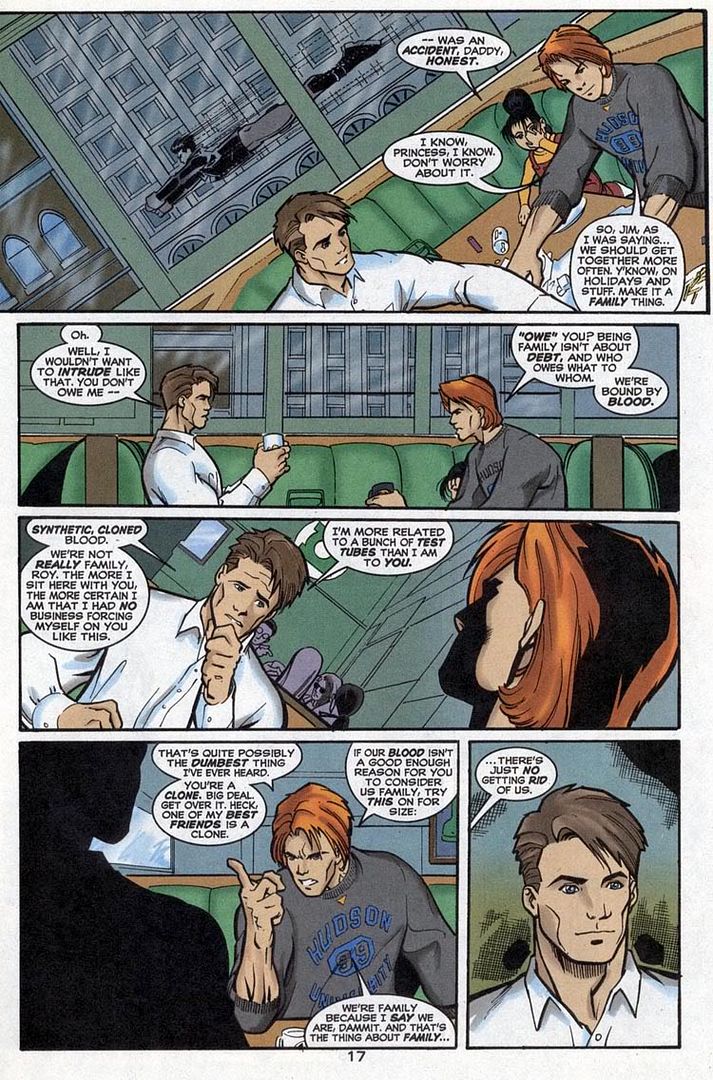
I read Superboy pretty religiously after it launched in the wake of "Reign of the Supermen." Karl Kesel and Tom Grummett did some truly excellent work (to say nothing of the brilliant Superboy and the Ravers spin-off). When I gave up reading comics in 1999, the series was in the middle of its "Hypertension" arc that was one of the first times DC had allowed the concept of the multiverse return after Crisis on Infinite Earths theoretically ended it forever. I'd highly encourage DC to print up some trade collections from the Kesel/Grummett years. This particular issue doesn't involve Kesel or Grummett (except the latter on the cover), but it at least continues the feel of that era in its story, unlike later issues (before its eventual cancellation with #100, in which it had transformed into a completely unrecognizable series, alas). The highlight is a conversation between Roy Harper (known variously as Speedy, Arsenal, and Red Arrow) and Jim Harper (known as Guardian), something I'm not even sure had ever been thought of before, but there's Jay Faerber doing it, at the moment he had his apparently fleeting moment to work in the mainstream.
The Adventures of Superman #476 (DC)
From 1991.
From 2003.
From 2012.
| via Vertigo Comics |
Air is the genius series that first introduced me to G. Willow Wilson, who has staged a remarkable comeback with Ms. Marvel. You see, even though I love Air, there wasn't much of that going on during its original publication. I named it twice to the top of my annual QB50 list. I passed on scooping up this random issue a couple of times before finally deciding to buy it. And once again I was reminded why I love Air so much. Blythe has just experienced mystery lover Zayn's life firsthand, but there's very little time to reflect on that, because piloting the hyperprax method takes great concentration. Did I mention Amelia Earhart was involved? The whole experience was like following pirates of the imagination whose goal was to try and invent the future. Hopefully Wilson's current success will help readers rediscover her masterpiece.
Detective Comics #648 (DC)
| via Comic Vine |
I picked this one up in part because of that gorgeous Matt Wagner cover, and also to hopefully catch a little of that early Tim Drake era, after he'd become the new Robin and before the whole Bane business threw everything into chaos. I ended up gifted with an early Spoiler appearance. Stephanie Brown's journey to becoming a permanent institution in the Batman mythos has been incredibly complicated. At one point she succeeded Tim as Robin, was unceremoniously killed off, revived, and apparently rejected from the New 52 landscape until she showed up in the pages of Batman Eternal. She's also been Batgirl, by the way. But Spoiler is iconic all on her own, thank you very much.
Daredevil #323 (Marvel)
| via Comic Vine |
The only reason for me to have gotten this one, as it turned out, was because of the Scott McDaniel art. Yeah, that cover promises Venom, and Venom was pretty big business for a while, but that's no reason to read this. The Daredevil costume inside the issue is one of those variants Marvel tried in the '90s, including a return to his original look, but that simple red one is really all you need. I had my first experience with McDaniel in the pages of Nightwing, which in a lot of ways might have been deemed in that first incarnation as a kind of DC version of Daredevil, complete with Blockbuster reinvented as a Kingpin figure with a similar singular focus on ruining the life of a pesky vigilante that went on to epic proportions (and under two creators: Chuck Dixon and Devin K. Grayson). So to finally see McDaniel in the pages of Daredevil itself was worth the trouble of ignoring everything else about the issue. And as it turns out, his work certainly evolved over the years. I mean, I guess it figures. But it's interesting to see it when it was less distinctive, though certainly recognizable. I still can't believe that McDaniel has apparently angered the comic book gods and now can't get a regular penciling gig. It boggles the mind. He's got insane talent.
Elongated Man #1 (DC)
| via Pinterest |
After Identity Crisis, Ralph and Sue Dibney took on iconic proportions, for reasons most comic book characters probably wouldn't want to have associated with them even if it meant immortality. Elongated Man is a peculiar relic of the Silver Age, a costumed detective who along with Plastic Man and Mr. Fantastic is best defined for an admittedly wacky superpower. Being married always gave him special distinction. This mini-series, spinning out of the infamous Giffen/DeMatteis Justice League era, is quite shocking for post-Identity Crisis readers, actually. This debut issue sees the Dibneys in considerable discord. The art is from the late Mike Parobeck, who would later achieve his greatest recognition in the pages of the comics spinning out of The Batman Adventures TV series. I first saw his work in the pages of an attempted Justice Society relaunch from around the same time, and I always liked it. Another crying shame in comic book creators taken too soon. At this point he's been dead nearly twenty years!
Global Frequency #12 (WildStorm)
![]() |
| via Full-Page Bleed |
Warren Ellis is the acknowledged master of the big concept in comics, the writer Jonathan Hickman and Rick Remender have been chasing and what Grant Morrison would look like if he weren't the personification of caffeine in the medium. Maybe it's because his reign in that regard began while I wasn't reading them, but I always found it difficult to get into him. Every now and then I'll check in with what he's done, and if I'm honest about it I'll admit I've never been disappointed. Global Frequency is another such instance. This is the conclusion of the story, with various characters converging in a sequence that in a movie would definitely have left my heart pounding as they try to disable a fail-safe weapon the United States military put in place years ago.
Grendel: War Child #1 (Dark Horse)
| via Comic Vine |
This is also technically Grendel #41. Grendel, along with Mage, is the defining work of Matt Wagner's insufficiently-heralded career. Wagner is one of the kings of the indy scene, a pioneer who helped pave the ground for Image (where Mage unfolded at one point), but now can't seem to get work unless it's related to some licensed property or another, which in itself is not a bad thing, but for a guy who's already struck gold twice on his own, it kind of comes off as a slap on the face. Anyway, this issue is brilliant, explains the whole concept perfectly (instantly makes me want to read more), and somehow the issue is still stolen by an account of Grendel's recent print history at that time, being tied up in legal hell after Comico went out of business until Dark Horse finally came to the rescue and the issue you've just read has been made possible. Anyway, Wagner is currently doing Grendel vs. The Shadow...
Justice League Europe #7 (DC)
From 1989.
![]() |
| via comiXology |
Here's the Giffen/DeMatteis era in full bloom, two series strong and crossing over for the first time. After Jurgens did his version and then later incarnations diluted the potential of having a non-all-stars version of the Justice League and we (happily) got Grant Morrison's JLA, it began to seem as if the whole run had been repudiated, but then the reunions began (and now we have Justice League 3000, which I've finally read for the first time). It might be sometimes hard to remember that not only was Batman present in these comics, but he was definitely the Batman you are probably thinking about, not Adam West and definitely the Dark Knight. Other than the "One punch!" moment with Guy Gardner, yeah, he was still around. And in this issue, doing his level best to counteract...everyone else. For me, it's inconceivable to even try to pretend these comics didn't happen. The line-up is classic in the same way the New Teen Titans were, and the many times Booster Gold and Blue Beetle have popped up together prove all over again that it's not all just "Bwa-ha-ha" but rather a solid era that left a positive impression on the landscape...
Spider-Man Unlimited #8 (Marvel)
| via Martwa Strefa |
Here's one of those Joe Hill comics. Hill's the son of Stephen King, and the father helped inspire the son to write books, and I figure the son helped inspire the father to write comics. This early example is a little goofy, but it does feature the art of Seth Fisher, another comic book creator who left us far too soon. Dying at the very start of 2006, which made much of his last work, Fantastic Four/Iron Man: Big in Japan, published posthumously, he was also known for Green Lantern: Willworld and The Flash: Time Flies. The issue also contains the work of Ryan Sook, whose clean work I've always admired, and is perfectly suited to Spider-Man. Sook probably comes closest to evoking the Stuart Immonen I know and love from his Superman era.
The Spirit #6 (DC)
| via Comic Vine |
I picked up a couple of Spirit comics because at the time I was reading a book that reminded me that there were Spirit comics that were probably similar to it. Yeah, so this issue in particular I grabbed because of the backup from Brian Azzarello and Eduardo Risso, the 100 Bullets team that have otherwise worked together a number of other times as well, and now I've caught a few of those instances for myself, even though I never got into 100 Bullets itself (when it reached the hundredth and final issue, I tried to catch that, but didn't manage to).
But to speak of The Spirit itself for a moment, of course this is the legendary Will Eisner's most famous creation, a pulp fiction vigilante who has since joined a whole collection of migratory characters constantly shuffling from company to company. It's not that this isn't good material, because it is. I wonder if it had been published under the Vertigo imprint that it might have had a different fate, or perhaps simply unconnected to the rest of the "First Wave" line. Who knows? One thing is for certain, however, and that the sneak preview included at the back of the issue for Scott Snyder's Batman debut in the pages of Detective Comics was another recent reminder that I've probably way too harsh on Snyder in recent years. Expect friendlier coverage on that front in 2015...
Superboy #82 (DC)
| via Scans Daily |
I read Superboy pretty religiously after it launched in the wake of "Reign of the Supermen." Karl Kesel and Tom Grummett did some truly excellent work (to say nothing of the brilliant Superboy and the Ravers spin-off). When I gave up reading comics in 1999, the series was in the middle of its "Hypertension" arc that was one of the first times DC had allowed the concept of the multiverse return after Crisis on Infinite Earths theoretically ended it forever. I'd highly encourage DC to print up some trade collections from the Kesel/Grummett years. This particular issue doesn't involve Kesel or Grummett (except the latter on the cover), but it at least continues the feel of that era in its story, unlike later issues (before its eventual cancellation with #100, in which it had transformed into a completely unrecognizable series, alas). The highlight is a conversation between Roy Harper (known variously as Speedy, Arsenal, and Red Arrow) and Jim Harper (known as Guardian), something I'm not even sure had ever been thought of before, but there's Jay Faerber doing it, at the moment he had his apparently fleeting moment to work in the mainstream.
The Adventures of Superman #476 (DC)
| via Boosteriffic |
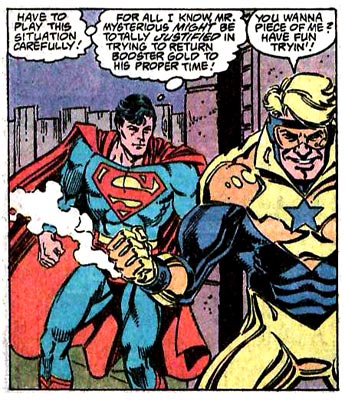
The "Time and Time Again!" arc was something I remember seeing advertised when it was later republished in a trade collection. It was the first notable arc Dan Jurgens orchestrated, and it involved Booster Gold, his most famous creation, and the Linear Men, and even the Legion of Super-Heroes. I wonder in hindsight if there was any discussion among fans that maybe this material was a little similar to the far more famous "Days of the Future Past" arc from X-Men, because there are definitely similarities. Either way, it's a reminder of how much Jurgens used to have fun with his Superman. When he wasn't, ah, killing him...
Superman #193 (DC)
| via We Shop |
Here's Scott McDaniel again, being far more familiar in his art this time than the previous Daredevil work, because of course this is after the Nightwing material I remember so fondly (among other work, including The Great Ten). The writer for the issue is Steven T. Seagle, whose most notable Superman story is actually a Vertigo graphic novel entitled It's a Bird..., which was released a year later and details his reluctance to tackle the Man of Steel creatively. One of the best comics I've ever read, too. This issue, meanwhile, seems to involve Superman and Lois Lane's daughter. But I'm sure there was some other explanation...
The Twelve #12 (Marvel)
| via Science Fiction |
Ha. Realizing the publication year is just one of those ironies about this issue that is only just now dawning on me. 2012. Of a series called The Twelve, twelve issues long, and here its twelfth issue. The other layer is that the series was famously delayed for quite a while two-thirds of the way through, seemed like it was never going to finish. And now several years later I catch this final installment, again, as a random discovery in a back issue bin. It remains a favorite comics memory, a variation on Watchmen from a more sober perspective, wondering what would happen to a whole generation of WWII heroes reawakened, years after Captain America received similar treatment, with all their stories opening up again and not to their benefit. The best I've ever seen from J. Michael Straczynski. Artist Chris Weston, who at one point cobbled together a one-shot all on his own just to keep awareness of the project alive, also worked with Grant Morrison on The Filth.
Tuesday, April 3, 2012
Quarter Bin #38 "Band of Heroes"
SANDMAN
MYSTERY THEATRE #4 (Vertigo)
From
July 1993:
Matt
Wagner is one of those great comic book writers who’s managed to float through
the medium for years without having been locked down by DC or Marvel. He’s perhaps best known for GRENDEL, which he’s
done for Dark Horse, and MAGE, which he’s done for Image. He actually has written for DC on a
semi-regular basis, but as I said…he’s a floater. SANDMAN MYSTERY THEATRE is one of those books
Vertigo was publishing when I first started reading comics but wasn’t old or
experienced enough to be interested in reading at the time. I always thought it had to have some
connection to Neil Gaiman’s SANDMAN, but then, at the time I didn’t have any
experience with that one, either. But
no, MYSTERY THEATRE starred the Golden Age Sandman, Wesley Dodds, whose last
major appearance was KINGDOM COME. This
is the first issue I’ve actually read of the series (late to the game, I know),
and now I can appreciate it as a kind of monthly crime thriller that TV
features in infinite combinations these days, sometimes in franchise variety, a
period comic book that was another of the Vertigo books at that time that
featured experienced DC properties in new and interesting ways. I wonder why it’s been forgotten since then,
left out of print, and not even a legacy character who’s trusted to be anything
but a bit player in team books. I think
given influence I’d probably change that.
This being an early issue, I get to read letters reacting to the very
start of the series, too, which is always fun.
STARMAN:
THE MIST (DC)
From
June 1998:
Part
of the “Girlfrenzy” skip week event, this was a one-shot spinning out of James
Robinson’s STARMAN. Fans reading it
today may find the references to Hal Jordan villains a little quaint,
especially since BLACKEST NIGHT star Black Hand is featured as an obscure
curiosity. It should be no wonder that I
purchased this issue around the same time I was reading the omnibus last year,
in an effort to steal some extra STARMAN goodness without spoiling some of the
rest of the story I’ll be reading once those collections are printed in
paperback later this year. It’s funny,
because THE SHADE is helping to keep one of Jack Knight’s foes in the
headlines, while the one featured here has kind of gone into the very obscurity
that Robinson was playing with here.
BRIGHTEST
DAY #24 (DC)
From
June 2011:
The
conclusion of Geoff Johns and Peter Tomasi’s follow-up to BLACKEST NIGHT was
something I missed last year when it was first published, thanks to my
semi-retirement from reading new comics, which at that time was more
semi-permanent than it is today, since I only really started to try and be
semi-active once FLASHPOINT began. To
me, BRIGHTEST DAY was on par with 52, certainly leagues better than the
meandering TRINITY, and better focused than COUNTDOWN (though I am probably
COUNTDOWN’s biggest fan, just as I remain one of 52’s biggest supporters). With a tightly focused core of characters and
a smaller slate, BRIGHTEST DAY was like the catch-all version of Johns getting
to do all the characters he’d really love to work with, and will probably go
down as the best Deadman story to date (which made it all the bigger a shame
that Boston Brand only received the first story of an anthology title in the
New 52, rather than his own series). The
biggest shame of BRIGHTEST DAY was that Johns and DC so quickly went about
rebooting everything, so that there was no real momentum from what occurred in
this story. As a big-concept culmination
of the previous incarnation of the DCU, however, it’ll be worth relishing for
years, or simply as an excellent sequel to BLACKEST NIGHT, to which BRIGHTEST
DAY is probably superior.
BABYLON
5: IN VALEN’S NAME #3 (DC)
From
May 1998:
J.
Michael Straczynski and the fans of BABYLON 5 are guilty of worshipping a TV
series that did not actually live up to its reputation. Like a long series of B-movies, it was a show
with a grand vision that could not in execution match its ambitions. Still, there are legions of fans out
there. Perhaps one day it can be redone
as an epic trilogy of movies, and Straczynski can be present to help guide it
once more. For now, its legacy is what
it is, and that can be seen in spin-offs like this comic book, too. Valen, if you didn’t know, is the Minbari
name Jeffrey Sinclair assumed after he traveled back in time to help end the
war he couldn’t prevent from happening in order for the resulting Shadows
conflict from ending in disaster.
Sinclair was the first lead character in the series, and was quickly
replaced in the second season. This is
the story of how his reputation meant everything (except anything practical to
the weekly episodes). Straczynski has
become known as someone who believes in total creative control, and BABYLON 5
was the project that helped him get that reputation, yet the irony is that a
critical analysis suggests that he flew by the seat of his pants, making it up
as he went along (even if he didn’t, that’s exactly what it looks like now,
regardless of how well-documented the transition between the fourth and seasons
is), rather than deliberately shaping the series from a pre-plotted roadmap. It’s funny, too. Every time a BABYLON 5 or STARGATE or
BATTLESTAR GALACTICA appears and starts usurping the Star Trek audience and
makes them believing they’re actually the hot new thing that’ll endure forever,
they can never really launch an enduring franchise. Maybe they all try too quickly, I don’t know,
but it’s always funny to see them collapse (even X-FILES did it). Just thought I’d mention that. It amuses me.
SUPERMAN:
METROPOLIS #11 (DC)
From
February 2004:
This
was a twelve-issue series that Chuck Austen did in the year before I started
getting back into comics, and something I’d never heard of before stumbling
across it at Heroes & Dragons.
Starring the intrepid Jimmy Olsen and featuring a strong technological
theme, I kind of wonder why it’s been so thoroughly forgotten, given the
extreme nature of smart phone obsession we now endure. You’d think if DC sanctioned a twelve-issue
mini-series, the company believed it enough to keep it in print. Jimmy is a character who’s been famous for so
long that he can be easy to take for granted.
Me, I’d keep him active in the paperback collections, and I’d have
plenty of suggestions on how to fill them (not the least being his “I found out
Superman’s secret identity!” debacle from the late 1990s), and I’d definitely
have him starring in his own book. Of
all the Superman characters, he’s the most relevant to the average reader. If DC wanted to start somewhere in picking up
that slack, they can reprint this story.
SUPERMAN:
THE MAN OF TOMORROW #2 (DC)
From
fall 1995:
In
the ’90s, it was impossible to escape Superman and Batman on the stands every
week, and eventually even the skip weeks were covering in BATMAN CHRONICLES and
this title, published quarterly for a handful of years. At the time of this one’s release, Lex Luthor
was just coming back from an extended period of being his own son, via a
surrogate clone sporting a full head of red hair, thanks to UNDERWORLD
UNLEASHED (which had not yet begun), and years away from being elected
President of the United States (yes, it happened), and he was matched by the
mysterious Contessa, a character I’d keep around as a permanent addition to the
Superman mythos. I’d also retain Alpha Centurion,
who was still working his way into the Superman comics of the time after a
false introduction during Zero Hour. The
Centurion was so rich in potential, and was years ahead of the Hollywood curve
that with GLADIATOR brought back the appeal of the historical epic, yet he
disappeared soon after his arrival, never to be heard from again. He’s another character I would unquestionably
revive, with probably a few modifications.
I thought I’d read most of his appearances, but I guess I wasn’t quite
as religious with Superman at the time as I thought I was, since I skipped the
second issue of MAN OF TOMORROW, with the Contessa and Centurion clearly on the
cover. It was another happy discovery.
JSA
CLASSIFIED #30 (DC)
From
November 2007:
Mr.
Terrific’s early loss in the New 52 of his first ongoing series was a mercy
killing. The book was terrible, baffling
in its lack of understanding of just how awesome Michael Holt really is, and
how relevant he is in the modern world.
Arvid Nelson, one of my favorite writers, wrote this spotlight that has
the rest of the Justice Society backing him in one of his periodic wars with
Nazis (a crossover with Atomic Robo is inevitable!). It’s still weird to think that the JSA has
had so many books in recent years, but was ignored in the first wave of the New
52, and still won’t have a book with its name in the title in the second. But then, Robin doesn’t have his own book,
either, so there’s at least some consistency.
I hope DC hasn’t given up on Mr. Terrific as a character who can command
his own stories. We’ll see.
Subscribe to:
Posts (Atom)