I'm about to relocate again. Don't know what kind of impact this will have on my admittedly at present sporadic comics reading, but it's certainly worth noting. This batch of comics represents what could be my last trip to Zimmies in Lewiston, Maine, which is a shop I've been visiting in its several incarnations since I bought my first comics nearly a quarter century ago.
Batman Annual #4 (DC)
This one's from 2015 and is set during Snyder's Commissioner Batman era, when Bruce Wayne has amnesia. It's James Tynion writing Bruce as he returns to Wayne Manor, which at the time had just finished being used as the new Arkham Asylum. It's interesting, story-wise insofar as it posits Bruce Wayne as a target for Batman's enemies, who may have mistaken him as the Dark Knight's financier. But it's the cover and the art that really interests me. The cover is from Sean Murphy.
Murphy has been a favorite since he collaborated with Grant Morrison on Joe the Barbarian, and I've tried to keep track of his work ever since, whether Punk Rock Jesus or the Detective Comics #27 (New 52 era) story he did with Snyder that rumor has it they'll be returning to soon. Murphy also has Batman: White Knight coming up, and that sounds fascinating.
The interior is from Roge Antonio, whose work looks like Snyder's American Vampire collaborator Raphael Albuquerque. Have a look at it yourself:
Apparently he's been on the Rebirth series Batgirl and the Birds of Prey these days. A career well worth tracking, too, I think.
Batman #30-31 (DC)
The first is "The Ballad of Kite Man Part 2," which is apparently hugely controversial, both parts, as it seems way too heavy for some readers. I just don't get that. This is literally the most relevant Kite Man has ever been. I don't expect Tom King is done with the guy just yet, sort of like Gotham Girl. The second is the penultimate chapter in "The War of Jokes and Riddles" itself, which promises an explosive ending (and apparently whether or not Catwoman accepts the proposal). I think the arc's been brilliant. This is a Joker who has been every bit the savage beast he's sometimes been depicted to be (The Killing Joke) but in a context where he's "lost his smile" (quotations thanks to Shawn Michaels). This is a Batman who has apparently been forced to ally himself with the Riddler. This is a story that once again feels, if Batman were every to be taken seriously, and his whole world around him, like this is what would actually happen. Too often these characters only exist one story at a time, or locked up in Arkham. What if Batman's foes were forced to take sides? What if Batman himself was forced to take sides?
Birthright #19 (Image)
This is from 2016, and is Josh Williamson's main interest outside of DC and The Flash, and I figured I'd finally have a look. Naturally it's a little difficult to know exactly what's going on, but it seems pretty fascinating.
Black Hammer #2, 13 (Dark Horse)
A kind of alternate DC from Jeff Lemire, in which the aftermath of a crisis left the heroes trapped in a kind of pocket dimension (wonder if Infinite Crisis will be reflected). These particular issues feature a kind of Shazam in a kind of I Hate Fairyland situation, the Skottie Young series where a young girl has been a young girl for far too long in a scenario she is well and truly over. I've been hearing that this is Lemire's best work. I'm a huge Lemire admirer, whether his recent Moon Knight or Descender, which I wish I were reading regularly. I'm not ready to declare Black Hammer in that league, but I suppose for fans wanting him to reflect superhero comics, in a way that makes sense to them, this is a good option.
Mister Miracle #2 (DC)
Like his Batman, King is finding readers who don't understand what he's doing in Mister Miracle. But I'm loving it. He is absolutely one of my all-time favorite comic book writers at this point, and I look forward to having this whole thing to relish.
Nightwing: The New Order #1 (DC)
I was quite happy when I heard this one announced. It's a Nightwing mini-series, the kind usually only Batman and Superman, and once in a while Wonder Woman, get. It's also Kyle Higgens returning to the character. He was the writer who launched the New 52 series and was at one time Snyder's running mate, the role Tynion later assumed. So I'm glad to see that The New Order was worth the interest. This first issue isn't really going to be able to explain how Dick Grayson ended up deciding superpowers are a bad thing. What it does instead is bring the focus to Dick's relationship with his son. This is a scenario previously featured in the Earth 2 comics, and an interesting continuing consideration for Nightwing's further legacy. We find out at the end of the issue that the mother is Starfire, which begs the question...is Dick's position based on heartbreak? Either way, I'll definitely want to read more of this.
Rise of the Black Flame #2 (Dark Horse)
This is another comic from 2016, part of the Hellboy universe. I bought it mainly for the Christopher Mitten (Wasteland) art. Always glad to see more!
Showing posts with label Christopher Mitten. Show all posts
Tuesday, September 26, 2017
Monday, April 13, 2015
Wasteland #60 (Oni)
writer: Antony Johnston
artist: Christopher Mitten
I want to go on record, once again, for how much I loved how Lost concluded. I thought it was a brilliant experience all the way through. And two of the most brilliant things it did came in the final season, specifically two episodes: 1) "Ab Aeterno," which detailed the previously mysterious Richard Alpert's complete backstory, and 2) "Across the Sea," which similarly explored Jacob and the Man in Black.
The only thing that would have been better is if one or both of them had been held until after the finale.
Because that's exactly what Antony Johnston chose to do with Wasteland, explaining once and for all what exactly was going on all along. Technically, the story ended last issue, and that one was circular, too, but in a different way. This one's strictly explaining, once and for all, how Michael first came to take up his quest for the mysterious A-Ree-Yass-I, and how his dark counterpart Marcus established the fateful town of Newbegin.
Like the Lost episodes, it features time-lapse so as to better cover a large chunk of Wasteland history. The series always had a strong generational theme to it, and so watching that play out again is one of the issue's pleasures.
And yeah, now with all this added perspective, for the first time I can probably suggest Wasteland to fans of Lost. I'd never realized that before.
Writer Antony Johnston includes a heartfelt essay about what it was like to finish his grand story. Omitted is any mention of what he's working on now, but there's more bad news for Johnston fans in that he's recently put Umbral on hold. Umbral is his second project with Christopher Mitten, Johnston's first and last collaborator on Wasteland, that in many ways was a more playful version of their first. From what he says in his essay here, it's easy to imagine that it's not easy being Johnston at the moment.
For readers like me, who have remained faithful for sixty issues, despite breaks in publication and rotating artists (when at the very least it would have been preferable for Mitten to have stuck around the whole time; Saga has built in breaks in its publication so that Fiona Staples can faithfully continue with each issue, but sometimes times change too slowly, although even that is a part of Wasteland mythology), it's great to see the end at last, so that we can commence enjoying the whole thing, over and over again, at our leisure. And continue praising its merits for the vast legions of the uninitiated.
Because this one's a classic.
artist: Christopher Mitten
I want to go on record, once again, for how much I loved how Lost concluded. I thought it was a brilliant experience all the way through. And two of the most brilliant things it did came in the final season, specifically two episodes: 1) "Ab Aeterno," which detailed the previously mysterious Richard Alpert's complete backstory, and 2) "Across the Sea," which similarly explored Jacob and the Man in Black.
The only thing that would have been better is if one or both of them had been held until after the finale.
Because that's exactly what Antony Johnston chose to do with Wasteland, explaining once and for all what exactly was going on all along. Technically, the story ended last issue, and that one was circular, too, but in a different way. This one's strictly explaining, once and for all, how Michael first came to take up his quest for the mysterious A-Ree-Yass-I, and how his dark counterpart Marcus established the fateful town of Newbegin.
Like the Lost episodes, it features time-lapse so as to better cover a large chunk of Wasteland history. The series always had a strong generational theme to it, and so watching that play out again is one of the issue's pleasures.
And yeah, now with all this added perspective, for the first time I can probably suggest Wasteland to fans of Lost. I'd never realized that before.
Writer Antony Johnston includes a heartfelt essay about what it was like to finish his grand story. Omitted is any mention of what he's working on now, but there's more bad news for Johnston fans in that he's recently put Umbral on hold. Umbral is his second project with Christopher Mitten, Johnston's first and last collaborator on Wasteland, that in many ways was a more playful version of their first. From what he says in his essay here, it's easy to imagine that it's not easy being Johnston at the moment.
For readers like me, who have remained faithful for sixty issues, despite breaks in publication and rotating artists (when at the very least it would have been preferable for Mitten to have stuck around the whole time; Saga has built in breaks in its publication so that Fiona Staples can faithfully continue with each issue, but sometimes times change too slowly, although even that is a part of Wasteland mythology), it's great to see the end at last, so that we can commence enjoying the whole thing, over and over again, at our leisure. And continue praising its merits for the vast legions of the uninitiated.
Because this one's a classic.
Sunday, December 28, 2014
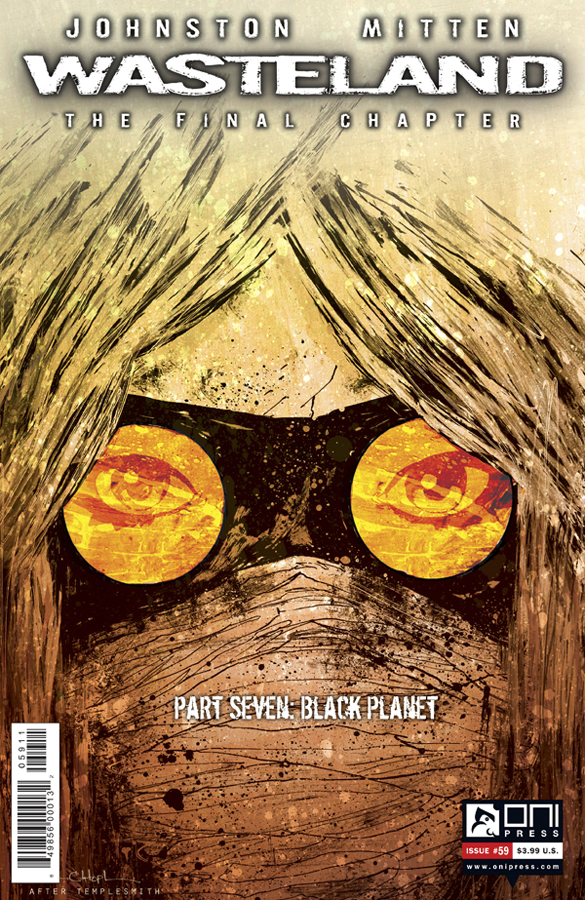
Wasteland #59 (Oni)
| via Previews World |
artist: Christopher Mitten
Technically, this is the last issue of the Wasteland saga. And it is deliciously cyclical, as most of the best stories are.
I say "technically" because there's one issue left, an epilogue as it turns out. All the better for Wasteland's few but hopelessly devoted fans, who will savor this story for years.
The very first issue featured a cover remarkably similar to this one. The person behind the goggles and the mask was Michael, whom I've always identified as a Wolverine figure, and somewhat rightly so as it turns out. The person behind the goggles and the mask this time is Abi. Both are characters we've spent the whole series following, and both split off from what had begun to seem like the main narrative of Wasteland when they left the city of Newbegin behind, in search of fabled A-Ree-Yass-I.
(Which is finally identified, by the way.)
When we first met Abi, she didn't know she was exactly like Michael. She knew she had peculiar abilities, but she'd forgotten, just as the world did, what had come before. And now she has replaced him.
The story begins anew, at the end. Hopefully the mistakes of the past won't be repeated? That's what it's all been about, remembering the past, learning from it.
And it's been a grand journey.
Friday, November 7, 2014
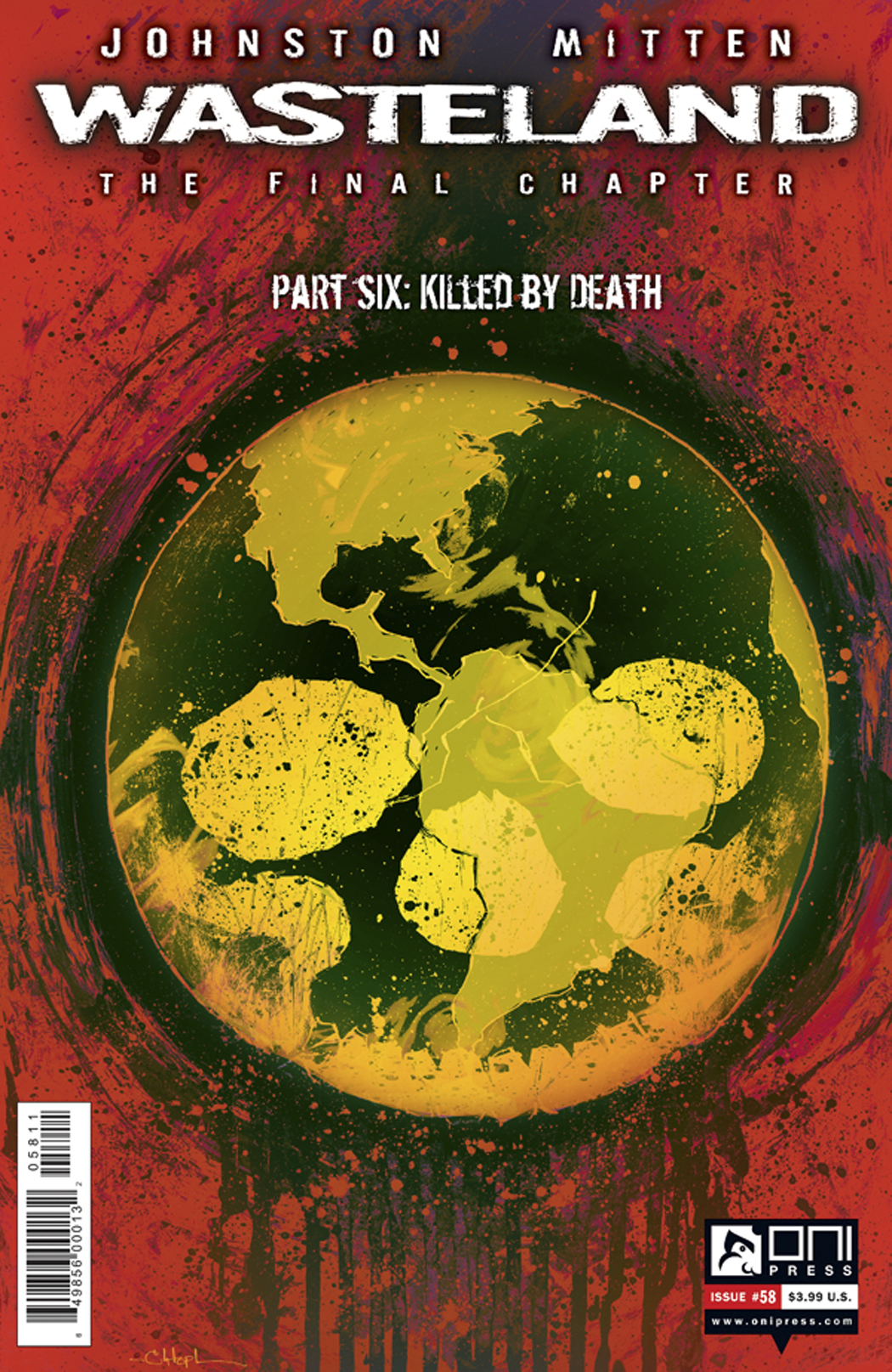
Wasteland #58 (Oni)
writer: Antony Johnston
artist: Christopher Mitten
"The Final Chapter" Part 6 (of 8), also known as the big reveal of what exactly the apocalypse looked like that created the world of Wasteland, or what exactly the Big Wet was.
Epic, epic stuff. I have not had the opportunity to read the whole arc yet, but I'm very happy to have at least read the previous issue and especially this one, which as far as I'm concerned does a large part of explaining the whole series.
Way back when the series started I liked to try and sell the series to potential new readers by pointing out the similarities between the character of Michael and the, ah, far more famous Wolverine. Nine years later or so and I still stand by that assertion, but as it turns out there may be a better comparison, one that wasn't even possible at the time: Wasteland, as it turns out, may be a lot like Hancock.
Hey, remember this year's Noah, and pop culture's first-ever exposure to the idea of the Nephilim, a concept probably even most Christians had never heard of? (You know, the rock creatures in the movie? The movie no one else has described this way but it really is: brilliant. By the way.) That's part of it, too.
You remember how in Hancock you thought you were just watching Will Smith being Bad Superhero, but then you realize that not only is Charlize Theron in it, too, but she's incredibly important, and that the story is really about a couple of angel protectors who can't spend any significant time together without massive consequences?
So it turns out the good folks such as Michael and Abi and Marcus (...okay, not all of them good folks) are a lot like Hancock. The whole extended Newbegin arc that sometimes seemed like it was the whole point of the series was actually a massive illustration that these guys were not actually cut out to be rulers (thanks again, Marcus!) of mankind.
I don't want to spend too much time analyzing that whole situation, because I need to read the whole sequence, and that probably won't happen until next year, and besides, there are two issues remaining and who knows what else Antony Johnston has yet to reveal?
The crux of what makes this issue so brilliant, so important to the whole series, is how perfectly it presents a portrait of the panicked end times of the hundred years in the past, the Big Wet that was the hidden mythology of Wasteland all this time. There was some of that tapestry last issue, and maybe there was more in previous ones, too, I don't know at this point. I know that I loved how it was done in this one. Loved it.
For a series built on a mystery that could easily have been, in anyone else's hands, the way it actually started, I'm loving having reached this point. Sad that it's the end of the series, but great that soon the whole story will be available so that maybe us die hard fans will finally be able to convince everyone else to read it. No more excuses, right? It's been a fantastic journey. One for the ages.
artist: Christopher Mitten
| via Previews World |
Epic, epic stuff. I have not had the opportunity to read the whole arc yet, but I'm very happy to have at least read the previous issue and especially this one, which as far as I'm concerned does a large part of explaining the whole series.
Way back when the series started I liked to try and sell the series to potential new readers by pointing out the similarities between the character of Michael and the, ah, far more famous Wolverine. Nine years later or so and I still stand by that assertion, but as it turns out there may be a better comparison, one that wasn't even possible at the time: Wasteland, as it turns out, may be a lot like Hancock.
Hey, remember this year's Noah, and pop culture's first-ever exposure to the idea of the Nephilim, a concept probably even most Christians had never heard of? (You know, the rock creatures in the movie? The movie no one else has described this way but it really is: brilliant. By the way.) That's part of it, too.
You remember how in Hancock you thought you were just watching Will Smith being Bad Superhero, but then you realize that not only is Charlize Theron in it, too, but she's incredibly important, and that the story is really about a couple of angel protectors who can't spend any significant time together without massive consequences?
So it turns out the good folks such as Michael and Abi and Marcus (...okay, not all of them good folks) are a lot like Hancock. The whole extended Newbegin arc that sometimes seemed like it was the whole point of the series was actually a massive illustration that these guys were not actually cut out to be rulers (thanks again, Marcus!) of mankind.
I don't want to spend too much time analyzing that whole situation, because I need to read the whole sequence, and that probably won't happen until next year, and besides, there are two issues remaining and who knows what else Antony Johnston has yet to reveal?
The crux of what makes this issue so brilliant, so important to the whole series, is how perfectly it presents a portrait of the panicked end times of the hundred years in the past, the Big Wet that was the hidden mythology of Wasteland all this time. There was some of that tapestry last issue, and maybe there was more in previous ones, too, I don't know at this point. I know that I loved how it was done in this one. Loved it.
For a series built on a mystery that could easily have been, in anyone else's hands, the way it actually started, I'm loving having reached this point. Sad that it's the end of the series, but great that soon the whole story will be available so that maybe us die hard fans will finally be able to convince everyone else to read it. No more excuses, right? It's been a fantastic journey. One for the ages.
Wednesday, October 22, 2014
Wasteland #57 (Oni)
writer: Antony Johnston
artist: Christopher Mitten
We're in the homestretch of the whole series itself. That means answers.
artist: Christopher Mitten
| via Antony Johnston |
Answers to how the whole story happened to begin with, the mystery of "The Big Wet," the event that created the post-apocalyptic world of Wasteland, and who exactly Michael, Abi, and others of their kind really are.
This is what Robert Kirkman will be getting around to, as he currently sees it, probably decades from now over in The Walking Dead. For my money, Wasteland was always better than Walking Dead.
But far more complicated. This is what fans like me have been dreaming about for years, these answers. But fans like me have been in short supply, which is why my record of reading the series has been spotty in recent years. I've tended to read my comics in print, and even though I've started reading them digitally this year, which happens to coincide with Mitten's return to the series for its final chapter, I wanted to read the end of Wasteland the way I began. Which meant getting my local comics shop to order it for me, which has turned out to be a little more difficult than I thought it would.
But here we are. I can only say, with this particular issue, that the answers have started to come. I don't know when, exactly, the answers began, because this is the first issue I've caught all year. I will play catch-up next year in the trade collections. I'm already three volumes behind in those, which is also the exact material covering the period where I stopped being able to catch the series regularly, and I guess one or two more to cover the final issues.
I'd say more about what this particular issues does, but I've just read the next one, and that one's pure dynamite, and I'll have a lot more to that about that one and how it reflects on the journey of the whole series. And after that, there are only two issues left of the series. The last one will apparently have to wait until next year to see publication.
I can wait. Probably.
Bottom line, I consider Wasteland to be among the best comics being published as much today as the day I first fell in love with it. With the second issue (only because I didn't catch the first).
Thursday, July 10, 2014
Reading Comics #127 "Antony Johnston"
Antony Johnston is the genius writer of Wasteland, one of the best comics I've ever read, counting down to its sixtieth and last issue later this year (#56 just released!). Thankfully he's being afforded an expanded presence in the comics landscape thanks to a pair of new Image series, which happen to feature art from his best Wasteland collaborators.
The more recent The Fuse features Justin Greenwood (I first experienced him on Marc Guggenheim's Resurrection). I have the first issue waiting in my comiXology queue, but the more recent #3 now stands as my first real experience with it.
Fuse is a detective comic set in the future. The genius of it is that it allows Johnston to work on his signature world-building in less daunting context than readers have typically been able to experience from him. And it's not even the far future, more like one of those near-future worlds that look completely familiar to what you already know. You don't even have to worry about the future at all to enjoy Fuse, at least not with this issue.
The more recent The Fuse features Justin Greenwood (I first experienced him on Marc Guggenheim's Resurrection). I have the first issue waiting in my comiXology queue, but the more recent #3 now stands as my first real experience with it.
| via Image |
(It's the kind of trick that has allowed Jonathan Nolan and J.J. Abrams' Person of Interest to be a reliable hit, whereas so many of Abrams' other shows have been stuck with the genre tag and therefore had limited appeal. Frame it as something that looks conventional and you can get away with so much more!)
I like what I read in the issue, although of course for me, it's Johnston's world-building that's the real draw, so I will have to read more (another dirty trick!) to truly get Fuse in my blood.
Of more immediate appeal for me is Umbral, which Johnston launched slightly earlier with original Wasteland collaborator Christopher Mitten. I've talked about this series already, how it's kind of like Wasteland if it had been set entirely in the city of Newbegin (and soaked, soaked! in purple). Since I haven't been reading it regularly (I hardly read any comics regularly, so this is not a knock against the series), I'm still prone to getting lost. I make a poor champion in that regard. I do, however, highly recommend it.
Coincidentally, the next issue is being released next week (there was a small break between issues, which is worth it to keep Mitten energized and involved in the project). The first trade, Out of the Shadows, was released at the end of May.
| via Image |
Umbral is pretty much the opposite of Fuse. It wears its genre (magic fantasy) thickly on its sleeve. It's also a quest story, like Wasteland, although the approach is far more deliberate. Again, Johnston seems to have handled this expanded platform brilliantly.
(This is not to say I think any less of Wasteland. I applaud worthwhile ambition. And Wasteland has always been a peak example of that.)
I was happy to come across Umbral #6. Not keeping track of the series closely (because, again, my trips to comic book stores and/or digital purchases are erratic these days), I didn't really know how fortuitous this one was. It feels nice to be a part of the experience. Part of that experience is definitely the letters column, which Umbral features vibrantly. Since these things are no longer a given experience in comics, it's almost as much a statement as a reader's platform on how the creators approach their fans, and comics in general, when they have them and how they approach them. Saga's letters column is the best around. There's just no question. Brian Michael Bendis tends to use them to talk about his many projects. The Walking Dead is one extended, interactive forum, probably moreso than any other I've seen. As of this issue, Umbral has entered the big leagues. Good stuff.
Tuesday, June 3, 2014
Umbral #4 (Image)
| via CBR |
artist: Christopher Mitten
I'm an original Wasteland fanboy. I've loved the Oni post-apocalypse series since it debuted. The fact that it's ending this year is incredibly bittersweet. It gets to go out on its own terms, but the massive cult following I always thought it deserved never really materialized. That being said, finally the comics industry seems to have caught up with it. Series writer Antony Johnston has two new series being published by Image, featuring the signature artists from Wasteland. The more recent one, The Fuse, features the work of Justin Greenwood. The slightly older one (by a matter of issues) is this one, Umbral, which features original Wasteland artist (who has returned for its final arc) Christopher Mitten.
Mitten was a huge reason Wasteland made an immediate impact on me. This is good news for Umbral, because it features glorious full color (whereas Wasteland was black & white for nearly every issue), including the bold and instantly trademark use of purple to truly make its world of magic pop.
This is the first issue of Umbral I've caught. I hoped it would reward my long interest in Johnston and Mitten's careers and collaborative potential, and it does. In a lot of ways, it's Wasteland from a more direct perspective. Lead character Rascal is like Abi (as well as virtually every other aspect) without all the mystery, just straight-up adventure. Wasteland was always a complicated tapestry playing a number of different storylines simulaneously. Umbral is in a lot of ways the streamlined version of that. All the toys are squarely in the same sandbox. Hopefully this means anyone who at least knew of Wasteland but might have been intimidated by everything they needed to keep straight will have a much easier time of it with Umbral.
Which is not to say Umbral is simplistic. Johnston is an expert at world-building. Even four issues in, having missed the first three, being thrown into his ideas is more fun than daunting. Like any fantasy series, there are a lot of weird names (but Game of Thrones fans will hopefully be more than comfortable with that). There's a big bad demon, if you like that sort of thing, too.
The first trade collection, Out of the Shadows, is available as of last week, if you want to bite the bullet and jump right in.
I'm an original Wasteland fanboy. I've loved the Oni post-apocalypse series since it debuted. The fact that it's ending this year is incredibly bittersweet. It gets to go out on its own terms, but the massive cult following I always thought it deserved never really materialized. That being said, finally the comics industry seems to have caught up with it. Series writer Antony Johnston has two new series being published by Image, featuring the signature artists from Wasteland. The more recent one, The Fuse, features the work of Justin Greenwood. The slightly older one (by a matter of issues) is this one, Umbral, which features original Wasteland artist (who has returned for its final arc) Christopher Mitten.
Mitten was a huge reason Wasteland made an immediate impact on me. This is good news for Umbral, because it features glorious full color (whereas Wasteland was black & white for nearly every issue), including the bold and instantly trademark use of purple to truly make its world of magic pop.
This is the first issue of Umbral I've caught. I hoped it would reward my long interest in Johnston and Mitten's careers and collaborative potential, and it does. In a lot of ways, it's Wasteland from a more direct perspective. Lead character Rascal is like Abi (as well as virtually every other aspect) without all the mystery, just straight-up adventure. Wasteland was always a complicated tapestry playing a number of different storylines simulaneously. Umbral is in a lot of ways the streamlined version of that. All the toys are squarely in the same sandbox. Hopefully this means anyone who at least knew of Wasteland but might have been intimidated by everything they needed to keep straight will have a much easier time of it with Umbral.
Which is not to say Umbral is simplistic. Johnston is an expert at world-building. Even four issues in, having missed the first three, being thrown into his ideas is more fun than daunting. Like any fantasy series, there are a lot of weird names (but Game of Thrones fans will hopefully be more than comfortable with that). There's a big bad demon, if you like that sort of thing, too.
The first trade collection, Out of the Shadows, is available as of last week, if you want to bite the bullet and jump right in.
Monday, January 27, 2014
Digitally Speaking...#4 "Avengers, Bad Medicine"
Avengers #12.1 (Marvel)
From 2011. This was part of the kick-off to the "Age of Ultron" event that has nothing at all to do with the upcoming Avengers: Age of Ultron movie. But it's also perfectly readable as a window into the decade-long Brian Michael Bendis era in the franchise, which ended a year ago. The Avengers you know from the movies more or less came ready-made from a Brian Bendis comic. Bendis is known as the godfather of decompressed storytelling, in that he can string any story out for many issues at a time. The funny thing about this issue, however, is that it seems to be severely compressed, the exact opposite. We go from the captured Spider-Woman to the Avengers arguing about how to handle the news (being delivered by a fairly complete nobody) to the Avengers finding Spider-Woman in a split second, right after we've heard her kidnappers hint at why they did it, to the revelation of Ultron's involvement.
There's a lot of trademark Bendis banter. I mean, that's the playbook to every Bendis script, bantering between a large number of characters. Especially in this issue, he might have benefited to streamline the players, so that the ones who actually contribute to the story better stand out rather than randomly comment here and there. It makes the whole team seem poorly led and extremely inexperienced. On the one hand, it makes things less intimidating to new readers. And obviously, when adapted to the big screen very popular, but...it fails for anyone looking to have a more-than-decent comics reading experience. Maybe when Bendis is writing a thousand different Avengers books (besides everything else he writes), it's easy to spit out the Bendis banter, but it's probably not great for his overall legacy, except to say that he's spent a huge amount of time writing Avengers (and Ultimate Spider-Man) adventures.
I'm always flip-flopping on Bendis. This particular experience is no different. A focused Bendis would be ideal, but a popular Bendis is an in-demand Bendis, and so I guess maybe that's not really an option. Obviously the guy has talent, and can come up with enough stories to fill a thousand monthly adventures...It'd be nice to find out what's possible if he tried to do a more finite story, I guess is what I'm saying.
FCBD 2012 Bad Medicine (Oni)
The comic itself seems to be a gloss on the TV series Fringe (and hopefully the writers knew that, because nearly element is an exact duplicate, although in every sense less inspired), so why did I bother reading this? Because of the art, from Christopher Mitten. Mitten drew much of one of my all-time favorite comics, Wasteland, also published by Oni, in collaboration with writer Antony Johnston. He became a little burned out and subsequently bowed out of the project, but is returning in time for the final ten issues, hopefully all of them to be released this year. His artwork in Bad Medicine is similar to his Wasteland work although not as distinctive, perhaps because Bad Medicine itself is not all that distinctive. The real bonus, the real treat for me, was the unexpected Wasteland backup tale from Mitten and Johnston, which nails perfectly everything to love about the series, the main characters Abi and Michael along their journey to I-Ree-Yass-I stumbling in classic Wasteland fashion into the middle of someone else's story (which is what half the series became in the city of Newbegin) even while providing more dazzling hints into the true nature of these deceptively complicated characters (their magic healing powers do not seem to be limited by decapitation, a throwaway joke aimed at Highlander fans).
From 2011. This was part of the kick-off to the "Age of Ultron" event that has nothing at all to do with the upcoming Avengers: Age of Ultron movie. But it's also perfectly readable as a window into the decade-long Brian Michael Bendis era in the franchise, which ended a year ago. The Avengers you know from the movies more or less came ready-made from a Brian Bendis comic. Bendis is known as the godfather of decompressed storytelling, in that he can string any story out for many issues at a time. The funny thing about this issue, however, is that it seems to be severely compressed, the exact opposite. We go from the captured Spider-Woman to the Avengers arguing about how to handle the news (being delivered by a fairly complete nobody) to the Avengers finding Spider-Woman in a split second, right after we've heard her kidnappers hint at why they did it, to the revelation of Ultron's involvement.
There's a lot of trademark Bendis banter. I mean, that's the playbook to every Bendis script, bantering between a large number of characters. Especially in this issue, he might have benefited to streamline the players, so that the ones who actually contribute to the story better stand out rather than randomly comment here and there. It makes the whole team seem poorly led and extremely inexperienced. On the one hand, it makes things less intimidating to new readers. And obviously, when adapted to the big screen very popular, but...it fails for anyone looking to have a more-than-decent comics reading experience. Maybe when Bendis is writing a thousand different Avengers books (besides everything else he writes), it's easy to spit out the Bendis banter, but it's probably not great for his overall legacy, except to say that he's spent a huge amount of time writing Avengers (and Ultimate Spider-Man) adventures.
I'm always flip-flopping on Bendis. This particular experience is no different. A focused Bendis would be ideal, but a popular Bendis is an in-demand Bendis, and so I guess maybe that's not really an option. Obviously the guy has talent, and can come up with enough stories to fill a thousand monthly adventures...It'd be nice to find out what's possible if he tried to do a more finite story, I guess is what I'm saying.
FCBD 2012 Bad Medicine (Oni)
The comic itself seems to be a gloss on the TV series Fringe (and hopefully the writers knew that, because nearly element is an exact duplicate, although in every sense less inspired), so why did I bother reading this? Because of the art, from Christopher Mitten. Mitten drew much of one of my all-time favorite comics, Wasteland, also published by Oni, in collaboration with writer Antony Johnston. He became a little burned out and subsequently bowed out of the project, but is returning in time for the final ten issues, hopefully all of them to be released this year. His artwork in Bad Medicine is similar to his Wasteland work although not as distinctive, perhaps because Bad Medicine itself is not all that distinctive. The real bonus, the real treat for me, was the unexpected Wasteland backup tale from Mitten and Johnston, which nails perfectly everything to love about the series, the main characters Abi and Michael along their journey to I-Ree-Yass-I stumbling in classic Wasteland fashion into the middle of someone else's story (which is what half the series became in the city of Newbegin) even while providing more dazzling hints into the true nature of these deceptively complicated characters (their magic healing powers do not seem to be limited by decapitation, a throwaway joke aimed at Highlander fans).
Subscribe to:
Posts (Atom)