Showing posts with label Martian Manhunter. Show all posts

Saturday, September 12, 2020

Reading Comics 243 “Comics Garage: First Box!”

 Having apparently ended my Forbidden Geek experiment only earlier this year (it feels like longer, although partly because it took so long to get that last box), I guess I was in the mood to try another service (or Amazon thought so, and I agreed). Like Geek, Comic Garage ships out assortments of random comics monthly. There are a variety of options. I opted, naturally, for DC titles, and ten comics per box. This is what I got in my first box:

Batgirl: Futures End #1

I’m pretty definitively determining that I just don’t care for Gail Simone. Most of the time I try to read her I hate the results. Somehow she even managed to screw up what so many other Futures End one-shots managed to accomplish, which was to give clever glimpses, well, into the future. The only worthwhile thing she does is gather the Batgirls together (and add a new one): Babs, Stephanie Brown, Cassandra Cain. But the other inexplicable thing Simone can be counted on is to screw up Bane, who was part of her Secret Six. She somehow takes Bane seriously for a change, but her idea of giving Barbara Gordon character development is to make her hulk out as part of a con job against him. I honestly have never seen Simone’s logic appear remotely logical. There’s a very real phenomenon called comic book logic, which I associate mostly with Marvel comics (and movies). Simone should probably just head over there. And stay there. She would be a killer writer for Squirrel Girl. That’s, ah, a whole other inexplicable thing...

Batman: Legends of the Dark Knight #121

As part of the “No Man’s Land” arc (loosely adapted as part of The Dark Knight Rises), Larry Hama (the G.I. Joe guy) tells a wimpy Mr. Freeze tale that’s about as generic as possible. I have nothing against Hama, but it at least seems like he was wildly out of his element. I have no idea how long he stuck around Batman at this time. Hopefully not very long.

Freedom Fighters #10

The newest (from last year) comic in the box is one I’d wanted to check out anyway. It’s written by Robert Venditti, another writer I’ve tended to struggle with. The only problem here is that this is toward the climax of the story (it was a twelve-issue series), so it’s all action. Most stories you really ought to be able to jump in and have a good chance to understand the tone of it, but unless it’s a movie it’s going to be hard to appreciate if it’s anywhere near the climax.

Green Lantern #53

The classic Ron Marz/Darryl Banks comics (receiving a lot of nostalgia recently, a quarter century in), at this point still featuring the nascent adventures of Kyle Rayner. This was prime comics for me at the time. If any era had been in a position to replicate the Silver Age generational shift, it would’ve been this one, which at least for a decade ended up being exactly the case. Wally was a new Flash, Kyle was a new Green Lantern, there was even a new Green Arrow, and of course there was the poster boy, Jack Knight. 

Reading this particular issue again was interesting. Kyle battles Mongul, the big brute Alan Moore created with the Black Mercy gimmick who later turned into Cyborg Superman’s key collaborator but somehow ended up taking an extreme backseat. He instead became a punching bag, here for Kyle and then again later for Wally. 

Superman sort of co-stars (Banks does not nail Mulletman), giving Kyle a mainstream link for the first time. But the big development is Major Force taking on the assignment that will lead to the most infamous moment in the Marz/Banks run (Women in Fridges, which coincidentally also gave Gail Simone her career; two wrongs don’t make a right). 

The thing is, this is the first time I actually found Kyle’s ill-fated girlfriend Alex almost necessary to sacrifice. Marz set her up as a way to establish Kyle as requiring a steep learning curve, but she actually sort of inadvertently made it steeper than it really needed to be. In hindsight it would perhaps have been better to have her be the classic archetype of girl who falls for boy after seeing in action as a superhero. Instead their relationship predates the costume, and she spends all her appearances questioning his pedigree. And in hindsight it’s pretty annoying. I guess it’s the difference between experiencing it as an adult rather than a teenager. That and knowing her ultimate fate. Ultimately Kyle’s journey becomes completely his own, and meeting Superman means more than what Major Force ends up doing. The intention to have him (and readers) shocked into character development becomes superfluous, especially because it happens so quickly. If the intention was to try and replicate Uncle Ben, then it backfired. Once she dies Alex becomes almost completely invisible to Kyle’s existence.

(Though if Jeph Loeb and Tim Sale ever returned to DC and did the kind of comics they did at Marvel, it would be really easy to guess what they’d do with Kyle, if they chose him as a subject.)

Martian Manhunter #11

In contrast to Freedom Fighters, this late-issue climax was easier to read, in part because I had already read and enjoyed this Mr. Biscuits, Williams/Barrows comic (though, alas, Barrows isn’t on art this particular issue). In recent years DC has been leaning heavily into J’onn’s alien nature (though, I guess, since the Ostrander/Mandrake series, so for some twenty years), and I think this was about as extreme, and awesome, as it’s likely to get. Really wish someone could manage to do it while also integrating him back into the rest of the DC landscape, though. Sort of like Aquaman, who only seems to look relevant if he’s worrrying about underwater politics. 

Nightwing #45

The classic Chuck Dixon era! This issue is part of a Birds of Prey crossover, “The Hunt for Oracle,” which is to say, the villains finally figuring out Oracle exists and maybe they should make that stop. The weirdest thing about recent comics is that Babs is Batgirl again. Naturally it was Gail Simone who wrote the initial stories, although it wasn’t until Burnside (and apparently de-aging her) that it was at all relevant. And as stupid as it was to cripple her in the first place, it was probably even dumber to un-cripple her, after years of developing an entirely new career, and apparently not even bothering to have her pass it on. In an era where if anything Oracle would have been even more relevant...

(Incidentally, I finally figured out where MCU Spider-Man came up with the “man in the chair” trope. I was rewatching Batman Returns and...it’s Alfred, of course.)

Robin: Son of Batman #1

Patrick Gleason started out this series as writer/artist. I think he did a brilliant job. It’s a direct continuation of his and Tomasi’s Batman and Robin, and is therefore a must-read for anyone bold enough to admit that those were the best Batman comics of the New 52. Fans still seem convinced Damian is a snot-nosed brat. I can only assume far too few have read this material.

StormWatch #21

Speaking of the New 52, I cannot fathom this series reaching anywhere near this many issues. And based on this issue, I wouldn’t have bothered reading anywhere near this many...

Action Comics #764

The Loeb/Kelly/Casey era! This was the bold break from the ‘90s triangle era, bold new writing and art styles that ultimately ended up remembered best by Loeb’s subsequent Superman/Batman. The Kelly in question is Joe Kelly. This issue is brilliant, a creative approach to the controversial decision the team had made to put relationship troubles into the married life of Lois & Clark. Superman spends much of the issue talking things over with Ma & Pa Kent, doing an extremely good deed for an old lady...and getting no closer to solving his real problem, alas. Plus Lex Luthor is up to something, but as far as this issue is concerned, I have no idea what. This is always a great era to revisit. They took huge risks, but not necessarily in bold dramatic arcs (at least, not all the time; this is also the era of “Emperor Joker,” after all).

Teen Titans #35

By the time the Doom Patrol shows up, I have to wonder why Geoff Johns never went and outright pursued a comic with them. He randomly brought them up in his Justice League, too, but didn’t go very far there, either. Maybe some day! This issue otherwise reads a lot like the Titans TV show (which I love).

I’ve read other comics since I last checked in here, but at the moment I figure it’s okay to leave them unobserved here. Will be back with more comics from Walmart...!

Monday, May 30, 2016

Martian Manhunter #12 (DC)

The latest exceptional Martian Manhunter story ends, well, exceptionally.  DC uses the guy sparingly, but when it does, increasingly so, the results are among the best in superhero comics.

Rob Williams creates the logical conclusion to the story he began with his first issue, J'onn J'onzz once again at war with the remnant of his home planet, Mars.  From the beginning, Martian Manhunter was always a variant of Superman, last survivor of a doomed population, and a stranger in a strange land on Earth as a result.  Because he's green, J'onn has always had the ability to present what being alien really means to this particular superhero archetype, and writers have frequently been drawn to that popular aspect of his backstory: life on Mars.

At least as far back as Grant Morrison's JLA and the spinoff Martian Manhunter series from John Ostrander, other Martians make a constant hell for this guy.  Williams produced a whole host of aliases for him as he combatted the latest threat, at first keeping the fact that they were J'onn a secret, and therefore creating some unique new characters and versions of him, including the instantly iconic Mr. Biscuits, who sadly didn't make it to the final issue.

No, in this finale, Williams reveals that the whole thing was literally in Martian Manhunter's head.  He suggests that the superhero actually went mad.  Unlike Superman, he didn't spring forth from his home planet an innocent little baby.  No, Martian Manhunter was an adult.  He's lived with what happened to his people ever since. 

I think this is as plausible a conclusion to reach about him as any, and it's the perfect ending to Williams' story, which rightfully takes its place alongside the best of Martian Manhunter's stories, arguably at or near the top.  Maybe that sounds like faint praise, because this has never been one of the most popular of DC's characters, and therefore he remains somewhat obscure.  But with storytelling like this, who cares?

Tuesday, March 22, 2016

Reading Comics 181 "Always a Fan"

I went shopping again, in part because Christian Mock got a letter in a comic book, and so I'll be heaping further praise on Tom King's masterful Omega Men, plus some other thoughts.

First, a word on Comic Shop News.  This is a free weekly newsletter you can find in most comic book shops (although I've had a rough time finding it in recent years with a lot of stores simply not making enough to give away stuff like this).  It's basically the last print source for fans in the age of the Internet, which is probably what killed Wizard.  While its interior content is more or less superfluous these days, its main articles are an excellent resource, the rare all-inclusive source for notable projects throughout the medium.  Without it, for instance, I may never have heard of Andi Ewington's breakthrough 45.  I'm talking about it at all because I picked up a copy, which turned out to be #1,500, which is a milestone if there ever was one.  The cover feature this issue concerns Paul Dini's forthcoming graphic novel Dark Night: A True Batman Story, which looks like an amazing project.

Before I get into the comics I bought, it's also worth noting that Batman v Superman: Dawn of Justice is opening this weekend, and the merchandising blitz is in full force, including select cereal boxes including mini-comics.  Most of these mini-comics aren't much to write about, but Jeff Parker's "Playground Heroes" turned out to be a pretty good one.  In it, he explores Superman's impact on a boy struggling with how to respond to bullies.  It's a worthwhile character study where these things tend to be fairly generic storytelling.   Presumably, the other three mini-comics in the set are equally worth reading. 

Plus, y'know, that movie they're technically hawking is a pretty big deal.  As a fan of Man of Steel, I'm glad the Justice League franchise is spinning out of it.  Even if fans still prefer the irreverent hijinks of the Avengers and Deadpool at the box office, this is still some of the best superhero material on the big screen, ever. 

Anyway, onto the comics proper:

Dark Knight III: The Master Race #3 (DC)
I nearly bought the deluxe version of the second issue.  In my more limited comics experience these days, I won't read the complete story until the eventual collected edition.  I previously read the first issue digitally.  As of this issue, I would equate DKIII with DC's previous Before Watchmen, with Brian Azzarello once again stepping up to help make it a reality.  Frank Miller's voice is still there, but there's clearly a filter this time around.  I decided to pick up this issue because the mini-comic this time features Green Lantern, apparently from the perspective of the ring itself rather than Hal Jordan.  It's interesting stuff. 

Martian Manhunter #10 (DC)
I figured I had to revisit this series when the cover boasts, "The Secret Origin of J'onn J'onzz," which otherwise means Rob Williams is getting around to explaining exactly what's been going on, and that's exactly what this issue is all about, a new version of Mars mythology and origin of the Martian Manhunter, how J'onn is involved, and why he ended up splitting himself up into a variety of guises, including Mr. Biscuits.  I liked it.  Should anyone be interested in expanding on these concepts, they could easily once again tie in Bloodwynd with the rest of it, as confused readers two decades ago...

The Omega Men #2, 4, 5, and 9 (DC)
While accidentally duplicating my print collection of #5, now I'm only missing #3, which I'd read previously in digital form.  I can't get over how brilliant this series is.  Tom King obviously got to write the greatest non-Geoff Johns Green Lantern story of the New 52 era by making the ostensible leads the terrorists/freedom fighters Omega Men, making alien politics as realistic and intriguing as possible, and featuring a heavy dose of Kyle Rayner to move the narrative along, including #9 finally featuring him reuniting with the white ring.  I think Omega Men represents what DC has routinely done better than Marvel, which is to look deeper into the superhero narrative, looking for alternatives in storytelling approach.  Marvel does it on occasion, like Frank Miller's Daredevil, Matt Fraction's Hawkeye, and King's Vision, but more often than not it clings to the tradition more than anything else, even in the Ultimate Comics experiments.  DC, meanwhile, routinely pushes the boundaries of literature storytelling, not as exceptions but increasingly as the rule.  It frustrates fans to no end.  They want simplicity and familiarity above everything else.  They want what they always had.  Omega Men flies in the face of all the rules.  Nine issues in and we're still waiting for Kyle to pick a side.  Shouldn't it be obvious?  Isn't it obvious?  And yet King is writing something truly great here, buried in a series that has some of the worst sales of DC's whole catalogue, which DC itself saved from cancellation in order to give King the chance to complete his story.  Because, as I've said time and again, DC knows better than the readers what it has with Omega Men, and King.  Word is that King will be writing Batman once the full details of DC Rebirth are revealed.  I couldn't be happier.

Robin: Son of Batman #5, 6 (DC)
These are the remaining issues under Patrick Gleason's creative direction (although I guess I missed #4) in the follow-up series to his and Pete Tomasi's brilliant Batman and Robin.  The more issues I read, the more I'm convinced that Gleason had more creative input in Robin: Son of Batman's predecessor than previously thought, because he proves a deft hand as writer, so similar to and in the same spirit as it that it's a seamless continuation.  These issues features Damian's reunion with his mother Talia, confronting the matter of what happened in Grant Morrison's Batman, Inc. while also exploring Goliath's secret origin and rounding out Maya Ducard's story.  I have no idea why fans wouldn't embrace this series.

Superman #50 (DC)
Gene Luen Yang's final issue is a big one, concluding both the 'Truth" and "Savage Dawn" arcs.  I follow two blogs that both savaged (heh) the issue, and weren't particularly keen on Yang's run in general.  For me, putting aside my incomplete reading of it to this point, it was a natural extension of Geoff Johns' (it's rare when two different writers can do this; previously I can think of Chuck Dixon and Devin K. Grayson in the pages of Nightwing, and...really, that's about it, except for maybe Karl Kesel and Stuart Immonen in the Superman comics).  The whole point of it, taking away Superman's powers, was to provide one of those extreme situations that the '90s did on a constant basis.  And in fact, Superman lost his powers in the '90s, too (in the wake of The Final Night).  This time, however, his identity was exposed at the same time.  He began to feel hounded, and no longer knew who to trust.  For a lot of readers, this didn't feel true to character.  Yang's fight club, I think, was what most alienated readers.  It's a common trope, but as far as I could tell from the issue that debuted it, Yang's version was uniquely positioned to explore Superman's insecurities, kind of like if he'd ended up in the Bottle City of Kandor instead, or some other environment where he had to rediscover what being Superman means.  Because that's really what it was all about.  It was a place where he was safe when he felt unsafe everywhere else, both because of the powers and the identity being compromised.  So this issue has him dealing with Vandal Savage, who presents him with further options, ultimately forcing Superman to once again affirm what he does and why he does it.  At the end of the issue, he's reunited with Lois (and Jimmy), who tell him, "Go be Superman!" and, "Go be Clark."  Because far too often, there's confusion as to which he is.  When he's really both.  Which, again, was the whole point of this crisis.  We've become too comfortable with the notions of Superman and his secret identity.  The modern era has been trying to dismantle that for twenty years.  I guess it'll have to keep trying.

All-New Wolverine #5 (Marvel)
Mock's letter appears in the letters column of this comic.  It's one of those letters from a fan who has found a comic that's let them be a fan again.  Mock as been a reader longer than I have.  He's probably a different kind of fan than I am.  Which is fine.  This is another of the many Marvel series in recent years featuring a new character in a familiar guise.  It's an old DC trick but one Marvel has only recently begun to embrace.  A lot of them have been about switching the gender.  This is one of them.  Since Death of Wolverine (which some have interpreted as Marvel's campaign to undermine the X-Men movies by removing the most popular mutant from the comics landscape, except in the pages of Old Man Logan), classic Wolverine has remained dead.  In his place is now the character formerly known as X-23 Laura Kinney.  This particular issue reminds me a great deal of Valiant's Bloodshot Reborn, which features a character who is very much a Wolverine variant himself.  I can't say I find this to be a bad thing, because it's always nice to see the big guys pay attention to the competition, and to have a comic that pays attention to mythology in general.  I can't say the issue made me want to read the series faithfully (all told, I guess I'm more interested in Bloodshot Reborn), but it was certainly worth reading at least once.  Cheers, Mock!

I guess, if there's an overall lesson to be learned from this particular post, it's that I'm always going to be a fan, no matter how my readership evolves.

Sunday, July 26, 2015

Quarter Bin 68 "Grant Morrison, etc."

This is a back issue feature, which features all these this edition: The Filth #6, Green Lantern (1990) #1 and 46, Green Lantern Corps #38, The Helmet of Fate: Zauriel #1, The Invisibles #6, Justice League America #74, JLA Classified #45, JSA #81, Legion of Super-Heroes #0, Marvels #1, The Mighty #1, Millennium #5, Neil Gaiman's Neverwhere #3, Starman #46, Adventures of Superman Annual #5, All Star Superman #1 and 5, Sweet Tooth #13, Tangent: Superman's Reign #12, Wisdom #1, and New X-Men #149.

The Filth #6 (Vertigo)
From 2002.

I have previously owned the entire Filth collection.  When I purged a vast amount of my things two years ago, this and Supergods didn't survive, despite my professed great admiration for Grant Morrison.  There are limits to everything.  When I originally read the complete Filth, I was in a different place.  I was still in the midst of figuring out what exactly it was I liked about Morrison.  Turns out, I like it best when he's not trying so hard to be weird.  Stuff like this and his current Nameless are definitely Morrison trying hard to be weird.  And the thing about Filth is even when I reread this particular issue, I had some thoughts about what helped make it seem less like Morrison trying hard to be weird, but now I've forgotten.  So again I'll walk away from it and not wonder whether I'm missing something crucial.  I guess it's supposed to be social commentary, and not necessarily about, well, filth, and maybe how some people really do try too hard.  And so maybe Morrison took on Filth in full irony.  I think I read once that it is or was his personal favorite, and at one point I described it myself as possibly the Invisibles experience condensed...Still, obviously personally, I've backed off from it, and I think Morrison has done a lot of stuff since then that's far superior, not just Joe the Barbarian and Annihilator, but...I mean, even Seven Soldiers is in some ways Filth repackaged.  Made better.  Moving on...

Green Lantern #1 (DC)
From 1990.

It seems odd to think today that Hal Jordan ever had a problem being the headlining Green Lantern act.  I mean, other than everyone who wants the cinematic Green Lantern to be John Stewart (mostly because of the animated Justice League adventures where he was).  And yet there was a considerable period where Green Lantern had in fact been retitled Green Lantern Corps, and this particular reboot was all about Hal taking back the spotlight.  It was also the debut of the white temple look, which Geoff Johns later retconned as the first indication of Parallax taking control.  The Hal in this issue is drawn directly from the Green Lantern/Green Arrow era.  I mean, Hal was regularly depicted as bucking authority and reluctant to be a good little Green Lantern, which was the whole reason Guy Gardner and John Stewart had rings to begin with, but this was making it not just a phase, but a defining part of his character.  Sticking around, being Green Lantern, and still fretting about all that.  And this was the beginning of the modern era, too.  The franchise was in fact about to begin.  Guy and John both got their own ongoing series before long, and they were in this issue to assert their continuing presence from the start.  And to think, fifty issues in and everything would change...

Green Lantern #46 (DC)
From 1993.

I don't know who decided to begin a new Green Lantern on the heels of Superman's big death-and-return saga, but they were a genius.  How often does that happen, linking one such event to another, however tangentially?  Mongul and Cyborg Superman incidentally destroy Coast City at the end of "Reign of the Supermen," which is Hal's city, and it drops him off the deep end.  In this issue, it looks like he might be able to get over it.  He gets his revenge on Mongul, he's the one who gets to defeat the other major villain of the big Superman climax.  And it still ends up resulting in "Emerald Twilight," the end of Green Lantern as it had existed as a property since the dawn of the Silver Age...and yeah, eventually, Hal's big redemption and the return of everything, supersized...But at this point, the next issue is the last Green Lantern/Green Arrow team-up (in its original combination; strangely even upon Hal's return it's never happened again).  To me, this moment has always stood as about as iconic as "Emerald Twilight" itself.  The original Green Lantern trade collections of that time never included it.  There were separate "Emerald Twilight" and "New Dawn" (the start of the Kyle Rayner era), and then "Emerald Twilight"/"New Dawn" collections.  And this major component of the story was left out.  Every time.  I don't know, did the "Reign of the Supermen" collections include it?

Green Lantern Corps #38 (DC)
From 2009.

This is from the Tomasi/Gleason era that kicked off the series, the best non-Johns Green Lantern comics from that time, and enhanced in hindsight by their later collaboration in Batman and Robin, which was a definite amplification of their efforts.  So good, in fact, that I tend to forget what their GLC was actually like, other than the distinctive presence of Soranik Natu (this issue she tries to erase her just as distinctive face tattoo because it's a constant reminder of her father...Sinestro).  The Guardians are ramping up to going totally insane, executing bad guys, with the Corps somehow having a problem with that.  But it's that cover that is the best thing about the issue.  Not totally relevant to the contents, but it's strong Pat Gleason all the same, before Gleason truly came into his own (again, Batman and Robin).  It's not my favorite cover from this selection of back issues, however.  We'll get to that.

The Helmet of Fate: Zauriel #1 (DC)
From 2007)

This was a part of the late Steve Gerber's last big project, an attempted reboot of Doctor Fate.  Gerber's legacy will arguably always be Howard the Duck, which luckily these days once again means a good thing.  I read the complete Helmet of Fate at the time of its original publication, so it was good to revisit.  Zauriel was one of the less obscure characters featured in this kind of condensed Seven Soldiers (the issue recaps every other encounter to that point, which was actually the last before the intended big payoff).  Zauriel was a Grant Morrison creation from the pages of JLA, a literal angel, a surrogate Hawkman (several reboot attempts from that period had soured that particular character, who would need a dramatic comeback within Geoff Johns' JSA in order to become relevant again), and his story is ably recapped in the issue as well.  He got a new incarnation in the New 52 in the pages of Phantom Stranger, but it's not quite the same.

The Invisibles #6 (Vertigo)
From 1994.

You know what's ironic?  Every time I randomly come across a back issue of Invisibles, it's always from the Say You Want a Revolution collection, the first volume of the series.  And that's awful, in a way, because Say You Want includes the most of what I've read from one of Grant Morrison's early seminal works.  And darn it if I don't want to read something else from it!

Maybe there's a message in that?

In the meantime, I'll instead talk here about the On the Ledge feature in the back of the issue, the Vertigo press page that speaks about the Paradox Press experiment, which today is known, if for anything at all, for Road to Perdition, which later became a Tom Hanks movie.  But this hype feature also references Jerome Charyn in Paradox Press's stable of writers.  Years later, Charyn became a favorite writer of mine, and it amused me to learn that he sometimes dabbles in comics, and apparently, so I learned here, he was in fact part of the Paradox Press experiment.  The result was published in 1995, Family Man.  I will read that at some point.

Justice League America #74 (DC)
From 1993.

This issue is the reason there are fans who think Bloodwynd was in fact Martian Manhunter all along.  That's because at the end of the issue, that's exactly what it seems like.  Apparently all those fans never read the next issue, which explains what's really going on (maybe comics just shouldn't try and confuse readers so often...).  Bloodwynd's always been a favorite of mine.  He's the Dan Jurgens creation not named Booster Gold, and for my mine, infinitely more fascinating.  And yet he's got a scant publishing history, and it was Grant Morrison himself who explained why in the pages of Supergods, calling him a example of the worst the '90s had to offer.  But then Morrison himself dragged Bloodwynd back into comics in the pages of The Multiversity.

And you want to know the saddest thing about Bloodwynd?  This is his only spotlight cover, and you can't even see his face!  Okay, that's a total lie.  That face is splashed across Justice League America #88.  But still!  I've said all along, he's a great character.  Time to help everyone else realize that, I say.


JLA Classified #45 (DC)
From 2007.

Speaking of Martian Manhunter, this is my favorite cover from this selection, and it was instantly one of my favorites at the time of its original publication, too.  The contents are pretty good, part of the "Ghosts of Mars" arc that was part of the foundation of the character becoming one of my all-times favorites.  The material at that time was the strongest in the character's history.  And it's absolutely, so far as I'm concerned, the basis for the new ongoing series.

JSA #81 (DC)
From 2005.

This is pretty far into Geoff Johns' JSA, but I figure if it's before the Justice Society of America reboot (where I read every issue), but it's a good issue to randomly read because it puts Stargirl, Courtney Whitmore, in the spotlight, who was also the first character Johns ever wrote for DC, in the pages of Stars and S.T.R.I.P.E.  The issue, in fact, delves deeply into Stargirl's world, so it's almost a complete reprise/update of the prior series, so all around it's a nice one to have chosen (there were several others available), if not randomly sampling one of Johns' formative arcs (I've done that; it's not as easy to be satisfied that way) then to definitely catch it at its best.

Legion of Super-Heroes #0 (DC)
From 1994.

One of my ambitions is to own the complete Stuart Immonen Superman.  I'd planned to chronicle the run here at Comics Reader, but I don't have that kind of readership, alas.  Anyway, Immonen made his mark at DC, originally, within the pages of Legion, and he was suited to that in the original clean look he had at this time in his career, before he talked himself, or allowed others to talk him, into a busier look.  I sampled the Legion books (including Legionnaires) a lot during that time, and I'm certain now that I had this in my collection (until an earlier purge than the one referenced above), so I had already begun appreciating Immonen before I realized it.  But I didn't stick around Legion, so I in fact officially discovered Immonen in the pages of Superman comics.  Just so you don't wonder, I don't intend to track down the complete Immonen Legion, too...

Marvels #1 (Marvel)
From 1993.

One of the most famous comics of the '90s, this was also the epitome of Marvel's self-mythologizing, not just a character, but its entire line, the fictional version of Stan Lee, as it were.  I've always wanted to read it.  The first issue, it turns out, is not wildly impressive.  Photographer Phil Sheldon is a wimpy lead character, not exactly the Norman McCay of Kingdom Come.  Devised to be an everyman observing Marvel's giants from street level, Phil Sheldon is instead a Jimmy Olsen/Peter Parker who otherwise has nothing interesting going for him, just a random romance.  Yes, there are three other issues to the story, but I'm not as interested, now, to read the rest of the story.  The depictions of Namor, the Human Torch, and Captain America are a mixed bag.  The Human Torch is easily the superhero who comes off best.  But if later superheroes are treated more like Namor, who blows up the realism of the approach, it kind of ruins the concept.  And anyway, it was as much if not more so the art of Alex Ross that made Marvels such a sensation.

Curiously, Marvels, other than the stories of mini-series of Jeph Loeb (incredibly, Captain America: White is finally, finally on the publishing schedule, with a September debut, after the preview released in...2008), remains the lone example of Marvel taking an actual sober approach to superheroes.  Other than random issues of Ed Brubaker's Captain America, further examples just don't exist.  And that's why I'm a DC guy.

The Mighty #1 (DC)
From 2009.

Until Batman and Robin, this was my first indication that Peter Tomasi would be a truly exceptional writer.  The Mighty is one of those rare creator-owned projects published under the DC banner (Chris Claremont's Sovereign Seven was another...and I can't think of a third), and it's also one of the best alternate Superman stories ever told.  Curiously, at the time there was considerable competition.  Mark Waid's Irredeemable was one, and The Life and Times of Savior 28, from J.M. DeMatteis, was the other.  Yet The Mighty jumped out from the pack.  There was talk of a movie adaptation.  IDW later put out the trade collection.  Turns out from this revisit, it really stands up.  So next time I have an opportunity to pick up the complete collection, I just might...

Millennium #5 (DC)
From 1987.

This was the Manhunters event, the third big DC crossover event after Crisis On Infinite Earths and Legends.  But as I now realize, maybe it was also an attempt to capitalize on the New Age guru sensation, because that's what's going on in this particular issue, and it confuses me, otherwise, a great deal, to see that going on in the middle of a big DC crossover event.  And so even though it's the big Manhunters event that helped establish them, I've probably read about all I need to from it, I really have.  Because it's baffling.  I guess I perhaps should have known how confusing it was, because I already knew Millennium featured the big Manhunters story as a story of infiltration.  Which otherwise, conceptually, makes little sense in Manhunters context.

Neil Gaiman's Neverwhere #3 (Vertigo)
From 2005.

As the title suggests, this is a Neil Gaiman story, actually an adaption of his first novel, the career shift that helped establish him as a cultural phenomenon.  Comic books fans will always consider Gaiman's legacy unquestionably to be Sandman, but readers at large, and movie audiences, wouldn't know him unless he'd made the transition to prose.  It wasn't until American Gods, arguably, that he had his true breakthrough.  I remember when Neverwhere was released.  I never got around to reading it myself, so I figured sampling the comic book adaption might give me an idea what it was like.  And I guess it's really obvious that Gaiman hadn't yet shaken himself out of the comic book mode, because if this issue of this adaptation is any indication, he wasn't quite ready yet.  It's too busy, too unfocused.  The main character becomes lost in the shuffle.  In Sandman, the main character was always lost in the shuffle, and in that context, it made absolute sense.  But Gaiman eventually figured out that in books, the rules are different.  Unless you've got something to say creatively.  With Neverwhere, I don't think he did.

Starman #46 (DC)
From 1998.

Starman is another thing I want to read in total at some point, ideally catching up with the rest of the omnibus collections (I've read the fifth volume) because James Robinson provides extensive commentaries in those.  I picked this issue at random because it was a "Times Past" issue, so there was no chance of catching a story midstream, and because "Times Past," as well as the "Conversations with David" issues, was one of the best things about the series, the reasoning behind which is actually explain in this issue's letters column.  Although of note is acknowledging original artist Tony Harris's departure from the series.  He later collaborated with Brian K. Vaughan on Ex Machina, and Robinson managed to muscle his way through the rest of the series even though it got progressively less fun as, well, time passed.  Because this issue also acknowledges the death of original editor and DC icon Archie Goodwin, who was also the reason the series happened at all.  So this was an excellent random issue to sample.

Adventures of Superman Annual #5 (DC)
From 1993.

From the Bloodlines event that attempted to present an entire new generation of superheroes, perhaps rightly criticized, so I later discovered, as trying desperately to cash in on the budding Image phenomenon.  But I found a bunch of characters I loved from it, including Sparx, who would go on to costar in Superboy and the Ravers, one of my all-time favorite comic books.  What's fascinating about Sparx, and was hardly capitalized on outside of this debut, is that she comes from a whole family of metahumans, who apparently needed to activate their powers (presumably no two alike).  Donna Carol "D.C." Force somewhat rashly, along with the dubious consent of her Uncle Harry, chooses the alien parasites going around activating new superheroes during Bloodlines.  Also in this issue is Superboy, and this is actually at the end of the "Reign of the Supermen," literally, apparently taking place just before the final battle with Cyborg Superman.

But as much as I love Sparx, the most amusing thing in this issue is an add for Zero Hour way, way in advance.  I mean, Superboy didn't even have his own series yet, and Superboy #8 was released the month every DC title started interacting with the event.  Moving on...

All Star Superman #1 and 5 (DC)
From 2006.

Wait, they sold me a FCBD release?  Unscrupulous merchants!  Actually, that's pretty common in the back issue trade, alas.  Anyway, this is what is commonly considered one of Grant Morrison's definite works.  And I liked it just fine at the time (in the annual QB50s, it went from 12 to 37 to 17 from 2006-2008, always playing second-fiddle to Geoff Johns' Action Comics, among other material).

What strikes me about it now, especially All Star Superman #5, which ties in with what I'll be talking about a few comics later (the last one, in fact, to assure you that this is not an infinite list of nonsense), is how Morrison handles the villain, who in this case is Lex Luthor.  The whole idea behind All Star Superman was to create an iconic, and perhaps to say definitive, version of the Superman mythos.  Which makes this Lex Luthor all the more interesting.  This Lex is strictly interested in his Superman obsession because he sees himself as a world-conqueror Superman has blocked from fulfilling his ambitions.  I'm not sure how I should feel about that.  I like nuanced characters.  I love Geoff Johns' Lex Luthor in the pages of Justice League.  This is not that Lex.  He's in fact about as brilliant as Star Trek II: The Wrath of Khan's eponymous villain, with clear holes in his logic and not nearly as threatening as he seems.  Which is to say, all bark and no bite.  Where Morrison's Superman is meant to be exactly the all-powerful Superman that everyone has always the character is and therefore completely unrelatable...his Lex is in fact all but the exact opposite.

Which is actually kind of fascinating, when you think about it...I've never reread the complete All Star Superman.  That could be interesting.

It's also worth noting that the issue also features a promo section for a WildStorm reboot, the one that Morrison was supposed to be a significant part of, writing both WildCATs and The Authority.  I know Keith Giffen ended up writing the latter almost immediately.  The WildCATs experiment was even more brief.  I didn't even remember about that one.  There was also a Garth Ennis Midnighter series.  Which surprisingly didn't really catch on.  You'd think it would somehow be completely natural.  But this was pretty much the end of WildStorm, so maybe the whole thing fizzling out isn't so surprising after all.

Sweet Tooth #13 (Vertigo)
From 2010.

This was one of Jeff Lemire's early signature works, along with the earlier Essex County.  I remember when it launched, and it was impossible for me to think of it as anything other than the comic featuring the boy with the antlers.  I never read it.  Later, I finally did come to appreciate Lemire's brilliance (Descender), so I figured I'd finally sample Sweet Tooth.  Turns out it's pretty interesting.  Not having gotten into it originally, I really had no idea what the boy was doing having those antlers.  Turns out it's a little like the second season of Dark Angel, a TV series I happen to love a great deal.  I don't know if Lemire had Dark Angel in mind, or The Island of Dr. Moreau, or something else I don't currently know about.  Either way, I guess this is to say, I really ought to read more Lemire.

Tangent: Superman's Reign #12 (DC)
From 2009.

Convergence brought back a lot of old concepts and eras, and I was happy to see Tangent Comics among them.  This was an idea from the '90s that sought to recapture the feel of the dawn of the Silver Age (and, I guess, Just Imagine Stan Lee Creating...) by taking familiar names and reimagining them.  I loved it.  When it was revisited in the pages of Tangent: Superman's Reign, I loved it all over again, even though there was a significant attempt to broaden the appeal by bringing in the more familiar versions to sort everything out.  Since the writer is Dan Jurgens, it features somewhat blunt storytelling, not exactly what you might have seen out of Tangent Superman in the pages of Convergence: The Flash (if you even knew clue one about Tangent Superman to begin with).  I don't remember reading the conclusion to the mini-series originally.  Although I didn't really miss much, other than the sacrifice of Tangent Batman. #sadpanda

Wisdom #1 (Marvel)
From 2006.

Paul Cornell's Captain Britain and MI13 was one of the series that made me a fan of Marvel (the other was Incredible Hercules) for a few years, just something with a vibe I'd never seen from the company before.  It made me an immediate fan of Cornell, who I was happy to later read within the pages of Action Comics and Knight & Squire, not to mention Saucer Country.  Then he went back to things more British-centric, like Doctor Who.  Wisdom, as in Pete Wisdom, was Captain Britain's predecessor, with a sterling reputation but otherwise something I knew nothing about.  I assumed it was a story about Pete Wisdom.  But as it turns out, it's basically as deliberate a predecessor to Captain Britain as you can get, the exact same approach with only a variation of the cast of characters.  So I guess I didn't miss anything wildly different.  The other notable thing about Wisdom is artist Trevor Hairsine, whom I later enjoyed in the pages of Divinity.  That's worth noting about Wisdom.

New X-Men #149 (Marvel)
From 2003.

And now we've reached the end.  While discussing The Filth, I discussed that I have a more complicated history with Grant Morrison than it can sometimes seem.  While discussing All Star Superman I was able to get into a little of how I don't necessarily always agree with his creative choices even when I don't find them particularly weird.

And here's where I concede a point to Marvel.  Maybe they weren't wrong to retcon Morrison's X-Men run.  This issue is late in the run and is just after Xorn, the mutant healer, was revealed to be Magneto all along.  Morrison's Magneto is little different from Morrison's Lex Luthor.  They're both evil.  End of story.  In fact, as of this issue Magneto has all but won.  Like he does in Final Crisis, which is far different context but also wildly unpopular with fans, Morrison writes a story in which the bad guy manages to win.  Whereas the story in comics never really advances, the X-Men in particular have tended to be stagnant (except when House of M forced them to advance to a more ludicrous point than even Morrison managed), so to see New X-Men reach a point like this must have been disconcerting to Marvel, not because Morrison revealed Xorn to be someone else all along, regardless of who that was, but because of what happened next.

Morrison's last X-Men arc was "Here Comes Tomorrow," his version of "Days of Future Past," presenting an outcome fraught with mutants everywhere.  Yes, the mutants "win," but at great cost.  This is the opposite of what he'd done with JLA, the model by which he'd been brought in with great fanfare.  Except Morrison always goes for what he sees as the big picture, and his big picture is just about bigger than anyone's except maybe Geoff Johns.  So having him do X-Men was probably a mistake to begin with, if Marvel wanted something more safe than it turned out to be.

And putting all that aside, back to Tony level, yes I had become a fan of Grant Morrison through JLA, like a lot of other fans, but when I had to break from comics at the start of the millennium, I found it difficult to get back into him, once I started reading again.  I remember seeing New X-Men on the stands when I started wading back in 2004, and although I knew what was going on, I didn't want to read it.  Even when Morrison helped kick off JLA Classified, I skipped that, too.  I only came back with Seven Soldiers, and then in a very big way.  Once I understood that Morrison's scope was bigger than anyone else's, at the time, I gave him the time of day.  And I've rarely been disappointed since.

Friday, July 17, 2015

Reading Comics 169 "Comics from 7/15/15"

Covered: Robin: Son of Batman #2, Book of Death #1, Hawkeye #22, Justice League #42, and Martian Manhunter #2.

Robin: Son of Batman #2 (DC)
Pat Gleason picks up where...Batman and Robin #0 left off, delving more deeply into Damian's formative years with Talia, while also further introducing the new Nobody (totally counts as this Boy Wonder's first romance) and not really getting much more into how exactly Goliath became Robin's new partner except to say that he's probably more rude to the Man-Bat than he's been to anyone else (even Pennyworth!).  And it's another fantastic issue.  I love that Gleason has turned out to be such an excellent chronicler as well as illustrator.  He knew he had plenty to build on.  And he's making the most of it.

Book of Death #1 (Valiant)
Robert Venditti is definitely one of those writers I have a tough relationship with.  Understandably, Geoff Johns had to leave Green Lantern at some point, but I hoped his replacement would be some version of inspired and thus not be a complete disappointment.  Venditti hasn't been a complete  disappointment (the funny thing for me to remember is that I didn't think Johns himself was as good as his Rebirth suggested when he first launched the ongoing), but I've just never been able to get into his Green Lantern.  Then over at Valiant, which is where he first came onto the scene with X-O Manowar, I wasn't overly impressed with his material there, either.  So to see Book of Death, a direct sequel to The Valiant, which I found brilliant, written by Venditti was a cause for concern.  Turns out, the only thing immediately objectionable about it is how the lettering seems enlarged, or done in bold, whatever the case may be.  Just makes the issue seem off.  But it's not Venditti's fault!  Probably.  So maybe I will continue reading Book of Death.  For now.

Hawkeye #22 (Marvel)
Apparently much, much delayed (although not really), this is the final Matt Fraction issue of Hawkeye (a Jeff Lemire reboot comes next).  I've caught enough of the series to know that this was something special, a truly unique "indy style" comic featuring a mainstream superhero (pretty much), the kind of storytelling you only wish Daredevil had received post-Miller (instead of endless rehashes or attempts to ignore Miller entirely).  Some of the impact of the issue is lost on me, as I didn't really have anything invested in the big showdown, but it was still fun to see and be a part of.

Justice League #42 (DC)
"Darkseid War" continues, and Geoff Johns reveals that both the female warriors he's introduced are basically villains, not only Grail, the daughter of Darkseid, but apparently even Myrina Black, Grail's mother, who willingly conspired with Darkseid (including, ah, knocking boots) in a thorough rejection of Amazonian dogma.  Maybe either or perhaps both will get a little more nuance later.  Because I'm still digging Johns' depiction of the New Gods, especially Metron, who loses "his" Mobius Chair (remember, "Mobius" is actually the Anti-Monitor!), with Batman taking seat and finding out disturbing things.  One is that Joe Chill murdered his parents.  This we knew.  But he also finds out Joker's real name.  No, Johns doesn't spill the beans.  But this is something DC has been teasing in Scott Snyder's Batman for a few years now.  Somehow I have the feeling that we finally are going to have a definitive origin for the Joker (although I'll always be partial to "Lovers and Madmen" from Batman Confidential).  Batman's reaction when he finds out?  "No.  That's not possible."  I love it.

Martian Manhunter #2 (DC)
Continues to be a pleasant surprise.  This issue is trickier than the first one.  At first Eddy Barrows seems to have stumbled in a simplistic "Angry Martian Manhunter" presentation as Superman and the Justice League attempt to intervene.  But Rob Williams backs Barrows up in the script, explaining the central premise of this arc and thus vision of the character, that pretty much everything we know, anyone knows, including Martian Manhunter himself, is subject to telepathic overwrite.  It's brilliant.  Why is this the first time anyone has ever thought of that?  This is a series that will challenge the reader in nearly every way.  I say it's a worthy challenge.

Sunday, June 21, 2015

Reading Comics 165 "Comics from 6/17/15"

Comics covered: Justice League of America #1, Martian Manhunter #1, MIND MGMT #34, Ms. Marvel #16, Prez #1, and Robin: Son of Batman #1.


Justice League of America #1 (DC)
That image can't help, for me, but evoke Mark Waid's The Kingdom, an attempt at a follow-up to the much more famous Kingdom Come.  Killing off Superman en masse will always have visual impact...Anyway, the rest of Bryan Hitch's debut (he was exclusive over at Marvel for a decade starting in 2002, and has been making a slow return to the DC fold for a few years now) of the latest Justice League title makes it clear that this is not an in-continuity series (although since Convergence, "in-continuity" doesn't mean that much anymore), and as such can be recommended to anyone looking for their DC fix without too much commitment.  The line-up is the same as the original from Geoff Johns' flagship.  That's about it.  Good, competent storytelling.  Nothing wildly exceptional, but then, I guess that doesn't particularly matter.


Martian Manhunter #1 (DC)
I've been waiting for a decent Martian Manhunter story from the New 52 era.  Thankfully, it arrived at the same time the unexpected ongoing series launched.  This is a character ripe with potential because he's never a given for the publishing schedule, which means anytime DC trots him out (for a solo story), chances are good that a creative team came together to tell something decent.  His only other ongoing series was somewhat of an exception for me (spinning out of Grant Morrison's JLA), featuring the creative team of John Ostrander and Tom Mandrake, who somehow made an alien character too alienating.  And this is a character who thrives on that distinction.  The later A.J. Lieberman mini-series was actually the first of the great Martian Manhunter material that I've had the fortune to read, and for me remains the high water mark for the character and his best presentation.

But that might change.  The writer is Rob Williams, whom I've previously encountered in the unremarkable Classwar.  Taking a cue from Ostrander, Morrison, and Lieberman, Williams has focused on how much is really known and/or set in stone in Martian Manhunter mythology, which again is perfect for exploring because while he's iconic his relatively scant publishing history makes him ideal for innovative storytelling (but less ideal for randomly killing, as Morrison discovered in the pages of Final Crisis).

The Eddy Barrows image I included, from the first page of the issue, features "Mr. Biscuits," whom I assume is actually Martian Manhunter.  Again, more of what you can do with a character like this.  The art, especially the depiction of Mr. Biscuits, is a major revelation for a reader like me only familiar with Barrows from the pages of Nightwing, where he was perfectly serviceable if not especially inspired.  Which is to say, he's definitely inspired here, and is a real strength for the series, moreso than Mandrake was in the previous series (nothing against Tom Mandrake, but his art was the major hindrance of that run).  Barrows can convey classic superhero and the rest of the range Williams requires.

It's that range that showcases everything right with this vision.  It's pretty sensational, really, and that's without even mentioning the character Pearl, who is that rarest of superhero characters, someone from the Middle East who isn't at all what you'd expect, but rather a traditional superhero character introducing us to an all-new vision of the Middle East, at least as compared to...everything else you tend to see.  She's the Catwoman of Arabia.  Brilliant.

I look forward to future issues, eagerly.


MIND MGMT #34 (Dark Horse)
I mentioned with the previous issue that Matt Kindt had reached the heist portion of the series, where the plan is explained, and how he exhibited how this story is different because the plan won't go wrong because, well, that's what kind of series this is.  This issue calls to mind Christopher Nolan's Inception.  Which is basically a heist movie.  So I guess this is to say, if you're wondering what kind of story MIND MGMT is, I guess you can say it's like a Christopher Nolan movie.  For me, this counts as a considerable endorsement.  I've been a Nolan fan since Memento.  And now, hopefully, years from now I will be able to say I've been a Kindt fan since MIND MGMT.


Ms. Marvel #16 (Marvel)
For the past few issues, I've been wondering if I should continue reading this series, because more often than not I've found myself disappointed.  Unlike a lot of other readers, I didn't start reading Ms. Marvel for its cultural uniqueness, but because the writer is G. Willow Wilson.  I became a fan of Wilson through work (Air) I considered the best of all the comics I was reading over the course of two consecutive years (2009-2010).  That comes with significant expectations for any future work.  And when this one started, Wilson absolutely lived up to the hype I gave her.  I read Wilson because of her ability to keep things interesting, on a number of levels.  Lately those levels have dropped.

I mention all that because this is one of those issues that reminds me why I like Wilson.  It's part of Marvel's Secret Wars event (hence "Last Days of..." printed over the logo).  I've found that sometimes ongoing comics really can knock out of the park what can otherwise be a cumbersome mandatory tie-in for an "end of the world" story (during DC's The Final Night two decades ago, for instance, this happened, and that's one of the reasons I love that event so much).  For Wilson, it seems to have been a fruitful chance to refocus, bring back some of the sharp observations that've been Ms. Marvel at its best, rather than the lukewarm ones that've been floating around lately.

So that was good to see.


Prez #1 (DC)
DC makes infrequent attempts to candor to the youth vote, as it were.  The last time I found it particularly effective was Final Crisis Aftermatch: Dance (the Super Young Team mini-series).  Prez is kind of like that, but I think it has a better shot at being noticed, so long as there's a willing audience out there.  The creative end certainly does its part.  In that above panel alone there's inspiration from Alan Moore, Frank Miller, and even Jeff Smith to be found, which is not bad company at all.

Writer Mark Russell seems to be pretty new, and he's certainly seized this opportunity.  I will, however, be concentrating my praise on Ben Caldwell.  I've been praising Ben since his exceptional Wonder Woman material from Wednesday Comics, which Prez evokes to a certain degree.  I say "certain degree," because I think part of the reason I seem to be somewhat singular in my devotion to Ben and his Wonder Woman is that he took his creative freedom in that project to a perhaps excessive extreme.  He's dialed in it here, but the work is still uniquely vivid, and that's what I love about him.

I think the big fear everyone had about Prez is that it would be more or less like the previous, decades-old version of this narrative, a precocious "kid president" (although as kid presidents go, you know about Kid President, right? he's awesome) that has no real creative value.  That couldn't be further from the case.  Another big post-Convergence winner right here.


Robin: Son of Batman #1 (DC)
Speaking of great art, here's Patrick Gleason in what's effectively a spin-off from Batman and Robin.  I think most of us fans feared that divorced from Pete Tomasi, Gleason couldn't really pull off the same magic on his own.  But as it turns out, he really, really can.  After the massive detour caused by Grant Morrison's murder of Damian in the pages of Batman, Inc. and various other crossover events, it's perhaps best of all to see Robin back in the mode that made for truly excellent comics in Batman and Robin's earliest days.  And for proof, there's even the return (of a sorts) of Nobody, a character the series thankfully picked up from one of Christopher Nolan's ideas in his Batman movies (even if his Henri Ducard ended up...not being Henri Ducard at all).

Given how DC likes to experiment with artists acting as their own writers, the results are always going to be interesting.  One of the last times was Scott McDaniel in the pages of Static Shock, which was one of the more notorious failures of the early New 52 (alas, McDaniel's career still has yet to show any signs of recovering).  As you can see earlier in this very column, one of the latest is Bryan Hitch.  But I think Gleason makes a better case, possibly because he did have that lead time with Tomasi, but perhaps also because he has proven such an excellent match for Damian.  There's no artist who has done the character better.

And now he's got a Man-Bat (don't call Goliath that, though!) as his new partner.  And that's a story we will get to see unfold in future issues, which should be interesting, just one of many Gleason gets to work with, which is a very good thing, because this is a series that has earned a certain amount of autonomy, and as I've suggested, if there was anything wrong with Batman and Robin, it was that it had to earn the same distinction the hard way.  But thank goodness.  Because it seems Damian's adventures just keep getting better and better as a result!

Monday, January 12, 2015

Quarter Bin 65 "Binge-worthy X: Some Things Old, Some New"

Blackhawk #16 (DC)
From 1990.

I picked this one up because of the Rick Burchett art.  Burchett was one of the artists who was later converted into Batman Adventures work, along with the late Mike Parobeck.  I wanted to see how much he had to modify his work to conform to the Bruce Timm model.  Turns out a bit more than Parobeck, whom I'd encountered in the pages of a Justice Society revival previous to the comics based on the Timm/Paul Dini cartoon.  But the real revelation is that Burchett's work was surprisingly sexy, and the bigger revelation that Blackhawk was a pretty darn excellent comic book.  This was its final issue, by the way, so it was another of those excellent comics that still somehow failed to find an audience.  It's the bane of fans everywhere.  But at least I've had the chance to discover this one, a quarter century after the fact.  The last time I did that, I fell in love with Loeb and Sale's Challengers of the Unknown, from around the same period, so it was good news/bad news for attempts to revive older DC properties at the time, right?  Blackhawk told the story of secret agents who were also pilots.  The last time a revival was attempt was Mike Costa's New 52 series Blackhawks, which also was an underrated series, though this time my late discovery of it was far less forgiveable, as I'm a big fan of Costa's (he's coming back to G.I. Joe/Cobra next week, by the way, in the pages of G.I. Joe - Snake Eyes: Agent of Cobra) who nonetheless made a poor effort to try out his first mainstream superhero effort.  My bad.
via Idol-Head
Brightest Day #3 (DC)
From 2010.

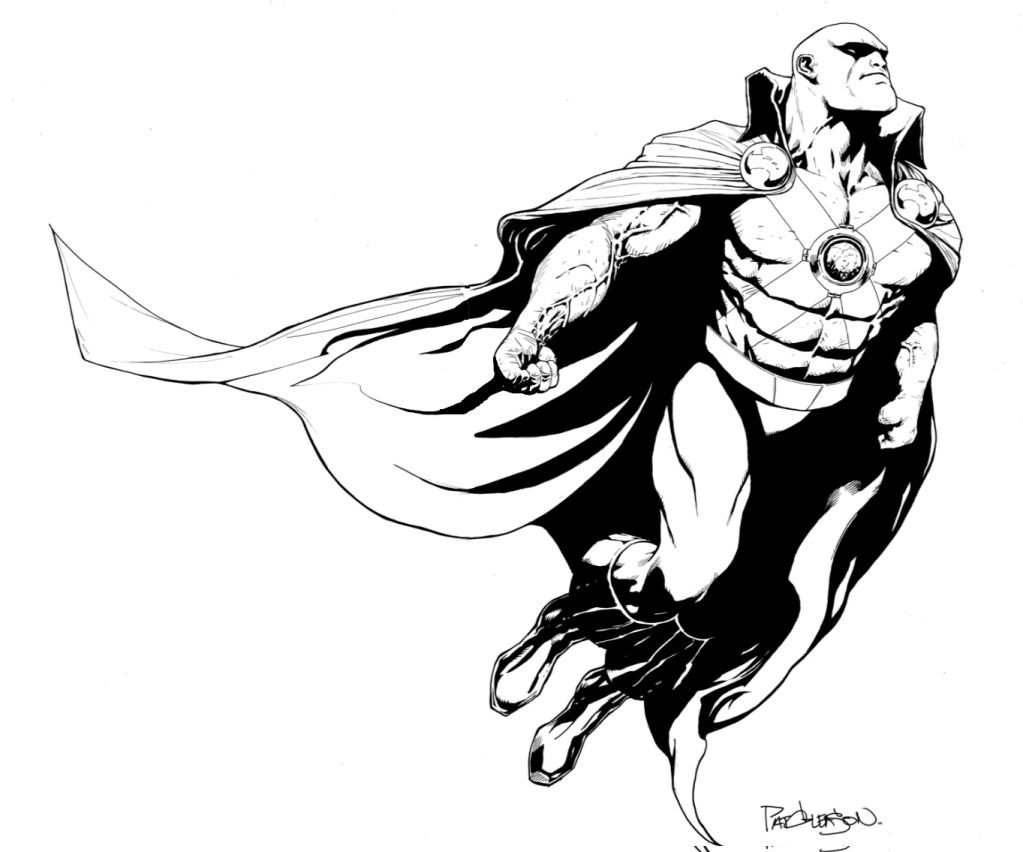
The image on the left is Patrick Gleason's Martian Manhunter.  Brightest Day was the biggest victim of my near-2011 implosion as a reader (this is the same time period in which I started this blog, so the whole journey has been documented for all its dubious relevance).  I loved it when it debuted, but have never had the opportunity to read the complete story, which along with Flashpoint helped usher the age of the New 52.  It was a bi-weekly series, but it's easily the best weeklyesque comic DC has managed since 52, and it was spearheaded, naturally, by Geoff Johns, working alongside Peter Tomasi, in the closest to an apprenticeship for the Tomasi who now writes the brilliant Batman and Robin as you're likely to find.  Tomasi's chief collaborator, Gleason, is present and accounted for, naturally, and of course his portions of Brightest Day revolve around Martian Manhunter.  This was a fact I'd forgotten until I picked up this issue.  This was a time in which J'onn J'onzz was getting some of his best material.  The Brightest material is in some ways a sequel to the 2006-2007 mini-series that was at the forefront of this era.  The Deadman and Aquaman material are also highlights of the issue that remind me of other things worth remembering about the series.

Justice League America #89-90 (DC)
From 1994.

Parts 1 and 4 of the "Judgment Day" Justice League crossover event that tried to ramp up the significance of the League books at the time (a little over two years later, Grant Morrison's JLA rebooted the whole field), this was a big dramatic end-of-the-world-type story.  The creative team is Dan Vado and Marc Campos, who soon after launched Extreme Justice, a series I followed throughout its run even though Vado and Campos left soon after it launched, apparently because of conflicts with the editor (so you see, New 52 creators, this was nothing new), Vado back to Slave Labor Graphics.  The Vado/Campos team was heavily influenced into following the Image style of the day.  The villain for "Judgment Day" was a kind of cross between Galactus and Darkseid, Overmaster, whom Vado chose in much the same fashion as Grant Morrison later would Libra for the purposes of Final Crisis, an afterthought of a character that could use a slight revision.  There were three additional chapters to the event, which may be best known, if at all, for the death of Ice.  I used to think it would make a nice trade collection.  Booster Gold's post-"Doomsday" woes, in which his original costume and therefore source of powers had been destroyed, also saw progress during the event, from a ridiculously bulky set of armor to a more streamlined look, which eventually led back to the form-fitting version for which he was known.  It was the start of Booster's transformation from a Bwa-ha-ha image to someone who could be taken seriously again, returning the focus back to his sometimes-anomalous background as coming from, ah, the future, who couldn't be relied upon to provide foreknowledge of major crises such as this and, yes, the whole Doomsday thing, which Blue Beetle rightly points out here as having been, in hindsight, a pretty dick move, since Beetle was among the ones severely injured during it, besides the cost to Booster himself.  All of which is to say, no matter how awkward this particular era might seem, it was a necessary evolution or at least transition.  Extreme Justice later addressed the Armageddon 2001 dangling issue of Captain Atom's involvement with the figure of Monarch, saw the return of Firestorm, and to Vado's chagrin the in-continuity debut of the Wonder Twins, one of the issues that drove him away from mainstream comics.

Action Comics #806 and 809 (DC)
From 2003.

Joe Kelly was part of the Man of Action alliance (also including Joe Casey, Duncan Rouleau, and Steven T. Seagle) that was a different kind of evolution, doing the Image founders one better by going into business for themselves outside of the comics medium, helping to create, among other projects, Ben 10 (Rouleau and Seagle also created Big Hero 6, which became a smash hit film in 2014).  This was a sort of lost generation for DC, most of whom had been tapped to join Jeph Loeb as the new millennium Superman creative team.  The first of these two issues features Traci 13 and Natasha Irons, who by the end of the issue has discovered a new set of armor forged for her by her uncle, Steel, who had recently undergone one of several crises (including a temporary death coming out of Our Worlds at War).  Superman is basically a guest star in the issue.  The second issue features Lois and Clark on a cruise, forced to contend with the irrepressible Jack Ryder, whose dual existence as the Creeper doesn't explain his human behavior.  It's a character who is always interesting but apparently can't carry his own series.
Supreme #64
From 2012.

As you may be aware, I've become heavily invested in Warren Ellis's Supreme: Blue Rose.  The previous attempt at a Supreme revival started with this issue from Erik Larsen, best known for his ongoing Savage Dragon.  Larsen used as his launching pad a lost script from Alan Moore, who had used Rob Liefeld's creation as a platform for writing Silver Age Superman adventures in the '90s.  That script was used for Supreme #63.  Larsen threw Supreme into a whole clash of multiple versions of himself and brought back the idea Liefeld originally envisioned, basically a violent version of Superman.  (Anyone find it ironic that Moore didn't want to use that version, from a creator who helped build his legacy on Miracleman?)  The result is typical Larsen, whose only competition at one point for the kinds of stories he likes telling was, of all comics, Garth Ennis's Preacher.  Larsen's profile has dropped considerably since he launched Savage Dragon, but he remains one of the more interesting subjects for critical analysis.  And unlike every other Image founder, he's remained true to the cause.

Tangent: Superman's Reign #1 (DC)
From 2008.

Speaking of causes, Tangent was Dan Jurgens' big to recreate DC's Silver Age revolution, when new versions of The Flash and Green Lantern helped revitalize its landscape.  Using familiar names but totally revamping the mythology, it jumpstarted the idea of legacy that became so important to the company.  Jurgens didn't have any pretensions of such a large-scale effect, but he created a fascinating concept all the same, one he was able to revisit after its debut in the '90s thanks to Dwayne McDuffie's Justice League of America, which also served as a platform to temporarily mainline the Milestone heroes.  It's amusing how subtle Jurgens can be as a storyteller when someone else is providing the art.  This is something I've remarked on before, but it bears repeating.  He scales back on excited speech patterns that remain the most unfortunate aspect of older comics in general, and allows himself the liberty to let loose creatively, something that was a highlight of his Superman at the start (he's also, remember, the creator of Booster Gold, the antithesis of the Man of Steel).  Superman, meanwhile, is the villain of the Tangent universe.  It's a concept that remains interesting.  If DC ever did decide to undergo another radical overhaul, it could do worse than look here for inspiration.

Saturday, November 29, 2014

Quarter Bin #61 "Binge-worthy VI: Martian Manhunter and other curiosities"

Martian Manhunter: American Secrets #1 (DC)
From 1992.
via Comic Book Resources
I've long been interested in having a look at this one.  I'm a huge fan of Martian Manhunter, one of the most perfect comic book creations ever and yet strangely one of the least-utilized DC icons, usually depicted as a stalwart member of the Justice League.  The launch of Grant Morrison's JLA put an extreme spotlight on all of the characters he chose to include, which led to the only, to date, Martian Manhunter ongoing series, which lasted for three years, at the turn of the millennium.  As indicated in his first appearance, previously featured in the "Binge-worthy" series here, the erstwhile John Jones was likely intended to be more of a detective than the green-skinned superhero he otherwise was.  With so many parallels to Superman and even the X-Men, Manhunter has always been a true outsider capable of providing a unique perspective on humanity.  American Secrets was an effort to do exactly that from a Cold War perspective, circa his earliest print history, the way some people still associate Wonder Woman with WWII even though she's been contemporized since her debut, unlike Captain America.  This is a noir story that doesn't even feature the green skin, much less cape (this is an alien who looks alien but is also a shape-shifter, so he can manipulate his appearance any number of ways, including a rough approximation of human, which is how he's usually depicted, and then an accurate version, which is how J'onn J'onzz becomes John Jones, the ultimate assimilated immigrant) until late in the first issue from the old "prestige format" (basically serialized graphic novel).  Maybe this particular line of dialogue, from our detective, sums up the project:
"...But not an evidence trail.  A trail of references, and hunches.  Game-shows, lizard-headed devils.  Comic books..."
I'd love for something like this to be reprinted, and for Martian Manhunter himself, for all intents and purposes, to be rediscovered.  If Ed Brubaker ever came back to DC, this is exactly the character he should write.  The same goes for Jason Aaron.  Heck, bring them both back and we can have a whole Martian Manhunter renaissance...

Martian Manhunter Special (DC)
From 1996.
via DC Wikia
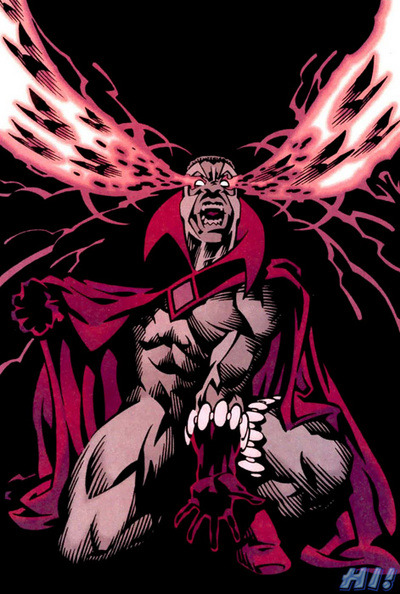
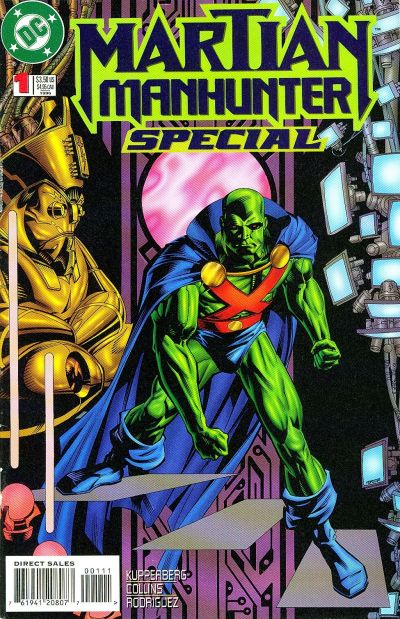
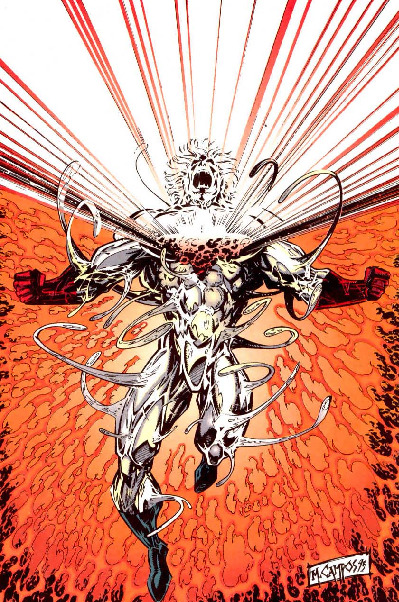
This was a one-shot released just prior to the Morrison reboot, replete with pin-ups featuring the characters who were Leaguers at the time and about to be become irrelevant.  My two favorites are the Marc Campos Captain Atom (the artist was familiar with the character from the "Judgment Day" crossover and the early issues of Extreme Justice)
via Tumblr
and my boy Bloodwynd
via Tumblr
who funny enough was at one point mistaken to be a version of Martian Manhunter thanks to some hilarious confusion.  Why am I talking about the pin-ups rather than the comic itself?  Because the story is pretty generic superhero sci-fi.  The cover, meanwhile, is more art I'd rather talk about, featuring work from Howard Porter, who helped Morrison launch JLA, and so probably represents the chronological launch of the relaunch, moreso than the one-shot itself.


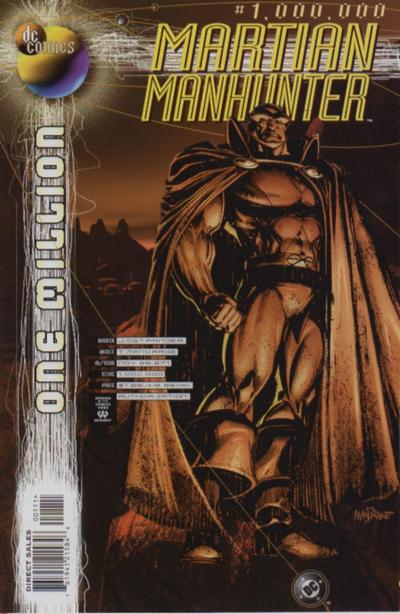
Martian Manhunter #1,000,000 (DC)
From 1998.
via DC Wikia
Speaking of Morrison's JLA, the event that spun out of it (the '90s were a decade that spun events out of series or creative teams DC wanted to spotlight; as such Dan Jurgens with Zero Hour in the wake of "Doomsday;" Mark Waid with Underworld Unleashed in the wake of his early Flash success; Karl Kesel and Stuart Immonen with The Final Night in the wake their Adventures of Superman; John Byrne with Genesis in conjunction with his Jack Kirby's Fourth World; and Geoff Johns with Day of Judgment on the cusp of taking over DC entirely) was called DC One Million, which was previously referenced in the "Binge-worthy" series concerning The Creeper.  Martian Manhunter was another character who greatly benefited from the event creatively, with regular series creators John Ostrander and Tom Mandrake exploring his adventures across thousands of years until he inhabits Mars itself.  It's another bold example of what sets the character apart and a welcome reminder of the undervalued work Ostrander and Mandrake did on the series, sort of the Brian Azzarello/Cliff Chiang Wonder Woman of its day, maybe not what JLA fans might have expected but some of the best character work of that time from an era that was steeped heavily in character work (Waid's Flash, James Robinson's Starman).

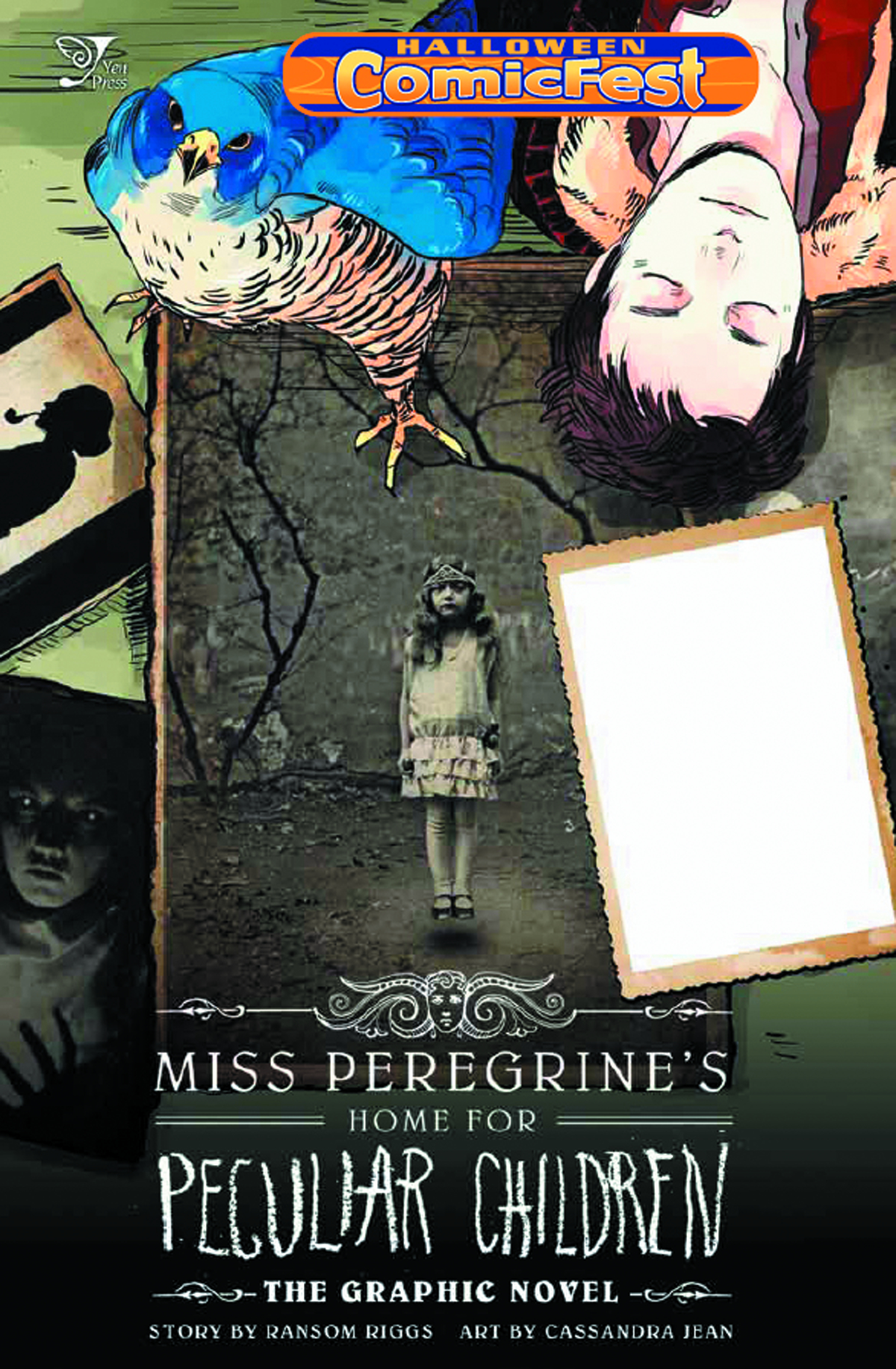
Miss Peregrine's Home for Peculiar Children: The Graphic Novel Halloween ComicFest Preview (Yen Press)
From 2013.
via Halloween ComicFest
Adapted from the acclaimed novel by Ransom Riggs, which I haven't read, for a graphic novel released early this year, which I also have not read, this becomes my first real exposure to the 2011 book, which will be a movie in 2016 starring the increasingly ubiquitous Eva Green (who has also starred in comics-related 300: Rise of an Empire and Sin City: A Dame to Kill For).  If this had originated as a Vertigo project, it would have fit in comfortably with Sandman and The Unwritten, a tale of a boy trying to reconcile the stories he used to hear from his grandfather which seemed too fantastic to be real, but as it turns out they were.  The Halloween ComicFest freebies are the unheralded cousins to Free Comic Book Day.  There are mini-comics (geared exclusively to kids) and also full-size releases like this one.


The Spectacular Spider-Man #229 (Marvel)
From 1995.
via SpiderFan
My earliest superheroes favorites were Robin and Spider-Man (two sides of the same coin, really).  These were the days when I knew superheroes exclusively from their TV appearances, which meant I knew Burt Ward's Robin and Spider-Man and His Amazing Friends.  By the time I started reading comics in the '90s, Tim Drake had become the third Robin, and...well, the Clone Saga was happening.  Every major superhero had some kind of crisis during that decade.  Superman was killed, Batman was broken, Green Lantern went insane, Wonder Woman was replaced.  And Spider-Man underwent the most extreme existential crisis ever: Peter Parker met Ben Reilly, and for a time neither knew which one was the clone.  It was a sprawling story that infuriated fans more than anything, mostly because it seemed the writers were, well, webslinging it as they went along.  I always felt it was maybe not deserving of all the hate it received, but then, I also didn't read any of it.  I was a DC guy by that point, had very little time for Marvel.  I think in hindsight, the Clone Saga is a perfect embodiment of what Marvel was for decades, a company that told the kinds of one-and-done stories DC became known for in the Silver Age, filled with sensational misdirection as a matter of course (if you heard the term "life model decoy" when people were trying to figure out how Agent Coulson was alive at the start of Agents of S.H.I.E.L.D. despite his death in the preceding Avengers, you have a sense of what I'm talking about), the very idea of instant retcon with every new creative team.  This issue is Peter Parker walking away from the whole mess (for a while), allowing Ben Reilly to assume the webbing as he tries to make sense of his ordinary life (again).  In case you were wondering, Ben Reilly was definitely the clone.  It's a whole era fans are still trying to remember positively, meaning its legacy in Spider-Man's history is still nowhere close to "Knightfall" or "Doomsday" despite the fact that Marvel itself keeps building off of it (to say nothing of the Ultimate Spider-Man version!).

Adventure Comics #6/509 (DC)
From 2010.
via Newkadia
Geoff Johns famously wrote into the letters column of Superboy, before he broke into comics, and offered his suggestion of the human DNA used to create Kon-El as having come from Lex Luthor.  This was something he made reality a relative handful of years later in the pages of Teen Titans.  Yet the best and subsequently undervalued work was done in the pages of Adventure Comics in what was also Johns' first collaboration with eventual Flash artist Francis Manapul, which led to the second Superboy ongoing series, written by Jeff Lemire.  After the New 52 reboot literally rebooted the character, this was a whole era that was consigned to the history books when it ought to have ushered a renaissance of appreciation.  This issue features a chilling version of Luthor, willing to do awful things to his own niece (another lost element, alas), one that trades heavily on his if-only-Superman-weren't-here self-mythology, and contrasts nicely with Johns' own Forever Evil version.  For fans like me, T-Shirt Superboy will always come in second place to Don't Call Me Superboy despite what Johns brought to the character, but this is an exception that deserves greater recognition.  Johns cleverly punctuated the arc with Superboy's running "What did Superman/does Lex Luthor do?" in the narration boxes, which I found instantly iconic, more relevant than what had been done with the character, outside of Johns and Karl Kesel, for years.