Showing posts with label Justice League. Show all posts

Tuesday, April 28, 2020

Pandemic Comics #7 “Justice Leagues”

More comics from the Mile High mystery boxes! Apparently today is National Superhero Day? And apparently Marvel began it? Well, the comics I’ll be talking about, ah, were all published by DC. But the pandemic is teaching us the real superheroes probably have very different costumes than we previously imagined, and masks look very different, too.

Harley Quinn #1
Here’s the “newest comic in the mystery boxes,” from Rebirth, featuring the creative team from the previous series (Marvel’s Constant Reboot Engine sees this happen more frequently) offers a quick recap of relevant information, including Harley’s huge collection of sidekicks. And yet in the spotlight: Deadpool Red Tool.  This was a shiny Mile High variant cover, by the way.

Hawkgirl #54 
As far as I know, this is the only time Hawkgirl had her own book. Of course, it began as Hawkman (where it was written by Geoff Johns) and this issue features the return of Hawkman (probably?). But the good news is it’s from legends Walt Simonson and Howard Chaykin, which is a combination and a series that stood out for me back in 2006, but for some reason never actually read. So, another mystery box that finally addresses one of my comic book sins...

icandy #1
I think it’s the title. Yeah, the title. It’s a terrible title. The comic itself turns out to be pretty good (I mean, it’s written by Dan Abnett & Andy Lanning, the geek gods of that period), a concept that folds video games into a playable concept. I’m frankly shocked this hasn’t been done more, or more successfully. The last time I saw it was Heroes Reborn, which naturally was four seasons after the series was actually popular.

Ion #7 
A maxi-series starring Kyle Rayner post-Green Lantern: Rebirth (otherwise known as “Thanks, Torchbearer, you now get to join the Back-up Corps!), this is a fortuitous random issue, because it reunites Kyle with Radu, the coffee shop owner who was a signature element of Kyle’s early days as a Green Lantern. Ion was a concept they fobbed on Kyle as a consolation prize, before it was replaced by his becoming White Lantern, before he became, well, just another Green Lantern...At the time, I guess, I was still annoyed that “my Green Lantern” had been “kicked to the curb” (which happens to literally every Green Lantern not named Hal Jordan eventually), and so couldn’t properly appreciate Ion. Now it seems like correcting that amounts to another of my comic book sins...

Justice League America #61
The first appearance of Bloodwynd! And, ah, Dan Jurgens takes over the series! In hindsight, Weapons Master really doesn’t seem like that big a challenge. Prometheus was basically an upgraded version only a handful of years later, and even he quickly got turned into a chump. Lesson, villains? Don’t put all your eggs in a fancy gimmick giving you special weapons. Because the weapons can be, well, taken away...

Justice League Task Force #2
This particular Justice League series from the ‘90s will always be the most thankless. Literally its biggest claim to fame is an issue of “Knightfall: The Crusade,” with Crippled Bruce Wayne. This issue is kind of ironic in hindsight: Nightwing looks like a chump while desperately trying to prove he isn’t just a former Teen Titan and/or Batman’s sidekick. If Dan DiDio caught this issue, it might explain why he used to think Nightwing was superfluous...

JLA/WildC.A.T.s
This was a really nice surprise! From the Grant Morrison era, written by Morrison, and featuring Electric Superman (what a snapshot!), something I think I’ve read before, but I guess never really considered that significant. But it is a great little snapshot. But the name of Jim Lee’s big superhero team still sucks, at least as far as incorporating one of the most convoluted acronyms from a whole history of convoluted acronyms in comics...

JLA #79 
It’s always great to remember just how long and varied Doug Mahnke’s history at DC alone is (dude’s also the co-creator of The Mask!), and he’s as easy a talent to revisit for that reason alone as there’s ever been. His art, at least during his DC tenure, has been remarkably consistent, though endlessly adaptable...Hopefully will get a spotlight collection at some point.

Sunday, October 6, 2019

Reading Comics 235 "Second Forbidden Geek Mystery Box"

I got my second Forbidden Geek mystery box, including a Supergirl statue, a copy of Justice League Vol. 2: The Villain's Journey (which was a very pleasant surprise; eventually I'll have the complete Johns collection), and the following comics:

All Star Batman #3 (DC)
Snyder once again in his nutshell, blowing everything up into possibly misguided epic proportions.  This time it's how Batman and Two-Face were actually childhood friends.  But, also features the KGBeast!  Alas, without his '90s Russian accent.

Captain Atom #7 (DC)
This is what I love about Forbidden Geek's mystery boxes, getting stuff I've always wanted to read but for whatever reason haven't gotten around to yet.  Captain Atom was one of those short-lived New 52 titles at launch.  I never had a clue what the series was like.  Now I finally do!  J.T. Krul, one of the dependable writers of that era who kind of disappeared without good reason, depicts his version of the character as Captain Atom has ever since DC gave in and acknowledged that Doctor Manhattan was based on him.  I first became acquainted with the character (whose main claim to fame is being but not really being the secret origin of Monarch in Armageddon 2001) in the pages of Justice League America and Extreme Justice, where he was depicted as more a Superman type, but a more aggressive version (just not to the degree that the original version of Supreme was, before Alan Moore made him a Silver Age Superman pastiche).  The art is from Freddie Williams II, who in recent years has come to be defined by the improbable Batman/Teenage Mutant Ninja Turtles comics.  I've got plenty of experience with his work, which I often find too cartoonish but not cartoonish enough to be accepted as such.  Here he's got better line work, though he apparently has no idea what riding a bike looks like (the legs, particularly).  I would absolutely love to read a collected edition of this material.

Constantine #5 (DC)
The New 52 attempt to mainstream John Constantine (a concept begun in Brightest Day) may have been somewhat misguided (at any rate, DC has yet to figure it out) works pretty well in this issue, with John temporarily stealing Shazam's powers (for his own good!), thereby setting a template other tales would do well to follow.  You can't really have the guy (even if he pops up in other books and/or teams) attempting to replicate his Vertigo experiences without recontextualizing him properly.  Ideally, he needs a central story, the way Zatanna is forever associated with her father's career, which increasingly is itself irrelevant but nonetheless provides a springboard to ground her.  The writer, of course, is Ray Fawkes, another great writer in that era who somehow failed to garner due respect.

Deathstroke #20 (DC)
A late New 52 series still running in the early Rebirth era (one of several, including Earth 2: Society and Doctor Fate, given a chance to wind down naturally), Slade (the youthful Slade, sans white hair!) blows up a partnership with Ra's al Ghul to reclaim his children. 

Hinterkind #10 (Vertigo)
A vampire series.  That is all.

Justice League #18 (DC)
A trademark of League comics is the membership drive (something Snyder ignored in pushing a huge lineup with multiple titles right from the start, so that everyone and their mother is instantly included).  That's what happens this issue.  Some new characters (Goldrush is sort of a revision of Bulleteer; sadly neither character has had much of a shelf life to date) and even a tease for the Crime Syndicate saga called Forever Evil makes this a fine character piece in a series with far more character work than you'd think.

Justice League #32 (DC)
Element Woman (a riff on Metamorpho), also featured in the membership drive, and the Doom Patrol(with a vicious Chief whose rival is Lex Luthor), try to tackle Jessica Cruz in the aftermath of her obtaining the power ring of, ah, Power Ring, the Crime Syndicate's Green Lantern.  Cruz later flattened into a character who sort of hid away in her room for...reasons, but it seems Johns originally had a deeper portrait in mind. 

Legion of Super-Heroes #283 (DC)
The token Older Issue in the box, this is an early '80s Legion comic featuring the secret origin of Wildfire.  I actually became more interested in the potential of at least one of the recruits he was testing.  Did anything ever end up happening with Lamprey?   Some quick research says no.  If I ever do get to write comics, I will include her in my Legion!

The New 52: Futures End #39 (DC)
This and Batman Eternal seem destined to show up in mystery selections.  At least I don't seem to get duplicate copies of this one. 

Richard Dragon #12 (DC)
The Chuck Dixon/Scott McDaniel series that reprised their Nightwing act.  Somewhat handily, the final issue.  God, I still want to know why McDaniel ended up blackballed from any significant work following Static Shock.  The dude was a staple at DC for a decade in high profile projects, and then criminally overlooked material like The Great Ten.  He's a treasure.  I doubt he was that awful to handle creatively when given a chance to write as well as draw.  He still shows up randomly here and there.  But, someone, anyone, give him a significant new project.

Superman #5 (DC)
The Tomasi/Gleason Rebirth series (seriously; McDaniel is like Gleason before Gleason was finally recognized), featuring the Eradicator targeting Jon Kent as a human/Kryptonian "abomination."  I don't think Tomasi/Gleason quite nailed Superman the way they did Batman and Robin.  I just saw Gleason popped up in Marvel Comics #1000 (which I'll be reading this week and have thoughts on next weekend).  Give these two a new project together before either considers really jumping ship.

Tuesday, September 19, 2017

Quarter Bin 117 "More DC 3-Pack Comics"

I love these DC 3-packs.  I love that I can find any comics in retail stores, even if they're grab bags, but the consistency of these 3-packs has been a continuous joy for the past few years.  So here's what I got in the last two:

Batman and Robin: Futures End (DC)
from November 2014

I love reading these Futures End issues.  I love that so many writers ignored, and possibly at editorial suggestion, the Futures End event itself and just had a look at whatever was most probably five years down the line in whatever was happening in the titles at the time.  Ray Fawkes was riffing, here, on Damian's death, and Batman's penchant for going gunshy on his new partners because of things like that.  This time he's pulling it on Duke Thomas, who in this Futures End timeline actually did become Robin, as so many fans long anticipated (Snyder has instead opted to give him his own identity: the Signal).  The art is by Dustin Nguyen, with inks by frequent collaborator Derek Fridolfs.  It's funny to see Nguyen presented as a traditional artist again, after getting so used to his Descender water colors look.


What's funny is that it makes his work look like Jorge Corona's.


Yeah, Corono drew Duke, too, as a kind of Robin, in the pages of We Are Robin.  Seems appropriate, anyway.

Here's what Nguyen looks like in Descender, by the way:


The story, by the way, involves Batman's showdown with a revived Heretic, most likely a clone, the villain who killed Damian in the pages of Morrison's Batman Incorporated.  I'm sure I've read it before, but it's another of the excellent Futures End specials. 

Green Arrow #1 (DC)
Wal-Mart reprint from July 2017

This is a reprint of the Rebirth debut issue from the ongoing series, and does an excellent job of spotlighting Benjamin Percy's vision for the series, integrating a lot of different elements of Green Arrow's publishing history, including his social views, relationship with Black Canary, and penchant for having a sidekick, except this one...It becomes a wonderful development for the character, having Ollie take on a half-sister, whose mother turns out to be his enemy Shado.  Makes me think I really should've made this series a priority read at some point.  Will have to check back in...

Justice League #36 (DC)
from January 2015

This is the first chapter in the "Amazo Virus," where Geoff Johns started amping the series back up to its "monthly event book" (my designation) status as it geared toward "Darkseid War."  The art of Jason Fabok was an immediate sensation, and certainly helped drive eyeballs back to the title. 

Justice League United #2, 5 (DC)
from August, December 2014

I never did get around to sampling this series at the time, but I'm glad I finally have.  Jeff Lemire (writer of Descender, by the way!) launched it, and these issues make it clear that United helped launch the New 52 version of Adam Strange, which was fun to read, especially for someone who's just finished rereading 52.

Batman and the Justice League: Outbreak #1 (DC)
Wal-Mart reprint from July 2017

This is what's really fascinating about these 3-packs, that the comic in front is always the newest, and often features a custom Wal-Mart cover and even, with some of them, custom titles.  Batman and the Justice League is actually the Rebirth Justice League from Bryan Hitch, and this is actually #10 from the series.  It's kind of funny, too, or maybe calculated, that the issue is related to the above Justice League, as it also features Amazo.

Monday, July 25, 2016

Reading Comics 195 "DC Rebirth Week Seven, 18 Days, Letter 44, Tokyo Ghost"

Featured this edition: Grant Morrison's 18 Days #12, Batgirl & the Birds of Prey: Rebirth #1, Batman #3, Green Lanterns #3, The Hellblazer: Rebirth #1, Justice League #1, Letter 44 #26, Superman #3, and Tokyo Ghost #8.

Grant Morrison's 18 Days #12 (Graphic India)
Morrison's Avatarex #1 shipped last week, and hopefully I'll be seeing a copy in a couple weeks.  Although I lost track of reading Graphic India's vision of his Indian superwar epic a while ago, I always thought it was well worth reading, and so I checked in again for this issue, which details Bhima's further experiences, from his great familial devotion to a momentum moment for him in the fighting.  This project's being executed with pitch-perfect precision.

Batgirl and the Birds of Prey: Rebirth #1 (DC)
The Birds of Prey was conceived during the '90s, and has been maintained in some fashion ever since.  It's a girls-only team (still unique in comics, but not with Ghostbusters).  This issue features Batgirl Barbara Gordon's biography at the forefront, but also gives nods to Black Canary's DCYou band exploits and Helena Bertinelli's Grayson spy work, and how the team only reluctantly gets back together.  It was a good introduction.

Batman #3 (DC)
Tom King's Dark Knight continues, as we learn the secret origin of the superpowered heroes who have lately been lending him a hand: Hank and Claire Clover.  Hank was saved by Batman years ago, when he was a kid.  King cleverly stages this origin so that the unsuspecting reader might think he's seeing Bruce Wayne's fateful Crime Alley nightmare all over again, but then the story continues and we find out what's really going on.  As always, King is in full command of the psychological beats, including those provided by villains Hugo Strange (always, ah, somewhat strangely overlooked in Batman lore) and Psycho Pirate. 

Green Lanterns #3 (DC)
Simon Baz spends more time in the spotlight this issue, including a killer sequence with Red Lantern soldier Bleez, who is the latest recipient of Baz's ability to unlock his power ring's most surprising abilities, ones rarely experienced by other bearers.  He'll need all the help he can get, because partner Jessica Cruz has just been overtaken by the rage seed...

The Hellblazer: Rebirth #1 (DC)
John Constantine is that unique DC character, in that he's a genuine antihero, which unlike his Marvel counterparts (say, the Punisher) doesn't mean that he goes around shooting people, but that he makes unorthodox moral decisions, possibly because of his ties to Hell (hence, the returning traditional name to his adventures).  Since his return to DC proper (after being a headlining Vertigo act since the brand's creation two decades ago) during Brightest Day five years ago, fans have been skeptical that Constantine can properly function in the relatively sanitized DC superhero landscape (for comparison, imagine if Neil Gaiman had had to make Sandman permanently co-exist with the likes of Dr. Destiny and Martian Manhunter, both of whom made early appearances in the series, but who seem hard to reconcile with Gaiman's later creative pursuits).  I've never really been a Constantine reader, so I welcomed this chance to have a look.  For what it's worth, I do think, at least in this issue of this iteration, he works perfectly well.  It's like the Demon Etrigan (who had a Garth Ennis-penned series in the '90s, that gave birth to one of Ennis's signature creations, Hitman), but without the Demon as the lead, if that makes any sense.

Justice League #1 (DC)
The first issue of the series, like its New 52 Geoff Johns predecessor, has Wonder Woman on the brain, which I love.  Tony Daniel on art (he helped launch Superman/Wonder Woman, which is all kinds of natural for this latest Daniel project) is as always a thing of beauty.  I love how the whole issue is about mobilizing the team. 

Letter 44 #26 (Oni)
I'd previously sampled this Charles Soule series, but didn't really get the hang of what's going on in it, so I'm glad that I've finally read another issue.  This is a story about the end of the world, and all the odd decisions people are going to make if the involved players include aliens, U.S. presidents, a team of scientists, and messianic collaborators.  Actually, I came out of this issue being very impressed.  But then, I was already a fan of Soule, so I'm doubly glad I can now say I like Letter 44, too.

Superman #3 (DC)
Having witnessed the thunderbolt that was Jorge Jimenez's work in the early issues of Earth 2: Society, I'm so happy to be seeing more of his art, in this Tomasi/Gleason series and in the forthcoming Super-Sons, which in some ways this issue helps set up, as we see Jon Kent light up for the first time.  The sequence of events that provoke this (a new vision of the Eradicator that offers some fascinating new wrinkles to established character mythology; Krypto) is breathtaking in ways I hoped this series would be.

Tokyo Ghost #8 (Image)
Rick Remender has joined Mark Millar in the select group of modern writers who have been able to establish a viable brand around their names, and a large net of titles to populate it.  This Remender project envisions a dystopic future directly culled from our own, in which addiction to digital content has literally sucked the life out of everyone, leaving the population susceptible to corrupting influences.  Fortunately, there's a hero in the eponymous Ghost capable of stepping in to stem the tide.  This issue turned out to be a perfect one to sample, involving the Ghost's tragic baskstory, and the man she's tried valiantly through the years to protect, despite increasing odds against her.  But the reason I wanted a look was because of the Sean Gordon Murphy art.  I've been a fan of Murphy's since Joe the Barbarian, his seminal work with Grant Morrison, as well as his personal creative vision, Punk Rock Jesus.  He's also collaborated with Scott Snyder (The Wake) in recent years, as well as Millar (Chrononauts).  I never get tired of his art.

Thursday, July 7, 2016

Reading Comics 192 "DC Rebirth Week Five, Astro City"

Covered this edition: Astro City #35, Batman #2, Green Lanterns #2, Justice League: Rebirth #1, and Superman #2.

Astro City #35 (Vertigo)
Kurt Busiek's pocket superhero universe, which literally resides entirely within the boundaries of Astro City, has long been fascinating.  It's one of those self-contained concepts that could easily satiate a given reader's interest in superhero comics, whether they're jaded older readers, or younger ones who aren't particularly interested in tracking down multiple titles to try and catch up with something they've just discovered.  The series has been around, in one incarnation or another, for twenty years, and was clearly inspired by Busiek's interest in following up on his Marvels success, where he was able to look at the full portrait of a given superhero landscape and provide nuanced insight into it.  His Astro City work rotates from character to character.  This particular issues features Jack-in-the-Box, a costumed vigilante with an outlandish gimmick but who Busiek otherwise presents pretty straightforwardly, getting at the heart of the character's human struggles, which in this case mean the legacy the grandson of the original Jack feels increasingly as a burden he can never live up to, with his father and uncle having carried it on but a reckless decision in his youth cost him his chance to do the same.  Jack-in-the-Box joins the league of black superheroes who sport all-covering masks, so that you wouldn't know his race otherwise, but the comic spends probably more time with the mask off of any given Jack than necessarily caring about his costumed exploits, treating that as more a McGuffin than anything.  There's a letters column page featuring the letter of the month (a rarity in a DC title of any extraction these days), and also a preview of Paul Dini's Dark Night: A True Batman Story, which details his experiences recovering from a mugging, and that's part of the reason I bought this comic, because I've seen plenty of hype for the graphic novel, but none of the interior.  But it's always worth checking in with Astro City.

Batman #2 (DC)
Tom King's era continues as Batman introduces Jim Gordon to Gotham and Gotham Girl, the superpowered new heroes who are eager to lend a hand in the ongoing war on crime.  It's Batman's sense of mortality that permeates the issue, however, the lingering aftereffects of his near-sacrifice in trying to prevent a fatal plane crash last issue.  It's King's grasp of character that strikes this material as fresh.  At one point Alfred explains to Duke Thomas how a young Bruce Wayne became disenchanted when Alfred made a prudent judgment call.  For someone like Bruce, there's no such thing as prudence.  He doesn't have the patience for something like that.  The current Bruce abandons a lady mid-dance when he spots the Bat-signal in the sky, and the woman is positively baffled.  You can imagine how it plays out just by the way it's depicted: Bruce doesn't want to attend function; he reluctantly agrees, puts on his best game face; is positively overjoyed when he gets to go back to work.  For him, it doesn't even matter what other people are expecting.  That's Batman in a nutshell.  He lives by his own rules.  It's great when a writer like King comes along and knows the psychology that well.  For those looking for something a little easier to digest, there's the young hero Gotham discovering for himself Batman's classic disappearing act, or Gordon wondering how on earth a mask doesn't become uncomfortable in this line of work (casually sidestepping Scott Snyder's depiction of Commissioner Batman)...

Green Lanterns #2 (DC)
Sam Humphries keeps hitting all the right notes.  His depictions of Simon Baz and especially Jessica Cruz as novice Lanterns is the perfect way to explain all over again what the Green Lantern concept is all about, and how it can be a little hard to comprehend.  Jessica is so neurotic that Simon's confidence makes him seem like a veteran, even though it's just his different personality that's creating the effect, because he's just as lost as she is.  Returning the Red Lanterns to the role of the villain is also a good move.  Readers don't particularly need to know that in their late ongoing series, they became sympathetic heroes.  The idea of them existing to help people cope with powerlessness further underscores Jessica's feelings of inadequacy.  Just good stuff, and very, very good to see for a reader who hasn't had a lot of Green Lantern he found worth reading lately.

Justice League: Rebirth #1 (DC)
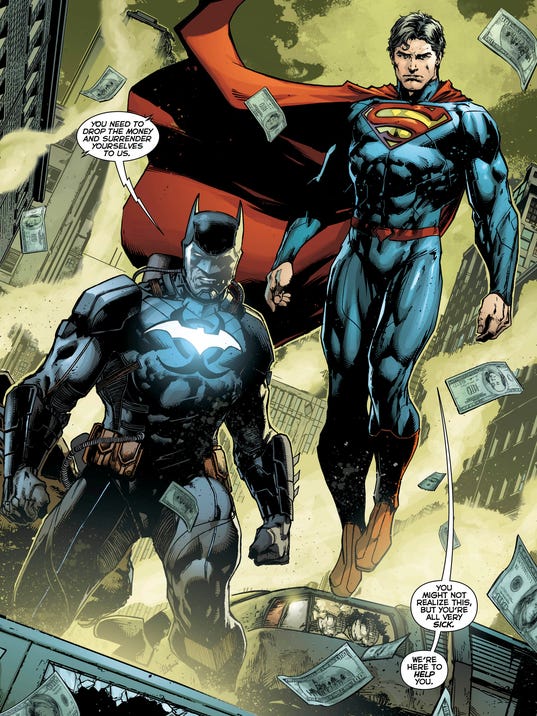
The Bryan Hitch era, as the headlining act of the franchise, begins as he brings the "new" Superman back into the fold, showcasing what a significant difference Superman makes both by his absence and presence.  That's something few writers have done, for whatever reason, but Hitch dives right at it, not so much at the cost of every other member, all DC icons in their own right, but in the role of leadership, which Superman embodies not so much because he takes charge but because he's capable of identifying what needs to be done, by example.  The whole issue makes the case for the team in general, as necessary guardians in the turbulent reality DC presents.  It does its job.

Superman #2 (DC)
I can't say too often how brilliant I think it was for DC to let Pete Tomasi and Patrick Gleason recontextualize their Batman & Robin work in the Rebirth era.  This was a dynamite team working in the shadow of Scott Snyder's work.  If readers sometimes wondered why Tomasi and Gleason were putting their previous charges into outsize adventures not typically associated with them in the modern era, it's completely justified with their new ones.  The young Jonathan has found an intriguing accomplice in Kathy, the figurative girl next door (insofar as adjacent farms can call have such things).  She's like his Lana Lang, knowing his secret and not being interested in anything else but the boy he otherwise is.  She and her grandfather lug Jon back home after he falls from a tree, which gives him a concussion.  His parents are necessarily alarmed, especially Clark.  It's a little odd seeing Lois as anything but a reporter (she writes fiction now; I don't know if it was a slip-up, but she gets a piece of mail under her given name, and it's not addressed, even though the family has been living under assumed names since emerging from Convergence into this reality).  Anyway, the big news occurs at the end of the issue, in which the Eradicator makes his New 52/Rebirth debut (coincidentally, I've just finished reading some of his original appearances).  But I love this series so much, already.  Seeing father and son, in the early pages, engaged in a rescue operation, and then disarming a monster, is everything Tomasi and Gleason couldn't do before, and everything I'd hoped they'd do in Superman.  For me, with just work like this, and King's Batman, and Humphries' Green Lanterns, the Rebirth era has already proven its worth, to a remarkable degree.

Thursday, June 23, 2016

Reading Comics 191 "DC Rebirth Week Four, Divinity II, Totally Awesome Hulk, Justice League, Robin"

Covered this edition: Divinity II #3, The Flash #1, The Totally Awesome Hulk #7, Justice League #52, Robin: Son of Batman #13, Action Comics #958, and Wonder Woman #1.

Divinity II #3 (Valiant)
Matt Kindt continues the second volume of his visionary superhero saga, in which Russian cosmonauts Abram Adams and Myshka engage in the ultimate duel, across time and reality, as they attempt to determine whose will triumphs in this high-stakes game of god-like beings.  For the second straight issue, it seems the villainous Myshka has once again come out on top, but there's a telling moment when Abram visits the young Myshka, years before the mission that was to change their lives and the whole world, and whispers something into her ear.  Abram has taken great pains in explaining to the adult Myshka that you can't change the past. The suggestion is that whatever he said to the girl is more crucial than the adult currently realizes.  I assume something of that sort will be involved in the conclusion next issue...

The Flash #1 (DC)
My name is Tony Laplume, and I am the happiest Flash fan alive.  Well, maybe one of them, because this debut issue of the series proper lives up to the promise of the Rebirth preview, as Josh Williamson sets up a bold new arc in which the gift of the Speed Force starts spreading around.  Williamson's best bit of storytelling is actually the whole issue, which starts out explaining Barry Allen's origin again, while inserting a key new player, who by the end of the issue is the first (there will be others) to experience the expansion of speedsters.  This series is in excellent hands.

The Totally Awesome Hulk #7 (Marvel)
Easiest some of the best Marvel comics I ever read were Incredible Hercules and its several continuations, which featured Amadeus Cho as the Hulk's (and yes, Herc's) biggest fan.  This shouldn't have worked, right?  In the modern era, the "kid sidekick" idea is passe, but Cho's enthusiasm, not to mention his smarts, puts him in a league all his own.  And in this era where every Marvel superhero is being replaced by their biggest cheerleader (of various extractions), this is the best variation possible.  But the issue actually puts the focus on Bruce Banner, who is totally free of the Hulk for the first time ever, and he's struggling to deal with it.  You'd think it would be a good thing, but when you're Bruce Banner, it's much more complicated than that.  If you like your Hulk to be good for something other than smashing (although that's good, too), then this is a good time to be a fan.  Spearheading this new era is Greg Pak, who knows a thing or two about the big green guy.

Justice League #52 (DC)
The final issue of the series strangely harkens back to the very beginning, as a new hero is introduced to the world.  This time it's Lex Luthor, presenting his version of Superman.  The writer is Dan Jurgens, providing a bridge between where Geoff Johns left off with Luthor and where Jurgens picks up again in the pages of Action Comics.  Lex Luthor was one of the characters who benefited greatly from the New 52, and Justice League.  It's only appropriate to give him the nod like this.  What I love perhaps even more is that the artist is Tom Grummett, making this a mini '90s Superman reunion. 

Robin: Son of Batman #13 (DC)
The final issue of the series, which I decided to read so I could say I was fair to the creators not named Patrick Gleason who worked on it.  (Okay, so technically it would have been more fair to read more than one issue, but still...)  As it turns out, Ray Fawkes is once again better than I seem to have given him credit for, as his version of Damian and friends fits in wonderfully with Gleason's, and even serves as a truly fitting finale.  Nice one, Fawkes.  I'll try to remember next time.

Action Comics #958 (DC)
Jurgens, Lex Luthor, and Superman, and Doomsday, and Clark Kent, oh my!  Clearly there are things going on that aren't quite what they seem, but I love, love, love that Jurgens is getting the chance to further expand on his Superman legacy, which admittedly he's had many chances to do over the years.  I think he's really nailed it this time.

Wonder Woman #1 (DC)
I thought Greg Rucka would be fixating somewhat exclusively on Wonder Woman's origins, despite the alternating storylines ahead, but this issue presents a wrinkle in that idea, as the end of the issue reveals that she's been locked out of Themyscira, and she's had to turn to Cheetah, of all people, for help.  I also like Rucka's characterization of Wonder Woman's reluctance to fight, and Steve Trevor's reclassification back into a military guy.  All around good stuff here.

Sunday, May 29, 2016

Justice League #50 (DC)

The conclusion to Geoff Johns' tenure on Justice League (there are two final issues to follow from other creators) finishes the epic "Darkseid War" in grand fashion. 

The mythology Johns created for "Darkseid War" alone is impressive.  Myrina and her daughter Grail, for instance, add not only to Amazon lore, but the New Gods as well.  It's only fitting, because Johns has literally been using Justice League as his Wonder Woman series all along, with few readers apparently realizing it.  Embroiled in this conflict is also, of course, Steve Trevor, who has been embroiled in a troubled relationship with Wonder Woman since the start of the series.

Grail turns out to be the real villain.  By now, the New Gods mythology is well-established, so someone new had to step into the role usually reserved for Orion: how to resolve what comes after Darkseid.  In Jack Kirby's original vision, Orion was the son of Darkseid while Mister Miracle was the son of Highfather.  In order to secure a truce between New Genesis (home of the good guys) and Apokolips (home of the bad guys), the offspring were raised by their (presumably) former enemies.  Mister Miracle, as ever, escaped unscathed.  It was Orion who emerged the troubled scion.  Famously, Kirby never got the chance to conclude his New Gods vision (the graphic novel Hunger Dogs didn't quite do the job).  So writers have been trying to do it for him ever since, including John Byrne (Jack Kirby's Fourth World) and Grant Morrison (Final Crisis).

Johns takes a unique approach by expanding the concept with significant new characters.  When he killed off Darkseid (these New Gods are always dying), he set about yet another new wrinkle.  His first had been introducing the concept that Crisis on Infinite Earths' Anti-Monitor was Mobius, whose chair Metron had been squatting in for as long as anyone could remember.  Darkseid's death unleashed all his powers, which went into various members of the Justice League. 

The ramifications prove to be profound, in this conclusion.  Batman sat in the chair, and learned the secret of the Joker's identity.  Turns out there are three of them.  Lex Luthor gained a killer new set of battle armor.  (He'll be wearing it in the Rebirth era's Action Comics.)  And Grail stole the offspring of Superwoman, from the Crime Syndicate, and made him the reincarnation of Darkseid.

The good news is, Johns also finally made Jessica Cruz an official member of the Green Lantern Corps, fulfilling the promise of a different teaser, from Green Lantern #20.

The only thing that doesn't really ring well is the art of Jason Fabok.  This is weird, because every other issue of Justice League with his work hasn't been a problem for me.  He has distinctive work, but I guess he's incapable of going truly wide screen which has been a staple of JLA comics since Howard Porter.  It's a shame.  Doesn't get in the way of the storytelling, but it produces an incomplete effect. 

Still, this was exactly what fans of this run could have hoped to see.  We even see, like in the beginning, Batman and Green Lantern working together, at one time a pair that seemed hopelessly incongruous.  Johns solved that by letting Batman use the ring.  As with Green Arrow before him (Green Lantern: Rebirth), it provides him with newfound respect for Hal Jordan.  Classic.

Thursday, April 28, 2016

Reading Comics 185 "I am being Broot, plus the end of Scott Snyder's Batman and the penultimate Geoff Johns Justice League"

Batman #50, 51 (DC)
These are Scott Snyder's final two issues of the most successful run from the New 52 era.  I've done my fair share of waffling on Snyder's Batman, but in the end I can agree that it was historic, and in a good way.  #50 counts as the end of Jim Gordon's run as Commissioner Batman.  Bruce Wayne, in an earlier issue I haven't read, finally reconciled himself with his Batman destiny again, and aided in the thwarting of Mr. Bloom's plans to deconstruct Gotham (via methods that made him a cross between Christopher Nolan's Ra's al Ghul in Batman Begins and Poison Ivy).  Along the way, Snyder brings Duke Thomas, the would-be next Robin who went on to somewhat fill that role in We Are Robin, back into the fold, providing sort-of closer to one of his signature creations (along with the Court of Owls and Harper Row) during the run.  #51 is a better issue, as it directly reflects on the very first issue by bringing back the "Gotham is..." newspaper column feature in the captions, along the way providing a hopeful interpretation of what Batman means to his city.  I think that about sums up what Snyder brought to the character, building on Grant Morrison's earlier Batman Inc. mentality and allowing Batman to be less grim, while still pursuing monumental stories (just about every story was a crossover arc).  This was something that was largely absent from of the New 52, a truly cohesive vision that looked like something new but was also, for those paying attention, something familiar.

(Snyder returns in the DC Rebirth era with All Star Batman.)

Justice League #49 (DC)
Geoff Johns pens the penultimate chapter of "Darkseid War" and his run in this series, his last regular writing assignment for the foreseeable future, and he continues to drop big moments, such as the death of Moebius (the responsible party is hardly someone you would expect), setting up a finale in which all the remaining players must sort out their variously tangled relationships, enemies of so many orders that you kind of might confuse this for the best-ever X-Men story (or the rest of the Marvel universe lately, as has been heavily depicted in its movies, soon to be seen again in Captain America: Civil War).  So that's exactly what Johns has accomplished in this very DC series that has stood as the uncrowned monthly event series I've been describing since the first issue...

Omega Men #11 (DC)
The penultimate issue of Tom King's masterpiece sees war grow more and more entrenched, as the individual remaining members of the team rally the individual worlds of the Vega System to the cause.  This is where we get to see the results of what the rest of the series has accomplished, and my favorite moment comes from Scrapps, the dirtiest player in the game (no, silly, not Ric Flair!).  Scrapps is the girl I will probably have to go back and read to find out if King ever actually explored her background, but she's been the toughest soldier in an army that was packed with all kinds of muscle.  She confronts Broot's father, the pontifex of Changralyn (where Omega be praised), and utters the phrase leading the title of this column, "I am being Broot."  ("Broot" means heretic, by the way.)  It's a great moment, and points to what King, and DC, may have been intending all along with Omega Men, which was to present DC's version of Marvel's Guardians of the Galaxy, which a couple of years ago became a hugely successful movie, famously with the tree creature Groot, whose dialogue nearly exclusively consists of uttering the phrase, "I am Groot."  And as far as I'm concerned, that's exactly what King has accomplished.  DC has always been the thinking man's comic book company.  There are plenty of people who would love to dispute this, but they'd be wrong, and I'm not even just talking superhero comics (no other company has been able to so successfully juggle those and so many other genres like DC).  But even in terms of between DC and Marvel, DC's always been the more philosophical one, whereas Marvel has always tried its hardest to play the superhero game straight (again, you can see that clearly in the movies).  Right now we have a lot of fans who prefer the Marvel method.  When it swings around again (and it will), Omega Men will be waiting to be rediscovered.  And make a better movie...

Friday, April 15, 2016

Reading Comics 184 "Darkseid War, Superman: America Alien, Omega Men, Web-Warriors"

Justice League #47, 48, Special #1 (DC)
Okay, so the word ought to be ought by this point that Justice League #50 will finally give a definitive answer as to who is the Joker.  Because that's going to happen.  So I dove back into Darkseid War.  The original plan was to eventually read the whole thing in trade collection, because this is one of the biggest stories Geoff Johns has ever done (which is saying something), building on just about everything he's done in this series, including Forever Evil, and arguably telling a definitive New Gods tale in the process.  With various members having taken over various New Gods facets in the wake of Darkseid's death, they come to the realization that the Crime Syndicate (as Lex Luthor realized immediately) will probably have to play a role in this, and by the end have actually decided to team up with their doppelgangers.  (It's worth noting that the animated Justice League: Crisis on Two Earths is actually pretty good.)  In the Special, Johns gets to write a Jessica Cruz (Power Ring) tale, more or less riffing on what he's already done in the series proper, but still fun for fans of his Green Lantern to see (it's also worth noting that his two creations, Cruz and Simon Baz, finally helm their first ongoing series, thanks to the upcoming Rebirth era, in Green Lanterns).  But more importantly, and also slightly riffing on earlier material, Special also puts the spotlight on Grail, and as such is another essential issue for those who realized that Johns has been using Justice League as his first run with Wonder Woman.  And may he have another...

Omega Men #3 (DC)
And thusly now do I have physical copies for all extant issues of this series.  In this one, Tom King explores Princess Kalista's motivations, which at the time seemed all the more crucial because she had the most immediate relationship with Kyle Rayner, and this was the first time the series delved into a team member's back story, but certainly not the last.  The William James quote?  "The 'sentimental fallacy' is to shed tears over abstract justice and generosity, beauty, etc., and never to know these qualities when you meet them in the street, because the circumstances make them vulgar."  Again, I love these quotes in the series.  Clearly Kalista was used to win Kyle over, because she's a romantic figure, enough to make him begin to care, when the rampant chaos of the Vega System itself was never enough.  I hope comics fans eventually come around and realize how significant King's work in this series really is...

Web-Warriors #5 (Marvel)
I had to read at least one issue of this series, right?  It's a de facto continuation of Mike Costa's work from the Secret Wars Spider-verse mini-series, which is to say, more with all those Spider-Man variations running amok together.  What strikes me, in reading this, is that Costa is completely at home in this chaos. I guess it took a while for me to reconcile this version of his writing with the more sober work I know best, but if it gets him more fans and maybe even regular work, then I can support that.  Maybe not read it regularly myself, but clearly there are readers for this sort of thing, so I can't complain.  Happy for the guy...

Superman: American Alien #2, 4, 5 (DC)
I read the first issue digitally, and I was impressed with this latest variation on Superman's origins.  Every issue spotlights a different period of Clark Kent's formative development.  The second issue, for instance, features Max Landis' take on the period featured in Smallville, the teenage Clark figuring out what to do with his powers.  Each issue features a different artist.  This one has Tommy Lee Edwards, in a style you'd not typically associate with Superman, more like Ed Brubaker's crime comics, say.  The fourth issue features budding journalism, with Clark, and Lois, covering the media coverage of emerging moguls Oliver Queen (post-island), Lex Luthor, and the elusive Bruce Wayne (who was previously featured in the third issue).  This is my favorite issue so far, and not just because of the typically lush Jae Lee art.  Here's a quote from Luthor:

"There's a fatalism that's been going around, and I think it's toxic -- self-fulfilling.  I think fatalism is hip and pragmatism has gotten boring.  I think dark futures are paradoxically easier to see than bright ones.  Everyone talks about the problems of tomorrow, the apocalypse of next week, but whatever happened to the man of tomorrow?  Why are we so convinced there aren't those among us who could maybe solve these problems that seem so insurmountable to the pseudo-intellectuals who pose them? We scared to even talk about a hopeful future, because we're terrified it won't come to light."

Anyway, Landis has some big, brainy thoughts in mind, perfectly in-character, too, and his work speaks to the enduring strength of revisiting familiar stories, no matter how familiar we think they are, or how familiar we think we are with the players.  Young Luthor is always as fascinating as Mature Luthor, and in the hands of someone like Landis, Young Clark is arguably more fascinating than his mature counterpart.  His first encounter with Batman, in this version, inspires him to become Superman.  And so the fifth issue is all about his first, unsure attempt at being a superhero, like the Landis version of Frank Miller's famous Batman: Year One.  And it's fantastic.  The whole Blur thing from Smallville always seemed half-considered to me, a placeholder.  As depicted by Francis Manapul, in arguably his best work to date, the Landis version seems like it always existed.  Well, now it always will...

Wednesday, December 23, 2015

Reading Comics 178 "Tom King, the Breakout Talent of 2015"

I've been chattering a lot about Tom King lately.  Well, it's official: he's my favorite breakout talent this year.

After lavishing his Omega Men with repeated praise, it felt like time to check out more of his recent work.  The first came by accident, looking inside the Justice League: Darkseid War - Green Lantern special and realizing that he was the writer.  With all due apologies to Robert Venditti and IDW's Star Trek/Green Lantern, this is now my favorite 2015 Green Lantern.  King handles Hal Jordan like a pro.  He's the first writer since Geoff Johns to get him so clearly.  Which is to say, if you loved Johns' Hal, you'll love King's.

I've been reading good stuff about King's Vision over at Marvel (don't you let him get away, DC!), and so had a look at its first two issues.  Very literate, more like sci-fi prose than superhero comic.  It's the latest version of comics evolving past their stereotype (which will of course always have hopeless devotees, as these things tend to go).  DC (and Brad Meltzer, in the pages of Justice League of America...several volumes ago) tried doing this sort of thing with Red Tornado.  But bringing out a true "other" perspective from the Vision is exactly what you can expect to find here.

Lastly, King's Sheriff of Baghdad from Vertigo, which draws on the writer's own background, flashing back to the chaotic early days of the Iraq War.  As Eastwood's immensely popular film American Sniper did before it, Sheriff imagines a Western vibe to the events.  Like his Omega Men, you might need a few issues to get your bearing, but it's another example of King separating from the rest of the pack with vital writing that is among comics' best.

This guy will be one of the biggest names among a lot of fans soon enough...

Friday, July 17, 2015

Reading Comics 169 "Comics from 7/15/15"

Covered: Robin: Son of Batman #2, Book of Death #1, Hawkeye #22, Justice League #42, and Martian Manhunter #2.

Robin: Son of Batman #2 (DC)
Pat Gleason picks up where...Batman and Robin #0 left off, delving more deeply into Damian's formative years with Talia, while also further introducing the new Nobody (totally counts as this Boy Wonder's first romance) and not really getting much more into how exactly Goliath became Robin's new partner except to say that he's probably more rude to the Man-Bat than he's been to anyone else (even Pennyworth!).  And it's another fantastic issue.  I love that Gleason has turned out to be such an excellent chronicler as well as illustrator.  He knew he had plenty to build on.  And he's making the most of it.

Book of Death #1 (Valiant)
Robert Venditti is definitely one of those writers I have a tough relationship with.  Understandably, Geoff Johns had to leave Green Lantern at some point, but I hoped his replacement would be some version of inspired and thus not be a complete disappointment.  Venditti hasn't been a complete  disappointment (the funny thing for me to remember is that I didn't think Johns himself was as good as his Rebirth suggested when he first launched the ongoing), but I've just never been able to get into his Green Lantern.  Then over at Valiant, which is where he first came onto the scene with X-O Manowar, I wasn't overly impressed with his material there, either.  So to see Book of Death, a direct sequel to The Valiant, which I found brilliant, written by Venditti was a cause for concern.  Turns out, the only thing immediately objectionable about it is how the lettering seems enlarged, or done in bold, whatever the case may be.  Just makes the issue seem off.  But it's not Venditti's fault!  Probably.  So maybe I will continue reading Book of Death.  For now.

Hawkeye #22 (Marvel)
Apparently much, much delayed (although not really), this is the final Matt Fraction issue of Hawkeye (a Jeff Lemire reboot comes next).  I've caught enough of the series to know that this was something special, a truly unique "indy style" comic featuring a mainstream superhero (pretty much), the kind of storytelling you only wish Daredevil had received post-Miller (instead of endless rehashes or attempts to ignore Miller entirely).  Some of the impact of the issue is lost on me, as I didn't really have anything invested in the big showdown, but it was still fun to see and be a part of.

Justice League #42 (DC)
"Darkseid War" continues, and Geoff Johns reveals that both the female warriors he's introduced are basically villains, not only Grail, the daughter of Darkseid, but apparently even Myrina Black, Grail's mother, who willingly conspired with Darkseid (including, ah, knocking boots) in a thorough rejection of Amazonian dogma.  Maybe either or perhaps both will get a little more nuance later.  Because I'm still digging Johns' depiction of the New Gods, especially Metron, who loses "his" Mobius Chair (remember, "Mobius" is actually the Anti-Monitor!), with Batman taking seat and finding out disturbing things.  One is that Joe Chill murdered his parents.  This we knew.  But he also finds out Joker's real name.  No, Johns doesn't spill the beans.  But this is something DC has been teasing in Scott Snyder's Batman for a few years now.  Somehow I have the feeling that we finally are going to have a definitive origin for the Joker (although I'll always be partial to "Lovers and Madmen" from Batman Confidential).  Batman's reaction when he finds out?  "No.  That's not possible."  I love it.

Martian Manhunter #2 (DC)
Continues to be a pleasant surprise.  This issue is trickier than the first one.  At first Eddy Barrows seems to have stumbled in a simplistic "Angry Martian Manhunter" presentation as Superman and the Justice League attempt to intervene.  But Rob Williams backs Barrows up in the script, explaining the central premise of this arc and thus vision of the character, that pretty much everything we know, anyone knows, including Martian Manhunter himself, is subject to telepathic overwrite.  It's brilliant.  Why is this the first time anyone has ever thought of that?  This is a series that will challenge the reader in nearly every way.  I say it's a worthy challenge.

Thursday, June 4, 2015

Justice League #41 (DC)

writer: Geoff Johns

artist: Jason Fabok

There seems to be a determined interest in downplaying or downright diminishing the work of Geoff Johns.  This is ridiculous and needs to stop.  Ideally, "The Darkseid War" will help with this.

FCBD's Divergence gave a preview of what to expect, including the official debut of a character the New 52 has been teasing for quite some time, Darkseid's daughter as she was originally known, now revealed as Grail.  Actually, this was the highlight of Divergence, which also included previews for the "Truth" arc featuring Superman and the new Batman.

What Johns does better than anyone before or currently is measure up a character, pretty much any character, and know what to do with them.  Since she made her debut in it, Wonder Woman has done a good job of making Justice League a part of her publishing cycle, which is still as close to Johns writing her as we've gotten.  At one point in this issue, he does a good job of reminding the reader that he has written solo adventures for nearly every member of the team to date, and nailed it every time.

The issue heavily features Mister Miracle, who has rarely been used as anything but an escape artist and general adventurer.  It's Johns who realized this is a guy who was traded by Highfather to go live on Apokolips.

And the final page features another addition to the growing stable of Geoff Johns Characters (he writes them, he owns them, and sometimes he creates them, too), a woman named Myrina Black.  It should perhaps be noteworthy that Myrina and Grail join Power Ring, Jessica Cruz, as formidable female characters.  Grail is an Amazon, by the way, so she's another way of Johns getting to write Wonder Woman stories without actually writing Wonder Woman.

A fifth woman also makes a big impact in the issue, Lena Luthor, Lex's sister.  Lex's status in the League takes a big turn in the issue as well.  Jason Fabok captures all of this typically in what is considered DC's house style, but brings his own ideas to the table as he depicts Darkseid himself.  Unusually, he keeps Darkseid in shadow, which has the effect of giving the granite-faced villain the kind of gravity he normally doesn't get to have.  You can practically hear the ground rattle beneath him.

When I've been reading this series (which, alas, has not been throughout its run), I've consistently tried to help sell Justice League as being as top-grade as you can get.  "Darkseid War" seems to be the arc where it, impossibly, sets the bar higher.

Sunday, May 3, 2015

Justice League #40 (DC)

writer: Geoff Johns

artist: Kevin Maguire, Phil Jimenez, Dan Jurgens, Jerry Ordway, Scott Kolins, Jason Fabok, Jim Lee

A lot of this issue, the prologue to "Darkseid War," recaps DC history, from Jack Kirby's New Gods saga to Crisis On Infinite Earths to Zero Hour to Infinite Crisis to Flashpoint to the opening arc of Justice League itself.  And it completely works.  Narrating is Metron, Kirby's famous New God observer who has long best been known for sitting in his Moebius chair.

And what's that, you say?  He's addressing some as Moebius in that panel?  Why, yes he is.  And that, folks, is Geoff Johns making yet another genius leap of imagination.

The subject of Metron's address is more commonly identified as the Anti-Monitor, the big bad from Crisis On Infinite Earths.  And so here's Geoff Johns finally having Anti-Monitor being something other than...the reverse of a Monitor.  And it absolutely makes sense.

Among the recap material is the famous truce between Apokolips and New Genesis when Metron convinces Highfather and Darkseid to swap sons.  Darkseid's son Orion, who goes to live with Highfather, has gotten a lot of mileage over the years.  Johns prefers to spend this brief moment with Scot Free, otherwise known as Mister Miracle.  Johns writes Scot as a scared little boy, petrified of what awaits him on Apokolips (of course he would be!).  Based on this sequence, I absolutely want Johns to write a larger Mister Miracle story at some point, even if it's got to be in backup stories like he did with Shazam.  This has got to happen.

And there are further tricks up his sleeve, because by the end of the issue we meet "Darkseid's daughter" all over again.  This is a character who's been teased throughout the New 52, a sort of second stab at the Pandora phenomenon.  I haven't read it yet myself, but I hear that she gets more time in Free Comic Book Day's Divergence.

I've tried to be a champion of Justice League throughout its run, but this may be the best time yet to be reading it...

Monday, March 2, 2015

Quick Hits February 2015

Batman and Robin #39 (DC)
Still trying to adjust to the impending status change to Gleason's solo Robin, Son of Batman.  But this was a fun, and far less emotionally heavy issue from the waning days of the Tomasi era.  Damian and Billy Batson.  Need.  To.  Have.  Their own.  Series.

Django/Zorro #4 (Dynamite) 
Wagner has slowly brought Django into the narrative.  Now we're seeing how he fits in to Zorro's grand Arizona adventure.

G.I. Joe: Snake Eyes, Agent of Cobra #2 (IDW) 
Well, now Costa ain't even pretending this is not a direct continuation of his previous Cobra saga.  This is a good thing.

Justice League #39 (DC) 
A rather abrupt end to "The Amazo Virus."  Ever since Citizen Cold, I've been thinking Leonard Snart could easily use a bigger spotlight.  This issue continues that.

Ms. Marvel #12 (Marvel) 
The Loki issue.  Honestly, I've started cooling on this series.

The Multiversity: Mastermen (DC) 
Morrison and Lee keep the Multiversity in high gear.

Red Lanterns #39 (DC) 
Walker is slightly less impressive in his second issue, but is still on-point.

Thor Annual #1 (Marvel) 
CM Punk's story is hilarious, and hilariously aided by Chew artist Rob Guillory.  It's also surprising to see a Raphael Albuquerque cover on a Marvel comic.
And an older issue:

Justice League #23.4 (DC) 
Featuring a direct Forever Evil tie-in and another Flashpoint link-of-sorts.

Monday, February 2, 2015

Reading Comics 149 "Justice League"

via DC Comics
Since getting back into Justice League recently, I've officially gotten the bug all over again.  In a manner of speaking.

Not the Amazo Virus, but the arc has certainly done the trick.  In Justice League #37 and 38, the story pushes past Patient Zero and sees Batman infected.  Between this and "Endgame," I bet the Dark Knight wishes things were less complicated, like in the old days when he didn't have to worry about two let alone one infectious plagues.

Oh, ah, "Contagion," "Legacy."  Yeah.

As usual, Geoff Johns is working multiple agendas, however, as he keeps referring back to two of the more dubious team recruits, the culpable Lex Luthor and Captain Cold, who embodies a Johns link back to The Flash, which hardly escapes his attention.  The man with the ice gun isn't just another rogue, though, but a guy with a serious weapon, which seems to be something Johns is on the verge of exploring to greater heights than ever before.

And a few issues back, we were reminded that Luthor's agenda includes preparing for other matters, and Johns has been doing an excellent job of exploring this "doomsday prepper" version of the character, more nuanced than ever before, as an ongoing link to Owlman was touched upon, which is a nod toward the upcoming Crisis.

Not to be confused with Convergence.  Probably.

Sunday, January 11, 2015

Reading Comics 145 "Justice League"

via Nothing But Comics
I've been a huge supporter of Geoff Johns' Justice League, but you'd be forgiven for not knowing that, as I haven't regularly read it in a few years.  I haven't even finished reading "Throne of Atlantis," which should be indication enough of how that's played out.

Since Forever Evil, I've been making an effort to get back into it.  The problem hasn't been the series itself, unless you count the fact that Justice League has consistently been one of the must-read-monthly series since it debuted in 2011.  What happens when you don't read monthly?  Pretty much what happened to me.

What brought me back?  In a word, Luthor, as in Lex Luthor, who has officially joined the team.  And don't think that's been easy.  I've recently read #34-36, the conclusion of the initial post-Evil arc and the start of "The Amazo Virus."

Luthor isn't the only new phase.  Recent issues have included Jessica Cruz, who Johns first introduced in Green Lantern #20.  Cruz is another legacy of Evil, who has gained possession of the alternate universe Power Ring's eponymous weapon, which like everything else from that reality has an evil bent.  Cruz has been terrified, but has shown an ability to overcome, so to speak, great fear.  She has supplanted Simon Baz as Johns' continuing link to Green Lantern lore, and the opportunity is hardly lost on him.

Interesting, at least in the pages of #34, he's also chosen to continue another legacy, the heroic alliance between Green Lantern and The Flash.  Green Lantern may be in a wholly different incarnation, but Flash is once again Barry Allen.  Johns tends to write the series pairing characters together in separate storylines, which was how a Green Lantern first appeared in its pages, alongside Batman (a genius combination that could really use additional exploration).  That's also how Superman/Wonder Woman happened, by the way.

The issue also sees Johns collaborate, once again, with Scott Kolins, with whom he's done many Flash stories before.  This was great to see, and Kolins, as always, didn't disappoint.

Wonder Woman and Luthor, Luthor and Bruce Wayne, Luthor and Owlman?  Of course Lex Luthor remains hugely important to the series.

#35 sees the rivalry between Luthor and Wayne (which is all in Luthor's head, naturally) continue, with competing public speeches that further illuminate both characters.  Most of the issue is about them, actually, incidentally introducing the next big arc when Luthor's fail-safe weapon is accidentally unleashed.  I admit I wasn't initially interested in jumping back into Justice League at this point because I wasn't sure how interesting "Amazo Virus" would be, but eventually I realized it's a variation on a subplot from 52, which Johns worked on with Grant Morrison, Greg Rucka, and Mark Waid.  It now seems that Johns may have been the spearhead behind that particular element.  This version, and my love of 52 is surely well-documented, may be more interesting, even if the main benefit of the original was finally creating a Luthor/Steel rivalry.

The art for this issue is from another frequent Johns collaborator, Doug Mahnke.

#36 is the official start of the arc.  Before I get to its story contents, let's just acknowledge the art, which is from Jason Fabok, who comes from a Batman background to provide dynamic new art for a series that began with Jim Lee.  
via USA Today
I'v including two pieces of Fabok art, rather than feature Kolins or Mahnke mostly to put a definitive spotlight on Fabok, who here makes a strong case for superstar status.

Johns pairs Superman and Batman (I haven't read the current Batman/Superman, so when I say that hasn't happened enough recently, that's where it's coming from), and Luthor and Wonder Woman once again, which leads to this choice exchange:

Luthor: She's a god. 
Wonder Woman: Why does that sound like an insult when you say it?

Priceless, and another clear instance of Johns nailing the Amazon's perspective in ways other writers haven't even considered.  

I haven't mentioned Captain Cold yet, but his scenes with Luthor across these issues are another highlight, and like Kolins another link to Johns' days writing The Flash.  Every character has a purpose, and a well-defined one, in Johns' scripts, which isn't often the case when a writer is juggling a large cast, whether in a team book or otherwise.  The temptation is always to just throw everyone in the same scenes and have them make random characteristic comments (this is one of my main beefs in Marvel comics).  I prefer more personal depictions.  Somehow Johns does that and keeps the stories big.  That's why Justice League is so important.

So, very profitable return to the series for me.

Sunday, October 12, 2014

Justice League: Futures End #1 (DC)

writer: Jeff Lemire
artist: Jed Dougherty

The first thing you should know about this, in case you skipped my writer/artist credits at the top, is that it isn't written by Geoff Johns.  The second is that it is in fact a continuation of the Justice League United: Futures End special.

The whole Futures End thing is the first time the annual New 52 September celebration has dedicated itself to something other than strictly matters of continuity.  In a way, it does, because one way or another, the Futures End weekly and its September one-shots are part of the canon (and by extension, the familiar character of Batman Beyond, who plays a prominent role in the weekly), but they're also by necessity and design headed toward a reboot.  Which means pretty much everything that happens in these specials won't have happened, not five years from now, not by next year, when DC has reached its latest Crisis event, which Futures End is leading toward.

All of that is also to say, because these issues are not necessarily part of the actual series, their contents don't have to reflect what's been going on in them.  Which is to say, it's okay to sub creators.  Which is to say, no Geoff Johns.

Yeah, I guess it was kind of foolish to expect that (this goes for Superman: Futures End, too), although as I understand Scott Snyder did choose to participate over in Batman: Futures End, and he seemed to play around with the nifty story he did for Detectives Comics #27, the idea of Batman cloning himself to keep his mission as well as himself alive.  

So what does this issue do, besides feature Jeff Lemire and continue from the other League title?  It's another shot at reconciling Captain Atom with his Alan Moore doppelganger from Watchmen, Dr. Manhattan.  Captain Atom traditionally been a kind of Hulk mixed with Superman, a superhero created in a nuclear accident who tends to be a leader.  Over the years he's had various levels of significance.  He actually did have a New 52 series when the relaunch happened, but it was one of those short-lived ones, and he subsequently became one of the many characters from the revamped landscape bumming around looking for continued relevance.  A lot of them seem to have ended up in Futures End, curiously enough.

I didn't read the first part of the story, but it's easy enough to figure out what's happening as it picks up here.  At this point, Captain Atom is threatening to go the full Zero Hour, and it's only the trouble of being contained on Mars and confronted by this era's League standing in his way.  Lemire captures the Dr. Manhattan prototype well in Captain Atom's dialogue and approach to the situation.  Suffice to say, but that's certainly a Dr. Manhattan that everyone would have feared, not the angst-ridden one Moore favored.  (Everyone's angst-ridden in Watchmen.  It's still a surprise that Moore never wrote for Marvel.)

There's a lot of things Moore never did.  He wouldn't have had room for the kind of action from this issue in Watchmen.  Moore's superheroes tended to be reminders of a previous age (his happiest and apparently only memories stem from the early Silver Age) or postmodern deconstructions.  He confronted them with moral dilemmas.  Did Moore ever have a happy ending?

Because Captain Atom receives one here.  Martian Manhunter spends most of the story out of commission, thereby preventing him from using his mental abilities to influence the situation.  That leaves a League comprised of a lot of characters who are reminiscent of all those eras DC periodically reacts against by once again bringing the icons back together.  There's Vostok (Aquaman and the Others), Equinox (Justice League United), Dawnstar and Wildfire (Legion of Super-Heroes), Stormguard (unique to Futures End), as well as The Flash and Cyborg.

My memories of the issue reduce it to the Captain Atom elements, but these heroes make an impression as they fight during the story, too, making it a true mix of Moore and the regular comic book approach.  (I imagine if anyone objects to my impression of Moore, it would have to come from his America's Best Comics days, probably Top Ten.  Feel free to rebut.)

Not what I would've wanted, but still entertaining, with an ending that helps the whole thing work.  It doesn't hurt that Martian Manhunter is involved.  I don't know why there seems to be such extreme reluctance to use him as something other than supporting material in the New 52, but Lemire makes it clear he's still got plenty of potential.

Thursday, September 25, 2014

Justice League #33 (DC)

writer: Geoff Johns
artist: Doug Manhke
via Comics X-aminer
Every time the Justice League forms anew, they have the iconic characters as the starting point, and then start dubbing in second stringers, until it's only second stringers.  We're three years in on this run.  New characters have started to join.  That's what's happening again, right?

Well, wrong.  Lex Luthor joined.  In typical Geoff Johns fashion, it's a radical new vision of previously established continuity.  Now that we're a few issues into the Luthor age, how're things looking?  

Actually, pretty good.

That page above has Luthor, plus Niles Caulder, founder of the Doom Patrol, sort of X-Men before there was X-Men.  There's also Power Ring, the new one, like Luthor another gift from Forever Evil.  All three are elements Johns has brought along to great effect.  He introduced Jessica Cruz, actually, in his final issue of Green Lantern, and Element Woman from Doom Patrol is a character he's been working with since Justice League #16 (although she debuted in Flashpoint).  These are examples of long-term planning and stories coalescing.  Maybe not too impressive a fete in and of itself, but also not what other people would do with the League.  Which is what Johns does all the time.  What seems natural after he does it, but probably would never have happened until he did.

Same with Luthor.  Same with Doom Patrol.  Luthor and Caulder clash over ideologies.  As everyone is with Luthor in the League, Luthor views Caulder, with extreme skepticism.  At this point, it's safe to assume we can take Lex at face value.  He wants to be a part of the League.  For all intents and purposes, he is a good guy now.

But it doesn't mean he's always right.  Take Caulder at face value, and statements like this are completely  natural in this series:

"Not everyone with super-powers can be an inspiration."
It's a pretty profound statement.  As far as Johns is concerned, the good guys are the good guys, and the Justice League is comprised of the best good guys there are.  But not everyone is League material.  And that's what Doom Patrol is for Johns, a chance to view superheroes in a different context.  Far too often, what the League itself is can be obscured by what it does.  But a team like Doom Patrol has been lost in the DC shuffle for years.  Not just because Grant Morrison happened to establish his whole legacy in part on the Vertigo series where the team was last relevant, but because sometimes, it's hard even for a company that's handled superheroes for three quarters of a century to know what to do with some of them.  There are plenty of lost superheroes out there.  Some of them are ripe for new context exactly like this.

So you get a perfect platform for a team that's the opposite of the League within Justice League itself.

In the middle of Lex Luthor joining.  In the middle of an alternate version of Green Lantern who's evil but actually it's just the ring and it's now in the possession of someone who's probably good.  I would hyphen all of that, but honestly, that's too much even for me.  Suffice to say, busy, but Johns handles it effortlessly.

That's why he's paid to do this, folks, why he's a cornerstone of DC as a whole.

And while all that is going on, just in case you didn't know the difference between Lex Luthor and Batman, Batman sets that record straight, too.  Because even though Luthor's with the good guys, he still has a massive ego.  And needs to learn his place.  Who better than Batman to teach him?  And who else but Batman can do it while addressing a different problem entirely?

And so that's how, oddly enough, Lex Luthor officially joins the League.

And this is also to say that it's nice to have Doug Mahnke on art.  He belongs here.  Let him stick around a while.

Sunday, September 14, 2014

Reading Comics #134 "Bull Moose Bargains II"

The second (possibly of two) batch of comics I got for fifty cents each at my friendly neighborhood Bull Moose:

Justice League #26 (DC)
I used to have an excellent track record with this series.  I'd like to think I used to be one of its biggest fans (a statement not to be misunderstood as meaning I decided at some point I don't love it anymore).  But I lost track last year and have had a hard time getting back into it.  The whole Forever Evil event was something I failed to follow monthly, and so I skipped the majority of it.  Unfortunately that meant skipping out on a lot of Justice League, too, because throughout the event this series was directly tied into it.  So I've slowly started making my way back in.  This issue features an origin story for Power Ring, which allowed Geoff Johns to write an alternate version of the classic Green Lantern origin.  Obviously he had great fun with it.  Obviously it made me wish all over again that he was still writing Green Lantern.  The other most interesting element of the issue, for me, was the page dedicated to Deathstorm, who of course is the evil version of Firestorm.  This made me nostalgic for the great Stuart Moore Firestorm comics.  Anyway, a lot of fans had a hard time with Forever Evil.  I still don't get that.

The Mysterious Strangers #4 (Oni)
A while back I wondered whatever would become of Chris Roberson, who was part of a flood of writers who fled DC over creative rights issues.  Well, here he is again.  I have to admit, he impressed me here, turned the Beatles into accidental harbingers of a near-apocalypse, based on their Maharishi period (John Lennon receives the brunt of the blame).  The Strangers who help prevent it are a little less distinctive than that, but it was certainly interesting to read another comic based on classic 60s rock (after the Hawkeye issue that spun off from the Smile! project that was such an issue between Brian Wilson and the rest of the Beach Boys).

Nova #5 (Marvel)
You may recall how much I loved the first issue of this series, and how disappointed I was that subsequent issues didn't seem to catch the same vibe (and how I love Starlight so much in part because it does).  The cover to this issue
via IGN
strongly suggests that Jeph Loeb, before he abruptly left the series, actually did what I'd hope he would, and return to the emotional crux of Sam Alexander's quest to reconnect with his father.  But it's basically a case of bait-and-switch, alas.  There's a stronger link to Nova's appearance in the Original Sin prelude.  I suppose there's nothing wrong with the series if it doesn't have what I want to see from it.  You can enjoy it for other reasons.  But for me, if it doesn't feature what for me is clearly it best material, then I personally have no reason to read it.  And besides, Loeb left.  I don't see a point in sampling it again.  Feel free to give me a heads-up if any of that changes in the future, if you haven't given up on it like I have.

Steam Wars #2 (Antarctic)
I caught the first issue back on Free Comic Book Day and was surprised to find that I loved it a great deal.  So when the opportunity came around to read another one, I figured I might as well, right?  As the title may or may not imply to you, Steam Wars is Star Wars as steampunk.  It's from Fred Perry, who otherwise is better known for his long-running Gold Digger.  Alas, once again I am quasi-disappointed.  It's not particularly that the second issue is worse than the first, but I guess, for me, much more so than with Nova, the magic simply wore off.  But we'll always have FCBD!

The Unwritten #51 (Vertigo)
This was a series that perhaps was impossibly high-concept when it debuted.  Mike Carey envisioned Harry Potter as if Harry Potter himself were a real boy whose life inspired his author to create a fictional version of him.  The author disappears and Tom Taylor (our Harry; it strikes me as funny that DC later acquired the services of a writer named Tom Taylor, current writer of Earth 2) has to put up both with his celebrity status and the apparently very real magical life his father left behind.  As I said, almost impossibly high-concept.  When it launched I was hugely intrigued, but I wasn't sure Carey pulled it off, or I simply didn't stick around near long enough to find out if he had.  It's a series I definitely want to revisit in the trades at some point.  And it's also a series that came to an end last year without my realizing it, right around the time of a tie-in arc with the more popular Fables.  Kind of an inglorious end, being told in no uncertain terms you're not as success as that, so we'll bring that in to make the point clear, and then we'll cancel you.  It does seem as if Tom became Harry pretty literally by the end.  I guess I want to see how that happened.  As convoluted as my relationship with Unwritten was, I'm sad to have seen it go so relatively early.  Vertigo already had a Harry Potter kind of comic years ago, before Harry even existed, in Neil Gaiman and subsequent writers' Books of Magic.  Because I'm obliged to reference either Geoff Johns or Grant Morrison as often as possible, I'd love to see Morrison do an out-and-out magic series.  The dude did make himself known as a practitioner of chaos magic at one point...

Wonder Woman #22 (DC)
Clearly these bargain comics were/have been a great way for me to catch up with some series and/or creators I've been meaning to revisit.  Some of them have been ones that in other circumstances I would probably have been reading religiously.  This is one of those series.  I've been impressed with the level of quality Brian Azzarello and Cliff Chiang have brought to Wonder Woman, not the least for the apparent fact that this is much harder than it seems.  When Orion and/or the rest of the New Gods was brought into the mix, I was beyond intrigued, so it's nice to finally read some of that material.  This is one of those developments that seems like it should have happened a long time ago.  Maybe it's because Jack Kirby created his Fourth World with Superman in mind that someone didn't think of it sooner (although for some reason Darkseid long ago made the jump to Legion of Super-Heroes lore with the "Great Darkness Saga," while this much more logical conclusion remained ignored).  Anyway, half the reason Orion joined the narrative was as a way to link the series with the rest of DC proper, which was always the one stumbling block.  As great as Azzarello's run has been, it's also been isolated.  Orion serves as a romantic possibility, and therefore default rival for Superman, which became a thing last year and then became a whole series (Orion/Big Barda Superman/Wonder Woman).  Wonder Woman as a result also boasted the distinction of getting a jump on the New 52 version of the New Gods, which is fast expanding this year (Batman and Robin, Green Lantern, Infinity Man and the Forever People).  I skipped out initially because I didn't particularly want to see just Orion hanging around.  I wanted to see the whole line-up.  Rest assured, they're here this issue.  

X-O Manowar #13 (Valiant)
This is the series that won Robert Venditti the right to write Green Lantern.  I've meant to sample it ever since I learned he'd be succeeding Geoff Johns (a very tall order, one he's sometimes seemed up to) in that regard.  X-O is one of those heroes who keeps getting revived in the hopes he'll be a legitimate alternative to the DC/Marvel big leagues.  This does not appear to have been the best issue to sample.