Showing posts with label Dustin Nguyen. Show all posts

Saturday, May 4, 2019

Reading Comics 227 "Ascender, Heroes in Crisis, The Green Lantern, Batman, DCeased"

Ascender #1 (Image)
The sequel series to Jeff Lemire and Dustin Nguyen's robot saga Descender, has already been compared to and/or described as Star Wars.  I'm very glad to see the story continue.  At some point I figure I will add the complete collected editions to my library.  Among all the comics I've read from Lemire, it's my favorite.

Batman #70 (DC)
Tom King seems destined to anger and/or fascinate readers (see below!).  His most recent arc in the series featured a series of nightmares.  I've been adding every collected edition to my library, and have yet to be disappointed in reads or rereads.  I haven't read the complete nightmare sequence; that'll follow in the collected edition (see above!).  This issue sort of wraps it up and begins a new arc.  Batman marches on Arkham!

DCeased #1 (DC)
Tom Taylor, who had some excellent material in the most recent Batman collected edition (Tyrant Wing), and has been toiling away in digital-first comics for probably too long, finally gets to seize the spotlight in a comic I think has been wrongly characterized as the DC equivalent of Marvel Zombies.  But then, I haven't read Marvel Zombies and this is only the first issue of DCeased.  But I like what I see.  Besides Taylor, the coup here is art from Trevor Hairsine (Divinity).

The Green Lantern #7 (DC)
I've kind of officially become a trade-waiter.  I haven't made an effort to read an issue of this Grant Morrison comic (!!!) since the first one.  Issues like this are a surefire way to ensure I will get the trade.  Morrison spends most of it in a literary disposition as he casually rewrites Green Lantern ring lore.  Great issue.

Heroes in Crisis #8 (DC)

Well, it's official.  Wally West did it.  It's a Tom King comic, so of course it's controversial.  A website I follow posted a bad review, which I'm inclined to take with a grain of salt, as it's admittedly a Flash site, and of course Wally West was the Flash, at least solidly in the '90s (most famously in the Mark Waid run, and how Geoff Johns first made his name writing Flash comics before solidly redefining it with Flashpoint). 

Anyway, the site argued that King, who's made his career in comics drawing on his war experiences, somehow goofed the issue, which is clearly a PTSD story in an event comic about PTSD.  Another site I follow gave the issue a poor review claiming it definitely betrays King having altered his original plans for Heroes in Crisis, which does have a documented history of change (first solicited as Sanctuary and as seven rather than nine issues).

Clearly I disagree with these negative reviews.  I'm a fan of King, but I'm not a reader who uncritically accepts things.  Every new project (whether a new comic, or a book, or a movie, or music, etc.) has to justify itself.  Being a fan of a creator or franchise is merely a way to guarantee my interest. 

King's thought process is clearly spelled out in the issue.  He even goes back over ground he covered previously.  This issue is mostly about explaining exactly how Wally did it.  The Flash site claims the issue is a poor representation of PTSD.  I respectfully disagree.  I think everyone who suffers from it (or from anything) believes their suffering is unique.  That's Wally's perspective throughout the issue.  Believing a predicament is unique is intrinsic to human nature; believing any condition is unique is intrinsic to the species.  We're often entirely bound up in our egos.  But in pain it's worst, as we become despondent, and the pain only encourages itself to continue. 

Wally reaches a breaking point.  Interestingly, King actually explains it by expanding on Flash lore, the idea of the Speed Force and what it takes to use it, which has always been Wally's hallmark.  His ability to command the Speed Force became Waid's ticket to a series of great stories.  And yet, in his new circumstances Wally has been cut off from everything he once took for granted, the family Waid ultimately left him with.  Even Barry, his famous "Trial of the Flash," endured considerable mental torment (with or without the intervention of Eobard Thawne).  He loses control for a moment, and accidently kills a handful of heroes.

In panic, he deliberately takes more lives.  At this point it becomes a Parallax situation.  Parallax was the fear entity that took over Hal Jordan following the loss of Coast City.  A momentary lapse of willpower compromised Hal for years.  This is really no different.  A Wally already suffering makes a terrible decision.  That's it.

There's one more issue.  And, folks, this is comics.  Wally West will run again.  He will be a hero again.  And regardless, we have those great Waid stories.  Hopefully, if nothing else, Heroes in Crisis will lead readers to read them for the first time.  They're among the all-times great.  I've listed "The Return of Barry Allen" as my all-time favorite in the past.  One story can't change that.  Why in the world would it?  Could it? 

This would be one thing if King were just mucking around.  But King doesn't muck around.  He tells compelling stories, that challenge, that go well beyond the scope other comic book writers typically conceive.  Heroes in Crisis is no different.  Fans heaped praise on King for The Vision.  DC clearly expected that for Mister Miracle.  He delivered, regardless of fan response, and he has delivered again with Heroes in Crisis.  This guy's one of the all-time greats.

Wednesday, October 18, 2017

Quarter Bin 119 "DC 3-Packs Strike Back!"

DC doesn't seem to have released new packs recently; these are just more from the last round I hadn't gotten yet (each one has a featured lead comic). 

Batman Eternal #1, 16 (DC)
from 2014

I consider Batman Eternal to have been Snyder and Tynion's attempt to sprint through everything they were never going to get a chance to explore during the New 52 as they explored their own arcs, revisiting classic characters and even letting some new ones (Harper Row) a chance to breathe.  The first issue is early DC Jason Fabok, who would later have his true breakthrough in the pages of Justice League.  #16 is another one featuring art from Dustin Nguyen and Derek Fridolfs. 

Batman #7 (DC)
from 2016

This was one of the featured lead comics, reprinted as Batman: Night of the Monster Men #1.  As I've said before, I love that these are true variants.  I have no idea if they'll ever be worth money, but I just love that they exist.  "Night of the Monster Men" was billed as the first crossover event of the Rebirth era, and it seems positively tame in hindsight.  It's also funny that Tom King bowed out as writer for the tie-in issues, allowing Steve Orlando, fast emerging as a new force in the company, a chance to step in. 

Green Arrow #48 (DC)
from March 2016

It's downright baffling that DC didn't make a greater priority of Green Arrow once Arrow, the TV series, began and eventually expanded into a whole franchise.  This late issue from the New 52 era seems to have left Oliver Queen a...werewolf?

Infinite Crisis: Fight for the Multiverse #10 (DC)
from June 2015

Injustice: Harley Quinn (DC)
from 2016

The later was originally published as Injustice: Ground Zero.  But being reprinted with Harley Quinn in the title isn't merely gratuitous, it's also acknowledging that the story is all about her, plus a review of everything that's happened in the Injustice comics.  I'm not a video game guy, so the Injustice comics, and the Infinite Crisis comic listed above, are as close as I'll get to those experiences. 

The New 52: Futures End #13 (DC)
from September 2014

It's really shocking that fans didn't really care about this weekly series.  The assembled writers were certainly impressive enough: Azzarello (synonymous with prestige), Giffen (synonymous with DC weekly comics at this point), Jurgens (still synonymous with "Doomsday," the biggest comics event of the modern era), and Lemire (now synonymous with the modern vanguard).  I still want to catch up with it.  This issue features part of the Superman arc, where he's been amnesiac about being Superman.  It was also the mainstreaming of Batman Beyond.  Terry McGinnis seems on his way to...involuntarily bequeathing the role to Tim Drake in this issue...

Convergence: Action Comics #2 (DC)
from July 2015

I still love Convergence.  Maybe it's because it came at a dark moment for me, and it was a rare beacon of life.  I didn't read the Action Comics two-parter at the time, and I'm not sure what I missed.  Maybe not too much.

Trinity of Sin: Pandora - Futures End (DC)
from November 2014

I've written about Pandora often enough.  This version of her story reveals an alternate explanation for the character (Geoff Johns had a different one during the Justice League "Trinity War" event, and a much different fate in DC Universe Rebirth).  But it was certainly interesting to see this one, even if the art didn't really do it much justice.

Tuesday, September 19, 2017

Quarter Bin 117 "More DC 3-Pack Comics"

I love these DC 3-packs.  I love that I can find any comics in retail stores, even if they're grab bags, but the consistency of these 3-packs has been a continuous joy for the past few years.  So here's what I got in the last two:

Batman and Robin: Futures End (DC)
from November 2014

I love reading these Futures End issues.  I love that so many writers ignored, and possibly at editorial suggestion, the Futures End event itself and just had a look at whatever was most probably five years down the line in whatever was happening in the titles at the time.  Ray Fawkes was riffing, here, on Damian's death, and Batman's penchant for going gunshy on his new partners because of things like that.  This time he's pulling it on Duke Thomas, who in this Futures End timeline actually did become Robin, as so many fans long anticipated (Snyder has instead opted to give him his own identity: the Signal).  The art is by Dustin Nguyen, with inks by frequent collaborator Derek Fridolfs.  It's funny to see Nguyen presented as a traditional artist again, after getting so used to his Descender water colors look.


What's funny is that it makes his work look like Jorge Corona's.


Yeah, Corono drew Duke, too, as a kind of Robin, in the pages of We Are Robin.  Seems appropriate, anyway.

Here's what Nguyen looks like in Descender, by the way:


The story, by the way, involves Batman's showdown with a revived Heretic, most likely a clone, the villain who killed Damian in the pages of Morrison's Batman Incorporated.  I'm sure I've read it before, but it's another of the excellent Futures End specials. 

Green Arrow #1 (DC)
Wal-Mart reprint from July 2017

This is a reprint of the Rebirth debut issue from the ongoing series, and does an excellent job of spotlighting Benjamin Percy's vision for the series, integrating a lot of different elements of Green Arrow's publishing history, including his social views, relationship with Black Canary, and penchant for having a sidekick, except this one...It becomes a wonderful development for the character, having Ollie take on a half-sister, whose mother turns out to be his enemy Shado.  Makes me think I really should've made this series a priority read at some point.  Will have to check back in...

Justice League #36 (DC)
from January 2015

This is the first chapter in the "Amazo Virus," where Geoff Johns started amping the series back up to its "monthly event book" (my designation) status as it geared toward "Darkseid War."  The art of Jason Fabok was an immediate sensation, and certainly helped drive eyeballs back to the title. 

Justice League United #2, 5 (DC)
from August, December 2014

I never did get around to sampling this series at the time, but I'm glad I finally have.  Jeff Lemire (writer of Descender, by the way!) launched it, and these issues make it clear that United helped launch the New 52 version of Adam Strange, which was fun to read, especially for someone who's just finished rereading 52.

Batman and the Justice League: Outbreak #1 (DC)
Wal-Mart reprint from July 2017

This is what's really fascinating about these 3-packs, that the comic in front is always the newest, and often features a custom Wal-Mart cover and even, with some of them, custom titles.  Batman and the Justice League is actually the Rebirth Justice League from Bryan Hitch, and this is actually #10 from the series.  It's kind of funny, too, or maybe calculated, that the issue is related to the above Justice League, as it also features Amazo.

Sunday, June 14, 2015

Reading Comics 164 "Comics from 6/10/15"

Featuring Batman #41, Descender #4, Earth 2: Society #1, Nameless #4, and Saga #29.


Batman #41 (DC)

This whole issue is Scott Snyder doing the hard sell for his new direction.  This can be seen as a good thing, even a smart thing.  But it might also be considered...an acknowledgment that maybe it's not such a good idea after all.  Veteran comics readers know how this game works.  Original character is replaced.  New character attempts to solidify their right to the role.  Original character returns.  Snyder has been playing a little fast and loose with the concept from the start, "killing off" Bruce Wayne while also making it clear (to anyone paying attention) that this didn't actually happen.  And this issue makes that clear, too.  He's sitting in a park on the first and last pages.  Some readers will wonder, is that really Bruce Wayne?  Of course it is.

And that's really Jim Gordon playing at being Batman, too.  Even he pokes fun at the new getup, by the way.  As I said, Snyder plays with fire in the issue.  And it's a little hard to swallow after a while.  I know what you'll say, you veteran of this blog.  I've acknowledged problems reading Snyder in the past.  The conclusion to "Endgame," I said, might have been the point where I put all that behind me.  But I guess it really doesn't work that way.

So this is Snyder trying to do his version of the replacement trope.  As you can see from the above panel, Snyder even gives lip service to all the reasons why this typically happens.  The oddest thing is that there's no one saying Batman needs this right now.  And so why is Snyder even doing it?  Because he's subverting even that part of the narrative?  Hey, since when was Scott Snyder even known as a guy who subverts expectations anyway?

So the issue is actually pretty uncomfortable, and once again I'm telling myself, I'm done with Snyder.  I won't be fooled again!  

We'll see...


Descender #4 (Image)

In strict contrast to Snyder and even to a comic I'll be talking about a little later is this one from the combined genius of Jeff Lemire and Dustin Nguyen.  I happen to love comics, or stories in general, with a lot of moving parts, which is to say components that are being used not necessarily in direct conjunction with each other but that keep things interesting, and this has nothing to do with being simple or complicated, but a general awareness that the creator(s) have figured out what they're doing in an obvious, even if subtle, way.  This means, for instance, what's illustrated above.  What Snyder's done in Batman has sometimes seemed like it wanted to do something like this, but then it turns out most of that was geared toward Batman Eternal and not Batman itself, which is fine and all, but there's a clear difference, and the distinction is that Snyder himself didn't want to affect what he was doing in trying to create an iconic Dark Knight by introducing a lot of dynamic new elements (Court of Owls notwithstanding, or perhaps included).

The above illustrates the difference nicely.  The Driller is somewhat one-dimensional, but serves as a nice contrast to Tim, the little boy robot who's the heart of Descender.  Tim convinces Driller not to be a killer because that would be bad for its future.  But later in the issue, when more mayhem surrounds Tim, he releases Driller from this restriction.  Lemire writes this perfectly, and of course Nguyen is doing the same killer work he's done since Batman: Li'l Gotham.  While Tim's creator Dr. Quon remains about as one-dimensional as Driller, there's also Telsa to be considered.  This is the issue where we begin to find out what makes her interesting.  At first not only as one-dimensional as Driller but as function-centered, she's a reflection of what the series may ultimately be about, breaking away from what others perceive you to be (and hence a sign that Quon will likely receive similar treatment at some point).  Tim himself, especially to Telsa, is just a boy robot programmed to be a "real" boy's best friend.  

Anyway, while Lemire has been careful to keep the action and plot moving, he doesn't do that at the expense of character development, and not just development, but exploration, which is a concept that is usually ignored.  Snyder, for instance, constantly flirts with it, but only in the safest ways possible, which was he allowed himself, and was allowed by DC, to do such a radical Batman/Joker story as "Endgame" ended up being.  But he always backs away.  When other writers aren't backing away, they aren't even attempting it.  Lemire pushes boldly ahead.  Descender, this is to say, is looking like an all-around classic.


Earth 2: Society #1 (DC)

Speaking of character exploration, the thing I liked best about Convergence was how it took Earth 2 and made it better.  When James Robinson started that series, it was about as character-centric as anything DC was publishing at the time.  Convergence came around and took one of Earth 2's characters, Dick Grayson, and pushed him forward.  And interestingly, as with Convergence as a whole, the story clearly didn't end there.  This is to be understood as a hook.  If you care at all about the character, you will want to know how the story continues.  The debut issue of Society keeps that idea going.

The panel above once again is selected for illustrative purposes.  A lot of the successful comics these days are ones that feature a hook for the real world.  The paralyzed Dick Grayson will hopefully join those ranks.  Most of the issue he is in fact running around, but this is also an issue that jumps back and forth in time.  The hook, then, is for the reader to want to continue reading the series, see how exactly Dick reaches the point where he is running around again.  Likely for the same reasons he was in Convergence, because he has some sort of artificial support.  This should be no big problem for someone looking to him as a role model.  Amputees, for instance, are very familiar with this narrative.

So for me, my interest in Earth 2 was absolutely elevated by Convergence, which I believe was one of the main points of the event, and Society is an excellent way to keep that momentum going.


Nameless #4 (Image)

For those two panels (the rest of the page becomes much like the rest of this particular story), Nameless evokes Grant Morrison's own We3, which is one of the best things he's ever done.  The problem is, Nameless is otherwise hellbent on being the weirdest thing Morrison has ever done, The Filth taken to the next level.  Weirdest as in most disturbing.  It's very easy to interpret Nameless as the culmination of Morrison realizing his Batman Inc. collaborator Chris Burnham as being capable of this exact kind of story.

For some comics readers, the weirder is in fact the better.  Comics, in their view, are supposed to shock.  And they have been shocking readers for many decades, sometimes deliberately so.  And Nameless is also a culmination of Morrison's own basic instincts, by the way.

But it's still very hard to enjoy.  I didn't particularly like Burnham in the pages of Batman Inc. either, by the way.  He's a definite proponent of gross-out material. It's sad, because in those panels above, he is clearly capable of stuff that doesn't need to do that.  (Sometimes I assume people who specialize in gross-out do it because they think they need to.)  To link more of this edition of Reading Comics together, Burnham can perhaps take lessons from Fiona Staples.  (I've been leading toward Saga.  There.)  Staples can do a lot of things.  Saga in one sense is designed to let her do a lot of things.  Some of it is explicitly to let her shock the reader.  But it never quite seems as shocking as what Burnham has routinely demonstrated in Nameless.

And it gets in the way, too.  That's the thing.  It distinctly feels as if Morrison is letting Burnham sell most of the concept for him.  And Morrison is routinely guilty of letting the story sell itself rather than bothering to explain it himself.  And when this works, it absolutely works.  But sometimes it doesn't.  And I think that's ultimately why I backed away from The Filth, too, because the more I thought about it, the more I wished Morrison didn't rely so much on the actual filth.  Imagine how much more readers would have hated Final Crisis if it had done that!

So more and more, that's what I think about Nameless.  I wish it evoked Morrison's best instincts more often.  But I also think this whole project is Morrison working his worst instincts out of his system, or simply trying to prove that old image he created of himself was real after all.  Except more and more, I'm convinced it really wasn't.  But what do I know?


Saga #29 (Image)

This issue is something of a bloodbath for supporting characters in Saga.  If this were Star Trek, it would be the redshirt issue.

And there's an image that's not about that at all, and may be one of the defining gross-out images of the whole series, and that's all I'm going to say about that.  Visually, this is about the sum of everything anyone who doesn't like what they've seen could possibly fear to see throughout a whole issue.

Which is also to say, just another issue of Saga.  But really, this really is Saga to the extreme.  And this is definitely one of the odder things about the series.  It doesn't need any of that to be awesome.  Why Brian K. Vaughan has done it at all, and repeatedly, is probably just because he absolutely knows he can get away with it, or because he just really always wanted to see a sci-fi story do it.  There are plenty of people who like their stories like this.  I'm not necessarily one of them.  Usually it's kept to a minimum, one shock per issue, and usually with a bunch of issues that don't feature this sort of thing at all (mostly).

And the thing of it all is that Fiona Staples otherwise has some of the most lush art around, and could as easily sell itself without any of that as Vaughan could write Saga without any of these distractions.  And yes, at this point it has to be considered one of the primary elements of the series, so there's little use complaining about it, especially so many issues into the series, and from a reader who has read a majority of the series...

Anyway, some of this was absolutely inevitable.  And I suppose Vaughan's greater point is that sci-fi that isn't dirty is simply ignoring a great too many realities.  But the long-term potential of Saga is somewhat compromised if this sort of issue will be routine.  Walking Dead does this all the time.  And I've mentioned before that I absolutely think Walking Dead was ruined by making this sort of thing routine.  You can't do a long-term story where the same thing happens over and over again.  After a certain point, the idea becomes routine and therefore pointless, especially if the writer clearly has nothing to say.

The point of this particular issue is that the things that have been happening throughout the series really have been messy, and are doomed to messy conclusions until and perhaps even when the same mistakes stop being made.  We'll see if that's where Vaughan is actually going with this.  The important thing is, the important people are still alive.  For now.

Monday, May 11, 2015

Digitally Speaking...50

This column features an ongoing tour of material I've read from my comiXology account...

The Trial of Atomic Robo (Tesladyne)
From 2015.

For the first time since Red 5 has existed and participated in Free Comic Book Day, it didn't feature Atomic Robo in its release.  No 2015 FCBD Robo.  That may have something to do with the fact that creators Brian Clevinger and Scott Wegener are migrating Robo to a new publishing platform, which is to say, he's becoming a webcomic.  Apparently that's how Clevenger started out his career, and so that's where he's returning, and he's taking Robo with him.  Trial is part of this transition, and as part of the festivities Doctor Dinosaur returns.  Atomic Robo is one of many, many comics that heavily feature absurdist humor, and there's no character in its history that better features this instinct than Doctor Dinosaur.  The title is somewhat misleading, since it's in fact a Doctor Dinosaur trial (which rapidly degenerates and is resolved in typical blunt Robo style).  The whole thing explains the appeal of Atomic Robo in one of its more charming aspects, but doesn't necessarily translate the overall thrust of Clevenger's storytelling, which is not always so absurdist.  Still, if you like your comics absurd, then Trial makes an excellent argument for joining the ranks of Robo's fans.

Descender #3 (Image)
From 2015.

The previous issue introduced emotional depth to the story, and so it was a matter of building on that for the follow-up, and not just the apparent death of the lead character...This issue manages to pull off such a difficult task by introducing new depth to the story itself, giving Tim a quest and even additional wrinkles to the existential matters inherent to Jeff Lemire's little robot.  Descender isn't the first story to tackle the rights of artificial life, but it's doing so with uncommon nuance, which once again is down to not only Lemire's writing but Dustin Nguyen's art.  Recently I became aware of the fact that the series launched to a sizable audience, and I couldn't be more pleased.

Fighting Stranger: Chapter Two (HicksVillain)
From 2013.

By the end of Chapter One, we learned somewhat unexpectedly that Stranger's day constantly repeats.  Chapter Two explains how this is an entirely orchestrated spectacle, and how a few citizens of the city Stranger escapes each day band together to change Stranger's day, break the loop, and hopefully one day overcome the mutant overlords that keep them all oppressed.  Fighting Stranger remains a pleasant discovery, filled with excellent storytelling and the occasional killer line, and this second installment enriches the whole thing even as the title character takes a backseat to help accomplish it.  The movie Edge of Tomorrow, I'm told was something like this.  If you were one of the people pleasantly surprised by that movie, you might enjoy Fighting Stranger as well.  The story continues here.

Swamp Thing #40 (DC)
From 2015.

The final issue of the series and also Charles Soule's last work for DC (for however long that lasts; at least Marvel had the good sense to let him write the Lando comic in its Star Wars line), something I'd hoped to read in print, had the local shop order me a copy when it sold out on original release, still haven't seen, gave up waiting for, and so I bought it digitally...I hopped around Soule's run and was always playing catch-up anyway, so it's only appropriate that I'm a little late to the conclusion.  Soule once again pulls off the unthinkable: imagine if Grant Morrison didn't go full meta in Animal Man and instead left it simply at Buddy Baker only realizing he was a fictional character.  That's what Swamp Thing discovers when he hides in the pages of a book.  By the end of the issue, he's seen reading One Hundred Years of Solitude, which is a novel about cyclical life that eventually ends.  It's clear that Soule parted with Swamp Thing reluctantly, but he also recognizes that above all else he was part of a whole tradition, and that regardless of what happens in this issue, Swamp Thing's story continues.  It's a fitting way to go, with far more grace than creators tend to exhibit, taking the ego out of the proceedings where it's far more common (even though this is usually pretty enjoyable to read) for the departing writer to weave some clever metaphor about why it's such a bittersweet if not outright bad development.  I may lament DC's loss, but it's not as if Soule hasn't left a lot of great storytelling behind.  That's a legacy, folks.

Sunday, April 12, 2015

Descender #2 (Image)

writer: Jeff Lemire

artist: Dustin Nguyen

I think I mentioned this in my review of the first issue, but it bears repeating: Descender reminds me of A.I. Artificial Intelligence.  Less Haley Joel Osment, alas.  But Jeff Lemire has got a very good thing going.

A major element of this particular issue is a series of memories Tim (our boy robot) has concerning his early years, including being activated and then joining his human family.  But that's in the past.  In the present, a repressive government has declared war against technology, including a Blade Runner-esque campaign against robots like Tim.

Against even little boy robots?  Lemire and artist Dustin Nguyen have done an excellent job of portraying Tim's innocence, his yearning to be "a real boy."  Except this Pinocchio comes equipped with a deadly plasma bolt!  And he's not afraid to use it.

The memory element turns out to be tied into how the issue ends, a real cliffhanger moment that's a bit shocking to see come so early in the story (you can maybe more or less guess what that is at this point).  As if I wasn't going to be reading more of this comic anyway, but it'll certainly be interesting to see what happens next.

Sunday, March 15, 2015

Descender #1 (Image)

via Jeff Lemire
writer: Jeff Lemire

artist: Dustin Nguyen

Imagine Independence Day crossed with A.I. Artificial Intelligence crossed with Blade Runner.  Great, now you have a general idea of what Descender is all about.

Jeff Lemire needs little introduction at this point, having become a real force in mainstream and indy comics through various works.  His collaborator for this project (Lemire typically does his own art), however, is all but getting a new introduction with Descender, and this is a very good thing.

I previously knew Dustin Nguyen from his Batman: Streets of Gotham work, but he truly began to stand out with Batman: L'il Gotham.  His use of pastel coloring, combined with his deceptively simple style, was the other big draw of the wonderful character work featured in L'il Gotham.  This is exactly the Nguyen that shows up in Descender.

When I say art is becoming crucial again in comics, you must understand that this is a completely different statement than it would have been in the '90s, during the height of the Image revolution.  There was a decided lack of subtlety, and a curious lack of real art, at that time.  Thanks to Fiona Staples, Tula Lotay, J.H. Williams III and others, art is becoming a big draw again today, art that enhances and complements the focus on writing that became the answer to the '90s boom.  Lemire certainly has the credentials and the chops to back up that half.  It's great to see Nguyen get his shot at a true showcase, because I think that may be the best way to sell Descender.

via Jeff Lemire
And he absolutely nails his big opportunity.  He's already been a favorite of mine.  With this project, I think a lot of other people are going to become fans of Dustin Nguyen.

Monday, February 2, 2015

Reading Comics 152 "Bull Moose Bargains V"

Got a bunch more cheaply-priced recent-ish comics from Bull Moose recently...

B.P.R.D. #114 (Dark Horse)
Part of the "Hell on Earth" arc, the series is the first expansion of the Hellboy franchise from Mike Mignola as featured in the movies.

B.P.R.D.: Vampire #4 (Dark Horse)
Both of these are from 2013.  I'm not sure, but these might be my first Hellboys.  The most interesting thing about them are the letters columns, which might almost be automatically the case for any comic book still featuring letters columns.  Otherwise a little hard to get into, being randomly available inexpensive purchases as they are.  As samples, I guess I would have to say that this is probably the reason I haven't read Hellboy until now.  They're comics for other readers.

Batman: Li'l Gotham #8 (DC)
These are fun comics (even referenced in The Multiversity Guidebook, for the record!) from a couple of dudes lucky enough to have their own little sandbox where they can use whatever continuity they want, which is to say, unconstrained by the wider New 52 mandate.  In some ways, this is also the Damian series that will never happen otherwise, what Batman and Robin would be like if Pete Tomasi weren't so concerned with, y'know, trying to make a permanent legacy and all.  Good comics for kids without being simplistic or derivative to some cartoon series.

FBP #4 (Vertigo)
Not to be confused with the Bureau for Paranormal Research and Development (see above), the Federal Bureau of Physics is the focus of a comic I hoped, when it launched, would become a new favorite.  But it didn't.  This was my chance to confirm I didn't make a mistake.

MPH #3 (Image)
I resisted picking this one up for the longest time, because it's Mark Millar's version of speedsters and having cursory looks didn't seem to suggest I'd be as jazzed about it as Starlight.  Boy was I wrong.  Plenty of superhero comics (and other stories) try to do the modern Robin Hood thing, but Millar has done a terrific job of nailing it.  This is a collection of youths who've discovered a drug giving them super speed, which they use to rob from the rich and give to the poor.  These are still times where that's a prescient topic.  A little like Brian Michael Bendis's Brilliant, but with greater relevance.  Glad I finally got this one.

The Walking Dead #115 (Image)
I don't know, it gets to a point where the story of Walking Dead is just repetitive.  Rick and pals are backed into a corner and must cleanse their situation of other survivors who are bad examples of humanity.  The reason I liked the second season of the TV so much was because the conflict came from within, Rick and Shane's reckoning.  To me, that's ultimately the only relevant thing Walking Dead can do, if it really won't address what caused the zombie apocalypse to begin with, as Robert Kirkman has suggested.  If it's not The Stand, with a clear beginning, middle and ending, then that's the only thing worth telling otherwise.  Maybe that's where Carl is headed?  If that's the case, then maybe, eventually, Walking Dead will be worth all the hype.  But spinning wheels is still spinning wheels.

Tuesday, November 4, 2014

Quarter Bin #57 "Binge-worthy II: Batman"

Detective Comics #225 (DC)
From 1955.
via My Comic Shop
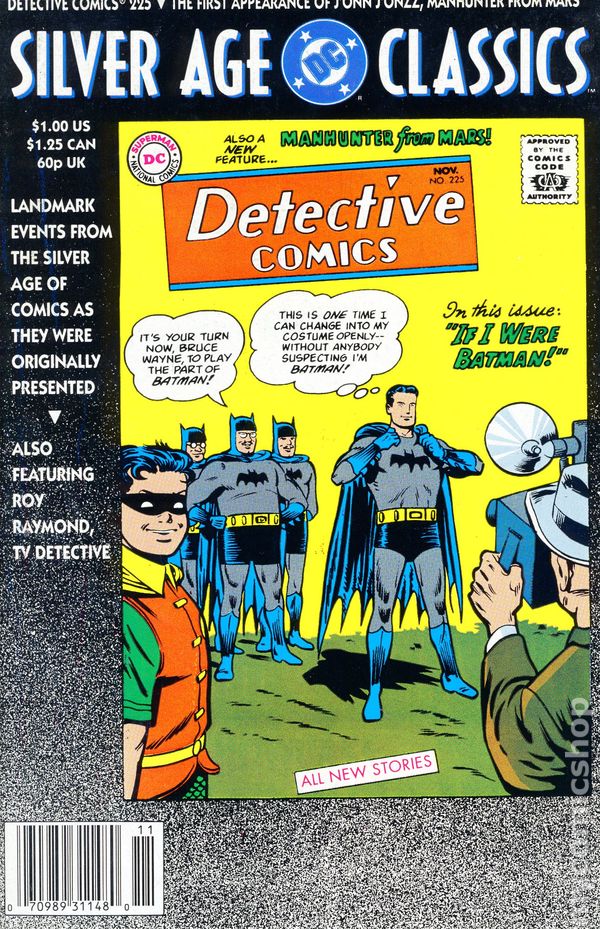
The cover story is a wacky Silver Age adventure concerning members of the public getting to be Batman for a day, which is one of those stories that made perfect sense at the time but would now require quite a bit more contextual justification.  The more relevant story from the issue is the debut of Martian Manhunter!  Although it might be funny to realize that he was probably intended to spend less time in his familiar green form and more in his human alter ego as, well detective John Jones.  Just imagine if he'd remained that way...!  The Silver Age Classics reprints were some of the first comics I ever owned, notably Showcase #22, the debut of Green Lantern Hal Jordan.


Detective Comics #567 (DC)
From 1986.
via comiXology
Harlan Ellison wrote this one (you, ah, might have been able to tell from the cover).  For some people, he's best known for the classic Star Trek episode "The City on the Edge of Forever."  In his Batman story, Batman keeps finding out he's not actually needed in any of the emergencies he comes across.  It would have made for a wacky Silver Age adventure, no doubt.


Batman: Gotham Knights #5 (DC)
From 2000.
via DC Wikia
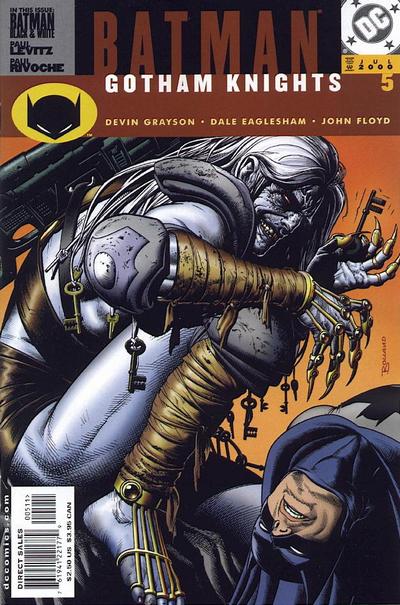
Devin K. Grayson, who sadly all but disappeared from comics nearly a decade ago, was at one time a leading writer of the Batman line, to the point where a whole series, Gotham Knights, was launched to give her a spotlight.  This issue features the Key, who had last appeared in the pages of Grant Morrison's JLA.  Here the depth of his psychoses are explored, a true villain who would be formidable indeed if only he could get out of his own way.  The art comes from Dale Eaglesham, whom I know better from the pages of Geoff Johns' Justice Society of America.  The idea behind Gotham Knights was to explore Batman in the context of his allies, and as such besides Robin there's Azrael in the story, although unfortunately the Azrael with his most terrible costume design.  I have no idea what they were thinking, the more desperate DC was to keep him relevant, they actually made it easier to dismiss him.  There's also a Batman: Black & White adventure from Paul Levitz featuring Commissioner Gordon.


Batman: Gotham Knights #21 (DC)
From 2001.
via DC Wikia
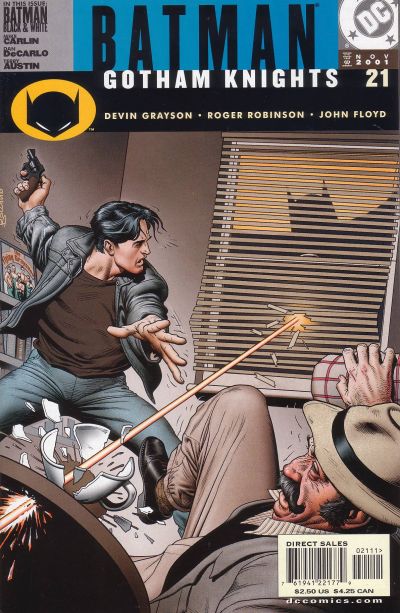
Here's Grayson again handling Dick Grayson, the character who became her true legacy, although much of what she did within the pages of Nightwing ended up being unpopular even though it followed directly in the footsteps of what Chuck Dixon had been doing before her, and both did some of the best work with the character I've read.  The story involves someone trying to convince Dick that he's got a whole secret history, but as it turns out it's just a lot of manipulation (reminding me of the Star Trek: Deep Space Nine episode "Second Skin").  The idea of Dick having an aspect of his past he hadn't known about was later explored again during the recent "Night of the Owls" event.  The art is from Roger Robinson, whom I usually find to be a far more pleasant presence than his general lack of reputation suggests, but he seems to have been working in a different style for the issue.  The Batman: Black & White feature this time is from Mike Carlin (better known as an editor), although it's done more or less in the Bruce Timm style as featured in Batman: The Animated Series.


Batman #625 (DC)
From 2004.
via DC Wikia
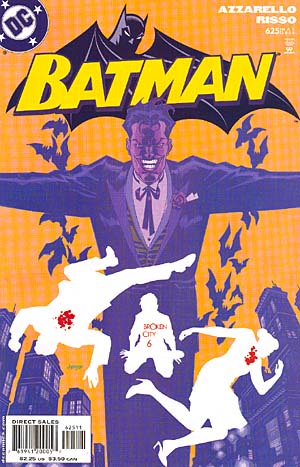
The conclusion to the "Broken City" arc from 100 Bullets team Brian Azzarello and Eduardo Risso reads like a preview of the Scott Snyder era, with a confrontation between Batman and the Joker that makes it clear just how obsessed with Batman the Joker really is.  There's also a tribute to Julius Schwartz, legendary editor, who had just died.


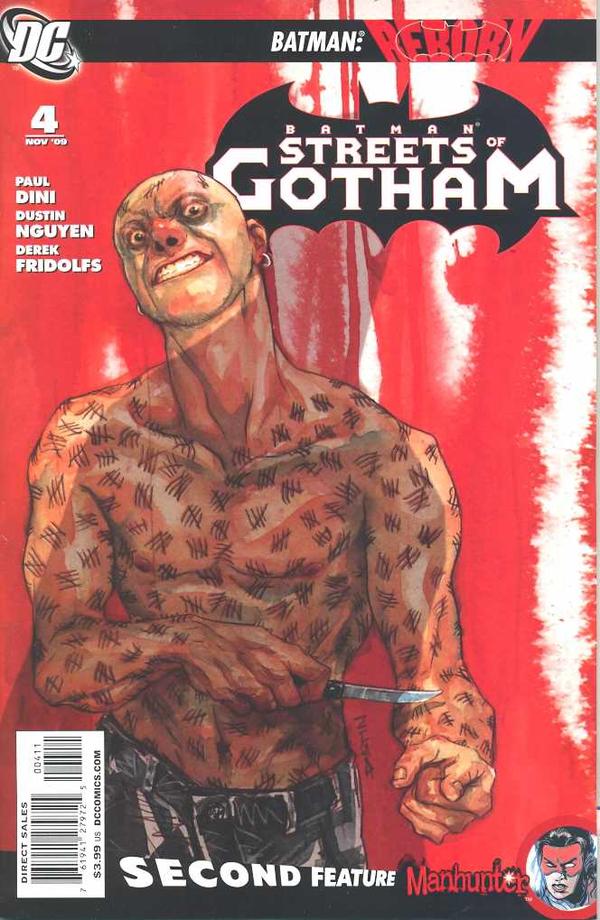
Batman: Streets of Gotham #4 (DC)
From 2009.
via DC Wikia
Streets of Gotham was Paul Dini's series, a highly underrated one that was better than the work he'd been doing in Detective Comics previously.  Dini is best known for his collaboration with Bruce Timm in Batman: The Animated Series.  Art for the issue is provided by Dustin Nguyen and Derek Fridolfs, who would keep the spirit of this initial collaboration alive within the delightful Li'l Gotham.  The villain is Mr. Zsasz, the psycho best known for cutting himself for every murder he commits.  This is also during Dini's Tommy Elliot arc, the underrated sequel material to "Hush," as he poses as Bruce Wayne.  Marc Andreyko's Manhunter is featured in the back-up.


Thursday, October 2, 2014

Reading Comics #135 "Batman and Family"

I've been meaning to say this, but I love Batman and Robin.  What's that?  I've said it before?  Can't hurt to say it again.

I love Batman and Robin!
via DC Comics.  That guy in the middle, by the way, is Batman
In #34, "Robin Rises" Part 2, Pete Tomasi and Patrick Gleason sort of swiftly undo whatever it is "Death of the Family" was supposed to accomplish, with Batman closing circle with Batgirl, Red Robin, and Red Hood and then later with Dick Grayson, who mentions this:

"You know how much Damian meant to me, Bruce..."
It's a subtle reminder that in the pages of a different Batman and Robin, Dick wore the cowl to Damian's Boy Wonder, an era that is more important to both characters than subsequent stories tended to acknowledge.  It's the sort of deft storytelling this series has constantly featured.

And then stuff like this, too, a quote from Shazam this time:

"See, Wonder Woman, I told ya I'd beat you here."
Tomasi has become near-impeachable in his grasp of the DC landscape, transforming the series into a phantasmagoria where the constant remains the Dark Knight, but everything around him can shift (hence the period where even the title wasn't constant) but always steeped deeply in old and current lore (which itself seems impossible for most other writers).  This is not a nostalgia ride.  This isn't just a series that provides commentary for things that happen elsewhere.  It's become a touchstone.  

And, of course, with "Robin Rises," where things are most definitely happening.  I keep saying that Batman and Robin is arguably the essential Batman series of the moment, even as it becomes increasingly timeless, a synthesis of everything it is and should be.
via IGN
In the Futures End one-shot, we receive an unexpected glimpse at a new Robin, a character introduced in Scott Snyder's "Zero Year" arc (everyone always assumed that it would be Harper Row, who instead has transformed, in the pages of Batman Eternal, into Bluebird), Duke Thomas, who like all Robins starts out as a boy impressed with Batman but who apparently was given a considerable gestation.  If Futures End at all leads to actual continuity, I hope Duke makes it.  Tons of story potential in an instant, unlike every other Robin with a built-in extended training period like Bruce Wayne himself.

The writer for the issue isn't Tomasi but rather Ray Fawkes.  I've previously wondered if Fawkes was ever going to impress me, so it was great to see that he did, and under the banner of Batman and Robin, which has come to represent true excellence for me, whether the writer is Tomasi or originator Grant Morrison.  Fawkes handles the storytelling deftly and seamlessly.  It certainly doesn't hurt that he has artists Dustin Nguyen and Derek Fridolfs (who've partnered before on material like Streets of Gotham and Li'l Gotham and have been begging to be given a shot at some major league material).  On the whole this trio accomplishes the impossible, matching Tomasi and Gleason as a perfect creative team for this series.

The story itself is also interesting, since it's Batman in hot pursuit of Heretic, the brute Morrison introduced as a henchman in "Batman R.I.P." but who gained far greater significance when he was revealed to be an altered clone of Damian in Batman Incorporated.  His appearance here hopefully certifies him as a standout villain in his own right, a sort of less sophisticated Bane (anyone who's actually tried that with Bane himself has only managed to neuter the character).