Showing posts with label Mike Costa. Show all posts

Saturday, April 11, 2020

Pandemic Comics #1 “A Fortuitous Midtown Order”

By sheer coincidence, just as the lockdowns were beginning, I had placed another order with Midtown Comics. A decade back I dug myself into a steep financial hole recklessly ordering comics every week through their website. Longtime readers of my blog (through its many names and locations) know I spent years putting together an annual listing of the fifty best comics I’d read. The Midtown addiction allowed me to expand it to a hundred one year. So it was a long time before I ordered from them again. The first time back it was to help complete my Stuart Immonen Superman collection (which was finally completed last year when I rectified one last oversight). Then last year I began an irregular comeback. This most recent order was deliberately patterned after the old days, when I’d comb the weekly release lists and see what looked interesting. In recent years my comics reading has been drastically limited. The only sequential reads I’ve done have been limited series. I gave up trying to catch Tom King’s Batman in every individual issue (though I’ve collected all the trades), even.

Well, anyway, these are, at the moment, not only some of the last new comics I personally have read, but that got to be released at all...

The Argus #1 (Action Lab)
I found the art to be kind of shoddy, but the familiar concept of time travel being filtered through a single person pulled from various points of his life is still a good one. Could absolutely be salvaged. Kirkman’s Walking Dead, after all, had a different tone and even different art at the beginning.

Billionaire Island #1 (Ahoy Comics)
The latest from Mark Russell is another biting satire skewering privilege. The end of the issue teases the badass who will help find some justice for victims who’ve been locked up. To be clear, involuntarily. Not because, y’know, of a pandemic.

Birthright #42 (Image)
Randomly checked in with the Josh Williamson epic fantasy. Would probably get more out of it with having read more than, oh, the first issue in an Image dollar reprint.

Daredevil #19 (Marvel) 
Checking back in with the excellent Chip Zdarsky run.

Doctor Tomorrow #1 (Valiant)
Valiant may have finally gotten a big screen adaptation (horribly timed though it turned out to be), but in the comics its boon period has officially ended. Would really love for another creative resurgence.

Far Sector #4 (DC’s Young Animal)
Another fine issue in this Green Lantern maxi-series. 

The Flash #123 (DC)
A facsimile edition of the famous “Flash of Two Worlds” issue, one of the truly legendary moments in superhero comics. It’s interesting to have finally read it. Just the recaps of Jay Garrick and Barry Allen’s origin stories, as they were told then, was interesting. 

Flash Forward #6 (DC)
The final issue of the mini-series saw Wally West take on a new destiny. Just had to read it.

The Flash #750 (DC)
One of several big anniversary comics DC was able to get in before all this happened (I was a little too soon for the Robin 80th anniversary celebration). Geoff Johns probably had the highlight. Real shame that Mark Waid seems to have totally rejected his DC past(s) at this point. Should have been a part of this.

Folklords #1 (Boom!)
This was a fourth printing or so (otherwise the series was up to its fourth issue, I think), another fine argument that Boom! may actually be the most consistently excellent alternative publisher of the past decade, still working with Matt Kindt, launching another excellent concept. It may have a lower profile than Image, Dark Horse, or IDW, but it’s consistently reinvented itself over the years and, hey, still boasts Grant Morrison’s Klaus on its release calendar, and is probably the only publisher that would do so.

King of Nowhere #1 (Boom!)
Here they are again. This one looks like it could’ve been published by Image, Dark Horse, or Vertigo, and that’s not something you can say for just any publisher. Was worth a look.

The Last God #5 (DC Black Label)
The shuttering of the Vertigo imprint didn’t mean its aesthetic was dead. This is clearly DC’s biggest bid for old school Vertigo in years. But ended up not being my cup of tea. High fantasy, as it turns out.

Omni #5 (H1)
Pretty annoyed that Devin K. Grayson, who launched the series, was still listed as a creator when, as of this issue, she’s not really an active member of the creative team anymore. Kind of felt like a bait-and-switch.

Plunge #1 (DC/Hill House)
The end of the Vertigo imprint came at the same time as an incredible flowering of new DC imprints, from the Sandman family to the Bendis line, and now Hill House, from Joe Hill (Stephen Kong’s kid). But what brought me here was the Stuart Immonen art. Immonen has once again elevated his game. After he went over to Marvel I thought he was allowing himself to lose what made him distinctive, but it led to, well, this. I love his Superman, always will, as it was, but of course, now I’d love to see him return, with this more detailed approach.

Skulldigger + Skeleton Boy #3 (Dark Horse)
The best thing Dark Horse has done post-Mind MGMT has been Jeff Lemire’s Black Hammer universe. At some point I want to read all of it. This latest installment is basically its Dark Knight Returns.

Stealth #1 (Image)
By far the best surprise in scanning through the releases was discovering Mike Costa had a new series. Costa is an all-time favorite thanks to his G.I. Joe/Cobra comics. In recent years he’s had a small resurgence at Marvel, so it’s nice to see him getting another crack, even if once again it’s someone else’s concept, in this instance Robert Kirkman’s. But, as Costa explains in a postscript, he’s more than capable of internalizing the idea. And he executes it perfectly.

Strange Adventures #1 (DC Black Label)
The latest from Tom King, starring Adam Strange, in Mister Miracle mode with Mitch Gerads and “Doc” Shaner. Love love love that Mister Terrific pops up at the end of the issue. Might be the breakthrough Michael Holt’s been waiting twenty years for...

Wolverine Through the Years (Marvel)
This was a freebie promo for the new ongoing series (which I decided to skip). There’s a code in it that I unscrambled: “Who is the Pale Girl?” Hopefully someone interesting!

Wonder Woman #750 (DC)
Could’ve read this for free at the library, but the pandemic shut those things down before I could get around to it. Ironically still open when I ordered this. Historically speaking, the first time Wonder Woman topped the sales chart. Also the soft launch for DC’s G5.

Friday, September 2, 2016

Quarter Bin 88 "Marvel's All New, All Different"

Back issues of the recent past this edition: All-New All-Different Avengers #1, the Uncanny Inhumans #2, Agents of S.H.I.E.L.D. #1, Secret Wars #5, Secret Wars Too, Spider-Woman #1, Star Wars: Darth Vader #11, and Web-Warriors #2.

All-New All-Different Avengers #1 (Marvel)
From January 2016.
The Alex Ross cover doesn't exactly scream the same "youth" as the lineup and interior of this revamped team, featuring characters from the Ms. Marvel generation.  Written by Mark Waid and drawn by Adam Kubert (the brother who worked on Action Comics with Geoff Johns, not the one who worked on Batman with Grant Morrison), this is exactly an updated version of the kind of stuff Marvel has been doing since the '60s, and hey, it seems to be working quite well for them, right? 

The Uncanny Inhumans #2 (Marvel)
From January 2016.
With the heavy role the Inhumans are playing lately, not just in Civil War II but generally speaking (Marvel is kind of desperate for them to replace the X-Men, whose movies are not currently controlled by Dr. Disney), it was kind of crucial for the comics to be good.  I knew Charles Soule had it in him, and Steve McNiven has been a heavy-hitter (collaborations with Mark Millar on the first Civil War and the original "Old Man Logan," for instance) for years, so creatively, I have nothing to complain about.  The comic is good, too, with Black Bolt falling out with his lady Medusa, and their son Ahura falling under the influence of Kang, an arc that accelerates giddily throughout this issue.  I have plenty of evidence that Soule knows how to write great comics (his Secret Wars version of Civil War, for instance, in case you thought I'd referenced that title for the last time), so it's good to see that he started out well here, too.

Agents of S.H.I.E.L.D. #1 (Marvel)
From March 2016.
This is stuff adapted from the TV series, which I've never particularly made a habit of watching (I'm a Flash guy, with some real effort toward DC's Legends of Tomorrow tossed in), but I knew Agent Coulson had a flying car he calls Lola.  Apparently he named it in honor of his ex-wife.

Secret Wars #5 (Marvel)
From October 2015.
As A DC guy, I tend to be amused at the way fans and creators alike treat Dr. Doom like a god.  I just never understood it.  In this entry of Jonathan Hickman's ultimate Fantastic Four (sendoff) saga, Doom literally has become a god, and the entire issue is just kind of Doom complaining about it with a lackey, because he recently offed Dr. Strange and no longer feels challenged.  You know what?  I'm not even going to talk about this issue.  Let's just move on, because Hickman's got better material in:

Secret Wars, Too (Marvel)
From January 2016.
This is literally Hickman and Marvel joking around about the whole Secret Wars concept.  Marvel has gotten to the point where it either publishes straight-out humor titles, titles obviously inspired by successful movies, or the handful of serious stuff it allows itself to do, so it's not at all surprising that something like Hickman literally laughing about his apparent inability to finish his story happens in something Marvel itself published.  Marvel has become the House Wizard Created.  All throughout the '90s, Wizard was a massive Marvel fan service, and introduced the cartoony approach to fandom that has since gone mainstream.  Hickman's piece is brilliant, in which he imagines a conversation with Dr. Doom about what the conclusion should be.  Then there's some middling stuff that's just kind of there, and then indy creators Rob Guillory (Chew) and Eric Powell (The Goon) provide some of their trademark wit.  I actually have to give Marvel props for releasing this.  In another era, this would've been a jump-the-shark moment, but this one's all about that kind of irreverence.

Spider-Woman #1 (Marvel)
From January 2016.
This one's famously the cover advance solicits spoiled as feature the pregnant Jessica Drew.  Dennis Hopeless somewhat hopefully assumes readers would be familiar with Spider-Woman's somewhat odd supporting cast (the guy who's dressed up as a porcupine), so he spends the entire issue presenting the awkward situation of superhero being unable to superhero while pregnant.  It's bold in an era where it's kind of anathema to be pregnant (or something) to have a pregnant superhero, but one wonders if this latest calculated move to corner every market didn't miscalculate.

Star Wars: Darth Vader #11 (Marvel)
From December 2015.
Kieron Gillen normally gets pretty high marks from fans, but he apparently is somewhat uninterested in featuring Darth Vader as the lead of his own comic...

Web-Warriors #2 (Marvel)
From February 2016.
This series was recently cancelled, and Mike Costa announced to be moving on with a new Venom series, which I think will be right up his alley.  I've been a vocal of supporter of Costa for years, and long for the day he'll be a major player at the Big Two (I can't believe he's gotten less than the Greg Rucka treatment).  It may be that he simply finds it hard to use his Cobra style outside of his IDW work.  Not in this issue, though.  This one reads like a straight-up Web-Warriors edition of Cobra, detailing Electro's romp through the Spider-Verse, with Spider-Gwen (this is what Marvel thinks of as witty) filling in for the good guy Costa frequently traps in his webs (phrasing it that way totally helps make sense of Marvel thinking of him as a Spider-Man guy).  Maybe I'm just as guilty as anyone else in not giving Costa's non-Cobra work a fair shot, but it's always nice to come across work that rings so true to what I know best, because Costa's best is among the all-time best.

Thursday, August 4, 2016

Quarter Bin 87 "Back to Automatic Kafka, and more from recent back issues blitzes"

Automatic Kafka #3, 4, 5, 9 (WildStorm)
From November & December 2002, January and July 2003
Joe Casey's comic caught my eye in previous rummaging through back issue bins, so I figured I'd read more of it.  Thankfully, #9 is the final issue and adequately explains what the hell he was doing with the rest of it.  Basically this was a post-modern superhero comic, in the tradition of Wasteland and Grant Morrison's Animal Man (Casey liberally appears in the final issue, speaking directly to Kaf and the reader), from the more cynical perspective of early millennium superhero comics, which had been turned on their head by stuff like The Authority, which would give birth to The Ultimates and somewhat strangely, the Marvel movies we all enjoy now, which are on the whole far less concerned with taking superheroes seriously than the comics that spawned them.  It's classic satire, the Kafkaesque version, if you will, of Loeb & Sale's formative collaboration in The Challengers of the Unknown Must Die!, a previous big find in the back issue bins recorded in previous editions of this column.

Black Magick #1 (Image)
From October 2015
Greg Rucka and Nicola Scott are past and present Wonder Woman creators.  Their pasts previously aligned in this series about a magic practitioner who's also a cop, which is kind of luck summarizing and simplifying Charmed.  Figured I'd finally have a look.

Blackhawks #2, 3, 4 (DC)
From December 2011, January & February 2012
As a huge Mike Costa fan...when he's writing his brilliant G.I. Joe/Cobra stories over at IDW, I always like to check in on his other stuff.  When the New 52 was announced, I was automatically intrigued at his Blackhawks, but then financial restraints got in the way and I was only able to check back in well after the fact.  This is the second such time I've read some of it, and I'm far more impressed now than the last time.  The big beef I had the last time was that I didn't really get the Mike Costa feel, that in having to create a whole team right off the bat, he didn't have the chance to dazzle with an intense single-character drama, like he did at IDW.  Well, I stand corrected, and even more curiously, the passage of time and further comics experience informs me that his Blackhawks reads like a preview of Valiant's current Bloodshot comics.  So I will definitely make a better effort at reading the complete short-lived run in the future.

Cairo sneak preview (Vertigo)
This graphic novel was G. Willow Wilson's comics debut, originally released in November 2007.  I later became hugely enamored with Wilson through Air, while other readers made her Ms. Marvel a leading member of Marvel's new generation.  I've always wanted to read Cairo (which is also Wilson's first collaboration with Air artist M.K. Perker), and so this teaser is a pretty good start.

Global Frequency #12 (WildStorm)
From August 2004
Thanks to Transmetropolitan and later works (such as the aforementioned Authority), Warren Ellis became known as one of the most progressive writers in comics (I dubbed his Supreme: Blue Rose as a landmark work).  Global Frequency was one of the several projects from the same general period that helped solidify his reputation.  At least in this final issue, it's a terrifying vision of government population measures.  I think I've read it before.  Didn't hurt to read it again.

Hitchhiker's Guide to the Galaxy Book 1 (DC)
From 1993
I've long wanted to have a look at DC's adaptation of Douglas Adams' classic story of Arthur Dent's terrifying vision of government population measures (heh).  For now, I'll have to settle with this first installment, featuring very, very '90s art.  No, not the Image kind.  What everyone else had when all the Image artists went to Image, or were employed in Marvel and DC books desperately trying to look like Image books.  If that helps.

Inferno #2 (DC)
From November 1997
I've read the complete mini-series before, but I wanted to have another look (those issues were lost in one of the purges).  This was Stuart Immonen's writer/artist tryout, I think, for DC, before he was allowed to assume the same responsibilities in his Superman comics.  His Inferno is a good reminder that there's a whole set of young readers who read comics because they identify with the human qualities these characters can exhibit, not the desperate attempts to be cool that some companies began to think were necessary to find them.  It's yet another example of the timelessness of Immonen's work, and why it's sad he's never really gotten another chance since that time to explore this side of comics.

Nova #3 (Marvel)
From March 2016
Ah...bad timing, Nova.  Because this latest incarnation of the Jeph Loeb vision for the character is the opposite everything I just talked about...

Our Love is Real (Image)
With his sensational work in Green Lanterns recently, I've gotten more aware of the name Sam Humphries, so when I saw this one-shot, I figured I really should have a look.  It's kind of a shameless parody of sexual diversity, and the artist draw sideburns like Howard Chaykin.  That's all I'll say about that!

Resistance #6 (WildStorm)
From July 2009
Here's Mike Costa again, doing another military comic, only this time it's based on a video game.  But it's excellent Costa material all the same.

Starman #6 (DC)
From January 1989
The Will Payton Starman, like the rest of them, popped up in James Robinson's later Starman series.  Here will is very much at the start of his career, and in the thick of the "Invasion" crossover arc, and contending with the Power Elite  But more on superhero Elites in a moment...

Action Comics #775 (DC)
From March 2001
The introduction of Manchester Black was one of those legendary events from early millennium Superman comics, and I always wanted to catch up with it.  Here was a character meant to help explain what makes Superman continually relevant, because he reflects all the violent tendencies that had been cropping up since the likes of Alan Moore and Frank Miller complicated such things.  This was a whole era in Superman comics dedicated to making him cool again, which really wouldn't work until Superman/Batman (somewhat ironically).  At the end of this issue, Joe Kelly makes him looks like he's stooped to Black's level, but then cleverly explains how he didn't, while still making Superman look pretty badass.  Black's Elites, who starred in a twelve-issue Justice League Elite, were another response to Ellis's work.

Superman: Last Son of Krypton FCBD
From 2013
This is the first issue in the Geoff Johns/Richard Donner run, that reads as well now as it did when originally published. 

We Stand on Guard #4 (Image)
From October 2015
Brian K. Vaughan is one of the guys who formed his reputation in the years following Ellis's dominance in the progressive movement, and in recent years he's been doing some even edgier stuff.  We Stand on Guard is a curious little thing, in that it tackles America's current reputation from the perspective of a future war with Canada.  It totally makes sense if you ignore the fact that Canada and the United States have generally been okay with each other since the unfortunate business of the war of 1812 and the business of trying to add Canada to the rest of America...

Ultimate X-Men #7 (Marvel)
From August 2001
Mark Millar explores the Ultimate version of Weapon X.  Predictably edgy outlook.

Friday, April 15, 2016

Reading Comics 184 "Darkseid War, Superman: America Alien, Omega Men, Web-Warriors"

Justice League #47, 48, Special #1 (DC)
Okay, so the word ought to be ought by this point that Justice League #50 will finally give a definitive answer as to who is the Joker.  Because that's going to happen.  So I dove back into Darkseid War.  The original plan was to eventually read the whole thing in trade collection, because this is one of the biggest stories Geoff Johns has ever done (which is saying something), building on just about everything he's done in this series, including Forever Evil, and arguably telling a definitive New Gods tale in the process.  With various members having taken over various New Gods facets in the wake of Darkseid's death, they come to the realization that the Crime Syndicate (as Lex Luthor realized immediately) will probably have to play a role in this, and by the end have actually decided to team up with their doppelgangers.  (It's worth noting that the animated Justice League: Crisis on Two Earths is actually pretty good.)  In the Special, Johns gets to write a Jessica Cruz (Power Ring) tale, more or less riffing on what he's already done in the series proper, but still fun for fans of his Green Lantern to see (it's also worth noting that his two creations, Cruz and Simon Baz, finally helm their first ongoing series, thanks to the upcoming Rebirth era, in Green Lanterns).  But more importantly, and also slightly riffing on earlier material, Special also puts the spotlight on Grail, and as such is another essential issue for those who realized that Johns has been using Justice League as his first run with Wonder Woman.  And may he have another...

Omega Men #3 (DC)
And thusly now do I have physical copies for all extant issues of this series.  In this one, Tom King explores Princess Kalista's motivations, which at the time seemed all the more crucial because she had the most immediate relationship with Kyle Rayner, and this was the first time the series delved into a team member's back story, but certainly not the last.  The William James quote?  "The 'sentimental fallacy' is to shed tears over abstract justice and generosity, beauty, etc., and never to know these qualities when you meet them in the street, because the circumstances make them vulgar."  Again, I love these quotes in the series.  Clearly Kalista was used to win Kyle over, because she's a romantic figure, enough to make him begin to care, when the rampant chaos of the Vega System itself was never enough.  I hope comics fans eventually come around and realize how significant King's work in this series really is...

Web-Warriors #5 (Marvel)
I had to read at least one issue of this series, right?  It's a de facto continuation of Mike Costa's work from the Secret Wars Spider-verse mini-series, which is to say, more with all those Spider-Man variations running amok together.  What strikes me, in reading this, is that Costa is completely at home in this chaos. I guess it took a while for me to reconcile this version of his writing with the more sober work I know best, but if it gets him more fans and maybe even regular work, then I can support that.  Maybe not read it regularly myself, but clearly there are readers for this sort of thing, so I can't complain.  Happy for the guy...

Superman: American Alien #2, 4, 5 (DC)
I read the first issue digitally, and I was impressed with this latest variation on Superman's origins.  Every issue spotlights a different period of Clark Kent's formative development.  The second issue, for instance, features Max Landis' take on the period featured in Smallville, the teenage Clark figuring out what to do with his powers.  Each issue features a different artist.  This one has Tommy Lee Edwards, in a style you'd not typically associate with Superman, more like Ed Brubaker's crime comics, say.  The fourth issue features budding journalism, with Clark, and Lois, covering the media coverage of emerging moguls Oliver Queen (post-island), Lex Luthor, and the elusive Bruce Wayne (who was previously featured in the third issue).  This is my favorite issue so far, and not just because of the typically lush Jae Lee art.  Here's a quote from Luthor:

"There's a fatalism that's been going around, and I think it's toxic -- self-fulfilling.  I think fatalism is hip and pragmatism has gotten boring.  I think dark futures are paradoxically easier to see than bright ones.  Everyone talks about the problems of tomorrow, the apocalypse of next week, but whatever happened to the man of tomorrow?  Why are we so convinced there aren't those among us who could maybe solve these problems that seem so insurmountable to the pseudo-intellectuals who pose them? We scared to even talk about a hopeful future, because we're terrified it won't come to light."

Anyway, Landis has some big, brainy thoughts in mind, perfectly in-character, too, and his work speaks to the enduring strength of revisiting familiar stories, no matter how familiar we think they are, or how familiar we think we are with the players.  Young Luthor is always as fascinating as Mature Luthor, and in the hands of someone like Landis, Young Clark is arguably more fascinating than his mature counterpart.  His first encounter with Batman, in this version, inspires him to become Superman.  And so the fifth issue is all about his first, unsure attempt at being a superhero, like the Landis version of Frank Miller's famous Batman: Year One.  And it's fantastic.  The whole Blur thing from Smallville always seemed half-considered to me, a placeholder.  As depicted by Francis Manapul, in arguably his best work to date, the Landis version seems like it always existed.  Well, now it always will...

Monday, August 31, 2015

Countdown to QB50 2015: August

18 Days #2 (Graphic India)

  • Notable creators: Grant Morrison (writer)
  • This second issue jumps into the narrative of the superwar and features a show of respect from the good guys to the bad guys, some of whom turn out to be pretty okay, too.
  • Definitely a welcome issue for the project.
ARCHIE #1 (Archie)
  • Notable creators: Mark Waid (writer), Fiona Staples (artist)
  • I saw that my local shop had it available, so I decided to have a look at this Archie reboot.  The second issue was available at the time.  In hindsight I probably should have just gotten both.
  • Waid continues to look better than I've seen in him in years, after this and Strange Fruit.
  • Staples (Saga) somehow manages to charm without all the gross-out elements.  Imagine that!
BATMAN #43 (DC)
  • Notable creators: Scott Snyder (writer)
  • Commissioner Batman (I had another name the last time I talked about it, but I think I like this one better) continues.
  • In much more interesting news, Superman stops by, and Alfred discusses how Bruce Wayne came back, and the unlikelihood, at this point, of resuming the crusade.
  • Pivotal issue.  Has nothing much to do with Commissioner Batman.
ROBIN: SON OF BATMAN #3 (DC)
  • Notable creators: Patrick Gleason (writer/artist)
  • Damian's girlfriend, Nobody's daughter Maya, continues to prove to be excellent company for the errant Boy Wonder.
  • Talia returns from the dead.
  • Deathstroke shows up.
  • Seriously, could this series be any better?
BLOODSHOT REBORN #5 (Valiant)
  • Notable creators: Jeff Lemire (writer)
  • Bloodsquirt, Bloodshot's irritating figment of nanite imagination, surprisingly does an excellent job of moving the story along.
  • Like Wolverine before him, Bloodshot has a mysterious past.  This issue he allows someone to read the file that explains who he used to be.  Decides he doesn't want to know what it says.
  • Marvel never did figure out how to make Wolverine's past life as interesting as his post-Weapon X days.  This is probably a good decision.
CIVIL WAR #2, 3 (Marvel)
  • Notable creators: Charles Soule (writer), Leinil Francis Yu (artist)
  • I stand by the assertion I made previously that out of all the Secret Wars spin-offs/extensions of past arcs, Soule's Civil War is arguably the most significant.
  • Yes, the war continued.  No Captain America did not end up assassinated.  Yes, Spider-Man still has problems stemming from his decisions.  Infiltration is the name of the game on both sides,  
  • Then we discover a true game-changer, the presence of a character who did not previously make a Civil War impact: Black Panther.
Between Civil War and Star Wars: Lando, Soule was one of the August standouts, easily.  That was four solid issues from both series for Soule.  I used to dread his Marvel contract.  Now I am really, really happy.  He's doing excellent, relevant, subtle work with both series, and as far as I'm concerned significantly raised his profile.  He's poised to become a major force.

DARK HORSE PRESENTS #13 (Dark Horse)
  • Notable creators: Jerry Ordway (artist), Craig Rousseau (artist)
  • This anthology title offers a number of stories, including the start of a new chapter in Ordway and Alex de Campi's Semiautomagic.
  • My main interest, however, was for Rousseau and Rick Woodall's Kyrra: Alien Jungle Girl, which I got to see in print for the first time, after discovering it digitally from comiXology.
DESCENDER #6 (Image)
  • Notable creators: Jeff Lemire (writer)
  • Hey, there he is again!  Lemire, along with Charles Soule and Paul Cornell, was a welcome repeat creator.
  • Dr. Quon's full story is detailed, as we discover more about Descender itself while he relates exactly how he stole the awesome breakthroughs in robotics that made his name (and cost him an arm).  
  • And we meet another Tim!
DIRK GENTLY'S HOLISTIC DETECTIVE AGENCY #3 (IDW)
  • Notable creators: Chris Ryall (writer)
  • Dirk begins to make actual progress in his investigation.
  • (Somehow.)
DOCTOR WHO: FOUR DOCTORS #1, 2, 3 (Titan)
  • Notable creators: Paul Cornell (writer)
  • The four Doctors in question are David Tennant (Tenth Doctor), Matt Smith (Eleventh Doctor) and Peter Capaldi (Twelfth Doctor). 
  • Wait, did I say four?  The fourth is John Hurt (War Doctor).
  • There are also a bunch of companions running around.  Fans will probably be able to identify them a lot better than I can.
  • Even for someone who doesn't have too much experience with the Doctor(s), this is a fun read.
EARTH 2: SOCIETY #3 (DC)
  • Notable creators: Daniel H. Wilson (writer)
  • Evil mastermind (and one-time Mr. Terrific) Terry Sloan is assassinated!
  • Prime suspect: Superman!
  • (The other one.)
FABLES #150/FABLES VOL. 22: FAREWELL (Vertigo)
  • Notable creators: Bill Willingham (writer)
  • The final issue comes in the form of a collection, with the kind of ending Peter Jackson gave his Lord of the Rings.
  • As in, a lot of epilogues.
  • A little hard for someone who didn't actually, y'know, read the series to fully appreciate, but it's also a heck of a novelty.
  • I like novelties.

THE FUSE #13 (Image)
  • Notable creators: Antony Johnston (writer), Justin Greenwood (artist)
  • The series returns from hiatus for its "Perihelion" arc.
  • "Perihelion" means the space station is at its closest to the sun.
  • Which means everyone gets crazier than usual.
  • Which means plenty of crime for Klem and Marlene to investigate.  Yay!
GRAYSON #10 (DC)
  • Notable creators: Tim Seeley (writer), Tom King (writer)
  • Guest-stars Lex Luthor, erstwhile member of the Justice League and, oh, the guy who killed Dick Grayson during Forever Evil, which is the event that led to this innovative relaunch.
  • Yeah, even if I've failed to read this series regularly, there's no chance I was going to miss that.
JUSTICE LEAGUE #43 (DC)
  • Notable creators: Geoff Johns (writer)
  • "Darkseid War" continues!
  • The Mobius Chair won't tell Batman who the Anti-Monitor is.  The reader knows Anti-Monitor is Mobius.  
  • Superman and Lex Luthor have some nice quality time together.
  • Up next?  Darkseid versus Anti-Monitor!
JUSTICE LEAGUE: GODS AND MONSTERS: WONDER WOMAN, 1, 3 (DC)
  • Notable creators: J.M. DeMatteis (writer), Bruce Timm (writer)
  • To be clear, what I read here was the Wonder Woman one-shot, plus the first and third issues of the Gods and Monsters event itself.  
  • Wonder Woman emerges as the most likable of the alternate Big Three, and hailing from Jack Kirby's New Gods.
  • This could be seen as Timm's version of the complicated Man of Steel reality where Superman isn't automatically accepted as a bright shining superhero.  


MIND MGMT #36/NEW MGMT #1 (Dark Horse)
  • Notable creators: Matt Kindt (writer/artist)
  • This coda to the MIND MGMT saga reads like a blueprint to how to avoid the huge mess the series unraveled.
  • And its lingering effects.
  • With a big happy, completely unambiguous ending!
MS. MARVEL #17 (Marvel)
  • Notable creators: G. Willow Wilson (writer)
  • Ms. Marvel meets Captain Marvel!
  • Not quite as awesome as the Wolverine team-up.
  • (Would that even be possible?)
PREZ #3 (DC)
  • Notable creators: Mark Russell (writer), Ben Caldwell
  • Corndog Girl begins building her presidential cabinet!
  • The blogger reaction to Prez I've read has been considerably less enthusiastic than mine has been.
  • For me, this thing is an instant classic, a portrait of our current political cynicism in a satire of what it could lead to.
SPIDER-VERSE #4 (Marvel)
  • Notable creators: Mike Costa (writer)
  • Peter Parker and Gwen Stacy, together again at last!
  • Sort of!
STAR TREK/GREEN LANTERN #2 (IDW)
  • Notable creators: Mike Johnson (writer)
  • Again, what could be a horrible gimmick continues to show considerable restraint.
  • Uhura (Star Sapphire; best quote of the issue: "Spock!  I need your help, not your analysis!)), Chekov (Blue Lantern), Gorn warrior (Red Lantern), Chang (Sinestro Corps), Romulan politican (Orange Lantern), and Bones (Indigo Tribe) are all inspired crossover choices.  
  • Sinestro shows up on the last page.  
  • Larfleeze is featured on the cover next issue.
  • Seriously.  Good fun!
STAR WARS #8 (Marvel)
  • Notable creators: Jason Aaron (writer), Stuart Immonen (artist)
  • Seriously, Immonen begins art duties on Star Wars, and you thought I wouldn't be there?
  • The big story in this Marvel series is the appearance of Sana Solo, the apparent wife of Han Solo.
  • Guess who vigorously denies that throughout this issue?
  • Immonen is a perfect fit, by the way.
STAR WARS: LANDO #2, 3 (Marvel)
  • Notable creators: Charles Soule (writer), Alex Maleev (artist)
  • By the second issue, we may know why Lobot is considerably less animated in The Empire Strikes Back than Soule presents him here.
  • The Emperor's Imperial Guard (the dudes in read) in action!
  • Chanath Cha continues his efforts to prove he's as awesome a bounty hunter as Boba Fett.
  • Lando discovers what the reader already knows: that Palpatine is steeped in Sith lore.
SUPERMAN #43 (DC)
  • Notable creators: Gene Luen Yang (writer), John Romita, Jr. (artist)
  • This is it!  Lois Lane reveals Superman's secret identity to the world!
  • She does it so that Hordr can no longer bribe Superman.
  • It's a big, big moment, obviously.
  • In this continuity, it makes perfect sense.
  • Yang even makes a connection to Grant Morrison's Action Comics run.
  • Where, you'll remember, Superman himself briefly "killed" Clark Kent.
  • Probably will be endlessly debated.  But we already had a tidy wedding in previous continuity.  In this one, there are fewer certainties.  This is a good thing.  Allows the mythos to breathe.
THIS DAMNED BAND #1 (Dark Horse)
  • Notable creators: Paul Cornell (writer)
  • Seeing this listed in Previews originally, I didn't know how much I should be interested in it.  Besides Cornell...?
  • But it reminds me that I have a considerable history at this point reading comics that involve rock n' roll: Night Trippers, the Brian Wilson issue of Hawkeye, Mysterious Strangers, Comeback, even a Prince comic...
  • So this is kind of...destiny.
Cornell, meanwhile, more than earns being in the spotlight, between This Damned Band and Doctor Who: Four Doctors.  And I'm happy to see so much material from him.  From Captain Britain to Knight & Squire to Saucer Country to his Lex Luthor arc in Action Comics and even Demon Knights, Cornell carved out a considerable legacy for himself, and I always hoped he'd take his rightful place within the comics elite.  But wide success always eluded him, and he became the opposite of the famed British Invasion, in that he went back home.  Went all British.  Returned to one of his true loves, the very British but expanding Doctor Who.  I'm glad I've now had the opportunity to experience Cornell's Doctor interest first-hand, and to find something new from him, too.  Welcome back!

THE UNWRITTEN: APOCALYPSE #12 (Vertigo)
  • Notable creators: Mike Carey (writer)
  • I finally had the chance to read the conclusion to Carey's Unwritten saga.
  • To my mind, much more satisfying than Fables'.
  • Fables, in part, by the way, circled around to an allusion to Harry Potter.
  • Unwritten, meanwhile, was perhaps the most clever Harry allusion anyone's yet produced.
Four more months left in the year.  Miller and Azarello will be launching The Dark Knight III in November.  Gaiman's Sandman: Overture is ending.  Morrison is launching Klaus.  And I'm sure there are plenty of highlights yet remaining.  This has been a pretty good year.

Friday, July 10, 2015

Reading Comics 168 "7/8/15 - One of the Best Weeks of the Year"

Covered this edition: Batman #42, Bloodshot Reborn #4, Civil War #1, Descender #5, Dirk Gently's Holistic Detective Agency #2, Earth 2: Society #2, Providence #2, Saga #30, Spider-Verse #3, Star Trek/Green Lantern #1, Star Wars: Lando #1, and Strange Fruit #1.

To say last week was disappointing for a comic book addict like me would be an understatement.  This is not to say that there nothing worth reading, but nothing that interested me, nothing from my pull list and, well, nothing else that I wanted to read.

So this week was an embarrassment of riches.  Very good (or very bad) for a comics addict.  I ended up reading a bunch of stuff I hadn't read previously, or continuing to read stuff that I don't typically read, or enjoyed a bunch of new stuff, and of course a bunch of stuff I've been reading all along.

Kicking off is Batman #42 (DC), the second issue of the Bat Gordon era.  Visually the costume in full armor still looks and will always look ridiculous, and Gordon's military haircut looks ridiculous, but...this is still the best Batman Snyder has ever written.  It's the first time he's allowed himself full control, and it shows.  The fact that astute readers knew Bruce Wayne was never dead, and Snyder has shown every willingness to play along, keeping him in every issue "post-death," including the issue with "his death" after "his death," this is what I've been waiting for.  This is an exercise in patience.  Obviously this is an exception, and if it hadn't been hugely popular from the start, DC would never have stuck around this long.  But thankfully this is an instance where popularity eventually gives way to material justifying the hype.  I don't know how popular this material will be, in the short- or long-term, but I have to imagine, however much longer Snyder sticks around, he will be back to writing Bruce Wayne as Batman, and will be the better for having this experience under his belt.

It's also clear that the villain concept was in part an excuse for Capullo to do a version of Clayface after discovering how well he does it visually in Batman #20 (excellent cover).  I would have maybe capitalized on the horn concept and named the villain Horn (although I guess there are other members of the gang, so there's always a chance, right?).

Bloodshot Reborn #4 (Valiant), meanwhile, is something I picked up because I just read The Valiant, and thought it was pretty brilliant, and because of the timing, which was even better than I thought, I realized this series existed and I should probably start reading it.  It's the first of two Jeff Lemire comics from this week (just as there are two from Charles Soule), and both are winners (just like Soule's).  Bloodshot, as I've explained elsewhere, is a kind of Wolverine, and in this iteration without any of the baggage and written in the full knowledge that it's perhaps is best to just concentrate on what makes him interesting, which is his background and how it continues to impact him.  In The Valiant, Bloodshot lost his powers, and so Reborn is the journey of getting them back.  In this instance, picking up the narrative four issues in (I wanted to try and catch up with whatever was available, but when that meant the latest issue as it was released and only one other plus a few of the preceding series, I opted just for this one) proved no problem at all.  Whatever else has been done in Reborn to date, this issue captures the journey perfectly, exactly as I hoped it'd be from The Valiant.

And even with surprises, such as Bloodsquirt.  Kind of like Bloodshot's Bat-Mite, Bloodsquirt is part of the hallucinations Bloodshot is experiencing as he tries to deal with his situation (the other person he sees is the woman responsible for taking away his powers, but in this scenario, unlike House of M's Scarlet Witch, the late Geomancer was a good guy who was very much Bloodshot's friend, which is why she did what she did, right before she died).  The nanites, meanwhile, that previously gave Bloodshot his powers have been infecting other people, and he's able to absorb them back when he finds these people.  Anyway, the whole thing is pretty fascinating, and executed perfectly.  I'm once again glad that Valiant exists, and that I've found my way in.

 Civil War #1 (Marvel) is one of the many, many Secret Wars spin-offs featuring past notable Marvel stories, whether standalone events or arcs within a given series.  Civil War ought to be polarizing.  Originally, it concluded with Captain America's assassination, but in this version that never happened, and things degenerated to a certain extent as the "Old Man Logan" arc did in Wolverine (which has become another Secret Wars spin-off, not to mention one of the titles announced as becoming an ongoing once Secret Wars ends, and Hugh Jackman's vision for his last performance as Wolverine).

This is written by Charles Soule.  When his exclusive contract with Marvel was originally announced, I conceived of it as a nightmare scenario, not because I had enjoyed his DC work so much, but because I feared Marvel wouldn't know what to do with him.  But as it turns out, that wasn't really the case at all.  If anything, he might be perfectly suited at Marvel, where he can use his best instincts to bring out Marvel's best instincts.  This is in fact a best case scenario.  At DC he was for the most part marginalized.  At Marvel he has the opportunity to become the company's next signature writer, succeeding Brian Michael Bendis and Jonathan Hickman.  I would be very happy to see that happen.

Civil War, then, is a kind of audition.  I mean, arguably all of these Secret Wars spin-offs are auditions, either for talent or for the continuing viability of old concepts.  In that, Marvel again has an edge over DC.  With Convergence, DC was letting fans know once again (and I do mean once again) that it hasn't forgotten its own history, but it was never going to revive anything.  DC is always looking forward, aggressively, often to the detriment of fans who want desperately to cling to the past.  Marvel isn't like that.  It's often just as merciless as DC when it chooses to change things, but it usually goes out of its way to assure fans that things are going to be okay (unless you're a mutant).  Anyway, it's always trying to do things organically, whereas DC is that pesky genetic engineering that everyone has such a passive-aggressive relationship with.

All that's to say, Civil War, and Soule along with it, is once again a fascinating concept.  The problem Marvel has, despite all its virtues (and I'm convinced Marvel fans celebrate the virtues and ignore everything else, on the whole), is that most of the time, once it's come up with an idea it really has no idea what to do with it.  The idea eventually, inevitably, peters out, or mutates so many times that it become irrelevant.

What Soule accomplishes here, as he usually does, is succeed in once again grounding the original idea without losing sight of how to once again progress it.  The original hook of the original Civil War is played out to its logical conclusions, going full American Civil War by creating separate nations: The Iron, which obviously is led by Tony Stark, and The Blue, which is led by Steve Rogers.  Perhaps with the less comic booky version of Captain America's assassination (otherwise, the opposite of what Brubaker chose to do) in the original in mind, Soule has an attempt by Stark and Rogers to negotiate sabotaged by a gunshot.  This Civil War is not dominated by meaningless battles between superheroes, but as a true war of ideology (which is what Kingdom Come was so good at depicting, but more on Mark Waid later).

It's also nice to see Leinil Francis Yu at work again.  He's been a signature Marvel artist for years.  Linking Yu and Soule is hopefully symbolic of past and future.  Although they could certainly continue working together.

Descender #5 (Image) features one of my favorite story tropes, the exposure of a fraud.  Back in the second Harry Potter book/film, The Chamber of Secrets, I was inordinately fascinated by the character of Gilderoy Lockhart in large part because he was exposed as a fraud.  I mention all this because this issue of Descender answers what I was looking for after the previous issue: Why should I care about Dr. Quon, erstwhile creator of adorable boy robot Tim?  Well, as it turns out, because he's a fraud.

And we learn this through the most grisly means possible.  I guess I haven't read enough Lemire to know how typical this is for him, but as far as Dustin Nguyen goes, I wouldn't have expected it, certainly not in his current mode of looking about as innocent as a comic book can, especially with killer robots running amok (although Driller, who is a Killer, can run amok as much as he wants, as far as I am concerned).

Which is to say, Dr. Quon is tortured, in the most direct way possible: a buzz saw is used to amputate his left hand.  Without no warning, mind you!

So Descender continues to surprise, and this is a very good thing, for a series that is proving more and more that what Saga started, other can and might actually do better.  Which is something fans of Saga probably never expected in a million years, let alone less than a handful of them.  (Luckily, ah, Dr. Quon still has a hand to grab things with.  But he won't be clapping again any time soon...)

Dirk Gently's Holistic Detective Agency #2 (IDW) continues to be the most improbably comic book ever (probably), and just as interesting a read for it, featuring the obscure Douglas Adams creation featured in two and a half books and nary a holiday to his credit.  Interestingly, the issue doesn't really try to advance the story at all, but merely let the chaos unleashed in the first one continue.  Although we do get introduced to Kate Schechter, from the second and better Dirk Gently book, The Long Dark Tea-Time of the Soul, this time with far less Norse mythology surrounding her.

One has the sense that IDW, and Chris Ryall, totally got that Adams was always a guy interested in nutty concepts and great dialogue, because that's what's to be found here, unabashedly.

And for those keeping score, I offered the theory in my review of the previous issue, which had never occurred to me before (because I hadn't given much thought to Adams's past) that Dirk Gently is another Doctor Who figure for his creator.  And the guys behind the comic seem to think so, too, because (and I can't name which one, because I'm not nearly as big a fan of Doctor Who as I am Douglas Adams) at one point Dirk dons a hat and looks the spitting image of one of the regenerations of Doctor Who.

So there's that.

Earth 2: Society #2 (DC) continues this pocket universe's hot streak.  Conceptually, I've loved the concept since it debuted as one of the second-wave titles in the New 52, because creatively it offered so much potential, which a number of writers at this point have capitalized on.  Convergence gave it the best possible spotlight, but the best possible storytelling has apparently saved for Society itself.

Traditionalists, purists, and other such individuals would probably have preferred the Justice Society of America concept to remain exactly as it was originally conceived, which is what the Justice League continues to represent.  And I think Geoff Johns pushed the original vision as far as it could go.  So, much like the Silver Age gave birth to a new Green Lantern and a new Flash, the same has been done for the Justice Society.

Here's where it truly begins to pay off, because now there is a society, and it's as literal as you can possibly get (in a good way), a whole society defined by the superheroes at its heart, survivors of an obliterated Earth.  And now we see what transpires next.  Terry Sloan, the original Mr. Terrific, has been transformed into a leader of questionable ethics manipulating events to his benefit.  I think there was some resistance to this previously, but at any rate I wasn't reading that material, and as presented here it works wonderfully, and he's in a situation that fully exploits his potential.  The same, hopefully, will be true of all the characters, including Dick Grayson as Batman.  This is a series that is going to take its time unfolding the story, and two issues in that's definitely what's been happening.  There are more introductions this issue, oddly enough, which might as well mean anyone who was reluctant to give it a try before has another opportunity to come aboard.

Because this is suddenly some of the best comics around.  Good storytelling, great art (and I liked Jorge Jimenez's work instantly last issue), and builds on a concept that is becoming better and better all the time.

Providence #2 (Avatar) is part of my continuing efforts to get a handle on Alan Moore.  His reputation has Moore out to be the best writer comics have ever seen, but my own views have been more contentious.  The last time I have him a shot was Avatar's own Crossed  +100, a spin-off of the Garth Ennis series, which to my mind embodied all Moore's worst instincts.

This time, however, Moore seems to be interested in what might actually be his true legacy: creating comics that attempt to be as literally the embodiment of the term "graphic novel" as you can get.  While fans might know him for Watchmen or Batman: The Killing Joke, Moore is also known for V for Vendetta and From Hell, both of which are very much relevant to any discussion of Providence.  When he tells a superhero story, Moore is able to disguise or even distort his best instincts.  But elsewhere he can't.  Even the Guy Fawkes mask can't obscure his real interests.  I have this theory that Moore is actually ambivalent about the comic book medium, or at least superheroes, whatever possibilities they might have, because for him they're nothing but memories he formed decades ago.  When he tells a story about superheroes, it is about them, not with them.  Later, with League of Extraordinary Gentlemen, he did tell stories with them, but superheroes of a different kind.  The difference is often hard to reconcile.

Anyway, Moore is interested in telling stories about characters interested in what he is.  Providence is a story of the occult, but in the way Stoker's original Dracula was, as something that's stumbled into like The Blair Witch Project.  This is the second issue, mind you, and I didn't read the first, but I'm not sure how much story I missed because of that.  The Alan Moore that exists today will never again have the impact he did in the '80s.  I don't know how he feels about that, but I think he's becoming comfortable with that.  In the '90s he was still trying to recapture what he'd lost by abandoning DC.  Providence might be the first time he's tried to move past that, return to what he once was, before superheroes dominated his legacy.  So if you're interested in that, you might be interested in Providence.

As for me, I found it interested if sedate.  If there must be irreconcilable differences between fans of Alan Moore and fans of Grant Morrison, this is what you would compare, say, Annihilator against.  And as different as the approaches are, for me there is no comparison.  Give me Morrison and Annihilator any day of the week.  Providence, meanwhile, glimpses for a moment the world Morrison's Nameless exists in.  Considering that I wish Nameless were a little less lunatic, maybe Providence actually represents the bridge that might still exist between them...

Saga #30 (Image) is the issue before a hiatus.  Vaughan and Staples have been taking these throughout Saga's run.  As far as I know, it's the first time a comic book has deliberately done this, and it's probably a smart idea.  I mean, other than tradition, there is no inherent reason why an ongoing series  has to publish continuously month after month for the duration of its existence.

The issue also presents a "season finale," which is something I hope future trades will help distinguish (ideally, I guess I'm arguing, there would be distinct collections for each "season," which is to say the material that exists between hiatuses).  For some time now, the story of Alana and Marko has been defined by their being apart.  They finally stumble back into each other's company.

The other major thing is that our helpful narrator Hazel once again reveals something major about what the future looks like, which in this instance (it hasn't always been as artful) is a very good thing, with excellent timing (which is another reason why I think the "season finale" concept should be better emphasized): she won't be returning to mommy and daddy any time soon.

In a way, Saga is taking on the feel of Lost (which Vaughan worked on), recognizing the inherent drama of reunions between characters who have complicated relationships with each other.  For me, this is another very good thing.  Sometimes I struggle to see what exactly Saga hopes to accomplish.  As of now, this is my conclusion, and I'm happy with that.

Spider-Verse #3 (Marvel) is one of the many, many Secret Wars spin-off releases, which I finally decided to be interested in because it's written by Mike Costa.  I was previously reluctant to embrace Costa's Spider-Man material because I feared he'd ultimately amount to about as much as Wasteland's Antony Johnston when he waded into Daredevil material a few years back.  Sometimes my favorite comic book writers don't write for DC or Marvel, and when they do, the results are less than favorable.  But Costa (responsible for so many excellent Cobra stories for IDW's G.I. Joe comics) has been doing his Spider-Man stories for a few years now, and apparently Spider-Verse is becoming an ongoing (as Web Warriors) in the fall, so I decided to quit fighting it.

I want Costa to do the kind of material I love Costa doing, but that's just not happening with G.I. Joe.  I liked Avengers: Millennium, saw the potential to get close to what I wanted, so I decided to give Spider-Verse a shot.  And it seems to be even closer than Avengers: Millennium.  As you may or may not know, Spider-Verse means the Spider-Man version of DC's multiverse, endless variations of the character.  The most famous one recently isn't of Spider-Man himself, but his dead lover Gwen Stacy, who is officially known as Spider-Gwen, and apparently wildly popular.  She's more or less the lead of this issue, too.  Costa has figured out how to present these characters in a group the way he normally does individually in his Cobra stories, focusing on their varying perspectives.  This I was glad to see.

Star Trek/Green Lantern #1 (IDW) is something that could very easily be a bad gimmick, as comics that mix different properties with different timelines must inevitably be (the Star Trek/X-Men crossover, I still have no idea how anyone could ever take that seriously), but as of this first issue, makes perfect sense.  I have no idea what the second issue will have to say about that, but let's focus on the positive!

What's great is that it also gives me a chance to read a good issue of two properties that aren't currently giving me much in that regard.  (As always, I provide the John Byrne caveat; because my local shop doesn't regularly stock his work, I don't have  a chance to read it regularly, unless I wanted to go the digital route.)  I haven't read IDW's Star Trek work with any regularity in a few years, and more often than not discover that I'm not missing much.  Robert Venditti's Green Lantern, meanwhile, is much the same.

This issue takes place in IDW's favorite Star Trek sandbox at the moment, stories set in the Abrams reboot era.  I think it's a mistake to routinely feature Kirk's Enterprise adventures at a time when new movies are still being produced.  Once in a while is fine.  I think there's much more valuable opportunity looking around the corners, which is what IDW used to do, even in the Abrams era.  Anyway, but that's exactly what this comic is doing, too, except with Green Lantern.

Or more accurately, the corpse of Ganthet.  That's a wonderful image.  With all the times the Guardians have been slaughtered over the years, I never imagined such an image would be so impactful, but there you are.  Until Hal Jordan (presumably) shows up on the final page, there isn't even anything to worry about time-wise.  Ganthet could easily have lived to Kirk's time (the Guardian's are the universe's oldest beings in DC speak).  He brought the last rings across the whole spectrum (red, yellow, blue, violet, orange, and indigo) created or embellished by Geoff Johns, and as Kirk's crew examines the corpse and the rings, the comic has ample opportunity to let the reader enjoy the Abrams era for what it is, a distinct version of familiar Star Trek.

Again, I have no idea what the next issue does to affect the continuing viability of the concept, but so far so good...

Star Wars: Lando #1 (Marvel) is unquestionably the one I've been dying to read since I had first heard about the series.  I've loved Lando since he first sauntered into Star Wars in The Empire Strikes Back, and this comic is written by Charles Soule.

As I've mentioned repeatedly, I had great misgivings when Soule went exclusive to Marvel.  His Red Lanterns was the work that made me a fan of Soule, and I didn't want to see it end.  (Well, DC ended it anyway, in the end.)  When I saw Lando announced, with Soule as writer, I saw it as the best chance to see Soule in the mode I knew best from him.

Turns out it's better than that.  Never mind what I already said about Soule above, this one's better than I could have imagined.  It not only features Lando, which is obvious, but takes him in new and unexpected directions.  Now, I'm about to reference Lost again.  Unlike a lot of fans, my affection for it not only didn't go away after the way it ended, but was actually amplified by it.  I loved the whole final season, in fact.  This is relevant, because in Soule's mind, Lando is something of a Sawyer, a con man who given the chance could absolutely go straight.  When we meet Lando in Empire Strikes Back, that's exactly what happened to him, but the Lando we meet is difficult to imagine as anything else.  I read and enjoyed the L. Neil Smith books, too, but they were part of the whole thing that suggested if Lando had ever been any different, he was basically Han Solo.

Which is not very imaginative.  Given a chance, Han would never have become an administrator.  But Lando loves a good con, because a con is basically an opportunity, and that's what con men love.  As a con man, Lando suddenly makes perfect sense.  And his Cloud City buddy Lobot becomes fully alive in the comic, too, plus a number of nefarious associates that make it seem just as if Star Wars: Lando is the first time anyone really tried to do additional Star Wars material.  Because this is exactly what Star Wars was always meant to be.

And so why care about Lando at all?  I liked him because he really wasn't involved in Luke's adventures.  Other than snatching Luke from that weathervane, if you think about it Lando really has nothing to do with him in his two movie appearances.  But this doesn't stop him from being, arguably the most confident man in the room, even when he quickly realizes he's got to switch allegiances.  That deal he strikes with Vader turned out to be a bad idea.  So he flips.  He's the only character to do that, too.  Han, if you'll remember, spends most of his time actively trying to avoid entanglements.  That's what he had in common with the old Lando.  He didn't see the opportunity Luke represented even though it was staring him in the face.  He came back because he grew to care about the boy.  Not Lando.

All of which is to say there was always unexplored potential in Lando.  As of now, there's less.  Or, more.

Strange Fruit #1 (Boom!) is the first installment in the Mark Waid story fans have been waiting for since Kingdom Come.

Whereas Alex Ross has been trying to recapture his Kingdom Come glory ever since (just as the project itself was originally embraced as "the next Alex Ross project" after Marvels, which Kurt Busiek followed up with the similar Astro City), Waid seems to have been incredibly reluctant, which is probably because initially he didn't understand what he'd accomplished.  Before Kingdom Come, Waid was a fan who became an editor who got to write The Flash and then anything else he wanted.  But along the way, he had the opportunity to do something big, Kingdom Come.  Even though fans (like me) claim the best of his Flash was incredibly hard to surpass, that's exactly what he did.  He set the bar higher than anyone could have imagined, and I think like Waid himself, everyone has been struggling to catch up with it.

This was transcendent material, for Waid, for superheroes, and in some ways, comic books in general.  Snooty fans won't even take superhero writers seriously, will try and create mainstream credentials by being anything but.  What Waid realized was that this wasn't by any means necessary.  But having someone like Alex Ross around to make it visually distinctive would probably help.

Here he was J.G. Jones, whose most visually distinctive work previously was on the landmark covers of the weekly series 52, which are among the rare covers to get their own collection.  Jones has gone to some trouble to evoke Alex Ross, but where Ross tends to be minimalist, Jones sketches in the rest.

Otherwise the rest is entirely Waid.  The only other times he's invoked Kingdom Come was to try and recapture the scope of superhero storytelling, which resulted in lesser works like The Kingdom and the Irredeemable/Incorruptible universe.  Strange Fruit is nothing like that.  And considering the charged nature of race relations, and even the status of the Confederate flag (interested observers can make much of the issue's final image on that score), it's beyond timely.  It's timeless in the best Kingdom Come manner.  It's Waid coming home to Boom!, yes, but it's also Waid coming to terms with a part of his legacy he has finally come to embrace, a challenge he set aside and has returned to at last.

At its heart, Strange Fruit is a variation on Superman.  It even evokes Django Unchained.  But it is distinctly its own, too.  It looks at politics, too, by the way, but at its heart is a social landscape at turmoil with itself, trying to come up with easy answers and finding that to be a difficult task.  And suddenly, there's this black man standing there, tearing the whole scene asunder, come to Earth like Superman, in a rocket that crashes in a field, but this is a full-grown man.

Who and what he is are matters for the three remaining issues.  I highly recommend you investigate the results for yourself.  And welcome back, Mark Waid.  It's been a long time.

Sunday, April 26, 2015

Avengers: Millennium #4 (Marvel)

writer: Mike Costa

artist: Carmine Di Giandomenico

The conclusion of Mike Costa's four issue weekly is a worthy ending to a project that at times seemed like it was spinning its wheels.

Costa's trademark is springing a well-devised trap, and that's exactly what this story promised and what it delivered.  Getting there was a little more complicated.  Working with any set of characters other than the good and bad guys of G.I. Joe over at IDW has for one reason or another proven to be something of a problem for Costa.  With Millennium he tended to swing radically from manic dialogue to the kind of character work he does best.  In an effort to be mainstream, he lost sight of his writerly instincts.

It's not a bad thing to be goofy.  At times it seems to be a mandate in comics, whether working with superheroes or otherwise (Chew is kind of what you get if you try to be goofy and clever all the time; personally I found Chew to be exhausting after a while; however, this is a formula that Atomic Robo has routinely made work extremely well).  So it's not surprising to see Costa attempt it, because the Avengers have been that kind of franchise since Brian Michael Bendis and/or Robert Downey, Jr. took control of its voice.

Fortunately that's not all Costa did with his story.  The thing is, however, that four issues ended up seeming like he needed to rush the ending, having characters explain what needed to happen rather than let it play out.  This may be a problem of trying to have too many lead protagonists.  This is always a gamble of superhero teams.  In his G.I. Joe stories, Costa normally has one lead per story and a bunch of supporting players (and all of them have motives that are clearly established; that's what makes them so great).  Likely he was given permission or didn't feel comfortable doing this with the Avengers.  But he should have.  He should also have, as I've previously pointed out, featured more than a generic Hydra agent as the bad guy.  Hydra was the basis for Cobra.  Costa knows Cobra.  He could be the guy to make Hydra as interesting as Cobra became.  If he was at all interested in doing so, this particular opportunity got away from him.

But this is still a step up from other non-Joe projects I've seen from him.  Hopefully Marvel took notice and will entrust him with bigger projects.  He uses Hawkeye pretty well in this finale; maybe Costa can write Hawkeye at some point.  Already there's Clint Barton and Kate Bishop and their complicated relationship, which is something right up Costa's Joe-honed instincts.

(Seriously, make this happen, Marvel.)

And no, it doesn't matter that the big threat Hydra set up was so easy to defeat, because this was a story about the Avengers out-thinking rather than outfighting their enemies, which should definitely happen every now and then.  Plus, dinosaurs are awesome no matter how they're used.

(I'm looking at you, Atomic Robo enemy Dr. Dinosaur!)

Sunday, April 19, 2015

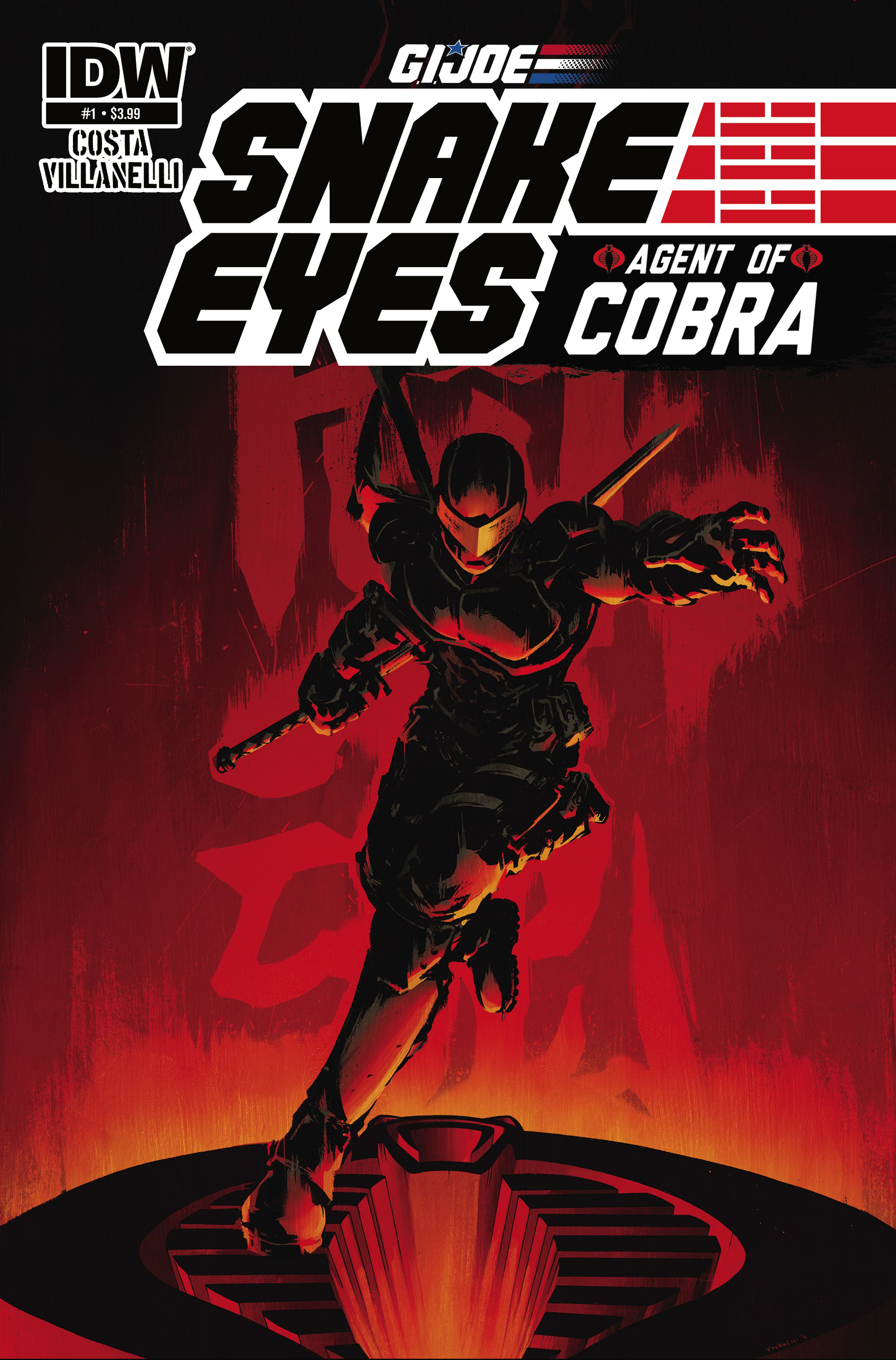
G.I. Joe: Snake Eyes, Agent of Cobra #4 (IDW)

writer: Mike Costa

artist: Paolo Vinanelli

We're getting to the point where Mike Costa's really going to trick the uninitiated to love his comics, because finally Snake Eyes and Storm Shadow will clash.

And it's because of Ronin.  The funny thing is, she's been in this position before, the exact position Costa leaves her in by the end of this issue.  So I'm not worried about her.  I mean, I should be, because Costa been evil like that before.  But he wouldn't do it again.  Would he?

Even if that's how he chooses to go, Costa has once again deepened his overall Cobra experience by continuing to spotlight characters he's been writing for years across a variety of titles but all basically the same continuing story.  In this instance it's also a direct continuation of last issue, which featured Billy, the son of the late Cobra Commander, whom Ronin has been watching since some prior point in this complex tapestry.  So this issue is all about Ronin's perspective.  This is the first time Costa has allowed Ronin to be the hero of the story rather than merely a supporting player.  All with all his characters, Costa has previously explained her poignant origins, but that's not what's important here.  The more time she's spent with Billy the more important he's become to her.  This is what Costa does, folks.  He twists the knife.

Again, hopefully not literally...

Avengers: Millennium #3 (Marvel)

writer: Mike Costa

artist: Carmine Giandomenico

This issue features Mike Costa settling in to his story.  Sure, there's more Spider-Man nonsense, but once it becomes apparent that even though Hydra seems to have everything figured out, the Avengers are still going to come out on top, and in a thoroughly Mike Costa way.

The image demonstrates how Costa is approaching Hydra in his familiar way, too.  The difference between his approach here, however, and how he would have done it in one of his G.I. Joe/Cobra comics is that Hydra is represented anonymously, whereas there are many famous figures to use or even create over at IDW.  Costa has learned that he doesn't need to do things the same way in order to get comparable results.  This is a considerable step forward from his Blackhawks experience.

He likes to make logical puzzles out of his stories, too, a key element of his IDW work, and certainly something Millennium at least suggested early on but is only now getting to actually demonstrate.  This is definitely true of how the issue ends, a moment that proves the story is going to show exactly how the good guys pull it off, which is the most insidious aspect of how Costa always presented Cobra, how he's done Hydra here, and even why the good guys were always worth rooting for in the midst of all that Cobra posturing, because the best laid plans can still be defeated.

So I'm pretty happy at this point.  I just wish he would ignore the impulse, whether by his own instincts or encouraged by Marvel, to present wacky nonsense alongside the rest of it.

Sunday, April 12, 2015

G.I. Joe: Snake Eyes, Agent of Cobra #3 (IDW)

writer: Mike Costa

artist: Paolo Villanelli

When The Cobra Files ended in 2013 it seemed like the last time Mike Costa would be involved in the further adventures of G.I. Joe.  Even someone like me, a hopelessly devoted fan, had forgotten that there were still loose ends to tie up.

This issue involves Billy, the late Cobra Commander's son.  Billy was a character previously featured in Larry Hama's comics, but Costa's stories are unrelated.  In this continuity, Cobra Commander was famously assassinated, and Billy is very much an innocent still trying to disentangle himself from the life his father led.

Whether or not he thinks Ronin is helping him do that might be open to interpretation, but that's what this issue's all about.  Ronin was another of Costa's signature characters in the older stories, and it's great seeing her again, too.  You might be wondering where Snake Eyes, the eponymous character, is in all of this, and to this I say: the dude is mute.  His story is bound to be told from someone else's perspective.  And because this is Mike Costa doing his Mike Costa best, there are a lot of moving parts around him.  Conveniently, continuing stories that really have nothing to do with Snake Eyes.

Although, who knows?  By the time he's done, Costa might have us thinking differently about Snake Eyes, too.  That tends to happen when Mike Costa's writing G.I. Joe...

Avengers: Millennium #1 & 2 (Marvel)

writer: Mike Costa

artist: Carmine Di Giandomenico

I've been a big fan of Mike Costa since discovering him in the pages of IDW's Cobra comics, where he's recently returned in the pages of G.I. Joe: Snake Eyes, Agent of Cobra.  The only downside in Costa's brilliant career is that he can't seem to connect with other material the way he has G.I. Joe.

A certain amount of that opinion has to do with my admittedly limited attempts to actually read that other material.  Yet my personal track record holds the opinion to be, at least for me, reasonably accurate.  When DC launched the New 52, Costa wrote Blackhawks, a military series that for all intents and purposes was a mainstream version of the work that had made him a name in the business.  And yet, he chose, or perhaps was mandated, to approach Blackhawks differently than he has Cobra.  (Which is to say, maybe this is one of those matters about creative freedom.)  In the pages of Jonathan Hickman's God Is Dead, which Costa has been writing for most of its run, there's not much of the Cobra vibe, either.

All the same, when I saw Avengers: Millennium listed, I was excited all over again.  This is a self-contained limited series.  Surely more room for the authentic Mike Costa to breathe?  To a certain extent, it seems.  And again, maybe it's just me, pigeon-holing the guy.

The page I included here is the second one from the first issue, and for two pages I saw exactly the Mike Costa I like so much, a writer fully engaged in a character, their particular nature fully on display.  And then, for the remainder of the two issues thus far released, he just kind of does Avengers Adventure Time.  Which isn't so bad, but it's not what I want to see from Mike Costa, specifically.

Most of these issues is also dedicated to the wacky banter of Hawkeye and Spider-Man.  This is nice to see, in a way, because it certainly broadens the scope of what Costa could be known for, but it also instantly limits him in a way.  Spider-Man has a way of swallowing writers whole, the ones who let their guard down.  Deadpool happened because Rob Liefeld, basically, let his guard down.  Deadpool is Spider-Man without any of the angst.  It's just wacky banter all the time, and stories attempting to reflect that.  Some writers can make sense of that.  Others can't.  Spider-Man is riding a wave of popularity at the moment because Dan Slott was able to focus more than writers tend to, without getting all mopey and woe-is-me (Spidey is basically manic-depressive, kind of like Daredevil), but a lot of what Slott did to make Spidey popular was the gimmick route that led to Spider-Verse.  Slott ended up taking the Geoff Johns approach, what Johns did on Green Lantern for nine years, event after event, except Spidey has more limited possibilities for such things than Green Lantern, so you get things like "Spider-Island" and what I always like to call Doctor Spider-Man, which was another character taking on the role, surely a comics staple, but in this instance more like when Ed Brubaker brought back Bucky, a genius character move.

...I feel like I have massively digressed.  Anyway, this is to say, I hope I see more of the Mike Costa I know and love in Avengers: Millennium, but even if I don't at least this time I'm committed to the experience one way or another.

Monday, February 2, 2015

G.I. Joe: Snake Eyes, Agent of Cobra #1 (IDW)

via Previews World
writer: Mike Costa

artist: Paolo Villanelli

It's a little insane to me that this project hasn't been hyped.  It's Mike Costa returning home, picking up the pieces of a saga he apparently concluded a year ago in the pages of The Cobra Files, a full-on espionage approach to G.I. Joe he originally launched with Christos Gage when IDW obtained the rights to the franchise a half dozen years ago.

I figure at least IDW has once again figured out what it has, as it's been doing from the start.  This is an instance of a publisher sticking to a project despite widespread apathy, much as Fox kept Fringe on the air for years without viewers particularly caring.  In both instances, it's more than worth whatever hassle it may be, because the end result is invariably genius.

But canny, in this instance.  With a new context, as the title of this latest title suggests.  Snake Eyes is making his debut in Costa's tales, which likely helped inform the recent mainstream G.I. Joe reboot, which hew closely in tone.  But since the masked ninja is famously mute, someone else must come along for the ride as well, and as such, Destro makes his debut as well.

Costa recaps Destro's backstory, and then gets to the good stuff, leading us back to Erika La Tene, Chameleon, rogue Joe and Cobra alike, who survived a game of psychological cat and mouse with Tomax Paoli.  The object of this return engagement is technically to pick up the thread of the Billy arc, Billy being the son of the late Cobra Commander (whose assassination at the hands of Chuckles was the clear moment Costa's work directly impacted IDW's wider landscape).

I didn't think this would happen.  But now it has.  Costa's back.  The game begins anew...