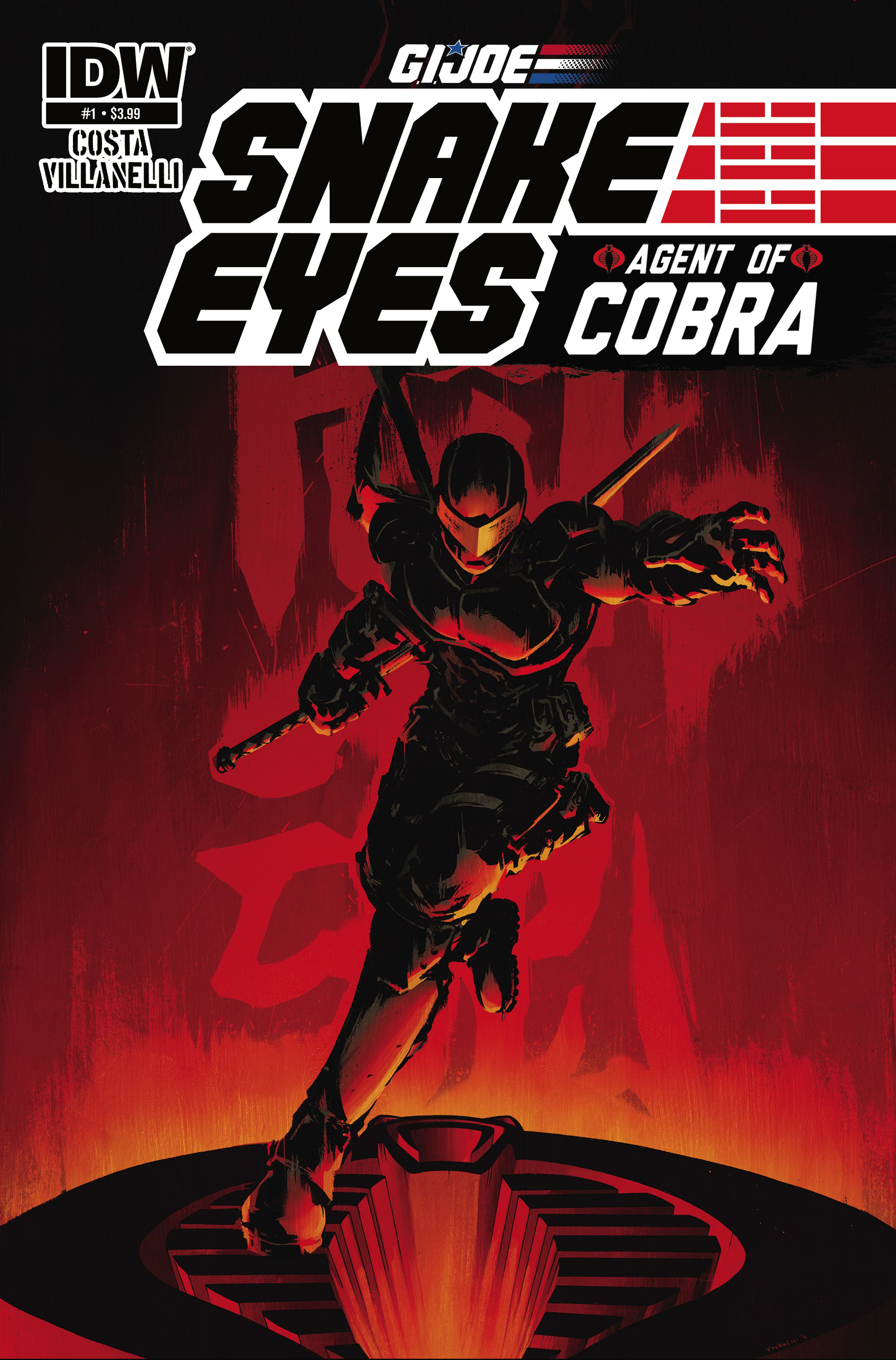
G.I. Joe: Snake Eyes, Agent of Cobra #5 (IDW)
The conclusion of Mike Costa's latest continuation of his sprawling Cobra saga features an epic confrontation between Snake Eyes and Storm Shadow, plus more of Costa's trademark insights, not only into various characters but the general G.I. Joe landscape. I keep heaping praise on the whole thing, but really at this point I'm just glad that IDW keeps letting Costa continue the whole thing, because the fans just aren't showing up, and every time Costa does something else, he doesn't seem to bring the same verve or perspective. But I guess I'm okay with that...
Ms. Marvel #15 (Marvel)
G. Willow Wilson has me as a fan, but I've never quite connected with her again the way I did over Air. I'm glad she's got a big hit in Ms. Marvel, but I've grown increasingly frustrated at the title spinning its wheels. The conclusion to the "Crushed" arc makes it plain as an allegory for Muslims (or any other group) being unfairly represented by their worst representatives (which sadly, for Muslims, are not at all hard to find), a topic of considerable importance to Wilson, since she's a convert to Islam, and as such probably doesn't like her religion looking so bad. That being said, the charm has begun to fade on this series. The heavier the material has gotten, the more it's lost its buoyancy, which is a statement that only sounds obvious when voiced that way, and the buoyancy is exactly what made it so unique to begin with. I will keep reading, but increasingly that's a statement that seems destined to end with "until I don't."
Rebels #2 (Dark Horse)
Be careful, writers. That's a message I say not so much about Rebels itself but what writer Brian Wood writes about himself in the back of this issue. He talks about his political views, and how he's writing Rebels in part to reclaim a part of himself he believes has been denied himself in the post-9/11 climate. And yet in doing so, he seems to totally misinterpret the climate of Rebels itself. The story in the issue seems to corroborate this view, as it takes a somewhat simplistic idea of who the people were who decided to fight...And I don't know how a writer who presents himself the way Wood does could possibly come to such a conclusion. There's absolutely nothing simplistic about the American Revolution, or about the people who decided to take up arms against England for the sake of independence. It's perhaps most frustrating because Wood, at least in this issue, has chosen for his main character a fictional base-level soldier in this war, someone whose motives perhaps could boil down to simplicity...but if you want to explore the complexities of this period, and reclaim a part of yourself, a writer probably should choose a different tack. And that's at least two reasons why I once again will not be able to read a Brian Wood series. This is four missed opportunities for me now. I guess I'm just not a Brian Wood guy...
Saga #28 (Image)
In contrast, I've connected with Brian K. Vaughan with two out of his four major projects, so I'm much more comfortable calling myself a Brian K. Vaughan guy even though I don't always care about what he's doing. Saga is at once a work of genius and also a series that at times seems like it desperately wants to repeat the Walking Dead model. I can hear a million voices saying, What can possibly be wrong with that??? Well, for starters, Saga can easily turn away from looking like a work of genius and become something that spins its wheels for the sake of remaining in-print (which, ah, is basically my impression of Walking Dead, and also the TV series). Which is not to say that a given issue of Saga doesn't feature everything I love about it, but that the story can drag quite a bit. Each issue features as little of the overall story as possible (when people talk about Brian Michael Bendis, they like to use the term "decompression;" they should consider applying it to Vaughan, too), which can be frustrating. And so when Vaughan reiterates at the prompting of a letter that he can easily see the series continue on for years, I scratch my head. Because at this pace, we will have seen the story advanced to a considerable degree years from now. Oh, now I get it...
Strange Sports Stories #3 (Vertigo)
There's only one reason why I bought this one, part of an anthology mini-series, and that's because it features CM Punk's second foray into comics. Punk was a professional wrestler until about a year and a half ago, but his every movement is still followed with breathless anticipation by wrestling fans (who obviously expect him to wrestle again at any moment), so when news of his working in comics began to appear, I was eager to see what he would do with such an opportunity. Recently it was announced that he'd be writing an ongoing Drax the Destroyer comic (appropriate, since Drax was portrayed by another ex-wrestler, Batista, in Guardians of the Galaxy), but before that Punk has been limited to much shorter material. His first effort was in Thor Annual #1 earlier this year, in which he proved a deft hand at comedy. Here he spins a yarn obviously dedicated to the Chicago Cubs, using a caption-heavy approach that contrasts nicely with his earlier work (he has versatility!). Punk has long been heavily associated with his hometown of Chicago, so it's not at all surprising that he demonstrates an affinity for the Cubs (looking really good this season!). He chooses to spotlight the idea of the team being cursed (several times over!). As a member in good standing of Red Sox Nation (season looking horrible!), I can understand the intricacies of curses, and can appreciate the restraint necessary to talk about such things with the kind of relaxed mood Punk demonstrates, especially since he exited wrestling with a lot less patience in mind (is the whole story a code suggesting he isn't done after all???). And yes, the rest of the issue is utter gibberish. It's clobbering time!
Showing posts with label Cobra. Show all posts
Sunday, May 17, 2015
Sunday, April 19, 2015
G.I. Joe: Snake Eyes, Agent of Cobra #4 (IDW)
writer: Mike Costa
artist: Paolo Vinanelli
We're getting to the point where Mike Costa's really going to trick the uninitiated to love his comics, because finally Snake Eyes and Storm Shadow will clash.
And it's because of Ronin. The funny thing is, she's been in this position before, the exact position Costa leaves her in by the end of this issue. So I'm not worried about her. I mean, I should be, because Costa been evil like that before. But he wouldn't do it again. Would he?
Even if that's how he chooses to go, Costa has once again deepened his overall Cobra experience by continuing to spotlight characters he's been writing for years across a variety of titles but all basically the same continuing story. In this instance it's also a direct continuation of last issue, which featured Billy, the son of the late Cobra Commander, whom Ronin has been watching since some prior point in this complex tapestry. So this issue is all about Ronin's perspective. This is the first time Costa has allowed Ronin to be the hero of the story rather than merely a supporting player. All with all his characters, Costa has previously explained her poignant origins, but that's not what's important here. The more time she's spent with Billy the more important he's become to her. This is what Costa does, folks. He twists the knife.
Again, hopefully not literally...
artist: Paolo Vinanelli
We're getting to the point where Mike Costa's really going to trick the uninitiated to love his comics, because finally Snake Eyes and Storm Shadow will clash.
And it's because of Ronin. The funny thing is, she's been in this position before, the exact position Costa leaves her in by the end of this issue. So I'm not worried about her. I mean, I should be, because Costa been evil like that before. But he wouldn't do it again. Would he?
Even if that's how he chooses to go, Costa has once again deepened his overall Cobra experience by continuing to spotlight characters he's been writing for years across a variety of titles but all basically the same continuing story. In this instance it's also a direct continuation of last issue, which featured Billy, the son of the late Cobra Commander, whom Ronin has been watching since some prior point in this complex tapestry. So this issue is all about Ronin's perspective. This is the first time Costa has allowed Ronin to be the hero of the story rather than merely a supporting player. All with all his characters, Costa has previously explained her poignant origins, but that's not what's important here. The more time she's spent with Billy the more important he's become to her. This is what Costa does, folks. He twists the knife.
Again, hopefully not literally...
Sunday, April 12, 2015
G.I. Joe: Snake Eyes, Agent of Cobra #3 (IDW)
writer: Mike Costa
artist: Paolo Villanelli
When The Cobra Files ended in 2013 it seemed like the last time Mike Costa would be involved in the further adventures of G.I. Joe. Even someone like me, a hopelessly devoted fan, had forgotten that there were still loose ends to tie up.
This issue involves Billy, the late Cobra Commander's son. Billy was a character previously featured in Larry Hama's comics, but Costa's stories are unrelated. In this continuity, Cobra Commander was famously assassinated, and Billy is very much an innocent still trying to disentangle himself from the life his father led.
Whether or not he thinks Ronin is helping him do that might be open to interpretation, but that's what this issue's all about. Ronin was another of Costa's signature characters in the older stories, and it's great seeing her again, too. You might be wondering where Snake Eyes, the eponymous character, is in all of this, and to this I say: the dude is mute. His story is bound to be told from someone else's perspective. And because this is Mike Costa doing his Mike Costa best, there are a lot of moving parts around him. Conveniently, continuing stories that really have nothing to do with Snake Eyes.
Although, who knows? By the time he's done, Costa might have us thinking differently about Snake Eyes, too. That tends to happen when Mike Costa's writing G.I. Joe...
artist: Paolo Villanelli
When The Cobra Files ended in 2013 it seemed like the last time Mike Costa would be involved in the further adventures of G.I. Joe. Even someone like me, a hopelessly devoted fan, had forgotten that there were still loose ends to tie up.
This issue involves Billy, the late Cobra Commander's son. Billy was a character previously featured in Larry Hama's comics, but Costa's stories are unrelated. In this continuity, Cobra Commander was famously assassinated, and Billy is very much an innocent still trying to disentangle himself from the life his father led.
Whether or not he thinks Ronin is helping him do that might be open to interpretation, but that's what this issue's all about. Ronin was another of Costa's signature characters in the older stories, and it's great seeing her again, too. You might be wondering where Snake Eyes, the eponymous character, is in all of this, and to this I say: the dude is mute. His story is bound to be told from someone else's perspective. And because this is Mike Costa doing his Mike Costa best, there are a lot of moving parts around him. Conveniently, continuing stories that really have nothing to do with Snake Eyes.
Although, who knows? By the time he's done, Costa might have us thinking differently about Snake Eyes, too. That tends to happen when Mike Costa's writing G.I. Joe...
Monday, February 2, 2015
G.I. Joe: Snake Eyes, Agent of Cobra #1 (IDW)
| via Previews World |
artist: Paolo Villanelli
It's a little insane to me that this project hasn't been hyped. It's Mike Costa returning home, picking up the pieces of a saga he apparently concluded a year ago in the pages of The Cobra Files, a full-on espionage approach to G.I. Joe he originally launched with Christos Gage when IDW obtained the rights to the franchise a half dozen years ago.
I figure at least IDW has once again figured out what it has, as it's been doing from the start. This is an instance of a publisher sticking to a project despite widespread apathy, much as Fox kept Fringe on the air for years without viewers particularly caring. In both instances, it's more than worth whatever hassle it may be, because the end result is invariably genius.
But canny, in this instance. With a new context, as the title of this latest title suggests. Snake Eyes is making his debut in Costa's tales, which likely helped inform the recent mainstream G.I. Joe reboot, which hew closely in tone. But since the masked ninja is famously mute, someone else must come along for the ride as well, and as such, Destro makes his debut as well.
Costa recaps Destro's backstory, and then gets to the good stuff, leading us back to Erika La Tene, Chameleon, rogue Joe and Cobra alike, who survived a game of psychological cat and mouse with Tomax Paoli. The object of this return engagement is technically to pick up the thread of the Billy arc, Billy being the son of the late Cobra Commander (whose assassination at the hands of Chuckles was the clear moment Costa's work directly impacted IDW's wider landscape).
I didn't think this would happen. But now it has. Costa's back. The game begins anew...
Thursday, March 20, 2014
G.I. Joe: The Cobra Files #9
(via CBDB)
writer: Mike Costa
artist: Antonio Fuso
All things must end. Mike Costa and Antonio Fuso have been, like Eric Shanower and Skottie Young, been collaborating since 2009, and their projects ended in 2013. While on the surface the worlds of Oz and Cobra have nothing in common, the approach from their respective creatives team in this context could not have been more similar. They were both genius, and understood the basic appeal and possibilities better than anyone else.
Costa and Fuso were masters of psychological warfare. Together, they tracked the fortunes of Cobra exiles Tomax Paoli and Erika La Tene, a story that like the team of Costa and Fuso comes to an end with this issue.
Paoli and La Tene's fortunes have been in flux. Paoli has been a prisoner of G.I. Joe, and La Tene has been struggling to prove herself as a valuable ally. Whereas Paoli has only been pretending to help, La Tene has been on a course toward redemption. But Paoli has been lying, and his end game involves causing his former ally to doubt whether or not she has been successful.
Last issue it was so much obvious that Costa was writing from the perspective of someone who was not necessarily writing just the characters, but a writer who was being forced to vacate a story early. This issue, he leaves all the doubt on the table. He ends his epic run on a note of ambiguity. I wasn't initially sure how to interpret this, but really, it's the only appropriate end for this saga. It remains, as it always was, a sheer work of genius.
And hopefully more readers will come to appreciate that, especially now that the whole thing has been published.
Monday, November 25, 2013
My All-time Favorite Comic Books, 10-1
The final countdown...!
#10. Geoff Johns's Green Lantern
Creators: Geoff Johns, Doug Mahnke, Ethan Van Sciver, Ivan Reis, various
Publication dates: 2004-2013
Issues: Green Lantern: Rebirth 1-6, Green Lantern 1-67, 0-20, Blackest Night 1-8
Green Lantern was already my favorite comic book franchise when Johns strolled into the story in 2004. I thought I already had my definitive era in Ron Marz's Kyle Rayner. Then Johns brought Hal Jordan back, and exploded the whole mythology. I mean, literally, he took the basic building blocks and figured out the best possible expansion, and led the whole thing to its greatest heights. It's the epitome of creative storytelling, the single best innovative run in superhero comic book history, one that will continue to be felt for years. I mean, even Larfleeze has gotten his own ongoing series now. Larfleeze! How awesome is that? Saint Walker made it into the pre-New 52 Justice League, the Red Lanterns have had their own series since the DC relaunch, and Johns has made a strong case for a Sinestro series. No one would have ever thought that possible before 2004. That's the definition of a substantial legacy.
#9. Air
Creators: G. Willow Wilson, M.K. Perker
Publication dates: 2008-2010
Issues: 1-24
Along with 52 part of a very select group to top my annual QB50 list twice, Air was an unabashed obsession of mine throughout its publication, even though it struggled to find an audience that did not have the name "Tony Laplume." But it was brilliant, typical of the Vertigo breed in having a distinct and imaginative mythology, but atypical in its intimate approach, like Sandman without all the Goth touches. G. Willow Wilson managed to spin a conspiracy and hero journey into one yarn. The closest proximity I've found since was the similarly short-lived Saucer Country. As with most of my selections, widely deserves a much larger audience.
#8. Cobra
Creators: Mike Costa, Antonio Fuso, Christos Gage
Publication dates: 2009-2013
Issues: 1-4, Special 1-2, 1-13, 1-21, The Cobra Files 1-9
This is basically everything I loved about Superboy and the Ravers, The Great Ten, Seven Soldiers of Victory, and Young Avengers in a nonsuperhero title, and surprisingly with another famous franchise it managed to totally reinvent from the outset, featuring an obscure Joe named Chuckles in the mission of his life, a reboot timeline where Cobra is just being discovered. And from there, it's basically the Assange/Snowden/NSA era well before any of those scandals broke, one brilliant bit of character exploration after another in a world of paranoia and secrets, an unexpected phenomenon publisher IDW never expected, assuming it had merely a good mini-series when it acquired G.I. Joe in 2008, leading to a series of extensions that eventually transformed the whole line with the sensational death of Cobra Commander. You don't need to know or care about the franchise to love this saga. You just need to love great comics.
#7. Sandman
Creators: Neil Gaiman, Dave McKean, various
Publication dates: 1989-1996
Issues: 1-75
For simplicity's sake I'm sticking to the original series rather than also include subsequent additional materials, such as the recently-launched Sandman Overture mini-series. Simply put, this one needs no introduction. It's perhaps the most literary comic book ever published, filled with classical elements and one of the best-known mythologies outside of superheroes ever created. It's a masterpiece. Move along, move along.
#6. Bone
Creators: Jeff Smith
Publication dates: 1991-2004
Issues: 1-55
This one I owe entirely to a friend who was obsessed with it. For a while, there was a very small cult audience obsessed with it. And it expanded, thanks to word of mouth. It started making in-roads to full-blown mainstream awareness. There was talk of a movie. All of this is for good reason. Like a cartoon strip wedded perfectly to epic fantasy (such as you would never have believed possible until Bone), Jeff Smith's vision was a dream come to life, so popular Image for a while took over publication, until it went back to Smith's own company, where it completed its epic journey, only to be reborn in a series of reprints, where its legacy (as I've been hoping throughout this list for many other series) has grown. Oh, and because it's my favorite phrase from Bone: stupid, stupid rat creatures...
#5. Wasteland
Creators: Antony Johnston, Christopher Mitten, Justin Greenwood
Publication dates: 2006-2014
Issues: 1-60
I've attempted for years to be an ambassador to this series, a classic post-apocalyptic yarn that explodes the genre into a startlingly rich landscape filled with intricate relationships between isolated figures. Unlike The Walking Dead, Wasteland has made the riddle of what created the world after the Big Wet the whole point, except it's taken the whole journey to reach it. In the meantime social politics have defined the story, especially the betrayals at the heart of life in Newbegin, the perfect representation of civilization after civilization's end. My favorite character remains Michael, a sort of Wolverine if Wolverine had never joined the X-Men.
#4. 52
Creators: Geoff Johns, Grant Morrison, Greg Rucka, Mark Waid, Keith Giffen, various
Publication dates: 2006-2007
Issues: 1-52
DC's first weekly series in years, an ambitious effort to put out a new issue every week for a year, could have been its riskiest gamble ever. Instead it turned out to be a stroke of genius, one of the best single comics it ever put out, following a hodgepodge of characters who could never have been mistaken for the mainstream (although some of them, including Booster Gold and the new Batwoman, received their own ongoing series as a result) as they embark on the greatest stories of their careers, including the Elongated Man's long-awaited response to Identity Crisis and Black Adam's shot at redemption. The league of creators who wrote it remains a who's who, and to my mind in no small part to their participation in this book. The company's later attempts to duplicate this remarkable accomplishment never seemed to capture the same interest from the fans, but that's to be expected, although I would highly recommend Countdown, while the bi-weekly Brightest Day is another winner.
#3. The Death of Captain Marvel
Creators: Jim Starlin
Publication date: 1982
Issues: [graphic novel]
This is the comic book that made me a fan of comic books, and it is also among the first I ever read, and completely by accident, something my sister had randomly come across and I stole a look, and no joking, I was changed forever. The death of any comic book character wasn't as common in 1982 as it is today, and the true testament of this event is that Captain Marvel remains respectfully deceased. It's a surreal, literary exploration and epitaph for a character who was never really that popular but whose legacy was instantly cemented by this effort. What more could you ask for?
#2. Kingdom Come
Creators: Mark Waid, Alex Ross
Publication dates: 1996
Issues: 1-4
You might notice that I love my comics to be literary, and no superhero comic was ever more literary, not to mention seminal in my own creative development, than this landmark event that peered into the future of DC's icons and saw nothing good. Lois Lane dead. Superman forced into retirement. The next generation, led by Magog, the reverse of everything that had come before them. Narrated by a simple preacher and steeped in religious imagery (this is the secret origin of my obsession with the number 7, and why I subsequently adopted the term "seven thunders" from the Book of Revelations for what I always assumed must be my own magnum opus, because it was used in the previews for Kingdom Come), this was both creators at their absolute finest. One of them ended up chasing this achievement for years (Ross) while the other only occasionally revisited it (Waid, in The Kingdom event that was as close to Seven Soldiers of Victory as DC ever got before Grant Morrison), while Geoff Johns famously brought it all back in the pages of his Justice Society of America. Even Magog eventually entered the regular canon and had an ongoing series. Often seen as DC's response to Marvels, it is more accurately seen in its own distinctive light, which is ultimately a more hopeful version of The Dark Knight Returns, taken on the grand scale.
#1. "The Return of Barry Allen"
Creators: Mark Waid, Greg LaRocque
Publication dates: 1993
Issues: The Flash 74-79
I choose to include only one storyline from Mark Waid's extended run on The Flash for a specific reason, because it was the earliest and best example of the whole thing, which often lived up to its potential and sometimes didn't (and the best of it wasn't even in the pages of The Flash but rather Impulse), so it's better to remember what remains the most memorable than complicate matters. Because "The Return of Barry Allen" is most certainly the best of it. And for the record, it doesn't even feature Barry Allen. This was years before Barry came back. The Flash throughout Waid's run was Wally West ("and I'm the Fastest Man Alive"), the third speedster to carry the name, and he was keenly aware of the whole mythology, which before Geoff Johns on Green Lantern, Waid was the first to attempt a wholesale expansion, introducing the concept of the Speed Force and old as well as new faces to the family, including my personal favorite, Max Mercury, the Zen Master of Speed. If there is any weakening to this legacy, it's perhaps that even Waid seemed to let it slip by the wayside after a while, perhaps after "Dead Heat" (acknowledged within the pages of Johns's The Flash: Rebirth with a cameo by the villain Savitar), while Johns himself in two separate runs (with Wally and Barry) went in different directions. Better, again, to remember it at its most pure, most perfect, most serene, most effective, when it's Wally struggling with his role in the grand scheme of things. James Robinson would later take the same basic concept to similar heights in the pages of Starman, but has no comparable single storyline to this one. This is the one, if you love superheroes and their legacies, that you have to read. This is the love letter of all love letters to the whole phenomenon.
(All covers via Comic Book Database.)
#10. Geoff Johns's Green Lantern
Creators: Geoff Johns, Doug Mahnke, Ethan Van Sciver, Ivan Reis, various
Publication dates: 2004-2013
Issues: Green Lantern: Rebirth 1-6, Green Lantern 1-67, 0-20, Blackest Night 1-8
Green Lantern was already my favorite comic book franchise when Johns strolled into the story in 2004. I thought I already had my definitive era in Ron Marz's Kyle Rayner. Then Johns brought Hal Jordan back, and exploded the whole mythology. I mean, literally, he took the basic building blocks and figured out the best possible expansion, and led the whole thing to its greatest heights. It's the epitome of creative storytelling, the single best innovative run in superhero comic book history, one that will continue to be felt for years. I mean, even Larfleeze has gotten his own ongoing series now. Larfleeze! How awesome is that? Saint Walker made it into the pre-New 52 Justice League, the Red Lanterns have had their own series since the DC relaunch, and Johns has made a strong case for a Sinestro series. No one would have ever thought that possible before 2004. That's the definition of a substantial legacy.
#9. Air
Creators: G. Willow Wilson, M.K. Perker
Publication dates: 2008-2010
Issues: 1-24
Along with 52 part of a very select group to top my annual QB50 list twice, Air was an unabashed obsession of mine throughout its publication, even though it struggled to find an audience that did not have the name "Tony Laplume." But it was brilliant, typical of the Vertigo breed in having a distinct and imaginative mythology, but atypical in its intimate approach, like Sandman without all the Goth touches. G. Willow Wilson managed to spin a conspiracy and hero journey into one yarn. The closest proximity I've found since was the similarly short-lived Saucer Country. As with most of my selections, widely deserves a much larger audience.
#8. Cobra
Creators: Mike Costa, Antonio Fuso, Christos Gage
Publication dates: 2009-2013
Issues: 1-4, Special 1-2, 1-13, 1-21, The Cobra Files 1-9
This is basically everything I loved about Superboy and the Ravers, The Great Ten, Seven Soldiers of Victory, and Young Avengers in a nonsuperhero title, and surprisingly with another famous franchise it managed to totally reinvent from the outset, featuring an obscure Joe named Chuckles in the mission of his life, a reboot timeline where Cobra is just being discovered. And from there, it's basically the Assange/Snowden/NSA era well before any of those scandals broke, one brilliant bit of character exploration after another in a world of paranoia and secrets, an unexpected phenomenon publisher IDW never expected, assuming it had merely a good mini-series when it acquired G.I. Joe in 2008, leading to a series of extensions that eventually transformed the whole line with the sensational death of Cobra Commander. You don't need to know or care about the franchise to love this saga. You just need to love great comics.
#7. Sandman
Creators: Neil Gaiman, Dave McKean, various
Publication dates: 1989-1996
Issues: 1-75
For simplicity's sake I'm sticking to the original series rather than also include subsequent additional materials, such as the recently-launched Sandman Overture mini-series. Simply put, this one needs no introduction. It's perhaps the most literary comic book ever published, filled with classical elements and one of the best-known mythologies outside of superheroes ever created. It's a masterpiece. Move along, move along.
#6. Bone
Creators: Jeff Smith
Publication dates: 1991-2004
Issues: 1-55
This one I owe entirely to a friend who was obsessed with it. For a while, there was a very small cult audience obsessed with it. And it expanded, thanks to word of mouth. It started making in-roads to full-blown mainstream awareness. There was talk of a movie. All of this is for good reason. Like a cartoon strip wedded perfectly to epic fantasy (such as you would never have believed possible until Bone), Jeff Smith's vision was a dream come to life, so popular Image for a while took over publication, until it went back to Smith's own company, where it completed its epic journey, only to be reborn in a series of reprints, where its legacy (as I've been hoping throughout this list for many other series) has grown. Oh, and because it's my favorite phrase from Bone: stupid, stupid rat creatures...
#5. Wasteland
Creators: Antony Johnston, Christopher Mitten, Justin Greenwood
Publication dates: 2006-2014
Issues: 1-60
I've attempted for years to be an ambassador to this series, a classic post-apocalyptic yarn that explodes the genre into a startlingly rich landscape filled with intricate relationships between isolated figures. Unlike The Walking Dead, Wasteland has made the riddle of what created the world after the Big Wet the whole point, except it's taken the whole journey to reach it. In the meantime social politics have defined the story, especially the betrayals at the heart of life in Newbegin, the perfect representation of civilization after civilization's end. My favorite character remains Michael, a sort of Wolverine if Wolverine had never joined the X-Men.
#4. 52
Creators: Geoff Johns, Grant Morrison, Greg Rucka, Mark Waid, Keith Giffen, various
Publication dates: 2006-2007
Issues: 1-52
DC's first weekly series in years, an ambitious effort to put out a new issue every week for a year, could have been its riskiest gamble ever. Instead it turned out to be a stroke of genius, one of the best single comics it ever put out, following a hodgepodge of characters who could never have been mistaken for the mainstream (although some of them, including Booster Gold and the new Batwoman, received their own ongoing series as a result) as they embark on the greatest stories of their careers, including the Elongated Man's long-awaited response to Identity Crisis and Black Adam's shot at redemption. The league of creators who wrote it remains a who's who, and to my mind in no small part to their participation in this book. The company's later attempts to duplicate this remarkable accomplishment never seemed to capture the same interest from the fans, but that's to be expected, although I would highly recommend Countdown, while the bi-weekly Brightest Day is another winner.
#3. The Death of Captain Marvel
Creators: Jim Starlin
Publication date: 1982
Issues: [graphic novel]
This is the comic book that made me a fan of comic books, and it is also among the first I ever read, and completely by accident, something my sister had randomly come across and I stole a look, and no joking, I was changed forever. The death of any comic book character wasn't as common in 1982 as it is today, and the true testament of this event is that Captain Marvel remains respectfully deceased. It's a surreal, literary exploration and epitaph for a character who was never really that popular but whose legacy was instantly cemented by this effort. What more could you ask for?
#2. Kingdom Come
Creators: Mark Waid, Alex Ross
Publication dates: 1996
Issues: 1-4
You might notice that I love my comics to be literary, and no superhero comic was ever more literary, not to mention seminal in my own creative development, than this landmark event that peered into the future of DC's icons and saw nothing good. Lois Lane dead. Superman forced into retirement. The next generation, led by Magog, the reverse of everything that had come before them. Narrated by a simple preacher and steeped in religious imagery (this is the secret origin of my obsession with the number 7, and why I subsequently adopted the term "seven thunders" from the Book of Revelations for what I always assumed must be my own magnum opus, because it was used in the previews for Kingdom Come), this was both creators at their absolute finest. One of them ended up chasing this achievement for years (Ross) while the other only occasionally revisited it (Waid, in The Kingdom event that was as close to Seven Soldiers of Victory as DC ever got before Grant Morrison), while Geoff Johns famously brought it all back in the pages of his Justice Society of America. Even Magog eventually entered the regular canon and had an ongoing series. Often seen as DC's response to Marvels, it is more accurately seen in its own distinctive light, which is ultimately a more hopeful version of The Dark Knight Returns, taken on the grand scale.
#1. "The Return of Barry Allen"
Creators: Mark Waid, Greg LaRocque
Publication dates: 1993
Issues: The Flash 74-79
I choose to include only one storyline from Mark Waid's extended run on The Flash for a specific reason, because it was the earliest and best example of the whole thing, which often lived up to its potential and sometimes didn't (and the best of it wasn't even in the pages of The Flash but rather Impulse), so it's better to remember what remains the most memorable than complicate matters. Because "The Return of Barry Allen" is most certainly the best of it. And for the record, it doesn't even feature Barry Allen. This was years before Barry came back. The Flash throughout Waid's run was Wally West ("and I'm the Fastest Man Alive"), the third speedster to carry the name, and he was keenly aware of the whole mythology, which before Geoff Johns on Green Lantern, Waid was the first to attempt a wholesale expansion, introducing the concept of the Speed Force and old as well as new faces to the family, including my personal favorite, Max Mercury, the Zen Master of Speed. If there is any weakening to this legacy, it's perhaps that even Waid seemed to let it slip by the wayside after a while, perhaps after "Dead Heat" (acknowledged within the pages of Johns's The Flash: Rebirth with a cameo by the villain Savitar), while Johns himself in two separate runs (with Wally and Barry) went in different directions. Better, again, to remember it at its most pure, most perfect, most serene, most effective, when it's Wally struggling with his role in the grand scheme of things. James Robinson would later take the same basic concept to similar heights in the pages of Starman, but has no comparable single storyline to this one. This is the one, if you love superheroes and their legacies, that you have to read. This is the love letter of all love letters to the whole phenomenon.
(All covers via Comic Book Database.)
Tuesday, February 5, 2013
Cobra #20 and 21 (IDW)
writer: Mike Costa
artist: Antonio Fuso, Werther Dell'Edera
The Oktober Guard saga concludes. Turns out the reports of Ronin's demise (mainly, here at Comics Reader) were greatly exaggerated. Instead of dying she's taken prisoner and begins a grueling interrogation experience, allowing us to learn more about the Guard in much the same way Mike Costa has explored characters from both the Joes and Cobra previously, proving there's no end to this successful character formula. While she's enjoying that, Flint puts an extraction team consisting of himself, Lady Jaye, and Chameleon, heading into Russia to put an end to this messy affair.
Except their efforts won't be enough. They end up captured, too, and it falls to Clockspring, another character like Ronin and Chameleon original to Costa's adventures, to make an awful deal to find resolution. He turns to the Joes' prize informant, Tomax Paoli, formerly a key member of Cobra, and by the end of #21 we find out just much of a deal with the devil has really been made, and is the true payoff to the Oktober Guard arc. Not only does it further emphasize the abilities of and rivalry between the Joes and Cobra, but it draws a lovely bow around Costa's efforts to date. #21 is the final issue of this particular incarnation. In April G.I. Joe: The Cobra Files will launch, the latest iteration of the series.
In a lot of ways, Cobra in its various incarnations can be described either as the saga of Paoli (and his late brother Tomax) or Chameleon, although it's really both. It's their journey and relationships with the two key organizations that Costa has used to define his approaches to them, intimate and personal but filled with intrigue. Like Chuckles in the original stories, Clockspring finds his best definition in relation to one of them.
I've long held that Cobra is one of the best comics on the market, and Costa continues to earn this faith. Anyone who still hasn't experienced it should at least acknowledge IDW's remarkable commitment to keeping these efforts in print on an ongoing basis. If it had been a fluke, the first mini-series would have been the end of it, or maybe the second mini-series, which was turned into the first ongoing series in the run. This is the end of the second ongoing series, leading to a third in just a few months. Though Cobra is in the title, Costa has never allowed the stories to feature mustache-twirling villains. He's a writer filled with nuance. He's one of the best.
artist: Antonio Fuso, Werther Dell'Edera
(from unleashthefanboy.com)
The Oktober Guard saga concludes. Turns out the reports of Ronin's demise (mainly, here at Comics Reader) were greatly exaggerated. Instead of dying she's taken prisoner and begins a grueling interrogation experience, allowing us to learn more about the Guard in much the same way Mike Costa has explored characters from both the Joes and Cobra previously, proving there's no end to this successful character formula. While she's enjoying that, Flint puts an extraction team consisting of himself, Lady Jaye, and Chameleon, heading into Russia to put an end to this messy affair.
Except their efforts won't be enough. They end up captured, too, and it falls to Clockspring, another character like Ronin and Chameleon original to Costa's adventures, to make an awful deal to find resolution. He turns to the Joes' prize informant, Tomax Paoli, formerly a key member of Cobra, and by the end of #21 we find out just much of a deal with the devil has really been made, and is the true payoff to the Oktober Guard arc. Not only does it further emphasize the abilities of and rivalry between the Joes and Cobra, but it draws a lovely bow around Costa's efforts to date. #21 is the final issue of this particular incarnation. In April G.I. Joe: The Cobra Files will launch, the latest iteration of the series.
In a lot of ways, Cobra in its various incarnations can be described either as the saga of Paoli (and his late brother Tomax) or Chameleon, although it's really both. It's their journey and relationships with the two key organizations that Costa has used to define his approaches to them, intimate and personal but filled with intrigue. Like Chuckles in the original stories, Clockspring finds his best definition in relation to one of them.
I've long held that Cobra is one of the best comics on the market, and Costa continues to earn this faith. Anyone who still hasn't experienced it should at least acknowledge IDW's remarkable commitment to keeping these efforts in print on an ongoing basis. If it had been a fluke, the first mini-series would have been the end of it, or maybe the second mini-series, which was turned into the first ongoing series in the run. This is the end of the second ongoing series, leading to a third in just a few months. Though Cobra is in the title, Costa has never allowed the stories to feature mustache-twirling villains. He's a writer filled with nuance. He's one of the best.
Saturday, January 12, 2013
Cobra #19 (IDW)
writer: Mike Costa
artists: Antonio Fuso
The fascinating thing about the Oktober Guard arc is that it harks back to Cobra's earliest days as Chuckles explored G.I. Joe's opposite number as it was being discovered for the first time. Mike Costa has wisely (but in this series he's done nothing but wise things) decided to use the same approach. Only, the Oktober Guard isn't Cobra.
What made Cobra so fascinating to explore in the manner Costa (and original co-writer Christos Gage) did was that it was definitely well-known, and its members to varying degrees iconic, yet every aspect came off as fresh and intriguing. Recently the tables have flipped, with certain of the characters featured in those early days (Erika La Tene, Tomax Paoli) now functioning as G.I. Joe informants, while the good guys are once again predominantly represented by agents like Ronin.
Ronin is a character unique to Cobra, and if you're a fan of hers you may want to approach this issue with caution. Like Chuckles before her she goes rogue on her latest mission, eager to learn more about the Oktober Guard, and ends up in hot water.
The Oktober Guard itself is not Cobra, and it's certainly isn't G.I. Joe. Since the end of the Cold War, America's relationship with Russia has altered drastically. Vladimir Putin proved to be an unlikely ally in the early days of the War on Terror, yet since that time the two countries have significantly diverged in their interests, to the point where Russia might as well exist on another planet for all its apparent importance to Americans today. Yet it remains inextricably linked to greater global affairs, and as such the continued presence of the Oktober Guard is not only a reminder of the past but a terrific nod to a part of G.I. Joe mythology that can sometimes be overlooked.
Costa is quick to acknowledge that the Guard is formidable, every bit the compelling rival that Cobra remains. He's got less familiar territory to work with, though, which is actually good as far as the focus on the greater Joe operation is concerned. It's not just Ronin, as it was all but only Chuckles driving the story in the beginning. This is where the tangled web of the complete Cobra run really begins to develop. It's not just the Guard that intrigues, but how its existence forces everything we've been following to date push forward.
It speaks directly to the strength of Costa's writing. It's familiar but also something new, which is what Cobra has been from the start, and the fact that he's still got new ways to express it is yet another reason why this is still one of the best series on the market.
artists: Antonio Fuso
(via unleashthefanboy.com)
The fascinating thing about the Oktober Guard arc is that it harks back to Cobra's earliest days as Chuckles explored G.I. Joe's opposite number as it was being discovered for the first time. Mike Costa has wisely (but in this series he's done nothing but wise things) decided to use the same approach. Only, the Oktober Guard isn't Cobra.
What made Cobra so fascinating to explore in the manner Costa (and original co-writer Christos Gage) did was that it was definitely well-known, and its members to varying degrees iconic, yet every aspect came off as fresh and intriguing. Recently the tables have flipped, with certain of the characters featured in those early days (Erika La Tene, Tomax Paoli) now functioning as G.I. Joe informants, while the good guys are once again predominantly represented by agents like Ronin.
Ronin is a character unique to Cobra, and if you're a fan of hers you may want to approach this issue with caution. Like Chuckles before her she goes rogue on her latest mission, eager to learn more about the Oktober Guard, and ends up in hot water.
The Oktober Guard itself is not Cobra, and it's certainly isn't G.I. Joe. Since the end of the Cold War, America's relationship with Russia has altered drastically. Vladimir Putin proved to be an unlikely ally in the early days of the War on Terror, yet since that time the two countries have significantly diverged in their interests, to the point where Russia might as well exist on another planet for all its apparent importance to Americans today. Yet it remains inextricably linked to greater global affairs, and as such the continued presence of the Oktober Guard is not only a reminder of the past but a terrific nod to a part of G.I. Joe mythology that can sometimes be overlooked.
Costa is quick to acknowledge that the Guard is formidable, every bit the compelling rival that Cobra remains. He's got less familiar territory to work with, though, which is actually good as far as the focus on the greater Joe operation is concerned. It's not just Ronin, as it was all but only Chuckles driving the story in the beginning. This is where the tangled web of the complete Cobra run really begins to develop. It's not just the Guard that intrigues, but how its existence forces everything we've been following to date push forward.
It speaks directly to the strength of Costa's writing. It's familiar but also something new, which is what Cobra has been from the start, and the fact that he's still got new ways to express it is yet another reason why this is still one of the best series on the market.
Saturday, November 17, 2012
Cobra #18 (IDW)
writer: Mike Costa
artist: Antonio Fuso
Much of this issue is dedicated to another of Cobra's patented character studies, this time of Ronin, a character unique to the series.
Linked to Jinx (killed early in the Cobra chronology) and Chameleon (Erika Le Tene), which was actually Ronin's previous identity, this is the first time we spend quality time with her. Ronin might previously have been described as the chick with the samurai swords who struck an impressive appearance but who otherwise was pretty anonymous. That's what helps make this another standout issue, although Cobra has been full of them, just one of the many reasons that I still cannot understand why it has never broken out from anything more than cult status. This has consistently been one of the best comic books in the market.
(It's worth noting that Mike Costa's original writing collaborator, Christos Gage, is referenced in an Easter Egg this issue.)
Anyone looking for additional signs of awesomeness will also take note that the issue also includes the Oktober Guard, the Russian equivalent to G.I. Joe, an element that has only just been introduced to the series. Anyone concerned when I say "character rich" ought to know that there is plenty of action. As I said, Ronin was previously known as the ninja, and Cobra clashing with the Guard makes a big splash at the start of the issue.
I cannot possibly recommend this series highly enough.
artist: Antonio Fuso
Much of this issue is dedicated to another of Cobra's patented character studies, this time of Ronin, a character unique to the series.
Linked to Jinx (killed early in the Cobra chronology) and Chameleon (Erika Le Tene), which was actually Ronin's previous identity, this is the first time we spend quality time with her. Ronin might previously have been described as the chick with the samurai swords who struck an impressive appearance but who otherwise was pretty anonymous. That's what helps make this another standout issue, although Cobra has been full of them, just one of the many reasons that I still cannot understand why it has never broken out from anything more than cult status. This has consistently been one of the best comic books in the market.
(It's worth noting that Mike Costa's original writing collaborator, Christos Gage, is referenced in an Easter Egg this issue.)
Anyone looking for additional signs of awesomeness will also take note that the issue also includes the Oktober Guard, the Russian equivalent to G.I. Joe, an element that has only just been introduced to the series. Anyone concerned when I say "character rich" ought to know that there is plenty of action. As I said, Ronin was previously known as the ninja, and Cobra clashing with the Guard makes a big splash at the start of the issue.
I cannot possibly recommend this series highly enough.
Wednesday, October 3, 2012
Robbin'
Batman and Robin #0 (DC)
writer: Peter J. Tomasi
artist: Pat Gleason
One of the things I absolutely loved about the idea of Zero Month (Version 2) was the chance for creative teams to refocus their attention on the characters who star in their books, and one of the great beneficiaries was Tomasi and Gleason's Damian. Introduced in 2006 by Grant Morrison as the son of Batman and Talia al Ghul (spinning off from an earlier graphic novel, Son of the Demon, which had previously given Mark Waid a totally different interpretation in his Kingdom Come stories), the newest Robin is easily the most inspired one in franchise history. The series was hottest this year when focusing directly on Damian, and so this issue was a no-brainer. Exploring his relationship with Talia before being introduced to his father, Damian must prove his worth, a little Alexander the Great (most comics fan will here think of Ozymandias, but I prefer to think more directly on Alexander himself, and the underrated movie Alexander). Though only Morrison's own Batman Incorporated deals with the current Talia storyline, the issue also serves as a good primer on what you need to know about that.
Batman Incorporated #0 (DC)
writer: Grant Morrison, Chris Burnham
artist: Frazer Irving
Well, speaking of the series, its own Zero Month contribution finally brings the concept of the book back to the forefront. Let me go back a step or two. This incarnation of Batman Inc. follows a previous one that did feature the Batmen of the world concept pretty heavily, but eventually started to emphasize the concept of Grant Morrison's concluding Dark Knight arc, featuring the threat of Leviathan, who turned out to be Talia as explored in the first issues of the relaunch. All the Batmen were previously introduced in earlier eras, and were recently reclaimed by Morrison, first as the Club of Heroes and then as members of the organization Batman put together to tackle the threat of Leviathan, realizing after his return from a journey through time that he's never been alone and should probably stop thinking of himself as so isolated. (This is a point reiterated in the issue as well.) The most famous members of Batman Inc. are Knight and Squire, who had their own mini-series from Paul Cornell (well worth checking out). Hopefully there will be more from this element of the series in future issues. Another interesting aspect of the issue is that Morrison works on the script with Chris Burnham, who has been the artist on Batman Inc., and this is interesting because another artist Morrison collaborated with during his Dark Knight run, Tony Daniel, has since gone off to a successful career as writer-artist, and is rumored to be assuming these duties on Justice League when Geoff Johns departs.
Before Watchmen: Comedian #3 of 6 (DC)
writer: Brian Azzarello
artist: J.G. Jones
Recently I've been modifying my comic-buying decisions, and one of the things that means is that I will not be reading individual issues of the whole Before Watchmen project. I realized that my favorite so far has been Comedian, and so here I am with another issue, in which Edward Blake has a conversation with Bobby Kennedy concerning events that transpired when Blake came back to the States from Vietnam, and was shocked to discover that hostile reaction to the war extends even to him, creating a sticky situation. Which he compounds by actually aiding a riot to help end it, logic that only he seems to appreciate. Makes sense, if you're the Comedian, or understand his psychology, which Azzarello clearly does. I suppose what this one's helping me realize is that Comedian was my favorite character from the original Watchmen, even though he was technically dead throughout the present-day events, more of a catalyst for pretty much everything that happens. What happens when he gets to carry the story? Apparently still the best of the project.
Cobra #17 (IDW)
writer: Mike Costa
artist: Werther Dell'Edera
A patented piece of the Cobra experience is the character study, and that's what this issue does with Major Bludd, exploring his origins and what they mean for the present. Costa and his collaborators perfected this long ago (to the point that Chuck Dixon copied the formula for this year's Annual that had a look at the new Cobra Commander), and still know how to use it. As with Comedian, Cobra is a book that respects psychology, which Bludd is careful to employ in trying to explain how a man of his comparatively lowly origins was able to become a trusted and valued member of the organization, with interesting insights for characters the series (and its predecessors) have been following, including the Paoli twins (Tomax and his late brother Xamot). And if that's not enough for you, or not traditional enough, the end of the issue promises the return of the Oktober Guard!
Happy! #1 of 4 (Image)
writer: Grant Morrison
artist: Darick Robertson
I've been waiting for this one (not as long as fans have been waiting for Multiversity, but that's a whole different story!), so it seemed like it was something like a miracle to finally see it released. Once again, Grant Morrison takes a side project to another publisher (see also: 18 Days, Dinosaurs vs. Aliens, the latter of which I'll be writing about in the coming weeks), and perhaps part of Happy! is something Vertigo wouldn't have touched even in its woollier days, with a good chunk of its debut issue very reminiscent of artist Darick Robertson's more famous collaborator Garth Ennis (as in The Boys), foul-mouthed and featuring nasty characters looking for nothing good in relation to each other. And yet Morrison pulls yet another rabbit out of his hat with the introduction of Happy, a tiny blue horse who comes to Nick Sax in his hour of need, when he's about to be brutally tortured for information. It's this glimmer of the bizarre and the push against the boundaries of reality (best demonstrated in Morrison's own favorite work, The Filth) that elevates this book past shock value and novelty to something that in the next three issues will once again redefine comic book storytelling as we know it.
Justice League #0 (DC)
writer: Geoff Johns
artist: Gary Frank
Since the seventh issue of the series Johns and Frank have been exploring a new origin for the hero once known as Captain Marvel, following a rebellious orphan called Billy Batson as he struggles to find a new home with a family whose belief in mankind contradicts everything he's come to experience in his short life. This issue he finally meets the wizard who gives him the power to become Shazam, and Johns takes the opportunity to reinvent the character, defining him first and foremost as a practitioner of magic. Previously he was all but a version of Superman with a few quirks, not the least being the famous (and since oft-duplicated) transformation from boy to man. There's so much potential in all of this, it's almost disappointing to know that in the near future we're simply going to see Billy figure out what to do with his new powers. But he's a boy, after all. A backup story from Johns and Green Lantern collaborator Ethan Van Sciver features New 52 newbie Pandora, who's still trying to live down sins of her past, while the Question makes his debut in the new continuity.
Nightwing #0 (DC)
writer: Kyle Higgins, Tom DeFalco
artist: Eddy Barrows
The exact character of Dick Grayson has always been a little difficult to define. For much of his existence, he was simply the second orphan in Batman mythos, the acrobat whose parents were murdered by a mobster and became Robin as a result, and later Nightwing. What motivated him, other than the presence of Bruce Wayne, to take on these roles? This Zero Month effort posits that it was an essential part of him long before his life changed, that Dick always had the instinct to look before he leaped, even though he always possessed the ability to know exactly where he was headed. His problem is that he didn't always consider the consequences. Like most youths, he was impulsive. What made him different was what happened to him. Higgins has been doing a good job grounding Dick back into his own particulars, and apparently now has Marvel veteran Tom DeFalco to assist him. Since the New 52 relaunch was all about getting back to the basics, Zero Month was necessary to remind fans where those basics began, to ground the new stories after a year's worth of development back to what it was all about. In some cases, I think this was as important to fans as it was for the creators, and Nightwing (and I'd say Batman and Robin, too) benefits a great deal from this issue.
Punk Rock Jesus #3 of 6 (Vertigo)
writer/artist: Sean Murphy
I became a fan of Sean Murphy after Joe the Barbarian, his epic collaboration with Grant Morrison. When Punk Rock Jesus was first advertised, I knew it was a project worthy of Murphy's talent and ambition, and now that I've had a chance to experience it for myself, I can say that he's absolutely nailed it. The first thing to note for those who may now be intrigued is that it's a rare black-and-white book from a major publisher. Not that it matters. Murphy's art is easily strong enough to sustain itself without color. The story is sort of like the Jim Carrey movie The Truman Show if it featured a clone of Jesus Christ (as PRJ actually does). As I like to say, the strength of any story is proven if you can come into the middle of it and still completely appreciate what's being done. This is definitely the case here. This issue handles the relationship between Chris, star of the unorthodox reality series "J2," and his troubled mother, who has grown increasingly wary of the affect of her son, who to her is simply her son, being trapped in the confines of a manipulative environment. She has very different ideas than the producers on how to raise Chris, but the producers have all the power, and by the end of the issue, prove it. This is brilliant, brilliant material, even if you only view it as a variation on The Truman Show and ignore its religious connections, and a revelation on the full impact of Murphy's talent.
Red Hood and the Outlaws #0 (DC)
writer: Scott Lobdell
artist: Pasqual Ferry
Completing my survey of Robin origins in the New 52 (technically Tim Drake gets his due in Teen Titans #0, but I didn't know that last Wednesday or Muse simply didn't have the issue, as it was missing several of the comics I was looking for, including that issue of The Ultimates that makes Captain America president of the United States), Jason Todd as star of this book is featured in the Zero Month issue. Though comparatively recently much of this story has already been retold (when Jason originally came back as the Red Hood), it's worth exploring the full story again, how he was a troubled youth even before Batman rethought his decision to name him the second Robin. I'd been waiting for Jason to get his own book for the past few years, so I was always going to be excited to see it in the line-up last fall. It didn't hurt subsequently when Lobdell proved that he understand exactly what to do with the character, or to surround him with characters who instantly had more chemistry with him than Dick Grayson, whom Starfire and Roy Harper had more history with (which is to say any history at all). Neither of them appears in this issue, however (I suspect they're in the book at all because some people in the DC offices questioned whether Jason could or even should have his own series). The truly brilliant element of the issue, however, is the backup feature wherein the Joker explains how he manipulated all the events of Jason Todd's life, except his resurrection. Just how much will that affect the "Death of the Family" event, which clearly calls to mind Jason's bloody death at the hands of the Clown Prince of Crime?
Road to Oz #1 of 6 (Marvel)
writer: Eric Shanower
artist: Skottie Young
Following their work in four previous L. Frank Baum adaptations (The Wonderful Wizard of Oz, The Marvelous Land of Oz, Ozma of Oz, and Dorothy and the Wizard in Oz), Shanower and Young continue their efforts to remind modern audiences of the true character of Baum's legacy, distorted for years by the Judy Garland film as almost nothing but a series of memorable songs. Baum was an incredibly clever and playful writer, and together Shanower and Young have perfectly embodied that spirit. I haven't read all of their work (though at some point I will correct that), but arguably it's more important than the ambitious Stephen King projects (the Dark Tower franchise, The Stand cycle) Marvel has been doing concurrently in the past few years, more essential. In this one, Dorothy is back once again, and the Shaggy Man is her somewhat dubious guide to Oz. (It should be noted that even in Young's depiction he seems little better than a pedophile in the making.)
Star Trek: The Next Generation - Hive #1 (IDW)
writer: Brannon Braga, Terry Matalas, Travis Fickett
artist: Joe Corroney
For a lot of Star Trek fans, Brannon Braga was a chief architect of the franchise's destruction, driving it into the ground with one too many series and one too many ill-advised ideas. It's an historical irony that he gets another shot, in the comics, to bring his vision to the public. Conceiving a new Borg story (especially after all the work in Voyager and that one episode in Enterprise) seems to be one of the things you'd least expect from him, but perhaps it's worth remembering that he co-wrote Star Trek: First Contact, the one Next Generation movie that everyone loved that happened to introduce a major new element to Borg Collective lore, the Borg Queen. The movies never returned to the Borg, though, and Voyager was consumed by the Seven of Nine arc and Captain Janeway's efforts to survive and take advantage of the Collective (ultimately use its technology to get home in the final episode). Hive presents a version of what might have been, returning the Borg story to Jean-Luc Picard and his "Best of Both Worlds" alter ego, Locutus, the human representative (fully assimilated) of the Collective. It's a truly epic vision, one if executed on the screen may have totally revolutionized the popular conception of Star Trek's ability to present an expansive saga. To be completely honest, I was always a fan of Braga, and this only further confirms my respect for him.
Thanos: The Final Threat (Marvel)
writer/artist: Jim Starlin
Another reprint one-shot, this time from still earlier in Marvel lore, 1977 (there's a ton of Star Wars influences here, although some references seem to look forward as well as backward, interestingly enough), as Thanos presents a sufficient threat to unite his natural foe Adam Warlock with Captain Marvel (Marvel's version, who would famously die of cancer in a story that also features Thanos), the Avengers, as well as Spider-Man and the Fantastic Four's Thing. The story reads like an earlier version of later epics (and seems to contradict Starlin's own efforts in the Thanos Quest reprint from some thirteen years later), including the definitive Infinity Gauntlet that in all likelihood inspired this summer's The Avengers to include the character in the end credits. This one's far more conventional than Thanos Quest, but that only means it's easier to see what Thanos is like in context. I suspect a lot of exclamation points were edited out of the dialogue, however, because that was the style at the time, and they're notably (mercifully!) absent. More reprints should do this. It would make it so much easier to appreciate older material.
Westward #1 (Kinetic)
writer/artist: Ken Krekeler
It's always worth checking out some of the smaller press efforts on the market, and always nice to find these things at my local comic book store (in this case Muse in Colorado Springs), and this is probably one of the more random ones, though very welcome, to have available, from a very small press indeed (currently soliciting Kickstarter support for future issues). If you haven't caught on to my predilections by now, rest assured that Westward has a strong emphasis on character (and like Punk Rock Jesus also features black-and-white art), specifically Victor West, who wakes up in a hospital with barely even a vague idea on how he got there. In a previous life, he was the spoiled son of a visionary who angered his father with irresponsibility. As Victor stumbles into the new truths of his life, we receive clues about what's been done to him, the secrets of the West family, and the unease of the world around them, which takes into account how us folks in the real world are living. It's impressive storytelling, hugely intriguing, even before the big reveal at the end.
writer: Peter J. Tomasi
artist: Pat Gleason
One of the things I absolutely loved about the idea of Zero Month (Version 2) was the chance for creative teams to refocus their attention on the characters who star in their books, and one of the great beneficiaries was Tomasi and Gleason's Damian. Introduced in 2006 by Grant Morrison as the son of Batman and Talia al Ghul (spinning off from an earlier graphic novel, Son of the Demon, which had previously given Mark Waid a totally different interpretation in his Kingdom Come stories), the newest Robin is easily the most inspired one in franchise history. The series was hottest this year when focusing directly on Damian, and so this issue was a no-brainer. Exploring his relationship with Talia before being introduced to his father, Damian must prove his worth, a little Alexander the Great (most comics fan will here think of Ozymandias, but I prefer to think more directly on Alexander himself, and the underrated movie Alexander). Though only Morrison's own Batman Incorporated deals with the current Talia storyline, the issue also serves as a good primer on what you need to know about that.
Batman Incorporated #0 (DC)
writer: Grant Morrison, Chris Burnham
artist: Frazer Irving
Well, speaking of the series, its own Zero Month contribution finally brings the concept of the book back to the forefront. Let me go back a step or two. This incarnation of Batman Inc. follows a previous one that did feature the Batmen of the world concept pretty heavily, but eventually started to emphasize the concept of Grant Morrison's concluding Dark Knight arc, featuring the threat of Leviathan, who turned out to be Talia as explored in the first issues of the relaunch. All the Batmen were previously introduced in earlier eras, and were recently reclaimed by Morrison, first as the Club of Heroes and then as members of the organization Batman put together to tackle the threat of Leviathan, realizing after his return from a journey through time that he's never been alone and should probably stop thinking of himself as so isolated. (This is a point reiterated in the issue as well.) The most famous members of Batman Inc. are Knight and Squire, who had their own mini-series from Paul Cornell (well worth checking out). Hopefully there will be more from this element of the series in future issues. Another interesting aspect of the issue is that Morrison works on the script with Chris Burnham, who has been the artist on Batman Inc., and this is interesting because another artist Morrison collaborated with during his Dark Knight run, Tony Daniel, has since gone off to a successful career as writer-artist, and is rumored to be assuming these duties on Justice League when Geoff Johns departs.
Before Watchmen: Comedian #3 of 6 (DC)
writer: Brian Azzarello
artist: J.G. Jones
Recently I've been modifying my comic-buying decisions, and one of the things that means is that I will not be reading individual issues of the whole Before Watchmen project. I realized that my favorite so far has been Comedian, and so here I am with another issue, in which Edward Blake has a conversation with Bobby Kennedy concerning events that transpired when Blake came back to the States from Vietnam, and was shocked to discover that hostile reaction to the war extends even to him, creating a sticky situation. Which he compounds by actually aiding a riot to help end it, logic that only he seems to appreciate. Makes sense, if you're the Comedian, or understand his psychology, which Azzarello clearly does. I suppose what this one's helping me realize is that Comedian was my favorite character from the original Watchmen, even though he was technically dead throughout the present-day events, more of a catalyst for pretty much everything that happens. What happens when he gets to carry the story? Apparently still the best of the project.
Cobra #17 (IDW)
writer: Mike Costa
artist: Werther Dell'Edera
A patented piece of the Cobra experience is the character study, and that's what this issue does with Major Bludd, exploring his origins and what they mean for the present. Costa and his collaborators perfected this long ago (to the point that Chuck Dixon copied the formula for this year's Annual that had a look at the new Cobra Commander), and still know how to use it. As with Comedian, Cobra is a book that respects psychology, which Bludd is careful to employ in trying to explain how a man of his comparatively lowly origins was able to become a trusted and valued member of the organization, with interesting insights for characters the series (and its predecessors) have been following, including the Paoli twins (Tomax and his late brother Xamot). And if that's not enough for you, or not traditional enough, the end of the issue promises the return of the Oktober Guard!
Happy! #1 of 4 (Image)
writer: Grant Morrison
artist: Darick Robertson
I've been waiting for this one (not as long as fans have been waiting for Multiversity, but that's a whole different story!), so it seemed like it was something like a miracle to finally see it released. Once again, Grant Morrison takes a side project to another publisher (see also: 18 Days, Dinosaurs vs. Aliens, the latter of which I'll be writing about in the coming weeks), and perhaps part of Happy! is something Vertigo wouldn't have touched even in its woollier days, with a good chunk of its debut issue very reminiscent of artist Darick Robertson's more famous collaborator Garth Ennis (as in The Boys), foul-mouthed and featuring nasty characters looking for nothing good in relation to each other. And yet Morrison pulls yet another rabbit out of his hat with the introduction of Happy, a tiny blue horse who comes to Nick Sax in his hour of need, when he's about to be brutally tortured for information. It's this glimmer of the bizarre and the push against the boundaries of reality (best demonstrated in Morrison's own favorite work, The Filth) that elevates this book past shock value and novelty to something that in the next three issues will once again redefine comic book storytelling as we know it.
Justice League #0 (DC)
writer: Geoff Johns
artist: Gary Frank
Since the seventh issue of the series Johns and Frank have been exploring a new origin for the hero once known as Captain Marvel, following a rebellious orphan called Billy Batson as he struggles to find a new home with a family whose belief in mankind contradicts everything he's come to experience in his short life. This issue he finally meets the wizard who gives him the power to become Shazam, and Johns takes the opportunity to reinvent the character, defining him first and foremost as a practitioner of magic. Previously he was all but a version of Superman with a few quirks, not the least being the famous (and since oft-duplicated) transformation from boy to man. There's so much potential in all of this, it's almost disappointing to know that in the near future we're simply going to see Billy figure out what to do with his new powers. But he's a boy, after all. A backup story from Johns and Green Lantern collaborator Ethan Van Sciver features New 52 newbie Pandora, who's still trying to live down sins of her past, while the Question makes his debut in the new continuity.
Nightwing #0 (DC)
writer: Kyle Higgins, Tom DeFalco
artist: Eddy Barrows
The exact character of Dick Grayson has always been a little difficult to define. For much of his existence, he was simply the second orphan in Batman mythos, the acrobat whose parents were murdered by a mobster and became Robin as a result, and later Nightwing. What motivated him, other than the presence of Bruce Wayne, to take on these roles? This Zero Month effort posits that it was an essential part of him long before his life changed, that Dick always had the instinct to look before he leaped, even though he always possessed the ability to know exactly where he was headed. His problem is that he didn't always consider the consequences. Like most youths, he was impulsive. What made him different was what happened to him. Higgins has been doing a good job grounding Dick back into his own particulars, and apparently now has Marvel veteran Tom DeFalco to assist him. Since the New 52 relaunch was all about getting back to the basics, Zero Month was necessary to remind fans where those basics began, to ground the new stories after a year's worth of development back to what it was all about. In some cases, I think this was as important to fans as it was for the creators, and Nightwing (and I'd say Batman and Robin, too) benefits a great deal from this issue.
Punk Rock Jesus #3 of 6 (Vertigo)
writer/artist: Sean Murphy
I became a fan of Sean Murphy after Joe the Barbarian, his epic collaboration with Grant Morrison. When Punk Rock Jesus was first advertised, I knew it was a project worthy of Murphy's talent and ambition, and now that I've had a chance to experience it for myself, I can say that he's absolutely nailed it. The first thing to note for those who may now be intrigued is that it's a rare black-and-white book from a major publisher. Not that it matters. Murphy's art is easily strong enough to sustain itself without color. The story is sort of like the Jim Carrey movie The Truman Show if it featured a clone of Jesus Christ (as PRJ actually does). As I like to say, the strength of any story is proven if you can come into the middle of it and still completely appreciate what's being done. This is definitely the case here. This issue handles the relationship between Chris, star of the unorthodox reality series "J2," and his troubled mother, who has grown increasingly wary of the affect of her son, who to her is simply her son, being trapped in the confines of a manipulative environment. She has very different ideas than the producers on how to raise Chris, but the producers have all the power, and by the end of the issue, prove it. This is brilliant, brilliant material, even if you only view it as a variation on The Truman Show and ignore its religious connections, and a revelation on the full impact of Murphy's talent.
Red Hood and the Outlaws #0 (DC)
writer: Scott Lobdell
artist: Pasqual Ferry
Completing my survey of Robin origins in the New 52 (technically Tim Drake gets his due in Teen Titans #0, but I didn't know that last Wednesday or Muse simply didn't have the issue, as it was missing several of the comics I was looking for, including that issue of The Ultimates that makes Captain America president of the United States), Jason Todd as star of this book is featured in the Zero Month issue. Though comparatively recently much of this story has already been retold (when Jason originally came back as the Red Hood), it's worth exploring the full story again, how he was a troubled youth even before Batman rethought his decision to name him the second Robin. I'd been waiting for Jason to get his own book for the past few years, so I was always going to be excited to see it in the line-up last fall. It didn't hurt subsequently when Lobdell proved that he understand exactly what to do with the character, or to surround him with characters who instantly had more chemistry with him than Dick Grayson, whom Starfire and Roy Harper had more history with (which is to say any history at all). Neither of them appears in this issue, however (I suspect they're in the book at all because some people in the DC offices questioned whether Jason could or even should have his own series). The truly brilliant element of the issue, however, is the backup feature wherein the Joker explains how he manipulated all the events of Jason Todd's life, except his resurrection. Just how much will that affect the "Death of the Family" event, which clearly calls to mind Jason's bloody death at the hands of the Clown Prince of Crime?
Road to Oz #1 of 6 (Marvel)
writer: Eric Shanower
artist: Skottie Young
Following their work in four previous L. Frank Baum adaptations (The Wonderful Wizard of Oz, The Marvelous Land of Oz, Ozma of Oz, and Dorothy and the Wizard in Oz), Shanower and Young continue their efforts to remind modern audiences of the true character of Baum's legacy, distorted for years by the Judy Garland film as almost nothing but a series of memorable songs. Baum was an incredibly clever and playful writer, and together Shanower and Young have perfectly embodied that spirit. I haven't read all of their work (though at some point I will correct that), but arguably it's more important than the ambitious Stephen King projects (the Dark Tower franchise, The Stand cycle) Marvel has been doing concurrently in the past few years, more essential. In this one, Dorothy is back once again, and the Shaggy Man is her somewhat dubious guide to Oz. (It should be noted that even in Young's depiction he seems little better than a pedophile in the making.)
Star Trek: The Next Generation - Hive #1 (IDW)
writer: Brannon Braga, Terry Matalas, Travis Fickett
artist: Joe Corroney
For a lot of Star Trek fans, Brannon Braga was a chief architect of the franchise's destruction, driving it into the ground with one too many series and one too many ill-advised ideas. It's an historical irony that he gets another shot, in the comics, to bring his vision to the public. Conceiving a new Borg story (especially after all the work in Voyager and that one episode in Enterprise) seems to be one of the things you'd least expect from him, but perhaps it's worth remembering that he co-wrote Star Trek: First Contact, the one Next Generation movie that everyone loved that happened to introduce a major new element to Borg Collective lore, the Borg Queen. The movies never returned to the Borg, though, and Voyager was consumed by the Seven of Nine arc and Captain Janeway's efforts to survive and take advantage of the Collective (ultimately use its technology to get home in the final episode). Hive presents a version of what might have been, returning the Borg story to Jean-Luc Picard and his "Best of Both Worlds" alter ego, Locutus, the human representative (fully assimilated) of the Collective. It's a truly epic vision, one if executed on the screen may have totally revolutionized the popular conception of Star Trek's ability to present an expansive saga. To be completely honest, I was always a fan of Braga, and this only further confirms my respect for him.
Thanos: The Final Threat (Marvel)
writer/artist: Jim Starlin
Another reprint one-shot, this time from still earlier in Marvel lore, 1977 (there's a ton of Star Wars influences here, although some references seem to look forward as well as backward, interestingly enough), as Thanos presents a sufficient threat to unite his natural foe Adam Warlock with Captain Marvel (Marvel's version, who would famously die of cancer in a story that also features Thanos), the Avengers, as well as Spider-Man and the Fantastic Four's Thing. The story reads like an earlier version of later epics (and seems to contradict Starlin's own efforts in the Thanos Quest reprint from some thirteen years later), including the definitive Infinity Gauntlet that in all likelihood inspired this summer's The Avengers to include the character in the end credits. This one's far more conventional than Thanos Quest, but that only means it's easier to see what Thanos is like in context. I suspect a lot of exclamation points were edited out of the dialogue, however, because that was the style at the time, and they're notably (mercifully!) absent. More reprints should do this. It would make it so much easier to appreciate older material.
Westward #1 (Kinetic)
writer/artist: Ken Krekeler
It's always worth checking out some of the smaller press efforts on the market, and always nice to find these things at my local comic book store (in this case Muse in Colorado Springs), and this is probably one of the more random ones, though very welcome, to have available, from a very small press indeed (currently soliciting Kickstarter support for future issues). If you haven't caught on to my predilections by now, rest assured that Westward has a strong emphasis on character (and like Punk Rock Jesus also features black-and-white art), specifically Victor West, who wakes up in a hospital with barely even a vague idea on how he got there. In a previous life, he was the spoiled son of a visionary who angered his father with irresponsibility. As Victor stumbles into the new truths of his life, we receive clues about what's been done to him, the secrets of the West family, and the unease of the world around them, which takes into account how us folks in the real world are living. It's impressive storytelling, hugely intriguing, even before the big reveal at the end.
Tuesday, September 25, 2012
Secret Origins
Action Comics #0 (DC)
writer: Grant Morrison
artist: Ben Oliver
September marks DC's second ever Zero Month (the original being from 1994 in conjunction with Dan Jurgens' Zero Hour), and where else would I want to start but with Grant Morrison's Superman? Since the launch of the New 52 a year ago, this has been the all-star of the crop, which is ironic, because of course Morrison also once gave us All Star Superman, which was as big-picture as the Man of Steel has ever gotten. Action Comics has been small-picture from the start, a more intimate Superman than perhaps anyone not dealing almost exclusively with Clark Kent has ever gotten. The redesign (two-fold in the New 52; the armor that the present version has, and the jeans-and-tee-shirt version in these pages, set five years in the past) has been a standout feature, and the origin of that t-shirt has been something Morrison has been teasing. One of the things this issue does is settle that once and for all. There's also the matter of the Kryptonian cape that's indestructible, and has also been a prominent element of the book. It falls into the possession of a boy whose father has been terrorizing the family, and the effects are interesting enough. But again, there's more to the issue! The dynamic between Clark and Jimmy Olsen is another highlight. (They're all highlights.) The guest art of Ben Oliver (who's been crushing Batwing) is another. The backup feature written by Sholly Fisch is another! It's a riff on the Captain Comet story that Morrison has worked on previously, a secret origin that probably makes Captain Comet more interesting in a few pages than he's been in decades. (Though one of the more memorable images from 52 involves him, though in pretty grim fashion.)
Cobra #16 (IDW)
writer: Mike Costa
artist: Antonio Fuso
I can never get over how awesome this book is. It's been running for years, and has remained completely awesome, and redefined IDW's approach to the G.I. Joe franchise, and still doesn't have near the amount of awareness that it deserves. It's awesome. In the beginning, the focus was on a single Joe (Chuckles, in Chuckles' most relevant story ever) attempting to infiltrate the mysterious Cobra organization. Recently the focus has shifted to the Joes working with Cobra defectors (some defecting a little more honestly than others). It's a very post-9/11 approach to G.I. Joe. Costa, who worked on Blackhawks for a few months and didn't do anything like his work here, has been one of the best writers of character in comics. In this issue, he makes the mystique of Firefly pop off the page, and potentially another breakout personality to work with in the future. The whole run has been filled with stuff like that.
Green Lantern #0 (DC)
writer: Geoff Johns
artist: Doug Mahnke
Speaking of the post-9/11 world, Geoff Johns gets to introduce his very own Earth Green Lantern this issue (has it really taken so long?!?) in the form of Simon Baz, who's in the midst of being mistaken for a terrorist when a green ring finds him in one of the most awkward pieces of timing ever. It's hard to understand this development not being a bigger deal, though I guess Superman and Wonder Woman over in Justice League does tend to eclipse a lot of things (another Johns book, by the way). Not only is it a huge twist in a series of huge twists in the Johns run on the franchise, but it's potentially the one with the longest-lasting effect (after all, each of the four previous humans to become Green Lantern are still running around, each of them decades old). This is the equivalent of Brian Michael Bendis introducing a new Spider-Man. This will be extremely interesting to follow in the coming months. And there's also that whole Third Army business coming up!
Scalped #60 (Vertigo)
writer: Jason Aaron
artist: R.M. Guera
I haven't read this series in a couple years, but this being the final issue and all, the moment I learned the end was coming, I knew I was going to have to read it. I actually had a conversation about it with the cashier at the store (I usually don't do that), who had never read Scalped. I remarked that the end was about as inevitable as you can get in a story, something very bloody. Inevitable in a good way, we both decided. Dashiel Bad Horse in the lead character of the series, but the central figure of the issue is someone else, which is perfectly befitting of Aaron's style. Jason Aaron has become a hotshot over at Marvel since he began working on Scalped, but aside from a short piece in a one-shot years ago, I've never found anything like the sheer amount of inspiration in his superhero work that he's consistently brought to one of the best comics of the past five years. And just as I assumed, the issue was easy to appreciate and derive resolution from, even if I missed a good chunk of storyline. Dash's story could easily continue, but Scalped has definitely concluded.
The Secret History of D.B. Cooper #s 4-5 (Oni)
writer/artist: Brian Churilla
Apparently these are the final issues of the book, depicting the inevitable conclusions of the first three, in which CIA agent D.B. Cooper is exposed for revealing secrets to the Soviet Union in his efforts to escape the program he's been blackmailed into continued participation in thanks to the kidnapping of his daughter, using an alternate dimension to carry out hits. In that dimension, he's been hanging out with a teddy bear, and these issues reveal the bear's identity, as well as the fateful events that lead to the November 1971 plane incident that was only reported as a hijacking and dramatic escape by Cooper. Yes, this is all fantasy, but Churilla handles it so brilliantly that you not only accept his conclusions as plausible, but invest it with real emotion. Five issues is a pretty good haul for a small press book, but I would have loved to read this one for years. It'll make a very nice trade collection for your bookshelf, though.
The Shade #12 (DC)
writer: James Robinson
artist: Gene Ha
The final issue of this series comes after a year's journey through the mind of experiences of a reformed villain who's lived centuries on the edge of ambiguity, and at last reveals his secret origin. Perhaps not so surprisingly, it's more of that ambiguity, Richard Swift finding himself in a bad situation because of an ego that got out of control (which would explain why he's been so careful ever since, and is a rare villain who has managed to take himself out of that role). Like D.B. Cooper and Scalped, there are obvious ways to keep the story going, but as far as the series go, it's the appropriate note to end on. (Yes, it's odd in hindsight to have gotten all three issues at the same time, and coincidentally appropriate.) James Robinson I hope has finally convinced some readers that his Starman reputation (for those who liked it; I received a comment from one visitor a while back that suggests not everyone shares it, and that's fine, too) isn't something that's been forsaken since that time. He can still do that work. It can sometimes be baffling when a creator does a different kind of story than what their fans know them for, but that doesn't mean the creator has suddenly lost the ability to do the work those fans recognize. The Shade is in fact different from Starman, too, more intimate, more studied (though those are the very terms that fans of the latter would cling to; I'd use "legacy" and "expansive"). The resulting collection, with its various artists, may prove quite interesting to read.
Thanos Quest (Marvel)
writer: Jim Starlin
artist: Ron Lim
I must admit, my favorite part from this summer's The Avengers remains the big reveal in the credits of Thanos, the rock-jawed Titan whom some comic book fans might mistake for Darkseid (hey, it could happen!), star of the crossover events Infinity Gauntlet and Infinity War. This book is a reprint prequel, revealing how Thanos acquired the Infinity Gems, basically talismans of power that fans of Star Trek: Deep Space Nine might find similar to the Orbs of the Prophets, in his efforts to woo Death. To my mind, Thanos is easily the most fascinating character in all of Marvel, and Thanos Quest helps make that point. He's Jim Starlin's baby, and I'm not sure Starlin has ever found a worthier subject for his talents. This is classic, epic material. Why Marvel's summer event involves the Phoenix rather than Thanos can only be considered baffling. Did the company not know what Joss Whedon was planning? Thanos is used so sparingly, though, and maybe that's what helps him keep his appeal. But I'd seriously wonder if the House of Ideas still didn't have something for him by next year.
writer: Grant Morrison
artist: Ben Oliver
September marks DC's second ever Zero Month (the original being from 1994 in conjunction with Dan Jurgens' Zero Hour), and where else would I want to start but with Grant Morrison's Superman? Since the launch of the New 52 a year ago, this has been the all-star of the crop, which is ironic, because of course Morrison also once gave us All Star Superman, which was as big-picture as the Man of Steel has ever gotten. Action Comics has been small-picture from the start, a more intimate Superman than perhaps anyone not dealing almost exclusively with Clark Kent has ever gotten. The redesign (two-fold in the New 52; the armor that the present version has, and the jeans-and-tee-shirt version in these pages, set five years in the past) has been a standout feature, and the origin of that t-shirt has been something Morrison has been teasing. One of the things this issue does is settle that once and for all. There's also the matter of the Kryptonian cape that's indestructible, and has also been a prominent element of the book. It falls into the possession of a boy whose father has been terrorizing the family, and the effects are interesting enough. But again, there's more to the issue! The dynamic between Clark and Jimmy Olsen is another highlight. (They're all highlights.) The guest art of Ben Oliver (who's been crushing Batwing) is another. The backup feature written by Sholly Fisch is another! It's a riff on the Captain Comet story that Morrison has worked on previously, a secret origin that probably makes Captain Comet more interesting in a few pages than he's been in decades. (Though one of the more memorable images from 52 involves him, though in pretty grim fashion.)
Cobra #16 (IDW)
writer: Mike Costa
artist: Antonio Fuso
I can never get over how awesome this book is. It's been running for years, and has remained completely awesome, and redefined IDW's approach to the G.I. Joe franchise, and still doesn't have near the amount of awareness that it deserves. It's awesome. In the beginning, the focus was on a single Joe (Chuckles, in Chuckles' most relevant story ever) attempting to infiltrate the mysterious Cobra organization. Recently the focus has shifted to the Joes working with Cobra defectors (some defecting a little more honestly than others). It's a very post-9/11 approach to G.I. Joe. Costa, who worked on Blackhawks for a few months and didn't do anything like his work here, has been one of the best writers of character in comics. In this issue, he makes the mystique of Firefly pop off the page, and potentially another breakout personality to work with in the future. The whole run has been filled with stuff like that.
Green Lantern #0 (DC)
writer: Geoff Johns
artist: Doug Mahnke
Speaking of the post-9/11 world, Geoff Johns gets to introduce his very own Earth Green Lantern this issue (has it really taken so long?!?) in the form of Simon Baz, who's in the midst of being mistaken for a terrorist when a green ring finds him in one of the most awkward pieces of timing ever. It's hard to understand this development not being a bigger deal, though I guess Superman and Wonder Woman over in Justice League does tend to eclipse a lot of things (another Johns book, by the way). Not only is it a huge twist in a series of huge twists in the Johns run on the franchise, but it's potentially the one with the longest-lasting effect (after all, each of the four previous humans to become Green Lantern are still running around, each of them decades old). This is the equivalent of Brian Michael Bendis introducing a new Spider-Man. This will be extremely interesting to follow in the coming months. And there's also that whole Third Army business coming up!
Scalped #60 (Vertigo)
writer: Jason Aaron
artist: R.M. Guera
I haven't read this series in a couple years, but this being the final issue and all, the moment I learned the end was coming, I knew I was going to have to read it. I actually had a conversation about it with the cashier at the store (I usually don't do that), who had never read Scalped. I remarked that the end was about as inevitable as you can get in a story, something very bloody. Inevitable in a good way, we both decided. Dashiel Bad Horse in the lead character of the series, but the central figure of the issue is someone else, which is perfectly befitting of Aaron's style. Jason Aaron has become a hotshot over at Marvel since he began working on Scalped, but aside from a short piece in a one-shot years ago, I've never found anything like the sheer amount of inspiration in his superhero work that he's consistently brought to one of the best comics of the past five years. And just as I assumed, the issue was easy to appreciate and derive resolution from, even if I missed a good chunk of storyline. Dash's story could easily continue, but Scalped has definitely concluded.
The Secret History of D.B. Cooper #s 4-5 (Oni)
writer/artist: Brian Churilla
Apparently these are the final issues of the book, depicting the inevitable conclusions of the first three, in which CIA agent D.B. Cooper is exposed for revealing secrets to the Soviet Union in his efforts to escape the program he's been blackmailed into continued participation in thanks to the kidnapping of his daughter, using an alternate dimension to carry out hits. In that dimension, he's been hanging out with a teddy bear, and these issues reveal the bear's identity, as well as the fateful events that lead to the November 1971 plane incident that was only reported as a hijacking and dramatic escape by Cooper. Yes, this is all fantasy, but Churilla handles it so brilliantly that you not only accept his conclusions as plausible, but invest it with real emotion. Five issues is a pretty good haul for a small press book, but I would have loved to read this one for years. It'll make a very nice trade collection for your bookshelf, though.
The Shade #12 (DC)
writer: James Robinson
artist: Gene Ha
The final issue of this series comes after a year's journey through the mind of experiences of a reformed villain who's lived centuries on the edge of ambiguity, and at last reveals his secret origin. Perhaps not so surprisingly, it's more of that ambiguity, Richard Swift finding himself in a bad situation because of an ego that got out of control (which would explain why he's been so careful ever since, and is a rare villain who has managed to take himself out of that role). Like D.B. Cooper and Scalped, there are obvious ways to keep the story going, but as far as the series go, it's the appropriate note to end on. (Yes, it's odd in hindsight to have gotten all three issues at the same time, and coincidentally appropriate.) James Robinson I hope has finally convinced some readers that his Starman reputation (for those who liked it; I received a comment from one visitor a while back that suggests not everyone shares it, and that's fine, too) isn't something that's been forsaken since that time. He can still do that work. It can sometimes be baffling when a creator does a different kind of story than what their fans know them for, but that doesn't mean the creator has suddenly lost the ability to do the work those fans recognize. The Shade is in fact different from Starman, too, more intimate, more studied (though those are the very terms that fans of the latter would cling to; I'd use "legacy" and "expansive"). The resulting collection, with its various artists, may prove quite interesting to read.
Thanos Quest (Marvel)
writer: Jim Starlin
artist: Ron Lim
I must admit, my favorite part from this summer's The Avengers remains the big reveal in the credits of Thanos, the rock-jawed Titan whom some comic book fans might mistake for Darkseid (hey, it could happen!), star of the crossover events Infinity Gauntlet and Infinity War. This book is a reprint prequel, revealing how Thanos acquired the Infinity Gems, basically talismans of power that fans of Star Trek: Deep Space Nine might find similar to the Orbs of the Prophets, in his efforts to woo Death. To my mind, Thanos is easily the most fascinating character in all of Marvel, and Thanos Quest helps make that point. He's Jim Starlin's baby, and I'm not sure Starlin has ever found a worthier subject for his talents. This is classic, epic material. Why Marvel's summer event involves the Phoenix rather than Thanos can only be considered baffling. Did the company not know what Joss Whedon was planning? Thanos is used so sparingly, though, and maybe that's what helps him keep his appeal. But I'd seriously wonder if the House of Ideas still didn't have something for him by next year.
Thursday, July 26, 2012
Last Week's Comics and an Epic Showdown
It should be noted that sometimes "last week's comics" will include some purchases that were not actually released last week.
Aquaman #10 (DC) Ever since Brightest Day, Geoff Johns has made it his mission to revive Aquaman as a legitimate presence in comics. DC has tried just about everything in many different revivals to achieve this over the years, but Johns alone seems to have had the radical approach of merely making Aquaman himself interesting. As he's done with Green Lantern, Johns has achieved this by widening the scope of Aquaman's career. Previous efforts to this regard have always centered on underwater kingdoms, and while some of these have an impact, they did not succeed in making the character for whom these kingdoms were created...relevant. Aquaman is not defined by underwater kingdoms. If he were, he'd be no better than Black Panther, an incredibly negligent ruler, spending so much time hanging out with other superheroes who notably have no interest in this faraway responsibility. Some creators have also tried to make his human origins interesting, to little avail other than extremely temporary visibility. Aquaman, unfortunately, is a character who can be summed up in an entirely dismissive fashion: he talks to fish. Johns decided to ignore all that and instead reveal a side of the character that speaks to his strengths in a far empowering way, as a guy who had an entirely separate group of allies who link his undersea world to surface concerns in ways that are still being explored nearly a year into the series and a rivalry with his archnemesis that has turned decidedly personal. Aquaman has always been portrayed as the victim in his stories (which is really weird), but Johns is turning him into a multifaceted and even culpable figure. Like Wonder Woman, he has always been a character who was supposed to be important just because he supposed to, and during Flashpoint last year their common significance as warriors was made plain. Yet being a warrior isn't enough. But being a tragic hero might be. This is a good issue to see how Johns is accomplishing this.
Before Watchmen: Silk Spectre #2 of 4 (DC) What's absolutely fascinating about this issue has a connection to Alan Moore's story that could almost have been entirely forgotten in the midst of hype for being the best superhero story ever told. Darwyn Cooke and Amanda Conner remind readers of the social significance of it, too, as they outline the insidious plot to turn drugs into the next big consumer hit, a habit that doesn't need to provide anything lasting in order to create its own constant demand. Laurie is just beginning her career as a costumed crimefighter, something she never thought she'd do, but it's another habit, in effect, that she can't overcome. If there's a message, it's that one of these habits is productive and the other isn't.
Cobra #15 (IDW) Longtime fans of G.I. Joe will know that one of the big developments in the late 80s continuity was the revelation that Cobra Commander had a hidden son named Billy. Billy hits Cobra in a big way this issue, only he's not the boy we used to know, but a man, who in the opening pages sounds suspiciously like the Cobra from earlier issues, the ones trying to sell the organization to the public. If he's not evil, then he certainly has an ego, and could have easily been used by his father's allies, possibly without him even realizing it. It's this malleable sense of morality that allows this series to remain so brilliant. You know who the bad guys and the good guys are, but they're both forced to exist in a world where it's not so easy to keep those distinctions separate when something needs to be done. This is not a G.I. Joe book in any traditional sense. You don't even need to care about G.I. Joe to enjoy it, and I'm certain that you don't even have to have read the several other dozen issues behind this one to start enjoying it now.
Justice League #11 (DC) I don't think Graves will go down as one of the most memorable villains in JLA history, and I don't think Geoff Johns thinks so, either. He's a catalyst, a means to an end, to make a point, that this team is not perfect, even though its reputation in the book and as a comics commodity suggests so. Readers from any number of eras will tell you that the Justice League is fallible. The different and the distinction Johns is making here, and certainly in this issue, is that even a membership comprised of its most iconic members has visible chinks in its armor. The underlying story from the beginning of the series has been Wonder Woman's journey, and it's fair to say that Johns has been doing more than other writer of the team to make her relevant. Her relationship with Steve Trevor, which takes a considerable step this issue (but not one you might be thinking of), has been at the center of this significance, but the big splash is her fight with Superman and Green Lantern. It's something of a cliche to try and help out a character's reputation by putting them in a situation like this, but for Wonder Woman, she's rarely had a moment like this. In recent years she's come to be defined more closely as a warrior than ever before, but Johns has managed to channel that into someone who can be irrational and rational at the same time. She can be reasoned with. (It's also amazing that Johns is willing to show Green Lantern as so vulnerable in these pages, considering he's gone a good way into making the character his signature work in comics.) The Shazam backup continues, and can it really been only the fifth installment? Johns and Gary Frank are owning the former Captain Marvel as no one since Jerry Ordway. I don't think he'll be overlooked again anytime soon.
Nightwing #11 (DC) The subplot of Detective Nie that Kyle Higgins has been sowing throughout this run is starting to come to a head. I don't know why Nightwing seems to elicit these kinds of characters (Chuck Dixon and Devin Grayson previously worked similarly extended angles), but I'm glad it's another thing that Higgins is most assuredly doing write in this book. There's plenty of story threads to keep reader interested this issue, including a visit from Sonia Branch, the daughter of Tony Zucco (the mobster responsible for the death of Dick Grayson's parents), who turns our hero down for a loan due to the established risk involved; a conversation with Damian, loaded with references to recent comics that also helps Nightwing riddle out some detective work; and the villain Paragon, who's there to exploit as much as possible. Guest artist Andres Guinaldo is hit-and-miss, especially with Dick's hair for some reason, but the coloring makes a good contrast of Nightwing's basic gray and the new red swash. All in all, this is a book that rewards regular readers.
Now here I'm going to talk about some recent new series from cult favorite writers Jonathan Hickman, Brian Wood, and Brian K. Vaughan. Hickman's been famous recently for his work with Marvel, notably Fantastic Four, but he originally made his name on creator-owned titles for Image. Wood is known for Demo and DMZ, while Vaughan is probably the biggest name of the bunch, having crafted Y: The Last Man and Ex Machina, two long-running titles that had readers invested in the unusual lives of their central protagonists.
I read these issues last week:
The Manhattan Projects #3 (Image)
from Hickman
The Massive #2 (Dark Horse)
from Wood
Saga #3 (Image)
from Vaughan
Of the three, I'm most impressed by Saga. Hickman is known for having a wild imagination, but cycling it through either historical figures or established characters (sometimes blending the two, as in S.H.I.E.L.D.), and Manhattan Projects is not so different from this mold, even though it seems to have a little more breathing room than usual. As the title implies, it deals with the development of the atomic bomb, and Hickman's idea of the greater things going on around it. He gets to play with Einstein, Roosevelt, and a wacked-out version of Truman (if this is even close to truth, my history teachers have a lot of explaining to do), among others. This particular issue handles the actual deployment of the bomb that resulted, and so it's fun (insofar as that bomb was "fun") to read Hickman's depiction of these events, although there's little indication of what exactly he's doing to build a larger story. Maybe I need to read another issue. The Massive, meanwhile, appears to be part-Wood and equally parts Dark Horse reviving Arvid Nelson's brilliant Zero Killer, but in a decentralized form. For this reason (because I loved Zero Killer), I'm perhaps less inclined to view Massive as a singular creation, even though it's a book (like all three of these titles) that has a considerable amount of buzz around it, mostly because of Wood's involvement. Saga, meanwhile, is something totally new from Vaughan, at least as far as my experience goes. Maybe his Runaways was similar. At any rate, this is a story set on an alien world, and Vaughan has embraced its otherworldliness, almost to a degree that I must ask you to see for yourself. It's like Neil Gaiman doing Pixar (Coraline only gives you so much of a clue). If you ever sampled Grant Morrison and had a hard time figuring him out, Vaughan might have provided an adequate window into that kind of storytelling, like Seaguy but without being a parody of superhero comics. This one demands to be read again.
Aquaman #10 (DC) Ever since Brightest Day, Geoff Johns has made it his mission to revive Aquaman as a legitimate presence in comics. DC has tried just about everything in many different revivals to achieve this over the years, but Johns alone seems to have had the radical approach of merely making Aquaman himself interesting. As he's done with Green Lantern, Johns has achieved this by widening the scope of Aquaman's career. Previous efforts to this regard have always centered on underwater kingdoms, and while some of these have an impact, they did not succeed in making the character for whom these kingdoms were created...relevant. Aquaman is not defined by underwater kingdoms. If he were, he'd be no better than Black Panther, an incredibly negligent ruler, spending so much time hanging out with other superheroes who notably have no interest in this faraway responsibility. Some creators have also tried to make his human origins interesting, to little avail other than extremely temporary visibility. Aquaman, unfortunately, is a character who can be summed up in an entirely dismissive fashion: he talks to fish. Johns decided to ignore all that and instead reveal a side of the character that speaks to his strengths in a far empowering way, as a guy who had an entirely separate group of allies who link his undersea world to surface concerns in ways that are still being explored nearly a year into the series and a rivalry with his archnemesis that has turned decidedly personal. Aquaman has always been portrayed as the victim in his stories (which is really weird), but Johns is turning him into a multifaceted and even culpable figure. Like Wonder Woman, he has always been a character who was supposed to be important just because he supposed to, and during Flashpoint last year their common significance as warriors was made plain. Yet being a warrior isn't enough. But being a tragic hero might be. This is a good issue to see how Johns is accomplishing this.
Before Watchmen: Silk Spectre #2 of 4 (DC) What's absolutely fascinating about this issue has a connection to Alan Moore's story that could almost have been entirely forgotten in the midst of hype for being the best superhero story ever told. Darwyn Cooke and Amanda Conner remind readers of the social significance of it, too, as they outline the insidious plot to turn drugs into the next big consumer hit, a habit that doesn't need to provide anything lasting in order to create its own constant demand. Laurie is just beginning her career as a costumed crimefighter, something she never thought she'd do, but it's another habit, in effect, that she can't overcome. If there's a message, it's that one of these habits is productive and the other isn't.
Cobra #15 (IDW) Longtime fans of G.I. Joe will know that one of the big developments in the late 80s continuity was the revelation that Cobra Commander had a hidden son named Billy. Billy hits Cobra in a big way this issue, only he's not the boy we used to know, but a man, who in the opening pages sounds suspiciously like the Cobra from earlier issues, the ones trying to sell the organization to the public. If he's not evil, then he certainly has an ego, and could have easily been used by his father's allies, possibly without him even realizing it. It's this malleable sense of morality that allows this series to remain so brilliant. You know who the bad guys and the good guys are, but they're both forced to exist in a world where it's not so easy to keep those distinctions separate when something needs to be done. This is not a G.I. Joe book in any traditional sense. You don't even need to care about G.I. Joe to enjoy it, and I'm certain that you don't even have to have read the several other dozen issues behind this one to start enjoying it now.
Justice League #11 (DC) I don't think Graves will go down as one of the most memorable villains in JLA history, and I don't think Geoff Johns thinks so, either. He's a catalyst, a means to an end, to make a point, that this team is not perfect, even though its reputation in the book and as a comics commodity suggests so. Readers from any number of eras will tell you that the Justice League is fallible. The different and the distinction Johns is making here, and certainly in this issue, is that even a membership comprised of its most iconic members has visible chinks in its armor. The underlying story from the beginning of the series has been Wonder Woman's journey, and it's fair to say that Johns has been doing more than other writer of the team to make her relevant. Her relationship with Steve Trevor, which takes a considerable step this issue (but not one you might be thinking of), has been at the center of this significance, but the big splash is her fight with Superman and Green Lantern. It's something of a cliche to try and help out a character's reputation by putting them in a situation like this, but for Wonder Woman, she's rarely had a moment like this. In recent years she's come to be defined more closely as a warrior than ever before, but Johns has managed to channel that into someone who can be irrational and rational at the same time. She can be reasoned with. (It's also amazing that Johns is willing to show Green Lantern as so vulnerable in these pages, considering he's gone a good way into making the character his signature work in comics.) The Shazam backup continues, and can it really been only the fifth installment? Johns and Gary Frank are owning the former Captain Marvel as no one since Jerry Ordway. I don't think he'll be overlooked again anytime soon.
Nightwing #11 (DC) The subplot of Detective Nie that Kyle Higgins has been sowing throughout this run is starting to come to a head. I don't know why Nightwing seems to elicit these kinds of characters (Chuck Dixon and Devin Grayson previously worked similarly extended angles), but I'm glad it's another thing that Higgins is most assuredly doing write in this book. There's plenty of story threads to keep reader interested this issue, including a visit from Sonia Branch, the daughter of Tony Zucco (the mobster responsible for the death of Dick Grayson's parents), who turns our hero down for a loan due to the established risk involved; a conversation with Damian, loaded with references to recent comics that also helps Nightwing riddle out some detective work; and the villain Paragon, who's there to exploit as much as possible. Guest artist Andres Guinaldo is hit-and-miss, especially with Dick's hair for some reason, but the coloring makes a good contrast of Nightwing's basic gray and the new red swash. All in all, this is a book that rewards regular readers.
Now here I'm going to talk about some recent new series from cult favorite writers Jonathan Hickman, Brian Wood, and Brian K. Vaughan. Hickman's been famous recently for his work with Marvel, notably Fantastic Four, but he originally made his name on creator-owned titles for Image. Wood is known for Demo and DMZ, while Vaughan is probably the biggest name of the bunch, having crafted Y: The Last Man and Ex Machina, two long-running titles that had readers invested in the unusual lives of their central protagonists.
I read these issues last week:
The Manhattan Projects #3 (Image)
from Hickman
The Massive #2 (Dark Horse)
from Wood
Saga #3 (Image)
from Vaughan
Of the three, I'm most impressed by Saga. Hickman is known for having a wild imagination, but cycling it through either historical figures or established characters (sometimes blending the two, as in S.H.I.E.L.D.), and Manhattan Projects is not so different from this mold, even though it seems to have a little more breathing room than usual. As the title implies, it deals with the development of the atomic bomb, and Hickman's idea of the greater things going on around it. He gets to play with Einstein, Roosevelt, and a wacked-out version of Truman (if this is even close to truth, my history teachers have a lot of explaining to do), among others. This particular issue handles the actual deployment of the bomb that resulted, and so it's fun (insofar as that bomb was "fun") to read Hickman's depiction of these events, although there's little indication of what exactly he's doing to build a larger story. Maybe I need to read another issue. The Massive, meanwhile, appears to be part-Wood and equally parts Dark Horse reviving Arvid Nelson's brilliant Zero Killer, but in a decentralized form. For this reason (because I loved Zero Killer), I'm perhaps less inclined to view Massive as a singular creation, even though it's a book (like all three of these titles) that has a considerable amount of buzz around it, mostly because of Wood's involvement. Saga, meanwhile, is something totally new from Vaughan, at least as far as my experience goes. Maybe his Runaways was similar. At any rate, this is a story set on an alien world, and Vaughan has embraced its otherworldliness, almost to a degree that I must ask you to see for yourself. It's like Neil Gaiman doing Pixar (Coraline only gives you so much of a clue). If you ever sampled Grant Morrison and had a hard time figuring him out, Vaughan might have provided an adequate window into that kind of storytelling, like Seaguy but without being a parody of superhero comics. This one demands to be read again.
Sunday, June 17, 2012
Unbeatable Comics: Cobra #14
writer: Mike Costa
artist: Antonio Fuso
The brilliant thing about this book is that its publishing history has already completely altered IDW's G.I. Joes comics line, and that hasn't thrown it for a single loop.
The original story concerned a Joe operative working his way into Cobra. When this approach was determined to breathe new life into the perception of the enemy, we got "Cobra Civil War." Essentially, the underdog became mainstream. How to compensate? By turning its story in reverse. Now Costa is exploring the possibilities of a Cobra operative working their way into Cobra. Which operative, though? Tomax Paoli, former Cobra power broker turned informant? Or Erika La Tene, who's become Chameleon, a full-fledged Joe?
At the moment, Tomax and Chameleon are playing a little dance, and the Joes are forced to be partners. last issue she tried to kill him. Now she's taking away all the remaining perks from his former life. At the moment, they're both pursuing the only leverage either has over Cobra, the hidden son of the assassinated Cobra Commander, a modern spin on the Billy arc from the original comics. It remains a must-read simply to see how Costa does it. Despite the baffling failure of Blackhawks, few are to the level of his execution. It may make things easier to know that Fuso is currently making his artwork more action-oriented, which the introduction of Ronin may be helping.
Bottom line is, you're rapidly running out of excuses for not reading this book.
artist: Antonio Fuso
The brilliant thing about this book is that its publishing history has already completely altered IDW's G.I. Joes comics line, and that hasn't thrown it for a single loop.
The original story concerned a Joe operative working his way into Cobra. When this approach was determined to breathe new life into the perception of the enemy, we got "Cobra Civil War." Essentially, the underdog became mainstream. How to compensate? By turning its story in reverse. Now Costa is exploring the possibilities of a Cobra operative working their way into Cobra. Which operative, though? Tomax Paoli, former Cobra power broker turned informant? Or Erika La Tene, who's become Chameleon, a full-fledged Joe?
At the moment, Tomax and Chameleon are playing a little dance, and the Joes are forced to be partners. last issue she tried to kill him. Now she's taking away all the remaining perks from his former life. At the moment, they're both pursuing the only leverage either has over Cobra, the hidden son of the assassinated Cobra Commander, a modern spin on the Billy arc from the original comics. It remains a must-read simply to see how Costa does it. Despite the baffling failure of Blackhawks, few are to the level of his execution. It may make things easier to know that Fuso is currently making his artwork more action-oriented, which the introduction of Ronin may be helping.
Bottom line is, you're rapidly running out of excuses for not reading this book.
Wednesday, May 30, 2012
Predator or Prey?
BATMAN INCORPORATED #1 (DC)
Grant Morrison’s vision of the Dark Knight finally
returns. For those unfamiliar with this
saga, it began in 2006, with BATMAN #655, when Damian was first introduced into
the mythos (having been conceived in SON OF THE BAT), adding a ripple of
complication into Bruce Wayne’s life.
Damian is his child with Talia Head, daughter of Ra’s al Ghul. Morrison previously put Batman through the
ringer in “R.I.P.,” FINAL CRISIS, and THE RETURN OF BRUCE WAYNE, though he
developed the budding Damian in BATMAN AND ROBIN, and brought Bruce back up to
speed the original volume of BATMAN INC.
The culmination of Morrison’s run has concerned the emerging threat of
Leviathan, who has necessitated the building of an alliance around the world of
Batmen (including Batwing, who stars in his own New 52 series). This issue is the beginning of the end, and
reveals the identity of Leviathan, but doesn’t miss an opportunity for another
rollicking (as has been the pattern for every issue of BATMAN, INC.) adventure,
this time centering around a would-be assassin obsessed over his own son, even
as he puts Robin in the crosshairs.
There’s a thousand things that would help you better understand exactly
what’s going on, but Morrison helpfully frames most of it in pithy moments that
ground the action, and leaves you begging for more. Well, hopefully at least eleven more issues.
COBRA #13 (IDW)
Mike Costa and Antonio Fuso have been doing some of the best
comics around for a few years now, and now they’ve folded both the villains and
the heroes under their auspices. I haven’t
been able to read COBRA regularly for some time now, but clearly they haven’t
missed a beat. Ever since Cobra Civil
War began (which, by the way, was an event initiated by these guys), the series
has been able to dive still deeper in the rich psychology available with
existing characters these stories have mastered. The best example from this issue involves the
confrontations Chameleon (who used to work for Cobra) has with defector (by
matter of elimination in choices) Tomax Paoli (yes, the surviving brother of
the two Cobras who seemed to exist to have silly names in some previous life)
and other Joes who try and walk her through this process. She has a violent reaction, but the situation
plays out beautifully, as does ever other moment in the issue, and the series,
in its several incarnations at this point.
If you’ve never read any of it, you owe it to yourself to correct this
omission. This is one of the best comics
being published today, and that has been true for years now.
RED HOOD AND THE OUTLAWS #9 (DC)
This is the first issue where Jason Todd might once again be
considered the villain he was when he first returned as the Red Hood, back from
the dead and menacing Batman. There’s
good reason for that, because he’s back in Gotham for “Night of the Owls” in a
story that seems like Scott Lobdell was both rushed into this moment and
therefore wasn’t entirely prepared for it, and what he embraces it like he has
the whole challenge of this series. None
of this should have worked. After “Under
the Hood,” no one really seemed to know what to do with Jason (COUNTDOWN TO
FINAL CRISIS seemed like just another in the series of missteps, including an
awkward stint in NIGHTWING), but suddenly the New 52 fresh start seemed like an
excellent way to start over. This is a
series about a team that’s not really a team, just three characters running
around together, and Jason happens to be at the center, and it’s Lobdell’s
narrations for him that really makes everything work so well, what keeps me
coming back. Although it seems like
barely the surface of the book’s potential has been scratched so far, it’s one
of the best books to come out of the reboot.
I’m hoping Lobdell and Kenneth Rocafort stick together for a long
time. Then they can get around to
telling that story where Jason gets to confront these Batman family
chuckleheads on his own terms. Except
this time he’ll really get to make his point.
THE WALKING DEAD #97 (Image)
I’ve been meaning to read another issue of this
one ever since discovering what a wonderful series the TV show has become. I read a handful of issues fairly regularly a
few years ago, but have never become a devotee.
It just never caught my imagination as something that needed to be read
regularly to have processed and understood as a worthy enterprise. Basically, it’s the same thing every issue,
these survivors struggling to survive, without a lot of progress being made one
way or the other. This issue, it seems
they’re finally at the point where they must decide whether they’re the
predator or the prey. Maybe that’s what
Robert Kirkman has been driving toward.
You’d think after a hundred issues he’d have gotten around to something
else, too, but maybe that’s what he really wants his fans to think about, the
act of survival, how it changes you.
Maybe the title of this thing is more ironic than you’d think.
Wednesday, April 4, 2012
Yo, Cobra!
COBRA, VOLUME 1: COBRA CIVIL WAR
Collects G.I. JOE: COBRA WAR #0 and COBRA #s 1-4
The relaunch that followed on the heels of the shocking
assassination of Cobra Commander and helped reshape IDW’s entire G.I. Joe line,
this is the perfect starting point for anyone who hasn’t yet discovered the
brilliance of the COBRA comics. IDW got
the rights in 2009, and G.I. JOE: COBRA, launched by creators Christos Gage,
Mike Costa, and Antonio Fuso, was an immediate sensation, at least for me. It was a revolution, a comic book that fully
embraced the concept of putting character first. Anyway, you can read those early issues, or
the quick recap of what they led to in this volume.
Suffice it to say, but COBRA is the first time the bad guy
has been fully embraced as a driver of the narrative. In an age where the bad guys are flaunting
their ability in the real world to drive things, sticking it to anyone who saw
how the Great Recession was caused by blatant greed worse than anything twenty
years ago, COBRA is the exploration of the mentalities that help justify these
decisions. In fact, this volume spells
it all out pretty nicely.
Cobra Commander is dead, and Cobra is an organization that abhors
a vacuum, but has no idea how to fill it.
Everyone involved is a rampant narcissist. From Crystal Ball to the Baroness to
Serpentor to Major Bludd to Tomax Paoli, and others besides, including a double
agent working within G.I. Joe itself, this volume is a primer on everything
Costa (Gage departed the project a little while back) has been doing so
brilliantly with very little fanfare.
Anyone else would have buckled under and started doing the
expected years ago, but Costa has maintained a consistent level of excellence,
and that has in turn dictated the course of IDW’s entire Joes line. DC got Costa to do exactly the kind of
generic book in BLACKHAWKS that he has contradicted with every twist of this
fascinating exploration of motivation and justification.
Any self-respecting comic book fan ought to be reading COBRA
by now, yet I can still find those on the Internet who find it easy to dismiss
this material, which astounds me, and just goes to speak to the power of
tradition that leaves some capable of following material that doesn’t even come
close to this depth, but flashes the expected in lieu of inspiration. Maybe it’s for that very reason, that COBRA
defies logic in every way, features a measured, deliberate approach that may
actually convince the skeptical that it’s more safe than it actually is. Some people will only respond to
bombast. Well, when it counts, COBRA can
do that, too, and affect the course of things it has long defied.
Wednesday, February 8, 2012
Cobra Annual 2012
writer: Chuck Dixon
artist: SL Gallant
Normally IDW's Cobra series demands to be written by Mike Costa (with or without Christos Gage and most frequently illustrated by Antonio Fuso), who seemed like the only creator capable of providing the trademark character-based storytelling required to deliver the Cobra perspective from a truly compelling, psychological perspective. I've just learned that Chuck Dixon can do it, too. (This is the first time someone other than Costa or Gage, who left a few years ago, has written one of the company's G.I. Joe books with "Cobra" in the name.) Dixon wrote a Zartan origin that suggested to a certain extent that he might be qualified, but now he's stepped up fully to the plate. This is a sign that the company realizes more than ever that the Cobra books are the best thing it's got in this franchise. After "Cobra Civil War" spun out of G.I. Joe: Cobra (which was quickly relaunched simply as Cobra), it was easy to get that impression, but this has got to be the defining turning point. The story's not too bad, either, in case you were wondering. The new Cobra Commander is a completely new character, and his origin helps fit him in with everything Costa has done with the characters who used to be one-dimensional villains. I have to imagine that Costa himself didn't write this one due to his recently cancelled Black Hawks (which curiously lacked any real sense of character) work at DC. All I can say is, I hope IDW does more and more G.I. Joe stuff like this.
artist: SL Gallant
Normally IDW's Cobra series demands to be written by Mike Costa (with or without Christos Gage and most frequently illustrated by Antonio Fuso), who seemed like the only creator capable of providing the trademark character-based storytelling required to deliver the Cobra perspective from a truly compelling, psychological perspective. I've just learned that Chuck Dixon can do it, too. (This is the first time someone other than Costa or Gage, who left a few years ago, has written one of the company's G.I. Joe books with "Cobra" in the name.) Dixon wrote a Zartan origin that suggested to a certain extent that he might be qualified, but now he's stepped up fully to the plate. This is a sign that the company realizes more than ever that the Cobra books are the best thing it's got in this franchise. After "Cobra Civil War" spun out of G.I. Joe: Cobra (which was quickly relaunched simply as Cobra), it was easy to get that impression, but this has got to be the defining turning point. The story's not too bad, either, in case you were wondering. The new Cobra Commander is a completely new character, and his origin helps fit him in with everything Costa has done with the characters who used to be one-dimensional villains. I have to imagine that Costa himself didn't write this one due to his recently cancelled Black Hawks (which curiously lacked any real sense of character) work at DC. All I can say is, I hope IDW does more and more G.I. Joe stuff like this.
Monday, October 17, 2011
The New 22
Confession time: this reformed Comics Reader comics junkie has been relapsing in the past month, thanks to the dastardly “New 52” from DC Comics. I’ve made several trips to Heroes & Dragons, and even bought some comics at Barnes & Noble (the evil remainders from the loss of Borders). Heroes hasn’t exactly made (or perhaps been in the position to) a solid effort to support the “New 52,” so there are notable omissions from the comics I intended to at least sample, including NIGHTWING, RED HOOD & THE OUTLAWS, WONDER WOMAN, and BLACKHAWKS). I’ve heard plenty about the supposed controversy surrounding “sexy” Starfire in OUTLAWS, disappointment that DC didn’t take the opportunity to align their comics version of the character with the cartoon variation kids enjoyed last decade. Maybe I was concentrating too much on Jason Todd finally getting his own series, but I never saw this one coming. If none of those kids picked up an actual regular DC comic in all the time since TEEN TITANS animated itself on the small screen, “New 52” would never have made a difference. Starfire in OUTLAWS is perfectly consistent with the character as comics fans have known her since her debut. Why should that have changed? Because some Internet commentators wanted to draw attention to themselves?
Anyway, so as suggested, I bought twenty-two new comics over the past handful of weeks, not all of them from the “New 52,” so let’s dive in without further adieu.
GREEN LANTERN: NEW GUARDIANS #1 (DC)
Kyle Rayner debuted eighteen years ago in the aftermath of Hal Jordan’s descent into Parallax. Writer Tony Bedard, charged with launching a new series featuring Kyle, figured it was a great time to remember the circumstances fans first got to know him, as a recipient of a ring from the apparent last Guardian of the Universe, Ganthet. The thing I’ve liked about Bedard (career highlight: THE GREAT TEN) is his sense of context and continuity, not just continuity itself, but how it fits into a given story. Here he continues the same general continuity the Green Lantern franchise enjoyed before the “New 52” reboot, with a story about various members of the spectrum corps (Red Lanterns, Sinestro Corpsmen, Star Sapphires, and the Indigo tribe) losing their rings, which come into the possession of Kyle Rayner. Naturally, none of them are very happy about this, and just as he was eighteen years ago, Kyle is just as confused by events. I heard this comic referred to as a reboot of Kyle’s origin, which it isn’t (though, sadly, the iconic NIN shirt is gone), since it clearly moves a different story along, a new one, which expands and develops things we’re already familiar with. That’s what makes Bedard so valuable a commodity at DC, that he’s able to do this with a wide variety of characters most creators and readers wouldn’t even have considered briefly, certainly not in the way he does. I look forward to the day his skills are widely appreciated. Being a part of the “New 52” certainly can’t hurt those chances.
FAME: CONAN O’BRIEN (Bluewater)
Formerly the home of indy superhero comics, Bluewater has reshaped its identity in recent years as the biographer of choice for pop personalities, hoping to carve out a niche in a crowded market. Like the above title, I got this one at Barnes & Noble. Conan is certainly a remarkable figure, a cult favorite among humor aficionados and subject of the latest TONIGHT SHOW controversy. Most fans are already familiar with the outlines of his career, including his stint as writer for THE SIMPSONS, but this is a nice summary of his life to this point.
THE SHADE #1 (DC)
As an earlier blog indicated, I’ve become a fan of James Robinson’s STARMAN, and so eagerly anticipated an announced Shade follow-up mini-series, though I had no idea when it was scheduled to be launched, being somewhat out of the loop these days. As it turned out, earlier this month, which I found out with perfect timing. The Blackest Night STARMAN #81 issue was a great reminder that Shade is a worthy and engaging subject in himself, and this first issue of his own book more than supports that belief, both supporting his mystique and subtly pushing at its boundaries. Given that this will be a full twelve issues, one might almost wonder why DC didn’t make it a part of the official “New 52” slate, given that it’s hardly likely all fifty-two titles will survive to even that length, but I guess “optimism” was the word of that particular day.
AQUAMAN #1 (DC)
The subject of so many attempts at ongoing series that a cornerstone of DC became a very public joke (as Raj on THE BIG BANG THEORY says, “Aquaman sucks”), it’s a wonder this guy was tapped by none other than Geoff Johns to be his next big project, beginning in the pages of BRIGHTEST DAY. Here, as in that book, we have ample reason to believe Johns knew exactly what he was doing, since once again he seems to have grasped what so many writers before him failed to, and that’s the intrinsic worth, and not just the mythology, of the character. That is to say, Johns understands what Aquaman is, what he’s about, and his potential as the star of his own series, not just as the dude who talks to fish and is associated with an underwater kingdom. So many writers have attempted to do everything but (the cosmetic changes Peter David created were a good effort, but didn’t really affect the intrinsic perception that Aquaman himself wasn’t interesting), even replacing him with an heir (Tad Williams did a good job to that end, to little credit), it’s refreshing that someone the caliber of Geoff Johns is finally taking the direct approach, while Aquaman actually has some momentum (both from BRIGHTEST DAY and a key role in FLASHPOINT).
ANIMAL MAN #1 (DC)
Jeff Lemire is the latest of the fresh faces to be called up to the big leagues, and this book absolutely has the feel of Grant Morrison’s own ANIMAL MAN, a piercing look into the character’s greater potential, not just “dude who can mimic animals.” Ever since Morrison, DC has had some idea that Buddy Baker is a worthwhile property, and since 52 he’s been the subject of perennial efforts to keep his name in the air, even the subject of a “last days” mini-series that was mildly intriguing, but seemed to take him back a step, keeping the focus on his apparent Starfire obsession and off his potential. Lemire seems to have done everything possible to take Buddy back to the land of Morrison, short of actually copying the metaphysical ambitions. Instead, he seems to have discovered that Animal Man, at his best, may in fact be ideal material for horror.
MARVEL SEASON ONE GUIDE (Marvel)
This was a freebie (always nice!) advertising the company’s 2012 slate of “season one” graphic novels, which seem to be as much about giving readers a starting point for Marvel’s most popular characters as providing a spotlight for creators they might expect to join their “Architects” in the future, including writers Roberto Aguirre-Sacasa, Anthony Johnston, and Cullen Bunn. I’m not convinced these things are going to be anything but fairly standard origin rehashes, based on the previews, which is kind of disappointing, but the idea may yet be worth keeping in mind, especially for a company apparently convinced, Ultimate comics aside, that continuity is something that fits in a comics bin.
SEVERED #3 (Image)
Scott Snyder is a writer everyone seems to have become excited about. Whether in the pages of AMERICAN VAMPIRE, DETECTIVE COMICS, or the “New 52” BATMAN, he’s being hyped as the next big thing. This is a more modest-sized work, but has a ton in common with AMERICAN VAMPIRE. Co-written by Scott Tuft, it’s another urchin’s tale of running into unexpected danger, and on that score is a little disappointing to see so directly reflected in other work, no matter how engaging this particular iteration may be.
AVENGERS 1959 #1 (Marvel)
Howard Chaykin is one of those veteran-of-many-decades creators who just keeps working, seemingly any way he sees fit (DIE HARD: YEAR ONE was a recent favorite), regardless of how little acclaim he unjustly seems to enjoy these days. This book is set in the Marvel proper, so features Nick Fury as he’s been traditionally depicted (how confused fans of the movies and comics must be, far more than those disgruntled Starfire fanatics!), so no Ultimate Samuel L. Jackson here, and comes packaged with a bunch of known historical figures, including Victor Creed (Sabretooth), Sergei Kravinoff (Kraven the Hunter) and Aquaria Nautica Neptunia (Namora), a sort of full-Marvel version of Jonathan Hickman’s S.H.I.E.L.D. As usual, Chaykin dives right into his adventure, all fast and loose, allowing the clash of male and female impulses drive his scenes without concern to unwarranted feminist complaints. Any time there’s new Chaykin, there’s cause for celebration. Anytime an Avengers project doesn’t follow the Bendis Expansion Principle or cater to the upcoming and extant film work, it’s got to be worth applauding.
VENGEANCE #3 (Marvel)
Joe Casey must be some kind of madman, since he’s unleashed this madcap superhero adventure and nobody seems to have noticed. “Madcap” is the only way to describe it, and “madman” is the only way to characterize Casey, since there’s no other explanation possible, for work of this quality that has gone completely under the radar. VENGEANCE is one of those comics that hopes readers will somehow be able to keep up, because it proceeds at a breakneck speed, exactly how real superheroes in the traditional comic book sense would probably be operating, with all typical restraints finally loosed. The “Brand New Day” Doctor Octopus is featured here, along with a slew of new heroes. All of it would probably make more sense if I’d read the first two issues first. But the energy is catching.
STAR TREK #1 (IDW)
Mike Johnson and Stephen Molnar make an ideal team to begin the further adventures of the J.J. Abrams-verse, adapting episodes of the original STAR TREK TV series, beginning with “Where No Man Has Gone Before.” Introducing Gary Mitchell into this reality is the most interesting aspect of the issue, since this new Trek needs at least one character to draw upon to work properly. It’s a little disappointing that the comic ends up feeling episodic, especially since it’s the first new adventure featuring characters who spent most of their time defining themselves in a fast-paced quest, but if Mitchell is to be our anchor, it’s at least appropriate.
THE FLASH #1 (DC)
I was disappointed to learn, initially, that Geoff Johns wouldn’t be continuing with Barry Allen into the “New 52,” but FLASHPOINT was such a seminal story for the character, it would almost have been a backwards step for Johns to try writing the way he had since FLASH: REBIRTH, since Barry had finally overcome the death of his mother. Francis Manapul, who was Johns’ artist on the last relaunch, instead gets to drive Barry along a kinetic new arc, one that hues to the spirit of the character’s latest incarnation without needing to be mired in the same morass writers not named “Mark Waid” or “Geoff Johns” could sometimes tend to recently. If the “New 52” is all about getting to the heart of its featured characters, then this book is, as it should be, a prime example.
ULTIMATE SPIDER-MAN #1 (Marvel)
For the second time, the Ultimate line ended a major event with the death of Spider-Man. The difference this time is that it appears to have stuck, with Brian Michael Bendis continuing his adventures with the name, but this time with a different face underneath, the much-publicized Miles Morales. I often seem to criticize Bendis as being something of a hack, but the truth is, I’m simply not invested enough in Marvel to follow his stories, not because they’re too dense but because they require more love for the characters he uses than I have to give. His Ultimate Spider-Man was always an exception; Bendis alone seems to have understood the potential of this line, and that’s no doubt a prime reason for why he’s most identified with it. The chance to redefine Spidey, then, must have been irresistible, after more than a decade setting a new record in more ways than one (not just the Lee-Kirby FANTASTIC FOUR count, but overall dedication to a single character), to add to his legacy by replacing the iconic Peter Parker in the only venue readers would have accepted it as anything but temporary. So how is Miles in reality? His seems to be a story ripped straight from LOST, a youth caught in the middle of a struggle between father figures (or, Walt between the dueling Michael & “Mr. Locke”). This could very well define Brian’s legacy.
GREEN LANTERN CORPS #1 (DC)
Peter J. Tomasi has gone from editor to one of DC’s most important writers, so it’s no wonder that he’s among the prominent names of the “New 52.” Relaunching the title that sheds a little more expansive light on the Green Lantern mythology, but putting the focus on Guy Gardner and John Stewart, Tomasi uses the opportunity to take a look at their character in ways that haven’t been seen in a while, not just as members of the Corps, but as humans who had regular lives and concerns outside of their identities as role models and heroes. There’s also a quintessential galactic mystery they join their colleagues in discovering, but it’s nice to see Gardner and Stewart receive some attention.
RED LANTERNS #1 (DC)
I had a goal to read all four of the Green Lantern offerings from the “New 52;” this was the one I was most skeptical about, since I wasn’t sure the Red Lanterns deserved their own series above some of the other spectrum corps (how interesting would it have been to follow Saint Walker on a monthly basis?). Peter Milligan, like Geoff Johns, seems to have appreciated Atrocitus as a worthy tragic figure, though, and in this issue even suggests an origin for a human member of this vengeful corps, which may prove the greater hook for the series, once the early issues play out. There’s definite potential in this one.
GREEN LANTERN #1 (DC)
Geoff Johns, the incredibly busy man that he is, stuck around one of his signature series after the big reboot, with the improbable redemptive arc for Sinestro continuing, as he offers a unique bargain with Hal Jordan by the end of this issue. Hal, meanwhile, also does a good job of screwing up his ring-free prospects, including a date with Carol Ferris that ends badly. It may seem redundant for viewers of the recent movie, to have this relationship misfire again, but in the comics, they’ve been apart literally for decades, even though in their first appearances Hal and Carol promised to be typical comic book romance material. Well, all those other relationships eventually ended up in marriage, while this one hasn’t. I have a feeling that Johns is driving at an eventual happy culmination. The one criticism I’ve had of his Green Lantern work is that he’s often had Hal a slave to the latest crisis, but with “War of the Green Lanterns,” he was once again stripped of his duties as space cop, forcing him to resume a normal life. Geoff understands character too well (see his work with Barry Allen) for this to be a coincidence.
SUPREME POWER #4 (Marvel)
Kyle Higgins was announced as the writer of the NIGHTWING “New 52” relaunch, which I initially found underwhelming, since I’ve been a big fan of Dick Grayson for as long as I can remember. If he wasn’t going to be Batman anymore, and reclaimed the Nightwing identity, then I hoped DC would continue to show him the same support he’d gotten as the Dark Knight, when he was written on a monthly basis by Grant Morrison, Scott Snyder, and Tony Daniel. Who’s this Kyle Higgins, anyway? So I eventually found out. Higgins had a number of projects he was working on recently, including this latest iteration of Marvel’s Squadron Supreme. Published under the MAX line, this one’s an adult read, as mainstream superhero comics go, but Higgins seems to have concentrated all his attention on the characters in the story, their psychology. It’s a good indication that Dick Grayson is in good hands.
MISTER TERRIFIC #1 (DC)
This was one I was tremendously excited about, since Michael Holt is one of the most important characters of modern DC comics who hasn’t until this point gotten his own book. Imagine my slight disappointment, then, when writer Eric Wallace spends a cursory among of time establishing Holt’s undernourished backstory, and instead plugs him almost directly into a fairly generic adventure. This isn’t to say that I’ve lost faith in Mister Terrific as a lead character or this series in itself, but that as introductions go, it was probably the least impactful of the “New 52” I’ve had a chance to read. There’s also the whole future son thing and the Power Girl/latent Justice Society connection which prove fruitful, the real upsides of this debut.
BATMAN: GATES OF GOTHAM #5 (DC)
Kyle Higgins again, plus Scott Snyder (again!) revisiting Gotham City’s past, plus famous fathers like Thomas Wayne. As an origin for the Architect, it’s certainly one of the more compelling projects the Batman mini-series pool has developed in recent years, something Paul Dini easily could’ve done in STREETS OF GOTHAM (which I say as a compliment), and serves as a credit to both Higgins and Snyder.
INCREDIBLE HULKS #635 (Marvel)
The last time I read a Hulk comic, it was when Jeph Loeb finally revealed the secret origin of the red version in the franchise’s other ongoing series (strange that there was finally more than one), and I’ve been no great devotee of the jolly green giant, believe me. This issue was really no different, but what made it special was that it was Greg Pak’s last, and through his and Fred Van Lente’s work with Hercules and Amadeus Cho, I’ve come to be a great admirer of Pak’s efforts. There’s a lot of celebratory essays in this one, expounding his legacy on the title, and I confess that I felt kind of bad not having read some of the truly memorable adventures I found recounted. Well, there’s always tomorrow. In the meantime, cheers, Greg Pak!
COBRA #4 (IDW)
One of the bad things about having cancelled my Midtown subscriptions is that I’ve effectively cut off my link to the best G.I. Joe book being published, which was recently relaunched without the enemy’s name in the title. Writer Mike Costa (who began these efforts with Christos Gage, but has been flying solo for a while now) and iconic series artist Antonio Fuso continue their great psychological games with Major Bludd, another key but often underrepresented member of the brood, as the search for the new Cobra Commander continues in the midst of the Cobra Civil War. The impact of this series, through its several incarnations, is so great that it forced the tie-in Civil War arc across IDW’s Joe line, even though its has yet to receive its critical or popular due. I remain an enthusiastic champion, no matter if I read it regularly or not.
WONDER WOMAN #614 (DC)
Phil Hester concludes J. Michael Straczynski’s “Odyssey” in the final issue of the series (I was interested in but missed the “New 52” relaunch). Though still laden with bluster rather than intrigue and development, Hester’s version of the story is more rewardingly detailed, which just begs the question of what he might have done if he’d had free-reign on the franchise. Maybe some day.
SPIDER-MAN: WITH GREAT POWER COMES GREAT RESPONSIBILITY (Marvel)
Reprinting ULTIMATE SPIDER-MAN #33 (in which the Venom saga begins), ULTIMATE SPIDER-MAN #97 (in which the Ultimate Clone Saga begins), and ULTIMATE COMICS SPIDER-MAN #1 (in which the last reboot began), this is a fine sampler of Brian Michael Bendis’ work as I was indicating earlier, and was no doubt printed with exactly that retrospective aspect in mind.
I have also read and enjoyed ACTION COMICS #1 (with Grant Morrison in full force refashioning the Man of Steel for modern times), BATWING #1 (with truly exceptional art from Ben Oliver), JUSTICE LEAGUE #1 (Geoff Johns and Jim Lee going All Star, as I’ve stated in the past), DETECTIVE COMICS #1 (Tony Daniel introducing a creepy new Batman villain in the most effective way possible), STATIC SHOCK #1 (featuring Scott McDaniel unleashing his full creative force), and STORMWATCH #1 (Paul Cornell melding Martian Manhunter with WildStorm’s Finest).
But, I’m a recovering addict. Really!
Anyway, so as suggested, I bought twenty-two new comics over the past handful of weeks, not all of them from the “New 52,” so let’s dive in without further adieu.
GREEN LANTERN: NEW GUARDIANS #1 (DC)
Kyle Rayner debuted eighteen years ago in the aftermath of Hal Jordan’s descent into Parallax. Writer Tony Bedard, charged with launching a new series featuring Kyle, figured it was a great time to remember the circumstances fans first got to know him, as a recipient of a ring from the apparent last Guardian of the Universe, Ganthet. The thing I’ve liked about Bedard (career highlight: THE GREAT TEN) is his sense of context and continuity, not just continuity itself, but how it fits into a given story. Here he continues the same general continuity the Green Lantern franchise enjoyed before the “New 52” reboot, with a story about various members of the spectrum corps (Red Lanterns, Sinestro Corpsmen, Star Sapphires, and the Indigo tribe) losing their rings, which come into the possession of Kyle Rayner. Naturally, none of them are very happy about this, and just as he was eighteen years ago, Kyle is just as confused by events. I heard this comic referred to as a reboot of Kyle’s origin, which it isn’t (though, sadly, the iconic NIN shirt is gone), since it clearly moves a different story along, a new one, which expands and develops things we’re already familiar with. That’s what makes Bedard so valuable a commodity at DC, that he’s able to do this with a wide variety of characters most creators and readers wouldn’t even have considered briefly, certainly not in the way he does. I look forward to the day his skills are widely appreciated. Being a part of the “New 52” certainly can’t hurt those chances.
FAME: CONAN O’BRIEN (Bluewater)
Formerly the home of indy superhero comics, Bluewater has reshaped its identity in recent years as the biographer of choice for pop personalities, hoping to carve out a niche in a crowded market. Like the above title, I got this one at Barnes & Noble. Conan is certainly a remarkable figure, a cult favorite among humor aficionados and subject of the latest TONIGHT SHOW controversy. Most fans are already familiar with the outlines of his career, including his stint as writer for THE SIMPSONS, but this is a nice summary of his life to this point.
THE SHADE #1 (DC)
As an earlier blog indicated, I’ve become a fan of James Robinson’s STARMAN, and so eagerly anticipated an announced Shade follow-up mini-series, though I had no idea when it was scheduled to be launched, being somewhat out of the loop these days. As it turned out, earlier this month, which I found out with perfect timing. The Blackest Night STARMAN #81 issue was a great reminder that Shade is a worthy and engaging subject in himself, and this first issue of his own book more than supports that belief, both supporting his mystique and subtly pushing at its boundaries. Given that this will be a full twelve issues, one might almost wonder why DC didn’t make it a part of the official “New 52” slate, given that it’s hardly likely all fifty-two titles will survive to even that length, but I guess “optimism” was the word of that particular day.
AQUAMAN #1 (DC)
The subject of so many attempts at ongoing series that a cornerstone of DC became a very public joke (as Raj on THE BIG BANG THEORY says, “Aquaman sucks”), it’s a wonder this guy was tapped by none other than Geoff Johns to be his next big project, beginning in the pages of BRIGHTEST DAY. Here, as in that book, we have ample reason to believe Johns knew exactly what he was doing, since once again he seems to have grasped what so many writers before him failed to, and that’s the intrinsic worth, and not just the mythology, of the character. That is to say, Johns understands what Aquaman is, what he’s about, and his potential as the star of his own series, not just as the dude who talks to fish and is associated with an underwater kingdom. So many writers have attempted to do everything but (the cosmetic changes Peter David created were a good effort, but didn’t really affect the intrinsic perception that Aquaman himself wasn’t interesting), even replacing him with an heir (Tad Williams did a good job to that end, to little credit), it’s refreshing that someone the caliber of Geoff Johns is finally taking the direct approach, while Aquaman actually has some momentum (both from BRIGHTEST DAY and a key role in FLASHPOINT).
ANIMAL MAN #1 (DC)
Jeff Lemire is the latest of the fresh faces to be called up to the big leagues, and this book absolutely has the feel of Grant Morrison’s own ANIMAL MAN, a piercing look into the character’s greater potential, not just “dude who can mimic animals.” Ever since Morrison, DC has had some idea that Buddy Baker is a worthwhile property, and since 52 he’s been the subject of perennial efforts to keep his name in the air, even the subject of a “last days” mini-series that was mildly intriguing, but seemed to take him back a step, keeping the focus on his apparent Starfire obsession and off his potential. Lemire seems to have done everything possible to take Buddy back to the land of Morrison, short of actually copying the metaphysical ambitions. Instead, he seems to have discovered that Animal Man, at his best, may in fact be ideal material for horror.
MARVEL SEASON ONE GUIDE (Marvel)
This was a freebie (always nice!) advertising the company’s 2012 slate of “season one” graphic novels, which seem to be as much about giving readers a starting point for Marvel’s most popular characters as providing a spotlight for creators they might expect to join their “Architects” in the future, including writers Roberto Aguirre-Sacasa, Anthony Johnston, and Cullen Bunn. I’m not convinced these things are going to be anything but fairly standard origin rehashes, based on the previews, which is kind of disappointing, but the idea may yet be worth keeping in mind, especially for a company apparently convinced, Ultimate comics aside, that continuity is something that fits in a comics bin.
SEVERED #3 (Image)
Scott Snyder is a writer everyone seems to have become excited about. Whether in the pages of AMERICAN VAMPIRE, DETECTIVE COMICS, or the “New 52” BATMAN, he’s being hyped as the next big thing. This is a more modest-sized work, but has a ton in common with AMERICAN VAMPIRE. Co-written by Scott Tuft, it’s another urchin’s tale of running into unexpected danger, and on that score is a little disappointing to see so directly reflected in other work, no matter how engaging this particular iteration may be.
AVENGERS 1959 #1 (Marvel)
Howard Chaykin is one of those veteran-of-many-decades creators who just keeps working, seemingly any way he sees fit (DIE HARD: YEAR ONE was a recent favorite), regardless of how little acclaim he unjustly seems to enjoy these days. This book is set in the Marvel proper, so features Nick Fury as he’s been traditionally depicted (how confused fans of the movies and comics must be, far more than those disgruntled Starfire fanatics!), so no Ultimate Samuel L. Jackson here, and comes packaged with a bunch of known historical figures, including Victor Creed (Sabretooth), Sergei Kravinoff (Kraven the Hunter) and Aquaria Nautica Neptunia (Namora), a sort of full-Marvel version of Jonathan Hickman’s S.H.I.E.L.D. As usual, Chaykin dives right into his adventure, all fast and loose, allowing the clash of male and female impulses drive his scenes without concern to unwarranted feminist complaints. Any time there’s new Chaykin, there’s cause for celebration. Anytime an Avengers project doesn’t follow the Bendis Expansion Principle or cater to the upcoming and extant film work, it’s got to be worth applauding.
VENGEANCE #3 (Marvel)
Joe Casey must be some kind of madman, since he’s unleashed this madcap superhero adventure and nobody seems to have noticed. “Madcap” is the only way to describe it, and “madman” is the only way to characterize Casey, since there’s no other explanation possible, for work of this quality that has gone completely under the radar. VENGEANCE is one of those comics that hopes readers will somehow be able to keep up, because it proceeds at a breakneck speed, exactly how real superheroes in the traditional comic book sense would probably be operating, with all typical restraints finally loosed. The “Brand New Day” Doctor Octopus is featured here, along with a slew of new heroes. All of it would probably make more sense if I’d read the first two issues first. But the energy is catching.
STAR TREK #1 (IDW)
Mike Johnson and Stephen Molnar make an ideal team to begin the further adventures of the J.J. Abrams-verse, adapting episodes of the original STAR TREK TV series, beginning with “Where No Man Has Gone Before.” Introducing Gary Mitchell into this reality is the most interesting aspect of the issue, since this new Trek needs at least one character to draw upon to work properly. It’s a little disappointing that the comic ends up feeling episodic, especially since it’s the first new adventure featuring characters who spent most of their time defining themselves in a fast-paced quest, but if Mitchell is to be our anchor, it’s at least appropriate.
THE FLASH #1 (DC)
I was disappointed to learn, initially, that Geoff Johns wouldn’t be continuing with Barry Allen into the “New 52,” but FLASHPOINT was such a seminal story for the character, it would almost have been a backwards step for Johns to try writing the way he had since FLASH: REBIRTH, since Barry had finally overcome the death of his mother. Francis Manapul, who was Johns’ artist on the last relaunch, instead gets to drive Barry along a kinetic new arc, one that hues to the spirit of the character’s latest incarnation without needing to be mired in the same morass writers not named “Mark Waid” or “Geoff Johns” could sometimes tend to recently. If the “New 52” is all about getting to the heart of its featured characters, then this book is, as it should be, a prime example.
ULTIMATE SPIDER-MAN #1 (Marvel)
For the second time, the Ultimate line ended a major event with the death of Spider-Man. The difference this time is that it appears to have stuck, with Brian Michael Bendis continuing his adventures with the name, but this time with a different face underneath, the much-publicized Miles Morales. I often seem to criticize Bendis as being something of a hack, but the truth is, I’m simply not invested enough in Marvel to follow his stories, not because they’re too dense but because they require more love for the characters he uses than I have to give. His Ultimate Spider-Man was always an exception; Bendis alone seems to have understood the potential of this line, and that’s no doubt a prime reason for why he’s most identified with it. The chance to redefine Spidey, then, must have been irresistible, after more than a decade setting a new record in more ways than one (not just the Lee-Kirby FANTASTIC FOUR count, but overall dedication to a single character), to add to his legacy by replacing the iconic Peter Parker in the only venue readers would have accepted it as anything but temporary. So how is Miles in reality? His seems to be a story ripped straight from LOST, a youth caught in the middle of a struggle between father figures (or, Walt between the dueling Michael & “Mr. Locke”). This could very well define Brian’s legacy.
GREEN LANTERN CORPS #1 (DC)
Peter J. Tomasi has gone from editor to one of DC’s most important writers, so it’s no wonder that he’s among the prominent names of the “New 52.” Relaunching the title that sheds a little more expansive light on the Green Lantern mythology, but putting the focus on Guy Gardner and John Stewart, Tomasi uses the opportunity to take a look at their character in ways that haven’t been seen in a while, not just as members of the Corps, but as humans who had regular lives and concerns outside of their identities as role models and heroes. There’s also a quintessential galactic mystery they join their colleagues in discovering, but it’s nice to see Gardner and Stewart receive some attention.
RED LANTERNS #1 (DC)
I had a goal to read all four of the Green Lantern offerings from the “New 52;” this was the one I was most skeptical about, since I wasn’t sure the Red Lanterns deserved their own series above some of the other spectrum corps (how interesting would it have been to follow Saint Walker on a monthly basis?). Peter Milligan, like Geoff Johns, seems to have appreciated Atrocitus as a worthy tragic figure, though, and in this issue even suggests an origin for a human member of this vengeful corps, which may prove the greater hook for the series, once the early issues play out. There’s definite potential in this one.
GREEN LANTERN #1 (DC)
Geoff Johns, the incredibly busy man that he is, stuck around one of his signature series after the big reboot, with the improbable redemptive arc for Sinestro continuing, as he offers a unique bargain with Hal Jordan by the end of this issue. Hal, meanwhile, also does a good job of screwing up his ring-free prospects, including a date with Carol Ferris that ends badly. It may seem redundant for viewers of the recent movie, to have this relationship misfire again, but in the comics, they’ve been apart literally for decades, even though in their first appearances Hal and Carol promised to be typical comic book romance material. Well, all those other relationships eventually ended up in marriage, while this one hasn’t. I have a feeling that Johns is driving at an eventual happy culmination. The one criticism I’ve had of his Green Lantern work is that he’s often had Hal a slave to the latest crisis, but with “War of the Green Lanterns,” he was once again stripped of his duties as space cop, forcing him to resume a normal life. Geoff understands character too well (see his work with Barry Allen) for this to be a coincidence.
SUPREME POWER #4 (Marvel)
Kyle Higgins was announced as the writer of the NIGHTWING “New 52” relaunch, which I initially found underwhelming, since I’ve been a big fan of Dick Grayson for as long as I can remember. If he wasn’t going to be Batman anymore, and reclaimed the Nightwing identity, then I hoped DC would continue to show him the same support he’d gotten as the Dark Knight, when he was written on a monthly basis by Grant Morrison, Scott Snyder, and Tony Daniel. Who’s this Kyle Higgins, anyway? So I eventually found out. Higgins had a number of projects he was working on recently, including this latest iteration of Marvel’s Squadron Supreme. Published under the MAX line, this one’s an adult read, as mainstream superhero comics go, but Higgins seems to have concentrated all his attention on the characters in the story, their psychology. It’s a good indication that Dick Grayson is in good hands.
MISTER TERRIFIC #1 (DC)
This was one I was tremendously excited about, since Michael Holt is one of the most important characters of modern DC comics who hasn’t until this point gotten his own book. Imagine my slight disappointment, then, when writer Eric Wallace spends a cursory among of time establishing Holt’s undernourished backstory, and instead plugs him almost directly into a fairly generic adventure. This isn’t to say that I’ve lost faith in Mister Terrific as a lead character or this series in itself, but that as introductions go, it was probably the least impactful of the “New 52” I’ve had a chance to read. There’s also the whole future son thing and the Power Girl/latent Justice Society connection which prove fruitful, the real upsides of this debut.
BATMAN: GATES OF GOTHAM #5 (DC)
Kyle Higgins again, plus Scott Snyder (again!) revisiting Gotham City’s past, plus famous fathers like Thomas Wayne. As an origin for the Architect, it’s certainly one of the more compelling projects the Batman mini-series pool has developed in recent years, something Paul Dini easily could’ve done in STREETS OF GOTHAM (which I say as a compliment), and serves as a credit to both Higgins and Snyder.
INCREDIBLE HULKS #635 (Marvel)
The last time I read a Hulk comic, it was when Jeph Loeb finally revealed the secret origin of the red version in the franchise’s other ongoing series (strange that there was finally more than one), and I’ve been no great devotee of the jolly green giant, believe me. This issue was really no different, but what made it special was that it was Greg Pak’s last, and through his and Fred Van Lente’s work with Hercules and Amadeus Cho, I’ve come to be a great admirer of Pak’s efforts. There’s a lot of celebratory essays in this one, expounding his legacy on the title, and I confess that I felt kind of bad not having read some of the truly memorable adventures I found recounted. Well, there’s always tomorrow. In the meantime, cheers, Greg Pak!
COBRA #4 (IDW)
One of the bad things about having cancelled my Midtown subscriptions is that I’ve effectively cut off my link to the best G.I. Joe book being published, which was recently relaunched without the enemy’s name in the title. Writer Mike Costa (who began these efforts with Christos Gage, but has been flying solo for a while now) and iconic series artist Antonio Fuso continue their great psychological games with Major Bludd, another key but often underrepresented member of the brood, as the search for the new Cobra Commander continues in the midst of the Cobra Civil War. The impact of this series, through its several incarnations, is so great that it forced the tie-in Civil War arc across IDW’s Joe line, even though its has yet to receive its critical or popular due. I remain an enthusiastic champion, no matter if I read it regularly or not.
WONDER WOMAN #614 (DC)
Phil Hester concludes J. Michael Straczynski’s “Odyssey” in the final issue of the series (I was interested in but missed the “New 52” relaunch). Though still laden with bluster rather than intrigue and development, Hester’s version of the story is more rewardingly detailed, which just begs the question of what he might have done if he’d had free-reign on the franchise. Maybe some day.
SPIDER-MAN: WITH GREAT POWER COMES GREAT RESPONSIBILITY (Marvel)
Reprinting ULTIMATE SPIDER-MAN #33 (in which the Venom saga begins), ULTIMATE SPIDER-MAN #97 (in which the Ultimate Clone Saga begins), and ULTIMATE COMICS SPIDER-MAN #1 (in which the last reboot began), this is a fine sampler of Brian Michael Bendis’ work as I was indicating earlier, and was no doubt printed with exactly that retrospective aspect in mind.
I have also read and enjoyed ACTION COMICS #1 (with Grant Morrison in full force refashioning the Man of Steel for modern times), BATWING #1 (with truly exceptional art from Ben Oliver), JUSTICE LEAGUE #1 (Geoff Johns and Jim Lee going All Star, as I’ve stated in the past), DETECTIVE COMICS #1 (Tony Daniel introducing a creepy new Batman villain in the most effective way possible), STATIC SHOCK #1 (featuring Scott McDaniel unleashing his full creative force), and STORMWATCH #1 (Paul Cornell melding Martian Manhunter with WildStorm’s Finest).
But, I’m a recovering addict. Really!
Subscribe to:
Posts (Atom)