Here's a rundown of what I've been reading lately, sort of a hodgepodge of new and slightly less new material (new titles in bold, slightly les new titles in italics):
Batman #23, 25, 26 (DC)
Tom King is still doing wonders in this title. The first issue is the Swamp Thing issue, while the latter two are the beginning of "The War of Jokes and Riddles". I was thwarted in my attempts to find a copy of #24 (the proposal issue) and Batman/Elmer Fudd, alas.
Dark Knight III: The Master Race #9 (DC)
Miller/Azzarello/Kubert finally delivered the conclusion of this story. I like how the ending is basically that Batman is finally acknowledging that he can learn from someone else. Seems like a metaphor, Miller's concession that it was okay for Azzarello to help out.
Codename: Baboushka #1, 3 (Image)
What with Atomic Blonde hitting screens soon (based on his Coldest City graphic novel), I figured it was time I had a look at another Antony Johnston spy comic. It's good stuff.
Dark Days: The Forge (DC)
The title of this event and the manner of starting it are peculiar things that still elude me, but this particular piece struck me as pure Scott Snyder. He may not be my favorite, but I'm glad he's finally getting to tell a DC event comic.
Earth 2 #24 (DC)
Funny to go back to the early days (relatively speaking) of Earth 2 and read the story where this reality's Superman first reveals his costume. Also interesting to see the Thomas Wayne Batman in action. That's honestly one of my favorite Earth 2 elements to this day.
Earth 2: World's End #7 (DC)
The weekly comic spinoff got crapped on ten ways to...Wednesday, I guess. But it reads okay to me, every time I sample it. Includes a nice nod to the "lost" Alan Scott gay storyline from Earth 2's early days.
The Flash #14 (DC)
It's, I don't know, hilarious or sad, but I was reminded recently that Josh Williamson worked on Captain Midnight, a Dark Horse comic that received a Free Comic Book Day back in Williamson's pre-DC days, and a collection I received from one of those crate companies a few years back. I was not a fan. I outright dismissed it both times. So this is one of the more remarkable turnarounds I've experienced as a reader, because I remain a fan of Williamson's recent work. I'm torn about rereading the Captain Midnight collection. What if I dismissed it for all the wrong reasons? What if I convince myself I like it now just because I now associate good things with Williamson? Anyway, this issue begins a Rogues arc.
Green Valley #1, 2, 3 (Image)
Max Landis made a name for himself writing the movie Chronicle, but I became a fan reading Superman: American Alien. I'm glad I got around to reading some of his original concept comic Green Valley, about knights being confronted with what as of the last issue I read seems to be a time-traveling dude from more or less the present with future tech he doesn't really understand.
Justice League Dark #35 (DC)
Focuses mostly on Zatanna. Honestly, if her main distinguishing feature weren't casting spells by speaking backwards, Zatanna would be so much bigger. Also glimpsed: Frankenstein and the lead from I, Vampire, two relatively short-lived New 52 characters whose series I caught up on in their collections a few months back. Also, Zatanna's Identity Crisis actions are coming back to haunt her in the Rebirth era. That's cool.
Justice League #33 (DC)
Funny to see what's become of the concepts Geoff Johns was exploring in this issue: 1) the Doom Patrol, in a different incarnation, now stars in a Young Animal series, 2) Jessica Cruz now stars in Green Lanterns, and 3) Lex Luthor has continued his strange heroics in the pages of Action Comics. Clearly fruitful ideas, Geoff!
Justice League vs. Suicide Squad #1 (DC)
Love that DC gave Williamson a soft event book. He deserves it. Also love that Max Lord is revealed as the villain on the last page.
King #1 (Jet City)
I really wish Joshua Hale Fialkov could enjoy greater exposure. This thematic update of Kamandi, however, is probably not the best way to go about it, entertaining though it may be.
Monstress #1, 12 (Image)
This is one of those books I've heard and heard and heard about, and so I figured I should finally have a look at it. The extra-length first issue was reprinted at $1.99, so I scooped that up, plus what's counted as the most recent issue for a few months now (returning from hiatus soon!). Marjorie Liu actually kind of interests me more as a creator who like Gene Yang is bringing an international voice to the table. Seems a lot like Saga, insofar as it includes random elements of mature material.
Saga #43 (Image)
Speaking of which! This special twenty-five cent issue (it's Image's 25th anniversary, yo!) was practically a gimme on two scores: 1) the price, obviously, and 2) the price combined with the fact that I've been a faithful reader in the past, but've lapsed in recent years. So here was my chance to catch up. Again the series seems almost as interested in cheap shock tactics as decent storytelling, which is what bumped me off the bandwagon, the seeming increased inability to balance these instincts. I guess at this point it seems necessary, the cheap shock tactics. The tactics this issue, of all issues (!), where potential new readers might have no idea what they're in for, include what's apparently a flippant trip to an abortion clinic, which is such a galvanizing issue, where you'll either get people to love or hate you depending on your conclusions. And what's become typical of Saga, it reaches different conclusions (probably) than what they initially seem. So I don't really know if I should care about this series again...
Saucer State #1, 2 (IDW)
I could not have been happier when Paul Cornell announced that his short-lived Vertigo series Saucer Country was due for a revival at IDW. So when I had a chance to scoop it up, I scooped it up. Funny that artist Ryan Kelly seems to have somewhat changed his style since the last time he drew these characters, but colorist Adam Guzowski does what he can to keep thing fairly consistent. The story itself remains intriguing, by the way!
Superman: Doomed #2 (DC)
I've been trying to track this down (not too hard, but y'know) for a while, so I'm glad I finally succeeded. This update of Doomsday not only led to the short-lived Doomed series that saw an updated Alpha Centurion debut in the New 52 (!), but also featured Brainiac a relative handful of months before his big New 52 event, Convergence, which this issue, knowingly or otherwise, alludes to. There were so many complaints about Superman in the New 52, but I think a lot of them were a result of previous complaints that just kept snowballing rather than had a real basis in the comics themselves. This was good stuff.
Superman #33, 42 (DC)
Speaking of Gene Yang (a little earlier; feel free to scroll up a little!), the latter issue is one of his, while the former is Geoff Johns'. I think this was an especially good time to be reading Superman, personally, and yeah, it was New 52 material.
Wonder Woman #1 (DC)
Greg Rucka got a lot of hate, surprisingly, for his Rebirth run. I guess he was too ambitious. He ruffled feathers by contradicting Brian Azzarello's New 52 run (even though it wasn't all that popular...until fans didn't much care for the Finch run that followed it). I still want to get around to reading more of it. It's funny that the origin story is being revisited so much lately. Just goes to prove how neglected the character has been. If she were as popular as she is important, this would not be happening.
Showing posts with label Joshua Hale Fialkov. Show all posts
Showing posts with label Joshua Hale Fialkov. Show all posts
Sunday, July 23, 2017


Monday, July 13, 2015
Digitally Speaking...56 "The Life After, etc."
Material in this feature is read from my comiXology account, which is to say, digitally...Covers this edition are: Lady Mechanika #0, The Legend of Bold Riley, The Legend of Oz: The Wicked West #1, The Life After #1, Life Begins at Incorporation, Little Nemo: Return to Slumberland #1, Lola XOXO #1, Lost in Space Anthology #1, and Lumberjanes #1.
Lady Mechanika #0 (Benitez)
From 2014.
Here's another of those pleasant surprises. Maybe I don't know Joe Benitez well enough, but seeing him kick around without having previously secured a true spotlight (he's writer and artist here) is surprising having read this. The concept is steampunk, a woman with mechanical parts who comes across a creature who turns out to be a figure from her forgotten past, clues to her origins, murdered before it can reveal them by an enemy who could be a friend but goes the other way. Anyway, it's not really the concept but the competent execution, which is rare indeed, that's such a treat to read. If you're looking for something new, Lady Mechanika would be a good pick. Benitez has a strong voice as a writer, and excellent characterization. His art is much as you'd expect from someone who has worked extensively with Aspen and Top Cow, but he's doing better work here than you'd typically find with them.
The Legend of Bold Riley (Northwest)
From 2012.
It's a little hard to know what to make of Bold Riley. On the one hand, there's a lot of competence behind it creatively. On the other, it seems like Weathington borrowed a lot of Indian folklore to create her stories, and kind of needlessly created a fictional version of India to do it.
So, what's wrong with that? For one, Weathington creates a bunch of difficult-to-pronounce names, or just plain difficult. Which in depicting another culture is fine, but she immediately undercuts that by giving the lead character a distinctly English nickname that once bestowed is clearly meant simply to make things easier for the reader. But the thing is, if Weathington hadn't created all the fake Indian names in the first place...
And that about sums up what's wrong with otherwise better-than-decent material: there are too many gaps in the logic. Because this is a series of somewhat-related stories, the individual parts work well enough, but taken as a whole, Weathington clearly left the wider vision of her main character unexplored, an empty template to be plugged into whatever's needed at the time. And that drags down the product as a whole.
If you're a reader who doesn't have a problem with any of that, then you should enjoy Bold Riley without much reservation. But to me, it's a way of saying, Weathington could do better. And hopefully does, elsewhere.
The Legend of Oz: The Wicked West #1 (Big Dog Ink)
From 2013.
Yeah, so...An inexplicable variation on The Wizard of Oz, as a Western. The title suggests that much. Doesn't explain how poorly it's conceived and executed otherwise. But there you are. It sucks that there are so many bad Oz comics out there. I mean, what gives? At least there are the Shanower/Young adaptations...
The Life After #1 (Oni)
From 2014.
Huh. By the time you finish this issue, your perspective kind of completely changes. Because now you know what it's about. I'm somewhat familiar with Joshua Hale Fialkov (Elk's Run), but maybe not well enough. For most of the issue I was thinking this was a variation of The Adjustment Bureau, and that was after I thought it was a variation of The Truman Show. But as the title suggests, this is in fact an afterlife story, but how exactly isn't very clear from the start. But then it is, and so now I've got to...reevaluate. It's actually pretty clever. I mean, the reader should be as confused as the main character. But then he meets Ernest Hemingway, who explains what's really going on. Which in the interests of keeping the surprise intact for anyone who doesn't know and is maybe interesting in finding out, I will keep a secret. Fialkov is doing another high-concept comic in The Bunker, so that makes him one of the more interesting creators out there at the moment. It would be better if this weren't still such a well-kept secret...
Life Begins at Incorporation (Matt Bors)
From 2013.
So as to not get into political talk, I will simply remark that this collection of editorial cartoons of the kind you'd find in your local free alternative news weekly features funnier stuff than I had in the one I read while living in Colorado Springs, but somewhat oddly features more essay material than editorial cartoons. Or it certainly feels like it.
Little Nemo: Return to Slumberland #1 (IDW)
From 2014.
Speaking of Eric Shanower (just a few comics ago), here he's adapting classic comic strip Little Nemo: Adventures in Slumberland for modern audiences. Modern audiences, ah, had more recently, Calvin & Hobbes, which did the same thing Little Nemo did but, ah, better. Shanower sticks to the original formula, with a boy constantly falling out of bed after his adventures getting, ah, near Slumberland. Readers who know Shanower better from his Oz adaptions than his original Oz work, much less Age of Bronze (which hasn't seen a new issue in two years) might be disappointed to see less of the creative spark than they might expect (because that spark came from, ah, L. Frank Baum) can see signs of life here and there, but the reverse of his Oz adaptions is true here: he's too faithful. And smothers his work for it. But it's still pretty good.
Lola XOXO #1 (Aspen)
From 2014.
Technically this is better and more nuanced than typical Aspen material, and you can imagine how the company came up with it, by pretty much saying exactly that to itself. The art is recognizably Aspen, but classed up a little. And the story is topical, or in this issue tries to be, in the 9/11 era. But yeah, things quickly even out. But it was pretty neat, reading this directly after reading the above, because the issue opens with dreams on the brain. If it gets better than this, I would have asked for the better material first...
Lost in Space Anthology #1 (Titan)
From 2015.
As anthologies go this (issue) is pretty good, though the title is taken pretty literally, as every story ends exactly that way (a nary a Dr. Smith to be found!). I like the dog (poor dog!), monkey (love monkeys!), and opening (twisted tale about reluctant hitchhikers that's easily the one I'd love to read more of) ones best. Good mix of styles, too, if that's what you like in anthologies, a true "something for everyone" vibe.
Lumberjanes #1 (Boom!)
From 2014.
This is another one that I totally got only as I got further into it. At first it looks like a bunch of nonsense, but then it gets good. Like all the comics based on all the cable animated series try to be (as far as I know, this one isn't based on a cable animated series), off the beaten path and following the beat of its own drum as it explores childhood, in this case a group of girl scouts known as Lumberjanes who (in this issue but maybe all of them, too) are camping, have some adventure, are caught by their troop leader (which is my favorite part of the issue, as she pompously marches them to the Lumberjanes leader herself, lecturing all the way). Anyway, you don't have to be young, or a girl, or a scout to enjoy this.
I'm going to try something new again, which is rank the material read in this edition:
- The Life After
- Lady Mechanika
- Lumberjanes
- Lost in Space Anthology
- Little Nemo: Return to Slumberland
- Life Begins at Incorporation
- Lola XOXO
- The Legend of Bold Riley
- The Legend of Oz: The Wicked West
Monday, November 10, 2014
Digitally Speaking...#22 "Greg Rucka, Loeb & Sale, Beast of Wolfe's Bay, Bikini Cowboy, Binary, The Black Well, Blastosaurus, Bob and His Beer, Boobage, Brandi Bare, The Bunker"
Batman: The Ten Cent Adventure (DC)
From 2002.
Yeah, a comic that cost ten cents! This was also the start of the "Bruce Wayne: Murderer?" arc. This lead-off was written by Greg Rucka; the art from Rick Burchett (best known for his Batman: The Animated Series comics) and lettering by Willie Schubert (I know, I never mention the people who work on these things other than the writers and artists, but it's a whole team effort) combined with Rucka's scripting end up with the closest I've ever seen any team match the classic duo of Jeph Loeb and Tim Sale (The Long Halloween). It's Rucka who I've got to spend this time talking about, though. He's one of the four writers responsible for one of my all-time favorite comics, 52, along with Grant Morrison, Geoff Johns and Mark Waid. Of the four I'm least familiar with Rucka's work. At DC he was best known for his Wonder Woman and Gotham Central, which among other things was best known for fleshing out the character of Renee Montoya, who in the pages of 52 would go on to become the new Question while at the same time Batwoman emerged. Suffice to say Rucka's had a vested interest in strong female characters. Ten Cent Adventure features another of those, Sasha Bordeaux, who eventually went on to have a career in Checkmate and an interesting relationship with OMAC. It's Rucka's depiction of Batman as a tragic story that may have deserved a different payoff than the "Murderer?" arc, something other than the Dark Knight Returns future, something bleaker. It'd be nice to see if Rucka could nail such a story if he ever returned to the DC fold. Rucka is also known for creator-owned titles like Queen & Country, Whiteout, Lazarus, and Stumptown.
Batman: Legends of the Dark Knight Special Edition (DC)
From 2014/1993.
Speaking of Loeb and Sale, here's their first Batman collaboration, the first of three Halloween one-shots later collected in Batman: Haunted Knight. It reads a lot more like their brilliantly underrated first collaboration, collected as The Challengers of the Unknown Must Die! but long out of print, than their later work, and a freebie this year hopefully helped remind readers, or make new ones aware, of their considerable legacy.
Well, this was pretty darn brilliant. Well before I reached the background material that acknowledged the graphic novel's origins, including the Kickstarter campaign that helped make it a reality, I'd been thinking this was like the Scream version of monster movies, what I wished the dreadfully overrated Blair Witch Project had actually been like. But as it turns out, Erik Evensen actually started out with the concept of modernizing Beowulf. And in that context, the whole thing may be more fascinating than it first seems. Other than that, this is a Bigfoot story, and in the past I've been a very amateur Bigfoot buff, so I always like to revisit that territory. Evensen pulls double duty as writer and artist, and the remarkable thing is that he not only knows how to tell a story but visualize it as well. The art gets better as the story continues, to the point where it started looking a lot like the excellent Fiona Staples' (Saga). This guy has a bright future, but as far as I'm concerned, he's already given himself a head-start in building a legacy.
Not surprisingly, the best "regular" comic experience of the bunch belongs to a seasoned pro, Joshua Hale Fialkov. For a few years now he's been plying his trade in superhero books, but Hale made his reputation on Elk's Run, and it looks like he's interested in getting back into that vibe. The Bunker is like Lost by way of Robert Sawyer's FlashForward, which not so coincidentally was adapted into one of the many TV series that tried to be Lost. It also reads a lot like Stephen King, actually. A group of friends discover a hatch that leads them to a set of letters addressed individually to each of them. The letters come from the future and don't speak especially well of what's to come. Do they believe the letters? It's fascinating stuff, and instantly becomes some of the best 2014 material I've read. I'll be coming back to this series for sure. It's just a matter of when.
From 2002.
 |
| via comiXology |
Batman: Legends of the Dark Knight Special Edition (DC)
From 2014/1993.
 |
| via View Comic |
The Beast of Wolfe's Bay (Evensen Creative)
From 2013.
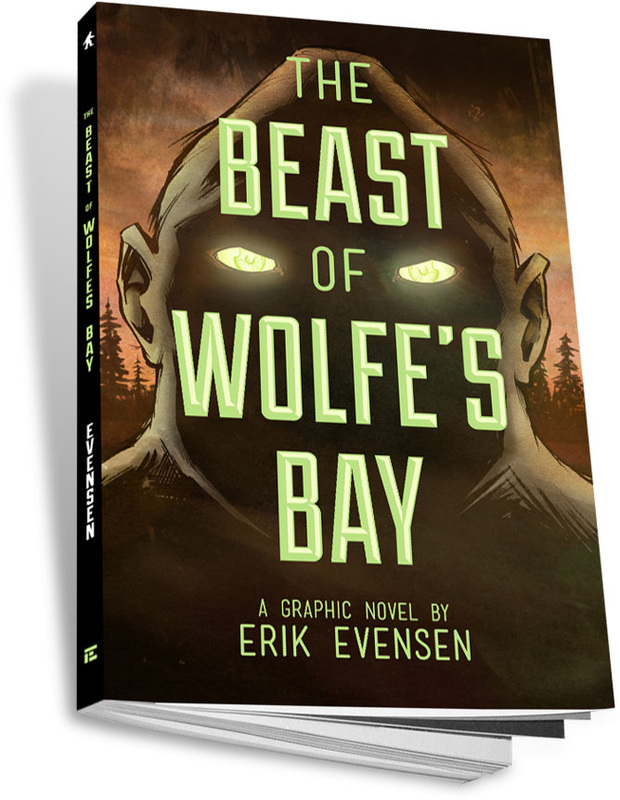 |
| via Wolfe's Bay |
***** (out of five)
Bikini Cowboy Vol. 1 (Fresherluke)
From 2013.
Once in a while you come across something that transcends your normal evaluation of "great." I've read a number of comics from the handy pack comiXology put together that I've really liked, including the above Beast of Wolfe's Bay and the Archeologists of Shadows series. But Bikini Cowboy is better than all of them. If this were a movie, I'd be ranking it alongside similar discoveries like The Fall and The Assassination of Jesse James by the Coward Robert Ford. In my Goodreads review I referenced Quentin Tarantino's Django Unchained as a similarly Weest-shattering experience, and called Bikini Cowboy a modern Peter Pan. It's phenomenal. It's astonishing. And it sneaks up on you. At first it seems as close to absurd as you can get. Girls did not wear bikinis back then. They just didn't. But the longer L. Frank Weber spins his tale, the more it works. The artwork is similar to Sean Murphy, and the story itself is comparable to Murphy's own breakthrough work Punk Rock Jesus. And this is only the first volume? I want to read more. Holy a-cow, Batman!
Based on Chris Hinz's own book Liege Killer, this graphic novel reads like the Philip K. Dick genre but needed a lot more streamlining to have a real impact. The art of Jon Proctor is similar to Tony Harris (Ex Machina), so that kept it visually appealing. Interesting concepts, anyway.
A little too convenient in how it all plays out, and it reads like a student's effort for a classroom writing assignment, but it works, generally, and at least for me, it's a unique comics experience. There's one point where it even takes advantage of the digital format, which is all too rare even today, more than a decade after Scott McCloud gave a lecture in my own school days about the possibilities of the form. I'd encourage a little more of that the next time the Stringfields collaborate.
Bikini Cowboy Vol. 1 (Fresherluke)
From 2013.
 |
| via comiXology |
*****
Binary (ilfeld comix)
From 2013.
 |
| via Amazon |
***
The Black Well
From 2012.
A graphic novel that features the style of underground comix but is generally easier to read, even if Jamie Tanner leaves his story somewhat open-ended. The Black Well might be described as a cross between The Island of Dr. Moreau and Kafka's Metamorphosis. It's pretty interesting.
 |
| via Lulu |
****
Blastosaurus #1 (Square Planet)
From 2014.
I...guess this is kind of the dinosaur version of Terminator. Not terrible. It is terribly imaginative, but all I can really say beyond that is that it's not really for me.
From 2014.
 |
| via All Comic |
***
Bob and His Beer
From 2012.
 |
| via Comic Vine |
****
Boobage (Lipstick Kiss Press)
From 2013.
Literary-style, you know, the kind of comic book and/or graphic novel that usually gets all the mainstream love and/or awards; more graphic novella than novel, basically a one-shot, because it's about as long as a standard issue; all that being said it's a pretty good, enlightening read on the insecurities of a small-chested woman, her perspective growing up. The only problem is that it doesn't really nail the landing. Is this an excerpt, then, for something Gallagher will later release? She's talented either way.
****
Brandi Bare
From 2014.
It's not really bad, per say, but the book remains open, as it were, if Joe Pekar is doing this comic for reasons other than the cheesecake factor. There are plenty of cheesecake comics out there, and most of them disguise their intentions by doing genre work of some extraction.
From 2013.
 |
| via Comic Vine |
****
Brandi Bare
From 2014.
 |
| via comiXology |
***
The Bunker #1 (Oni)
From 2014.
 |
| via Rhymes with Geek |
*****
Tuesday, March 4, 2014
Cataclysm # 0.1 (Marvel)

(via CBDB)
writer: Joshua Hale Fialkov
artist: Mico Suayan, Mirco Pierfederici, Leonard Kirk
Marvel's Ultimate Comics line originally debuted in 2000. The whole idea was to present readers with a soft reboot, an arena with which to rediscover old favorites from the beginning of their adventures. In 2014, that idea looks a fair bit different, and a book like Cataclysm is hardly likely to improve matters.
The legacy of the Ultimate concept is considerable, but only in two aspects: it gave birth to the cinematic Avengers and Brian Michael Bendis is still writing Ultimate Spider-Man (as of a few years ago in his very own model, Miles Morales). Other than that, the original idea gradually lost its point when it became clear it was generally unsustainable, that fans were never going to follow these comics the way they had and still do the original Marvel universe, and that creators given the option to make the Ultimate version of events more gritty sabotaged the entire line to the point where although the story continues it has not only lost all relevance but has also become just as impenetrable to new readers as, well, the original Marvel universe. Probably moreso at this point.
Cataclysm, again, is a good (?) example of that. It presents Galactus as a new threat to the Ultimate reality, even though there was already a years-long event with the Ultimate version of Galactus (which I believe was the basis for the much-maligned version in Fantastic Four: Rise of the Silver Surfer). Really, the only reason the Ultimate reality still exists at all is because of Ultimate Spider-Man. And as soon as Bendis stops writing him (/them), this whole thing will end up like 2099 (although good news for Morales and Bendis, Spider-Man 2099 continues to be the only lingering element of that experiment). It's just a bunch of nonsense at this point.
This is no real judgment on the creators. Had Marvel limited the Ultimate reality to a few mini-series, the way it has recently turned to the "Season One" graphic novels to reintroduce origins to new readers, the way the first few Ultimates adventures that introduced the Samuel L. Jackson version of Nick Fury were released (the only real argument against this remains Bendis and his Ultimate Spider-Man, by the way; that run is directly responsible for his whole Marvel career) readers would have some nifty graphic novels to enjoy and maybe one or two definitive, iconic stories.
The latest rube to write for the Ultimate experiment is Joshua Hale Fialkov, one of the many DC defectors who became upset with issues of creator rights. Fialkov was another one who seemed to have such a bright future ahead of him, too, and now he's writing something like this. Again, it's not so much the work itself but the concept that fails him.
The Ultimate version of the android Avenger known as Vision, which seems to be completely different from the regular version of the character, is in the spotlight, and Fialkov does a fine job writing from her perspective. That much is perfectly fine.
But you have to question why yet another Ultimate crossover event/reboot is even happening. Does Marvel really think any of this is still salvageable? That the whole concept isn't straying further and further from the original point, all because someone realized a pocket universe can get away with things regular continuity can't, like killing off key characters like Peter Parker and Wolverine? The only readers who will care at this point are those who were there at the start, or can still be convinced that this is a cool concept.
It was cool in 2000. Now it's just old and tired. And increasingly pointless.
Thursday, March 14, 2013
Quick Hits: Legends of the Dark Knight #5 (DC)
I love anthology titles because it increases the possibility for welcomes surprises, and this particular issue of Legends of the Dark Knight is exactly what I'm talking about. I've been trying to find ways to appreciate Joshua Hale Fialkov short of making a commitment to I, Vampire (which if I didn't have to worry about money would probably have been a series to follow since its launch, but looked for all appearances to be something that would've been cancelled long ago), and so along with the recent news that he'll be one of the lead writers in the Green Lantern creative relaunch this was the best thing I could've discovered. It's a Batman story featuring the classic detective character Slam Bradley (I think I'd respect the much ballyhooed Gotham Central if it had featured more cowbell, I mean Slam Bradley). And what's more, it's illustrated by Phil Hester. I love Phil Hester. I don't have a clue why more people don't love Phil Hester. He's known for his art, which on fine display here, but he's also a killer writer, as evidenced by anything from Golly to The Anchor. I would've loved this issue regardless, but it was enjoyable too!
Wednesday, February 22, 2012
Quarter Bin #31 "Catching up with Waid, Fialkov, Robinson, & Morrison"
THE FLASH #150 (DC)
From July 1999:
This is the conclusion of the six-part “Chain Lightning,” one of Mark Waid’s final Wally West epics (before the “Dark Flash Saga,” which I’d never heard about beware doing a little research, and the poorly-received latter-day reprise of “The Wild Wests”). I tracked this one down because “Chain Lightning” was a story I was abruptly forced to quit when I weaned myself off comics in 1999, and I was always curious about how it ended. With art from Paul Pelletier, as it turns out. Pelletier was a favorite of mine, thanks in no small part to his work in SUPERBOY AND THE RAVERS, so it was nice to discover that he was another of the fine artists who worked with Waid on THE FLASH (there’s a laundry list). Anyway, also with a nod to CRISIS ON INFINITE EARTHS, long before Geoff Johns wrote a sequel, during a time when fans might’ve believed that they had already heard all there was to know about that event. Wally’s predecessor and mentor, Barry Allen (and this was long before anyone suspected Barry himself would make a comeback) famously met his end in that story, and so “Chain Lightning,” which had already introduced Barry’s apparent evil twin, the original Thawne, built toward Wally finally facing that moment, with complicated results, and once again affirming that his legacy wasn’t to carry on Barry’s but to build his own. It’s certainly an interesting issue to read for any of the reasons you can gleam from these thoughts.
ELK’S RUN #1 (Hoarse & Buggy)
From 2005:
I first came upon the name Joshua Hale Fialkov when I was a part of the Digital Webbing community, and his name was already kind of legendary thanks to his work on this mini-series (I don’t know what happened to the publishing company Hoarse & Buggy, but ELK’S RUN could easily be published by Image or Vertigo today), which was his first published comics work. Today he writes I, VAMPIRE for the New 52. ELK’S RUN is something I’ve meant to read since I first heard about it, and so I’m finally making good on that personal commitment, and this issue is a fine reason to believe the rest of it is equally excellent. Fialkov remains someone I believe will make a huge impact on the comics landscape, and I’m happy to have been there at the beginning. Well, close enough.
JSA #1 (DC)
From August 1999:
James Robinson, still flush from his STARMAN success, helped launch the new adventures of the Justice Society along with David S. Goyer (and an opening push from Grant Morrison), lending Jack Knight and his gift for getting at the heart of the connectedness at the heart of a shared superhero community. The series continued, with another relaunch added in the mix, until the New 52, where it’ll soon be reborn, again under the auspices of Robinson, as EARTH 2. I thought, thanks to my recent experience reading STARMAN, that I should read at least the start of his JSA.
JLA #31 (DC)
From July 1999:
I’ve been playing catch-up with Grant Morrison’s JLA for the last several years now, finally reading the complete ONE MILLION and “World War Three,” and now the conclusion to “Crisis Times Five” (which curiously ran for four issues). As I indicated above, this is the story Morrison did to help launch the new Justice Society, which in Morrison’s hands is predictably more grandiose than written by anyone else. Mixing the imps of the 5th Dimension with Thunderbolt formally in the possession of Johnny Thunder, the League joins forces with the new Hourman as they confront Triumph, the DC equivalent of Marvel’s Sentry.
JLA CLASSIFIED #s 1-3 (DC)
From January-March 2005:
As I’ve said before, I was inexplicably avoiding Morrison during my transition back into reading comics around this time (it was SEVEN SOLDIERS OF VICTORY that convinced me back aboard), so I should have been enjoying these issues as they were released. Instead it took a few more years. One of my main hooks was experiencing Knight and Squire in some of their original modern tales, after Morrison bringing them back along with the rest of the Club of Heroes, and eventually the excellent Paul Cornell mini-series, and truth be told, although billed as an Ultramarines tale (they were a team Morrison introduced in his JLA run), the British Batman & Robin are more or less the stars of the story anyway, so that was pretty awesome to learn. There’s also clear foreshadowing for SEVEN SOLDIERS, plus the joy of reading Morrison writing the League again, which was assumed to be the hook in the first place, as well as art from Ed McGuinness. As it turns out, I was an idiot to avoid this the first time around, but the truth is, I probably appreciate it more now. By the way, nobody writes Gorilla Grodd like Grant Morrison.
From July 1999:
This is the conclusion of the six-part “Chain Lightning,” one of Mark Waid’s final Wally West epics (before the “Dark Flash Saga,” which I’d never heard about beware doing a little research, and the poorly-received latter-day reprise of “The Wild Wests”). I tracked this one down because “Chain Lightning” was a story I was abruptly forced to quit when I weaned myself off comics in 1999, and I was always curious about how it ended. With art from Paul Pelletier, as it turns out. Pelletier was a favorite of mine, thanks in no small part to his work in SUPERBOY AND THE RAVERS, so it was nice to discover that he was another of the fine artists who worked with Waid on THE FLASH (there’s a laundry list). Anyway, also with a nod to CRISIS ON INFINITE EARTHS, long before Geoff Johns wrote a sequel, during a time when fans might’ve believed that they had already heard all there was to know about that event. Wally’s predecessor and mentor, Barry Allen (and this was long before anyone suspected Barry himself would make a comeback) famously met his end in that story, and so “Chain Lightning,” which had already introduced Barry’s apparent evil twin, the original Thawne, built toward Wally finally facing that moment, with complicated results, and once again affirming that his legacy wasn’t to carry on Barry’s but to build his own. It’s certainly an interesting issue to read for any of the reasons you can gleam from these thoughts.
ELK’S RUN #1 (Hoarse & Buggy)
From 2005:
I first came upon the name Joshua Hale Fialkov when I was a part of the Digital Webbing community, and his name was already kind of legendary thanks to his work on this mini-series (I don’t know what happened to the publishing company Hoarse & Buggy, but ELK’S RUN could easily be published by Image or Vertigo today), which was his first published comics work. Today he writes I, VAMPIRE for the New 52. ELK’S RUN is something I’ve meant to read since I first heard about it, and so I’m finally making good on that personal commitment, and this issue is a fine reason to believe the rest of it is equally excellent. Fialkov remains someone I believe will make a huge impact on the comics landscape, and I’m happy to have been there at the beginning. Well, close enough.
JSA #1 (DC)
From August 1999:
James Robinson, still flush from his STARMAN success, helped launch the new adventures of the Justice Society along with David S. Goyer (and an opening push from Grant Morrison), lending Jack Knight and his gift for getting at the heart of the connectedness at the heart of a shared superhero community. The series continued, with another relaunch added in the mix, until the New 52, where it’ll soon be reborn, again under the auspices of Robinson, as EARTH 2. I thought, thanks to my recent experience reading STARMAN, that I should read at least the start of his JSA.
JLA #31 (DC)
From July 1999:
I’ve been playing catch-up with Grant Morrison’s JLA for the last several years now, finally reading the complete ONE MILLION and “World War Three,” and now the conclusion to “Crisis Times Five” (which curiously ran for four issues). As I indicated above, this is the story Morrison did to help launch the new Justice Society, which in Morrison’s hands is predictably more grandiose than written by anyone else. Mixing the imps of the 5th Dimension with Thunderbolt formally in the possession of Johnny Thunder, the League joins forces with the new Hourman as they confront Triumph, the DC equivalent of Marvel’s Sentry.
JLA CLASSIFIED #s 1-3 (DC)
From January-March 2005:
As I’ve said before, I was inexplicably avoiding Morrison during my transition back into reading comics around this time (it was SEVEN SOLDIERS OF VICTORY that convinced me back aboard), so I should have been enjoying these issues as they were released. Instead it took a few more years. One of my main hooks was experiencing Knight and Squire in some of their original modern tales, after Morrison bringing them back along with the rest of the Club of Heroes, and eventually the excellent Paul Cornell mini-series, and truth be told, although billed as an Ultramarines tale (they were a team Morrison introduced in his JLA run), the British Batman & Robin are more or less the stars of the story anyway, so that was pretty awesome to learn. There’s also clear foreshadowing for SEVEN SOLDIERS, plus the joy of reading Morrison writing the League again, which was assumed to be the hook in the first place, as well as art from Ed McGuinness. As it turns out, I was an idiot to avoid this the first time around, but the truth is, I probably appreciate it more now. By the way, nobody writes Gorilla Grodd like Grant Morrison.
Wednesday, November 30, 2011
I, Vampire #1
Writer: Joshua Hale Fialkov
Artist: Andrea Sorrentino
Fialkov (Elk's Run) is one of the big new writers to be introduced to DC readers in the "New 52." To have him on one of the riskier launches is a mark of trust on the part of the company.
For me, this is one of those classic doomed-to-fail titles, like Simon Dark, something that tries to introduce something new to regular readers, succeeds in making something special of itself, but fails in making a connection with actual readers. The difference is that I, Vampire is making a bold move for Twilight Saga fans who may now be wondering what to read next, who might have a different take on the vampire romance concept, what might happen next.
The genius of the timing is that I, Vampire is part of a high-profile relaunch that has connected with the pop culture zeitgeist, and so has a better chance of succeeding than it first seems. Fialkov is a quality writer and this is his most visible gig so far. Given that Jeff Lemire's Animal Man is getting a lot of attention, that makes it that much more likely that another horror title will be able to succeed. Whe that other horror title is I, Vampire, it seems like good news for Fialkov.
Subscribe to:
Posts (Atom)