The Adventures of Superman #473 (DC)
From 1990.
 |
| via DC Wikia |
Dan Jurgens is known for creating Booster Gold and killing Superman. Before
Superman #75 he spent a considerable apprenticeship to become the successor of
Man of Steel rebooter John Byrne. It's not like he came out of nowhere to introduce Doomsday, though it probably seemed that way to everyone who came just for the big event. It turns out there was also considerable lead-in to the crucial role Hal Jordan would play in the follow-up "Reign of the Supermen" climax. Jurgens had also been employing Guy Gardner in another of his successor projects,
Justice League, in which he followed the Giffen/DeMatteis/Maguire act. Gardner and Superman were teammates in that book. This is an issue that brings Superman, Jordan, and Gardner together, and even by the cover alone is a reminder that Jordan had a rough time of it from the start of that particular
Green Lantern reboot, which was also the start of Gardner's solo push. Seeing these elements interact well before they hit the grand stage was a moment I had to include in the binge, beyond a doubt. The story itself is meaningless, but it's also more than worth noting that the issue opens with Lois showing off the engagement ring she's just gotten from Clark, because the later wedding was
postponed deliberately by the Doomsday business because of the
Lois & Clark TV series. It's always good to remember context. Jurgens also used Jordan to considerable effect in the pages of
Zero Hour, meanwhile, the conclusion of his hot streak. And then everyone started reducing his career to "the guy who killed Superman." Even his art, here inked by Art Thiburt, is crisp, something altogether removed from the Jurgens who would later be accused of being out of touch. I think it was his notoriety that made it so easy for Jurgens to be dismissed, being so closely associated with one of the biggest moments in comics history, and one of the first to be later dismissed as a publicity stunt, although it wasn't.
The Adventures of Superman #516 (DC)
From 1994.
 |
| via DC Wikia |
The debut of Alpha Centurion, although the supporting character who appeared in later comics is more or less a completely different character, this one's written by the frequently underrated Karl Kesel, who along with Stuart Immonen provided the most reliable material for the concept. The
Zero Hour issues across the line provided DC a chance to revisit older continuity due to the changes that were occurring in the timeline thanks to the event, but this was a marked departure. The Superman zero issues themselves introduced another new character, Conduit, a villain this time, which was in-step with a company-wide effort to refresh the landscape with new and updated concepts. Alpha Centurion is much like the current Ulysses, although in the Roman's case he became soiled by association with Lex Luthor and the Contessa, a relationship featured in...
Superman: The Man of Tomorrow #2 (DC)
From 1995.
 |
| via Comic Vine |
Man of Tomorrow was a "skip week" title, as in what DC published in its weekly Superman cycle when there were five instead of four weeks in a month, or in other words perhaps the series that made the franchise wear out its welcome in the '90s, that and the steady stream of climactic arcs ("Doomsday"! "The Death of Clark Clark"! Electric Superman!). At the time it also brought back creators who hadn't been used in the titles for a while, in this instance Roger Stern, who at one time had written
Action Comics, and Tom Grummett, whose work on
Adventures of Superman had included the debut of Superboy. This issue involves Lex Luthor's post-
Underworld Unleashed revitalization (the long red hair and beard of the '90s Luthor who was originally called Luthor's son was in fact a clone meant to replace the body poisoned by years of wearing a kryptonite-studded ring; the frail body left when the ruse was exposed lead to the Lex Luthor we know best today, the calculating villain who could pose a positive public face) as well as his relationship with the Contessa, the only character who ever stood toe-to-toe with him, and the in-continuity version of Alpha Centurion's debut. The noble time-displaced hero becomes a pawn of the Contessa's but never a villain, it should be noted.
The Adventures of Superman #1,000,000 (DC)
From 1998.
 |
| via DC Wkkia |
DC One Million was a Grant Morrison event spinning out of his
JLA. This particular tie-in is a reminder that the event attempted to elevate
Resurrection Man, whose title character is heavily spotlighted in the issue. Creators Dan Abnett and Andy Lanning later became known for their Marvel sci-fi titles and DC Western efforts, but the hero who died, came back with a different power, and was as such one of several immortals on the playground added one of the many twists to the event as far as legacies explored were concerned. DC liked the idea well enough to attempt a, well, resurrection of
Resurrection Man in the New 52 reboot, but the concept wasn't much more popular then, either.
Superman: The Man of Tomorrow #1,000,000 (DC)
From 1998.
 |
| via DC Wikia |
In this
DC One Million issue, the histories of the Superman dynasty and Solaris, the Tyrant Sun and villain of the event are explored, making it a pretty crucial tie-in. For me the
most significant aspect of the issue is artist Georges Jeanty, one of the first artists to convince me Superboy could survive without Tom Grummett. Jeanty later went on to have an extended run illustrating
Buffy the Vampire Slayer comics for Dark Horse, and has returned to DC in the pages of
Batwoman.
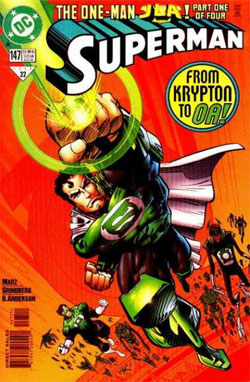
Superman #147 (DC)
From 1999.
 |
| via Superman Homepage |
One of the things I never really understood was why, if it was a shared universe, there was always so little emphasis on who the Green Lantern for the sector of space Krypton occupied, they had so little to do with its destruction. Actually, that Lantern was Tomar-Re, a now-deceased Corpsman who was integral to Hal Jordan's early career (as reflected in the
Green Lantern movie). Superman himself would seem to be a natural as a selection for the Corps (the idea was bandied about to have Clark Kent glimpsed as the ring looked for a new host in the movie). There was a neat Elseworlds comic called
Batman: In Darkest Knight, which you can figure out for yourself. This comic comes from 1999, the year I gave up reading comics for half a decade to save money for college, so it features an arc I hadn't previously known about, Superman exploring various different fates had things turned out differently for him. You've got to remember, too, that at the time, there
was no Green Lantern Corps, only the one, Kyle Rayner, so a cover
with a Corps is itself a novelty. The writer is Ron Marz, who guided Rayner throughout his early career, so he certainly knew the lore. The issue also features one of those periodic Hal Jordan appearances post-Parallax, although this is a reality where none of that happened. Also present is Sinestro, who had more presence "Emerald Twilight" and afterward than he'd had in years. In fact it might be said that Jordan's downfall was a huge
windfall for Sinestro. He became relevant again, which eventually led to everything Geoff Johns did with him, and now an ongoing series of his own.
Superman #155 (DC)
From 2000.
 |
| via DC Wikia |
Another thing I missed was Jeph Loeb's Superman prior to
Superman/Batman, his last universally-heralded creative run, which included one of his collaborators during that time, Ed McGuinness. This was the start of a soft reboot, in which you could pretty much forget the '90s ever happened, when DC was once again struggling to prove that the Man of Steel was still relevant. (On a side note, isn't it a little odd that McGuinness has never done an out-and-out Shazam project? Just going by that cover, you'd think he would be an obvious selection!) One of the biggest beneficiaries of the soft reboot, in a way, was Lex Luthor, who was extricated in a heartbeat from all the shenanigans of the previous decade (which in a way was a very bad thing, at least concerning the Contessa and Luthor's daughter with her). The issue opens with Superman and Luthor in one of those improbable we're-buddies moments Luthor helps stage for the benefit of the public. It also has, as the cover shows, Superboy in one of his earliest let's-hang-out-with-the-Kents moments. Some of the developments are keyed in to that era: Luthor about to run for president, Lois being estranged from Clark. Loeb's trademark narration, used sparingly this time, comes from Pa Kent. I know Loeb is working for Marvel's media division these days, but I'd love for him to make a committed return to comics themselves...
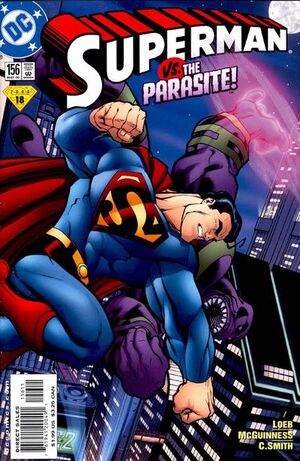
Superman #156 (DC)
From 2000.
 |
| via DC Wikia |
The story continues! Loeb's narration begins by quoting a Clark Kent newspiece on Superman's activities, but then becomes Perry White's thoughts on Clark's problems with Lois (it should be noted that
Lois & Clark had been over since 1997, so any soap opera elements were strictly comic book material). Involved in this state of affairs is Wonder Woman. This was years before the New 52 reboot, mind you, years before
Superman/Wonder Woman, years before Clark and Lois actually split up and a romance formed between the Man of Steel and the Amazon Princess. But an idea that was too good to pass up apparently came up at least once before, in more innocent form. It should be noted that if the soft reboot hadn't taken place, Lois's behavior in the issue wouldn't make any sense. I wonder how readers reacted at the time. The ones who write into letters columns always tend to like bold new creative teams. It was likely a different story in the budding online community, where everyone basically hates everything...
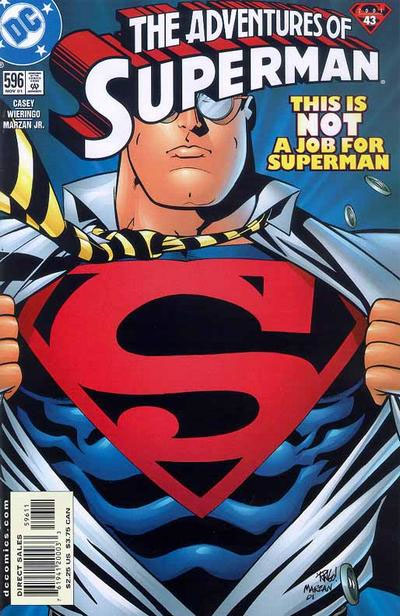
The Adventures of Superman #596 (DC)
From 2001.
 |
| via Recalled Comics |
This issue shipped the day after 9/11. The debut of the black S-shield and the aftermath of the
Our Worlds At War event are one of the coincidences that cropped during that time. Featured is a confrontation between Superman and Flash villain Weather Wizard. Suffice to say but Superman handles this particular Rogue a little more...directly. Also featured is President Luthor, who attempts once again to paint Superman in a bad light, only for an ordinary construction worker to put things into perspective. The artist might seem to be more Ed McGuinness, but it's actually the late, much-lamented Mike Wieringo, known as Ringo to his fans. I loved his work in the pages of
The Flash and
Robin. Even though he died in 2007, it seems like it's been far longer. He remains greatly missed.
Superman #179 (DC)
From 2002.
 |
| via DC Wikia |
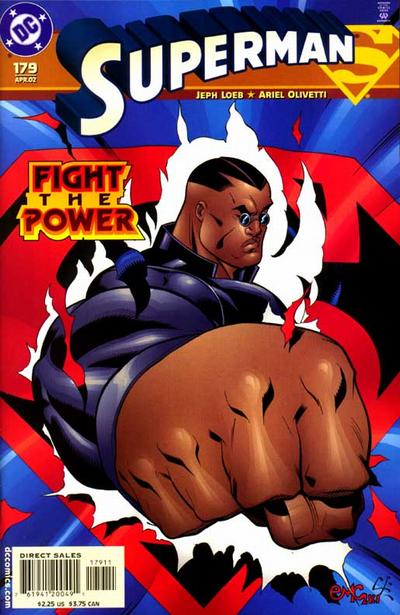
This is one of the stories that addressed Superman's continued relevance directly, as he ends up in a black neighborhood and confronted by a black superhero he's never even heard of, Muhammad X (Jeph Loeb cobbled the name from Muhammad Ali and Malcolm X, as the character himself explains). Although the whole lesson is pretty obvious, I like the unusual perspective the character still manages to bring to the proceedings. It'd be interesting to see him return, if he would feel compromised. Anyway, Lois (their relationship, it seems, didn't end after all, at least at
that point) convinces Superman to talk with Steel about his concerns, but he ends up with talking with Steel's niece, Natasha Irons, instead. Stargirl happens to be present as well. "Have you ever heard of 'Muhammad X'?" he asks. "Have
you ever heard of
Batman?" she responds. She lists a bunch of other black heroes, Rush, Silence, Stoneyard, Underground, none of whom exist outside this issue. Superman later talks to Martian Manhunter (one of the green skins another black man might have referred to in
Green Lantern/Green Arrow #76) and references Black Lightning (he's a member of Luthor's cabinet, it might be noted) and Mr. Terrific. Aside from the point the comic is trying to make, it's also interesting to note that Loeb at least is capable of acknowledging that no matter how many heroes DC has running around that
readers know about, there are likely many more that they
don't, a little of what happens to characters after their series have been cancelled, only it applies to others as well. Muhammad X also represents some of the more violent superheroes DC experimented with, such as those who appeared in
Justice League Elite following the appearances of Manchester Black, another character who challenged Superman during this period.
Action Comics #791 (DC)
From 2002.
 |
| via DC Wikia |
I picked this one up because of its gorgeously offbeat, evocative cover, which looks like it has Tim Sale written all over it, but the artist is actually John Paul Leon. The story inside takes a flashback to Clark Kent's Smallville days, as the cover might also tell you, and it's about bullying, but it also reveals that Clark isn't just a superhero because of his powers, but because of the values instilled in him by the Kents, something that's sometimes overlooked. The perspective of the story is interesting, because by some interpretations the feelings of isolation in the girl Clark (yes,
Clark, not
Superman) saves are shared by Clark himself (certainly in the movie
Man of Steel, less so in
Smallville), who is sometimes depicted as a jock and sometimes as someone who
can't be a jock (
Superman the movie). It's a nice issue, and certainly fits in with the era nicely.
Superman #185 (DC)
From 2002.
 |
| via DC Wikia |
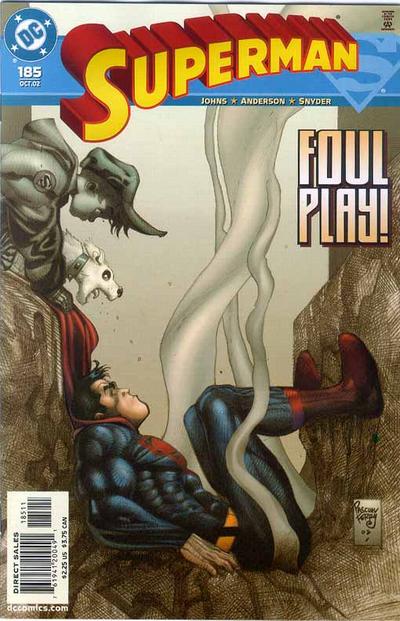
Here's one of Geoff Johns' earliest Superman stories. The Man of Steel smashes into a softball field (there's a real American image right there!) in the midst of a fight with Major Force (who may forever be associated with the women-in-fridges moment from
Green Lantern), one of those real brawls fans always want Superman to have in the movies (uh...until they got it in
Man of Steel). Johns seems to use Major Force in much the way Grant Morrison later would classic Superman villain Metallo, as a kind of experiment in what would have happened in the Man of Steel had become a tool of the U.S. military. At the end of the fight, Superman leaves Major Force looking...very much like what happened to Wolverine at the end of
Death of Wolverine recently. I don't think any of these kinds of parallels are intentional, but it's certainly interesting to see them happen.
Action Comics Annual #11 (DC)
From 2008.
 |
| via DC Wikia |
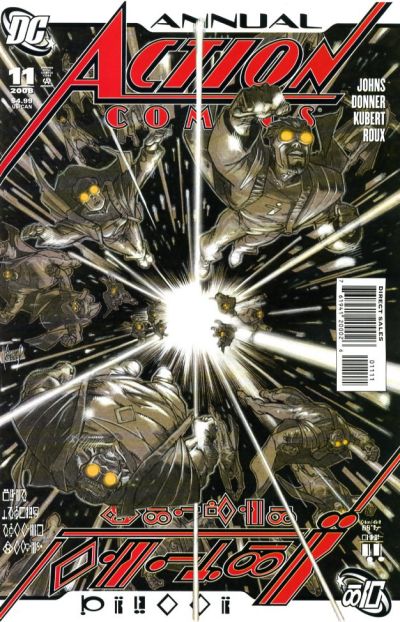
Here's the conclusion to a different Johns story entirely, when he'd returned years later for the start of a proper Geoff Johns run on Superman, starting out working alongside Richard Donner for the second time in his career (Johns famously began his working career as Donner's personal assistant), the finale of "Last Son," in which the son of General Zod becomes the
adopted son of Superman (Rick Remender has recently done a kind of echo of this in the pages of
Captain America), the Chris Kent later featured in the pages of Grant Morrison's
The Multiversity: The Just. The character was also featured in the "New Krypton" arc in the guise of the Kryptonian hero Nightwing, after whom Dick Grayson named his post-Robin superhero personna, and in a different incarnation is the Superman of
Earth 2.
Superman: Birthright #12 (DC)
From 2004.
 |
| via DC Wikia |
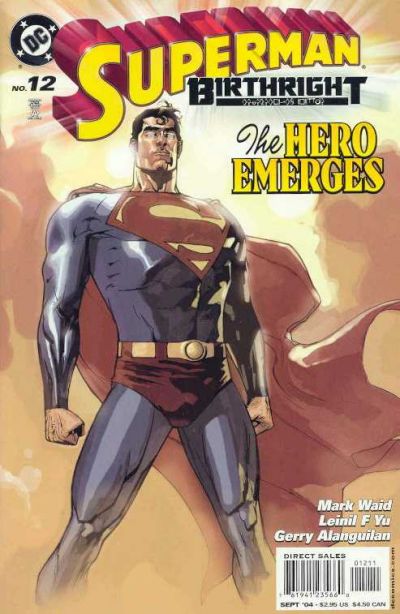
A Mark Waid project. There was a time when I was hopelessly devoted to Waid's career and believed he could do no wrong. That version of me would still have existed in 2004, but ten years later things are a little different. What about a project
from 2004? A twelve-issue miniseries where I've read only the concluding chapter, and without doing the research I must assume that the whole story is basically a Year One story where Lex Luthor tries to prove how bad Superman is by perpetrating a whole hoax of a Kryptonian crisis, which culminates, of course, in Luthor's defeat, but on a pretty nice note where it's
this context where Superman learns about his origins for the first time (there are many versions of
that, too). It strikes me as very similar to Scott Snyder's
Superman Unchained. But more on that another time...
Superman/Shazam: First Thunder #4 (DC)
From 2006.
 |
| via DC Wikia |
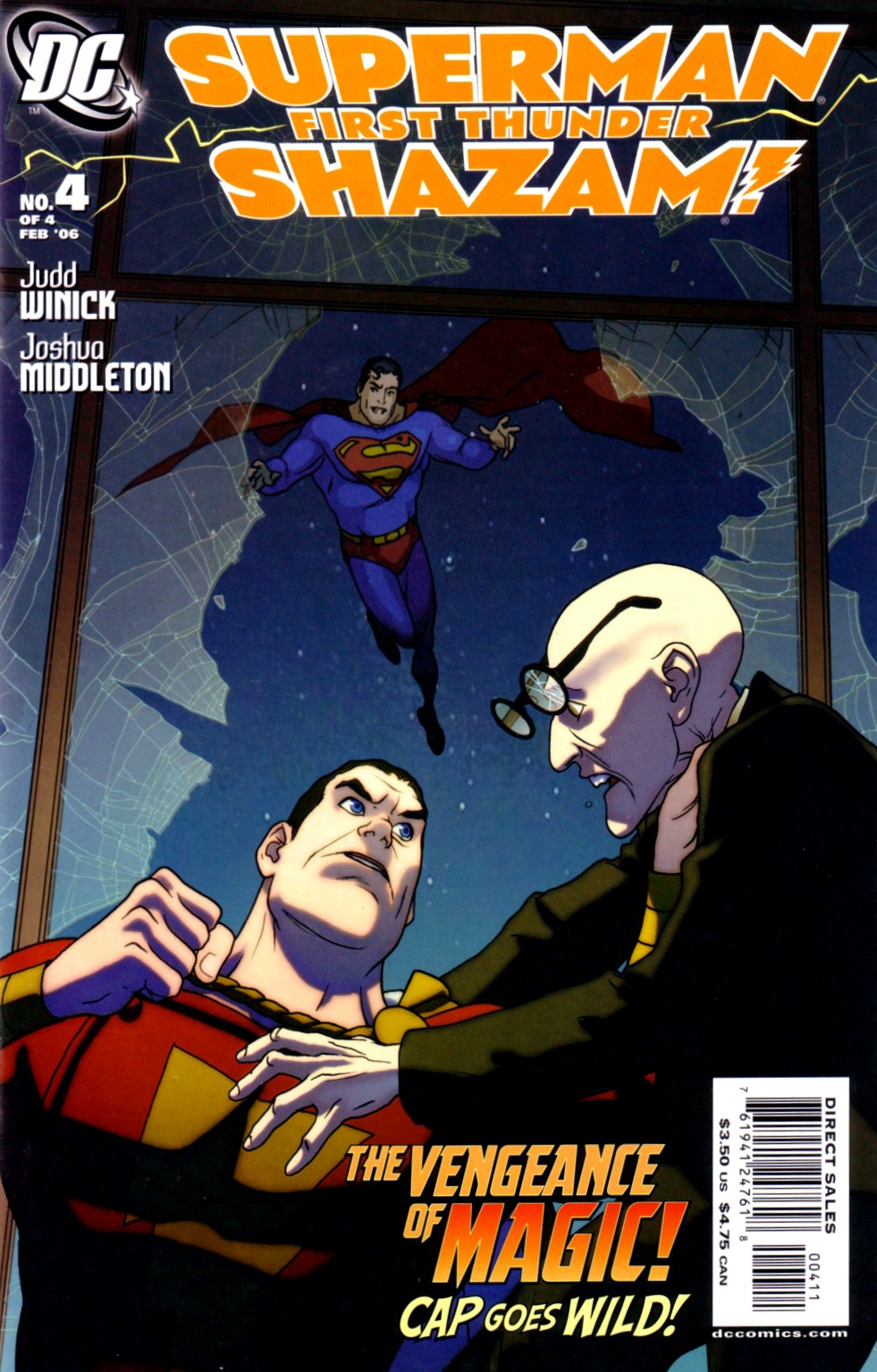
If you asked the survivors of Fawcett Comics decades ago what they would've thought of a shiny happy Superman/Captain Marvel team-up mini-series...the results would probably not have been suitable for a family-friendly blog. DC put Fawcett out of business when it successfully accused its hugely popular lead character of being a shameless ripoff of Superman (just one of the many legal battles Captain Marvel spawned; there's a whole saga associated with his British counterpart Marvelman, also known as Miracleman, a revival Marvel has only recently made possible after remaining in limbo for two decades). The writer is Judd Winick, who at one time had a massive tide of his own popular acclaim, but gradually lost, well, pretty much all of it, and I guess I still don't quite understand why. I've always liked what I've seen of his work. Actually, I guess I'm not really a
Barry Ween fan. Still haven't read
Pedro and Me. This comic seems like it's more of the good stuff, perhaps even some of his
best stuff. Captain Marvel/Shazam (because
Marvel ended up creating an
unrelated character named Captain Marvel, an incarnation of which was famously killed off by Jim Starlin in an groundbreaking graphic novel,
this Captain Marvel eventually
lost the right to be called anything else but Shazam by DC) has had a number of efforts given him at re-establishing his credentials, and like Martian Manhunter, by my estimation, has looked excellent in all of them, but he's lost the popular vote. It's a shame. It's ironic that this particular effort exists at all, because in a weird kind of way, Shazam as interpreted from a Superman perspective totally works...