Here's a rundown of what I've been reading lately, sort of a hodgepodge of new and slightly less new material (new titles in bold, slightly les new titles in italics):
Batman #23, 25, 26 (DC)
Tom King is still doing wonders in this title. The first issue is the Swamp Thing issue, while the latter two are the beginning of "The War of Jokes and Riddles". I was thwarted in my attempts to find a copy of #24 (the proposal issue) and Batman/Elmer Fudd, alas.
Dark Knight III: The Master Race #9 (DC)
Miller/Azzarello/Kubert finally delivered the conclusion of this story. I like how the ending is basically that Batman is finally acknowledging that he can learn from someone else. Seems like a metaphor, Miller's concession that it was okay for Azzarello to help out.
Codename: Baboushka #1, 3 (Image)
What with Atomic Blonde hitting screens soon (based on his Coldest City graphic novel), I figured it was time I had a look at another Antony Johnston spy comic. It's good stuff.
Dark Days: The Forge (DC)
The title of this event and the manner of starting it are peculiar things that still elude me, but this particular piece struck me as pure Scott Snyder. He may not be my favorite, but I'm glad he's finally getting to tell a DC event comic.
Earth 2 #24 (DC)
Funny to go back to the early days (relatively speaking) of Earth 2 and read the story where this reality's Superman first reveals his costume. Also interesting to see the Thomas Wayne Batman in action. That's honestly one of my favorite Earth 2 elements to this day.
Earth 2: World's End #7 (DC)
The weekly comic spinoff got crapped on ten ways to...Wednesday, I guess. But it reads okay to me, every time I sample it. Includes a nice nod to the "lost" Alan Scott gay storyline from Earth 2's early days.
The Flash #14 (DC)
It's, I don't know, hilarious or sad, but I was reminded recently that Josh Williamson worked on Captain Midnight, a Dark Horse comic that received a Free Comic Book Day back in Williamson's pre-DC days, and a collection I received from one of those crate companies a few years back. I was not a fan. I outright dismissed it both times. So this is one of the more remarkable turnarounds I've experienced as a reader, because I remain a fan of Williamson's recent work. I'm torn about rereading the Captain Midnight collection. What if I dismissed it for all the wrong reasons? What if I convince myself I like it now just because I now associate good things with Williamson? Anyway, this issue begins a Rogues arc.
Green Valley #1, 2, 3 (Image)
Max Landis made a name for himself writing the movie Chronicle, but I became a fan reading Superman: American Alien. I'm glad I got around to reading some of his original concept comic Green Valley, about knights being confronted with what as of the last issue I read seems to be a time-traveling dude from more or less the present with future tech he doesn't really understand.
Justice League Dark #35 (DC)
Focuses mostly on Zatanna. Honestly, if her main distinguishing feature weren't casting spells by speaking backwards, Zatanna would be so much bigger. Also glimpsed: Frankenstein and the lead from I, Vampire, two relatively short-lived New 52 characters whose series I caught up on in their collections a few months back. Also, Zatanna's Identity Crisis actions are coming back to haunt her in the Rebirth era. That's cool.
Justice League #33 (DC)
Funny to see what's become of the concepts Geoff Johns was exploring in this issue: 1) the Doom Patrol, in a different incarnation, now stars in a Young Animal series, 2) Jessica Cruz now stars in Green Lanterns, and 3) Lex Luthor has continued his strange heroics in the pages of Action Comics. Clearly fruitful ideas, Geoff!
Justice League vs. Suicide Squad #1 (DC)
Love that DC gave Williamson a soft event book. He deserves it. Also love that Max Lord is revealed as the villain on the last page.
King #1 (Jet City)
I really wish Joshua Hale Fialkov could enjoy greater exposure. This thematic update of Kamandi, however, is probably not the best way to go about it, entertaining though it may be.
Monstress #1, 12 (Image)
This is one of those books I've heard and heard and heard about, and so I figured I should finally have a look at it. The extra-length first issue was reprinted at $1.99, so I scooped that up, plus what's counted as the most recent issue for a few months now (returning from hiatus soon!). Marjorie Liu actually kind of interests me more as a creator who like Gene Yang is bringing an international voice to the table. Seems a lot like Saga, insofar as it includes random elements of mature material.
Saga #43 (Image)
Speaking of which! This special twenty-five cent issue (it's Image's 25th anniversary, yo!) was practically a gimme on two scores: 1) the price, obviously, and 2) the price combined with the fact that I've been a faithful reader in the past, but've lapsed in recent years. So here was my chance to catch up. Again the series seems almost as interested in cheap shock tactics as decent storytelling, which is what bumped me off the bandwagon, the seeming increased inability to balance these instincts. I guess at this point it seems necessary, the cheap shock tactics. The tactics this issue, of all issues (!), where potential new readers might have no idea what they're in for, include what's apparently a flippant trip to an abortion clinic, which is such a galvanizing issue, where you'll either get people to love or hate you depending on your conclusions. And what's become typical of Saga, it reaches different conclusions (probably) than what they initially seem. So I don't really know if I should care about this series again...
Saucer State #1, 2 (IDW)
I could not have been happier when Paul Cornell announced that his short-lived Vertigo series Saucer Country was due for a revival at IDW. So when I had a chance to scoop it up, I scooped it up. Funny that artist Ryan Kelly seems to have somewhat changed his style since the last time he drew these characters, but colorist Adam Guzowski does what he can to keep thing fairly consistent. The story itself remains intriguing, by the way!
Superman: Doomed #2 (DC)
I've been trying to track this down (not too hard, but y'know) for a while, so I'm glad I finally succeeded. This update of Doomsday not only led to the short-lived Doomed series that saw an updated Alpha Centurion debut in the New 52 (!), but also featured Brainiac a relative handful of months before his big New 52 event, Convergence, which this issue, knowingly or otherwise, alludes to. There were so many complaints about Superman in the New 52, but I think a lot of them were a result of previous complaints that just kept snowballing rather than had a real basis in the comics themselves. This was good stuff.
Superman #33, 42 (DC)
Speaking of Gene Yang (a little earlier; feel free to scroll up a little!), the latter issue is one of his, while the former is Geoff Johns'. I think this was an especially good time to be reading Superman, personally, and yeah, it was New 52 material.
Wonder Woman #1 (DC)
Greg Rucka got a lot of hate, surprisingly, for his Rebirth run. I guess he was too ambitious. He ruffled feathers by contradicting Brian Azzarello's New 52 run (even though it wasn't all that popular...until fans didn't much care for the Finch run that followed it). I still want to get around to reading more of it. It's funny that the origin story is being revisited so much lately. Just goes to prove how neglected the character has been. If she were as popular as she is important, this would not be happening.
Showing posts with label Saga. Show all posts
Showing posts with label Saga. Show all posts
Sunday, July 23, 2017


Friday, July 10, 2015
Reading Comics 168 "7/8/15 - One of the Best Weeks of the Year"

To say last week was disappointing for a comic book addict like me would be an understatement. This is not to say that there nothing worth reading, but nothing that interested me, nothing from my pull list and, well, nothing else that I wanted to read.
So this week was an embarrassment of riches. Very good (or very bad) for a comics addict. I ended up reading a bunch of stuff I hadn't read previously, or continuing to read stuff that I don't typically read, or enjoyed a bunch of new stuff, and of course a bunch of stuff I've been reading all along.
Kicking off is Batman #42 (DC), the second issue of the Bat Gordon era. Visually the costume in full armor still looks and will always look ridiculous, and Gordon's military haircut looks ridiculous, but...this is still the best Batman Snyder has ever written. It's the first time he's allowed himself full control, and it shows. The fact that astute readers knew Bruce Wayne was never dead, and Snyder has shown every willingness to play along, keeping him in every issue "post-death," including the issue with "his death" after "his death," this is what I've been waiting for. This is an exercise in patience. Obviously this is an exception, and if it hadn't been hugely popular from the start, DC would never have stuck around this long. But thankfully this is an instance where popularity eventually gives way to material justifying the hype. I don't know how popular this material will be, in the short- or long-term, but I have to imagine, however much longer Snyder sticks around, he will be back to writing Bruce Wayne as Batman, and will be the better for having this experience under his belt.
It's also clear that the villain concept was in part an excuse for Capullo to do a version of Clayface after discovering how well he does it visually in Batman #20 (excellent cover). I would have maybe capitalized on the horn concept and named the villain Horn (although I guess there are other members of the gang, so there's always a chance, right?).

And even with surprises, such as Bloodsquirt. Kind of like Bloodshot's Bat-Mite, Bloodsquirt is part of the hallucinations Bloodshot is experiencing as he tries to deal with his situation (the other person he sees is the woman responsible for taking away his powers, but in this scenario, unlike House of M's Scarlet Witch, the late Geomancer was a good guy who was very much Bloodshot's friend, which is why she did what she did, right before she died). The nanites, meanwhile, that previously gave Bloodshot his powers have been infecting other people, and he's able to absorb them back when he finds these people. Anyway, the whole thing is pretty fascinating, and executed perfectly. I'm once again glad that Valiant exists, and that I've found my way in.

This is written by Charles Soule. When his exclusive contract with Marvel was originally announced, I conceived of it as a nightmare scenario, not because I had enjoyed his DC work so much, but because I feared Marvel wouldn't know what to do with him. But as it turns out, that wasn't really the case at all. If anything, he might be perfectly suited at Marvel, where he can use his best instincts to bring out Marvel's best instincts. This is in fact a best case scenario. At DC he was for the most part marginalized. At Marvel he has the opportunity to become the company's next signature writer, succeeding Brian Michael Bendis and Jonathan Hickman. I would be very happy to see that happen.
Civil War, then, is a kind of audition. I mean, arguably all of these Secret Wars spin-offs are auditions, either for talent or for the continuing viability of old concepts. In that, Marvel again has an edge over DC. With Convergence, DC was letting fans know once again (and I do mean once again) that it hasn't forgotten its own history, but it was never going to revive anything. DC is always looking forward, aggressively, often to the detriment of fans who want desperately to cling to the past. Marvel isn't like that. It's often just as merciless as DC when it chooses to change things, but it usually goes out of its way to assure fans that things are going to be okay (unless you're a mutant). Anyway, it's always trying to do things organically, whereas DC is that pesky genetic engineering that everyone has such a passive-aggressive relationship with.
All that's to say, Civil War, and Soule along with it, is once again a fascinating concept. The problem Marvel has, despite all its virtues (and I'm convinced Marvel fans celebrate the virtues and ignore everything else, on the whole), is that most of the time, once it's come up with an idea it really has no idea what to do with it. The idea eventually, inevitably, peters out, or mutates so many times that it become irrelevant.
What Soule accomplishes here, as he usually does, is succeed in once again grounding the original idea without losing sight of how to once again progress it. The original hook of the original Civil War is played out to its logical conclusions, going full American Civil War by creating separate nations: The Iron, which obviously is led by Tony Stark, and The Blue, which is led by Steve Rogers. Perhaps with the less comic booky version of Captain America's assassination (otherwise, the opposite of what Brubaker chose to do) in the original in mind, Soule has an attempt by Stark and Rogers to negotiate sabotaged by a gunshot. This Civil War is not dominated by meaningless battles between superheroes, but as a true war of ideology (which is what Kingdom Come was so good at depicting, but more on Mark Waid later).
It's also nice to see Leinil Francis Yu at work again. He's been a signature Marvel artist for years. Linking Yu and Soule is hopefully symbolic of past and future. Although they could certainly continue working together.

And we learn this through the most grisly means possible. I guess I haven't read enough Lemire to know how typical this is for him, but as far as Dustin Nguyen goes, I wouldn't have expected it, certainly not in his current mode of looking about as innocent as a comic book can, especially with killer robots running amok (although Driller, who is a Killer, can run amok as much as he wants, as far as I am concerned).
Which is to say, Dr. Quon is tortured, in the most direct way possible: a buzz saw is used to amputate his left hand. Without no warning, mind you!
So Descender continues to surprise, and this is a very good thing, for a series that is proving more and more that what Saga started, other can and might actually do better. Which is something fans of Saga probably never expected in a million years, let alone less than a handful of them. (Luckily, ah, Dr. Quon still has a hand to grab things with. But he won't be clapping again any time soon...)

One has the sense that IDW, and Chris Ryall, totally got that Adams was always a guy interested in nutty concepts and great dialogue, because that's what's to be found here, unabashedly.
And for those keeping score, I offered the theory in my review of the previous issue, which had never occurred to me before (because I hadn't given much thought to Adams's past) that Dirk Gently is another Doctor Who figure for his creator. And the guys behind the comic seem to think so, too, because (and I can't name which one, because I'm not nearly as big a fan of Doctor Who as I am Douglas Adams) at one point Dirk dons a hat and looks the spitting image of one of the regenerations of Doctor Who.
So there's that.

Traditionalists, purists, and other such individuals would probably have preferred the Justice Society of America concept to remain exactly as it was originally conceived, which is what the Justice League continues to represent. And I think Geoff Johns pushed the original vision as far as it could go. So, much like the Silver Age gave birth to a new Green Lantern and a new Flash, the same has been done for the Justice Society.
Here's where it truly begins to pay off, because now there is a society, and it's as literal as you can possibly get (in a good way), a whole society defined by the superheroes at its heart, survivors of an obliterated Earth. And now we see what transpires next. Terry Sloan, the original Mr. Terrific, has been transformed into a leader of questionable ethics manipulating events to his benefit. I think there was some resistance to this previously, but at any rate I wasn't reading that material, and as presented here it works wonderfully, and he's in a situation that fully exploits his potential. The same, hopefully, will be true of all the characters, including Dick Grayson as Batman. This is a series that is going to take its time unfolding the story, and two issues in that's definitely what's been happening. There are more introductions this issue, oddly enough, which might as well mean anyone who was reluctant to give it a try before has another opportunity to come aboard.
Because this is suddenly some of the best comics around. Good storytelling, great art (and I liked Jorge Jimenez's work instantly last issue), and builds on a concept that is becoming better and better all the time.

This time, however, Moore seems to be interested in what might actually be his true legacy: creating comics that attempt to be as literally the embodiment of the term "graphic novel" as you can get. While fans might know him for Watchmen or Batman: The Killing Joke, Moore is also known for V for Vendetta and From Hell, both of which are very much relevant to any discussion of Providence. When he tells a superhero story, Moore is able to disguise or even distort his best instincts. But elsewhere he can't. Even the Guy Fawkes mask can't obscure his real interests. I have this theory that Moore is actually ambivalent about the comic book medium, or at least superheroes, whatever possibilities they might have, because for him they're nothing but memories he formed decades ago. When he tells a story about superheroes, it is about them, not with them. Later, with League of Extraordinary Gentlemen, he did tell stories with them, but superheroes of a different kind. The difference is often hard to reconcile.
Anyway, Moore is interested in telling stories about characters interested in what he is. Providence is a story of the occult, but in the way Stoker's original Dracula was, as something that's stumbled into like The Blair Witch Project. This is the second issue, mind you, and I didn't read the first, but I'm not sure how much story I missed because of that. The Alan Moore that exists today will never again have the impact he did in the '80s. I don't know how he feels about that, but I think he's becoming comfortable with that. In the '90s he was still trying to recapture what he'd lost by abandoning DC. Providence might be the first time he's tried to move past that, return to what he once was, before superheroes dominated his legacy. So if you're interested in that, you might be interested in Providence.
As for me, I found it interested if sedate. If there must be irreconcilable differences between fans of Alan Moore and fans of Grant Morrison, this is what you would compare, say, Annihilator against. And as different as the approaches are, for me there is no comparison. Give me Morrison and Annihilator any day of the week. Providence, meanwhile, glimpses for a moment the world Morrison's Nameless exists in. Considering that I wish Nameless were a little less lunatic, maybe Providence actually represents the bridge that might still exist between them...

The issue also presents a "season finale," which is something I hope future trades will help distinguish (ideally, I guess I'm arguing, there would be distinct collections for each "season," which is to say the material that exists between hiatuses). For some time now, the story of Alana and Marko has been defined by their being apart. They finally stumble back into each other's company.
The other major thing is that our helpful narrator Hazel once again reveals something major about what the future looks like, which in this instance (it hasn't always been as artful) is a very good thing, with excellent timing (which is another reason why I think the "season finale" concept should be better emphasized): she won't be returning to mommy and daddy any time soon.
In a way, Saga is taking on the feel of Lost (which Vaughan worked on), recognizing the inherent drama of reunions between characters who have complicated relationships with each other. For me, this is another very good thing. Sometimes I struggle to see what exactly Saga hopes to accomplish. As of now, this is my conclusion, and I'm happy with that.

I want Costa to do the kind of material I love Costa doing, but that's just not happening with G.I. Joe. I liked Avengers: Millennium, saw the potential to get close to what I wanted, so I decided to give Spider-Verse a shot. And it seems to be even closer than Avengers: Millennium. As you may or may not know, Spider-Verse means the Spider-Man version of DC's multiverse, endless variations of the character. The most famous one recently isn't of Spider-Man himself, but his dead lover Gwen Stacy, who is officially known as Spider-Gwen, and apparently wildly popular. She's more or less the lead of this issue, too. Costa has figured out how to present these characters in a group the way he normally does individually in his Cobra stories, focusing on their varying perspectives. This I was glad to see.

What's great is that it also gives me a chance to read a good issue of two properties that aren't currently giving me much in that regard. (As always, I provide the John Byrne caveat; because my local shop doesn't regularly stock his work, I don't have a chance to read it regularly, unless I wanted to go the digital route.) I haven't read IDW's Star Trek work with any regularity in a few years, and more often than not discover that I'm not missing much. Robert Venditti's Green Lantern, meanwhile, is much the same.
This issue takes place in IDW's favorite Star Trek sandbox at the moment, stories set in the Abrams reboot era. I think it's a mistake to routinely feature Kirk's Enterprise adventures at a time when new movies are still being produced. Once in a while is fine. I think there's much more valuable opportunity looking around the corners, which is what IDW used to do, even in the Abrams era. Anyway, but that's exactly what this comic is doing, too, except with Green Lantern.
Or more accurately, the corpse of Ganthet. That's a wonderful image. With all the times the Guardians have been slaughtered over the years, I never imagined such an image would be so impactful, but there you are. Until Hal Jordan (presumably) shows up on the final page, there isn't even anything to worry about time-wise. Ganthet could easily have lived to Kirk's time (the Guardian's are the universe's oldest beings in DC speak). He brought the last rings across the whole spectrum (red, yellow, blue, violet, orange, and indigo) created or embellished by Geoff Johns, and as Kirk's crew examines the corpse and the rings, the comic has ample opportunity to let the reader enjoy the Abrams era for what it is, a distinct version of familiar Star Trek.
Again, I have no idea what the next issue does to affect the continuing viability of the concept, but so far so good...

As I've mentioned repeatedly, I had great misgivings when Soule went exclusive to Marvel. His Red Lanterns was the work that made me a fan of Soule, and I didn't want to see it end. (Well, DC ended it anyway, in the end.) When I saw Lando announced, with Soule as writer, I saw it as the best chance to see Soule in the mode I knew best from him.
Turns out it's better than that. Never mind what I already said about Soule above, this one's better than I could have imagined. It not only features Lando, which is obvious, but takes him in new and unexpected directions. Now, I'm about to reference Lost again. Unlike a lot of fans, my affection for it not only didn't go away after the way it ended, but was actually amplified by it. I loved the whole final season, in fact. This is relevant, because in Soule's mind, Lando is something of a Sawyer, a con man who given the chance could absolutely go straight. When we meet Lando in Empire Strikes Back, that's exactly what happened to him, but the Lando we meet is difficult to imagine as anything else. I read and enjoyed the L. Neil Smith books, too, but they were part of the whole thing that suggested if Lando had ever been any different, he was basically Han Solo.
Which is not very imaginative. Given a chance, Han would never have become an administrator. But Lando loves a good con, because a con is basically an opportunity, and that's what con men love. As a con man, Lando suddenly makes perfect sense. And his Cloud City buddy Lobot becomes fully alive in the comic, too, plus a number of nefarious associates that make it seem just as if Star Wars: Lando is the first time anyone really tried to do additional Star Wars material. Because this is exactly what Star Wars was always meant to be.
And so why care about Lando at all? I liked him because he really wasn't involved in Luke's adventures. Other than snatching Luke from that weathervane, if you think about it Lando really has nothing to do with him in his two movie appearances. But this doesn't stop him from being, arguably the most confident man in the room, even when he quickly realizes he's got to switch allegiances. That deal he strikes with Vader turned out to be a bad idea. So he flips. He's the only character to do that, too. Han, if you'll remember, spends most of his time actively trying to avoid entanglements. That's what he had in common with the old Lando. He didn't see the opportunity Luke represented even though it was staring him in the face. He came back because he grew to care about the boy. Not Lando.
All of which is to say there was always unexplored potential in Lando. As of now, there's less. Or, more.

Whereas Alex Ross has been trying to recapture his Kingdom Come glory ever since (just as the project itself was originally embraced as "the next Alex Ross project" after Marvels, which Kurt Busiek followed up with the similar Astro City), Waid seems to have been incredibly reluctant, which is probably because initially he didn't understand what he'd accomplished. Before Kingdom Come, Waid was a fan who became an editor who got to write The Flash and then anything else he wanted. But along the way, he had the opportunity to do something big, Kingdom Come. Even though fans (like me) claim the best of his Flash was incredibly hard to surpass, that's exactly what he did. He set the bar higher than anyone could have imagined, and I think like Waid himself, everyone has been struggling to catch up with it.
This was transcendent material, for Waid, for superheroes, and in some ways, comic books in general. Snooty fans won't even take superhero writers seriously, will try and create mainstream credentials by being anything but. What Waid realized was that this wasn't by any means necessary. But having someone like Alex Ross around to make it visually distinctive would probably help.
Here he was J.G. Jones, whose most visually distinctive work previously was on the landmark covers of the weekly series 52, which are among the rare covers to get their own collection. Jones has gone to some trouble to evoke Alex Ross, but where Ross tends to be minimalist, Jones sketches in the rest.
Otherwise the rest is entirely Waid. The only other times he's invoked Kingdom Come was to try and recapture the scope of superhero storytelling, which resulted in lesser works like The Kingdom and the Irredeemable/Incorruptible universe. Strange Fruit is nothing like that. And considering the charged nature of race relations, and even the status of the Confederate flag (interested observers can make much of the issue's final image on that score), it's beyond timely. It's timeless in the best Kingdom Come manner. It's Waid coming home to Boom!, yes, but it's also Waid coming to terms with a part of his legacy he has finally come to embrace, a challenge he set aside and has returned to at last.
At its heart, Strange Fruit is a variation on Superman. It even evokes Django Unchained. But it is distinctly its own, too. It looks at politics, too, by the way, but at its heart is a social landscape at turmoil with itself, trying to come up with easy answers and finding that to be a difficult task. And suddenly, there's this black man standing there, tearing the whole scene asunder, come to Earth like Superman, in a rocket that crashes in a field, but this is a full-grown man.
Who and what he is are matters for the three remaining issues. I highly recommend you investigate the results for yourself. And welcome back, Mark Waid. It's been a long time.
Sunday, June 14, 2015
Reading Comics 164 "Comics from 6/10/15"
Featuring Batman #41, Descender #4, Earth 2: Society #1, Nameless #4, and Saga #29.

Batman #41 (DC)
This whole issue is Scott Snyder doing the hard sell for his new direction. This can be seen as a good thing, even a smart thing. But it might also be considered...an acknowledgment that maybe it's not such a good idea after all. Veteran comics readers know how this game works. Original character is replaced. New character attempts to solidify their right to the role. Original character returns. Snyder has been playing a little fast and loose with the concept from the start, "killing off" Bruce Wayne while also making it clear (to anyone paying attention) that this didn't actually happen. And this issue makes that clear, too. He's sitting in a park on the first and last pages. Some readers will wonder, is that really Bruce Wayne? Of course it is.
And that's really Jim Gordon playing at being Batman, too. Even he pokes fun at the new getup, by the way. As I said, Snyder plays with fire in the issue. And it's a little hard to swallow after a while. I know what you'll say, you veteran of this blog. I've acknowledged problems reading Snyder in the past. The conclusion to "Endgame," I said, might have been the point where I put all that behind me. But I guess it really doesn't work that way.
So this is Snyder trying to do his version of the replacement trope. As you can see from the above panel, Snyder even gives lip service to all the reasons why this typically happens. The oddest thing is that there's no one saying Batman needs this right now. And so why is Snyder even doing it? Because he's subverting even that part of the narrative? Hey, since when was Scott Snyder even known as a guy who subverts expectations anyway?
So the issue is actually pretty uncomfortable, and once again I'm telling myself, I'm done with Snyder. I won't be fooled again!
We'll see...

Descender #4 (Image)
In strict contrast to Snyder and even to a comic I'll be talking about a little later is this one from the combined genius of Jeff Lemire and Dustin Nguyen. I happen to love comics, or stories in general, with a lot of moving parts, which is to say components that are being used not necessarily in direct conjunction with each other but that keep things interesting, and this has nothing to do with being simple or complicated, but a general awareness that the creator(s) have figured out what they're doing in an obvious, even if subtle, way. This means, for instance, what's illustrated above. What Snyder's done in Batman has sometimes seemed like it wanted to do something like this, but then it turns out most of that was geared toward Batman Eternal and not Batman itself, which is fine and all, but there's a clear difference, and the distinction is that Snyder himself didn't want to affect what he was doing in trying to create an iconic Dark Knight by introducing a lot of dynamic new elements (Court of Owls notwithstanding, or perhaps included).
The above illustrates the difference nicely. The Driller is somewhat one-dimensional, but serves as a nice contrast to Tim, the little boy robot who's the heart of Descender. Tim convinces Driller not to be a killer because that would be bad for its future. But later in the issue, when more mayhem surrounds Tim, he releases Driller from this restriction. Lemire writes this perfectly, and of course Nguyen is doing the same killer work he's done since Batman: Li'l Gotham. While Tim's creator Dr. Quon remains about as one-dimensional as Driller, there's also Telsa to be considered. This is the issue where we begin to find out what makes her interesting. At first not only as one-dimensional as Driller but as function-centered, she's a reflection of what the series may ultimately be about, breaking away from what others perceive you to be (and hence a sign that Quon will likely receive similar treatment at some point). Tim himself, especially to Telsa, is just a boy robot programmed to be a "real" boy's best friend.
Anyway, while Lemire has been careful to keep the action and plot moving, he doesn't do that at the expense of character development, and not just development, but exploration, which is a concept that is usually ignored. Snyder, for instance, constantly flirts with it, but only in the safest ways possible, which was he allowed himself, and was allowed by DC, to do such a radical Batman/Joker story as "Endgame" ended up being. But he always backs away. When other writers aren't backing away, they aren't even attempting it. Lemire pushes boldly ahead. Descender, this is to say, is looking like an all-around classic.

Speaking of character exploration, the thing I liked best about Convergence was how it took Earth 2 and made it better. When James Robinson started that series, it was about as character-centric as anything DC was publishing at the time. Convergence came around and took one of Earth 2's characters, Dick Grayson, and pushed him forward. And interestingly, as with Convergence as a whole, the story clearly didn't end there. This is to be understood as a hook. If you care at all about the character, you will want to know how the story continues. The debut issue of Society keeps that idea going.
The panel above once again is selected for illustrative purposes. A lot of the successful comics these days are ones that feature a hook for the real world. The paralyzed Dick Grayson will hopefully join those ranks. Most of the issue he is in fact running around, but this is also an issue that jumps back and forth in time. The hook, then, is for the reader to want to continue reading the series, see how exactly Dick reaches the point where he is running around again. Likely for the same reasons he was in Convergence, because he has some sort of artificial support. This should be no big problem for someone looking to him as a role model. Amputees, for instance, are very familiar with this narrative.
So for me, my interest in Earth 2 was absolutely elevated by Convergence, which I believe was one of the main points of the event, and Society is an excellent way to keep that momentum going.

Nameless #4 (Image)
For those two panels (the rest of the page becomes much like the rest of this particular story), Nameless evokes Grant Morrison's own We3, which is one of the best things he's ever done. The problem is, Nameless is otherwise hellbent on being the weirdest thing Morrison has ever done, The Filth taken to the next level. Weirdest as in most disturbing. It's very easy to interpret Nameless as the culmination of Morrison realizing his Batman Inc. collaborator Chris Burnham as being capable of this exact kind of story.
For some comics readers, the weirder is in fact the better. Comics, in their view, are supposed to shock. And they have been shocking readers for many decades, sometimes deliberately so. And Nameless is also a culmination of Morrison's own basic instincts, by the way.
But it's still very hard to enjoy. I didn't particularly like Burnham in the pages of Batman Inc. either, by the way. He's a definite proponent of gross-out material. It's sad, because in those panels above, he is clearly capable of stuff that doesn't need to do that. (Sometimes I assume people who specialize in gross-out do it because they think they need to.) To link more of this edition of Reading Comics together, Burnham can perhaps take lessons from Fiona Staples. (I've been leading toward Saga. There.) Staples can do a lot of things. Saga in one sense is designed to let her do a lot of things. Some of it is explicitly to let her shock the reader. But it never quite seems as shocking as what Burnham has routinely demonstrated in Nameless.
And it gets in the way, too. That's the thing. It distinctly feels as if Morrison is letting Burnham sell most of the concept for him. And Morrison is routinely guilty of letting the story sell itself rather than bothering to explain it himself. And when this works, it absolutely works. But sometimes it doesn't. And I think that's ultimately why I backed away from The Filth, too, because the more I thought about it, the more I wished Morrison didn't rely so much on the actual filth. Imagine how much more readers would have hated Final Crisis if it had done that!
So more and more, that's what I think about Nameless. I wish it evoked Morrison's best instincts more often. But I also think this whole project is Morrison working his worst instincts out of his system, or simply trying to prove that old image he created of himself was real after all. Except more and more, I'm convinced it really wasn't. But what do I know?

Saga #29 (Image)
This issue is something of a bloodbath for supporting characters in Saga. If this were Star Trek, it would be the redshirt issue.
And there's an image that's not about that at all, and may be one of the defining gross-out images of the whole series, and that's all I'm going to say about that. Visually, this is about the sum of everything anyone who doesn't like what they've seen could possibly fear to see throughout a whole issue.
Which is also to say, just another issue of Saga. But really, this really is Saga to the extreme. And this is definitely one of the odder things about the series. It doesn't need any of that to be awesome. Why Brian K. Vaughan has done it at all, and repeatedly, is probably just because he absolutely knows he can get away with it, or because he just really always wanted to see a sci-fi story do it. There are plenty of people who like their stories like this. I'm not necessarily one of them. Usually it's kept to a minimum, one shock per issue, and usually with a bunch of issues that don't feature this sort of thing at all (mostly).
And the thing of it all is that Fiona Staples otherwise has some of the most lush art around, and could as easily sell itself without any of that as Vaughan could write Saga without any of these distractions. And yes, at this point it has to be considered one of the primary elements of the series, so there's little use complaining about it, especially so many issues into the series, and from a reader who has read a majority of the series...
Anyway, some of this was absolutely inevitable. And I suppose Vaughan's greater point is that sci-fi that isn't dirty is simply ignoring a great too many realities. But the long-term potential of Saga is somewhat compromised if this sort of issue will be routine. Walking Dead does this all the time. And I've mentioned before that I absolutely think Walking Dead was ruined by making this sort of thing routine. You can't do a long-term story where the same thing happens over and over again. After a certain point, the idea becomes routine and therefore pointless, especially if the writer clearly has nothing to say.
The point of this particular issue is that the things that have been happening throughout the series really have been messy, and are doomed to messy conclusions until and perhaps even when the same mistakes stop being made. We'll see if that's where Vaughan is actually going with this. The important thing is, the important people are still alive. For now.
Sunday, May 31, 2015
Quarter Bin 67 "Here, There, and Everywhere"

Action Comics Weekly #632 (DC)
From 1988.
This is apparently one of the final Action Comics Weeklys. I know this because the letters column addresses this. Unlike DC's later weekly comics, this was an anthology series that borrowed the flagship more closely associated with Superman for about a year. Rather than addressing the content from this particular issue, I thought it would be fun to reflect on the material that spun out of the experiment, at least as announced in the letters column...
The first is Blackhawk, which I actually got to sample a few months back and was impressed by, even though I was surprised to see sexy art from Rick Burchett. Although being surprised by sexy art from Rick Burchett was a response the original Action Comics Weekly material garnered as well, and this was before Burchett ever did material based on Batman: The Animated Series. The surprise from this point was actually from scandalized readers...The second title is Green Lantern, the relaunch that led to "Emerald Twilight" and Kyle Rayner, featuring the creative team of
Asylum #2 (Millennium)
From 1993.
An anthology title (another one???) scored a lucky break (although it lasted only one more issue...) by featuring Neil Gaiman, who provided a straight-up horror story (much of Sandman was basically horror). So when I saw that I bought the issue just to read it. That's pretty much it. Among the other material is P. Craig Russell providing a piece of artwork for an old Edgar Allen Poe poem, "Eldorado."
The Books of Magic #26 (Vertigo)
The Books of Magic #32 (Vertigo)
From 1996.
This was something conceived by Gaiman and later continued by others, featuring young wizard Tim Hunter as he explores the magical world. I've long wanted to read something, anything, from the concept, and so finally took the opportunity. Of course, Harry Potter later completely usurped the genre of young wizards, and Vertigo later had The Unwritten, which was more or less the imprint reclaiming the concept in a very meta way. The issues I had a look at bookend a trip to America ("Rites of Passage") from the British youth, featuring bits of continuity that the letters column helps spell out for neophytes (wherever they may be coming from). I liked what I saw.
Civil War: The Confession (Marvel)
Fallen Son: The Death of Captain America #3 (Marvel)
From 2007.
The Fallen Son issue is written by Jeph Loeb and features Tony Stark (Iron Man) convincing Clint Barton (Hawkeye) to become the new Captain America (for about the length of the issue). That's all fine and dandy, but it's more The Confession that fascinates me. Civil War was a Mark Millar comic, but Confession is written by Brian Michael Bendis, and is perhaps the comic that anyone looking for the best Civil War material should read. This is literally the two main characters from Civil War, Stark and Steve Rogers, presenting their closing arguments in the polarizing debate that split the Marvel universe apart. And it's absolutely brilliant. If none of it ended up meaning anything more than a bump in the road for everyone involved, even the temporarily assassinated Rogers (Ed Brubaker ended up making a mockery of the whole thing by wrongly co-opting what Grant Morrison was doing with Batman at the time), then the concept endures somewhere other than the forthcoming Captain America: Civil War in theaters in a spin-off one-shot that completely transcends typical superhero storytelling. I read it when it was originally released, along with Civil War itself, and I remember being impressed then, too, but I think its value has increased with time, knowing what Marvel actually did post-Civil War (the next big event involved alien shape-shifters infiltrating Earth, which is about as opposite Civil War as you can get).
Legionnaires #0 (DC)
From 1994.
I sometimes dabbled in the two Legion of Super-Heroes titles from that era, and so revisiting it is hardly a tough call. This issue, part of the original zero issue month post-Zero Hour, features Mark Waid co-writing, and conveniently enough a speedster (at the time Waid was best-known as the writer of The Flash) named Jenni Ognats, granddaughter of Barry Allen and soon to be known as XS (not to be confused at all with Bart Allen, who was known originally as Impulse). And yes, this is her first appearance, so that's a good thing to have in a collection (for a Waid fan, at the very least). She, ah, appears only on Page 20, however. She next appears in the following month's Legion of Super-Heroes #62.
Punk Rock Jesus #1 (Vertigo)
From 2012.
I think I mentioned at the time this mini-series was originally being released how impressed I was by it. Sean Murphy had previously ended up on my radar thanks to his work on Grant Morrison's Joe the Barbarian. He would later work on Scott Snyder's The Wake and Mark Millar's Chrononauts (his current project, actually). I still haven't read the whole thing, but I'm continually impressed with Murphy's turn as writer/artist on the project, for my money easily one of the most interesting Vertigo titles of the recent past. Scientists use the Shroud of Turin to create a clone of Jesus, which is then featured as the star of a reality show in the vein of The Truman Show. The sacrilegious baby is surrounded by a mother who isn't entirely comfortable with the whole thing and a bodyguard with a traumatic past. And it can only get better from there, right?
Saga #4 (Image)
From 2012.
I was reading this series pretty much from the beginning, but to randomly revisit it from somewhere near the beginning is to be reminded all over again how fascinating Saga really is. First of all, The Will is featured on the cover along with Lying Cat (can it get any better?), and the bounty hunter is featured inside as well (in other comics, this is never a given). Given that The Will has been largely absent from recent issues, and he's basically my favorite character in the series, this was hugely welcome to read again. The letters column also features the inaugural Saga Readers Survey results (so soon???). Apparently Brian K. Vaughan was a huge fan of the movie Haywire at this point. It makes sense. But that was also the last time Gina Carano was culturally significant, right at the moment where she was poised for her biggest breakthrough. Now all her thunder's been stolen by Ronda Rousey. But c'mon folks, Gina Carano!!!
Zot! #10 (Eclipse)
From 1985.
Looking back, it's incredibly bizarre that Scott McCloud ended up becoming such a notable name in the field of comic books. Until 1993's seminal Understanding Comics, the only thing he'd really done was write Zot!, which was a part of the deconstruction of the superhero form that the '80s featured a number of ways, culminating in Alan Moore's Watchmen. Eclipse was a publisher was a little like the Image of the day. It was one of the early publishers of Dave Stevens' The Rocketeer (which until the later movie was much more important than it seems today) as well as the stateside home of Miracleman, among other seminal projects, Zot! being among them. It's incredibly common for someone who succeeds in comics to begin thinking they've more or less transcended the form as practiced by everyone else, and McCloud was among those who began thinking of himself in that way. This was supposed to be the final issue, but a few years later he picked it back up and continued for a while longer, but then more or less abandoned work as a regular creator (this year he released a new graphic novel, The Sculptor), working almost exclusively as someone trying to push comics into some imagined future (I first became aware of these efforts when I attended a McCloud seminar in college about the possibilities of the Internet). I'd read some of his more elaborate later Zot! (I'm pretty sure on the Internet), so to see some of the early material in its original form was certainly interesting.
Sunday, May 17, 2015
Reading Comics 160 "More from 5/13/15"

The conclusion of Mike Costa's latest continuation of his sprawling Cobra saga features an epic confrontation between Snake Eyes and Storm Shadow, plus more of Costa's trademark insights, not only into various characters but the general G.I. Joe landscape. I keep heaping praise on the whole thing, but really at this point I'm just glad that IDW keeps letting Costa continue the whole thing, because the fans just aren't showing up, and every time Costa does something else, he doesn't seem to bring the same verve or perspective. But I guess I'm okay with that...
Ms. Marvel #15 (Marvel)
G. Willow Wilson has me as a fan, but I've never quite connected with her again the way I did over Air. I'm glad she's got a big hit in Ms. Marvel, but I've grown increasingly frustrated at the title spinning its wheels. The conclusion to the "Crushed" arc makes it plain as an allegory for Muslims (or any other group) being unfairly represented by their worst representatives (which sadly, for Muslims, are not at all hard to find), a topic of considerable importance to Wilson, since she's a convert to Islam, and as such probably doesn't like her religion looking so bad. That being said, the charm has begun to fade on this series. The heavier the material has gotten, the more it's lost its buoyancy, which is a statement that only sounds obvious when voiced that way, and the buoyancy is exactly what made it so unique to begin with. I will keep reading, but increasingly that's a statement that seems destined to end with "until I don't."
Rebels #2 (Dark Horse)
Be careful, writers. That's a message I say not so much about Rebels itself but what writer Brian Wood writes about himself in the back of this issue. He talks about his political views, and how he's writing Rebels in part to reclaim a part of himself he believes has been denied himself in the post-9/11 climate. And yet in doing so, he seems to totally misinterpret the climate of Rebels itself. The story in the issue seems to corroborate this view, as it takes a somewhat simplistic idea of who the people were who decided to fight...And I don't know how a writer who presents himself the way Wood does could possibly come to such a conclusion. There's absolutely nothing simplistic about the American Revolution, or about the people who decided to take up arms against England for the sake of independence. It's perhaps most frustrating because Wood, at least in this issue, has chosen for his main character a fictional base-level soldier in this war, someone whose motives perhaps could boil down to simplicity...but if you want to explore the complexities of this period, and reclaim a part of yourself, a writer probably should choose a different tack. And that's at least two reasons why I once again will not be able to read a Brian Wood series. This is four missed opportunities for me now. I guess I'm just not a Brian Wood guy...
Saga #28 (Image)
In contrast, I've connected with Brian K. Vaughan with two out of his four major projects, so I'm much more comfortable calling myself a Brian K. Vaughan guy even though I don't always care about what he's doing. Saga is at once a work of genius and also a series that at times seems like it desperately wants to repeat the Walking Dead model. I can hear a million voices saying, What can possibly be wrong with that??? Well, for starters, Saga can easily turn away from looking like a work of genius and become something that spins its wheels for the sake of remaining in-print (which, ah, is basically my impression of Walking Dead, and also the TV series). Which is not to say that a given issue of Saga doesn't feature everything I love about it, but that the story can drag quite a bit. Each issue features as little of the overall story as possible (when people talk about Brian Michael Bendis, they like to use the term "decompression;" they should consider applying it to Vaughan, too), which can be frustrating. And so when Vaughan reiterates at the prompting of a letter that he can easily see the series continue on for years, I scratch my head. Because at this pace, we will have seen the story advanced to a considerable degree years from now. Oh, now I get it...
Strange Sports Stories #3 (Vertigo)
There's only one reason why I bought this one, part of an anthology mini-series, and that's because it features CM Punk's second foray into comics. Punk was a professional wrestler until about a year and a half ago, but his every movement is still followed with breathless anticipation by wrestling fans (who obviously expect him to wrestle again at any moment), so when news of his working in comics began to appear, I was eager to see what he would do with such an opportunity. Recently it was announced that he'd be writing an ongoing Drax the Destroyer comic (appropriate, since Drax was portrayed by another ex-wrestler, Batista, in Guardians of the Galaxy), but before that Punk has been limited to much shorter material. His first effort was in Thor Annual #1 earlier this year, in which he proved a deft hand at comedy. Here he spins a yarn obviously dedicated to the Chicago Cubs, using a caption-heavy approach that contrasts nicely with his earlier work (he has versatility!). Punk has long been heavily associated with his hometown of Chicago, so it's not at all surprising that he demonstrates an affinity for the Cubs (looking really good this season!). He chooses to spotlight the idea of the team being cursed (several times over!). As a member in good standing of Red Sox Nation (season looking horrible!), I can understand the intricacies of curses, and can appreciate the restraint necessary to talk about such things with the kind of relaxed mood Punk demonstrates, especially since he exited wrestling with a lot less patience in mind (is the whole story a code suggesting he isn't done after all???). And yes, the rest of the issue is utter gibberish. It's clobbering time!
Monday, April 13, 2015
Saga #27 (Image)

artist: Fiona Staples
So yeah, Saga is basically a soap opera, which if you take the term "space opera" in full soap opera context, is exactly what you might have always expected a space opera to be like.
Which is to say, the story is still hinging on whether or not Marko has a chance of getting back together with Alana. At the moment it looks pretty grim. He was thrown out after he, uh, threw groceries at her (it's slightly more complicated than that, but she's basically treating it as spousal abuse; she doesn't trust him, he doesn't trust her, and oh wait! a psycho robot janitor kidnapped their baby girl!), and this issue sees him actually have a bad drug experience (which was kind of the whole reason he, uh, threw groceries at her), which reminds him of all the bad things he's done (worse than throwing groceries). He emerges with a clear sense of what he has to do next. Whether that ends up making sense remains to be seen.
This is a space opera filled with great characters, by the way. That's kind of the real appeal of Saga, that it's the most clearheaded science fiction creation since Star Trek and Star Wars, fairly straightforward yet filled with moving parts. Fortunately, they'll all very distinctive. The two in the image I've included for this issue are: 1) the shorter one, Ghus, a deceptively cuddly-looking fellow who is more than willing to help 2) Prince Robot IV draw some blood. Prince Robot is by definition awesome. His Robot Kingdom features a population with television monitors for heads. Pure awesomeness.
Saga is filled with moments like that.
Monday, March 9, 2015
Quick Hits 2
Here's some more quick hits.
Aquaman and the Others #11 (DC)

 |
| In your face! (Funnier if you had had worked with me at Borders.) |
This is my first issue of the series. And it's also the last issue of the series. I can see why.
Earth 2: World's End #22 (DC)
Based on the preview cards and the same material appearing in all of DC's releases last week for next month's Convergence, I'd say this particular weekly is leading directly into it. That and the end of this very issue.
Grayson #8 (DC)
This was a great week for ending things, I guess. Dick's boss in Spyral, Minos, plays his hand. And totally gets played. Not brilliant, but probably the best regular issue I've read from the series to date.
The New 52: Futures End #44 (DC)
At some point, Superman officially made his return. I like that he's back to the t-shirt look. This is easily the best issue I've read of the series to date.
Saga #26 (Image)
In which Marko becomes a hopeless drug addict? I know Hamburger K. Vaughan prefers paper correspondence, but here're my answers to the reader survey, results featured this issue: 1) Carter, 2) male, 3) no, 4) Green Lantern, 5) never left the good ol' USofA, 6) absurd (probably), 7) middle-to-late in the pack, 8) Peter Ackroyd's English Music, but to make things less obscure, Dan's Brown's Angels & Demons, 9) I generally support Israel's right to exist, 10) lately it's been cookie dough bites, 11) yeah, 12) no, 13) addicted to comics?, 14) One.org, 15) actually, because I tend to imagine the worst anyone could call me, people don't tend to vocalize it themselves, 16) we'll say it's a many cartoons tie, 17) I had to look up the best novel I've read recently, 18) I don't remember the name of it, but that one I was obsessed with a decade ago, 19) actually, pretty much every day, 20) none, 21) not yet, 22) U2's Songs of Innocence, 23) none, 24) for expansion of your cultural awareness, 25) hopefully for being a good brother, son, and having written a decent story or two.
Supreme: Blue Rose #7 (Image)
The biggest end of the batch and the best by far, this one concludes Warren Ellis's whole statement on the continuing legacy of Supreme by literally writing into the narrative that the poor guy actually waits for reboots. Classic.
Based on the preview cards and the same material appearing in all of DC's releases last week for next month's Convergence, I'd say this particular weekly is leading directly into it. That and the end of this very issue.
Grayson #8 (DC)
This was a great week for ending things, I guess. Dick's boss in Spyral, Minos, plays his hand. And totally gets played. Not brilliant, but probably the best regular issue I've read from the series to date.
The New 52: Futures End #44 (DC)
At some point, Superman officially made his return. I like that he's back to the t-shirt look. This is easily the best issue I've read of the series to date.
Saga #26 (Image)
In which Marko becomes a hopeless drug addict? I know Hamburger K. Vaughan prefers paper correspondence, but here're my answers to the reader survey, results featured this issue: 1) Carter, 2) male, 3) no, 4) Green Lantern, 5) never left the good ol' USofA, 6) absurd (probably), 7) middle-to-late in the pack, 8) Peter Ackroyd's English Music, but to make things less obscure, Dan's Brown's Angels & Demons, 9) I generally support Israel's right to exist, 10) lately it's been cookie dough bites, 11) yeah, 12) no, 13) addicted to comics?, 14) One.org, 15) actually, because I tend to imagine the worst anyone could call me, people don't tend to vocalize it themselves, 16) we'll say it's a many cartoons tie, 17) I had to look up the best novel I've read recently, 18) I don't remember the name of it, but that one I was obsessed with a decade ago, 19) actually, pretty much every day, 20) none, 21) not yet, 22) U2's Songs of Innocence, 23) none, 24) for expansion of your cultural awareness, 25) hopefully for being a good brother, son, and having written a decent story or two.
Supreme: Blue Rose #7 (Image)
The biggest end of the batch and the best by far, this one concludes Warren Ellis's whole statement on the continuing legacy of Supreme by literally writing into the narrative that the poor guy actually waits for reboots. Classic.
 |
| Yes, the title flower is a maguffin. But a good one. |
Monday, February 16, 2015
Saga #25 (Image)

artist: Fiona Staples
The nature of the conflict between Landfall and Wreath is explored to considerable length this issue, which turns out to be a setup for an ending that adds a new wrinkle to the Saga, um, saga.
Dengo, the janitor from the Robot Kingdom who has been dictating a lot of the action lately as well as kidnapping Prince Robot IV's newborn and Hazel, the infant child of Alana and Marko, has the following exchange with Alana:
Alana: What the hell have you done now, android?"
Dengo: Commenced with Plan B. I'd hoped to persuade others to join my campaign through words and images, but it's clear the only language people understand is action.
Alana: Dengo, who's out there?
Dengo: A heroic band of freedom fighters dedicated to ending both of your worlds' reigns of terror.
Alana: No. Please tell me you didn't really bring the Rebellion here.
Dengo: "Rebellion" is for teenage girls.
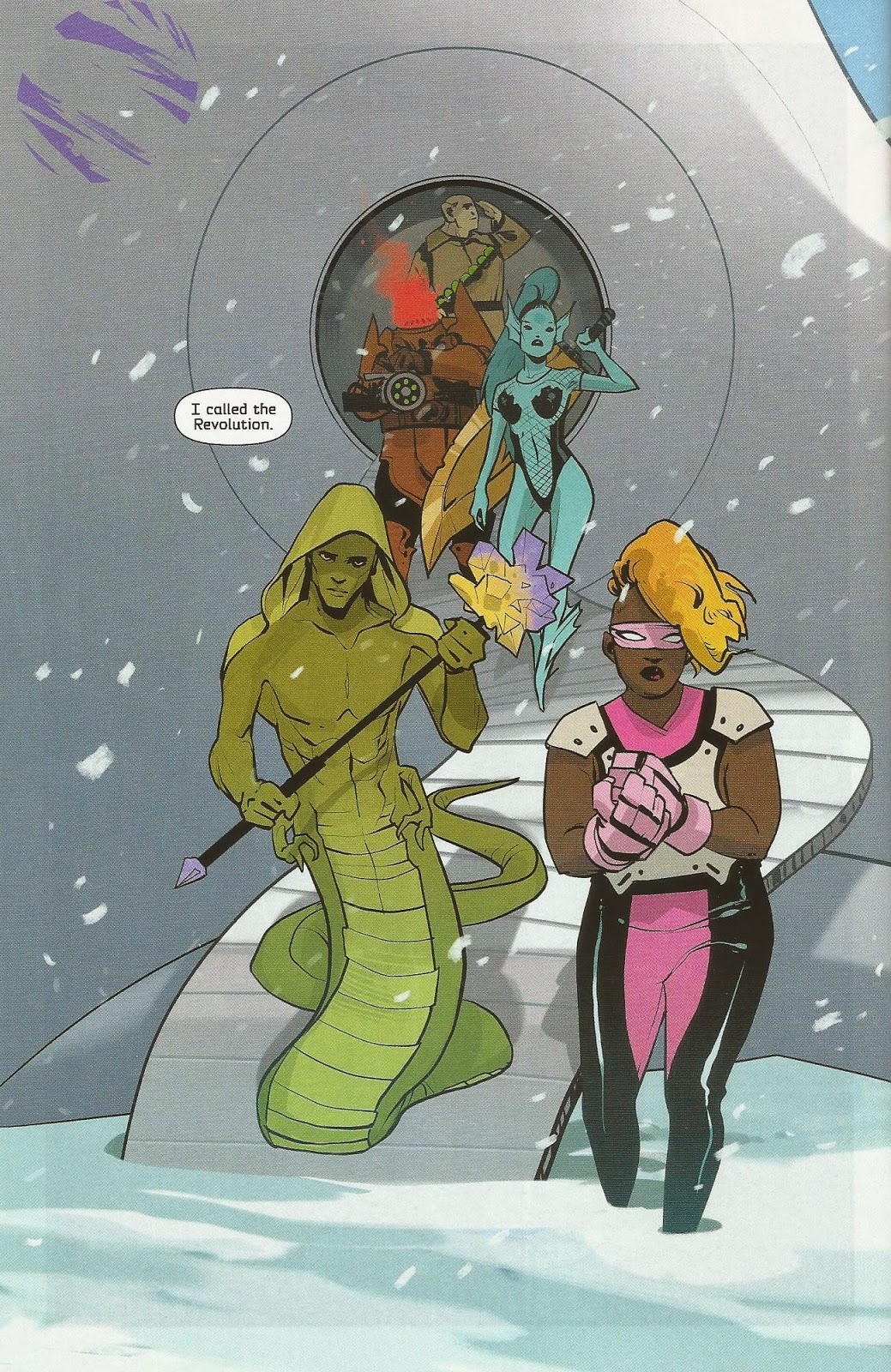
Which means a bunch of new characters! One of the great strengths of Saga is Vaughan's ability to create dynamic personalities out of clearly-defined roles. Beyond that, the Revolution is a clever spin on a sci-fi trope made famous by Star Wars and featured most recently to great success in Guardians of the Galaxy.
Also of note for dedicated readers, as always, is the letters section, in which one correspondent hilariously explains how Saga ruined her relationship with her mother, and another from a prison inmate that continues a different saga entirely, the effects of a different prison inmate who brought the love of comics inside the institution. Real Shawshank Redemption stuff there, folks.
Have I mentioned how much I love the name of Vaughan's dog, Hamburger K. Vaughan?
Genius.
Sunday, December 14, 2014
Reading Comics #140 "Bull Moose Bargains IV"
Atomic Robo: The Savage Sword of Dr. Dinosaur #1 (Red 5)
From 2013.
From 2014.
From 2013.
From 2013.
From 2013.
From 2014.
From 2013.
From 2013.
From 2013.
From 2014.
 |
| via Razorfine |
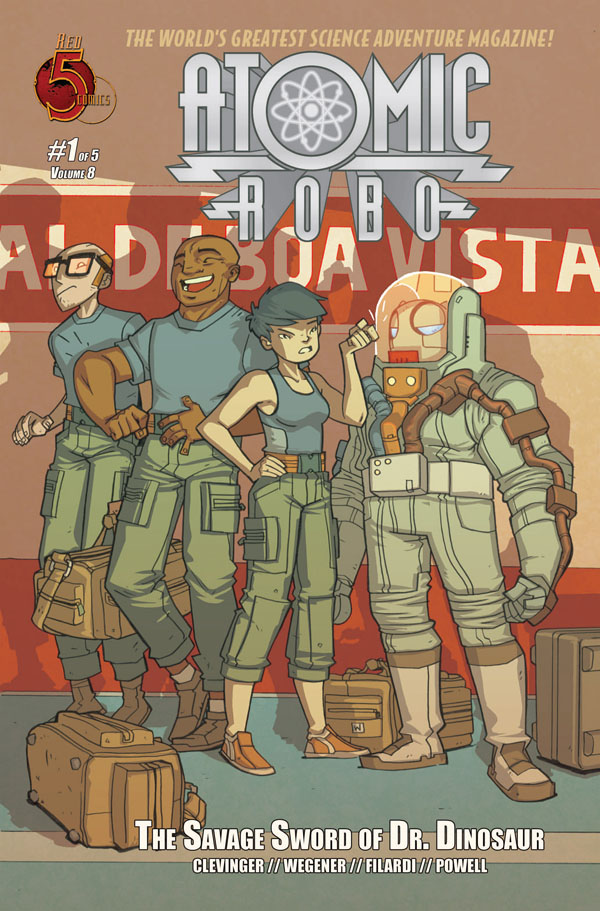
Hey, so I love Atomic Robo. The genius creation of Brian Clevinger and Scott Wegener is, among other things, the perennial highlight of Free Comic Book Day, the headlining act of Red 5 Comics, and the indy answer to Hellboy. And Dr. Dinosaur is the best thing about Atomic Robo besides Atomic Robo himself. I missed this whole arc last year, so once again I have to give thanks to Bull Moose's new trend of importing random back issues into its dying comics spinning rack. Savage Sword opens in a pretty bleak scenario, with Robo having fallen out of public favor thanks to a trumped-up scandal, which adds valuable emotional context to his adventures. By the time Dr. Dinosaur shows up late in the issue, it gives the story an unexpected twist, which only an Atomic Robo comic could do with the spoiler in the name of the mini-series. Dr. Dinosaur is a character who breaks the fourth wall all over his dialogue ("It was I! Behold, the dramatic reveal!"), just a fun character who knocks all pretension out of what comics are supposed to be. This is exactly what fans are talking about when they ask for comics that younger readers can enjoy without be condescended to and not featuring some previously-established-in-another-medium properties. That being said, how about an Atomic Robo cartoon? A live action Robo might even be better!
Black Science #3 (Image)
 |
| via Image Comics |
Having finally cracked the Rick Remender egg in the pages of his Captain America comics, I've become more interested in exploring his other work. Black Science is a little like Sliders if it were done in the Fringe manner, a team of scientists who are able to cross between dimensions. It's pretty interesting stuff, and once again defies my previous impressions of Remender's work.
Green Arrow #26 (DC)
 |
| via IGN |
"The Outsiders War" is an arc I wanted to have a look at all year. It's another instance of DC repackaging a concept for the New 52 era. In other words, this is not the Outsiders as you remember it. This is a new vision that is tied directly into Green Arrow's mythology, concerning that all-important origin on the island (in a lot of ways, DC has finally realized that Oliver Queen has all along been a kind of Lost figure). The Outsiders this time are a whole network of clans that are like a human version of the spectrum of power rings introduced by Geoff Johns in Green Lantern. In the past it's been difficult to define what exactly makes Green Arrow special, and sometimes that answer has been making him a modern Robin Hood, and sometimes a very political, liberal figure, and even sometimes, his unique relationship with Black Canary. Finally, it seems, they've hit the nail on the head. A couple years into his New 52 tenure and several creative teams later, the archer is being handled by Jeff Lemire during this arc, and this is exactly what the comic needed to be as relevant as the popular Arrow TV series (the emphasis on the island is the greatest link between them). Great, great stuff. I will have to read the whole story at some point.
Imagine Agents #3 (Boom!)
 |
| via the Geek Girl Project |
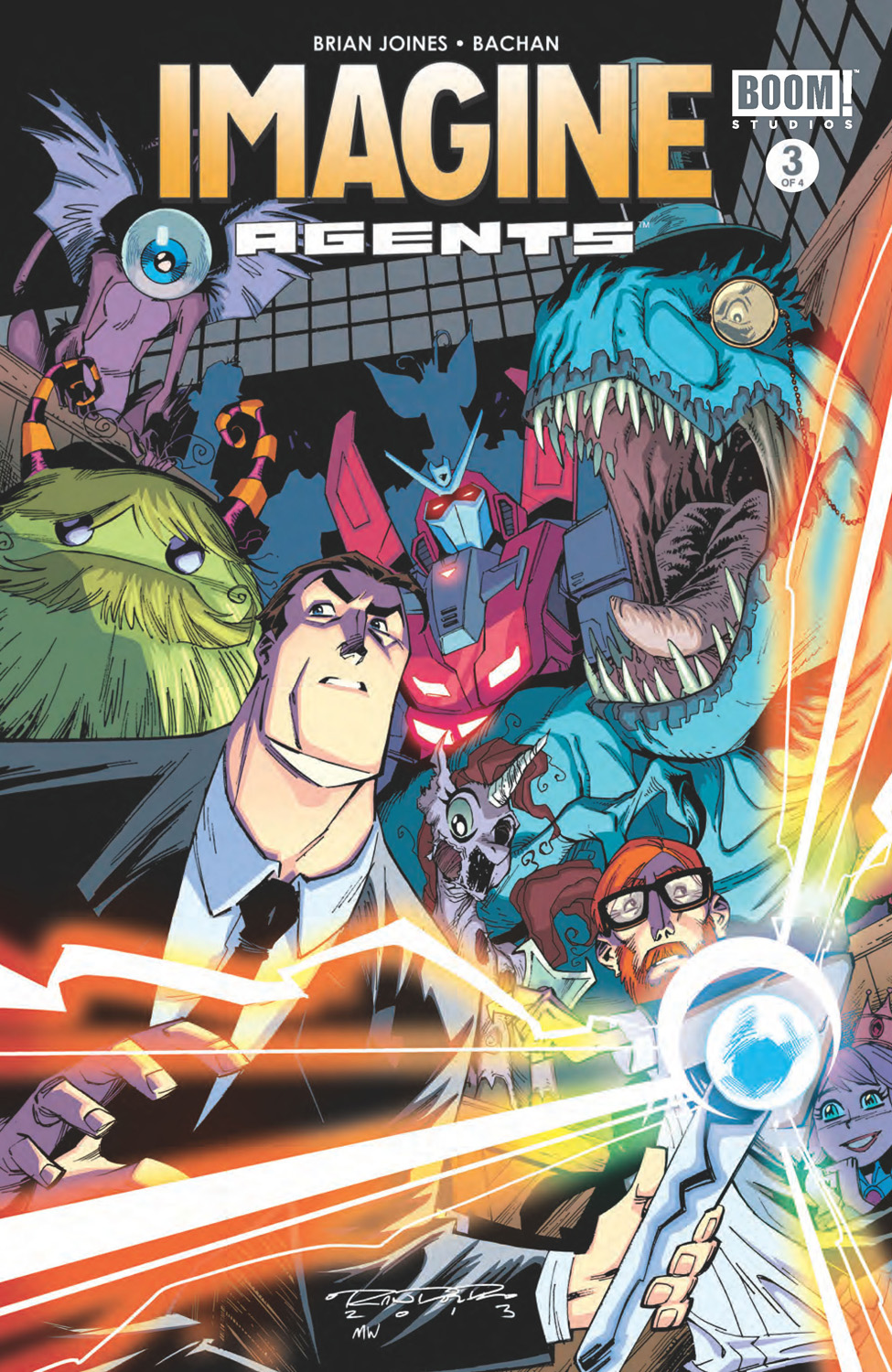
I thought this looked pretty interesting, but it kind of degenerated into gibberish and so I guess I was wrong. It happens.
Katana #9 (DC)
 |
| via DC Wikia |
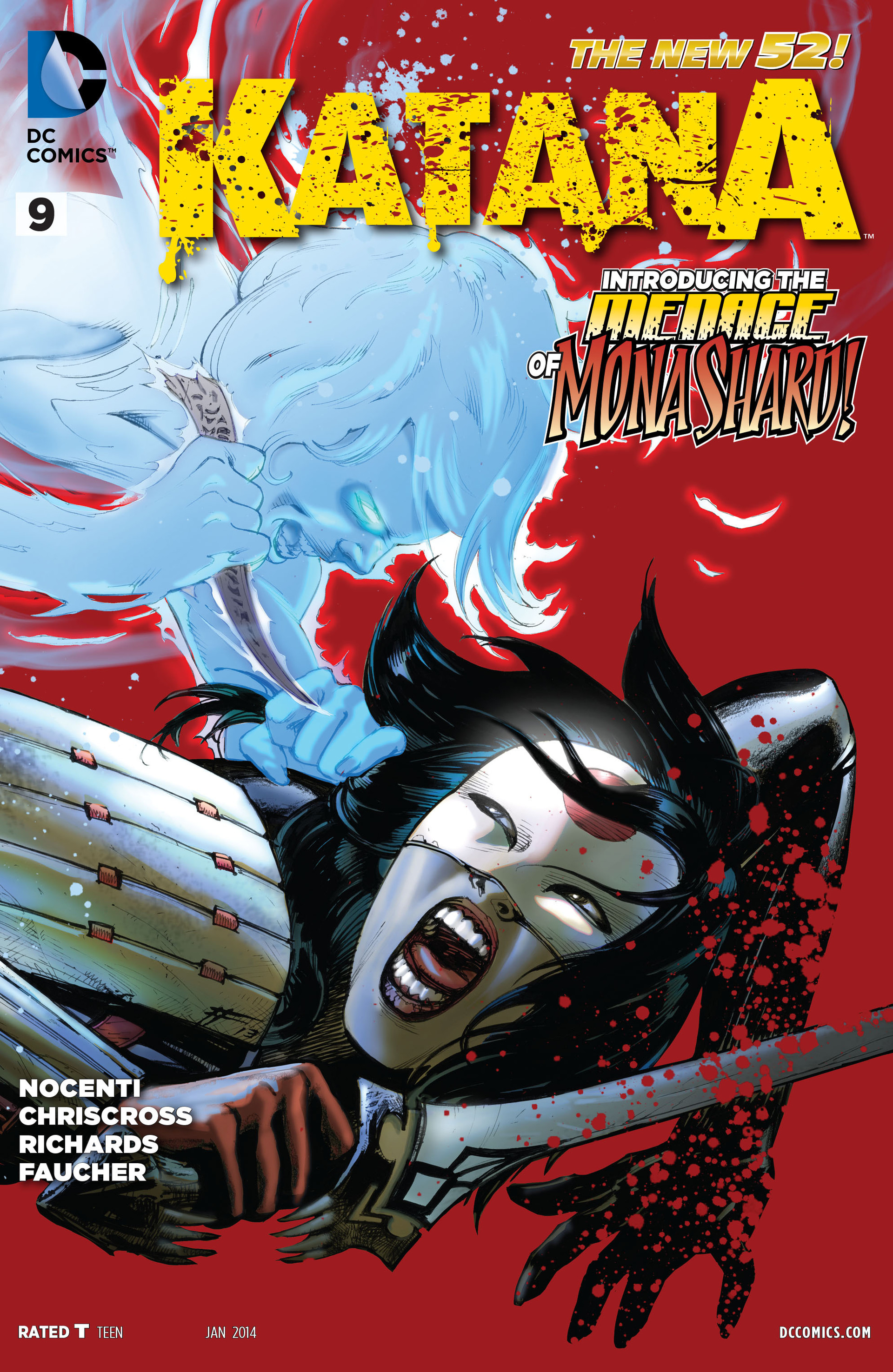
Along with Vibe this was one of the risky simultaneous launches along with Justice League of America last year, and it's another series I've long wanted to have a look at. It's very similar to Lemire's Green Arrow, actually. Unfortunately, there was only one more issue left in the series at this point.
Saga #18 (Image)
 |
| via Image Comics |
Okay, seriously, Fiona Staples does the best covers ever. Just look at that! Oh, and by the way, that's Lying Cat, who's able to tell when you're lying (as you may or may not have guessed). Saga is packed with these seemingly simplistic characters who are nonetheless dynamic figures, and always shifting around the story, which this most recent Bull Moose Bargains selection from the series helps fill in a few more of those gaps that cropped up from my erratic experience with Saga last year. There's a great moment in which Marko tricks Alana into flying, forced to happen thanks to Marko's reunion with Gwendolyn, who's trying save The Will, while Prince Robot IV is walking around desperately needing a reboot. Is this also The Brand's first appearance? The Brand is The Will's sister. A seriously awesome series.
Swamp Thing #26 (DC)
 |
| via Pick of the Brown Bag |
I wish I had been reading Charles Soule's Swamp Thing all along. It's the DC commitment he'll be finishing out next year before his exclusive contract with Marvel officially kicks in, and his work in the series has been seriously good, another case of a DC property with a mythology a creator has been able to lucratively crack. Much of what Soule has done has also been undermined by fans, though, because of the tie-ins the series has had with other comics in the post-Vertigo line. Batshit insane logic. Anyway, Alec Holland is no longer the avatar of the Green, which is to say he's no longer Swamp Thing. His role has been usurped by Seeder. There's a great sequence involving Animal Man, too (part of that post-Vertigo line). After the places Alan Moore took Swamp Thing and Grant Morrison took Animal Man, it seemed impossible to do relevant material with either character again that had nothing to do with that material. Proven wrong.
Thumbprint #2 (IDW)
 |
| via comiXology |
Joe Hill, in case you didn't know, is Stephen King's kid. He's also likely the reason King finally started actively dabbling in comics. Until Hill came along with Locke & Key in 2008, King's efforts were few and far between, and suddenly there were adaptations of The Stand and the Dark Tower series, the American Vampire stint (if you want to be technical, King started these efforts a year prior to Locke & Key's launch, but c'mon), and various other projects. This issue marks the first time I've read Hill, though he certainly seems to have established a reputable career all his own, in case there was any such fear on my part. Like his old man, some of Hill's comics are not by Hill himself, but are adaptions of his prose material. Thumbprint is one of those. It concerns a hardcase of a woman who was a soldier and now an investigator. I like this particular bit of narrative:
"Everyone has a story, a secret. That's what I want...the secrets. Most humans are terrible at keeping secrets. We're storytelling animals. It hurts to keep things inside and feels good to spill. The act of confession feels as right as breathing and as good as a kiss. If you can use your voice to tell your story, you must be alive. Only dead men are comfortable with silence."
Is there some King in Hill's literary voice? You bet. But I like what I've seen...
Trillium #5 (Vertigo)
 |
| via Weekly Comic Book Review |
Lemire is a heck of a talent, one I've started appreciating in 2014, thank goodness, and Trillium was his latest creator-owned opus that concluded earlier in the year. The nifty yet tricky first issue I've caught recently, the flip book that introduced the parallel narratives of the story, was adapted to even trickier heights in later issues, it seems, a flip book on every page. Helpfully, there's always instructions or at least an indication as to which side to read first, and of course it's not always the one you expect it to be. Maybe not the best way to read Trillium, though, in fits and starts. I'll have to catch up on this one later, too...
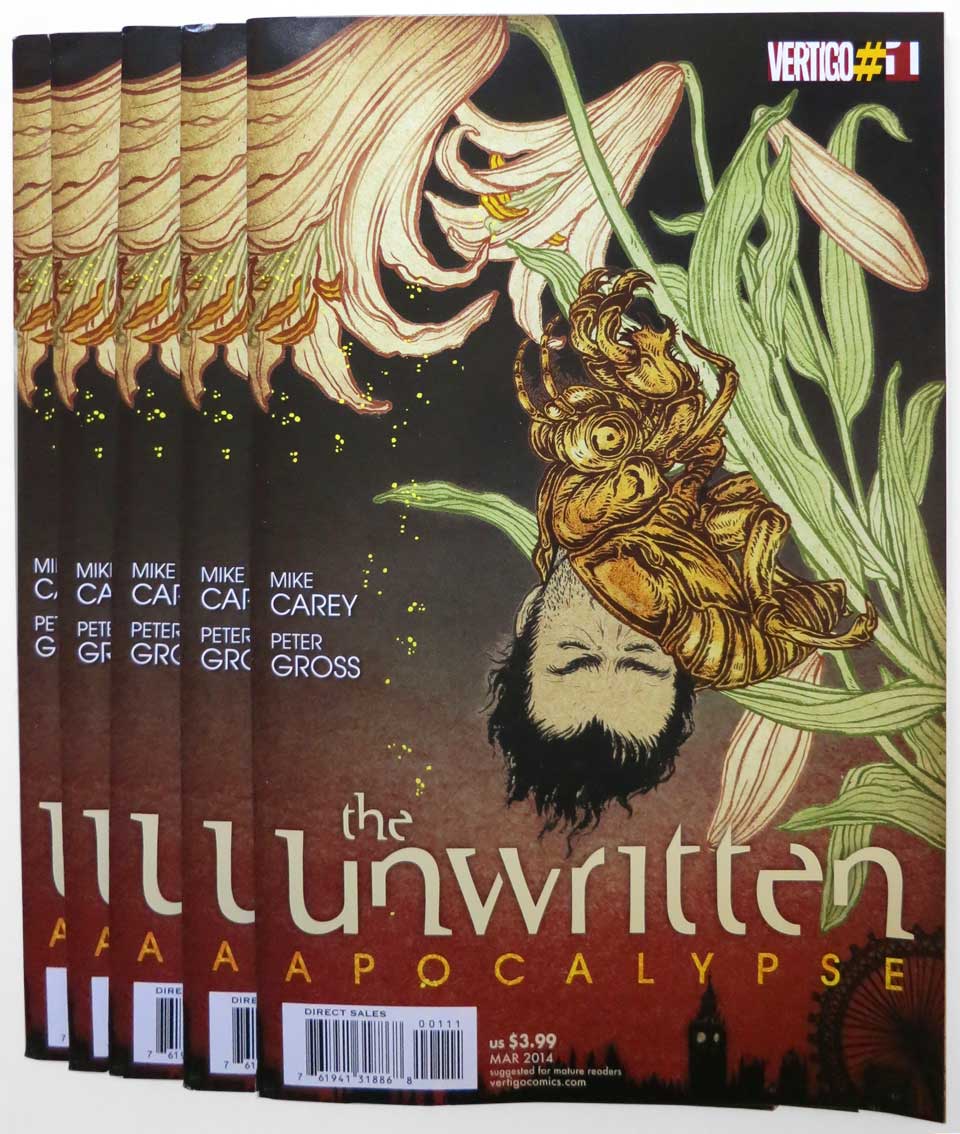
The Unwritten: Apocalypse #1 (Vertigo)
 |
| via Yuko Art |
Previously I may have suggested that Vertigo dumped The Unwritten at the worst possible moment, after its Fables crossover, just at the moment that readers (possibly including me) might have finally started paying attention. But it was relaunched, as it turned out, with a concluding mini-series. And. Holy. Crap. Mike Carey knocked this first issue out of the park. It's the kind of material I've been expecting from The Sandman Overture, just a creator completely letting loose with full-on narrative fantasy potential. Instantly became one of my favorite comic book memories of 2014. And now I'll have to read the rest of Unwritten...
Subscribe to:
Posts (Atom)