Showing posts with label Neil Gaiman. Show all posts

Sunday, June 4, 2017

Digitally Speaking...58 "Neil Gaiman's Eternals"


Okay, so I've been doing a pretty lousy job of talking through my comiXology library, but really it's because there hasn't been much to speak of.  I guess the material was kind of top-loaded or something.  But the good news is that very shortly I'll have finally read all of it, all the Submit stuff and the Image stuff that came in those massive bundles and everything else I got several years back.  What I'm talking about today, actually, is something I added recently because of that dwindling supply, something I'd read when it was originally released but hadn't thought that much about at the time, but having now reread it...
 
So yeah, I wish I'd read the whole thing.  I guess I wouldn't have appreciated it at the time, but at least I'd have read it.  I'm talking about Neil Gaiman's Eternals, a rare Marvel project from about a decade ago, when he was dabbling in comics again, figuring out where he might still fit in after having left the medium for a full-time career writing books.  Part of why I had a look at the freebie first issue comiXology had available was that I've now read the complete Sandman, and that's a great feeling in and of itself.  Part of it is that I've read a few issues of the comics adaption of American Gods, which is the Neil Gaiman book (along with its sequel Anansi Boys) that to date is my Neil Gaiman prose standout, and reading American Gods in any medium made me realize what Neil had done with it all over again, and so why not have a look at Eternals again, right?
 
I remember thinking, at the time, that Eternals didn't seem to live up to the reputation Neil had based on Sandman.  I don't know if it's Marvel's typical inability or lack of interest in keeping its back library visible, but Eternals seemed to blink in and out of existence.  It was Neil's version of a Jack Kirby concept that the King developed as his Marvel answer to his DC New Gods.  I thought that it was merely Marvel handing Neil something that seemed vaguely expansive in the Sandman sense, but that Neil didn't seem to have found as interesting as that, and so the result was easy to dismiss.
 
Well, I found it a great deal more interesting this time. It's a different story from Sandman, of course, although in a lot of ways you might consider the Eternals to be comparable to the Endless Ones.  I didn't really know much about the Endless Ones before actually reading Sandman, so I didn't know that.
 
But what really struck me was the art, from John Romita, Jr.  At the time he did Eternals, John was still very much a Marvel guy, and I was still very much a DC guy trying to figure out Marvel.  In fact, probably a large part of the reason I found it so easy to reject Eternals was because it was a Marvel project, and John was definitely a Marvel artist, whose style was something I'd never really tried to figure out.  Then I had a chance to associate it with something else, Mark Millar's Kick Ass, and still later, Superman, because John eventually became a DC guy. 
 
It's not because he became a DC guy that I suddenly started liking John's work.  I know plenty of DC readers who struggled a great deal with his Superman.  But it probably didn't hurt.  I know it was impossible to think of anything else when reading that issue of Eternals again.  All I could think was, I love this art!  And maybe that helped get me into the story, too.
 
Yeah, though, it's the combination of the plot, and my affinity for the writer and the artist.  I think that's a good equation for liking anything, really, what it is and who's responsible for it, and I guess whether they brought their best material to the table. 
 
Well, I guess at some point I will have to read the rest of it...

Tuesday, May 9, 2017

Reading Comics 204 "Fifth Trip 2017"

American Gods #2 (Dark Horse)
Amazingly, this adaption of the Neil Gaiman book still really hasn't reached the actual concept of the story.  Although Spider does drink an amazing amount of mead, and beats up a rather tall leprechaun.

Bane: Conquest #1 (DC)
Chuck Dixon and Graham Nolan reunite and return to the chronicles of Bane.  The results may baffle readers who are less familiar with Vengeance of Bane (parts 1 & 2) and more "Knightfall," Dark Knight Rises, Tom King's recent "I Am Bane," or any manner of terrible Bane appearances over the years, but they're entirely in-character, especially, again, for the Bane of Vengeance of Bane (parts 1 & 2).  The luchadore mask Nolan gives Bane for this comic is a fun little nod to the fact that the character is, technically, Latino, even though that never seems to come up other than his base of operations and/or origins.

Batman #21 (DC)
The Flash #21 (DC)
Batman #22 (DC)
Parts 1-3 of "The Button" see Tom King and Josh Williamson collaborate on a sequel to Flashpoint (the importance of this classic story to yours truly is chronicled in the early period of this blog) that also helps set up later DC-wide storytelling first introduced by DC Universe Rebirth.  Very, very good storytelling here.

Blue Beetle #8 (DC)
Giffen/DeMatteis have apparently taken over the title as of this issue, and bring a strong Larfleeze feel to the proceedings.  I loved the original Jaime Reyes series post-Infinite Crisis, and so it's great to read his Blue Beetle again.  The big draw for the issue, however, is that the magical scarab that has granted him powers (and/or de facto Iron Man suit) all these years has been taken from him.  So he and Ted Kord (the second and most famous Blue Beetle) make a bold decision: Jaime will now, even if temporarily, revive Ted's classic costume.  Yeah!

Divinity III: Stalinverse #4 (Valiant)
Matt Kindt will be moving on to Eternity, a sequel rather than continuation to Divinity, so this is the conclusion of this particular vision.  And I think, having read it twice, he came up with a good one:
"This world you've built may be real.  But you know it is not true.  You read books when you were younger.  Just as I did.  Do you not remember?  We are similar, you and I.  We were not forced to read.  We were encouraged.  But my adoptive parents raised me.  Treated me as their own.  They gave me books.  Science fiction was my favorite.  I read everything they gave me.  It wasn't until much later that I realized what they'd really done.  My parents couldn't force me...or anyone to be good.  Just as the Soviet Union cannot.  All they could do was present me with their example.  And with stories.  With writing.  With ideas.  Through those books I learned the danger of power.  I learned of the terrible effects of violence and conflict.  Of the unending cycle of war that we should be working to break.  And I learned the importance of love and to be loved.  Earth...humanity?  They are our children, Kazmir.  They can't be forced to learn.  They must learn by example.  They must be taught with stories.  With experience.  We have the power of gods, Kazmir.  Yet you choose to live a parasitic life inside Myshka.  And you choose to obey a small-minded oligarch.  But there is an entire universe out there for you.  Worlds to see.  Galaxies to explore.  Just like in the books we read when we were younger.  I am sorry for what happened to us out there...in the unknown.  I am sorry I did not bring you back when I returned.  And I am sorry that Myshka broke your heart.  I understand why you came back for revenge.  What I don't understand is why wouldn't you stay out there?  Why wouldn't you go further?  Why wouldn't you want to see more?  Our conflict will have a winner and a loser.  That is the nature of the game.  But why should we confine ourselves to the game?  Ti these pieces?  To this artificial boundary?  To Earth?  When there is the unknown all around us?  Waiting to be explored?  I tell you all of this, Kazmir, not to "win."  But to set you free."
That's the best argument an hero has probably ever made to their enemy, in a comic book.  It's an argument that can only be made in a comic book, I think.  It's a perfect synopsis of superhero logic, as has Divinity been from the start.  I don't know why Divinity hasn't become more important among comic book readers.  It's the Watchmen of intellectual superhero storytelling.  It's surely one of the most fascinating comics I've ever read.  Every issue has someone involved in creating the issue provide commentary.  Most of it is somewhat hugely overblown praise. Most of it seems to miss the point.  It's not just how it's executed that makes Divinity great, but its ideas.  I'm hugely glad to have read along.  And to see where Kindt goes next.

Planet of the Apes/Green Lantern #3 (Boom!/DC)
This latest mash-up is about as good as Green Lantern/Star Trek (which is to say, good), but it's the art I came to see.  Omega Men's Barnaby Bagenda, to be precise.  That guy deserves to reach the stratosphere, like his collaborator, Tom King.  Hopefully it'll happen at some point.

Green Lanterns #22 (DC)
The adventures of upstarts Simon Baz and Jessica Cruz have now reached the stage where they're actively interacting with the rest of the Green Lantern Corps.  Continues to be what I've long hoped to read in a Green Lantern comic again.

Nightwing #19, 20 (DC)
Well, hot damn.  Tim Seeley has turned Nightwing into a must-read after all.  Nightwing has been so hit-and-miss since the Dixon/Grayson years, a lot of creators coming in hot and then sort of sputtering out.  This includes Grayson, Seeley and Tom King's bold revision that saw Nightwing become a spy for a couple years.  But to take Nightwing away from Dick Grayson is to take away the essential part of the character, no matter how intriguing the results.  Too many of these writers have tried to forget this or that element of the character.  Seeley seems to have built not only on the Grayson momentum, but folded Dick's Batman and Robin days back into his adventures.  "Nightwing Must Die" is a Dr. Hurt story (the whole thing plays nicely with Batman and Robin, Grant Morrison memories), but it remembers that Dick's whole history is what defines him, perhaps more than any other superhero.  Possibly the two best issues of Nightwing I've ever read (Grayson: Futures End notwithstanding).

Savage Dragon #223 (Image)
If you were to read, in 2017, only one comic book series in its entirety to figure out what superheroes are all about, I think Savage Dragon would have to be that series.  Erik Larsen is the Image creator who never gave up on the original vision of the company, who never decided to pursue other interests at the expense of the creative freedom and opportunity his vision gave him.  The letters column is almost more important than the comic itself this time:


"Change is inevitable and being more stuck in the past is no solution. Styles change, people change. You loved that old stuff because you were 12 and that was your sweet spot. You may not want change but I crave it. Doing the same drawings the same way for decades is mind-numbingly monotonous. I love nothing more than finding new ways of tackling a similar problem. I look at the older issues and see all the mistakes. I see all the poor drawings and attempts to hide my deficiencies behind a wall of crosshatching and it doesn't do much for me. The lines aren't defining shapes and establishing light sources. They're lines for the sake of lines. Emulating that seems insane. 

Strong iconic poses are great, sure, but ultimately, I'm trying to tell a story here, not compose pictures to be popped onto T-shirts and lunchboxes. And given the choice of repeating a familiar shot or finding something new--nine times out of ten I'll go with the new.

It's not an easy path. Some artists get stuck in a rut, forever repeating and emulating their old work. Readers get bored and move on. Others keep trying new and different approaches but that can alienate old readers who liked the way things had been. There's no simple solution, clearly, but in order to preserve my sanity, I need to keep moving. If I'm not kept engaged, I can't expect my audience to be. If I'm bored, it's reflected in the work. So I tend to try something new. Sometimes it's successful and sometimes it's not, but hopefully it's worth your attention.
 
And honestly, it's important to unlearn what you've learned. A lot of what made earlier work vibrant and full of life was the learning process. I was figuring stuff out. And part of that involved screwing up. I can look back at old art and see where arms were clearly too long or faces were constructed poorly, where compositions and anatomy and perspective are all skewed and line work makes no sense. It's hard to recreate that--and why would I want to? It would be like going back to high school."
To my mind, it reads like Larsen becoming the Bill Watterson of comic books.

Superman #22 (DC)
I really need to read more of this run.

Old Man Logan #22 (Marvel)
Jeff Lemire continues his concluding run with Wolverine exploring the character's fictional past, brilliantly, literally revisiting famous stories (at one point his origin in the pages of a Hulk comic, complete with the original dialogue).  If anyone had to tell Old Man Logan stories as a surrogate to actual Wolverine stories, I'm glad it was Lemire.  He proves why it was such a good idea all over again.

Thursday, March 30, 2017

Reading Comics 202 "Third LCS Visit 2017"

American Gods #1 (Dark Horse)
An adaptation of Neil Gaiman's novel, which is soon to be debuted in another adaptation, for television.  I haven't read the book in years, but I liked it quite a lot.  Still, reading some of it in comics form makes me realize it really has been years, so I may have to reread it.

Batman #19 (DC)
Tom King sets up an epic clash between Bane and Batman.  He continues to write sensationally.

Divinity III: Stalinverse #3 (Valiant)
Matt Kindt likewise continues to write sensationally.

The Amazing Spider-Man #25 (Marvel)
Dan Slott's epic run continues, this time with Norman Osborn.  I actually picked this up because Stuart Immonen begins his run (he's done Peter Parker before in the pages of Ultimate Spider-Man) with the issue.  Thankfully he retains his return to streamlined work previously seen in Empress and other recent work.  Actually, the most notable thing about the issue is Slott introducing...the Superior Octopus.  Which is really, really awesome.

Star Trek: Waypoint #4 (IDW)
The first Enterprise-focused comic ever!  Phlox was featured in a doctors confab a few years ago, but this is the first time the fifth live action series has gotten its own comics adaptation.  The writer somewhat flubs the opportunity, but still rightfully puts Porthos in the spotlight.  It's always about Porthos!

Superman #19 (DC)
Action Comics #976 (DC)
Peter Tomasi and Patrick Gleason are their usual sensational selves in the first issue, while Dan Jurgens continues to struggle to adapt to modern storytelling in the second.  But I like the "Reborn" concept and how Mxyzptlk was revealed to be behind the Clark Kent mystery, and how Jurgens gets to unique disparate continuities in the conclusion, which feels right regardless of my other qualms.

X-O Manowar #1 (Valiant)
Matt Kindt again, in this quasi-reboot of the franchise, completely nailing it.  Might be viewed as the Dark Knight Returns/"Old Man Logan" for comics' most famous Visigoth.

Wednesday, June 22, 2016

Quarter Bin 83 "Sandman, Shattered Image, Shockrockets, and Skrull Kill Krew..."

Yes, it would be safe to assume that these particular comics were, in fact, bought in a literal quarter bin.

Sandman #39 (Vertigo)
From July 1992.
This is the last issue in the Annotated Sandman Vol. 2 so at some point in the next year, hopefully, I'll be reading and talking about it again.  (And just as hopefully, I will eventually collect and read the third and forth volumes in this version of the series.)  It features Marco Polo in a dream sequence (naturally), the young boy version of the famous explorer, so we get a peak at his less-publicized origins traveling with his dad.  Also present, G.K. Chesterton, naturally.  This is a classic example of what made Sandman so great, how Neil Gaiman could do just about anything he wanted and it made perfect thematic sense.  This is the epitome of comic book storytelling.

Shattered Image #1 (Image)
From August 1996.
This Image version of the superhero crossover event is a hot mess, even though it's written by some fairly well-established and well-respected creators, Kurt Busiek and Barbara Kesel.  I can only imagine they felt pressured to present the Image version, which at that time, still only a handful of years after the company's infamous founding, was still infused with the arrogance of attempting to ignore everything that made superhero comics great, and just try and be cool and hope (as it was for a while) that was good enough.  Still, it's interesting to remember that Tony Daniel made his name in this period, and that he's probably the creator whose work evolved the most, and most positively, in the past twenty years.  Busiek has been doing Astro City all this time, and it's been increasingly less relevant ever since, which is not to say anything about the quality, but that it's a shame that of the major superheroes created at Image in those early years who're still operating, that one big attempt at true respectability has become so easy to ignore.  Then again, maybe it's because he is still working at it.  After Marvels, Busiek became known for his interest in defining the tradition of the superhero.  I wonder if anyone still believes he's interested in that. 

Shockrockets #6 (Gorilla)
From October 2000.
Speaking of Busiek, Shockrockets was kind of his take on the Rogue Squadron pilots from Star Wars, but set in near-future Earth.  For me, it was always more notable as one of Stuart Immonen's first big projects post-Superman.  Between this and his early Legion of Super-Heroes, his later Star Wars, and his current Empress, Immonen may have established himself as a go-to sci-fi artist, which I find pretty interesting, because yeah, I still think of him for his '90s Superman.  Which Immonen obliquely references in Gorilla promotional material from the issue: "My ideas, drawings, and designs are not only met with approval but I feel valued and appreciated as a person!"  I have to admit, the end of his Superman run had DC take him off art (by that time he'd become a writer/artist, which he's never again been) but also had Mark Millar punch up his scripts by providing dialogue.  And then he was somewhat obviously asked to move aside so that a new generation could take over, or otherwise made the decision himself.  Which is sad, because I still think he's never gotten the respect he deserves for his Superman work.  Also included is a preview of Busiek and Immonen's Superstar graphic novel, which was actually pretty great.

Skrull Kill Krew #2, 5 (Marvel)
From October 1995, January 1996.
This was a Grant Morrison project I'd long wanted to see, as it was one of his earliest Marvel projects.  Teamed up with then-frequent collaborator Mark Millar, I found the concept to be kind of a Marvel version of Morrison's Invisibles, his first widely-known creation.  The second issue features a heavy Pulp Fiction vibe, in which the character of Ryder closely matches up with Samuel L. Jackson's Jules in his speech patterns (no epic biblical quote, alas, at least not in this issue).  I wonder if that's how people really viewed Pulp Fiction, in the guise of the character Jules (which wouldn't be a terrible thing, but it isolates the experience far too much), or how they viewed United Kingdom creators, the punk Vertigo impression that took years to shake and was in part inspired, naturally, by Morrison's Invisibles.  (Clearly Gaiman's Sandman didn't have punk so much as Goth in mind, while spiritual predecessor Alan Moore had horror as his guiding Swamp Thing principle.)  Morrison eventually distanced himself, for the most part, from this style, somewhat dramatically in his major superhero debut with JLA nearly a year later, but I wonder if Millar kept it in mind longer.  Certainly, he became enamored with the concept of the mini-series, a style he works in almost exclusively these days.

Sunday, July 26, 2015

Quarter Bin 68 "Grant Morrison, etc."

This is a back issue feature, which features all these this edition: The Filth #6, Green Lantern (1990) #1 and 46, Green Lantern Corps #38, The Helmet of Fate: Zauriel #1, The Invisibles #6, Justice League America #74, JLA Classified #45, JSA #81, Legion of Super-Heroes #0, Marvels #1, The Mighty #1, Millennium #5, Neil Gaiman's Neverwhere #3, Starman #46, Adventures of Superman Annual #5, All Star Superman #1 and 5, Sweet Tooth #13, Tangent: Superman's Reign #12, Wisdom #1, and New X-Men #149.

The Filth #6 (Vertigo)
From 2002.

I have previously owned the entire Filth collection.  When I purged a vast amount of my things two years ago, this and Supergods didn't survive, despite my professed great admiration for Grant Morrison.  There are limits to everything.  When I originally read the complete Filth, I was in a different place.  I was still in the midst of figuring out what exactly it was I liked about Morrison.  Turns out, I like it best when he's not trying so hard to be weird.  Stuff like this and his current Nameless are definitely Morrison trying hard to be weird.  And the thing about Filth is even when I reread this particular issue, I had some thoughts about what helped make it seem less like Morrison trying hard to be weird, but now I've forgotten.  So again I'll walk away from it and not wonder whether I'm missing something crucial.  I guess it's supposed to be social commentary, and not necessarily about, well, filth, and maybe how some people really do try too hard.  And so maybe Morrison took on Filth in full irony.  I think I read once that it is or was his personal favorite, and at one point I described it myself as possibly the Invisibles experience condensed...Still, obviously personally, I've backed off from it, and I think Morrison has done a lot of stuff since then that's far superior, not just Joe the Barbarian and Annihilator, but...I mean, even Seven Soldiers is in some ways Filth repackaged.  Made better.  Moving on...

Green Lantern #1 (DC)
From 1990.

It seems odd to think today that Hal Jordan ever had a problem being the headlining Green Lantern act.  I mean, other than everyone who wants the cinematic Green Lantern to be John Stewart (mostly because of the animated Justice League adventures where he was).  And yet there was a considerable period where Green Lantern had in fact been retitled Green Lantern Corps, and this particular reboot was all about Hal taking back the spotlight.  It was also the debut of the white temple look, which Geoff Johns later retconned as the first indication of Parallax taking control.  The Hal in this issue is drawn directly from the Green Lantern/Green Arrow era.  I mean, Hal was regularly depicted as bucking authority and reluctant to be a good little Green Lantern, which was the whole reason Guy Gardner and John Stewart had rings to begin with, but this was making it not just a phase, but a defining part of his character.  Sticking around, being Green Lantern, and still fretting about all that.  And this was the beginning of the modern era, too.  The franchise was in fact about to begin.  Guy and John both got their own ongoing series before long, and they were in this issue to assert their continuing presence from the start.  And to think, fifty issues in and everything would change...

Green Lantern #46 (DC)
From 1993.

I don't know who decided to begin a new Green Lantern on the heels of Superman's big death-and-return saga, but they were a genius.  How often does that happen, linking one such event to another, however tangentially?  Mongul and Cyborg Superman incidentally destroy Coast City at the end of "Reign of the Supermen," which is Hal's city, and it drops him off the deep end.  In this issue, it looks like he might be able to get over it.  He gets his revenge on Mongul, he's the one who gets to defeat the other major villain of the big Superman climax.  And it still ends up resulting in "Emerald Twilight," the end of Green Lantern as it had existed as a property since the dawn of the Silver Age...and yeah, eventually, Hal's big redemption and the return of everything, supersized...But at this point, the next issue is the last Green Lantern/Green Arrow team-up (in its original combination; strangely even upon Hal's return it's never happened again).  To me, this moment has always stood as about as iconic as "Emerald Twilight" itself.  The original Green Lantern trade collections of that time never included it.  There were separate "Emerald Twilight" and "New Dawn" (the start of the Kyle Rayner era), and then "Emerald Twilight"/"New Dawn" collections.  And this major component of the story was left out.  Every time.  I don't know, did the "Reign of the Supermen" collections include it?

Green Lantern Corps #38 (DC)
From 2009.

This is from the Tomasi/Gleason era that kicked off the series, the best non-Johns Green Lantern comics from that time, and enhanced in hindsight by their later collaboration in Batman and Robin, which was a definite amplification of their efforts.  So good, in fact, that I tend to forget what their GLC was actually like, other than the distinctive presence of Soranik Natu (this issue she tries to erase her just as distinctive face tattoo because it's a constant reminder of her father...Sinestro).  The Guardians are ramping up to going totally insane, executing bad guys, with the Corps somehow having a problem with that.  But it's that cover that is the best thing about the issue.  Not totally relevant to the contents, but it's strong Pat Gleason all the same, before Gleason truly came into his own (again, Batman and Robin).  It's not my favorite cover from this selection of back issues, however.  We'll get to that.

The Helmet of Fate: Zauriel #1 (DC)
From 2007)

This was a part of the late Steve Gerber's last big project, an attempted reboot of Doctor Fate.  Gerber's legacy will arguably always be Howard the Duck, which luckily these days once again means a good thing.  I read the complete Helmet of Fate at the time of its original publication, so it was good to revisit.  Zauriel was one of the less obscure characters featured in this kind of condensed Seven Soldiers (the issue recaps every other encounter to that point, which was actually the last before the intended big payoff).  Zauriel was a Grant Morrison creation from the pages of JLA, a literal angel, a surrogate Hawkman (several reboot attempts from that period had soured that particular character, who would need a dramatic comeback within Geoff Johns' JSA in order to become relevant again), and his story is ably recapped in the issue as well.  He got a new incarnation in the New 52 in the pages of Phantom Stranger, but it's not quite the same.

The Invisibles #6 (Vertigo)
From 1994.

You know what's ironic?  Every time I randomly come across a back issue of Invisibles, it's always from the Say You Want a Revolution collection, the first volume of the series.  And that's awful, in a way, because Say You Want includes the most of what I've read from one of Grant Morrison's early seminal works.  And darn it if I don't want to read something else from it!

Maybe there's a message in that?

In the meantime, I'll instead talk here about the On the Ledge feature in the back of the issue, the Vertigo press page that speaks about the Paradox Press experiment, which today is known, if for anything at all, for Road to Perdition, which later became a Tom Hanks movie.  But this hype feature also references Jerome Charyn in Paradox Press's stable of writers.  Years later, Charyn became a favorite writer of mine, and it amused me to learn that he sometimes dabbles in comics, and apparently, so I learned here, he was in fact part of the Paradox Press experiment.  The result was published in 1995, Family Man.  I will read that at some point.

Justice League America #74 (DC)
From 1993.

This issue is the reason there are fans who think Bloodwynd was in fact Martian Manhunter all along.  That's because at the end of the issue, that's exactly what it seems like.  Apparently all those fans never read the next issue, which explains what's really going on (maybe comics just shouldn't try and confuse readers so often...).  Bloodwynd's always been a favorite of mine.  He's the Dan Jurgens creation not named Booster Gold, and for my mine, infinitely more fascinating.  And yet he's got a scant publishing history, and it was Grant Morrison himself who explained why in the pages of Supergods, calling him a example of the worst the '90s had to offer.  But then Morrison himself dragged Bloodwynd back into comics in the pages of The Multiversity.

And you want to know the saddest thing about Bloodwynd?  This is his only spotlight cover, and you can't even see his face!  Okay, that's a total lie.  That face is splashed across Justice League America #88.  But still!  I've said all along, he's a great character.  Time to help everyone else realize that, I say.


JLA Classified #45 (DC)
From 2007.

Speaking of Martian Manhunter, this is my favorite cover from this selection, and it was instantly one of my favorites at the time of its original publication, too.  The contents are pretty good, part of the "Ghosts of Mars" arc that was part of the foundation of the character becoming one of my all-times favorites.  The material at that time was the strongest in the character's history.  And it's absolutely, so far as I'm concerned, the basis for the new ongoing series.

JSA #81 (DC)
From 2005.

This is pretty far into Geoff Johns' JSA, but I figure if it's before the Justice Society of America reboot (where I read every issue), but it's a good issue to randomly read because it puts Stargirl, Courtney Whitmore, in the spotlight, who was also the first character Johns ever wrote for DC, in the pages of Stars and S.T.R.I.P.E.  The issue, in fact, delves deeply into Stargirl's world, so it's almost a complete reprise/update of the prior series, so all around it's a nice one to have chosen (there were several others available), if not randomly sampling one of Johns' formative arcs (I've done that; it's not as easy to be satisfied that way) then to definitely catch it at its best.

Legion of Super-Heroes #0 (DC)
From 1994.

One of my ambitions is to own the complete Stuart Immonen Superman.  I'd planned to chronicle the run here at Comics Reader, but I don't have that kind of readership, alas.  Anyway, Immonen made his mark at DC, originally, within the pages of Legion, and he was suited to that in the original clean look he had at this time in his career, before he talked himself, or allowed others to talk him, into a busier look.  I sampled the Legion books (including Legionnaires) a lot during that time, and I'm certain now that I had this in my collection (until an earlier purge than the one referenced above), so I had already begun appreciating Immonen before I realized it.  But I didn't stick around Legion, so I in fact officially discovered Immonen in the pages of Superman comics.  Just so you don't wonder, I don't intend to track down the complete Immonen Legion, too...

Marvels #1 (Marvel)
From 1993.

One of the most famous comics of the '90s, this was also the epitome of Marvel's self-mythologizing, not just a character, but its entire line, the fictional version of Stan Lee, as it were.  I've always wanted to read it.  The first issue, it turns out, is not wildly impressive.  Photographer Phil Sheldon is a wimpy lead character, not exactly the Norman McCay of Kingdom Come.  Devised to be an everyman observing Marvel's giants from street level, Phil Sheldon is instead a Jimmy Olsen/Peter Parker who otherwise has nothing interesting going for him, just a random romance.  Yes, there are three other issues to the story, but I'm not as interested, now, to read the rest of the story.  The depictions of Namor, the Human Torch, and Captain America are a mixed bag.  The Human Torch is easily the superhero who comes off best.  But if later superheroes are treated more like Namor, who blows up the realism of the approach, it kind of ruins the concept.  And anyway, it was as much if not more so the art of Alex Ross that made Marvels such a sensation.

Curiously, Marvels, other than the stories of mini-series of Jeph Loeb (incredibly, Captain America: White is finally, finally on the publishing schedule, with a September debut, after the preview released in...2008), remains the lone example of Marvel taking an actual sober approach to superheroes.  Other than random issues of Ed Brubaker's Captain America, further examples just don't exist.  And that's why I'm a DC guy.

The Mighty #1 (DC)
From 2009.

Until Batman and Robin, this was my first indication that Peter Tomasi would be a truly exceptional writer.  The Mighty is one of those rare creator-owned projects published under the DC banner (Chris Claremont's Sovereign Seven was another...and I can't think of a third), and it's also one of the best alternate Superman stories ever told.  Curiously, at the time there was considerable competition.  Mark Waid's Irredeemable was one, and The Life and Times of Savior 28, from J.M. DeMatteis, was the other.  Yet The Mighty jumped out from the pack.  There was talk of a movie adaptation.  IDW later put out the trade collection.  Turns out from this revisit, it really stands up.  So next time I have an opportunity to pick up the complete collection, I just might...

Millennium #5 (DC)
From 1987.

This was the Manhunters event, the third big DC crossover event after Crisis On Infinite Earths and Legends.  But as I now realize, maybe it was also an attempt to capitalize on the New Age guru sensation, because that's what's going on in this particular issue, and it confuses me, otherwise, a great deal, to see that going on in the middle of a big DC crossover event.  And so even though it's the big Manhunters event that helped establish them, I've probably read about all I need to from it, I really have.  Because it's baffling.  I guess I perhaps should have known how confusing it was, because I already knew Millennium featured the big Manhunters story as a story of infiltration.  Which otherwise, conceptually, makes little sense in Manhunters context.

Neil Gaiman's Neverwhere #3 (Vertigo)
From 2005.

As the title suggests, this is a Neil Gaiman story, actually an adaption of his first novel, the career shift that helped establish him as a cultural phenomenon.  Comic books fans will always consider Gaiman's legacy unquestionably to be Sandman, but readers at large, and movie audiences, wouldn't know him unless he'd made the transition to prose.  It wasn't until American Gods, arguably, that he had his true breakthrough.  I remember when Neverwhere was released.  I never got around to reading it myself, so I figured sampling the comic book adaption might give me an idea what it was like.  And I guess it's really obvious that Gaiman hadn't yet shaken himself out of the comic book mode, because if this issue of this adaptation is any indication, he wasn't quite ready yet.  It's too busy, too unfocused.  The main character becomes lost in the shuffle.  In Sandman, the main character was always lost in the shuffle, and in that context, it made absolute sense.  But Gaiman eventually figured out that in books, the rules are different.  Unless you've got something to say creatively.  With Neverwhere, I don't think he did.

Starman #46 (DC)
From 1998.

Starman is another thing I want to read in total at some point, ideally catching up with the rest of the omnibus collections (I've read the fifth volume) because James Robinson provides extensive commentaries in those.  I picked this issue at random because it was a "Times Past" issue, so there was no chance of catching a story midstream, and because "Times Past," as well as the "Conversations with David" issues, was one of the best things about the series, the reasoning behind which is actually explain in this issue's letters column.  Although of note is acknowledging original artist Tony Harris's departure from the series.  He later collaborated with Brian K. Vaughan on Ex Machina, and Robinson managed to muscle his way through the rest of the series even though it got progressively less fun as, well, time passed.  Because this issue also acknowledges the death of original editor and DC icon Archie Goodwin, who was also the reason the series happened at all.  So this was an excellent random issue to sample.

Adventures of Superman Annual #5 (DC)
From 1993.

From the Bloodlines event that attempted to present an entire new generation of superheroes, perhaps rightly criticized, so I later discovered, as trying desperately to cash in on the budding Image phenomenon.  But I found a bunch of characters I loved from it, including Sparx, who would go on to costar in Superboy and the Ravers, one of my all-time favorite comic books.  What's fascinating about Sparx, and was hardly capitalized on outside of this debut, is that she comes from a whole family of metahumans, who apparently needed to activate their powers (presumably no two alike).  Donna Carol "D.C." Force somewhat rashly, along with the dubious consent of her Uncle Harry, chooses the alien parasites going around activating new superheroes during Bloodlines.  Also in this issue is Superboy, and this is actually at the end of the "Reign of the Supermen," literally, apparently taking place just before the final battle with Cyborg Superman.

But as much as I love Sparx, the most amusing thing in this issue is an add for Zero Hour way, way in advance.  I mean, Superboy didn't even have his own series yet, and Superboy #8 was released the month every DC title started interacting with the event.  Moving on...

All Star Superman #1 and 5 (DC)
From 2006.

Wait, they sold me a FCBD release?  Unscrupulous merchants!  Actually, that's pretty common in the back issue trade, alas.  Anyway, this is what is commonly considered one of Grant Morrison's definite works.  And I liked it just fine at the time (in the annual QB50s, it went from 12 to 37 to 17 from 2006-2008, always playing second-fiddle to Geoff Johns' Action Comics, among other material).

What strikes me about it now, especially All Star Superman #5, which ties in with what I'll be talking about a few comics later (the last one, in fact, to assure you that this is not an infinite list of nonsense), is how Morrison handles the villain, who in this case is Lex Luthor.  The whole idea behind All Star Superman was to create an iconic, and perhaps to say definitive, version of the Superman mythos.  Which makes this Lex Luthor all the more interesting.  This Lex is strictly interested in his Superman obsession because he sees himself as a world-conqueror Superman has blocked from fulfilling his ambitions.  I'm not sure how I should feel about that.  I like nuanced characters.  I love Geoff Johns' Lex Luthor in the pages of Justice League.  This is not that Lex.  He's in fact about as brilliant as Star Trek II: The Wrath of Khan's eponymous villain, with clear holes in his logic and not nearly as threatening as he seems.  Which is to say, all bark and no bite.  Where Morrison's Superman is meant to be exactly the all-powerful Superman that everyone has always the character is and therefore completely unrelatable...his Lex is in fact all but the exact opposite.

Which is actually kind of fascinating, when you think about it...I've never reread the complete All Star Superman.  That could be interesting.

It's also worth noting that the issue also features a promo section for a WildStorm reboot, the one that Morrison was supposed to be a significant part of, writing both WildCATs and The Authority.  I know Keith Giffen ended up writing the latter almost immediately.  The WildCATs experiment was even more brief.  I didn't even remember about that one.  There was also a Garth Ennis Midnighter series.  Which surprisingly didn't really catch on.  You'd think it would somehow be completely natural.  But this was pretty much the end of WildStorm, so maybe the whole thing fizzling out isn't so surprising after all.

Sweet Tooth #13 (Vertigo)
From 2010.

This was one of Jeff Lemire's early signature works, along with the earlier Essex County.  I remember when it launched, and it was impossible for me to think of it as anything other than the comic featuring the boy with the antlers.  I never read it.  Later, I finally did come to appreciate Lemire's brilliance (Descender), so I figured I'd finally sample Sweet Tooth.  Turns out it's pretty interesting.  Not having gotten into it originally, I really had no idea what the boy was doing having those antlers.  Turns out it's a little like the second season of Dark Angel, a TV series I happen to love a great deal.  I don't know if Lemire had Dark Angel in mind, or The Island of Dr. Moreau, or something else I don't currently know about.  Either way, I guess this is to say, I really ought to read more Lemire.

Tangent: Superman's Reign #12 (DC)
From 2009.

Convergence brought back a lot of old concepts and eras, and I was happy to see Tangent Comics among them.  This was an idea from the '90s that sought to recapture the feel of the dawn of the Silver Age (and, I guess, Just Imagine Stan Lee Creating...) by taking familiar names and reimagining them.  I loved it.  When it was revisited in the pages of Tangent: Superman's Reign, I loved it all over again, even though there was a significant attempt to broaden the appeal by bringing in the more familiar versions to sort everything out.  Since the writer is Dan Jurgens, it features somewhat blunt storytelling, not exactly what you might have seen out of Tangent Superman in the pages of Convergence: The Flash (if you even knew clue one about Tangent Superman to begin with).  I don't remember reading the conclusion to the mini-series originally.  Although I didn't really miss much, other than the sacrifice of Tangent Batman. #sadpanda

Wisdom #1 (Marvel)
From 2006.

Paul Cornell's Captain Britain and MI13 was one of the series that made me a fan of Marvel (the other was Incredible Hercules) for a few years, just something with a vibe I'd never seen from the company before.  It made me an immediate fan of Cornell, who I was happy to later read within the pages of Action Comics and Knight & Squire, not to mention Saucer Country.  Then he went back to things more British-centric, like Doctor Who.  Wisdom, as in Pete Wisdom, was Captain Britain's predecessor, with a sterling reputation but otherwise something I knew nothing about.  I assumed it was a story about Pete Wisdom.  But as it turns out, it's basically as deliberate a predecessor to Captain Britain as you can get, the exact same approach with only a variation of the cast of characters.  So I guess I didn't miss anything wildly different.  The other notable thing about Wisdom is artist Trevor Hairsine, whom I later enjoyed in the pages of Divinity.  That's worth noting about Wisdom.

New X-Men #149 (Marvel)
From 2003.

And now we've reached the end.  While discussing The Filth, I discussed that I have a more complicated history with Grant Morrison than it can sometimes seem.  While discussing All Star Superman I was able to get into a little of how I don't necessarily always agree with his creative choices even when I don't find them particularly weird.

And here's where I concede a point to Marvel.  Maybe they weren't wrong to retcon Morrison's X-Men run.  This issue is late in the run and is just after Xorn, the mutant healer, was revealed to be Magneto all along.  Morrison's Magneto is little different from Morrison's Lex Luthor.  They're both evil.  End of story.  In fact, as of this issue Magneto has all but won.  Like he does in Final Crisis, which is far different context but also wildly unpopular with fans, Morrison writes a story in which the bad guy manages to win.  Whereas the story in comics never really advances, the X-Men in particular have tended to be stagnant (except when House of M forced them to advance to a more ludicrous point than even Morrison managed), so to see New X-Men reach a point like this must have been disconcerting to Marvel, not because Morrison revealed Xorn to be someone else all along, regardless of who that was, but because of what happened next.

Morrison's last X-Men arc was "Here Comes Tomorrow," his version of "Days of Future Past," presenting an outcome fraught with mutants everywhere.  Yes, the mutants "win," but at great cost.  This is the opposite of what he'd done with JLA, the model by which he'd been brought in with great fanfare.  Except Morrison always goes for what he sees as the big picture, and his big picture is just about bigger than anyone's except maybe Geoff Johns.  So having him do X-Men was probably a mistake to begin with, if Marvel wanted something more safe than it turned out to be.

And putting all that aside, back to Tony level, yes I had become a fan of Grant Morrison through JLA, like a lot of other fans, but when I had to break from comics at the start of the millennium, I found it difficult to get back into him, once I started reading again.  I remember seeing New X-Men on the stands when I started wading back in 2004, and although I knew what was going on, I didn't want to read it.  Even when Morrison helped kick off JLA Classified, I skipped that, too.  I only came back with Seven Soldiers, and then in a very big way.  Once I understood that Morrison's scope was bigger than anyone else's, at the time, I gave him the time of day.  And I've rarely been disappointed since.

Sunday, May 31, 2015

Quarter Bin 67 "Here, There, and Everywhere"

This is a back issues column, meaning that the title should not be taken literally.  Shame on you literalists!

Action Comics Weekly #632 (DC)
From 1988.

This is apparently one of the final Action Comics Weeklys.  I know this because the letters column addresses this.  Unlike DC's later weekly comics, this was an anthology series that borrowed the flagship more closely associated with Superman for about a year.  Rather than addressing the content from this particular issue, I thought it would be fun to reflect on the material that spun out of the experiment, at least as announced in the letters column...

The first is Blackhawk, which I actually got to sample a few months back and was impressed by, even though I was surprised to see sexy art from Rick Burchett.  Although being surprised by sexy art from Rick Burchett was a response the original Action Comics Weekly material garnered as well, and this was before Burchett ever did material based on Batman: The Animated Series.  The surprise from this point was actually from scandalized readers...The second title is Green Lantern, the relaunch that led to "Emerald Twilight" and Kyle Rayner, featuring the creative team of "James Owsley" Christopher Priest (oh wait, that's just the writer from the story in this issue of Action Comics Weekly) Gerard Jones and M.D. Bright.  The Deadman mini-series referenced finally emerged in 1992 as Deadman: Exorcism.  There was indeed a Wild Dog special released soon after.  It seems to have been the character's last regular appearance, however, outside of Action Comics Weekly itself.  Marv Wolfman apparently promised to have a solo Nightwing project at some point, but other than in the pages of The New Titans, he wouldn't write solo Nightwing until Nightwing #125 (thru #137).  The first Nightwing solo, headlining comic was Nightwing: Alfred's Return in 1995, which led directly into a mini-series which led directly into his first ongoing series...Speaking of Wolfman and the Teen Titans, though, the letters column also references Wolfman and George Perez working on a hardcover graphic novel, which finally became a reality as New Teen Titans: Games...in 2011.  Black Canary presumably did appear in Green Arrow.

Asylum #2 (Millennium)
From 1993.

An anthology title (another one???) scored a lucky break (although it lasted only one more issue...) by featuring Neil Gaiman, who provided a straight-up horror story (much of Sandman was basically horror).  So when I saw that I bought the issue just to read it.  That's pretty much it.  Among the other material is P. Craig Russell providing a piece of artwork for an old Edgar Allen Poe poem, "Eldorado."

The Books of Magic #26 (Vertigo)
The Books of Magic #32 (Vertigo)
From 1996.

This was something conceived by Gaiman and later continued by others, featuring young wizard Tim Hunter as he explores the magical world.  I've long wanted to read something, anything, from the concept, and so finally took the opportunity.  Of course, Harry Potter later completely usurped the genre of young wizards, and Vertigo later had The Unwritten, which was more or less the imprint reclaiming the concept in a very meta way.  The issues I had a look at bookend a trip to America ("Rites of Passage") from the British youth, featuring bits of continuity that the letters column helps spell out for neophytes (wherever they may be coming from).  I liked what I saw.

Civil War: The Confession (Marvel)
Fallen Son: The Death of Captain America #3 (Marvel)
From 2007.

The Fallen Son issue is written by Jeph Loeb and features Tony Stark (Iron Man) convincing Clint Barton (Hawkeye) to become the new Captain America (for about the length of the issue).  That's all fine and dandy, but it's more The Confession that fascinates me.  Civil War was a Mark Millar comic, but Confession is written by Brian Michael Bendis, and is perhaps the comic that anyone looking for the best Civil War material should read.  This is literally the two main characters from Civil War, Stark and Steve Rogers, presenting their closing arguments in the polarizing debate that split the Marvel universe apart.  And it's absolutely brilliant.  If none of it ended up meaning anything more than a bump in the road for everyone involved, even the temporarily assassinated Rogers (Ed Brubaker ended up making a mockery of the whole thing by wrongly co-opting what Grant Morrison was doing with Batman at the time), then the concept endures somewhere other than the forthcoming Captain America: Civil War in theaters in a spin-off one-shot that completely transcends typical superhero storytelling.  I read it when it was originally released, along with Civil War itself, and I remember being impressed then, too, but I think its value has increased with time, knowing what Marvel actually did post-Civil War (the next big event involved alien shape-shifters infiltrating Earth, which is about as opposite Civil War as you can get).

Legionnaires #0 (DC)
From 1994.

I sometimes dabbled in the two Legion of Super-Heroes titles from that era, and so revisiting it is hardly a tough call.  This issue, part of the original zero issue month post-Zero Hour, features Mark Waid co-writing, and conveniently enough a speedster (at the time Waid was best-known as the writer of The Flash) named Jenni Ognats, granddaughter of Barry Allen and soon to be known as XS (not to be confused at all with Bart Allen, who was known originally as Impulse).  And yes, this is her first appearance, so that's a good thing to have in a collection (for a Waid fan, at the very least).  She, ah, appears only on Page 20, however.  She next appears in the following month's Legion of Super-Heroes #62.

Punk Rock Jesus #1 (Vertigo)
From 2012.

I think I mentioned at the time this mini-series was originally being released how impressed I was by it.  Sean Murphy had previously ended up on my radar thanks to his work on Grant Morrison's Joe the Barbarian.  He would later work on Scott Snyder's The Wake and Mark Millar's Chrononauts (his current project, actually).  I still haven't read the whole thing, but I'm continually impressed with Murphy's turn as writer/artist on the project, for my money easily one of the most interesting Vertigo titles of the recent past.  Scientists use the Shroud of Turin to create a clone of Jesus, which is then featured as the star of a reality show in the vein of The Truman Show.  The sacrilegious baby is surrounded by a mother who isn't entirely comfortable with the whole thing and a bodyguard with a traumatic past.  And it can only get better from there, right?

Saga #4 (Image)
From 2012.

I was reading this series pretty much from the beginning, but to randomly revisit it from somewhere near the beginning is to be reminded all over again how fascinating Saga really is.  First of all, The Will is featured on the cover along with Lying Cat (can it get any better?), and the bounty hunter is featured inside as well (in other comics, this is never a given).  Given that The Will has been largely absent from recent issues, and he's basically my favorite character in the series, this was hugely welcome to read again.  The letters column also features the inaugural Saga Readers Survey results (so soon???).  Apparently Brian K. Vaughan was a huge fan of the movie Haywire at this point.  It makes sense.  But that was also the last time Gina Carano was culturally significant, right at the moment where she was poised for her biggest breakthrough.  Now all her thunder's been stolen by Ronda Rousey.  But c'mon folks, Gina Carano!!!

Zot! #10 (Eclipse)
From 1985.

Looking back, it's incredibly bizarre that Scott McCloud ended up becoming such a notable name in the field of comic books.  Until 1993's seminal Understanding Comics, the only thing he'd really done was write Zot!, which was a part of the deconstruction of the superhero form that the '80s featured a number of ways, culminating in Alan Moore's Watchmen.  Eclipse was a publisher was a little like the Image of the day.  It was one of the early publishers of Dave Stevens' The Rocketeer (which until the later movie was much more important than it seems today) as well as the stateside home of Miracleman, among other seminal projects, Zot! being among them.  It's incredibly common for someone who succeeds in comics to begin thinking they've more or less transcended the form as practiced by everyone else, and McCloud was among those who began thinking of himself in that way.  This was supposed to be the final issue, but a few years later he picked it back up and continued for a while longer, but then more or less abandoned work as a regular creator (this year he released a new graphic novel, The Sculptor), working almost exclusively as someone trying to push comics into some imagined future (I first became aware of these efforts when I attended a McCloud seminar in college about the possibilities of the Internet).  I'd read some of his more elaborate later Zot! (I'm pretty sure on the Internet), so to see some of the early material in its original form was certainly interesting.

Reading Comics 163 "More Comics from 5/27/15"

Divinity #4 (Valiant)

The conclusion to the first Divinity mini-series (this issue announces the next one) is a worthy ending to an outstanding story that not only explores the potential of a character with infinite abilities in ways that you normally don't see, but explores Valiant's superheroes in general (grouped together as Unity) to a remarkable degree, all of which previous issues suggested, and so it's nice to see everything come together so nicely.  And we see Divinity himself, in a move that if it's ever happened I'm not particularly aware of it, actually inspire a religion.  (Seriously, I have no idea why DC's New Gods have never been presented this way.)  Another feather in the cap of Matt Kindt.

Mister X: Razed #4 (Dark Horse)

Dean Motter's latest Mister X concludes a little more intimately than usual, as usual referencing the setup of the whole concept, but also presenting Mister X himself as a character with more than just an obsessive quest (for redemption, among other things) going for him.  I haven't read all of Motter's Mister X, although at some point I'd certainly like to.  I like its cerebral approach, how it evokes a previous era while at the same time presenting something new.  What I've always wanted is for the narrative to move forward a bit.  I think this issues represents exactly that, so I'm glad to have read my first-ever Mister X in original serialized form.  Anyone curious about Motter's work might actually start with this issue, because it sums up the whole thing nicely.

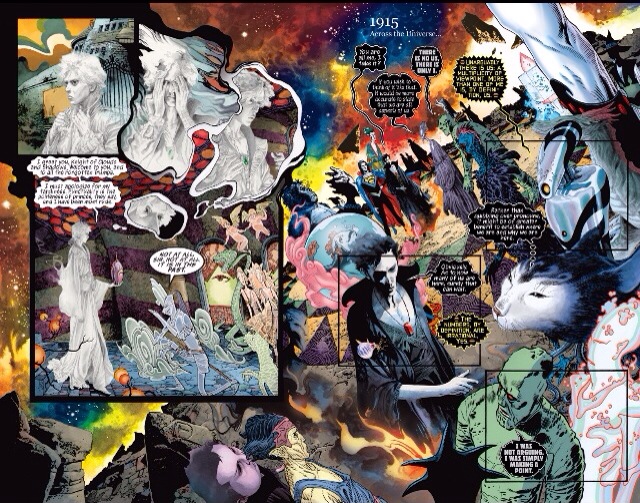
The Sandman: Overture #5 (Vertigo)

The first issue published this year???  Indeed.  And the mini-series launched at the end of 2013, so...five issues across three calendar years.  Obviously not a very fast pace...I've had my issues enjoying this effort from Neil Gaiman and J.H. Williams III, but at this point I think I've put them behind me.  This was never supposed to be the Sandman of the original series, but rather an expansive view of the whole thing, Dream himself.  The next issue (whenever that happens) is actually the conclusion, so I'll wait until then to come up with a more comprehensive reaction to Overture.  But as with Mister X, I'm just glad to have an opportunity to correct something I hadn't done previously, which is read the serialized version of something I previously knew from collected editions...

Sunday, December 28, 2014

The Sandman: Overture #4 (Vertigo)

via Lady Geek Girl
writer: Neil Gaiman
artist: J.H. Williams III

The Sandman: Overture is being released so gradually, you can almost forget sometimes that it's even happening.  I think that's exactly what's happened, too.

It probably doesn't help that this is not at all easy reading.

All the same, we're four issues in now and Dream is talking to stars.  Stars, mind you, that don't particularly respect him.  

And is this the issue where we finally get something to hold onto?  Dream is endangered by the troublesome stars, and he speaks with his father, and this is what the father has to say about Dream's companion, the little alien girl called Hope:
"There is always a time in which she will have been alive.  Always a time in which she does not exist.  That is the nature of existence.  I cannot think why nobody except me seems to see things like that."
Such is the value of this effort, I suspect, trying to address some terrifically big ideas.

Wednesday, August 27, 2014

The Sandman: Overture #3 (Vertigo)

writer: Neil Gaiman
artist: J.H. Williams III
via IGN
It sucks, because I never know if I'm missing something that directly references prior Sandman material.  I know, for instance, that we have a secret origin for Dream's helm, which was famously recovered in the original series' opening arc.  But then again, maybe this is something that fans have seen before?  

It seems as if the romance around that moment is first-run material, but then what do I know?  And should I even be worrying about this?  The third volume of The Annotated Sandman is being released in October.  I hope to get both that one and the second volume and read them either by the end of the year or earlier in 2015.  By that point I'll have caught up with the bulk of the mythology, and maybe will be less confused about these matters.

But then again, maybe I really shouldn't be worrying so much about these matters.  This issue is probably the most enjoyable, for me anyway, of Overture so far.  There appear to be direct references to Dream's ultimate fate, so that this is a prequel for all I understand.  Regardless, Dream is on a quest.  There are multiple versions of him running around.  In fact, he's at the moment hanging out with a cat version of himself.  This leads to an amusing moment when they pick up a tagalong, who suggests when she doesn't walk by herself, "I could ride your cat."  To which Dream responds:

"My cat is Dream of the Endless.  He does not give rides."

Classic.  Gaiman is a master storyteller, and is a better writer, generally, than pretty much anyone else.  Regardless of how lost I sometimes feel, he's always in control.  Reading Overture for me is a little like what reading Grant Morrison must be like for all those people who don't get him.  

And as always, J.H. Williams III is stunning on art.  The way he composes his layouts can sometimes be challenging to follow even for veteran comics readers, but it's always a welcome challenge.

Friday, June 13, 2014

The Sandman: Overture #2 (Vertigo)

writer: Neil Gaiman
artist: J.H. Williams III

via Nothing But Comics
I came very late to Neil Gaiman's Sandman, but I became as much a fan as anyone has.  That being said, and also that I'm very happy that they've once again come together, I'm not sure what I think of Overture after two issues.  The above image is part of my dilemma.  

Gaiman so far has been setting the stage, and that's about it.  This is not one of those complaints that has anything to do with delays.  I'm not so starved for entertainment that I must hang all of my attention on a single story.  That being said, I'm pretty sure the schedule was always more elongated than usual.  Now it seems it's a little longer still.  Whatever.

No, this is more a matter of how much time Gaiman is spending talking about Dream rather than tossing him into another story.  My limited experience of Sandman to date is that it's less to do with the central character and more his tangential role in a whole tapestry of stories.  With Overture, Gaiman seems to have reversed that.  I get the sense that the whole reason he's even working on this project is because like a lot of writers at later stages in their careers (although considering Gaiman is only 53, this is kind of ridiculous to be saying, I know) and years removed from their most famous projects, they either try to distance themselves from said project or try and do whatever they can to remind everyone of what made them so special to begin with.

So on that score it makes sense for Overture to be more about Dream than feature him.  This is a chance to revisit the character and everything else around him, to celebrate, and so that's a little of what's going on here.  This second issue doesn't do a ton more than the first one.  The multiple versions of Dream do a lot of talking with each other.  In theory this is right up my alley.  I like cerebral material, people talking about things rather merely doing things.  But as far as my expectations go, I kind of what, I guess (and I just realized what I was thinking as I was writing this sentence, and how it suddenly sounds kind of stupid) what Gaiman has done before.

And I guess, that's an important thing to realize.  Maybe Overture is doing exactly what it's supposed to be doing.  I'm still a neophyte as a fan.  I'm not lost, really, but maybe because I still haven't actually read the whole of the original material, I wanted something that evoked it more than I should have.  I was probably being a little ridiculous.  

Ha.

So I guess I'll relax a little.  The next issue is scheduled for release at the end of next month.  Sometimes it bears reminding in a monthly format that it's not always as easy as it can seem to appreciate what a finite story is accomplishing from issue to issue.

In the meantime, have another look at that art!  All praise to J.H. Williams III!

Monday, May 5, 2014

Reading Comics #122 "Bull Moose Grab Bag"

I love grab bags.  One of the shops I frequent these days, which is actually an indy music/movie chain store that also has comic books, is Bull Moose in Lewiston, Maine.  I've gotten a few grab bags from them over the last few months, and during the course of my reviews of the stuff I've been reading lately you might have seen some fairly negative ones.  Since I've cut back on my spending, I've been reading far fewer comics than I used to, only the stuff that I'm really certain I'll appreciate, so that's the secret origin of that.  Bull Moose grab bags are a great bargain (since it's highly unlikely that there will be a lot of Lewiston, Maine, natives in my reading audience, this does not count as a shameless plug), ten recent comics for five bucks.  "Recent" means within the past year, usually within the last few months (although the one I got this Saturday must have been one of the older bags they had, because its contents were near a year old).

So at this point I've decided to bring back the roundup feature I sometimes fall back on here.  When there's something I haven't really enjoyed I don't have to try and justify it too much.  But there can be real gems in the bunch as well!

Cable and X-Force #18 (Marvel)
Cable and Bishop are time-traveling mutants who are fascinating in theory but are more often than not incapable of living up to their potential, possibly because writers aren't really thinking about what they can do but rather what they can't, which is explore the dystopias they come from.  Bishop has had a much rougher path to follow than Cable (notice which one is in the title, and has had a lot of series over the years and which...hasn't), although he's been a favorite of mine since I first saw him in the old early '90s X-Men cartoon.  (Hey, and speaking of which, is either one of these guys in X-Men: Days of the Future Past?)  They've got the same curse every Marvel mutant has, actually, only amplified.  Everyone knows that the X-Men are supposed to be a persecuted lot, but the logical gymnastics writers take to keep them that way, or ignore this concept entirely, can sometimes be ridiculous.  Recently they've settled on making more Magneto characters, which is to say compromised figures trying to do the right thing but making all the wrong moves (read: Cyclops).  Add Bishop to that bunch, unfortunately.  And so that's what this issue is all about.  Apparently someone also thought it was a good idea to have not one but two teams of X-Force running around (because you can never have too many competing concepts in Marvel), and so that's also what this comic's about.  It's not very good, alas.  And the art looks a little weird at points.  It screws up Cable, for instance.  (Since when was his metallic arm a covering for an actual arm?  Who am I kidding?  I don't care!)  Long story short: this is not a comic book I would have read deliberately.

Earth 2 #19 (DC)
I kept trying to find the recent annual that basically mainlined the awesome Flashpoint concept from a few years back of Thomas Wayne becoming Batman instead of his son, but failed everywhere I looked (even though I do digital comics now and am clearly aware of the Internet, I still love operating in the physical world), so it was pretty awesome to randomly come across an issue of the regular series.  This series, in case you're not aware, is set in one of DC's alternate realities.  It was launched by James Robinson as a surrogate Justice Society landscape but set in the same context as the debut arc from Geoff Johns' Justice League, so that the Darkseid siege of Earth was more successful and so everyone had to figure out how to pick up the pieces.  At the start the new versions of the classic JSA superheroes were occupying a landscape devoid of the more familiar DC icons because those guys had been eliminated.  But recently they've been resurfacing, including the new Batman.  I think it's evolved beautifully, and under the auspices of Tom Taylor remains a leading contender for a mainstream superhero comic that you could pick as your standalone experience should you want to know what that's like without having to worry about picking up any other series.  And this is a good issue.  Like I've said about Justice League all along, Earth 2 could easily be construed as an ongoing event book.  Closing in on two years, that's not a bad thing to consider reading at all.  At the moment, Batman and the altered version of Superman have been occupying the center stage, coming ever closing to a reckoning.  Well, like I said, good stuff.

Infinity #6 (Marvel)
This was last year's big Marvel event, sort of like something-something Thanos, something-something Inhumans (because Marvel keeps trying to make them a thing just like DC keeps trying to make the New Gods a thing, and only one of them actually has something interesting to explore) (and it's not Marvel).  This was Jonathan Hickman's effort to duplicate the classic Jim Starlin stories featuring Thanos, no doubt thanks to the large-chin villain's cameo at the end of Avengers (although he won't appear as a main character until the third movie) (probably).  I've always admired Hickman's ambition, but I'm not sure he's quite what Marvel keeps hoping he'll be, which is their own Grant Morrison.  He's better than other writers who've tried to handle Thanos recently, but the result is still a fairly poor echo of Starlin's material.  Still, the art is from Jim Cheung, who was half of the iconic original team on Young Avengers (along with Allan Heinberg).  Good strong stuff there, anyway, as always.  Glad to see him still considered a significant player.

Marvel Previews #14 (Marvel)
This is Marvel's separate catalog to the industry-standard, Diamond distributor version that handles...everyone else.  I don't really know why this ended up in the grab bag.  But it didn't exactly convince me to think any differently about Marvel's current output than I have been.  On the cover is Nightcrawler, the latest returned-from-the-dead character.  Oh, which reminds me, in case you had no idea, Nightcrawler's been dead lately.  But apparently he got better.

Red Lanterns #25 (DC)
I haven't really been following the Green Lantern franchise, other than Geoff Johns, since the New 52 relaunch in 2011, but it's been nice knowing it exists, and in such force.  One of the odder additions to the lineup was a Red Lanterns series, but it seems the longer it's lasted the better it's gotten.  With Charles Soule, always good news, writing it these days, and Guy Gardner having become the face, it's probably as good or better than anything else you'll find in the lineup.  Guy has repositioned the remaining members of the corps into defenders of his home turf, not so much on Earth but the territory (Space Sector 2814, to be precise).  Soule has particular fun with Guy's allies, while he also continues the saga of Atrocitus, who once ruled the roost.  It's as good a sci-fi title as I've read, which is actually pretty rare for a Green Lantern series.  Which is pretty odd when you think about it.

The Sandman: Overture Special Edition #1 (Vertigo)
So, clearly I'm kind of the target audience for this series.  I'm not sure how many new readers will be coming aboard for the journey, except maybe Neil Gaiman fans who came about after the end of the original series when he'd begun making a name for himself as a prose writer.  The casual comics reader probably won't be spending too much time in the Vertigo sandbox, because with Image and a thousand indies running around, there's a lot more competition for the nonsuperhero set than ever before.  As someone who loves Gaiman's Sandman but who hasn't read the complete series, I'm a curious phenomenon (for a lot of other reasons, too).  I caught the original version of this debut issue of Overture, but was glad to randomly catch the special edition as well.  It helped me digest it a little more, not just the bonus features, but being forced to read the comic itself over again.  The Corinthian (the creepy dude with two additional mouths where his eyes ought to be) is in the spotlight once again, but only until our title hero stumbles into an existential conundrum that is not anywhere near finished by the end of the issue.  Gaiman's approach is serialized in this effort, rather than in some of the fairly self-contained stories he told even in his arcs from the original Sandman.  There's plenty to find familiar and interesting here.  It certainly helps to have an artist the caliber of J.H. Williams III (there are few others capable of being anywhere near as awesome), whose sense of the page is virtually unparalleled, which as host of the special edition he's capable of walking through with the reader.  If you're unsure of Overture, these special editions may actually be your better bet.

Sonic Universe #58 (Archie)
I'm just going to skip over this one.  Better for you.  Better for me.  Better for them.

Swamp Thing #27 (DC)
There's whole corners of the New 52 landscape that have nothing to do with Superman or Batman or Green Lantern.  No, really!  One of them involves the so-called "dark" characters who most recently were handled by Vertigo rather than DC.  Their return has been one of the most interesting things about the relauch (I know, if you hear much about it I bet you much more regularly hear all the complaints about what was lost rather than gained).  I confess to not having really taken advantage of this stuff.  But it's good.  It's probably some of the best stuff DC has.  But even fans who know about this corner find reasons to complain, especially since there have been a lot of crossovers.  I don't see the problem with crossovers.  If it's a shared universe, it's a lot more useful, sometimes, to have an out-and-out crossover rather than have a guest-star.  Crossovers, when done right, have a good way of establishing context, and as far as I can tell, books like Swamp Thing have definitely understood that.  Unsurprisingly, the writer here is also Charles Soule.  The dude has quickly become indispensable.  Where the heck did he come from???  A lot of what this particular character means comes from Alan Moore work from thirty years ago.  This run, and even this very issue, is a chance for a fresh start.  Good stuff.

Walking Dead #119 (Image)
(Comic Book Datebase locked me out of the issue listing without a login, so no cover for you.)
Obviously you know about Walking Dead.  Whether from the comic or the TV series or both.  Rather than discuss anything specifically from the issue, I want to address the letters column.  In it, creator/writer Robert Kirkman discusses the future of the comic, how long he envisions it to last.  A couple years ago he was talking a total length of 300 issues.  And keep in mind we're only a third of the way there.  But apparently now he's thinking 500.  And he's already got fans talking about him padding his storytelling.  Because of the huge success of the TV show, Kirkman could keep this thing going as long as he wants, long after the show is over.  The one doesn't depend on the other.  It just sounds ridiculous to me.  No writer has five hundred issues worth of material to tell about one story.  It's just this dude realizing he's got it made.  No matter what else happens, he'll always have this in his back pocket.  Now, there are certainly creators in any medium who spend their whole careers on the same property.  In comics that's certainly been the case.  But other than Dave Sim (who by the way did accomplish 300 issues, over the course of thirty years, on his Cerebus), there hasn't really been anyone who has managed to make such a dedicated run (it's worth noting Sim was his own artist).  Kirkman probably ought to stop prognosticating.  If fans are already complaining about his output now, he may have very few fans indeed decades from now who care about the latest shenanigans of survivors stumbling from scenario to scenario.  Just saying.

Savage Wolverine #14 (Marvel)
Like Walking Dead above, I'm not really going to talk about the issue or the capable talents of Richard Isanove, but rather some of the ridiculous recent habits of Marvel.  On the cover, as you can see, there's a giant #1 in the corner, even though this is not the first issue or some reboot (of a reboot of a reboot of a reboot...over the span of...just a handful of years).  Marvel has always prided itself as never having rebooted its line.  The stories you read today are theoretically related to stories that were done decades ago.  And yet, there've been so many shenanigans that it doesn't really matter anymore.  It's just one successful gimmick to keep fans interested after another.  Such as the equally ridiculous Marvel Now! branding that is clearly Marvel's lackluster answer to DC's New 52.  The cover also has the copy #14.now, which means...absolutely nothing.  It's just one stupid, we're accessible! argument after another.  I think in a few years Marvel will have finally worn out its welcome at the top.  Hopefully.  Well, I wish...

All images via Comic Book Database.