writer: Antony Johnston
artist: Justin Greenwood
Last week I read a digital copy of Fuse's first issue, and it reminded me that I should be reading The Fuse. By sheer coincidence, there was a new issue released on Wednesday, and it was the conclusion of an arc. Coincidence, perfect timing...
Fuse is a police procedural set on a space station, and it comes from the mind of Antony Johnston, genius creator of the recently concluded Wasteland.
Part of the reason I originally felt reluctance to sign up for an ongoing tour was that I wasn't sure I wanted to follow a more episodic Johnston after the epic arc featured in sixty issues of Wasteland. But Klem and Marlene do have their secrets. Marlene (real name: Ralph)'s reasons for requesting assignment to the station have been a lingering mystery that the veteran Klem has been wondering about since she accepted him on as her new partner. But now it seems as if Klem, too, has her mysteries.
This is good.
The issue concludes the "Gridlock" arc and it's in classic procedural fashion, the culprit being fingered with a full explanation of how they did it. Maybe it's the TV viewer in me, but that's always my favorite part anyway. I previously checked in on Fuse at the start of the arc, so that's another of the good timing bit going around.
In the letters column, Johnston celebrates the connection the series has made with its fans, and then explains what the next arc is going to be, and it sounds very interesting, a sort of reverse of The Purge, the movies about the one day of the year when everybody can be bad guys (!!!). Here it will be an exploration of the day Earth is closest to the sun, and how this makes everyone extra crazy. If you know of other stories that have explored this concept, let me know!
Showing posts with label The Fuse. Show all posts
Sunday, May 3, 2015
Monday, April 27, 2015
Digitally Speaking...49
This column details my adventures reading comics from my comiXology account...
Fade Out: Painless Suicide (WiseDog)
From 2014.
I'm not entirely sure what this was supposed to be. It starts out like it's going to be about suicide. And then young love. Young love and suicide? Makes sense. But then it's about a murder mystery. And then the murder mystery ends with the main character being murdered. Not, you know, committing suicide. So I guess...I just don't get it.
Fantastic Four #1 (Marvel)
From 1961.
History could have read this so much differently. Mister Fantastic (Plastic Man/Elongated Man) and Human Torch (the Golden Age Human Torch) were archetypes of existing superheroes, while the Thing and Invisible Girl were culled straight from horror movies...In fact, the whole thing seemed to be Stan Lee and Jack Kirby creating horror characters more than superheroes, but using them as superheroes. The team launched the Marvel Age, and as such became known as the first superheroes to inhabit the angst-ridden, "human level" variety Marvel became known for, but...they were horror creations, tossed together like Van Helsing meets League of Extraordinary Gentlemen. Doom Patrol, the X-Men, the Incredible Hulk, these were all characters more akin to horror, which at that time cinematically was still steeped in the classic horror age, before the dawn of the slasher flicks twenty years later. Just imagine if the team had remained known as horror characters, rather than superheroes...But then, Marvel became known as DC's main competition, and the rest is history. Characters who slipped in from the frames of movies have transitioned into the movies, where they have become a whole genre like, well, the horror movies that inspired them. It figures.
Fatherhood #1 (Challenger)
From 2013.
This one-shot is much like Fade Out, tonally somewhat baffling. The writer describes it as attempting to explore what it means to be a father (hence the, ah, title), fighting between impulses of great devotion and the ability to do very questionable things because of that great devotion...but the story abruptly shifts from being about the pain of a separated marriage to the father going all psycho and pseudo-noir as he gets the latest popular toy for his daughter. Like Fade Out, I can say I just don't get it. You understand, this essentially means, these are poorly-reasoned comics.
Fighting Stranger: Chapter One (HicksVillain)
From 2013.
Fighting Stranger is...strange. And it becomes stranger. The good news is that it's a good kind of strange. The writing is at turns incredibly clever and clunky. Thankfully the cleverness outweighs the clunk. And the cleverness extends a few ways, from how the stereotypical story of an amnesiac being guided along a journey to discovering he has certain skills and purpose is reshaped by how it's done (by the end of this chapter, there's a whole new level added) and with what kind of characters. The most important character isn't the lead at all, but his guide, the dancing entertainbot C4D, who proves endlessly amusing. Good stuff.
First Law of Mad Science #1 (Noreon)
From 2012.
By the time a quote from H.P. Lovecraft shows up at the end, I guess what precedes it makes perfect sense. Lovecraft has inspired something of a religion. I doubt his fans would consider their devotion to be a religion...but yeah, it's something like a religion at this point. The story involves a scientist who's a pretty crummy father, a son who is resentful of his scientist father being so crummy, cybernetic eyes, robot daughters, seeing monsters that aren't there...Damn Lovecraft fans. I rue the day I ever learned about Lovecraft!
The Flash (DC)
#30 (from 1989)
#54 (from 1991)
#162 (from 2000)
I was recommended the first two when Flash comics went on sale in celebration of the new TV series launching. For me they're rare Wally West stories not written by Mark Waid, but rather William Messner-Loebs. There came a point where I no longer believed this, but during the '90s, when he was writing The Flash, Waid could do no wrong. He was, for me, the definitive writer of not only Wally West but the Flash in general. So for someone to recommend reading issues from the same series Waid later made his own felt like an impossible mission. Waid came onboard years after the series launched, which meant he wasn't the first writer to attempting defining what it meant for Wally to have assumed the scarlet cowl, succeeding his friend and mentor Barry Allen. But the recommendation was, Messner-Loebs made Wally's life as a speedster interesting. And so?
The first issue features Wally in a theater realizing that time seems to have stopped. But it didn't, he merely sped up without realizing it. That's a pretty neat trick. Not that special, but pretty neat. The second issue is probably better. This recommendation made it known that Wally's "Nobody dies" edict alone was special, but there's also diving out of a plane to catch someone, and that was special. Messner-Loebs, it seems, got what being a speedster could feel like. Waid always concentrated on the legacy, but here's a writer who slowed things down (heh) and let Wally, and the reader, experience how the powers actually work. Sometimes it takes a great deal of effort. This is something that's rarely touched on in superhero comics. That alone makes #54 unique.
The third issue, meanwhile, was Waid's final one (until All Flash #1 in 2007, which kicked off the era recently resurrected in Convergence: Speed Force) after his long, historic tenure. By this point he'd been transitioning away, giving more and more responsibility to Brian Augustyn, and so maybe it's not surprising that there's not really a farewell message here, as I would have expected. I took a break from comics in early 1999, when Waid was working on his last great Flash arc, "Chain Lightning," a story whose conclusion I finally read a few years back. The truth is, I thought for years that Waid left after "Chain Lightning," that it was his big goodbye. Turns out he lingered. The issue instead is a pretty random Captain Marvel team-up. I consider this disappointing. Or maybe the disappointment was Waid's. Either way, he did return to the character (fans always considered that work disappointing), but by that point Wally had become a Geoff Johns guy. Which turned out pretty well, until Johns decided he was more of Barry Allen guy...
Flash Gordon #1 (Dynamite)
From 2014.
Flash Gordon is one of those characters most people know but don't really know much about. He's a space adventurer in the vein of Star-Lord, the currently popular model as seen in last year's popular Guardians of the Galaxy flick. And he's more or less fallen completely by the wayside. So of course he gets a revival. The question is, does the revival remind us what makes Flash Gordon unique? Not really. Very quickly, we're dumped in the middle of an adventure, Ming, all of that. Which is fine. if you like random adventure stories set on alien worlds, then this is your thing. But if you want a reason to care for Flash Gordon specifically again, this may not be. Because otherwise the character has become as equally random as the story he's in. I personally don't see this as a particularly good development.
Footprints Vol. 1 (Soup Dad)
From 2014.
If you ever wanted to find out what it would be like if Alan Moore wrote Hellboy in the same general style he did Watchmen...Footprints follows Bigfoot in much the way the early issues of Fables followed the Big Bad Wolf. You don't know why Bigfoot became a private investigator except that the story felt like putting him in that role. And then he has to solve the mystery of what's been happening to the cryptoid community. Tries to make bold statements about the 20th century. Fails. Scott Snyder provides an introduction, although he unwittingly reveals what kind of experience you're really headed for when he begins by explaining how he used to watch a bad Bigfoot special on TV all the time, and he got hooked on it. That's what this basically is.
FUBAR: FCBD Edition (Alterna)
From 2013.
Soldiers in various eras blah-blah-blah random monsters! And that's basically all this is. If you like random monsters, I guess you'd probably like this more than I did. And as for all those acronyms...FUBAR = F***ed Up Beyond All Reason (it's a military term, naturally), FCBD = Free Comic Book Day. Which incidentally is this Saturday!
Fun Fun Comics #1 (Fun Fun)
From 2013.
Deliriously funny stuff from Michael D. Koch (presumably not related to the Derek Koch I got to know from Paperback Reader, who actually probably would like stuff like Footprints), a collection of some old indy comic strip material filled with terrific gags and wacky situations that are kind of what Family Guy tries to do (which is not to say that Family Guy fails so much that Koch does it better). His noble work continues, weirdly enough, at a site called Fun Fun Comics. Later in the collection, Hamlet tries to warn Mel Gibson about the talking skull. But of course it doesn't matter. I guess I'm just a sucker for this kind of stuff. And what about Michael Bolton? As everyone who's seen Office Space knows, Michael Bolton sucks. But that's hardly the last word on him. Probably you should read this to find out more...
The Fuse #1 (Image)
From 2014.
I may have sold The Fuse short. This is because I know the writer, Antony Johnston, from something that I love, the recently concluded post-apocalyptic epic Wasteland, and so when Fuse launched a little over a year ago, I wasn't quite ready to dive into another Johnston project. I mean, Wasteland happens once a lifetime, right? And Johnston launched another series at the same time, Umbral. The thing is, Umbral is a lot more like Wasteland than Fuse. What they all share is Johnston's knack for world-building. But where Wasteland and Umbral set up years-long stories, Fuse is, basically, a procedural set on a space station (the title is the name of the station). I actually liked what I read when I sampled Fuse previously, but again, I wasn't ready to make another commitment. Reading the first issue for the first time, after the end of Wasteland, I think I'm ready. This is good stuff. And so I will be correcting my oversight first chance I get.
Fade Out: Painless Suicide (WiseDog)
From 2014.
I'm not entirely sure what this was supposed to be. It starts out like it's going to be about suicide. And then young love. Young love and suicide? Makes sense. But then it's about a murder mystery. And then the murder mystery ends with the main character being murdered. Not, you know, committing suicide. So I guess...I just don't get it.
Fantastic Four #1 (Marvel)
From 1961.
History could have read this so much differently. Mister Fantastic (Plastic Man/Elongated Man) and Human Torch (the Golden Age Human Torch) were archetypes of existing superheroes, while the Thing and Invisible Girl were culled straight from horror movies...In fact, the whole thing seemed to be Stan Lee and Jack Kirby creating horror characters more than superheroes, but using them as superheroes. The team launched the Marvel Age, and as such became known as the first superheroes to inhabit the angst-ridden, "human level" variety Marvel became known for, but...they were horror creations, tossed together like Van Helsing meets League of Extraordinary Gentlemen. Doom Patrol, the X-Men, the Incredible Hulk, these were all characters more akin to horror, which at that time cinematically was still steeped in the classic horror age, before the dawn of the slasher flicks twenty years later. Just imagine if the team had remained known as horror characters, rather than superheroes...But then, Marvel became known as DC's main competition, and the rest is history. Characters who slipped in from the frames of movies have transitioned into the movies, where they have become a whole genre like, well, the horror movies that inspired them. It figures.
Fatherhood #1 (Challenger)
From 2013.
This one-shot is much like Fade Out, tonally somewhat baffling. The writer describes it as attempting to explore what it means to be a father (hence the, ah, title), fighting between impulses of great devotion and the ability to do very questionable things because of that great devotion...but the story abruptly shifts from being about the pain of a separated marriage to the father going all psycho and pseudo-noir as he gets the latest popular toy for his daughter. Like Fade Out, I can say I just don't get it. You understand, this essentially means, these are poorly-reasoned comics.
Fighting Stranger: Chapter One (HicksVillain)
From 2013.
Fighting Stranger is...strange. And it becomes stranger. The good news is that it's a good kind of strange. The writing is at turns incredibly clever and clunky. Thankfully the cleverness outweighs the clunk. And the cleverness extends a few ways, from how the stereotypical story of an amnesiac being guided along a journey to discovering he has certain skills and purpose is reshaped by how it's done (by the end of this chapter, there's a whole new level added) and with what kind of characters. The most important character isn't the lead at all, but his guide, the dancing entertainbot C4D, who proves endlessly amusing. Good stuff.
First Law of Mad Science #1 (Noreon)
From 2012.
By the time a quote from H.P. Lovecraft shows up at the end, I guess what precedes it makes perfect sense. Lovecraft has inspired something of a religion. I doubt his fans would consider their devotion to be a religion...but yeah, it's something like a religion at this point. The story involves a scientist who's a pretty crummy father, a son who is resentful of his scientist father being so crummy, cybernetic eyes, robot daughters, seeing monsters that aren't there...Damn Lovecraft fans. I rue the day I ever learned about Lovecraft!
The Flash (DC)
#30 (from 1989)
#54 (from 1991)
#162 (from 2000)
I was recommended the first two when Flash comics went on sale in celebration of the new TV series launching. For me they're rare Wally West stories not written by Mark Waid, but rather William Messner-Loebs. There came a point where I no longer believed this, but during the '90s, when he was writing The Flash, Waid could do no wrong. He was, for me, the definitive writer of not only Wally West but the Flash in general. So for someone to recommend reading issues from the same series Waid later made his own felt like an impossible mission. Waid came onboard years after the series launched, which meant he wasn't the first writer to attempting defining what it meant for Wally to have assumed the scarlet cowl, succeeding his friend and mentor Barry Allen. But the recommendation was, Messner-Loebs made Wally's life as a speedster interesting. And so?
The first issue features Wally in a theater realizing that time seems to have stopped. But it didn't, he merely sped up without realizing it. That's a pretty neat trick. Not that special, but pretty neat. The second issue is probably better. This recommendation made it known that Wally's "Nobody dies" edict alone was special, but there's also diving out of a plane to catch someone, and that was special. Messner-Loebs, it seems, got what being a speedster could feel like. Waid always concentrated on the legacy, but here's a writer who slowed things down (heh) and let Wally, and the reader, experience how the powers actually work. Sometimes it takes a great deal of effort. This is something that's rarely touched on in superhero comics. That alone makes #54 unique.
The third issue, meanwhile, was Waid's final one (until All Flash #1 in 2007, which kicked off the era recently resurrected in Convergence: Speed Force) after his long, historic tenure. By this point he'd been transitioning away, giving more and more responsibility to Brian Augustyn, and so maybe it's not surprising that there's not really a farewell message here, as I would have expected. I took a break from comics in early 1999, when Waid was working on his last great Flash arc, "Chain Lightning," a story whose conclusion I finally read a few years back. The truth is, I thought for years that Waid left after "Chain Lightning," that it was his big goodbye. Turns out he lingered. The issue instead is a pretty random Captain Marvel team-up. I consider this disappointing. Or maybe the disappointment was Waid's. Either way, he did return to the character (fans always considered that work disappointing), but by that point Wally had become a Geoff Johns guy. Which turned out pretty well, until Johns decided he was more of Barry Allen guy...
Flash Gordon #1 (Dynamite)
From 2014.
Flash Gordon is one of those characters most people know but don't really know much about. He's a space adventurer in the vein of Star-Lord, the currently popular model as seen in last year's popular Guardians of the Galaxy flick. And he's more or less fallen completely by the wayside. So of course he gets a revival. The question is, does the revival remind us what makes Flash Gordon unique? Not really. Very quickly, we're dumped in the middle of an adventure, Ming, all of that. Which is fine. if you like random adventure stories set on alien worlds, then this is your thing. But if you want a reason to care for Flash Gordon specifically again, this may not be. Because otherwise the character has become as equally random as the story he's in. I personally don't see this as a particularly good development.
Footprints Vol. 1 (Soup Dad)
From 2014.
If you ever wanted to find out what it would be like if Alan Moore wrote Hellboy in the same general style he did Watchmen...Footprints follows Bigfoot in much the way the early issues of Fables followed the Big Bad Wolf. You don't know why Bigfoot became a private investigator except that the story felt like putting him in that role. And then he has to solve the mystery of what's been happening to the cryptoid community. Tries to make bold statements about the 20th century. Fails. Scott Snyder provides an introduction, although he unwittingly reveals what kind of experience you're really headed for when he begins by explaining how he used to watch a bad Bigfoot special on TV all the time, and he got hooked on it. That's what this basically is.
FUBAR: FCBD Edition (Alterna)
From 2013.
Soldiers in various eras blah-blah-blah random monsters! And that's basically all this is. If you like random monsters, I guess you'd probably like this more than I did. And as for all those acronyms...FUBAR = F***ed Up Beyond All Reason (it's a military term, naturally), FCBD = Free Comic Book Day. Which incidentally is this Saturday!
Fun Fun Comics #1 (Fun Fun)
From 2013.
Deliriously funny stuff from Michael D. Koch (presumably not related to the Derek Koch I got to know from Paperback Reader, who actually probably would like stuff like Footprints), a collection of some old indy comic strip material filled with terrific gags and wacky situations that are kind of what Family Guy tries to do (which is not to say that Family Guy fails so much that Koch does it better). His noble work continues, weirdly enough, at a site called Fun Fun Comics. Later in the collection, Hamlet tries to warn Mel Gibson about the talking skull. But of course it doesn't matter. I guess I'm just a sucker for this kind of stuff. And what about Michael Bolton? As everyone who's seen Office Space knows, Michael Bolton sucks. But that's hardly the last word on him. Probably you should read this to find out more...
The Fuse #1 (Image)
From 2014.
I may have sold The Fuse short. This is because I know the writer, Antony Johnston, from something that I love, the recently concluded post-apocalyptic epic Wasteland, and so when Fuse launched a little over a year ago, I wasn't quite ready to dive into another Johnston project. I mean, Wasteland happens once a lifetime, right? And Johnston launched another series at the same time, Umbral. The thing is, Umbral is a lot more like Wasteland than Fuse. What they all share is Johnston's knack for world-building. But where Wasteland and Umbral set up years-long stories, Fuse is, basically, a procedural set on a space station (the title is the name of the station). I actually liked what I read when I sampled Fuse previously, but again, I wasn't ready to make another commitment. Reading the first issue for the first time, after the end of Wasteland, I think I'm ready. This is good stuff. And so I will be correcting my oversight first chance I get.
Saturday, December 13, 2014
Reading Comics #139 "November 2014"
Batman and Robin #36 (DC)
writer: Peter J. Tomasi
writer: Antony Johnston
writer: Charles Soule
writer: Geoff Johns
writer: Scott Snyder
writer: Antony Johnston
| via Comic Book Roundup |
artist: Patrick Gleason
"Robin Rises" continues! In Part IV, Batman's backup (Red Robin, Batgirl, Red Hood, Titus, and the reluctant Cyborg) has arrived on Apokolips as Batman himself continues to deploy the Hellbat armor to full effect in his rampage through hell as he seeks to reclaim the body of Damian. I love when Red Hood (Jason Todd) says, "Went a little Red Lantern here, don'tcha think?" as it evokes Tomasi's time in the Green Lantern titles. It's a full-on action installment of the arc, allowing Gleason ample opportunity to demonstrate how awesome his work is. The big payoff is on the last page, one of those perfect cliffhangers: standing behind Batman is the shadow of Darkseid himself. The Dark Knight merely states, "Hrrn. About time you showed up." This moment evokes not only the opening arc of the New 52 Justice League reboot, but the dramatic events of Final Crisis. Tomasi has succeeded in capturing the Batman every geek always knew existed, one who could take on any challenge without sweating it. December promises big, big things...
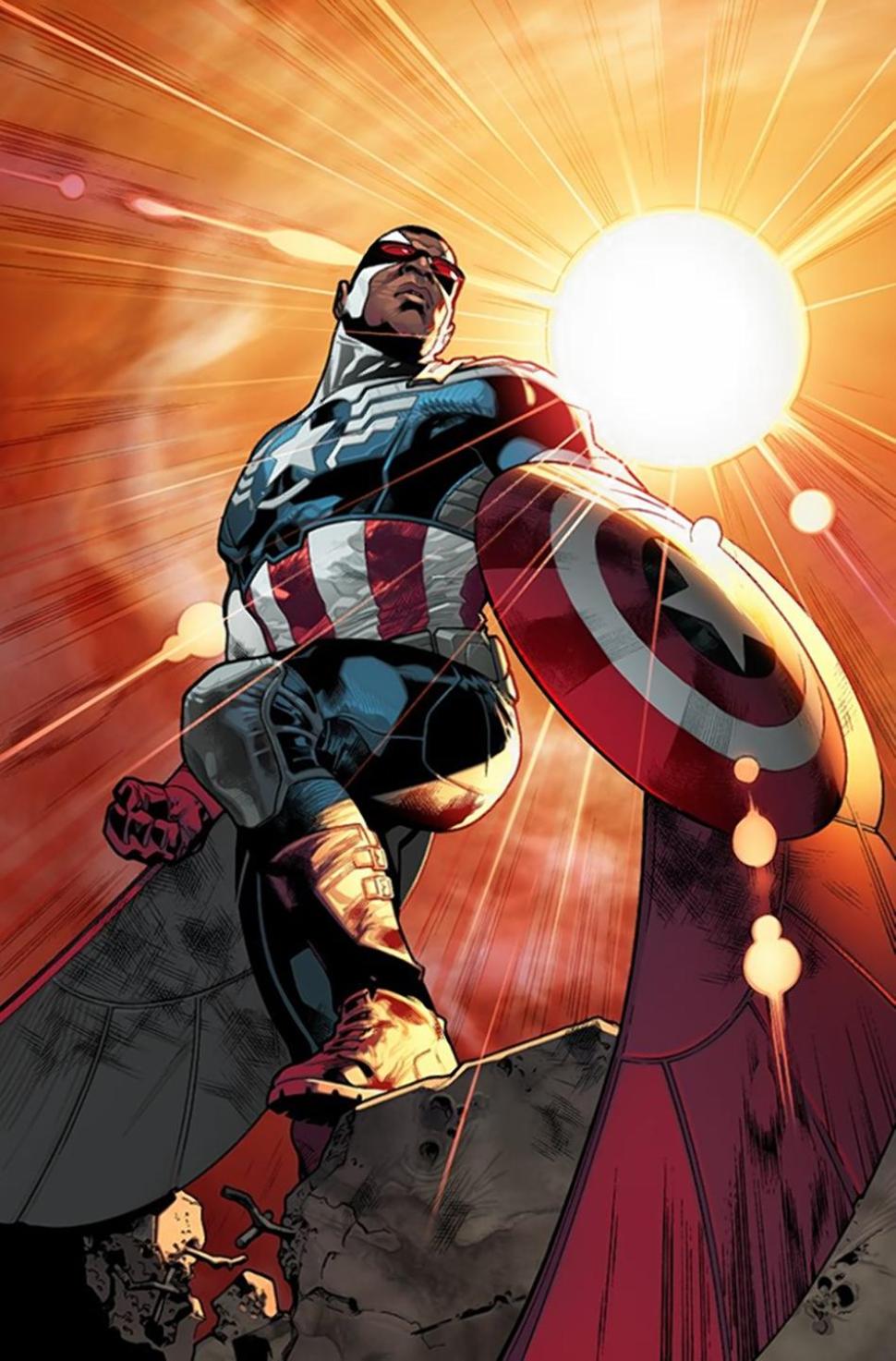
All-New Captain America #1 (Marvel)
| via Marvel Wikia |
writer: Rick Remender
artist: Stuart Immonen
I had already been intrigued by what Remender had been doing with Captain America, but then Sam Wilson, the Falcon, was announced as inheriting the role, a whole reboot of the series was in order, and Stuart Immonen was tapped as artist. I last caught Immonen's Marvel work in the pages of Brian Michael Bendis's All-New X-Men, and it was the best work I'd seen from him for the company, a subtle return to the form I'd admired so much in his Superman work. His All-New Captain America may be the closest yet. Times have changed since Immonen's Superman, certainly. Coloring has become a major business, adding whole new dimensions to the art, regardless of the artist. Sometimes the colorist is actually the most prominent contributor these days (on that score, aiding Immonen and inker Wade von Grawbadger are Marte Gracia and Eduardo Navarro), along with more detailed shading (whether attributed to Immonen or von Grawbadger; shading was usually conspicuously absent from Immone's Superman, which was what helped make it so striking). Visually a very stunning comic, then. Story-wise is pretty interesting, too. The last time Steve Rogers, for one reason or another, was replaced as the Sentinel of Liberty it was by James "Bucky" Barnes, the Winter Soldier, who was billed for all intents and purposes as pretty permanent. There was a giant hubbub about the updated uniform Alex Ross created for the occasion. Wilson gets a new uniform, too, that looks a little like a cross between his Falcon garb, the S.H.I.E.L.D. design Rogers for a time ran around in, and of course the traditional Captain America look. Upstaging Wilson's Cap is the son Remender introduced in his clever Dimension Z story, Ian, who is actually Arnim Zola's kid. Ian, by the way, has adopted the moniker Nomad, which has become a part of Cap lore ever since Rogers himself used it in one of his earlier exiles from the cowl. The dynamic between Wilson and Ian is unusual, almost as if Wilson is less Cap than Ian is. Remender provides a one-page review of Wilson's origins in the likely event readers will not have been familiar with it. It's a darn good issue regardless of all the altered dynamics.
The Fuse #7 (Image)
| via Image Comics |
artist: Justin Greenwood
I became a devoted fan of Johnston's thanks to his soon-to-conclude opus Wasteland, so to see a couple of new projects launch at Image this year was a nice way to see that others have noticed his talent, too. In this futuristic cop procedural he's joined by Greenwood, who helped on Wasteland but should better be known for Marc Guggenheim's Resurrection. This issue begins the "Gridlock" arc, which concerns contestants in a reality show. While I don't read the series regularly, I like reading the letters column featuring those that do, and their observations of the main characters, who are doubtless easier to keep track of when you don't skip around like I do...
Red Lanterns #35 (DC)
| via Darkstar Sci Fi |
artist: J. Calafiore
Here's where I interrupt the proceedings for a moment and complain about the unreliability of the pull list service I've been receiving from my local comics shop. I don't know why they've had such problems, and maybe they have good reasons, but it's certainly been annoying. I haven't read the Starlight finale because of this and after a few months I've only now just gotten them to produce an issue of Supreme: Blue Rose for me. And I read this issue of Red Lanterns late because of the same problems.
Anyway, enough complaints. This was part of the first month of the "Godhead" crossover event in the Green Lantern titles, featuring the New Gods as they've targeted the various power rings as the answer to the Life Equation. When we last saw Guy Gardner he'd just defeated Atrocitus and taken a sabbatical. We pick up with Guy on vacation with his sometimes beau, Ice (not to be confused with Bea, Ice's sometimes bestie, Fire). The issue is heavily Red Lanterns-centric, possibly because Soule's days, sadly, are numbered in the series and at DC in general (darn exclusive contract at Marvel!). New Gods show up, and then Simon Baz does, too. I'm glad to see Baz, who was Geoff Johns' late addition to Green Lantern lore at the end of his tenure (he remains, though, at DC, obviously).
Superman #36 (DC)
| via IGN |
artist: John Romita, Jr.
Speaking of Johns, arguably his biggest gig at the moment is in the pages of Superman (I check in over at Justice League more than read it regularly these days, alas, after having missed so much of the last few years). Ulysses, the latest strange visitor, has finally tipped his hand. For maybe half the issue things still seem exactly as they have in previous issues of the arc, but then Neil Quinn (Ulysses) visits his parents and begins to reveal what's really going on ("I love you both so much. That's why you can't come with me." "I don't understand." "I didn't know you were still alive! They didn't tell me you were still alive! I'm trying to protect you!") It seems the offer he made to humanity at the end of last issue is the ulterior motive most readers were probably expecting from his first appearance. And soon Ulysses and Superman are fighting, at last. Romita is a big-impact kind of artist (he did work on Millar's Kick-Ass after all), and he gets to do a good bit of that here. Wherever Johns is headed with all of this, it remains expertly paced.
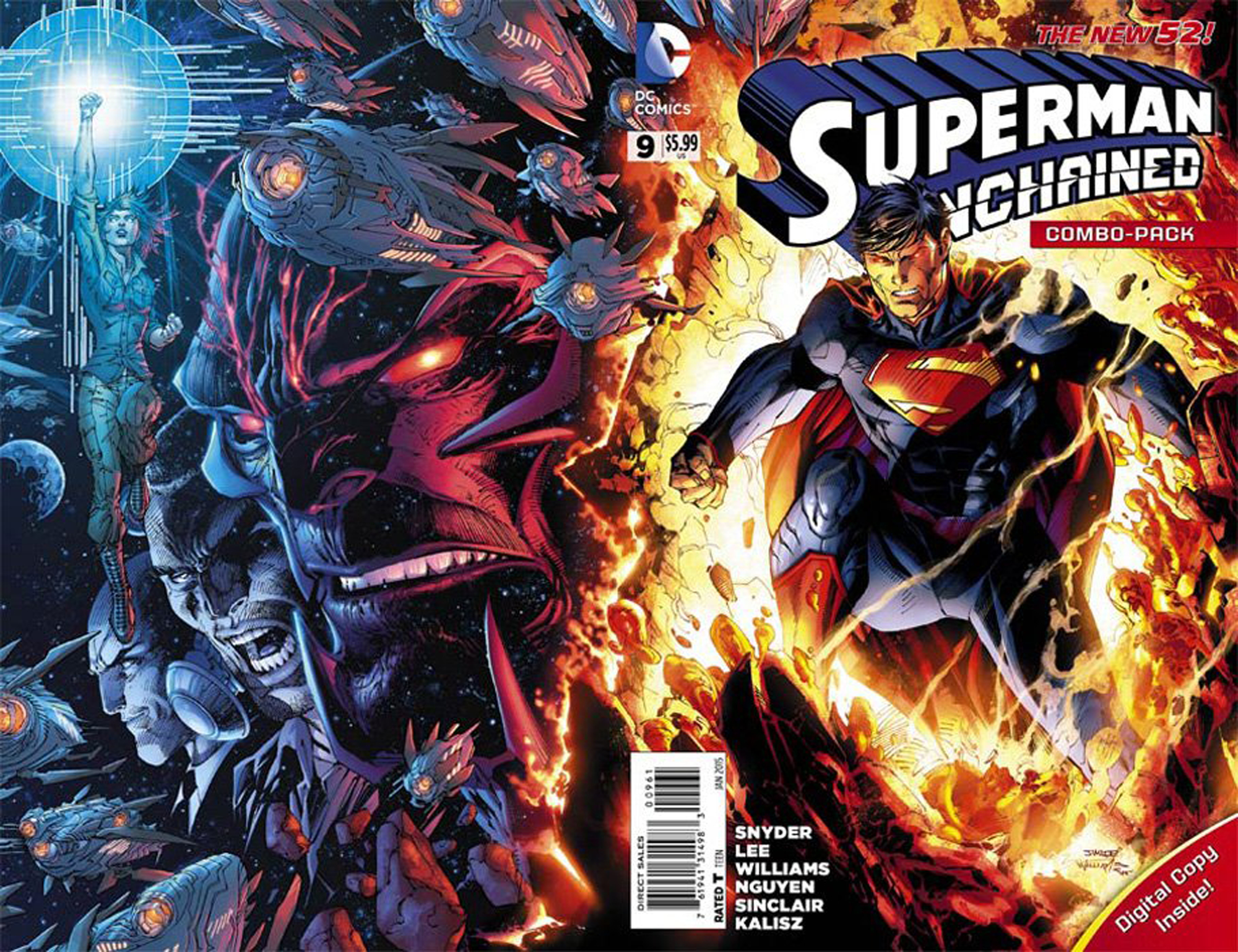
Superman Unchained #9 (DC)
| via Previews World |
artist: Jim Lee
Given my complicated feelings toward Snyder, I was reluctant to check out his big Superman story. This final issue, however, may have proven my doubts wrong in a fairly major way. It's not even so much how he handles Superman but rather Lex Luthor. Here's some prime Luthor dialogue to illustrate:
"You look at him, and you see a light leading the way...But instead he is a light lost in the darkness."
[...]
"What I expected to see, looking backwards through time at his efforts, was, as you said, Ms. Lane: someone who stood for something. I thought a profile would emerge, the profile of someone sure of himself. Someone sure he knew what was best for all of us. But I saw that Superman, whoever he is, is trial and error."
[...]
"The point I'm making is that Superman doesn't stand for anything. He's just a man, stumbling through life. He's not a great beacon, he's barely a candle, lighting a path for himself the best he can. And as we all know, eventually...candles go out."
"I reject him," he goes on to say. In essence, of course, Luthor is equating Superman with America. It's the first time I've noticed a particular perspective from Snyder, and it's one I completely recognize, as very similar to my own. It's a revelation. Regardless of your own perspective, this is Luthor making the same observation that is supposed to have been made of Superman all along ("...and the American way!"), only from a modern perspective. It's really quite startling. Bravo, Mr. Snyder. Lee's Superman is distinct from the work he did in the early issues of Justice League, which is interesting to note.
Superman/Wonder Woman #13 (DC)
artist: Doug Mahnke
Charles Soule's year on the title was capped with a statement on the whole concept readers considered pretty definitive. What can Tomasi add? Plenty, as it turns out. When Wonder Woman showed up in the pages of Batman and Robin, it was one of the rare odd notes in that series. This is proof that Tomasi more than understands the Amazon Princess. "You fight with too much on your mind. Who did you train under?" "My father," Superman responds. "Obviously," she says. Fight scenes are rampant in the series, and the contrasting approaches these lovers take as always been a focal point. Tomasi leaves room for these observations from Wonder Woman, too [spoken to a civilian]:
"In my culture this fragility would be your downfall. Here it's practically a virtue. I've been doing my best to help some of you since my arrival, but how will you ever grow stronger if you need us every waking moment?"
Superman has this in way of a response: "This man has internal bleeding and needs immediate help. You should've done something instead of talking to him."
It's the kind of Wonder Woman that Geoff Johns tried to introduce in the early issues of Justice League, who has recently come to what she calls "man's world" and struggles to fully comprehend it, so that what ends up defining her is the gap that exists between herself and those she is theoretically here to champion. For Superman, there is no gap, and for Batman, the third member of DC's Trinity, the gap is something he's constantly trying to create with his enemies. One is human but alien (Wonder Woman), one is alien but human (Superman). Tomasi is excellent at these kinds of interpersonal observations. He'd perfect for this series.
Umbral #10 (Image)
| via Image Comics |
artist: Christopher Mitten
Hey, remember when I was giving props to colorists earlier, this is definitely a series that owes a huge debt to its colorist. Otherwise it's a Wasteland reunion between Johnston and once-and-final artist Mitten. For anyone, and that would be just about everyone, who struggled to understand the appeal of Wasteland, Umbral is your shot to embrace the fantastic vision of Johnston and Mitten. Like The Fuse I haven't been reading it regularly, so it's a little tough to completely appreciate the proceedings, and because Umbral is a continuing story it's all the harder. I think of the two, I can see myself making a commitment to this one next year. Although I may end up reading both regularly. We'll see!
Thursday, July 10, 2014
Reading Comics #127 "Antony Johnston"
Antony Johnston is the genius writer of Wasteland, one of the best comics I've ever read, counting down to its sixtieth and last issue later this year (#56 just released!). Thankfully he's being afforded an expanded presence in the comics landscape thanks to a pair of new Image series, which happen to feature art from his best Wasteland collaborators.
The more recent The Fuse features Justin Greenwood (I first experienced him on Marc Guggenheim's Resurrection). I have the first issue waiting in my comiXology queue, but the more recent #3 now stands as my first real experience with it.
Fuse is a detective comic set in the future. The genius of it is that it allows Johnston to work on his signature world-building in less daunting context than readers have typically been able to experience from him. And it's not even the far future, more like one of those near-future worlds that look completely familiar to what you already know. You don't even have to worry about the future at all to enjoy Fuse, at least not with this issue.
The more recent The Fuse features Justin Greenwood (I first experienced him on Marc Guggenheim's Resurrection). I have the first issue waiting in my comiXology queue, but the more recent #3 now stands as my first real experience with it.
| via Image |
(It's the kind of trick that has allowed Jonathan Nolan and J.J. Abrams' Person of Interest to be a reliable hit, whereas so many of Abrams' other shows have been stuck with the genre tag and therefore had limited appeal. Frame it as something that looks conventional and you can get away with so much more!)
I like what I read in the issue, although of course for me, it's Johnston's world-building that's the real draw, so I will have to read more (another dirty trick!) to truly get Fuse in my blood.
Of more immediate appeal for me is Umbral, which Johnston launched slightly earlier with original Wasteland collaborator Christopher Mitten. I've talked about this series already, how it's kind of like Wasteland if it had been set entirely in the city of Newbegin (and soaked, soaked! in purple). Since I haven't been reading it regularly (I hardly read any comics regularly, so this is not a knock against the series), I'm still prone to getting lost. I make a poor champion in that regard. I do, however, highly recommend it.
Coincidentally, the next issue is being released next week (there was a small break between issues, which is worth it to keep Mitten energized and involved in the project). The first trade, Out of the Shadows, was released at the end of May.
| via Image |
Umbral is pretty much the opposite of Fuse. It wears its genre (magic fantasy) thickly on its sleeve. It's also a quest story, like Wasteland, although the approach is far more deliberate. Again, Johnston seems to have handled this expanded platform brilliantly.
(This is not to say I think any less of Wasteland. I applaud worthwhile ambition. And Wasteland has always been a peak example of that.)
I was happy to come across Umbral #6. Not keeping track of the series closely (because, again, my trips to comic book stores and/or digital purchases are erratic these days), I didn't really know how fortuitous this one was. It feels nice to be a part of the experience. Part of that experience is definitely the letters column, which Umbral features vibrantly. Since these things are no longer a given experience in comics, it's almost as much a statement as a reader's platform on how the creators approach their fans, and comics in general, when they have them and how they approach them. Saga's letters column is the best around. There's just no question. Brian Michael Bendis tends to use them to talk about his many projects. The Walking Dead is one extended, interactive forum, probably moreso than any other I've seen. As of this issue, Umbral has entered the big leagues. Good stuff.
Subscribe to:
Posts (Atom)