Showing posts with label Doug Mahnke. Show all posts

Tuesday, April 28, 2020

Pandemic Comics #7 “Justice Leagues”

More comics from the Mile High mystery boxes! Apparently today is National Superhero Day? And apparently Marvel began it? Well, the comics I’ll be talking about, ah, were all published by DC. But the pandemic is teaching us the real superheroes probably have very different costumes than we previously imagined, and masks look very different, too.

Harley Quinn #1
Here’s the “newest comic in the mystery boxes,” from Rebirth, featuring the creative team from the previous series (Marvel’s Constant Reboot Engine sees this happen more frequently) offers a quick recap of relevant information, including Harley’s huge collection of sidekicks. And yet in the spotlight: Deadpool Red Tool.  This was a shiny Mile High variant cover, by the way.

Hawkgirl #54 
As far as I know, this is the only time Hawkgirl had her own book. Of course, it began as Hawkman (where it was written by Geoff Johns) and this issue features the return of Hawkman (probably?). But the good news is it’s from legends Walt Simonson and Howard Chaykin, which is a combination and a series that stood out for me back in 2006, but for some reason never actually read. So, another mystery box that finally addresses one of my comic book sins...

icandy #1
I think it’s the title. Yeah, the title. It’s a terrible title. The comic itself turns out to be pretty good (I mean, it’s written by Dan Abnett & Andy Lanning, the geek gods of that period), a concept that folds video games into a playable concept. I’m frankly shocked this hasn’t been done more, or more successfully. The last time I saw it was Heroes Reborn, which naturally was four seasons after the series was actually popular.

Ion #7 
A maxi-series starring Kyle Rayner post-Green Lantern: Rebirth (otherwise known as “Thanks, Torchbearer, you now get to join the Back-up Corps!), this is a fortuitous random issue, because it reunites Kyle with Radu, the coffee shop owner who was a signature element of Kyle’s early days as a Green Lantern. Ion was a concept they fobbed on Kyle as a consolation prize, before it was replaced by his becoming White Lantern, before he became, well, just another Green Lantern...At the time, I guess, I was still annoyed that “my Green Lantern” had been “kicked to the curb” (which happens to literally every Green Lantern not named Hal Jordan eventually), and so couldn’t properly appreciate Ion. Now it seems like correcting that amounts to another of my comic book sins...

Justice League America #61
The first appearance of Bloodwynd! And, ah, Dan Jurgens takes over the series! In hindsight, Weapons Master really doesn’t seem like that big a challenge. Prometheus was basically an upgraded version only a handful of years later, and even he quickly got turned into a chump. Lesson, villains? Don’t put all your eggs in a fancy gimmick giving you special weapons. Because the weapons can be, well, taken away...

Justice League Task Force #2
This particular Justice League series from the ‘90s will always be the most thankless. Literally its biggest claim to fame is an issue of “Knightfall: The Crusade,” with Crippled Bruce Wayne. This issue is kind of ironic in hindsight: Nightwing looks like a chump while desperately trying to prove he isn’t just a former Teen Titan and/or Batman’s sidekick. If Dan DiDio caught this issue, it might explain why he used to think Nightwing was superfluous...

JLA/WildC.A.T.s
This was a really nice surprise! From the Grant Morrison era, written by Morrison, and featuring Electric Superman (what a snapshot!), something I think I’ve read before, but I guess never really considered that significant. But it is a great little snapshot. But the name of Jim Lee’s big superhero team still sucks, at least as far as incorporating one of the most convoluted acronyms from a whole history of convoluted acronyms in comics...

JLA #79 
It’s always great to remember just how long and varied Doug Mahnke’s history at DC alone is (dude’s also the co-creator of The Mask!), and he’s as easy a talent to revisit for that reason alone as there’s ever been. His art, at least during his DC tenure, has been remarkably consistent, though endlessly adaptable...Hopefully will get a spotlight collection at some point.

Monday, September 18, 2017

Quarter Bin 116 "JLA"

JLA #8 (DC)
from August 1997

This is the setup to the Key revamp Grant Morrison pulled early in his run, but I remember it best for Green Arrow Connor Hawke's memorable statement: "Dad.  Oh, dad.  You're going to be the death of me."  He's referencing having to use his then-late father Oliver Queen's infamous trick arrows.  I used a similar line for a story I later wrote. It's just perfectly executed, and still one of the most memorable endings to any single issue I've ever read.  It's also worth noting the excellent art of Oscar Jimenez, which he seems incapable of delivering on an ongoing basis.  How about signing him up for a limited series, folks?  Also, worth noting that Morrison's Key uses tactics that are very similar to The Matrix, an irony, as Morrison's The Invisibles has long been said to be an unacknowledged source of inspiration for the movie.  I don't know Invisibles well enough to offer a judgment about that, but clearly Morrison was on the right wavelength somewhere...

JLA #14 (DC)
from January 1998

Yeah, so I mistakenly thought this was the "Darkseid Is" issue (it's on the cover an' everything!), but it's the one after it.  It's also "Part 5 of 6" in the "Rock of Ages" arc, but for all intents and purposes, is probably to be considered, along with its immediate predecessor, the best stuff in the arc.  It's Morrison's first crack at Darkseid.  C'mon!  He responds with possibly his best JlA material.  Howard Porter provides art.  It's crazy to think Porter, when JLA launched, was instantly considered an elite artist, but has never received another elite assignment.  What the Apokolips is up with that???

JLA #88 (DC)
from December 2003

Truth be told, after Morrison left the title, I didn't really see much point in trying to see what his successors were up to, despite the fact that there's a lot more non-Morrison JLA issues than ones he actually wrote.  This one's from Joe Kelly, who at the time was threatening to become one of DC's most important writers.  Instead he and a bunch of his pals went and did their own projects, not in the Image way, but bigger, arguably.  Anyway, I chose this issue because the cover promised a strong Martian Manhunter spotlight ("vs the Martian Manhunter! and J'onn Jonzz! and John Jones!"), but as it turns out, Plastic Man is the one who receives the best spotlight.  Plastic Man was Morrison's most outlandish addition to the League, so it's really good to see that his presence in the team wasn't overlooked or forgotten years after the fact.  Kelly spins some poignant material that segues nicely with the Offspring character Mark Waid envisioned as Plastic Man's son.  Waid apparently considers Offspring the best thing about The Kingdom.  You'd really think there would've been more with these two.  There's always the future...Also quite fun to see Doug Mahnke's work, as always.  He seems to have developed, by this point, more or less the style he still uses today.

Sunday, May 28, 2017

Superman #12, 13 (DC)

Anyone unfortunate enough to be following my lengthy Goodreads reviews knows I recently read the two collections of the New 52 series Frankenstein, Agent of S.H.A.D.E., which was the first time I read the series.  I'd previously read the New 52 Frankenstein in the pages of Pete Tomasi and Patrick Gleason's Batman and Robin, and fell in love with the guy all over again (he originally debuted in this incarnation in Grant Morrison's Seven Soldiers of Victory).

So flipping through back issues of Tomasi and Gleason's Rebirth series Superman, I was reminded that Frankenstein makes appearances here, too.  I couldn't have been happier that Tomasi and Gleason were given the Superman assignment.  I knew instantly that DC was rewarding them for knocking Batman and Robin out of the park, even if readers didn't seem to have notice.  But I haven't so far been much of a dedicated reader of their Superman because...I really want Gleason on art.  Every issue. 

Which on a biweekly basis, is never going to happen.

And it really doesn't have to, either, as I've gradually come to accept.  It doesn't hurt to have ringers like Doug Mahnke.  Mahnke has been working at DC since the turn of the millennium, and his stock has consistently risen, even as his profile has remained consistent.  If that makes sense. Anyway, he remains important to the company, and that remains true in the pages of Superman.

He's the artist who did Frankenstein for Seven Soldiers, by the way.  But he's not doing the character the same way in these pages.  He's been softening his style for years.  Some readers think his Superman now contrasts with Gleason's nicely, and I wonder if that has become the point.

Frankenstein himself, though, remains a joy to read.  The version who appears here is once again an agent of S.H.A.D.E., and seems to have become an intergalactic agent of said agency.  By the second issue, however, the point becomes finally resolving something from the old New 52 series, the status of his relationship with the Bride (no, not Uma!).  In that series they'd parted ways, and that was a big part of the reason why Frankenstein was in the shape he was when Tomasi and Gleason found him in Batman and Robin.  So the four of them (five, I guess!) come full circle in the pages of Superman.

Yes, the whole two-part episode is a metaphor about Superman's new status quo as both husband and father, but I can't help but appreciate this nod to Frankenstein, and his previous appearances.

Tuesday, June 7, 2016

Superman: Rebirth #1 (DC)

I've made few bones about how much I loved Tomasi and Gleason's Batman & Robin.  As far as I was concerned, it was the definitive Batman of the New 52 era.  This went against the grain, for fans obsessed with Snyder's work.  I never cared.  I didn't overlook Gleason's follow-up in Robin: Son of Batman, either.  And neither did DC.  Because now Patrick Gleason is joining Peter J. Tomasi as co-writer in a more high-profile project.  Namely, Superman.

This launch issue features the art of Doug Mahnke (always a stand-out), but the series will feature Gleason pulling double duty as co-writer and artist.  For now, you can forget about the fact that the series will feature Tomasi and Gleason creating father-and-son comics again, because this one's all about the father, and bridging a few gaps.

The Convergence Superman, last featured in the pages of Superman: Lois & Clark and Tomasi's Superman #52, is the '90s Superman in his next logical incarnation: as a father.  The post-Crisis on Infinite Earths Superman reboot saw the Man of Steel finally get married to Lois Lane.  The big thing that never happened was the happy couple rounding out their family with a child.  The soft post-millennium reboot that preceded the New 52 broke off from the continuity that had guided the '90s, effectively postponing if not outright removing that possibility from ever happening.  Then Convergence happened, and the '90s Superman returned.  In Superman: Lois & Clark, he adopted a black costume variant not unlike the one he sported in the wake of his return from death at the hands of Doomsday.

Tomasi and Gleason don't go over all of that, but they acknowledge the Doomsday event, something that for all intents and purposes didn't exist in the New 52 (fans tend to ignore that Grant Morrison alluded to it in his Action Comics run), and how the Convergence Superman is forced to reveal himself more than ever before on a world he's tried to stay out of the way of in deference to its Superman.

If that sounds complicated, it really isn't, and Tomasi and Gleason explain it probably better than I could. 

The issue is all about how the old Superman must decide to take up his replacement's mantle, more or less.  It's the ongoing series that will delve into his parental adventures.  Which is just as well.  If I made it sound complicated, it's because it really did need to be explained.

The problem with a lot of the New 52 Superman stories is that the continuity was frequently getting in the way, even though the results were supposed to be exactly the opposite.  I mean, that was the whole point of the New 52.  But a series of creative teams meant continuity was an issue.  So having a backup Superman, with a backstory rich enough but also suddenly streamlined (you won't have to worry about everything that came before) means a Superman who will once again be easy to follow.

And if that's not good enough, Tomasi and Gleason will be doing what they do best: stories about family.  Really, that's what's always made Superman great.

Monday, April 13, 2015

The Multiversity: Ultra Comics

writer: Grant Morrison

artist: Doug Mahnke

Honestly, the only thing you need to know about this particular edition of The Multiversity is that Grant Morrison is addressing his well-know proclivity for breaking the fourth wall.  This is the full-on meta issue.

At one point, he has some social media comments embedded:

"Same Old, Same Old Pretentious SYMBOLISM."

"Yet ANOTHER comic-about-comics treatise retreading the SAME tired themes."

"How about a simple adventure story for once?"

As far as the last comment goes, certainly Thunderworld would fit that one, or even Mastermen (the Evil Superman version of Crisis On Infinite Earths), or even Society of Super-Heroes (so, about half of The Multiversity, really).  But because this is Grant Morrison; everyone expects this from him.

Structurally it tries to be clever but isn't really, and probably that's intentional, because Pax Americana was also intentionally clever (on several levels) and quite successfully so.

It's slightly disappointing, though, insofar as for the first handful of pages, Morrison succeeds in tricking the reader into having a more interactive relationship with the story than a typical comic will (read: any comic not written by Grant Morrison), remarking how characters think in the voice of the reader, or a correct estimation of when the reader is likely to prepare turning the page, or of course the matter of turning the page at all.  (These techniques are spread throughout the issue, but the heaviest concentration comes early.)

But then it just becomes a story.  I would have tried a little harder to make the whole experience cyclical, personally, given that the issue starts out with the main character reporting that he's actually come back from the end of the story.  How does that solve things?  Well, obviously, comics are a fairly easy medium to experience again, reaching the end of the issue and then starting over again.  Some can be read in a matter of minutes, and some readers will reread several times in one sitting.

Come to think of it, that's exactly what Grayson: Futures End did.  So that would've been nice to see here as well.  At least we have the art of Doug Mahnke to keep us company.

Maybe the whole point really is Morrison goosing readers.  The joke is that there really isn't a joke this time.

Monday, February 2, 2015

Reading Comics 151 "Wonder Woman"

via DC Comics
It continues to be a very good time to be a fan of Wonder Woman.

In the pages of Superman/Wonder Woman, Peter Tomasi is acknowledging that the Amazon was indeed a crucial element of Kingdom Come, which can sometimes be overlooked.  You may have heard that Magog, who was once called Mark Waid and Alex Ross's answer to Marvel's Cable, has made his New 52 debut.

Tomasi has introduced a revelation concerning the character.  Even if he started as Cable, he always had the potential, equally, to be that character who bridges the gap between Superman and Wonder Woman.  That was always in the design, too.  Perhaps now, that's all you'll see?

via DC Comics

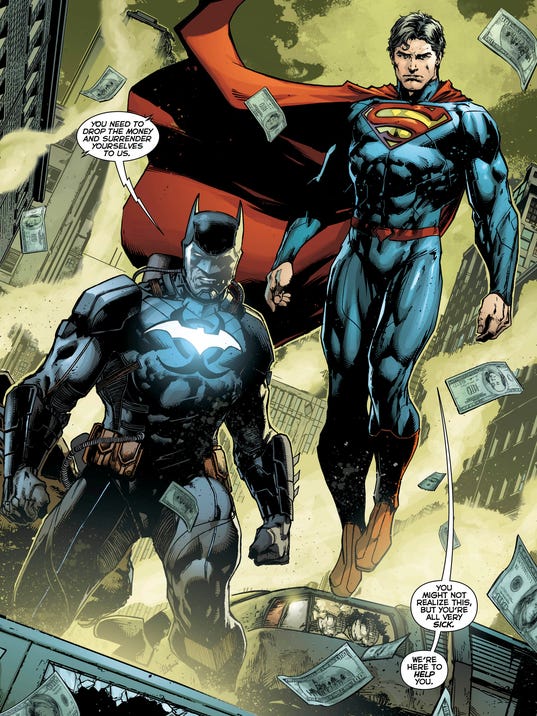
The commentators I've read have been less than impressed with Tomasi and Doug Mahnke's run so far, and they were even less impressed with seeing Magog enter the picture.  For me, both continue to excel.  Tomasi borrows elements of the classic Magog origin as Waid outlined it in The Kingdom but updates it for the all-important starting point of the New 52, the opening arc of Justice League.  Skeptics wonder why the young David Reid would fixate on Superman and Wonder Woman when clearly there were many other future Leaguers involved, but Superman is always the most prominent hero, and Wonder Woman in this continuity was making her spectacular debut in Man's World.

So much for that.

In Wonder Woman, the Finches have been receiving an equally dubious response, for the most part, but the critics are warming a little.

It probably doesn't hurt that they're starting to make it their own, and joining the company-wide re-introduction of long-absent characters.  In this instance, Donna Troy.  The former Wonder Girl has been brought in to replace Diana as ruler of the Amazons.  Diana, meanwhile, is struggling with the idea of being the God of War, the biggest ripple of the Azzarello years.  It was noted early on that Meredith Finch didn't seem completely familiar with how the outgoing writer ended things, but as brilliant as Brian Azzarello was, he also stuck Wonder Woman into a pocket.  Finch and husband David Finch are expanding it.  Batman and Superman appear in the issue just as if this were right alongside Justice League and Superman/Wonder Woman, which of course it is.  David Finch as always does excellent work, the opposite in style of outgoing Cliff Chiang.  Meredith, new to the game, proves surprisingly adept.

All this and Gal Gadot as the first film version of Wonder Woman, coming up next year...


Sunday, January 11, 2015

Reading Comics 145 "Justice League"

via Nothing But Comics
I've been a huge supporter of Geoff Johns' Justice League, but you'd be forgiven for not knowing that, as I haven't regularly read it in a few years.  I haven't even finished reading "Throne of Atlantis," which should be indication enough of how that's played out.

Since Forever Evil, I've been making an effort to get back into it.  The problem hasn't been the series itself, unless you count the fact that Justice League has consistently been one of the must-read-monthly series since it debuted in 2011.  What happens when you don't read monthly?  Pretty much what happened to me.

What brought me back?  In a word, Luthor, as in Lex Luthor, who has officially joined the team.  And don't think that's been easy.  I've recently read #34-36, the conclusion of the initial post-Evil arc and the start of "The Amazo Virus."

Luthor isn't the only new phase.  Recent issues have included Jessica Cruz, who Johns first introduced in Green Lantern #20.  Cruz is another legacy of Evil, who has gained possession of the alternate universe Power Ring's eponymous weapon, which like everything else from that reality has an evil bent.  Cruz has been terrified, but has shown an ability to overcome, so to speak, great fear.  She has supplanted Simon Baz as Johns' continuing link to Green Lantern lore, and the opportunity is hardly lost on him.

Interesting, at least in the pages of #34, he's also chosen to continue another legacy, the heroic alliance between Green Lantern and The Flash.  Green Lantern may be in a wholly different incarnation, but Flash is once again Barry Allen.  Johns tends to write the series pairing characters together in separate storylines, which was how a Green Lantern first appeared in its pages, alongside Batman (a genius combination that could really use additional exploration).  That's also how Superman/Wonder Woman happened, by the way.

The issue also sees Johns collaborate, once again, with Scott Kolins, with whom he's done many Flash stories before.  This was great to see, and Kolins, as always, didn't disappoint.

Wonder Woman and Luthor, Luthor and Bruce Wayne, Luthor and Owlman?  Of course Lex Luthor remains hugely important to the series.

#35 sees the rivalry between Luthor and Wayne (which is all in Luthor's head, naturally) continue, with competing public speeches that further illuminate both characters.  Most of the issue is about them, actually, incidentally introducing the next big arc when Luthor's fail-safe weapon is accidentally unleashed.  I admit I wasn't initially interested in jumping back into Justice League at this point because I wasn't sure how interesting "Amazo Virus" would be, but eventually I realized it's a variation on a subplot from 52, which Johns worked on with Grant Morrison, Greg Rucka, and Mark Waid.  It now seems that Johns may have been the spearhead behind that particular element.  This version, and my love of 52 is surely well-documented, may be more interesting, even if the main benefit of the original was finally creating a Luthor/Steel rivalry.

The art for this issue is from another frequent Johns collaborator, Doug Mahnke.

#36 is the official start of the arc.  Before I get to its story contents, let's just acknowledge the art, which is from Jason Fabok, who comes from a Batman background to provide dynamic new art for a series that began with Jim Lee.  
via USA Today
I'v including two pieces of Fabok art, rather than feature Kolins or Mahnke mostly to put a definitive spotlight on Fabok, who here makes a strong case for superstar status.

Johns pairs Superman and Batman (I haven't read the current Batman/Superman, so when I say that hasn't happened enough recently, that's where it's coming from), and Luthor and Wonder Woman once again, which leads to this choice exchange:

Luthor: She's a god. 
Wonder Woman: Why does that sound like an insult when you say it?

Priceless, and another clear instance of Johns nailing the Amazon's perspective in ways other writers haven't even considered.  

I haven't mentioned Captain Cold yet, but his scenes with Luthor across these issues are another highlight, and like Kolins another link to Johns' days writing The Flash.  Every character has a purpose, and a well-defined one, in Johns' scripts, which isn't often the case when a writer is juggling a large cast, whether in a team book or otherwise.  The temptation is always to just throw everyone in the same scenes and have them make random characteristic comments (this is one of my main beefs in Marvel comics).  I prefer more personal depictions.  Somehow Johns does that and keeps the stories big.  That's why Justice League is so important.

So, very profitable return to the series for me.

Thursday, September 25, 2014

Justice League #33 (DC)

writer: Geoff Johns
artist: Doug Manhke
via Comics X-aminer
Every time the Justice League forms anew, they have the iconic characters as the starting point, and then start dubbing in second stringers, until it's only second stringers.  We're three years in on this run.  New characters have started to join.  That's what's happening again, right?

Well, wrong.  Lex Luthor joined.  In typical Geoff Johns fashion, it's a radical new vision of previously established continuity.  Now that we're a few issues into the Luthor age, how're things looking?  

Actually, pretty good.

That page above has Luthor, plus Niles Caulder, founder of the Doom Patrol, sort of X-Men before there was X-Men.  There's also Power Ring, the new one, like Luthor another gift from Forever Evil.  All three are elements Johns has brought along to great effect.  He introduced Jessica Cruz, actually, in his final issue of Green Lantern, and Element Woman from Doom Patrol is a character he's been working with since Justice League #16 (although she debuted in Flashpoint).  These are examples of long-term planning and stories coalescing.  Maybe not too impressive a fete in and of itself, but also not what other people would do with the League.  Which is what Johns does all the time.  What seems natural after he does it, but probably would never have happened until he did.

Same with Luthor.  Same with Doom Patrol.  Luthor and Caulder clash over ideologies.  As everyone is with Luthor in the League, Luthor views Caulder, with extreme skepticism.  At this point, it's safe to assume we can take Lex at face value.  He wants to be a part of the League.  For all intents and purposes, he is a good guy now.

But it doesn't mean he's always right.  Take Caulder at face value, and statements like this are completely  natural in this series:

"Not everyone with super-powers can be an inspiration."
It's a pretty profound statement.  As far as Johns is concerned, the good guys are the good guys, and the Justice League is comprised of the best good guys there are.  But not everyone is League material.  And that's what Doom Patrol is for Johns, a chance to view superheroes in a different context.  Far too often, what the League itself is can be obscured by what it does.  But a team like Doom Patrol has been lost in the DC shuffle for years.  Not just because Grant Morrison happened to establish his whole legacy in part on the Vertigo series where the team was last relevant, but because sometimes, it's hard even for a company that's handled superheroes for three quarters of a century to know what to do with some of them.  There are plenty of lost superheroes out there.  Some of them are ripe for new context exactly like this.

So you get a perfect platform for a team that's the opposite of the League within Justice League itself.

In the middle of Lex Luthor joining.  In the middle of an alternate version of Green Lantern who's evil but actually it's just the ring and it's now in the possession of someone who's probably good.  I would hyphen all of that, but honestly, that's too much even for me.  Suffice to say, busy, but Johns handles it effortlessly.

That's why he's paid to do this, folks, why he's a cornerstone of DC as a whole.

And while all that is going on, just in case you didn't know the difference between Lex Luthor and Batman, Batman sets that record straight, too.  Because even though Luthor's with the good guys, he still has a massive ego.  And needs to learn his place.  Who better than Batman to teach him?  And who else but Batman can do it while addressing a different problem entirely?

And so that's how, oddly enough, Lex Luthor officially joins the League.

And this is also to say that it's nice to have Doug Mahnke on art.  He belongs here.  Let him stick around a while.

Thursday, July 31, 2014

Secret Origins #1 (DC)

writers: Greg Pak, Kyle Higgins, Tony Bedard
artists: Lee Weeks, Doug Mahnke, Paulo Siqueira
via Comic Vine
Some fans get tired of seeing secret origins regurgitated repeatedly.  Me, I love the stuff.  I love it as a creative exercise, to see how it'll be approached.  Even if the elements don't change (which is seldom the case), the best writers will make their presence known.  

So, four years in, DC has revived the Secret Origins series in order to catch fans up on the backstories that've emerged behind familiar faces in the New 52.  Two Septembers ago, sure, a certain amount of that was already done in the zero issues, and many of the initial launches in 2011 incorporated the idea from the start.  Still, as far as I'm concerned, this is a good idea, and I think this first issue proves why.

The first of three stories in the issue features DC's first and arguably still most iconic superhero, Superman.  It's written by Greg Pak, who's recently joined the Man of Steel's writing stable, taking over Action Comics.  Previously, Pak was a Marvel guy (best known for his Hulk and Incredible Hercules, the latter of which he wrote entertainingly with Fred Van Lente for years), which certainly makes the whole proposition all the more intriguing.  If this effort is any indication, Superman is in very good hands.

Intriguingly, Pak approaches Superman's Kryptonian and human origins from the perspectives of his two mothers.  This is incredibly rare.  You're no doubt as familiar as I am with the idea of presenting Jor-El and Jonathan Kent ahead of Lara and Martha Kent, the heavier emphasis on the fathers over the years.  In the movies, Lara had her biggest moment in Superman II when she replaced Marlon Brando's Jor-El in discussions at the Fortress of Solitude (that is, until the Richard Donner cut from 2006 brought Brando back).  Pa Kent had periodically been depicted as dying relatively early in Clark Kent's life, but he's often credited with instilling Superman with the values that would define his heroic career.  There's a lot I'm glossing over, but you get the point.

So that's perhaps reason enough to read that one.  And Pak nails the idea, with both mothers.

Next comes Dick Grayson's story via Kyle Higgins.  Higgins, of course, defined Dick for the New 52 set with his multi-year run on Nightwing.  In a way, this is the effort I was waiting for all along, what he danced around for much of the first year of that series.  Since Dick Grayson is a character uniquely defined by his past, not burdened by it but certainly informed by it, a concept Higgins nails in the piece, it's always profitable to look backward with him, which writers like Higgins and Marv Wolfman had tended to do over the years.

It helps to have Doug Mahnke doing the art for this segment.  Mahnke is awesome.  For a hiccup, after seeing his work in this issue, I feared that DC had finally let him slip through the cracks.  That's not really the case, though.  He's an excellent utility player when he needs to be (although it certainly looked like he was doing exactly that role at the end of Final Crisis, there was also the tie-in with his having already drawn the Superman two-issue mini-series for that event).  And he always delivers.

Supergirl rounds out the issue via Tony Bedard, and this segment reads like one of those young adult book series that've been turning into profitable film franchises like The Hunger Games and Divergent.  I have no idea if that's how Supergirl entered the New 52, but this is canny all the same, and deserves to be identified as such.  Sometimes jumping on a bandwagon is a good thing.  It's recognizing a good thing.  And as far as I can tell, this new interpretation of Supergirl has been a good thing.  In the past I've absolutely loved Bedard's work, but recently I've lost track of him.  So it's good to see that he's definitely still got it.

It's an interesting mix for the first issue.  Superman was certainly obvious.  Including someone from the Batman family I suppose was equally obvious.  And as I've suggested, it's probably a good thing to put Supergirl out in front of something like this, too, so she'll have a better chance of getting noticed.  Higgins may have departed Dick Grayson's adventures, but the character has recently been repositioned, so in hindsight this was like a part of that relaunch, too.

An excellent debut issue.

Thursday, July 17, 2014

Batman and Robin #31 (DC)

writer: Peter J. Tomasi
artist: Doug Mahnke
via Reddit
The penultimate chapter in "The Hunt for Robin" sees Batman come up against Frankenstein for the first time since #19.  As suggested in the above sample from this issue, Frankenstein hasn't forgotten what the grief-stricken Batman did to him previously.

It's a perfect issue.  One of my big regrets from the early New 52 was not reading Frankenstein, Agent of S.H.A.D.E., which stars the character originally introduced in Grant Morrison's ambitious Seven Soldiers of Victory project and also featured in Flashpoint: Frankenstein & the Creatures of the Unknown.  Hopefully these latest appearances will cause more fans than just me to remember how awesome Frankenstein is.

The artist with Peter Tomasi this time around, rather than regular collaborator Patrick Gleason, is the always excellent Doug Mahnke, who it might need reminding helped create The Mask (I'm continually surprised that no effort has been made to relaunch this character).  

Friday, February 28, 2014

Batman and Robin Annual #2 (DC)

writer: Peter J. Tomasi
artist: Doug Mahnke, Patrick Gleason

I've mentioned a few times here how much I love Peter Tomasi's Batman and Robin.  It got to the point last year where I was ready to name it to the top of the 2013 QB50 (it ended up settling for fourth), which makes it from this point a perennial contender for that spot, however long the run lasts (hopefully a good bit longer).

It's one of those series that I want to add in its entirety to my trade collection, and in fact is at the moment how I've been reading it (not quickly enough, but it's an excellent way to savor the work all the same).  Every so often, though, I dip back into the individual releases, and this annual seemed like as good a time as any to do so again.

The story brings Damian back.  Damian, the son of Bruce Wayne and Talia al Ghul, was famously (or infamously, depending on who you listen to) killed off by creator Grant Morrison last year in the run-up to the conclusion to both Batman Incorporated and his Batman run in general.  Any new Damian story, then, is bound to be notable.

This one isn't really a Damian story at all, but a Dick Grayson one, looking back at his debut as the first Robin.  Since Dick's glories days are firmly in the Golden Age, and readers are far more familiar with his Teen Titans transition period or his Nightwing years (I'm still wondering how I feel about the Forever Evil developments), anytime there's a new Dick Grayson/Robin story, it's pretty much the same as a new Damian story these days.  One of the famous examples from years past is Batman Chronicles: The Gauntlet, a one-shot from 1997 (that's how infrequent it is), although there has also been Batman: Dark Victory and All Star Batman and Robin, the Boy Wonder (which angered fans because it portrayed Batman as...grim; no, really), neither of which was as direct a focus on him, though.

Add this one to the mix.  And it kind of leaves you begging for more.  Sometimes in comics, which are often hard-pressed to move on with the careers of superheroes, you end up with a situation where progress has been made and suddenly you realize there's still more to tell about that earlier period.  It's all well and good if you're Batman, but if you're Robin?  You're kind of screwed.

Tomasi's Batman and Robin has always been more of a Robin (and Batman) than anything, the lost Robin solo series that remembers Robin sometimes is most distinctive in association with his old partner.  With the loss of Damian, the series has become not so much a team-up book, but a series that explores Batman in relation with other characters.  Lately that character has been Two-Face (I've been savoring the prospect of reading that one, all at once, the way I read the first arc of the series, by accident, but that's exactly how it should be enjoyed, all at once).  For the annual, Robin gets to return.

And so, this is a Year One story for Robin, Dick Grayson's version.  Nightwing is known as a Spider-man kind of guy, always cracking jokes.  It can sometimes be easy to forget that he was like that as Robin, too.  That means, in essence, he was hardly the grim crusader Batman tends to be, and consequently that Batman probably had a hard time dealing with that.  Tomasi gets that.  He gets everything.  That's what makes his Batman so great.

The way Damian is incorporated acknowledges that he is technically dead and so not able to be an active participant.  I love these little reminders Tomasi is able to do.  In a few months, a new storyline in the series will feature Batman and Damian all over again, but with another twist.  (It will also feature Frankenstein, the Grant Morrison, Seven Soldiers of Victory version.  I still can't believe he had his own New 52 series.  I still can't believe I never read it.  I will have to correct that.)

Tomasi also has room to create an interesting villain in the story, a Dick Grayson foe, Tusk.  I'd love to see that whole story expanded.  Maybe Tomasi will do that some day.  Hopefully!

Also noteworthy, besides the assist from regular collaborator (and fellow Batman and Robin saint) Patrick Gleason, is the art of Doug Mahnke.  Mahnke is best known recently for his Green Lantern collaboration with Geoff Johns.  For some reason, even though he became one of the go-to guys during that run, Mahnke's name never really became especially elevated.  The fact that he's illustrating an annual is at once awesome because it's for Batman and Robin, and also a little worrying.  Surely the guy deserves another high profile assignment.

It's especially nice to see a distinctive style from Manhke in the issue, one that's different enough from his Green Lantern work that you might almost not even know it's the same artist, but still very much the same remarkable talent.

Maybe this is a way of saying that if Gleason isn't available for an issue of Batman and Robin, it's Mahnke we'll get instead?  Because that would be nice.  Because Gleason and Tomasi are too perfect together to settle for something worse.  Mahnke isn't worse.  He's almost as perfect a match for Tomasi as Gleason.  And that's pretty awesome to see.

Even if you're not obsessed with Batman and Robin like I am, I think this annual is easy to recommend, to see Dick Grayson as Robin, and to see Damian once again in that role, too.

Cover via Comic Book Database.