Showing posts with label The Multiversity. Show all posts

Sunday, June 28, 2015

Reading Comics 166 "Comics from 6/24/15"

Covered this week: E for Extinction #1, G.I. Joe: A Real American Hero #215 (plus #214), Green Lantern: Lost Army #1, Superman #41, and We Are Robin #1, as well as The Multiversity: Pax Americana Director's Cut.


E for Extinction #1 (Marvel)
Among the many, many Secret Wars spin-offs attempting to pick up the pieces of past Marvel stories is that incredibly rare title, E for Extinction, otherwise known as acknowledgment that Grant Morrison did, in fact, write X-Men stories for a number of years.  You may be forgiven to forget this happened, because Marvel has been trying to scrub history of this for years.  The minute Morrison left, for instance, Xorn was retconned far away from being Magneto.  Perish the thought!  To be fair, this run did have a fair impact on the future of mutants, but any and all associations with Morrison seem to have been severed as completely as possible, and everyone agreed that Joss Whedon's Astonishing X-Men was in fact the true watershed of the franchise, and that was that.

I confess to have played a part in this debacle.  Observers today might assume I've always been a hopeless devotee of Grant Morrison.  This is true to a point.  I became a fan through JLA, which is probably true for the vast amount of us.  But then I had to work my way back in.  I never read New X-Men, only a few issues here and there in later years (still working my way toward the complete run, as with Invisibles, Animal Man, and Doom Patrol, the titles the truly devoted would call the starting point, although this would be from a critical and not popular standpoint).  I was keenly aware of Morrison's mutants, so there's a kind of mythological element to the run, as with the fourth-wall Animal Man breakthrough, mostly what became of Xorn and how Beast became subject to a secondary mutation (to his present look).

All of which is to say, I'm glad E for Extinction exists.  Named after the opening arc in Morrison's New X-Men (in all, forty issues, with eight arcs), which along with several others features the art of Frank Quitely (the cover of this issue closely mirrors the famous art for the run), this is a wonderful reminder of how Morrison attempted to push the franchise forward.  Morrison himself isn't present, but Chris Burnham is.  Burnham is currently collaborating with Morrison on Image's Nameless and also did the art for the second run of Batman Inc., and as such has become associated with him enough that I guess he was a go-to guy for Marvel for this project.  That, I guess, and the fact that his art somewhat resembles Quitely's.  But he's not doing the art for this, rather another guy who somewhat resembles Burnham's!

Burnham himself has an issue of Batman Inc. in his credits as writer (#11, plus credit for #0 along with Morrison).  For most of this issue he's remarkably adequate, although he has instincts that one would not typically associate with Morrison material (although I could be wrong; I'm not familiar enough with New X-Men to identify all the characters in E for Extinction who come directly from it).  At any rate, he does an excellent job of conveying everything Morrison hoped to accomplish.  The representative panel in relation to that philosophy demonstrates how it's hilariously outdated to suggest today that minority groups in America haven't gained a certain mainstream credential (if not outright equality) that can no longer be denied with the simple moral equivalencies typical for mutant allegory.  Magneto (no mention made of Xorn, naturally) leads the new X-Men, with hopelessly dated Cyclops and Emma Frost used in counterpoint (the clearest connection to more recent material like how Bendis started out All-New X-Men).  Thrown in as well is Wolverine, because: Wolverine.

I'm just not a big fan of Burnham.  I don't like his art, and I think he tends to ruin what he does.  As a writer this is less so, but then there's the guy hired because he kind of draws like Burnham, so more or less, this is all Burnham all the time.  Unfortunately.  Fortunately there's plenty of Morrison present.  So as far as this first issue goes, I like this project.  I'm very glad it exists.  Clearly Marvel kind of desperately wants Morrison back in the fold (going back to the Marvelman annual that finally brought to life one of his old scripts).  I guess we'll see where that goes...


G.I. Joe: A Real American Hero #215 (IDW)
(and #214)
IDW did something somewhat remarkable when it acquired the G.I. Joe franchise.  It began publishing new issues of Larry Hama's Marvel run along with its own material.  This in itself was not hugely unique, since at the time Marvel itself was doing (or very near to doing) the very same with Chris Claremont and the X-Men.  But the Claremont experiment ended years ago, and Hama's G.I. Joe continues.  And it's just completed its biggest arc ever: "The Death of Snake Eyes."

And so apparently readers get to discover that when a publisher like IDW does a story like this, the rules are different, because the actual death occurred two issues ago.  I found that out because I was only reminded this was happening at all when I looked at the cover and saw the arc's title, so I flipped through the issue.  Seeing that the death didn't happen this issue, I went to see what other issues had to say about it.  Needless to say, #213 was not available.  I'd assumed it did occur in #214, but no such luck.  I decided to buy it even though it's a silent issue (appropriate) depicting full G.I. Joe honors for the body.

What this issue does is conclude a journey for the new Snake Eyes, someone Hama is careful to set up in the same mute mode as the original (seems somewhat convenient, but I'm willing to go with it).  So a little like "Knightfall," which ended with the new Batman defeating Bane rather than Bane's snapping of the original Batman's spine, the next chapter has already begun.

The issue also includes a tribute to Hama's original collaborator, Herb Trimpe, who passed away earlier this year.


Green Lantern: Lost Army #1 (DC)
I figured I'd give this one a shot because with the end of Red Lanterns I would otherwise not have been reading Green Lantern, and generally speaking, for as long as I've been reading comics I've been reading Green Lantern.  And I'm still not particularly interested in Robert Venditti's run (his revamp in the main title is something that looks radically...desperate to me).  And this does feature Guy Gardner, although the how and the why of his having a red and a green ring will apparently have to wait.

Otherwise, the most interesting thing about Lost Army is the inclusion of Krona, a traditional Green Lantern villain who for some reason or other is working alongside the heroes.  If anything, Lost Army reads like New Guardians crossed with Red Lanterns.  I have considerable doubts about whether I will be reading this long-term.  Why oh why did Venditti have to be given control...


Superman #41 (DC)
In Gene Yuen Lang's debut, quite unexpectedly "Truth" technically has not even begun yet.  Unlike the rest of the titles included in the arc, which have already released their first entries, anyway, the moment of, well, truth hasn't been reached yet.

Actually, thanks to the continuity of artist John Romita Jr., this issue reads as seamlessly with the Johns run as Romita's own issue, and I guess that's probably the point.  The other common link is Superman's apparent obsession with his new solar flare power.  It seems likely at this point that Superman will have probably used it once too often, and thus deprived himself of all his powers, which accounts for the other gimmick of the "Truth" arc.  The other being the loss of his secret identity.

And that is to say, I think the whole point of the arc is a complete deconstruction of Superman.  At this point, DC probably feels more than ready for something to dramatically shake things up.  Other than Grant Morrison's run in the early issues of Action Comics, nothing any creator has done since the start of the New 52 has really stuck.  This tends to make DC think there's a problem, and the answer invariably is a defensive one.  So: "Truth."

Given that he has managed to make himself at home in the Romita era, Lang already has my endorsement for being able to pull it off.  I'll be skipping the tie-ins from other series.  As far as I'm concerned, Superman is absolutely worth reading again.


We Are Robin #1 (DC)
For whatever reason, DC decided to be all mysterious about this series from writer (usually known as artist, but in Suicders, both) Lee Bermejo.  But to clarify, this series stars Duke Thomas, one of the many characters Scott Snyder has tossed off in the pages of Batman.  As depicted in a possibly unreliable Futures End: Batman and Robin #1, Duke at some point does in fact officially become Robin.  For now, he will have to content himself with a more unofficial distinction.

It's perhaps helpful to mention, as well, that Bermejo has made at least one thing official: finally, a connection between the concept of Robin and the legendary Robin Hood.  Traditionally, DC has attempted to make such distinctions with Green Arrow (most blatantly during the "Brightest Day" era just before the New 52).  In a nutshell, that's what the concept behind We Are Robin seems to be.

But really, it's just good seeing Duke again.  Featured in "Zero Year" and "Endgame" (the timeline seems a little muddled, but then as far as Batman's concerned that's been true throughout New 52, so it's just best not to worry about it), this is the first time he's gotten his own story (which is one better than the other Snyder castoff, Harper Row, who fans must be content to find in the pages Batman Eternal, apparently).  The artwork is nothing like Bermejo's cover, and it's easy to suspect that DC may have been thinking of Miles Morales with art that somewhat evokes Humberto Ramos (who has been identified with Spider-Man for a number of years now).

Also along for the ride is Leslie Tompkins, a Batman staple whom fans have been protective of over the years (she was tied up in the Stephanie Brown arc when the once and future Spoiler took on the role of Robin), so that's good to see.  Overall, I like this series quite a bit.


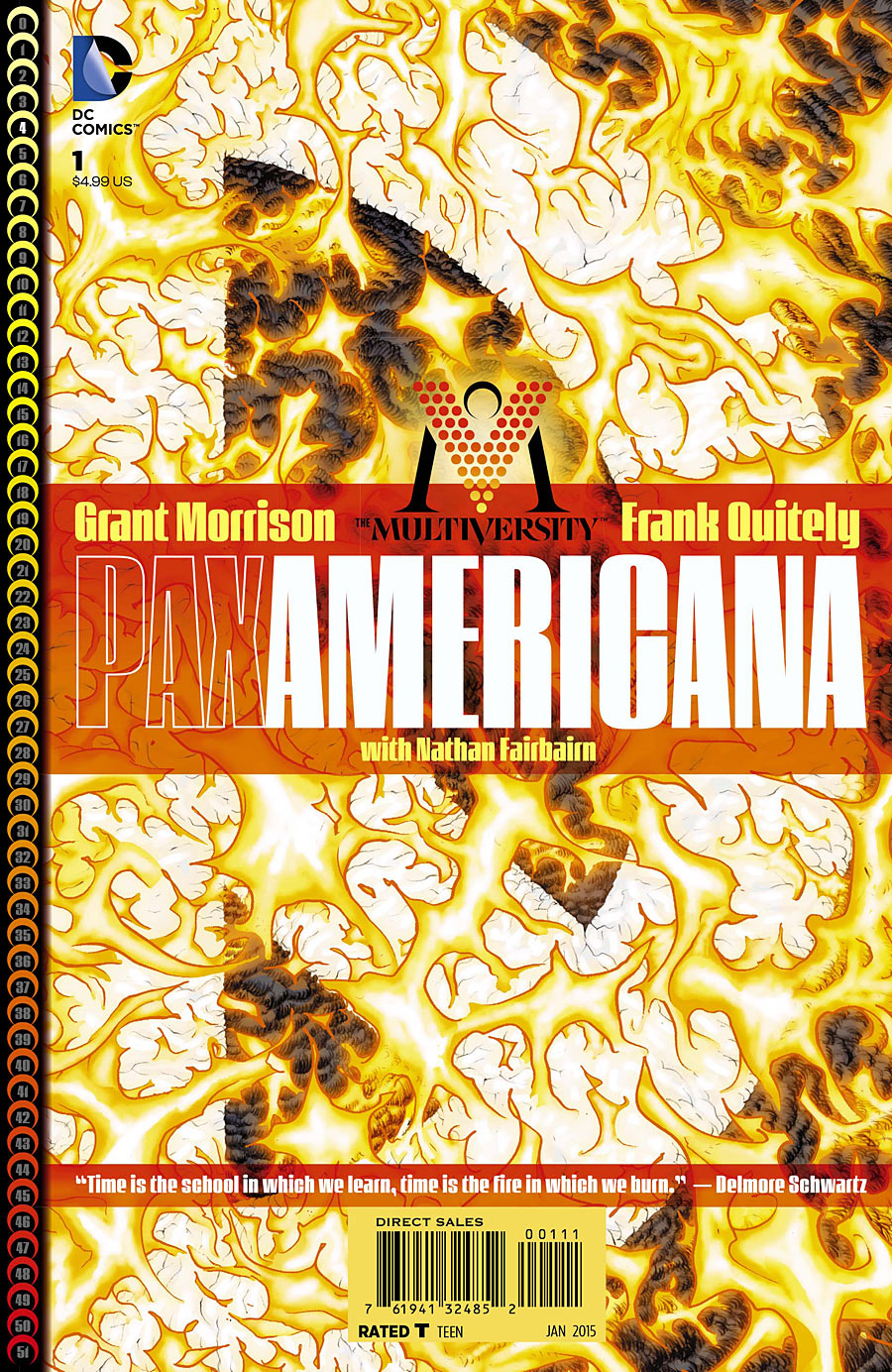
The Multiversity: Pax Americana Director's Cut (DC)
The local shop finally stocked copies of this, so I snapped one up.  As you can see, the crux of this is the entire issue reprinted with Frank Quitely's original pencil art, which I think actually looks better than the finished work.  There're also excerpts from Grant Morrison's script and looks at the art in development.  For some reason it always humbles me to see how much Morrison is involved in helping to visualize the art, since I stopped doing artwork of any serious nature years ago.  If I were to try what he does, it would not be fit to print.

To the extent that I've read any reaction to this release at all, it's griping that this is all it is.  "Director's cuts" in comics usually tend to include creator commentary if not outright added story (which is impractical in comics).  Morrison's script is represented only in part, his descriptions for panels, showing just how much he does in collaboration with Quitely to accomplish this ideological answer to Watchmen.  It begins with a full-blown description of intent, actually, which for the subsequent reader is also like an introduction-after-the-fact.

It was also an excellent excuse to read the whole thing all over again, by the way.  Still love it.

Also included in this polybagged issue is a larger version, in fold-out poster form, of the Multiversity map.

Sunday, May 3, 2015

The Multiversity #2 (DC)

writer: Grant Morrison

artist: Ivan Reis

And it all boils down to: Morrison's love letter to superhero comics.  That's what The Multiversity is, when you strip away everything else, all the stories he told in the pages of the individual issues, even the extremely clever and begging-to-be-a-standalone-classic Pax Americana.

All throughout Multiversity the characters have been reading Multiversity itself.  Typical meta Morrison, right?  Except this time, he has a greater point to make.  Superhero comics often get a bad rap.  They're throwaway nonsense, escapist literature for light readers.  Except they're not.  Morrison certainly doesn't see them that way.

What he sees is this: Something that adds value to the reader's life.  That's why Nix Uotan, in Earth 0 a regular human, comes up with rent money after bringing together Justice Incarnate, the team cobbled together from the combined adventurers of Multiversity.  He hasn't created a new superhero team, he's found a version of the world that makes sense to him.

Could you expect a better statement from Grant Morrison?

Monday, April 13, 2015

The Multiversity: Ultra Comics

writer: Grant Morrison

artist: Doug Mahnke

Honestly, the only thing you need to know about this particular edition of The Multiversity is that Grant Morrison is addressing his well-know proclivity for breaking the fourth wall.  This is the full-on meta issue.

At one point, he has some social media comments embedded:

"Same Old, Same Old Pretentious SYMBOLISM."

"Yet ANOTHER comic-about-comics treatise retreading the SAME tired themes."

"How about a simple adventure story for once?"

As far as the last comment goes, certainly Thunderworld would fit that one, or even Mastermen (the Evil Superman version of Crisis On Infinite Earths), or even Society of Super-Heroes (so, about half of The Multiversity, really).  But because this is Grant Morrison; everyone expects this from him.

Structurally it tries to be clever but isn't really, and probably that's intentional, because Pax Americana was also intentionally clever (on several levels) and quite successfully so.

It's slightly disappointing, though, insofar as for the first handful of pages, Morrison succeeds in tricking the reader into having a more interactive relationship with the story than a typical comic will (read: any comic not written by Grant Morrison), remarking how characters think in the voice of the reader, or a correct estimation of when the reader is likely to prepare turning the page, or of course the matter of turning the page at all.  (These techniques are spread throughout the issue, but the heaviest concentration comes early.)

But then it just becomes a story.  I would have tried a little harder to make the whole experience cyclical, personally, given that the issue starts out with the main character reporting that he's actually come back from the end of the story.  How does that solve things?  Well, obviously, comics are a fairly easy medium to experience again, reaching the end of the issue and then starting over again.  Some can be read in a matter of minutes, and some readers will reread several times in one sitting.

Come to think of it, that's exactly what Grayson: Futures End did.  So that would've been nice to see here as well.  At least we have the art of Doug Mahnke to keep us company.

Maybe the whole point really is Morrison goosing readers.  The joke is that there really isn't a joke this time.

Monday, March 2, 2015

Quick Hits February 2015

Batman and Robin #39 (DC)
Still trying to adjust to the impending status change to Gleason's solo Robin, Son of Batman.  But this was a fun, and far less emotionally heavy issue from the waning days of the Tomasi era.  Damian and Billy Batson.  Need.  To.  Have.  Their own.  Series.

Django/Zorro #4 (Dynamite) 
Wagner has slowly brought Django into the narrative.  Now we're seeing how he fits in to Zorro's grand Arizona adventure.

G.I. Joe: Snake Eyes, Agent of Cobra #2 (IDW) 
Well, now Costa ain't even pretending this is not a direct continuation of his previous Cobra saga.  This is a good thing.

Justice League #39 (DC) 
A rather abrupt end to "The Amazo Virus."  Ever since Citizen Cold, I've been thinking Leonard Snart could easily use a bigger spotlight.  This issue continues that.

Ms. Marvel #12 (Marvel) 
The Loki issue.  Honestly, I've started cooling on this series.

The Multiversity: Mastermen (DC) 
Morrison and Lee keep the Multiversity in high gear.

Red Lanterns #39 (DC) 
Walker is slightly less impressive in his second issue, but is still on-point.

Thor Annual #1 (Marvel) 
CM Punk's story is hilarious, and hilariously aided by Chew artist Rob Guillory.  It's also surprising to see a Raphael Albuquerque cover on a Marvel comic.
And an older issue:

Justice League #23.4 (DC) 
Featuring a direct Forever Evil tie-in and another Flashpoint link-of-sorts.

Monday, February 2, 2015

The Multiversity Guidebook (DC)

via Comics Alliance
writer: Grant Morrison

artist: Marcus To, Paolo Siqueira

The Guidebook to the ambitious (is there any other kind of Grant Morrison project?) Multiversity turns out to feature both guide and story.

There are profiles for most of the 52 realities, as well as a continuation of the main story begun in the initial issue that has room for two very different Batmen (advertised prominently on the cover) as well as Kamandi, Jack Kirby's Last Boy on Earth whose last appearance was a clever revision within the pages of Countdown to Final Crisis (I'm sure the irony isn't entirely lost on Morrison), another version of OMAC, and the New Gods acting much like the Greek gods in Clash of the Titans.

I figured I'd try and recap the previous appearances for each of the near-52 realities:

  • Earth 0, home of the New 52.
  • Earth 1, home of the Earth One graphic novels, which at some point will include Grant Morrison's take on Wonder Woman.
  • Earth 2, home of Earth 2 (at least until the end of World's End).
  • Earth 3, home of the Crime Syndicate, most recently featured in Forever Evil, but also famously depicted in Morrison's JLA: Earth 2 (it was based in different continuity, okay?).
  • Earth 4, home of the Pax Americana folks.
  • Earth 5, home of the Thunderworld folks.
  • Earth 6, home of the Just Imagine Stan Lee Creating... folks.
  • Earth 7, home of Thunderer, as seen in The Multiversity #1.
  • Earth 8, home of Morrison's Marvel counterparts.
  • Earth 9, home of Tangent Comics.
  • Earth 10, home of Overman as depicted in Final Crisis.
  • Earth 11, introduced here, home of Amazonian variations.
  • Earth 12, home of characters from Batman Beyond.
  • Earth 13, home of Superdemon and pals as depicted in Final Crisis.
  • Earth 15, home of Superboy-Prime as depicted in Infinite Crisis.
  • Earth 16, home of The Just folks.
  • Earth 17, introduced here, featuring variations on Adam Strange and others, including one of two Batmen featured here.
  • Earth 18, home of characters introduced in The Justice Riders.
  • Earth 19, home of characters introduced in Amazonia.
  • Earth 20, home of the Society of Super-Heroes folks.
  • Earth 21, home of characters introduced in DC: The New Frontier.
  • Earth 22, home of characters introduced in Kingdom Come.
  • Earth 23, home of President Superman, introduced in Final Crisis and featured in Action Comics #9 and Multiversity #1.
  • Earth 26, home of Captain Carrot and the Zoo Crew.
  • Earth 29, home of the square Bizarro planet Htrae, explored in All Star Superman.
  • Earth 30, home of characters introduced in Superman: Red Son.
  • Earth 31, home of characters introduced in Detective Comics Annual #7.
  • Earth 32, home of characters introduced in Batman: In Darkest Knight.
  • Earth 33, Morrison's theoretical starting point.
  • Earth 34, introduced here, featuring an ancient super-civilization.
  • Earth 35, featuring Morrison's version of Alan Moore's Supreme.
  • Earth 36, featuring characters introduced in Action Comics #9.
  • Earth 37, home of Tommy Tomorrow and other classic DC sci-fi characters.
  • Earth 38, home of characters featured in Superman & Batman: Generations (probably).
  • Earth 39, introduced here, featuring super spies.
  • Earth 40, home of Society of Super-Heroes folks.
  • Earth 41, home of Morrison's Image counterparts.
  • Earth 42, home of characters featured here, including one of the Batmen.
  • Earth 43, home of characters likely inspired by the numerous Doug Moench/Kelley Jones Batman vampire comics.
  • Earth 44, introduced here, featuring characters combining the Justice League and the Metal Men.
  • Earth 45, home of characters introduced in Action Comics #9.
  • Earth 47, home of Brother Power, the Geek.
  • Earth 48, home of characters introduced in Crisis on Infinite Earths.
  • Earth 50, home of characters introduced in the animated Justice League.
  • Earth 51, home of various Jack Kirby characters, as featured here.

Sunday, December 28, 2014

The Multiversity: Thunderworld Adventures (DC)

via IGN
writer: Grant Morrison
artist: Cameron Stewart

To even begin to outline the convoluted publishing history of Captain Marvel again would exhaust me so much, I would actually prefer the Sivana Family to attack...

The latest chapter of The Multiversity from Grant Morrison tackles Fawcett City's own Big Red Cheese.  From the opening pages, featuring a more dynamic Wizard than anyone one's (the way he's been handling every character, basically, in this whole splendid exercise) to Captain Marvel's own Lex Luthor, Sivana, at long last creating his own Sivana Family to counteract Billy Batson's allies in Mary Marvel and Captain Marvel, Jr., it's once again a textbook adventure of the given set of superheroes.  The only major element missing, other than in substitute form, of the Captain Marvel mythos is Black Adam, who arguably became the most significant one in DC's estimation in recent years.

It's a fun read, not exactly the dense Pax Americana experience, and proves that Captain Marvel, who is now routinely known as Shazam, could be a viable franchise all his own.  I mean, who wouldn't want a Talky Tawny book?  And did Morrison invent the Lieutenant Marvels?  Once all these allies are present, it pretty well demolishes the typical image Captain Marvel projects of being that superhero who isn't Superman but also happens to switch places with an adolescent boy (who plays reporter thanks to "loosely enforced child labor laws," one of several clever quips, including allusions to Mary Marvel's turn to the dark side in Countdown to Final Crisis).

Sivana is the real winner.  It takes someone really willing to play with the concept of the mad scientist to make a character like him pop.  He's what Luther would be like without gobs of money to make him socially respectable.  There's also great fun with a different aspect of the multiverse than has so far been explored in the project, as Sivanas from across several realities attempt to collaborate on something other than the creation of "Sivanaday."

Artist Cameron Stewart has previously worked with Morrison in the pages of the Seaguy comics.  He's altered his style to match the traditional Captain Marvel style for the purposes of Thunderworld Adventures.

Everything's more vivid and vital in The Multiversity...

Wednesday, November 26, 2014

The Multiversity: Pax Americana (DC)

writer: Grant Morrison
artist: Frank Quitely
via DC Wikia
The Multiversity: Pax Americana is all about the elephant in the room.

The elephant's name is Watchmen, by the way, but like any comic book reference there's a secret identity, too, and that's Alan Moore.  And Grant Morrison spends the entire issue deconstructing the most famous deconstruction of comic book superheroes ever created, one that has been hailed not merely as one of the finest superhero comics ever, but one of the great pieces of 20th century American fiction in general.

Late in the issue, Morrison delivers his most sly commentary on the effort when he quotes President Kennedy from a speech he made in 1963, five months before his assassination, supporting an initiative that led to the Nuclear Test-Ban Treaty.

You'll note for the record here that I've previously discussed how Moore's vision was perhaps influenced by his growing up under the spectre of nuclear war, something later generations perhaps may not properly appreciate.

Morrison's reference to the speech is a direct refute of Moore's thesis, and represents the fundamental difference between their approaches to superhero comics.  In Pax Americana, Peacemaker assassinates the president, a direct reference to the Comedian's implied assassination of Kennedy.  Comedian is Peacemaker, and thus in this iteration Peacemaker is Comedian.  Part of what I loved so much about the recent Before Watchmen comics was the chance for creators to more heavily explore the implications of what Moore outlined in his original story, and Brian Azzarello did exactly that within his Comedian, the best of those efforts.  Now we're seeing more of the fruits of comic books directly reflecting Watchmen rather than applying all the wrong lessons, which many of Moore's successors did (I would argue Garth Ennis as being the worst offender, especially in the pages of the vastly overrated The Boys).

Moore was always a cynic in some respects, a Silver Age fan in a post-Silver Age world who clung to his memories and yet was the first to truly obliterate them.  It should be understood that when I say "Silver Age," I refer to the innocent comics that are best reflected in the popular memory by the George Reeves Superman and Adam West Batman on television, which even at that time were beginning to be artifacts of the past, with the dawn of the Marvel Age introducing a layer of new sophistication.

Morrison himself has long attempted to redeem the Silver Age through more conventional means; the "Black Casebook" aspects of his Batman stories were a way of incorporating the more outlandish elements of the Dark Knight's legacy into a more realistic approach, or at least one that better fit in with what comics have since become.  Funny enough, when he did a Bat-Mite story outside of Batman context (Happy!), he was accused of trying to be someone else (Ennis).

Such are critics.

Pax Americana is littered with ideas like this.  It's a terrific accomplishment on any number of levels, the best single issue of the Multiversity saga to date (which is saying something; this was a project that was years in development, and it shows).

There's Morrison's reteaming with Frank Quitely.  The last time they worked this well together, the result was We3, a breakthrough for both of them that still awaits its proper appreciation.  Pax Americana on this score is a perfect example of the benefits of two creators continuing to work together, pushing each other to their very best.  Clearly Quitely is asked to tackle the challenge of Watchmen's famous stylistic legacy, which is half of what everyone gushes about it.  The script itself does so, too.  Not since Grayson: Futures End #1, and this is incredible to have one let alone two comics in a single year to have tackled a story so deliberately, have I read something this sensational.
Morrison's Question reflects Moore's Rorschach, but again and perhaps more tellingly, which came first?  The Question is a character whose legacy has been all but forgotten except through the lens of a pastiche.  The last time he was relevant was in the pages of 52, and in a current iteration has an entire mystical layer that isn't a part of the original legacy at all.  A reinvented persona.  Morrison is a writer who will always be able to understand a character better than whoever else has been handling them previously.  His Question isn't a psychopath exorcising his own demons, but he does take his gimmick seriously.  Maybe the general attitude is the same, but again, Pax Americana is clearly a reflection of Watchmen already.  One that turns the story back around.

Captain Atom/Doctor Manhattan, Blue Beetle/Nite-Owl, Nightshade/Silk Spectre.  There's a lot of analytic potential here.

Bottom line is, this is one master reflecting on another.  I personally think Morrison comes out on top.  He has a better grasp of the subject material and he's more willing to side with the material, oddly, trust that superheroes can make their own defense, that stories can be multifaceted, and that a single issue can do all the necessary work.  Ever since the early days of Batman Incorporated (the first volume), he's made a concerted effort to tell a complete story while suggesting how it fits in the larger context.  That's what he did in Seven Soldiers of Victory, The Return of Bruce Wayne, and now The Multiversity.  This issue is his most subtle and yet most intricate work to date.  It may be the best comic book published in 2014, the most relevant superhero statement of the 21st century to date.

And the project isn't even finished yet.  This is a giant love letter to a medium, to a genre.  That's the difference between Grant Morrison and Alan Moore.  Moore wanted to distinguish an emerging sophisticated approach.  Morrison hopes superheroes can still explain themselves.  It certainly helps to have someone like him around to lend some assistance.

Sunday, November 16, 2014

Reading Comics #138 "Character rundown from The Multiversity: The Just, plus other October 2014 comics"

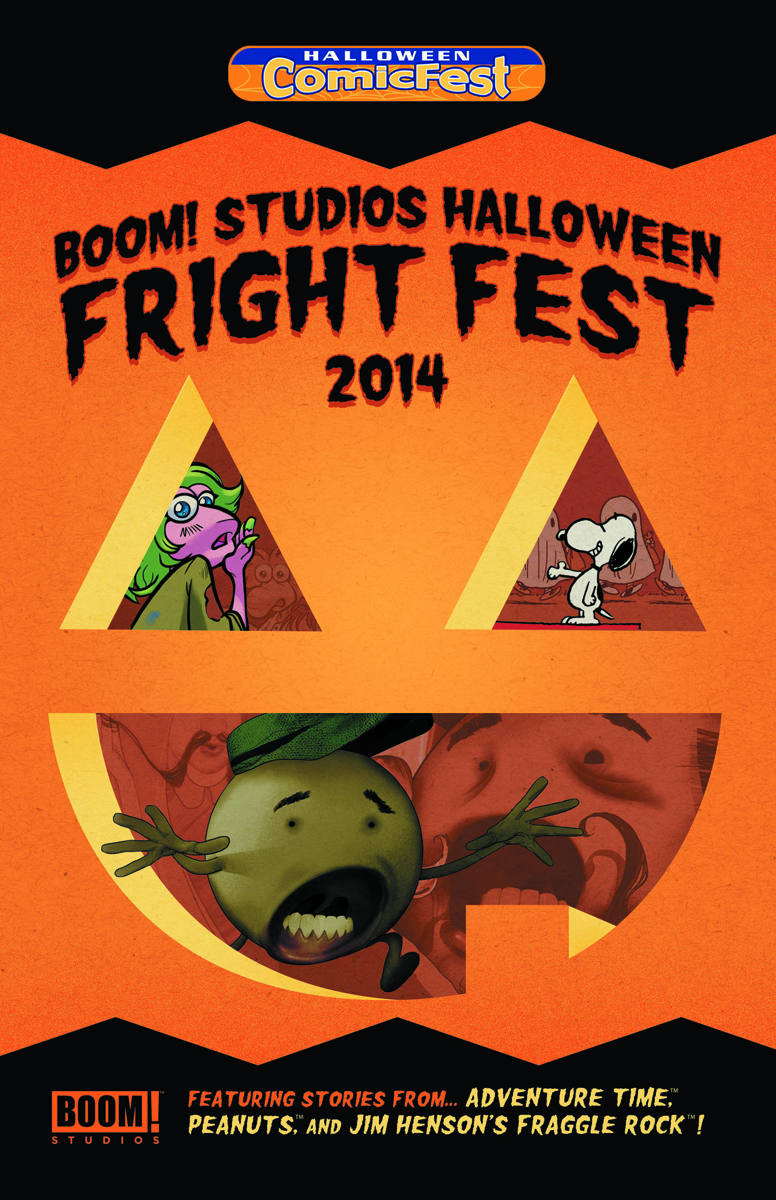
Boom! Studios Halloween Fright Fest 2014 (Boom!)
via Previews World
The only Halloween freebie I picked up this year.  Frazer Irving illustrated the Adventure Time lead story, which was interesting insofar as Irving always does good work and Adventure Time is, well, interesting.  There were a few vintage Peanuts strips reprinted, plus background information on Charlie Brown's infamous luck with kites explained by the late Charles Schultz.  Finally, the lead-out was Fraggle Rock.  Hey, it was free.


Marvel 75th Anniversary Celebration (Marvel)
via Hero Complex
I'm not really a Marvel guy, but I like it when Marvel celebrates itself (which does seem to happen often).  Anyway, this was a special that featured a couple of stories and retrospective essays.  The first story is from James Robinson and is close to the Marvel version of Darwyn Cooke's New Frontier comics over at DC.  It's also, I guess, like Marvels.  Reflects on "where were you" when the Fantastic Four were born.  Bruce Timm next adapts Stan Lee's first-ever Marvel story, featuring Captain America.  Works better in a modern, Timm style.  Also included is the original text version.  Then there's Brian Michael Bendis revisiting Alias (his comic, not the unrelated TV show).  I never read Alias, but if it was as good as this was, hopefully Bendis really does consider bringing it back, as is suggested in the story.  A text piece explores forgotten Golden Age creations, and curiously includes Rockman, a character revived in the pages of the excellent The Twelve.  Tom DeFalco does a pretty typical young Peter Parker Spider-Man tale.  A text piece on Marvel's black superheroes.  Len Wein returns to his most famous creation, Wolverine.  A text piece on the real world intruding in Marvel's pages.  Goofy covers that mock things that would never happen (What If? for the Instagram generation).  All told, I thought it was a pretty good reflection.

The Multiversity - The Just (DC)
via Comic Vine
The third issue of The Multiversity from Grant Morrison explores a world populated by all the DC characters created from the '90s onward, a next generation experience that takes a different tack from Kingdom Come, more akin to Morrison's ideas previously represented by Zenith and Super Young Team, superheroes straight from our media-obsessed age, who have less fighting and more angst to fill up their days.

Here's a rundown of the characters who appear"
  • Sister Miracle (Sasha Norman), new creation, based off Shilo Norman, the Mister Miracle alternate Morrison used in his Seven Soldiers of Victory project.
  • Megamorpho (Saffi Mason), new creation, based off Metamorpho, also known as Rex Mason.
  • The Atom (Ray Palmer), long-established character who in the '90s was de-aged and became a member of Dan Jurgens' Teen Titans.
  • Alexis Luthor, Lex Luthor's daughter, based on a concept from late '90s Superman comics.
  • Batman (Damian Wayne) one of Morrison's most famous characters.
  • Superman (Chris Kent), based on the "Last Son" character created by Geoff Johns.
  • Azrael (Jean-Paul Valley), his costume on display; the post-"Knightfall" replacement Batman.
  • Offspring (Ernie O'Brian), featured in Mark Waid's follow-up to Kingdom Come, The Kingdom.
  • Green Lantern (Kyle Rayner), the '90s addition to the franchise.
  • Green Arrow (Connor Hawke), Oliver Queen's son and one-time successor.
  • Loose Cannon, Chronos, Gunfire, Max Mercury, Anima, Risk; group shot.  Loose Cannon, Anima and Gunfire were part of the "Bloodlines" generation from 1993.  Chronos was the anti-hero star of a brilliant, short-lived series.  Max Mercury was another Waid creation, within the pages of The Flash and Impulse.  Risk was part of Jurgens' Titans.  There are a few others I can't positively identify.
  • Superboy (Kon-El), whom Morrison cleverly has suffering from Bizarro syndrome.  I have no idea why this is the first time the idea has ever come up.  Brilliant.
  • Red Amazo, combining Red Tornado with classic Justice League villain Amazo.
  • The Flash (Wally West), the defining Flash for a generation thanks to Waid and Johns.
  • Alpha Centurion (Marcus Aelius), a character I've badly wanted to see make a comeback for years.  This may be it.  For now.
  • Steel (Natasha Irons), daughter of John Irons, the original Steel, with a long history herself.
  • Argus (Nick Kovak), another "Bloodlines" creation.
  • Wonder Woman (Artemis), the Azrael of the Wonder Woman '90s.
  • Aquaman (Garth), also known as Aqualad and Tempest.
  • Menta (Holly Dayton), daughter of Mento, Steve Dayton, associated with Doom Patrol.
  • Doctor Midnite (Pieter Cross), part of the revived Justice Society at the turn of the century.
  • Bloodwynd, part of Dan Jurgens' Justice League, famously described by Morrison in the pages of Supergods as being one of the worst examples of '90s comics.  Should be noted that his distinctive speech bubble (a crackly red outline) is omitted.  He, Alpha Centurion and Max Mercury are characters I'd want to explore given any possible comics career.
  • Arrowette (Cissie King-Hawke), taking the name of a character who was part of Young Justice.
  • Gypsy (Cynthia Reynolds), a member of the '90s Justice League scene.
  • Jakeem Thunder, a character Morrison created to join the revived Justice Society, succeeding one of the original members.
  • Impulse (Bart Allen), later known as Kid Flash.
Anyway, loved this issue.  Although of course I've loved all of them.  But this one in particular.

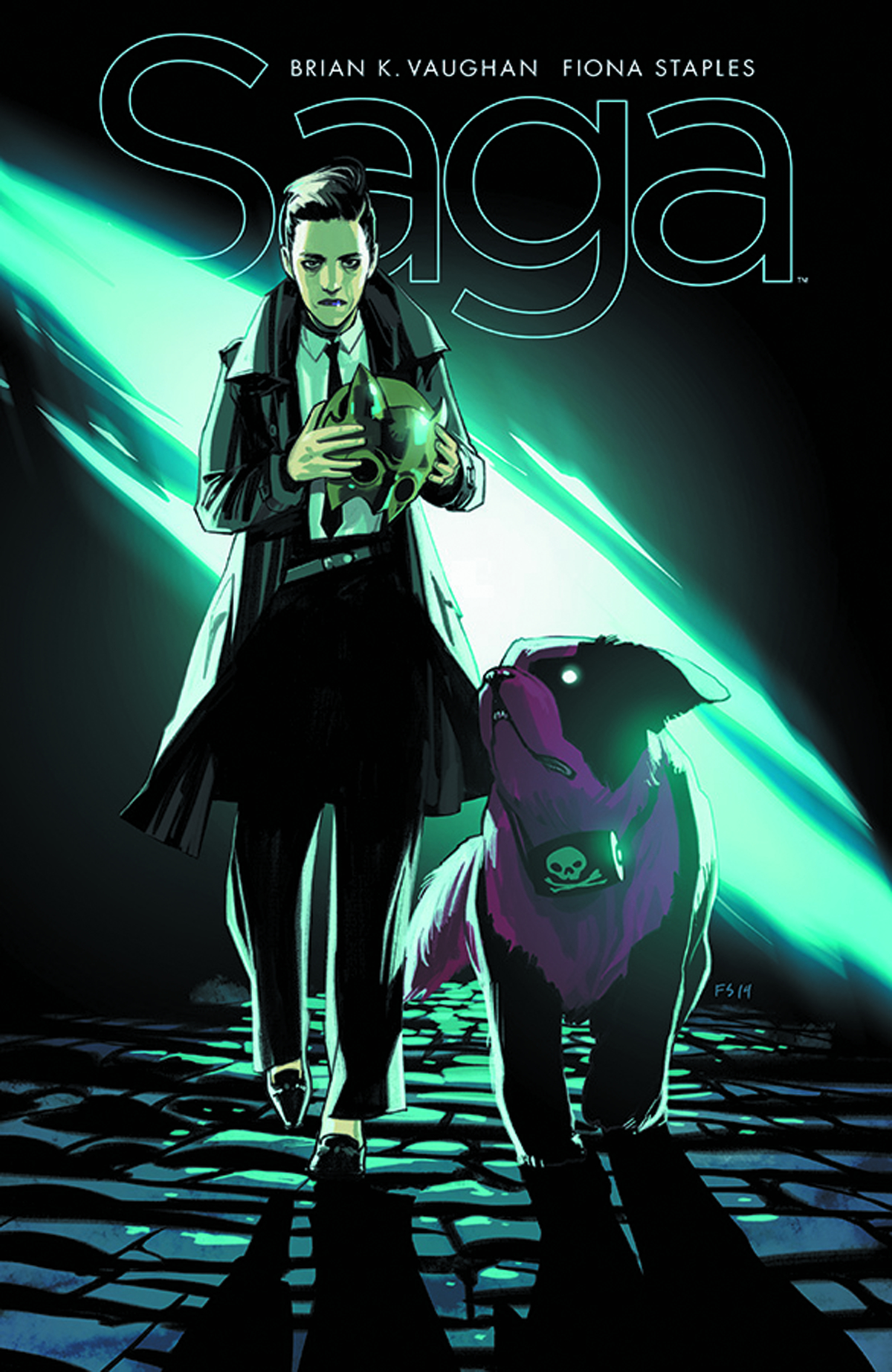
Saga #24 (Image)
via Previews World
The Brand enters (re-enters? I don't know) the picture, looking to figure out whatever happened to The Will, one of my favorite supporting characters who hasn't been around in a while.  Just a truly excellent issue, classic example of what made me love the series in the first place.  Pity, since the series now goes on hiatus until sometime early next year.


Superman #35 (DC)
via Ain't It Cool
Geoff Johns returns after the Futures End interlude to continue the Ulysses saga as he and Superman step up their efforts to end the threat of the Machinist.  Ulysses ends up making a bold move that may prove to be the definitive transition of the arc.


Wonder Woman #35 (DC)
via Rhymes with Geek
The conclusion of the Brian Azzarello/Cliff Chiang era has been getting mediocre reviews from the circles I visit, but I was going to have to read this one for myself even though I've had a spotty record reading the series so far.  This is basically the end of the First Born arc, too, with the most feeling of conclusion coming from Azzarello revealing the true nature of one of his supporting characters, a twist that underwhelmed other observers, but to my mind tracks well with what the series had done previously, exploring the nature of conflicting allegiances that has always been one of the worst-explored aspects of Wonder Woman (previously relegated to "you represent us!  you don't represent us!").  All along I've been convinced that this was a classic interpretation of the character, completely unusual and therefore with that much greater opportunity to say something new, which has been badly needed for decades.  It's distinctive, not just because of the art, but because it's allowed Wonder Woman to completely own her own mythology, not just "Greek gods, Greek gods, Greek gods" but what that means to her specifically.  Again, something that's needed to be done for a long time.  The instinct in the future will be to distance Diana as much from this material as possible without outright erasing it from the record, but that would be a mistake.  DC's already had other writers doing a more traditional interpretation simultaneously, including within the pages of Geoff Johns' Justice League and a burgeoning, unprecedented-in-the-modern-era line of sister titles, Superman/Wonder Woman and Sensation Comics.  I don't think any of that would have been possible without Azzarello's confident take

Tuesday, October 14, 2014

The Multiversity: Society of Super-Heroes (DC)

writer: Grant Morrison
artist: Chris Sprouse
via Weird Science DC Comics
I've been reading Grant Morrison for years, and am still figuring out how to read him.  Today, while looking at Multiversity #2 (which is what this basically is), I realized he's a little like Quentin Tarantino by way of Indiana Jones.  He technically started writing comics in the late '70s, but he's a product of the '80s, the decade that saw popular culture become acceptable.  Or in other words, the birthplace of everything we know now.

The thing that really makes Morrison distinctive, though, is his ability to synthesize whole experiences.  Famously, he did that as a personal challenge with Batman, and his version of the Justice League was the start of, somewhat curiously, everything that Marvel has done ever since, including its wildly popular Avengers movies.

What he does is accept that every insane thing comic books take for granted and then approach them from that perspective.  He doesn't just follow the general template, like so many other writers.  He incorporates.  He incorporates like crazy.

This issue of Multiversity is the Justice Society issue.  Like the opening issue of the project, it's apparent that he's trying to make good on his Final Crisis ambition.  You may remember how he opened that, with the character Anthro, who's the narrating lead in this issue.

Incidentally, another character, used opposite Anthro/Immortal Man, is Vandal Savage, repackaged as a sort of prototypical Ra's al Ghul.  Now, why hasn't anyone else made such a connection?  And how cool would this version of Anthro be in a more extended capacity?  Although, of course, history has shown that other writers don't always approach Morrison's versions that same way he does.  Not to knock the new Klarion!

Morrison's Atom is more interesting than I've ever seen Al Pratt.  He does Dr. Fate better than anyone.  His Green Lantern is Abin Sur (with a new look that is justified in the story).

Overall, this is a great issue.  He clearly had a lot of fun creating it.  Artist Chris Sprouse (who's best known for his Tom Strong work with...Alan Moore) is a great collaborator for this content.  I don't know what to say.  I'm loving Multiversity.

Tuesday, September 30, 2014

The Multiversity #1 (DC)

writer: Grant Morrison
artist: Ivan Reis
via DC Comics
Grant Morrison is going supersized again.  The Multiversity is a project he's been teasing and talking about for years, and his fans have been salivating for exactly as long.  Not that it hasn't been kind of obvious for all that time, but as it turns out, now that it's here and two issues have been released, it's kind of a mix between Seven Soldiers of Victory and The Return of Bruce Wayne.

But to be more accurate, it may actually be his bid to make good with Final Crisis.

Even Morrison's biggest fans have had a hard time with Final Crisis, an event that seemed to go in a thousand different directions at the same time without a great deal of coherence to it.  I personally never had a problem with it, but I'm sure that someone like Morrison would've found that to be a considerable problem for his legacy, a project he and DC were certain about being a surefire success instead becoming a critical nightmare.

As a creator Morrison has always been interested in embracing the total experience.  Famously, he broke the fourth wall in Animal Man, which in some ways still dominates his legacy.  Whenever he's done anything remotely like that again, it could then be argued that he was just repeating himself.  But what's he really been doing?  Pushing, always pushing forward.

A lot like Geoff Johns, the other DC mainstay of the modern era, Morrison loves to look at the history of a character or property, and instead of seeing problems sees opportunities.  Where Alan Moore and Frank Miller famously sought to introduce "realism" to superheroes, Morrison has sought to comprehend and therefore translate what it would mean for superheroes to exist in the worlds they've inhabited in their own context.  (Context, after all, is always king.  With apologies to Jack Kirby.)

The problem, if in fact there was a problem, with Final Crisis was that Morrison in fact was overly ambitious.  He tried to tie a bow around the whole DC experience, when in reality he ended up with a knot.

The Multiversity is Morrison undoing that knot.

It features, in this kickoff issue, one of Final Crisis's key figures, the Monitor known as Nix Uotan, who in that story was banished from among his brethren to the "real world."  Consider this a depiction of where he ended up.  Central to at least Superman's experience in Final Crisis was the unique DC storytelling element known today as the multiverse, where alternate realities sometimes explain how characters who used to be published by other companies suddenly exist in DC proper, or where problems of current continuity are resolved (such as the current series Earth 2, which revived the Justice Society).

As it was with the New Gods for a few years, the multiverse in its totality may be something only Morrison can approach and present in such a way that it stands a chance of being taken seriously.  It's one thing to have a standalone story take place in an alternate reality (one of the enduring examples of the abandoned Elseworlds brand is Superman: Red Son, which imagines, well, a Soviet Superman, although Morrison himself probably wouldn't like that example, since it was written by Mark Millar; he and Morrison were once good friends, but they aren't anymore), another to have them all running around at the same time.  A recipe for disaster.

Not for Morrison.  That's why he's taking the Seven Soldiers/Return of Bruce Wayne approach, but with a twist.  Each issue will feature a different alternate reality, but the interconnectedness of it is that it's all a mission to rescue Nix Uotan.

There are what might be considered meta tricks involved.  So what?  This is unabashedly Morrison's love letter to comic book geeks.  Perhaps that's all you really need to know.  It sounds complicated, but it's really just an excuse for him to let loose (hence Captain Carrot), and suitably, it's something of a fanfare for his current run with DC (he's been absent, actually, since Batman Incorporated and his Action Comics run wrapped up, which made the wait for this that much more interesting and all the more rewarding when it was finally announced to schedule, and of course now that it's finally in print).

For me, perhaps the most interesting thing about the debut issue is the appearance of Bloodwynd.
via The Escapist.  That dude in white is Bloodwynd
In his nonfiction book on superheroes, Supergods, Morrison thoroughly dismissed Bloodwynd as perhaps the prototypical DC version of the forgettable, laughable '90s comics image.  To see him in a Grant Morrison comic, then, is not only surprising, it may be the biggest turnaround in pop culture history (a slight exaggeration).  I happen to love Bloodwynd.  He was intriguing for all the right reasons, and perhaps disappeared at exactly the right moment, leaving his best moments still in his fans' imaginations.

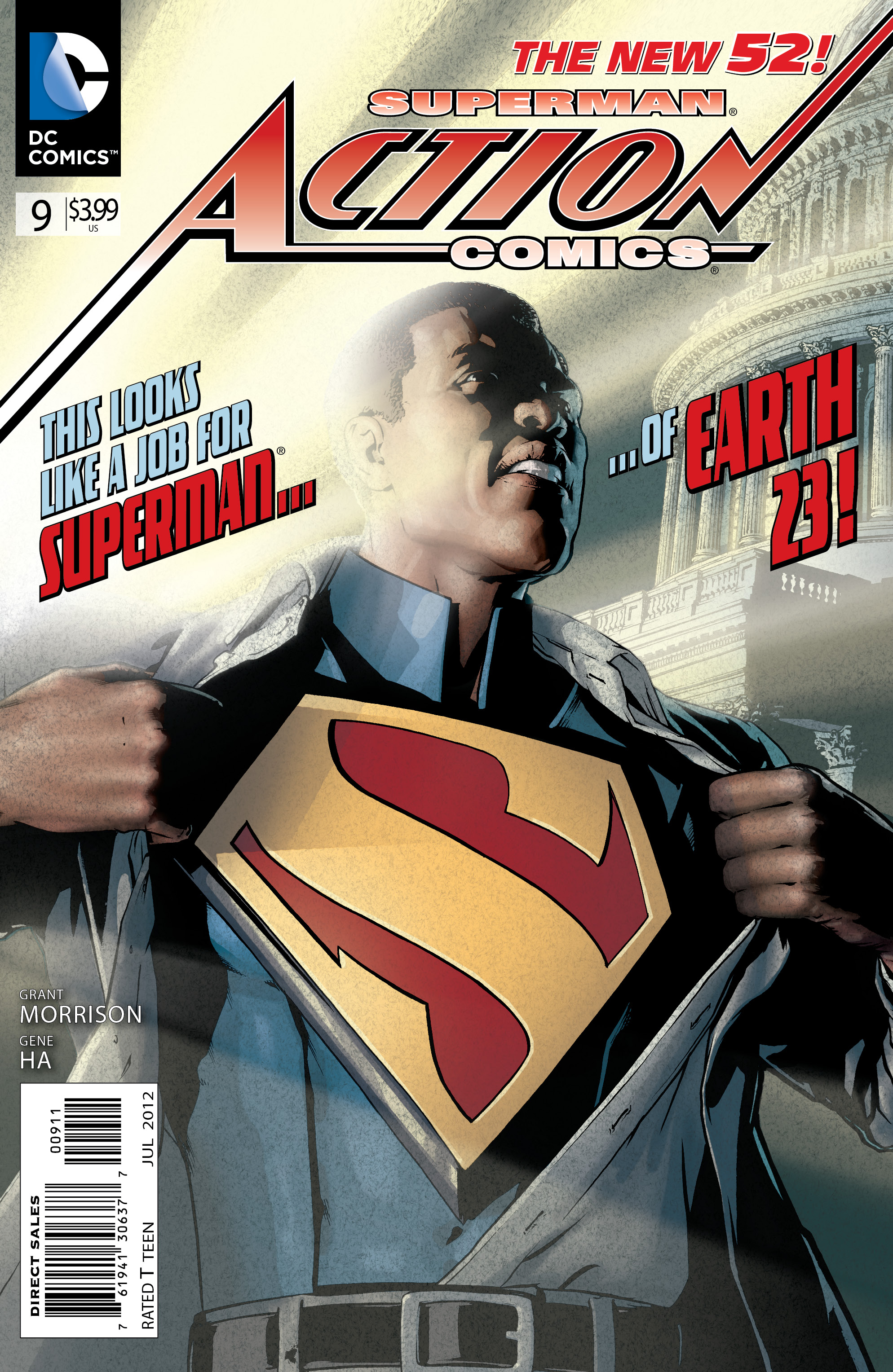
Aside from that, the other character I loved seeing again was President Superman, who first appeared in Final Crisis and was also memorably the featured character in Action Comics #9:
via DC Wikia
I loved that issue, and at the time thought it might be a tease for Multiversity.  Turns out I nailed it.