DC doesn't seem to have released new packs recently; these are just more from the last round I hadn't gotten yet (each one has a featured lead comic).
Batman Eternal #1, 16 (DC)
from 2014
I consider Batman Eternal to have been Snyder and Tynion's attempt to sprint through everything they were never going to get a chance to explore during the New 52 as they explored their own arcs, revisiting classic characters and even letting some new ones (Harper Row) a chance to breathe. The first issue is early DC Jason Fabok, who would later have his true breakthrough in the pages of Justice League. #16 is another one featuring art from Dustin Nguyen and Derek Fridolfs.
Batman #7 (DC)
from 2016
This was one of the featured lead comics, reprinted as Batman: Night of the Monster Men #1. As I've said before, I love that these are true variants. I have no idea if they'll ever be worth money, but I just love that they exist. "Night of the Monster Men" was billed as the first crossover event of the Rebirth era, and it seems positively tame in hindsight. It's also funny that Tom King bowed out as writer for the tie-in issues, allowing Steve Orlando, fast emerging as a new force in the company, a chance to step in.
Green Arrow #48 (DC)
from March 2016
It's downright baffling that DC didn't make a greater priority of Green Arrow once Arrow, the TV series, began and eventually expanded into a whole franchise. This late issue from the New 52 era seems to have left Oliver Queen a...werewolf?
Infinite Crisis: Fight for the Multiverse #10 (DC)
from June 2015
Injustice: Harley Quinn (DC)
from 2016
The later was originally published as Injustice: Ground Zero. But being reprinted with Harley Quinn in the title isn't merely gratuitous, it's also acknowledging that the story is all about her, plus a review of everything that's happened in the Injustice comics. I'm not a video game guy, so the Injustice comics, and the Infinite Crisis comic listed above, are as close as I'll get to those experiences.
The New 52: Futures End #13 (DC)
from September 2014
It's really shocking that fans didn't really care about this weekly series. The assembled writers were certainly impressive enough: Azzarello (synonymous with prestige), Giffen (synonymous with DC weekly comics at this point), Jurgens (still synonymous with "Doomsday," the biggest comics event of the modern era), and Lemire (now synonymous with the modern vanguard). I still want to catch up with it. This issue features part of the Superman arc, where he's been amnesiac about being Superman. It was also the mainstreaming of Batman Beyond. Terry McGinnis seems on his way to...involuntarily bequeathing the role to Tim Drake in this issue...
Convergence: Action Comics #2 (DC)
from July 2015
I still love Convergence. Maybe it's because it came at a dark moment for me, and it was a rare beacon of life. I didn't read the Action Comics two-parter at the time, and I'm not sure what I missed. Maybe not too much.
Trinity of Sin: Pandora - Futures End (DC)
from November 2014
I've written about Pandora often enough. This version of her story reveals an alternate explanation for the character (Geoff Johns had a different one during the Justice League "Trinity War" event, and a much different fate in DC Universe Rebirth). But it was certainly interesting to see this one, even if the art didn't really do it much justice.
Showing posts with label Futures End. Show all posts
Showing posts with label Futures End. Show all posts
Wednesday, October 18, 2017


Monday, April 13, 2015
The New 52: Futures End #48 (DC)

artists: many, many artists
And how does The New 52: Futures End, well, end? Apparently with Batman Beyond realizing, as the panel suggests, that he failed.
Yeah. Never quite see that coming, do you? But there were surely surprises along the way, and really, I think the whole point of Futures End was making Batman Beyond officially part of DC canon, giving him a whole event and everything. And as it turns out, replacing the original one with Tim Drake.
This wouldn't be the first time a weekly series has swapped one secret identity for another, even. Countdown to Final Crisis did that for Red Robin, a persona that debuted in Kingdom Come and originally featured Dick Grayson under the cowl. But as with the Boy Wonder version of Robin, Jason Todd succeeded him. And later, even Tim Drake. Drake has, in fact, been Red Robin throughout the New 52, though with a redesigned look and relegated mostly to Teen Titans comics except for appearances in various Batman crossovers.
Drake is the Robin who most selflessly supports the Batman legacy, so it's fitting that he finally gets a chance to be Batman, in one form or another. Unless there's another swerve, he's going to be the star of the upcoming Batman Beyond ongoing, which will also mean his first solo series in the New 52 era. He was famously the star of the first-ever Robin ongoing, not to mention the popular series of limited adventures that preceded it.
Second lead, at least as represented in this issue, for Futures End turned out to be Mr. Terrific, a character among several who was given a second chance in the weekly after having proven a bust at the start of the New 52 in his own series. He also appeared in Earth 2: World's End, although he was probably more crucial here, as one of two people (the other being Bruce Wayne) responsible for the unintentional unleashing of Brother Eye, who has been a standby villain since Infinite Crisis, and at one point even the intended foe in a Justice League movie, him and all his associated OMAC drones.
I'm still more than okay with not having read Futures End all the way through. It was launched under great fanfare as the most important of the three weeklies DC debuted last year, and had at least two writers with considerable critical pedigree behind them (Brian Azzarello and Jeff Lemire), supported by more traditional ones (Dan Jurgens and Keith Giffen). In the end, I would assume that the veterans seemed to run more of the show. I don't know.
The only thing I would really want to go back and read is Superman's arc from when he returned to how he eventually exited. Given how much attention was given to whether or not the real Man of Steel was even going to be present, one might have expected him to be featured in this final issue. At least, one might have expected that if they hadn't been reading faithfully.
As it turns out, the future that ended was Batman Beyond's. But now there's a new one.
Monday, March 9, 2015
Quick Hits 2
Here's some more quick hits.
Aquaman and the Others #11 (DC)

 |
| In your face! (Funnier if you had had worked with me at Borders.) |
This is my first issue of the series. And it's also the last issue of the series. I can see why.
Earth 2: World's End #22 (DC)
Based on the preview cards and the same material appearing in all of DC's releases last week for next month's Convergence, I'd say this particular weekly is leading directly into it. That and the end of this very issue.
Grayson #8 (DC)
This was a great week for ending things, I guess. Dick's boss in Spyral, Minos, plays his hand. And totally gets played. Not brilliant, but probably the best regular issue I've read from the series to date.
The New 52: Futures End #44 (DC)
At some point, Superman officially made his return. I like that he's back to the t-shirt look. This is easily the best issue I've read of the series to date.
Saga #26 (Image)
In which Marko becomes a hopeless drug addict? I know Hamburger K. Vaughan prefers paper correspondence, but here're my answers to the reader survey, results featured this issue: 1) Carter, 2) male, 3) no, 4) Green Lantern, 5) never left the good ol' USofA, 6) absurd (probably), 7) middle-to-late in the pack, 8) Peter Ackroyd's English Music, but to make things less obscure, Dan's Brown's Angels & Demons, 9) I generally support Israel's right to exist, 10) lately it's been cookie dough bites, 11) yeah, 12) no, 13) addicted to comics?, 14) One.org, 15) actually, because I tend to imagine the worst anyone could call me, people don't tend to vocalize it themselves, 16) we'll say it's a many cartoons tie, 17) I had to look up the best novel I've read recently, 18) I don't remember the name of it, but that one I was obsessed with a decade ago, 19) actually, pretty much every day, 20) none, 21) not yet, 22) U2's Songs of Innocence, 23) none, 24) for expansion of your cultural awareness, 25) hopefully for being a good brother, son, and having written a decent story or two.
Supreme: Blue Rose #7 (Image)
The biggest end of the batch and the best by far, this one concludes Warren Ellis's whole statement on the continuing legacy of Supreme by literally writing into the narrative that the poor guy actually waits for reboots. Classic.
Based on the preview cards and the same material appearing in all of DC's releases last week for next month's Convergence, I'd say this particular weekly is leading directly into it. That and the end of this very issue.
Grayson #8 (DC)
This was a great week for ending things, I guess. Dick's boss in Spyral, Minos, plays his hand. And totally gets played. Not brilliant, but probably the best regular issue I've read from the series to date.
The New 52: Futures End #44 (DC)
At some point, Superman officially made his return. I like that he's back to the t-shirt look. This is easily the best issue I've read of the series to date.
Saga #26 (Image)
In which Marko becomes a hopeless drug addict? I know Hamburger K. Vaughan prefers paper correspondence, but here're my answers to the reader survey, results featured this issue: 1) Carter, 2) male, 3) no, 4) Green Lantern, 5) never left the good ol' USofA, 6) absurd (probably), 7) middle-to-late in the pack, 8) Peter Ackroyd's English Music, but to make things less obscure, Dan's Brown's Angels & Demons, 9) I generally support Israel's right to exist, 10) lately it's been cookie dough bites, 11) yeah, 12) no, 13) addicted to comics?, 14) One.org, 15) actually, because I tend to imagine the worst anyone could call me, people don't tend to vocalize it themselves, 16) we'll say it's a many cartoons tie, 17) I had to look up the best novel I've read recently, 18) I don't remember the name of it, but that one I was obsessed with a decade ago, 19) actually, pretty much every day, 20) none, 21) not yet, 22) U2's Songs of Innocence, 23) none, 24) for expansion of your cultural awareness, 25) hopefully for being a good brother, son, and having written a decent story or two.
Supreme: Blue Rose #7 (Image)
The biggest end of the batch and the best by far, this one concludes Warren Ellis's whole statement on the continuing legacy of Supreme by literally writing into the narrative that the poor guy actually waits for reboots. Classic.
 |
| Yes, the title flower is a maguffin. But a good one. |
Tuesday, October 21, 2014
Superman: Futures End #1 (DC)
writer: Dan Jurgens
artist: Lee Weeks
We interrupt your regularly scheduled Geoff Johns/John Romita, Jr./Ulysses Superman for this special Futures End issue featuring...none of those guys.
artist: Lee Weeks
 |
| via Superman Homepage |
Instead there's Dan Jurgans, Lee Weeks, and Shazam!
This is an issue pulled directly (metaphorically speaking) from the pages of Futures End itself, where the mystery of the masked Superman (similar to Supernova in 52) was somewhat quickly resolved, with the erstwhile Captain Marvel revealed as the would-be Man of Steel.
(Somewhere the ghost of Fawcett Comics is groaning.)
It wasn't a bad way to spend an issue of the series, mind. Actually, it was a fun reminder of the "Reign of the Supermen" era from twenty (!) years ago, with Lois Lane pulling interview duties the same way she did for "Cyborg Superman" all those years ago, within the pages of Superman, naturally.
Jurgens is something of a revelation. I don't know how often he's been writer but not artist simultaneously. The constant knock against him in recent years is that his art style seems hopelessly dated (I'd say that it's more that he's simply lost his edge; Superman #75 stands up quite well, thank you). Even I've sort of jumped on that bandwagon. It's one of the reasons I haven't really been able to read Futures End itself as regularly as I thought I might.
Lee Weeks is artist instead, and he does his reliably excellent work. He's another artist who's worked almost exclusively for Marvel throughout his career (Daredevil is a highlight) and now popping up at DC.
One of the big mysteries of Futures End is what exactly happened to Superman to make him disappear. I can tell you one thing: thankfully Jurgens and Weeks had something to do with it.
 |
| via Comic Box Commentary |
Sunday, October 19, 2014
Red Lanterns: Futures End #1 (DC)
writer: Charles Soule
artist: J. Calafiore
Aside from the brilliant Grayson: Futures End, no other one-shot from the event last month, so far as I know, took the opportunity to explore the parent title's continuity as richly as Red Lanterns.
artist: J. Calafiore
 |
| via Comic Book Resources |
There was good reason. Just as the new series Grayson saw a chance to help define a new series, the Red Lanterns effort was one of Charles Soule's final issues and therefore a way to flashforward to an ending that might otherwise never happen.
When he debuted in the series, Soule brought Guy Gardner along with him, and he used this crucial element to transform Red Lanterns into a focused character study, with the rest of the established characters free to evolve the same way. The greatest beneficiary was Bleez, the demonic-looking lass originally introduced by Geoff Johns in Final Crisis: Rage of the Red Lanterns #1. (The other way of describing her would be to take Farscape's Scorpius, make him female and add bone wings.) It's fair to say that Soule helped make her into one of the most fleshed-out characters Johns has created.
Along with Gardner and Bleez there's Rankorr, the human introduced in Red Lanterns as an intended bridge character for readers who might otherwise have been dubious about the series when it originally launched. It's fair to say that Soule vastly improved him, too. Eventually an unwitting pawn of Atrocitus, the original star of the series (fans weren't never quite convinced by that one) until the events of the recent "Atrocities" arc finally concluded that arc, it's Rankorr who serves as the the third necessary character to conclude Gardner's journey.
Soule's work has transformed Guy Gardner from a frequently combative hothead to someone who has finally made peace with himself, and therefore been able to function profitably among others. Anyone who knows the character's history would probably have never seen that coming. This issue makes a compelling case for Gardner as a Blue Lantern. He's been a Green Lantern, a Red Lantern, even had Sinestro's yellow ring (someone still has to revisit that in the new Johns context). Who would've thought that the formerly rage-defined Red Lanterns would've put him on the path to inner peace?
Soule is joined by regular Red Lanterns artist J. Calafiore, another reason to accept this as part of regular series continuity regardless of how Futures End concludes. Five years into a future that probably won't exist in that form by next year. Not that you'll care after reading something like this.
Tuesday, October 14, 2014
Reading Comics #136 "And I Wonder, Still I Wonder..."
It's beginning to feel as if Wonder Woman really belongs in the Big Three at DC. Much has been made of her inclusion in the upcoming Batman V Superman: Dawn of Justice. DC just announced a fourth series, Wonder Woman '77 (based on the TV series, like Batman '66), her second after Sensation Comics. There's also Superman/Wonder Woman besides her eponymous series. Pretty unbelievable. There was a period, oh...a three quarters of a century or so, where it seemed no one believed she could handle that kind of load. She handled quite a lot in her earliest years. But when the comics bubble burst at the end of WWII, so did her widespread popularity. She persisted, along with Superman and Batman, but at a reduced capacity. Her placement in the Big Three always seemed more a concession to the fact that she remains the most prominent female superhero in comics.
Things are changing.
In September I caught Superman/Wonder Woman: Futures End and Sensation Comics #2. I figured it was a good chance to see how things are going. Brian Azzarello's Wonder Woman run is concluding this month, and then we're headed into Finch territory, and at some point I hope to read the complete Azzarello, but I fell too far behind to have done so already. But Wonder Woman: Futures End was actually a tie-in with Superman/Wonder Woman (some creators opted in, some out).
Charles Soule wrote this adventure, which doesn't seem to have much to say about his own just-concluded run on the series except that Superman and Wonder Woman are both involved. It's more about Wonder Woman, and actually, something of a rebuttal to some of what Azzarello did, the whole Goddess of War thing. Soule's conclusions make a good amount of sense and end the issue well. Superman's arc in the overall Futures End story is more complicated than can be covered here, but that's another thing Soule gets around.
Damn. I'm going to miss Soule at DC. You'd better be good to him, Marvel!
It's Sensation Comics, which like Wonder Woman '77 will be is digital-first, that provides a little more to talk about. There are a couple of stories inside the second print issue. The first is from Ivan Cohen and plays around with the fact that like Shazam, Diana owes a lot of what she is and does to gifts she's been given rather than what she inherently is. It's another difference between this particular icon and other superheroes. It's probably easier to think of her as an ambassador (which was certainly fruitful material for, say, Greg Rucka), but Wonder Woman's biggest strength is her belief in herself. Batman's obsessive quest makes him what he is, Superman's origins from another planet and subsequent adoption. Cohen does a little trickery in his story but circles around to what truly makes his lead who and what she is.
But that's not the best story in the issue. (It is the longer one, though.)
The second story comes from Jason Bischoff. (These are both relatively new names in comics, I assume. That's another difference for Wonder Woman. Very often in the past twenty years or so, DC has tossed one big name after another at the character. There's been some good material. But maybe for someone like her, a fresh voice is needed.) A few years back, Ben Caldwell presented an innovative take on Wonder Woman's origins within the pages of Wednesday Comics. It was one of the best comic book stories I've ever read. Now it has a rival, at least in terms of versions of Wonder Woman's origins.
Strangely enough, I've got to evoke another favorite comic book memory. Two Septembers ago Peter Tomasi presented his version of Damian Wayne's origins in Batman and Robin #0. Damian was the son of Batman and Talia al Ghul, raised by Talia as a perfect warrior for the League of Assassins. To "graduate" he had to be able to defeat his own mother in combat.
Cleverly, Bischoff does the same thing between Diana and her mother Hippolyta. The story is narrated by Hippolyta, leaving the young Wonder Woman free to struggle toward her destiny on her own. The result is another story I've read recently that could easily be expanded upon in the future (the other being the masterful Grayson: Futures End). Gail Simone had her strongest material when she revisited Themyscira and the origin material, while J. Michael Straczynski's best work in "Odyssey" was exploring the teenage Diana.
That's another difference for Wonder Woman. Batman as a boy (besides a subject currently be explored in the new Gotham TV series) isn't nearly as interesting as Batman as a young man. Superman as a boy is pretty much Superman discovering his powers one by one, otherwise it's really just a story about the Kents, while Superman as a teenager is basically exactly Smallville. It's Wonder Woman who has the most potential as a little girl. And writers like Caldwell and Bischoff are finally getting that.
What I'm saying is, Diana didn't need to become Wonder Woman for her story to begin. She didn't need a catalyst; regardless of the version of her birth you choose, that alone was all she needed. She won a contest to earn the title and leave her home behind, but her whole life was already headed in that direction.
So that's what Bischoff got me thinking.
It's a good time to be a fan of Wonder Woman.
Things are changing.
In September I caught Superman/Wonder Woman: Futures End and Sensation Comics #2. I figured it was a good chance to see how things are going. Brian Azzarello's Wonder Woman run is concluding this month, and then we're headed into Finch territory, and at some point I hope to read the complete Azzarello, but I fell too far behind to have done so already. But Wonder Woman: Futures End was actually a tie-in with Superman/Wonder Woman (some creators opted in, some out).
Charles Soule wrote this adventure, which doesn't seem to have much to say about his own just-concluded run on the series except that Superman and Wonder Woman are both involved. It's more about Wonder Woman, and actually, something of a rebuttal to some of what Azzarello did, the whole Goddess of War thing. Soule's conclusions make a good amount of sense and end the issue well. Superman's arc in the overall Futures End story is more complicated than can be covered here, but that's another thing Soule gets around.
Damn. I'm going to miss Soule at DC. You'd better be good to him, Marvel!
It's Sensation Comics, which like Wonder Woman '77 will be is digital-first, that provides a little more to talk about. There are a couple of stories inside the second print issue. The first is from Ivan Cohen and plays around with the fact that like Shazam, Diana owes a lot of what she is and does to gifts she's been given rather than what she inherently is. It's another difference between this particular icon and other superheroes. It's probably easier to think of her as an ambassador (which was certainly fruitful material for, say, Greg Rucka), but Wonder Woman's biggest strength is her belief in herself. Batman's obsessive quest makes him what he is, Superman's origins from another planet and subsequent adoption. Cohen does a little trickery in his story but circles around to what truly makes his lead who and what she is.
But that's not the best story in the issue. (It is the longer one, though.)
The second story comes from Jason Bischoff. (These are both relatively new names in comics, I assume. That's another difference for Wonder Woman. Very often in the past twenty years or so, DC has tossed one big name after another at the character. There's been some good material. But maybe for someone like her, a fresh voice is needed.) A few years back, Ben Caldwell presented an innovative take on Wonder Woman's origins within the pages of Wednesday Comics. It was one of the best comic book stories I've ever read. Now it has a rival, at least in terms of versions of Wonder Woman's origins.
Strangely enough, I've got to evoke another favorite comic book memory. Two Septembers ago Peter Tomasi presented his version of Damian Wayne's origins in Batman and Robin #0. Damian was the son of Batman and Talia al Ghul, raised by Talia as a perfect warrior for the League of Assassins. To "graduate" he had to be able to defeat his own mother in combat.
Cleverly, Bischoff does the same thing between Diana and her mother Hippolyta. The story is narrated by Hippolyta, leaving the young Wonder Woman free to struggle toward her destiny on her own. The result is another story I've read recently that could easily be expanded upon in the future (the other being the masterful Grayson: Futures End). Gail Simone had her strongest material when she revisited Themyscira and the origin material, while J. Michael Straczynski's best work in "Odyssey" was exploring the teenage Diana.
That's another difference for Wonder Woman. Batman as a boy (besides a subject currently be explored in the new Gotham TV series) isn't nearly as interesting as Batman as a young man. Superman as a boy is pretty much Superman discovering his powers one by one, otherwise it's really just a story about the Kents, while Superman as a teenager is basically exactly Smallville. It's Wonder Woman who has the most potential as a little girl. And writers like Caldwell and Bischoff are finally getting that.
What I'm saying is, Diana didn't need to become Wonder Woman for her story to begin. She didn't need a catalyst; regardless of the version of her birth you choose, that alone was all she needed. She won a contest to earn the title and leave her home behind, but her whole life was already headed in that direction.
So that's what Bischoff got me thinking.
It's a good time to be a fan of Wonder Woman.
Sunday, October 12, 2014
Justice League: Futures End #1 (DC)
writer: Jeff Lemire
artist: Jed Dougherty

artist: Jed Dougherty
The first thing you should know about this, in case you skipped my writer/artist credits at the top, is that it isn't written by Geoff Johns. The second is that it is in fact a continuation of the Justice League United: Futures End special.
The whole Futures End thing is the first time the annual New 52 September celebration has dedicated itself to something other than strictly matters of continuity. In a way, it does, because one way or another, the Futures End weekly and its September one-shots are part of the canon (and by extension, the familiar character of Batman Beyond, who plays a prominent role in the weekly), but they're also by necessity and design headed toward a reboot. Which means pretty much everything that happens in these specials won't have happened, not five years from now, not by next year, when DC has reached its latest Crisis event, which Futures End is leading toward.
All of that is also to say, because these issues are not necessarily part of the actual series, their contents don't have to reflect what's been going on in them. Which is to say, it's okay to sub creators. Which is to say, no Geoff Johns.
Yeah, I guess it was kind of foolish to expect that (this goes for Superman: Futures End, too), although as I understand Scott Snyder did choose to participate over in Batman: Futures End, and he seemed to play around with the nifty story he did for Detectives Comics #27, the idea of Batman cloning himself to keep his mission as well as himself alive.
So what does this issue do, besides feature Jeff Lemire and continue from the other League title? It's another shot at reconciling Captain Atom with his Alan Moore doppelganger from Watchmen, Dr. Manhattan. Captain Atom traditionally been a kind of Hulk mixed with Superman, a superhero created in a nuclear accident who tends to be a leader. Over the years he's had various levels of significance. He actually did have a New 52 series when the relaunch happened, but it was one of those short-lived ones, and he subsequently became one of the many characters from the revamped landscape bumming around looking for continued relevance. A lot of them seem to have ended up in Futures End, curiously enough.
I didn't read the first part of the story, but it's easy enough to figure out what's happening as it picks up here. At this point, Captain Atom is threatening to go the full Zero Hour, and it's only the trouble of being contained on Mars and confronted by this era's League standing in his way. Lemire captures the Dr. Manhattan prototype well in Captain Atom's dialogue and approach to the situation. Suffice to say, but that's certainly a Dr. Manhattan that everyone would have feared, not the angst-ridden one Moore favored. (Everyone's angst-ridden in Watchmen. It's still a surprise that Moore never wrote for Marvel.)
There's a lot of things Moore never did. He wouldn't have had room for the kind of action from this issue in Watchmen. Moore's superheroes tended to be reminders of a previous age (his happiest and apparently only memories stem from the early Silver Age) or postmodern deconstructions. He confronted them with moral dilemmas. Did Moore ever have a happy ending?
Because Captain Atom receives one here. Martian Manhunter spends most of the story out of commission, thereby preventing him from using his mental abilities to influence the situation. That leaves a League comprised of a lot of characters who are reminiscent of all those eras DC periodically reacts against by once again bringing the icons back together. There's Vostok (Aquaman and the Others), Equinox (Justice League United), Dawnstar and Wildfire (Legion of Super-Heroes), Stormguard (unique to Futures End), as well as The Flash and Cyborg.
My memories of the issue reduce it to the Captain Atom elements, but these heroes make an impression as they fight during the story, too, making it a true mix of Moore and the regular comic book approach. (I imagine if anyone objects to my impression of Moore, it would have to come from his America's Best Comics days, probably Top Ten. Feel free to rebut.)
Not what I would've wanted, but still entertaining, with an ending that helps the whole thing work. It doesn't hurt that Martian Manhunter is involved. I don't know why there seems to be such extreme reluctance to use him as something other than supporting material in the New 52, but Lemire makes it clear he's still got plenty of potential.
Monday, October 6, 2014
Grayson: Futures End #1 (DC)
writer: Tom King, Tim Seeley
artist: Stephen Mooney
An instant classic. Best single issue I'll read all year. The Dick Grayson story I've been waiting to read for years.
Need I go on?
The idea of Futures End, whether considering the weekly series itself or the September one-shots, is to present a portrait of the DC landscape five years in the future. In the weekly series, it's a catastrophe that needs to be undone. In the one-shots it's a glimpse at where everyone ends up.
Since the New 52 launch four years ago, September has been the best time to be a fan of DC. The first September was the launch of the initial wave of fifty-two new series, the second a look at everyone's origins, the third a month dedicated to villains. Every time it's a chance to reconnect with the characters themselves, take a wide view of their activities. In essence, September is the absolute best opportunity for me to catch my favorite kind of storytelling.
And this year, that happened within the pages of Grayson. Since the final issue of Nightwing saw Tom King and Tim Seeley take their first stab at defining the career of Dick Grayson, I've been hopeful that these were the writers who would finally do justice to the character. There have been others in the past who have done excellent work with the character, but few have been as interested in exploring the character in the same way countless creators have, say, Superman or Batman. I know, Dick Grayson no matter what he's called can't be argued to be Superman or Batman. I mean, only Superman and Batman are, right? But Dick's been around for about as long as they have. He also holds the distinction of making permanent leaps of development into new roles, something no other character has been able to do. He went from Robin the Boy Wonder, Batman's sidekick, to leader of the Teen Titans, to Nightwing, to a solo career, and several stints as Batman. And now he's Dick Grayson, undercover as an agent of SPYRAL, the premise behind Grayson itself.
So far I haven't read a regular issue of Grayson. I've heard some good things about it, but every time I have a look it seems Dick is in the midst of a spy adventure, which is fine. I'd probably like it just fine, considering it's the last vestige of Grant Morrison's Batman Incorporated. But over the years, I've developed a real fear of writers wasting Dick on adventures that ultimately mean nothing to the character, a trend that began after some truly excellent material from Chuck Dixon and Devin K. Grayson. After Dick was scheduled to die in the pages of Infinite Crisis, DC lost its nerve with the character. Other than the last stint as Batman, Dick has been completely directionless. And then he was singled out as the victim in Forever Evil, had his superhero identity stolen away, and ended up thrown off the deep end.
The Futures End one-shot changes everything. It's the story that finally tells the story of Dick's life, all of it. Even if the destination ends up being something that never actually happens, that's not really the point. The particulars don't matter. It's the story, and the effort to make a cohesive thru-line for everything Dick has done. King and Seeley skewer heavily toward his later solo adventures, and naturally the context of Grayson itself, and this works incredibly well. Helena Bertinelli, the erstwhile Huntress, has considerable history with Dick, so it's nice to see her so important to the story, at last, in this version of events, the permanent romantic foil he's been searching for his whole publication history (Dixon had a few ideas, and of course there was also Starfire in the Titans days and Batgirl, a notion that's been danced around for so long it's actually lost its appeal). Helena was always the contrasting figure who challenged Dick best, and nowhere is that more evident than in this one-shot. Their interactions force Dick to remember the signal moments of his career, incidental ones that represent the impermanence of his life, how he was living it even before becoming Robin, as a circus performer.
The brilliance of the story might be blunted in some eyes by the gimmick of unfolding it backwards, but I've always liked that idea, and it's done perfectly anyway, even with a nice cylindrical nature to it. There's a command to the whole thing that's rare in storytelling anywhere, let alone comics featuring superheroes. This is very deliberate stuff, not plodding but calculated, that rewards repeat reading (demands it, in some respects, depending how much you follow initially).
If the series as a whole is as good as this, I'll probably be adding Grayson to the growing list of series to read in trade collection format, because it seems as if it's another experience that would greatly benefit from that style. Hopefully King and Seeley stick around for a while, get as far along the Futures End narrative as they can, because they've proven a long-term and enduring benefit to Dick's current role, how it fits in with his whole history, enhances it. I wouldn't mind their doing side projects exploring his past a little more, either.
But the beauty of it is that even if that doesn't happen, this one-shot still exists, and it already does all that, and it has a great deal of fun in the process, something that's been missing from the character for too long. It's a perfect single issue, and thankfully King and Seeley were smart enough to realize that the Futures End month gave them such an opportunity. I don't know if they already had ideas like this percolating for the series or if the prompt forced them to this creative peak. It doesn't matter. It happened, and it's the new high-water mark for Dick Grayson stories.
artist: Stephen Mooney
 |
| via Comic Newbies |
Need I go on?
The idea of Futures End, whether considering the weekly series itself or the September one-shots, is to present a portrait of the DC landscape five years in the future. In the weekly series, it's a catastrophe that needs to be undone. In the one-shots it's a glimpse at where everyone ends up.
Since the New 52 launch four years ago, September has been the best time to be a fan of DC. The first September was the launch of the initial wave of fifty-two new series, the second a look at everyone's origins, the third a month dedicated to villains. Every time it's a chance to reconnect with the characters themselves, take a wide view of their activities. In essence, September is the absolute best opportunity for me to catch my favorite kind of storytelling.
And this year, that happened within the pages of Grayson. Since the final issue of Nightwing saw Tom King and Tim Seeley take their first stab at defining the career of Dick Grayson, I've been hopeful that these were the writers who would finally do justice to the character. There have been others in the past who have done excellent work with the character, but few have been as interested in exploring the character in the same way countless creators have, say, Superman or Batman. I know, Dick Grayson no matter what he's called can't be argued to be Superman or Batman. I mean, only Superman and Batman are, right? But Dick's been around for about as long as they have. He also holds the distinction of making permanent leaps of development into new roles, something no other character has been able to do. He went from Robin the Boy Wonder, Batman's sidekick, to leader of the Teen Titans, to Nightwing, to a solo career, and several stints as Batman. And now he's Dick Grayson, undercover as an agent of SPYRAL, the premise behind Grayson itself.
So far I haven't read a regular issue of Grayson. I've heard some good things about it, but every time I have a look it seems Dick is in the midst of a spy adventure, which is fine. I'd probably like it just fine, considering it's the last vestige of Grant Morrison's Batman Incorporated. But over the years, I've developed a real fear of writers wasting Dick on adventures that ultimately mean nothing to the character, a trend that began after some truly excellent material from Chuck Dixon and Devin K. Grayson. After Dick was scheduled to die in the pages of Infinite Crisis, DC lost its nerve with the character. Other than the last stint as Batman, Dick has been completely directionless. And then he was singled out as the victim in Forever Evil, had his superhero identity stolen away, and ended up thrown off the deep end.
The Futures End one-shot changes everything. It's the story that finally tells the story of Dick's life, all of it. Even if the destination ends up being something that never actually happens, that's not really the point. The particulars don't matter. It's the story, and the effort to make a cohesive thru-line for everything Dick has done. King and Seeley skewer heavily toward his later solo adventures, and naturally the context of Grayson itself, and this works incredibly well. Helena Bertinelli, the erstwhile Huntress, has considerable history with Dick, so it's nice to see her so important to the story, at last, in this version of events, the permanent romantic foil he's been searching for his whole publication history (Dixon had a few ideas, and of course there was also Starfire in the Titans days and Batgirl, a notion that's been danced around for so long it's actually lost its appeal). Helena was always the contrasting figure who challenged Dick best, and nowhere is that more evident than in this one-shot. Their interactions force Dick to remember the signal moments of his career, incidental ones that represent the impermanence of his life, how he was living it even before becoming Robin, as a circus performer.
The brilliance of the story might be blunted in some eyes by the gimmick of unfolding it backwards, but I've always liked that idea, and it's done perfectly anyway, even with a nice cylindrical nature to it. There's a command to the whole thing that's rare in storytelling anywhere, let alone comics featuring superheroes. This is very deliberate stuff, not plodding but calculated, that rewards repeat reading (demands it, in some respects, depending how much you follow initially).
If the series as a whole is as good as this, I'll probably be adding Grayson to the growing list of series to read in trade collection format, because it seems as if it's another experience that would greatly benefit from that style. Hopefully King and Seeley stick around for a while, get as far along the Futures End narrative as they can, because they've proven a long-term and enduring benefit to Dick's current role, how it fits in with his whole history, enhances it. I wouldn't mind their doing side projects exploring his past a little more, either.
But the beauty of it is that even if that doesn't happen, this one-shot still exists, and it already does all that, and it has a great deal of fun in the process, something that's been missing from the character for too long. It's a perfect single issue, and thankfully King and Seeley were smart enough to realize that the Futures End month gave them such an opportunity. I don't know if they already had ideas like this percolating for the series or if the prompt forced them to this creative peak. It doesn't matter. It happened, and it's the new high-water mark for Dick Grayson stories.
Thursday, September 11, 2014
Reading Comics #133 "Bull Moose Bargains"
As you may recall, I was enjoying bargain grab bags from local entertainment franchise Bull Moose, until I learned they weren't doing them anymore. But they didn't stop carrying comics outright (but I haven't gotten a chance to check in a few weeks, so I don't know what the prospects look like now). Instead they started sticking their discounted comics in one of those old-fashioned spinning racks, so I now had the opportunity to select exactly what I wanted (from the available titles, of course). Some of them were the same 2013 leftovers I'd find in some of the grab bags, and some of them were new releases (did they know???), all of them marked at fifty cents. For the first of two trips in this new configuration to date, I scooped up nine titles. And those were:
Astro City #10 (Vertigo)
When this series was relaunched last year, I was part of the I-don't-know-how-large contingent of fans who was happy to see it return. The last time the title was in print it was the extended Dark Age arc, which apparently bothered long-term readers, but was at least a version of something creator Kurt Busiek had been intending to do ever since Marvels (twenty years ago). I've never read Marvels, a giant love letter to (as you may have guess) Marvel history which quickly became known as painter Alex Ross's breakout project (some argue best work, but I hold that for Kingdom Come, which is the one he clearly drew on for the later Earth X comics). Ross has done every Astro City cover since it launched in 1995 (so! Busiek wasted little time!), and Brent Anderson has been the interior artist. This is a hardcore nostalgia comic in the Alan Moore tradition, with Busiek versions of pretty much every major superhero. Did it really take this long for him to get around to a Winged Victory spotlight? Winged Victory, you understand, is his Wonder Woman. The story takes off of the Infinite Crisis era of controversy surrounding DC's Amazon taking the life of Maxwell Lord. In fairness to Busiek, he does craft his pastiches into fairly distinctive variations, so that you don't necessarily have to be thinking WonderWomanWonderWomanWonderWoman while reading this issue (if you so choose). It's a Winged Victory story, even if you know how Busiek reached this point. All that being said, I cooled on the whole thing pretty quickly. I keep wanting him to grab the brass ring, go for the gusto, but Busiek is determined to take a relaxed pace. These are comics for Silver Age fans (early Silver Age, the lens of what would follow refracted through the 1950s). Originally Astro City was one of the most acclaimed comics around, but even other readers don't seem as excited about it these days. Good to have it around again, though.
Kick-Ass 3 #8 (Icon)
The big surprise was this conclusion to the Kick-Ass saga, begun in 2008. I read the early issues, but lost track of it along the way, after it became a movie phenomenon I inexplicably still haven't seen (despite active interests in the careers of both Jim Carrey, featured in the second one, and Chloe Grace Moretz, whose whole career happened thanks to Hit-Girl). It might have to do with the fact that the writer is Mark Millar, and for a time I kind of soured on him, not so much because of anything he'd done, but because of things Grant Morrison said. Morrison and Millar used to be bosom buddies, but they had a creative falling-out, and Morrison subsequently expressed the kind of opinions about his former friend that, well, Alan Moore routinely spouts about Morrison himself. (Guys! Guys! Can't we all just get along?) Comics Reader readers know I've recently turned the corner on Millar thanks to Starlight, so I was more than ready to read how he ended Kick-Ass. It seems to be exactly the way it should have, and that's fine. The art of John Romita, Jr. remains integral to the whole experience. Romita moved on to Superman with Geoff Johns immediately after concluding this saga, and of course I'm definitely there for that experience. In this sudden Millar- and Romita-heavy season for my comics experience, it was fitting to catch their mutual landmark as it happened.
The New 52: Futures End #10 (DC)
Contrary to my own expectations, Futures End still hasn't become a new version of my beloved 52 experience. I'm still keeping tabs on it (the Masked Superman was recently revealed to be Shazam, if you wanted to know), and of course September this year is a whole month dedicated to the event otherwise chronicled in the weekly series, with DC's line decked out in special issues looking at the futures of their stars. Masked Superman Before He Was Unmasked has encounter with Lois Lane this issue, which is otherwise highlighted by (Big) Barda being asked to suit up again. Undeniably awesome moment. Barda is the Wonder Woman of the New Gods. Come to think of it, I have no idea why there haven't been more Barda/Wonder Woman stories. Somebody fix that, please?
Saga #21 (Image)
On the opposite side of my recent Astro City experience is Saga. I lost track of both series over the course of the last year, but returning to Saga was to remember how much I love it. In the current comics, Brian K. Vaughan is finally putting the spotlight on the Robot Kingdom. Prince Robot IV (such a deceptively simple, awesome name; I'm a man of uncomplicated pleasures sometimes) has had a baby, and that baby has been kidnapped by a disgruntled Robot Kingdom janitor. Alana and Marko are still in the thick of their soap opera (call it what it is) otherwise. I'm once again addicted.
Superman/Wonder Woman #6 (DC)
I don't know if you remember, but I was wild about this series when it launched. I thought it was a brilliant idea, long-in-coming for Wonder Woman to get a second ongoing series of any form (and now she has a third, thanks to the digital-first Sensation Comics), and it also happened to have part of the early comic crush I've developed over Charles Soule (who unfortunately has recently signed an exclusive contract with...Marvel). This issue is one of the periodic General Zod stories DC loves to do, these inspired by the Man of Steel version Michael Shannon embodied more than Terrence Stamp in Superman II (but there have been lots of versions over the years). Zod is presented as a formidable foe. In fact, Superman/Wonder Woman in general seems to love thrusting its love birds in epic battles they can only hope to survive (although of course they will), valuing their link as warriors, a bond only they can truly experience together (which is the whole point of the relationship). The art is from Tony Daniel, whom I've greatly admired since his "Batman R.I.P." days, and whose work continues to evolve. He may epitomize what some fans have called the "New 52 house style," which basically folds around Jim Lee's work. For a brief moment it seemed as if Daniel had in fact begun to pattern himself pretty directly on Lee, but as I said, this issue is proof that he's still in flux. This is a good thing. I still have great hope for his career. Given the right project, his budding interests as a writer-artist could cement a real legacy. Next project in that regard is the forthcoming Deathstroke relaunch (which I will be rooting for, obviously).
Trinity of Sin: Pandora #2 (DC)
Ever since it became clear that the New 52 was launching with the secret lynchpin of a new character (who looks like part of the WildStorm legacy that officially became a part of DC canon at that time), I began rooting for Pandora to become an important, lasting creation. This is a work in progress. When she got her own book last year, I was rooting for that, too, but kept looking for a way in after I missed the launch. Well, now I've finally read an issue, just in time for a forthcoming relaunch where the character and her Trinity of Sin cohorts (Phantom Stranger, Question) fold in together under the single, unspecified banner (it could certainly be worse!). I think this is a good thing. A character like Pandora kind of needs context. She was built for context. Unless someone literally spends a year or more exploring her own story, sending Pandora on random adventures will do her no favors at all. This issue is a tie-in with "Trinity War," a Justice League crossover event that was supposed to be a big deal but kind of wasn't, a culmination of everything the New 52 was meant to accomplish to that point. (Failure? There are fans who've wanted the New 52 to be a failure from the start. Is this how fans were after Crisis On Infinite Earths? I hope not!) The strongest element of the issue is its use of Vandal Savage. Someone other than Ray Fawkes might have really played that up. Fawkes is one of the writers who've benefited from the revised creative landscape DC has sought to establishment, and he's one I really haven't formed an impression of, so I hope this isn't completely indicative of his work. I'd like to see better.
Wolverine #4 (Marvel)
Ah, Paul Cornell. He's one of those writers who became an instant favor a few years back, and I became a loyal reader for a good long while. But I wonder if he hasn't lost the thread of what interested him in writing comics along the way. He's also known for his work with Doctor Who, and as an author. And also for not really sticking around any one comic book project for long. Maybe that's why I stopped trying to keep track, or found I didn't care when he started on Wolverine. I kept almost checking out the run, but never quite doing it. He's the writer who set up the Death of Wolverine event that...Charles Soule is finishing. So I finally checked it out. And...I really don't think I've missed anything. Sorry, Paul. Doesn't seem to be among your best. When Cornell is at his best he's among the best. So that's why I've been disappointed.
Wonder Woman #23 (DC)
If I hadn't gotten so horribly behind, I'd've been a loyal fan of the whole Brian Azzarello/Cliff Chiang run on this series, which is about to end. It's brilliant, easily one of the best things that's ever happened to Wonder Woman, and for one of the biggest characters in comics. This issue is part of the First Born arc. First Born is a new villain to the mythos, part of the September 2013 Villains Month one-shot line-up and everything. The one thing that can be held against the Azzarello Wonder Woman is that it feels completely disconnected from the rest of the DC landscape (which, I'm convinced, is half the reason Superman/Wonder Woman happened), and why First Born didn't at all become a household name. I mean, H'El over in the Scott Lobdell Superman comics from around the same time had a better shot. Wonder Woman from this era will become known for its particular context. To read one issue is to read any issue, in some respects. It's all one continuous story. (Although I will be contradicting this gross simplification next time I talk about it, which is another tie-in to how Superman/Wonder Woman happened.) This is a good thing. I'm already hoping for a Azzarello/Chiang reprise somewhere down the line, an epic mini-series or even crossover event. Hey, I can dream!
All-New X-Men #24 (Marvel)
This is another series I was once completely hot on but cooled over as time wore on. This is the Brian Michael Bendis/Stuart Immonen series that spun out of AvX and famously sports the gimmick of having the original, youthful X-Men time-displaced to the present. I'm about as all over the place with Bendis as I am with a handful of other creators. He's kind of the Marvel equivalent, for me, of Scott Snyder in some respects. When I love his work, I think he's brilliant. But he's not always engaged in ways I think benefit what he's doing. This issue is all about how he's reached that point again. I thought the time-displaced heroes would be gone by now. I really have no idea why they're still around. In the early issues, All-New X-Men seemed primed to introduce a whole new generation of mutant heroes. I don't know if I've simply missed that whole development, or if it's been abandoned, delayed, whatever. That's what I think the series ought to be doing. And as always, I want Immonen to be doing work that's far less busy. He's the pen-and-ink version of Alex Ross at his best. At Marvel he's simply never been given a chance to express that side of his work. Maybe he's fine with that. But for me, the same with Bendis, I'm...disappointed. Bendis and Immonen could indeed be a dynamite combination. But not this way. Anyway, "The Trial of Jean Grey Part 5 of 6." Blah blah blah, "Dark Phoenix Saga," I-can't-believe-we-didn't-remain-innocent-forever, forcing an unnecessary Guardians of the Galaxy connection. (I never really got why the X-Men ever had to have anything to do with space. Basically the complete opposite of what makes them relevant.)
Next time, fewer comics. That's all I can promise...
Astro City #10 (Vertigo)
When this series was relaunched last year, I was part of the I-don't-know-how-large contingent of fans who was happy to see it return. The last time the title was in print it was the extended Dark Age arc, which apparently bothered long-term readers, but was at least a version of something creator Kurt Busiek had been intending to do ever since Marvels (twenty years ago). I've never read Marvels, a giant love letter to (as you may have guess) Marvel history which quickly became known as painter Alex Ross's breakout project (some argue best work, but I hold that for Kingdom Come, which is the one he clearly drew on for the later Earth X comics). Ross has done every Astro City cover since it launched in 1995 (so! Busiek wasted little time!), and Brent Anderson has been the interior artist. This is a hardcore nostalgia comic in the Alan Moore tradition, with Busiek versions of pretty much every major superhero. Did it really take this long for him to get around to a Winged Victory spotlight? Winged Victory, you understand, is his Wonder Woman. The story takes off of the Infinite Crisis era of controversy surrounding DC's Amazon taking the life of Maxwell Lord. In fairness to Busiek, he does craft his pastiches into fairly distinctive variations, so that you don't necessarily have to be thinking WonderWomanWonderWomanWonderWoman while reading this issue (if you so choose). It's a Winged Victory story, even if you know how Busiek reached this point. All that being said, I cooled on the whole thing pretty quickly. I keep wanting him to grab the brass ring, go for the gusto, but Busiek is determined to take a relaxed pace. These are comics for Silver Age fans (early Silver Age, the lens of what would follow refracted through the 1950s). Originally Astro City was one of the most acclaimed comics around, but even other readers don't seem as excited about it these days. Good to have it around again, though.
Kick-Ass 3 #8 (Icon)
The big surprise was this conclusion to the Kick-Ass saga, begun in 2008. I read the early issues, but lost track of it along the way, after it became a movie phenomenon I inexplicably still haven't seen (despite active interests in the careers of both Jim Carrey, featured in the second one, and Chloe Grace Moretz, whose whole career happened thanks to Hit-Girl). It might have to do with the fact that the writer is Mark Millar, and for a time I kind of soured on him, not so much because of anything he'd done, but because of things Grant Morrison said. Morrison and Millar used to be bosom buddies, but they had a creative falling-out, and Morrison subsequently expressed the kind of opinions about his former friend that, well, Alan Moore routinely spouts about Morrison himself. (Guys! Guys! Can't we all just get along?) Comics Reader readers know I've recently turned the corner on Millar thanks to Starlight, so I was more than ready to read how he ended Kick-Ass. It seems to be exactly the way it should have, and that's fine. The art of John Romita, Jr. remains integral to the whole experience. Romita moved on to Superman with Geoff Johns immediately after concluding this saga, and of course I'm definitely there for that experience. In this sudden Millar- and Romita-heavy season for my comics experience, it was fitting to catch their mutual landmark as it happened.
The New 52: Futures End #10 (DC)
Contrary to my own expectations, Futures End still hasn't become a new version of my beloved 52 experience. I'm still keeping tabs on it (the Masked Superman was recently revealed to be Shazam, if you wanted to know), and of course September this year is a whole month dedicated to the event otherwise chronicled in the weekly series, with DC's line decked out in special issues looking at the futures of their stars. Masked Superman Before He Was Unmasked has encounter with Lois Lane this issue, which is otherwise highlighted by (Big) Barda being asked to suit up again. Undeniably awesome moment. Barda is the Wonder Woman of the New Gods. Come to think of it, I have no idea why there haven't been more Barda/Wonder Woman stories. Somebody fix that, please?
Saga #21 (Image)
On the opposite side of my recent Astro City experience is Saga. I lost track of both series over the course of the last year, but returning to Saga was to remember how much I love it. In the current comics, Brian K. Vaughan is finally putting the spotlight on the Robot Kingdom. Prince Robot IV (such a deceptively simple, awesome name; I'm a man of uncomplicated pleasures sometimes) has had a baby, and that baby has been kidnapped by a disgruntled Robot Kingdom janitor. Alana and Marko are still in the thick of their soap opera (call it what it is) otherwise. I'm once again addicted.
Superman/Wonder Woman #6 (DC)
I don't know if you remember, but I was wild about this series when it launched. I thought it was a brilliant idea, long-in-coming for Wonder Woman to get a second ongoing series of any form (and now she has a third, thanks to the digital-first Sensation Comics), and it also happened to have part of the early comic crush I've developed over Charles Soule (who unfortunately has recently signed an exclusive contract with...Marvel). This issue is one of the periodic General Zod stories DC loves to do, these inspired by the Man of Steel version Michael Shannon embodied more than Terrence Stamp in Superman II (but there have been lots of versions over the years). Zod is presented as a formidable foe. In fact, Superman/Wonder Woman in general seems to love thrusting its love birds in epic battles they can only hope to survive (although of course they will), valuing their link as warriors, a bond only they can truly experience together (which is the whole point of the relationship). The art is from Tony Daniel, whom I've greatly admired since his "Batman R.I.P." days, and whose work continues to evolve. He may epitomize what some fans have called the "New 52 house style," which basically folds around Jim Lee's work. For a brief moment it seemed as if Daniel had in fact begun to pattern himself pretty directly on Lee, but as I said, this issue is proof that he's still in flux. This is a good thing. I still have great hope for his career. Given the right project, his budding interests as a writer-artist could cement a real legacy. Next project in that regard is the forthcoming Deathstroke relaunch (which I will be rooting for, obviously).
Trinity of Sin: Pandora #2 (DC)
Ever since it became clear that the New 52 was launching with the secret lynchpin of a new character (who looks like part of the WildStorm legacy that officially became a part of DC canon at that time), I began rooting for Pandora to become an important, lasting creation. This is a work in progress. When she got her own book last year, I was rooting for that, too, but kept looking for a way in after I missed the launch. Well, now I've finally read an issue, just in time for a forthcoming relaunch where the character and her Trinity of Sin cohorts (Phantom Stranger, Question) fold in together under the single, unspecified banner (it could certainly be worse!). I think this is a good thing. A character like Pandora kind of needs context. She was built for context. Unless someone literally spends a year or more exploring her own story, sending Pandora on random adventures will do her no favors at all. This issue is a tie-in with "Trinity War," a Justice League crossover event that was supposed to be a big deal but kind of wasn't, a culmination of everything the New 52 was meant to accomplish to that point. (Failure? There are fans who've wanted the New 52 to be a failure from the start. Is this how fans were after Crisis On Infinite Earths? I hope not!) The strongest element of the issue is its use of Vandal Savage. Someone other than Ray Fawkes might have really played that up. Fawkes is one of the writers who've benefited from the revised creative landscape DC has sought to establishment, and he's one I really haven't formed an impression of, so I hope this isn't completely indicative of his work. I'd like to see better.
Wolverine #4 (Marvel)
Ah, Paul Cornell. He's one of those writers who became an instant favor a few years back, and I became a loyal reader for a good long while. But I wonder if he hasn't lost the thread of what interested him in writing comics along the way. He's also known for his work with Doctor Who, and as an author. And also for not really sticking around any one comic book project for long. Maybe that's why I stopped trying to keep track, or found I didn't care when he started on Wolverine. I kept almost checking out the run, but never quite doing it. He's the writer who set up the Death of Wolverine event that...Charles Soule is finishing. So I finally checked it out. And...I really don't think I've missed anything. Sorry, Paul. Doesn't seem to be among your best. When Cornell is at his best he's among the best. So that's why I've been disappointed.
Wonder Woman #23 (DC)
If I hadn't gotten so horribly behind, I'd've been a loyal fan of the whole Brian Azzarello/Cliff Chiang run on this series, which is about to end. It's brilliant, easily one of the best things that's ever happened to Wonder Woman, and for one of the biggest characters in comics. This issue is part of the First Born arc. First Born is a new villain to the mythos, part of the September 2013 Villains Month one-shot line-up and everything. The one thing that can be held against the Azzarello Wonder Woman is that it feels completely disconnected from the rest of the DC landscape (which, I'm convinced, is half the reason Superman/Wonder Woman happened), and why First Born didn't at all become a household name. I mean, H'El over in the Scott Lobdell Superman comics from around the same time had a better shot. Wonder Woman from this era will become known for its particular context. To read one issue is to read any issue, in some respects. It's all one continuous story. (Although I will be contradicting this gross simplification next time I talk about it, which is another tie-in to how Superman/Wonder Woman happened.) This is a good thing. I'm already hoping for a Azzarello/Chiang reprise somewhere down the line, an epic mini-series or even crossover event. Hey, I can dream!
All-New X-Men #24 (Marvel)
This is another series I was once completely hot on but cooled over as time wore on. This is the Brian Michael Bendis/Stuart Immonen series that spun out of AvX and famously sports the gimmick of having the original, youthful X-Men time-displaced to the present. I'm about as all over the place with Bendis as I am with a handful of other creators. He's kind of the Marvel equivalent, for me, of Scott Snyder in some respects. When I love his work, I think he's brilliant. But he's not always engaged in ways I think benefit what he's doing. This issue is all about how he's reached that point again. I thought the time-displaced heroes would be gone by now. I really have no idea why they're still around. In the early issues, All-New X-Men seemed primed to introduce a whole new generation of mutant heroes. I don't know if I've simply missed that whole development, or if it's been abandoned, delayed, whatever. That's what I think the series ought to be doing. And as always, I want Immonen to be doing work that's far less busy. He's the pen-and-ink version of Alex Ross at his best. At Marvel he's simply never been given a chance to express that side of his work. Maybe he's fine with that. But for me, the same with Bendis, I'm...disappointed. Bendis and Immonen could indeed be a dynamite combination. But not this way. Anyway, "The Trial of Jean Grey Part 5 of 6." Blah blah blah, "Dark Phoenix Saga," I-can't-believe-we-didn't-remain-innocent-forever, forcing an unnecessary Guardians of the Galaxy connection. (I never really got why the X-Men ever had to have anything to do with space. Basically the complete opposite of what makes them relevant.)
Next time, fewer comics. That's all I can promise...
Monday, August 18, 2014
Reading Comics #130 "Bull Moose Grab Bag IV"
Local physical-things shop Bull Moose has recently changed the way it sells comics. It remains to be seen whether it will be selling comics much longer. But until recently it sold new comics and then slightly-less-new comics in grab bag form. I like grab bags, and on the whole I liked what I got in these Bull Moose grab bags. This is the last official Bull Moose grab bag, though I get to continue this sub-feature in future editions of this column as Bull Moose Bargains. More on that when it happens! Until then, the contents of the last grab bag.
Batman '66 #12 (DC)
The comic based on the '60s TV series that has swung back around to being culturally tolerated remains amusing for what it is.
Bravest Warriors #21 (KaBOOM!)
One of those cartoons clearly inspired by the success of Adventure Time. Bull Moose Grab Bag did me wrong in giving me two copies, thanks to there being two different covers for some reason.
Chew #42 (Image)
I read some of the earliest issues of Chew, liked them well enough, but it was also fairly easy to...not read Chew anymore. When John Layman wrote Detective Comics I was actually more impressed with him. In his own sandbox, Layman is free to do what he wants...and I don't know, I guess he just wants to screw around. These days I compare this kind of comic to Atomic Robo, and bottom line is, Chew doesn't seem as inspired. Weirdo concept though it sports and the ability to exploit said weirdo concept, Chew is ultimately fairly throwaway. Hey Layman, feel free to jump back into the mainstream. Or find something more interesting to do with Chew. Apparently he's one of the Batman Eternal writers, but does that really count? I guess I'll keep myself posted...
C.O.W.L. #2 (Image)
A few years back I was ready to consider myself a pretty big fan of Kyle Higgins. These days I'm wondering what happened. Something that bothers me is that he often has a co-writer. This is not in itself a bad thing. He first burst onto the scene with Scott Snyder as co-writer (Batman: Gates of Gotham). Given Snyder's reputation these days, that's not a bad association at all. (Even Snyder had a co-writer tagging along when he worked on Severed for whatever reason.) With C.O.W.L., Higgins is working alongside Alec Siegel. I have no idea. What I've read of this project, Higgins has been getting all the credit. As far as the need for co-writers goes (it should be noted even Geoff Johns worked with James Robinson in his early years, and Robinson worked with a co-writer, too, for part of Starman), I'm wondering if this is something he really does need. Maybe as a kind of focusing lens? Because as far as his Nightwing ended up going, I wonder if he needed such a lens, and just never got one. C.O.W.L., like the final issues of the Nightwing run, is set in Chicago. There's been speculation that this is, in fact, what Higgins would have done if given the chance in his mainstream effort. Well, maybe? Anyway, regardless of my personal feelings on its (co-)writer, this series has gotten a fair bit of hype. "C.O.W.L." is short for Chicago Organized Workers League, otherwise known as the World's First Superhero Labor Union. That's interesting and all, and this is even a period piece, for whatever reason. Maybe I just can't figure Higgins out. Maybe I'm approaching this wrong from the start, but as with my Higgins experience in general lately, I...just wish there was as much on the page as I wish there was.
Deadly Class #6 (Image)
Speaking of Image series from writers I really wish I could like as much as it sometimes seems I should, this one's from Rick Remender, who's recently impressing me with the scope of what he's doing in Captain America. Apparently, Deadly Class is a personal project for him. I wish I could say I loved it and totally understood how it's so important to him, but I can't. This and C.O.W.L. are the kinds of disappointments I think I probably need to reread. Maybe I will. (I generally don't do a lot of that.)
All-New Doop #3 (Marvel)
Peter Milligan is a writer I feel guilty for not liking. He's like the advanced stage of where Higgins and Remender could be years from now. Milligan has been around for years, a kind of junior member of the British Invasion who helped forge the early years of Vertigo. His most recent prominent work was nearly the first two years of Red Lanterns, a series I've recently fallen madly in love with...under the auspices of Charles Soule. As for what Milligan is doing now (not meant as a pun, but there's that, too), I...guess this is related to his earlier X-Statix, a cartoony corner of the X-Men franchise that was much cult-loved at the time. But Doop reads like instantly pointless drivel. I'd read Chew over this.
The Flash #32 (DC)
And what is this, a trend or something? Another writer I wish I liked is Robert Venditti, who happens to have been the guy who took over Green Lantern following the historic near-decade Geoff Johns run. I haven't read too much of that. Sometimes I wish I did, because I've liked what I have read. But then I read something like this. I have great history with The Flash. For some reason that history ended with the New 52 relaunch. No disrespect to the early run, because I just never really got around to reading it, probably because I was disappointed that Johns ended a pre-New 52 run prematurely following the excellent Flashpoint event. So I wish I liked what I read here. But I just didn't. The best material is still pretty weak, Barry Allen bonding with the new version of Wally West. I don't know if Veditti's heart just isn't in this title, but it just reads so tepidly, a very far cry from Johns or Mark Waid. For a Flash reader who wishes The Flash would always be a must-read, as it certainly was under Waid and a slightly lesser extent Johns, this is not just disappointing, it's kind of disheartening.
Justice League Dark #32 (DC)
I actually like this series. I'm waiting to be really wowed by it. Hollywood was wowed enough to option a movie based on it, so there's that. Frankenstein is usually featured in it, but not this issue. As referenced during his recent appearances in Batman and Robin, he's been on a sabbatical. We've got Zatanna, Deadman, and we-have-our-own-titles-too guys Constantine and Swamp Thing. J.M. DeMatteis is a writer I greatly respect, but he doesn't always write to potential. He's someone who's better than the lot I've been grappling with in this column, but I sometimes wish he'd be better. If this were a truly dark series, maybe that might be the case here. I don't know.
The New 52: Futures End #8 (DC)
Futures End badly wants to be a new 52. I know, with wording like that, I could easily confuse you. 52, as opposed to the New 52, was the 2006-2007 weekly series that helped prove possible the modern viability of such a format. I loved it. I mean, I loved it. (It ranked fourth in my list of all-time favorites.) I've been trying to make comparisons between Futures End and 52 since the newer title launched, based on my sporadic experience with it. Maybe if I read it every week my opinion would be different, but I just don't see it as hitting the mark quite as truly as its predecessor. This is disappointing, too.
...Yesh. With all these disappointments, is this because this was all part of the final Grab Bag? The world may never know...
Batman '66 #12 (DC)
The comic based on the '60s TV series that has swung back around to being culturally tolerated remains amusing for what it is.
Bravest Warriors #21 (KaBOOM!)
One of those cartoons clearly inspired by the success of Adventure Time. Bull Moose Grab Bag did me wrong in giving me two copies, thanks to there being two different covers for some reason.
Chew #42 (Image)
I read some of the earliest issues of Chew, liked them well enough, but it was also fairly easy to...not read Chew anymore. When John Layman wrote Detective Comics I was actually more impressed with him. In his own sandbox, Layman is free to do what he wants...and I don't know, I guess he just wants to screw around. These days I compare this kind of comic to Atomic Robo, and bottom line is, Chew doesn't seem as inspired. Weirdo concept though it sports and the ability to exploit said weirdo concept, Chew is ultimately fairly throwaway. Hey Layman, feel free to jump back into the mainstream. Or find something more interesting to do with Chew. Apparently he's one of the Batman Eternal writers, but does that really count? I guess I'll keep myself posted...
C.O.W.L. #2 (Image)
A few years back I was ready to consider myself a pretty big fan of Kyle Higgins. These days I'm wondering what happened. Something that bothers me is that he often has a co-writer. This is not in itself a bad thing. He first burst onto the scene with Scott Snyder as co-writer (Batman: Gates of Gotham). Given Snyder's reputation these days, that's not a bad association at all. (Even Snyder had a co-writer tagging along when he worked on Severed for whatever reason.) With C.O.W.L., Higgins is working alongside Alec Siegel. I have no idea. What I've read of this project, Higgins has been getting all the credit. As far as the need for co-writers goes (it should be noted even Geoff Johns worked with James Robinson in his early years, and Robinson worked with a co-writer, too, for part of Starman), I'm wondering if this is something he really does need. Maybe as a kind of focusing lens? Because as far as his Nightwing ended up going, I wonder if he needed such a lens, and just never got one. C.O.W.L., like the final issues of the Nightwing run, is set in Chicago. There's been speculation that this is, in fact, what Higgins would have done if given the chance in his mainstream effort. Well, maybe? Anyway, regardless of my personal feelings on its (co-)writer, this series has gotten a fair bit of hype. "C.O.W.L." is short for Chicago Organized Workers League, otherwise known as the World's First Superhero Labor Union. That's interesting and all, and this is even a period piece, for whatever reason. Maybe I just can't figure Higgins out. Maybe I'm approaching this wrong from the start, but as with my Higgins experience in general lately, I...just wish there was as much on the page as I wish there was.
Deadly Class #6 (Image)
Speaking of Image series from writers I really wish I could like as much as it sometimes seems I should, this one's from Rick Remender, who's recently impressing me with the scope of what he's doing in Captain America. Apparently, Deadly Class is a personal project for him. I wish I could say I loved it and totally understood how it's so important to him, but I can't. This and C.O.W.L. are the kinds of disappointments I think I probably need to reread. Maybe I will. (I generally don't do a lot of that.)
All-New Doop #3 (Marvel)
Peter Milligan is a writer I feel guilty for not liking. He's like the advanced stage of where Higgins and Remender could be years from now. Milligan has been around for years, a kind of junior member of the British Invasion who helped forge the early years of Vertigo. His most recent prominent work was nearly the first two years of Red Lanterns, a series I've recently fallen madly in love with...under the auspices of Charles Soule. As for what Milligan is doing now (not meant as a pun, but there's that, too), I...guess this is related to his earlier X-Statix, a cartoony corner of the X-Men franchise that was much cult-loved at the time. But Doop reads like instantly pointless drivel. I'd read Chew over this.
The Flash #32 (DC)
And what is this, a trend or something? Another writer I wish I liked is Robert Venditti, who happens to have been the guy who took over Green Lantern following the historic near-decade Geoff Johns run. I haven't read too much of that. Sometimes I wish I did, because I've liked what I have read. But then I read something like this. I have great history with The Flash. For some reason that history ended with the New 52 relaunch. No disrespect to the early run, because I just never really got around to reading it, probably because I was disappointed that Johns ended a pre-New 52 run prematurely following the excellent Flashpoint event. So I wish I liked what I read here. But I just didn't. The best material is still pretty weak, Barry Allen bonding with the new version of Wally West. I don't know if Veditti's heart just isn't in this title, but it just reads so tepidly, a very far cry from Johns or Mark Waid. For a Flash reader who wishes The Flash would always be a must-read, as it certainly was under Waid and a slightly lesser extent Johns, this is not just disappointing, it's kind of disheartening.
Justice League Dark #32 (DC)
I actually like this series. I'm waiting to be really wowed by it. Hollywood was wowed enough to option a movie based on it, so there's that. Frankenstein is usually featured in it, but not this issue. As referenced during his recent appearances in Batman and Robin, he's been on a sabbatical. We've got Zatanna, Deadman, and we-have-our-own-titles-too guys Constantine and Swamp Thing. J.M. DeMatteis is a writer I greatly respect, but he doesn't always write to potential. He's someone who's better than the lot I've been grappling with in this column, but I sometimes wish he'd be better. If this were a truly dark series, maybe that might be the case here. I don't know.
The New 52: Futures End #8 (DC)
Futures End badly wants to be a new 52. I know, with wording like that, I could easily confuse you. 52, as opposed to the New 52, was the 2006-2007 weekly series that helped prove possible the modern viability of such a format. I loved it. I mean, I loved it. (It ranked fourth in my list of all-time favorites.) I've been trying to make comparisons between Futures End and 52 since the newer title launched, based on my sporadic experience with it. Maybe if I read it every week my opinion would be different, but I just don't see it as hitting the mark quite as truly as its predecessor. This is disappointing, too.
...Yesh. With all these disappointments, is this because this was all part of the final Grab Bag? The world may never know...
Friday, July 11, 2014
The New 52: Futures End #1 (DC)
writer: Brian Azzarello, Jeff Lemire, Dan Jurgens, Keith Giffen
artist: Patrick Zircher
Futures End is the latest weekly series from DC, launched on Free Comic Book Day earlier this year. There's been a lot of speculation on just how important it really is, whether it's leading to a significant event next year (how much the concurrent Batman Eternal is involved remains to be seen, but the upcoming Earth 2: World's End, which begins in October, will definitely be part of the loop). The New 52 trend of September being an event month continues with a full-blown Futures End tie-in across every ongoing series.
artist: Patrick Zircher
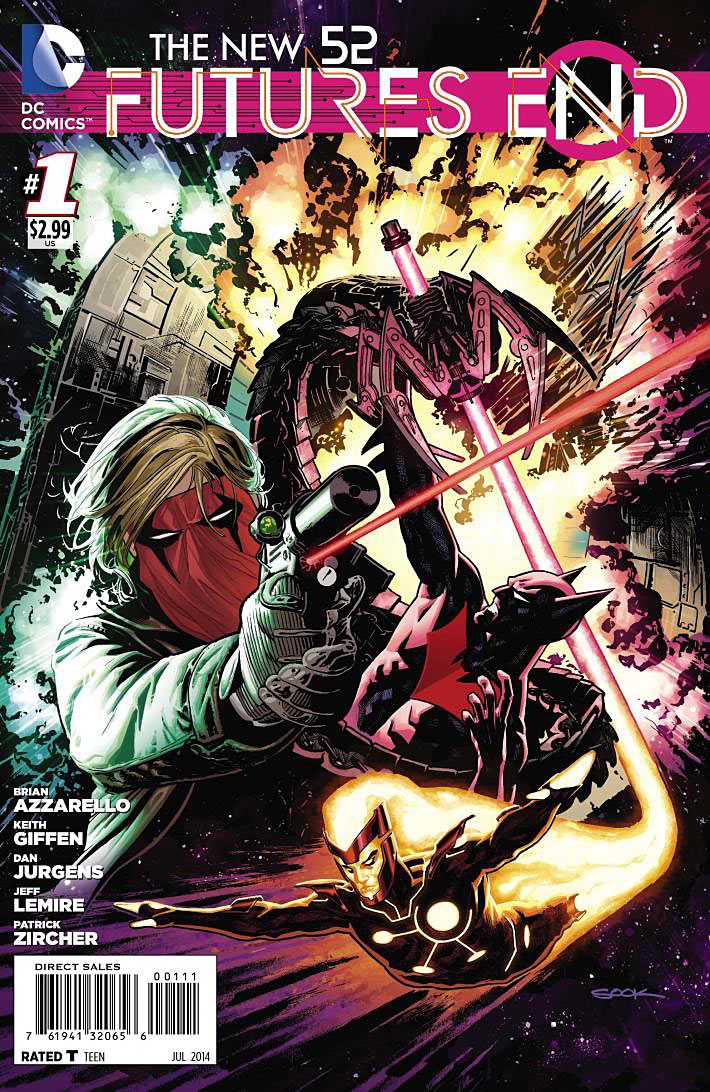 |
| via DC Wikia |
So what about Futures End itself? Well, Batman Beyond, Terry McGinnis, has now joined official canon, sent from the future to slightly earlier in our future to prevent the end of the world. Conveniently, everyone involved seems to be characters DC tried to feature in their own New 52 series (although no sign of Static, so far as I know, so far). This is bad news for Stormwatch (as always; although in this new context I think maybe someone could finally help them find their DC groove) but good news for Grifter (mixed bag for WildStorm overall).
Also involved in this issue is Firestorm. For whatever reason, I seemed to skip the whole New 52 experience, but I loved what was being done with the character previous to the relaunch, after the third host, Jason Rusch, was introduced post-Infinite Crisis. With the brain (Martin Stein) and the brawn (Ronnie Raymond) thrown into the mix, there evolved full-blown potential for a Firestorm franchise, if the character ever became, y'know, popular.
Mostly, though, the biggest winner I foresee at this point is Grifter. The best thing about 52, the brilliant weekly that began this modern trend at DC, was how it took characters who had been overlooked and made them relevant, and Grifter's the one who most closely matches what I loved so much in those pages. If there was a true problem with Countdown, it was a lack of that kind of character. Trinity didn't have one either, but I think there were a lot of things calculated incorrectly with that one.
No, I haven't been reading Futures End regularly. In fact, this remains the most recent issue I've read. But I suspect it will be a pretty good weekly. I trust Brian Azzarello and Jeff Lemire, two of the key writers in the current DC fold, and they have a few guiding voices in Dan Jurgens and Keith Giffen to keep things not only interesting but grounded in the kind of work that has always been exemplary of this company, which is about as much as you can expect from a DC weekly.
Tuesday, June 24, 2014
Reading Comics #124 "Reading FCBD 2014"
Atomic Robo (Red 5)
I'm on record for loving me Atomic Robo. Earlier this year I read every other FCBD offering featuring the most awesome Tesla-inspired fighting robot in comics (recapped here). In the eighth installment of this peculiar series, there is, alas, no Dr. Dinosaur (what's up with that?). Maybe it's because I just read all those, but this time it seems a bit been there done that. Although I still recommend Robo to any and everyone. Red 5's other samples aren't very inspiring, either. They be a small publisher for a reason, yo.
Bongo Free-for-All (Bongo)
Featuring nothing but the Simpsons (plus a weak nod to Futurama on the back cover that's actually nearly as much a nod to...Archie). The first tale features Bart and Milhouse trying to accidentally gain superpowers, like they do in comics. The one real result is Milhouse's hair becoming amazing. Then there's a Spy vs. Spy (a classic feature of Mad Magazine) featuring Itchy and Scratchy. Then there's a Mr. Burns story that has some fun with the idea of his being "the best boss in the world." Then back to Bart and Milhouse, imagining the behind-the-scenes of Krusty Burger. Then more superhero adventure-type things. Then a "Where's Waldo" feature with Ralph from Sergio Aragones! Simpsons comics are always good stuff!
(Help the CBLDF) Defend Comics (CBLDF)
The Comic Book Legal Defense Fund helps you take comics more seriously than you every thought possible, and this handy special helps you understand exactly how! Highlight, for me, is an excerpt from Fred Van Lente and Ryan Dunlavey's excellent Comic Book Comics (later reprinted as Comic Book History of Comics) featuring the (in)famous tale of Fredric Wertham, the man who declared war on the medium in the 1950s. Although since it takes up the bulk of the issue, this isn't such a difficult accomplishment. The other highlight features Sergio Aragones again, as well as Mark Evanier, Tom Luth, and Stan Sakai (a sequence originally featured in CBLDF Presents: Liberty Comics #1) in a series of examples of people being silly about comics (and not in a debating-who-would-win kind of manner).
The Dumbest Idea Ever! (Graphix)
Excerpted from a longer work, this is actually...kind of...a fictional account...of how this...thing...was created...in the first place. Not greatly impressed, but maybe the whole thing is better?
Guardians of the Galaxy (Marvel)
This one is basically, with the title feature, a primer on the comic book version of the team (likely comparable to the movie version hitting theaters this summer) from Brian Michael Bendis. Not hugely inspiring, but I guess you don't expect a lot from something like this, especially since it doesn't even get the whole issue. The next segment belongs to Jim Starlin and Thanos, two names that historically have gone very well together, and is an excerpt from the Thanos: The Infinity Revelation graphic novel. Either it's not the greatest excerpt, or it's not the greatest pairing of these two. Hard to say. Then there's a silly Spider-Verse excerpt from Dan Slott. I just don't know what to make of Slott's overall vision for Spider-Man. This is how he chooses to follow-up Doctor Spider-Man? I know I'm not usually Marvel's biggest fan, but this was not a hugely inspiring FCBD offering.
The New 52: Futures End #0 (DC)
I haven't been reading the latest DC weekly series, but it's an undeniably good idea, making a whole bunch of characters who don't necessarily have viable homes in the current landscape suddenly relevant, headlined by Grifter and, especially with this special preview, Batman Beyond in his official continuity debut. I'm a DC guy, and it's always nice when there's full-issue new material from anyone for FCBD, so it's especially nice for new material for a major new project available. This is the way it's done.
Previews: What's @ Comic Shops (Diamond)
Ideally everyone who wasn't already familiar with reading comics as a hobby picked this one up. It's an excellent primer.
Project Black Sky (Dark Horse)
As part of Dark Horse's latest attempt at jump-starting a superhero franchise, this is possibly also its first ever major crossover event, featuring Captain Midnight and Brain Boy in starring roles (also involved are Ghost and X, both of whom have been part of past attempts). The writer is Fred Van Lente, who was a considerable favorite of mine back when he was working at Marvel but another of those creators who've been floating around looking for ideal context again. Captain Midnight, by the way, is a pastiche on Captain America. That's the hardest thing to overcome with this story. Otherwise probably a pretty smart gamble on Dark Horse's part.
The Rise of the Magi #0 (Top Cow)
I think this is an irredeemably terrible title for the project, but the actual comic isn't too bad, finally a Top Cow idea that doesn't have anything to do with the Artifacts concept cobbled together from characters like Witchblade and the Darkness (Think Tank is the other notable attempt for the publisher to break out of its bubble). As for what it is, Magi is a fantasy concept.
Rocket Raccoon #1 (Marvel)
It is what it is. Groot comes off best. Hey, did you know he's Groot???
Shigeru Mizuki's Showa: A History of Japan (Drawn & Quarterly)
Excerpted from a larger work, this was one of the best things I read from all my selections. This special features the best look at Japan during WWII from a sympathetic point of view since Letters from Iwo Jima. Anyone still trying to reconcile the country we know today with the one that attacked Pearl Harbor ought to consider having a look.
Steam Wars #1 (Antarctic Press)
The biggest pleasant surprise of the whole bunch, one I hesitated a great deal picking up because I feared it would be terrible. But it's awesome, it really is, a variant on Star Wars that completely nails it.
Teen Titans Go! #1 (DC)
Yes, DC and Marvel each get two selections, one for kid readers and one for whoever reads comics otherwise. Based on the cartoon that was actually brought back a few years ago, this was another highlight for me, unexpectedly written by Sholly Fisch of all people, the guy who was doing all those excellent backup features during Grant Morrison's run on Action Comics. Good fun.
The Tick (New England Comics)
Aside from the Teenage Mutant Ninja Turtles, The Tick is the most famous indy character in comics, having successfully (to a much more limited extent) completed the leap to television both in animated and live action (a series that starred Patrick Warburton). This latest FCBD offering details every previous release in the free series. In a just world, The Tick would be more famous. Good stuff.
Valiant Universe Handbook 2014 (Valiant)
Dry reading featuring bios for a set of characters who've had a thousand chances to catch on (they were among Dark Horse's previous superhero attempts, for instance). This was perhaps not the best way to go about FCBD, but it's at least a handy reference that can be looked through later. Just not right-now-kind-of-later.
Worlds of Aspen 2014 (Aspen)
Looks at new series Zoohunters and Damsels in Distress. Neither look like great, per say.
2000 AD (Rebellion)
One of the longest-running comics outlets is British and an anthology that's released every week (up to nearly two thousand issues!), known as the birthplace of Judge Dredd, who is coincidentally the star of the standout story from this special. The creator responsible is actually Chris Burnham, the artist who collaborated with Grant Morrison during the final run of both Batman Incorporated and Morrison's long Batman run as a whole. The last pleasant surprise, as I'd never really had an opportunity to fully appreciate Dredd before; Burnham's story did an excellent job explaining the character's appeal.
I'm on record for loving me Atomic Robo. Earlier this year I read every other FCBD offering featuring the most awesome Tesla-inspired fighting robot in comics (recapped here). In the eighth installment of this peculiar series, there is, alas, no Dr. Dinosaur (what's up with that?). Maybe it's because I just read all those, but this time it seems a bit been there done that. Although I still recommend Robo to any and everyone. Red 5's other samples aren't very inspiring, either. They be a small publisher for a reason, yo.
Bongo Free-for-All (Bongo)
Featuring nothing but the Simpsons (plus a weak nod to Futurama on the back cover that's actually nearly as much a nod to...Archie). The first tale features Bart and Milhouse trying to accidentally gain superpowers, like they do in comics. The one real result is Milhouse's hair becoming amazing. Then there's a Spy vs. Spy (a classic feature of Mad Magazine) featuring Itchy and Scratchy. Then there's a Mr. Burns story that has some fun with the idea of his being "the best boss in the world." Then back to Bart and Milhouse, imagining the behind-the-scenes of Krusty Burger. Then more superhero adventure-type things. Then a "Where's Waldo" feature with Ralph from Sergio Aragones! Simpsons comics are always good stuff!
(Help the CBLDF) Defend Comics (CBLDF)
The Comic Book Legal Defense Fund helps you take comics more seriously than you every thought possible, and this handy special helps you understand exactly how! Highlight, for me, is an excerpt from Fred Van Lente and Ryan Dunlavey's excellent Comic Book Comics (later reprinted as Comic Book History of Comics) featuring the (in)famous tale of Fredric Wertham, the man who declared war on the medium in the 1950s. Although since it takes up the bulk of the issue, this isn't such a difficult accomplishment. The other highlight features Sergio Aragones again, as well as Mark Evanier, Tom Luth, and Stan Sakai (a sequence originally featured in CBLDF Presents: Liberty Comics #1) in a series of examples of people being silly about comics (and not in a debating-who-would-win kind of manner).
The Dumbest Idea Ever! (Graphix)
Excerpted from a longer work, this is actually...kind of...a fictional account...of how this...thing...was created...in the first place. Not greatly impressed, but maybe the whole thing is better?
Guardians of the Galaxy (Marvel)
This one is basically, with the title feature, a primer on the comic book version of the team (likely comparable to the movie version hitting theaters this summer) from Brian Michael Bendis. Not hugely inspiring, but I guess you don't expect a lot from something like this, especially since it doesn't even get the whole issue. The next segment belongs to Jim Starlin and Thanos, two names that historically have gone very well together, and is an excerpt from the Thanos: The Infinity Revelation graphic novel. Either it's not the greatest excerpt, or it's not the greatest pairing of these two. Hard to say. Then there's a silly Spider-Verse excerpt from Dan Slott. I just don't know what to make of Slott's overall vision for Spider-Man. This is how he chooses to follow-up Doctor Spider-Man? I know I'm not usually Marvel's biggest fan, but this was not a hugely inspiring FCBD offering.
The New 52: Futures End #0 (DC)
I haven't been reading the latest DC weekly series, but it's an undeniably good idea, making a whole bunch of characters who don't necessarily have viable homes in the current landscape suddenly relevant, headlined by Grifter and, especially with this special preview, Batman Beyond in his official continuity debut. I'm a DC guy, and it's always nice when there's full-issue new material from anyone for FCBD, so it's especially nice for new material for a major new project available. This is the way it's done.
Previews: What's @ Comic Shops (Diamond)
Ideally everyone who wasn't already familiar with reading comics as a hobby picked this one up. It's an excellent primer.
Project Black Sky (Dark Horse)
As part of Dark Horse's latest attempt at jump-starting a superhero franchise, this is possibly also its first ever major crossover event, featuring Captain Midnight and Brain Boy in starring roles (also involved are Ghost and X, both of whom have been part of past attempts). The writer is Fred Van Lente, who was a considerable favorite of mine back when he was working at Marvel but another of those creators who've been floating around looking for ideal context again. Captain Midnight, by the way, is a pastiche on Captain America. That's the hardest thing to overcome with this story. Otherwise probably a pretty smart gamble on Dark Horse's part.
The Rise of the Magi #0 (Top Cow)
I think this is an irredeemably terrible title for the project, but the actual comic isn't too bad, finally a Top Cow idea that doesn't have anything to do with the Artifacts concept cobbled together from characters like Witchblade and the Darkness (Think Tank is the other notable attempt for the publisher to break out of its bubble). As for what it is, Magi is a fantasy concept.
Rocket Raccoon #1 (Marvel)
It is what it is. Groot comes off best. Hey, did you know he's Groot???
Shigeru Mizuki's Showa: A History of Japan (Drawn & Quarterly)
Excerpted from a larger work, this was one of the best things I read from all my selections. This special features the best look at Japan during WWII from a sympathetic point of view since Letters from Iwo Jima. Anyone still trying to reconcile the country we know today with the one that attacked Pearl Harbor ought to consider having a look.
Steam Wars #1 (Antarctic Press)
The biggest pleasant surprise of the whole bunch, one I hesitated a great deal picking up because I feared it would be terrible. But it's awesome, it really is, a variant on Star Wars that completely nails it.
Teen Titans Go! #1 (DC)
Yes, DC and Marvel each get two selections, one for kid readers and one for whoever reads comics otherwise. Based on the cartoon that was actually brought back a few years ago, this was another highlight for me, unexpectedly written by Sholly Fisch of all people, the guy who was doing all those excellent backup features during Grant Morrison's run on Action Comics. Good fun.
The Tick (New England Comics)
Aside from the Teenage Mutant Ninja Turtles, The Tick is the most famous indy character in comics, having successfully (to a much more limited extent) completed the leap to television both in animated and live action (a series that starred Patrick Warburton). This latest FCBD offering details every previous release in the free series. In a just world, The Tick would be more famous. Good stuff.
Valiant Universe Handbook 2014 (Valiant)
Dry reading featuring bios for a set of characters who've had a thousand chances to catch on (they were among Dark Horse's previous superhero attempts, for instance). This was perhaps not the best way to go about FCBD, but it's at least a handy reference that can be looked through later. Just not right-now-kind-of-later.
Worlds of Aspen 2014 (Aspen)
Looks at new series Zoohunters and Damsels in Distress. Neither look like great, per say.
2000 AD (Rebellion)
One of the longest-running comics outlets is British and an anthology that's released every week (up to nearly two thousand issues!), known as the birthplace of Judge Dredd, who is coincidentally the star of the standout story from this special. The creator responsible is actually Chris Burnham, the artist who collaborated with Grant Morrison during the final run of both Batman Incorporated and Morrison's long Batman run as a whole. The last pleasant surprise, as I'd never really had an opportunity to fully appreciate Dredd before; Burnham's story did an excellent job explaining the character's appeal.
Subscribe to:
Posts (Atom)