Here’s the last batch of Mile High mystery box comics:
The New Teen Titans #10
I think the ‘80s Titans has some shenanigans occurring with the title of their series, since this isn’t the beginning of the run; I suppose ordinary research would confirm, but the launch title seems to have become Tales of the Teen Titans...Anyway, Wolfman’s writing but the artist is Garcia Lopez (a great favorite among some partisans), rather than Perez (who in 1985 was no doubt deeply immersed in Crisis On Infinite Earths). This issue deals with a number of characters who sort of remained in that era, sort of pivoting around Jericho but not really being about him (Jericho was mute, so it figures, although he was used really well in the second season of Titans).
Titans #15
Not really featuring the team so much as a spotlight for Tempest (the erstwhile Aqualad), detailing his circumstances as they were circa Blackest Night.
Tomorrow Stories #2
An anthology series from Alan Moore’s America’s Best Comics. I get that there are a lot of Alan Moore partisans out there (he’s the guy who legitimized superheroes for the mainstream, after all), but I’m not really one of them, and it’s material like this that showcases what his base-level engagement in the medium is. The last tale features characters huddling in slums, braving the fallout of superhero nostalgia ruining everything. Most of what he says, thinks, and does is a product of Alan Moore’s nostalgia. He seems to honestly think only Alan Moore was capable of saying, thinking, or doing anything relevant, that he existed, in essence, in a post-superhero medium, and that it’s only misguided fans and/or creators who believe otherwise. Doctor Manhattan is the only superpowered hero in Watchmen mostly to represent ambivalence and futility in the modern world. Yay Alan Moore...
The Twilight Experiment #2
From Palmiotti & Gray.
Vigilante #2
This update of the character had a ton of potential, a superhero who talks with a psychiatrist, but Bruce Jones, at least in this issue, spends half the time taking it seriously and half as if he’s doing a parody. I was pretty invested in Jones as a creator. He took over Nightwing “One Year Later,” one of the few stories to feature interactions between Dick Grayson and Jason Todd, and before that he was writing Incredible Hulk in the vein of the TV series, something that caught on years later as Immortal Hulk, freeing the character from what Peter David had done for years, which was basically any and everything, the basic template creators at Image were riffing on in endless facsimiles. Anyway, this Vigilante, for context, is like the Daredevil who goes to confession. I like the idea of superheroes seeking outlets like that, it grounds them in ways that aren’t as forced as...the majority of Marvel’s hamfisted techniques. The psychiatrist is basically being held hostage by Vigilante, too, but you can see the potential in the scenario, how it could have led to a regular partnership. Even Batman never consulted psychiatrists, and he’s got the craziest villains in comics (except maybe Green Goblin).
Vixen: Return of the Lion #1
Seeing someone like G. Willow Wilson transition from something like Air to Ms. Marvel, I always wanted to understand how that was possible. This is another strong indication, as it turns out. Wilson’s Vixen was a member of the Meltzer-era Justice League, and at least as far as this issue is concerned, she treats her more famous teammates much as Kamala Khan does...anyone she meets in her early adventures: by geeking out. Vixen has an ethnic background, which she returns to, an African nation of some generic extraction, where the story quickly falls into the later New 52 trap of immediately introducing a villain who takes the hero by surprise (literally every first issue of a New 52 series ended this way). I really wish comic book writers (and blockbuster filmmakers) weren’t so consistently lazy about this: Hero gets defeated! Hero rallies!
World’s Finest #1-2
I was really hoping these were the only issues of the prestige format series, but of course there turned out to be three. Anyway, “World’s Finest” was the term, and title of the series, when Batman and Superman used to team up (now it’s...Superman/Batman, or the daring alternative...Batman/Superman), and this was a later tribute from comics masters Dave Gibbons and Steve Rude. For large swathes of the first issue, Gibbons allows Rude’s brilliant art do all the storytelling. Only a portion of it retells the origins, though Rude cleverly juxtaposes the bullet of the gun with the rocketing spaceship.
What’s better is that Gibbons seems to be the first and only writer to see how well Bruce Wayne could potentially clean up what ails Metropolis, and Clark Kent could do the same in Gotham. And that’s frankly astonishing, not only that someone figured that out but that no attempt has been made to even create surrogates. There’s no crusading journalist in Gotham (Vicki Vale doesn’t count, and certainly not Knox!). There’s no counterpoint to Lex Luthor. And these things really ought to exist!
This is a story set before they became the World’s Finest, and in these issues go well out of their way to avoid actively collaborating (i.e. fight together), and that’s another great feature. If I were DC this is another easy evergreen candidate. There are surprisingly few of the two together.
Young Justice: Sins of Youth - JLA Jr.
Read this recently from a back issue bargain bin, much as the kind all these mystery box comics likely came from. Thankfully I found a few really great reads in them.
Definitely worth the price of admission. Thanks again, Chuck & Mile High!
Showing posts with label G. Willow Wilson. Show all posts
Showing posts with label G. Willow Wilson. Show all posts
Thursday, May 7, 2020


Saturday, May 2, 2020
Pandemic Comics #9 “Ronin, and Team Sports!”
More comics from the Mile High mystery boxes! (Shocked myself when I realized there are only two more batches to go through after this one! Time flies!)
Outsiders #46
“Pay As You Go,” an arc I somewhat remember, at least certainly the title, apparently dealing with the fallout, at least as of this issue, of Black Lightning being a part of President Luthor’s cabinet, now locked up at Iron Heights and requiring extraction. This incarnation of the team included his daughter, so yeah, there are a few passionate advocates for getting that done, although some of them, being superheroes, think it’s a bad idea. Pretty sure this was the end of this particular incarnation. The Outsiders in general have a somewhat nebulous history, periodically reverting back to Batman’s Personal Team, as it was in the ‘80s. Otherwise no one’s really managed to nail down what exactly makes them relevant. Seldom actually composed of “outsiders,” though leaning into that would be...relevant?
Outsiders: Five of a Kind - Metamorpho and Aquaman
Didn’t notice when I was unpacking the boxes that this was written by G. Willow Wilson, who at this point in history was still known mostly for the graphic novel Cairo and Vertigo series Air, which only an obscure chap named Tony Laplume thought was brilliant. This one-shot leading to the next iteration of Outsiders allows Wilson, perhaps, to lean into her Muslim faith for the first time, although she needs a supporting character to do so, as neither Metamorpho nor this incarnation of Aquaman (who was quickly tossed to the scrap heap of history) can help out with that. I was reading these one-shots, and invested in that Aquaman, at the time, so there’s a chance this is a second read. But I experienced it as a first. This time more interested in Metamorpho, at any rate.
The Power Company #2
Kurt Busiek definitely wrote this more as a Marvel book than as a DC book, which might explain why it vanished so quickly (but as a rule, most modern new concepts go that way). Better appreciated, by me, for the Tom Grummett art. Grummett was a ‘90s Superman staple, but ended up being more closely associated with Superboy specifically, and in recent years has continued working with Superboy collaborator Karl Kesel, which I’m always happy to be reminded.
Robin #166
Sort of the awkward period where Tim Drake’s solo adventures had reached their zenith and no one wanted to admit it.
Ronin #1
Ah! One of the Frank Miller projects that used to be heavily touted! But eventually fell out of favor once Miller became best known for Daredevil, Dark Knight Returns, Sin City, 300, and fans hating him trying to do more with Dark Knight Returns! DC has long been very good at “evergreens,” keeping their celebrated and best work in print, probably something that sprang from ensuring Watchmen stayed in print. For the longest time Ronin was kept in print, too, and celebrated equally among Miller’s other achievements. I don’t know if it was the backlash alone to Miller’s later work that took it off the slate, or that it became harder to categorize, as it wasn’t part of the DC landscape nor connected to Vertigo nor a superhero tale in general, or DC just got caught up trying to redeem Miller’s reputation by fishing for a Dark Knight Returns sequel fans didn’t actively hate and legitimately forgot about Ronin, but forgot it was. And I never got around to reading it, nor getting any real idea of what it was.
Well, now I’ve read this first installment. As the title suggests, it’s heavily relevant to the Daredevil portions of Miller’s legacy, and the art style, since this began in 1983, looks more like his Daredevil than his later work (fans are always saying how his work degenerated over the years, but it was clearly always changing). And the story weaves between a past and a future, linked by a magic sword and two warriors locked in mortal combat (if this were a podcast I would be playing the theme song to a certain video game/movie right now). And it’s very interesting! And absolutely does not deserve to be forgotten. At some point I will read the rest of it. Miller’s a treasure through and through. The back cover includes praise from Klaus Jansen, Walt Simonson, and Will Eisner, all of whom champion Miller’s innovative instincts, an emerging master of the craft. That’s exactly how it began, folks. Eisner’s endorsement is probably the most significant, and out of everyone Miller probably came to see him in particular as his peer. And rightfully so. I later read a book of conversations between them. Priceless history and insight.
Seven Soldiers of Victory #1
The conclusion of Grant Morrison’s innovative modular team book, which in hindsight might even be considered a template of the MCU; both are composed of individual spotlights converging on limited team experiences. Morrison’s imagination can be overwhelming; it’s in full epic scale here, and I’m almost ashamed to admit I haven’t always been able to remember how great it is. I became a fan of Morrison only with JLA, and somehow found it easy to walk away from him as I did comics in general at the turn of the millennium. I knew all about the wild expectations for his New X-Men, which Marvel expected only to duplicate his JLA, but ended up being...more ambitious. The moment Morrison left Marvel gleefully deconstructed everything he’d accomplished. And I never felt overly compelled at the time to see what was happening. It wasn’t until Seven Soldiers happened that I became interested in Morrison again. A lot of fans were baffled by the whole thing. Morrison himself saw it as his take on Jack Kirby’s approach to the New Gods, multiple series presenting multiple viewpoints on the same general landscape. But Kirby’s New Gods famously got cut off before he could reach an ending, and creators (including Kirby himself at one point) have been chasing that ever since. In some respects Seven Soldiers was Morrison’s dry run at his own attempt, Final Crisis, safely obscured in the Mister Miracle material by the many other moving parts around it, but in hindsight it’s pretty obvious. But I don’t think Morrison has allowed himself to be this wild since, even with Multiversity, which is as much a shame as what happened to Kirby’s New Gods. But Morrison, at least, still has plenty of time and opportunity...
Shadowpact #2
Shadowpact #7
Funny how time can change things. I enjoyed reading this series at the time, but find now that it’s virtually impossible to get back into.
Outsiders #46
“Pay As You Go,” an arc I somewhat remember, at least certainly the title, apparently dealing with the fallout, at least as of this issue, of Black Lightning being a part of President Luthor’s cabinet, now locked up at Iron Heights and requiring extraction. This incarnation of the team included his daughter, so yeah, there are a few passionate advocates for getting that done, although some of them, being superheroes, think it’s a bad idea. Pretty sure this was the end of this particular incarnation. The Outsiders in general have a somewhat nebulous history, periodically reverting back to Batman’s Personal Team, as it was in the ‘80s. Otherwise no one’s really managed to nail down what exactly makes them relevant. Seldom actually composed of “outsiders,” though leaning into that would be...relevant?
Outsiders: Five of a Kind - Metamorpho and Aquaman
Didn’t notice when I was unpacking the boxes that this was written by G. Willow Wilson, who at this point in history was still known mostly for the graphic novel Cairo and Vertigo series Air, which only an obscure chap named Tony Laplume thought was brilliant. This one-shot leading to the next iteration of Outsiders allows Wilson, perhaps, to lean into her Muslim faith for the first time, although she needs a supporting character to do so, as neither Metamorpho nor this incarnation of Aquaman (who was quickly tossed to the scrap heap of history) can help out with that. I was reading these one-shots, and invested in that Aquaman, at the time, so there’s a chance this is a second read. But I experienced it as a first. This time more interested in Metamorpho, at any rate.
The Power Company #2
Kurt Busiek definitely wrote this more as a Marvel book than as a DC book, which might explain why it vanished so quickly (but as a rule, most modern new concepts go that way). Better appreciated, by me, for the Tom Grummett art. Grummett was a ‘90s Superman staple, but ended up being more closely associated with Superboy specifically, and in recent years has continued working with Superboy collaborator Karl Kesel, which I’m always happy to be reminded.
Robin #166
Sort of the awkward period where Tim Drake’s solo adventures had reached their zenith and no one wanted to admit it.
Ronin #1
Ah! One of the Frank Miller projects that used to be heavily touted! But eventually fell out of favor once Miller became best known for Daredevil, Dark Knight Returns, Sin City, 300, and fans hating him trying to do more with Dark Knight Returns! DC has long been very good at “evergreens,” keeping their celebrated and best work in print, probably something that sprang from ensuring Watchmen stayed in print. For the longest time Ronin was kept in print, too, and celebrated equally among Miller’s other achievements. I don’t know if it was the backlash alone to Miller’s later work that took it off the slate, or that it became harder to categorize, as it wasn’t part of the DC landscape nor connected to Vertigo nor a superhero tale in general, or DC just got caught up trying to redeem Miller’s reputation by fishing for a Dark Knight Returns sequel fans didn’t actively hate and legitimately forgot about Ronin, but forgot it was. And I never got around to reading it, nor getting any real idea of what it was.
Well, now I’ve read this first installment. As the title suggests, it’s heavily relevant to the Daredevil portions of Miller’s legacy, and the art style, since this began in 1983, looks more like his Daredevil than his later work (fans are always saying how his work degenerated over the years, but it was clearly always changing). And the story weaves between a past and a future, linked by a magic sword and two warriors locked in mortal combat (if this were a podcast I would be playing the theme song to a certain video game/movie right now). And it’s very interesting! And absolutely does not deserve to be forgotten. At some point I will read the rest of it. Miller’s a treasure through and through. The back cover includes praise from Klaus Jansen, Walt Simonson, and Will Eisner, all of whom champion Miller’s innovative instincts, an emerging master of the craft. That’s exactly how it began, folks. Eisner’s endorsement is probably the most significant, and out of everyone Miller probably came to see him in particular as his peer. And rightfully so. I later read a book of conversations between them. Priceless history and insight.
Seven Soldiers of Victory #1
The conclusion of Grant Morrison’s innovative modular team book, which in hindsight might even be considered a template of the MCU; both are composed of individual spotlights converging on limited team experiences. Morrison’s imagination can be overwhelming; it’s in full epic scale here, and I’m almost ashamed to admit I haven’t always been able to remember how great it is. I became a fan of Morrison only with JLA, and somehow found it easy to walk away from him as I did comics in general at the turn of the millennium. I knew all about the wild expectations for his New X-Men, which Marvel expected only to duplicate his JLA, but ended up being...more ambitious. The moment Morrison left Marvel gleefully deconstructed everything he’d accomplished. And I never felt overly compelled at the time to see what was happening. It wasn’t until Seven Soldiers happened that I became interested in Morrison again. A lot of fans were baffled by the whole thing. Morrison himself saw it as his take on Jack Kirby’s approach to the New Gods, multiple series presenting multiple viewpoints on the same general landscape. But Kirby’s New Gods famously got cut off before he could reach an ending, and creators (including Kirby himself at one point) have been chasing that ever since. In some respects Seven Soldiers was Morrison’s dry run at his own attempt, Final Crisis, safely obscured in the Mister Miracle material by the many other moving parts around it, but in hindsight it’s pretty obvious. But I don’t think Morrison has allowed himself to be this wild since, even with Multiversity, which is as much a shame as what happened to Kirby’s New Gods. But Morrison, at least, still has plenty of time and opportunity...
Shadowpact #2
Shadowpact #7
Funny how time can change things. I enjoyed reading this series at the time, but find now that it’s virtually impossible to get back into.
Saturday, January 18, 2020
Reading Comics 240 "Batman #85, Doomsday Clock #12, and more"
Because
there were a few comics I had to read
at the end of the year, I put in another order at Midtown, and this is what I
got:
Batman Annual #2 (DC)
This isn’t
the issue I was aiming for, but it was nice to revisit all the same, as it
demonstrates Tom King’s lyrical grace, a quality that seemed to have eluded
many of his readers, or at least his many critics. But if something like this escapes them, I
suppose it doesn’t matter whether or not they approve. At the end is a coda for King’s whole
conception of Batman, and Catwoman, and it is beautiful.
Batman #85 (DC)
Here’s
King’s grand finale, which splits time between defeating Thomas
Wayne/Flashpoint Batman, and tying everything up, how the whole thing flowed
from Batman’s theory of a “good death” at the start of King’s run, how he
finally reconciled the death of his parents and what that meant about the
existence of Batman, and his continued
existence, and how his relationship with Catwoman confirms all of it. I think it’s brilliant, but then I think just
about everything Tom King does is brilliant.
He has no contemporary equal. He
may in fact be the best superhero comics writer ever. And he has set the bar very high indeed.
Batman: Last Knight on Earth #3 (DC)
A Batman
finale of a different order, this is Scott Snyder and Greg Capulo’s
farewell. As I was reading it, it
suddenly occurred to me that if there’s any logic Snyder has followed all these
years, it’s probably Dan Jurgens’. Dan
is famously the guy who in the final analysis is responsible for the death of
Superman. He further contributed to DC
‘90s lore with Zero Hour, an event
that’s frequently overlooked but is probably one of the greatest event comics
ever written, a “Crisis in Time” that expanded on Hal Jordan’s fall from grace
to truly epic proportions and offered a plausible reshaping of continuity that
hit a very soft reset button. But Jurgens
more often writes his superheroes in broader strokes. His ideas are seldom as grounded in grace as
his best stories (sort of like Mark Waid), and so he’s kind of easy to dismiss
as the comics great that he ultimately is, at his best. Snyder, meanwhile, has so often leaned on the
assistance of cowriters it’s probably easy to forget that he has relied so often on them, when his
legacy has shrunk to the “one great thing to come out of the New 52.” He needs someone to temper his crazier
instincts. He’s the kind of writer who
looks at the examples other writers have set, and considered only that they
look like the most outrageous thing that could’ve been done, and so what he
needs to do is the most outrageous thing he
can come up with, and the logic will explain itself. And his ideas are sound, but the execution always beggars the imagination of the
reader more than convincingly tells a story.
His big finale, as he seemed to decide after coming up with the Court of
Owls in his original Batman comics, centers around Batman’s relationship with
the Joker. As far as the Joker is
concerned, everything he has ever done was meant to make Batman the best he
could be. But I don’t think Batman would
ever be comfortable with that assessment, even in a scenario where he’s
confronted with a version of himself that’s the worst he could be (and even there, Snyder doesn’t adequately
account for how Batman could end up wanting to take over the whole world;
that’s a story that would contrast Batman with Lex Luthor, not himself, much
less Joker) (and while we’re on the subject, Snyder really, really missed a
trick with his current projects when he called his upgraded Luthor “Apex Lex,”
when, since the rhyme is already there, the logic clearly dictates calling him
“Apex Luthor). As far as Snyder’s own
logic goes, I suppose this is as appropriate a finale as he could’ve
envisioned. This isn’t what I thought
the original cloning concept he introduced way back in Detective Comics #27 (the New 52 edition), but at least he did
something with it.
Doomsday Clock #12 (DC)
The second
grand finale I wanted to catch (the above Snyder was merely incidental, not
something I had intended to go out of my way to catch), or at least read for
myself, since I had allowed the internet to spoil it for me. Naturally, the internet was most interested in Geoff Johns outlining
the theoretical future of DC lore. I
don’t think anyone at DC seriously expects this material to be followed
(considering one of the stories referenced is apparently another crossover with
Marvel, a situation always fraught with complications, as the long development
of JLA/Avengers proved). The sentiment itself represents the central
thesis that DC follows Superman, that wherever he goes, his new continuity is
the foundation of DC’s new continuity, even going so far as to suggest that if
comics are still being made in 3020, a thousand years from now, the age of the
Legion of Super-Heroes, Superman’s origin will take place then, and continuity
will resettle around him once again, even though the Legion took its inspiration
from the exploits of Superboy a thousand years earlier. I think the whole project is justified. It gives Doctor Manhattan a far more
satisfying arc than he got in Watchmen
(although I think Zack Snyder corrected that in his movie, too), removing the
cynicism of Alan Moore himself and allowing a man who can see everything
(except his ultimate fate) to adequately comprehend it, given the opportunity
to make a decision, or in this instance, rethink a decision. Which may also have been the point.
Family Tree #2 (Image)
I wanted to
have a look at this latest Jeff Lemire project.
The guy is the most prolific creator in comics! The art is from Phil Hester, whom I always
love to see pop up with new work. A fine
variation on familiar Lemire themes.
Flash Forward #4 (DC)
I had
already read what happened in this one, too, but wanted a chance to experience
it for myself: Wally West meets Lightspeed, Linda Park! But, of course, a Linda Park from an
alternate reality, and who doesn’t particularly care what a counterpart made of
Wally. But the comic is also toying with
Wally reuniting with his kids, which is something I’ve become much more fond of
in the years since Mark Waid first introduced them in his return to Wally’s
adventures, which were sort of a soft launch of the Tomasi/Gleason Superman, which wasn’t as good as their Batman & Robin, but still well worth
existing. And I think most fans will
agree, if Wally is back, his whole family ought to get to join him, too. Hopefully this comic has a truly happy
ending.
Incoming! (Marvel)
Basically a
tour of the current Marvel landscape, another visit with the Masked Raider (I
don’t know if this guy, that name, and his gunslinging costume, is destined for
greatness, but he’s nice to hang these stories on), and the push for the
upcoming Kree/Skrull invasion of Earth!
The movies are probably headed somewhere in that direction, too, so it’s
nice for the comics to get there first, for a change (a lot of recent comics
belatedly obsessed over Thanos, which seemed way too obvious at that point),
picking up where a famous, but
forgotten-except-by-diehards-because-Marvel-can’t-keep-its-defining-stories-in-print
Avengers epic left off way back in the ‘70s (or ‘60s? but I think ‘70s). And central to all this? My 2005 inner Marvel nerd is excited that
it’s characters from Young Avengers!
Invisible Kingdom #8 (Dark Horse)
Lately I’ve
been feeling kind of bad about not caring that G. Willow Wilson has enjoyed so
much success in recent years, since Air
was such a favorite of mine from when nobody else cared, so I checked out an
issue of this project. It’s okay.
Joker: Killer Smile #2 (DC)
Jeff Lemire
and Andrea Sorrentino once again reunite for a tale of a psychiatrist’s descent
into madness when he believes he can figure out the Clown Prince. A bit obvious, but a sort of welcome
companion to Lemire’s brilliant Moon
Knight.
Klaus: The Life & Times of Joe
Christmas (Boom!)
I haven’t
had much luck reading the annual Christmas follow-ups to Grant Morrison and Dan
Mora’s original Klaus, so I was
pleased to order (because as I’ve come to understand, I just won’t be able to
find it in an actual comics shop) the latest.
This one’s sort of in the model of a calendar, which counts up from
December 1 and ends on the 25th.
And there is no dialogue, only a chronicle of the life and adventures of
Joe Christmas, who sort of becomes Klaus’s sidekick. I almost choked up when I realized the cat
had died. Great comic. Might singlehandedly justify Morrison’s whole
concept of making Santa Claus a superhero.
Years from now someone could write a whole series around Joe Christmas
based on this one comic, or maybe they could base a movie on it. (Hint
hint.)
The Old Guard: Force Multiplied #1
(Image)
I read the
original miniseries in trade paperback at the library, and was immediately
smitten, so I was extremely glad to discover this follow-up. Perhaps moreso than the story itself is value
of the Greg Rucka essay at the end detailing his thoughts about the origins and
emerging legacy of Old Guard,
including an upcoming Netflix movie version.
I’m glad things are working out this way.
The Amazing Spider-Man #36 (Marvel)
I was
suckered into buying this issue because the solicitation listed Pat Gleason as
the artist. He was not. But I subsequently picked up a slightly
earlier issue, and he was.
Superman Smashes the Klan #2 (DC)
Gene Luen
Yang writes perhaps his most important Superman and/or DC comic, at last,
detailing a group of kids’ experiences with Superman as he, well, battles the
Klan, centering around a Chinese perspective, not in the way Hollywood has been
catering to the massive Chinese market in recent years, but because Yang has more
immediate ties, the kind that stretch across American history. We tend to forget, except for all that
Chinese food that was actually invented in America, how long the Chinese have
been here, and how complicated their lives have been here. Thankfully Yang is here to help fill in the
gaps. Included is an essay detailing
Superman history that’s both familiar and also relevant to Yang’s perspective
and intentions.
Friday, August 12, 2016
Reading Comics 198 "DC Rebirth Week 10, All-New All-Different Avengers, Civil War II: The Accused, and The Fuse"
Featured this edition: All-New All-Different Avengers Annual #1, All Star Batman #1, Civil War II: The Accused, Deathstroke: Rebirth #1, The Flash #4, The Fuse #18, New Superman #2, and Superwoman #1.
All-New All-Different Avengers Annual #1 (Marvel)
I kind of had to buy this one as an early fan of G. Willow Wilson's Ms. Marvel, because this whole issue is dedicated to fan fiction, or Marvel creator versions of fan fiction, which turns out to be pretty funny.
All Star Batman #1 (DC)
Scott Snyder is never a sure-thing for me, although I did read through much of his New 52 Batman run, which was that era's biggest success story. I had to at least give his follow-up a shot. Turns out I love it, at least in this debut. This is a Two-Face story, which may have things to say about the current US presidential campaign season, and it's some of the best writing I've ever seen from Snyder. It doesn't hurt that he has John Romita, Jr., to help guide him along to greater creative heights. That's something few fans appreciated about Romita's Superman run, which was a real shame, but I think they'll have less of a problem accepting his style in this series.
Civil War II: The Accused (Marvel)
Screenwriter Marc Guggenheim has hopefully done enough comics where fans will accept him as one of their own. It can't possibly hurt his cause exploring one of Civil War II's touchstone moments: Hawkeye murdering the Hulk. Guggenheim helps Matt Murdock (Daredevil) navigate the intricacies of the resulting trial, exploring a range of relevant social topics. The only knock is that this could easily have been expanded.
Deathstroke: Rebirth #1 (DC)
Unlike other Rebirth one-shots, Christopher Priest's (he's now billing himself strictly as Priest) Slade Wilson primer doesn't really make the origin explicit so much as exploring his complicated history as a father, and the kind of morality he inhabits as DC's most famous mercenary and frequent star of his own series. The results are certainly fascinating, and they allow the reader to reach their own conclusions. I haven't read too much solo Deathstroke, but this may be the start of his best run yet.
The Flash #4 (DC)
Joshua Williamson continues to nail it. What else can I say? Even moreso than Sam Humphries' Green Lanterns, this is feeling like comics that will be remembered fondly for years to come. When this happens in the pages of The Flash, it usually means someone has managed to become the new standard by which all others follow. Williamson joins the ranks of Mark Waid and Geoff Johns in that regard.
The Fuse #18 (Image)
This issue was released earlier in the year, after which the series took a hiatus that just ended last month. The Fuse is Antony Johnston's police procedural set aboard a space station, and the issue concludes the "Perihelion" arc, which represents the day of the year Earth and the station are closest to the sun, which seems to bring about more communal chaos than usual. I like that Johnston (who became a legend, at least as I'm concerned, with his masterful Wasteland) not only builds scenarios but thinks of scenarios-within-scenarios like this. Also, the plot of what brought Ralph Dietrich to the station ramps up, and continues in the next arc, "Constant Orbital Revolutions." That's another Johnston trademark, the ability to build his stories a layer at a time, so that different arcs actually mean something and don't just mean another story in the series. This is much rarer than you'd think. Geoff Johns in his epic Green Lantern run would be another such example.
New Super-Man #2 (DC)
What Wilson's done in the pages of Ms. Marvel is something Gene Luen Yang is doing in the pages of this comic, introducing a unique cultural perspective that also presents a unique perspective on superheroes. I love that DC let Yang do this even after the lackluster response to his Superman.
Superwoman #1 (DC)
The blockbuster "Last Days of Superman" story that helped round out the New 52 era has proven to be reach creative groundwork for the Rebirth era, which now proudly includes Superwoman in its ranks of successes. Marvel has been swapping the identities and genders behind their icons for a couple years now, which in truth is kind of old hat in comics. On the surface, Superwoman probably seems like it's climbing aboard the bandwagon, but DC has at least put considerable thought into it. "Superwoman" is actually "Superwomen" in this issue, in which long-time creator Phil Jimenez gets another chance to shine in writing and art duties (he's previously done so with the likes of his early millennial Wonder Woman run), and features longtime supporting cast members Lois Lane and Lana Lang gaining powers. As Lois points out, this would hardly be the first time for her (perhaps the most famous example was in Grant Morrison's All Star Superman, but she also had Brainiac powers in the New 52, among other instances). Jimenez also acknowledges Lois's role in the controversial "Truth" arc, in which she exposed Superman's secret identity. The clever thing, though, is that Lana is along for the ride, too, and so any fans still grumbling about how Lois Lane was depicted in the New 52, and the lack of a romance with Clark Kent, can instead focus on Lana, Clark's Smallville crush. In fact, without giving too much away, Lana Lang is actually the star of this comic. I also like that her costume and powers harken to the much-maligned "Electric Superman" (as did Strange Visitor fifteen years ago). Good creators always know better than naysaying fans. This issue more than proves that Jimenez is a good creator.
All-New All-Different Avengers Annual #1 (Marvel)
I kind of had to buy this one as an early fan of G. Willow Wilson's Ms. Marvel, because this whole issue is dedicated to fan fiction, or Marvel creator versions of fan fiction, which turns out to be pretty funny.
All Star Batman #1 (DC)
Scott Snyder is never a sure-thing for me, although I did read through much of his New 52 Batman run, which was that era's biggest success story. I had to at least give his follow-up a shot. Turns out I love it, at least in this debut. This is a Two-Face story, which may have things to say about the current US presidential campaign season, and it's some of the best writing I've ever seen from Snyder. It doesn't hurt that he has John Romita, Jr., to help guide him along to greater creative heights. That's something few fans appreciated about Romita's Superman run, which was a real shame, but I think they'll have less of a problem accepting his style in this series.
Civil War II: The Accused (Marvel)
Screenwriter Marc Guggenheim has hopefully done enough comics where fans will accept him as one of their own. It can't possibly hurt his cause exploring one of Civil War II's touchstone moments: Hawkeye murdering the Hulk. Guggenheim helps Matt Murdock (Daredevil) navigate the intricacies of the resulting trial, exploring a range of relevant social topics. The only knock is that this could easily have been expanded.
Deathstroke: Rebirth #1 (DC)
Unlike other Rebirth one-shots, Christopher Priest's (he's now billing himself strictly as Priest) Slade Wilson primer doesn't really make the origin explicit so much as exploring his complicated history as a father, and the kind of morality he inhabits as DC's most famous mercenary and frequent star of his own series. The results are certainly fascinating, and they allow the reader to reach their own conclusions. I haven't read too much solo Deathstroke, but this may be the start of his best run yet.
The Flash #4 (DC)
Joshua Williamson continues to nail it. What else can I say? Even moreso than Sam Humphries' Green Lanterns, this is feeling like comics that will be remembered fondly for years to come. When this happens in the pages of The Flash, it usually means someone has managed to become the new standard by which all others follow. Williamson joins the ranks of Mark Waid and Geoff Johns in that regard.
The Fuse #18 (Image)
This issue was released earlier in the year, after which the series took a hiatus that just ended last month. The Fuse is Antony Johnston's police procedural set aboard a space station, and the issue concludes the "Perihelion" arc, which represents the day of the year Earth and the station are closest to the sun, which seems to bring about more communal chaos than usual. I like that Johnston (who became a legend, at least as I'm concerned, with his masterful Wasteland) not only builds scenarios but thinks of scenarios-within-scenarios like this. Also, the plot of what brought Ralph Dietrich to the station ramps up, and continues in the next arc, "Constant Orbital Revolutions." That's another Johnston trademark, the ability to build his stories a layer at a time, so that different arcs actually mean something and don't just mean another story in the series. This is much rarer than you'd think. Geoff Johns in his epic Green Lantern run would be another such example.
New Super-Man #2 (DC)
What Wilson's done in the pages of Ms. Marvel is something Gene Luen Yang is doing in the pages of this comic, introducing a unique cultural perspective that also presents a unique perspective on superheroes. I love that DC let Yang do this even after the lackluster response to his Superman.
Superwoman #1 (DC)
The blockbuster "Last Days of Superman" story that helped round out the New 52 era has proven to be reach creative groundwork for the Rebirth era, which now proudly includes Superwoman in its ranks of successes. Marvel has been swapping the identities and genders behind their icons for a couple years now, which in truth is kind of old hat in comics. On the surface, Superwoman probably seems like it's climbing aboard the bandwagon, but DC has at least put considerable thought into it. "Superwoman" is actually "Superwomen" in this issue, in which long-time creator Phil Jimenez gets another chance to shine in writing and art duties (he's previously done so with the likes of his early millennial Wonder Woman run), and features longtime supporting cast members Lois Lane and Lana Lang gaining powers. As Lois points out, this would hardly be the first time for her (perhaps the most famous example was in Grant Morrison's All Star Superman, but she also had Brainiac powers in the New 52, among other instances). Jimenez also acknowledges Lois's role in the controversial "Truth" arc, in which she exposed Superman's secret identity. The clever thing, though, is that Lana is along for the ride, too, and so any fans still grumbling about how Lois Lane was depicted in the New 52, and the lack of a romance with Clark Kent, can instead focus on Lana, Clark's Smallville crush. In fact, without giving too much away, Lana Lang is actually the star of this comic. I also like that her costume and powers harken to the much-maligned "Electric Superman" (as did Strange Visitor fifteen years ago). Good creators always know better than naysaying fans. This issue more than proves that Jimenez is a good creator.
Thursday, August 4, 2016
Quarter Bin 87 "Back to Automatic Kafka, and more from recent back issues blitzes"
Automatic Kafka #3, 4, 5, 9 (WildStorm)
From November & December 2002, January and July 2003
Joe Casey's comic caught my eye in previous rummaging through back issue bins, so I figured I'd read more of it. Thankfully, #9 is the final issue and adequately explains what the hell he was doing with the rest of it. Basically this was a post-modern superhero comic, in the tradition of Wasteland and Grant Morrison's Animal Man (Casey liberally appears in the final issue, speaking directly to Kaf and the reader), from the more cynical perspective of early millennium superhero comics, which had been turned on their head by stuff like The Authority, which would give birth to The Ultimates and somewhat strangely, the Marvel movies we all enjoy now, which are on the whole far less concerned with taking superheroes seriously than the comics that spawned them. It's classic satire, the Kafkaesque version, if you will, of Loeb & Sale's formative collaboration in The Challengers of the Unknown Must Die!, a previous big find in the back issue bins recorded in previous editions of this column.
Black Magick #1 (Image)
From October 2015
Greg Rucka and Nicola Scott are past and present Wonder Woman creators. Their pasts previously aligned in this series about a magic practitioner who's also a cop, which is kind of luck summarizing and simplifying Charmed. Figured I'd finally have a look.
Blackhawks #2, 3, 4 (DC)
From December 2011, January & February 2012
As a huge Mike Costa fan...when he's writing his brilliant G.I. Joe/Cobra stories over at IDW, I always like to check in on his other stuff. When the New 52 was announced, I was automatically intrigued at his Blackhawks, but then financial restraints got in the way and I was only able to check back in well after the fact. This is the second such time I've read some of it, and I'm far more impressed now than the last time. The big beef I had the last time was that I didn't really get the Mike Costa feel, that in having to create a whole team right off the bat, he didn't have the chance to dazzle with an intense single-character drama, like he did at IDW. Well, I stand corrected, and even more curiously, the passage of time and further comics experience informs me that his Blackhawks reads like a preview of Valiant's current Bloodshot comics. So I will definitely make a better effort at reading the complete short-lived run in the future.
Cairo sneak preview (Vertigo)
This graphic novel was G. Willow Wilson's comics debut, originally released in November 2007. I later became hugely enamored with Wilson through Air, while other readers made her Ms. Marvel a leading member of Marvel's new generation. I've always wanted to read Cairo (which is also Wilson's first collaboration with Air artist M.K. Perker), and so this teaser is a pretty good start.
Global Frequency #12 (WildStorm)
From August 2004
Thanks to Transmetropolitan and later works (such as the aforementioned Authority), Warren Ellis became known as one of the most progressive writers in comics (I dubbed his Supreme: Blue Rose as a landmark work). Global Frequency was one of the several projects from the same general period that helped solidify his reputation. At least in this final issue, it's a terrifying vision of government population measures. I think I've read it before. Didn't hurt to read it again.
Hitchhiker's Guide to the Galaxy Book 1 (DC)
From 1993
I've long wanted to have a look at DC's adaptation of Douglas Adams' classic story of Arthur Dent's terrifying vision of government population measures (heh). For now, I'll have to settle with this first installment, featuring very, very '90s art. No, not the Image kind. What everyone else had when all the Image artists went to Image, or were employed in Marvel and DC books desperately trying to look like Image books. If that helps.
Inferno #2 (DC)
From November 1997
I've read the complete mini-series before, but I wanted to have another look (those issues were lost in one of the purges). This was Stuart Immonen's writer/artist tryout, I think, for DC, before he was allowed to assume the same responsibilities in his Superman comics. His Inferno is a good reminder that there's a whole set of young readers who read comics because they identify with the human qualities these characters can exhibit, not the desperate attempts to be cool that some companies began to think were necessary to find them. It's yet another example of the timelessness of Immonen's work, and why it's sad he's never really gotten another chance since that time to explore this side of comics.
Nova #3 (Marvel)
From March 2016
Ah...bad timing, Nova. Because this latest incarnation of the Jeph Loeb vision for the character is the opposite everything I just talked about...
Our Love is Real (Image)
With his sensational work in Green Lanterns recently, I've gotten more aware of the name Sam Humphries, so when I saw this one-shot, I figured I really should have a look. It's kind of a shameless parody of sexual diversity, and the artist draw sideburns like Howard Chaykin. That's all I'll say about that!
Resistance #6 (WildStorm)
From July 2009
Here's Mike Costa again, doing another military comic, only this time it's based on a video game. But it's excellent Costa material all the same.
Starman #6 (DC)
From January 1989
The Will Payton Starman, like the rest of them, popped up in James Robinson's later Starman series. Here will is very much at the start of his career, and in the thick of the "Invasion" crossover arc, and contending with the Power Elite But more on superhero Elites in a moment...
Action Comics #775 (DC)
From March 2001
The introduction of Manchester Black was one of those legendary events from early millennium Superman comics, and I always wanted to catch up with it. Here was a character meant to help explain what makes Superman continually relevant, because he reflects all the violent tendencies that had been cropping up since the likes of Alan Moore and Frank Miller complicated such things. This was a whole era in Superman comics dedicated to making him cool again, which really wouldn't work until Superman/Batman (somewhat ironically). At the end of this issue, Joe Kelly makes him looks like he's stooped to Black's level, but then cleverly explains how he didn't, while still making Superman look pretty badass. Black's Elites, who starred in a twelve-issue Justice League Elite, were another response to Ellis's work.
Superman: Last Son of Krypton FCBD
From 2013
This is the first issue in the Geoff Johns/Richard Donner run, that reads as well now as it did when originally published.
We Stand on Guard #4 (Image)
From October 2015
Brian K. Vaughan is one of the guys who formed his reputation in the years following Ellis's dominance in the progressive movement, and in recent years he's been doing some even edgier stuff. We Stand on Guard is a curious little thing, in that it tackles America's current reputation from the perspective of a future war with Canada. It totally makes sense if you ignore the fact that Canada and the United States have generally been okay with each other since the unfortunate business of the war of 1812 and the business of trying to add Canada to the rest of America...
Ultimate X-Men #7 (Marvel)
From August 2001
Mark Millar explores the Ultimate version of Weapon X. Predictably edgy outlook.
From November & December 2002, January and July 2003
Joe Casey's comic caught my eye in previous rummaging through back issue bins, so I figured I'd read more of it. Thankfully, #9 is the final issue and adequately explains what the hell he was doing with the rest of it. Basically this was a post-modern superhero comic, in the tradition of Wasteland and Grant Morrison's Animal Man (Casey liberally appears in the final issue, speaking directly to Kaf and the reader), from the more cynical perspective of early millennium superhero comics, which had been turned on their head by stuff like The Authority, which would give birth to The Ultimates and somewhat strangely, the Marvel movies we all enjoy now, which are on the whole far less concerned with taking superheroes seriously than the comics that spawned them. It's classic satire, the Kafkaesque version, if you will, of Loeb & Sale's formative collaboration in The Challengers of the Unknown Must Die!, a previous big find in the back issue bins recorded in previous editions of this column.
Black Magick #1 (Image)
From October 2015
Greg Rucka and Nicola Scott are past and present Wonder Woman creators. Their pasts previously aligned in this series about a magic practitioner who's also a cop, which is kind of luck summarizing and simplifying Charmed. Figured I'd finally have a look.
Blackhawks #2, 3, 4 (DC)
From December 2011, January & February 2012
As a huge Mike Costa fan...when he's writing his brilliant G.I. Joe/Cobra stories over at IDW, I always like to check in on his other stuff. When the New 52 was announced, I was automatically intrigued at his Blackhawks, but then financial restraints got in the way and I was only able to check back in well after the fact. This is the second such time I've read some of it, and I'm far more impressed now than the last time. The big beef I had the last time was that I didn't really get the Mike Costa feel, that in having to create a whole team right off the bat, he didn't have the chance to dazzle with an intense single-character drama, like he did at IDW. Well, I stand corrected, and even more curiously, the passage of time and further comics experience informs me that his Blackhawks reads like a preview of Valiant's current Bloodshot comics. So I will definitely make a better effort at reading the complete short-lived run in the future.
Cairo sneak preview (Vertigo)
This graphic novel was G. Willow Wilson's comics debut, originally released in November 2007. I later became hugely enamored with Wilson through Air, while other readers made her Ms. Marvel a leading member of Marvel's new generation. I've always wanted to read Cairo (which is also Wilson's first collaboration with Air artist M.K. Perker), and so this teaser is a pretty good start.
Global Frequency #12 (WildStorm)
From August 2004
Thanks to Transmetropolitan and later works (such as the aforementioned Authority), Warren Ellis became known as one of the most progressive writers in comics (I dubbed his Supreme: Blue Rose as a landmark work). Global Frequency was one of the several projects from the same general period that helped solidify his reputation. At least in this final issue, it's a terrifying vision of government population measures. I think I've read it before. Didn't hurt to read it again.
Hitchhiker's Guide to the Galaxy Book 1 (DC)
From 1993
I've long wanted to have a look at DC's adaptation of Douglas Adams' classic story of Arthur Dent's terrifying vision of government population measures (heh). For now, I'll have to settle with this first installment, featuring very, very '90s art. No, not the Image kind. What everyone else had when all the Image artists went to Image, or were employed in Marvel and DC books desperately trying to look like Image books. If that helps.
Inferno #2 (DC)
From November 1997
I've read the complete mini-series before, but I wanted to have another look (those issues were lost in one of the purges). This was Stuart Immonen's writer/artist tryout, I think, for DC, before he was allowed to assume the same responsibilities in his Superman comics. His Inferno is a good reminder that there's a whole set of young readers who read comics because they identify with the human qualities these characters can exhibit, not the desperate attempts to be cool that some companies began to think were necessary to find them. It's yet another example of the timelessness of Immonen's work, and why it's sad he's never really gotten another chance since that time to explore this side of comics.
Nova #3 (Marvel)
From March 2016
Ah...bad timing, Nova. Because this latest incarnation of the Jeph Loeb vision for the character is the opposite everything I just talked about...
Our Love is Real (Image)
With his sensational work in Green Lanterns recently, I've gotten more aware of the name Sam Humphries, so when I saw this one-shot, I figured I really should have a look. It's kind of a shameless parody of sexual diversity, and the artist draw sideburns like Howard Chaykin. That's all I'll say about that!
Resistance #6 (WildStorm)
From July 2009
Here's Mike Costa again, doing another military comic, only this time it's based on a video game. But it's excellent Costa material all the same.
Starman #6 (DC)
From January 1989
The Will Payton Starman, like the rest of them, popped up in James Robinson's later Starman series. Here will is very much at the start of his career, and in the thick of the "Invasion" crossover arc, and contending with the Power Elite But more on superhero Elites in a moment...
Action Comics #775 (DC)
From March 2001
The introduction of Manchester Black was one of those legendary events from early millennium Superman comics, and I always wanted to catch up with it. Here was a character meant to help explain what makes Superman continually relevant, because he reflects all the violent tendencies that had been cropping up since the likes of Alan Moore and Frank Miller complicated such things. This was a whole era in Superman comics dedicated to making him cool again, which really wouldn't work until Superman/Batman (somewhat ironically). At the end of this issue, Joe Kelly makes him looks like he's stooped to Black's level, but then cleverly explains how he didn't, while still making Superman look pretty badass. Black's Elites, who starred in a twelve-issue Justice League Elite, were another response to Ellis's work.
Superman: Last Son of Krypton FCBD
From 2013
This is the first issue in the Geoff Johns/Richard Donner run, that reads as well now as it did when originally published.
We Stand on Guard #4 (Image)
From October 2015
Brian K. Vaughan is one of the guys who formed his reputation in the years following Ellis's dominance in the progressive movement, and in recent years he's been doing some even edgier stuff. We Stand on Guard is a curious little thing, in that it tackles America's current reputation from the perspective of a future war with Canada. It totally makes sense if you ignore the fact that Canada and the United States have generally been okay with each other since the unfortunate business of the war of 1812 and the business of trying to add Canada to the rest of America...
Ultimate X-Men #7 (Marvel)
From August 2001
Mark Millar explores the Ultimate version of Weapon X. Predictably edgy outlook.
Monday, August 31, 2015
Countdown to QB50 2015: August
18 Days #2 (Graphic India)

- Notable creators: Grant Morrison (writer)
- This second issue jumps into the narrative of the superwar and features a show of respect from the good guys to the bad guys, some of whom turn out to be pretty okay, too.
- Definitely a welcome issue for the project.
ARCHIE #1 (Archie)
- Notable creators: Mark Waid (writer), Fiona Staples (artist)
- I saw that my local shop had it available, so I decided to have a look at this Archie reboot. The second issue was available at the time. In hindsight I probably should have just gotten both.
- Waid continues to look better than I've seen in him in years, after this and Strange Fruit.
- Staples (Saga) somehow manages to charm without all the gross-out elements. Imagine that!
BATMAN #43 (DC)
- Notable creators: Scott Snyder (writer)
- Commissioner Batman (I had another name the last time I talked about it, but I think I like this one better) continues.
- In much more interesting news, Superman stops by, and Alfred discusses how Bruce Wayne came back, and the unlikelihood, at this point, of resuming the crusade.
- Pivotal issue. Has nothing much to do with Commissioner Batman.
ROBIN: SON OF BATMAN #3 (DC)
- Notable creators: Patrick Gleason (writer/artist)
- Damian's girlfriend, Nobody's daughter Maya, continues to prove to be excellent company for the errant Boy Wonder.
- Talia returns from the dead.
- Deathstroke shows up.
- Seriously, could this series be any better?
BLOODSHOT REBORN #5 (Valiant)
- Notable creators: Jeff Lemire (writer)
- Bloodsquirt, Bloodshot's irritating figment of nanite imagination, surprisingly does an excellent job of moving the story along.
- Like Wolverine before him, Bloodshot has a mysterious past. This issue he allows someone to read the file that explains who he used to be. Decides he doesn't want to know what it says.
- Marvel never did figure out how to make Wolverine's past life as interesting as his post-Weapon X days. This is probably a good decision.
CIVIL WAR #2, 3 (Marvel)
- Notable creators: Charles Soule (writer), Leinil Francis Yu (artist)
- I stand by the assertion I made previously that out of all the Secret Wars spin-offs/extensions of past arcs, Soule's Civil War is arguably the most significant.
- Yes, the war continued. No Captain America did not end up assassinated. Yes, Spider-Man still has problems stemming from his decisions. Infiltration is the name of the game on both sides,
- Then we discover a true game-changer, the presence of a character who did not previously make a Civil War impact: Black Panther.
Between Civil War and Star Wars: Lando, Soule was one of the August standouts, easily. That was four solid issues from both series for Soule. I used to dread his Marvel contract. Now I am really, really happy. He's doing excellent, relevant, subtle work with both series, and as far as I'm concerned significantly raised his profile. He's poised to become a major force.
DARK HORSE PRESENTS #13 (Dark Horse)
- Notable creators: Jerry Ordway (artist), Craig Rousseau (artist)
- This anthology title offers a number of stories, including the start of a new chapter in Ordway and Alex de Campi's Semiautomagic.
- My main interest, however, was for Rousseau and Rick Woodall's Kyrra: Alien Jungle Girl, which I got to see in print for the first time, after discovering it digitally from comiXology.
DESCENDER #6 (Image)
- Notable creators: Jeff Lemire (writer)
- Hey, there he is again! Lemire, along with Charles Soule and Paul Cornell, was a welcome repeat creator.
- Dr. Quon's full story is detailed, as we discover more about Descender itself while he relates exactly how he stole the awesome breakthroughs in robotics that made his name (and cost him an arm).
- And we meet another Tim!
DIRK GENTLY'S HOLISTIC DETECTIVE AGENCY #3 (IDW)
- Notable creators: Chris Ryall (writer)
- Dirk begins to make actual progress in his investigation.
- (Somehow.)
DOCTOR WHO: FOUR DOCTORS #1, 2, 3 (Titan)
- Notable creators: Paul Cornell (writer)
- The four Doctors in question are David Tennant (Tenth Doctor), Matt Smith (Eleventh Doctor) and Peter Capaldi (Twelfth Doctor).
- Wait, did I say four? The fourth is John Hurt (War Doctor).
- There are also a bunch of companions running around. Fans will probably be able to identify them a lot better than I can.
- Even for someone who doesn't have too much experience with the Doctor(s), this is a fun read.
EARTH 2: SOCIETY #3 (DC)
- Notable creators: Daniel H. Wilson (writer)
- Evil mastermind (and one-time Mr. Terrific) Terry Sloan is assassinated!
- Prime suspect: Superman!
- (The other one.)
FABLES #150/FABLES VOL. 22: FAREWELL (Vertigo)
- Notable creators: Bill Willingham (writer)
- The final issue comes in the form of a collection, with the kind of ending Peter Jackson gave his Lord of the Rings.
- As in, a lot of epilogues.
- A little hard for someone who didn't actually, y'know, read the series to fully appreciate, but it's also a heck of a novelty.
- I like novelties.
THE FUSE #13 (Image)
- Notable creators: Antony Johnston (writer), Justin Greenwood (artist)
- The series returns from hiatus for its "Perihelion" arc.
- "Perihelion" means the space station is at its closest to the sun.
- Which means everyone gets crazier than usual.
- Which means plenty of crime for Klem and Marlene to investigate. Yay!
GRAYSON #10 (DC)
- Notable creators: Tim Seeley (writer), Tom King (writer)
- Guest-stars Lex Luthor, erstwhile member of the Justice League and, oh, the guy who killed Dick Grayson during Forever Evil, which is the event that led to this innovative relaunch.
- Yeah, even if I've failed to read this series regularly, there's no chance I was going to miss that.
JUSTICE LEAGUE #43 (DC)
- Notable creators: Geoff Johns (writer)
- "Darkseid War" continues!
- The Mobius Chair won't tell Batman who the Anti-Monitor is. The reader knows Anti-Monitor is Mobius.
- Superman and Lex Luthor have some nice quality time together.
- Up next? Darkseid versus Anti-Monitor!
JUSTICE LEAGUE: GODS AND MONSTERS: WONDER WOMAN, 1, 3 (DC)
- Notable creators: J.M. DeMatteis (writer), Bruce Timm (writer)
- To be clear, what I read here was the Wonder Woman one-shot, plus the first and third issues of the Gods and Monsters event itself.
- Wonder Woman emerges as the most likable of the alternate Big Three, and hailing from Jack Kirby's New Gods.
- This could be seen as Timm's version of the complicated Man of Steel reality where Superman isn't automatically accepted as a bright shining superhero.

MIND MGMT #36/NEW MGMT #1 (Dark Horse)
- Notable creators: Matt Kindt (writer/artist)
- This coda to the MIND MGMT saga reads like a blueprint to how to avoid the huge mess the series unraveled.
- And its lingering effects.
- With a big happy, completely unambiguous ending!
MS. MARVEL #17 (Marvel)
- Notable creators: G. Willow Wilson (writer)
- Ms. Marvel meets Captain Marvel!
- Not quite as awesome as the Wolverine team-up.
- (Would that even be possible?)
PREZ #3 (DC)
- Notable creators: Mark Russell (writer), Ben Caldwell
- Corndog Girl begins building her presidential cabinet!
- The blogger reaction to Prez I've read has been considerably less enthusiastic than mine has been.
- For me, this thing is an instant classic, a portrait of our current political cynicism in a satire of what it could lead to.
SPIDER-VERSE #4 (Marvel)
- Notable creators: Mike Costa (writer)
- Peter Parker and Gwen Stacy, together again at last!
- Sort of!
STAR TREK/GREEN LANTERN #2 (IDW)
- Notable creators: Mike Johnson (writer)
- Again, what could be a horrible gimmick continues to show considerable restraint.
- Uhura (Star Sapphire; best quote of the issue: "Spock! I need your help, not your analysis!)), Chekov (Blue Lantern), Gorn warrior (Red Lantern), Chang (Sinestro Corps), Romulan politican (Orange Lantern), and Bones (Indigo Tribe) are all inspired crossover choices.
- Sinestro shows up on the last page.
- Larfleeze is featured on the cover next issue.
- Seriously. Good fun!
STAR WARS #8 (Marvel)
- Notable creators: Jason Aaron (writer), Stuart Immonen (artist)
- Seriously, Immonen begins art duties on Star Wars, and you thought I wouldn't be there?
- The big story in this Marvel series is the appearance of Sana Solo, the apparent wife of Han Solo.
- Guess who vigorously denies that throughout this issue?
- Immonen is a perfect fit, by the way.
STAR WARS: LANDO #2, 3 (Marvel)
- Notable creators: Charles Soule (writer), Alex Maleev (artist)
- By the second issue, we may know why Lobot is considerably less animated in The Empire Strikes Back than Soule presents him here.
- The Emperor's Imperial Guard (the dudes in read) in action!
- Chanath Cha continues his efforts to prove he's as awesome a bounty hunter as Boba Fett.
- Lando discovers what the reader already knows: that Palpatine is steeped in Sith lore.
SUPERMAN #43 (DC)
- Notable creators: Gene Luen Yang (writer), John Romita, Jr. (artist)
- This is it! Lois Lane reveals Superman's secret identity to the world!
- She does it so that Hordr can no longer bribe Superman.
- It's a big, big moment, obviously.
- In this continuity, it makes perfect sense.
- Yang even makes a connection to Grant Morrison's Action Comics run.
- Where, you'll remember, Superman himself briefly "killed" Clark Kent.
- Probably will be endlessly debated. But we already had a tidy wedding in previous continuity. In this one, there are fewer certainties. This is a good thing. Allows the mythos to breathe.
- Notable creators: Paul Cornell (writer)
- Seeing this listed in Previews originally, I didn't know how much I should be interested in it. Besides Cornell...?
- But it reminds me that I have a considerable history at this point reading comics that involve rock n' roll: Night Trippers, the Brian Wilson issue of Hawkeye, Mysterious Strangers, Comeback, even a Prince comic...
- So this is kind of...destiny.
Cornell, meanwhile, more than earns being in the spotlight, between This Damned Band and Doctor Who: Four Doctors. And I'm happy to see so much material from him. From Captain Britain to Knight & Squire to Saucer Country to his Lex Luthor arc in Action Comics and even Demon Knights, Cornell carved out a considerable legacy for himself, and I always hoped he'd take his rightful place within the comics elite. But wide success always eluded him, and he became the opposite of the famed British Invasion, in that he went back home. Went all British. Returned to one of his true loves, the very British but expanding Doctor Who. I'm glad I've now had the opportunity to experience Cornell's Doctor interest first-hand, and to find something new from him, too. Welcome back!
THE UNWRITTEN: APOCALYPSE #12 (Vertigo)
- Notable creators: Mike Carey (writer)
- I finally had the chance to read the conclusion to Carey's Unwritten saga.
- To my mind, much more satisfying than Fables'.
- Fables, in part, by the way, circled around to an allusion to Harry Potter.
- Unwritten, meanwhile, was perhaps the most clever Harry allusion anyone's yet produced.
Four more months left in the year. Miller and Azarello will be launching The Dark Knight III in November. Gaiman's Sandman: Overture is ending. Morrison is launching Klaus. And I'm sure there are plenty of highlights yet remaining. This has been a pretty good year.
Sunday, June 21, 2015
Reading Comics 165 "Comics from 6/17/15"
Comics covered: Justice League of America #1, Martian Manhunter #1, MIND MGMT #34, Ms. Marvel #16, Prez #1, and Robin: Son of Batman #1.

Justice League of America #1 (DC)
That image can't help, for me, but evoke Mark Waid's The Kingdom, an attempt at a follow-up to the much more famous Kingdom Come. Killing off Superman en masse will always have visual impact...Anyway, the rest of Bryan Hitch's debut (he was exclusive over at Marvel for a decade starting in 2002, and has been making a slow return to the DC fold for a few years now) of the latest Justice League title makes it clear that this is not an in-continuity series (although since Convergence, "in-continuity" doesn't mean that much anymore), and as such can be recommended to anyone looking for their DC fix without too much commitment. The line-up is the same as the original from Geoff Johns' flagship. That's about it. Good, competent storytelling. Nothing wildly exceptional, but then, I guess that doesn't particularly matter.

Martian Manhunter #1 (DC)
I've been waiting for a decent Martian Manhunter story from the New 52 era. Thankfully, it arrived at the same time the unexpected ongoing series launched. This is a character ripe with potential because he's never a given for the publishing schedule, which means anytime DC trots him out (for a solo story), chances are good that a creative team came together to tell something decent. His only other ongoing series was somewhat of an exception for me (spinning out of Grant Morrison's JLA), featuring the creative team of John Ostrander and Tom Mandrake, who somehow made an alien character too alienating. And this is a character who thrives on that distinction. The later A.J. Lieberman mini-series was actually the first of the great Martian Manhunter material that I've had the fortune to read, and for me remains the high water mark for the character and his best presentation.
But that might change. The writer is Rob Williams, whom I've previously encountered in the unremarkable Classwar. Taking a cue from Ostrander, Morrison, and Lieberman, Williams has focused on how much is really known and/or set in stone in Martian Manhunter mythology, which again is perfect for exploring because while he's iconic his relatively scant publishing history makes him ideal for innovative storytelling (but less ideal for randomly killing, as Morrison discovered in the pages of Final Crisis).
The Eddy Barrows image I included, from the first page of the issue, features "Mr. Biscuits," whom I assume is actually Martian Manhunter. Again, more of what you can do with a character like this. The art, especially the depiction of Mr. Biscuits, is a major revelation for a reader like me only familiar with Barrows from the pages of Nightwing, where he was perfectly serviceable if not especially inspired. Which is to say, he's definitely inspired here, and is a real strength for the series, moreso than Mandrake was in the previous series (nothing against Tom Mandrake, but his art was the major hindrance of that run). Barrows can convey classic superhero and the rest of the range Williams requires.
It's that range that showcases everything right with this vision. It's pretty sensational, really, and that's without even mentioning the character Pearl, who is that rarest of superhero characters, someone from the Middle East who isn't at all what you'd expect, but rather a traditional superhero character introducing us to an all-new vision of the Middle East, at least as compared to...everything else you tend to see. She's the Catwoman of Arabia. Brilliant.
I look forward to future issues, eagerly.

MIND MGMT #34 (Dark Horse)
I mentioned with the previous issue that Matt Kindt had reached the heist portion of the series, where the plan is explained, and how he exhibited how this story is different because the plan won't go wrong because, well, that's what kind of series this is. This issue calls to mind Christopher Nolan's Inception. Which is basically a heist movie. So I guess this is to say, if you're wondering what kind of story MIND MGMT is, I guess you can say it's like a Christopher Nolan movie. For me, this counts as a considerable endorsement. I've been a Nolan fan since Memento. And now, hopefully, years from now I will be able to say I've been a Kindt fan since MIND MGMT.

Ms. Marvel #16 (Marvel)
For the past few issues, I've been wondering if I should continue reading this series, because more often than not I've found myself disappointed. Unlike a lot of other readers, I didn't start reading Ms. Marvel for its cultural uniqueness, but because the writer is G. Willow Wilson. I became a fan of Wilson through work (Air) I considered the best of all the comics I was reading over the course of two consecutive years (2009-2010). That comes with significant expectations for any future work. And when this one started, Wilson absolutely lived up to the hype I gave her. I read Wilson because of her ability to keep things interesting, on a number of levels. Lately those levels have dropped.
I mention all that because this is one of those issues that reminds me why I like Wilson. It's part of Marvel's Secret Wars event (hence "Last Days of..." printed over the logo). I've found that sometimes ongoing comics really can knock out of the park what can otherwise be a cumbersome mandatory tie-in for an "end of the world" story (during DC's The Final Night two decades ago, for instance, this happened, and that's one of the reasons I love that event so much). For Wilson, it seems to have been a fruitful chance to refocus, bring back some of the sharp observations that've been Ms. Marvel at its best, rather than the lukewarm ones that've been floating around lately.
So that was good to see.

Prez #1 (DC)
DC makes infrequent attempts to candor to the youth vote, as it were. The last time I found it particularly effective was Final Crisis Aftermatch: Dance (the Super Young Team mini-series). Prez is kind of like that, but I think it has a better shot at being noticed, so long as there's a willing audience out there. The creative end certainly does its part. In that above panel alone there's inspiration from Alan Moore, Frank Miller, and even Jeff Smith to be found, which is not bad company at all.
Writer Mark Russell seems to be pretty new, and he's certainly seized this opportunity. I will, however, be concentrating my praise on Ben Caldwell. I've been praising Ben since his exceptional Wonder Woman material from Wednesday Comics, which Prez evokes to a certain degree. I say "certain degree," because I think part of the reason I seem to be somewhat singular in my devotion to Ben and his Wonder Woman is that he took his creative freedom in that project to a perhaps excessive extreme. He's dialed in it here, but the work is still uniquely vivid, and that's what I love about him.
I think the big fear everyone had about Prez is that it would be more or less like the previous, decades-old version of this narrative, a precocious "kid president" (although as kid presidents go, you know about Kid President, right? he's awesome) that has no real creative value. That couldn't be further from the case. Another big post-Convergence winner right here.

Robin: Son of Batman #1 (DC)
Speaking of great art, here's Patrick Gleason in what's effectively a spin-off from Batman and Robin. I think most of us fans feared that divorced from Pete Tomasi, Gleason couldn't really pull off the same magic on his own. But as it turns out, he really, really can. After the massive detour caused by Grant Morrison's murder of Damian in the pages of Batman, Inc. and various other crossover events, it's perhaps best of all to see Robin back in the mode that made for truly excellent comics in Batman and Robin's earliest days. And for proof, there's even the return (of a sorts) of Nobody, a character the series thankfully picked up from one of Christopher Nolan's ideas in his Batman movies (even if his Henri Ducard ended up...not being Henri Ducard at all).
Given how DC likes to experiment with artists acting as their own writers, the results are always going to be interesting. One of the last times was Scott McDaniel in the pages of Static Shock, which was one of the more notorious failures of the early New 52 (alas, McDaniel's career still has yet to show any signs of recovering). As you can see earlier in this very column, one of the latest is Bryan Hitch. But I think Gleason makes a better case, possibly because he did have that lead time with Tomasi, but perhaps also because he has proven such an excellent match for Damian. There's no artist who has done the character better.
And now he's got a Man-Bat (don't call Goliath that, though!) as his new partner. And that's a story we will get to see unfold in future issues, which should be interesting, just one of many Gleason gets to work with, which is a very good thing, because this is a series that has earned a certain amount of autonomy, and as I've suggested, if there was anything wrong with Batman and Robin, it was that it had to earn the same distinction the hard way. But thank goodness. Because it seems Damian's adventures just keep getting better and better as a result!

Justice League of America #1 (DC)
That image can't help, for me, but evoke Mark Waid's The Kingdom, an attempt at a follow-up to the much more famous Kingdom Come. Killing off Superman en masse will always have visual impact...Anyway, the rest of Bryan Hitch's debut (he was exclusive over at Marvel for a decade starting in 2002, and has been making a slow return to the DC fold for a few years now) of the latest Justice League title makes it clear that this is not an in-continuity series (although since Convergence, "in-continuity" doesn't mean that much anymore), and as such can be recommended to anyone looking for their DC fix without too much commitment. The line-up is the same as the original from Geoff Johns' flagship. That's about it. Good, competent storytelling. Nothing wildly exceptional, but then, I guess that doesn't particularly matter.

Martian Manhunter #1 (DC)
I've been waiting for a decent Martian Manhunter story from the New 52 era. Thankfully, it arrived at the same time the unexpected ongoing series launched. This is a character ripe with potential because he's never a given for the publishing schedule, which means anytime DC trots him out (for a solo story), chances are good that a creative team came together to tell something decent. His only other ongoing series was somewhat of an exception for me (spinning out of Grant Morrison's JLA), featuring the creative team of John Ostrander and Tom Mandrake, who somehow made an alien character too alienating. And this is a character who thrives on that distinction. The later A.J. Lieberman mini-series was actually the first of the great Martian Manhunter material that I've had the fortune to read, and for me remains the high water mark for the character and his best presentation.
But that might change. The writer is Rob Williams, whom I've previously encountered in the unremarkable Classwar. Taking a cue from Ostrander, Morrison, and Lieberman, Williams has focused on how much is really known and/or set in stone in Martian Manhunter mythology, which again is perfect for exploring because while he's iconic his relatively scant publishing history makes him ideal for innovative storytelling (but less ideal for randomly killing, as Morrison discovered in the pages of Final Crisis).
The Eddy Barrows image I included, from the first page of the issue, features "Mr. Biscuits," whom I assume is actually Martian Manhunter. Again, more of what you can do with a character like this. The art, especially the depiction of Mr. Biscuits, is a major revelation for a reader like me only familiar with Barrows from the pages of Nightwing, where he was perfectly serviceable if not especially inspired. Which is to say, he's definitely inspired here, and is a real strength for the series, moreso than Mandrake was in the previous series (nothing against Tom Mandrake, but his art was the major hindrance of that run). Barrows can convey classic superhero and the rest of the range Williams requires.
It's that range that showcases everything right with this vision. It's pretty sensational, really, and that's without even mentioning the character Pearl, who is that rarest of superhero characters, someone from the Middle East who isn't at all what you'd expect, but rather a traditional superhero character introducing us to an all-new vision of the Middle East, at least as compared to...everything else you tend to see. She's the Catwoman of Arabia. Brilliant.
I look forward to future issues, eagerly.

MIND MGMT #34 (Dark Horse)
I mentioned with the previous issue that Matt Kindt had reached the heist portion of the series, where the plan is explained, and how he exhibited how this story is different because the plan won't go wrong because, well, that's what kind of series this is. This issue calls to mind Christopher Nolan's Inception. Which is basically a heist movie. So I guess this is to say, if you're wondering what kind of story MIND MGMT is, I guess you can say it's like a Christopher Nolan movie. For me, this counts as a considerable endorsement. I've been a Nolan fan since Memento. And now, hopefully, years from now I will be able to say I've been a Kindt fan since MIND MGMT.

Ms. Marvel #16 (Marvel)
For the past few issues, I've been wondering if I should continue reading this series, because more often than not I've found myself disappointed. Unlike a lot of other readers, I didn't start reading Ms. Marvel for its cultural uniqueness, but because the writer is G. Willow Wilson. I became a fan of Wilson through work (Air) I considered the best of all the comics I was reading over the course of two consecutive years (2009-2010). That comes with significant expectations for any future work. And when this one started, Wilson absolutely lived up to the hype I gave her. I read Wilson because of her ability to keep things interesting, on a number of levels. Lately those levels have dropped.
I mention all that because this is one of those issues that reminds me why I like Wilson. It's part of Marvel's Secret Wars event (hence "Last Days of..." printed over the logo). I've found that sometimes ongoing comics really can knock out of the park what can otherwise be a cumbersome mandatory tie-in for an "end of the world" story (during DC's The Final Night two decades ago, for instance, this happened, and that's one of the reasons I love that event so much). For Wilson, it seems to have been a fruitful chance to refocus, bring back some of the sharp observations that've been Ms. Marvel at its best, rather than the lukewarm ones that've been floating around lately.
So that was good to see.
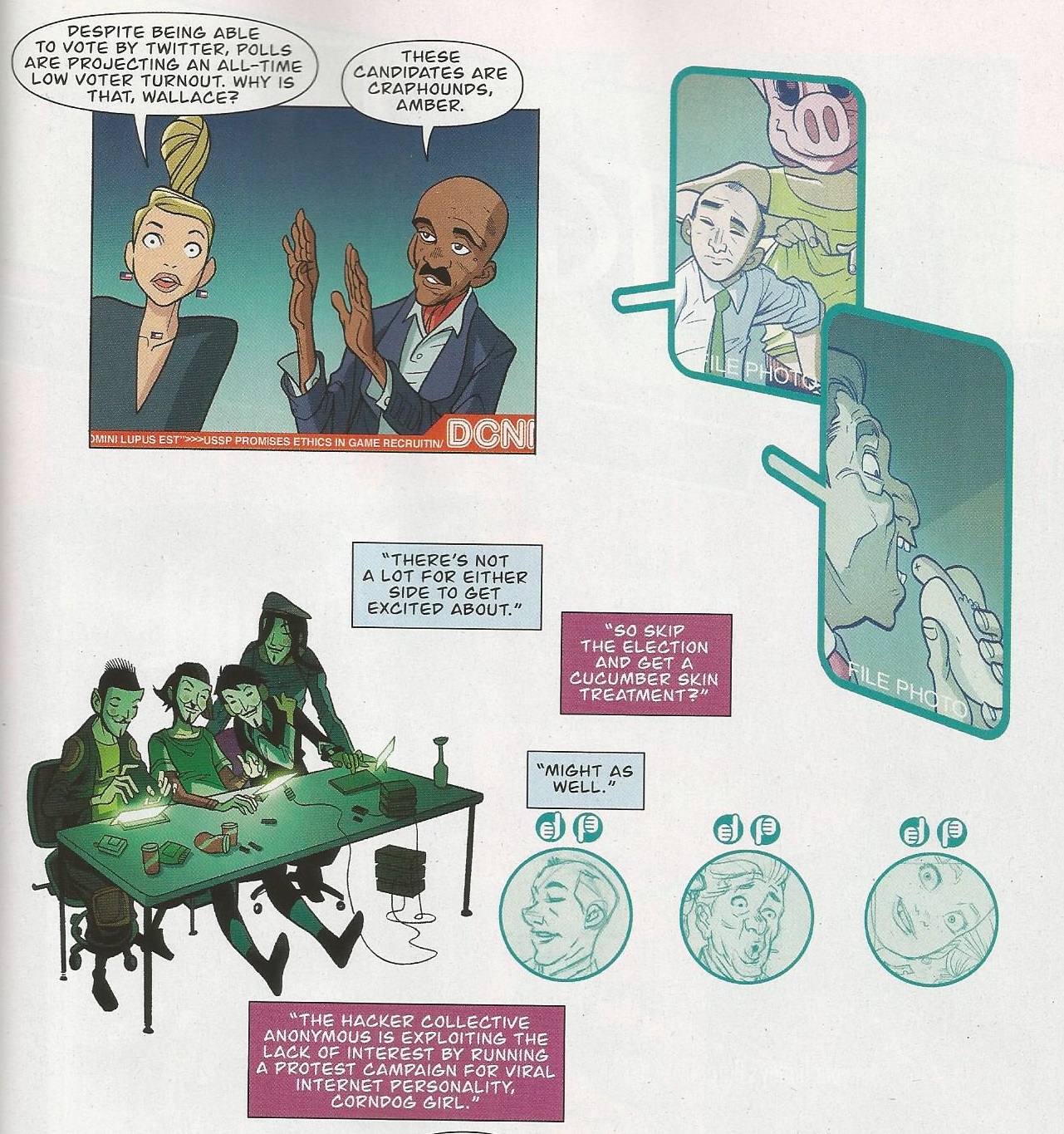
Prez #1 (DC)
DC makes infrequent attempts to candor to the youth vote, as it were. The last time I found it particularly effective was Final Crisis Aftermatch: Dance (the Super Young Team mini-series). Prez is kind of like that, but I think it has a better shot at being noticed, so long as there's a willing audience out there. The creative end certainly does its part. In that above panel alone there's inspiration from Alan Moore, Frank Miller, and even Jeff Smith to be found, which is not bad company at all.
Writer Mark Russell seems to be pretty new, and he's certainly seized this opportunity. I will, however, be concentrating my praise on Ben Caldwell. I've been praising Ben since his exceptional Wonder Woman material from Wednesday Comics, which Prez evokes to a certain degree. I say "certain degree," because I think part of the reason I seem to be somewhat singular in my devotion to Ben and his Wonder Woman is that he took his creative freedom in that project to a perhaps excessive extreme. He's dialed in it here, but the work is still uniquely vivid, and that's what I love about him.
I think the big fear everyone had about Prez is that it would be more or less like the previous, decades-old version of this narrative, a precocious "kid president" (although as kid presidents go, you know about Kid President, right? he's awesome) that has no real creative value. That couldn't be further from the case. Another big post-Convergence winner right here.

Robin: Son of Batman #1 (DC)
Speaking of great art, here's Patrick Gleason in what's effectively a spin-off from Batman and Robin. I think most of us fans feared that divorced from Pete Tomasi, Gleason couldn't really pull off the same magic on his own. But as it turns out, he really, really can. After the massive detour caused by Grant Morrison's murder of Damian in the pages of Batman, Inc. and various other crossover events, it's perhaps best of all to see Robin back in the mode that made for truly excellent comics in Batman and Robin's earliest days. And for proof, there's even the return (of a sorts) of Nobody, a character the series thankfully picked up from one of Christopher Nolan's ideas in his Batman movies (even if his Henri Ducard ended up...not being Henri Ducard at all).
Given how DC likes to experiment with artists acting as their own writers, the results are always going to be interesting. One of the last times was Scott McDaniel in the pages of Static Shock, which was one of the more notorious failures of the early New 52 (alas, McDaniel's career still has yet to show any signs of recovering). As you can see earlier in this very column, one of the latest is Bryan Hitch. But I think Gleason makes a better case, possibly because he did have that lead time with Tomasi, but perhaps also because he has proven such an excellent match for Damian. There's no artist who has done the character better.
And now he's got a Man-Bat (don't call Goliath that, though!) as his new partner. And that's a story we will get to see unfold in future issues, which should be interesting, just one of many Gleason gets to work with, which is a very good thing, because this is a series that has earned a certain amount of autonomy, and as I've suggested, if there was anything wrong with Batman and Robin, it was that it had to earn the same distinction the hard way. But thank goodness. Because it seems Damian's adventures just keep getting better and better as a result!
Sunday, April 19, 2015
Ms. Marvel #14 (Marvel)

artist: Takeshi Miyazawa
In this second of three chapters of the "Crushed" arc...I find myself asking all over again, am I over my fascination with Ms. Marvel?
This is the second time now that G. Willow Wilson has come up with an unsatisyingly generic twist to an intriguing story. The first was with the Collector, the villain who dominated the first year of the series.
The problem is the same: Wilson is apparently bold enough to challenge the status quo but too shy to have Kamala Khan openly rebel. Maybe I'm asking too much.
"Crushed" started out promisingly. Kamala unexpectedly meets a Muslim boy who is her perfect match. But it turns out to be one of those "too good to be true" developments. Which is exactly like Wilson's tepid conclusion to the Collector dilemma involving today's youth and their overall worth in society. Just as things were becoming interesting on an intellectual level, everyone just starts throwing punches. I realize this is superhero comics. I've read plenty of superhero comics. I know how this goes. But I've also read Wilson's Air. I know she's capable of going deep.
Maybe she's compromising for the sake of keeping it mainstream? Or maybe she truly believes she's pulling it off. Maybe other readers are perfectly fine with all of this. But I expect better.
And if it continues like this, I'm done with Ms. Marvel.
Monday, February 16, 2015
Ms. Marvel #11 (Marvel)

artist: Adrian Alphona
This is the conclusion of the Inventor arc. Our villain gets to shout, "I am not a bird!" on the first page, and by the last page we see what he really looks like. And he is in fact, not a bird. So, truth in advertising.
It's a little disappointing insofar as the disenchanted youths who willingly played into the Inventor's hands previously are now just as willing to play along with Ms. Marvel. This is kind of the opposite of the intended message, I suspect.
The other point the issue makes involves Kamala Khan's emerging need to protect her secret identity, what she calls "my new normal" and "a parallel life."
A certain amount of that may also be G. Willow Wilson speaking directly through Kamala. With the massive success of Ms. Marvel, Wilson is having her first real moment of comic book popularity, which goes with expanded demand, which means she's also writing X-Men these days, which is quite a vote of confidence.
Sunday, December 28, 2014
Ms. Marvel #10 (Marvel)
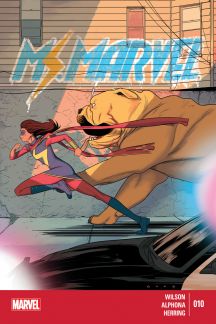 |
| via Marvel |
artist: Adrian Alphona
Yay me! I've been enjoying a series that's being recognized as one of the year's best!
Kamala Khan has been trying to get to the bottom of the threat the Inventor (who, remember, is basically a giant chicken person) has been posing basically the entire series. This issue she comes...closer.
The kids her curious archnemesis has been kidnapping turn out to have willingly played along. They think the world has basically pegged them correctly as a worthless generation. But don't take it from me, here's the Inventor himself spelling it all out:
"The young are seen as a political burden, a public nuisance. They are not considered worth educating or protecting. They are called parasites, leeches, brats, spawn -- If you used these words to describe any other minority but children, it would quite understandably be considered hate speech. We are simply taking this loathing to its logical conclusion."
The appeal of Wilson's approach is that it's been incredibly varied. She's freely mixed in thoughts like that with typical teenage foibles and plenty of playfulness. All that's in the issue, too.
It's rightly being considered one of the most fresh takes on superheroes in years.
Wednesday, October 29, 2014
Ms. Marvel #9 (Marvel)
writer: G. Willow Wilson
artist: Adrian Alphona
Kamala Khan learns all about her Inhuman origins, meets more Inhumans than just the giant-dog-with-a-tuning-fork-on-its-head Lockjaw, and tells them, Thanks but no thanks I'll defeat my supervillain on my own.
Also, lots of Star Wars references this issue. That's good, too!
And a twist ending. Twist endings are good, right? Kamala learns a vital piece of the puzzle she's been missing about the Inventor saga that will surely make things very interesting next issue, and perhaps even shed additional light on the whole series.
This series remains infinitely intriguing.
artist: Adrian Alphona
 |
| via comiXology |
And then hears her mother say this:
"We came here so our children would be safe -- safe from the chaos and corruption and bombings back home. Only after we arrived did we discover school shootings, date rape drugs and gangs. And now giant robots!"Apart from giant robots, that's a pretty accurate assessment, I think, from G. Willow Wilson concerning what immigrants experience coming to America these days, and that's one of the signal insights from Ms. Marvel that has brought it so much deserved attention. It's not just a superhero series, or even just "that Muslim series," but an integration of a lot of elements, and it's interesting watching as they all play out.
Also, lots of Star Wars references this issue. That's good, too!
And a twist ending. Twist endings are good, right? Kamala learns a vital piece of the puzzle she's been missing about the Inventor saga that will surely make things very interesting next issue, and perhaps even shed additional light on the whole series.
This series remains infinitely intriguing.
Monday, October 13, 2014
Ms. Marvel #8 (Marvel)
writer: G. Willow Wilson
artist: Adrian Alphona
The first part of the "Generation Why" arc continues the Inventor arc, introduces the Inhumans dog Lockjaw as Kamala's new pet, and helps further explain what G. Willow Wilson hopes to accomplish with the series. It also sees the return of regular artist Adrian Alphona.
These days, new characters never seem to last. If they stick around at all, they end up in a group and therefore don't really amount to much, compared to the legacies of characters created decades ago. The last time there was a significant expansion of the superhero landscape was in the '60s, the whole reason we still, well, marvel at the Marvel Age. Image came close in the '90s, but it's fair to say that no character from that time has become a true icon (Spawn, Savage Dragon, and Witchblade come close, but they still have yet to prove they can exist in contexts other than how they were originally presented).
Sometimes someone comes along and makes a clear effort to do something new. Often, that's done in relationship to some established character. That's what Wilson has done, but she's also made an effort to distinguish her efforts. She's trying to make the character relevant as a kid growing up, and as someone entering the greater superhero community.
So far so good.
artist: Adrian Alphona
 |
| via Comic Vine |
The Inventor is the default villain at this point, the problem our hero is still trying to figure out. At this point Ms. Marvel is learning everything he's been doing, starting to clean up the mess, and is working toward the inevitable final confrontation. For this issue, it's probably the least interesting aspect.
Moving on, Lockjaw's debut puts yet another element into the ongoing narrative. Usually a move like this is done because someone's getting anxious for people to discover the series and they've started looking for gimmicks. In this case, it's a kind of subtle tie-in to Kamala's heroic origins (as figured out by Wolverine last issue, a by-product of the recent Inhumanity event) without advancing the series arc too quickly. The friendly dog is a gentle reminder, is all, a placeholder. It's also a chance for Kamala to interact with her family in matters other than faith. That's important, too. Every kid wants a pet. Comics sometimes forget that.
By the time Kamala shows up for class late in the issue, she has to explain away a few things. Her teacher tries to prove that she's a bad student, but Kamala quickly turns the tables on her with this insightful comment:
"Well...giving up on the next generation is like giving up on the future, right? And...and sometimes the next generation has to deal with all the problems the last generation left for it to fix, and that means getting up really early in the morning --"It amounts to a mission statement for the series. Some of it's pretty obvious, standard talking points, but Wilson also puts Ms. Marvel's context firmly in the very argument you always see but never see played out. Quite literally, she's going to be dealing with problems (the ongoing Inhumans saga) that her predecessors have never figured out, and forging her own future, and by extension a new generation of heroes.
These days, new characters never seem to last. If they stick around at all, they end up in a group and therefore don't really amount to much, compared to the legacies of characters created decades ago. The last time there was a significant expansion of the superhero landscape was in the '60s, the whole reason we still, well, marvel at the Marvel Age. Image came close in the '90s, but it's fair to say that no character from that time has become a true icon (Spawn, Savage Dragon, and Witchblade come close, but they still have yet to prove they can exist in contexts other than how they were originally presented).
Sometimes someone comes along and makes a clear effort to do something new. Often, that's done in relationship to some established character. That's what Wilson has done, but she's also made an effort to distinguish her efforts. She's trying to make the character relevant as a kid growing up, and as someone entering the greater superhero community.
So far so good.
Monday, September 29, 2014
Ms. Marvel #7 (Marvel)
writer: G. Willow Wilson
artist: Jacob Wyatt
The two-part Wolverine guestie (a term I just made up) concludes, moving along the series as a whole with, y'know, the power of imagination.
artist: Jacob Wyatt
 |
| via Things Matter |
That's the unexpected power of Ms. Marvel, which you might otherwise think of as "that Muslim comic." The truth is, G. Willow Wilson is clever enough as a writer to have things like facets to her storytelling.
I guess I hadn't realized it at the time, but the first issue actually was a tie-in to the recent Inhumanity crossover event featuring, as you may or may not have guessed, the Inhumans (the X-Men if they were a lot like the New Gods). That's the secret origin of the mist that gave Kamala Khan her powers.
That and developments in the Inventor arc, which lately has involved a lot more Inventor.
That and Wolverine, who has been in the midst of definitely-probably-permanently-dying, without the benefit of his nifty regenerative powers, imparting on Kamala the importance of not completely relying on her nifty new powers.
And it only seemed like a giant digression from what the first five issues had been doing, an excuse to feature Wolverine and storytelling that doesn't specifically relate to Kamala's Muslim faith issues, which after all is one of the big draws of the series. Okay, the big draw.
Guest artist Jacob Wyatt unexpectedly brought a more cartoonish look to the series for the arc, and it really worked to keep the mood light. I mean, it kept Wolverine in a good enough mood to humor Kamala, the way he used to other junior heroes like Kitty Pryde and Jubilee, so that he and/or the reader wasn't thinking definitely-probably-permanently-dying the whole time.
Again, that's to the considerable prowess of Wilson, and the facets she brings to her storytelling.
By the end of the issue, a new supporting character is introduced. But more on that next issue.
Thursday, August 7, 2014
Reading Comics #129 "Wilson's Marvel"
Wilson became an instant favorite thanks to her remarkable run in the little-read Vertigo series Air, which twice topped my annual QB50 list (2009-2010). Then she kind of went away. Granted, Wilson is an accomplished writer outside of the comics medium. Recently I read her novel Alif the Unseen, and that was pretty good, but it wasn't quite as satisfying as Air was. I was surprised to see her resurface, but not surprised (okay, pleasantly surprised) to see Wilson tackling her relationship with Muslim culture directly, in a superhero comic of all things. I approached Ms. Marvel with great faith but also some trepidation.
I think as of #6 I can strike "trepidation" completely from the record.
#5 was the conclusion of the opening arc (mistakenly printed in the issue as "Part Four of Five"), the origin story of Kamala Khan's debut in the role. Being a superhero is great and all, but Wilson's genius in the series is that she recognizes and embraces that Kamala's journey kind of has nothing to do with that. The best moment of this issue is a chat between father and daughter. The issue also features the debut of Kamala's permanent costume.
 |
| via Things Matter. This is her making it. |
 |
| via Project Fandom. And then the finished product. |
The highlight, though, is the guest appearance from Wolverine. I know, I know, Wolverine seems as gratuitous as you can probably get. Putting aside that guest appearances from rather than in stories featuring better-known characters will never be as effective in finding new readers, this one's handled with considerable skill. It addresses current Wolverine events but still manages to get across exactly what Wilson and Kamala need at this point, which is for Kamala to have an unabashedly good superhero moment, now that she's gotten over her introductory jitters.
This comes about thanks to Kamala going off in search of her apparent nemesis, the Inventor. The Inventor, unexpectedly, seems to come straight from the pages of Atomic Robo. I didn't see that coming. It fits perfectly with the tone of the series, too.
And then Wolverine shows up, and Kamala's endearing fangirl tendencies emerge for the first time since the first issue. Who does that around Wolverine??? This girl, apparently! It's fun. It's so atypical, just like the whole series, but in a way that hasn't really been featured so far, it pushes the whole thing forward.
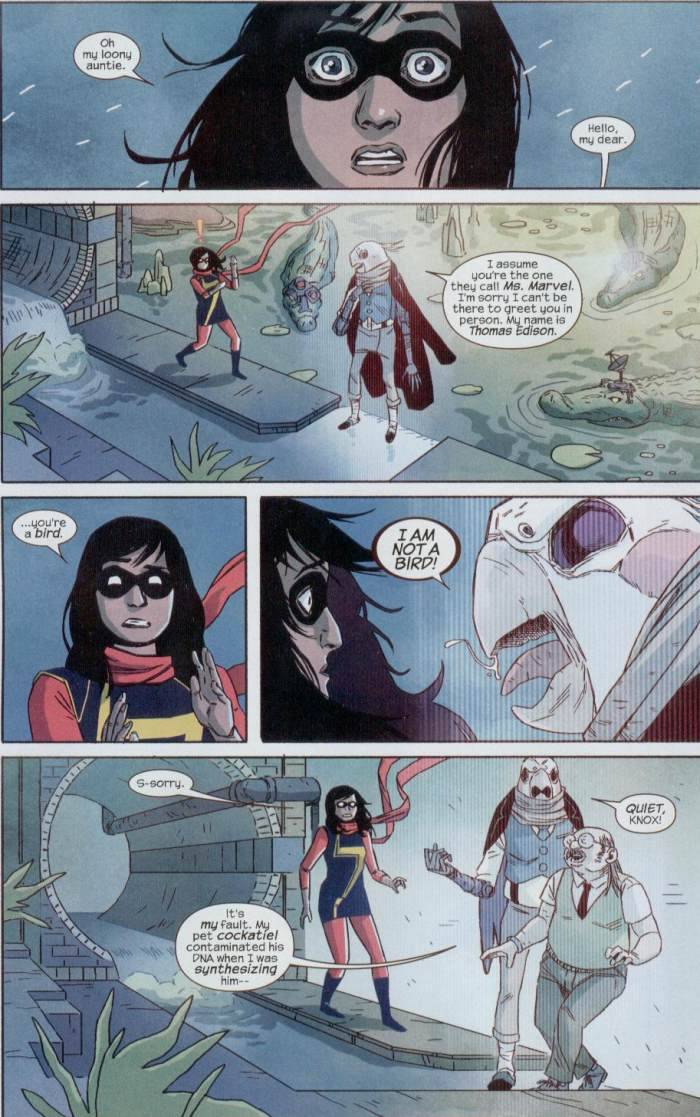 |
| via Scans Daily |
 |
| via Reddit |
Loving it.
Wednesday, July 23, 2014
Ms. Marvel #4 (Marvel)
writer: G. Willow Wilson
artist: Adrian Alphona
This is the big turning point issue. Technically, it could easily have served as the first issue of the series, and a lot of other creators might have done exactly that.
artist: Adrian Alphona
 |
| via The Daily Crate |
By the way, G. Willow Wilson is not a lot of other creators.
Funny thing is, her Ms. Marvel in this issue looks a lot like Mark Millar's Kick-Ass (thanks to Adrian Alphona's art looking a little like John Romita Jr.'s in some respects), just an ordinary girl (our girl Kamala Khan) trying to be a superhero without any of the usual finesse. Yes, this is an origin story. Superheroes in origin stories don't usually have a lot of finesse (just look at multiple versions of Batman's). But this is the start of a series, and that's not typical for an origin story at the start of a series. So, Kick-Ass, or Brian Michael Bendis's Ultimate Spider-Man. Stories that don't jump right into typical superhero material.
The thing is, last issue Ms. Marvel was shot. So this issue she's got to figure out if that, y'know, fatal. It isn't, just so you know, or this new series will have had some strange stories in the last two issues I've read. The twist is that these powers Kamala is still trying to figure out have a lot to do with altering her body. To this point she's been in superhero form in basically a different body. The typical, blonde white girl body of Ms. Marvel. This is the issue where that changes. She changes back to Kamala, and learns that the bullet wound doesn't travel with her.
So the panels above are a little of what follows. This is also the issue where Kamala's good friend Bruno finds out her little secret. When the cops show up at the crime scene (Bruno's brother has attempted to fake a robbery of the Circle Q where Bruno works and this was the result, Kamala being shot), and Ms. Marvel has once again become Kamala (to her benefit!), she and Bruno scramble to provide a cover for her. It's not impressive, and not convincing when Kamala tries explaining that she is Ms. Marvel. She doesn't look like her, right?
Another understated moment in the series. The whole point so far has been that Kamala is definitely not the Ms. Marvel you know. The draw was always the Muslim Ms. Marvel. Except Wilson hasn't just written the Muslim Ms. Marvel. To even conceive of the Muslim Ms. Marvel was always going to be risky. Perhaps it helps that she lives in a fictional Jersey City.
So I love this series more and more. This issue, this strange new Ms. Marvel begins to embrace herself, her own image, as a superhero. Her unique costume begins to take shape. If you're going for the hat trick of superheroes (bucking stereotypes, being a woman, and wearing a costume that doesn't exploit a woman's body) then you've finally arrived at the moment you've been waiting for. (It goes without saying, but Alphona probably doesn't even know what "brokeback" is.)
It's a goofy series. It's lighthearted. But as with the best of Wilson, it's a constant revelation, and its appeal only grows. I don't know how long it's going to last. I don't know if this Ms. Marvel ultimately has a chance at being embraced by the larger Marvel landscape. Outside of her own comic, she would probably be just another bumbling teenage hero. (The whole Avengers Arena thing is the proof in the pudding about how far that goes.) That's too bad. But then again, she could also be like a new Spider-Man. If she proved popular enough, that would not be too big of a stretch. Who knows?
Subscribe to:
Posts (Atom)