Showing posts with label Rick Remender. Show all posts

Saturday, September 14, 2019

Reading Comics 230 "First Forbidden Geek Mystery Box"

Recently I delved back into the crate phenomenon, the mystery box thing that’s become a whole cottage industry, even finding its way into Walmart and Target (plus kids toys! of course!), with Forbidden Geek.  At the moment, I’m officially a subscriber, so I will be getting a new box every month.  I got my first one recently.  I opted for a bonus pack of comics, which apparently, unlike the more official set, don’t come with bags and boards (which is fine by me), and those will be the first batch I write about:

Black Science #1 (Image)
This was the Image Firsts $1 reprint edition of the Rick Remender series.  Remender became one of those one-man creative industries (Fraction, Lemire, Millar) that’s been happening in recent years, and as the trend has been, helped make his name at the Big Two.  Black Science, as it turns out, is sort of his creator-owned version of Fantastic Four, not in the way Image was doing this sort of thing at the beginning, shamelessly and little creative spark, but the full-blown modern imaginative revamp.  So that was nice to see.

The Demon #37 (DC)
It’s funny that Forbidden Geek ended up sending me two issues of The Demon, and only a few issues apart.  But the results, for me, ended up being pretty much the same.  This was an era in which DC was still trying to hold onto the early Vertigo vibe of using familiar characters in a more edgy manner (which itself was an impulse from the horror comics of the ‘70s, where the Vertigo instinct originated, not from the British Invasion, as is popularly assumed).  But a little more on this in the second batch.

Infinity Inc. #12 (DC)
One of my earliest comics was actually an issue of All-Star Squadron, which was sort of an Earth 2 Justice Society.  Infinity Inc. is a spin-off featuring the offspring of the original guard, which in Earth 2 continuity means Batman is included (in that continuity he not only actually married Catwoman but died) and his daughter is the Huntress (which is where, basically, that version of the character depicted in the short-lived Birds of Prey TV series came from).  It’s funny to read a version of Jade and Obsidian who aren’t automatically associated with Golden Age Green Lantern Alan Scott, because later, when they were absorbed into DC proper, they’re accepted as his kids.  There’s also Fury, Wonder Woman’s daughter.  I had an idea once of making that part of continuity again.  Just imagine…!

Uncanny Inhumans #7 (Marvel)
Marvel fans became maniacally opposed to the whole idea of the Inhumans once they decided Marvel was trying to use them to replace the X-Men in a bid to devalue the mutant property until the movies could be brought into the studio fold.  In the end, it doesn’t really matter if that was the intention or not (the X-Men did get acquired, and the fans were so happy they gleefully decided the last Fox movie, Dark Phoenix, was a bomb before they ever saw it), they missed out on a lot of great comics.  (Forget about appearances in Agents of SHIELD or an aborted show of their own.)  And Charles Soule was the biggest loser.  Here was a major writing talent given what seemed like a plush assignment: a major title with a big push.  So it’s always funny to read Soule’s comics and enjoy them so much and imagine fans seething at the very thought of them existing, regardless of the actual quality. 

Kingpin #1 (Marvel)
Speaking of irrational hatred for Inhumans, this comic spun out of Civil War II, an excellent event comic that not only cleverly revolved around them, but was written by Brian Michael Bendis when Marvel fans apparently suddenly decided he didn’t matter anymore (the joke turned out to be on them).  Charles Soule later used Wilson Fisk as a kind of Trump stand-in when he wrote Daredevil, but here he’s in his classic role, apparently returning to his old New York haunts after adventures on the west coast (West Coast Kingpin), in one of those crime comics that some fans like so much.

Leave It to Chance #6 (Image)
James Robinson, at the time basking in the critical success of Starman, was also writing a creator-owned comic, which I never got around to reading, although its name was familiar enough to me.  Maybe I would’ve enjoyed it more, then (although I didn’t get into Starman then, either), but now it just reads like a generic all-ages kind of comic. 

Mae #1 (Dark Horse)
Gene Ha signs all his covers as, “ha!” which along with his actual artwork tends to help identify his work.  This was an attempt to draw and write his own work.  But not all artists can write, too, and I think, as far as I’m concerned, Gene Ha is one of those. 

Sisters of Mercy #2 (Maximum Press)
Maximum was one of several attempts by Rob Liefeld for a spin-off company from his early Image days.  All of them were basically the same (probably the best material was published when he had dubbed the company Awesome, which is pretty appropriate), and none particularly permanent, obviously, since Liefeld seems to be somewhat allergic to commitment.  As far as Sisters of Mercy is concerned, that was probably a good thing.  This was apparently its second and last issue with Maximum, but I don’t know how or why it had even one.  Basically one of the many, many “bad girl” comics of the ‘90s, gratuitously featuring women in as little costuming as possible (in this issue, with strategic covering, one girl is nude for…reasons).  But the art is terrible.  Forget the writing.  Writing in this era of Image(ish) comics was notoriously weak.  But the whole point of the Image era was extreme emphasis on art (to the point where Image had defined a whole style of art, the most exaggerated figures, male and female, imaginable).  So to feature bad art….?  Again, why was this even accepted by Liefeld to begin with?

The Adventures of Superman #484 (DC)
Happily, I had far less of a problem with the art in this comic, as it’s early Tom Grummett, about a year before “Death of Superman” made this Superman era famous, before Grummett fell upon his signature work with the new Superboy.  Funny enough, it’s tough to identify Grummett as artist, since he hadn’t yet streamlined his style, so it’s really just the few appearances of Superman before he sticks a ridiculous contraption onto his head, created by Emil Hamilton (a defining supporting character from the era who later made an appearance in Man of Steel), that leads to a forgotten Superman crossover event called “Blackout.”  Grummett didn’t get to contribute the cover; that honor went to Jerry Ordway, who is otherwise the writer of the issue.

Weirdworld #2 (Marvel)
I honestly don’t know who came up with the idea first at this point, but I always perceived it as Marvel shamelessly jumping on something DC was doing at the time: DC’s Convergence event led to a series of comics that revisited various eras, and then Marvel’s Secret Wars…led to a series of comics that revisited various eras (or more accurately, famous storylines).  DC’s was an excuse to use fill-in creators while it moved offices from New York to California, and its nostalgia comics lasted two months.  Marvel’s ran longer.  Anyway, Secret Wars was basically Jonathan Hickman’s big blow-off to his Fantastic Four saga, with Doctor Doom getting his big triumph and remaking the world in his image, so theoretically its spin-off features that Doom reality in some way (although my favorite was the Charles Soule version of a Civil War follow-up that could easily be enjoyed for its own merits).  Weirdworld was written by Jason Aaron.  I have no particular knowledge of whatever it was supposed to be drawing on, but it’s another instance where post-Scalped Aaron has never really clicked with me.  Although, in the final pages Crystar, the Crystal Warrior, shows up. I had a Crystar action figure as a kid.  So there’s that.

Before I jump into the second batch, here’s an excerpt from an editorial written by Dick Giordano found within the pages of Infinity Inc. #12, originally published in 1984 (which also features an ad for “DC Universe: Crisis On Infinite Earths"):


“I take some series proposal scripts from my bulging portfolio and settle back to read.  I read two…and they’re mind-bogglers!  I rarely find two proposals a month that are interesting enough to consider publishing.  To find two in the same morning that I like so much is a rare bonanza […] The first is a proposal from Alan Moore, Swamp Thing scripter, for a maxi-series starring the super-heroes we recently obtained from Charlton.  The idea is gutsy, grittily realistic, and explores aspects of the super-hero never really dealt with before.  Unfortunately, I can’t really consider it for the Charlton heroes.  For one thing, certain aspects of the plotline do things with and to these characters that would make it difficult for us to use some, if not all, of them after the series was over.  Secondly, I’d already made plans, now pretty far along, to publish Charlton heroes in tandem with some current and past DC favorites in a weekly comic book format.  I like the idea so much, though, that I’m going to suggest that Alan create new characters for this maxi-series (in place of the Charlton heroes) and tell his story! … It’s a wonderful concept!  (Note: since this was written, Alan has enthusiastically agreed with my scheme and is hard at work.  Dave Gibbons is slated to illustrate.  With luck, it will be a 1985 release tentatively titled “Watchman.”)  Incidentally, Alan is a pleasure.  His scripts are liberally dotted with asides, bits of humor, relevant background information, and clever insights into his feelings about pivotal sequences or events that make it easy for the artist(s) to share his vision.  Alan Moore is one of the more creative writers in comics.  The ideas fairly bubble forth from his fertile imagination, and I am delighted that at least some of his unbelievable production will be for DC Comics.  The other series proposal is no less exciting.  It’s the outline for book #1 of a proposed 48-page, deluxe-format limited series.  We’ve talked about this idea and the talks excited me, but nowhere near the excitement engendered by the script.  It is written by Frank Miller.  And I love it!  And I can’t say much more until Mr. Miller puts his John Hancock on a contract.  I can say that it is a very special story about one of the most popular super-heroes ever!”


Ah, you may’ve heard of the comics that resulted.

Anyway, here’s the stuff Forbidden Geek included in the official mystery box (aside from a Kid Flash, by way of the Flash TV series, Funko statue and a softcover copy of Teen Titans Earth One Vol. 1, which coincidentally I finally read for the first time earlier this year):

Ame-Comi Girls #6 (DC)
The name of the comic is somewhat unnecessarily convoluted, but it’s basically an all-girls comic and actually a pretty good read.   

All-Star Batman #4 (DC)
Scott Snyder continued writing Batman comics in the early days of Tom King’s Batman, but they weren’t treated with as much fanfare as his New 52 run.  Two-Face (who, if the series did continue Snyder’s New 52 comics, was technically probably actually dead, at least as far as Tomasi & Gleason’s Batman & Robin was concerned) is the villain.  John Romita Jr., whose work has never been as embraced by DC fans as it was at Marvel or Kick-Ass, is on art.

Batman Eternal #11 (DC)
This was a series that frequently showed up in the Walmart mystery packs, so it was amusing to find in this collection, too, but at least there was far greater variety otherwise.  This issue spotlights Stephanie Brown, one of my favorite supporting characters from Batman comics.

Booster Gold #26 (DC)
Ted Kord!  Him and Elongated Man still seem to have been buried in the post-Flashpoint comics, but at least Ted gets to show up now and then.  He got a new incarnation in the New 52 (who never really went anywhere), at least.  This Blackest Night tie-in zombie appearance is pre-Flashpoint.  It’s still funny to think that Booster Gold, despite getting as big a spotlight as he ever had in 52, ended up back in obscurity despite this relatively long-running spotlight, which theoretically led to the Legends of Tomorrow TV show, which…decided, inexplicably, not to feature him.  For…reasons.

The Demon #42 (DC)
Oh, here’s Demon again!  But this time, it’s from Garth Ennis and John McCrea.  I was never an Ennis guy.  He’s sort of Alan Moore if he never had a Silver Age fetish, just a guy who wrote superhero comics because at the time it was the best way to make a name for himself, who later wrote The Boys as if to prove how much he hated them, despite not understanding them a single wit.  (But I guess that’s generally why you hate something.)  But Demon, amazingly, reads exactly the same under Ennis as Alan Grant in the previous issue.  I hate when letterers use cursive.  It’s virtually impossible to read.  Yet both issues feature angels speaking in cursive (like Thor, the special lettering is supposed to help them stand out as Not Human).  And I just gave up trying to care.  The Demon Etrigan famously speaks in rhymes, which is fun to read in a limited capacity, but incredibly difficult to care about reading for longer stretches.  So I don’t know why there was an audience who put up with it for so long.  But not so hard to figure out why he hasn’t carried a series since.

Fate #8 (DC)
This was one of the series that debuted during DC’s original Zero Month, following the Zero Hour soft reboot.  And some of the series launched at that time looked like shameless Image rip-offs (looking at you, Manhunter), but it also seemed to be another attempt by DC to reintegrate the original Vertigo vibe back into the fold.  Fate is one such example, as it turns out.  (Starman, meanwhile, seemed to lead directly to what Vertigo became later.)  This was a reinvention of Doctor Fate to make him more edgy (the ‘90s were big on “edgy”), but with more credible creative results than its short run may have suggested.  I think part of it was that the whole Vertigo phenomenon was misunderstood from the start, that it diverged from its roots so rapidly that any attempt to replicate them have invariably met with, at best, fan apathy, including the more recent Young Animal imprint.  Part of that was because Sandman, which actually had some superhero connections early on, so dramatically departed from them that fans no longer thought of superheroes as relevant to the idea, so any further attempts to present superheroes in a more complex manner seemed to be asking too much. 

Green Arrow Annual #6 (DC)
Part of the “Eclipso: The Darkness Within” crossover from the 1992 annuals, this issue eventually puts the spotlight on Black Canary, but also features a guest appearance from Batman.  I have a particular nostalgia for these annuals, since they were happening just as I was beginning to read comics regularly for the first time.  Given the opportunity, I’d probably collect them in the same fashion as I have been with the theme months from the New 52, which were tremendous creative successes too little celebrated (or not at all) by fans. 

Justice League #23 (DC)
Ah, but which version of the title?  The Rebirth era, the first series from the Rebirth era…The League is probably the worst example within DC of endless reboots, which at Marvel happens to every series just about every six months or so.  And it’s funny that beginning with the New 52, any title attempting to supplement the main series is even more prone to a short shelf life…Anyway, the post-Johns League has been particularly hard hit.  This issue, featuring a cover with characters not even featured in the issue, much less the one in the spotlight, revolves around Green Lantern Jessica Cruz, which like all Jessica Cruz tales revolves around her inability to avoid fear (funny, for a Green Lantern).  I liked the act in the pages of Green Lanterns, as it and she were paired with Simon Baz, but to have it once again being the only defining quality worth writing about…Anyway, it’s clear why DC once again rebooted the series this time, since the concept was spiraling the drain until Scott Snyder revisited the widescreen concept from the old Grant Morrison days.  (Of course, I think, as with most Snyder stories, he attempts to go too big too soon too often…)

Legion of Super-Heroes #291 (DC)
It’s forgotten today, but the New Teen Titans and the X-Men had a rival in popular during the ‘80s with the Legion, and this issue, luckily enough for me, comes from its most famous story arc, “The Great Darkness Saga,” which until this I’d never actually read anything from (alas, unlike the Titans and X-Men, reprints haven’t been anymore kind to the Legion than fan memory).  This second installment makes it clear that the villain of the arc was kept hidden early on, but: Darkseid.  And since it’s a Legion story, everyone’s worried about who’s going to be elected next leader of the team. 

Northlanders #1 (Vertigo)
From Brian Wood.  I’m not a Brian Wood guy.  This is his Viking comic.  The write-up for the concept was more interesting than what I skimmed in the comic itself.

Swamp Thing #3 (DC)
Scott Snyder’s series from the New 52, y’know, the one fans didn’t really care about, ultimately, even though they remained gaga over Snyder’s Batman.  I got into the series later when it was being written by Charles Soule (part of how I became such a fan of his), but never got around to reading Snyder’s run.  The Walmart Swamp Thing Giant was serializing it, but I wasn’t interested in reading that particular giant regularly.  So it was interesting to read a little more.  I think Snyder actually did more relevant character work here than with Batman.  But what do I know?

Until the next box…

Wednesday, May 8, 2019

Reading Comics 228 "FCBD 2019"

What I love about Free Comic Book Day is that it's basically the best shot most companies have at being visible to the average reader.  For the folks showing up just for free comics, it probably won't make much of a difference.  For the folks who show up to comics shops every Wednesday or in any other sense on a regular basis, it's a chance to find out what companies outside of DC and Marvel are doing (because let's face it, for the average fan, it's still basically just DC and Marvel).  I don't know how many sales these free comics result in (for a long time, I bought Atomic Robo comics in part because Red 5 always included it in their FCBD releases, when Red 5 had Atomic Robo in its slate), but it says a lot about the companies, what they're willing to release for the annual celebration. 

Here again is what I got, and what I thought after reading through all of it:

Animosity Tales (AfterShock)
Marguerite Bennett's comic is basically the flagship of AfterShock, another would-be Image in a crowded indy scene.  What was more interesting than the story featured in the issue was the summary of the series to date, which reads a heck of a lot like The Walking Dead.  So if you want your zombies to instead be animals, this is the comic for you.

Bloodshot (Valiant)
I've been a supporter of the Valiant relaunch for years (not specifically from the start, but around the time The Valiant came out).  While I don't love everything they publish, I still maintain that this is the discerning superhero fan's best bet for a coherent modern landscape to follow, the Ultimate version of the classic Valiant characters, the condensed version of what the New 52 attempted.  And Bloodshot has been a part of it, and been a favorite of mine, for years.  This take is from Tim Seeley, who's been an underrated star of the modern comics landscape whether in his DC work or elsewhere.  But Seeley's take on Bloodshot feels hollow compared to what Jeff Lemire was doing.  Lemire pulled off Bloodsquirt!  He wants a Bloodshot that's actually the complete reverse of Lemire's, all action and no character study.  I thought that was the best part of the modern Bloodshot!  Anyway, also included is the latest chapter of the Rai saga, Fallen World, which reads a lot better.  It's from Dan Abnett, who could use a breakout solo project. 

Deadly Class (Image)
I'd sampled the series previously, but this particular issue was a brilliant way to highlight what makes it truly awesome, and I'm glad all over again that there's a TV adaptation, which I hope to catch.  Remender's a particularly busy creator, the hardest working concept engine not named Mark Millar, who takes all manner of risks with high concepts. 

H1 Ignition (Humanoids)
Here's Mark Waid's latest attempt at a startup.  Dude's been at this for twenty years now, and...has yet to find one that truly sticks (or as with Boom!...sticks with).  This one's all about straining for modern credibility, the social awareness that actually...turned off a lot of Marvel fans.  Maybe it works better with new characters.  I don't know.  But this preview is somewhat poorly put together.  I have little faith of it sticking any better than his previous efforts.  I have no idea why Waid strayed so far from what he did so brilliantly in the pages of The Flash.  Maybe someday he rediscovers that spark.

Interceptor (Vault)
Donny Cates is another firecracker in modern comics, but one that's working equally hard at mainstream (with Marvel) as with his personal projects.  Since this isn't a well-loved era for Marvel, fans haven't really rallied around him, but I like to see what he's doing.  I like his storytelling in this issue.  He's definitely worth keeping an eye on.

 
Punchline (Antarctic Press)

Here's the best comic I read from the bunch!  It's a superhero book from other than DC/Marvel, which is always an interesting prospect.  There will be great material done elsewhere (see: Valiant) and there will be shoddy stuff.  This looks like great stuff.

Part of what makes it look great is the artwork, naturally.  Matthew Weldon seems like the closest I'll get to classic Stuart Immonen, before he started adding detail into his clean forms.  There's some rough work in there, but Weldon is like Patrick Gleason more interested in shadow than warm figures, a moody look at its best that the touch of reality Bill Williams seeks in a script that looks more to the human than superhuman.

I like the details Williams includes, like the fact that the Black Arrow is actually two people sharing a costume to evade seekers of secret identities.  (I'd read that comic, too, thank you!)  It feels like a genuinely fresh take, just when you thought you'd seen everything.  There's a collection already available with the rest of the story, which I think I might actually track down (read: order online).  And I guess there's more new issues coming. 

Stranger Things (Dark Horse)
As I've said, I haven't been initiated into the Stranger Things cult, and this comic didn't make me consider reconsidering.  Fortunately there was also a Black Hammer backup, with Jeff Lemire presenting the "Cabin of Horrors," clearly an homage to House of Mystery and such.  Eventually we meet Jack Sabbath (familiar to Black Hammer fans?), who has just discovered that his backstory might be different than he previously thought.  Cowritten by Ray Fawkes, in defense of whom I sort of exiled myself from Millarworld a few months back.  Also discovered that Mice Templar artist Victor Santos has been working at Dark Horse recently, with a long-running espionage comic called Polar, which might be worth checking out.  See, Free Comic Book Day???  Success.

Year of the Villain (DC)
Again, not technically a FCBD release, but for the second year in a row a cheap DC comic meant to promote upcoming stories.  Scott Snyder is the brains behind a new Underworld Unleashed/Forever Evil-type event headlined by the bad guys.  I really wish Lex Luthor could just stay the antihero he's done so well in stories like Final Night and Geoff Johns' Justice League, but he keeps getting dragged back into villainy.  This is one of those stories where "he's finally gone too far."  More significantly, Brian Michael Bendis signals he may be interested in working on Batgirl comics, with a tale that finally allows Barbara Gordon to remember she was pretty badass as Oracle, too.

Star Wars Day: May the 4th Be With You (Marvel)
Again, not technically a FCBD release (but part of another of the things last Saturday was culturally).  Besides some previews for various comics, there are some creator interviews, including one spotlighting Kieron Gillen's creation of Doctor Aphra, whom he repeatedly describes as a Star Wars version of Indiana Jones.  (Yes, yes, yes: Harrison Ford played both Indy and Han Solo, but Gillen's point is that Aphra collects artifacts...but with a more nefarious agenda in mind!)  On the whole, I'm quite happy that Marvel got the rights for Star Wars back from Dark Horse (other than Dark Horse's brilliant adaptation of The Star Wars), as it sticks much closer to film material and less creating whatever the hell it wants.  I just can't decide if Aphra is closer to the Dark Horse mentality than Marvel's...

Monday, September 26, 2016

Quarter Bin 92 "Hail Hydra #1"

Hail Hydra #1 (Marvel)
From September 2015

writer: Rick Remender

artist: Roland Boschi

Yeah, I had no idea this one even existed, or at least what it was, among the glut of Secret Wars spin-off mini-series.  Someone over at Marvel had a look at what DC was doing with Convergence, and decided they'd like some of that action, and so a lot of old storylines were revisited in one form or another, and apparently one of them was Rick Remender's run on Captain America, by Rick Remender himself, and that Secret Wars spin-off mini-series is this very title.  Again, I had absolutely no idea.  The title doesn't exactly give it away, now does it?

There were apparently four issues of this, all of them written by Remender.  It's a follow-up, specifically, to his notion that Arnim Zola had a son who in Damian Wayne fashion ended up being mentored by Steve Rogers.  While the greater story around Hail Hydra draws on the bonkers kit-bashing reality of Secret Wars and thusly dumps Leopold Zola/Ian Rogers into an alternate reality where Arnim Zola rules with an iron fist, it at least puts him into a situation where he must confront his past all over again.

Remender's Captain America was easily one of my most pleasant discoveries of the past few years, something that broke free of the pseudo-earnestness of the Ed Brubaker years and just had some fun with the core concepts.  I love that Marvel gave him a shot to revisit it.  I don't know if it was Marvel's or Remender's idea to completely bury the result, but it at least becomes another pleasant discovery, because this is once again one of the best things I've read from Marvel recently.

I also love that Roland Boschi, whether at Remender's direction or otherwise, ends up depicting the alternate Leopold Zola Ian finds himself confronting exactly like Tom Hardy's Shinzon from Star Trek Nemesis.  It can't have been a coincidence one way or another.

Monday, July 25, 2016

Reading Comics 195 "DC Rebirth Week Seven, 18 Days, Letter 44, Tokyo Ghost"

Featured this edition: Grant Morrison's 18 Days #12, Batgirl & the Birds of Prey: Rebirth #1, Batman #3, Green Lanterns #3, The Hellblazer: Rebirth #1, Justice League #1, Letter 44 #26, Superman #3, and Tokyo Ghost #8.

Grant Morrison's 18 Days #12 (Graphic India)
Morrison's Avatarex #1 shipped last week, and hopefully I'll be seeing a copy in a couple weeks.  Although I lost track of reading Graphic India's vision of his Indian superwar epic a while ago, I always thought it was well worth reading, and so I checked in again for this issue, which details Bhima's further experiences, from his great familial devotion to a momentum moment for him in the fighting.  This project's being executed with pitch-perfect precision.

Batgirl and the Birds of Prey: Rebirth #1 (DC)
The Birds of Prey was conceived during the '90s, and has been maintained in some fashion ever since.  It's a girls-only team (still unique in comics, but not with Ghostbusters).  This issue features Batgirl Barbara Gordon's biography at the forefront, but also gives nods to Black Canary's DCYou band exploits and Helena Bertinelli's Grayson spy work, and how the team only reluctantly gets back together.  It was a good introduction.

Batman #3 (DC)
Tom King's Dark Knight continues, as we learn the secret origin of the superpowered heroes who have lately been lending him a hand: Hank and Claire Clover.  Hank was saved by Batman years ago, when he was a kid.  King cleverly stages this origin so that the unsuspecting reader might think he's seeing Bruce Wayne's fateful Crime Alley nightmare all over again, but then the story continues and we find out what's really going on.  As always, King is in full command of the psychological beats, including those provided by villains Hugo Strange (always, ah, somewhat strangely overlooked in Batman lore) and Psycho Pirate. 

Green Lanterns #3 (DC)
Simon Baz spends more time in the spotlight this issue, including a killer sequence with Red Lantern soldier Bleez, who is the latest recipient of Baz's ability to unlock his power ring's most surprising abilities, ones rarely experienced by other bearers.  He'll need all the help he can get, because partner Jessica Cruz has just been overtaken by the rage seed...

The Hellblazer: Rebirth #1 (DC)
John Constantine is that unique DC character, in that he's a genuine antihero, which unlike his Marvel counterparts (say, the Punisher) doesn't mean that he goes around shooting people, but that he makes unorthodox moral decisions, possibly because of his ties to Hell (hence, the returning traditional name to his adventures).  Since his return to DC proper (after being a headlining Vertigo act since the brand's creation two decades ago) during Brightest Day five years ago, fans have been skeptical that Constantine can properly function in the relatively sanitized DC superhero landscape (for comparison, imagine if Neil Gaiman had had to make Sandman permanently co-exist with the likes of Dr. Destiny and Martian Manhunter, both of whom made early appearances in the series, but who seem hard to reconcile with Gaiman's later creative pursuits).  I've never really been a Constantine reader, so I welcomed this chance to have a look.  For what it's worth, I do think, at least in this issue of this iteration, he works perfectly well.  It's like the Demon Etrigan (who had a Garth Ennis-penned series in the '90s, that gave birth to one of Ennis's signature creations, Hitman), but without the Demon as the lead, if that makes any sense.

Justice League #1 (DC)
The first issue of the series, like its New 52 Geoff Johns predecessor, has Wonder Woman on the brain, which I love.  Tony Daniel on art (he helped launch Superman/Wonder Woman, which is all kinds of natural for this latest Daniel project) is as always a thing of beauty.  I love how the whole issue is about mobilizing the team. 

Letter 44 #26 (Oni)
I'd previously sampled this Charles Soule series, but didn't really get the hang of what's going on in it, so I'm glad that I've finally read another issue.  This is a story about the end of the world, and all the odd decisions people are going to make if the involved players include aliens, U.S. presidents, a team of scientists, and messianic collaborators.  Actually, I came out of this issue being very impressed.  But then, I was already a fan of Soule, so I'm doubly glad I can now say I like Letter 44, too.

Superman #3 (DC)
Having witnessed the thunderbolt that was Jorge Jimenez's work in the early issues of Earth 2: Society, I'm so happy to be seeing more of his art, in this Tomasi/Gleason series and in the forthcoming Super-Sons, which in some ways this issue helps set up, as we see Jon Kent light up for the first time.  The sequence of events that provoke this (a new vision of the Eradicator that offers some fascinating new wrinkles to established character mythology; Krypto) is breathtaking in ways I hoped this series would be.

Tokyo Ghost #8 (Image)
Rick Remender has joined Mark Millar in the select group of modern writers who have been able to establish a viable brand around their names, and a large net of titles to populate it.  This Remender project envisions a dystopic future directly culled from our own, in which addiction to digital content has literally sucked the life out of everyone, leaving the population susceptible to corrupting influences.  Fortunately, there's a hero in the eponymous Ghost capable of stepping in to stem the tide.  This issue turned out to be a perfect one to sample, involving the Ghost's tragic baskstory, and the man she's tried valiantly through the years to protect, despite increasing odds against her.  But the reason I wanted a look was because of the Sean Gordon Murphy art.  I've been a fan of Murphy's since Joe the Barbarian, his seminal work with Grant Morrison, as well as his personal creative vision, Punk Rock Jesus.  He's also collaborated with Scott Snyder (The Wake) in recent years, as well as Millar (Chrononauts).  I never get tired of his art.

Monday, April 25, 2016

Quarter Bin 72 "Moon Knight is the connoisseur's Deadpool"

Let's recap.  These comics were not literally bought from a quarter bin.  The title of this column is symbolic.

Moon Knight #7 (Marvel)
From November 2014.
It strikes me that no one is running around trying to get Moon Knight into his own movie.  Well, maybe someone is, after the big success of Deadpool?  Because Moon Knight is basically the connoisseur's Deadpool.  Marvel has been trying for about as long as it has with Deadpool to get Moon Knight to connect.  At first a fairly lame and obvious Batman rip-off, because he was so expendable, Marvel let its creators loose, and for several short-lived series now (including one written by Brian Michael Bendis), Moon Knight has emerged as one of the company's better creative vehicles.  Now more or less a psychotic vigilante, a kind of Marvel version of the Spirit, Moon Knight in this particular series and/or issue is written by Brian Wood, who is well-loved in the comics community but with whom I've continually failed to connect as a reader.  This issue features a more or less straight Spirit adventure for Moon Knight, despite the fact that the tag line in the intro page specifically addresses that he is insane and this is what follows...Well, apparently in this series Marvel has determined that Moon Knight addresses how absurd the concept of vigilantes really is.  But the character still has better overall storytelling potential than the relentlessly one-note Deadpool...

Winter Soldier #1 (Marvel)
From May 2014.
Winter Soldier, a.k.a. Bucky Barnes, is a signature character of Marvel's post-millennial comics, a resurrected, repackaged, repurposed superhero who helped lead the way to the Avengers movies and has otherwise spent a lot of time being written by Ed Brubaker, who envisioned the whole concept.  This issue, however, is written by Rick Remender, with whom I have a better record than Brian Wood.  But Winter Soldier, ironically, barely appears in this issue.  Instead, it's a Nick Fury/S.H.I.E.L.D. Cold War/Nazi Hangover adventure (as are a lot of Marvel stories).  Presumably later issues more directly feature, y'know, the Winter Soldier...

All-New X-Men #27 (Marvel)
From September 2014.
A series that shipped twice-monthly, All-New X-Men wasn't as old as its numbering this issue suggests.  I read the early issues thanks to the pairing of Brian Bendis and Stuart Immomen, who was finally emerging from a long quagmire in which he didn't draw very much like, y'know, Stuart Immonen.  But the Immonen who shows up in this issue is kind of phoning it in, as is Bendis, whose grand vision for his time-lost original X-Men and more contemporary mutants had kind of petered out into a time travel adventure...with future enemies!  I had high hopes for a Bendis X-Men.  Everyone did.  I mean, he nearly single-handedly invented the Avengers as we know them today (also contributing: The Ultimates and Brubaker's Captain America).  In the end, I think it was the overreliance on the increasingly baffling gimmick of the time-lost X-Men.  For one arc, it would have made perfect sense.  But then he just kept it going and going...Which is kind of a Bendis trademark.  And maybe something he really ought to work on...

Wolverine and the X-Men #9 (Marvel)
From November 2014.
This is from the days of "Death of Wolverine," so Marvel was about to kill off its most popular character in order to spite 20th Century Fox.  But these were good days.  This issue features Logan confronting a rogue student (saddled with a terrible name I won't dignify here) who eventually makes it clear that it isn't all X-Men or Brotherhood of Mutants.  There's a third option.  There always is.  So, a pretty good issue. 

Thursday, July 30, 2015

Reading Comics 171 "A Frustrating Week"

Last week I ended up skipping on Justice League: Gods and Monsters - Batman #1 (DC), but I decided to get it this week, along with JL:GaM - Superman #1.  These are comics that help flesh out Bruce Timm's return to the animated DC fold after helping shape its legacy (along with Paul Dini) in the '90s and early 2000s with Batman, Superman, and Justice League cartoons.  I initially skipped out because the art inside Batman was nothing like the Timm I know, but I guess if these spin-offs go in a different direction artistically, it only goes to emphasize the stories more.  Batman features Kirk Langstrom, the erstwhile Man-Bat, in the role of the Dark Knight, having transformed himself, instead of a giant bat, into a vampire.  But the neat thing about the story is that it focuses on the matter of whether or not Batman does what he does because he enjoys it or out of a sense of justice.  Superman features a Man of Steel, meanwhile, who ends up being raised by Mexican immigrants, ending up more resentful as a superhero as a result.  I guess these are the variations that make them monsters...

Anyway, when I entitled this week's edition "A Frustrating Week," I wasn't really thinking about Gods and Monsters, but rather a couple of comics I tried for the first time because of my familiarity with the writers.  (J.M. DeMatteis, by the way, wrote both GaM tie-ins.)  The first sampling was Low #8 (Image) from Rick Remender, and the second was Sex Criminals #11 (Image) from Matt Fraction.  Remender is one of those writers I seem to constantly go back and forth on.  Recently I had gotten around to liking him again thanks to his Captain America work.  Fraction, meanwhile, just concluded what ought to be considered a seminal run on Hawkeye.  Both are well-known for their creator-owned work, as well.  The problem is, these particular efforts seem to have been greenlit by Image with the express interest of trying to duplicate or at least build off the momentum of Saga (which in effect makes them like all the superhero comics that all these nonsuperhero comics are constantly trying to say they're more interesting than for the simple fact of being more original in a vast sea of superhero comics...).

Low, for instance, is the latest in an increasingly long list of comics that hinge a great deal on their art and distinctive coloring, not to mention general sci-fi adventure flavoring.  In a lot of ways, Saga provoked Image into returning to the art-heavy days of its origins, but in a more thoughtful, nuanced way.  The problem is, if Image starts to produce a lot of comics with the same general artistic interests (what is otherwise termed a house style), they all begin to be lost in the shuffle.

Like Deadly Class, Remender apparently takes Low personally, and has attracted, or so the letters column suggests, an audience that seems to have instinctively gotten exactly whatever it is he's trying to accomplish.  Because the results, as with Deadly Class, are somewhat impenetrable.  And again, part of that is because the art so thoroughly dominates the storytelling, the story itself becomes lost in the shuffle.

Sex Criminals, meanwhile, is one of those comics intended to appeal to that hip audience that gravitates to taboo material, or otherwise "mature audiences" that premium cable seems to think must include, well, sex.  Graphic sex.  And again, Saga opened those doors.  The gimmick behind Fraction's comic is that the central characters stop time every time they have sex.  This would be an excellent gimmick indeed, if this were any other medium besides a comic book, which by nature exists in static images.  Which sort of limits the ability for time being stopped looking like anything other than your typical comic book panel...

But the thing is, Fraction seems to have gotten how slim a gimmick that really is, because Sex Criminals is at its best as metafiction, as he addresses the reader directly, explaining certain matters of the art that he talks over rather than allows to be depicted (but not the sex, naturally).

But are either worth reading, at least for someone like me?  I wish.  I really wish, because these are writers I want to like, and every time Remender talks about how personal something is or how much he's risking to do this particular project...I want to believe in the material, too.  But I don't.  I see creators doing stuff because no one told them to try harder.  They go for something easy, or attempt to cash in on some other hot project...

So I was happy indeed to have broken my usual alphabetical reading order and started out with Superman #42 (DC), the continuation of Gene Luen Yang's origin behind the "Truth" crossover event.  This issue we find out who the villain is, a cult figure who calls himself Hordr_Root.  This is another instance of John Romita, Jr. remaining as continuity past the Geoff Johns run paying dividends, because along with the solar flare thing, this is truly a new era for Superman, with new villains popping up, sharing a similar technological bent that speaks to modern times (needless to say, but this guy is similar to but distinctive from Machinist).  If you have no interest in "Truth," then Yang's storytelling at least has something to say about today's controversies over privacy.

Romita, meanwhile, continues to evolve.  If his Superman remains the same, it's striking how his Lois Lane looks a lot like Ron Frenz's.  Frenz was a Superman artist in the '90s.  I actually hated his work a great deal.  But to see it, in a roundabout way, again is to recognize that if just a few things had been different about it, maybe it wouldn't have been so bad.  This is ironic, because Romita's Superman work has received a great deal of criticism, too.  But I'd still take Romita's over Frenz's any day.

Needless to say, but Superman was my favorite read of the week, followed by the expectation-challenging Gods and Monsters and then whichever of the two remaining I can form a more favorable opinion at the given moment...

I won't be checking in for a couple of weeks, as I'll be visiting family in Virginia and hopefully finding a bunch of comics duly pulled for me.  But I won't know for sure until I visit the shop next.  We'll see!

Monday, March 9, 2015

Digitally Speaking...33 "Deadly Class"

via Image
Deadly Class #1 (Image)
From 2014.

The last time I read an issue of this comic, I kind of got what Rick Remender was doing.  But I was also kind of lost.  Deadly Class is not a series you can jump into the middle of, as it turns out.

But when you start at the beginning, you will probably have a much better idea of what it is.

A mix between Mark Millar's Wanted, Grant Morrison's Invisibles, and Brian Michael Bendis's Ultimate Spider-Man, Deadly Class starts out much more grounded in the real world than any of them, detailing the life of a lost youth suffering from suicidal depression at having been left completely behind by the rest of the world.  There's a fair bit of real world details stuck in, specifically Reagan's America (although it's not really a period story otherwise; this could just as easily be set in the present).

Then he's approached by representative of a special school.  Not for mutants.  For students training to become assassins.

And, more or less, the first issue ends.  And suddenly, I wouldn't mind reading more of Deadly Class.  I had this issue in my comiXology cue when I read the other one I've sampled to date sometime last year (#6), but such was my reaction that I didn't feel particularly compelled to seek out more of the story at that point.  

This is something of a personal project for Remender, a comics veteran who lately has done some off-the-wall and yet compelling work with Captain America.  I'd recommend Deadly Class as an ideal way to see how much potential Remender really has.

As for any digital comments, as always I think this is a format that exposes the limits of current lettering capabilities.  In normal mode at comiXology, it's hard to read Deadly Class properly.  This is not a knock against Deadly Class itself, but, as I said, against the whole lettering profession.  You would certainly think, along with all the digital inking and in some cases even art, lettering would not even remotely be a problem today.  But incredibly, it is.  Considering how many psychopaths we have reading comics (and watching things) on tiny devices, I can't imagine how this has not been a problem already addressed and corrected at this point.  Seriously.  

And yeah, this is not a problem one has with physical comics.

Sunday, December 14, 2014

Reading Comics #140 "Bull Moose Bargains IV"

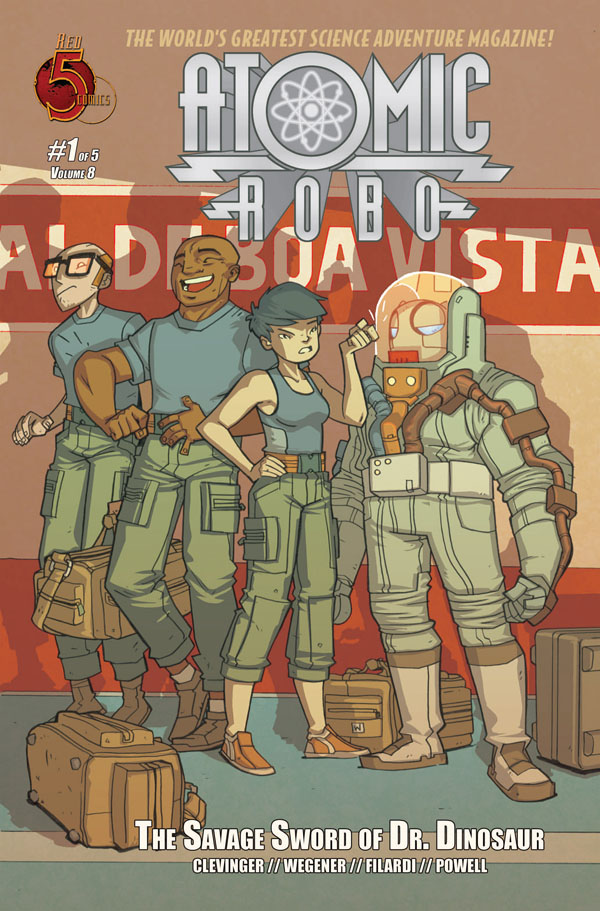
Atomic Robo: The Savage Sword of Dr. Dinosaur #1 (Red 5)
via Razorfine
From 2013.

Hey, so I love Atomic Robo.  The genius creation of Brian Clevinger and Scott Wegener is, among other things, the perennial highlight of Free Comic Book Day, the headlining act of Red 5 Comics, and the indy answer to Hellboy.  And Dr. Dinosaur is the best thing about Atomic Robo besides Atomic Robo himself.  I missed this whole arc last year, so once again I have to give thanks to Bull Moose's new trend of importing random back issues into its dying comics spinning rack.  Savage Sword opens in a pretty bleak scenario, with Robo having fallen out of public favor thanks to a trumped-up scandal, which adds valuable emotional context to his adventures.  By the time Dr. Dinosaur shows up late in the issue, it gives the story an unexpected twist, which only an Atomic Robo comic could do with the spoiler in the name of the mini-series.  Dr. Dinosaur is a character who breaks the fourth wall all over his dialogue ("It was I!  Behold, the dramatic reveal!"), just a fun character who knocks all pretension out of what comics are supposed to be.  This is exactly what fans are talking about when they ask for comics that younger readers can enjoy without be condescended to and not featuring some previously-established-in-another-medium properties.  That being said, how about an Atomic Robo cartoon?  A live action Robo might even be better!

Black Science #3 (Image)
via Image Comics
From 2014.

Having finally cracked the Rick Remender egg in the pages of his Captain America comics, I've become more interested in exploring his other work.  Black Science is a little like Sliders if it were done in the Fringe manner, a team of scientists who are able to cross between dimensions.  It's pretty interesting stuff, and once again defies my previous impressions of Remender's work.


Green Arrow #26 (DC)
via IGN
From 2013.

"The Outsiders War" is an arc I wanted to have a look at all year.  It's another instance of DC repackaging a concept for the New 52 era.  In other words, this is not the Outsiders as you remember it.  This is a new vision that is tied directly into Green Arrow's mythology, concerning that all-important origin on the island (in a lot of ways, DC has finally realized that Oliver Queen has all along been a kind of Lost figure).  The Outsiders this time are a whole network of clans that are like a human version of the spectrum of power rings introduced by Geoff Johns in Green Lantern.  In the past it's been difficult to define what exactly makes Green Arrow special, and sometimes that answer has been making him a modern Robin Hood, and sometimes a very political, liberal figure, and even sometimes, his unique relationship with Black Canary.  Finally, it seems, they've hit the nail on the head.  A couple years into his New 52 tenure and several creative teams later, the archer is being handled by Jeff Lemire during this arc, and this is exactly what the comic needed to be as relevant as the popular Arrow TV series (the emphasis on the island is the greatest link between them).  Great, great stuff.  I will have to read the whole story at some point.

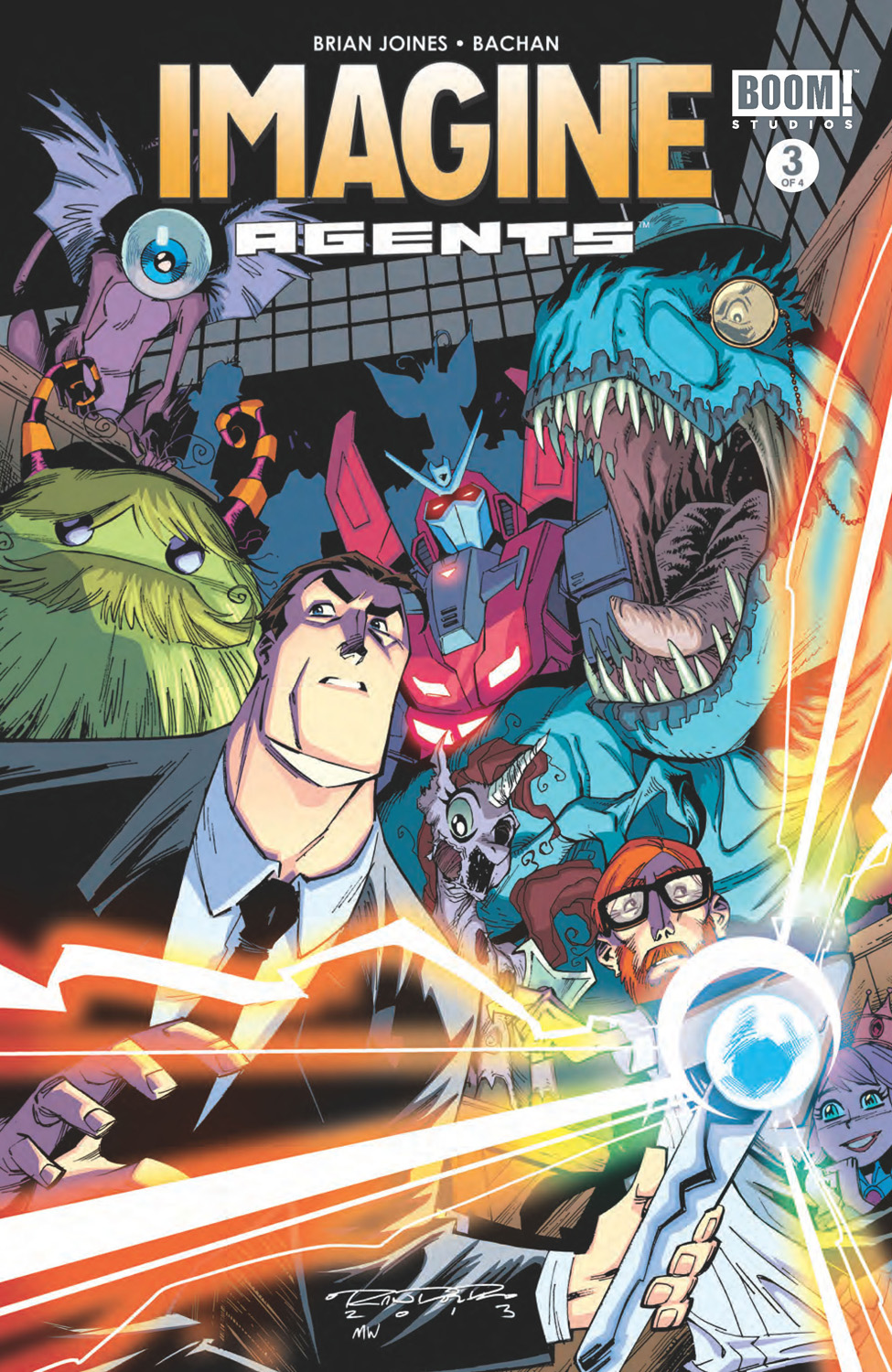
Imagine Agents #3 (Boom!)
via the Geek Girl Project
From 2013.

I thought this looked pretty interesting, but it kind of degenerated into gibberish and so I guess I was wrong.  It happens.


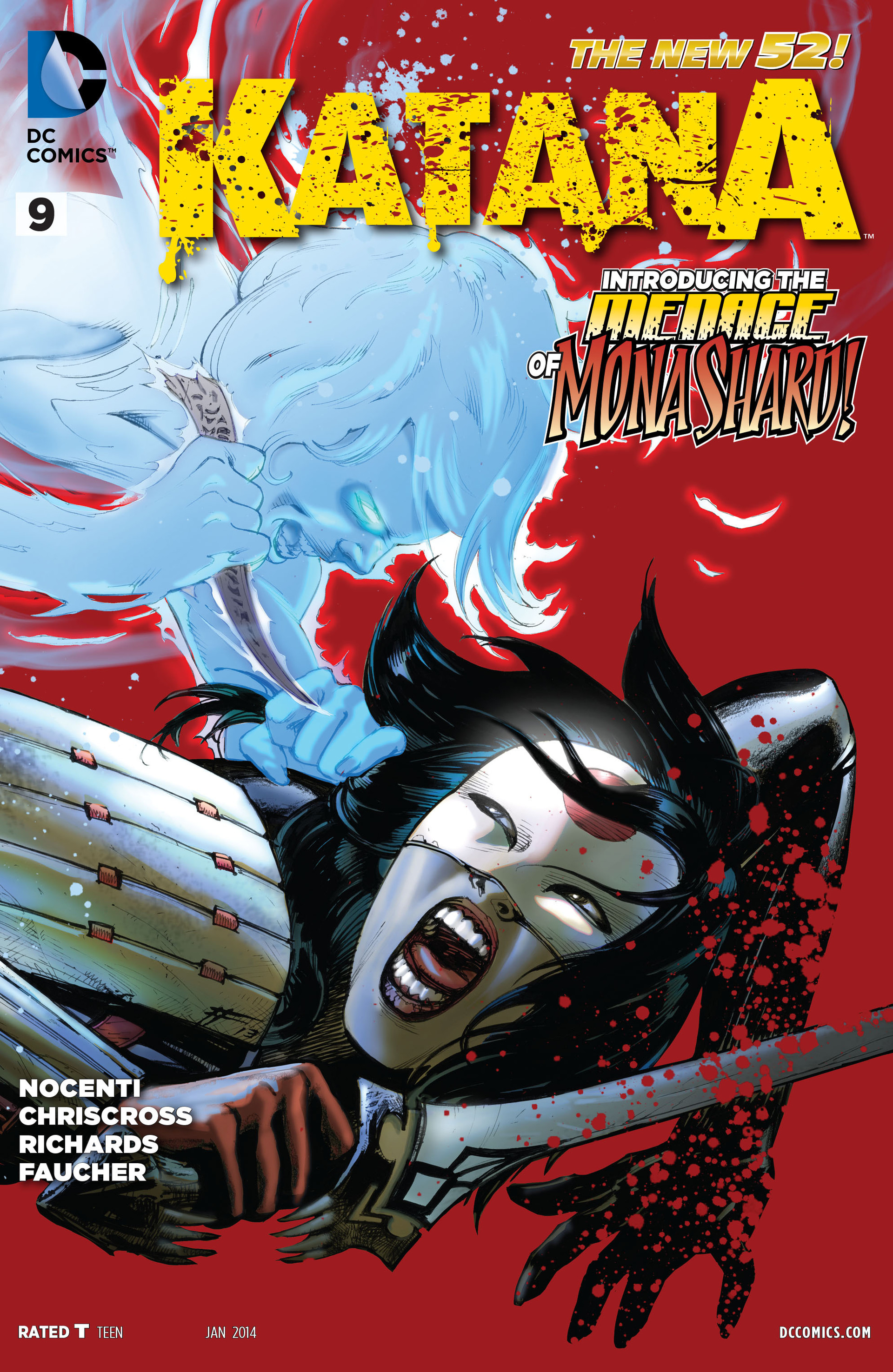
Katana #9 (DC)
via DC Wikia
From 2013.

Along with Vibe this was one of the risky simultaneous launches along with Justice League of America last year, and it's another series I've long wanted to have a look at.  It's very similar to Lemire's Green Arrow, actually.  Unfortunately, there was only one more issue left in the series at this point.


Saga #18 (Image)
via Image Comics
From 2014.

Okay, seriously, Fiona Staples does the best covers ever.  Just look at that!  Oh, and by the way, that's Lying Cat, who's able to tell when you're lying (as you may or may not have guessed).  Saga is packed with these seemingly simplistic characters who are nonetheless dynamic figures, and always shifting around the story, which this most recent Bull Moose Bargains selection from the series helps fill in a few more of those gaps that cropped up from my erratic experience with Saga last year.  There's a great moment in which Marko tricks Alana into flying, forced to happen thanks to Marko's reunion with Gwendolyn, who's trying save The Will, while Prince Robot IV is walking around desperately needing a reboot.  Is this also The Brand's first appearance?  The Brand is The Will's sister.  A seriously awesome series.

Swamp Thing #26 (DC)
via Pick of the Brown Bag
From 2013.

I wish I had been reading Charles Soule's Swamp Thing all along.  It's the DC commitment he'll be finishing out next year before his exclusive contract with Marvel officially kicks in, and his work in the series has been seriously good, another case of a DC property with a mythology a creator has been able to lucratively crack.  Much of what Soule has done has also been undermined by fans, though, because of the tie-ins the series has had with other comics in the post-Vertigo line.  Batshit insane logic.  Anyway, Alec Holland is no longer the avatar of the Green, which is to say he's no longer Swamp Thing.  His role has been usurped by Seeder.  There's a great sequence involving Animal Man, too (part of that post-Vertigo line).  After the places Alan Moore took Swamp Thing and Grant Morrison took Animal Man, it seemed impossible to do relevant material with either character again that had nothing to do with that material.  Proven wrong.

Thumbprint #2 (IDW)
via comiXology
From 2013.

Joe Hill, in case you didn't know, is Stephen King's kid.  He's also likely the reason King finally started actively dabbling in comics.  Until Hill came along with Locke & Key in 2008, King's efforts were few and far between, and suddenly there were adaptations of The Stand and the Dark Tower series, the American Vampire stint (if you want to be technical, King started these efforts a year prior to Locke & Key's launch, but c'mon), and various other projects.  This issue marks the first time I've read Hill, though he certainly seems to have established a reputable career all his own, in case there was any such fear on my part.  Like his old man, some of Hill's comics are not by Hill himself, but are adaptions of his prose material.  Thumbprint is one of those.  It concerns a hardcase of a woman who was a soldier and now an investigator.  I like this particular bit of narrative: 
"Everyone has a story, a secret.  That's what I want...the secrets.  Most humans are terrible at keeping secrets.  We're storytelling animals.  It hurts to keep things inside and feels good to spill.  The act of confession feels as right as breathing and as good as a kiss.  If you can use your voice to tell your story, you must be alive.  Only dead men are comfortable with silence."

Is there some King in Hill's literary voice?  You bet.  But I like what I've seen...

Trillium #5 (Vertigo)
via Weekly Comic Book Review
From 2013.

Lemire is a heck of a talent, one I've started appreciating in 2014, thank goodness, and Trillium was his latest creator-owned opus that concluded earlier in the year.  The nifty yet tricky first issue I've caught recently, the flip book that introduced the parallel narratives of the story, was adapted to even trickier heights in later issues, it seems, a flip book on every page.  Helpfully, there's always instructions or at least an indication as to which side to read first, and of course it's not always the one you expect it to be.  Maybe not the best way to read Trillium, though, in fits and starts.  I'll have to catch up on this one later, too...

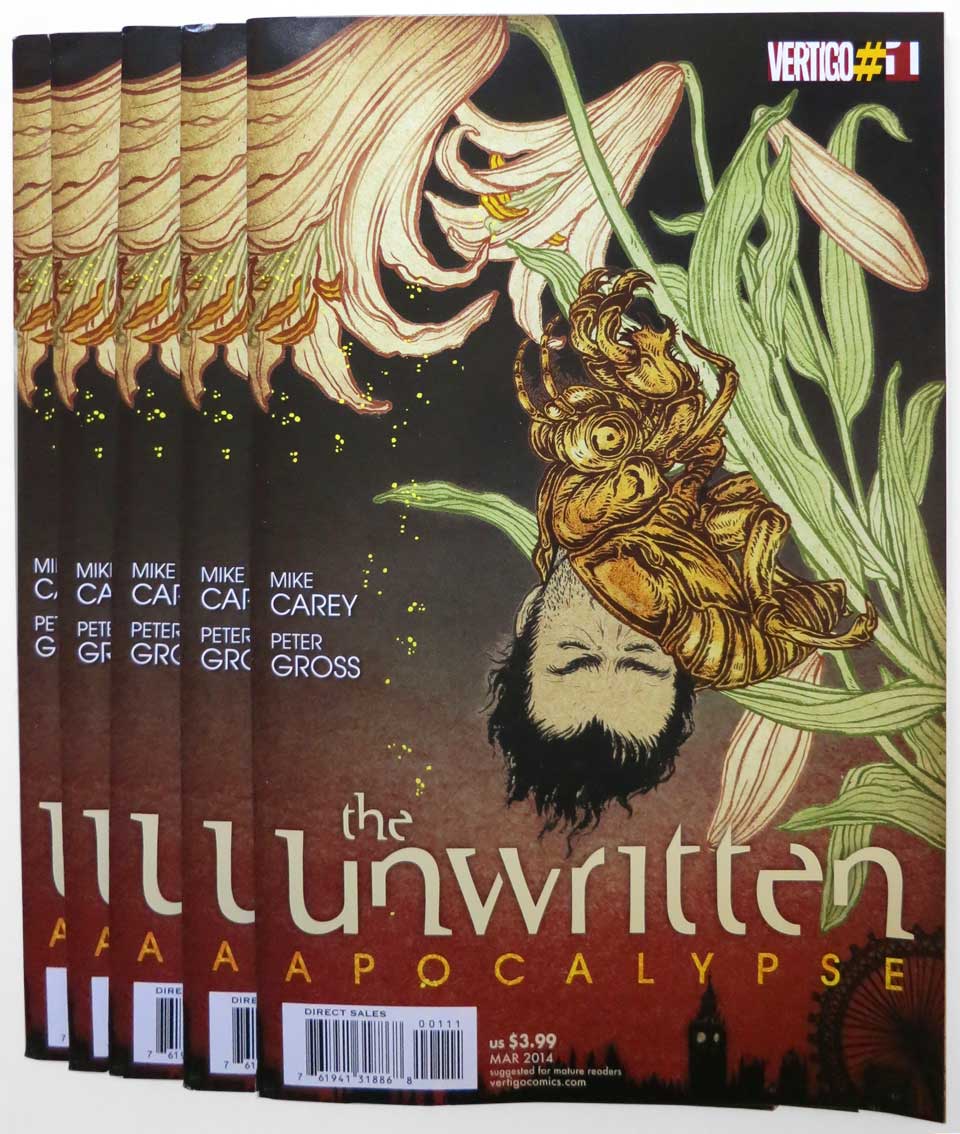
The Unwritten: Apocalypse #1 (Vertigo)
via Yuko Art
From 2014.

Previously I may have suggested that Vertigo dumped The Unwritten at the worst possible moment, after its Fables crossover, just at the moment that readers (possibly including me) might have finally started paying attention.  But it was relaunched, as it turned out, with a concluding mini-series.  And.  Holy.  Crap.  Mike Carey knocked this first issue out of the park.  It's the kind of material I've been expecting from The Sandman Overture, just a creator completely letting loose with full-on narrative fantasy potential.  Instantly became one of my favorite comic book memories of 2014.  And now I'll have to read the rest of Unwritten...


Monday, August 18, 2014

Reading Comics #130 "Bull Moose Grab Bag IV"

Local physical-things shop Bull Moose has recently changed the way it sells comics.  It remains to be seen whether it will be selling comics much longer.  But until recently it sold new comics and then slightly-less-new comics in grab bag form.  I like grab bags, and on the whole I liked what I got in these Bull Moose grab bags.  This is the last official Bull Moose grab bag, though I get to continue this sub-feature in future editions of this column as Bull Moose Bargains.  More on that when it happens!  Until then, the contents of the last grab bag.

Batman '66 #12 (DC)
The comic based on the '60s TV series that has swung back around to being culturally tolerated remains amusing for what it is.

Bravest Warriors #21 (KaBOOM!)
One of those cartoons clearly inspired by the success of Adventure Time.  Bull Moose Grab Bag did me wrong in giving me two copies, thanks to there being two different covers for some reason.

Chew #42 (Image)
I read some of the earliest issues of Chew, liked them well enough, but it was also fairly easy to...not read Chew anymore.  When John Layman wrote Detective Comics I was actually more impressed with him.  In his own sandbox, Layman is free to do what he wants...and I don't know, I guess he just wants to screw around.  These days I compare this kind of comic to Atomic Robo, and bottom line is, Chew doesn't seem as inspired.  Weirdo concept though it sports and the ability to exploit said weirdo concept, Chew is ultimately fairly throwaway.  Hey Layman, feel free to jump back into the mainstream.  Or find something more interesting to do with Chew.  Apparently he's one of the Batman Eternal writers, but does that really count?  I guess I'll keep myself posted...

C.O.W.L. #2 (Image)
A few years back I was ready to consider myself a pretty big fan of Kyle Higgins.  These days I'm wondering what happened.  Something that bothers me is that he often has a co-writer.  This is not in itself a bad thing.  He first burst onto the scene with Scott Snyder as co-writer (Batman: Gates of Gotham).  Given Snyder's reputation these days, that's not a bad association at all.  (Even Snyder had a co-writer tagging along when he worked on Severed for whatever reason.)  With C.O.W.L., Higgins is working alongside Alec Siegel.  I have no idea.  What I've read of this project, Higgins has been getting all the credit.  As far as the need for co-writers goes (it should be noted even Geoff Johns worked with James Robinson in his early years, and Robinson worked with a co-writer, too, for part of Starman), I'm wondering if this is something he really does need.  Maybe as a kind of focusing lens?  Because as far as his Nightwing ended up going, I wonder if he needed such a lens, and just never got one.  C.O.W.L., like the final issues of the Nightwing run, is set in Chicago.  There's been speculation that this is, in fact, what Higgins would have done if given the chance in his mainstream effort.  Well, maybe?  Anyway, regardless of my personal feelings on its (co-)writer, this series has gotten a fair bit of hype.  "C.O.W.L." is short for Chicago Organized Workers League, otherwise known as the World's First Superhero Labor Union.  That's interesting and all, and this is even a period piece, for whatever reason.  Maybe I just can't figure Higgins out.  Maybe I'm approaching this wrong from the start, but as with my Higgins experience in general lately, I...just wish there was as much on the page as I wish there was.

Deadly Class #6 (Image)
Speaking of Image series from writers I really wish I could like as much as it sometimes seems I should, this one's from Rick Remender, who's recently impressing me with the scope of what he's doing in Captain America.  Apparently, Deadly Class is a personal project for him.  I wish I could say I loved it and totally understood how it's so important to him, but I can't.  This and C.O.W.L. are the kinds of disappointments I think I probably need to reread.  Maybe I will.  (I generally don't do a lot of that.)

All-New Doop #3 (Marvel)
Peter Milligan is a writer I feel guilty for not liking.  He's like the advanced stage of where Higgins and Remender could be years from now.  Milligan has been around for years, a kind of junior member of the British Invasion who helped forge the early years of Vertigo.  His most recent prominent work was nearly the first two years of Red Lanterns, a series I've recently fallen madly in love with...under the auspices of Charles Soule.  As for what Milligan is doing now (not meant as a pun, but there's that, too), I...guess this is related to his earlier X-Statix, a cartoony corner of the X-Men franchise that was much cult-loved at the time.  But Doop reads like instantly pointless drivel.  I'd read Chew over this.

The Flash #32 (DC)
And what is this, a trend or something?  Another writer I wish I liked is Robert Venditti, who happens to have been the guy who took over Green Lantern following the historic near-decade Geoff Johns run.  I haven't read too much of that.  Sometimes I wish I did, because I've liked what I have read.  But then I read something like this.  I have great history with The Flash.  For some reason that history ended with the New 52 relaunch.  No disrespect to the early run, because I just never really got around to reading it, probably because I was disappointed that Johns ended a pre-New 52 run prematurely following the excellent Flashpoint event.  So I wish I liked what I read here.  But I just didn't.  The best material is still pretty weak, Barry Allen bonding with the new version of Wally West.  I don't know if Veditti's heart just isn't in this title, but it just reads so tepidly, a very far cry from Johns or Mark Waid.  For a Flash reader who wishes The Flash would always be a must-read, as it certainly was under Waid and a slightly lesser extent Johns, this is not just disappointing, it's kind of disheartening.

Justice League Dark #32 (DC)
I actually like this series.  I'm waiting to be really wowed by it.  Hollywood was wowed enough to option a movie based on it, so there's that.  Frankenstein is usually featured in it, but not this issue.  As referenced during his recent appearances in Batman and Robin, he's been on a sabbatical.  We've got Zatanna, Deadman, and we-have-our-own-titles-too guys Constantine and Swamp Thing.  J.M. DeMatteis is a writer I greatly respect, but he doesn't always write to potential.  He's someone who's better than the lot I've been grappling with in this column, but I sometimes wish he'd be better.  If this were a truly dark series, maybe that might be the case here.  I don't know.

The New 52: Futures End #8 (DC)
Futures End badly wants to be a new 52.  I know, with wording like that, I could easily confuse you.  52, as opposed to the New 52, was the 2006-2007 weekly series that helped prove possible the modern viability of such a format.  I loved it.  I mean, I loved it.  (It ranked fourth in my list of all-time favorites.)  I've been trying to make comparisons between Futures End and 52 since the newer title launched, based on my sporadic experience with it.  Maybe if I read it every week my opinion would be different, but I just don't see it as hitting the mark quite as truly as its predecessor.  This is disappointing, too.

...Yesh.  With all these disappointments, is this because this was all part of the final Grab Bag?  The world may never know...

Tuesday, August 5, 2014

Captain America #22 (Marvel)

writer: Rick Remender
artist: Carlos Pacheco
via Comic Book Movie
Hey, so you know the monkey in the room concerning classic Marvel comics and movie personality Captain America, that he's practically the poster child for steroids?  Someone finally wrote a story where his juice is taken away.

This leaves Steve Rogers as a shriveled old man, kind of what he'd be if he'd aged naturally from his original WWII existence.  Instead someone finally magically stripped him of whatever happened to have allowed him to originally escape such a fate.  And that's something DC fans saw twenty years ago in the pages of Zero Hour.

Anyway, so as part of the Marvel Even-More-Now initiative, as you might have read, the big three Avengers (Cap, Iron Man, Thor) will be going through a simultaneous identity crisis.  I'm not really clear on Iron Man's, but as far as Thor goes, apparently you can become the Norse god of thunder just because you can possess his power by lifting his hammer (I don't know, it sounded less stupid in my head explaining it that way, but anyway, they really stretched temporarily replacing him, one way or another).

I like Rick Remender's idea for Cap best.  I wish someone really would address his steroids more directly, but this is pretty good.  Sure, he'll get his steroids back (keep saying it and maybe it'll sink in), Falcon will go back to being Falcon, after being Cap for a while, but in the meantime there's an interesting wrinkle.

This is another instance of Remender writing Steve Rogers and/or Captain America more directly and relevantly than Ed Brubaker ever managed.  (The Winter Soldier thing was a great idea, but it's also a great gimmick, as in...gimmick.)

Having once randomly caught an issue and finding much to my surprise that I liked it, I was glad to give Remender's run a more deliberate look, and this was a good issue to sample.

Thursday, July 3, 2014

Reading Comics #126 "Bull Moose Grab Bag III"

Ten comics for a steal.  Even when the contents go wrong, you can't go wrong.  These happened to all be bagged and boarded.  Always a plus.  I used to do that with all my comics.  Became less of a priority after the first break in reading at the start of the millennium, and then I sold that collection, and sold the next one.  What're you gonna do?

Uncanny Avengers #16 (Marvel)
Here's Rick Remender again, our new friend from the pages of Captain America, apparently in the thick of some gigantic crisis that will likely have been rebooted, given all the characters who are killed off during it.  The big threat constitutes the Apocalypse Twins (this series is part of the X-Men/Avengers mash-up that has persisted since the end of, well, AvX, so the referenced Apocalypse is the one and same Apocalypse you may or may not have recognized as teased at the end of X-Men: Days of the Future Past).  This story kind of wraps up next issue, but carries over into the next storyline.  Well, whatever.  The big development in this particular installment involves Thor and Captain America being all climactic, in typical Avengers fashion.  The artist is Steve McNiven, whom I remember most fondly from the "Old Man Logan" arc in Wolverine.  Good reliable talent right there, makes this looks sufficiently impressive.  As usual, I don't really understand what Remender is up to.  Like Jonathan Hickman, Remender for me is what Grant Morrison seems to be for a lot of other readers.

Batwing #28 (DC)
For a while, Batwing was the African representative of Batman Incorporated.  I enjoyed what I read of that from the start of the New 52 era.  Recently the armor has gone to Lucius Fox's son.  Based on this issue I don't see this as an improvement.  Writers Justin Gray and Jimmy Palmiotti have plenty of good credentials behind them (various Jonah Hex and Uncle Sam & the Freedom Fighters comics chief among them), but they're felled by the typical trap of trying to fake their way through the stereotype urban scene (ready to write Milestone adventures they are not).

The Flash #27 (DC)
At one time I read The Flash regularly without exception, thanks in large part to the remarkable Mark Waid run that began a little over twenty years ago.  I haven't really done much of that lately, not really at all since the New 52 launch, perhaps out of disappointment that Geoff Johns cut short his second run with the latest relaunch.  This issue, from recently departed (co-)writer Brian Buccellato, who along with Francis Manapul has shifted over to Detective Comics, is actually pretty good, mixing Rogues with history, playing with the revised Barry Allen story of having the death of his mother hanging over him thanks in part to fact that her murder was pinned on his father (made for truly excellent material in Flashpoint).  I still have to wonder if this increasingly revolving game of musical chairs will lead to resolution on that.  Or simply hope Johns will return to the thread he left behind...

Forever Evil: A.R.G.U.S. #4 of 6 (DC)
I remember Martin Gray over at Too Dangerous for a Girl calling this perhaps the best part of the Forever Evil crossover event.  A.R.G.U.S. is the we're-not-S.H.I.E.L.D.? group from DC (which is funny, because Checkmate is a perfectly viable and distinctive alternative).  The main draw for me is the presence of Steve Trevor, who in a previous incarnation was the, ah, Lois Lane to Wonder Woman's Superman.  Since the New 52, he's best been defined by his inability to retain that relationship, and thus his efforts to find a surrogate.  I thought he'd found it in Justice League of America, but things might've changed when I wasn't looking.  Another sometimes-supporting cast member for Wonder Woman, Etta Candy, is present in the issue.  Wonder Woman herself isn't in the issue (mostly), but curiously she is on the cover, and her frequent enemy Cheetah shows up both on the cover and on the last page (it's actually artist Neil Edwards' weakest moment the whole issue, besides mouthless Psi).  One has the sense that the whole point of the mini-series was to further establish the Wonder Woman brand in the New 52.  This is overall a good thing.

Green Lantern #28/Red Lanterns #28 (DC)
via Hit Fix

via Green Lantern Wikia
This is another another comic I was glad to have gotten randomly in one of these grab bags, especially based on my increased appreciation for Red Lanterns from other grab bags.  This was the flip book saga featuring the debut of Supergirl as a Red Lantern.  This is a saga that completely capitalizes on the New 52 version of Supergirl, who isn't the well-known superhero she was in previous incarnations.  In fact, no one knows who she is when she pops up as a Red Lantern.  They in fact think she is just a random Red Lantern.  This occurs in the midst of other things that've been developing in the Green Lantern franchise, likely by the lead of Robert Venditti, who was given the unenviable task of following Geoff Johns in that regard (unless people were just looking for a fresh start, which Green Lantern itself didn't really get at the start of the New 52).  One of his ideas has been to restrict the use of all those rings floating around, with the idea that unrestricted usage drains the universe of essential energy.  Something like that.  Star Trek: The Next Generation toyed with that idea concerning warp drives.  Venditti also seems to have reconfigured a few semi-familiar faces from days past, including Evil Star (totally reinvented and it seems quite interestingly), Kanjar Ro, and Bolphunga the Unrelenting (famously debuted in the same Alan Moore as Mogo, "Mogo Doesn't Socialize").  Each time I sample Venditti's Green Lantern I like it.  Certainly the same goes for Red Lanterns these days.  The writer on the flipside is Charles Soule, who's always impressing me.  The man running the Red Lanterns in the comics is Guy Gardner, who is actually less of a hothead than ever before.  He's also got Ice by his side once again (more fond memories from two decades ago), although it's as contentious a relationship as ever.  (By the way, Guy looks awesome these days.  About the first time ever that can be said.)  The main thrust of the flip book actually has far more to do with Green and Red Lanterns not getting along (but for different reasons than before, more like a professional rivalry these days).  When they realize this mysterious girl is Kryptonian, they of course realize she has something to do with Superman.  If you're not reading either (or I guess any of these, including Supergirl), this would be a good sampling occasion.

The Superior Spider-Man #26 (Marvel)
I recently talked a little bit about how the Doctor Spider-Man era ended, but on its way to that ending there was (seemingly as always) Green Goblin to deal with.  But in this particular issue Goblin is dealing with the Hobgoblin, trying to figure out who's behind the latest incarnation.  He thinks he knows.  He's wrong.  There are a number of stories in the issue with a number of artists drawing them.  One is Peter Parker inside the so-called mindscape figuring out how he'll find his way back.  Another is the Avengers finally rejecting Doctor Spider-Man (I won't explain that again).  The final is the Goblin/Hobgoblin one, which amounts to the most significant one (it does rate the cover), and feature the work of Humberto Ramos.  I was a huge fan of Ramos for years thanks in large part to, ah, his collaboration with Mark Waid (I just can't avoid mentioning that guy!) on Impulse.  I'm glad he's remained relevant, and that he's become one of Dan Slott's chief collaborators on whatever version of Spider-Man he's writing.  His Goblins are fantastic.  Who knew?  Plays completely against type (as far as I knew), but it's a huge reason why that's the best thing about this issue.

Superman #27 (DC)
One of the major developments of the New 52 was the sudden end of the romance between Lois & Clark.  (Guess she didn't want to become a desperate housewife.  Ha!)  But thankfully, Lois Lane has stuck around.  And even gained powers.  But I guess with this issue she lost them, which as far as current logic goes is a good thing.  Superman risks a giant gamble in allowing Parasite to siphon them from her.  Scott Lobdell is at the helm.  Apparently his run wasn't very popular.  I still have no idea why fans find him so hard to love.  (But, ah, the next issue promises Starfire.  There you go.)

Swamp Thing #28 (DC)
Swamp Thing, with about a decade lead time, was a poster child for the early Vertigo, thanks to Alan Moore's psychological approach.  In the New 52 the character has returned to his own mythology, which Charles Soule goes about exploring in this issue.  The character of Capucine, featured and named on the cover, is fascinating, a long-lived woman with an incredible story all her own.  This is good stuff.  Another series I've never really thought to buy deliberately, but am infinitely glad each time I've found it in a grab bag.

Talon #15 (DC)
A spin-off from Scott Snyder's Batman...not hugely compelling a concept on its own.

Teen Titans #27 (DC)
Remember Impulse, which I mentioned earlier.  That was Bart Allen's earliest incarnation.  Geoff Johns turned him into Kid Flash.  And the New 52, thanks to Scott Lobdell and a new backstory, or I guess forestory, is a freedom fighter from the future.  I've long been interested in reading some of this for myself, and I think it's pretty interesting.  The only curious element is the strange looks Kid Flash keeps giving people, as if he really is the villain fans have been interpreting this new version of the character to have suddenly become.  One of Lobdell's original Titans, Solstice, has her story explained in the issue, too, while the Superboy situation is explore, too.  (From what I've read about it, I think that's pretty interesting, too.)  Besides all that, I also found it interesting that Scott McDaniel provided breakdowns.  I found this particular image to make that most obvious:
via Up Roxx
If you know McDaniel's work at all, you can see it most clearly in the shoulder.  He's another talent I wish would get a better break these days.  He's long been a favorite of mine (how long? twenty years of course!).  The last significant work he's done was the short-lived Static Shock at the start of the New 52, which to say it was received poorly would be an understatement.  This is unfortunate, since McDaniel started out that one as both artist and writer (his first real effort in that regard), which was a statement of confidence from DC.  I don't know what's happened, but it certainly seems like he lost it, apparently in both regards.  I wish him luck digging his way back to where he belongs.