/36_medium.jpg) |
| via Comic Book Roundup |
artist: Patrick Gleason
"Robin Rises" continues! In Part IV, Batman's backup (Red Robin, Batgirl, Red Hood, Titus, and the reluctant Cyborg) has arrived on Apokolips as Batman himself continues to deploy the Hellbat armor to full effect in his rampage through hell as he seeks to reclaim the body of Damian. I love when Red Hood (Jason Todd) says, "Went a little Red Lantern here, don'tcha think?" as it evokes Tomasi's time in the Green Lantern titles. It's a full-on action installment of the arc, allowing Gleason ample opportunity to demonstrate how awesome his work is. The big payoff is on the last page, one of those perfect cliffhangers: standing behind Batman is the shadow of Darkseid himself. The Dark Knight merely states, "Hrrn. About time you showed up." This moment evokes not only the opening arc of the New 52 Justice League reboot, but the dramatic events of Final Crisis. Tomasi has succeeded in capturing the Batman every geek always knew existed, one who could take on any challenge without sweating it. December promises big, big things...
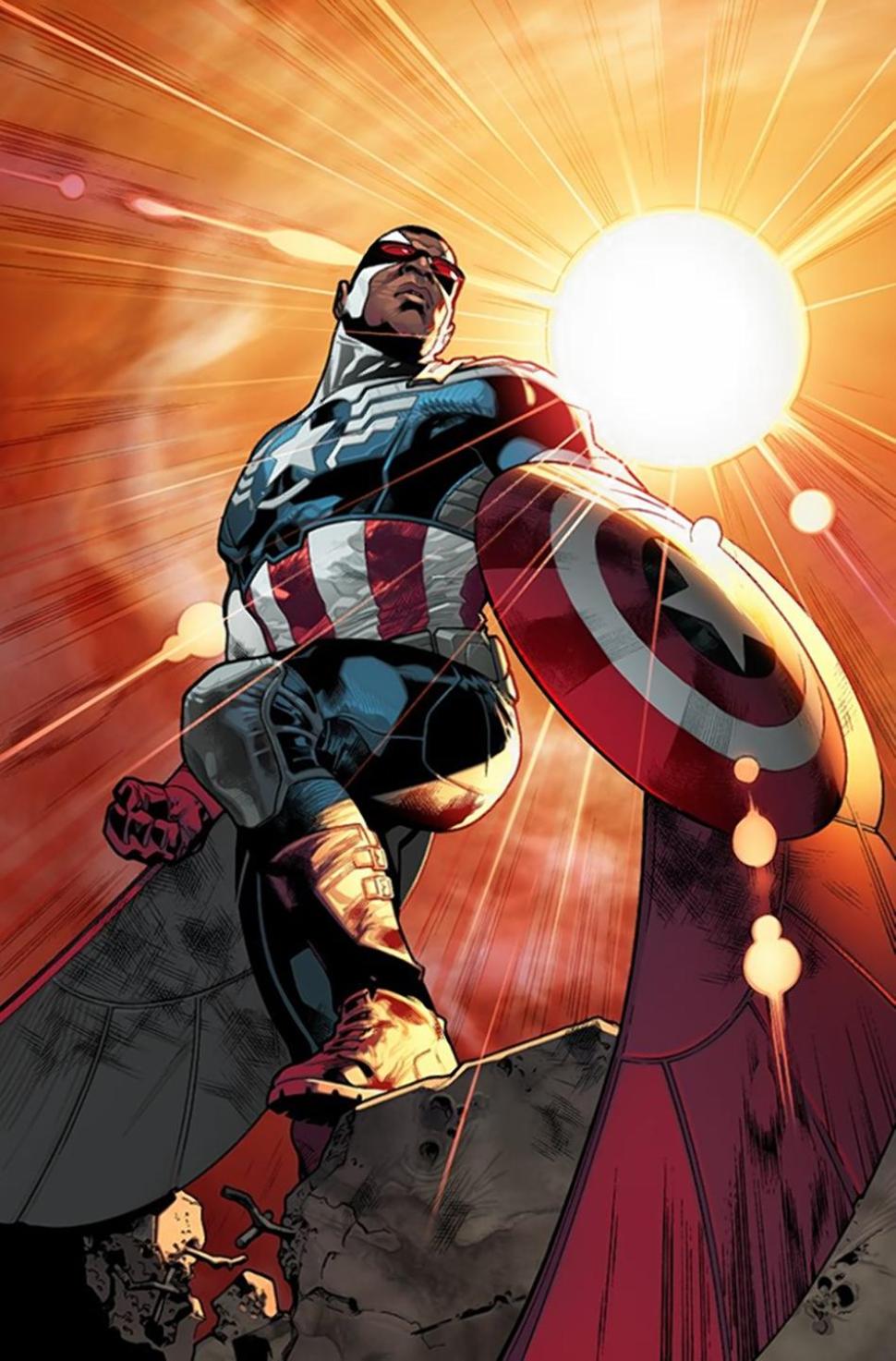
All-New Captain America #1 (Marvel)
 |
| via Marvel Wikia |
writer: Rick Remender
artist: Stuart Immonen
I had already been intrigued by what Remender had been doing with Captain America, but then Sam Wilson, the Falcon, was announced as inheriting the role, a whole reboot of the series was in order, and Stuart Immonen was tapped as artist. I last caught Immonen's Marvel work in the pages of Brian Michael Bendis's All-New X-Men, and it was the best work I'd seen from him for the company, a subtle return to the form I'd admired so much in his Superman work. His All-New Captain America may be the closest yet. Times have changed since Immonen's Superman, certainly. Coloring has become a major business, adding whole new dimensions to the art, regardless of the artist. Sometimes the colorist is actually the most prominent contributor these days (on that score, aiding Immonen and inker Wade von Grawbadger are Marte Gracia and Eduardo Navarro), along with more detailed shading (whether attributed to Immonen or von Grawbadger; shading was usually conspicuously absent from Immone's Superman, which was what helped make it so striking). Visually a very stunning comic, then. Story-wise is pretty interesting, too. The last time Steve Rogers, for one reason or another, was replaced as the Sentinel of Liberty it was by James "Bucky" Barnes, the Winter Soldier, who was billed for all intents and purposes as pretty permanent. There was a giant hubbub about the updated uniform Alex Ross created for the occasion. Wilson gets a new uniform, too, that looks a little like a cross between his Falcon garb, the S.H.I.E.L.D. design Rogers for a time ran around in, and of course the traditional Captain America look. Upstaging Wilson's Cap is the son Remender introduced in his clever Dimension Z story, Ian, who is actually Arnim Zola's kid. Ian, by the way, has adopted the moniker Nomad, which has become a part of Cap lore ever since Rogers himself used it in one of his earlier exiles from the cowl. The dynamic between Wilson and Ian is unusual, almost as if Wilson is less Cap than Ian is. Remender provides a one-page review of Wilson's origins in the likely event readers will not have been familiar with it. It's a darn good issue regardless of all the altered dynamics.
The Fuse #7 (Image)
 |
| via Image Comics |
artist: Justin Greenwood
I became a devoted fan of Johnston's thanks to his soon-to-conclude opus Wasteland, so to see a couple of new projects launch at Image this year was a nice way to see that others have noticed his talent, too. In this futuristic cop procedural he's joined by Greenwood, who helped on Wasteland but should better be known for Marc Guggenheim's Resurrection. This issue begins the "Gridlock" arc, which concerns contestants in a reality show. While I don't read the series regularly, I like reading the letters column featuring those that do, and their observations of the main characters, who are doubtless easier to keep track of when you don't skip around like I do...
Red Lanterns #35 (DC)
 |
| via Darkstar Sci Fi |
artist: J. Calafiore
Here's where I interrupt the proceedings for a moment and complain about the unreliability of the pull list service I've been receiving from my local comics shop. I don't know why they've had such problems, and maybe they have good reasons, but it's certainly been annoying. I haven't read the Starlight finale because of this and after a few months I've only now just gotten them to produce an issue of Supreme: Blue Rose for me. And I read this issue of Red Lanterns late because of the same problems.
Anyway, enough complaints. This was part of the first month of the "Godhead" crossover event in the Green Lantern titles, featuring the New Gods as they've targeted the various power rings as the answer to the Life Equation. When we last saw Guy Gardner he'd just defeated Atrocitus and taken a sabbatical. We pick up with Guy on vacation with his sometimes beau, Ice (not to be confused with Bea, Ice's sometimes bestie, Fire). The issue is heavily Red Lanterns-centric, possibly because Soule's days, sadly, are numbered in the series and at DC in general (darn exclusive contract at Marvel!). New Gods show up, and then Simon Baz does, too. I'm glad to see Baz, who was Geoff Johns' late addition to Green Lantern lore at the end of his tenure (he remains, though, at DC, obviously).
Superman #36 (DC)
 |
| via IGN |
artist: John Romita, Jr.
Speaking of Johns, arguably his biggest gig at the moment is in the pages of Superman (I check in over at Justice League more than read it regularly these days, alas, after having missed so much of the last few years). Ulysses, the latest strange visitor, has finally tipped his hand. For maybe half the issue things still seem exactly as they have in previous issues of the arc, but then Neil Quinn (Ulysses) visits his parents and begins to reveal what's really going on ("I love you both so much. That's why you can't come with me." "I don't understand." "I didn't know you were still alive! They didn't tell me you were still alive! I'm trying to protect you!") It seems the offer he made to humanity at the end of last issue is the ulterior motive most readers were probably expecting from his first appearance. And soon Ulysses and Superman are fighting, at last. Romita is a big-impact kind of artist (he did work on Millar's Kick-Ass after all), and he gets to do a good bit of that here. Wherever Johns is headed with all of this, it remains expertly paced.
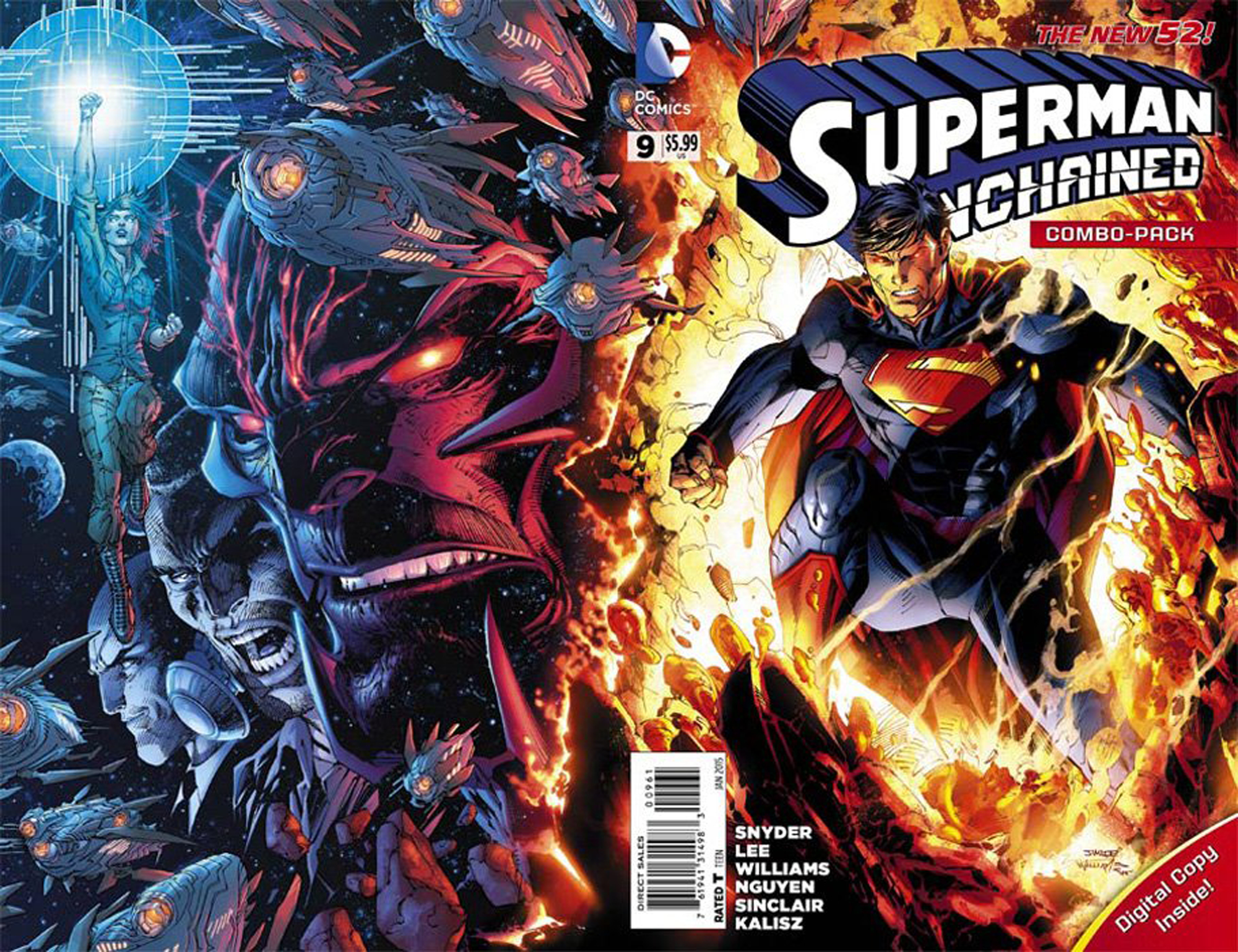
Superman Unchained #9 (DC)
 |
| via Previews World |
artist: Jim Lee
Given my complicated feelings toward Snyder, I was reluctant to check out his big Superman story. This final issue, however, may have proven my doubts wrong in a fairly major way. It's not even so much how he handles Superman but rather Lex Luthor. Here's some prime Luthor dialogue to illustrate:
"You look at him, and you see a light leading the way...But instead he is a light lost in the darkness."
[...]
"What I expected to see, looking backwards through time at his efforts, was, as you said, Ms. Lane: someone who stood for something. I thought a profile would emerge, the profile of someone sure of himself. Someone sure he knew what was best for all of us. But I saw that Superman, whoever he is, is trial and error."
[...]
"The point I'm making is that Superman doesn't stand for anything. He's just a man, stumbling through life. He's not a great beacon, he's barely a candle, lighting a path for himself the best he can. And as we all know, eventually...candles go out."
"I reject him," he goes on to say. In essence, of course, Luthor is equating Superman with America. It's the first time I've noticed a particular perspective from Snyder, and it's one I completely recognize, as very similar to my own. It's a revelation. Regardless of your own perspective, this is Luthor making the same observation that is supposed to have been made of Superman all along ("...and the American way!"), only from a modern perspective. It's really quite startling. Bravo, Mr. Snyder. Lee's Superman is distinct from the work he did in the early issues of Justice League, which is interesting to note.
Superman/Wonder Woman #13 (DC)
 |
| via IGN |
artist: Doug Mahnke
Charles Soule's year on the title was capped with a statement on the whole concept readers considered pretty definitive. What can Tomasi add? Plenty, as it turns out. When Wonder Woman showed up in the pages of Batman and Robin, it was one of the rare odd notes in that series. This is proof that Tomasi more than understands the Amazon Princess. "You fight with too much on your mind. Who did you train under?" "My father," Superman responds. "Obviously," she says. Fight scenes are rampant in the series, and the contrasting approaches these lovers take as always been a focal point. Tomasi leaves room for these observations from Wonder Woman, too [spoken to a civilian]:
"In my culture this fragility would be your downfall. Here it's practically a virtue. I've been doing my best to help some of you since my arrival, but how will you ever grow stronger if you need us every waking moment?"
Superman has this in way of a response: "This man has internal bleeding and needs immediate help. You should've done something instead of talking to him."
It's the kind of Wonder Woman that Geoff Johns tried to introduce in the early issues of Justice League, who has recently come to what she calls "man's world" and struggles to fully comprehend it, so that what ends up defining her is the gap that exists between herself and those she is theoretically here to champion. For Superman, there is no gap, and for Batman, the third member of DC's Trinity, the gap is something he's constantly trying to create with his enemies. One is human but alien (Wonder Woman), one is alien but human (Superman). Tomasi is excellent at these kinds of interpersonal observations. He'd perfect for this series.
Umbral #10 (Image)
 |
| via Image Comics |
artist: Christopher Mitten
Hey, remember when I was giving props to colorists earlier, this is definitely a series that owes a huge debt to its colorist. Otherwise it's a Wasteland reunion between Johnston and once-and-final artist Mitten. For anyone, and that would be just about everyone, who struggled to understand the appeal of Wasteland, Umbral is your shot to embrace the fantastic vision of Johnston and Mitten. Like The Fuse I haven't been reading it regularly, so it's a little tough to completely appreciate the proceedings, and because Umbral is a continuing story it's all the harder. I think of the two, I can see myself making a commitment to this one next year. Although I may end up reading both regularly. We'll see!


