Sunday, February 15, 2015

Digitally Speaking...29 "Combat Jacks"

via comiXology
Combat Jacks #1 (Banana Tale Press)
From 2013.

No, that's not Catwoman on the cover, and no one trying to impersonate Catwoman is in the comic, either.  So if you think you're going to read this for that, think again.

For the record, that's not why I read it.  It was part of a bundle.

And also, is this for real?  Space pumpkins that turn out to be monsters?  Seriously?  Seriously.  That's what Combat Jacks turns out to be.

A new planet is somehow lodged into our solar system.  A bleak-future-Earth-looking-for-colonization-options sends folks there to live.  Contact is lost.  A military unit is sent in to find out what happened.

And yeah, finds space pumpkins that turn out to be monsters.  Also, the space pumpkins were the defining trait about this planet.  Apparently the only thing the people in this bleak-future-Earth-looking-for-colonization-options does by way of initial research is take pictures and send people there.  

...Some very, very questionable storytelling, folks...But hey!  There's Not Really Catwoman who's not really in it!  Awesome!

Digitally Speaking...28 "Classwar"

via Goodreads
Classwar #1 (Com.X)
From 2002.

Mainstream professionals Rob Williams and Trevor Hairsine make Classwar look mainstream professional....And that's about it, really.  That's the best I can say about it.

The idea behind Classwar is one of those expose-the-truth-behind-what-America's-doing deals, from back in 2002, a true Iraq War comic before the Iraq War even happened.  Reading it now, you wouldn't even realize that if you didn't know its original publication date.

Another blast from the past is a figure who seems comparable to Ultimate Nick Fury, also known as the Samual L. Jackson version we know and love from the movies who debuted, in full appearance, in the pages of The Ultimates the same year.  

All this weird prescience is probably as close as Classwar can get to being worth talking about.

The main character is a superhero called the American.  (Never mind that I just remembered the Jack Kirby character named Fighting American, a kind of Captain America who is...not called Captain America.)  Which is actually not a bad idea.  Straight and to the point.  Simplifies things, much as the storytelling does.  The American is like Superman if he were...Captain America.  See also: The Mighty.  Or Life and Times Savior 28.  Or The Plutonian from Irredeemable.  You get the picture.  Classwar is none of those. 

Move along.

Digitally Speaking...27 "Ciudad"

via Comic Files
Ciudad #1 (Oni)
From 2014.

The subject of girls being kidnapped in Mexican cities was something I read for the first time in Roberto Bolano's masterpiece 2666.  The subject in general has been featured in Liam Neeson's popular film series Taken.

Ciudad the comic book...doesn't seem to have learned much from either.

It's not bad, and maybe in some sense it may even helpfully simplify things, for anyone who still doesn't know much about the subject and happens to have come across this comic book by way of introduction.

That's another way of saying, this is not a piercing study of the problem, nor is it a cool action vehicle.  It's all kind of generic.  Maybe it improves in further issues.  Although based on this debut, I have no interest in finding out.

That being said, maybe it works better for you.  Who knows?

via comiXology


Digitally Speaking...26 "Chloe Noonan: Monster Hunter

via Digital Spy
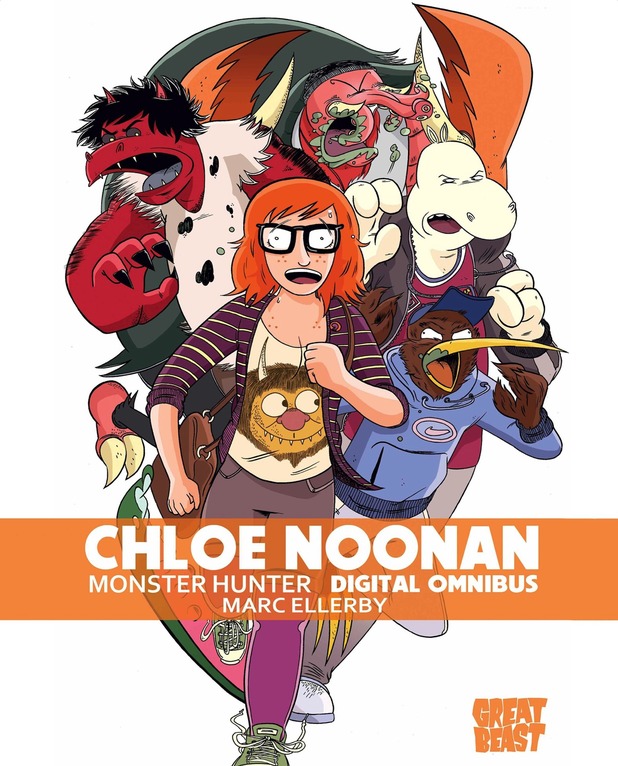
Chloe Noonan: Monster Hunter (Great Beast)
From 2013.

Ever wonder what might happen if you crossed Scott Pilgrim with Buffy the Vampire Slayer?  Wonder no more...

Chloe Noonan started out as Marc Ellerby's version of Buffy if she didn't have powers.  It kind of got a lot more loose from there.  Chloe's life is more about her friendship with Zoe, in some ways her polar opposite (though equally powerless), and only incidentally about fighting monsters.

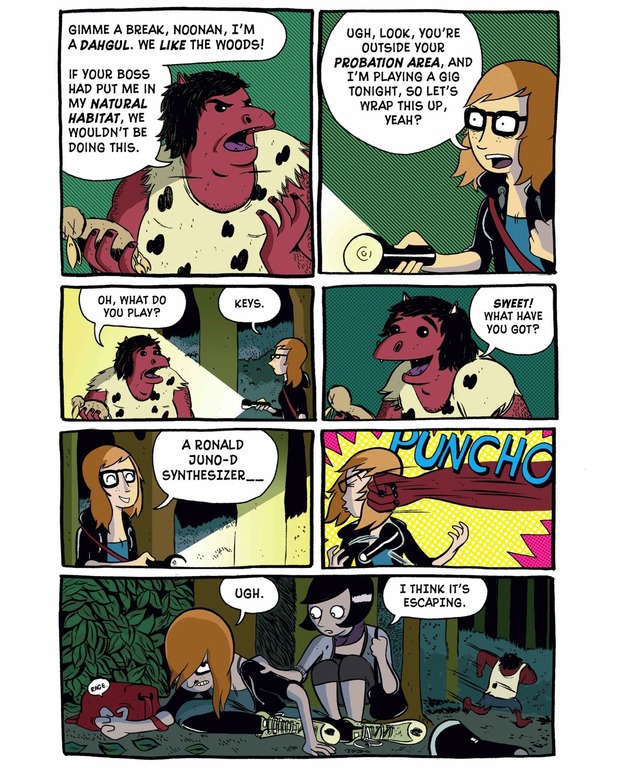
Actually, the monster bit is one of the more notable aspects of Ellerby's storytelling, and not for the obvious reasons.  Ellerby's monsters aren't scary so much as unwanted social elements Chloe is just trying to clear out of the way.  Maybe in a different context this would be biting commentary, but as I said, Ellerby tends toward a Scott Pilgrim style.

The fact that Chloe (and by extension everyone else) is British doesn't come up right away, but then it becomes important, insofar as anything else that happens is important.  It's goofy fun in a cartoon kind of way.  That's about the sum of this stuff: it can easily be pictured as a cartoon.

via Digital Spy


Digitally Speaking...25 "The Chairs' Hiatus"

via comiXology
The Chairs' Hiatus 
From 2013.

This is an excellent little graphic novel about being part of something, and what it's like to then become detached from that thing.

Matthew Bogart's simple approach is to follow the course of the reunion between two women who used to be in a rock band together.  The lead character walked away and has been trying to distance herself from her old life.  She doesn't even know what to make of reminders, of fans who recognize her.  This is the part where she's so far removed from what she used to have, she's become completely isolated, and prefers that isolation.

Then her bandmate comes back and forces a reunion, which backfires spectacularly, and as a result, we get to learn exactly what happened.  And it's not just a story about being in a band and touring, but can be applied to other circumstances, and as such has a somewhat powerful therapeutic potential to it.  How relationships end, and how they can begin again, is something Bogart has expressed in a profound way.

This is a thing of beauty.

via Matthew Bogart


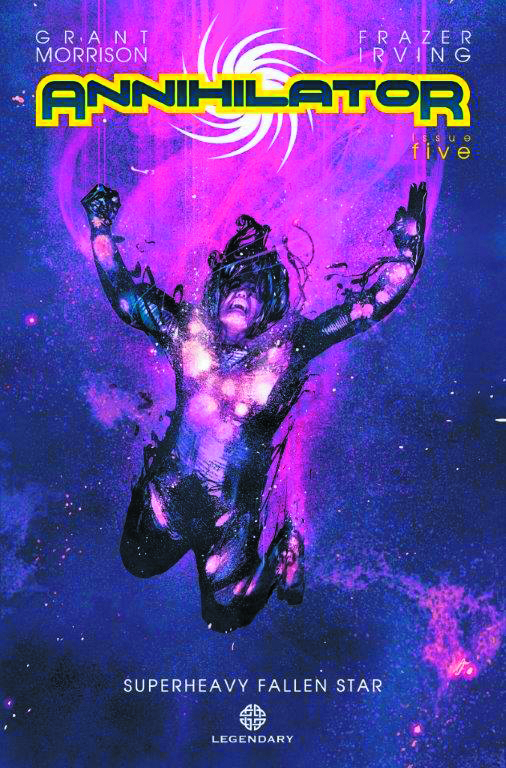
Annihilator #5 (Legendary)

via Previews World
writer: Grant Morrison

artist: Frazer Irving

The penultimate issue begins to explain everything and brings the story to its long-impending climax: the death of Ray Spass.

The Hollywood screenwriter attempting to revive his career with a brilliant new script who instead embarked on a quest with the dubious figure of Max Nomax to figure out how Max, the lead character of Ray's script, survived an epic conflict, has now reached his fateful moment.  He's near completion of the script, by the way.  And dying from a tumor in his brain.

He's discovered that Max isn't the hero after all, but a true villain, who gambled away the love of his life to settle the score with his rival, fueled by a madness that has been waiting for its own culmination from the start, when he declared that he would find a solution to death.  To bring back the woman he sacrificed?

Along the way, Ray's ex-lover, Luna, was also introduced, and this issue we even learn details of the big hit Ray has been trying to live up to.  Grant Morrison has been especially lucid, if typically heavy on the big ideas, and Annihilator as a result seems like a good way to introduce his work to movie audiences.  Have I mentioned Terry Gilliam as a possible director already?  Because the connection is too obvious, increasingly so.  If another director, then Christopher Nolan, who would have ample material to slow the pace down to a more contemplative interpretation.  

Frazer Irving's art is indelible to this project, a match step-for-step with the chaos Ray has been experiencing and the full grandeur of it.  Art direction has always been key to both Gilliam and Nolan's careers, aside from their storytelling.

There's so much to say before the story concludes, there seem to be several moments on which the issue could have ended, but there's always another step to be taken, and Morrison, always a step ahead of his readers, is keen to remember.  Every time Irving zooms in on a detail in the midst of a page otherwise concentrating on something else, it's a reminder of how in sync they are.

The ending will be most interesting...

Digitally Speaking...24 "Annihilation"

via Marvel
Annihilation #1 (Marvel)
From 2006.

I like to browse comiXology's freebies just to see what's available.  More often than not, a landscape of material I've already added to my library.  So when new stuff appears, it's exciting.  Marvel tends to make certain issues available as they're somehow related to what's currently relevant.  In this case, Annihilation is the birth of the Guardians of the Galaxy phenomenon from last year's hit film.  I'll explain elsewhere exactly how the t's are crossed and the i's are dotted, but suffice to say, as far as Marvel's space heroes go, this was basically Green Lantern: Rebirth.

Keith Giffen was writer.  Later, he was succeeded by Dan Abnett and Andy Lanning, who cut their space teeth with DC's Legion of Super-Heroes, and it was in that form I first heard about Annihilation, so naturally I thought it was an Abnettt/Lanning project all along, making it a surprise to learn that it was in fact Giffen's.  Giffen later revisited space comics for DC with Threshold and the spin-off Larfleeze, so it only figures there was some precedent there.

Above everything else that resulted, Annihilation also seems to have been, in some sense, a kind of Lord of the Rings story for Marvel's space heroes, a big cosmic war.  The movies will take a different direction, since clearly Marvel has long since considered the Thor movies to be the Marvel version of Lord of the Rings, which is fine.

Peter Quill, the erstwhile Star-Lord, co-stars, below a member of the Nova Corps.  Nova is Marvel's Green Lantern, except fewer people know anyone who's actually been Nova (except, y'know, John C. Reilly).  Gamora is present, as is Drax.  Thanos is there, too.  The one in this debut issue that receives the most interesting character work is Drax.  I suppose it only figures.

I'm not particularly inclined to read more of Annihilation itself, in part because I think I've already read the best of it (more on that elsewhere).  If you like cosmic war stories, though, you might read the rest of it.