Monday, February 16, 2015

Superman #38 (DC)

writer: Geoff Johns

artist: John Romita, Jr.

Some of the news coming out of DC has been surprising lately.  No, I want to correct that statement.  All of the news coming out of DC lately has been surprising.

I'm not talking about Superman's new superpower, hyped to debut this issue.

What I'm talking about specifically relating to Superman is the fact that this is apparently the penultimate issue of Geoff Johns' run, and that post-Convergence John Romita Jr. will be continuing on, but with writer Gene Luen Yang (author of American Born Chinese) instead.

Yang may actually be a refreshing pick.  The disappointment lies in Johns leaving again so soon.  But he can't do epic runs all the time, and he's currently in the midst of one with Justice League, which he's written since the New 52 began.

This issue also ends the Ulysses arc.  The moment the new character debuted, it was always a matter of how exactly he might continue as part of Superman's mythology.  With this conclusion, he might replace Johns's own Superboy-Prime from Infinite Crisis as a villain with considerable power left to bide his time.

So much power that he forces Superman to unleash a new ability.  And, just as in defeating Superboy-Prime, it leaves Superman powerless.  For a time.

The Superboy-Prime thing belonged to a different mythology.  I'm not sure anyone will miss that anyway.  Recasting the role, in a completely new context, one that once again has direct ties to Superman but plays as an intriguingly well-defined twist (Superman, for all intents and purposes, is Ulysses's Zod, or Doomsday).  There's plenty of room for other writers, or Johns, to exploit this further down the road.

Meanwhile, powerless Superman.  For a day.  The subject of Johns' impending final issue.  If the results of this quirk are half as interesting character-wise as what Superman does this issue...He tells Jimmy Olsen his big secret.  It's a nice twist on a subplot Johns had been weaving in his arc, redefining Jimmy while also underlining his classic role.

And what of that new power?  It's kind of like a star-burst, what Batman describes as what the heat-ray vision was always about, a mere prelude all this time.  As such, Johns does what he always does, takes a classic mythology and expands it.  He makes Superman more powerful, and more human, at the same time.

Romita has apparently gotten a lot of grief for his work in Superman, but I've liked it, so I'm not sad to see him continuing in the series at all.  He's the perfect embodiment of what Johns has been trying to convey.  If Yang writes what I think he'll write, he will be another complement, and if anything as close to a true continuation as Johns has ever had.

So, good surprising news.

Star Wars #2 (Marvel)

writer: Jason Aaron

artist: John Cassaday

A curious thing happened to Star Wars comics recently.  No, I don't mean leaving Dark Horse for the first time in a quarter century, returning to the Marvel fold in conjunction with the franchise being in the hands of Disney and on the heels of Star Wars: Episode VII - The Force Awakens.

No, they've become popular.  It's kind of a slap in the face to Dark Horse.  The debut issue of the flagship in Marvel's launch (like the new films, there are spin-offs for individual characters as well) sold like hotcakes, an instant collectors item the likes of which comics in general haven't seen in years.  At my local comics shop, people were buying two and three (etc.) at a time.  I never even saw the first issue.

So here I am with the second.  What're the results?  It doesn't even seem important that the writer is Jason Aaron, an acclaimed member of the Marvel fold whom I personally still know best from his Vertigo series Scalped.

Aaron has placed his series in the aftermath of A New Hope.  Luke wears the yellow jacket he rocked in the awards ceremony.  The Rebellion is trying to capitalize on the destruction of the Death Star.  And Darth Vader ain't happy.  He also doesn't seem to know who Luke Skywalker is.

At first it didn't really bother me, but the more I think about it, this is a sizable plothole.  I mean, Vader isn't just some shmoe, he's a Sith, a practitioner of the Force.  You might explain the gap as Vader's apparent disinterest in either of his offspring, or perhaps simply his understandable confusion about how exactly Revenge of the Sith ended, whether he has offspring at all.  And yet, there's a real argument to be made that he would have known in an instant who the mysterious pilot was, a confusion from the end of A New Hope he would've cleared up much more quickly.

That's the central element of the issue, and whether or not you go along with it probably defines what you think of it.  They'll obsess over it if they're not primed to accept just about anything.  The minute they have reason to reject even one thing, something like this would drive them crazy.

I suspect most fans just won't care.  For me, it's reason enough to give up.

Saga #25 (Image)

writer: Brian K. Vaughan

artist: Fiona Staples

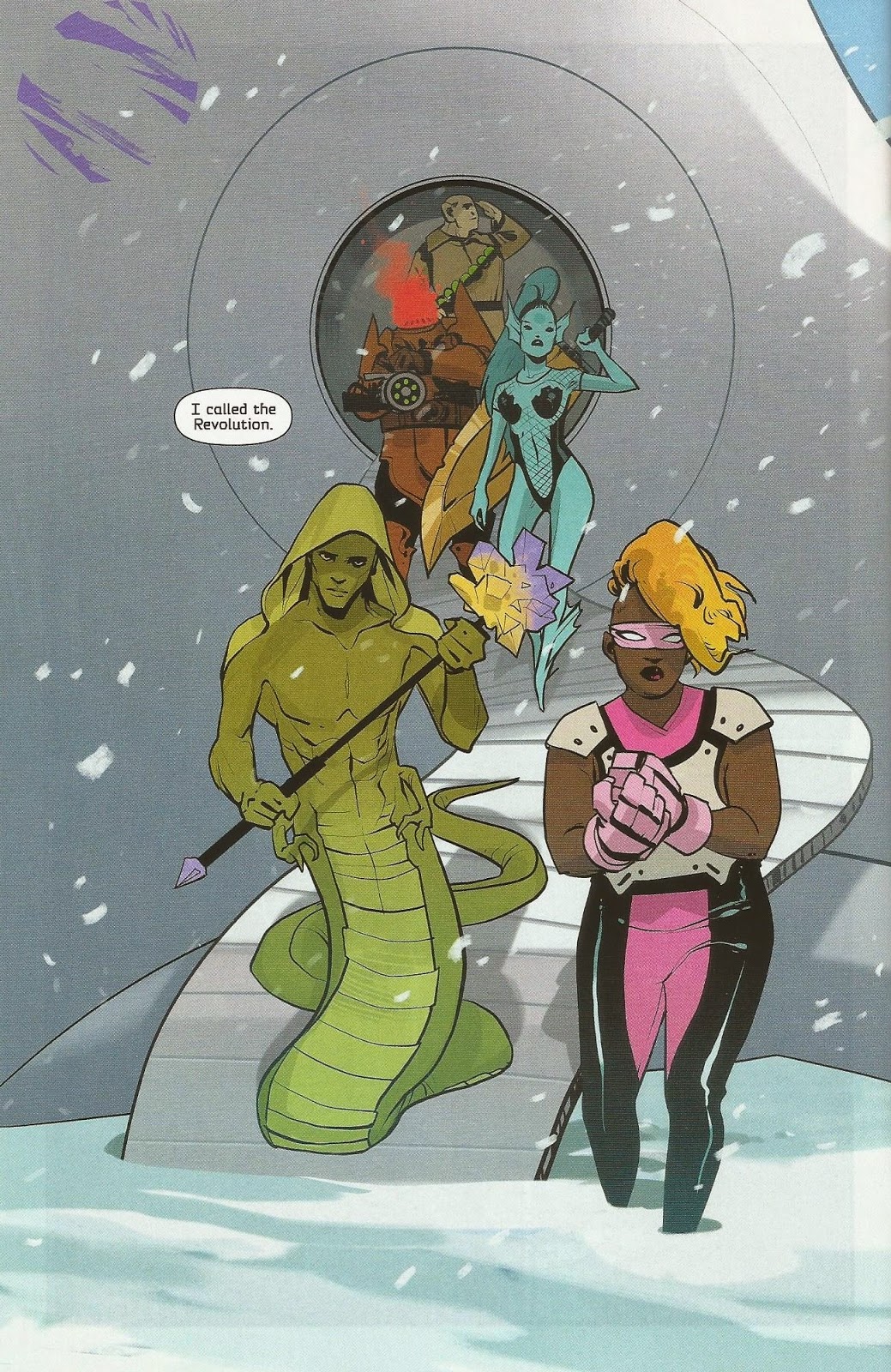
The nature of the conflict between Landfall and Wreath is explored to considerable length this issue, which turns out to be a setup for an ending that adds a new wrinkle to the Saga, um, saga.

Dengo, the janitor from the Robot Kingdom who has been dictating a lot of the action lately as well as kidnapping Prince Robot IV's newborn and Hazel, the infant child of Alana and Marko, has the following exchange with Alana:

Alana: What the hell have you done now, android?"

Dengo: Commenced with Plan B.  I'd hoped to persuade others to join my campaign through words and images, but it's clear the only language people understand is action.

Alana: Dengo, who's out there?

Dengo: A heroic band of freedom fighters dedicated to ending both of your worlds' reigns of terror.

Alana: No.  Please tell me you didn't really bring the Rebellion here.

Dengo: "Rebellion" is for teenage girls.


Which means a bunch of new characters!  One of the great strengths of Saga is Vaughan's ability to create dynamic personalities out of clearly-defined roles.  Beyond that, the Revolution is a clever spin on a sci-fi trope made famous by Star Wars and featured most recently to great success in Guardians of the Galaxy.

Also of note for dedicated readers, as always, is the letters section, in which one correspondent hilariously explains how Saga ruined her relationship with her mother, and another from a prison inmate that continues a different saga entirely, the effects of a different prison inmate who brought the love of comics inside the institution.  Real Shawshank Redemption stuff there, folks.  

Have I mentioned how much I love the name of Vaughan's dog, Hamburger K. Vaughan?

Genius.

Nameless #1 (Image)

writer: Grant Morrison

artist: Chris Burnham

Sometimes there's no Grant Morrison.  Sometimes there's suddenly an explosion of Grant Morrison.  Last year Morrison launched both The Multiversity and Annihilator, both of which are limited series and counting down to their conclusions now.  Nameless has joined those ranks.  Is it as good as them?

And more importantly, because the actual subject is never clear from the start, what's it about?

Actually, the basic setup is pretty much Armageddon, the Michael Bay movie where Bruce Willis is charged with destroying an asteroid before it has a chance to destroy Earth.

But, Morrison being Morrison, it can't be that simple, can it?  Of course not.

The complicated setup is Morrison revisiting a particular aspect of his own mythology.  While writing The Invisibles, he was quite vocal about his personal dabbling in the occult.  It was a time in Morrison's career where he was known for Invisibles, Doom Patrol, and Animal Man, all extremely out-there material that not only helped define Vertigo comics at the time, but who exactly Morrison was, not just as a writer, but person.  This was not the mainstream-friendly Morrison later introduced for the purposes of JLA.  This was a Morrison who happily skirted controversy, helping to form a firm fan support group.

The last such work of this kind was The Filth early in the new millennium.  He's described this kind of storytelling as his effort to explain experiences he's actually had.

Fast-forward to the present, where there really hasn't been much of that talk in years.  Hence, the mainstream-friendly Morrison, the rough edges rounded off.  Almost.  Annihilator has gone a long way in bringing back the classic Morrison, but Nameless seems designed to bring the thing full circle.  Who better to illustrate the tale than Chris Burnham, the Batman Incorporated artist who brought the rough edge back?

Nameless evokes much of Annihilator while making the unusual more apparent.  Our main character, literally named Nameless, is hiding from things happened in the past, but the present is dragging all that back to the surface.  And yes, calling for Nameless to be a hero.

At this point, it's really a case of letting more of it play out, to get a feel of where Morrison is going with it, a little of how far down the rabbit hole he's really going.  At this point it doesn't seem like the kind of transcendent material Annihilator is, but Nameless is similarly interested in plumbing the depths of Morrison's own life for inspiration.  This is a good thing.

Ms. Marvel #11 (Marvel)

writer: G. Willow Wilson

artist: Adrian Alphona

This is the conclusion of the Inventor arc.  Our villain gets to shout, "I am not a bird!" on the first page, and by the last page we see what he really looks like.  And he is in fact, not a bird.  So, truth in advertising.

It's a little disappointing insofar as the disenchanted youths who willingly played into the Inventor's hands previously are now just as willing to play along with Ms. Marvel.  This is kind of the opposite of the intended message, I suspect.

The other point the issue makes involves Kamala Khan's emerging need to protect her secret identity, what she calls "my new normal" and "a parallel life."

A certain amount of that may also be G. Willow Wilson speaking directly through Kamala.  With the massive success of Ms. Marvel, Wilson is having her first real moment of comic book popularity, which goes with expanded demand, which means she's also writing X-Men these days, which is quite a vote of confidence.

Django/Zorro #3 (Dynamite)

writer: Matt Wagner, Quentin Tarantino

artist: Esteve Polls

In the third issue of this mash-up, Matt Wagner gets around to explaining how exactly this counts as a sequel to Quentin Tarantino's Django Unchained.  At the end of the film, Django has been happily reunited with the love of his life and can live his life as he pleases (he chooses to continue on as a bounty hunter).  Where is Hildy now?  Django explains that she's off assisting the underground railroad.

Slightly more relevant to the story is the list of investors (hearing them explain their culinary differences is a highlight) to the villain's evil scheme [insert evil scheme here] including Spartacus LeQuint, owner of the mining company Django escapes from at the end of the movie.

At the end of the issue is Django's first official meeting with Zorro.  Well, "meeting" insofar as Django watches the Fox put the fear of the letter "z" into LeQuint.  As Zorro does, quite literally...

Sunday, February 15, 2015

Digitally Speaking...30 "Copperhead"

via Previews World
Copperhead #1 (Image)
From 2014.

I've read and generally enjoyed Jay Faerber in the past.  I still think his Noble Causes could use a little more recognition (and subsequently, I have no idea why he's never done Fantastic Four).

Copperhead is a Western in space.  For me, it has clear echoes of a specific Western in space that I've already seen.  Not just Star Trek in general (which in an essay Faerber mentions) but Deep Space Nine.  They both feature a parent and child settling in a new assignment after some business they'd rather forget.

Copperhead is something of a Western procedural, as the main character is a sheriff, making this comic a space age version of the many Westerns that used to populate TV.  In that crime sense, it's perfectly aligned with another recent Image launch, The Fuse.  I have no idea why crime procedures are suddenly such a thing in comics, other than Brian Michael Bendis and Ed Brubaker.  And you know, Batman and stuff.

It's not bad, but I'd like to have had a better sense of the world Copperhead represents.  I'm expecting something as awesome as Saga, and clearly that's not really going to happen.  But it's probably something worth checking out all the same.