Sunday, December 28, 2014

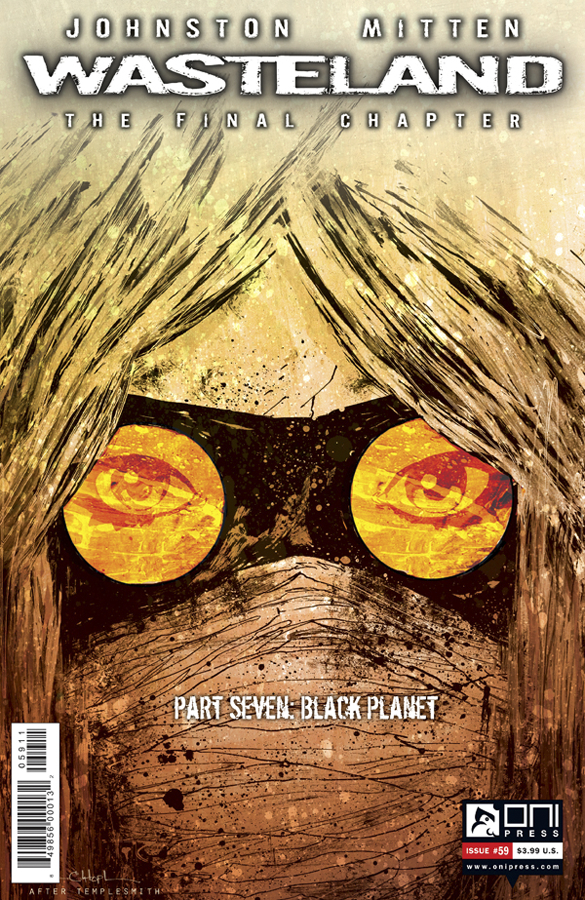
Wasteland #59 (Oni)

via Previews World
writer: Antony Johnston
artist: Christopher Mitten

Technically, this is the last issue of the Wasteland saga.  And it is deliciously cyclical, as most of the best stories are.

I say "technically" because there's one issue left, an epilogue as it turns out.  All the better for Wasteland's few but hopelessly devoted fans, who will savor this story for years.

The very first issue featured a cover remarkably similar to this one.  The person behind the goggles and the mask was Michael, whom I've always identified as a Wolverine figure, and somewhat rightly so as it turns out.  The person behind the goggles and the mask this time is Abi.  Both are characters we've spent the whole series following, and both split off from what had begun to seem like the main narrative of Wasteland when they left the city of Newbegin behind, in search of fabled A-Ree-Yass-I.

(Which is finally identified, by the way.)

When we first met Abi, she didn't know she was exactly like Michael.  She knew she had peculiar abilities, but she'd forgotten, just as the world did, what had come before.  And now she has replaced him.

The story begins anew, at the end.  Hopefully the mistakes of the past won't be repeated?  That's what it's all been about, remembering the past, learning from it.

And it's been a grand journey.

Reading Comics 144 "Supreme: Blue Rose"

via Image Comics
Rob Liefeld isn't dead, but he's began to have a wonderful creative afterlife.

A few years back, a couple of his characters were revised away from their strictly superheroic origins in the most recent Glory and Prophet comics, with Prophet in particular making a cult-sized impact.  Starting this year, it was Supreme's turn.  Liefeld originally conceived of Supreme as a more violent Superman.  Not long afterward, Alan Moore came along for the first revision of the character, crafting him into a full-blown homage to the Silver Age Superman, which later inspired Moore's own Tom Strong.  Image even brought this version back recently.

But now comes Warren Ellis.  Ellis is the slightly more grounded version of Grant Morrison, the one the mainstream couldn't hope to tame, as it has Jonathan Hickman.  From the moment I heard of Supreme: Blue Rose, I knew I had to have a look.  The longer it took for the opportunity to present itself, the more I wondered if the diminishing but intrigued response I heard, very tepidly, from my sources might be telling me that perhaps it wasn't all that remarkable after all.

But then I read an issue for myself.  And then was able to read the rest of the issues released to date.  It's amazing.

And actually, it's not hugely different from a personal favorite comic of mine, IDW's Cobra, which Christos Gage and Mike Costa envisioned as a first look at G.I. Joe's enemy just as if the reader had never seen it before, a true psychological exploration that exploded the concept onto a whole new level.

That's what Ellis is doing with Supreme.  Oh, and Supreme himself is barely even present in this story.  He's identified by his secret identity, Ethan Crane, but he's basically become the maguffin of his own story.

Instead, the focus has shifted to Diana Dane, the Lois Lane equivalent Moore introduced.  In fact, all the characters I can identify other than Supreme himself were created by Moore.  Darius Dax, Moore's Lex Luthor, has become very much a Lex Luthor figure.  Doc Rocket, a member of Moore's Youngblood, is present and better than ever.

It's hard to say much more about what's happened over the course of the first five issues except to say that Dane's investigation into the mystery of Ethan Crane's existence has continued.  The other thing Ellis shares with Moore is a fascination with the acknowledgment that there has been more than one incarnation of Supreme.  But this is not metafiction.  There isn't even much of a connection to Morrison's tendencies.  This is simply a creator embracing an opportunity to be creative, in ways most writers never even imagine possible.

It is unarguably one of the best comics of the year.  Astonishingly good, and the art of Tula Lotay helps in exactly the same way Fiona Staples does for Saga.  More people need to talk about Blue Rose.  More people need to be reading.  Because this is comic book history in the making.
Superman #37 (DC)

via DC Comics
writer: Geoff Johns
artist: John Romita, Jr.

This is the issue the Ulysses arc has been waiting for.

Geoff Johns posited this new figure as the inverse of Superman from the start.  Readers like me waited to see the apparent hero turn into a villain, and that's exactly what happened.  Right?

Except, now the lines are blurred.  Yes, Ulysses seems pretty bad now, considering the fairly naively innocent guy he originally seemed.  Somewhat monstrous, in fact.

Yet Johns has twisted the inversion still further.  The Ulysses arc has looked from the start like Johns doing something boldly new instead of stepping into the hands of tradition, as he'd done previously, exactly what he's tended to do in other projects.  Usually he'll do it by playing very directly with tradition, before turning it on its side.  He's done that again.

Superman has become something of a do-gooder villain.  He's convinced Ulysses to turn away from his original plans and in fact cause the destruction of the "Great World."  It really is a tragedy, too: Ulysses, the strange visitor who has just lost his adopted world, after having found his birth world the complete opposite of everything he'd ever known.  Just as if Superman had lost Earth, too.  Except, beyond anything Ulysses himself had planned, it's Superman who caused the destruction.

It's complicated.  The concept of the Great World is pretty monstrous, and Ulysses' complicity in its upkeep is no doubt monstrous, too, but there's enough room for gray areas to emerge.  

As the story continues, it has the potential to change Superman's outlook.  And that's the kind of stuff Johns is very good at indeed...

Starlight #6 (Image)

via Comic Vine
writer: Mark Millar
artist: Goran Parlov

The conclusion of the story is pretty formulaic to a certain degree, so in some ways, I didn't have to worry so much about potentially missing it.

The human who became a hero on an alien world, Duke McQueen, does it again, saves the day.  Pretty straightforward.

The ending I'd been wanting doesn't happen, exactly, either.  The wish-fulfillment factor from that first issue of Jeph Loeb's Nova had to instead give way to Mark Millar's Starlight:

The alien kid who, unlike Duke's human children, never stopped believing in him, arranges for a spectacular demonstration that turns the whole story on its head.  Dropping Duke back home on Earth, he arranges for dramatic flybys in his spaceship that can't help but be noticed, and even contacting the grown men so they must.  Then he goes a step further and lands right on the lawn of the White House.

Boom.  Humans, acknowledge the existence of aliens!

But Millar doesn't end the story bothering with whatever Duke's kids or the president think about all this.  It ends with a hug between the only two characters who really matter.

It is a great ending.

She-Hulk #10 (Marvel)

via Marvel
writer: Charles Soule
artist: Javier Pulido

In my continuing efforts to make peace with Charles Soule's approaching exclusive contract with Marvel, I've been trying to find something he's done for Marvel, on a regular basis, that's been anywhere near as interesting to me as what I've read from him at DC.

Well, turns out that might have been She-Hulk.  Which of course has been cancelled.  Apparently Soule used to be a lawyer, which made this court-based series a hugely appropriate venue for his talents (experts, meanwhile are still analyzing what exactly explains Stephan Pastis doing Pearls Before Swine despite a similar background...), even though readers such as myself still find it hard to reconcile a Hulk-related character working as a lawyer.

She-Hulk has always been kind of...green-skinned?  A somewhat flimsy addition to a franchise?  One that's not even particularly relevant to the franchise?

Anyway, this was an excellent issue to sample, since it's the conclusion of a Steve Rogers trial.  Steve Rogers, A.K.A. Captain America, A.K.A. Old Man Rogers, given recent developments reflected in the story.  Soule is not exactly disinclined to make Steve much more nuanced than elsewhere, but it's still a fine issue.  Opposing council is Matt Murdock, A.K.A. Daredevil (by the end, Steve explains why these two particular lawyers were chosen, which harks this geek's mind back to the classic Star Trek: The Next Generation episode "The Measure of a Man" in some respects).

Hey, Marvel, if you aren't planning to secretly relaunch the series, why not allow Soule to write Daredevil directly?  I mean, is Mark Waid's material really that interesting?  Or maybe even an Old Man Rogers series?  Because there's a great scene at the end ripe with possibilities.  That's a Steve Rogers I'd read on a regular basis...

The Sandman: Overture #4 (Vertigo)

via Lady Geek Girl
writer: Neil Gaiman
artist: J.H. Williams III

The Sandman: Overture is being released so gradually, you can almost forget sometimes that it's even happening.  I think that's exactly what's happened, too.

It probably doesn't help that this is not at all easy reading.

All the same, we're four issues in now and Dream is talking to stars.  Stars, mind you, that don't particularly respect him.  

And is this the issue where we finally get something to hold onto?  Dream is endangered by the troublesome stars, and he speaks with his father, and this is what the father has to say about Dream's companion, the little alien girl called Hope:
"There is always a time in which she will have been alive.  Always a time in which she does not exist.  That is the nature of existence.  I cannot think why nobody except me seems to see things like that."
Such is the value of this effort, I suspect, trying to address some terrifically big ideas.

Red Lanterns #36 (DC)

via DC Comics
writer: Charles Soule
artist: J. Calafiore

From the second month of the Green Lantern "Godhead" crossover event, Charles Soule marches ever closer to the end of his Red Lanterns tenure and helpfully has Guy Gardner explain to Simon Baz everything he's done in the series.

Which is a nice touch.

Although the issue also features one of those awkward continuity moments that are bound to crop up when there are dozens of comics books under multiple editors needing to be juggled on a monthly basis.  Cyborg has been heavily featured in the pages of Batman and Robin recently for a New Gods arc.  And here he is in Red Lanterns for a New Gods arc appearance.  And nary the twain shall meet.

And it's kind of all the more clear that Soule correctly identified Red Lanterns: Futures End as his real last word on the series.