Showing posts with label Jason Fabok. Show all posts

Sunday, November 3, 2019

Reading Comics 237 "My third Forbidden Geek mystery box"

My third shipment from Forbidden Geek included a Lobo statue, Snyder & Capullo’s Batman Vol. 1 The Court of Owls, and the following comics:

Astro City #25 (Vertigo)

Kurt Busiek’s familiar act continues for another issue.  It’s the kind of storytelling that perhaps feels more impressive if you catch it when you’re younger, but begins to seem regressive the more experience you have.  Interestingly, the only time readers have really revolted was when Busiek was telling an extended Dark Age tale that was the only time he was building on the Marvels method that inspired the whole thing, the sequel he never got to write, which to my mind was perhaps the best Astro City ever got.  Perhaps most recommended to unsophisticated budding comic book writers who have no idea how character storytelling works.

Detective Comics #14 (DC)

The John Layman (Chew) era, little celebrated at the time but an excellent Batman experience all the same (I get that Snyder’s was sensational, but it wasn’t the only or even best example of the New 52), with Poison Ivy in the spotlight.  Layman’s Batman is the analytical mind you’d expect in a title called Detective Comics, and he’s constantly challenged by familiar foes in interesting ways.  Perhaps best represented by the “Gothtopia” arc that went unobserved as a crossover.  Also features early but typically sensational Jason Fabok art, before he got the plush Justice League assignment.

Blue Beetle #1 (DC)

From the Rebirth era, which until now I’d never read.  In fact I skipped the New 52 series, too, and in both cases it’s entirely down to simply not having the funds.  When the New 52 launched I’d just lost my job of five years and went unemployed the rest of that year (then got a terrible job and then got a slightly less terrible job that compensated for that slight increase by paying far less and giving me far fewer hours…).  Anyway, both series were based on an excellent pre-Flashpoint series I did read enthusiastically, spinning out of Infinite Crisis, in which the legacy is passed on to Jaime Reyes in the form of a magical alien scarab with a fairly unexplored link to the Green Lantern Corps.  In this Rebirth relaunch Jaime’s friends from the first series are still present with the same witty banter, but Ted Kord gets to be part of the narrative this time (remember: Ted famously was murdered by Max Lord just prior to Infinite Crisis; the best thing about the current Snyder act is the recent Dark Multiverse one-shot that posits a scenario where Ted shot Max instead).  At some point I’ll really have to catch up with all this Blue Beetle material.

Firestorm: The Nuclear Men #6 (DC)

Another series I was sorry to have to skip in the early New 52 was this one, as it, too, was a follow-up to an excellent pre-Flashpoint series I enjoyed immensely.  So of course I enjoyed this issue.  Ronnie Raymond and Jason Rusch apparently each have their own Firestorm bodies (one of the familiar gimmicks of the concept is that Firestorm combines two people, with one providing the body and the other becoming a mental sidekick).  In this tale they’re confronted by the Russian Firestorm, Pozhar.  I’m still pretty convinced that if handled correctly, Firestorm could handle a Geoff Johns level renaissance.

The Flash #19 (DC)

Featuring the tease for the debut of the New 52 Reverse-Flash.  The issue features pretty much the bare minimum input from Francis Manapul, who was responsible (with Brian Buccellato) for the best Flash New 52 material, which itself also influenced much of the current TV series.

Green Arrow #31 (DC)

From the Rebirth era, in which DC finally figured out that Ollie ought to be allowed to be awesome again, aligning more with what he was best known for, including associations with Black Canary, Hal Jordan, and the Justice League, all of whom prominently appear in the issue.  I just don’t get how the much-influential TV series never seemed to convince the company, previously, that they should pay a little attention to the comic, help it shine when not written by Jeff Lemire, misguidedly believing instead that Green Arrow should be a younger punk.  This is a character defined by being world weary!  One of the main beneficiaries of Rebirth.

Hal Jordan and the Green Lantern Corps #35 (DC)

The Robert Venditti era continued in Rebirth with this series, which because I became disinterested in his New 52 comics I never really made an attempt to get into.  This issue is mainly Venditti deciding that Hal, John, Kyle & Guy are the Green Lantern equivalent of wrestling’s Four Horsemen.  For…reasons.  Although it ends on a pretty amusing note, as Ganthet taunts the Controllers, by pointing out they want to, well, control these Lanterns, which, certainly with Hal, has famously been pretty impossible.  The main difference between Venditti and Geoff Johns, whom he succeeded, is that while Johns tossed in a lot of bold new concepts, he did so in a manner that built on existing ones.  He seemed like a fan.  Venditti never really seemed to understand any of it.  He tossed in a lot of bold new concepts, too, but without ever really seeming to understand that there were existing ones.  He never felt like he connected with the material.  It’s just incredibly bizarre.  Now you’ve got Grant Morrison writing Green Lantern, and he admitted he was reluctant to do so because he never understood the concept, and yet to read the results is to see that he got past that.  A lot of readers are confused, they see nothing but 2001 AD, but I see storytelling that comes alive with possibility, grounded in tradition.  Charles Soule, when he was writing Guy in Red Lanterns, was much the same, and so too Ron Marz in the uncomfortable position of writing Kyle ostensibly when the tradition had been exploded.  Maybe not everyone will see it, but when you do see it, it’s hard to look past.  That’s me and Venditti’s Green Lantern in a nutshell.  Ironically readers rejected the New 52 era because that’s what they thought they saw everywhere.  As far as I’m concerned, Venditti was ground zero, if nothing else, of the perceived phenomenon.

Infinite Inc. #27 (DC)

Ah!  Irony!  This is a whole issue dedicated to the Crisis on Infinite Earths effect, helpfully further spelled out in the letters column, in which a reader bemoans the cruel dismantling of continuity in the form of Huntress being “murdered” because she couldn’t exist outside of her context (Batman and Catwoman being her parents ‘n’ all, on Earth 2).  And this was a whole series about the offspring of the Justice Society.  So eventually, Brainwave Jr. removes Fury’s memories of her parents (y’know, Wonder Woman and Steve Trevor).  Ironically, the reconciliation of canon effectively obliterated the Infinity Inc. concept, and Fury ended up a curious footnote, never to be revisited (at least as of now!), a curious appearance or two in the pages of Neil Gaiman’s Sandman that feel the more elegiac the more you’re aware of her publishing history.  A version of Huntress did return, eventually, an independent one with no background ties to Batman or Catwoman, although in the short-lived Birds of Prey TV series, she did.  Even better, this issue features a pre-Spider-Man, pre-Spawn Todd McFarlane, whose work is totally unrecognizable, if anything familiar to the Sandman style (just imagine!) with a few panels emphasizing shadow on facial features but otherwise looking fairly generic…

Red Hood and the Outlaws #11 (DC)

The Rebirth era, featuring Artemis & Bizarro, with the spotlight on Artemis (the Azrael of Wonder Woman lore) as she squares off with an Amazon of a spin-off tribe.  Lobdell’s Red Hood comics are another I want to catch up on at some point.

Suicide Squad #45 (DC)

From Rebirth, this issue features an apparent attempt to revisit the exact concept behind the team, as famously featured in the apparent infamous movie, villains being recruited by Amanda Waller for missions where their lawful participation will be disavowed, and if they go rogue the bomb in their heads goes boom.  So I guess if you need a random issue to remind you of all that, this one’s a good one to catch.

Superman/Doomsday: Hunter/Prey #2 (DC)

The second of three issues, the prestige format follow-up to the more famous death-and-return saga, Dan Jurgens goes bold, explaining Doomsday’s origin!  I’m glad this was the random issue I got, because I’d never officially read any of it, but had heard of the origin concept.  In hindsight it’s somewhat convoluted.  A better version would be something like Wolverine, a monster with a healing factor who constantly evolves from the horrible deaths it endures, reviving on its own rather than being constantly cloned.  I mean, how would a clone adapt to whatever happened to the previous body?  It’s new material.  Bad science, Dan.  But typical Dan Jurgens art, which sadly lost pretty much all of its impact and appeal after the sensational work of Superman #75, famously depicted entirely in splash pages.  No comic could ever justify that format again, and Jurgens himself really had nowhere to go but down.  This issue also saddles us with Cyborg Superman, who didn’t die in Superman #82, and so he just keeps coming back.  Geoff Johns later used him, too, but I’ve never been convinced that it’s a concept worth revisiting.  If he’s no longer pretending to be Superman, what’s the point? 

Wednesday, October 18, 2017

Quarter Bin 119 "DC 3-Packs Strike Back!"

DC doesn't seem to have released new packs recently; these are just more from the last round I hadn't gotten yet (each one has a featured lead comic). 

Batman Eternal #1, 16 (DC)
from 2014

I consider Batman Eternal to have been Snyder and Tynion's attempt to sprint through everything they were never going to get a chance to explore during the New 52 as they explored their own arcs, revisiting classic characters and even letting some new ones (Harper Row) a chance to breathe.  The first issue is early DC Jason Fabok, who would later have his true breakthrough in the pages of Justice League.  #16 is another one featuring art from Dustin Nguyen and Derek Fridolfs. 

Batman #7 (DC)
from 2016

This was one of the featured lead comics, reprinted as Batman: Night of the Monster Men #1.  As I've said before, I love that these are true variants.  I have no idea if they'll ever be worth money, but I just love that they exist.  "Night of the Monster Men" was billed as the first crossover event of the Rebirth era, and it seems positively tame in hindsight.  It's also funny that Tom King bowed out as writer for the tie-in issues, allowing Steve Orlando, fast emerging as a new force in the company, a chance to step in. 

Green Arrow #48 (DC)
from March 2016

It's downright baffling that DC didn't make a greater priority of Green Arrow once Arrow, the TV series, began and eventually expanded into a whole franchise.  This late issue from the New 52 era seems to have left Oliver Queen a...werewolf?

Infinite Crisis: Fight for the Multiverse #10 (DC)
from June 2015

Injustice: Harley Quinn (DC)
from 2016

The later was originally published as Injustice: Ground Zero.  But being reprinted with Harley Quinn in the title isn't merely gratuitous, it's also acknowledging that the story is all about her, plus a review of everything that's happened in the Injustice comics.  I'm not a video game guy, so the Injustice comics, and the Infinite Crisis comic listed above, are as close as I'll get to those experiences. 

The New 52: Futures End #13 (DC)
from September 2014

It's really shocking that fans didn't really care about this weekly series.  The assembled writers were certainly impressive enough: Azzarello (synonymous with prestige), Giffen (synonymous with DC weekly comics at this point), Jurgens (still synonymous with "Doomsday," the biggest comics event of the modern era), and Lemire (now synonymous with the modern vanguard).  I still want to catch up with it.  This issue features part of the Superman arc, where he's been amnesiac about being Superman.  It was also the mainstreaming of Batman Beyond.  Terry McGinnis seems on his way to...involuntarily bequeathing the role to Tim Drake in this issue...

Convergence: Action Comics #2 (DC)
from July 2015

I still love Convergence.  Maybe it's because it came at a dark moment for me, and it was a rare beacon of life.  I didn't read the Action Comics two-parter at the time, and I'm not sure what I missed.  Maybe not too much.

Trinity of Sin: Pandora - Futures End (DC)
from November 2014

I've written about Pandora often enough.  This version of her story reveals an alternate explanation for the character (Geoff Johns had a different one during the Justice League "Trinity War" event, and a much different fate in DC Universe Rebirth).  But it was certainly interesting to see this one, even if the art didn't really do it much justice.

Tuesday, September 19, 2017

Quarter Bin 117 "More DC 3-Pack Comics"

I love these DC 3-packs.  I love that I can find any comics in retail stores, even if they're grab bags, but the consistency of these 3-packs has been a continuous joy for the past few years.  So here's what I got in the last two:

Batman and Robin: Futures End (DC)
from November 2014

I love reading these Futures End issues.  I love that so many writers ignored, and possibly at editorial suggestion, the Futures End event itself and just had a look at whatever was most probably five years down the line in whatever was happening in the titles at the time.  Ray Fawkes was riffing, here, on Damian's death, and Batman's penchant for going gunshy on his new partners because of things like that.  This time he's pulling it on Duke Thomas, who in this Futures End timeline actually did become Robin, as so many fans long anticipated (Snyder has instead opted to give him his own identity: the Signal).  The art is by Dustin Nguyen, with inks by frequent collaborator Derek Fridolfs.  It's funny to see Nguyen presented as a traditional artist again, after getting so used to his Descender water colors look.


What's funny is that it makes his work look like Jorge Corona's.


Yeah, Corono drew Duke, too, as a kind of Robin, in the pages of We Are Robin.  Seems appropriate, anyway.

Here's what Nguyen looks like in Descender, by the way:


The story, by the way, involves Batman's showdown with a revived Heretic, most likely a clone, the villain who killed Damian in the pages of Morrison's Batman Incorporated.  I'm sure I've read it before, but it's another of the excellent Futures End specials. 

Green Arrow #1 (DC)
Wal-Mart reprint from July 2017

This is a reprint of the Rebirth debut issue from the ongoing series, and does an excellent job of spotlighting Benjamin Percy's vision for the series, integrating a lot of different elements of Green Arrow's publishing history, including his social views, relationship with Black Canary, and penchant for having a sidekick, except this one...It becomes a wonderful development for the character, having Ollie take on a half-sister, whose mother turns out to be his enemy Shado.  Makes me think I really should've made this series a priority read at some point.  Will have to check back in...

Justice League #36 (DC)
from January 2015

This is the first chapter in the "Amazo Virus," where Geoff Johns started amping the series back up to its "monthly event book" (my designation) status as it geared toward "Darkseid War."  The art of Jason Fabok was an immediate sensation, and certainly helped drive eyeballs back to the title. 

Justice League United #2, 5 (DC)
from August, December 2014

I never did get around to sampling this series at the time, but I'm glad I finally have.  Jeff Lemire (writer of Descender, by the way!) launched it, and these issues make it clear that United helped launch the New 52 version of Adam Strange, which was fun to read, especially for someone who's just finished rereading 52.

Batman and the Justice League: Outbreak #1 (DC)
Wal-Mart reprint from July 2017

This is what's really fascinating about these 3-packs, that the comic in front is always the newest, and often features a custom Wal-Mart cover and even, with some of them, custom titles.  Batman and the Justice League is actually the Rebirth Justice League from Bryan Hitch, and this is actually #10 from the series.  It's kind of funny, too, or maybe calculated, that the issue is related to the above Justice League, as it also features Amazo.

Sunday, May 29, 2016

Justice League #50 (DC)

The conclusion to Geoff Johns' tenure on Justice League (there are two final issues to follow from other creators) finishes the epic "Darkseid War" in grand fashion. 

The mythology Johns created for "Darkseid War" alone is impressive.  Myrina and her daughter Grail, for instance, add not only to Amazon lore, but the New Gods as well.  It's only fitting, because Johns has literally been using Justice League as his Wonder Woman series all along, with few readers apparently realizing it.  Embroiled in this conflict is also, of course, Steve Trevor, who has been embroiled in a troubled relationship with Wonder Woman since the start of the series.

Grail turns out to be the real villain.  By now, the New Gods mythology is well-established, so someone new had to step into the role usually reserved for Orion: how to resolve what comes after Darkseid.  In Jack Kirby's original vision, Orion was the son of Darkseid while Mister Miracle was the son of Highfather.  In order to secure a truce between New Genesis (home of the good guys) and Apokolips (home of the bad guys), the offspring were raised by their (presumably) former enemies.  Mister Miracle, as ever, escaped unscathed.  It was Orion who emerged the troubled scion.  Famously, Kirby never got the chance to conclude his New Gods vision (the graphic novel Hunger Dogs didn't quite do the job).  So writers have been trying to do it for him ever since, including John Byrne (Jack Kirby's Fourth World) and Grant Morrison (Final Crisis).

Johns takes a unique approach by expanding the concept with significant new characters.  When he killed off Darkseid (these New Gods are always dying), he set about yet another new wrinkle.  His first had been introducing the concept that Crisis on Infinite Earths' Anti-Monitor was Mobius, whose chair Metron had been squatting in for as long as anyone could remember.  Darkseid's death unleashed all his powers, which went into various members of the Justice League. 

The ramifications prove to be profound, in this conclusion.  Batman sat in the chair, and learned the secret of the Joker's identity.  Turns out there are three of them.  Lex Luthor gained a killer new set of battle armor.  (He'll be wearing it in the Rebirth era's Action Comics.)  And Grail stole the offspring of Superwoman, from the Crime Syndicate, and made him the reincarnation of Darkseid.

The good news is, Johns also finally made Jessica Cruz an official member of the Green Lantern Corps, fulfilling the promise of a different teaser, from Green Lantern #20.

The only thing that doesn't really ring well is the art of Jason Fabok.  This is weird, because every other issue of Justice League with his work hasn't been a problem for me.  He has distinctive work, but I guess he's incapable of going truly wide screen which has been a staple of JLA comics since Howard Porter.  It's a shame.  Doesn't get in the way of the storytelling, but it produces an incomplete effect. 

Still, this was exactly what fans of this run could have hoped to see.  We even see, like in the beginning, Batman and Green Lantern working together, at one time a pair that seemed hopelessly incongruous.  Johns solved that by letting Batman use the ring.  As with Green Arrow before him (Green Lantern: Rebirth), it provides him with newfound respect for Hal Jordan.  Classic.

Thursday, June 4, 2015

Justice League #41 (DC)

writer: Geoff Johns

artist: Jason Fabok

There seems to be a determined interest in downplaying or downright diminishing the work of Geoff Johns.  This is ridiculous and needs to stop.  Ideally, "The Darkseid War" will help with this.

FCBD's Divergence gave a preview of what to expect, including the official debut of a character the New 52 has been teasing for quite some time, Darkseid's daughter as she was originally known, now revealed as Grail.  Actually, this was the highlight of Divergence, which also included previews for the "Truth" arc featuring Superman and the new Batman.

What Johns does better than anyone before or currently is measure up a character, pretty much any character, and know what to do with them.  Since she made her debut in it, Wonder Woman has done a good job of making Justice League a part of her publishing cycle, which is still as close to Johns writing her as we've gotten.  At one point in this issue, he does a good job of reminding the reader that he has written solo adventures for nearly every member of the team to date, and nailed it every time.

The issue heavily features Mister Miracle, who has rarely been used as anything but an escape artist and general adventurer.  It's Johns who realized this is a guy who was traded by Highfather to go live on Apokolips.

And the final page features another addition to the growing stable of Geoff Johns Characters (he writes them, he owns them, and sometimes he creates them, too), a woman named Myrina Black.  It should perhaps be noteworthy that Myrina and Grail join Power Ring, Jessica Cruz, as formidable female characters.  Grail is an Amazon, by the way, so she's another way of Johns getting to write Wonder Woman stories without actually writing Wonder Woman.

A fifth woman also makes a big impact in the issue, Lena Luthor, Lex's sister.  Lex's status in the League takes a big turn in the issue as well.  Jason Fabok captures all of this typically in what is considered DC's house style, but brings his own ideas to the table as he depicts Darkseid himself.  Unusually, he keeps Darkseid in shadow, which has the effect of giving the granite-faced villain the kind of gravity he normally doesn't get to have.  You can practically hear the ground rattle beneath him.

When I've been reading this series (which, alas, has not been throughout its run), I've consistently tried to help sell Justice League as being as top-grade as you can get.  "Darkseid War" seems to be the arc where it, impossibly, sets the bar higher.

Monday, February 2, 2015

Reading Comics 149 "Justice League"

via DC Comics
Since getting back into Justice League recently, I've officially gotten the bug all over again.  In a manner of speaking.

Not the Amazo Virus, but the arc has certainly done the trick.  In Justice League #37 and 38, the story pushes past Patient Zero and sees Batman infected.  Between this and "Endgame," I bet the Dark Knight wishes things were less complicated, like in the old days when he didn't have to worry about two let alone one infectious plagues.

Oh, ah, "Contagion," "Legacy."  Yeah.

As usual, Geoff Johns is working multiple agendas, however, as he keeps referring back to two of the more dubious team recruits, the culpable Lex Luthor and Captain Cold, who embodies a Johns link back to The Flash, which hardly escapes his attention.  The man with the ice gun isn't just another rogue, though, but a guy with a serious weapon, which seems to be something Johns is on the verge of exploring to greater heights than ever before.

And a few issues back, we were reminded that Luthor's agenda includes preparing for other matters, and Johns has been doing an excellent job of exploring this "doomsday prepper" version of the character, more nuanced than ever before, as an ongoing link to Owlman was touched upon, which is a nod toward the upcoming Crisis.

Not to be confused with Convergence.  Probably.

Sunday, January 11, 2015

Reading Comics 145 "Justice League"

via Nothing But Comics
I've been a huge supporter of Geoff Johns' Justice League, but you'd be forgiven for not knowing that, as I haven't regularly read it in a few years.  I haven't even finished reading "Throne of Atlantis," which should be indication enough of how that's played out.

Since Forever Evil, I've been making an effort to get back into it.  The problem hasn't been the series itself, unless you count the fact that Justice League has consistently been one of the must-read-monthly series since it debuted in 2011.  What happens when you don't read monthly?  Pretty much what happened to me.

What brought me back?  In a word, Luthor, as in Lex Luthor, who has officially joined the team.  And don't think that's been easy.  I've recently read #34-36, the conclusion of the initial post-Evil arc and the start of "The Amazo Virus."

Luthor isn't the only new phase.  Recent issues have included Jessica Cruz, who Johns first introduced in Green Lantern #20.  Cruz is another legacy of Evil, who has gained possession of the alternate universe Power Ring's eponymous weapon, which like everything else from that reality has an evil bent.  Cruz has been terrified, but has shown an ability to overcome, so to speak, great fear.  She has supplanted Simon Baz as Johns' continuing link to Green Lantern lore, and the opportunity is hardly lost on him.

Interesting, at least in the pages of #34, he's also chosen to continue another legacy, the heroic alliance between Green Lantern and The Flash.  Green Lantern may be in a wholly different incarnation, but Flash is once again Barry Allen.  Johns tends to write the series pairing characters together in separate storylines, which was how a Green Lantern first appeared in its pages, alongside Batman (a genius combination that could really use additional exploration).  That's also how Superman/Wonder Woman happened, by the way.

The issue also sees Johns collaborate, once again, with Scott Kolins, with whom he's done many Flash stories before.  This was great to see, and Kolins, as always, didn't disappoint.

Wonder Woman and Luthor, Luthor and Bruce Wayne, Luthor and Owlman?  Of course Lex Luthor remains hugely important to the series.

#35 sees the rivalry between Luthor and Wayne (which is all in Luthor's head, naturally) continue, with competing public speeches that further illuminate both characters.  Most of the issue is about them, actually, incidentally introducing the next big arc when Luthor's fail-safe weapon is accidentally unleashed.  I admit I wasn't initially interested in jumping back into Justice League at this point because I wasn't sure how interesting "Amazo Virus" would be, but eventually I realized it's a variation on a subplot from 52, which Johns worked on with Grant Morrison, Greg Rucka, and Mark Waid.  It now seems that Johns may have been the spearhead behind that particular element.  This version, and my love of 52 is surely well-documented, may be more interesting, even if the main benefit of the original was finally creating a Luthor/Steel rivalry.

The art for this issue is from another frequent Johns collaborator, Doug Mahnke.

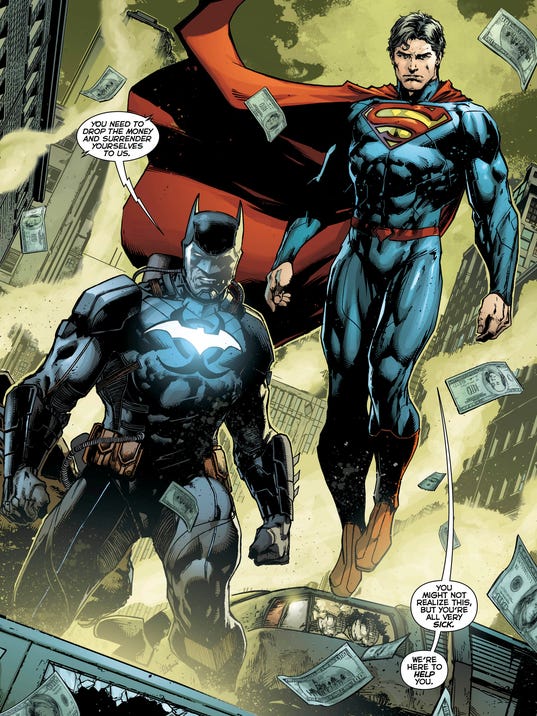
#36 is the official start of the arc.  Before I get to its story contents, let's just acknowledge the art, which is from Jason Fabok, who comes from a Batman background to provide dynamic new art for a series that began with Jim Lee.  
via USA Today
I'v including two pieces of Fabok art, rather than feature Kolins or Mahnke mostly to put a definitive spotlight on Fabok, who here makes a strong case for superstar status.

Johns pairs Superman and Batman (I haven't read the current Batman/Superman, so when I say that hasn't happened enough recently, that's where it's coming from), and Luthor and Wonder Woman once again, which leads to this choice exchange:

Luthor: She's a god. 
Wonder Woman: Why does that sound like an insult when you say it?

Priceless, and another clear instance of Johns nailing the Amazon's perspective in ways other writers haven't even considered.  

I haven't mentioned Captain Cold yet, but his scenes with Luthor across these issues are another highlight, and like Kolins another link to Johns' days writing The Flash.  Every character has a purpose, and a well-defined one, in Johns' scripts, which isn't often the case when a writer is juggling a large cast, whether in a team book or otherwise.  The temptation is always to just throw everyone in the same scenes and have them make random characteristic comments (this is one of my main beefs in Marvel comics).  I prefer more personal depictions.  Somehow Johns does that and keeps the stories big.  That's why Justice League is so important.

So, very profitable return to the series for me.