Comics covered: Justice League of America #1, Martian Manhunter #1, MIND MGMT #34, Ms. Marvel #16, Prez #1, and Robin: Son of Batman #1.
Justice League of America #1 (DC)
That image can't help, for me, but evoke Mark Waid's The Kingdom, an attempt at a follow-up to the much more famous Kingdom Come. Killing off Superman en masse will always have visual impact...Anyway, the rest of Bryan Hitch's debut (he was exclusive over at Marvel for a decade starting in 2002, and has been making a slow return to the DC fold for a few years now) of the latest Justice League title makes it clear that this is not an in-continuity series (although since Convergence, "in-continuity" doesn't mean that much anymore), and as such can be recommended to anyone looking for their DC fix without too much commitment. The line-up is the same as the original from Geoff Johns' flagship. That's about it. Good, competent storytelling. Nothing wildly exceptional, but then, I guess that doesn't particularly matter.
Martian Manhunter #1 (DC)
I've been waiting for a decent Martian Manhunter story from the New 52 era. Thankfully, it arrived at the same time the unexpected ongoing series launched. This is a character ripe with potential because he's never a given for the publishing schedule, which means anytime DC trots him out (for a solo story), chances are good that a creative team came together to tell something decent. His only other ongoing series was somewhat of an exception for me (spinning out of Grant Morrison's JLA), featuring the creative team of John Ostrander and Tom Mandrake, who somehow made an alien character too alienating. And this is a character who thrives on that distinction. The later A.J. Lieberman mini-series was actually the first of the great Martian Manhunter material that I've had the fortune to read, and for me remains the high water mark for the character and his best presentation.
But that might change. The writer is Rob Williams, whom I've previously encountered in the unremarkable Classwar. Taking a cue from Ostrander, Morrison, and Lieberman, Williams has focused on how much is really known and/or set in stone in Martian Manhunter mythology, which again is perfect for exploring because while he's iconic his relatively scant publishing history makes him ideal for innovative storytelling (but less ideal for randomly killing, as Morrison discovered in the pages of Final Crisis).
The Eddy Barrows image I included, from the first page of the issue, features "Mr. Biscuits," whom I assume is actually Martian Manhunter. Again, more of what you can do with a character like this. The art, especially the depiction of Mr. Biscuits, is a major revelation for a reader like me only familiar with Barrows from the pages of Nightwing, where he was perfectly serviceable if not especially inspired. Which is to say, he's definitely inspired here, and is a real strength for the series, moreso than Mandrake was in the previous series (nothing against Tom Mandrake, but his art was the major hindrance of that run). Barrows can convey classic superhero and the rest of the range Williams requires.
It's that range that showcases everything right with this vision. It's pretty sensational, really, and that's without even mentioning the character Pearl, who is that rarest of superhero characters, someone from the Middle East who isn't at all what you'd expect, but rather a traditional superhero character introducing us to an all-new vision of the Middle East, at least as compared to...everything else you tend to see. She's the Catwoman of Arabia. Brilliant.
I look forward to future issues, eagerly.
MIND MGMT #34 (Dark Horse)
I mentioned with the previous issue that Matt Kindt had reached the heist portion of the series, where the plan is explained, and how he exhibited how this story is different because the plan won't go wrong because, well, that's what kind of series this is. This issue calls to mind Christopher Nolan's Inception. Which is basically a heist movie. So I guess this is to say, if you're wondering what kind of story MIND MGMT is, I guess you can say it's like a Christopher Nolan movie. For me, this counts as a considerable endorsement. I've been a Nolan fan since Memento. And now, hopefully, years from now I will be able to say I've been a Kindt fan since MIND MGMT.
Ms. Marvel #16 (Marvel)
For the past few issues, I've been wondering if I should continue reading this series, because more often than not I've found myself disappointed. Unlike a lot of other readers, I didn't start reading Ms. Marvel for its cultural uniqueness, but because the writer is G. Willow Wilson. I became a fan of Wilson through work (Air) I considered the best of all the comics I was reading over the course of two consecutive years (2009-2010). That comes with significant expectations for any future work. And when this one started, Wilson absolutely lived up to the hype I gave her. I read Wilson because of her ability to keep things interesting, on a number of levels. Lately those levels have dropped.
I mention all that because this is one of those issues that reminds me why I like Wilson. It's part of Marvel's Secret Wars event (hence "Last Days of..." printed over the logo). I've found that sometimes ongoing comics really can knock out of the park what can otherwise be a cumbersome mandatory tie-in for an "end of the world" story (during DC's The Final Night two decades ago, for instance, this happened, and that's one of the reasons I love that event so much). For Wilson, it seems to have been a fruitful chance to refocus, bring back some of the sharp observations that've been Ms. Marvel at its best, rather than the lukewarm ones that've been floating around lately.
So that was good to see.
Prez #1 (DC)
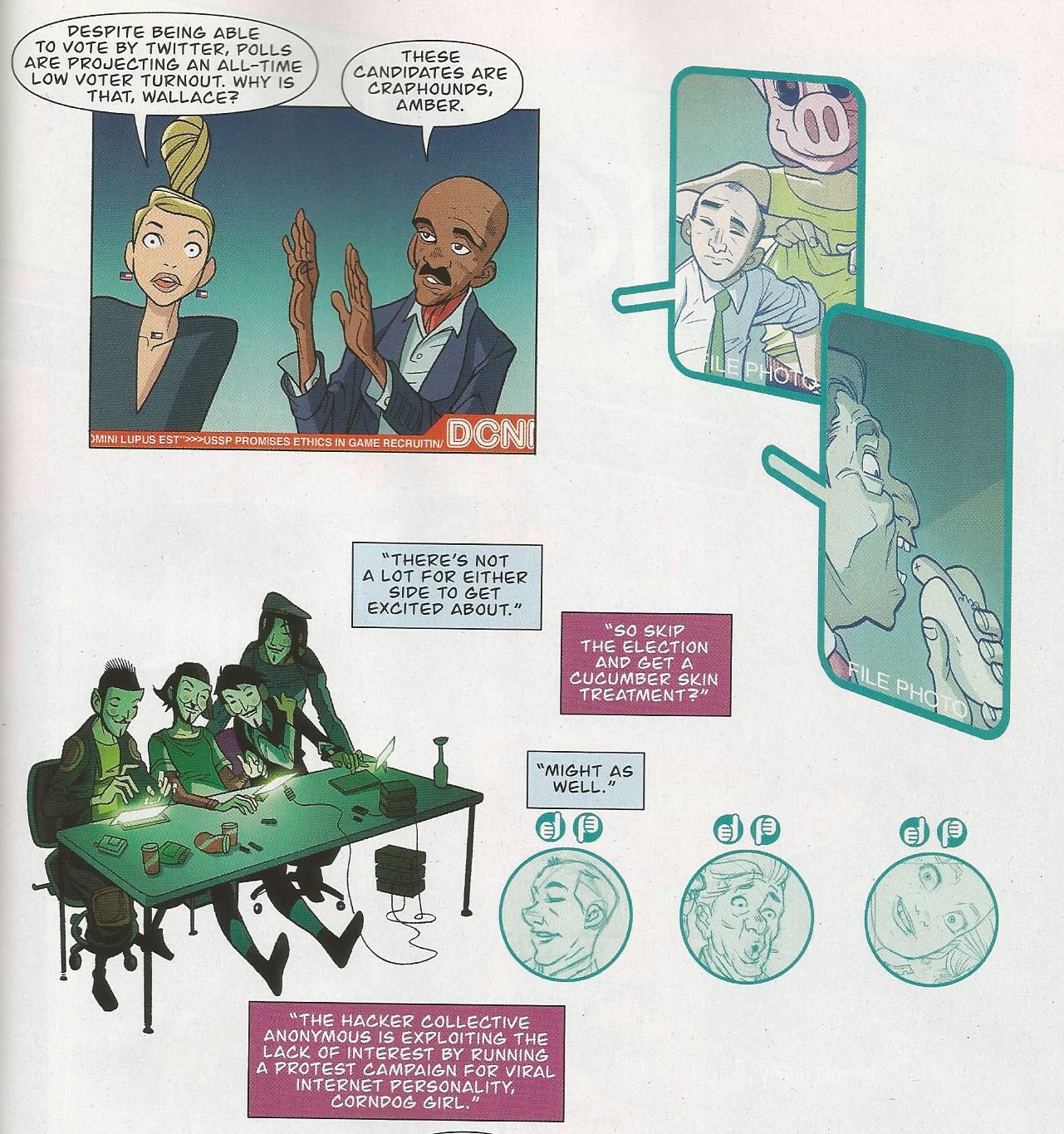
DC makes infrequent attempts to candor to the youth vote, as it were. The last time I found it particularly effective was Final Crisis Aftermatch: Dance (the Super Young Team mini-series). Prez is kind of like that, but I think it has a better shot at being noticed, so long as there's a willing audience out there. The creative end certainly does its part. In that above panel alone there's inspiration from Alan Moore, Frank Miller, and even Jeff Smith to be found, which is not bad company at all.
Writer Mark Russell seems to be pretty new, and he's certainly seized this opportunity. I will, however, be concentrating my praise on Ben Caldwell. I've been praising Ben since his exceptional Wonder Woman material from Wednesday Comics, which Prez evokes to a certain degree. I say "certain degree," because I think part of the reason I seem to be somewhat singular in my devotion to Ben and his Wonder Woman is that he took his creative freedom in that project to a perhaps excessive extreme. He's dialed in it here, but the work is still uniquely vivid, and that's what I love about him.
I think the big fear everyone had about Prez is that it would be more or less like the previous, decades-old version of this narrative, a precocious "kid president" (although as kid presidents go, you know about Kid President, right? he's awesome) that has no real creative value. That couldn't be further from the case. Another big post-Convergence winner right here.
Robin: Son of Batman #1 (DC)
Speaking of great art, here's Patrick Gleason in what's effectively a spin-off from Batman and Robin. I think most of us fans feared that divorced from Pete Tomasi, Gleason couldn't really pull off the same magic on his own. But as it turns out, he really, really can. After the massive detour caused by Grant Morrison's murder of Damian in the pages of Batman, Inc. and various other crossover events, it's perhaps best of all to see Robin back in the mode that made for truly excellent comics in Batman and Robin's earliest days. And for proof, there's even the return (of a sorts) of Nobody, a character the series thankfully picked up from one of Christopher Nolan's ideas in his Batman movies (even if his Henri Ducard ended up...not being Henri Ducard at all).
Given how DC likes to experiment with artists acting as their own writers, the results are always going to be interesting. One of the last times was Scott McDaniel in the pages of Static Shock, which was one of the more notorious failures of the early New 52 (alas, McDaniel's career still has yet to show any signs of recovering). As you can see earlier in this very column, one of the latest is Bryan Hitch. But I think Gleason makes a better case, possibly because he did have that lead time with Tomasi, but perhaps also because he has proven such an excellent match for Damian. There's no artist who has done the character better.
And now he's got a Man-Bat (don't call Goliath that, though!) as his new partner. And that's a story we will get to see unfold in future issues, which should be interesting, just one of many Gleason gets to work with, which is a very good thing, because this is a series that has earned a certain amount of autonomy, and as I've suggested, if there was anything wrong with Batman and Robin, it was that it had to earn the same distinction the hard way. But thank goodness. Because it seems Damian's adventures just keep getting better and better as a result!
Showing posts with label Justice League America. Show all posts
Sunday, June 21, 2015
Monday, January 12, 2015
Quarter Bin 65 "Binge-worthy X: Some Things Old, Some New"
Blackhawk #16 (DC)
From 1990.
I picked this one up because of the Rick Burchett art. Burchett was one of the artists who was later converted into Batman Adventures work, along with the late Mike Parobeck. I wanted to see how much he had to modify his work to conform to the Bruce Timm model. Turns out a bit more than Parobeck, whom I'd encountered in the pages of a Justice Society revival previous to the comics based on the Timm/Paul Dini cartoon. But the real revelation is that Burchett's work was surprisingly sexy, and the bigger revelation that Blackhawk was a pretty darn excellent comic book. This was its final issue, by the way, so it was another of those excellent comics that still somehow failed to find an audience. It's the bane of fans everywhere. But at least I've had the chance to discover this one, a quarter century after the fact. The last time I did that, I fell in love with Loeb and Sale's Challengers of the Unknown, from around the same period, so it was good news/bad news for attempts to revive older DC properties at the time, right? Blackhawk told the story of secret agents who were also pilots. The last time a revival was attempt was Mike Costa's New 52 series Blackhawks, which also was an underrated series, though this time my late discovery of it was far less forgiveable, as I'm a big fan of Costa's (he's coming back to G.I. Joe/Cobra next week, by the way, in the pages of G.I. Joe - Snake Eyes: Agent of Cobra) who nonetheless made a poor effort to try out his first mainstream superhero effort. My bad.
Brightest Day #3 (DC)
From 1990.
I picked this one up because of the Rick Burchett art. Burchett was one of the artists who was later converted into Batman Adventures work, along with the late Mike Parobeck. I wanted to see how much he had to modify his work to conform to the Bruce Timm model. Turns out a bit more than Parobeck, whom I'd encountered in the pages of a Justice Society revival previous to the comics based on the Timm/Paul Dini cartoon. But the real revelation is that Burchett's work was surprisingly sexy, and the bigger revelation that Blackhawk was a pretty darn excellent comic book. This was its final issue, by the way, so it was another of those excellent comics that still somehow failed to find an audience. It's the bane of fans everywhere. But at least I've had the chance to discover this one, a quarter century after the fact. The last time I did that, I fell in love with Loeb and Sale's Challengers of the Unknown, from around the same period, so it was good news/bad news for attempts to revive older DC properties at the time, right? Blackhawk told the story of secret agents who were also pilots. The last time a revival was attempt was Mike Costa's New 52 series Blackhawks, which also was an underrated series, though this time my late discovery of it was far less forgiveable, as I'm a big fan of Costa's (he's coming back to G.I. Joe/Cobra next week, by the way, in the pages of G.I. Joe - Snake Eyes: Agent of Cobra) who nonetheless made a poor effort to try out his first mainstream superhero effort. My bad.
| via Idol-Head |
From 2010.
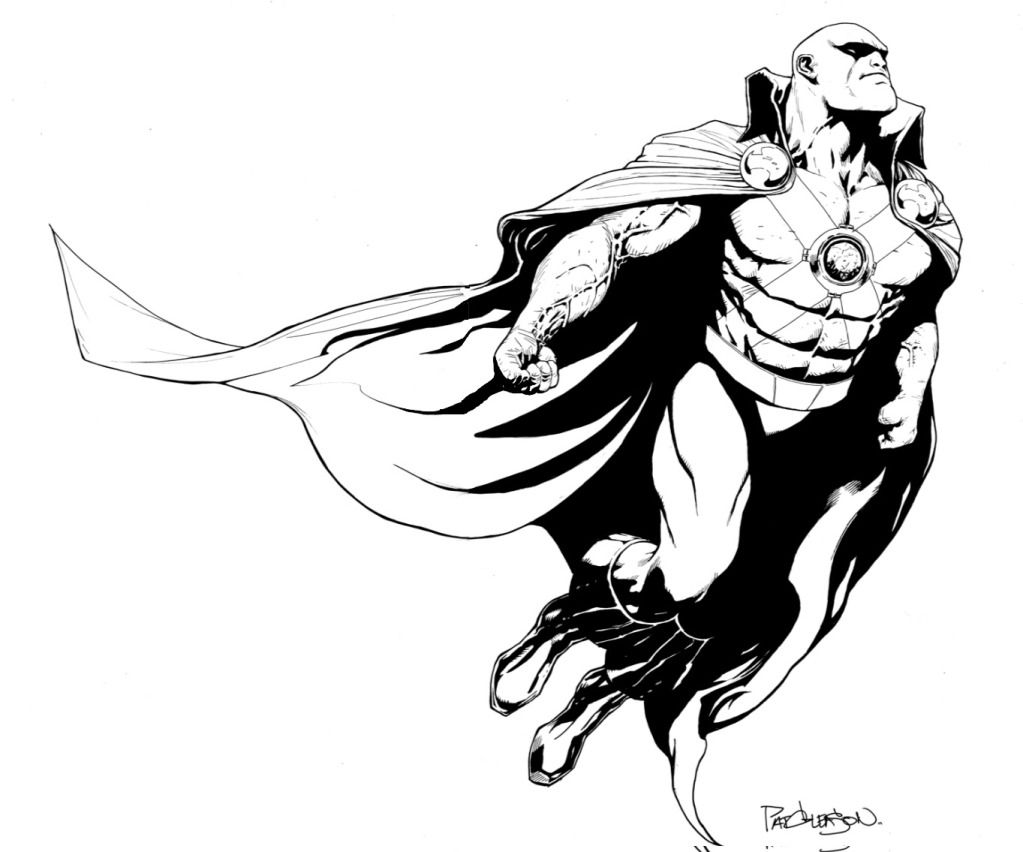
The image on the left is Patrick Gleason's Martian Manhunter. Brightest Day was the biggest victim of my near-2011 implosion as a reader (this is the same time period in which I started this blog, so the whole journey has been documented for all its dubious relevance). I loved it when it debuted, but have never had the opportunity to read the complete story, which along with Flashpoint helped usher the age of the New 52. It was a bi-weekly series, but it's easily the best weeklyesque comic DC has managed since 52, and it was spearheaded, naturally, by Geoff Johns, working alongside Peter Tomasi, in the closest to an apprenticeship for the Tomasi who now writes the brilliant Batman and Robin as you're likely to find. Tomasi's chief collaborator, Gleason, is present and accounted for, naturally, and of course his portions of Brightest Day revolve around Martian Manhunter. This was a fact I'd forgotten until I picked up this issue. This was a time in which J'onn J'onzz was getting some of his best material. The Brightest material is in some ways a sequel to the 2006-2007 mini-series that was at the forefront of this era. The Deadman and Aquaman material are also highlights of the issue that remind me of other things worth remembering about the series.
Justice League America #89-90 (DC)
From 1994.
Parts 1 and 4 of the "Judgment Day" Justice League crossover event that tried to ramp up the significance of the League books at the time (a little over two years later, Grant Morrison's JLA rebooted the whole field), this was a big dramatic end-of-the-world-type story. The creative team is Dan Vado and Marc Campos, who soon after launched Extreme Justice, a series I followed throughout its run even though Vado and Campos left soon after it launched, apparently because of conflicts with the editor (so you see, New 52 creators, this was nothing new), Vado back to Slave Labor Graphics. The Vado/Campos team was heavily influenced into following the Image style of the day. The villain for "Judgment Day" was a kind of cross between Galactus and Darkseid, Overmaster, whom Vado chose in much the same fashion as Grant Morrison later would Libra for the purposes of Final Crisis, an afterthought of a character that could use a slight revision. There were three additional chapters to the event, which may be best known, if at all, for the death of Ice. I used to think it would make a nice trade collection. Booster Gold's post-"Doomsday" woes, in which his original costume and therefore source of powers had been destroyed, also saw progress during the event, from a ridiculously bulky set of armor to a more streamlined look, which eventually led back to the form-fitting version for which he was known. It was the start of Booster's transformation from a Bwa-ha-ha image to someone who could be taken seriously again, returning the focus back to his sometimes-anomalous background as coming from, ah, the future, who couldn't be relied upon to provide foreknowledge of major crises such as this and, yes, the whole Doomsday thing, which Blue Beetle rightly points out here as having been, in hindsight, a pretty dick move, since Beetle was among the ones severely injured during it, besides the cost to Booster himself. All of which is to say, no matter how awkward this particular era might seem, it was a necessary evolution or at least transition. Extreme Justice later addressed the Armageddon 2001 dangling issue of Captain Atom's involvement with the figure of Monarch, saw the return of Firestorm, and to Vado's chagrin the in-continuity debut of the Wonder Twins, one of the issues that drove him away from mainstream comics.
Action Comics #806 and 809 (DC)
From 2003.
Joe Kelly was part of the Man of Action alliance (also including Joe Casey, Duncan Rouleau, and Steven T. Seagle) that was a different kind of evolution, doing the Image founders one better by going into business for themselves outside of the comics medium, helping to create, among other projects, Ben 10 (Rouleau and Seagle also created Big Hero 6, which became a smash hit film in 2014). This was a sort of lost generation for DC, most of whom had been tapped to join Jeph Loeb as the new millennium Superman creative team. The first of these two issues features Traci 13 and Natasha Irons, who by the end of the issue has discovered a new set of armor forged for her by her uncle, Steel, who had recently undergone one of several crises (including a temporary death coming out of Our Worlds at War). Superman is basically a guest star in the issue. The second issue features Lois and Clark on a cruise, forced to contend with the irrepressible Jack Ryder, whose dual existence as the Creeper doesn't explain his human behavior. It's a character who is always interesting but apparently can't carry his own series.
Supreme #64
From 2012.
As you may be aware, I've become heavily invested in Warren Ellis's Supreme: Blue Rose. The previous attempt at a Supreme revival started with this issue from Erik Larsen, best known for his ongoing Savage Dragon. Larsen used as his launching pad a lost script from Alan Moore, who had used Rob Liefeld's creation as a platform for writing Silver Age Superman adventures in the '90s. That script was used for Supreme #63. Larsen threw Supreme into a whole clash of multiple versions of himself and brought back the idea Liefeld originally envisioned, basically a violent version of Superman. (Anyone find it ironic that Moore didn't want to use that version, from a creator who helped build his legacy on Miracleman?) The result is typical Larsen, whose only competition at one point for the kinds of stories he likes telling was, of all comics, Garth Ennis's Preacher. Larsen's profile has dropped considerably since he launched Savage Dragon, but he remains one of the more interesting subjects for critical analysis. And unlike every other Image founder, he's remained true to the cause.
Tangent: Superman's Reign #1 (DC)
From 2008.
Speaking of causes, Tangent was Dan Jurgens' big to recreate DC's Silver Age revolution, when new versions of The Flash and Green Lantern helped revitalize its landscape. Using familiar names but totally revamping the mythology, it jumpstarted the idea of legacy that became so important to the company. Jurgens didn't have any pretensions of such a large-scale effect, but he created a fascinating concept all the same, one he was able to revisit after its debut in the '90s thanks to Dwayne McDuffie's Justice League of America, which also served as a platform to temporarily mainline the Milestone heroes. It's amusing how subtle Jurgens can be as a storyteller when someone else is providing the art. This is something I've remarked on before, but it bears repeating. He scales back on excited speech patterns that remain the most unfortunate aspect of older comics in general, and allows himself the liberty to let loose creatively, something that was a highlight of his Superman at the start (he's also, remember, the creator of Booster Gold, the antithesis of the Man of Steel). Superman, meanwhile, is the villain of the Tangent universe. It's a concept that remains interesting. If DC ever did decide to undergo another radical overhaul, it could do worse than look here for inspiration.
Subscribe to:
Posts (Atom)