Picked up one of Marvel's Free Spotlight comics with Dan Slott's Fantastic Four on the cover, with four pages from this month's relaunch. There's been a lot of talk that Marvel took the FF off the board as a bargaining chip (seems to have worked) to get the movie rights back, dating back to Jonathan Hickman's Secret Wars, where Reed Richards and Doctor Doom had their most epic showdown to date. Since then Johnny Storm and Ben Grimm have appeared in various team books. And of course it's Johnny and Ben who appear in these preview pages.
There's also Gerry Duggan offering a look at Infinity Wars, which apparently will feature an Infinity Watch of heroes and villains protecting the various Infinity Gems. Clearly calculated as an event to follow on the heels of Avengers: Infinity War at the movies. Then there's Extermination, another X-Men event; a page detailing various Miracleman collections, including a Neil Gaiman volume called The Golden Age perhaps in the hope more material will eventually follow; various other one-and-two-page ads, including for Charles Soule's Return of Wolverine featuring the infamous new flaming claws; four pages of Cullen Bunn's Asgardians of the Galaxy, which is another cue from the movies, borrowing elements from Thor: Ragnarok; and finally four from Kelly Thompson's West Coast Avengers, which features both Hawkeyes and land sharks that do not try and pretend to be delivering things.
DC Nation #0 (DC)
Besides looks at Brian Michael Bendis's Superman and Scott Snyder's Justice League, this quarter-priced special released just before Free Comic Book Day this year featured a wicked Joker story from Tom King in anticipation of the Batwedding, in which the Clown Prince breaks into someone's home and he waits there, along with the poor guy, for an invitation. It's as perfect a representation of Joker's twisted logic and sense of humor as I've ever seen. A lot of fans swear by Alan Moore's Killing Joke, but I think that one speaks more to Moore's proclivities than it does Joker's. King's Joker had a great spotlight in "War of Jokes and Riddles," in which he tries to figure out why nothing seems funny to him anymore, before realizing that Batman gives him bold new context, a challenge that will never get old. Here he's just free to terrorize the poor guy, using his singular logic.
Batman #50 (DC)
The main event, though, the issue that promised the actual Batwedding, angered a lot of fans because the wedding...doesn't happen. Instead, it proves an elaborate setup to the events of "I Am Bane," the earlier arc where Batman prevented Bane from attaining his Psycho-Pirate happy ending. Holly Robinson, who has proven so crucial to King's Catwoman, turns out to be a stooge of Bane, and whispers in Catwoman's ear doubt about what a happy ending would do to Batman. So the issue is instead really another caption character study of Batman and Catwoman's perspectives. No one has done that sort of thing as well as King since Jeph Loeb's early Superman/Batman.
Eternity #2, 4 (Valiant)
I went back and read #3, which I'd caught earlier, too, and that turned out to be a good idea, because it reads better in context, obviously, and is just a pleasure to read again in general. Eternity is the fourth volume of Matt Kindt's brilliant Divinity suite, in which Kindt reimagines the idea of the omnipotent hero previously featured in Moore's Watchmen under the guise of Dr. Manhattan, this time as a Russian cosmonaut and his colleagues, one of whom became his wife and the other a foe, while he inspired a fanatic who has proven far more troublesome than he could've possibly imagined. Eternity was pitched as beyond imagination, so its ending is apropos, the true consequences of Abram Adams's transformation far more wild than anything he discovers from the world that changed him forever. Hopefully there's a fifth volume of this stuff. The ending of this one certainly suggests that the story continues, anyway...
The Flash #50 (DC)
Josh Williamson continues his Rebirth buildup of previous lore by concluding the "Flash War" fight between Barry Allen and Wally West amicably and bringing back the classic Bart Allen in his classic Impulse costume. Howard Porter's career renaissance continues, and that's great to see from a reader who well-remembers his JLA heyday.
Showing posts with label Howard Porter. Show all posts
Sunday, August 5, 2018
Monday, September 18, 2017
Quarter Bin 116 "JLA"
JLA #8 (DC)
from August 1997
This is the setup to the Key revamp Grant Morrison pulled early in his run, but I remember it best for Green Arrow Connor Hawke's memorable statement: "Dad. Oh, dad. You're going to be the death of me." He's referencing having to use his then-late father Oliver Queen's infamous trick arrows. I used a similar line for a story I later wrote. It's just perfectly executed, and still one of the most memorable endings to any single issue I've ever read. It's also worth noting the excellent art of Oscar Jimenez, which he seems incapable of delivering on an ongoing basis. How about signing him up for a limited series, folks? Also, worth noting that Morrison's Key uses tactics that are very similar to The Matrix, an irony, as Morrison's The Invisibles has long been said to be an unacknowledged source of inspiration for the movie. I don't know Invisibles well enough to offer a judgment about that, but clearly Morrison was on the right wavelength somewhere...
JLA #14 (DC)
from January 1998
Yeah, so I mistakenly thought this was the "Darkseid Is" issue (it's on the cover an' everything!), but it's the one after it. It's also "Part 5 of 6" in the "Rock of Ages" arc, but for all intents and purposes, is probably to be considered, along with its immediate predecessor, the best stuff in the arc. It's Morrison's first crack at Darkseid. C'mon! He responds with possibly his best JlA material. Howard Porter provides art. It's crazy to think Porter, when JLA launched, was instantly considered an elite artist, but has never received another elite assignment. What the Apokolips is up with that???
JLA #88 (DC)
from December 2003
Truth be told, after Morrison left the title, I didn't really see much point in trying to see what his successors were up to, despite the fact that there's a lot more non-Morrison JLA issues than ones he actually wrote. This one's from Joe Kelly, who at the time was threatening to become one of DC's most important writers. Instead he and a bunch of his pals went and did their own projects, not in the Image way, but bigger, arguably. Anyway, I chose this issue because the cover promised a strong Martian Manhunter spotlight ("vs the Martian Manhunter! and J'onn Jonzz! and John Jones!"), but as it turns out, Plastic Man is the one who receives the best spotlight. Plastic Man was Morrison's most outlandish addition to the League, so it's really good to see that his presence in the team wasn't overlooked or forgotten years after the fact. Kelly spins some poignant material that segues nicely with the Offspring character Mark Waid envisioned as Plastic Man's son. Waid apparently considers Offspring the best thing about The Kingdom. You'd really think there would've been more with these two. There's always the future...Also quite fun to see Doug Mahnke's work, as always. He seems to have developed, by this point, more or less the style he still uses today.
Tuesday, May 23, 2017
The Flash #22, and thoughts on "The Button" in general
The four-part "Button" arc concludes with the dramatic return of Jay Garrick, the Golden Age Flash, as well as prelude to Doomsday Clock, Geoff Johns's November-launching DC Rebirth event that finally delivers on the promise of integrating Watchmen into regular company lore. I know at least one fan who thinks this is inherently a terrible idea. Spent a great deal of time last year arguing against his brick wall about the sacredness of Alan Moore's iconic original story. Alan Moore has a way of inspiring that kind of lunatic devotion, and I can't say I'll ever really understand that. As far as I'm concerned, the guy is a hypocrite. He thinks he operates by a separate set of rules just because in the '80s he was considered the greatest comic book writer of that time, a reputation that more or less still persists. He borrowed the creator rights crusade other creators from that time staked a lot more of their careers on, creators who spent their time creating original works as a matter of course, rather than spending it working very deliberately on the ideas of others, as he very demonstrably did, regardless of what else can be said about his work...
But that's neither here nor there, really. Let's talk about some creators who are proving vital in 2017. (Jerusalem may be an eminently worthy piece of literature. Moore's ego will probably prevent me from judging for myself anytime soon. Shame. That's the first rule of literature, that you don't put the cart before the horse. But then, there's also a tradition of writers attempting to make themselves more famous by reputation than by their actual creative prowess. Seemingly to give their work a little attention. Except with Moore he seems to begrudge attention. And that's the real problem, here.)
I'm talking about Geoff Johns, who is given conceptual credit for "The Button," because it follows DC Universe Rebirth, and leads to Doomsday Clock, so naturally he has a vested interest in how "Button" worked out. I'm talking Tom King, who wrote one of its four chapters. I'm talking Howard Porter, who since JLA has never really had the spotlight put on his art. I'm talking Josh Williamson, whose work in the pages of The Flash has been excellent all along, but whose role in writing three of the four chapters of "Button" has suddenly thrust him into a new level of significance within the elites of DC creators. As is, he's becoming one of the elites.
Even at four chapters, "The Button" is a story that progressed so deliberately that there seems to have been very little actual story to it, but as a sequel to Flashpoint along with every other thing that can be said about it, everything about it seemed inevitable, except the skill and finesse of the storytelling is actually what makes it read so smoothly, and again, that falls completely at the feet of Williamson. Anyone can be told what's expected of them, what elements to use, what's supposed to happen, but if they don't make it work, that's pretty clear. Williamson makes it work. He makes it work so effortlessly, the result is that he seems to have done hardly anything at all. Yet he's done a truly incredible job. Superhero comics can be such thankless storytelling, with a long tradition of generic storytelling, adventure quests filled with scene after scene of good guys and bad guys doing their thing, and yet, even Williamson's Reverse-Flash, who ends up making a comeback of his own, aside from everyone else making splashy appearances, it's just as easy to overlook his significance as everything else. Reverse-Flash, the classic one who caused Barry Allen hell not only in Flashpoint but "The Trial of the Flash," one of the longest Flash stories ever, until a few years ago virtually forgotten in the face of Barry's death in Crisis on Infinite Earths, who actually becomes a kind of new Psycho-Pirate, the character who remembered Crisis happened when everyone else forgot. And you can see where even that's significant, how it ties everything together.
Williamson, in just the material I've read so far, has been telling excellent Flash stories already, but "The Button" has put him over the top. I loved Flashpoint. At the very start of this blog, it saved me as a reader. I love that it has once again proven important (and also in the Flash TV series in the just-concluded third season, which presented its own interpretation of Flashpoint and its consequences).
I love that kind of resonant storytelling. I'm glad Moore was able to write things that connected so powerfully with readers. But I'm sorry it came at the expense of his willingness to stay connected with the stories that made it possible. He closed himself off. What I value so much about storytelling is the ability to make connections, not wall them off. That's what Moore loves, too, but he seems incapable of admitting it at this point. He thinks everything exists in isolation, unless he says otherwise. Things like "The Button," and the work of Josh Williamson in general, prove otherwise, as far as I'm concerned.
Sunday, December 28, 2014
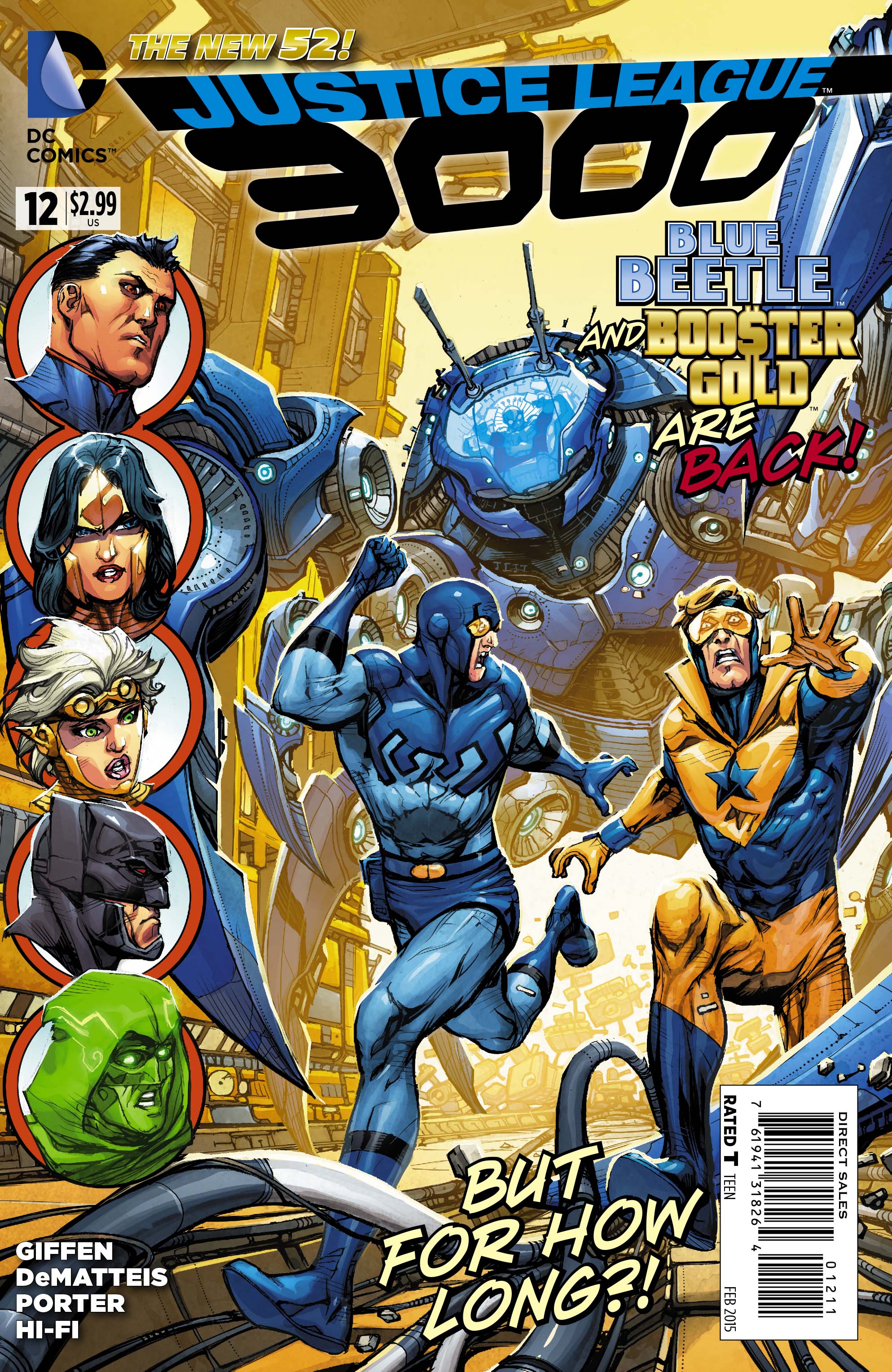
Justice League 3000 #12 (DC)
| via 13th Dimension |
artist: Howard Porter
Here's the series that was originally conceived as a complete reunion of the "Bwa-ha-ha League" creator reunion. Except artist Kevin Maguire was replaced with JLA's Howard Porter. Clearly the writers, the inimitable duo of Keith Giffen and J.M. DeMatteis, are exactly the same!
I don't know if it was the Maguire/Porter swap, or ongoing interest in the "Bwa-ha-ha League" is never exactly what DC thinks it is, but Justice League 3000 has been struggling for relevance. Time for Blue & Gold?
Absolutely!
"Blue & Gold" are Blue Beetle and Booster Gold. And not just any Blue Beetle, but Ted Kord, the one who was, of course, an original member of the team, and whose last and most famous moment in DC lore was being blown away by Maxwell Lord in Countdown to Infinite Crisis. Later, Jaime Reyes took over as Blue Beetle, even at the start of the New 52, but a new incarnation of Ted showed up in Geoff Johns' Forever Evil. The Ted here is not that Ted. Booster jokes around about a time before Original Ted's death where he'd really let himself go.
And they steal this whole issue, by the way. Your regularly scheduled Justice League a thousand years in the future (apparently having new usurped that era from the Legion of Super-Heroes) are backup players in their own series! Does it matter? Only if you plan to read any issues that don't spotlight Blue & Gold.
It's great, because Porter clearly does his best to channel the distinctive Maguire facial features in the issue. I don't know if this is something he's done for other issues, but it's clearly noticeable in this one. And much appreciated.
It's a pretty great issue.
Sunday, November 9, 2014
Quarter Bin #58 "Binge-worthy III: Mark Waid's Marvel, and other artifacts"
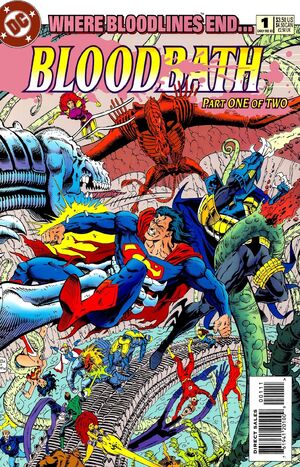
Bloodbath #1 (DC)
From 1993.
DC's 1993 annuals represented an effort to introduce an entire generation of new superheroes under the "Bloodlines" banner, surviving victims of a parasitic alien invasion who discovered hidden powers. A few of these characters were featured in their own short-lived ongoing series (Gunfire, Anima) or mini-series (Loose Cannon, Razorsharp in Psyba-Rats), or else in various teams (Sparx) or as supporting characters in the titles whose annuals they debuted (Argus in The Flash). The most famous alumnus, Hitman, branched off to create his own Garth Ennis-fed legacy. Critics generally dismiss the whole effort as a crass attempt to cash in on the Image craze at the time, and maybe it was, but it was considerably ambitious and also the last time DC tried to replicate the success of its breakthrough Silver Age boom, which was followed by the Marvel Age renaissance a few years later. I've been interested in these characters being revisited ever since, but that day still hasn't come, so the next best thing is to revisit "Bloodlines" itself, which I've done on a few occasions now. This time I couldn't help but enjoy the snapshot of the DC landscape of that time that Bloodbath helps capture. There's Mullet Superman, "Azbats," Bulky Armor Booster Gold, even my good buddy Bloodwynd. There's also an advertisement for the DC adaptation of Hitchhiker's Guide to the Galaxy, something I didn't read at the time and am still hoping to track down some day. I'm one of the few people out there who wouldn't mind owning the complete "Bloodlines" event, and its related material. That would be binging!
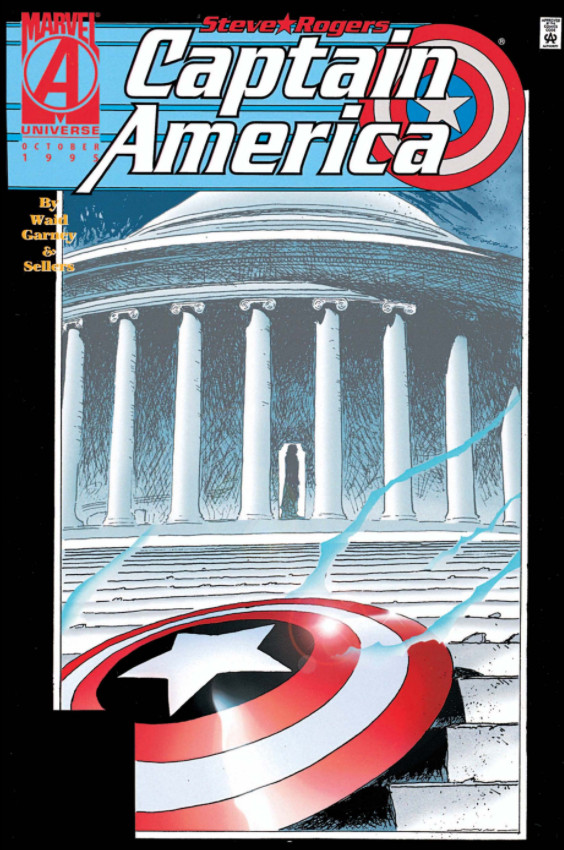
Captain America #444 (Marvel)
From 1995.
Until now I'd never read Mark Waid's Captain America, which at the time was distinguished as the first time he'd been noticed for something other than The Flash. It was a run that was interrupted by the "Heroes Reborn" thing, another effect of the Image revolution, but popular enough that Marvel brought Waid back after the "Heroes Return." I'd always wondered if Waid really was as ideal with Cap as he'd been with Wally West. What made his Flash so special was a deep love for the character and his history, and everything Waid added to that legacy, notably bringing all the speedsters together, creating a few of his own, and introducing the concept of the Speed Force, basically a prototype for everything that Geoff Johns would do for Green Lantern a decade later. After reading some of Waid's Captain America, I'm still not sure what to make of this work. This issue in particular seems determined to make readers appreciate Steve Rogers for the idealistic and idealized hero he is, a Marvel concept if I ever saw one, the sacrifices and triumphs he's experienced over the years. Steve isn't even in the issue, it's his supporters standing up for him against the doubts a skeptical government agent. It's not very subtle work, although by the end of the issue Waid has done his trademark work of focusing on an iconic image, a frozen Captain America, except this time he's in the clutches of his enemies. Most telling, perhaps, is Waid's heavy use of Quicksilver, Marvel's resident speedster, either a concession to fans of The Flash or a storytelling crutch for someone who was more than familiar with that kind of character at that point.
Perhaps the most ironic part of Waid's arc at this point is that it's happened again under the current Rick Remender regime: Steve Rogers losing his super-soldier edge. In this issue, he's given his strength back by his worst enemy, the Red Skull. Part of the reason I know the fans were exaggerating a little, or that there were far fewer fans championing this run, is that until now I had no idea any of that even happened. Waid creates the Speed Force and it's a permanent addition. Waid monkeys around with Captain America and it's just his version of the classic '90s crisis every superhero underwent. This is not to say it's not good storytelling, but that it doesn't seem to have had much impact. I've been wondering the same about Waid's current Marvel cult favorite, Daredevil, which seems headed in the same direction. Which leads me to this conclusion: Waid knows how to work the angles of any given iconic character, but he rarely seems interested, or motivated, to significantly add to that character's legacy.
Obviously, this is part of Waid's return engagement. This one's got a pretty interesting idea: What happens when an enemy (in this case the shape-shifting Skrulls) actually undermine Cap by making him popular? All of Marvel's superheroes have inferiority complexes in one shape or form, part of the gimmick that's supposed to make them more relatable to the angst-ridden teenage market (also why the company has somewhat distanced itself from that approach in the big box office era). If you ever wanted to know the biggest difference between Superman and Captain America, there it is. Although a dude with "America" in his name, that doesn't automatically mean Cap is always aces with his country (something Captain America: The Winter Soldier helped demonstrate). Although it should be noted that Waid did a similar story in the pages of The Flash.
Cap working alongside S.H.I.E.L.D. sounds like the movies, doesn't it? Other than that, there's Sharon Carter drama (which was also a theme of other issues I sampled), and Andy Kubert (the Kubert who now has a functional Batman legacy under his belt thanks to helping Grant Morrison introduce Damian) proves there's at least one thing he can't draw, which is Steve Rogers drinking wine. Maybe I don't know the character well enough, but I highly doubt he'd hold the glass like a dandy. The man's a soldier. I think people sometimes forget that. Somehow...Actually, come to think of it, if I'd formed any impression of what to expect from a Mark Waid Captain America, I would have expected a heavy emphasis on that. Although he seems to have done anything but.
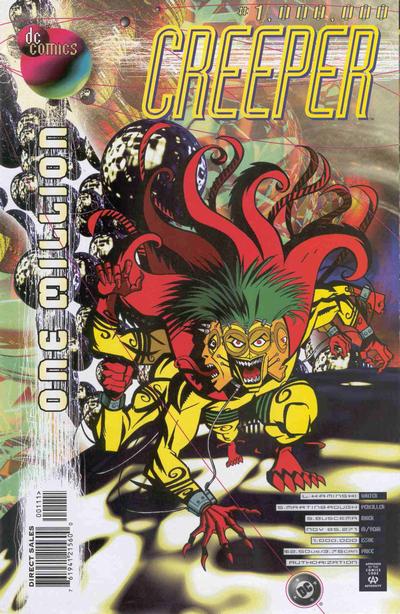
Another event I have a great affinity for is Grant Morrison's DC One Millioni, which imagines what the legacy of today's superheroes will look like in the year the one millionth issue of their current comic books would be published. Turns out, despite all that time, pretty familiar. Except The Creeper keeps it close to home, featuring the present version, possibly because this also happens to be the last issue of the series, meaning writer Len Kaminski has to come up with a statement on the character that makes sense in the event context. He pulls it off. Creeper is one of those wild card characters DC loves to experiment with, a sort of Joker combined with the Mask and Deadpool, with the same body-swapping gimmick as Captain Marvel and the Demon Etrigan. I'd never read the series, so picked up the issue mainly out of interest in One Million, but I ended up loving the issue. In hindsight this was another of those comics DC should probably have published under the Vertigo banner, as it features many of the classic hallmarks of a more abstract interpretation of superhero storytelling. But if that had happened, the One Million issue would never have happened.
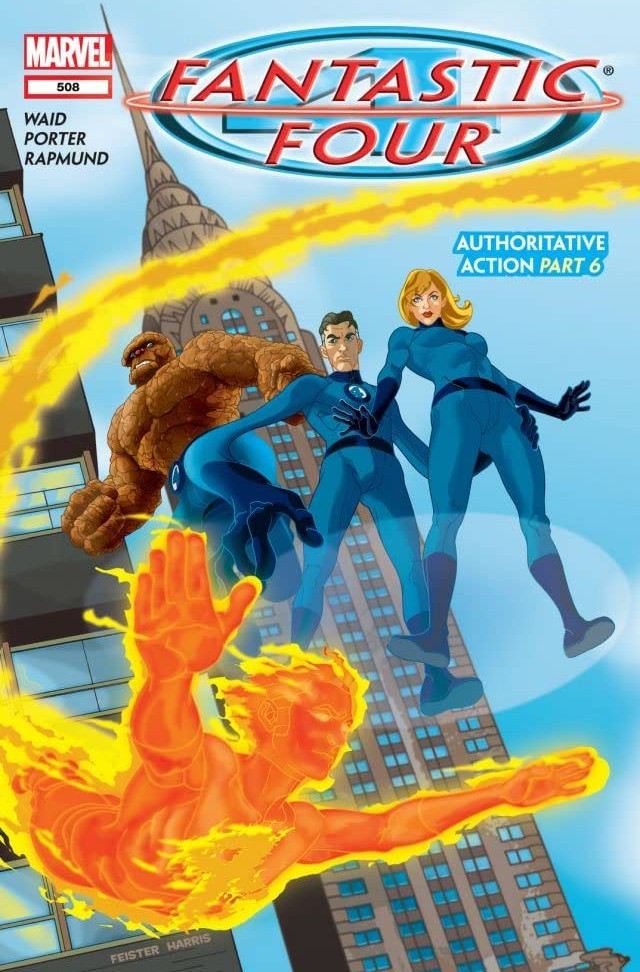
The final Mark Waid in the binge, this issue features Dr. Doom possessing successive members of the Fantastic Four, a concept straight out of the Silver Age, although it also features the "death" of the Thing, although by the end of the issue Sue Storm is already talking strategies on how to bring him back. So in that regard, Waid is ahead of his competitors. I can't judge his First Family on one issue, but I didn't find it to be too remarkable. The biggest hook for me is Howard Porter on art. Ever since his JLA with Grant Morrison, I've been interested in Porter's career, and although he's never had another high profile run like that, I'm happy whenever I see him on a new project (current one: Justice League 3000). Some artists change their style over time, but Porter's is the same in this issue as it was in JLA. I consider that a good thing.
From 1993.
| via DC Wikia |
Captain America #444 (Marvel)
From 1995.
| via Marvel Wikia |
Captain America #445 (Marvel)
From 1995.
| via Comic Megastore |
Captain America #5 (Marvel)
From 1998.
| via Comic Vine |
Captain America #20 (Marvel)
From 1999.
| via Comic Vine |
The Creeper #1,000,000 (DC)
From 85,271/1998.
| via DC Wikia |
DC Universe #0 (DC)
From 2008.
| via DC Wikia |
Technically the last issue of Countdown to Final Crisis, this one was written by Grant Morrison and Geoff Johns and is best known for Morrison's interlude between Batman and the Joker, which ties in with "Batman R.I.P." The narration is provided by Barry Allen, whose return is revealed at the end of the issue. He'd been the most famous victim of Crisis on Infinite Earths, which Final Crisis undoes by bringing back the concept of the multiverse in full force. But readers who expected it to be more like Infinite Crisis probably have only this issue to hold onto. Probably Johns' biggest influence on it.
This is Grant Morrison's intended film collaboration with Barry Sonnenfeld, a project that followed on the hinges of a similar release in 18 Days. Dinosaurs vs. Aliens sounds gimmicky, especially when you consider the similarly-titled Cowboys vs. Aliens and how poorly that went over with wide audiences, but it's actually pretty interesting. It's Morrison in minimalist mode (We3, Joe the Barbarian), although as gorgeous as the art is (I should note that I've previously read the whole graphic novel release), it's almost better to read the script excerpts, where you can truly appreciate how much effort Morrison puts into his concepts. The trouble with this one, though, is that it risks being, ultimately, about as interesting as that underwater chase in Star Wars Episode I: The Phantom Menace in which the heroes are confronted with a succession of large fish. The animators put a lot of work into that, too, details you might not have caught, even a whole story you might have missed. It's a little hard imagining that a potential movie version of this concept would play differently, which might be part of the reason there still isn't, well, a movie version of this. Maybe it just needs more Rip Torn?
Dinosaurs vs. Aliens Free Comic Book Day Special Preview (Liquid Comics)
From 2012.
| via Comic Vine |
Fantastic Four #508 (Marvel)
From 2004.
| via Marvel Wikia |
Subscribe to:
Posts (Atom)