Showing posts with label Brightest Day. Show all posts

Monday, January 12, 2015

Quarter Bin 65 "Binge-worthy X: Some Things Old, Some New"

Blackhawk #16 (DC)
From 1990.

I picked this one up because of the Rick Burchett art.  Burchett was one of the artists who was later converted into Batman Adventures work, along with the late Mike Parobeck.  I wanted to see how much he had to modify his work to conform to the Bruce Timm model.  Turns out a bit more than Parobeck, whom I'd encountered in the pages of a Justice Society revival previous to the comics based on the Timm/Paul Dini cartoon.  But the real revelation is that Burchett's work was surprisingly sexy, and the bigger revelation that Blackhawk was a pretty darn excellent comic book.  This was its final issue, by the way, so it was another of those excellent comics that still somehow failed to find an audience.  It's the bane of fans everywhere.  But at least I've had the chance to discover this one, a quarter century after the fact.  The last time I did that, I fell in love with Loeb and Sale's Challengers of the Unknown, from around the same period, so it was good news/bad news for attempts to revive older DC properties at the time, right?  Blackhawk told the story of secret agents who were also pilots.  The last time a revival was attempt was Mike Costa's New 52 series Blackhawks, which also was an underrated series, though this time my late discovery of it was far less forgiveable, as I'm a big fan of Costa's (he's coming back to G.I. Joe/Cobra next week, by the way, in the pages of G.I. Joe - Snake Eyes: Agent of Cobra) who nonetheless made a poor effort to try out his first mainstream superhero effort.  My bad.
via Idol-Head
Brightest Day #3 (DC)
From 2010.

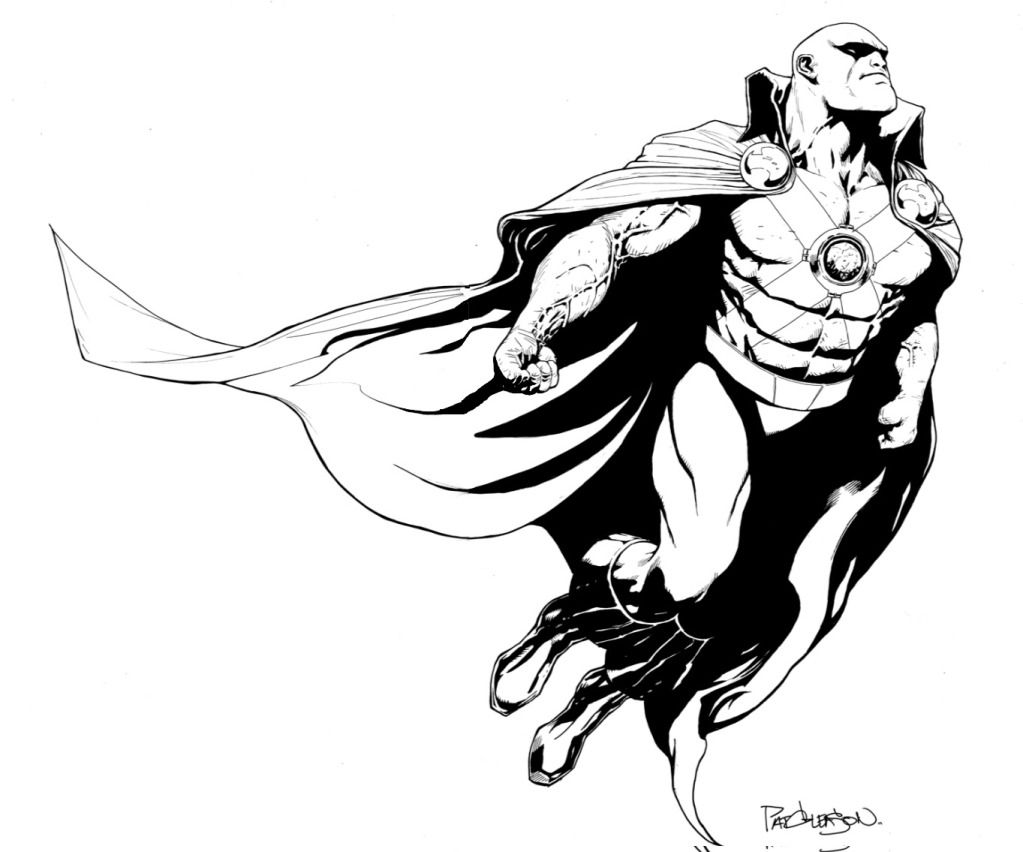
The image on the left is Patrick Gleason's Martian Manhunter.  Brightest Day was the biggest victim of my near-2011 implosion as a reader (this is the same time period in which I started this blog, so the whole journey has been documented for all its dubious relevance).  I loved it when it debuted, but have never had the opportunity to read the complete story, which along with Flashpoint helped usher the age of the New 52.  It was a bi-weekly series, but it's easily the best weeklyesque comic DC has managed since 52, and it was spearheaded, naturally, by Geoff Johns, working alongside Peter Tomasi, in the closest to an apprenticeship for the Tomasi who now writes the brilliant Batman and Robin as you're likely to find.  Tomasi's chief collaborator, Gleason, is present and accounted for, naturally, and of course his portions of Brightest Day revolve around Martian Manhunter.  This was a fact I'd forgotten until I picked up this issue.  This was a time in which J'onn J'onzz was getting some of his best material.  The Brightest material is in some ways a sequel to the 2006-2007 mini-series that was at the forefront of this era.  The Deadman and Aquaman material are also highlights of the issue that remind me of other things worth remembering about the series.

Justice League America #89-90 (DC)
From 1994.

Parts 1 and 4 of the "Judgment Day" Justice League crossover event that tried to ramp up the significance of the League books at the time (a little over two years later, Grant Morrison's JLA rebooted the whole field), this was a big dramatic end-of-the-world-type story.  The creative team is Dan Vado and Marc Campos, who soon after launched Extreme Justice, a series I followed throughout its run even though Vado and Campos left soon after it launched, apparently because of conflicts with the editor (so you see, New 52 creators, this was nothing new), Vado back to Slave Labor Graphics.  The Vado/Campos team was heavily influenced into following the Image style of the day.  The villain for "Judgment Day" was a kind of cross between Galactus and Darkseid, Overmaster, whom Vado chose in much the same fashion as Grant Morrison later would Libra for the purposes of Final Crisis, an afterthought of a character that could use a slight revision.  There were three additional chapters to the event, which may be best known, if at all, for the death of Ice.  I used to think it would make a nice trade collection.  Booster Gold's post-"Doomsday" woes, in which his original costume and therefore source of powers had been destroyed, also saw progress during the event, from a ridiculously bulky set of armor to a more streamlined look, which eventually led back to the form-fitting version for which he was known.  It was the start of Booster's transformation from a Bwa-ha-ha image to someone who could be taken seriously again, returning the focus back to his sometimes-anomalous background as coming from, ah, the future, who couldn't be relied upon to provide foreknowledge of major crises such as this and, yes, the whole Doomsday thing, which Blue Beetle rightly points out here as having been, in hindsight, a pretty dick move, since Beetle was among the ones severely injured during it, besides the cost to Booster himself.  All of which is to say, no matter how awkward this particular era might seem, it was a necessary evolution or at least transition.  Extreme Justice later addressed the Armageddon 2001 dangling issue of Captain Atom's involvement with the figure of Monarch, saw the return of Firestorm, and to Vado's chagrin the in-continuity debut of the Wonder Twins, one of the issues that drove him away from mainstream comics.

Action Comics #806 and 809 (DC)
From 2003.

Joe Kelly was part of the Man of Action alliance (also including Joe Casey, Duncan Rouleau, and Steven T. Seagle) that was a different kind of evolution, doing the Image founders one better by going into business for themselves outside of the comics medium, helping to create, among other projects, Ben 10 (Rouleau and Seagle also created Big Hero 6, which became a smash hit film in 2014).  This was a sort of lost generation for DC, most of whom had been tapped to join Jeph Loeb as the new millennium Superman creative team.  The first of these two issues features Traci 13 and Natasha Irons, who by the end of the issue has discovered a new set of armor forged for her by her uncle, Steel, who had recently undergone one of several crises (including a temporary death coming out of Our Worlds at War).  Superman is basically a guest star in the issue.  The second issue features Lois and Clark on a cruise, forced to contend with the irrepressible Jack Ryder, whose dual existence as the Creeper doesn't explain his human behavior.  It's a character who is always interesting but apparently can't carry his own series.

Supreme #64
From 2012.

As you may be aware, I've become heavily invested in Warren Ellis's Supreme: Blue Rose.  The previous attempt at a Supreme revival started with this issue from Erik Larsen, best known for his ongoing Savage Dragon.  Larsen used as his launching pad a lost script from Alan Moore, who had used Rob Liefeld's creation as a platform for writing Silver Age Superman adventures in the '90s.  That script was used for Supreme #63.  Larsen threw Supreme into a whole clash of multiple versions of himself and brought back the idea Liefeld originally envisioned, basically a violent version of Superman.  (Anyone find it ironic that Moore didn't want to use that version, from a creator who helped build his legacy on Miracleman?)  The result is typical Larsen, whose only competition at one point for the kinds of stories he likes telling was, of all comics, Garth Ennis's Preacher.  Larsen's profile has dropped considerably since he launched Savage Dragon, but he remains one of the more interesting subjects for critical analysis.  And unlike every other Image founder, he's remained true to the cause.

Tangent: Superman's Reign #1 (DC)
From 2008.

Speaking of causes, Tangent was Dan Jurgens' big to recreate DC's Silver Age revolution, when new versions of The Flash and Green Lantern helped revitalize its landscape.  Using familiar names but totally revamping the mythology, it jumpstarted the idea of legacy that became so important to the company.  Jurgens didn't have any pretensions of such a large-scale effect, but he created a fascinating concept all the same, one he was able to revisit after its debut in the '90s thanks to Dwayne McDuffie's Justice League of America, which also served as a platform to temporarily mainline the Milestone heroes.  It's amusing how subtle Jurgens can be as a storyteller when someone else is providing the art.  This is something I've remarked on before, but it bears repeating.  He scales back on excited speech patterns that remain the most unfortunate aspect of older comics in general, and allows himself the liberty to let loose creatively, something that was a highlight of his Superman at the start (he's also, remember, the creator of Booster Gold, the antithesis of the Man of Steel).  Superman, meanwhile, is the villain of the Tangent universe.  It's a concept that remains interesting.  If DC ever did decide to undergo another radical overhaul, it could do worse than look here for inspiration.

Tuesday, April 3, 2012

Quarter Bin #38 "Band of Heroes"

SANDMAN MYSTERY THEATRE #4 (Vertigo)
From July 1993:
Matt Wagner is one of those great comic book writers who’s managed to float through the medium for years without having been locked down by DC or Marvel.  He’s perhaps best known for GRENDEL, which he’s done for Dark Horse, and MAGE, which he’s done for Image.  He actually has written for DC on a semi-regular basis, but as I said…he’s a floater.  SANDMAN MYSTERY THEATRE is one of those books Vertigo was publishing when I first started reading comics but wasn’t old or experienced enough to be interested in reading at the time.  I always thought it had to have some connection to Neil Gaiman’s SANDMAN, but then, at the time I didn’t have any experience with that one, either.  But no, MYSTERY THEATRE starred the Golden Age Sandman, Wesley Dodds, whose last major appearance was KINGDOM COME.  This is the first issue I’ve actually read of the series (late to the game, I know), and now I can appreciate it as a kind of monthly crime thriller that TV features in infinite combinations these days, sometimes in franchise variety, a period comic book that was another of the Vertigo books at that time that featured experienced DC properties in new and interesting ways.  I wonder why it’s been forgotten since then, left out of print, and not even a legacy character who’s trusted to be anything but a bit player in team books.  I think given influence I’d probably change that.  This being an early issue, I get to read letters reacting to the very start of the series, too, which is always fun.

STARMAN: THE MIST (DC)
From June 1998:
Part of the “Girlfrenzy” skip week event, this was a one-shot spinning out of James Robinson’s STARMAN.  Fans reading it today may find the references to Hal Jordan villains a little quaint, especially since BLACKEST NIGHT star Black Hand is featured as an obscure curiosity.  It should be no wonder that I purchased this issue around the same time I was reading the omnibus last year, in an effort to steal some extra STARMAN goodness without spoiling some of the rest of the story I’ll be reading once those collections are printed in paperback later this year.  It’s funny, because THE SHADE is helping to keep one of Jack Knight’s foes in the headlines, while the one featured here has kind of gone into the very obscurity that Robinson was playing with here.

BRIGHTEST DAY #24 (DC)
From June 2011:
The conclusion of Geoff Johns and Peter Tomasi’s follow-up to BLACKEST NIGHT was something I missed last year when it was first published, thanks to my semi-retirement from reading new comics, which at that time was more semi-permanent than it is today, since I only really started to try and be semi-active once FLASHPOINT began.  To me, BRIGHTEST DAY was on par with 52, certainly leagues better than the meandering TRINITY, and better focused than COUNTDOWN (though I am probably COUNTDOWN’s biggest fan, just as I remain one of 52’s biggest supporters).  With a tightly focused core of characters and a smaller slate, BRIGHTEST DAY was like the catch-all version of Johns getting to do all the characters he’d really love to work with, and will probably go down as the best Deadman story to date (which made it all the bigger a shame that Boston Brand only received the first story of an anthology title in the New 52, rather than his own series).  The biggest shame of BRIGHTEST DAY was that Johns and DC so quickly went about rebooting everything, so that there was no real momentum from what occurred in this story.  As a big-concept culmination of the previous incarnation of the DCU, however, it’ll be worth relishing for years, or simply as an excellent sequel to BLACKEST NIGHT, to which BRIGHTEST DAY is probably superior.

BABYLON 5: IN VALEN’S NAME #3 (DC)
From May 1998:
J. Michael Straczynski and the fans of BABYLON 5 are guilty of worshipping a TV series that did not actually live up to its reputation.  Like a long series of B-movies, it was a show with a grand vision that could not in execution match its ambitions.  Still, there are legions of fans out there.  Perhaps one day it can be redone as an epic trilogy of movies, and Straczynski can be present to help guide it once more.  For now, its legacy is what it is, and that can be seen in spin-offs like this comic book, too.  Valen, if you didn’t know, is the Minbari name Jeffrey Sinclair assumed after he traveled back in time to help end the war he couldn’t prevent from happening in order for the resulting Shadows conflict from ending in disaster.  Sinclair was the first lead character in the series, and was quickly replaced in the second season.  This is the story of how his reputation meant everything (except anything practical to the weekly episodes).  Straczynski has become known as someone who believes in total creative control, and BABYLON 5 was the project that helped him get that reputation, yet the irony is that a critical analysis suggests that he flew by the seat of his pants, making it up as he went along (even if he didn’t, that’s exactly what it looks like now, regardless of how well-documented the transition between the fourth and seasons is), rather than deliberately shaping the series from a pre-plotted roadmap.  It’s funny, too.  Every time a BABYLON 5 or STARGATE or BATTLESTAR GALACTICA appears and starts usurping the Star Trek audience and makes them believing they’re actually the hot new thing that’ll endure forever, they can never really launch an enduring franchise.  Maybe they all try too quickly, I don’t know, but it’s always funny to see them collapse (even X-FILES did it).  Just thought I’d mention that.  It amuses me.

SUPERMAN: METROPOLIS #11 (DC)
From February 2004:
This was a twelve-issue series that Chuck Austen did in the year before I started getting back into comics, and something I’d never heard of before stumbling across it at Heroes & Dragons.  Starring the intrepid Jimmy Olsen and featuring a strong technological theme, I kind of wonder why it’s been so thoroughly forgotten, given the extreme nature of smart phone obsession we now endure.  You’d think if DC sanctioned a twelve-issue mini-series, the company believed it enough to keep it in print.  Jimmy is a character who’s been famous for so long that he can be easy to take for granted.  Me, I’d keep him active in the paperback collections, and I’d have plenty of suggestions on how to fill them (not the least being his “I found out Superman’s secret identity!” debacle from the late 1990s), and I’d definitely have him starring in his own book.  Of all the Superman characters, he’s the most relevant to the average reader.  If DC wanted to start somewhere in picking up that slack, they can reprint this story.

SUPERMAN: THE MAN OF TOMORROW #2 (DC)
From fall 1995:
In the ’90s, it was impossible to escape Superman and Batman on the stands every week, and eventually even the skip weeks were covering in BATMAN CHRONICLES and this title, published quarterly for a handful of years.  At the time of this one’s release, Lex Luthor was just coming back from an extended period of being his own son, via a surrogate clone sporting a full head of red hair, thanks to UNDERWORLD UNLEASHED (which had not yet begun), and years away from being elected President of the United States (yes, it happened), and he was matched by the mysterious Contessa, a character I’d keep around as a permanent addition to the Superman mythos.  I’d also retain Alpha Centurion, who was still working his way into the Superman comics of the time after a false introduction during Zero Hour.  The Centurion was so rich in potential, and was years ahead of the Hollywood curve that with GLADIATOR brought back the appeal of the historical epic, yet he disappeared soon after his arrival, never to be heard from again.  He’s another character I would unquestionably revive, with probably a few modifications.  I thought I’d read most of his appearances, but I guess I wasn’t quite as religious with Superman at the time as I thought I was, since I skipped the second issue of MAN OF TOMORROW, with the Contessa and Centurion clearly on the cover.  It was another happy discovery.

JSA CLASSIFIED #30 (DC)
From November 2007:
Mr. Terrific’s early loss in the New 52 of his first ongoing series was a mercy killing.  The book was terrible, baffling in its lack of understanding of just how awesome Michael Holt really is, and how relevant he is in the modern world.  Arvid Nelson, one of my favorite writers, wrote this spotlight that has the rest of the Justice Society backing him in one of his periodic wars with Nazis (a crossover with Atomic Robo is inevitable!).  It’s still weird to think that the JSA has had so many books in recent years, but was ignored in the first wave of the New 52, and still won’t have a book with its name in the title in the second.  But then, Robin doesn’t have his own book, either, so there’s at least some consistency.  I hope DC hasn’t given up on Mr. Terrific as a character who can command his own stories.  We’ll see.

Thursday, February 17, 2011

Escape Velocity

Okay, so you’ve already slogged through my so-called “Comic Book Memoir,” so you know that I have technically quit the business of reading comics. What further relevance can I have for those who want to read about new comics? For starters, I have not given up completely, even though it’s financially unfeasible to continue the habit as I’ve have pursued it throughout my regular experience. I will continue to read, in altered ways, in a more limited capacity. For instance, I will become the very monster I had once vowed to fight with my life. I will “wait for the collections.” I also work at a bookstore, so I’ve got a limited selection of first-run issues still available. I’ve got DC represented pretty well there, GREEN LANTERN, GREEN LANTERN CORPS, THE FLASH. (Okay, so I’ve got Geoff Johns pretty well represented.) ACTION COMICS is another, which I’m thrilled about, because I love what Paul Cornell has been doing, and that big anniversary issue is coming up. I can still keep tabs on Tony Daniel’s BATMAN (which is a bestseller there, so I need to be fleet of foot, if I want to read it, if not buy it). There are a few others, and of course some that aren’t DC.

But that’s the future, that’s potential and possibility. Back in the present, I’ve made a new vow, and so far so good. I haven’t gotten a comic book in over a week (woo!), whether in a store or via a shipment from Midtown. The subject then, for this week is my last-for-now trip to a store, Escape Velocity in downtown Colorado Springs. I made it in the full knowledge and after canceling all my subscriptions with Midtown. Though I still had one final shipment awaiting me, this was technically how my comics habit came to an end.

I should backtrack a little. I can’t completely acknowledge my motivations for this decision without mentioning the inciting incident. I live in an apartment. I never truly appreciated the differences in postal service from carrier to carrier until I moved to Colorado Springs. I had tremendous experiences, growing up in Maine and in Burlington, MA, with postal carriers, met some really good ones, even had some really good relationships and even friendships with them over the years. When I moved into this particular apartment, however, and started depending on Midtown to read comics, I crossed over the postal matrix, and finally experienced the flipside. Not all carriers are created equal. Unfortunately, it seems most of the carriers here come from the Dark Side. Still, not to dwell too much on the negative, since it was one of Midtown’s random decisions to ship with UPS that allowed some hooligan to steal the package mere hours before I could have taken it into my door that really concluded the series of unfortunate events that seem to have gone hand-in-hand with packages and this apartment, that finally convinced me that peace of mind and security were more important than spending money I did not technically have. So, thank you, hapless carriers, hooligans, and assorted other rogues. Your apathy and devilry helped me do the right thing.

Anyway, the comics I will be writing about this week come from that fateful trip to Escape Velocity, and they all come from either the third week of January or the first week of February, 2011, the former replacing the essentials from that lost package, and the latter representing the fact that I made the trip on a Wednesday (it was both convenient and appropriate).

BRIGHTEST DAY #18-19 (DC)
In many ways, this is the title I most regret not being able to follow, because there are really only a handful of issues left, and I was really enjoying it. As a huge fan of 52, which quickly became one of my all-time favorites, not because of the weekly gimmick, but because the four writers (Grant Morrison, Geoff Johns, Mark Waid, and Greg Rucka) proved why they were and are some of the top writers working in comics today, I had followed DC’s subsequent efforts at successor projects. COUNTDOWN was the closest until BRIGHTEST DAY (and probably reads better in collections, where it more appropriately takes on the air of a quasi-event, an old-school one, anyway, and maybe that’s why so many current fans found it hard to enjoy). Johns and Pete Tomasi have absorbed the lessons well, and have made BRIGHEST DAY a mix of the two, following semi-obscure characters (which both previous books did) as they embarked on extremely personal quests (which 52 did) that have wide-ranging implications elsewhere (which COUNTDOWN did better; Booster Gold rediscovering the multiverse is not the same as the Fourth World smackdown). These two particular issues help to point out the further direction of the book, especially the surprising act of killing off both Hawkman and Hawkwoman, well in advance of the conclusion (an act similar to the death of Osiris; while lacking in visual impact, infinitely more significant). Then Aquaman finally gets a huge moment, probably the first huge moment he’s ever gotten, building on a lot of his lore, and suggesting that there’s always been more potential in this character than any writer seems to have ever bothered. I would suggest anyone who hasn’t been reading this book to either start now, or join me later in the collections.

CHARMED #5 (Zenescope)
This is a book I’ve been reading/buying partly because I’ve been passing it on to my sister, who’s a huge fan of the TV series. This issue seems to bring about a premature end to the Source arc that helped launch the comic, but in fact plays right into further developments. My sister said she wonders how this would have played out on television. I figure the arc would have been a single episode, and that’s probably it would make most sense. Of course, in comics, this represents pretty much a collected edition (I can’t call it a trade paperback, because there’s almost as strong a push these days for hardcovers), which is a strange way to equate the material covered in TV and comic book formats. But let’s move on, shall we?

DC UNIVERSE ONLINE LEGENDS #1 (DC)
A comic book that’s basically supposed to be a promotional gimmick has absolutely no right to be this good. From Tony Bedard and Marv Wolfman (with art this issue by Howard Porter) comes an extraordinarily compelling story to launch the series about how Lex Luthor comes to regret making a bargain with Brainiac, both as he sets the deal up and then prepares to pay for it, after they’ve actually won. Clearly a story that could not be told in regular continuity, and is all the better for it. Seriously, you need to read this one.

G.I. JOE: COBRA #12 (IDW)
I have no idea why this book has such low readership, and apparently even this landmark issue was virtually ignored, because it has, since the original mini-series, been among my absolute favorites, a psychological thriller that has followed Chuckles’ efforts to explore the mysteries of Cobra, most of the time tracking the activities of the Paoli brothers, Tomax and Xamot. Well, this is the big climax (which I’m hugely grateful to have been able to recover), in which Chuckles finally plays his hand, and assassinates Cobra Commander, an event so unprecedented that IDW will actually (and not just by necessity) be reshaping its whole slate of G.I. Joe books around. Christos Gage, who has been helping shape this book from the beginning, will be moving on, but Mike Costa, the best G.I. Joe writer since Mark Powers (who worked over at DDP; IDW got the rights to the franchise, and trust me, we lost the other great G.I. Joe book of the modern era) will continue on.

GREEN LANTERN CORPS #56 (DC)
Tony Bedard also works his magic here. Bedard has quickly become one of the best writers working in comics today; this may be the platform where he is finally noticed. Since taking over from Pete Tomasi, he has been writing one huge event after another, first rewriting the Alpha Lanterns, and now summoning the Qwardians back into Green Lantern lore, with the Weaponer, who forged Sinestro’s original yellow ring, becoming a formidable adversary, and probably the only guy besides Hal Jordan capable of provoking him. This is the kind of work Tomasi consistently aspired to in the book, but only really reached when some big event necessitated a crossover. Bedard can’t seem to help himself.

IRON MAN #500 (Marvel)
I’m not a regular reader of this book and/or character, but I’d heard enough intriguing things about Matt Fractions’s plans for this issue that I had to read it. Unfortunately, it seems to fall into the same trap so many other Iron Man stories do, in failing to completely grasp the potential of the character. Much of Fraction’s work seems to be inspired by the Jon Favreau movies, but without a singular and concentrated vision, that sort of approach doesn’t work in comics, and the bigger the scale Fraction attempts to handle, the less he’s able to grasp it. The story spans several generations of Starks, and maybe it holds more significance either for those who have been reading the book, or the ones Fraction hopes will be reading later, but it just feels desperate to me, a grandiosity assumed but not earned. (I’ll have more such Marvel thoughts in two weeks.)

IRON MAN #500.1 (Marvel)
I don’t really get why Marvel is doing these issues, especially with the potentially confusing gimmick with that numbering. Are they assuming regular readers don’t need to read them? That’s my underlying assumption, anyway. The good news for IRON MAN, though, is that I bought another issue all the same. This one reads better, even if it dips into the incredibly obvious pool, the one that’s rarely actually explored but dipped in whenever convenient, that Tony Stark used to have a drinking problem. Fraction acquaints readers with Stark’s history via an AA meeting. One of the things I hate about Marvel is that every writer is forced to accept every single that every other writer before them ever wrote, dating back decades. It’s literally all canon. No matter how little everything actually gels, it’s all got to fit in. In the retconned context of most of Stark’s history being explained by either his relapses or recoveries, this story really makes sense. Of course, I was reading a little of Iron Man around CIVIL WAR, and I know that his regular comics did everything but actually work on his character. It’s disingenuous to suggest to new readers that they can expect intimate explorations of Tony Stark. That’s the last thing on the mind of a regular Iron Man writer (which again, made it so ironic that the best parts of the Iron Man movies had everything to do with Tony Stark and very little to do with Iron Man) Anyway, still a comic worth reading, good timing, all that.

What sucks about the pilfered package is that it also contained some stuff I would have written about elsewhere in this blog, as part of the regular Quarter Bin column. It contained a few issues of DEATHSTROKE: THE HUNTED and one of GREEN LANTERN: MOSAIC. I really wanted to read those comics. And some day, when I either find or order them again, I will have another opportunity. But it probably won’t be soon. Still, I have plenty of comics to talk about, and plenty more to read. But that’s a matter for the future.

Thursday, January 20, 2011

Batman without Grant Morrison

For some people, I guess, this isn’t a problem. They think of Grant Morrison, and they think of that crazy writer who can’t even begin to be coherent to them, the one with wild ideas (and maybe predilections) who is best avoided or ignored all together. He’s the comics master who has never quite managed to join the ranks of Frank Miller and Alan Moore, from whose generation he comes. Where Miller and Moore have numerous iconic projects to their credit that fans are able to point to, Morrison alone among the three is still incredibly active…but without the same credit line. You can say ALL STAR SUPERMAN, maybe, or THE INVISIBLES, or even point to ANIMAL MAN, DOOM PATROL, ARKHAM ASYLUM, JLA. All these are famous Grant Morrison projects, and there are others worth mentioning, too, along the same lines, but they don’t really help or hinder my point, and that would be, Morrison tends to be a little harder to grasp than Miller or Moore. He hasn’t found the project that beyond a doubt can be called a classic, someone everyone can at least claim to love. He’s the consummate and ultimate comic book writer, will perhaps one day become the patron saint or even god of that forsaken clan. He’s perhaps too good.

His most concerted effort for the last half decade has been with Batman, and perhaps, here, he might find that missing piece of the puzzle. God knows he’s been working at it. Ed Brubaker is the only other creator who has been making the same kind of effort, or at least comparable. Brubaker, of course, has been doing it with Captain America, a project I followed for a while, but Brubaker is no Grant Morrison. He has the focus, but he doesn’t, ultimately, have the inspiration. His one idea was the return of Bucky Barnes, and now that Bucky is Captain America, it’ll be anyone’s guess if the writer who ultimately succeeds him will respect anything that he’s done, sort of like Ron Marz and Kyle Rayner. I would actually argue that the longer Brubaker stays on CAPTAIN AMERICA, the more his weakens his legacy. He needs someone else to prove writing Bucky is possible. The problem with writing Captain America at all has always been that it’s difficult to prove that Cap is actually an interesting character. Interesting idea, sure, and many writers have proven that, but as a character, there just isn’t that much to work with, and Brubaker has proven that much repeatedly.

No, what Grant Morrison has done with Batman is different. The way others wrote Batman, at their best, was always in some separate, sometimes alternate, continuity. Miller achieved it with YEAR ONE and THE DARK KNIGHT RETURNS, of course. Loeb did THE LONG HALLOWEEN. Moore did KILLING JOKE. Morrison himself did ARKHAM ASYLUM. But now he’s done a whole series of stories, his own “Knightfall” saga in “R.I.P.” being the most obvious of them, but he’s also taken the idea of Bruce Wayne having a son and actually made it work. Damian is like Bucky Barnes done in 3D. Lots of other writers have thrown themselves over wet sidewalks just for a chance to write Damian. Dan Jurgens wrote Damian, and Dan is the version of Alex Ross that can actually write. Morrison has advanced and articulated the continuing legacy of Batman so that he no longer seems like a static concept but something that actually seems worthy of the hype.

Recently, of course, he finished a time-spanning saga that saw Bruce Wayne come back, but in such a way that didn’t totally through away everything that had been done in his absence, expanding it and evolving Bruce one step further, and that story is only just beginning. That’s what Grant Morrison has done with Batman. He’s completely owned the concept.

The funny thing is, unlike Brubaker, he hasn’t monopolized it. This isn’t to say that other writers haven’t been allowed to write a little Captain America here and there. There was an excellent CAPTAIN AMERICA: PATRIOT from the underappreciated Karl Kesel recently, for instance, but it was a throwback tale that didn’t even involve Bucky, much less Steve Rogers (so yes, there is now a rich legacy that could really be exploited by a Mark Waid, given the right and ongoing opportunity). Geoff Johns sort of goofed in an unintentional Brubaker fashion when he was writing ACTION COMICS. He created such an expansive version of Superman that no one DC was at the time employing to write the same character and/or family could compete with him (except, of course Morrison, on ALL STAR SUPERMAN). Kurt Busiek suffered in comparison. Greg Rucka and James Robinson stumbled all over themselves trying to finish what he started. So it’s a good thing, in some sense, that Brubaker has maintained his monopoly. It preserves the mystique, in one sense, and prevents any immediate need for comparisons. But I hate to be the poor sap who follows him, unless they are equally inspired by a singular and extended vision.

It just isn’t that way with Morrison, even though it seems like, more than any other example, it really should be. Okay, it was in the beginning. I like Paul Dini, love him for helping give us the animated Batman, but his DETECTIVE COMICS could never truly compete. It wasn’t until after “R.I.P,” when Morrison opened the table to other writers, that it truly became evident, what he was doing. He literally made it possible to consider Batman, one of the most established characters in modern fiction, a tabula rasa.

Instead of detailing how exactly that evolved, let’s skip to the present. Now, as we all know, Dick Grayson took on the cowl (for the second time, after his prior attempt in “The Prodigal,” a storyline that followed the whole “Knightfall” saga), and as was nothing like Bucky becoming Captain America and staying so even after Steve Rogers returned (any scholarly account of the parallels between Brubaker and Morrison’s writing would not favor Brubaker), kept it even after Bruce Wayne returned. So currently, you can read any number of Batman books and they might star either Dick or Bruce under the cowl. The book actually called BATMAN is currently being managed by Tony Daniel, a creator who first came to prominence as an artist working alongside Morrison , but who has since taken on the dual assignment and begun writing as well. He’s one of a handful of creators capable of doing so (Phil Hester and Stuart Immonen are two others, but they rarely do both at the same time), and he’s kept the book a bestseller since beginning the effort, to some initial surprise. But the real surprise is that he’s been doing so by continuing all sorts of legacies, none of them directly related to his work with Morrison, of all things. In fact, he owes more to Jeph Loeb (continuing the Falcone saga begun in THE LONG HALLOWEEN) and drawing artistic inspiration from Frank Miller and Jim Lee. The results are nothing short of astonishing, because Daniel would otherwise be a complete unknown, and to be doing this kind of work is unbelievable, and he hasn’t, beyond sales, gotten near enough credit for it.

It’s the only way he falls under the shadow of Grant Morrison, because otherwise, Tony Daniel has proven beyond a doubt that he’s as much a part of Batman’s continuing legend as Morrison, as crazy as that might sound. But you should be reading his BATMAN. Your future self will thank you.

Dini, by the way, is also still working on Batman, this time in BATMAN: STREETS OF GOTHAM, where he’s been continuing the legacy of Hush, along with Dustin Nguyen. It’s more work that deserves more recognition.

There’s also Scott Snyder, who burst onto the scene with the high profile AMERICAN VAMPIRE, but who recently inherited DETECTIVE COMICS. His first few issues prove that Dick Grayson is not as difficult a character to write as some writers have sometimes suggested. As a fan of Grayson and the Robin legacy in general, I couldn’t be more happy.

That’s some evidence, anyway, that there really is life for Batman outside of Grant Morrison. But yeah, Grant Morrison rocks.

Here’re some quick takes on comics from the period that inspired this week’s column:

BATMAN #705 (DC)
The Tony Daniel effort that introduced the Riddler’s daughter, Enigma, but also features other Daniel originals Peacock and I-Ching. Peacock’s characterization of Dick Grayson’s Batman is priceless.

AVENGERS: THE CHILDREN’S CRUSADE #4 (of 9) (Marvel)
I don’t really get why fans no longer seem to care about the Young Avengers, especially now that Allan Heinberg and Jimmy Cheung have finally returned to them. Heinberg gets to write the sequel to HOUSE OF M, and nobody cares? That’s what all that undiluted Bendis will get you.

WHAT IF? #200 (Marvel)
I’m a DC partisan if there ever was one. It’s not as if I haven’t given Marvel a lot of chances over the past five years, but the House of Ideas keeps finding ways to bungle them. Ironically, I have never really gotten into this particular idea, so I was happy to at least help celebrate this milestone. Poor Sentry finally gets to prove that he was at least a powerful character, if not a compelling one.

RED: EYES ONLY (WildStorm)
Cully Hamner throws his hat into the writer/artist arena with this prequel to the project he originally began with Warren Ellis, a little treat for those like me who loved the movie.

GREEN ARROW #7 (DC)
Okay, I may actually believe the hype surrounding J.T. Krul now. This comic was pretty awesome, and is exactly the kind of story Oliver Queen should be starring in. If Green Arrow is to walk around with a conceit like that, he might as well stumble into whole scenarios that can really exploit it, and having a whole forest and even one or two new supporting characters (who aren’t just sidekicks and/or love interests) is pretty awesome.

DETECTIVE COMICS #871-872 (DC)
Did a little creative catching up here, the first two Scott Snyder issues, where he syncs up with Dick Grayson and finds a unique way to explore the legacy of Batman’s war on crime to boot. Also features a Commissioner Gordon backup.

SUPERMAN/BATMAN #79 (DC)
Chris Roberson conjures some good juju by revisiting DC One Million, a Grant Morrison concept that I particularly enjoyed.

AZRAEL #15-16 (DC)
The “Killer of Saints” arc made this book immortal last year. Here, David Hine rounds out some of that story in anticipation of the upcoming cancellation. It’s too bad, but at least now there’s a useful legacy for the Azrael concept.

WEIRD WORLDS #1 (DC)
DC has been trying to do books with its space heroes for a while now, perhaps because Marvel has developed something of a cult around theirs. Well, this book actually has Lobo, so this time it will probably be worth sticking around for. Also, Kevin Maguire gives us Tanga, who looks like another troublemaker worth a thing or two.

STEEL #1 (DC)
I don’t know what DC has planned otherwise with “Reign of Doomsday,” but this appears to be the death of John Henry Irons, and I for one mourn the guy. This is a pretty worthy tribute to some of his forgotten history, making me wish all the more that he would’ve been a little more loved by fans, so there would be more stories to treasure.

STARMAN/CONGORILLA #1 (DC)
James Robinson, I don’t really know what he’s been doing in JUSTICE LEAGUE OF AMERICA, because I haven’t been reading. CRY FOR JUSTICE was a classic (until it turned into a vehicle to help relaunch Green Arrow, which in itself turned out to be a pretty good thing), and with the right characters, Robinson is golden (ah, no pun intended). Word is he’s working on another project that might be more up his alley. This one was like a cross between James Robinson “good” and James Robinson “meh.”

OZMA OF OZ #3 (of 8) (Marvel)
Love, love, love Shanower and Young on these adaptations.

IRREDEEMABLE # 21 (Boom!)
I like reading this book, but I can’t help but wonder if it wouldn’t be a little better a little more compressed. Still, consistently pretty interesting.

BRIGHTEST DAY # 17 (DC)
Somebody called this, and other weekly(ish) books that DC has done ADD comics. I would counter that anyone who can’t follow them suffers from their own attention disorders.