Thursday, August 14, 2014

Star Trek Special: Flesh and Stone (IDW)

writer: Scott and David Tipton
artist: Sharp Brothers
via Seven Sees
I haven't read a lot of Star Trek comics lately, but I've generally liked the material IDW has published since it acquired the rights to the franchise in 2006.  The reason I wanted to read this special was the dude on the right-most side of the cover image.  That's Phlox from Enterprise.  His role in the episode "Divergence" was referenced in the Blood Will Tell mini-series that to my mind remains one of the best Star Trek comics ever (it was a Klingon saga).  Yet Flesh and Stone is now the most prominent appearance by an Enterprise character in a comic book.

Yeah, I love Enterprise.

Part of this achievement is blunted by the fact that pretty much every chief medical officer from throughout the franchise is featured in the special.  There's McCoy from the original TV series (and his Next Generation-era version), Crusher and Pulaski from Next Generation, Bashir from Deep Space Nine, and The Doctor from Voyager.  Missing would be Boyce, featured in the original pilot "The Cage" and Piper from "Where No Man Has Gone Before," the second pilot (yes, this is nitpicking).

This idea of including all of the casts has been done before, notably in several Pocket Books crossover events.  This was before Enterprise, of course.  IDW has done plenty of comics based in the original series era, as well as comics in the Abrams era, Next Generation comics, and even a Deep Space Nine mini-series.  Voyager has had a comic, too, from the second time Marvel had franchise rights.  During Enterprise's TV run, there were basically no comics being published, by the way, although admittedly it's never been a favorite among the fans.

Flesh and Stone isn't one of IDW's best.  In the effort to come up with a gimmick that includes all these doctors, few of them have much more to do than help move along the medical mystery at the story's heart.  Characterization, then, isn't really key.  If this is your introduction to any of these doctors, you won't really end up knowing a lot about them.  Pulaski, who was featured in Next Generation's second season (and is sometimes referred to as "the female McCoy" and has mostly been dismissed and forgotten) is depicted perhaps most distinctly, and accurately.  That's pretty ironic!

The Tholians who show up, by the way, are based on a design featured in Enterprise.

Wednesday, August 13, 2014

Red Lanterns #32 (DC)

writer: Charles Soule
artist: J. Calafiore
via Comic Box Commentary
This was a series I reconnected with thanks to some grab bags I'd been getting.  It's a New 52 launch, one of four Green Lantern titles from that time.  I'd sampled it before but hadn't really been able to get into it despite thinking it was a better idea than fans generally considered it.  It seems time has been kind to Red Lanterns.

It doesn't hurt at all for emerging superstar Charles Soule to have taken the helm.  The scene above features Rankorr, the human recruit who was introduced early in the series as someone who might be more sympathetic for the reader than other members of the rage corps originally led by Atrocitus, who was the first of the Red Lanterns introduced by Geoff Johns.  Atrocitus has been undergoing a crisis since the start.  Recently Guy Gardner revamped the Red Lanterns entirely, making it possible for them to control their rage and thereby retroactively making the red ring more comparable to the more familiar green one.  He's also successfully negotiated control of patrol over Earth from the Green Lanterns.

Oh, and that blonde in the foreground?  It's Supergirl.  That was a whole recent event.  She didn't stay a member for long, but it was certainly an interesting and key development for this version of the character.

This issue begins the four-part "Atrocities" arc that brings the conflict of leadership between Gardner and Atrocitus to a head.  It's a perfect point to recognize how great the series has become.  In fact, it's the only Green Lantern series I'm interested in reading on a regular basis these days.  As a long-time fan of the franchise, I didn't really see that coming.  The thing is, Red Lanterns gets that the franchise is a sci-fi franchise.  I know.  This is kind of weird.  It's also a lot like Guardians of the Galaxy, actually.  One might say that the Red Lanterns themselves, or their Sinestro Corps predecessors, played a huge part in laying the comic book ground for the GotG revival and current movie incarnation success.

Big epic stuff in a totally unexpected corner.  I like that.

Thursday, August 7, 2014

Reading Comics #129 "Wilson's Marvel"

I've been reading Ms. Marvel since it launched earlier this year, not because of the rather gimmicky ethnic hook but because Marvel came up with the perfect writer to pull it off.  Quite shamelessly, I've been reading Ms. Marvel because of G. Willow Wilson.

Wilson became an instant favorite thanks to her remarkable run in the little-read Vertigo series Air, which twice topped my annual QB50 list (2009-2010).  Then she kind of went away.  Granted, Wilson is an accomplished writer outside of the comics medium.  Recently I read her novel Alif the Unseen, and that was pretty good, but it wasn't quite as satisfying as Air was.  I was surprised to see her resurface, but not surprised (okay, pleasantly surprised) to see Wilson tackling her relationship with Muslim culture directly, in a superhero comic of all things.  I approached Ms. Marvel with great faith but also some trepidation.

I think as of #6 I can strike "trepidation" completely from the record.

#5 was the conclusion of the opening arc (mistakenly printed in the issue as "Part Four of Five"), the origin story of Kamala Khan's debut in the role.  Being a superhero is great and all, but Wilson's genius in the series is that she recognizes and embraces that Kamala's journey kind of has nothing to do with that.  The best moment of this issue is a chat between father and daughter.  The issue also features the debut of Kamala's permanent costume.
via Things Matter.  This is her making it.

via Project Fandom. And then the finished product.
But as I said, the best issue so far is #6.  Surprisingly, it features none of the by-now trademark family scenes.  Substituted instead is Kamala having a conversation with her spiritual adviser, Sheikh Abdullah, which is probably a better moment than the one with her father in the previous issue.

The highlight, though, is the guest appearance from Wolverine.  I know, I know, Wolverine seems as gratuitous as you can probably get.  Putting aside that guest appearances from rather than in stories featuring better-known characters will never be as effective in finding new readers, this one's handled with considerable skill.  It addresses current Wolverine events but still manages to get across exactly what Wilson and Kamala need at this point, which is for Kamala to have an unabashedly good superhero moment, now that she's gotten over her introductory jitters.  

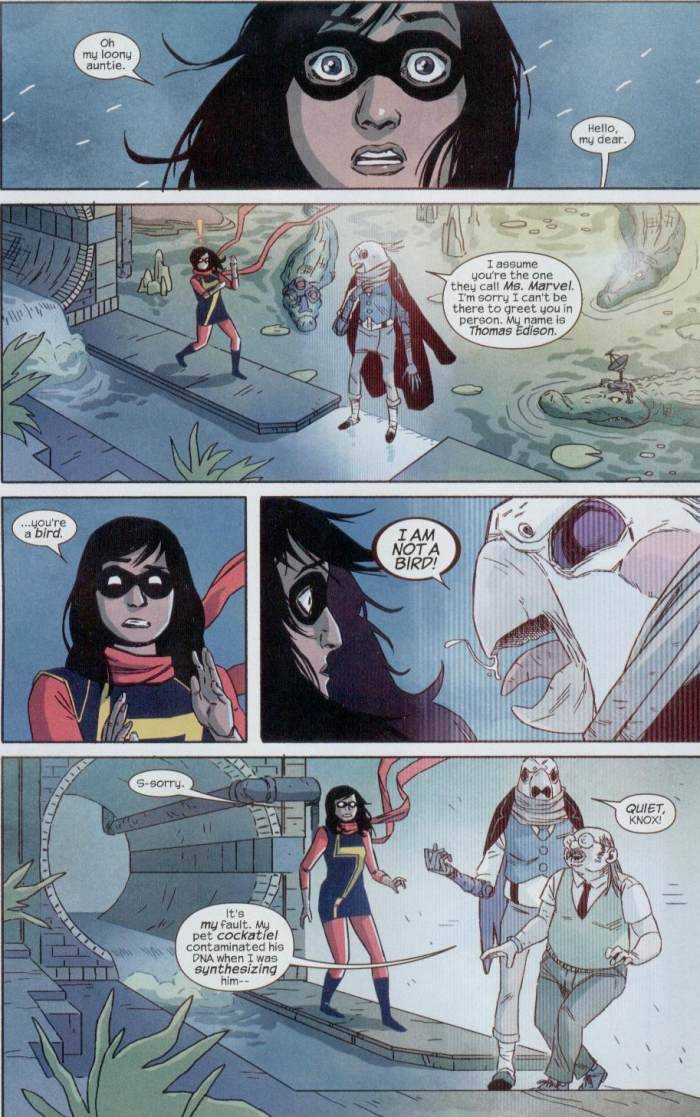
This comes about thanks to Kamala going off in search of her apparent nemesis, the Inventor.  The Inventor, unexpectedly, seems to come straight from the pages of Atomic Robo.  I didn't see that coming.  It fits perfectly with the tone of the series, too.
via Scans Daily
And then Wolverine shows up, and Kamala's endearing fangirl tendencies emerge for the first time since the first issue.  Who does that around Wolverine???  This girl, apparently!  It's fun.  It's so atypical, just like the whole series, but in a way that hasn't really been featured so far, it pushes the whole thing forward.
via Reddit
The artist for the issue is Jacob Wyatt rather than Adrian Alphona, and he does an excellent job on all accounts.  Alphona tends to get a lot of the credit for helping Ms. Marvel stand out, but it's nice to know someone else can step in and help knock it out of the park.

Loving it.

Wednesday, August 6, 2014

Earth 2 #25 (DC)

writer: Tom Taylor
artist: Nicola Scott
via Comic Obsessed
Earth 2 began as a series that relaunched the classic Justice Society characters in a New 52 context, set in an alternate reality that spun off the events of the Justice League opening arc of Darkseid's first appearance.  Big dramatic developments became a matter of course.

The latest big dramatic development is the debut of the new Superman.  Likely this is a character that will remain (mostly) unique to Earth 2 canon, even though he's another Krypton survivor (who teases "...another," and is not referring to Supergirl).

Tom Taylor took over writing chores from the departing James Robinson last year, and seems to have dramatically ramped up the big dramatic development machine.  He's the one who explored the new Batman (I'd still love to read Earth 2 Annual #2, where the full story of how Thomas Wayne adopted the cowl unfolds), and unleashed the returned original Superman, now apparently a force for evil and soldier of Apokolips.

So now Evil Superman has some competition.  Since this is a series that has a story that has continued nonstop since its first issue, it's maybe not an ideal one to randomly sample.  Which is not to say it can't be, but I think the impact of any given issue drops when you're no longer connected to the arcs of given characters, like the revamped Jay Garrick Flash or Alan Scott Green Lantern, both of whom were original stars of the series but are supporting characters these days.  Batman doesn't have a huge role in this issue, either, and even the new Superman only shows up for a few pages.  The most dramatic development actually involves Evil Superman.  Suffice to say, but if Evil Superman asks you to dinner, find a way to refuse.  If you can.

I'm not familiar enough with Taylor's run on the series to know if this is typical for him.  Nicola Scott has been the artist on the series since the start.  She's one of the few female artists working on an extended high profile project in comics.  Perhaps it's a good thing that even she seems to have keyed in most passionately with Evil Superman's moment.

With the upcoming Earth 2: World's End weekly series, more attention is going to be drawn to this corner of the New 52.  I'd suggest at the very least to begin with that second annual, then the issue previous to this one, so you know how the new Superman's existence is first exposed, and then continue reading, so you know how Evil Superman and New Superman measure up against each other...And then maybe you'll see how any of this relates to the rest of DC continuity, probably by next spring.  Nobody knows what's coming up.  There's speculation.  But I'm saying, maybe this is important.

Tuesday, August 5, 2014

Captain America #22 (Marvel)

writer: Rick Remender
artist: Carlos Pacheco
via Comic Book Movie
Hey, so you know the monkey in the room concerning classic Marvel comics and movie personality Captain America, that he's practically the poster child for steroids?  Someone finally wrote a story where his juice is taken away.

This leaves Steve Rogers as a shriveled old man, kind of what he'd be if he'd aged naturally from his original WWII existence.  Instead someone finally magically stripped him of whatever happened to have allowed him to originally escape such a fate.  And that's something DC fans saw twenty years ago in the pages of Zero Hour.

Anyway, so as part of the Marvel Even-More-Now initiative, as you might have read, the big three Avengers (Cap, Iron Man, Thor) will be going through a simultaneous identity crisis.  I'm not really clear on Iron Man's, but as far as Thor goes, apparently you can become the Norse god of thunder just because you can possess his power by lifting his hammer (I don't know, it sounded less stupid in my head explaining it that way, but anyway, they really stretched temporarily replacing him, one way or another).

I like Rick Remender's idea for Cap best.  I wish someone really would address his steroids more directly, but this is pretty good.  Sure, he'll get his steroids back (keep saying it and maybe it'll sink in), Falcon will go back to being Falcon, after being Cap for a while, but in the meantime there's an interesting wrinkle.

This is another instance of Remender writing Steve Rogers and/or Captain America more directly and relevantly than Ed Brubaker ever managed.  (The Winter Soldier thing was a great idea, but it's also a great gimmick, as in...gimmick.)

Having once randomly caught an issue and finding much to my surprise that I liked it, I was glad to give Remender's run a more deliberate look, and this was a good issue to sample.

Friday, August 1, 2014

Reading Comics #128 "Apokolips Cowl"

via DC Infinite
It's here, the Batman and Robin event: Robin Rises.

As far as I'm concerned, this is DC finally acknowledging the significance of this series.  As a title, it's had impressive pedigree ever since its original launch under the auspices of Grant Morrison.  When it relaunched under Peter Tomasi and Patrick Gleason at the start of the New 52 era, the series was counting down to the end of Morrison's run with Batman, which also meant the end of Morrison's own Robin, Damian Wayne.  But the end of Robin did not mean the end of Batman and Robin.  As we've seen over the past year, far from it.  And as we're seeing now, this is an extremely good thing.

Recently I've been making a much greater effort to keep up with the series.  Issue #32, the last of the covers to share credit with a featured guest-star rather rather than list ...and Robin, this one saying ...and Ra's al Ghul, wraps up the "Hunt for Robin" arc that's seen Batman pursuing al Ghul around the globe after his old foe, who happens to be Damian's grandfather, stole Robin's corpse along with his mother's, Talia (al Ghul's daughter, Bruce Wayne's one-time lover).  

Along the way, Batman has teamed up with Frankenstein, Wonder Woman, and Aquaman.  Frankenstein is the last ally standing, which comes in handy, because by the time they catch up with Ra's, it's time for a fight!  Because Gleason draws Frankenstein so well, I'm glad Morrison's erstwhile Soldier of Victory has been part of the arc.  (It doesn't hurt that Tomasi writes him so well, too.)  It's also been fun having Ra's al Ghul in the spotlight.  He's a villain who often sits on the sidelines, allowing others to handle the chaos he's unleashed.  This is the first time he's had an active role in the Damian saga, too.

But the big twist introduced at the end of "Hunt for Robin" is also the spotlight of Robin Rises: Omega, which is the addition of Jack Kirby's Fourth World into the mix.  The Fourth World is Kirby's New Gods playground, a perennial feature of the DC landscape.  DC's making another push, what with Infinity Man and the Forever People and the upcoming arc in Green Lantern, while the "Robin Rises" arc has the distinction of bringing up the fact that this is the first time the New 52 has revisited the demons of Apokolips since the opening arc of Justice League.

Art in the kickoff special is provided by Andy Kubert, who helped launch the Damian saga at the start of Morrison's run, since featured in the collection Batman and Son.  Kubert also recently wrote and drew Damian: Son of Batman.  It's always nice to see him return to the fold.  He handles the chaos in Robin Rises well, and is an intrinsic part of making it hit widescreen mode, Batman and Robin as blockbuster material, all stops unleashed, however you want to say it.

Basically, everything that the series has done to date reaching a culmination point.  It's a reward for existing fans, and a chance for new ones to discover just how significant it's been.  Tomasi has been doing an excellent job explaining how important Damian was and is to his father, in life and in death, Batman's desperation and grief and conflicting impulses as events spiral out of control.  In "Hunt for Robin" he was finally content to let his son rest in peace, possibly because he knew that if Damian was revived under al Ghul's control, he'd become a monster.  But in "Robin Rises" he seems to want Damian to have another shot at life after all.  It's a grieving process that keeps going.  The cynics will tell you Damian will return at some point anyway, but I think the whole point of these stories is that he won't, and this is all we have left, the chance to see how important he really was.

And really, Damian himself wouldn't have it any other way.

Thursday, July 31, 2014

Secret Origins #1 (DC)

writers: Greg Pak, Kyle Higgins, Tony Bedard
artists: Lee Weeks, Doug Mahnke, Paulo Siqueira
via Comic Vine
Some fans get tired of seeing secret origins regurgitated repeatedly.  Me, I love the stuff.  I love it as a creative exercise, to see how it'll be approached.  Even if the elements don't change (which is seldom the case), the best writers will make their presence known.  

So, four years in, DC has revived the Secret Origins series in order to catch fans up on the backstories that've emerged behind familiar faces in the New 52.  Two Septembers ago, sure, a certain amount of that was already done in the zero issues, and many of the initial launches in 2011 incorporated the idea from the start.  Still, as far as I'm concerned, this is a good idea, and I think this first issue proves why.

The first of three stories in the issue features DC's first and arguably still most iconic superhero, Superman.  It's written by Greg Pak, who's recently joined the Man of Steel's writing stable, taking over Action Comics.  Previously, Pak was a Marvel guy (best known for his Hulk and Incredible Hercules, the latter of which he wrote entertainingly with Fred Van Lente for years), which certainly makes the whole proposition all the more intriguing.  If this effort is any indication, Superman is in very good hands.

Intriguingly, Pak approaches Superman's Kryptonian and human origins from the perspectives of his two mothers.  This is incredibly rare.  You're no doubt as familiar as I am with the idea of presenting Jor-El and Jonathan Kent ahead of Lara and Martha Kent, the heavier emphasis on the fathers over the years.  In the movies, Lara had her biggest moment in Superman II when she replaced Marlon Brando's Jor-El in discussions at the Fortress of Solitude (that is, until the Richard Donner cut from 2006 brought Brando back).  Pa Kent had periodically been depicted as dying relatively early in Clark Kent's life, but he's often credited with instilling Superman with the values that would define his heroic career.  There's a lot I'm glossing over, but you get the point.

So that's perhaps reason enough to read that one.  And Pak nails the idea, with both mothers.

Next comes Dick Grayson's story via Kyle Higgins.  Higgins, of course, defined Dick for the New 52 set with his multi-year run on Nightwing.  In a way, this is the effort I was waiting for all along, what he danced around for much of the first year of that series.  Since Dick Grayson is a character uniquely defined by his past, not burdened by it but certainly informed by it, a concept Higgins nails in the piece, it's always profitable to look backward with him, which writers like Higgins and Marv Wolfman had tended to do over the years.

It helps to have Doug Mahnke doing the art for this segment.  Mahnke is awesome.  For a hiccup, after seeing his work in this issue, I feared that DC had finally let him slip through the cracks.  That's not really the case, though.  He's an excellent utility player when he needs to be (although it certainly looked like he was doing exactly that role at the end of Final Crisis, there was also the tie-in with his having already drawn the Superman two-issue mini-series for that event).  And he always delivers.

Supergirl rounds out the issue via Tony Bedard, and this segment reads like one of those young adult book series that've been turning into profitable film franchises like The Hunger Games and Divergent.  I have no idea if that's how Supergirl entered the New 52, but this is canny all the same, and deserves to be identified as such.  Sometimes jumping on a bandwagon is a good thing.  It's recognizing a good thing.  And as far as I can tell, this new interpretation of Supergirl has been a good thing.  In the past I've absolutely loved Bedard's work, but recently I've lost track of him.  So it's good to see that he's definitely still got it.

It's an interesting mix for the first issue.  Superman was certainly obvious.  Including someone from the Batman family I suppose was equally obvious.  And as I've suggested, it's probably a good thing to put Supergirl out in front of something like this, too, so she'll have a better chance of getting noticed.  Higgins may have departed Dick Grayson's adventures, but the character has recently been repositioned, so in hindsight this was like a part of that relaunch, too.

An excellent debut issue.