Showing posts with label Andy Kubert. Show all posts

Sunday, October 27, 2019

Watching the Walmart Giants 3 "October 2019"

Now, the title of this feature is obviously becoming an anachronism (and it was from the moment I decided on it), since these giants are going to begin appearing in the direct market (comic book shops), but I will continue to pick them up at Walmart.  October's releases were late in my local store, and I guess the release schedule has changed, with apparently a bimonthly scheduled in effect, which means three titles I didn't see last month finally appeared this month, and the final installment of Superman Giant, and King & Kubert's arc.

So here's what I'm talking about:

Aquaman Giant #1
  • Original story from Steve Orlando & Daniel Sampere featuring Aquaman battling Black Manta.  Somewhat standard material here, though Orlando introduces the "tether of Amphitrite," and possibly the concept of the mermazons, which alone was worth reading.
  • Original story from Marv Wolfman & Pop Mhan featuring Aquaman battling an organization called Scorpio (unrelated to the pseudo Bond villain from The Simpsons, probably, and thus featuring far fewer hammocks).
  • Prologue to "Throne of Atlantis" from Aquaman #14 by Geoff Johns.
  • Mera: Queen of Atlantis #1.
  • Teen Titans #14, featuring the new Aqualad.
DC Super Hero Girls Giant #1
  • Original story from Amanda Deibert & Erich Owen.
  • Original story from Amy Wolfram & Agnes Garbowska.
  • Excerpts from Hits and Myths, Summer Olympus, and Past Times at Super Hero High.
I originally wasn't going to get this one, but I figured I could later give it to my niece. 

Superman Giant #16
  • "Up in the Sky, Part 12" from Tom King and Andy Kubert, the conclusion, featuring Superman and the little girl on their eventual journey home, depicted as a conversation they have along the way.  It may not be the flashiest installment of the epic tale (which, as I think I've emphasized previously, has become another of King's many, many highlights for me), but it's a nice way to ground the Man of Steel, as the story has done all along, in his more human qualities, even as he's constantly asked to use his superhuman skills.  This is a far trickier task than it seems, and King has just provided a master class.
  • Superman/Batman #50, featuring the improbably team-up of Jor-El and Thomas Wayne (it works, although I wish more of the story focused on them and less on the present-day and extraneous Justice League activities).
  • A Superboy tale from Superman80-Page Giant 2011.
  • The Terrifics Annual #1, featauring a Tom Strong tale but more importantly a Java flashback written by Mark Russell.  You may remember me talking about Russell's work in the September giants.  He seems to have effortlessly refuted me in advance, because this one's a wonderful narrative that somewhat knowingly takes a note from Russell's own Flintstones but imbues real poignancy in its observations.  It's the best thing I've read from him, personally, since my original impressions of him in Prez. 
This was also the final issue. 

Teen Titans Go! Giant #1
  • Original story from Sholly Fish & Marcelo DiChiara featuring Tamaranian hiccups.
  • Original story from Ivan Cohen & Sarah Leuver.
  • Reprints from Teen Titans Go! and Teen Titans Go! Digital, featuring far more art from Jorge Corona (whom I previously encountered in the pages of We Are Robin) than I expected.

Saturday, September 28, 2019

Reading Comics 233 "Superman Giant #15"

Having now read Superman Giant #15, I actually ended up getting another copy so I can hopefully include it among the stuff I'm bringing to my sister's wedding in December, which will hopefully include most of my family (I already know my oldest brother won't be able to make it), including my two nephews based in Maine.  I had already planned on giving them duplicate copies of other Walmart giants I'd gotten, but this one's an opportunity to give them something truly special.

The penultimate (eleventh) installment of Tom King and Andy Kubert's "Up in the Sky" is yet another excellent example from the pair of Superman's unwillingness to give up (as is the whole story) despite unrelenting odds.  In a lot of ways, this is the conclusion of the story (he even finally finds the girl he went into space to save).

Among the other material is a reprint of a Lex Luthor story from 2018's Beach Blanket Bad Guys Special.  Without having read it, I initially thought it would be a throwaway story, but it's actually really excellent, from writer Jeff Loveness and David Williams.  In it, Lex's car has broken down on the side of the road (this version of the character seems inspired by Elon Musk), and a kindly stranger stops to help.  (No, it's not Superman.)  Lex of course rants about Superman in his traditional fashion, as the embodiment of everything that prevents someone from reaching their full potential.  The kindly stranger, though, gives Lex a different impression, of Superman's selfless heroism, and even a portrait of just another guy with regular problems, who'll stop and share s chat and even a burrito with you. 

You'd probably expect at this point for Loveness to have Lex at least consider changing his tune about Superman, but the great thing he does is pivot away from Lex, and just let regular joe, and Superman, end the story.  We glimpse Lex, but he's no longer really relevant.  It's a great bit of storytelling.

Between them, King's and Loveness's takes on what being Superman means encompass not only his abilities but his humanity.  They're a perfect way to explain the character.  Which makes the comic itself a great way to introduce the character. 

I really hope my nephews can make it.  I know I want to see them again, but it would also be nice to be able to give them some interesting gifts.

Saturday, September 21, 2019

Watching the Walmart Giants 2 "September 2019"

This month saw the latest revision of the Walmart DC 100-Page Giants line.  I haven't had a chance to read them yet (and it's worth noting that my store apparently wasn't carrying the Aquman, Teen Titans Go or Super Hero Girls Giants), but I figured it was worth outlining the contents:

Batman Giant #1
  • A new story from Michael Grey & Ryan Benjamin featuring Clayface.
  • A new story from Steve Orlando & Tom Mandrake featuring Batwoman.
  • Batman #1 from the New 52 (Snyder & Capullo).
  • Detective Comics #23.2 from the New 52 featuring Matt Kindt's brilliant Harley Quinn origin.
  • Nightwing #1 from Rebirth.
The Flash Giant #1
  • A new story from Gail Simone & Clayton Henry.
  • A new story from Jeff Parker & Miguel Mendonca.
  • The Flash #13 from the New 52 (still featuring the sweet art of Francis Manapul.
  • Green Arrow: Rebirth #1.
  • Blue Beetle #1 from 2006, the first of several ongoing series featuring the Jaime Reyes version of the character  Still ashamed to admit I stopped reading after this series ended.
Ghosts Giant #1
  • A new story from Dan Jurgens & Scott Eaton featuring the Spectre.
  • A new story from Keith Giffen & Priscilla Petraites featuring Gentleman Ghost.
  • A new story from John Layman & Andy Clarke featuring John Constantine.
  • Various shorts from Cursed Comics Cavalcade, DC House of Horror, DCU Halloween Special 2010, and Justice League #35.
Superman Giant #15
  • The penultimate chapter of Tom King & Andy Kubert's twelve-part "Up in the Sky" series.
  • Superman/Batman Annual #2.
  • Beach Blanket Bad Guys, featuring Lex Luthor.
  • The Terrifics Annual #1 featuring new writer Gene Luen Yang.
Swamp Thing Giant #1
  • A new story from Mark Russell (!) & Marco Santucci featuring Swamp Thing.
  • A new story from Andrew Constant & Tom Mandrake.
  • Swamp Thing #1, the 2016 miniseries from Len Wein & Kelley Jones.
  • The Hellblazer #1 from Rebirth.
  • Zatanna #1, a Paul Dini miniseries from 2010.
Villains Giant #1
  • A new story from Mark Russell (!) & Victor Bogdanovic featuring Batman and Joker.  Russell's involvement in these things is a further example of DC's expansion of his visibility, and a good thing, in my mind, in establishing him as a future lead writer for the company.
  • A new story from Tom Taylor & Daniel Sampere featuring Deathstroke.  Taylor's profile has risen considerably thanks to DCeased, so his presence in these things is also a sign of confidence from the company.
  • A new story from Gail Simone & Priscilla Petraites featuring Harley Quinn.
  • Justice League #23.1 featuring the New 52 version of Darkseid's origin from Greg Pak.
  • The Flash #8 from the New 52, featuring the origin of the Reverse-Flash.
  • Secret Origins #10 featuring Poison Ivy.
Wonder Woman Giant #1
  • A new story from Amanda Conner and Jimmy Palmiotti & Inaki Miranda featuring Wonder Woman and Harley Quinn.  (Knew Conner & Palmiotti would turn up somewhere.)
  • Wonder Woman #2 from Rebirth, the Year One arc.
  • Green Lantern #29, skipping the Sinestro Corps War to "Secret Origin."
  • Sword of Sorcery #0 from the New 52 featuring Amethyst.

Saturday, September 14, 2019

Reading Comics 231 "Midtown Comics"

I had a bad habit of spending money I didn’t have, a decade ago, ordering comics from Midtown.  When I placed my most recent order, it was money I did have, so it was a fine thing to revisit the old habit.  Here’s what I got:

Doomsday Clock #11 (DC)
The penultimate issue, leading to the much-anticipated encounter between Superman and Doctor Manhattan, lays out what exactly Geoff Johns was doing all along, including finally explaining what Saturn Girl has been doing in the Rebirth era (somewhat ironically, for her).  This is probably some of the best stuff Johns has ever written.

The Green Lantern #11 (DC)
Back when I was at my blogging height, I collected a number of blogs I thought would be worth reading on a regular basis, but more often than not I was wrong.  One of them is a comics blog that has continued to review new comics every week, and…I just don’t give a wit about the guy’s opinions.  He seems positively allergic to any real ambition in comics.  So: he doesn’t like Grant Morrison’s Green Lantern.  I think you have to be an idiot not to like a Morrison comic, especially when he’s obviously applying himself and having a great old time.  And he’s clearly doing exactly that in this comic.  And in this issue alone, he does what no one since Geoff Johns has really been able to nail and that’s introduce another forgotten element of Green Lantern lore, and it doesn’t hurt that he deliberately draws on Don Quixote to do it (this has sort of been my Year of Don Quixote).  Anyway, while I don’t love everything Grant Morrison has ever done, this whole run is going to sit very proudly alongside my collection of his works.

Legion of Super-Heroes: Millennium #1 (DC)
Wow.  So, Brian Michael Bendis, folks.  The dude has been a tireless creative dynamo since coming to work for DC, not just with the creator-owned material he either brought with him or began, but the stuff he’s been imagining with familiar characters, and everything fans expected him to do, he just keeps coming up with curveballs.  This comic, for instance, actually centers on Rose & Thorn, a concept I came across in ‘90s Superman comics, but which Bendis makes his own, brilliantly.  Now I want to read a comic based on her, forget about the returning Legion!  But I’ll take the Legion, too, because I’m pretty convinced that if anyone can pull off a relevant new Legion, it’s Bendis.  I’ve never enjoyed him as much as I am now.  I haven’t always been a fan, per say, but I’ve enjoyed him in the past.  But he’s operating on an entirely new level now.  It’s, dare I say, amazing…

Section Zero #6 (Image)
Karl Kesel and Tom Grummett are basically reprising their old Superboy comics, which to my mind is a very good thing, with this one.  I bought the Stuart Immonen variant cover, naturally.

Spawn #300 (Image)
I’m pretty sure the creator-owned landmark Spawn is matching this issue and passing with the next one is Cerebus, which was much-celebrated in times past but much-criticized today.  Now, given that there’re 300 issues of Spawn to be accounted for and maybe the first few years that most fans are actually going to remember, someone had the bright idea to reboot back to the continuity, basically, of those early years for this occasion.  It’s only just occurred to me that Spawn as a concept seems to have copy-and-posted almost directly from Venom, as far as being a symbiotic costume thing.  Todd McFarlane explains how he came up with the character in the ‘70s, obviously before Venom or the black Spider-Man costume ever existed, but I wonder how much of what ended up being Spawn was envisioned back in the day and how much when McFarlane went off to help found Image on the back of all the money he and his fellow pirate artists were making at the time.  In fact, reading (or sort of reading) those Demon Etrigan comics from Forbidden Geek sort of put Spawn further in perspective: He’s sort of exactly Venom, but envisioned by DC. 

Star Trek: Discovery – Aftermath #1 (IDW)
I’m a fan of the series itself, so I didn’t mind revisiting it in comics form, and this comic is a good way to do so, and even harkens back to the best of IDW’s Star Trek comics.

Superman: Up in the Sky #3 (DC)
This is the comic book store reprint series of the Walmart Superman Giant material from Tom King and Andy Kubert, which I thought I’d get at least one issue of, calculating (correctly, as it happily turned out), that this one would feature the “controversial” installment featuring the many deaths of Lois Lane.  And rereading this material was as equally pleasurable as the first time, as I hoped, so that was also good to see.

Monday, February 18, 2019

Reading Comics 225 "Grass of Parnassus, Superman 100 Page Giant #7"

Grass of Parnassus

This is a new webcomic that made me use Instagram for one of the first times ever.  The hook, for me, is Stuart Immonen, working once again alongside wife Kathryn Immonen (realized when I was composing this and adding labels that she didn't have one yet).  Stuart's one of my all-time favorite comics creators, so it's always fun to see what he's up to. 

Grass appears to be an attempt at a kind of slice-of-life-in-the-future.  Readers seem a little baffled as to what exactly is going on, but it seems pretty straightforward to me. The Immonens have an excellent track record (I haven't read all of their work, but Russian Olive to Red King and Moving Pictures are fantastic).  Here's a compilation of Stuart's best-regarded work.  As much as I love Stuart's art, and his collaborations with Kathryn as writer, I really wish he got back into writing; his Superman comics, as artist and writer, have yet to be rediscovered, but they should be.

Superman Giant #7

I'd be remiss if I didn't chime in on this one.  Apparently these Walmart 100-page giants finally made the news for something other than merely existing.  This was last month's edition (I just scooped up this month's full slate, which included the first revamp and expansion of the line, but haven't had a chance to read it yet).  When I read it I thought it was just another typically intricate narrative from Tom King (my favorite among all active writers in the medium, easily), but...

So the story is this: Superman, on a desperate quest to rescue a young girl kidnapped by aliens, places an extreme-long-distance call, deep in space, to Lois back on Earth.  The whole process is tedious and slow, and on top of that Lois seems to take forever to answer.  Superman spends the time imagining all kinds of worst case scenarios, Lois dying horrible deaths from any of the many emergencies Superman's usually there to prevent.

Sounds fairly normal, doesn't it?  I mean, Superman's been saving Lois Lane from certain death since the very beginning.  It's one of the most recognizable tropes in all of superhero storytelling.  Lois actively puts herself in danger all the time as an intrepid reporter.  You'd think no one could possibly object to a story that just sort of points all that out.

But...

Well, people are always kind of outraged about one thing or another.  It only seems that outrage dominates public discourse more than ever before.  Right?  Anyway.  The outrage this time is that this was a comic that featured Lois dying.  Repeatedly.

This was a reported case of a mother being shocked at what her kid was being exposed to.  Big surprise, right?  Story of comic books right there.  Mom buys these Walmart comics every month, never imagining that there was anything to object to, until she takes a gander and...

So you can't really help that sort of thing.  King is no stranger to provoking readers, of course.  He's been doing that since seemingly killing off Kyle Rayner in the Omega Men preview, and he's made an ongoing spectacle of Batman with regular intervals of similar acts, shocking readers who should have possibly seen it all before.  He did it again with Heroes in Crisis (if I get around to it, I'd love to talk more about that one, especially how #5 lets the cat out of the bag, assuming readers were aware that there was a cat, and a bag, and that you could've anticipated that from the very beginning, without really harming the story, because it's all about how masterfully King commands the page, as always).

What I love about all this is that it does put the focus on the content rather than the existence of these giants, and hopefully will get more readers checking them out. 

Friday, November 23, 2018

Reading Comics 223 "The DC Walmart 100-Page Giants, Month 5"

So I've continued buying DC's Walmart-exclusive (although someone...smuggled? them in, as I guess you should expect, to one of the comic cons I went to this fall) 100-page giants.  I've caught every issue of the Superman giants, most of the Batman, and started buying the Teen Titans giants again.  Haven't really gotten back into Justice League after the first issue.

World's Greatest Super-Heroes Holiday Special
The second holiday special, after the Halloween one, is Christmas-centric.  The lead, original story is from Scott Lobdell and features the Flash and his Rogues.  The real highlight of this particular giant is, however, is a reprint from two years ago, "Good Boy," a Batman Annual #1 reprint written by Tom King, his origin of Ace the Bathound, who starts out as a dog used by the Joker.  Batman brings him home, not knowing what else to do, and Alfred spends the next four months taming him, exhibiting his infinite Pennyworth patience.  The sequence, of course, ends on Christmas, with Batman noting wryly that Alfred didn't get him anything this year.  One of King's great characterizations has been Alfred; it'd be great for an extended look at some point, although if this is the closest we get it'll still rank among the highlights of the run.

The other highlight is from Superman #64, originally published in 1991, as you can tell a little less than a year before "Doomsday."  The writer is Dan Jurgens, but the artist is Butch Guice (as he was later known; here he's still known as Jackson Guice), who was later one of the key "triangle era" artists, best known for his Action Comics Eradicator "Reign of the Supermen" arc.  The Guice in this issue is wonderfully moody (even if the inking could be updated to freshen it up), full of shadows, a marked contrast to his later work and not the kind of art you typically associate with Superman.

There's also a Supergirl tale that's similar to Jurgens' tale about answering mail and humanity; a Harley Quinn; and a Green Lanterns, Rebirth era tale featuring Simon Baz and Jessica Cruz.  Honestly, when that run began I was hugely excited for Baz and Cruz to step into the spotlight, but over time I've grown tired of the storytelling that leaned so heavily on their core insecurities, which of course this tale does, too. 

Batman 100-Page Comic Giant #5
The lead is the third installment of Brian Michael Bendis and Nick Derington's all-new tale, which this issue finally reveals as featuring Vandal Savage as the big bad, after spotlighting an atypically muddled Riddler as Batman and eventually Green Arrow, too, trying to figure out his latest scheme.  Bendis is clearly having a ball (a lot of DC fans expected him to jump into writing Batman, not Superman, when his jump from Marvel was first announced), while Derington has helped keep things lively, too.  I was trying to remember where I knew Derington from, and figured out it was the Young Animal Doom Patrol, famously much-delayed in recent issues.  Hopefully his collaborating with Bendis means Derington is gaining DC's confidence as one of its elite artists.

As has appeared in previous issues, the three reprint comics that round out the Batman giants are the "Hush" arc, plus the New 52 Nightwing and Harley Quinn.  I was initially a fan of Kyle Higgins' Nightwing, but I find myself glossing over the material in the giants, and I have no real interest in Harley Quinn.  "Hush" remains brilliant, although in hindsight it certainly seems obvious that Jeph Loeb's fixation on the previously-nonexistent childhood pal of Bruce Wayne, Tommy Elliot, is a dead giveaway that he was the mystery villain all along.  The Jim Lee art equally remains spectacular.  Honestly I think Lee's DC work will become his lasting legacy.

Superman 100-Page Comic Giant #5
But I'm really here to once again gush over Tom King.  Like Bendis, he's now on the third installment of his giants tale, which features Superman's search for a little girl, and the increasingly desperate lengths he will go to in order to find her.

This issue features his most desperate moment so far in the tale.  It's a kind of update on the classic Superman/Muhammad Ali boxing match from the '70s, only this time it's not Ali he's fighting, but an alien named Mighto.  That cover image is from artist Andy Kubert, who unlike his brother Adam has stuck with DC since they jumped, like Bendis, unexpectedly from Marvel, ten years back.  Until now Andy had mostly been associated with Batman material, but he's proving equally adept, and perhaps, ideally suited, to Superman, and this issue, as it for King's tale, might be the highlight of his DC work to date.  It's really something you ought to go out of your way to track down and read for yourself.

As really only the classic "Doomsday" arc had done previously, the story is all about Superman's incredible endurance, his ability to absorb punishment.  This is superhero comics storytelling usually reserved for Spider-Man (which always seemed fairly beside the point to me, other than Marvel's penchant for tortured characters), and seems counterintuitive for someone like Superman, who's usually thought of as overpowered to the point where an artificial weakness (kryptonite) had to be invented along the way.  But Superman is best understood not by his powers but by his force of will, his humanity, and as such, King has rightly illustrated what putting him in a fight ought to look like.  He takes an incredible pounding, apparently past his ability to endure, and yet he refuses to stay down. 

When you think of DC going out on a limb with something like these Walmart giants, you don't really expect them to throw away exceptional material like this, much less have talent the caliber and prestige of Tom King, Brian Bendis or Andy Kubert.  And yet these are bold decisions that are truly paying off, as these guys are massively delivering, and this installment proves beyond any doubt that truly great material is making its way into the giants. 

Reprints include Green Lantern (the original Geoff Johns series), Superman/Batman (someone at DC no doubt finds it deliciously amusing to look back at President Luthor in the Trump era), and The Terrifics, which continues to prove, well, terrific.  I hope Jeff Lemire can keep it going for a long time.  It's at long last, perhaps, his DC breakthrough, and quite possibly Mister Terrific himself in his breakthrough moment.

Teen Titans 100-Page Comic Giant #5
Dan Jurgens, at his most generic, is about the level of what you'd expect from the idea of Walmart-exclusive storytelling.  This is not to say that Jurgens can't rise well above that perception, but he seems uninterested in what I've read, and why I haven't read all of the Teen Titans giants.

But the reprint material is well worth the price of admission.  Johns' Teen Titans is being serialized (last issue included the classic moment where Bart Allen officially reinvented himself as Kid Flash).  I'd never really read it before; this introductory arc is kind of funny in hindsight, as Johns is clearly presenting a version of his later Reverse-Flash as a villain merely attempting to make the hero better, an idea that reached its zenith in Flashpoint.  There's also Super Sons, which I likewise haven't previously had a lot of experience actually reading. I think Pete Tomasi is better suited to writing this than he was Superman.  And then there's Sideways, which on a superficial level was always interpreted as the New Age of Heroes DC version of Spider-Man, but honestly, like the New 52 Doctor Fate before it is kind of more the DC version of the Kamala Khan Ms. Marvel.  And in two more issues I'll finally get to read the first appearance of the Seven Soldiers of Victory in the series.  But I'll probably have to track down the annual separately to enjoy Morrison playing in that sandbox again...

Sunday, December 28, 2014

Reading Comics 143 "Apokolips Cowl Part II"

The conclusion of "Robin Rises" comes in the form of Batman and Robin #37 and Robin Rises: Alpha, finishing an arc that began in "The Hunt for Robin" and Robin Rises: Omega earlier in the year.  After Damian's death in Grant Morrison's Batman Incorporated #8 last year, Batman and Robin as a series was altered seemingly forever.  Batman was without a Robin.  At first there were a series of guest-stars, and then a Two-Face arc, but Peter Tomasi revealed an ace in his sleeve when he began his most ambitious story to date, the theft of Damian's body and its subsequent relocation to Apokolips, the home of Darkseid.

It was a big, big development.  Darkseid made an auspicious New 52 debut in the opening arc of the line's flagship title, Justice League, which later proved to be a launching pad for Earth 2 as well.  The New Gods slowly began to return, first in the form of Orion in the pages of Wonder Woman, and then  later in "Robin Rises" and the "Godhead" Green Lantern crossover, after Forever Evil suggested Darkseid's return would signal the next major DC event, which will surely be one of 2015's biggest stories.

"Robin Rises" has long promised Damian's return, and by the end of Batman and Robin #37, that has indeed occurred.  Seeing Patrick Gleason's rendering of Damian and Batman's embrace was easily one of the best comic book moments of the year.  I knew Gleason and Tomasi's stories have been some of my favorite comics of the past few years, but I didn't realize until that moment how much I wanted to see Gleason's Damian again.  Gleason is the only artist capable of making a frequently pugnacious character look vulnerable, and Tomasi has somehow improved on Morrison's depiction of the bond between father and son.  For that reason alone, Batman and Robin has been an important piece of the Dark Knight legacy since its 2011 launch, but its exposure has greatly increased since Batman started his grieving process.

One of the most famous elements of Batman among fans, but one that has rarely been depicted in-continuity, has been the very human Bruce Wayne's ability to stand toe-to-toe with cosmic forces in a fight.  Usually the answer to this dilemma has always been Batman's keen mind, but Tomasi instead opted for the "Hellbat" armor, something he envisioned in association with the Justice League.  Batman wasn't even able to gain access to this armor without outright stealing it from his own colleagues, who strongly disapproved of his plans to invade Apokolips.

The sheer desperation that has driven Batman since Damian's death has been amply demonstrated, and even emphasized, by two separate encounters with Frankenstein, a symbolic figure if there ever was one for these circumstances.  But seeing him clash with Darkseid is one of those fights that elevate the story to operatic proportions.  The armor, by the way, gives him only so much hope in such an encounter.  Make no mistake: Darkseid would have won, given enough time.  But Batman prevails in a timely escape.

And he uses a maguffin to bring his son back from the dead.  There's a little tomfoolery that is a bit dismissed between the two comics, a fake-out of a mortal emergency on Batman's own part, probably explained by a momentary acknowledgment of just how dire the situation really was.  But then father and son are off leaping into action together again by the end.  And it is wonderful.

Andy Kubert provides art for both installments of Robin Rises, an acknowledgment of his own integral history with Damian, having help Morrison introduce him originally, and also working solo on Damian: Son of Batman.  And as much as I love Gleason's Damian, by Alpha Kubert's version has truly become an enduring image as well.

As usual, Batman and Robin is a story where the dramatic payoff is really a powerful urge to see what happens next, and as such it has been one of the strongest examples of serialized storytelling in comics.  That element has only been increased.

Sunday, November 9, 2014

Quarter Bin #58 "Binge-worthy III: Mark Waid's Marvel, and other artifacts"

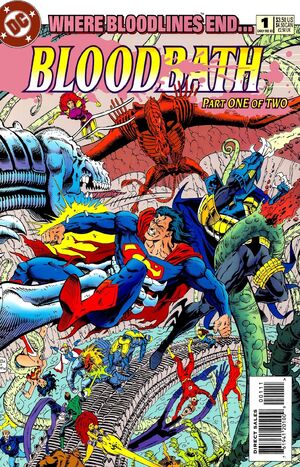
Bloodbath #1 (DC)
From 1993.
via DC Wikia
DC's 1993 annuals represented an effort to introduce an entire generation of new superheroes under the "Bloodlines" banner, surviving victims of a parasitic alien invasion who discovered hidden powers.  A few of these characters were featured in their own short-lived ongoing series (Gunfire, Anima) or mini-series (Loose Cannon, Razorsharp in Psyba-Rats), or else in various teams (Sparx) or as supporting characters in the titles whose annuals they debuted (Argus in The Flash).  The most famous alumnus, Hitman, branched off to create his own Garth Ennis-fed legacy.  Critics generally dismiss the whole effort as a crass attempt to cash in on the Image craze at the time, and maybe it was, but it was considerably ambitious and also the last time DC tried to replicate the success of its breakthrough Silver Age boom, which was followed by the Marvel Age renaissance a few years later.  I've been interested in these characters being revisited ever since, but that day still hasn't come, so the next best thing is to revisit "Bloodlines" itself, which I've done on a few occasions now.  This time I couldn't help but enjoy the snapshot of the DC landscape of that time that Bloodbath helps capture.  There's Mullet Superman, "Azbats," Bulky Armor Booster Gold, even my good buddy Bloodwynd.  There's also an advertisement for the DC adaptation of Hitchhiker's Guide to the Galaxy, something I didn't read at the time and am still hoping to track down some day.  I'm one of the few people out there who wouldn't mind owning the complete "Bloodlines" event, and its related material.  That would be binging!

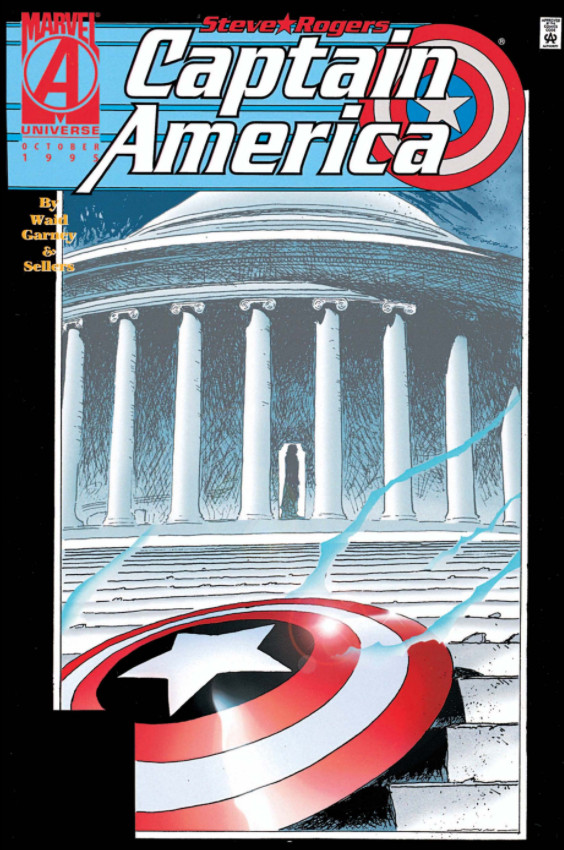
Captain America #444 (Marvel)
From 1995.
via Marvel Wikia
Until now I'd never read Mark Waid's Captain America, which at the time was distinguished as the first time he'd been noticed for something other than The Flash.  It was a run that was interrupted by the "Heroes Reborn" thing, another effect of the Image revolution, but popular enough that Marvel brought Waid back after the "Heroes Return."  I'd always wondered if Waid really was as ideal with Cap as he'd been with Wally West.  What made his Flash so special was a deep love for the character and his history, and everything Waid added to that legacy, notably bringing all the speedsters together, creating a few of his own, and introducing the concept of the Speed Force, basically a prototype for everything that Geoff Johns would do for Green Lantern a decade later.  After reading some of Waid's Captain America, I'm still not sure what to make of this work.  This issue in particular seems determined to make readers appreciate Steve Rogers for the idealistic and idealized hero he is, a Marvel concept if I ever saw one, the sacrifices and triumphs he's experienced over the years.  Steve isn't even in the issue, it's his supporters standing up for him against the doubts a skeptical government agent.  It's not very subtle work, although by the end of the issue Waid has done his trademark work of focusing on an iconic image, a frozen Captain America, except this time he's in the clutches of his enemies.  Most telling, perhaps, is Waid's heavy use of Quicksilver, Marvel's resident speedster, either a concession to fans of The Flash or a storytelling crutch for someone who was more than familiar with that kind of character at that point.

Captain America #445 (Marvel)
From 1995.
via Comic Megastore
Perhaps the most ironic part of Waid's arc at this point is that it's happened again under the current Rick Remender regime: Steve Rogers losing his super-soldier edge.  In this issue, he's given his strength back by his worst enemy, the Red Skull.  Part of the reason I know the fans were exaggerating a little, or that there were far fewer fans championing this run, is that until now I had no idea any of that even happened.  Waid creates the Speed Force and it's a permanent addition.  Waid monkeys around with Captain America and it's just his version of the classic '90s crisis every superhero underwent.  This is not to say it's not good storytelling, but that it doesn't seem to have had much impact.  I've been wondering the same about Waid's current Marvel cult favorite, Daredevil, which seems headed in the same direction.  Which leads me to this conclusion: Waid knows how to work the angles of any given iconic character, but he rarely seems interested, or motivated, to significantly add to that character's legacy.  


Captain America #5 (Marvel)
From 1998.
via Comic Vine
Obviously, this is part of Waid's return engagement.  This one's got a pretty interesting idea: What happens when an enemy (in this case the shape-shifting Skrulls) actually undermine Cap by making him popular?  All of Marvel's superheroes have inferiority complexes in one shape or form, part of the gimmick that's supposed to make them more relatable to the angst-ridden teenage market (also why the company has somewhat distanced itself from that approach in the big box office era).  If you ever wanted to know the biggest difference between Superman and Captain America, there it is.  Although a dude with "America" in his name, that doesn't automatically mean Cap is always aces with his country (something Captain America: The Winter Soldier helped demonstrate).  Although it should be noted that Waid did a similar story in the pages of The Flash.


Captain America #20 (Marvel)
From 1999.
via Comic Vine
Cap working alongside S.H.I.E.L.D. sounds like the movies, doesn't it?  Other than that, there's Sharon Carter drama (which was also a theme of other issues I sampled), and Andy Kubert (the Kubert who now has a functional Batman legacy under his belt thanks to helping Grant Morrison introduce Damian) proves there's at least one thing he can't draw, which is Steve Rogers drinking wine.  Maybe I don't know the character well enough, but I highly doubt he'd hold the glass like a dandy.  The man's a soldier.  I think people sometimes forget that.  Somehow...Actually, come to think of it, if I'd formed any impression of what to expect from a Mark Waid Captain America, I would have expected a heavy emphasis on that.  Although he seems to have done anything but.


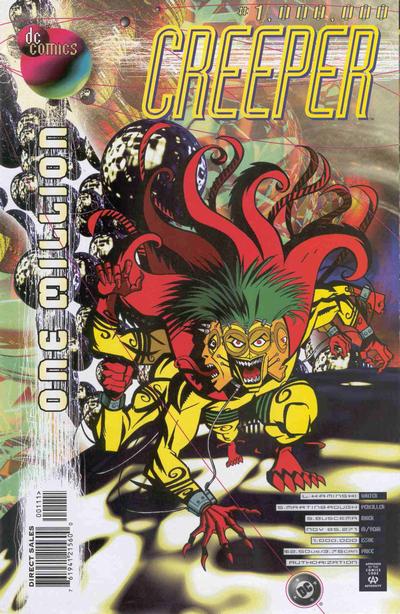
The Creeper #1,000,000 (DC)
From 85,271/1998.
via DC Wikia
Another event I have a great affinity for is Grant Morrison's DC One Millioni, which imagines what the legacy of today's superheroes will look like in the year the one millionth issue of their current comic books would be published.  Turns out, despite all that time, pretty familiar.  Except The Creeper keeps it close to home, featuring the present version, possibly because this also happens to be the last issue of the series, meaning writer Len Kaminski has to come up with a statement on the character that makes sense in the event context.  He pulls it off.  Creeper is one of those wild card characters DC loves to experiment with, a sort of Joker combined with the Mask and Deadpool, with the same body-swapping gimmick as Captain Marvel and the Demon Etrigan.  I'd never read the series, so picked up the issue mainly out of interest in One Million, but I ended up loving the issue.  In hindsight this was another of those comics DC should probably have published under the Vertigo banner, as it features many of the classic hallmarks of a more abstract interpretation of superhero storytelling.  But if that had happened, the One Million issue would never have happened.

DC Universe #0 (DC)
From 2008.
via DC Wikia

Technically the last issue of Countdown to Final Crisis, this one was written by Grant Morrison and Geoff Johns and is best known for Morrison's interlude between Batman and the Joker, which ties in with "Batman R.I.P."  The narration is provided by Barry Allen, whose return is revealed at the end of the issue.  He'd been the most famous victim of Crisis on Infinite Earths, which Final Crisis undoes by bringing back the concept of the multiverse in full force.  But readers who expected it to be more like Infinite Crisis probably have only this issue to hold onto.  Probably Johns' biggest influence on it.


Dinosaurs vs. Aliens Free Comic Book Day Special Preview (Liquid Comics)
From 2012.
via Comic Vine
This is Grant Morrison's intended film collaboration with Barry Sonnenfeld, a project that followed on the hinges of a similar release in 18 Days.  Dinosaurs vs. Aliens sounds gimmicky, especially when you consider the similarly-titled Cowboys vs. Aliens and how poorly that went over with wide audiences, but it's actually pretty interesting.  It's Morrison in minimalist mode (We3, Joe the Barbarian), although as gorgeous as the art is (I should note that I've previously read the whole graphic novel release), it's almost better to read the script excerpts, where you can truly appreciate how much effort Morrison puts into his concepts.  The trouble with this one, though, is that it risks being, ultimately, about as interesting as that underwater chase in Star Wars Episode I: The Phantom Menace in which the heroes are confronted with a succession of large fish.  The animators put a lot of work into that, too, details you might not have caught, even a whole story you might have missed.  It's a little hard imagining that a potential movie version of this concept would play differently, which might be part of the reason there still isn't, well, a movie version of this.  Maybe it just needs more Rip Torn?

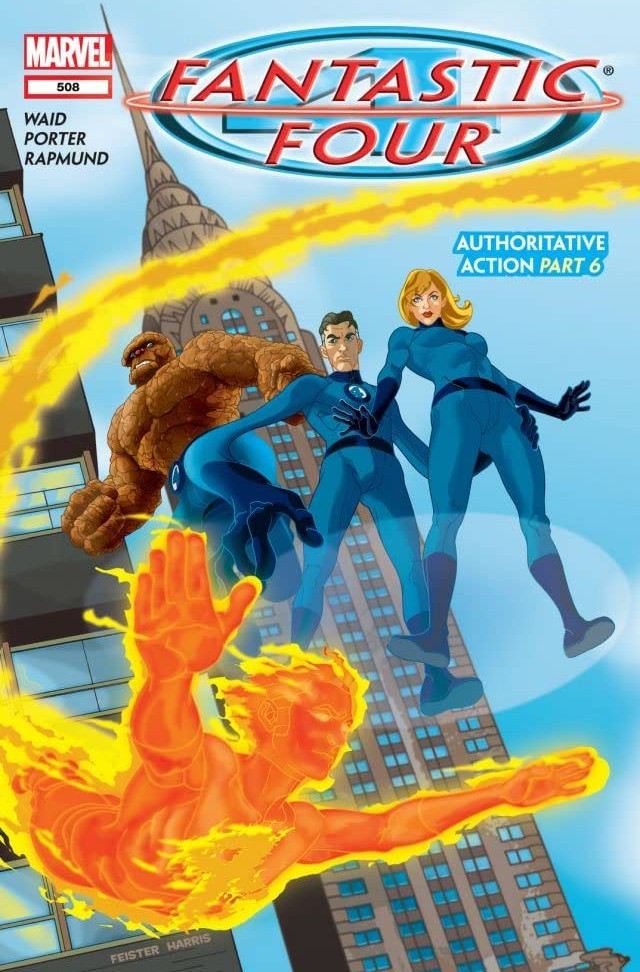
Fantastic Four #508 (Marvel)
From 2004.
via Marvel Wikia
The final Mark Waid in the binge, this issue features Dr. Doom possessing successive members of the Fantastic Four, a concept straight out of the Silver Age, although it also features the "death" of the Thing, although by the end of the issue Sue Storm is already talking strategies on how to bring him back.  So in that regard, Waid is ahead of his competitors.  I can't judge his First Family on one issue, but I didn't find it to be too remarkable.  The biggest hook for me is Howard Porter on art.  Ever since his JLA with Grant Morrison, I've been interested in Porter's career, and although he's never had another high profile run like that, I'm happy whenever I see him on a new project (current one: Justice League 3000).  Some artists change their style over time, but Porter's is the same in this issue as it was in JLA.  I consider that a good thing.

Friday, August 1, 2014

Reading Comics #128 "Apokolips Cowl"

via DC Infinite
It's here, the Batman and Robin event: Robin Rises.

As far as I'm concerned, this is DC finally acknowledging the significance of this series.  As a title, it's had impressive pedigree ever since its original launch under the auspices of Grant Morrison.  When it relaunched under Peter Tomasi and Patrick Gleason at the start of the New 52 era, the series was counting down to the end of Morrison's run with Batman, which also meant the end of Morrison's own Robin, Damian Wayne.  But the end of Robin did not mean the end of Batman and Robin.  As we've seen over the past year, far from it.  And as we're seeing now, this is an extremely good thing.

Recently I've been making a much greater effort to keep up with the series.  Issue #32, the last of the covers to share credit with a featured guest-star rather rather than list ...and Robin, this one saying ...and Ra's al Ghul, wraps up the "Hunt for Robin" arc that's seen Batman pursuing al Ghul around the globe after his old foe, who happens to be Damian's grandfather, stole Robin's corpse along with his mother's, Talia (al Ghul's daughter, Bruce Wayne's one-time lover).  

Along the way, Batman has teamed up with Frankenstein, Wonder Woman, and Aquaman.  Frankenstein is the last ally standing, which comes in handy, because by the time they catch up with Ra's, it's time for a fight!  Because Gleason draws Frankenstein so well, I'm glad Morrison's erstwhile Soldier of Victory has been part of the arc.  (It doesn't hurt that Tomasi writes him so well, too.)  It's also been fun having Ra's al Ghul in the spotlight.  He's a villain who often sits on the sidelines, allowing others to handle the chaos he's unleashed.  This is the first time he's had an active role in the Damian saga, too.

But the big twist introduced at the end of "Hunt for Robin" is also the spotlight of Robin Rises: Omega, which is the addition of Jack Kirby's Fourth World into the mix.  The Fourth World is Kirby's New Gods playground, a perennial feature of the DC landscape.  DC's making another push, what with Infinity Man and the Forever People and the upcoming arc in Green Lantern, while the "Robin Rises" arc has the distinction of bringing up the fact that this is the first time the New 52 has revisited the demons of Apokolips since the opening arc of Justice League.

Art in the kickoff special is provided by Andy Kubert, who helped launch the Damian saga at the start of Morrison's run, since featured in the collection Batman and Son.  Kubert also recently wrote and drew Damian: Son of Batman.  It's always nice to see him return to the fold.  He handles the chaos in Robin Rises well, and is an intrinsic part of making it hit widescreen mode, Batman and Robin as blockbuster material, all stops unleashed, however you want to say it.

Basically, everything that the series has done to date reaching a culmination point.  It's a reward for existing fans, and a chance for new ones to discover just how significant it's been.  Tomasi has been doing an excellent job explaining how important Damian was and is to his father, in life and in death, Batman's desperation and grief and conflicting impulses as events spiral out of control.  In "Hunt for Robin" he was finally content to let his son rest in peace, possibly because he knew that if Damian was revived under al Ghul's control, he'd become a monster.  But in "Robin Rises" he seems to want Damian to have another shot at life after all.  It's a grieving process that keeps going.  The cynics will tell you Damian will return at some point anyway, but I think the whole point of these stories is that he won't, and this is all we have left, the chance to see how important he really was.

And really, Damian himself wouldn't have it any other way.

Wednesday, March 5, 2014

Damian: Son of Batman #s 2-4 (DC)

(via CBDB)

writer/artist: Andy Kubert

Andy Kubert was the original artist for Grant Morrison's Batman run.  This means he was there at the beginning of the Damian saga.  It also apparently means that he seems to have considered his role a fairly significant one, important enough to try his hand at extending the character's legacy past his death last year in the pages of Morrison's Batman Incorporated.

This mini-series is a what-if that returns to the world of Batman #666, a future that saw Damian become Batman.  As readers became more familiar with the character, it was easy to see how different Damian would be in the role compared to his father, Bruce Wayne, and yet more similar than anyone else who has worn the cowl over the years, whether Dick Grayson or Terry McGinnis from that other future, Batman Beyond (soon to finally achieve continuity in The New 52: Futures End).  

In fact, the second issue presents a stark contrast between Damian and McGinnis, both of whom start their careers succeeding Wayne with the aged crimefighter observing them.  Where McGinnis always had Wayne's begrudging sanction, Damian most certainly doesn't.  It leads to a short-lived fight that causes Wayne to suffer a heart attack, which sidelines him for the remainder of the series.  

We witness Damian's conflicted emotions (which he struggles to admit to himself) as he consults a priest in a confessional.  It's implied that the priest is really Jim Gordon, one of Batman's oldest allies.  By the end of the issue, Damian has donned his distinctive variation of the classic Batman costume.

The third issue features Kubert's most creative conceit, Alfred (whom Damian always calls simply "Pennyworth") dying but transferring his consciousness to a cat.  It's something Morrison might have done himself (and in fact is reminiscent of his Happy!), and works well in the warped but intelligent psychology of the new Batman.

Gordon, or least the priest who appears to be him, pulls a classic Batman disappearing act on Damian, and that's one of the nice touches to the issue.

The fourth and final issue is all about Damian's confrontation with the Joker, who is not actually the original Joker, but like Damian a self-styled successor.  It's an appropriate way to conclude the series.  The way this substitute Joker's story ends is appropriate, too (which I won't spoil), just as the way Damian's does.  It's the way some fans no doubt wish he would have ended up in regular continuity.

As a series, it's not overall very similar to Morrison's Batman, or other DC comics in general.  Kubert's style is as full-throttled as Damian's, and at first this can be a little disconcerting, but really, that's exactly the way a Damian-as-Batman story should be.  If he lived long enough to enter that future, this is what he would become.  In a lot of ways, Damian was always what Jason Todd would have been like if he'd been Bruce Wayne's son.  The similarities between Jason's revised fate and what would have become of Damian are no mistake.  The thing is, this story could only have happened with Damian.  

Kubert is less concerned with the doubts Morrison and Peter Tomasi have featured in the bond between father and son.  It drains some of the emotion from the story, but it also means that there's more of a classic vigilante adventure to be found here than is usual for Damian.

If this is the only adventure Kubert gets to tell about this Batman, then that's fine.  Although it would certainly be nice to have more.  This is not a classic, but it's a fine memory to have been given with a classic character.