Monday, February 2, 2015

The Multiversity Guidebook (DC)

via Comics Alliance
writer: Grant Morrison

artist: Marcus To, Paolo Siqueira

The Guidebook to the ambitious (is there any other kind of Grant Morrison project?) Multiversity turns out to feature both guide and story.

There are profiles for most of the 52 realities, as well as a continuation of the main story begun in the initial issue that has room for two very different Batmen (advertised prominently on the cover) as well as Kamandi, Jack Kirby's Last Boy on Earth whose last appearance was a clever revision within the pages of Countdown to Final Crisis (I'm sure the irony isn't entirely lost on Morrison), another version of OMAC, and the New Gods acting much like the Greek gods in Clash of the Titans.

I figured I'd try and recap the previous appearances for each of the near-52 realities:

  • Earth 0, home of the New 52.
  • Earth 1, home of the Earth One graphic novels, which at some point will include Grant Morrison's take on Wonder Woman.
  • Earth 2, home of Earth 2 (at least until the end of World's End).
  • Earth 3, home of the Crime Syndicate, most recently featured in Forever Evil, but also famously depicted in Morrison's JLA: Earth 2 (it was based in different continuity, okay?).
  • Earth 4, home of the Pax Americana folks.
  • Earth 5, home of the Thunderworld folks.
  • Earth 6, home of the Just Imagine Stan Lee Creating... folks.
  • Earth 7, home of Thunderer, as seen in The Multiversity #1.
  • Earth 8, home of Morrison's Marvel counterparts.
  • Earth 9, home of Tangent Comics.
  • Earth 10, home of Overman as depicted in Final Crisis.
  • Earth 11, introduced here, home of Amazonian variations.
  • Earth 12, home of characters from Batman Beyond.
  • Earth 13, home of Superdemon and pals as depicted in Final Crisis.
  • Earth 15, home of Superboy-Prime as depicted in Infinite Crisis.
  • Earth 16, home of The Just folks.
  • Earth 17, introduced here, featuring variations on Adam Strange and others, including one of two Batmen featured here.
  • Earth 18, home of characters introduced in The Justice Riders.
  • Earth 19, home of characters introduced in Amazonia.
  • Earth 20, home of the Society of Super-Heroes folks.
  • Earth 21, home of characters introduced in DC: The New Frontier.
  • Earth 22, home of characters introduced in Kingdom Come.
  • Earth 23, home of President Superman, introduced in Final Crisis and featured in Action Comics #9 and Multiversity #1.
  • Earth 26, home of Captain Carrot and the Zoo Crew.
  • Earth 29, home of the square Bizarro planet Htrae, explored in All Star Superman.
  • Earth 30, home of characters introduced in Superman: Red Son.
  • Earth 31, home of characters introduced in Detective Comics Annual #7.
  • Earth 32, home of characters introduced in Batman: In Darkest Knight.
  • Earth 33, Morrison's theoretical starting point.
  • Earth 34, introduced here, featuring an ancient super-civilization.
  • Earth 35, featuring Morrison's version of Alan Moore's Supreme.
  • Earth 36, featuring characters introduced in Action Comics #9.
  • Earth 37, home of Tommy Tomorrow and other classic DC sci-fi characters.
  • Earth 38, home of characters featured in Superman & Batman: Generations (probably).
  • Earth 39, introduced here, featuring super spies.
  • Earth 40, home of Society of Super-Heroes folks.
  • Earth 41, home of Morrison's Image counterparts.
  • Earth 42, home of characters featured here, including one of the Batmen.
  • Earth 43, home of characters likely inspired by the numerous Doug Moench/Kelley Jones Batman vampire comics.
  • Earth 44, introduced here, featuring characters combining the Justice League and the Metal Men.
  • Earth 45, home of characters introduced in Action Comics #9.
  • Earth 47, home of Brother Power, the Geek.
  • Earth 48, home of characters introduced in Crisis on Infinite Earths.
  • Earth 50, home of characters introduced in the animated Justice League.
  • Earth 51, home of various Jack Kirby characters, as featured here.

Reading Comics 149 "Justice League"

via DC Comics
Since getting back into Justice League recently, I've officially gotten the bug all over again.  In a manner of speaking.

Not the Amazo Virus, but the arc has certainly done the trick.  In Justice League #37 and 38, the story pushes past Patient Zero and sees Batman infected.  Between this and "Endgame," I bet the Dark Knight wishes things were less complicated, like in the old days when he didn't have to worry about two let alone one infectious plagues.

Oh, ah, "Contagion," "Legacy."  Yeah.

As usual, Geoff Johns is working multiple agendas, however, as he keeps referring back to two of the more dubious team recruits, the culpable Lex Luthor and Captain Cold, who embodies a Johns link back to The Flash, which hardly escapes his attention.  The man with the ice gun isn't just another rogue, though, but a guy with a serious weapon, which seems to be something Johns is on the verge of exploring to greater heights than ever before.

And a few issues back, we were reminded that Luthor's agenda includes preparing for other matters, and Johns has been doing an excellent job of exploring this "doomsday prepper" version of the character, more nuanced than ever before, as an ongoing link to Owlman was touched upon, which is a nod toward the upcoming Crisis.

Not to be confused with Convergence.  Probably.

Reading Comics 148 "Grayson"

via Gotham Spoilers
So the jury on Grayson continues.

Generally, I'm wildly excited for the potential of this series, as demonstrated in the phenomenal Futures End one-shot, a bold new, deliberate approach to the further adventures of Dick Grayson that finally exploits the character's full potential, unencumbered by whatever identity he happens to be taking.  For such a man, now free to take whichever one he needs, it's the greatest gift imaginable.

The first issue I read recently was Grayson #6, the latest one, featuring a one-on-one confrontation with Midnighter, the WildStorm character who's a facsimile of Batman.  And clearly Tim Seeley and Tom King keyed in on that, because the Midnighter in the issue is all gruff, the Batman of Frank Miller's All Star Batman and Robin, the Boy Wonder (I'm one of a token few who loved that project, and hope Jim Lee can find time in his schedule to finish it).  But as I've feared, the regular series doesn't have as much as the pizzazz, so far, as the outliers that keep showcasing its potential.

Such as the Futures End issue, and Grayson Annual #1, which I resisted reading initially because I feared it would be similar to the series.  But it's a lot like the Futures End spot, clever and focused and an all-around fantastic read, and perhaps not coincidentally featuring a good spotlight for Helena Bertinelli, the erstwhile Huntress.  These are two characters Chuck Dixon and Devin Grayson helped tie together intrinsically in a previous DC universe, and so it was always nice to see them together again.  A Grayson free from any other obvious association should always be with a Bertinelli.

I've made this point before, but Grayson has much of its allure for me based on nostalgic memories of the TV show Alias, where Sydney Bristow and Michael Vaughn had similar chemistry.  The Spyral case is like Dick and Helena's Rambaldi.  

I'll be keeping tabs for sure.

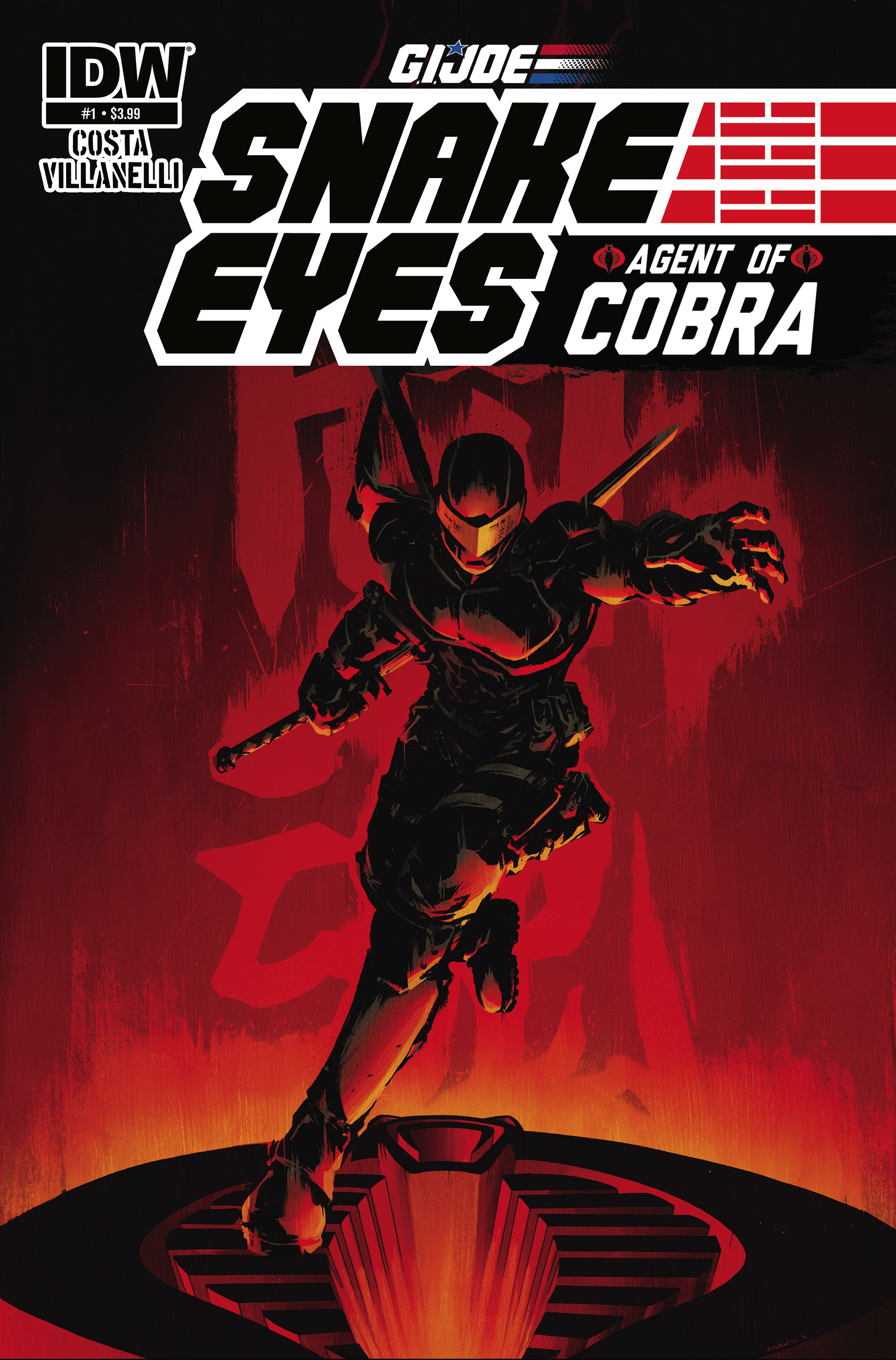
G.I. Joe: Snake Eyes, Agent of Cobra #1 (IDW)

via Previews World
writer: Mike Costa

artist: Paolo Villanelli

It's a little insane to me that this project hasn't been hyped.  It's Mike Costa returning home, picking up the pieces of a saga he apparently concluded a year ago in the pages of The Cobra Files, a full-on espionage approach to G.I. Joe he originally launched with Christos Gage when IDW obtained the rights to the franchise a half dozen years ago.

I figure at least IDW has once again figured out what it has, as it's been doing from the start.  This is an instance of a publisher sticking to a project despite widespread apathy, much as Fox kept Fringe on the air for years without viewers particularly caring.  In both instances, it's more than worth whatever hassle it may be, because the end result is invariably genius.

But canny, in this instance.  With a new context, as the title of this latest title suggests.  Snake Eyes is making his debut in Costa's tales, which likely helped inform the recent mainstream G.I. Joe reboot, which hew closely in tone.  But since the masked ninja is famously mute, someone else must come along for the ride as well, and as such, Destro makes his debut as well.

Costa recaps Destro's backstory, and then gets to the good stuff, leading us back to Erika La Tene, Chameleon, rogue Joe and Cobra alike, who survived a game of psychological cat and mouse with Tomax Paoli.  The object of this return engagement is technically to pick up the thread of the Billy arc, Billy being the son of the late Cobra Commander (whose assassination at the hands of Chuckles was the clear moment Costa's work directly impacted IDW's wider landscape).

I didn't think this would happen.  But now it has.  Costa's back.  The game begins anew...

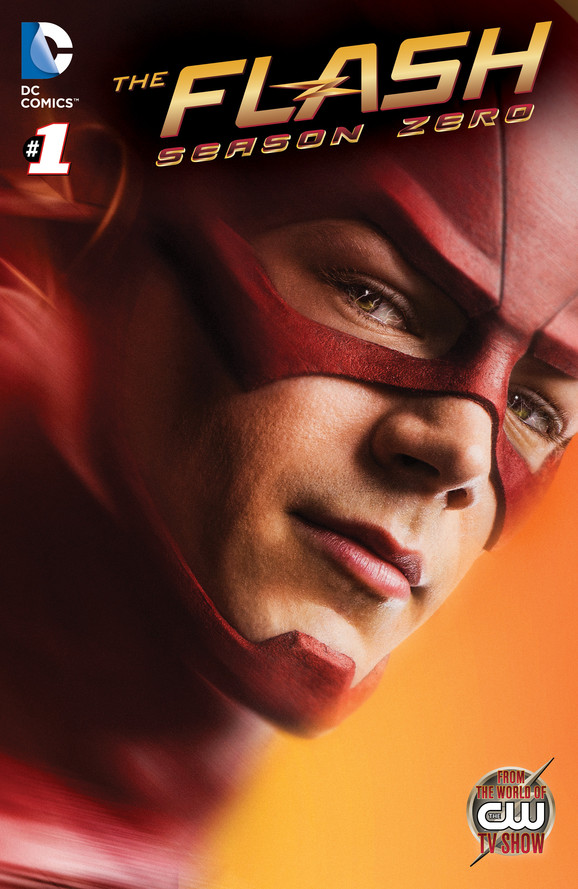
The Flash: Season Zero #1 (DC)

via speedforce.org
writer: Andrew Kreisberg, Brooke Eikmeier, Katherine Walczak

artist: Phil Hester

There's no TV series I'd rather be watching right now than The Flash.  No, this isn't 1990, but you might be mistaken for believing so, because the new show has acknowledged its predecessor by bringing back many of the original stars.  That's just one of the reasons I can't believe this is happening.

Well, thank goodness Smallville happened, made it safe for DC superheroes in prime time again.  I don't care for Arrow, but at least it gave us The Flash.

Yet I still haven't seen an episode.  I know, we live in a multi-platform age where being unable to watch live is no longer even a ghost of an excuse, but hey, things happen.  I'll catch it on DVD, just like the first one.  That's the speed at which I run, yo.

And there's a comic.  The first one had a special that recapped the whole series, but this one has a whole, digital-first, comic book series to call its own.  Miracles of modern times.

And the best part about it is another resurrection.  The artist, Phil Hester.
via DC Comics


Hester is a writer/artist, actually, and a lot of his recent work has been as a writer, but he first came to prominence as an artist, where among other projects he helped Kevin Smith on a Green Arrow relaunch (appropriately enough).

I'd begun getting used to the idea of Hester as a writer, working on his own projects (one of many writer/artists I don't understand why the comics industry hasn't thrown itself all over them to deliver a steady stream of such work), but heck, I can't kid myself.  I love Hester's art.

And it looks much as it did before.  Sometimes there's something to be said for consistency.  I don't know that Hester has worked on the Flash before.  I don't know if he's necessarily ideal at depicting speed, but apparently that's not completely necessary for this version of the character.

As represented in the comic, this is a Barry Allen who seems to have taken a lot from the Mark Waid comics featuring Wally West, as well as the Barry comics from Geoff Johns.  I like.

And it beats whatever they've been doing in the New 52 with the canonical version of the Fastest Man Alive.  

Reading Comics 147 "Batman"

via Caped Crusades
It's a pretty good time to be reading Batman.

I'm reading Scott Snyder's Batman regularly for the first time ever, two issues and counting.  "Endgame" turned out to be the return of the Joker.  And it looks like Snyder is about the start knocking down his dominoes, which is what I've been waiting for, and it looks like it'll be quite interesting.

"Death of the Family" was a little underwhelming for me in that it was basically Joker stating how he and Batman were opposites that couldn't help attract.  And?  And, well, this.  Snyder's big statement on how far down the rabbit hole goes, an expansive look that other creators have shied away from, has been reflected nicely in Batman #37 and 38, the latter of which explains the mystery of the Joker's apparent new supernatural nature, and sets up Batman's visit to the Court of Owls for further answers.  The Owls concept was another one I thought Snyder hadn't fully presented other than as a signature arc.  In his original Detective Comics run, Snyder promised to be a writer who could connect the dots.

And that's what's happening.

Pete Tomasi and Pat Gleason, meanwhile, connected their dots, in the recently concluded "Robin Rises" arc, and Batman and Robin #38 is a deliberate step back from the heavily serialized approach the series has featured for the past year.  It breaks from Bruce Wayne's steel focus and allows the reader to see Damian, in his new context, the way we would have observed him from before his death.  And it's important to note how the early issues of the series now take on new relevance, because the focus was originally on Damian, and then by necessity switched to Batman, and now it's back.  Because Damian is on a quest of his own, which isn't necessarily how readers might have predicted it to go, based on recent proceedings.

But that's exactly how it should be.  And suddenly we see how the story indeed continues.

That makes at least two Batman titles that are hitting their stride years into the New 52, with dedicated creators who have been remarkably patient, taking their stories in directions readers might have expected, but not as they have turned out.  

That's truly remarkable.

Reading Comics 146 "Aquaman"

via DC Comics
It took me forever, but I've finally read the conclusion to Geoff John's Aquaman.  

Yeah, about a year late.

But the local comics shop had the original comics available, or at least the last two issues, Aquaman # 24 and 25, and so I got them and now have read them.

And it struck me, this was a little like Johns revisiting some of what he'd done in the pages of Green Lantern.  Now, before you say some hogwash like Johns repeating himself let alone others, that's the story of storytelling.  That's what it's all about.

Now, the last Green Lantern story Johns told concerned the First Lantern, his vision of how the Guardians of the Universe began creating what would become the space cops as embodied by Hal Jordan and others.  The First Lantern returned as a villain, naturally.  The same, it seems, as the King of the Seven Seas, the prototypical Aquaman who ruled ancient Atlantis and subsequently returns, as a villain.

The whole idea of the Others, it now seems apparent, was Johns recreating the spectrum corps in a new context, too.  

And it's about bloody time.

For so long, when Aquaman wasn't that crazy person who talks to fish (or lobsters, as depicted in the new Throne of Atlantis animated adaptation), he was thrust into some quasi-fantasy context that, sure, revolved around the obvious backdrop of the famed lost city that toppled over, sank into a swamp (er, your knowledge of Monty Python and the Holy Grail lore may not be extensive enough to know how pathetically hilarious I just was) and left our hero a fish out of water even though he technically patrols, y'know, most of the world.  But as he does with every concept he touches, Johns expanded Aquaman's horizons.

And he did it by dipping into the same waters twice, as it were.  But context is always key.  And I think it's worth celebrating this latest breakthrough.

The Others all have connections to artifacts (which is also like the Top Cow characters whose backstories hinge on how aware you are that Witchblade kind of long ago stopped being just that chick who was one of the many blatant excuses the '90s had for female characters wearing as strategically little as possible) stemming from the new Atlantis mythology.  You may have noticed that Aquaman and the Others has been an ongoing series for some time now, too.

I haven't read Aquaman since Johns left.  It took so long to read how Johns left, it only figures.  I don't know if those who inherited this Johns playground have properly exploited what he left behind, or if they've simply been enjoying the new visibility of the property.  Which, actually, wouldn't be a bad thing, because there now stands on record a number of key Aquaman arcs, "Throne of Atlantis," "Death of a King" (the arc that concludes with these issues), and of course the introduction of the Others.

It was also fun to see the art of Paul Pelletier, which has been missing from the pages of DC comics for years now, but was some of my favorite material from the '90s.  His work is still recognizable, but has more, ah, depth now.  Which is always good.