Saturday, November 12, 2022

On the Death of Kevin Conroy

I haven’t posted in this blog in more than a year. It’s the longest by far in twenty years, outside of reviewing collections at Goodreads, I’ve gone without talking comics. This post won’t do that, either. Instead it acknowledges the death of the voice of Batman.

Kevin Conroy, folks.

Kevin voiced Batman starting in Batman: The Animated Series, which celebrated its thirtieth anniversary this year. When it began, Tim Burton’s cinematic revival had already cleansed the camp reputation of Batman from the popular consciousness, after the 1960s live action TV show had set the standard. Comic book fans had already had Batman redefined in the pages of The Dark Knight Returns in the 80s, but perceptions still feared the combination of Burton and Michael Keaton would revert the character back to Adam West.

The cartoon followed Burton’s moody take, even adapted its theme music from Danny Elfman, to the point where there were probably kids watching who just assumed it originated there. It tackled and redefined the Gotham landscape, even introducing new elements like Renee Montoya and Harley Quinn that would become permanent along the way. Its Joker was voiced by Mark Hamill, a realization that didn’t sink in right away, but would eventually totally redefine him, too.

Watching as a kid, I was always impressed at how Kevin gave separate voices to Batman and Bruce Wayne. It was the first time I was really aware that there might be a difference between them, and in the three decades since it’s still the clearest example that there probably ought to be, in any medium.

Kevin kept voicing Batman over the years, whether in material directly associated with the cartoon or in various other projects. He finally got to play a live action Batman in the Arrowverse’s “Crisis on Infinite Earths” crossover in 2019.

Over the years, I lost interest in the cartoon. The more it ended up codified as a defining version of Batman (in many eyes, the defining one, the same way fans assumed John Stewart is the only acceptable Green Lantern, because he was the version in this shared universe), the more I struggled to remember why I had been a fan, too. Watching it now, it’s very clearly a kid’s show. The villains all have voices that would not be out of place in the 60s show. Forget that how they were used, such as Mr. Freeze, gave them new depth: how they sounded is harsh on an adult’s ears without the filter of nostalgia.

That being said, Kevin gave a star performance. He was impeccable, and you could listen to his Batman now as then without doubting for a moment that this guy should be Batman. Out of all the actors who have played Batman over the years, and this is not to say any of them were bad, it’s still a great argument that Kevin sounded like the most perfect fit. 

So: rest in peace, Kevin. Your legacy in the role is assured. You made it your own, and in doing so you defined the character for generations. 

Saturday, June 26, 2021

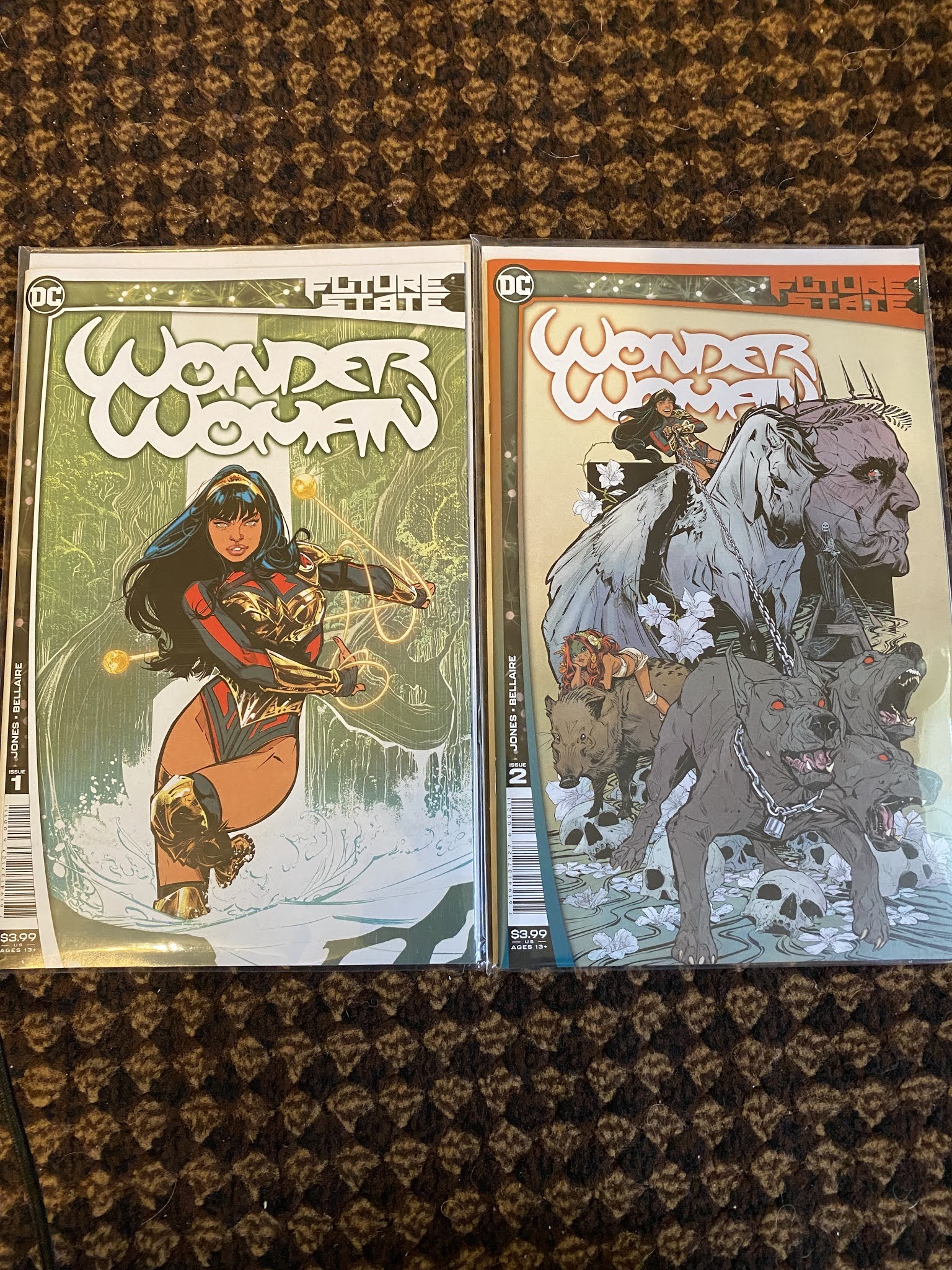
Future State - Top Ten: #1. Wonder Woman


Writer/Artist: Jöelle Jones

This result was basically self-evident from the first issue. I say “basically” since I had it ranked second when covering just the first two weeks of Future State. Swamp Thing topped it initially, with a truly outstanding first issue that was probably never going to be easy to follow with only one additional issue (though, again, Ram V’s follow-up series has more than adequately rectified that). But Jöelle Jones had created something that was truly effervescent:

A perfect confluence of writer, artist, and character. Two out of three of those were fairly easy to accomplish, as Jones wrote and drew the comic. Her new Wonder Woman, Brazilian (as in Amazon Rainforest) Yara Flor, didn’t bother with any kind of introduction or justification, but rather plunged into Jones’s version of Wonder Woman adventures.

Now, Wonder Woman is one of DC’s Big Three, but she has never had the rich history of Batman or Superman. She’s had continuous publication and significance, but really, none of the classic storytelling. There has been a considerable uptick in great storytelling in the past twenty years or so, with Greg Rucka (at least his classic embassy run) and Brian Azzarello being the obvious highlights, but nothing that feels quite as effortless as what Jones accomplishes here.

Simply put: This is a truly fun read. It’s beautiful to look at (I’m ashamed to admit this is the first time I’ve really appreciated Jones’s artwork), but it’s playful and assured in ways I’ve never really seen in a superhero comic. Usually playful means cartoonish. That’s not what Jones does. Her Wonder Woman enjoys being Wonder Woman, and is prepared for what she encounters. Simple as that.

And it’s a complete revelation. It’s easy to see that DC envisioned Future State to be a platform for new voices. I truly hope Jones has the chance to be elevated as far as she can go. I’ve read the first issue of the follow-up, and it’s just as awesome, but now I want more! I want to see Jones unleashed! The first female lead creator in comics! 

Saturday, June 19, 2021

Future State - Top Ten: #2. Mister Miracle


Writer: Brandon Easton

Artist: Valentine De Landro

Out of all the backup features in Future State, Easton & De Landro’s Mister Miracle was not only the longest (running four segments serialized between Superman of Metropolis and Superman: Worlds of War) but the most consistently entertaining, which I assume is why it was longest, and also why it was picked up as an Infinite Frontier miniseries, which recently launched (and I have also enjoyed).

Unlike Tom King’s comic, which featured the more traditional Mister Miracle, Scott Free, this is a spotlight for Shilo Norman, last featured in Grant Morrison’s Seven Soldiers of Victory.

The absolute beauty of it, other than De Landro’s wonderfully simplistic, fantastic art (which, sadly, wasn’t carried over into the sequel project), is Easton’s depiction of Shilo’s relationship with his Mother Box.

Now, as a longtime comics reader who has experienced plenty of Booster Gold conversations with Skeets, just to name one example, I’ve seen this kind of interplay before. But I have never seen it better. The “man in the chair” trope the MCU Spider-Man identified and usually illustrated by Batman and Alfred tends to be defined by an exchange of information. 

Shilo & his Mother Box have a full-blown camaraderie going on.

Again, not like Booster & Skeets. Skeets tends, because Booster is often a comic character, to be the long-suffering counterpoint. The “man in the chair” itself is a gimmick of unequal weight.

Shilo & his Mother Box are pals.

And I loved that! In New Gods lore Mother Boxes are basically smartphones with AI interaction, capable of transporting the protagonist wherever they need to go via Boom Tube. Very infrequently you’ll have a Green Lantern comic where a ring is depicted like Easton does his Mother Box.

(Ooh! Ooh! Get Easton to write Green Lantern!)

The interplay between Shilo & his Mother Box is ubiquitous in the story. For me it was the whole draw. Technically Shilo is involved, the link between, the adventures playing out in the main stories of the Superman Future State titles (which themselves, again, play out in a far more satisfyingly subtle manner than the Batman family’s).

It gives the result a true personality. I hope when the sequel is collected, this is included along with it. The sequel takes a completely different tack, by the way, focusing more on Shilo specifically, but Easton is sufficiently talented, it seems, to not even miss a beat in the transition. A hugely promising new voice at DC.

Saturday, June 12, 2021

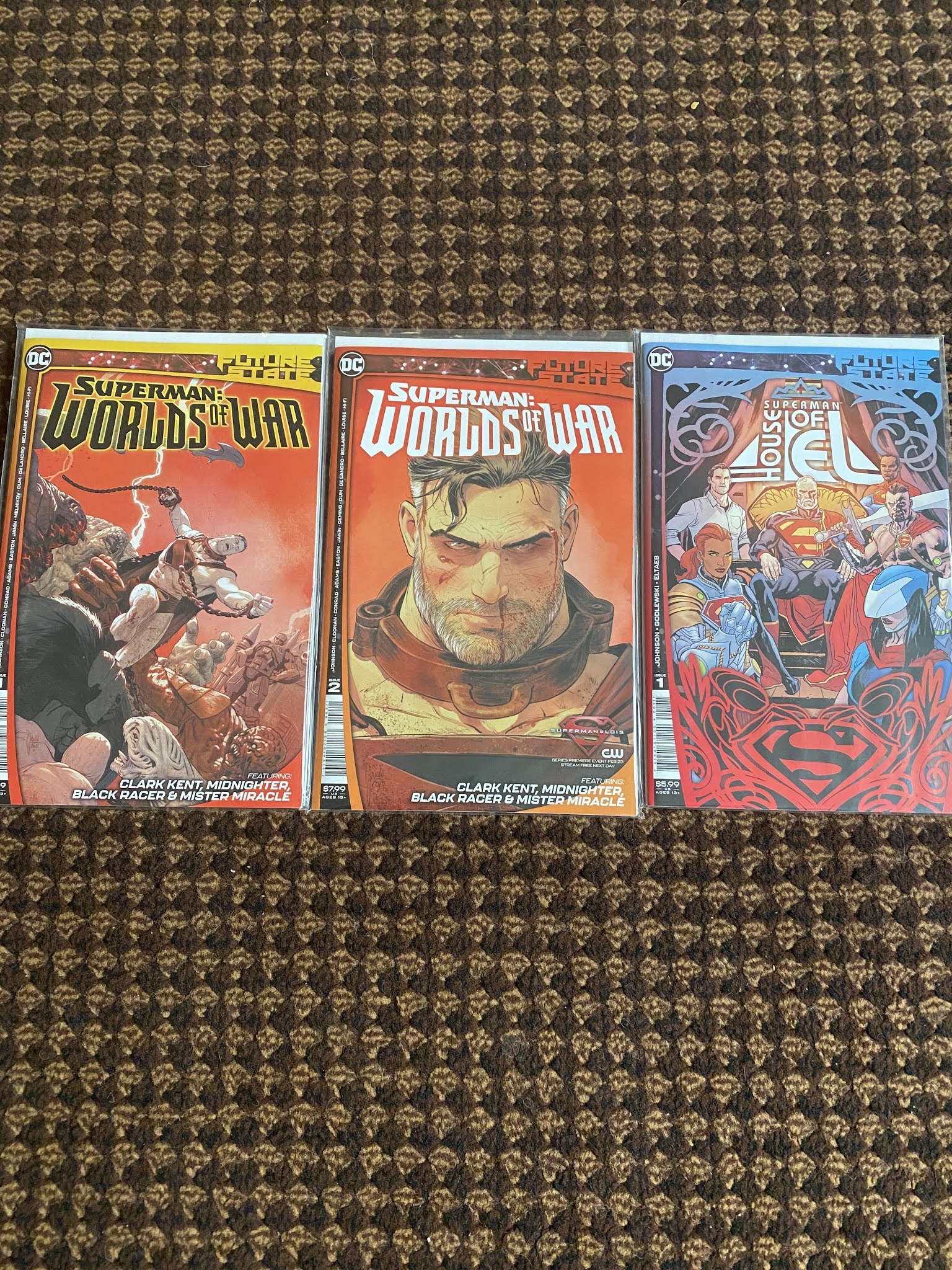
Future State - Top Ten: #3. Superman: Worlds of War/House of El


Writer : Phillip Kennedy Johnson

Artists: Mikel Janín, Scott Godlewski

My only previous experience with Johnson was The Last God, which I had only sampled with one issue, which I found impenetrable, so I had no idea what to expect from this.

So you might say this was the biggest surprise (other than my pick for second best of Future State!), because I thought it was brilliant!

Johnson takes a truly mythic approach to Superman, both in the woman who hero worships him at a human level and the task Superman himself has on Warworld.

What made it so amazing for me was that it turned out to be the very unlikely spiritual sequel to Tom King’s Superman: Up in the Sky, the story originally serialized in the pages of the Walmart Superman giants, which immediately became one of my favorite King comics, and Superman comics in general.

Most writers get caught up in Superman going about his everyday heroics, or try to scale him back, and yet Johnson, like King, is somehow capable of doing both.

It doesn’t hurt this comic’s standing, and legacy, to have subsequently enjoyed the early issues of Johnson’s Infinite Frontier Superman ongoing adventures.

Sunday, June 6, 2021

Future State - Top Ten: #4. Superman vs. Imperious Lex


Writer: Mark Russell

Artist: Steve Pugh

Future State played out in January and February 2021 for every other title, but this one’s final issue was published in March. In fact, I would’ve started in on this final ranking earlier if it hadn’t. By its first issue I knew it was a highlight, so of course I was eager to read the final one.

Yeah, I’m a Mark Russell guy. Not the most dedicated reader, but I’ve been keeping track since Prez, which was his mainstream breakthrough, and have been following loosely along ever since. Most of all I’ve been eager to see how far mainstream he can actually go.

Russell readers know his strong suit is social commentary, which tends to run contrary to expected mainstream norms, by which I mean anything remotely resembling traditional superhero storytelling. This wouldn’t be a problem if he didn’t pursue superhero comics, but Russell has. This is the first time he’s tackled Superman, though the focus here is more on Lex Luthor, who seems right up his wheelhouse (and not the first brush between the two; Russell previously tackled Luthor with a Porky Pig team-up).

The premise is Lex retiring to Lexor, a planet from Silver Age comics where he discovered he might pull off being considered the good guy.

The results are more classic Russell social commentary, including the media’s complicity in government messaging, and the public’s willingness to play along, no matter how horrible things really are.

Along the way, Superman, as well as Lois! must outsmart Lex (he’s powerless, literally, on Lexor), whose one ally is a robotic lackey willing to believe anything Lex tells him (the truest of true Lexor devotion), all while Lex flirts with going straight, or as straight as he ever gets, until he determines it simply isn’t in his best interests.

(This is significant because the citizens of Lexor really do believe he’s the good guy, which in Lex Luthor mythology is a big deal, since at times he’s depicted as being bad mostly because he knows he exists in Superman’s shadow.)

I don’t know where Russell goes from here (he’s so far absent from Infinite Frontier), but that’s pretty much always the story with one of the most interesting careers in comics.

Monday, May 31, 2021

Future State - Top Ten: #5. Swamp Thing


Writer: Ram V

Artist: Mike Perkins

After the first two weeks of Future State I had declared this one the achievement to beat. When all was said and done four other stories beat it, but that hardly diminishes the first issue of Ram V and Mike Perkins’ Swamp Thing, a master class of tone and setting.

I’m not the biggest Swamp Thing fan. Part of that is because I’m also not the biggest Alan Moore fan. His Swamp Thing was Moore’s calling card before he had any other credentials, and remains one of his most celebrated runs. He famously made existentialism cool in comics when he postulated that Swamp Thing wasn’t even Alec Holland but a plant creature who thought he was, a deconstruction of superhero secret origins that still stands as unique in the modern era. 

But I never got around to reading much of it, and what I have suggests much of it is Moore being Moore, which for me isn’t really my thing.

The closest I came to being a fan of Swamp Thing was Charles Soule’s run in the New 52, which rounded out Scott Snyder’s (which has been completely forgotten by the same rabid Snyder fans who proclaimed his Batman to be the only good thing about the New 52). Soule focused heavily on Swamp Thing mythology, which for me is a reliable source of superhero comic entertainment. 

Anyway, so I didn’t come into Future State expecting to love the Swamp Thing entry.

I hadn’t even been overly involved in the career of Ram V. Ram is an emerging talent who was operating below the radar, looking for a breakout work amid consistently excellent material. For me that breakout was this comic. It’s Ram at his most focused, which means a writer who can usually already have an excellent grasp of the potential in arcane characters had found the one character who unlocked his considerable potential.

The first issue is brilliant setup. The second issue is a letdown insofar as the first is so great it’s disappointing that it had to be wrapped up so quickly.

Fortunately DC understood what it had and immediately commissioned a follow-up mini-series from the same team. I have since been reading it, and several issues in Ram and Perkins once again put their magic on full display, which also had the benefit of helping me stick with Ram’s new Boom! series, The Many Deaths of Laila Starr, the second issue of which was even better than the first, which I wouldn’t have found out if I had stopped reading either series when it looked like Ram and Perkins were once again coasting on their laurels. 

Won’t make that mistake again.

Saturday, May 22, 2021

Future State - Top Ten: #6. Superman/Wonder Woman


Writer: Dan Watters

Artist: Leila Del Duca

My favorite thing about these issues is the Lee Weeks art on the covers. Weeks is one of the treasures of modern comics, doesn’t get enough appreciation for that. 

The issues themselves are a welcome reprise of the New 52 team up between Superman and Wonder Woman, with the obvious distinction that there it was a budding romance and here it’s the next generation of Jon Kent and Yara Flor. It’s Jon’s best Future State showing, and another highlight for Yara.

It’s also, very sneaky, evocative of All Star Superman, which for some is kind of the career highlight for Grant Morrison.


That’s how the credit pages appear in both issues, which is the style used in Morrison’s comic. Solaris, the tyrant sun, is also featured. It’s pretty deliberate.

Otherwise, writer Dan Watters and artist Leila Del Duca follow their own fancy. It’s just great to see a comic everyone sees as a classic finally show up as a source of inspiration. Obviously Watchmen shows up like that all the time. This is a welcome way to see Morrison finally reaching that status.