Showing posts with label Avengers. Show all posts

Monday, June 15, 2020

Sunday Marvel Sunday - “MONDAY Marvel MONDAY!”

Sunday Marvel Sunday...on a Monday??? I know what my legions of readers are thinking: the world has officially gone well and truly mad...

That being said, I’m still waiting for libraries to reopen to bring Sunday Marvel Sunday back as regularly scheduled, but since I recently bought some additional three-pack Marvel comics at Walmart and the alphabet still works in only one direction, I’m skipping the line a bit, and here’s some comics thoughts:

Uncanny Avengers #23
From 2014
Rick Remender dropped Captain America into an alternate dimension for a little while. Apparently he did exactly the same thing to the Avengers. This issue deals with the aftermath. Apparently big traumatic things happened to some members of the team. This is the textbook example of things that can only ever be completely ignored by later writers. That is all.

Avengers #27
From 2019
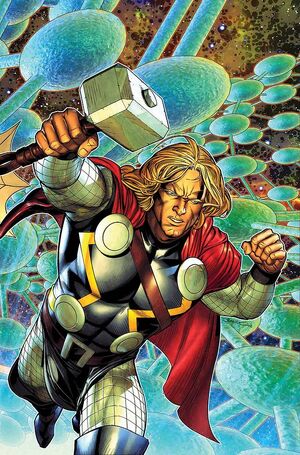
Jason Aaron probably should never have been used by Marvel to produce traditional superhero comics. That is not his wheelhouse. His wheelhouse is gritty crime comics. But, as it is, Marvel did, and there was a long Thor run, and then, because he is still one of their biggest name writers, he moved on to the Avengers. And somehow this issue is highlighted...by Thor. Brood Thor. Brooding over being worthy of Mjolnr. Kids, don’t grow up someday to run a comic book company where things like this happen. In completely unrelated news, probably later this year you will read a future edition of Sunday Marvel Sunday in which I enjoy a Thor comic. And I don’t mean this to sound personal, but it will not have been written by Jason Aaron. But, all things considered, Brood Thor brooding over Mjolnr is...still a pretty awesome image. So there’s that.

Captain Marvel #6
From 2019
In which Jason Aaron’s Ragnorak, I mean “War of the Realms” is happening, and someone at Marvel is writing superhero dialogue that sounds “relatable” and “believable” and totally absolutely convincing. In unrelated news, someone at Marvel got very, very carried away with the Bendis phenomenon. And the MCU. Probably mostly the MCU. Which wouldn’t exist without Bendis. But, not everyone can pull it off. And every single character should not be talking like this all the time.

Road to Empyre
From 2020
Back in ye innocent days before the pandemic when everything was still on schedule, the latest Marvel event was going to riff on classic Marvel storytelling concerning the Kree and Skrulls, as some fans naively think is going to be the next Thanos arc in the MCU. Which maybe even the MCU thinks this? But it’s not. It’s not going to continue indefinitely. It’s not. This I guarantee you. Anyway, this issue is a recap of relevant events. It starts out with that horrible Meet the Skrulls comic that was not at all as good as the Tom King comic it desperately wanted to be. And then circles around to beloved Young Avenger Hulkling, who is either a villain now. Or not. Probably not? But possibly? But, probably not. But, temporarily. Also? Young Avenger Iron Lad already...had this arc? He’s Young Kang. Why can’t they just bring back the Young Avengers. The actual team. The original team. Anyway...

Marvel Comics #1001
From 2019
The first one was great. This one isn’t. The only page worth anything is Kaare Andrews’, which reminds me all over again how great he is. That is all.

Moon Girl and Devil Dinosaur #47
From 2019
A poster child of everything that’s wrong with Marvel’s recent efforts to be “cool” and “relevant,” in its final issue. Devil Dinosaur is one of those Marvel monsters that just kind of exists, like Fin Fang Foom. A few years ago someone thought to team him up with a hyper-intelligent little girl. Because. Reasons. The girl is hyper-intelligent in the way writers who don’t understand how intelligence works think intelligence works. She is capable of...anything. This issue revolves around how she is in fact smarter than Reed Richards. If she were a legitimate prodigy, people would have noticed. Part of the gimmick is that she and Devil Dinosaur “don’t have anyone else, but at least they have each other!” It’s “beautifully empowering.” I don’t care that she’s a black girl, it’s sloppy writing regardless of her skin color. At the end of the issue she and Devil Dinosaur are traipsing about New York. This is a Marvel comic, where the Hulk can’t so much as raise a green eyebrow without everyone freaking out. The issue has Moon Girl messing around with a Doombot. The issue has Moon Girl wondering if she should maybe be a superhero? This is published by Marvel, the House of Ideas, one of which is...Spider-Man. Moon Girl in a Marvel comic literally makes no sense at all, and I have the feeling no one pointed this out, at all, because she’s “empowering.” It would be more empowering not to empower stupid writing, and stupid characters. That is all.


Sunday, January 5, 2020

Sunday Marvel Sunday "Avengers #2 (2018)"

Avengers #2
December 2018

I got a bunch of packs of Marvel comics late last year at Walmart, and will be talking about them individually here every Sunday.  Here's the first one!

I clarified in the title which year this came out, because Marvel has relaunched all its major titles about a billion times.  Helpfully, this black and white fifth printing includes a legacy numbering of #692, which was also helpful.

The creators are Jason Aaron, who just finished up a near-decade chronicling the adventures of Thor, and Ed McGuinness, who was a major name at the start of the millennium but has inexplicably slipped below superstar status since moving his horse to Marvel, where one of his first projects was Red-Hulk with Jeph Loeb.  I knew he was still in the doghouse when fans were complaining about the cover art from the first issue, as if they had never heard of McGuinness before, but I guess it shouldn't be surprising from the kind of community I've also seen this kind of reception from the likes of Matt Wagner, as if nobody had seen his work before.

The comic itself is quip-heavy, which seems to lean into the Avengers of the movies, which is solid enough thinking, considering how insanely popular the movies are, although technically this mindset probably comes from the comics, the Bendis revival that made the team relevant again, if not the Ultimates version that inspired a few movie elements like Samuel L. Jackson as Nick Fury (since they kind of cast him in that role first).

She-Hulk, as depicted by McGuinness, is looking like Banner Hulk these days, even though she's more traditionally depicted as a well-developed regular body-type.  That's her in the lower corner.

Captain Marvel is there doing her modern Captain Marvel thing, which annoys fans because she's only been doing it for a few years and the other guys have been doing it for decades.  It would perhaps be more helpful if she were an entirely new character, but entirely new characters haven't done so well in recent decades.

The new Ghost Rider has a car.  Nic Cage probably would've loved that version, circa Gone In 60 Seconds ("Driiiive!"), but then he still did two movies of the classic biker version.  I still think a lot of non-MCU Marvel movies are wildly unappreciated, especially since the MCU phenomenon hit full-stride.  Nic Cage is an excellent Ghost Rider.  (Haven't actually seen the second one.  Don't think Eva Mendes is in it.  Seems less important.)

Yadda yadda yadda, Loki shows up, saves the issue from generic villains with vaguely Kirbyesque designs.  The end.

Friday, September 2, 2016

Quarter Bin 88 "Marvel's All New, All Different"

Back issues of the recent past this edition: All-New All-Different Avengers #1, the Uncanny Inhumans #2, Agents of S.H.I.E.L.D. #1, Secret Wars #5, Secret Wars Too, Spider-Woman #1, Star Wars: Darth Vader #11, and Web-Warriors #2.

All-New All-Different Avengers #1 (Marvel)
From January 2016.
The Alex Ross cover doesn't exactly scream the same "youth" as the lineup and interior of this revamped team, featuring characters from the Ms. Marvel generation.  Written by Mark Waid and drawn by Adam Kubert (the brother who worked on Action Comics with Geoff Johns, not the one who worked on Batman with Grant Morrison), this is exactly an updated version of the kind of stuff Marvel has been doing since the '60s, and hey, it seems to be working quite well for them, right? 

The Uncanny Inhumans #2 (Marvel)
From January 2016.
With the heavy role the Inhumans are playing lately, not just in Civil War II but generally speaking (Marvel is kind of desperate for them to replace the X-Men, whose movies are not currently controlled by Dr. Disney), it was kind of crucial for the comics to be good.  I knew Charles Soule had it in him, and Steve McNiven has been a heavy-hitter (collaborations with Mark Millar on the first Civil War and the original "Old Man Logan," for instance) for years, so creatively, I have nothing to complain about.  The comic is good, too, with Black Bolt falling out with his lady Medusa, and their son Ahura falling under the influence of Kang, an arc that accelerates giddily throughout this issue.  I have plenty of evidence that Soule knows how to write great comics (his Secret Wars version of Civil War, for instance, in case you thought I'd referenced that title for the last time), so it's good to see that he started out well here, too.

Agents of S.H.I.E.L.D. #1 (Marvel)
From March 2016.
This is stuff adapted from the TV series, which I've never particularly made a habit of watching (I'm a Flash guy, with some real effort toward DC's Legends of Tomorrow tossed in), but I knew Agent Coulson had a flying car he calls Lola.  Apparently he named it in honor of his ex-wife.

Secret Wars #5 (Marvel)
From October 2015.
As A DC guy, I tend to be amused at the way fans and creators alike treat Dr. Doom like a god.  I just never understood it.  In this entry of Jonathan Hickman's ultimate Fantastic Four (sendoff) saga, Doom literally has become a god, and the entire issue is just kind of Doom complaining about it with a lackey, because he recently offed Dr. Strange and no longer feels challenged.  You know what?  I'm not even going to talk about this issue.  Let's just move on, because Hickman's got better material in:

Secret Wars, Too (Marvel)
From January 2016.
This is literally Hickman and Marvel joking around about the whole Secret Wars concept.  Marvel has gotten to the point where it either publishes straight-out humor titles, titles obviously inspired by successful movies, or the handful of serious stuff it allows itself to do, so it's not at all surprising that something like Hickman literally laughing about his apparent inability to finish his story happens in something Marvel itself published.  Marvel has become the House Wizard Created.  All throughout the '90s, Wizard was a massive Marvel fan service, and introduced the cartoony approach to fandom that has since gone mainstream.  Hickman's piece is brilliant, in which he imagines a conversation with Dr. Doom about what the conclusion should be.  Then there's some middling stuff that's just kind of there, and then indy creators Rob Guillory (Chew) and Eric Powell (The Goon) provide some of their trademark wit.  I actually have to give Marvel props for releasing this.  In another era, this would've been a jump-the-shark moment, but this one's all about that kind of irreverence.

Spider-Woman #1 (Marvel)
From January 2016.
This one's famously the cover advance solicits spoiled as feature the pregnant Jessica Drew.  Dennis Hopeless somewhat hopefully assumes readers would be familiar with Spider-Woman's somewhat odd supporting cast (the guy who's dressed up as a porcupine), so he spends the entire issue presenting the awkward situation of superhero being unable to superhero while pregnant.  It's bold in an era where it's kind of anathema to be pregnant (or something) to have a pregnant superhero, but one wonders if this latest calculated move to corner every market didn't miscalculate.

Star Wars: Darth Vader #11 (Marvel)
From December 2015.
Kieron Gillen normally gets pretty high marks from fans, but he apparently is somewhat uninterested in featuring Darth Vader as the lead of his own comic...

Web-Warriors #2 (Marvel)
From February 2016.
This series was recently cancelled, and Mike Costa announced to be moving on with a new Venom series, which I think will be right up his alley.  I've been a vocal of supporter of Costa for years, and long for the day he'll be a major player at the Big Two (I can't believe he's gotten less than the Greg Rucka treatment).  It may be that he simply finds it hard to use his Cobra style outside of his IDW work.  Not in this issue, though.  This one reads like a straight-up Web-Warriors edition of Cobra, detailing Electro's romp through the Spider-Verse, with Spider-Gwen (this is what Marvel thinks of as witty) filling in for the good guy Costa frequently traps in his webs (phrasing it that way totally helps make sense of Marvel thinking of him as a Spider-Man guy).  Maybe I'm just as guilty as anyone else in not giving Costa's non-Cobra work a fair shot, but it's always nice to come across work that rings so true to what I know best, because Costa's best is among the all-time best.

Tuesday, January 1, 2013

Avengers #34 (Marvel)

writer: Brian Michael Bendis
artist: various

(from weeklycomicbookreview.com)

The significance of this issue (along with New Avengers #34) is that it is Brian Michael Bendis' final issue of Avengers after writing the team in various incarnations since 2004.

Bendis has a massive essay at the end of the issue detailing this relationship, hitting up its highlights and origins.  Suffice it to say, but I did not read every issue (he has a count of 232), and in fact very few of them.  Here's a very brief recap, though: "Avengers Disassembled," House of M, New Avengers, Mighty Avengers, Dark Avengers, New Avengers, Avengers.

Anyway, not to be reductive, but the first three will remain his legacy with the team that has lately stormed the box office.  "Disassembled" was the story that, as the title implies, took the team apart, famously killing off (for a while) Hawkeye.  House of M was basically a very early preview of Bendis's X-Men.  New Avengers was where he took the Justice League formula and more accurately the Grant Morrison JLA formula, and applied it to Earth's Mightiest Heroes.  He brought Wolverine and Spider-Man, among other characters who had never been members to the Avengers, and in the process made it possible for just about every other character ever to be an Avenger.

This last issue is more or less about scaling it back to what the team was when he started.  It features Wonder Man desperately trying to redeem himself.  You may not know Wonder Man too well.  He played a part in "Disassembled" and then went away.  It also features the return of Janet Van Dyne, the Wasp, who was a founding member of the Avengers.  Bendis' whole idea was to move the team away from its original concept and defining characters, although of course Iron Man was still around.  

The catchphrase included in this issue is, "We go bigger" (although realistically it's impossible to go bigger than the team was in the Bendis era), uttered by Tony Stark, who is one of several characters who acts exactly in this comic the way he does in the movies (synergy!).  

Bendis doesn't do a lot to make a closing statement other than undo everything he did and suggest other people will "go bigger" (by again, basically doing all of that over again).  It's more implied.  If you get it, that's great.  Otherwise you might be forgiven to assume that this is just another issue of Avengers, aside from that massive essay.  

One of the things I love about Marvel is that it still includes things like massive essays from incoming/outgoing creators, and also letters columns.  Bendis is a big proponent of letters columns (although no letters column this issue), and you've got to admire that about him.  Although I did not read all 232 issues, I think it's definitely worth marking his departure, although he's really only picking up a thread he laid down years ago, with a different franchise.

Tuesday, May 1, 2012

Teenage Wasteland


Here I go again.  I really shouldn’t have, but I opened a box at Heroes & Dragons, meaning I will be reading comics on a regular basis again, in a more limited capacity than I have in the past, when I didn’t have a ton of impulse control.  This time I’ll be reading on the stuff I really want to read.  Some of my selections have been shaped by the extended trial I’ve been on for the past year, some by decisions I made before it.  It’s really an effort to read books that may be unavailable typically, things I don’t want to miss, things I won’t have had the ability to catch if I hadn’t made this decision.  For instance, as visitors to Comics Reader will know by now, I’m a fan of Oni Press’s WASTELAND, a comic that spent a great deal of time recently not actually being published, but the circumstances that forced that particular break were recently resolved, and throughout 2012 it’s been back on a regular basis.  I haven’t seen it in any comic book store I’ve visited since Newbury Comics, so in order to read it without a lot of hassle, opening up a box was a decision that was more or less necessary.

There are two kinds of people who read comics: those with arrested development and those who are simply developing.  I don’t mean to disparage either group, but the fact is, it takes a special kind of person to be interested in stories told in illustrated form, especially when the most popular stories in the medium feature outsized personalities in colorful costumes.  Part of what drove me to reading comics in the first place was vindicated frustration from a childhood deprived of them when I was most keen to do so; I’ve been playing catch-up for twenty years.  I was a teenager by the time I was able to fulfill this ambition, and it so happened that at the time, there were a lot of comics being published that rewarded continued interest, and that helped develop a habit.  Yes, reading comics is a habit; otherwise they wouldn’t be released in monthly increments.

Again, none of this is a bad thing.  In fact, I think it’s a very good thing, because comics have an ability to remove the filter many storytellers force on themselves, making their tales more mundane, more ordinary, more constrained by things that have actually happened.  That in itself isn’t a bad thing, and in some instances can be a very good thing, but the universal is at its best in the sublime, when it activates the imagination.  There are more benefits to looking beyond the simple and embracing the abstract.  Comics do this better than any other expressive form except perhaps music.  For some reason, but you combine a static image with words, the words become more important, if you let them.

That being said, let’s look at some examples:

AQUAMAN #8 (DC)
Geoff Johns continues to expand his vision of Aquaman beyond the simple parody that pop culture has embraced in the past ten years, abetted by lackluster comic book portrayals in endless relaunches throughout many decades (Tad Williams, I contend, remains the sole exception) since the character’s creation.  Some creators have understood the potential of his unique setting, the mythology that Aquaman alone can truly tap into, but Johns is looking beyond that simple vision and tapping into how Aquaman’s life and career can be shaped outside his connections to the Justice League and embrace, like his Green Lantern stories, a far greater world than ever before.  To wit, Johns opens this issue with the young Arthur Curry attempting to distance himself from humans who could never understand him, following the death of his father, thrusting him into a dawning awareness of his Atlantean heritage.  He eventually meets others who understand him, but they aren’t the Justice League, but rather a whole myriad of outcasts.  As I’ve been saying, anyone who hasn’t read AQUAMAN yet should probably start doing so soon, because if history is any indication, Johns has a lot more planned, and this is just the foundation.

THE AVENGERS #1 (Marvel)
A reprint of the 2010 relaunch, Brian Michael Bendis (guru of all things Earth’s Mightiest Heroes) picks up the pieces of many conflicts he himself has helped engineer, reassembling the team once more and then bringing back time-traveling Kang for a more specific purpose.  There are moments where the gravity of what everyone’s been through is clear, but there’s also the trademark flippant style of Bendis that has likely built him his following (it’s no wonder he moonlights as the Ultimate chronicler of Spider-Man, since that’s his natural character vein).  This one’s a freebie, which is really smart, given the movie that pretty much everyone is going to see this summer, many in multiple visits.

AVENGERS VS X-MEN #0 (Marvel)
I got this reprint, too (had to pay for it, though), the one that looks like the most obvious gimmick in a long series of Marvel events since Bendis came aboard, but it spears someone really did figure out that there’s a story to be had, too.  Bendis started the ball rolling with HOUSE OF M (not to mention “Disassembled”), but the House of Ideas finally figured out what to do with mutant messiah Hope, too, tying her in with the Phoenix saga that was the highlight of the Claremont era that made the X-Men rise to the prominence it still enjoys today.  If this event figures out how to handle all of what it promises competently, it may be the most important story from Marvel in the past decade.

BATMAN AND ROBIN #5 (DC)
Seeing this even earlier issue from the story I snapped up in one of my previous visits, I couldn’t pass it up.  I am now thoroughly convinced that the series has already earned a prominent spot in the eventual 2012 QB50.  Peter Tomasi and Patrick Gleason are creating the most important in-continuity Batman stories, period.

DEMON KNIGHTS #7 (DC)
Another issue that fills in one of my gaps, Paul Cornell’s period heroics are just as astonishing as everything else he does, featuring historic heroes in ways only Grant Morrison previously approached with SEVEN SOLDIERS OF VICTORY.  If you want, consider this an ongoing series inspired by some of the mini-series in that project.

JUSTICE LEAGUE #8 (DC)
Geoff Johns again, once again putting the focus on a relative outsider, approaching the League from the outside in.  This time it’s Green Arrow, more famously depicted as an older, more cynical hero obsessed with social causes and his own legacy.  As a younger version, he does seem a little more superfluous, so it’s no wonder the League wants nothing to do with him (even if they have other reasons besides), even when he finally, petulantly, gives voice to the reasons he wants to join, which more accurately reflect the Oliver Queen we know and love.  The backup Shazam feature continues, and is already a definitive version of the character.  But what else did you expect from Geoff Johns?

RED HOOD AND THE OUTLAWS #8 (DC)
I can’t decide whether I actually want to read this series on a regular basis, but I keep getting drawn to it because Jason Todd is such a compelling character, a damaged individual with a tragic past, sometimes awful tendencies, and a road to redemption.  Scott Lobdell has captured this perfectly, and Kenneth Rocafort is an extremely unusual artist for DC (the only negative this issue is the cartoonish fat woman who’s the villain of the story), and another strong draw.  Forget the backlash concerning the costume of Starfire.  You need to at least sample this series.

SAUCER COUNTRY #2 (Vertigo)
Sometimes it’s better to miss the first issue of a comic book, and in this case, it’s almost mandatory.  Arcadia Alvarado will be running for President, but she believes she was abducted by aliens.  Do you believe her?  That’s the whole thrust of this series from Paul Cornell, finally getting the chance to stretch himself a little, with a concept entirely created by himself, in a book that has the potential to be the next great Vertigo project. 

THE TWELVE #12 (Marvel)
WATCHMEN as retold by J. Michael Straczynski and Chris Weston finally concludes.  Okay, it’s not really WATCHMEN, more like Captain America retold in the manner of WATCHMEN.  Regardless, this was an ambitious project of motivations and fate that proved fascinating and then frustrating when Straczynski took an extended break, leading many fans for several years to fear that it would never be concluded.  So important to Weston, actually, that he produced a one-shot on his own to continue the saga of the WWII heroes suspended and then revive in modern times, only to succumb to their own failings, THE TWELVE comes to a worthy if quiet conclusion, befitting its focus on character ahead of sensation.  Hopefully it will take its place among the seminal superhero stories.

WASTELAND #36 (Oni)
It’s a little strange for this reader to dive back into the series now that RESURRECTION artist Justin Greenwood has settling in as replacement for Christopher Mitten, whose distinctive style helped shape the early issues of Antony Johnston’s epic vision of the future, especially after having read (and written synopses for here at Comics Reader) the first six collected editions.  I have missed four issues between the last one featured in the paperbacks and what I was surprised to find waiting for me last week.  Michael and Abi, on their way to A-Ree-Yass-I, have stumbled into another town overrun with overblown egos.  If you were at all hesitant about WASTELAND before, it may be easier to catch exactly what this series is all about with these new issues, with new art but the same complex storytelling Johnston has been employing from the start.