Showing posts with label Joe Kelly. Show all posts

Saturday, September 12, 2020

Reading Comics 243 “Comics Garage: First Box!”

 Having apparently ended my Forbidden Geek experiment only earlier this year (it feels like longer, although partly because it took so long to get that last box), I guess I was in the mood to try another service (or Amazon thought so, and I agreed). Like Geek, Comic Garage ships out assortments of random comics monthly. There are a variety of options. I opted, naturally, for DC titles, and ten comics per box. This is what I got in my first box:

Batgirl: Futures End #1

I’m pretty definitively determining that I just don’t care for Gail Simone. Most of the time I try to read her I hate the results. Somehow she even managed to screw up what so many other Futures End one-shots managed to accomplish, which was to give clever glimpses, well, into the future. The only worthwhile thing she does is gather the Batgirls together (and add a new one): Babs, Stephanie Brown, Cassandra Cain. But the other inexplicable thing Simone can be counted on is to screw up Bane, who was part of her Secret Six. She somehow takes Bane seriously for a change, but her idea of giving Barbara Gordon character development is to make her hulk out as part of a con job against him. I honestly have never seen Simone’s logic appear remotely logical. There’s a very real phenomenon called comic book logic, which I associate mostly with Marvel comics (and movies). Simone should probably just head over there. And stay there. She would be a killer writer for Squirrel Girl. That’s, ah, a whole other inexplicable thing...

Batman: Legends of the Dark Knight #121

As part of the “No Man’s Land” arc (loosely adapted as part of The Dark Knight Rises), Larry Hama (the G.I. Joe guy) tells a wimpy Mr. Freeze tale that’s about as generic as possible. I have nothing against Hama, but it at least seems like he was wildly out of his element. I have no idea how long he stuck around Batman at this time. Hopefully not very long.

Freedom Fighters #10

The newest (from last year) comic in the box is one I’d wanted to check out anyway. It’s written by Robert Venditti, another writer I’ve tended to struggle with. The only problem here is that this is toward the climax of the story (it was a twelve-issue series), so it’s all action. Most stories you really ought to be able to jump in and have a good chance to understand the tone of it, but unless it’s a movie it’s going to be hard to appreciate if it’s anywhere near the climax.

Green Lantern #53

The classic Ron Marz/Darryl Banks comics (receiving a lot of nostalgia recently, a quarter century in), at this point still featuring the nascent adventures of Kyle Rayner. This was prime comics for me at the time. If any era had been in a position to replicate the Silver Age generational shift, it would’ve been this one, which at least for a decade ended up being exactly the case. Wally was a new Flash, Kyle was a new Green Lantern, there was even a new Green Arrow, and of course there was the poster boy, Jack Knight. 

Reading this particular issue again was interesting. Kyle battles Mongul, the big brute Alan Moore created with the Black Mercy gimmick who later turned into Cyborg Superman’s key collaborator but somehow ended up taking an extreme backseat. He instead became a punching bag, here for Kyle and then again later for Wally. 

Superman sort of co-stars (Banks does not nail Mulletman), giving Kyle a mainstream link for the first time. But the big development is Major Force taking on the assignment that will lead to the most infamous moment in the Marz/Banks run (Women in Fridges, which coincidentally also gave Gail Simone her career; two wrongs don’t make a right). 

The thing is, this is the first time I actually found Kyle’s ill-fated girlfriend Alex almost necessary to sacrifice. Marz set her up as a way to establish Kyle as requiring a steep learning curve, but she actually sort of inadvertently made it steeper than it really needed to be. In hindsight it would perhaps have been better to have her be the classic archetype of girl who falls for boy after seeing in action as a superhero. Instead their relationship predates the costume, and she spends all her appearances questioning his pedigree. And in hindsight it’s pretty annoying. I guess it’s the difference between experiencing it as an adult rather than a teenager. That and knowing her ultimate fate. Ultimately Kyle’s journey becomes completely his own, and meeting Superman means more than what Major Force ends up doing. The intention to have him (and readers) shocked into character development becomes superfluous, especially because it happens so quickly. If the intention was to try and replicate Uncle Ben, then it backfired. Once she dies Alex becomes almost completely invisible to Kyle’s existence.

(Though if Jeph Loeb and Tim Sale ever returned to DC and did the kind of comics they did at Marvel, it would be really easy to guess what they’d do with Kyle, if they chose him as a subject.)

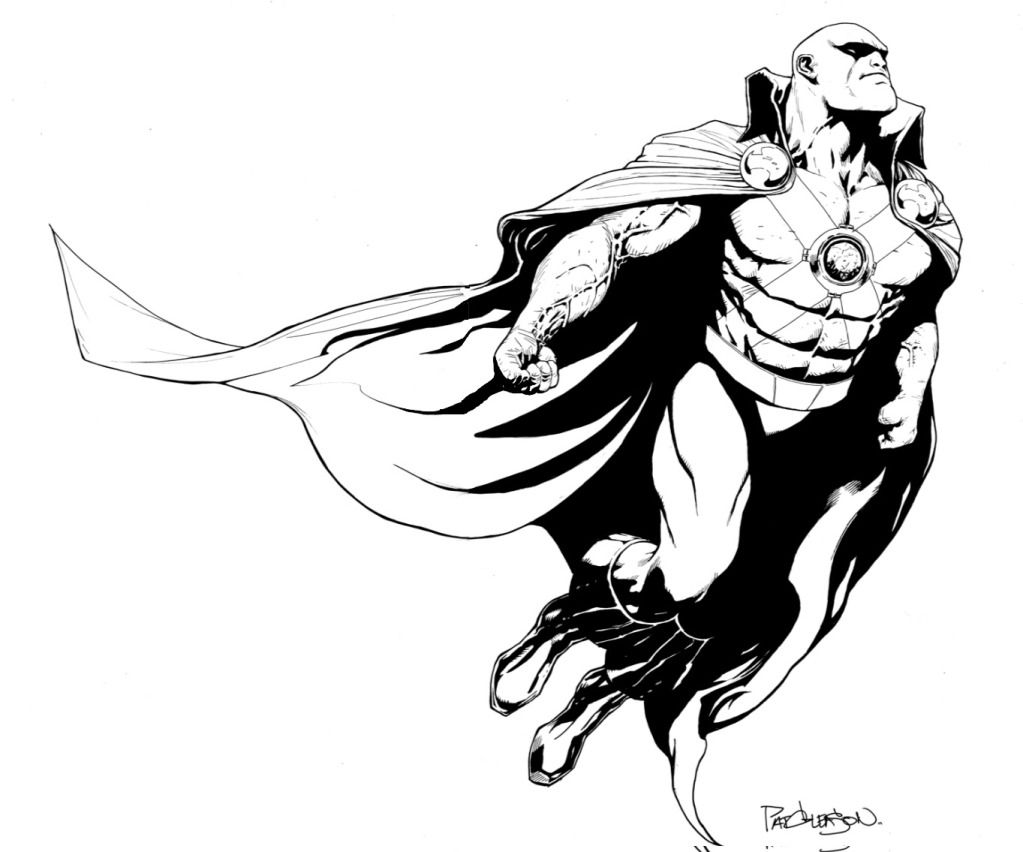
Martian Manhunter #11

In contrast to Freedom Fighters, this late-issue climax was easier to read, in part because I had already read and enjoyed this Mr. Biscuits, Williams/Barrows comic (though, alas, Barrows isn’t on art this particular issue). In recent years DC has been leaning heavily into J’onn’s alien nature (though, I guess, since the Ostrander/Mandrake series, so for some twenty years), and I think this was about as extreme, and awesome, as it’s likely to get. Really wish someone could manage to do it while also integrating him back into the rest of the DC landscape, though. Sort of like Aquaman, who only seems to look relevant if he’s worrrying about underwater politics. 

Nightwing #45

The classic Chuck Dixon era! This issue is part of a Birds of Prey crossover, “The Hunt for Oracle,” which is to say, the villains finally figuring out Oracle exists and maybe they should make that stop. The weirdest thing about recent comics is that Babs is Batgirl again. Naturally it was Gail Simone who wrote the initial stories, although it wasn’t until Burnside (and apparently de-aging her) that it was at all relevant. And as stupid as it was to cripple her in the first place, it was probably even dumber to un-cripple her, after years of developing an entirely new career, and apparently not even bothering to have her pass it on. In an era where if anything Oracle would have been even more relevant...

(Incidentally, I finally figured out where MCU Spider-Man came up with the “man in the chair” trope. I was rewatching Batman Returns and...it’s Alfred, of course.)

Robin: Son of Batman #1

Patrick Gleason started out this series as writer/artist. I think he did a brilliant job. It’s a direct continuation of his and Tomasi’s Batman and Robin, and is therefore a must-read for anyone bold enough to admit that those were the best Batman comics of the New 52. Fans still seem convinced Damian is a snot-nosed brat. I can only assume far too few have read this material.

StormWatch #21

Speaking of the New 52, I cannot fathom this series reaching anywhere near this many issues. And based on this issue, I wouldn’t have bothered reading anywhere near this many...

Action Comics #764

The Loeb/Kelly/Casey era! This was the bold break from the ‘90s triangle era, bold new writing and art styles that ultimately ended up remembered best by Loeb’s subsequent Superman/Batman. The Kelly in question is Joe Kelly. This issue is brilliant, a creative approach to the controversial decision the team had made to put relationship troubles into the married life of Lois & Clark. Superman spends much of the issue talking things over with Ma & Pa Kent, doing an extremely good deed for an old lady...and getting no closer to solving his real problem, alas. Plus Lex Luthor is up to something, but as far as this issue is concerned, I have no idea what. This is always a great era to revisit. They took huge risks, but not necessarily in bold dramatic arcs (at least, not all the time; this is also the era of “Emperor Joker,” after all).

Teen Titans #35

By the time the Doom Patrol shows up, I have to wonder why Geoff Johns never went and outright pursued a comic with them. He randomly brought them up in his Justice League, too, but didn’t go very far there, either. Maybe some day! This issue otherwise reads a lot like the Titans TV show (which I love).

I’ve read other comics since I last checked in here, but at the moment I figure it’s okay to leave them unobserved here. Will be back with more comics from Walmart...!

Monday, September 18, 2017

Quarter Bin 116 "JLA"

JLA #8 (DC)
from August 1997

This is the setup to the Key revamp Grant Morrison pulled early in his run, but I remember it best for Green Arrow Connor Hawke's memorable statement: "Dad.  Oh, dad.  You're going to be the death of me."  He's referencing having to use his then-late father Oliver Queen's infamous trick arrows.  I used a similar line for a story I later wrote. It's just perfectly executed, and still one of the most memorable endings to any single issue I've ever read.  It's also worth noting the excellent art of Oscar Jimenez, which he seems incapable of delivering on an ongoing basis.  How about signing him up for a limited series, folks?  Also, worth noting that Morrison's Key uses tactics that are very similar to The Matrix, an irony, as Morrison's The Invisibles has long been said to be an unacknowledged source of inspiration for the movie.  I don't know Invisibles well enough to offer a judgment about that, but clearly Morrison was on the right wavelength somewhere...

JLA #14 (DC)
from January 1998

Yeah, so I mistakenly thought this was the "Darkseid Is" issue (it's on the cover an' everything!), but it's the one after it.  It's also "Part 5 of 6" in the "Rock of Ages" arc, but for all intents and purposes, is probably to be considered, along with its immediate predecessor, the best stuff in the arc.  It's Morrison's first crack at Darkseid.  C'mon!  He responds with possibly his best JlA material.  Howard Porter provides art.  It's crazy to think Porter, when JLA launched, was instantly considered an elite artist, but has never received another elite assignment.  What the Apokolips is up with that???

JLA #88 (DC)
from December 2003

Truth be told, after Morrison left the title, I didn't really see much point in trying to see what his successors were up to, despite the fact that there's a lot more non-Morrison JLA issues than ones he actually wrote.  This one's from Joe Kelly, who at the time was threatening to become one of DC's most important writers.  Instead he and a bunch of his pals went and did their own projects, not in the Image way, but bigger, arguably.  Anyway, I chose this issue because the cover promised a strong Martian Manhunter spotlight ("vs the Martian Manhunter! and J'onn Jonzz! and John Jones!"), but as it turns out, Plastic Man is the one who receives the best spotlight.  Plastic Man was Morrison's most outlandish addition to the League, so it's really good to see that his presence in the team wasn't overlooked or forgotten years after the fact.  Kelly spins some poignant material that segues nicely with the Offspring character Mark Waid envisioned as Plastic Man's son.  Waid apparently considers Offspring the best thing about The Kingdom.  You'd really think there would've been more with these two.  There's always the future...Also quite fun to see Doug Mahnke's work, as always.  He seems to have developed, by this point, more or less the style he still uses today.

Monday, January 12, 2015

Quarter Bin 65 "Binge-worthy X: Some Things Old, Some New"

Blackhawk #16 (DC)
From 1990.

I picked this one up because of the Rick Burchett art.  Burchett was one of the artists who was later converted into Batman Adventures work, along with the late Mike Parobeck.  I wanted to see how much he had to modify his work to conform to the Bruce Timm model.  Turns out a bit more than Parobeck, whom I'd encountered in the pages of a Justice Society revival previous to the comics based on the Timm/Paul Dini cartoon.  But the real revelation is that Burchett's work was surprisingly sexy, and the bigger revelation that Blackhawk was a pretty darn excellent comic book.  This was its final issue, by the way, so it was another of those excellent comics that still somehow failed to find an audience.  It's the bane of fans everywhere.  But at least I've had the chance to discover this one, a quarter century after the fact.  The last time I did that, I fell in love with Loeb and Sale's Challengers of the Unknown, from around the same period, so it was good news/bad news for attempts to revive older DC properties at the time, right?  Blackhawk told the story of secret agents who were also pilots.  The last time a revival was attempt was Mike Costa's New 52 series Blackhawks, which also was an underrated series, though this time my late discovery of it was far less forgiveable, as I'm a big fan of Costa's (he's coming back to G.I. Joe/Cobra next week, by the way, in the pages of G.I. Joe - Snake Eyes: Agent of Cobra) who nonetheless made a poor effort to try out his first mainstream superhero effort.  My bad.

via Idol-Head
Brightest Day #3 (DC)
From 2010.

The image on the left is Patrick Gleason's Martian Manhunter.  Brightest Day was the biggest victim of my near-2011 implosion as a reader (this is the same time period in which I started this blog, so the whole journey has been documented for all its dubious relevance).  I loved it when it debuted, but have never had the opportunity to read the complete story, which along with Flashpoint helped usher the age of the New 52.  It was a bi-weekly series, but it's easily the best weeklyesque comic DC has managed since 52, and it was spearheaded, naturally, by Geoff Johns, working alongside Peter Tomasi, in the closest to an apprenticeship for the Tomasi who now writes the brilliant Batman and Robin as you're likely to find.  Tomasi's chief collaborator, Gleason, is present and accounted for, naturally, and of course his portions of Brightest Day revolve around Martian Manhunter.  This was a fact I'd forgotten until I picked up this issue.  This was a time in which J'onn J'onzz was getting some of his best material.  The Brightest material is in some ways a sequel to the 2006-2007 mini-series that was at the forefront of this era.  The Deadman and Aquaman material are also highlights of the issue that remind me of other things worth remembering about the series.

Justice League America #89-90 (DC)
From 1994.

Parts 1 and 4 of the "Judgment Day" Justice League crossover event that tried to ramp up the significance of the League books at the time (a little over two years later, Grant Morrison's JLA rebooted the whole field), this was a big dramatic end-of-the-world-type story.  The creative team is Dan Vado and Marc Campos, who soon after launched Extreme Justice, a series I followed throughout its run even though Vado and Campos left soon after it launched, apparently because of conflicts with the editor (so you see, New 52 creators, this was nothing new), Vado back to Slave Labor Graphics.  The Vado/Campos team was heavily influenced into following the Image style of the day.  The villain for "Judgment Day" was a kind of cross between Galactus and Darkseid, Overmaster, whom Vado chose in much the same fashion as Grant Morrison later would Libra for the purposes of Final Crisis, an afterthought of a character that could use a slight revision.  There were three additional chapters to the event, which may be best known, if at all, for the death of Ice.  I used to think it would make a nice trade collection.  Booster Gold's post-"Doomsday" woes, in which his original costume and therefore source of powers had been destroyed, also saw progress during the event, from a ridiculously bulky set of armor to a more streamlined look, which eventually led back to the form-fitting version for which he was known.  It was the start of Booster's transformation from a Bwa-ha-ha image to someone who could be taken seriously again, returning the focus back to his sometimes-anomalous background as coming from, ah, the future, who couldn't be relied upon to provide foreknowledge of major crises such as this and, yes, the whole Doomsday thing, which Blue Beetle rightly points out here as having been, in hindsight, a pretty dick move, since Beetle was among the ones severely injured during it, besides the cost to Booster himself.  All of which is to say, no matter how awkward this particular era might seem, it was a necessary evolution or at least transition.  Extreme Justice later addressed the Armageddon 2001 dangling issue of Captain Atom's involvement with the figure of Monarch, saw the return of Firestorm, and to Vado's chagrin the in-continuity debut of the Wonder Twins, one of the issues that drove him away from mainstream comics.

Action Comics #806 and 809 (DC)
From 2003.

Joe Kelly was part of the Man of Action alliance (also including Joe Casey, Duncan Rouleau, and Steven T. Seagle) that was a different kind of evolution, doing the Image founders one better by going into business for themselves outside of the comics medium, helping to create, among other projects, Ben 10 (Rouleau and Seagle also created Big Hero 6, which became a smash hit film in 2014).  This was a sort of lost generation for DC, most of whom had been tapped to join Jeph Loeb as the new millennium Superman creative team.  The first of these two issues features Traci 13 and Natasha Irons, who by the end of the issue has discovered a new set of armor forged for her by her uncle, Steel, who had recently undergone one of several crises (including a temporary death coming out of Our Worlds at War).  Superman is basically a guest star in the issue.  The second issue features Lois and Clark on a cruise, forced to contend with the irrepressible Jack Ryder, whose dual existence as the Creeper doesn't explain his human behavior.  It's a character who is always interesting but apparently can't carry his own series.

Supreme #64
From 2012.

As you may be aware, I've become heavily invested in Warren Ellis's Supreme: Blue Rose.  The previous attempt at a Supreme revival started with this issue from Erik Larsen, best known for his ongoing Savage Dragon.  Larsen used as his launching pad a lost script from Alan Moore, who had used Rob Liefeld's creation as a platform for writing Silver Age Superman adventures in the '90s.  That script was used for Supreme #63.  Larsen threw Supreme into a whole clash of multiple versions of himself and brought back the idea Liefeld originally envisioned, basically a violent version of Superman.  (Anyone find it ironic that Moore didn't want to use that version, from a creator who helped build his legacy on Miracleman?)  The result is typical Larsen, whose only competition at one point for the kinds of stories he likes telling was, of all comics, Garth Ennis's Preacher.  Larsen's profile has dropped considerably since he launched Savage Dragon, but he remains one of the more interesting subjects for critical analysis.  And unlike every other Image founder, he's remained true to the cause.

Tangent: Superman's Reign #1 (DC)
From 2008.

Speaking of causes, Tangent was Dan Jurgens' big to recreate DC's Silver Age revolution, when new versions of The Flash and Green Lantern helped revitalize its landscape.  Using familiar names but totally revamping the mythology, it jumpstarted the idea of legacy that became so important to the company.  Jurgens didn't have any pretensions of such a large-scale effect, but he created a fascinating concept all the same, one he was able to revisit after its debut in the '90s thanks to Dwayne McDuffie's Justice League of America, which also served as a platform to temporarily mainline the Milestone heroes.  It's amusing how subtle Jurgens can be as a storyteller when someone else is providing the art.  This is something I've remarked on before, but it bears repeating.  He scales back on excited speech patterns that remain the most unfortunate aspect of older comics in general, and allows himself the liberty to let loose creatively, something that was a highlight of his Superman at the start (he's also, remember, the creator of Booster Gold, the antithesis of the Man of Steel).  Superman, meanwhile, is the villain of the Tangent universe.  It's a concept that remains interesting.  If DC ever did decide to undergo another radical overhaul, it could do worse than look here for inspiration.